从此走进深度人生 Deep net, deep life.

作者: deepoo

  • 秦晖:民国的面相

    本文原载于《南方周末》

    在两次世界大战中,中国都进行了正确的“站队”,成为战胜国之一,这是民国外交的巨大成功,对“中国站起来”具有重大意义。对此,我们不能不给予公正的评价。

    关于民族、民生、民权的“三阶段”说

    民国历史上最令人印象深刻的进步,还是在民族独立方面。曾经有人在谈到辛亥革命的历史意义时说:孙中山先生的“三民主义”在中国意味着三个阶段:毛泽东时代中国人民站起来了,实现了民族主义;改革时代中国人民富起来了,实现了民生主义;今后的任务,就是要进一步解决民权主义的问题了。

    这个说法的确有见地。尽管民族自立、经济发展与政治民主在中国的具体实现(含将来可能的实现)时间,有不同的说法,但实现的先后顺序,大概就是那么回事。只是要补充两点:

    一是,“中国人民站起来了”并非只有“民族”的含义,“民权”的含义恐怕更重要,如果民权主义不能实现,最多只能说“中国站起来了”,那和“人民站起来了”还是大有区别的。而“中国人民站起来了”,仅从简单的语义上讲,也应该是两者的共同实现。

    如果只讲“中国站起来了”,那么鸦片战争以前中国一直就站得很好,现代民族解放的目标如果只是回到那种状态,还叫什么“新中国”?何况仅从领土上讲,今天的中国比鸦片战争前的清帝国不也还差得远吗(仅从外蒙和外兴安岭两个方向就不言而喻)?因此我们应该明白,现代民族主义的本质本来就是“国民主义(nationalism),而不是“国家主义”(statism)。

    二是,即便仅就“中国站起来了”而言,它“实现的顺序”与“争取的顺序”也有所不同,争取民族、民生、民权的斗争,应该说是同时开展的。中国人争取民权的历史,却并不比为民族、民生的斗争晚——如果不是更早的话。

    辛亥革命的直接目的,就是推倒皇权,争取“民权”,实现民主共和。虽然这一革命的“民族”色彩也很突出——有些人认为更加突出,但那主要是“驱逐鞑虏”、“排满兴汉”的民族性,与后来“中华民族反对帝国主义”的民族主义,不是一回事。而且辛亥时期,无论革命派、立宪派乃至清廷新政派,都对庚子时的“反动排外”记忆犹新,十分反感,因此这时的斗争,各方都对列强示好,不能争取到列强支持,也是希望他们中立,至少并没有摆出对抗姿态。

    民国时期的外患主要来自日、俄

    但民国建立后,中国与列强的国家利益矛盾就凸显出来。尤其是日本与俄国这两个近邻,给中国带来的“外患”,是晚清以来前所未有的。可以说,民国时期的中国,对于其他列强,只有把清末丧失的权益收回多少的问题,没有进一步丧失的问题。而日俄两强的胃口,却比清末时更大,民国政府对日俄的抗争,是极为艰苦的。

    而且,这时日俄两强的侵华,与晚清西方列强的侵华,性质上也有所不同。后者主要是谋取“在华利益”,尽管很多确实是不正义的强权利益,但是他们并不想灭亡中国,把中国变成他们统治的殖民地;他们与中国的战争是局部性的,中国战败后丧失给他们的主要是藩属和边疆,除了香港和各地租界这类据点,没有涉及汉族居民为主的大片土地。

    日本就不同了,不仅清末就通过甲午战争割去了台湾(以汉族居民为主的一个省),进入民国后,胃口更加膨胀,先是提出“二十一条”,然后出兵侵占东三省,最后更发动了全面侵华战争,在其自以为得手时,竟公然叫嚣不以民国政府“为谈判对手”,摆出一副吞并中国的架势。“中华民族到了最危险的时候”,诚非虚语!

    俄国方面,虽然在民国时期经历了由沙俄到苏俄的变化,但其对华野心完全是一脉相承。

    晚清时,俄国就是列强中侵占中国领土最多的一个,而且也是首先对大片汉族居住区——东北——下手的,日本人可以说是其学生。日本侵略东北的两大先遣力量“满铁”和“关东军”,就是沿袭俄国东清(中东)路和远东军的先例。如果不是在日俄战争中失败,东北就是俄国人的了。

    进入民国后,日俄两国在东北也是且斗且和,但都以中国为牺牲。军1929年借中东路事件大举入侵东北、攻陷海拉尔等地、重创东北军的“成功”,不仅为两年后日本发动“九一八”事变奠定了信心,而且连事变的借口都为日本人所复制:两年前,苏联人出兵,借口是中国侵犯了他们的铁路权益;两年后,日本人制造“柳条湖事件”,也说中国破坏了他们的铁路。

    更有甚者,苏俄在武力挫败中国收回中东路权益的企图,严厉报复了中国之后,却把中东路全部卖给了日本,后来更成为轴心国以外承认日本人制造的“满洲国”的惟一重要国家。

    更严重的是,俄国虽然在入侵东北上输给了日本,但在中国北方和西北却取得了更大的成功。清末民初沙俄策动蒙古“自治”,民初北京政府出兵重新控制蒙古、恢复主权后,苏俄又挥军入蒙,击败中国军队,使蒙古“独立”,并从此驻重兵于蒙古,直到苏联解体,使蒙古成为苏联的卫星国,并附带吞并了悬隔于蒙古以北的大片中国领土唐努乌梁海。

    此后,苏俄先与日本交互承认满、蒙“独立”,实际上是联手瓜分中国领土,后借日本濒败之际,参加对日“最后一战”,不仅把日本败后中国收回的东北权益又切去了一块(中东路、旅顺大连等),完全恢复了沙俄在东北的昔日“光荣”,还借中国内战之机,先后要挟双方承认蒙古独立,从而成为列强中惟一成功地把侵华成果永久化的国家。

    盛世才投靠苏俄

    而更少被今人提到、但绝非不重要的是:苏俄在西北也曾取得了不亚于在蒙古的进展。

    1930年代,苏俄出兵干预新疆内战,扶植盛世才成为“新疆王”。盛世才治下的新疆,虽未宣布“独立”,但完全脱离民国中央政府的控制。苏联不但给盛世才大量军援,还派出苏军精锐机械化部队,常驻新疆——不是驻在国境附近,而是驻在新疆面对内地的门户哈密一带,明摆着就是防范内地中国军队入疆。

    那时的新疆,拒挂中华民国国旗,而挂盛氏政权的“六星旗”,新疆不理会中央政府,完全自行其是地发展“苏新关系”、签订各种投靠条约。盛世才本人还秘密加入苏共,持有1859118号党证,并立下效忠誓词。新疆境内的五个苏联领事馆和大量苏联顾问,成为盛氏的“太上皇”,而苏联中亚也公然设立了五个不属于中国外交部的新疆“领事馆”。

    盛氏新疆不仅体制高度“苏化”,甚至还按苏联的步调,在新疆内部搞“肃反”、“镇压托派”之类的政治清洗。现在人们都知道盛氏“背叛革命”后杀害了毛泽民、陈潭秋等中共烈士,却很少提到他“革命”时就按共产国际旨意,大搞“红色恐怖”,自行杀害、捕送苏联杀害和配合中国的“斯大林派”,杀害了为数更多的“托派”,包括俞秀松、李特、黄超等著名中国共产党人和杜重远等左派人士。

    所以毫不奇怪,当时民国政府蒙藏委员会委员长吴忠信曾有名言:“人常云,不到西北,不知中国之大;可再加一句,不到西北,亦不知中国之危。”蒋介石则将新疆与东北、外蒙一样视为外国占领区:“新疆已成为东北,当忍之。”(转引自王建朗:《试论抗战后期的新疆内向:基于〈蒋介石日记〉的再探讨》,《晋阳学刊》2011年第1期)

    当时人们心目中,新疆与外蒙一样都是苏联控制区,则不言而喻。虽然没有公开宣布“独立”,但事实上盛世才确曾建议新疆独立后加盟苏联,只是苏联认为时机未到,没有同意而已。可以说,那时盛世才依附于苏俄的程度,比伪满依附于日本、外蒙依附于苏联的程度,或许稍逊一点,但是比据称是“日本走狗”的张作霖、段祺瑞,则高出不知几个数量级,南京民国政府受英美影响的程度与之相比,简直不值一提了。

    从国家主权的角度讲,新疆、蒙古与东北,当时无疑都是最能体现中国“到了最危险时候”的典型地区。

    因此,整个民国时期“中国站起来了”的斗争,对象主要就是日俄两强,向西方列强“收回权益”,只是次要的问题。这是认识民国时期中国所处国际环境的一个基本点。

    国内斗争、列强争夺与国权维护

    而当时中国国内所处的乱世,对于外争国权而言,也有两方面的影响:

    一方面,中国的“内乱”自然影响对外御侮的能力。中国参与逐鹿的各派政治势力,都不同程度地借助外援,而所有的外援无论打着什么旗号,也都不是“无私”的,都有“藉仗义之美名,阴以渔猎其资产”(谭嗣同语)的动机,也都借参与中国内争来扩大自己的势力。

    但另一方面,逐鹿的各方为争取政治合法性,又都不同程度地把反对“帝国主义”(主要是国内对手所依附的列强)作为“政治正确”,并抨击对手的对外依附。在没有真正的多党宪政的情况下,这种互相抨击也形成了某种意义上的多元制约,从而确实也对各方扩大对外依附的可能性构成抑阻,不像大一统时代那样,无所顾忌的皇帝可以忽而向所有列强“同时宣战”,忽而又“量中华之物力,结与国之欢心”。

    同时,各方列强的在华角逐,对他们各自的企图也是一个多元制约因素。尤其是,为了支持他们各自扶植的力量,常常会“归还”一些已攫取的权益,以增加这些力量在国内斗争中的政治合法性。

    抗战时期,日本与英法等西方国家都竞相放弃租界、治外法权等在华权益,苏联在1949年与新中国的谈判中承诺减少其在东北的权益,都是这方面的例子。当然,日本人把权益“归还”给自己的“儿皇帝”,只是作秀而已,但西方列强与苏联的上述行动,显然是有利于中国的。

    那时,日、俄两强在中国扩张势力,都打着帮助中国对抗“西方帝国主义”的旗号。当然,他们彼此也支持自己在中国的依附者对抗对方的扩张。而当时的欧美列强,英美法在华基本上没有大的矛盾,德国本是野心勃勃的后起列强,从巨野教案、攻占青岛、挂帅八国联军、渗入胶济沿线,19-20世纪之交其在华扩张势头之猛,堪比日俄。但是德国在“一战”中战败,终止了这一势头。

    此后,德国虽在欧洲重新崛起,并与英法对立,在中国则由于利益不多,与处于利益守势状态的英法也没什么冲突,因此除了在二战中因同盟关系挺日反英法外,在民国的大部分时期,德国也属于在华“西方”阵营,甚至在早期中日冲突中,从参与李顿调查团到不满南京大屠杀,德国的态度也与英美相仿。

    所以,那时列强在中国,主要就是日、俄、“西方”(以英美为主)三方角逐。

    在这种情况下,中国对抗日、俄侵略扩张的斗争,容易得到西方的同情。这种同情,虽然也并非“无私”,而且由于美国的孤立主义和英法的守势,在除抗战时期以外的多数时段,都显得软弱无力(用当时批评者的话讲,就是有“绥靖”倾向)。

    但另一方面,同样正因为美国的孤立倾向和英法的守势倾向,英美法借帮助中国抵抗日、俄为名,扩大自身对华侵略的危险,可以说很小,而在关键时刻(如华盛顿会议和抗战时期),他们一旦放弃孤立和守势,对中国的助力确实很大。

    相反地,在中国向西方列强收回权益的正义斗争中,日、俄不仅不帮忙,反而构成更大的阻碍而日、俄打着帮助中国反抗“西方”的旗号扩张自己势力的险恶企图,则很容易鱼目混珠,国人如果把握不住底线,就会构成致命大害。

    苏俄支持孙中山、盛世才时都打着“反帝”旗号,自不待言,日本人也擅长玩这一手,它发动侵华战争的理由,居然是要从“白人帝国主义”的控制下,“解放黄种人”,团结“大东亚”各国,来摆脱“西方殖民主义”的压迫。日军在攻占西方租界时,曾强迫白人拉黄包车,让中国人坐着招摇过市,接受欢呼鼓噪,以煽起“大东亚”的“反帝”情绪。

    伪满、汪伪也都以“反帝”(英美俄)作为投靠日本人的借口,就像盛世才以“反帝”(英美日)作为投靠苏联的借口一样。

    评价民国时期外交的标准

    平心而论,当时中国国内真正“自力更生”、除思想影响外没有受到外部实力支援的政治力量,大概只有“第三方”,即知识分子为主的中间派,其成员在思想史上可能颇有影响,在当时的政局中却不成气候。

    成了气候的力量,第一都有武力,第二都要借助外援。所以简单地贴“爱国”“卖国”的标签,恐怕是不管用的。从有利于“中国站起来了”的角度讲,评价它们的标准应该有这么几个:

    第一,对外依附的程度,是像伪满、汪伪那样完全是“儿皇帝”,像1942年前的盛世才那样基本是外国代理人,还是像北京政府和南京政府那样基本上独立自主,只是在“弱国无外交”的情况下,才有对外妥协之举?

    第二,对外依附的代价,尤其是在一些明显有损于中国、却有利于自己党派利益与个人利益的问题上,持何种态度?外援并非“无私”,通常都是有“代价”的,而且这个代价不只是“口惠”,必须是“实至”,能够做到这一点,必须有相当权力。所以历史上的专制者都是“爱国”的——“国”几乎就是他家的私产,他岂能不爱?但同时也只有他们最能“卖国”——老百姓想卖也卖不了呀。孙中山在密谋革命争取外援时,曾对日本有很糟糕的许诺,但是当时的孙中山是在野力量,没有什么权力,日、俄在华攫取的权益并非是他奉送的,如果他当政后真的这样做,那就是另一回事了。

    而宁可自己失败,也拒绝出卖国家权益的正面典型,则是盛世才在新疆的前任金树仁。在新疆出现反金政变时,苏联曾表示愿意出兵为他平定事态,条件当然是金必须像后来的盛世才那样,听命于苏,金的部属多希望他接受,但金宁愿失败下野,也拒绝引狼入室,并毅然向部属发出通电:“我不能图一时之快,遗万世之讥。诸君应以地方为重,勿以我为念。”

    金氏历史上有功过是非,但此举确实难能可贵。

    民国时期其他的一些势力,就不能像金树仁那样决断,为取得外援,他们愿意付“代价”,但也还是有底线。例如,张作霖就是有限地依附日本,但不愿越过底线,最后遭遇皇姑屯之祸。孙中山当年为争取苏联援助,也付出了代价,但他的底线更是明确,从今天披露的档案看,他与苏联的矛盾其实很大,如果他晚去世几年,他的“联俄”能否联得下去确实是个问题,这不仅仅是谁“背叛”与否的问题。君不见就连陈独秀,这个中国共产党的创党总书记,最后都被苏联“逼反”了吗?

    第三,对外依附的选择从理想角度讲,不靠外援或只接受“纯洁”的外援而振兴国家,当然具有道德美感,但其实很难做到。然而即使接受了不“纯洁”的外援,并因此在某种程度上处于依附状态,选择仍然是重要的。

    民国时期的一些汉奸,以“曲线救国”来为自己卖身投靠的恶行辩护,当然令人不齿,不过我们也确实看到,中外历史上的确有很多通过忍辱生存,终于实现国家东山再起的案例,有的是对敌忍辱以求最终灭敌——典型的就是我国古代越王勾践的故事,有的则是通过依附于某个列强,“以夷制夷”战胜敌人,甚至还有依附外力先击败自己的同胞,然后自己强大起来再把当初的“主子”干掉的。

    当年莫斯科大公投靠蒙古金帐汗,靠蒙古人撑腰,狐假虎威地统一了罗斯诸国——包括击败了不肯屈服于蒙古人的罗斯同胞诺夫哥罗德,最终壮大到把金帐汗国也打败了,莫斯科公国就是靠这种不光彩的办法,成功“崛起”,变成了沙俄帝国。

    其实莫斯科大公当初投靠蒙古人,攻打不屈的罗斯同胞,确实很像是“汉奸”行为,但是这当然不能给我国的那些汉奸提供解脱理由。

    关键就在于,这种“对外依附的选择”,又包括两个方面:

    一是从功利角度,在国际政治环境中选择最有利于自己国家权益发展的依附对象。

    莫斯科大公投靠的蒙古汗曾经强大了很长时间,长到足以让莫斯科在其卵翼下坐大,但后来蒙古人又“适时”地衰落了,坐大后的莫斯科得以反客为主。否则,蒙古汗要是像汪伪投靠的日本那样很快就垮了,莫斯科就可能成为殉葬品;而如果蒙古汗一直强大,莫斯科就只好一直做儿皇帝了。

    二是从价值角度,选择最有利于本国社会进步的依附对象。

    莫斯科的故事发生在野蛮的中世纪,那时它所处的交往环境中,并没有什么更先进的文明(蒙古人在宋朝看来是落后的游牧民,但与当时诺曼海盗遗风之下的罗斯诸国相比,并不落后,后来罗斯的赋税制度就是跟蒙古人学的)。

    如果换到近代,假如某国依附于纳粹德国而壮大,而且为虎作伥击败了民主国家,即便它像当年的莫斯科那样成功,这种成功难道不可怕吗?当年汪伪投靠的日本法西斯,正是这样的邪恶势力。像南京大屠杀这样凶残的大规模暴行,英美法是干不出来的。

    被侵略、被殖民,当然是坏事,但正如反对专制并不排除对不同的皇帝有不同评价一样,当年日本侵占英治下的香港,香港人民并没有认为只是换了个“主子”,而是支持港英抵抗的。香港同胞对港英时代的感受,当然不同于韩国人或我国东北人民对日治时代的感受。不要说这是因为英国人的“奴化教育”比日本人成功,中国人其实最清楚两者的区别。

    当年,中共在上海等地的地下活动,几乎都是在英法租界(美国在华基本没有租界)进行,一旦被英法租界巡捕抓住,首要的营救措施就是尽一切可能防止被引渡给中国政府。因为落在“英法帝国主义”手里,还能生存,而一旦落到“中国主权”之下,必死无疑。

    但是,落到日本人手里的共产党人就从来没有防止引渡之说,也没有哪个共产党人认为被日本人抓住,会比被国民党抓住强。毫无疑问,日本法西斯远比英法野蛮、残暴,这不是泛言反殖民所能遮蔽,更不是什么“黄种反对白种”、“东亚反对西方”的日式“反帝”诡词所能颠倒的。

    两次正确“站队”的重大意义

    从以上三个方面看,民国时期代表中国主权的中央政府,包括1927年以前的北京政府和以后的南京政府,其外交和国际政治行为是相当成功的。尤其是与既颟顸自大一味虚荣,又愚昧怯懦卑躬屈膝,不懂外交也不谙世情的清朝相比,这个时期中国的外交进步非常明显。

    我们只要看一个基本事实:1840年以来的清朝,和平、统一的时段比民国长,1840年时清帝国与列强的实力差距,也不比民初大,但是清朝外交,基本上就是一连串的丧权辱国。而基本处于“乱世”之中、国力相对更为孱弱的民国,在向西方列强“收回权益”和抵抗日、俄新的侵略这两个方面,反而都成就卓著,对此不能不给予公正的评价。

    北京政府与南京政府,当然都有一定程度的对外依附,他们彼此之间以及与中国其他政治势力之间,也为此互相抨击。但平心而论,这两个政府尤其是南京政府,在依附程度上与国内其他政治势力相比,还是最小的。

    这或许不是因为他们更加“爱国”,而是因为他们的谈判地位更为有利,但无论如何,他们都不是“儿皇帝”,也都没有公然宣布自己是外国势力的附庸。他们的领导人也希望获得“友邦”的支持——包括支持自己打内战和镇压国内反对派,但毕竟这些领导人不需要“国际”的批准与“远方”的任命。

    由于实力不强,他们在盟国中也受过气,但就说蒋介石在史迪威事件中的所为吧,他在抗战最危急的关头,对几乎是惟一救星的美国人,也还是敢于顶撞的(顶撞的对不对是另一回事),而不会百依百顺,更不至于为消除“为首者”的怀疑,就主动迎合,投其所好,去火中取栗。

    民国外交的成功,首先表现在那个时代国际政治的两次大变局,即两次世界大战中,中国都进行了正确的“站队”。

    应当说,这并不容易,因为珍珠港事件前,美国长期实行孤立主义,并没有刻意“拉拢”中国,而英法那时被视为衰落中的列强,对急于“崛起”的中国来讲,其榜样的魅力,远不如后来居上、成功“赶超”的新兴强国德、日——当时世界上一些急于翻身的老大帝国,如奥斯曼土耳其和西班牙,都是比较亲德的。而日本对北京政府、德国对南京政府的影响,也曾经非常大。

    这样的背景下,中国在关键的变局中何以能选择与英美法而不是与德日结盟(一战中日本虽属协约国一方,但中国参战是支持英法,与日本无关)?

    主要的原因,当然是日本欺人太甚,德国又是日本的盟国;而列强之中,美国在近代欺负中国最少,并且在巴黎和会、华盛顿会议、中国收回利权运动和抗战等主要关键问题上,都同情和支持中国。

    但应当说,辛亥后孙中山以下许多国民党要人的英美背景,英美(尤其是美国自容闳留美运动和庚款办学以来)对中国教育的影响,以及早自晚清徐继畬、郭嵩焘以来“反法之儒”对民主共和的好印象,也起了作用。

    中国人搞民主共和,尽管“尚未成功”,中国人也并非不知民主国家对外也会自私,但对民主共和的向往,还是明显影响了中国人在国际政治中的倾向性,甚至激进的中国人对苏联的好感,在相当程度上也与此有关(当时很多人都把苏联的制度想象为一种最激进的民主)。这些潜在的因素也不容忽视。

    两次“站队”,对中国国家权益的增进是非常显著的众所周知,二战时的“站队”,使中国成了联合国安理会五个常任理事国之一(当时俗称“五强”),这是多少比中国发达的国家几十年梦寐以求而至今不可得的,也是迄今体现“中国站起来”的最大标志性事件

    而一战时“站队”的收获,今人很少谈到。

    当时中国只是派出了华工,付出远小于二战,收获也无法与二战相比,但也很重要:中国借宣战之机,一举废除了对德奥两国的所有旧条约,不仅终止了德国在华扩张的势头,也开启了此后废约外交的先河。

    尽管巴黎和会不尊重中国的战胜国权益,引起了国人的公愤,但正是这公愤,使与民权相关的民族主义(即不同于古代“精忠报国”“夷夏大防”观念的近代民族主义)在中国出现了第一次高潮。而随着巴黎和会上被忽视的中国权益在华盛顿会议上得到重视,中国不仅确实收回了德国遗下的侵华权益,并且顺势开启了持续的普遍“废约”“改约”谈判,取得了一系列成果。

    同时,中国虽然拒签和约,但仍以战胜国身份,以参加“一战”和巴黎和会为契机,开始介入国际事务,参与多边政治游戏,并在国际联盟中积极活动,与清末中国的国际孤立(庚子时甚至是国际厌弃)状态形成了鲜明对比。

    两次大战间,虽然中国因为实力太弱,仍然被(主要是日俄)欺负,但国际上普遍同情中国。日、俄对满、蒙的侵占,长期不被国际社会承认,这在当时崇尚实力政治、习惯接受既成事实的国际上,是很罕见的。

    尽管在二战前,这种同情显得软弱,但日本为此退出国联,苏俄对国联也素有恶评(我们以前也跟着骂国联,现在看来是不对的),反过来恰恰证明了,这种同情并非可有可无。经过国人在抗战中的壮烈表现,战前国联的同情,演进为战后“联合国家”的尊敬,这是中国成为“五强”的基础。

    民国时期中国军队对外国侵略的抵抗,可歌可泣,非常惨烈,但由于国力与体制的问题,战果常难如人意。于是,正确的“站队”,就显得尤其重要,用前述三个标准来讲,就是在尽可能地保持独立自主的情况下,付出最少的国家权益损失代价,选择站在功利上最可能的赢家、价值上最文明进步的阵营一边,使阵营的胜利成为中国的胜利。正是这样的选择,使中国在民国时期两次成为战胜国之一,这对“中国站起来”具有重大意义。

    反法西斯性质的第二次世界大战,中国参加的一方,既是胜利者,也是正义者,自不待言,就是第一次世界大战,正义性虽不及二战,但从国际政治的功利而言,中国如果选择不参战或参加另一方,结果都会非常糟糕:如果不参战,就不可能借机对德奥废约,也很难启动由此发端的普遍改约。而如果参加另一方,只要想想同为“老大帝国”的奥斯曼土耳其由于在这次大战中“站错了队”落得什么下场,就很清楚了。显然,后来的事实证明中国的选择是正确的。

    而第二次世界大战中,中国如果被汪精卫等亲日派引入歧途,不要说当什么“儿皇帝”,即便是作为自主的盟国,与德意日法西斯搞到一起,那后果也不堪设想:如果日本获胜,那么中国也不过与日治下的韩国相当,战败了,中国的下场会比奥斯曼帝国还惨!至于什么联合国“五强”之一,那就更是想都别想了。

    当然,由于实力弱,中国作为战胜国的权益,无论是在一战后的凡尔赛体系,还是在二战后的雅尔塔体系中,都没有得到足够的尊重,尤其是建立凡尔赛体系的巴黎和会,被中国人视为国耻,还引发了“五四”抗议;但是也应该看到,凡尔赛体系对中国的不公,后来在华盛顿会议时得到了相当的弥补,正如雅尔塔体系的不公,在斯大林死后也得到了相当的弥补一样。

    总的来讲,中国在这两次(尤其是后一次)正确“站队”中的获益,对“中国站起来了”是非常关键的。当今国际上经济比中国更发达的德国与日本、人口比苏、美众多而发展也很迅速的印度、同样从老大帝国的衰落中通过变革脱胎换骨重新崛起的土耳其,都与联合国“五强”无缘,而中国早在1945年就有了这样的地位,这两次正确选择无疑起了至关重要的作用。

  • 真叫卢俊:上海的青旅里,挤满了年轻人

    01 “毕业来上海,100块的青旅刚好作过渡。”

    最先我和汤圆认识的青旅

    位置很好,就在市中心静安区的老街上

    附近就是精致的餐饮店和咖啡店,到是确有几分上海小洋房的浪漫情调

    但现在的汤圆可没时间享受这份美妙,对于出身于安徽淮南,今年才毕业的汤圆来说

    真要说回的自家小县城吧,适合自己的就业岗位太少,自然离家较近、机会更多的大城市上海,就成了汤圆的下一站目的地

    但要想住在上海市区,单就20平左右的老破小套一,房租就得4000元/月左右,还得是押一付三

    这样的价格对于打工人都不是一笔小数目,更别提每天收入为0元的汤圆

    于是在师兄师姐的介绍下

    一晚也就100块左右的青旅,就成为了找工作时最好的过渡区

    汤圆最终选择的是类似这样走廊式的,100元一晚的六人间

    房间面积非常有限,随处可见都是衣服和行李箱

    更让汤圆失望的是,住进青旅的第一晚,没有诗和远方,也没能结交天南地北的朋友和他们谈天说地

    “我才走进房间的第一秒,里面一位女生就“唰”的一下把窗帘拉上了”

    远比想象中冷清

    此外,除了要和同住的人共享私密空间,更局促的

    还是也就勉强能到2平左右,一个长条型的床位,夜深人静的时候,还得为每一次翻个身而小心翼翼

    这样的条件,或许已经工作的人,不太会选择

    但对于才从校园毕业的汤圆来说,“和学校的宿舍也差不太多,就当自己快速置换了一批室友呗”

    于是作为工作临时过渡的汤圆,就这样接纳了与学校生活无缝衔接的“社会宿舍”

    而在青旅的生活其实有点单调,接到面试就出去,没面试就待在公区接着找下一家,继续投简历

    比如在汤圆住过的上一家上海青旅里

    她就常常一个人这样,在独立的小隔间自习室里,浏览招聘信息

    当我问到汤圆打算住多久时,汤圆表示自己昨晚才收到杭州的面试邀约

    打算立刻开启自己另一段的杭州寻找工作之旅

    如果说对于毕业才到上海的汤圆,青旅是初入社会的过渡区,那么更令我惊讶的

    还是那些找到工作后,还仍然选择在青旅长期生活的人

    02 “60块一晚的八人间,我住了快大半年。”

    不同于汤圆还算蛮精致的青旅住宿

    我和可可见面的青旅,是位于长宁区的一栋商住大楼里

    并且青旅老板还告诉我,住在这里的年轻人,要么是来上海临时求职,要么是好几个月都连续住在这里,每天几乎都是爆满

    但老实说,60块一个晚上,还要住8个人

    这样的住宿条件,直到我走入房间的那一刻,才能真实感受到空间的利用有多极致

    一打开门,映入眼帘的是男生们居住的8人间宿舍

    女生们的还要在更左侧,双方之间仅有薄薄的窗帘维持个人的私密空间

    再来看看公区,入口处的玄关

    紧巴巴的放着鞋架和洗衣机,走进门时还得微微侧着点身子

    并且对于唯一的活动区域,没有长桌,也没有大面积的活动区域

    只有小小的一个单人沙发,冰箱也紧凑的挤在一旁

    而就是这样的青旅,作为上海某所大学今年应届生的可可,去年因为疫情从学校回家后就没再申请宿舍,直接住进了青旅

    到现在为止,可可已经住了快大半年,并且她还告诉我即使上个月已经找到工作,她还会继续住下去

    为什么会这样

    可可简单给我算了一笔经济帐

    第一,房租足够便宜

    在有限的面积里,要塞下整整八个人

    甚至连日常的吃饭,也只能勉强端个凳子,蹲着身子吃

    那些和可可同样选择住在这里的人

    有律师、hr、还有同时兼职了多份工作的小姐姐,她们也都是在找到工作后,依然坚持住在这里上班族们

    包括每个人的床位,宽度也就在1米左右

    但是一晚60的价格,如果连续包月还能更便宜,大概1500一个月

    此外包括额外的水费、电费、以及洗衣机的钱全免

    这样的房费,相比基本在长宁要到3000元/月一个单间的价格,还是划算的

    第二,也是因为今年可可在上海面试的公司,基本都在降低招人成本

    毕竟疫情也才开放不久,不少公司也开始通过降薪度过阵痛期,就好比原本8k左右的月薪,今年也就能拿到6k

    因此,虽然看似简陋的青旅,倒成了可可求职路上的避风港

    甚至为了最大程度减少房租,她还会每个月抽个4、5天去Zara兼职,一天200的薪水,差不多也能抵得上青旅的支出

    毕业才来上海过渡住了几天的汤圆,还有在青旅住了快大半年的的可可

    对于她们来说,也就是在一个城市才开始接触青旅

    而还有的小伙伴,已经在穿梭于各个城市的面试过程中,将住进青旅变成了家常便饭的事

    03 “北京、上海、杭州、青海,青旅就是我的酒店平替。”

    小妹应该是我见过的,在所有城市中居住在青旅,那个最频繁的人了

    作为今年河北高校的历史专业硕士,从去年12月左右,小妹就开始奔波于各个城市准备面试

    而对于还没毕业的小妹来说,跨城面试带来的交通费、餐食开销已经够多,至于每晚的住宿问题更是能省钱就省

    尤其是小妹曾经在上海住过的酒店,一晚两三百的开销,房间干净,服务也蛮好

    唯一的缺点就是没有窗户

    这样的压抑感也让小妹更加青睐价格更便宜的青旅,同样的,青旅也见证了小妹跨城市找工作的每个过程

    从北京坐了一天一夜的火车到上海参加申博考试

    住的是漕河泾附近约80一晚的四人间青旅

    考试成绩不理想,被焦虑充斥的小妹,又紧接着缩在青旅狭小的上铺,开始狂投简历

    几经波折后,小妹终于在青海找到了自己心仪的工作

    而面试前的当晚,住的青旅就更便宜了

    是这样只需要40左右一晚的1.2米的胶囊床

    而当我问小妹,你对这些青旅有什么感受吗

    小妹笑了笑,“要是青旅能像便利店一样热饭就更好了,买一份外卖能够吃两顿”

    “热一热还能再省一笔钱”

    所以你看,无论是毕业后初来乍到的汤圆,坚持挤在60元一晚的八人间大半年的可可

    还有为了节省酒店开销,在各个城市都选择住在青旅的小妹

    04 这些正涌入青旅,或是过渡或是长期生活的年轻人

    其实也都是在积极奋斗,不断追求更好生活的人

    对于那些毕业不久就入住青旅的人来说,没有选择躺平,哪怕是挤在一个小小的上下铺

    也是因为真的想要在一个好的城市去找到一份工作,扎下去好好的稳定下来

    才会考虑将价格更低的青旅作为自己初入城市的一个过渡

    这些为了在一线城市找工作,挤在青旅的年轻人

    住着六七十的青旅,有的风尘仆仆奔走多个城市四处面试,有的干着一个月三四千不包住的工作

    但在我眼里更多看见的,还是他们自给自足,努力生活的样子

  • 世超:我给AI打工,时薪只有三块五…

    没有任何难度,只需要在电脑面前点点鼠标就能月入 8k 的工作,就问你想不想干吧。
    说是只要你有电脑,会认字识图,那你基本上就能胜任这份工作。
    而且根据兼职和全职工作的不同,薪资在 2-8k 不等。
    这就是“数据标注”。

    世超分别找了三家语音标注、文本标注和图片标注的兼职。
    咱先来看看语音标注。
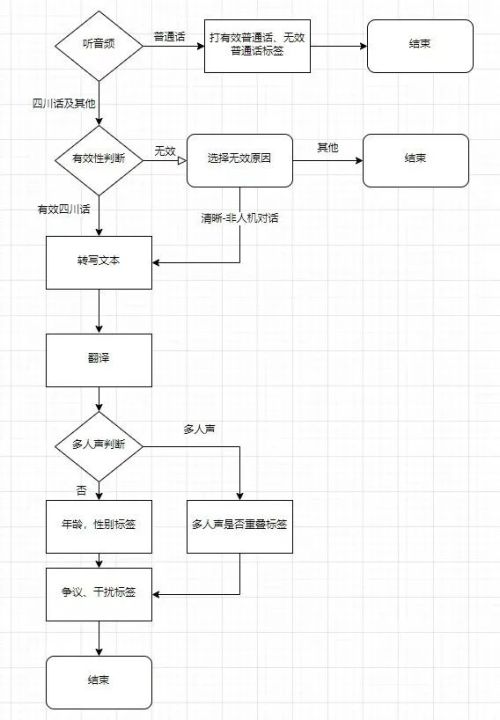
    这个项目主要是让人工听音频,再对音频进行转写和分类。

    目的呢,就是给某手机厂商的 AI 语音助手打工,让它能听懂四川话。
    一条音频 0.07 元,计件付费,多劳多得。
    在内部平台上完成注册后,世超就算是正式上岗了。
    在任务界面里,会显示目前需要做的一些任务包。

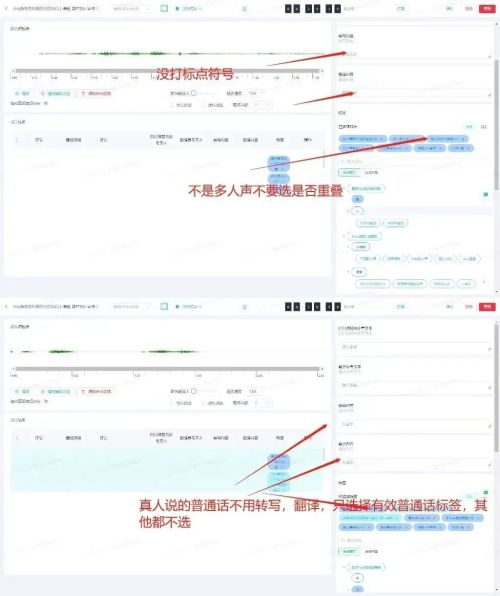
    第一步,要先把听到的音频转写成 AI 能够看得懂的普通话。

    再根据听到的内容,打上具体的标签,比如是否有效的四川话、是否存在干扰等等。

    一条语音只有几秒钟,上手倒是挺快的,不到 5 分钟,世超就已经提交了十多条。

    可越做到后边儿,难度也上来了。

    这些音频都是随机录进来的,要不就是不完整,要不就是好几个人在讲话,背景音杂乱,根本分不清主讲话人和次讲话人。

    估计四川本地人来了,转写起来也费劲。。。

    好不容易把试标的 50 条给做完了,审核的人还全给我打回来,让我重做。

    按照 0.07 一条来算, 50 条就是 3.5 元,费劲巴拉花了快一个小时。一顿操作猛如虎,一看时薪三块五???
    世超算了下,即使是熟手,一分钟完成 3 条,时薪才 12.6 。
    一天 8 个小时啥也不干就坐在电脑面前听这玩意儿,也就 100 块钱。

    咱再来看看文本标注的活儿。

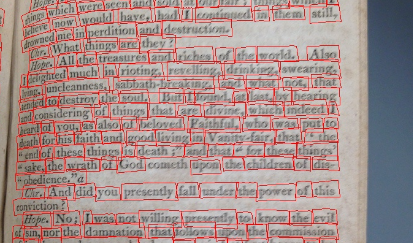
    其实操作很简单,就是两个字——拉框。

    图中白框为放大镜;红框为标注部分

    像这样的图片,每个任务包里有 100 张,标注员要做的,就是把图片里的文字符号给框出来。

    按住 shift 键,从文本的左上角开始打点,一直到把文字部分框住,而且框柱的部分不能多也不能少,要是没框完全,还得重新来。

    像这样的一个框是 0.03 元,每张图片里要拉多少个框都是未知的。

    如果碰上这种的,标注起来就很简单,一分钟就完事儿了。

    但也有可能会遇到这样的;

    本来图片的清晰度就不高,有些单词还是倒着的,直接让世超框到崩溃。
    粗略计算了下时间,快的话一分钟能框 5-8 个,也就是 0.24 元。
    如果想要完成日入 150 的目标,一天得框 5000 条文本。。。
    也就意味着,差不多 16 个小时都得坐在电脑面前。

    就剩下一个图片标注,咱说什么也得给它做完了。
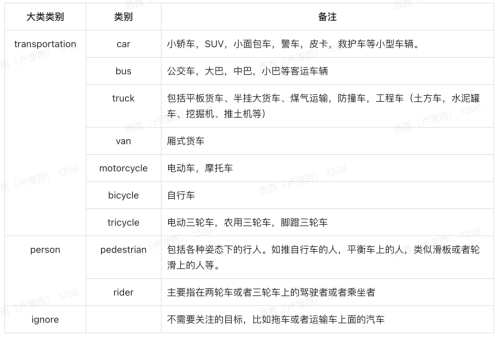
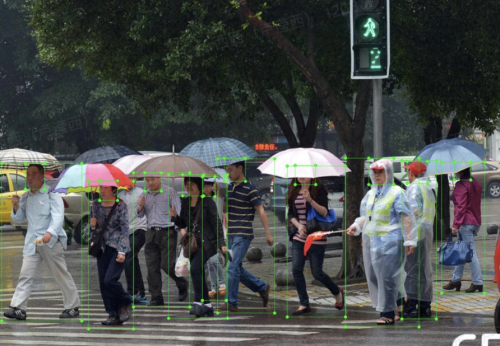
    这个图片标注项目其实也不难,就是在给定的一张道路照片里,找到车和人在哪,并把它框出来,看样子应该是给自动驾驶做 2D 的目标检测。
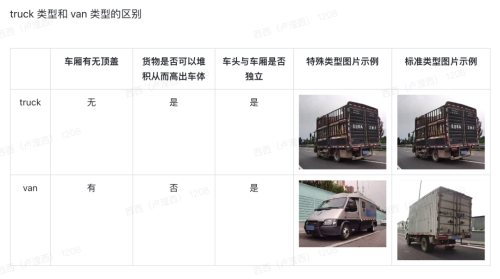
    只不过,这玩意儿不能乱框,要根据甲方提供的标注类别进行细分。

    比如说, “truck” 和 “van” 的区分就十分讲究。

    而且框要和标注物边缘紧密贴合,如果边界像素误差超过 3 个像素就要被判为误标。

    不知道是不是因为前面被文本标注摧残了一遍,世超觉得这图片标注上手更快了。

    虽然只是试标没有薪水,但根据这家公司的计件标准,我一个小时标了快 200 个,也有个 10 块钱,总归要比前面的三块五要好。

    其实除了这次世超找到的几个数据标注兼职以外,还看到了很多比如 3D 点云标注、 4D 车道线标注,但这些都喜欢招有经验的,对世超的简历直接已读不回。

    体验下来,我个人对数据标注这个兼职的评价是:性价比极低。

    操作起来简单,但越标到后边儿越觉得恶心,非常考验耐力。

    不管怎么说吧,好歹咱也算是体验了一把给 AI 打工的感觉。

    虽然体验感不太好,但工作这件事儿本来就是仁者见仁、智者见智。

    不过也有不少人可能跟世超一样,都是被需求大、门槛低还能挣钱给忽悠过去,等做了一段时间之后发现,压根就不是那么一回事儿。

    而且从我随机接触到这几个项目来看,基本都是甲方外包的项目,等项目拿到自己手里,已经不知道包浆多少层了,里边儿的猫腻还不少。

    最后呢,咱们也暂且先不去定义,数据标注是否是一份好的工作,毕竟的确有人靠着这份工作在补贴家用。

  • 三和大神(深圳):日结100元的年轻人们

    2018年,日本NHK电视台做了一期节目,题为《三和人才市场 中国日结1500日元(约100块)的年轻人们》。

    在中国这个地方,他们20块就能做神仙

    在距离深圳市中心20公里以外的龙华城中村,你会看到许许多多的年轻人躺在公园里、酒店门口和马路边上,以天为被、以地为席。
    他们没有工作、没有梦想,没有任何积蓄和财产
    这群青年,被称为“三和大神”
    与那些拼命奋斗的年轻人有着截然相反的人生。

    他们多为新一代农民工,原本怀揣着各种赚钱的梦想来到深圳,现实却无情打碎了他们的梦想。他们卖力工作,却只能游走在都市边缘,在一次次遭遇黑中介和黑厂坑蒙拐骗之后,他们滑落到身无分文的境地。渐渐地,这个群体形成了底层社会独特的生活状态和人生态度。他们“破罐破摔”,抵制枯燥无味的流水线工作,在三和周边“混吃等死”,乐在其中。

    他们过日子的宗旨就是:“混过今天,不想明天。”

    凭借薪水日结的工作和低廉的生活成本,位于深圳市龙华区景乐新村北区的三和人力市场成了廉价打工者的乐土,吸引着各地的外来务工人员。从这里走出的“三和大神”早已在网络世界“走红”。他们中的很多人没有身份证,身背债务,与家人鲜有来往。 

    “三和人才市场”是三和青年的活动轨迹的中心,他们在这里寻找日结,即每天结算薪水的工作。三和青年喜欢做保安、快递员和工地工人等工作,以获得收入。“大神”是一种对他们挑战“人类生存极限”,以极低的收入过日子的调侃。拿着一天7、80,有时候能到100块的临时工工资(相当于1500日元),干一天,玩三天,成了他们的生活常态。

    100块钱过三天,那他们怎么混的?

    首先,因为三和这边生活成本低,

    日结百元足够支撑他们吃喝玩乐住的开销。

    吃的是传说中的“挂逼面”!

    喝的是2块钱2升的清蓝矿泉水,

    俗称三和大神们的官方指定用水。

    住的是旅馆里15块钱的床位,

    被褥脏乱,厕所恶臭。

    更省钱的办法,就是干脆睡在路边或者公园长椅,

    与蚊虫鼠蚁为伴。

    不想半夜被警察吵醒抓进局子里,

    只要找准一个隐蔽的位置就好。

    玩的是网吧里的网游,或是上黄网看A片,

    1块钱1小时,10块钱即可通宵。

    现实中糟糕透顶的时候,

    大神们还能在虚拟的游戏世界里谈恋爱结婚。

    你会发现,哪怕他们穷得几天没饭吃,甚至把身份证都便宜卖了,

    身上也带着台智能手机。

    破烂的旅馆哪怕没有24小时的热水,也一定有24小时的wifi。

    看着他们聊着微信,打着王者荣耀,

    有些时候和普通的年轻人也没什么区别。

    女朋友?没钱没房也没啥能力,

    没人跟你,花钱去小巷子里钻几小时就算解瘾了。

    赚钱安个家?做梦呢,就算拼上了命,永远也不可能赶上飙升的房价。

    老了怎么办?老了……那就死了呗……

    NHK跟踪采访了几位生活在三和的青年;

    这几位年轻人所处阶段不同,

    有三和大神、即将成为三和大神、刚来三和的新人。

    三和大神–宋春江

    27岁的宋春江,出来打工已经有10多年,他是一名留守儿童;

    他沉迷于上网,借网贷,打游戏。

    毕业于技校被学校送到了深圳,一开始每天上班10多个小时。

    干了几年后,受不了了就去富士康上班;

    在富士康,天天干流水线的活,一天要装配近3000台苹果手机;

    后来,干了几个月,觉得没啥意思就辞职了;

    在经历了一段长期打工的岁月后,

    他好像觉得没啥梦想了,就开始了打日结工的生活。

    现在的他,有时候经常睡大街,因为这事被警察抓了2次。

    而他唯一剩下的财产“身份证”,也弄丢了;

    身份证的违法交易也是这里的一条黑产。

    宋春江名下现在被拥有了1500万的注册资金,

    他是三个公司的法人;

    三和大神–李磊

    来三和打工多年,父亲去世早,母亲又改嫁。

    外出打工,深知学历和技术的重要性。

    三和大神–赵伟

    30多岁的他,至今还是单身,;

    他知道自己吃不了苦,他也曾努力过,最后却还是这样走了下来。

    即将成为三和大神–东东

    22岁的东东,来自江西的农村,是一名留守儿童;

    16岁就出来和母亲一起打工,来深圳快1年;

    最开始来深圳,第一份工作就是在三星打工;

    干了不到1个月就辞了职,开始干起日结零工。

    晚上东东住着15元一晚的床位,

    他似乎已习惯这样的环境;

    没钱的时候,他还会借网贷,年华利率达到30%。

    东东很多时间也消磨在网吧,通宵也就10元;

    除了网络游戏,最近他还开始染指违法的网络赌博。

    “绝望”,是他们提到最多的一个词。

    可刚来深圳的时候,他们也曾怀揣梦想,

    相信凭借自己的努力,完全可以闯出一片天。

    但找工作途中遇到的黑中介,宣传与实质不符的黑公司,高强度体力的压榨……

    无一不在打压着他们的斗志。

    尤其是在承受了几年的打击与煎熬,他们自愿放弃了曾经的理想。

    因为这里没有留给他们的希望,现在没有,未来也没有。

    房价飙升,贫富差距扩大,富人越来越富,穷人越来越穷。

    这正应了大神宋春江提起的那段属于打工者的顺口溜。

    远看广州像天堂,近看广州像银行;到了广州像牢房,不如回家放牛羊。
    个个都说广州好,个个都往广州跑;广州挣钱广州花,哪有钞票寄回家。

    每个光鲜的城市背后,都有这样的辛酸总结。

    没了人生动力的三和大神,如同行尸走肉一样在世间游走,

    在这条不归路上渐行渐远。

  • 新疆民丰:五星出东方利中国

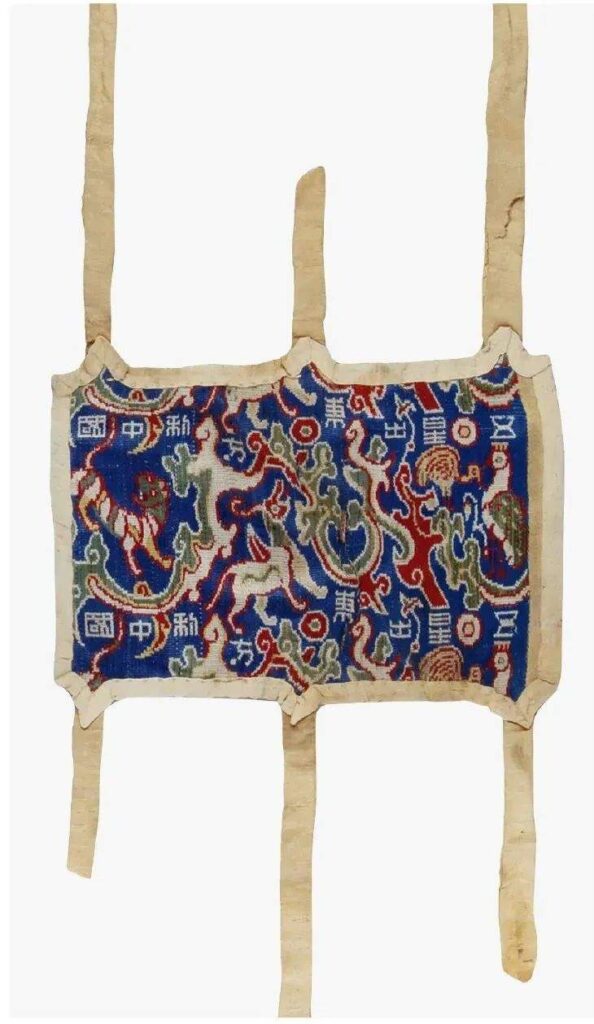
    1995年10月出土于新疆民丰县尼雅(汉代精绝国遗址)。

    织锦出其旁,作长方形,幅长18.5厘米,宽12.5厘米,四周以麻布缘边,上下缘各缝缀三条黄白色绢带,长约21厘米,发掘者推测是“引弓者护臂之物”,简称为“护膊”。

    出土处为一座夫妻合葬墓。墓主当是精绝贵族。墓葬年代,估计在东汉末至魏晋这一段。织锦的年代要比墓葬早,估计在东汉时期。织锦材料出自汉地。

    “五星出东方利中国”,“五星”是古代星占中的“五星占”,“中国”即中原地区。

    此锦上的动物图案只有四种,两禽两兽,其他动物只有局部,都是重复出现。

    它们从右至左(和文字的顺序一致)依次是:

    (1)右起第一种。《太平御览》卷九二七“异鸟”类引《临海异物志》,提到一种作为祥瑞的“世乐鸟”,其特征是“五色,头上有冠,丹喙赤足,有道则见”,与此禽吻合。其原型可能是综合了外来的鹦鹉和孔雀的特点。
    (2)右起第二种。此鸟从形状看,应是鸵鸟。鸵鸟原产非洲,经西亚传入。我国史籍多称“大鸟”或“大爵(雀)”,并依其出产之地,或称“安息雀”(安息在今伊朗高原和两河流域),或称“条支大鸟”(条支在今伊拉克境内)。
    (3)右起第三种。为有翼神兽〔有翼神兽是西亚流行的艺术主题,后经欧亚草原传入中国,西方称为格里芬(Griffin)〕。可大别为两类,一类是禽首类(禽首禽身或禽首兽身),一类是兽首类(带翼狮、带翼鹿、带翼羊)。它们的共同点是有翼和禽兽合一。中国的有翼神兽也分两类,一类作禽首(如上海博物馆藏“翼兽形提梁盉”、台北故宫博物馆藏“鸟首兽尊”、曾侯乙墓出土的铜鹿角立鹤);一类作兽首(如中山王墓和曾侯乙墓出土的铜有翼神兽),多称之为“天禄”“辟邪”。
    (4)右起第四种。从形状看,与“虎”比较吻合。但此兽的头部并不清晰,也有可能是狮子,或狮子的变形。总体看,这些动物应皆是来自远方的珍禽异兽,皆有祥瑞之义(即瑞兽),更可能是“狮子”。

  • 杜深忠:我对土地一点感情都没有

    本文内容来自焦波拍摄纪录片《乡村里的中国》(2013年)。

    “文化人”杜深忠:我对土地没有感情

    满脸沟壑的杜深忠正蹲在地上用蘸水的毛笔练书法。妻子埋怨丈夫“头顶火炭不觉热”,家里这么穷,他却总想着看书写字弹曲儿。“没钱买宣纸,他就天天蘸水在地上写。”

    杜深忠把脖子一扭:“焦老师你看,太阳亮光从门口照进来一块地方,在我眼里就是一张很好的宣纸。”

    他是村里有名的“文化人”,年轻时当过四年炮兵,退伍后在“中庄乡农业学大寨工作队”又干了六七年。不甘于种地的他平日最爱读书看报,还参加过鲁迅文学院的函授课和培训班,向许多报刊投稿,可惜均石沉大海。

    一次焦波跟拍杜深忠参加族人葬礼,杜深忠指着一座坟对焦波说,那就是俺爹俺娘的坟。“老人在这里,我太不恭敬了。”焦波跪下,对坟磕了三个头。杜深忠惊讶又感动。

    “都说农民对土地有感情,我对土地一点感情也没有!就是没办法,无奈。如果有,何必叫孩子千方百计出去上学?”

    焦波一愣,百感交集。“兄弟,你说出了我的心里话啊!如果当年我没走出大山,我就是今天的你。”

    片中,杜深忠多次表达过对土地的失望。他辛苦一年收获七千三百来斤苹果,却只挣了七八千元。他对同村人慨叹:“这些年我在果树上付出的努力已经很多很多,但花十分代价得不到三分收入。”

    村民很有同感:“今年盼着明年好,明年裤子改棉袄。”

    “土地能给予农民什么?一年几千块钱收入,说实在的,对得起他们么?”焦波理解,杜深忠对土地的复杂情感,是“爱之深,恨之切”。杜深忠很在意这片青山热土。看到村民把古树卖到城里搞绿化,杜愤愤地说:“这叫剜大腿上的肉贴到脸上!只看见钱了。”

    杜深忠瞧不上“只看见钱”的人。“我觉得人的素质上不去,物质反而成了负担,物质和精神要对应起来。”

    杜深忠一直梦想拥有一把琵琶,“听到琵琶动静心里就舒服”,并最终咬牙到城里花690元买了一把,对妻子撒谎说是490元。后来发现真相的妻子火了:“你为这个家庭想吗?谁没有鞋?谁没有棉袄?……你想吗?”“人需要吃饭,可精神也需要填补!”杜深忠争辩道。

    村支书张自恩:干一年支部书记,就赚了一肚子酒

    一年到头只领到1200元工资的村支书张自恩是性情中人,张自恩在部队当过四年后勤兵,退伍回乡后,从2002年起担任村支书至今。他工作热忱,一张圆脸上常挂着憨笑,在村中费力斡旋。

    村口因修建小广场砍树,村民和张自恩起了争执;为了让村里脱贫,张自恩不断去旅游开发公司寻找机缘;村民张光爱与张光学的纠纷愈演愈烈,张自恩在中间反复“灭火”;更有村民怀疑张自恩贪污,不断上访要求查账……

    片中,张自恩语带辛酸地总结自己一年的工作:“干一年支部书记,也就是赚了一肚子酒。”当时,政府已对村中账目审查多次,并未发现问题,但村民却认为“上面有人包庇张自恩”。

    村支书张自恩

    焦波相信张自恩的为人:“他为村里争取项目,经常提着自家的鸡蛋去送礼。”

    “你当过兵、见过世面,还能被这点事情打垮?再说,你也要理解群众。”焦波给张自恩宽心。张自恩慢慢平静下来,第二天,又照常为村里的事忙活。

    面对矛盾,张自恩有时会骂脏话,但在焦波看来,这才是广大村干部的真实状态:“你总不能要求他坐下来讲马列主义吧!”他认为,中国有无数张自恩这样的基层干部,并不高大全,但充满想把工作干好的“正能量”。“张自恩的烦恼,道出了当代中国乡村治理的难点。”

    ”以知识换命运”“以人肉换猪肉”:乡村年轻一代的两种人生

    杜滨才四岁时,父亲杜洪法患精神病,母亲另嫁他乡,他由父亲抚养长大。杜滨才自小刻苦,考入山东商业职业技术学院后,还曾荣获“中国大学生自强之星”提名,是父亲唯一的骄傲。

    图/纪录片《乡村里的中国》

    对于家,杜滨才的感情是复杂的。他对父亲说:“我不愿意回这个破家,这个破家对我来说一点好处都没有!”

    也同样是他,在杓峪村第四届春节联欢会上,含泪唱了一首《父亲》:“总是向你索取,却不曾说谢谢你。只到长大以后才懂得你不容易,每次离开总是装作轻松的样子……”

    “在城市学习生活,杜滨才的思维方式已经和农村的父辈截然不同”。毕业后的杜滨才如愿在旅游公司担任导游,常在微博上分享自己天南地北的见识。

    杜深忠也盼望在聊城大学读电子商务的儿子杜海龙毕业后能在城里谋份体面差事,“以知识换命运”。

    “这个土地不养人,咱这里的这二亩贫瘠土地不养人。所以说我多么盼望着你成才!”

    影片外,杜海龙和五个同学合伙创业,开了一个电商平台,生意不错。

    “虽然现在刚起步,但我相信未来可以做大做强。”谈起梦想,杜海龙像父亲一样执著,尽管父亲对他“毕业卖果子”的选择并不理解。

    不同于杜滨才、杜海龙,现实中多数乡村青年还是走上了外出打工的道路。

    杜深忠把外出打工比喻为“拿着人肉换猪肉吃”。片中,年轻村民张自军在贵州某工地打工时从高架摔落,不治身亡,留下一个年幼的儿子。下葬时,幼子指着墓坑好奇发问:“那是俺爸爸的家吗?门口怎么这么小。”

    葬礼结束,杜深忠哀叹:“山里的孩子出去打工,真是个要命的事。农民工百分之八十以上的都是被逼出去的。”

    乡村需要被了解、理解和重视

    农村是中国的根。“整个农村最需要的就是了解而非想象,它不代表桃花源,也不代表脏乱差。那片土地,大有希望。”

    “了解之后才是理解。农民面对困境会发泄情绪,比如有的嚷嚷:‘我看透了法律!’但她并没有恶意,相反,农民是最宽容的一群人。”

    “只有真正理解农村,才可能对农村问题投以重视。保护乡村,不是保护贫穷,也不是把农民赶上楼房,而是让乡村真正宜居。”

    在杓峪村家中的杜深忠正聚精会神地盯着电视,他是全村唯一每天都看《新闻联播》的人。闲暇时,他喜欢推着独轮小车上山找好看的石头,根据花纹刻上不同节气名。他指着一块充满裂隙的石头对说:“这些条条就像钻出土的虫子,所以我刻上了‘惊蛰’俩字。”

    杜深忠对焦波说过,自己最渴望拥有一间书屋,有书架和明亮的窗户,门口再放块泰山石,刻上“松石书屋”四字。

  • 中快餐饮与指鼠为鸭

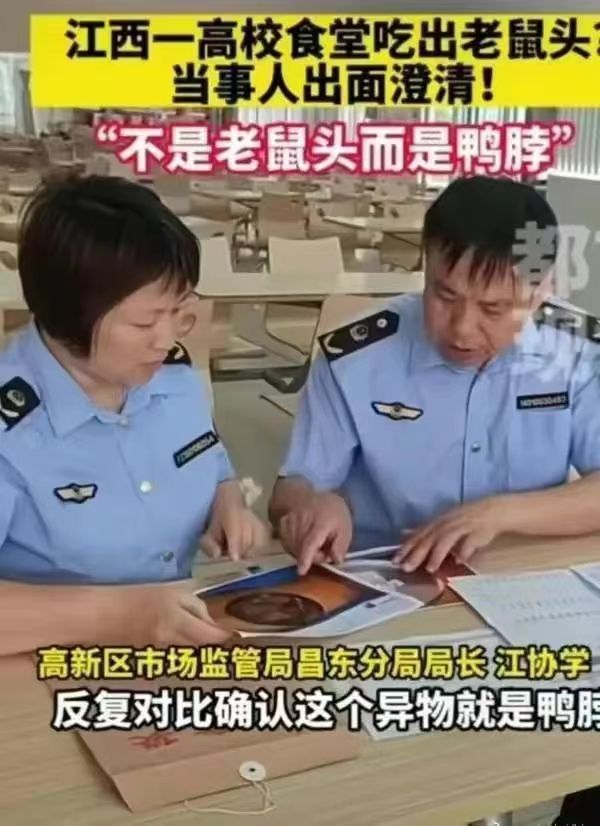
    2023.6.1,江西工业职业技术学院一学生在学校食堂吃饭时,疑吃出一只“鼠头”,与食堂工作人员交涉未果,遂将其拍照公开了。

    后学生改口,且有关部门也鉴定为鸭脖,于是一个新词被创造出来:指鼠为鸭。

    6月17日,江西省联合调查组发布通报,判定异物为老鼠类啮齿动物的头部。
    6月19日,江西工业职业技术学院已与涉事食堂供应商江西中快后勤服务有限公司解约。

    江西中快的控股大股东是深圳中快餐饮集团有限公司。
    中快餐饮集团创立于1994 年,总部位于深圳市,是一家集高校、中学、医院、企事业单位及写字楼供餐业务为一体的专业团餐综合服务商。高校团餐板块是店数最多,最具代表性的品牌。中快餐饮集团在全国多个省市至少直接投资了24家地方“中快餐饮”企业,其中包括上海、安徽、陕西、河南等地。

    该集团创始人李平金,江西庐山人,1994年在南昌承包万寿宫的工商处食堂起家,随后在1995年拿下南昌蓝天学院(现名江西科技学院)的食堂招标,切入高校市场。2004年,该集团通过收购一家深圳公司,进军全国。李平金的弟弟是中快餐饮董事长李四星。

    李四星称,中快餐饮一大业态为高校业态,“全国范围内在营高校食堂项目700多个,年营收规模直逼海底捞”,“好吃+自营”是中快高校食堂的经营策略。此外,和其它团餐公司普遍外包档口联营的经营模式不同,中快的高校食堂项目,全部采用自营。李四星认为,招商转包制容易导致风味档口产品质量参差不齐,使食堂出现经营问题,有实力的餐饮公司需要通过统一采购和自营自制来解决这一问题,同时自营还能使食品安全得到保障。

    涉事企业要求“诚信经营”,研究称其发展得益于“成本控制”

    2020年,“中国食品报官方平台”刊登了一篇中快餐饮集团创始人李平金的专访。专访中提到的,中快发展离不开三个核心:诚信经营、服务意识、物美价廉。

    “说到做到,做不到的事诚实地说,争取对方的理解。诚信是中快的经营之本,也是很多学校选择与其合作的原因。”李平金表示。

    在文章中,李平金称,食堂,一端服务的是学校,一端服务的是学生。如果说学校选择中快是因为诚信,那么想要打动学生,中快则要靠物美价廉的产品。这就需要让利,薄利多销会形成规模。规模大,采购成本会更低,才能做到物美价廉,这是一个良性循环的链条。

    无独有偶,早在2015年,中国教育后勤协会也曾刊登了一篇题为《“中快餐饮”调研报告》的内容,提到了相似的观点。该文署名作者为中国教育后勤协会专家委员会委员。

    作者提出,“中快餐饮”以年均30%速度迅速扩张,业务覆盖全国多个省市区,旗下员工达2万人。在考察了旗下江西中快所经营的多个高校食堂后,作者在文中总结其发展迅速的原因,其中提到了一点——“成本控制与效率效益”。

    文章显示,中快餐饮连锁经营,其原料采购价格低于全国任何地区高校餐饮“联采”价格;粮油价格约低2—3%,其它大宗原料价格约低3—4%,蔬菜价格约低10%,总体原料成本约低5%。

    据测算,“中快餐饮”人工成本约占营业额20%;水电气成本约占营业额7%,集团和分公司各类管理成本约占营业额2.5%,三项合计间接成本为29.5%,均低于当时全国任何一家高校食堂的间接成本。

    其中,文章中还提到了“食品安全关键控制点”。文章称,江西中快落实原料进出库台帐制度,确保食品源头安全;原材料供货索证制度,严格审核供应商,拒绝不合格原材料。同时,确立了食品留样制度,设立留样柜、留样员,每餐每个品种200克、48小时留样。

    根据行业报告显示,2023年中国团餐市场规模将达到2万亿元,占据中国餐饮市场近半壁江山。

    圳中快餐饮集团在北京、上海、河南、广东、山西、陕西、江苏、湖北、湖南、云南等全国26个省级、直辖市地区投资有公司,通过股权控制有160家企业,间接持股公司超200家,商业版图涉及住宿、餐饮、租赁和商务服务业等。

      据中国团餐行业新媒体“新团餐”在2019年7月19日推送的一篇文章显示,中快餐饮已形成连锁化经营规模,经营的食堂已经超过了800家,员工超过四万人,每天提供500万人次用餐。

      目前,中快餐饮集团以聚焦中小学基础教育餐饮的中禾百年,定位高校市场的中快餐饮,面向医院团餐市场的中康餐饮,一起构成了三大业务板块。

      去年11月,一家认证为“团餐产业第一新媒体与服务平台”的自媒体“团餐界”曾发布了一篇对中快餐饮董事长李四星的采访。稿件中称,中快餐饮“全国范围内在营高校食堂项目700多个,年营收规模直逼海底捞”。

      作为中国火锅界的龙头企业,海底捞2022年共有1371家门店,营收高达347.41亿元,净利润约13.73亿元,其创始人张勇更是凭借海底捞一度成为新加坡首富。

      李四星在文章中称,中快餐饮一大业态为高校业态,“好吃+自营”是中快高校食堂的经营策略。不过,截至发稿,“团餐界”公众号上已无法找到上述李四星的采访。

      据东方网6月19日报道,一名此前任职于江西省教育厅学校后勤与产业办公室,目前仍在江西省教育厅下属事业单位工作的干部表示,江西工业职业技术学院“61”食品安全事件涉事餐饮企业为江西中快后勤服务有限公司,“现在学校已经和他们解约了。”

      两万亿的隐秘江湖

      此次的江西鼠头鸭脖事件,还揭开了团餐市场的神秘面纱。

      不同于社会餐饮,团餐市场由于并不直接面对C端消费者,因此外界对其关注度整体偏低。

      团餐是针对特定场景下餐饮需求的B2B外包服务,主要餐饮服务对象为学校、机关单位、医院、大型企业等团体。中国社科院服务经济与餐饮产业研究中心执行主任赵京桥表示,自上世纪90年代末以来,机关事业单位后勤社会化改革、学生营养餐政策出台,以及不断推进阳光化采购,使得我国团餐产业不断扩容,其应用场景也逐步覆盖至老年餐、月子餐等,并同社会餐饮融合,布局社区团餐、团餐外卖、航空餐等。

      艾媒咨询发布的《2022—2023年中国团餐行业发展研究及典型案例分析报告》显示,2016-2022年,中国团餐市场规模由0.90万亿元增至1.98万亿元,截至2022年占餐饮市场的比重达45.1%,总体呈现上升趋势。

      团餐市场中,校园餐则是体量最大(全国约有2.6亿人消费人口)的细分行业,具有社会关注度最高、政策性强的特点。宸睿资本创始人胡维波也曾提到,学校场景是团餐产业最大的消费场景,也是各个团餐企业重点布局的市场,占比在35%-40%。

      连锁经营专家文志宏告诉中国新闻周刊,由于团餐偏刚需的属性,近几年发展速度明显高于社会餐饮。

      数据显示,2017—2022年,我国团餐市场总体保持较好的增速,2021年以外的年份同比增长均超过餐饮市场。2020年,在餐饮市场负增长15.4%的情况下,团餐市场仍能保持2%的增速。2022年,在疫情的冲击下,团餐市场比社会餐饮表现更为稳定、更具韧性,收入同比增长11.9%。

      随着政府阳光采购政策的不断深化推进,团餐市场有望进一步扩容。根据中国饭店协会发布的《2022年度中国团餐发展报告》预测,团餐行业将会保持10%的增长率,预计2023年达到约2万亿元市场规模,2026年将达到3.6万亿左右。

      不过知支之(上海)商业管理有限公司创始人孟庆刚告诉中国新闻周刊,相较于社会餐饮,团餐行业仍然处于比较原始的阶段,其一大特征是企业获取订单大多依靠资源驱动,这在整个行业内非常普遍。“说的好听是不太市场化,说的不好听就是桌面下的东西比较多。”

      事实上,中快餐饮就是如此起家的。该集团微信公众号中提到,创始人李平金是江西庐山人,于1994年在南昌承包万寿宫的工商处食堂起家,随后在1995年拿下南昌蓝天学院(现名江西科技学院)的食堂招标,切入高校市场。2004年,该集团通过收购一家深圳公司,进军全国。

      校园餐怎么管?

      对于团餐,特别是校园餐来说,安全是第一诉求。

      上海市食品安全研究会专家组成员刘少伟,同时也是上海市教委食品安全检查员。他告诉中国新闻周刊,从某种角度来说,团餐的安全风险比社会餐饮更高。“社会餐饮的就餐规模也就几十个人,但团餐规模化作业属性,意味着同时就餐人数少则几百,多则上千。一旦发生食品安全问题,容易形成大规模群体性食物中毒。”

      刘少伟表示,客观来说,我国对校园的食品安全不可谓不重视,每年开学前各地都会组织针对学校餐饮单位的监督检查,但其实监管的办法并不多。

      监管不足主要体现在专业度方面。孟庆刚指出,餐饮是非常专业的事情,而学校和教委都是教育教学部门,“会不会管”需要打个问号。

      “校园餐的监管应该从两个主体着手,一个是经营者,就是做饭的,另一个则是供应商,负责送菜的。目前对校园餐的监管重在前端,比如明厨亮灶,卫生清洁等,也就是针对做菜的。但供应链其实是团餐的核心,比如食材从哪里买的,怎么进入的食堂,过程中是否需要冷链,这才是重中之重。”

      一位不愿具名的团餐企业负责人告诉中国新闻周刊,团餐兼具市场和社会双重属性,利润普遍低于社会餐饮。“服务主体往往会制订毛利上限,且涨价行为也会被严格监督,所以团餐企业如果想要赚钱,主要从供应链想办法。”

      在团餐行业内,供应链被称为“第二大利润中心”,也是企业降本增效、挖掘增长潜力的关键。据悉,在不同因素的影响下,团餐企业采购成本占总收入的比重高达45%,有的甚至会高达60%,远高于社餐采购成本占比。

      而根据中国教育后勤协会于2015年刊登的一篇题为《“中快餐饮”调研报告》的文章显示,中快餐饮连锁经营,其原料采购价格低于全国任何地区高校餐饮“联采”价格;粮油价格约低2—3%,其它大宗原料价格约低3—4%,蔬菜价格约低10%,总体原料成本约低5%。

      据测算,“中快餐饮”人工成本约占营业额20%;水电气成本约占营业额7%,集团和分公司各类管理成本约占营业额2.5%,三项合计间接成本为29.5%,均低于当时全国任何一家高校食堂的间接成本。

    中快后勤成立于2009年,注册资本1600万元,由深圳中快餐饮集团有限公司(下称中快餐饮集团)控股,持股比例为58%。8日,记者就中快后勤是否是涉事食堂承包商等问题向中快餐饮集团核实,该集团总部工作人员表示“不太了解情况,没有接到(相关通知)”。

      官网信息显示,中快餐饮集团注册资本7700万元,创立于 1994 年。该公司总部位于深圳市,是一家集高校、中学、医院、企事业单位及写字楼供餐业务为一体的专业团餐综合服务商,战略布局达全国 30 个省、自治区及直辖市,拥有 37 个子公司,日服务顾客逾 700 万人次,北京理工大学、东北大学、东南大学、复旦大学、交通大学等60多家高校在其项目展示之列。

      相较于中快餐饮集团,菁禾餐饮、金盟餐饮的规模要小一些,其中金盟餐饮成立于2005年,注册资本5000万元,除江西工业职业技术学院(瑶湖校区)第二食堂外,该公司还中标过江西建设职业技术学院三楼学生食堂委托经营管理采购项目、浙江理工大学科技与艺术学院一期食堂委托管理项目、洛阳理工学院王城校区铭苑一餐厅二楼委托经营项目、南昌市卫生学校食堂租赁项目等。

      菁禾餐饮成立于2016年,注册资本2000万元,2018年该公司还曾中标江西制造职业技术学院上海路小区食堂招租项目,合同期为3年。

      承包高校食堂是一门什么样的生意?

      记者发现,目前,高校食堂外包给餐饮公司的现象已十分普遍。通常情况下,高校会进行公开招标,中标的餐饮公司便可获得食堂的承包权。之后,餐饮公司会根据所需对外招商,将一些档口以租金或提点的模式租给餐饮商户。

      8日,记者以商户身份咨询了武汉某家餐饮公司,其工作人员介绍,在武汉,高校食堂档口的出租大部分是以提点模式,少部分是以租金模式。“提点的话一般是全部包干,公摊水电等都包含在内,大概是提25—32个点,具体得看哪个学校,每个学校政策不一样。”

      所谓提点模式,简单理解就是抽成模式,“提25—32个点”则意味着餐饮公司的抽成比例是25%—32%。即商户每收入100元,便需要拿出25-32元分给承包食堂的餐饮公司。

      上述工作人员称,对于商户而言,提点模式前期投入相对会少一些,主要是3万元的押金支出;租金模式前期投入较大,以武汉白沙洲某高校食堂为例,租一个面食档口算下来大约需要12万元,除3万元押金外,还包括5万元租金(一年)、3000元管理费(一年)、1500元公摊费用(一个月)以及采购食材、设备等方面的支出。

      “这个学校(武汉白沙洲某高校)目前有3000人,只有一家食堂,一个面食档口营业额现在每天能达到约3000元,一个月下来差不多七八万元。高校食堂通常都是下半学期的营业额会比上半学期好,主要是因为下半学期会有新生入学,人数会多一些。”该工作人员称。

      除直接与承包食堂的餐饮公司联系外,商户也可通过一些加盟项目进入高校食堂。

      记者以加盟者身份从哈尔滨某餐饮项目加盟方了解到,该公司名下加盟店大多都开在高校食堂,公司可向加盟者提供档口资源,协助加盟者开店。加盟者除需向品牌方支付一定金额的加盟费、品牌管理费等费用外,还得向承包食堂的餐饮公司缴纳2万-5万元押金,以及相应的租金或提点金额,其中提点比例在25%—30%之间。

      那么,高校食堂档口的生意好不好做?能赚到钱吗?一位在武汉江夏区某高校食堂卖鸡公煲的商户对记者表示,他们是加盟的品牌店,刚做了约一年时间,目前还未回本。“前期光加盟费就交了四五万元,档口是提点模式,水电气等全都算进去提二十多个点,赚不到什么钱。”

      随后,记者又以咨询者身份和一位打算转让河南某高校食堂档口的商户杨森(化名)聊了聊。据杨森介绍,他在该校食堂档口是卖米粉、肉夹馍等,一天的营业额虽不及快餐,但也能达到2500元左右,除去成本之后能剩下约1000元;周末低一些,营业额约2000元。

      “学校就是人流稳定。这个学校大概有一万多人,一共两个食堂。因为学校食堂点外卖要去校门口拿,平时同学们都是在食堂吃。”杨森说。

      杨森介绍,其档口是租金模式,一年租金4万元,其余是水电费,一个月1000元左右,每年大概有9个月的营业时间。“我们简单算了下,毛利约65%,刨去水电、租金,毛利在45%左右。”

      值得一提的是,不管是以哪种方式进入高校食堂,最终的合同都是与食堂承包商签订,承包商负责整个食堂的管理、招商等,学校则负责卫生检查等工作。而商户进入高校食堂档口,餐饮公司及校方对其并没有营业执照、卫生许可证等相关证件上的要求。

      “只要健康证就行,其他证件都不用。健康证要公示出来,没有健康证不能开业。健康证好办,医院几十块钱就能办,当天就能拿到证。”杨森表示。

      上述哈尔滨某餐饮项目加盟方也向记者确认,在高校食堂经营档口,不需要营业执照和卫生许可证。

      但高校平时会较为频繁地对食堂各档口卫生情况进行检查。“学校要求很严格,晚上走之前一定得弄好卫生。”杨森说。

      至于校方是否会给予相应的处罚,杨森表示他还未曾看到有商户因卫生问题被校方罚钱。“都是嘴上说说,警告一下,然后你立马做好就没事了。”

      记者注意到,在江西工业职业技术学院2021年11月发生“老鼠事件”时,该校曾发表情况说明称,食堂清洁间出现老鼠是由于涉事餐饮公司卫生清洁人员在做完清洁工后,并末及时盖住食堂地面排污下水管道盖板,导致有室外老鼠窜入。学校专项调查组掌握该情况后,对该公司进行了严厉处罚,并对当事人进行了相应处理,同时立即开展环境卫生大检查,第一时间责令该公司对食堂卫生进行整改,立即组织专业公司对食堂实施全面的清洁消毒,重点对下水道、排水沟等处做灭鼠处理,立整立改切实做到“零疏忽”“零死角”。

  • 俞可平:从“连坐”看传统中国的群己关系

    连坐是存续时间最长的中国传统政治法律制度之一。从文献记载来看,它起源于夏朝,直到清朝覆灭的前夕,缘坐之制才得以废除。“在中国,迟至1910年公布施行的《大清现行刑律》、1911年公布的《大清新刑律》中,对族诛、连坐等体现责任牵连的制度才明确予以废除。”此后,作为国家法律制度的连坐正式宣告退出历史舞台。目前国内学界对连坐的研究,多集中在法学领域,历史学、社会学和经济学间或也有涉及,政治学则鲜有研究。然而,连坐是传统中国社会一种重要的专制统治制度,缺乏政治学的分析不利于揭示连坐制度的本质。

    一、连坐的起源和演变

    连坐指一人犯罪导致其特定关系人皆负连带责任而受到集体性的惩罚。先秦已经作为法律术语流行的连坐,在中国政治法律史上还有其他众多不同的称谓,例如缘坐、从坐、相坐、随坐、族诛、族刑、夷族、籍没、门诛、孥戮、收孥和株连等等。《尚书·甘誓》首次出现了“孥戮”一词:“弗用命戮于社,予则孥戮汝。”一般认为,这里的“孥戮”意即连坐:如果胆敢抗命,则戮及子孙。“连坐”一语先秦时期应该已经流行,战国时代的商鞅在秦国推行变法,颁布的法令之一即被后人称为《告奸连坐令》。至于“缘坐”之制,先秦早已行之,但“缘坐之语,已见于后魏。意谓相缘为坐(缘即因缘)”。现代汉语中最为流行的“株连”一词,相对出现较晚,在先秦文献中尚无发现。《辞海》的释义是:“株连”又称“株联”,意即“因一人犯罪而牵连他人”。例如《新唐书》曰:“于是慎矜兄弟皆赐死,株连数十族”(《新唐书·酷吏传·吉温》)。据文献记载,公元前1600多年前,中国历史上最早的夏王朝就已经施行连坐制度。《尚书·甘誓》载:夏王启与有扈氏决战之前,他对将士说:“嗟!六事之人,予誓告汝:有扈氏威侮五行,怠弃三正,天用剿绝其命,今予惟恭行天之罚。左不攻于左,汝不恭命;右不攻于右,汝不恭命;御非其马之正,汝不恭命。用命,赏于祖;弗用命,戮于社,予则孥戮汝。”最后一句涉及了连坐:如果你们听命于我,我则在祖宗面前奖赏你们;如果违抗命令,我不仅在祖宗面前对你们本人要处以极刑,而且罪及妻子眷属,也要杀死他们。《尚书·汤誓》也有类似的记载:“不用命,予则孥戮汝,罔有攸赦。”这里所说的“孥戮,是上古时代人们对罪及正犯亲属制度的通称,孥指妻、子,戮为刑罚”。汉朝大儒孔安国以为,“孥戮”是罪及其子——杀死他本人和他的儿子,从而侮辱罪犯本人并累及其心的一种残酷刑罚。因此,通常认为,今文《尚书·甘誓》所载的夏朝“孥戮汝”刑罚,开启了中国连坐历史的先河。

    《甘誓》中关于连坐的这个重要片断,保存于被公认为真实可靠的今文《尚书》之中,后被司马迁收录于《史记·夏本纪》。“由此可以推测,司马迁应是把这条史料所记载的内容视为夏朝的信史来处理的……司马迁的这种处理方式为近代以来史学研究者所认可,并且基本上形成共识。从清末沈家本开始,法制史学者就将其作为一条可以信从的夏代法律史料来处理作用。”然而,关于“孥戮汝”的具体内容,特别是关于“戮”的真实意义,学者一直存在争议。一种观点认为,“戮”就是杀戮或处死;另一种观点则认为,“戮”只是羞辱家人的刑罚,并非处死。对此,清末法学大家沈家本在引述各种关于《甘誓》的经典释读后有过详细说明:“予则孥戮汝。《史记》‘孥’作‘帑’。《传》:‘帑,子也。非但止汝身,辱及子。言耻累也。’蔡《传》:‘孥戮’与上‘戮’字同义,言若不用命,非但戮及汝及汝身,将并汝妻子而戮之。战,危事也。不重其法,则无以整肃其众而使赴功也。或曰:‘戮,辱也’,犹《秋官·司厉》‘戮男子以为罪隶’之戮。古人以辱为戮,谓戮辱之以孥耳。古者罚弗及嗣,孥戮之刑,非三代之所宜有也。”但是,无论对《甘誓》“孥戮汝”的具体意义有多少争论,古往今来学者们的一个基本共识就是,中国的连坐或缘坐制度,最早可溯源于传说中的夏王朝。

    继夏朝之后的商朝,上古文献中也有关于连坐的明确记载。《尚书·盘庚》篇记录了商王盘庚迁都殷之前发布的训令:“呜呼!今予告汝:不易!永敬大恤,无胥绝远!汝分猷念以相从,各设中于乃心。乃有不吉不迪,颠越不恭,暂遇奸宄,我乃劓殄灭之,无遗育,无俾易种于兹新邑。”最后一段话的大意是,若有人居心不良,违抗不恭,图谋不轨,那么,我不仅要毁灭你们,而且要断绝你们的子孙后代,不让你们这些坏人在新的国都里繁衍后代。《尚书·盘庚》属今文《尚书》的篇目,亦被古典文献学界认为是可信的材料。据此可知,商王朝延续了夏朝的连坐制度。

    尽管普遍认为连坐制起源于夏王朝,存续于殷商,然而迄今关于夏朝和商朝连坐的所有文献记载都是间接的转录,尚无原始的考古和文献证据。比较而言,周代关于连坐的文献记录更加丰富,并且出现了两种截然相反的态度。一方面,西周时正式出现了公开反对连坐制度的强大声音,主张“罪不及孥”。例如,《康诰》曰:“父不慈,子不祗,兄不友,弟不共,不相及也”(《左传·僖公三十三年》)。周文王则被认为是“罪人不孥”的代表性人物,孟子说:“昔者文王之治岐也,耕者九一,仕者世禄,关市讥而不征,泽梁无禁,罪人不孥”(《孟子·梁惠王下》)。作为一种原始的政治统治手段,周朝无疑传承了夏商的连坐制度。这些反对声音的出现,“并不代表孟子或周文王反对株连亲属”,恰恰从相反的角度反映了西周连坐制度的存在。另一方面,至少到了东周王朝和春秋时期,连坐制度已经普遍推行,而且首次出现了对以后的中国政治产生深远影响的“族”“灭族”和“灭三族”刑罚。《左传》中已经有大量关于春秋时期东周各国的族刑记载,例如,《左传》记载楚国的费无极和鄢将师勾结,制造错杀郤宛的冤案,其中多次提到了“灭族”:“尽灭郤氏之族党,杀阳令终与其弟完及佗与晋陈及其子弟。”“夫鄢将师矫子之命,以灭三族”(《左传·昭公二十七年》。《左传》记楚晋之战:“冬,晋人讨邲之败,与清之师,归罪于先縠而杀之,尽灭其族”(《左传·宣公十三年》)。

    战国是连坐制度的成型时期,秦国是春秋战国连坐制度的集大成者,而商鞅则是传统中国连坐制度的奠基者。确立完善的连坐制度,对臣民推行严厉的连带责任制,以壮大秦国的军事力量,巩固秦国君主的统治地位,是商鞅变法的重要内容。商鞅认为,对那些严重的犯罪,特别是挑战秦王统治地位的行为,不仅对当事人要杀无赦,而且必须罪其连带责任者,同时要鼓励官民举报周围的犯罪行为,这样才能使民众安分守己。他说:“守法守职之吏有不行王法者,罪死不赦,刑及三族。周官之人,知而讦之上者,自免于罪,无贵贱,尸袭其官长之官爵田禄。故曰:重刑,连其罪,则民不敢试。”(《商君书·赏刑》)据此,商鞅发布了《告奸连坐令》等一系列法令,“令民为什伍,而相牧司连坐。不告奸者腰斩,告奸者与斩敌首同赏,匿奸者与降敌同罚”(《史记·商君列传》)。“商鞅变法后的连坐主要有以下四种:一是邻伍连坐……把老百姓编成以什(10户)伍(5户)为单位的小社区,然后强制同伍同什的人互相监督,对犯罪的人进行举告。二是军事连坐,5人为一伍,作战时有一人逃跑的,其余4人受连坐。三是全家连坐,规定家庭主要成员有违法行为,则全家受牵连,即所谓‘一人有罪,并坐其家室’。四是职务连坐,这是对担负某种国家职务的人被告的连坐。官吏如果知而不告,就不能免自己的罪,不仅下对上有连坐责任,上对下也有这种责任。”

    战国时期,连坐制度已经为各国普遍采用。“不仅秦国,其他国家也都实行连坐制度。”不过,商鞅在秦国确立的连坐制度,包括了传统中国连坐制度的基本要素,成为后世历代王朝效法的蓝本。秦统一中国后,秦皇不仅全盘继承了商鞅的连坐制度,而且变本加厉,连坐和族刑的范围更加扩大,惩罚更加残酷。例如,秦始皇在《焚书令》中明确规定:“以古非今者族。”“只要用以往事例,或民间各家学说议论现时政策、制度者,便构成以古非今罪,被处以族刑连坐的重刑,如所管官吏知情不纠举,与犯者处同罪。李斯曾有明确说明:‘……有敢偶语诗书者弃市。以古非今者族。吏见知不举者与同罪’。”秦朝是中国历史上第一个大一统的专制王朝,虽然存续的时间不到15年,但却奠定了整个中国专制政治的制度基础。世人称,“百代皆行秦政”,包括连坐在内的其他众多统治制度均被后来的专制君主所效仿。此后的汉、三国、晋、南北朝、隋、唐、宋、元、明、清等朝代,均推行残酷的连坐制度。

    当然,历朝的连坐制度在程序和形式上都会有某种差异,连坐或缘坐的范围及所施刑罚也会有所不同。在三国魏晋南北朝时代,连坐制度曾有个重大的进步性改革,明显缩小了连坐的范围,降低了连坐的残酷程序。特别是废除了妇女在本家和夫家的双重缘坐制,并曾一度废除“夷三族”的酷刑。三国之前,已婚妇女“如父母与夫家犯族刑,都要连坐受刑,‘父母有罪,追刑已出之女;夫党见诛,又有随姓之戮。一人之身,内外受辟’。《新律》缩小了连坐范围,规定:‘大逆无道,腰斩,家属从坐,不及祖父母、孙’。《新律》颁布后,又据主簿程咸上议,修改律令,规定‘在室之女;从父母诛,既醮之妇,从夫家之罚’,开缘坐不及出嫁女之先例。晋《泰始律》进一步缩小连坐范围:‘除谋反適养母出女嫁皆不复还坐父母弃市’。晋怀帝永嘉元年(307年),曾明确‘除三族刑’”。尽管连坐制度在魏晋时代出现了重大改革,但从秦汉至明清的漫长专制政治客观历史进程来看,不仅族刑没有废除,而且也不能像有些学者想当然地那样得出结论说:连坐的残酷程度会随着时间的推移和专制王朝的更新而日趋减弱,“缘坐之刑是愈到后代刑责愈轻”。正如戴炎辉所说,“所宜注意者,不能一概说是:愈后代,缘坐人的范围愈狭”。不仅如此,连坐在明清时代甚至达到了新的高度。例如,清朝的连坐法律与唐、宋律大体上保持一致,如“谋反大逆”和“谋叛”之罪,皆刑及正犯之同宗三代、祖孙与同居亲属;“杀一家非死罪三人及支解人”“采生折割人”和“造畜蛊毒杀人”等罪,皆刑及妻、子或同居家口。但“清律处罚‘谋反大逆’‘谋叛’的严酷程度远远超过了唐宋律”。“康熙朝以后,少有收孥之事,但司法实践中及续修的条例中,族刑的适用范围却不断扩大。清末,修订法律大臣沈家本在论及本朝族刑制度时称:‘唐律惟反叛、恶逆、不道,律有缘坐,他无有也。今律则奸党、交结近侍诸项俱缘坐矣,反狱、邪教诸项亦缘坐矣。’”

    正如在开头指出的那样,连坐有不同的称谓,如族刑、门诛、相坐、从坐、缘坐、伍坐等等。这主要是因为不同的时代,对这些刑罚常有不同的法律称谓,学者很难有相同的术语去概括这些律令。因而,有些学者统称为“连坐”或“缘坐”,另一些学者统称为“族刑”或“族诛”,还有一些学者则试图将它们做出区分。例如,戴炎辉将“缘坐”与“连坐”相区分,认为“缘坐”意谓“相缘为坐”,而“连坐”乃“邻伍(什伍)或同职连带负刑事责任之谓”。罗翔则将“族诛”与“连坐”相区分,他提醒大家注意,“在很长一段时间,族诛与连坐往往混在一起,两者往往你中有我,我中有你,难分彼此,但到隋唐之后,两者的区别渐趋明显。前者是死刑,族诛之人必死无疑,而后者则未必,父子以外的其他亲属、女眷、从犯很少有处死刑的,大多是被充军、流放、为奴或被阉割。另外,族诛之人主要是同姓血亲,殃及朋友门生只是特例,而连坐者主要是因事牵连,而非血缘关系”。

    为了分析的方便,我们在这里将对这些概念和称谓重新做出界定。“连坐”泛指因当事人犯罪而连带惩罚其所有特定关系人,“缘坐”指因当事人犯罪而惩罚与其有血缘关系之人,“伍坐”指因当事人犯罪而处罚与其有邻居关系之人,“职坐”指因当事人犯罪而处罚与其有职务关系之人。我们对这些概念做出重新定义,其实也是尝试对连坐进行不同的分类。“所谓连坐,是指刑罚向犯罪者以外第三者的株连,主要可以划分为三类。一是邻保组织中的连坐,有名的商鞅变法中的什伍制即属此类;二是秦法中以恶法中之恶法与夷三族刑为代表的血缘关系连坐;三是官僚组织内对上司及其同僚的责任连带。”显而易见,“连坐”所包含的范围最为广泛,它包括缘坐、伍坐和职坐三个不同子类。

    二、缘坐:个人与家族的关系

    缘坐是一人犯罪株连与其有血缘关系的直系近亲属,这是最重要的连坐惩罚,也是传统连坐制度的原型。在法律和习俗限定的血缘亲属共同体中,只要有一人犯罪,其他成员即使毫不知情和毫无干系,也同样要受到严厉的惩罚。缘坐体现了个人与家族共同体的关系,深刻地反映了个人与家族不仅有自然的血缘关系,在传统社会中还具有政治和法律关系,也要承担相应的法律连带责任。缘坐制度典型地反映了传统中国“一荣俱荣,一损俱损”这种家族本位的文化价值观念和家国同构的社会政治形态。

    缘坐不仅是连坐的最重要内容,其实也是连坐的渊源。连坐起源于上古时期的孥戮,孥戮就是除处死本人外,还罪及妻子和儿子等家属。一般认为,在历代连坐制度中,唐律关于连坐的法律条文最为完善,而唐律所说的缘坐主要就是指罪及有血缘关系的直系亲属。“唐律中的缘坐,是指因血缘、亲属及家庭关系而实行的株连。”缘坐的范围即是基于血缘关系的宗族,宗族的基本构成要素是家族。在中国传统文化中,同宗为族,家族与宗族在经典文献中常常交互使用。但是,“宗族并不是零零散散的家族的集合,而是祖先在某一个时期分化出来的家族,以分派支系即房的形式有系统地逐步构成的,最后形成一个巨大的父系血族集团的联合和集结”。缘坐的具体范围多大,包括哪些家族成员,虽然在每个朝代或多或少会有所不同,但大体类似。历代缘坐法律所及的连坐对象主要包括三族、五族、九族、同居、同产、门房等。

    族的基本单元是家,族与家交织融合,难舍难分,它们自然作为缘坐的直接对象。家庭中最亲近的血缘关系,即是父母、配偶、子女和兄弟姐妹,他们构成最亲密的血缘共同体,也就是缘坐中最早出现的“灭三族”或“夷三族”。缘坐刑罚中的“族灭”“族诛”和“门诛”“门房诛”等,首先便是指这个血缘共同体。春秋时期已经零星出现了“三族”的提法,如“夫鄢将师矫子之命,以灭三族”(《左传·昭公二十七年》。到了战国时期,“三族”之语已散见于多种文献记载,“三族”作为缘坐的主要对象似乎已经习以为常。例如,《商君书》曰:“守法守职之吏有不行王法者,罪死不赦,刑及三族”(《商君书·赏刑》);《吕氏春秋》曰:“且荆国之法,丽兵于王尸者,尽加重罪,逮三族”(《吕氏春秋·开春论》);《墨子》曰:“其以城为外谋者,三族”(《墨子·号令》)。《史记》曰:“(文公)二十年(即公元前746年——引者注),法初有三族之罪”,“(武公)三年(公元前695年——引者注),诛三父等而夷三族,以其杀出子也”(《史记·秦本纪》)。不过,对于“三族”究竟具体指哪些家族成员,历代并无一致说法,一直众说纷纭。一种意见认为,“三族”即指父母、子女、孙辈;另一种观点认为,“三族”即是父族、母族、妻族;还有一种说法是父母、兄弟、妻子。无论对“三族”具体成员的理解存在多大的分歧,无可争辩的是,“三族”即是血缘关系最紧密的家族成员。

    与“三族”类似,作为缘坐对象出现的还有“五族”“七族”和“九族”等。尤其是“株连九族”,在后世文献中更是经常出现,“九族”成为中国传统社会中范围最大的家族血缘共同体。顾名思义,“五族”“七族”和“九族”是对“三族”这一血缘共同体的进一步延伸。关于“三族”和“九族”等家族共同体,族刑研究专家魏道明有过详细的阐释。他认为,古文经学派把父、子、孙三代称为“三族”,把同宗高祖至玄孙的上下九代亲属视为“九族”;而今文经学派则把父族、母族和妻族视为“三族”,把内、外有服亲共同组成的亲属集团视作“九族”,其中父族四、母族三、妻族二。他不赞同今文经学派的观点,认为三族、九族不能当三姓、九姓来理解,而应该作同姓三代、九代讲。在他看来,三族、五族、七族、九族分别对应期亲、大功、小功、缌麻等不同的血缘共同体。因此,“所谓三族,族是以己为中心、通过对上下代数的推定来确定亲等的方法而已。具体说来,同父为三族(上下各推一代),同祖为五族(上下各推两代),同曾祖为七族(上下各推三代),同高祖为九族(上下各推四代)”。“九族”作为传统社会最大的血缘共同体,从而也是缘坐导致的最大规模群体性惩罚。明朝靖难之役中殉身的名臣方孝孺被灭九族,其家族血缘宗亲成员因缘坐被诛杀者多达847人,后人称之为“诛十族”。但据清代学者朱彝尊所说,所谓“诛十族”只是“野史之谬”,事实上并未超出株连“九族”的明朝缘坐定制。

    除了“三族”“九族”等之外,历代缘坐律令中还经常出现“同居”“同产”“同财”“本房”“室人”“家人”等连坐的惩罚对象。这些称谓大体都是指家庭血缘共同体,但在不同的法律语境中,不同称谓有时会有一些细微的差异。例如,历朝连坐法律沿用的“同居”,并非本来意义上共同居住生活在一起的人,而是指户籍意义上登记入册的家族。《睡虎地秦墓竹简》曰:“盗及者(诸)它罪,同居所当坐”。可(何)谓‘同居’?户为‘同居’,坐隶,隶不作户谓殹(也)”(《睡虎地秦墓竹简·法律答问》)。“可(何)谓室人?可(何)谓同居?同居,独户母之谓殹(也)。室人者,一室,尽当坐罪人之谓殹(也)”(《睡虎地秦墓竹简·法律答问》)。“室人”一般认为是共居一家的父母妻子,但也有人认为并非仅指有血缘关系的家人,还包括家中的奴婢。如富谷至解释说,“秦简中散见的‘室人’是指包括家族、奴婢及其他人在内,是在同一个家中居住的人的意思”。“同产”一语也频繁出现在先秦及秦汉时期的缘坐律令中,《墨子》曰:“诸有罪自死罪以上,皆沓父母、妻子、同产”,“若欲以城为外谋者,父母、妻子、同产皆断”(《墨子·号令》)。“同产”一般指兄弟姐妹,属“三族”成员。

    历代的连坐之罪均为重罪,对缘坐对象的惩罚极其严酷,几乎对正犯的所有刑罚均适用于缘坐成员。首先是诛杀或处死,从肉体上消灭正犯及其最亲近的血缘共同体成员。“灭族”“夷族”“门诛”“灭门”“孥戮”等,皆是杀死正犯及其家族成员的意思,以至“族”在传统法律语境中衍生出了“诛杀家人”“诛灭家族”或“满门抄斩”的特殊语义。对当事犯的各种残酷处死手段,同样也适用于缘坐成员,如弃市、凌迟、腰斩、车裂等。墨子说:“归敌者父母、妻子、同产皆车裂”(《墨子·号令》)。张家山汉简载:“以城邑亭障反,降诸侯,及守乘城亭障,诸侯人来攻盗,不坚守而弃去之,若降之,及谋反者,皆要(腰)斩。其父母、妻子、同产,无少长皆弃市”(《张家山汉简·二年律令》)。唐代的缘坐制度规定:“诸谋反及大逆者,皆斩。父子年十六以上,皆绞。十五以下及母女、妻妾、祖孙、兄弟、姐妹、若部曲、资财、田宅,并没官……伯叔、兄弟之子,并流三千里,不限籍之同异。即虽谋反,词理不能动众,威力不足率人者,亦皆斩。父子、母女、妻妾,并流三千里。”“缘坐非同居者,资财,田宅不在没限。岁同居,非缘坐及缘坐子孙应免流,各准分法应还。若女许嫁已定,归其夫。出养、入道及聘妻未成者,不追坐。道士及妇人,若部曲、奴婢,犯反逆者,止坐其身”(《唐律疏议》总第二百四十八条)。

    除了诛杀处死的极刑外,适用缘坐对象的刑罚还包括流放、充军、籍没、收帑等。流放特指将犯人从其原居地驱离至边远的异乡,籍没就是抄没家产收归官府,收帑即是将罪犯家属贬为奴隶或罚做奴役。在传统社会,流放和充军被列为“五刑”之一,是仅次于处死的刑事重罚,也是处罚缘坐对象的常见方式。当正犯被处以流放之刑罚后,犯缘坐罪的家族成员也通常随主犯流放他乡。例如,汉文帝行仁政,欲废除残酷的“族刑”连坐制度,并大幅度减免死罪。据史载,汉文帝事实上并不能真正废除连坐制度,但此后确实将许多缘坐的死罪减为流刑。例如,“永平八年(公元65年)冬十月丙子,诏三公募郡国中都官死罪系囚,减罪一等,勿笞,诣度辽将军营,屯朔方、五原之边县;妻、子自随,便占著边县。父母、同产欲相随者,恣听之”(《后汉书》卷2《孝明帝纪》)。《唐律》“犯流应配条”也明文规定,正犯不足处死而被处流刑的,除妻妾必须随主人流放外,“父母、子孙欲随者,听之”(《唐律疏议》卷3《名例律》)。到了明代,充军成为流刑的替代;到了清代,在流放和充军的基础上,又增加了集流放、刺字和劳役为一体的“发遣”,形成了一个刑罚渐次加重的完备流刑体系:“流,流之远方,终身不返。折二千里、二千五百里、三千里为三等,三流并杖一百”;“罪重于流者为(充)军,附近,发二千里,近边,发二千五百里,边远,发三千里,极边及烟瘴,皆发四千里,五军均发卫所,改设州县者则发各州县”;“罪又重于(充)军者为发遣”(《清通志》卷75《刑法略·刑制》)。按清制,从流亲属,必须无条件随正犯同流,故有清一代“凡流刑,皆株连亲属”。

    缘坐是连坐的主要载体,是连坐的源头和原型,在传统的连坐制度中具有特别重要的地位和作用。缘坐制的长期存在有其深刻的自然、社会和伦理基础。缘坐的组织基础是家族血缘共同体,这是一种强制性的血缘连带责任。在人类的各种关系中,血缘关系具有天然属性,在传统社会中这是最紧密的人类关系。所谓“血浓于水”,强调的正是这样一种密不可分的血缘关系。在一般情况下,对任何血缘近亲人员的惩罚,都会深刻地触及家族其他成员的内心情感,造成重大的心理和情感创伤,从而达到震慑全体家族成员的目的。在古人看来,这就是一种“胁迫从善”:“为非,罪之必加,而戮及父兄,必惧而为善。”

    家族是社会生活的基本单元,家族不仅是血缘共同体,也是一个紧密的利益共同体。尤其是在家族本位的传统中国社会,家族主要成员的社会政治和经济地位,对家族其他成员的物质权益、政治权益和文化权益有着直接的影响,家族成员之间有着“一荣俱荣,一损俱损”的天然利益关系。通过缘坐制度剥夺当事犯其他家族成员的实质性政治和经济利益,极大地有助于强化家族的利益共同体性质,从而有效地从利益关系上实行家族成员之间的相互约束。

    在传统中国,孝与忠是进入文明时代后的华夏民族为维护基本的社会政治秩序所倡导的核心价值,孝的价值主要用于维护以血缘宗法为核心的社会秩序。孝主要用以调节和规范家族共同体内部的关系,在宗法社会中,孝实际上是维持等级秩序和家族内部和睦所不可缺少的伦理规范,因而被称为“礼之始”和“仁之本”。只有人人尽孝,才能维护“父父子子”“长长幼幼”“兄兄弟弟”“夫夫妇妇”的宗法秩序。缘坐制度极大地强化了孝的社会功能,它通过惩罚家族其他成员的方式来塑造家族主要成员的孝道,引导对家族成员的忠孝评价。一人犯罪全家人均要遭殃,当事犯往往成为全体家族成员痛恨的对象,被视作最大的不孝,受到家族成员的集体声讨,从而对当事犯的行为形成强有力的约束。

    缘坐制度也强化了家族成员之间的相互监督,有助于提高政治统治的效能。家族成员通常生活朝夕相处,不仅相互之间最为了解,而且很难保守违法犯罪的秘密。一人犯罪全家受罚的缘坐制度虽然极不公平,但却可以有效激发家族成员之间的防范意识。“父母妻子同产,相坐及收,所以累其心,使重犯法也”(《汉书·刑法志》)。家族成员由于害怕自己无故受罚,平常会形成一种强大的心理动机,在家族内部进行相互规劝,甚至为了明哲保身会检举揭发家族成员的违法犯罪行为,从而在某种程度上起到不可取代的预防犯罪作用。

    最后,缘坐制度在一定程度上也可以防止当事犯家族成员的反抗与复仇。在宗法社会中,血缘关系具有天然的合法性。当事犯被处死或受到严重惩罚,自然会引起其家族成员的愤恨与抵抗。尤其是在残酷的政治斗争中,如果政治对手被镇压后,其家族成员安然无事,那就有可能形成家族性的集体反抗力量,成为掌权者莫大的政治隐患。这也是为什么残忍无比的“灭族”尽管一直有人反对,甚至偶而也有个别仁慈的统治者试图废止,但作为缘坐的主要形式,在历朝不仅始终没有废除,而且不断被滥用的重要原因。这种所谓“斩草除根,不留后患”的统治心理,使得历史上的“灭族”之罚,少则处死数十人,多则数百成千人。史载明太祖朱元璋为削夺相权而制造的“胡惟庸案”,先后诛杀胡惟庸“九族”成员多达3万余人,创造了传统中国“灭族”之最。

    三、伍坐:个人与邻里的关系

    伍坐,是一人犯罪株连共同居住地的其他无故之人,这是仅次于缘坐的连坐形式。伍坐深刻地反映了个人与其所处地缘共同体的有机联系,体现了传统社会中个人与邻里的连带责任,是对个人与其所在地缘共同体相互联系的强制性约束。“在什伍连坐中,成员和犯人要被处相同的刑罚。什伍连坐实际上是一种责任连带,有连带责任者与犯罪者承受同等刑罚。”伍坐累及的地缘共同体成员,在传统社会一般就是居住于同一自然村落的邻里乡亲。对于当事犯来说,其伍坐所及的这些左邻右舍,往往具有费孝通所说的“熟人社会”性质。亚里士多德说:人类要繁衍,便有男女之自然结合;男女配偶便组成家庭,家庭是人类满足自然需要而建立的社会基本形式;若干家庭组成村落,村坊是由家庭繁殖而衍生的自然聚落。家族和村落是个人生活于其内的最基本的社会共同体,缘坐和伍坐分别是对个人与其家族和所在村落这两个共同体相互关系的强制性约束。

    伍坐又称“邻里连坐”“邻保连坐”或“邻伍连坐”,作为基于地域共同体之上的强制性连带责任制度,其起源明显要晚于基于家族血缘共同体之上的缘坐制度。从已有的文献材料看,最早确立伍坐制度的是西周。伍坐制的前提,是作为居住共同体的伍保组织的建立和存在。从《尚书》和《逸周书》等可靠的典籍记载看,西周时已经建立了基层社区居住组织“比”“闾”等伍保共同体。按《周礼》所载,西周已经建立起比较完备的六级递进式行政区划体系“比”“闾”“族”“州”“乡”:“令五家为比,使之相保。五比为闾,使之相受。四闾为族,使之相葬。五族为党,使之相救。五党为州,使之相赒。五州为乡,使之相宾”(《周礼·大司徒》)。五家组成比,比是最基层的居住共同体,各家相互担保,即大家之间具有连带责任。五比组成闾,大家之间可以相互托付。四闾组成一族,大家之间在丧葬上相互帮助。五族为党,大家可以相互救助。五党为一州,大家可以相互周济。五州为一乡,大家以宾客相待。

    从《周礼》的记载来看,闾以下的基层社区组织已经赋有联保功能,形成了具有连带责任的地缘共同体。这些基层居住共同体的成员一旦违法,同一地域内的其他成员则要承担相应的强制性连带责任,接受某种形式的惩罚。这一点从《周礼》“乡师”的记载中可以明显看到:“五家为比,十家为联;五人为伍,十人为联;四闾为族,八闾为联;使之相保相受,刑罚庆赏,相及相共,以受邦职,以役国事,以相葬埋”(《周礼·乡师/比长》)。综合《周礼》“大司徒”和“乡师”中关于伍保的记述,不难发现,《周礼》及其他仅有的几处关于周朝伍保连坐的文献记载,只有原则性的伍保连坐表达,并没有究竟要承担何种连带惩罚责任的具体内容。

    虽然《周礼》对西周的伍保体系已经有明确的叙述,但对相传作者为周公旦的《周礼》的可信性一直争议不断。《周礼》是儒家十三经之一,但却是最晚出现的经典,它最早出现于东汉班固的《汉书·景十三王传》。在所有先秦的典籍中均无见《周礼》的任何记载,这是极其反常的现象,故不少学者认为《周礼》系后人伪作。然而,即便是后人伪作,近现代多数专家也认为其成书于战国年间。综合《周礼》及其他古典文献,有理由相信,在商鞅变法前,伍保连坐制度在战国时期已经普遍推行。例如,一般认为,托管仲之名而作的《管子》,成书也在战国时期。《管子》对伍坐制度的叙述,比《周礼》更为详细。不仅具体指出了“十家为什,五家为伍,什伍皆有长”,而且明确指出了什伍之内实行惩罚性的连带责任,“罚有罪不独及”:“分国以为五乡,乡为之师,分乡以为五州,州为之长。分州以为十里,里为之尉。分里以为十游,游为之宗。十家为什,五家为伍,什伍皆有长焉……凡过党,其在家属,及于长家。其在长家,及于什伍之长。其在什伍之长,及于游宗。其在游宗,及于里尉。其在里尉,及于州长。其在州长,及于乡师,其在乡师,及于士师。三月一复,六月一计,十二月一著。凡上贤不过等,使能不兼官,罚有罪不独及,赏有功不专与”(《管子·立政》)。

    据董仲舒的记载,春秋时期的梁国(公元前821?前641年)就已经推行伍保连坐制:“梁内役民无已,其民不能堪,使民比地为伍,一家亡,五家杀刑,其民曰:‘先亡者封,后亡者刑’”(《春秋繁露·王道》)。《法经》被认为是中国历史上的第一部成文法,其作者相传为战国时期曾任魏国丞相的法家著名代表人物李悝(公元前455?前395年)所撰。《法经》有这样的一个条文:“越城一人则诛,自十人以上则夷其乡及族”(李悝《法经》)。照此条文,10人以上越城,就要诛杀全乡的人,这是极其残酷的一种伍坐。史称“魏文侯师李悝著《法经》六篇,商君受之以相秦”(《资治通鉴·魏纪三》)。商鞅深受李悝的影响,他携带《法经》入秦辅佐秦孝公变法。由此可推论,商鞅在秦国实行“什伍连坐令”,应当学习借鉴了魏国等其他国家的伍坐制度。不过,后人论及伍坐,还是会自然将之归于商鞅:“商鞅保甲诛连坐。”这是因为伍坐制度正式形成的公认文献,仍然是《史记》的《商君列传》以及《商君书》转引的秦国连坐法律:“令民为什伍,而相牧司连坐。不告奸者腰斩,告奸者与斩敌首同赏,匿奸者与降敌同罚”(《史记·商君列传》)。商鞅在秦施行伍坐制,也为战国法家代表人物韩非所证实:“公孙鞅之治秦也,设告相坐而责其实,连什伍而同其罪”(《韩非子·定法》)。

    从文献记载看,先秦和秦汉的伍坐范围已经扩至伍、什、乡,而且伍坐的刑罚包括腰斩处死。但从秦汉的案例证据看,一方面缺少大规模伍坐处死的文献记录与考古证据,另一方面伍坐的刑罚远不仅限于死刑,而包括罚款等。如汉初《二年律令》载:“盗铸钱及佐者,弃市。同居不告,赎耐。正典、田典、伍人不告,罚金四两。或颇告,皆相除”(《二年律令》201)。这种情况使得一些法制史专家对秦汉的伍坐制度产生了某种疑惑:连坐的范围超越伍而达于什,一家有罪若九家不相互举发,则十家连坐。连坐者处以腰斩或与犯罪者“同其罪”,这是“十分苛刻之连坐制。然而秦汉律令中不见民里中什之存在,连坐者刑罚也不限于‘腰斩’或‘同其罪’。不禁让人怀疑从商鞅到睡虎地、张家山时代,连坐制是否已然发生了变化?”伍坐制在秦汉隋唐是否发生了重大变化,尚未见相关研究成果。但伍坐制在北宋时期却发生了实质性转型,这就是王安石在变法中推出的保甲法,使得原先的伍坐制转变成了后世影响极大的保甲制。

    尽管先秦和秦汉以来的伍保制度,特别是商鞅在秦国推行的伍保连坐,已经具备了后世保甲制度的雏形,包含了保甲制度的若干要素,以致一些学者认为保甲制度亦源于商鞅变法。但一般认为,北宋的王安石才是保甲制度的集大成者,“保甲之法,起于宋之王安石”。推行保甲法,是王安石变法的重要内容。在中国传统政治文化中,政治变革的重要合法性来源是传说中的古代理想政治和四书五经等政治经典,即使具有“天变不足畏,祖宗不足法,人言不足恤”这种罕见的“三不畏”精神的王安石也不例外,他的变法同样也要从“三王五帝”和儒家经典中寻找合法性。他说,推行保甲法并非他的首创,而是源于古代的圣王之道:“《传》曰:‘事不师古,以克永世,匪说攸闻’。若三法者,可谓师古矣。然而知古之道,然后能行古之法,此臣所谓大利害者也……保甲之法,起于三代丘甲,管仲用之齐,子产用之郑,商君用之秦,仲长统言之汉,而非今日之立异也。”宋朝熙宁三年(1070年),在王安石的设计并推动下,司农寺正式颁布了《畿县保甲条制》,先在京畿地区试行,初步成功后继而在河东、河北、陕西等地试行,最后于熙宁六年(1073年)在全国推广。王安石主导的保甲法规定:“凡十家为一保,选主户有材干、心力者一人为保长;十家为一大保,选主户最有心力及物产最高者一人为大保长;十大保为一都保,仍选主户有行止、材勇为众所伏者二人为都、副保正……单丁、老幼、疾患、女户等,并令就近附保……如同保不及五户,听并入别保……本保内户数足,且令附保,候及十户,即别为一保。”“应主、客两丁以上选一人为保丁……两丁以上有余丁而壮勇者亦附之……是农民半为兵也。”

    北宋的保甲制度在两个基本的方面承传了先秦以来的伍坐制度。一是“编户齐民”和“四邻为伍”,将相邻的每一户人家和每一个人通过伍保组织,使之联结成一个居住共同体。王安石推行保甲法初,规定十家为一保,五十家为一大保;后重新改为传统的五家一保,五保为大保。二是实行“什伍联保”,使邻里共同体成员之间具有法定的强制性连带责任。例如,《畿县保甲条制》规定,伍保成员一旦犯罪,同保的其他成员则必须举报告官,否则,须承担相应的法律责任:“同保内有犯强窃盗、杀人、谋杀、放火、强奸、略人、传习妖教、造畜蛊毒,知而不告,论如伍保律。其余事不干己,除敕律许人陈告外,皆毋得论告。知情不知情,并与免罪。其编敕内邻保合坐者,并依旧条。及居停强盗三人以上,经三日,同保内邻人虽不知情,亦科不觉察之罪。”

    然而,北宋王安石为代表的保甲制与先秦商鞅为代表的伍坐制,有着实质性的区别。王安石的保甲制对传统的伍坐制实行了革命性改变,使之发展到了一个新的阶段。商鞅伍坐制的本质功能,是通过伍保的连带责任对邻里共同体的成员实行严酷的集体性刑事惩罚。王安石保甲制的本质功能,是通过保甲的连带责任对邻里共同体履行正常的社会治安管理职能。王安石自己曾就为何要实行新的保甲法有过多次解释,他说得非常清楚,推行保甲法主要有三个目的:一是治安防盗,联防联治;二是兵农合一,农时为“保”,战时为“甲”;三是节省费用,增加国库收入。他说:“今所以为保甲,足以除盗;然非特除盗也,固可渐习其为兵,既人人能射,又为旗鼓变其耳目,渐与约免税,上番代巡检下兵士,又令都副保正,能捕贼者奖之,或使为官,则人竞劝。然后使与募兵相参,则可以消募兵骄志。省养兵财费,事渐可以复古,此宗庙长久计,非小事也。”关于王安石的变法目标有否实现,其变法后果是否有利于宋朝的稳定与繁荣,从变法之初直至现在,一直存在着众多的争议。但毋庸置疑的是,王安石的保甲制度设计,处处体现着上述三个主要目的。正如一位研究者所看到的那样:王安石对熙宁保甲的预想实际上已远远突破了普通军事保甲或邻保制度的范畴,而是尝试建构一整套融合军政和民政的全新社会管理体制。据这位研究者的粗略统计,“熙宁、元丰期间保甲法所涵盖的相关立法有:保甲公职、养马、煽摇、恤免、漏丁收丁、捕盗、请给、借贷、赈济、簿籍、都作、器甲什物管理、犯罪、科举、投军、逃匿、伤亡存恤、差用保甲及擅差等多达二十余项,虽尚未全面覆及‘文教’系统,然以编户为基础,军政为指向(“会比保伍,寄诸军政”)的保甲机制却已在很大程度上统摄民政民事,而呈现出‘纲纪’之意”。

    王安石的保甲法使得伍坐制度的本质功能发生了根本性的变化,邻里共同体的连带责任重心从互害的刑事惩罚,转为互利的治安联保。此后直至清王朝覆灭的上千年时间中,尽管其间对王安石的新法有过不断的反复,但传统中国的伍保制度大体上沿用了北宋的保甲新制。伍坐连带责任的重点主要在基层社区的治安管理,而不再是株连惩罚。例如,明代的里甲制度规定,每里一百一十户,其中丁粮多者十户轮流担任里长,其余百户分十甲,每甲十户。编制里甲的主要功能,是“催征钱粮,勾摄公事”。所谓“催征钱粮”,就是每年由一名现年里长率一个现年甲,征收本里税粮,佥派杂役。所谓“勾摄公事”,主要是管理本里成员,拘捕盗犯,维持治安等。“明代的里甲制度以鱼麟图册和赋役黄册为保证,将行政和徭役相有机地结合起来。把国家编户民的基层组织和主要服役单位统一编制,固定下来,二者互相牵制。里甲组织保证国家赋役征调,国家通过赋役征调控制了里甲之民。”清代大体沿袭明代的里甲制度,主要职能也在于地方治安与赋役征收。康熙四十七年的“申行保甲之法”规定:“十户立一牌头,十牌立一甲长,十甲立一保长,若村庄人少,户不及数,即就其少数编之。无事递相稽查,有事互相救应。保长、甲长、牌头不得借端鱼肉众户。客店亦立籍稽查,寺庙亦给纸牌。月底令保长出具无事甘结,报官备查,违者罪之。”清代保甲制度改革的重点,“就是把里甲组织与赋役制度基本分开来进行改革,将里甲组织与地亩分离,向以维护社会治安、社会稳定为主,兼理征收赋税钱粮等杂役的‘保甲法’转变;将赋役制度与编审户丁分离,向以地亩征收赋税钱粮的新赋役法转化”。

    一个特别值得令人深思的现象是,民国时期的保甲制度出现了反常的逆转。1911年,孙中山领导的辛亥革命推翻了在中国延续二千多年的专制王权体制,建立了中华民国。按照孙中山三民主义的政治逻辑,地方自治的基层民主制度将彻底终结专制主义的伍坐保甲体制。因此,1928年国民政府进入“训政”时期后便着手开始推行地方自治,“地方自治依建国大纲及地方自治开始实行法之规定推行之”。然而,直到“训政”结束,国民政府也未能实现地方自治,而且又要面临共产党崛起所带来的执政危机,国民党便开始实质性地偏离孙中山的地方自治设想。1934年,南京国民政府内政部公布了《改进地方自治原则》,正式将“融保甲于地方自治”的政策纳入地方自治,相继出台了《南京市编组保甲规则》《整理乡镇保甲办法》《整理保甲应行注意事项》等一系列保甲制度。这一系列规则办法的出台,“标志着地方自治政策向保甲过渡”,“保甲的推行完全吞没了地方自治。如户口登记调查和异动管理、保甲编组等事务几乎全部取代先前的地方自治事务”。多少出人意外的是,国民党把原先为了清除共产党而实施的《清乡条例》的“联保连坐”内容纳入到了新的保甲制度中,并在全国强制推行,从而使得民国后期的保甲制度在实质上重新退回到了一千多年前被王安石“变法”废除的商鞅式伍保连坐制。换言之,虽然在形式上,民国保甲制度仍然保留着治安联防的职能,但其实质性的功能事实上在于包括死刑在内的连带刑事惩罚。

    例如,1948年民国政府颁布的《乡镇保甲实施纵横联保连坐条例草案》明确规定:“本联保期内一户有人违反联保事项时,该户长与联保各户户长均连坐,该户户长处以无期徒刑,联保各户户长处以三年以下有期徒刑,违反联保事项之本人,则处以死刑或无期徒刑。该甲甲长于事前未能查明具报者亦连坐,处以一年以上、七年以下有期徒刑。”“一保之内一个月中有两个以上之甲长受连坐处分,而保长于事前未能查明具报者,保长连坐,处以三年以上、十年以下有期徒刑。”“一乡镇内一个月中有三个以上之保长受连坐处分,而乡镇长未能于事先查明具报者,乡镇长连坐,处以五年以上、十二年以下有期徒刑。”“乡镇保甲长违反联保事项或有惩治盗匪条例第五条第三款之行为者处死刑。”民国时期的保甲制度,将作为邻里共同体的连带责任重心从互利性治安联保,返回到北宋之前的互害性刑事惩罚,这在政治上是十足的倒行逆施。任何违背人类政治进步潮流的制度,终究要归于失败,民国的保甲制度也不例外。例如,据相关研究,如此严厉的保甲制度,在实践上其实并未取得如期的效果。

    在传统社会,对于塑造和影响个人的价值观和行为方式来说,最重要的就是基于血缘之上的家族共同体和基于地缘之上的邻里共同体。在传统农业社会中,任何人都无法选择自己的出生家庭和成长环境,邻里共同体就是人们直接生活于其内的社会环境。每个人生活在社会之中,邻里共同体是人们与社会发生互动的基本载体。任何人无论其从事何种职业,出身于什么样的家庭,具有何种社会地位,他都是邻里共同体的成员,其行为方式直接或间接地受到邻里共同体的规范和制约,并接受邻里共同体成员的评价。邻里共同体对其成员的规制,甚至常常超越政府和企业的作用。例如,高官和富豪在邻里共同体中也常常难以施展其权力和金钱的影响,他们如果不转换角色,就难以与其他左邻右舍友好相处。

    伍保所及的邻里共同体,也属于费孝通所说的“熟人社会”。这是人们生于斯、长于斯、死于斯的共同生活环境。这个地缘共同体成员之间不仅具有亲密的关系,而且每个成员的行为都深刻地受到这个共同体的规制,甚至他们自己也无法选择这种生存环境。费孝通说:“假如在一个村子里的人都是这样的话,在人和人的关系上也就发生了一种特色,每个孩子都是在人家眼中长大的,在孩子眼里周围的人也是从小就看惯的。这是一个‘熟悉’的社会,没有陌生的社会。”“生活上被土地所囿住的乡民,他们平素所接触的是生而与俱的人物,正像我们的父母兄弟一般,并不是由于我们选择得来的关系,而是无须选择,甚至先我而在的一个生活环境。”在费孝通看来,熟人社会是“靠亲密和长期的共同生活来配合各个人的相互行为,社会的联系是长成的,是熟习的,到某种程度使人感觉到是自动的。只有生于斯、死于斯的人群里才能培养出这种亲密的群体,其中各个人有着高度的了解”。

    作为邻里共同体的成员,伍坐之所以对其有重大的威慑和规制作用,一个重要原因是,在传统社会中礼俗对个人的规制主要是通过个人所处的“熟人社会”而发生作用的。隆礼致法,礼法合治是贯穿中国传统社会的主要统治方式,从某种意义上说,礼法不仅塑造了中国人的行为方式,也塑造了中国传统的社会政治形态。传统中国虽有相当完备的“法制”,却并无现代意义上的“法治”,所谓的“礼治”和“德治”,是传统中国主要的政治统治方式。对于维持传统中国的社会政治秩序来说,礼的作用甚至比法的作用更为重要。“礼”是传统中国社会的核心政治范畴,尤其对于儒家来说,礼是仁之本、理之源、事之治。在传统中国,“礼”实际上是规范人们日常行为和制约官员权力的制度体系。广义的“礼”,既包括约束人们言行的道德规范,也包括限制人们行为的法律准则;既包括成文的规则仪式,也包括不成文的习俗惯例。如果法对个人行为的约束主要通过国家实现的话,那么,礼对个人行为的规制则主通过社会而得以实现,其中,个人“长于斯、死于斯”的熟人社会,尤其是邻里共同体,有着实质性的决定作用。

    对于维持社会政治秩序来说,伍坐制度的重要意义还在于,邻里共同体成员很难挣脱传统社会中“人情关系”的制约。传统中国人特别看重的“人情关系”实际上就是熟人社会中的一种连带责任关系,任何人一旦处于特定的“人情关系”网络之中,那么,伍坐的连带性惩罚必然对其有着无形的规制作用。正如一些社会学研究者所说的那样,人情首先指的往往不是自然情感,而是人与人之间的关系,人情在熟人社会中是一种机制或制度。“在熟人社会中,熟人社会中的每个人既是这种人情规范的实践者、承担者,也是监督者;既是人情关系的主体,也是人情规范的主体;既受人情关系对方的权力支配,也受人情规范的支配(人情规范的支配,实际上是熟人社会的所有人对某个人的支配关系的合成)。熟人社会的人情机制不断地自我执行和规训,同时也规训他人的机制,从而将村庄整合成了亲密社群。”

    伍保制度可以从奖励和惩罚两个方面激发邻里共同体成员之间的相互监督,引导熟人社会中的公共舆论,从而有效地规制共同体成员的行为方式。对个人的社会监督和社会舆论,是制约个人行为的重要外部因素。每个人都生活在社会之中,其行为方式和价值观都要受到社会环境的影响,并且接受社会的监督和评价。来自邻里共同体的监督和评价,是最有效的社会监督和评价。左邻右舍之间不仅知根知底,而且朝夕生活在一起,彼此之间几乎没有秘密可言,一旦形成一种相互监视的机制,那就能够产生最有效的连带责任效果。此外,每个人可以不重视陌生人对自己的评价,但必定重视周围熟人对自己的评价。一旦在邻里共同体内部形成对某个成员的负面评价,那就会对其形成难以抗衡的舆论压力,从而有效地约束其行为。

    伍保连坐极大地强化了邻里组织作为地缘性利益共同体的功能。与基于血缘之上的家族组织一样,基于地缘之上的伍保组织也是一个利益共同体。特别是在居住环境、社区治安、公共娱乐、红白喜事、救灾互助等方面,邻里共同体成员之间有着休戚与共的利益关系。纵使财产最富有和权势最强大的家族和个人,也难以想象可以脱离邻里共同体而独居生活。例如小区的公共治安和公共秩序,任何个别成员都无法单独承担责任,必须依靠全体成员的共同努力。王安石之所以力推保甲法,是因为在他看来,大者,伍保制度有利于维护社会安定;小者,伍保制度可以减少村落社区的偷盗犯罪。他说:“民散则多事,什伍之则无事。”“古事不论,但以今日言之,自府界立保甲,贼盗十减七八。”“且言三代禁防百姓严密之意,能什伍其民,维持之以法制,则天下定;不能维持以法制,则其不乱者幸也。”因此,商鞅的伍坐令强化了伍保成员之间互害性的连带刑事责任,王安石的保甲法则强化了伍保成员之间互利性的连带治安责任,它们分别从消极和积极两个方面强化了伍保组织作为地缘性利益共同体的连带责任。

    四、职坐:个人与同僚的关系

    职坐是职务连坐的简称,主要是指同一官僚机构成员之间的连带惩罚,因而也称官坐。在秦汉以来的中国,“职务连坐即同犯罪主体存在某种法定行政关系的国家官吏所承担的刑事连坐责任。这些连坐关系可以分为上级官员坐部属、部属坐上级官员、平级或非领属官员之间、基层官吏坐所辖人民等”。职坐反映的是个人与单位之间的相互关系,是个人对业缘共同体所承担的连带责任。对于个人而言,在传统社会,除了基于血缘基础的家族和地缘基础的伍保之外,最重要的便是基于业缘基础的职场。绝大多数人为了自己的生存和养育家人后代,都要从事某种职业以作为获取物质利益的基本手段。因此,人们或多或少都要参与某种职业共同体,其行为也难免要受到职业共同体的规制。在众多的职业共同体中,对于维护传统社会的政治秩序而言,最重要的职业共同体便是各种各样的官方机构。按照历代职务连坐制度的通例,一旦同一官僚共同体中的某个成员触犯法律,其他同僚即使没有参与犯罪,也要受到连带性的惩罚。职坐不同于对共犯的处罚,共犯是两个以上的责任人既有主观意图又有客观后果的共同犯罪,职坐是对同一职务共同体中并未直接参与犯罪的其他成员的连带处罚。职坐深刻地体现了个人与同僚之间的连带责任关系,它极大地强化了职业共同体对其成员行为的强制性约束。

    职务连坐随着官僚机构而产生和发展,官僚机构在社会共同体中的地位愈高,职务连坐的作用便愈重要。从人类社会发展的逻辑看,家族和邻里共同体要先于官僚共同体而产生,而且在人类文明的早期,基于血缘的宗法共同体和基于地缘的邻里共同体比基于业缘的职业共同体往往更加重要。但随着人类文明的进步,家族和邻里共同体的重要性逐渐下降,而职业共同体则变得日益重要。从已有的历史文献记载看,职坐制度远晚于缘坐制度,大体与伍坐制度同时产生。前引的《管子》在论及伍保连坐的同时,也谈到了职务连坐:“凡过党,其在家属,及于长家。其在长家,及于什伍之长。其在什伍之长,及于游宗。其在游宗,及于里尉。其在里尉,及于州长。其在州长,及于乡师,其在乡师,及于士师……罚有罪不独及,赏有功不专与”(《管子·立政》)。至迟在战国时期,职坐制度应当已经上升为国家的正式法律。《史记》载,秦国的法律规定,凡所荐任官员犯罪的,推荐者就要受到相应的惩罚:“秦之法,任人而所任不善者,各以其罪罪之”(《史记·范雎蔡泽列传》)。睡虎地秦简的法律条文也大量涉及了职坐的内容,例如,秦律规定:“马劳课殿,赀厩啬夫一甲,令、垂、佐、史各一盾”(《睡虎地秦墓竹简·法律答问》)。这里的令、垂、佐、史均是地方官员,对下属啬夫“货一甲”的失职罪须承担“货一盾”的连带性惩罚。

    从连坐的对象看,职坐大体可分为三类,一是上级犯事,下级僚属均要受到惩罚,它用以强化下级僚属对上级官员的连带责任,激发下级对上级的规约。例如,秦律规定:官员“冗吏”犯事,其属下也要接受惩罚:“县、都官坐效计以负赏偿者,已论,啬夫即以其直(值)钱分负其官长及冗吏,而人与参辨卷,以效少内”(《睡虎地秦简》)。唐律也规定,作为中央决策中枢的门下省长官渎职,其下属也要受到连坐的惩罚:“尚书省应奏之事,须缘门下者,以状牒门下省,准式依令,先门下录事勘,给事中读,黄门侍郎省,侍中审。有乖失者,依法敬正,却牒省司。若实有乖失,不胶正者,录事以上,减省下从一等。既无递减之文,即侍中以下,同减一等”(《唐律疏议·名例律》)。二是下级犯事,上级官员要受到连带惩罚,它用以强化上级官员对其僚属的连带责任,督促上级官员对属下行为的监管。如秦律规定,下级官员犯事,上级主官必须受到法定的惩罚:“司马令史掾苑计,计有劾,司马令史坐之,如令史坐官计劾然”。“尉计及尉官吏节有劾,其令、丞坐之,如它官然”(《睡虎地秦简·效律注释》)。汉律也规定,基层官员对管辖的下属犯罪,不检举揭发,则须接受连坐的惩罚:“盗铸钱及佐者,弃市。同居不告,赎耐。正、典、田典、伍人不告,罚金四两。或颇告,皆相除”(《张家山汉简·二年律令》)。三是同一官僚机构内任何人犯事,上下级官员及其他所有同僚均要受到处罚,这类职坐是为了强化整个官僚共同体的连带责任,鼓励官僚共同体成员之间的相互监督。如唐律规定,官员一旦犯下公共职务罪,那么除了作为首犯的当事人之外,同一官僚系统中的其他各类官员作为从犯均须承担连带责任,并受到法律的惩罚:“诸同职犯公坐者,长官为一等,通判官为一等,判官为一等,主典为一等,各以所由为首”(《唐律·同职犯公坐》)。民国时期的纵横联保制度把伍坐和职坐融为一体,一旦触犯联保法,除当事人外,则保长、甲长、乡长一并要受到严厉的惩罚:“一保之内一个月中有两个以上之甲长受连坐处分,而保长于事前未能查明具报者,保长连坐,处以三年以上、十年以下有期徒刑”。“一乡镇内一个月中有三个以上之保长受连坐处分,而乡镇长未能于事先查明具报者,乡镇长连坐,处以五年以上、十二年以下有期徒刑”。“乡镇保甲长违反联保事项或有惩治盗匪条例第五条第三款之行为者处死刑。”

    从连坐内容看,职坐又可分为职务连坐、科举连坐和举主连坐等类型。在传统中国的专制政治条件下,各级官员的遴选没有近现代政治中的民主选举,主要依靠科举考试和官僚系统内部的举荐。统治当局为了杜绝官员选拔过程中的营私舞弊,强化推荐人和担任人的连带责任,以确保被选任官员的政治忠诚和业务素质,逐渐在普通的职务连坐之外,还发展起了特殊的举荐连坐和科举连坐。对举荐人和担保人的失职连坐,最早也可追溯到先秦时期。前引的司马迁所言“秦之法,任人而所任不善者,各以其罪罪之”,即属于典型的举荐担保人连坐。从出土的法律文献看,秦律和汉律均有关于举荐连坐的明确规定。例如,秦律规定,对被举荐人失察“不审”,举荐人则要判处“耐”刑或者罚款的惩罚:“当除弟子籍不得,置任不审,皆耐为侯(候)。使其弟子赢律,及治(笞)之,赀一甲;决革,二甲。除弟子律”(《睡虎地秦墓竹简·除弟子律》)。汉律关于举荐失当的连带惩罚,则比秦律规定得更加详细和完备。若被荐任人不廉洁、不胜任,举荐人也要被处以连坐的惩罚:“有任人以为吏,其所任不廉、不胜任以免,亦免任者。其非吏及宦也,罚金四两,戍边二岁”(《张家山汉简·二年律令》)。关于科举连坐和举荐连坐的法律制度,到了唐宋时期达到了高峰,臻于完备。

    在唐代,举主连坐和科举连坐已经成为一种重要的法律制度。唐朝的最高统治者屡屡发布诏令,强调荐人不当,须负连带法律责任。例如,唐太宗在《荐举贤能诏》中强调,若地方官员为朝廷所举荐的官员失当,则须“罪加一等”:“诸州所举,十有一人,联载怀仄席,引入内殿,借以温颜,密访政道,莫能对扬,相顾结舌……宜并放还,各从本色。其举主以举其非人罪,仍加一等”(《唐大诏令集》卷102《政事·举贤上》)。唐玄宗在《处分选人救》中强调,“如其政不能举,行且有遗,岂独败龄厥躬,必将坐朴举主”(《唐大诏令集》卷101《政事·官制上》)。高宗时所颁行的《永徽律疏》规定:“诸贡举非其人及应贡举而不贡举者,一人徒一年,二人加一等,罪止徒三年。非其人,谓德行乖僻,不如举状者。若试不及第,减二等。率五分得三分及第者,不坐”(《永徽律疏》卷九《职律制》)。有论者认为,唐代的“科举考试之举主连坐制度立法表现出较高立法水平”。一是法律形式多样化。《唐律疏议·职制律》中“贡举非其人”一条从“贡举非其人”的犯罪构成和具体量刑两方面对科举考试之举主连坐做出详细规定,但科举考试之举主连坐的规定也不仅限于该条规定,唐朝历代帝皇因时因地颁布不少诏令对该律条进行修正或补充。二是“法律规定明细化”。从主观意图上将连坐责任进行区分;在连坐的量刑上能从数量角度进行考虑,将相关犯罪的数量作为刑事责任的一个重要因素。

    宋代全盘继承并进一步完善了唐代的举主连坐和科举连坐制度,形成了十分完备的“举官连坐”制度。在论及宋代的举荐连坐时,有学者发现,“宋朝的官员们几乎每个人在仕途上都要面对荐举或被荐举,这样就造成了宋朝举官连坐制度的发达”。在宋代,“举主承担连带责任,主要集中在以下几点:举官犯赃私罪、举官失实、举官不当、举非其人、不如举状等。一言以蔽之,即以荐举行为发生为前提,凡是举主在荐举前后,被荐举人出现违背荐举原则的行为,举主都应为此承担连带责任”。按照宋代的法律,科举考试中如考生出现舞弊和考生信息失实的情况,不仅考生自己要受到法律惩罚,而且地方官员也要连坐受罚:“州守贰若教授询审无谬,即保任入贡,具实以闻,不实者坐罪有差”(《宋史》卷157《选举志三》)。至于被举荐人枉法犯罪,举荐人必须担负连带刑事责任,对此宋朝的法律有非常详细的规定。例如,被举荐人贪赃枉法,举主则应根据被荐人的犯罪事实处以连坐的惩罚:“若犯入己赃,举主与同坐(犯赃应除免,若赃轻以除免比罪而坐奏举者,听依私罪法减等),至死者减壹等。私罪徒以上减贰等。举改官或从事郎以上而止循资、若举其他职任并泛言升阶,已用所举关升资序或转官及举恩泽文学已注官者,各又减壹等。其用举主差注入官,又减贰等……以上被举人非故犯私罪,举主不坐”(《庆元条法事类》卷一四《荐举总法·职制敕》)。

    职坐或官坐的本质功能,是通过强制性地约束官僚个人与所在官僚共同体的连带责任,规范官员个人及其官僚共同体的政治行为,维护王朝的政治统治秩序。不难发现,在整个传统连坐体系的演进过程中,与缘坐和伍坐相比,职坐或官坐呈现出三个明显的发展趋势。

    首先,比较而言,职坐在社会政治生活中的作用变得日益重要,直到最后超越缘坐和伍坐,成为最重要的连坐形式。在家族本位的传统社会,基于血缘关系的族坐或族刑长期是最重要的连坐形式,而且在明朝达到了族诛的新高峰。但即使如此,缘坐的对象一直在缩小,妇女儿童在一般性犯罪中很早就不再成为缘坐惩罚的对象。而且在清朝末年,清政府自己宣布了缘坐制度的终结。伍坐的变化更明显,在北宋的王安石变法后,连坐的重点发生了实质性的改变,从互害性的刑事惩罚转为互助性的治安联保。虽然在民国时期的伍保连坐有过短暂的复辟,但毕竟昙花一现,并未产生重大影响。与缘坐和伍坐不同,职坐的对象却一直在扩大,关于职坐的制度也日益完善。在现实生活中,职坐的适用范围甚至常常超越官方的政府机构,扩至其他准官方性质的职场,如官手工业作坊等。

    其次,职坐导致的刑事惩罚比起缘坐和伍坐来更轻。缘坐和伍坐的连带惩罚,常常与主犯所受的惩罚相同。与此不同,职坐对象的连带刑事责任通常比当事犯更轻。主犯处以死刑,连坐从犯则常常为流刑或其他更轻的刑罚;如主犯罚钱若干,职坐从犯则罚钱减半等等,依次递减。例如,秦律有载,对主官的处罚常常是一倍于其属官:“官啬夫赀二甲,令、丞赀一甲,官吝夫赀一甲,令、丞赀一盾”(《睡虎地秦简》)。又如,汉律有载,对于发生盗贼的刑事追责,间接责任人比直接责任要更轻:“盗贼发,士吏、求盗部者,及令、丞、尉弗觉智(知),士吏、求盗皆以卒戍边二岁,令、丞、尉罚金各四两”(《二年律令·捕律》)。尤其是,对职坐对象的刑事处罚虽然法律上历代都保留着死刑,但实际上职坐官员极少被处死。即使主犯被诛杀,职坐犯也通常不再被处死。例如,唐代法律规定,对下属犯贪赃罪的,上级主官均须连坐处罚,但处罚程度则各不相同。例如,唐开元十年,河南府洛阳县主簿犯贪赃罪,被处以死刑。其上级主官河南尹连坐受罚,但并未处以极刑。唐玄宗有诏:“两台御史、河南尹纵吏轻渔,《春秋》重责帅,其出(韦)凑曹州刺史,侍御史张洽通州司马。”

    最后,对职坐对象的处罚逐渐从刑事惩罚,转向行政处罚。缘坐和伍坐的连带处罚,基本上是刑事性质的。而对职坐的处罚,从秦汉开始就采取多种形式,既有与主犯一样被处以死刑和流放等重罪,也有被课以罚金等轻罪,而在唐宋之后则大量被行政处罚所取代。以唐宋时期作为职坐重点的举荐连坐为例,被举荐者一旦犯罪,举荐者均须连坐。然而,即使被举荐者犯了死罪,举主通常也不再被处以刑事惩罚,更不会被处以与主犯相同的重罪。正如一位研究两宋时期举荐保任法的学者所看到的,两宋时期对职坐对象的处罚,与其说是一种刑事惩罚,不如说是一种行政处分:“保举连坐虽然经常强调‘同罪’受罚,但这里的同罪不是判以同等之罪,而是连同受罪,在法律上,举主连坐一般都比被举人降等处罚,因此,被举人有判死罪或刺配者,而举主往往只降官阶、落职、罢任或改任远地次等职务,或罚钱。如至知二年十二月,龙图阁直学士、刑部郎中、知庐州包拯,因前任陕西转运使时所荐凤翔府监税卢士安犯罪,被‘追一官,降小郡’,改知池州。北宋后期至南宋,保举连坐之罚仍多实行贬降官阶之法,罢任者较少。”

    与缘坐和伍坐相比,职坐或官坐之所以有以上这些特征和趋势,有其深刻的社会历史原因。人们常说,中国传统社会建立在家族本位之上。这种判断当然没有错,因为孝的价值和血缘关系对于维持传统社会秩序是不可或缺的。然而,在秦始皇建立专制主义的政治体制后,支配中国社会更重要的并非家族本位,而是官本位。官本主义,而非家族主义,才是中国传统社会的本质特征。官本主义就是权力本位,官僚共同体作为权力共同体掌握着中国传统社会最重要的物质资源和文化资源,是最重要的利益共同体。对于维持王朝的政治统治秩序来说,官僚集团比其他任何社会组织都更加重要。这就决定了基于官职之上的连坐,比起基于血缘和地缘之上的连坐,对于维护王朝利益有着更重要的意义。此外,职坐变得更加重要,也符合政治发展的客观逻辑。任何有效的政治统治都离不开一个由职业官僚组成的行政科层体系,而行政科层体系的有效性又有赖于官员之间的行政连带责任机制。这一点即使在现代政治条件下也不例外,政治与行政的发展,内在地要求不断强化官僚体系内部的连带责任机制。

    五、结论:连坐是专制政治的伴生物

    就其本来意义上说,传统中国社会的连坐是一种刑事惩罚。一人犯罪,其所在共同体的其他成员并未参与犯罪也要无故受到法律的惩罚。传统中国的连坐是一种国家制度,是国家对个人与其家族、邻里和同僚等连带责任的强制性要求,是国家对个人行为的超强制约束。连坐与现代意义上的行政连带责任有着实质性的区别,行政连带责任仅限于官僚系统,而连坐的范围远远超出这个范围,还包括基于血缘关系的家族组织和基于地缘关系的伍保组织。即使在官僚机构内部,现代的行政连带责任也仅只限于共同承担行政职能的公职人员,而传统的职坐则包括完全不承担共同行政责任的同僚。进而言之,传统的连坐是一种极端严酷的群体性惩罚,其惩罚的对象不仅是当事犯个人,更包括当事犯所在的群体。特别是惩罚缘坐罪的族刑,更是一种超常规的群体性杀戮,具有无比的残忍性。从另一个角度看,连坐也是国家对个人生存权、自主权和其他基本权利的无端剥夺,是国家对个人及与其关系最紧密群体的一种绝对专制。

    连坐在传统中国存续了数千年,是历史最悠久的政治制度之一。它之所以为历代王朝所袭用,最根本的原因在于它是维持专制政治统治和巩固现存政治秩序的有效手段。连坐通过剥夺与当事犯有密切关系的其他无故者的生命权和自由权这种野蛮的方式,来遏制和消灭任何对现存秩序的重大挑战,这是最原始的同时也是最有效的惩罚手段。因而,不难理解,作为族刑最初记载的“孥戮汝”,据学者考证源自夏朝的军法,是战争时期对违抗军令的严厉惩罚。据古典文献记载,即使在传说中的“三代”,“夷三族”这种野蛮的群体性屠杀也被贤明的统治者认为是“不仁之法”。它之所以在数千年中被历代统治者屡试不爽,就是因为生命权和自由权,是人类最基本的权利,任何人都害怕失去它们。统治者正是利用人类这种天然的恐惧心理,将这种最严酷的惩罚不仅施予当事犯本人,而且扩展到与当事犯关系最紧密的亲友、邻里和同僚,从而起到最大的震慑作用,使人们自发地恐惧任何对现存专制秩序的重大挑战。

    连坐是君主专制的重要制度安排,其根本目的就是通过残暴的群体性惩罚来镇压和扑灭任何对现存政权现实的或可能的重大反抗。连坐的范围、对象和刑罚均由朝廷制定,是国家政权对个人和人类共同体的强制性要求,它以维护君主专制统治为基本目标。惨绝人寰的“夷三族”“夷九族”等族诛罪的“罪行”,历朝多少会有些变化,但始终不变的是所谓“十恶”之首罪,即反抗、威胁、挑战和蔑视君主权威的言行。自秦汉至明清,缘坐罪最严重的前三种罪行便是“谋反”“大逆”和“谋叛”,其次才是“肢解人”“造畜蛊毒”等严重危害社会秩序的“不道”罪。“其中最重者为谋反及大逆,缘坐人的范围广(父母、子女、祖孙、兄弟姐妹、妻妾、子之妻妾、伯叔父、兄弟之子),缘坐之刑又重;明清律更扩大缘坐人的范围(加同居人,不分姓之异同,且严其刑)。须附说者,女子限于谋反、大逆,始予缘坐。缘坐刑有绞、斩、没官及流。”即使在最开明的王朝,女子和儿童往往在连坐惩罚中可以网开一面,但一旦事主犯下了“谋反”与“大逆”罪,他们也难以幸免。例如,唐律规定:“诸谋反及大逆者,皆斩;父子年十六以上皆绞,十五以下及母女、妻妾、祖孙、兄弟、姊妹若部曲、资财、田宅并没官,男夫年八十及笃疾、妇人年六十及废疾者并免;伯叔父、兄弟之子皆流三千里,不限籍之同异”(《唐律疏议·贼盗律》)。

    容隐制是对连坐制的补充,而不是对连坐的对抗,两者在本质上不相冲突。容隐就是当事人犯罪,其亲属须为其隐匿,若有告发,反而要受到法律的惩罚。据文献记载,容隐最早也源于周朝。《礼记》载:“事亲有隐无犯”(《礼记·檀弓》)。通常认为,这里的“隐”,被认为指的就是隐瞒亲属的罪恶。不过,关于容隐最有影响的依据来自孔子的以下著名论断:“子为父隐,父为子隐,直在其中”(《论语·子路》)。孔子这里所说的“隐”被认为不仅仅是指“家丑不可外扬”,而且包含了父子之间相互隐匿所犯罪过的意思。儒家的这一“亲亲相为隐”的思想理念,到汉宣帝时才首次成为“亲亲得相首匿”的制度性现实。汉地节四年(公元前66年)宣帝诏令曰:“自今子首匿父母,妻匿夫,孙匿大父母,皆勿坐。其父母匿子,夫匿妻,大父母匿孙,罪殊死,皆上请廷尉以闻”(《汉书·宣帝纪》)。汉宣帝的这一法令对后世产生了极大影响,从此,子女、丈夫和子孙为父母、妻子和祖父母隐瞒罪行,不再视为犯罪。到了唐代,关于容隐的法律条文已相当完备。唐律既有“同居相为隐”的总则:“诸同居,若大功以上亲及外祖父母外孙,若孙之妇,夫之兄弟及兄弟妻,有罪相为隐。部曲奴婢为主隐,皆勿论……其小功以下相隐,减凡人三等”(《唐律疏议·名例律》);又有关于“亲属容隐”的具体规定,这些详细的规定多达十条之外。“这十条规定将总则中‘容隐’原则无微不至地贯彻到具体事情中,且互相补充,相辅相成。考虑得如此周到的‘容隐’法规范体系,举世无双。”

    从表面上看,容隐制度似乎与连坐制度正相对立,容隐要求亲人之间即使犯罪也要隐匿包庇,缘坐则要求一人犯罪其无故的亲人也要受到刑事惩罚。其实,历代的容隐都有一个不容置疑的共同前提,即威胁君主专制和王朝统治的谋反、叛逆和大逆等罪行除外。例如,唐律明确规定,“若(亲属)犯谋叛以上,不用此(容隐)律”。“谋反大逆及谋叛以上皆为不臣,故子孙虽告亦无罪,缘坐同(自)首法”(《唐律疏·名例律》)。宋律几乎照搬唐律的规定,对一般犯罪子孙若告发父母、祖父母,要处以绞刑,但针对君主和朝廷的谋反等大逆除外:“诸同居若大功以上亲……有罪相为隐,部曲奴婢为主隐勿论……犯谋叛以上者不用此律”(《宋刑统》卷17《贼盗》“谋反逆条”)。明清对谋反叛逆的处罚更加严厉,所有此类犯罪均不在容隐之列。如大明律规定:“凡谋反及大逆,但共谋者,不分首从,皆凌迟处死。祖父、父、子、孙、兄弟及同居之人,不分异姓,及伯叔父、兄弟之子,不限籍之异同,年十六以上,不论笃疾、废疾皆斩;其十五岁之下,及母女、妻妾、姊妹,若子之妻妾,给付功臣之家奴。财产入官”(《大明律》卷18《刑律·贼盗》)。显而易见,在维护王朝统治和君主专制这一点上,容隐和连坐完全不相矛盾,它们相辅相成,在法律制度上体现了“忠孝一体”和“家国同构”的传统专制政治形态。容隐体现了“孝”和“家”的价值,它有助于维持社会公共秩序;连坐体现了“忠”和“国”的价值,它主要维持政治统治秩序。当家和国发生冲突,忠孝不能两全,孝必须服从忠,家必须让位于国。

    连坐的本质特征不是互利性的连带责任,而是互害性的刑事责任。社会管理和公共管理都离不开管理者之间,以及管理者与被管理者之间的连带责任。就其一般意义而言,社会管理的连带责任不仅是必要的,而且是互利的。例如,北宋王安石推行的保甲法,对于邻里共同体的治安、消防和救济等更多是互利的。又如,职坐中的行政连带责任,对于提高政府管理效率也是必要的。但是,所有这些都不是传统中国连坐制度的本质,传统连坐的本质是群体性的刑事惩罚。这一点在作为连坐制原型的缘坐中体现得最为充分,诸如“夷三族”和“株灭九族”与作为“激励机制的连带责任”或“基于信息的连带责任”没有任何内在的联系。如果从管理学的角度将传统的连坐理解为“激励机制的连带责任”和“基于信息的连带责任”,那就完全无法解释随着管理水平的提高和信息机制的改善,缘坐罪特别是族刑的群体性杀戮,反而在明清时期达到了高峰。朱元璋灭胡惟庸家族3万多人,朱棣诛杀方孝孺“十族”,唯一的动因就是扑灭任何对专制君权的威胁和反抗。

    对于维护专制王权而言,连坐制度不失为一种相当有效的统治手段。连坐对于专制统治的有效性,建立在人作为社会动物其生活离不开社会共同体这一人类的基本社会属性之上。唯其如此,连坐作为专制政治的产物具有某种普遍性,并不为传统中国社会所独有。早在公元前18世纪,著名的《汉谟拉比法典》就包含有连坐的条款:“如果人质在抓他的人家里被打或虐待而死,人质的主人应证实他(指抓人质者)的有罪,如果人质是人的儿子,那么他们应杀死他(指抓人质者)的儿子”。“(如果一个人打了另一个女人),造成那女人死亡,那么应把他的女儿处死。”“除《汉谟拉比法典》外,同样在西方法制史上居于重要地位的古罗马《十二铜表法》以及古印度的《摩奴法典》等也都存在大量责任牵连之类的规定。”又如,在15世纪的意大利,正式的法律判决文书中还存在着“整个家族都被流放”的现象。不过应当说,连坐制度在传统中国社会最为发达,在数千年的传统社会中它为历代王朝竞相使用。

    连坐是国家对个人社会连带责任的强制性约束,深刻地反映了个人的社会属性。亚里士多德说,人是天生的政治动物。亚里士多德这里所说的“政治”,其实是“群体性”和“社会性”的意思。在亚里士多德看来,蜜蜂和大雁像人一样,也是“政治性动物”。作为群体性动物,任何个体都不能离开群体而单独生活。人一旦离开了群体和社会,“他不是野兽,便是神祇”。与亚里士多德一样,马克思也特别强调人的社会属性,在马克思看来,人是一切社会关系的总和,是一种社会存在。他说:“人是最名副其实的社会动物,不仅是一种合群的动物,而且是只有在社会中才能独立的动物。孤立的一个人在社会之外进行生产——这是罕见的事,偶然落到荒野中的已经内在地具有社会力量的文明人或许能做到——就像许多个人不在一起生活和彼此交谈而竟有语言发展一样,是不可思议的。”人既然是一种社会动物,就必然生活在各种社会关系之中,并且承担各种社会责任。当个体没有按照统治当局的要求承担某种社会责任时,统治者就有可能对当事者实行连带性的集体惩罚。在传统中国,连坐是历史最悠久、影响最深远的集体惩罚制度。

    更进一步说,连坐是对个人生活于其内的血缘、地缘和业缘共同体的群体性惩罚。社会是由各种各样的共同体组成的,每个人必定生活在各种具体的共同体之中,例如家庭、村庄和社群,并且通过这种具体的共同体进入特定的社会。正如滕尼斯所说,共同体和社会是人类共同生活的两种基本形式,但与社会相比,共同体的历史更悠久,与个人的关系更为直接。滕尼斯认为,有三类共同体对人类的集体生活具有根本性的意义,即基于上血缘之上的家族共同体,基于地缘之上的邻里共同体,以及基于友谊和信仰之上的精神共同体。他说:“血缘共同体作为行为的统一体发展为和分离为地缘共同体,地缘共同体表现为直接居住在一起,而地缘共同体又发展为精神共同体”。无论在空间和时间上,这三类共同体都密切相关,任何人的社会生活都离不开这三类共同体:“凡是在人以有机的方式由他们的意志相互结合和相互肯定的地方,总是有这种方式的或那种方式的共同体,因为从前的方式包含着后来的方式,或者后者变为相对独立于前者。因此,可以观察到这些原始的方式的各种很容易理解的名称相互并存:1)亲属;2)邻里;3)友谊。”

    连坐是因个人犯罪而对特定共同体内具有连带关系者的处罚,从本质上说,是一种对个人与共同体关系的强调性规范和约束。更具体地说,连坐反映的是一种特定的个人?群体关系模式。个人与群体的关系或曰群己关系,是一种基本的社会关系,也是社会的结构性要素,在相当程度上决定着社会的政治形态。人们常说,中国传统社会是一种家国同构的社会政治模式,奉行个人利益服从公共利益的集体主义逻辑。传统中国的这种政治结构和政治逻辑,在连坐制度中得到了十分典型的体现。反过来说,连坐制度明晰地折射出了传统中国以家族本位、忠孝一体和家国同构为基本特征的集体主义群己关系。从连坐的三种主要形式缘坐、伍坐和职坐中可以发现,在传统中国社会,对个体最具有决定性影响的社会共同体分别是家族、邻里和同僚。连坐制度极大地强化了血缘关系、地缘关系和业缘关系对个体的束缚,连坐制是造成中国传统社会中严重人身依附的结构基础。

    连坐以牺牲大量无故个体的生命自主、自由和尊严等基本人权为代价,来换取国家对社会的严密控制,增进少数统治者的特权利益。这是一种典型的前现代野蛮政治,与以民主和法治为实质性要素的现代政治文明格格不入。现代民主政治建立在人的主体性之上,充分保障每个人的自由、平等、自主和尊严等基本人权,实行“罪责自负”的基本法治原则,所有这些现代政治文明的要素在本质上与传统的连坐制度截然对立。因此,推进高度发达的民主法治,建设社会主义政治文明,要求我们必须坚决摈弃任何形式的连坐政治文化,努力肃清数千年连坐制度残留下来的余毒。

  • 李宏彬 等:父母的政治资本如何影响大学生在劳动力市场中的表现?

    李宏彬 孟岭生 施新政 吴斌珍:《父母的政治资本如何影响大学生在劳动力市场中的表现?———基于中国高校应届毕业生就业调查的经验研究》,本文的数据来源于2010年的调查,文章原载《经济学(季刊)》2012年第3期。

    引言

    近年来,越来越多的经济学家开始研究经济社会地位的代际间传递问题。已有的大量研究发现,父母的健康状况、受教育程度及收入对下一代的健康状况、教育水平,以及他们的职场表现都有重要影响。 然而,关于父母的政治资本对下一代的影响的研究依然十分缺乏。 
    中国高校快速扩招之后 (从1999-2009年,高校招生规模扩大了293%),更多的年轻人有机会接受大学教育。这种情况下,代际传递更有可能影响下一代的收入,而不是影响他们的受教育年限。也就是说,即使同样拥有大学文凭,家庭出身更好的大学生可能会在劳动力市场中找到更好的工作。
    目前在中国,“官二代”和 “非官二代”在各个方面受到不同对待的现象受到了包括官方媒体在内的极大关注。例如,《人民日报》在2010年7月1日的一篇题为《为“二代”创建公平的竞技场》的文章中这样说道:“三十多年前,改革开放打破身份桎梏,社会如水流活; 三十多年后,一部分人先富起来,财富与权力的差距,在事实上形成身份的差别、阶层的分化。恰逢代际更替,也就造成了不同的‘二代’—— ‘富二代’、‘官二代’、二代农民工、二代独生子……‘学好数理化,不如有个好爸爸’、‘他们有的是背景,我们有的是背影’等灰色民谣、‘拼爹’等让人啼笑皆非的网络新词,都让人看到在社会的同场竞技中,不同‘二代’面临的不同境遇。”
    文章有几点需要说明。首先,尽管我们的数据库信息丰富,但是父母的政治资本对子女人力资本的影响有一部分是我们 (研究者)无法观察到的,但是雇主能观察到。不过,这对于大学毕业生首份工作的工资而言,这不是一个很大的问题。因为即使对雇主而言,他们的人力资本特征与老员工相比也是难以观察的。因此,研究者和雇主之间的信息不对称问题是可以忽略的。其次,我们只调查了应届毕业生第一份工作的工资。由于工资溢价很可能会随时间而变化,如果说对于缺乏工作经验的应届毕业生而言都存在工资溢价的话,那么,工资溢价很可能会随着这些学生年龄的增长而进一步提高。

    调查数据

    我们的数据来自清华大学中国经济社会数据中心于2010年5、6月间开展的第一轮中国大学生就业追踪调查 (CCSS)。调查以院校的地理位置(北京、上海、天津、东北、东部、中部和西部)1和学校类型(7种)为依据进行分层随机抽样。最终在全国2305所高校中抽取了100所院校,然后在每所大学内随机抽取学生。
    作为预调查,第一轮调查包括了全样本100所高校中的19所,其中10所为名牌大学,即211院校 (含985院校)。我们特意抽取了更多的名牌大学来检验问卷的质量以及整个调查的组织情况。被调查院校分布于全国11个省市,涵盖了各大地理区域。为了基于小样本进行统计推断,我们根据两项指标将被调查院校分为八类,并据此构建了权重用于统计分析。两项指标分别为:院校类型(211院校)和院校所在区域(东北、北部、中部和西部)。每所院校的权重为总体中该类院校的总量与样本中该类院校数量之比。
    我们在每所院校中随机抽取约300名应届毕业生。在被调查的全部6059名应届毕业生中,有3167名学生来自重点高校,2892名来自其他院校。在9所非重点院校中,6所为公立院校(2201名学生),2所为私立院校(415名学生),1所为职业学校(276名学生)。
    调查所使用的问卷是由包括经济学、社会学和教育学在内的各个领域的专家共同设计完成的。问卷内容不仅包括个人基本信息、家庭背景,还包括高考成绩、大学生活、毕业去向等问题。调查工作由各个样本院校选派的1-3名主管教学、学生工作的行政人员负责。我们在北京对他们进行了集中培训。学生填写完问卷后,问卷会被放入密封的信封里以保证匿名性。在所有问卷都填写完成之后,各校负责人收集完成的问卷并将问卷邮寄回北京。为了保证调查的整体质量,我们全程监督了各校问卷填答过程、数据收集及录入过程。
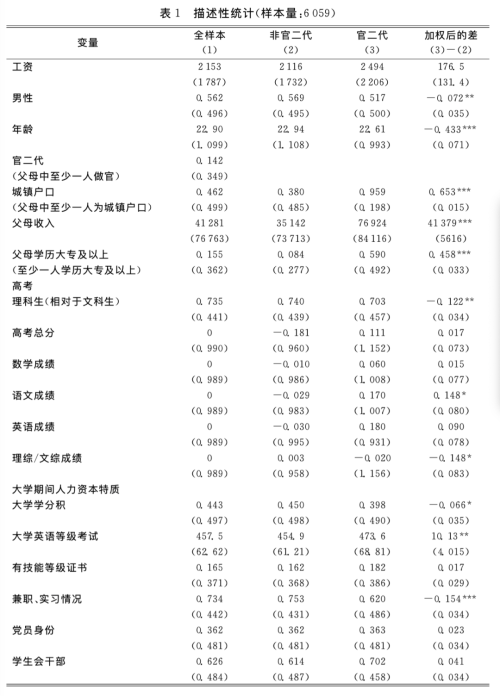
    表1为描述性统计结果,其中第 (1)列为全样本信息,第 (2)、(3)列分别为“非官二代”和“官二代”学生的信息。第四列为考虑权重后两组学生相关变量的差别,权重计算方法如前文所述。“官二代”的划分标准是学生父母中至少一人为政府官员,14%的学生符合“官二代”标准。

    表1第一部分是学生的基本信息。从平均水平上看,大学毕业生第一份工作的平均工资是2153元。“官二代”的平均工资比其他普通同学高出18%(2494元相比于2116元),但是加权后两类学生间的差距没有那么显著。我们将用多元回归的办法来检验控制了其他变量的影响后工资溢价是否依然存在。
    由表1可知,全部样本中有56.2%的学生是男生。有意思的是,“非官二代”学生中的男生比例比 “官二代”学生高 (56.9%相比于51.7%)。学生的平均年龄为22.9岁,在 “非官二代”学生与“官二代”学生之间差别很小,分别为22.9岁和22.6岁。16%的学生父母中至少有一人有大专及以上学历; 不过“官爸爸”、“官妈妈”中有大专及以上文凭的比例比普通父母高出6倍多(59%相比于8.4%)。官二代家庭收入比普通家庭收入也高很多,高出2倍有余(76924元相比于35142元)。
    表1的第二部分报告了学生文理分科情况和标准化后的高考成绩。基于省内参加同类考试的学生高考成绩的平均值和标准差,我们对所有高考分数进行了标准化,公式如下:(学生分数-平均分)/标准差。由定义可知,标准化后的分数均值为0。样本中约75%的学生为理科生。有意思的是,出身普通家庭的学生中理科生的比例更高 (74.0%相比于70.3%)。“官二代”学生的数学成绩更好,但理综/文综成绩更差。不过这两类学生的其他成绩差别不显著。

    表1的第三部分报告了学生在大学期间所获得的人力资本,包括英语等级考试成绩,是否有技术等级证书,是否有工作经验,是否是党员,以及是否有学生会干部经历。从表中可以看到,与来自普通家庭的学生相比“官二代”的更低,但是英语成绩较高。同时,大学期间普通家庭的学生从事打工兼职的可能性也更高。不过,两类学生在持有技术等级证书、入党和担任学生会干部方面没有明显区别。

    在附表中,我们还给出了“官二代”大学生和非“官二代”大学生就业行业的百分比分布。相比之下,“官二代”大学生更多地在金融业以及党政机关/群众组织/社会团体/国际组织等行业就业。

    实证研究模型

    在本部分中,我们建立了一个简单的计量模型来展示我们的研究思路。 假设收入由以下方程决定:

    lnW2 =α+βP1 +γX1 +δX2 +ε 方程(1)

    其中,lnW 为大学毕业生第一份工作工资的对数,P 为“官二代”的虚拟量,1代表父母中至少一人具有行政级别,0代表没有。这里的“官”包括任何有行政级别 (包括副科及以下)的人,他们的工作单位性质可以是党政机关、事业单位和国有企业。X表示其他影响收入的变量。X1表示父母特征变量,X2表示学生特征变量。ε为误差项。系数β是要估计的父母的政治资本给孩子带来的工资溢价。
    当且仅当P独立于误差项ε的时候,普通最小二乘法对β的估计是一致的。但是由于以下几个原因,P可能会与误差项ε相关。
    第一,父母当官对孩子收入有正影响的原因可能在于父母其他方面的特征帮助了孩子。因此除了父母的政治资本之外,我们还需要控制父母其他方面的特征,如父母的户口、人力资本和收入。
    第二,“官二代”可能能力更高,而能力和收入正相关。对这个问题最简单的处理方法是找到一个可以衡量能力的代理变量,并将其包括在回归方程中。前人在研究教育回报时采用高中考试成绩、IQ值、AFQT成绩和其他类似的能力考试的成绩作为不可观测的能力的代理变量。在我们的数据中,学生报告了高考成绩。如果高考成绩是能力的合理或近似合理的度量,那么将高考成绩加入方程会减少“能力偏差”。调查中我们不仅获得了高考总成绩信息,还获得了学生各科的高考成绩,包括数学、语文、英语、理/文综。这些成绩可以用来度量学生不同方面的能力。
    第三,“官二代”就读的院校可能更好,或者他们在本科学习中积累了更多企业需要的技能。这两个因素对学生毕业后的起薪都有促进作用。我们的调查提供了非常丰富的信息,使得我们可以对学生的大学以及大学表现的异质性进行很好的控制。
    不过,我们无法观察到所有影响大学毕业生起薪的因素。尽管我们较为全面地控制背景变量可以减少潜在的遗漏变量问题,但是我们仍然无法从根本上消除其影响。

    父母的政治资本有工资溢价吗?

    通过对回归方程式 (1)的估计,我们估计了“官二代”和非“官二代”大学毕业生在首份工作的工资上的差别。回归中,因变量是工资的对数值。 由于观察对象均为大学生,因此没有引入受教育年限作为自变量。全部的回归都考虑了权重。回归系数估计值的标准差是异方差稳健的,并在各省内聚类(cluster)。

    (一) 基 本 结 果

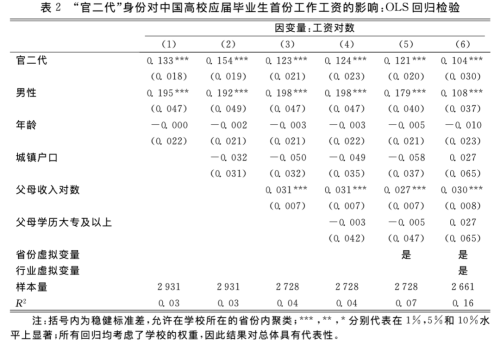
    表2的回归结果表明“官二代”毕业后首份工作的工资更高。第 (1)列中的回归包含3个解释变量: “官二代”虚拟变量、性别和年龄。“官二代” 虚拟变量的系数在1%的水平上显著,其估计值为0.133。这意味着相比于普通家庭学生,“官二代”的工资溢价为13.3%。根据Zhang et al. (2007) 的估计,这个溢价约为两年教育的回报。另外值得注意的是男生的工资溢价约为20%,考虑到学生之前均没有工作经验,这个差距还是相当大的。由于学生之间年龄差距不是很大,所以年龄对工资的影响并不显著。

    父母做官之所以对下一代收入有正的影响可能是因为“官爸爸”或“官妈妈”其他方面的特质影响了下一代。由表1可知,“官爸爸”和“官妈妈” 整体上的教育水平更高、收入更高。有鉴于此,我们分别引入以下因素作为控制变量:第 (2)列的父母户口虚拟变量(是否为城镇户口)、第 (3)列的父母收入(取对数)、第(4)列的父母学历虚拟变量(是否至少一人有大专及以上学历)。在第5列中,我们还控制了学生来源省份的固定效应。在控制了这些变量后,“官二代”身份对起薪的影响基本没有变化; 第5列显示,“官二代”虚拟变量前的系数依然在1%水平上显著为正,大小为12.1%。
    表2的最后一列显示进一步控制行业虚拟变量之后的回归结果。在控制了行业变量后,“官二代”身份对起薪的影响相对于先前的结果略有下降; “官二代”虚拟变量前的系数依然在1%水平上显著为正,大小为10.4%。
    正如我们所预期的那样,在所有回归中((3)-(6)列),父母收入对子女工资均有正向作用,且在1%水平上显著。由于父母收入、子女工资都是对数形式,因此收入前的系数代表弹性。估计结果表明父母收入每增加1%,子女大学毕业后首份工作的工资就增加3%,这个影响是很大的。此外,父母是否有城镇户口和父母是否有大专及以上学历对子女工资没有影响。

    (二)能力可以解释父母政治资本的工资溢价吗?

    以往研究表明中国官员的能力比普通人更强。如果 “官爸爸”、“官妈妈”的这些能力禀赋可以遗传给子女的话,那么“官二代”与“非官二代”学生之间的能力禀赋有差别,那么将两者的工资进行比较就无法得出父母的政治资本有工资溢价这个结论。由于无法利用自然实验,因此目前处理这个问题的最好办法就是在方程中引入能力的合适代理变量。中国大学生绝大部分都要参加高考,而且他们在高中时都是尽全力准备高考。因此,高考成绩可能比较好地度量能力。
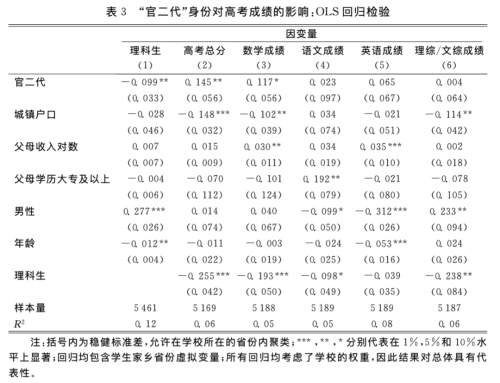
    通过研究“官二代”是否更重视理科(相对于文科),以及“官二代”的高考成绩是否更好,我们首先对“官二代”是否比普通大学生能力更强这个问题予以验证。表3第(1)列研究了哪类学生在高中 (和大学)更倾向于学理科。“官二代”虚拟变量前的系数为负并在10%的水平上显著,说明“官二代”更倾向于在高中(和大学)学文科。我们同时发现男生和年龄更小的学生更倾向于学理科。不过,户口、收入甚至父母学历都没有显著影响。

    “官二代”在高考中表现更好。表3的第 (2)—(6)列中,我们分别以高考总分、数学、语文、英语和理/文综成绩作为因变量进行回归。“官二代”高考总分、数学成绩更高,但是另外几科成绩与普通大学生不分伯仲。以上结果表明,在工资方程中引入高考成绩作为控制变量是非常有必要的。

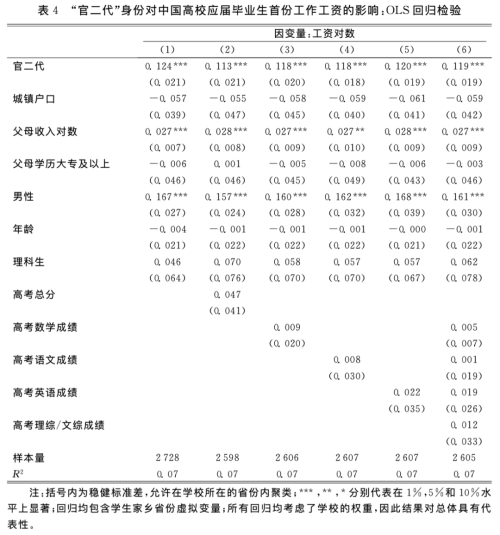
    其次,我们来研究“官二代”的工资溢价能在多大程度上能由高考成绩来解释。我们先来看 “官二代”工资高是否与他们更倾向于学文科有关系。表4第 (1)列在表2第(5)列的基础上引入理科生虚拟变量。结果显示理科生虚拟变量前的系数不显著,这说明是否为理科生不会影响到首份工作的工资。进一步的,理科生虚拟变量的引入对“官二代”虚拟变量前的系数也没有影响。

    表4的回归结果表明“官二代”并没有因为能力更强而获得工资溢价。第(2)列的结果表明,高考总分的估计系数为正但并不显著。更重要的是,它的引入没有明显改变“官二代”虚拟变量的系数估计结果,这意味着“官二代”的工资溢价不是由于难以观测到的能力或智力因素导致的。

    在第 (3)-(5)列中,我们以数学、语文和英语成绩代替高考总分作为控制变量分别进行回归。类似的,各科成绩前的系数为正但都不显著。在最后一列,我们将四科成绩同时放入方程进行回归。尽管四科成绩的系数联合显著,但是“官二代”虚拟变量的系数并没有明显变化。

    为什么父母的政治资本会有帮助?

    前面的研究结果表明,“官二代”大学生毕业后的首份工作工资更高,且这不是由于学生的能力差异或者父母其他方面的特性所导致的。本部分就“官二代”获得工资溢价的可能原因进行探讨。特别的,我们想对两类可能导致工资溢价的因素予以检验: 院校选择与大学期间的人力资本积累。

    (一)“官二代”选择更好的院校了吗?

    “官二代”在职场上更有优势可能是因为他们上了更好的学校或者在有“工资溢价”的学校读书。高考志愿填报是一个非常讲究策略的事情。考生对风险的不同态度、对院校相关信息的了解、和学校的关系、大学的费用都是影响他们填报志愿的重要因素。如果出身官员家庭的考生有信息优势,有关系,填报志愿时风险承受能力更强,经济条件更好的话,那么他们上好大学的机会就更大。
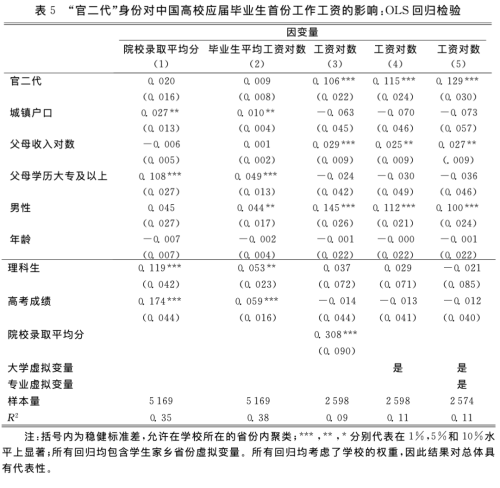
    由表5回归结果可知,“官二代”和“非官二代”上好大学的几率相当。第(1)列以各校平均的高考录取分数为因变量进行回归,录取分数越高,代表学校更好。自变量与表4类似。“官二代”虚拟变量前的系数小且不显著,说明“官二代”在上好大学(以高考平均分衡量)方面并没有优势。第(2)列中,我们采用各校应届毕业生平均工资作为因变量进行回归,结果类似。

    表5的第(3)、(4)列估计了控制了学校质量之后工资方程,结果证实“官二代”身份所带来的工资溢价不是由于“官二代”上好大学导致的。更具体的,在表4基础上,表5第(3)列、第(4)列分别加入各校学生高考平均成绩、院校固定效应来控制院校质量。加入这些控制变量后,“官二代”虚拟变量前的系数依然显著且大小基本没有变化。有意思的是,学校质量本身影响大学生的起薪,因为各校平均录取分数系数在1%水平上显著为正。

    为了控制专业对收入的影响,在表5的最后一列,我们在回归中加入了大学专业的固定效应。结果显示,“官二代”虚拟变量前的系数略有增大,而且依然在1%水平上显著为正。

    (二)大学期间的人力资本积累能否解释工资溢价?

    “官二代”在大学期间可能积累了更多有助于提升未来工资的人力资本。这些人力资本是多维度的,可以用学分积、技术等级证书、党员身份、学生会干部经历或者是打工兼职(包括实习)经历等来测量。我们在本节中研究这些人力资本特质对大学毕业生的起薪以及 “官二代”的工资溢价的影响。
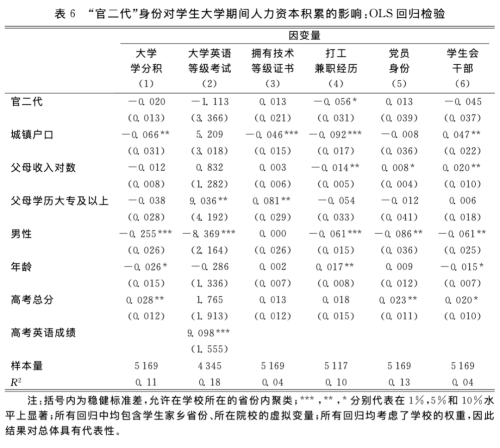
    基于回归结果,我们发现“官二代”与普通同学在学习成绩、获得技术等级证书方面不分伯仲,但是他们的打工兼职 (包括实习)经历更少。表6第1列的回归以学分积为因变量,自变量与之前保持一致。“官二代”虚拟变量前的系数小且不显著,这表明“官二代”在学习成绩上没有优势。英语对大学生而言很重要,所以我们也以全国英语等级考试成绩为因变量进行了回归。虽然之前的简单统计显示“官二代”的英语成绩更高,但是表6显示,在控制其他因素的影响之后,“官二代”在英语方面没有优势(第(2)列)。同时他们获得技术等级证书的几率与普通同学相同(第(3)列),但是在校期间从事兼职工作的可能性更小(第(4)列)。

    另外一个工资溢价的解释和入党的概率相关: “官二代”更可能是党员,而党员更容易获得政府机关或国企工作。更重要的是党员本身也是一种能力的标志,在职场中是一种积极的信号。但是表6第5列的回归结果表明,“官二代”入党几率与其他同学大致相当。“官二代”也许更多地在课余活动中培养了能力,比如担任学生会干部。但回归结果却表明大学期间“官二代”并没有在社会活动中更活跃。表6最后一列表明“官二代” 担任学生会干部的机会与普通同学不相上下。

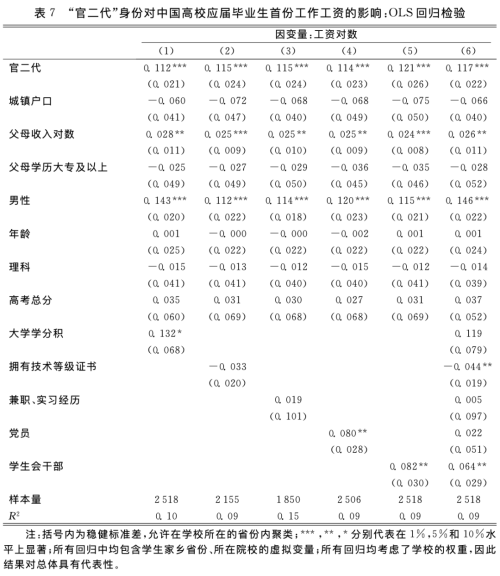
    最后,我们将以上衡量大学期间人力资本积累的因素全部包括在工资方程中,其中包括:学分积、技术等级证书、学生会干部身份、党员身份和兼职经历。表7的(1)-(5)列中,我们将这些变量逐一引入方程,在第(6)列中我们将这些变量同时引入。大学学分积、党员身份和学生会干部经历对首份工作工资有正向影响;但技术等级证书和打工兼职经历不影响工资。更重要的是,在控制了所有这些变量后(第(6)列),“官二代”虚拟变量的系数没有明显变化,这表明大学期间积累的人力资本不能解释 “官二代”身份带来的工资溢价。

    结论

    本文的研究结果表明,父母的政治资本对高校毕业生第一份工作的工资存在显 著正向的影响, “官二代”大学毕业生的起薪比其他同学高出了13% (约280元/月)。在控制父母的其他特征,如户口、收入、教育等因素的影响之后,父母政治资本的影响甚至更大了。

    尽管我们无法利用自然实验来解决线性回归中存在的遗漏变量问题,但是我们可以通过控制大量可能影响工资的变量来降低可能存在的估计偏差。其中,最为重要的是,我们将高考成绩作为学生能力或智商的代理变量。在高考中取得好成绩是所有高中生的目标,他们努力学习的目的就是为了提高高考分数。因此,高考成绩可以较好地衡量学生的能力或智商。本文的回归结果表明,“官二代”的高考总分和数学成绩更高。但是,即使引入高考成绩作为控制变量,“官二代”大学生在劳动力市场上有明显工资溢价的结论依然成立。这说明,“官二代”和非“官二代”学生之间可能存在的能力差别不能解释“官二代”的工资溢价。

    中国大学毕业生就业追踪调查所收集的信息还使得我们可以研究父母政治资本通过哪些渠道来影响子女工资。研究发现,父母的政治资本对学生进入211院校读书的可能性、在校期间人力资本的积累情况都没有显著的影响。因此在控制了所有这些可能影响工资的因素之后,“官二代”获得的工资溢价仍高达12%。这些结果进一步说明,父母的政治资本本身对子女的工资是有帮助的。其原因可能是“官二代”父母与雇主间有着某些特殊的关系、也可能是 “官二代”父母有着更好的获取求职信息的渠道。

    尽管仍然存在一些不可观测的人力资本因素可能与 “官二代”身份相关,但鉴于我们可以观察到的人力资本指标都与 “官二代”身份不相关,我们基本可以认定剩余的工资溢价就是 “官二代”身份本身在大学生劳动力市场中的回报。

    即便剩余的工资溢价仍然可能是由不可观测的能力或人力资本引起的, 本文的研究结果依然对我们进一步理解社会公平问题有一定的启发。近年来, 新闻媒体、网络论坛中有很多关于中国“官二代”享受社会、经济等方面特权的讨论,这些讨论很容易激起民众的愤怒情绪。一个毫不怀疑的事实是, 当今大多数中国人都倾向于认为“官二代”是能够获得工资溢价的。我们的实证结果表明,“官二代”身份以外的可观测的家庭特征和学生自身的特征,并不能解释“官二代”所获得的工资溢价,这说明父母的政治资本本身有助于提高大学毕业生的工资。不过影响的具体机制还有待于进一步的研究,文献对此也没有很好的解释。

  • 马克斯·韦伯:古典西方文明衰落的社会原因

    罗马帝国的衰亡并非是由外部因素所造成,亦即并非由于其敌人在数量上大占优势,亦非因为帝国本身缺乏政治领袖。事实上,罗马帝国在其最后的百年中不乏伟大的政治家,例如英雄人物斯提利科(365?—408,罗马将领,395—402年率部击败哥持人和汪达尔人的入侵)就集日耳曼的勇武与老道的外交手段于—身。然则为何日后那些土头土脑的封建部落诸如墨洛温人(450—751年法兰克王朝,由墨洛温建立)、加洛林(751年建立的法兰克王朝,由矮子裴品推翻加洛林王朝后所建;裴品之子即查理曼大帝.查理死后帝国分裂为三;该王朝在今德国境内存在到911年,在今法国境内则存在到987年)以及撒克逊人(原为西日尔曼部落的一支,于第五和第六世纪侵入不列颠)能够动员足够的兵力去抵挡撤拉森人和匈奴人的凶猛进攻,而罗马人即使有斯提利科之辈为领油却已完全做不到这一点?答曰:罗马帝国早就已经在衰落中,蛮族的入侵只不过为罗马漫长衰落过程划了一个句号罢了。

    不过首先必须强调指出的是,古典西方文明的衰落并非由于罗马帝国的衰亡所造成。事实上,古典西方文明本身在此之前早就已经没落,但罗马帝国作为一个政治结构却在古典文明衰落几世纪后仍然存在。早在第三世纪初,罗马文学已乏善可陈,罗马法学则与其各学派一起退化;希腊罗马的诗歌几已绝种,历史编纂—片凋零,甚至连铭文都已难得一见。用不了多久连拉丁文本身都已让位给各种方言。

    再过一个半世纪即当西罗马帝国最终灭亡时,帝国内部事实上已经从文明退化为野蛮状态了。只不过外部蛮族的入侵并末建立新的制度来代替帝国的旧制度,以至墨洛温王朝至少在高卢一度基本上是罗马外省组织的延续。

    由此我们不能不问:古代世界文明衰落的原因究竟何在?

    对此自然早就有过各种解答,有些不着边际,有些则从正确前提导出错误结论。例如有人论证说,是专制主义扼杀了古代人的心智及其政治生活。然而再明显不过,腓特烈大帝(腓特烈二世,1740—1786在位的普鲁士专制君主,18世纪欧洲“开明专制君主”的代表人物)的专制主义恰恰是促成欣欣向荣的动力。另外一些人宣称,上层社会的奢侈与堕落乃招致历史对他们的惩罚。但奢侈与堕落都只是病兆,而非病因。导致古典文明衰亡的原因远比任何个人的邪恶重大得多。

    再有一种解释则将重心放在罗马妇女的解放上,即认为统治阶层之间婚姻纽带的解体削弱了古代社会的基础。这只能说明我们时代的反动者仍然在不断重复当年那位有偏见的反动者即史家塔西陀关于所谓日耳曼妇女的故事,实际上这妇女乃是一个作战农民的悲惨奴隶罢了。真正讲来,这种理化的“日耳曼妇女”与日耳曼人最终荡平罗马几乎浑不相干,就像广为人知的“普鲁士小学教师”与普鲁士在克尼格雷茨战役(1866年7月3日普鲁士军队大败奥地利军队之役,此战为伸斯麦统一德国铺平道路)中取胜一样不相干。事实上,如我们马上就会看到的,古典文明的衰落毋宁说与社会下层阶级之间家庭纽带的重建有关。

    还有一种解释同样来自一位古代人的证言,即老普林尼的名言:“大地产毁掉了意大利”。一位现代学者由是说:“看吧,毁掉罗马帝国的正是罗马的容克贵族们”。对立的一方则答辩说,“也许是这样,但这恰恰是因为大地产本身已被进口谷物所毁掉。设若当时罗马能高筑关税以保护农业,帝国或将延续至今”。然而我们下面立即会看到,古典文明的覆灭恰恰标志着农民阶级复兴之开端。

    达尔文主义的解释自然更不会缺乏。近来一直都有人论证,自然选择过程当时乃逆向而行,因为当时的征兵制使得最强者都成了独身,从而导致罗马种族在古代后期日益劣质化。但我们将会看到的是,事实上当时军队乃日益从士兵的子弟中征募,而这种发展趋势恰恰加速罗马帝国的衰亡。

    以上种种已足以说明迄今为止人们是怎样回答古典文明为何覆灭这一问题的。以下我将对方法问题先略作评论,然后提出我自己的回答。

    一个说故事的人要能引起听众的高度兴趣通常总要使听众相信这故事乃与他们自己的生活息息关,从而最后能引出某种教训。我要讲的故事则完全不同。对我们自己今天的社会问题而言,古代史能提供给我们的东西实在微乎其微甚至根本没有。今天的无产者与古代的奴隶之间,就像一个欧洲人与一个中国人之间一样,几乎没有任何共同之处。我们今天的问题与古代的问题完全不同。因此我要讲的故事只有纯粹的历史兴趣。但尽管如此,这故事却是有史以来最引人入胜的故事之一,因为它描述了一个古典文明的内在解体。

    我们的首要任务是清楚界定古典西方社会结构的特质。我们将会看到,正是这些特质规定了古典文明发展的轮回。

    首先,古代西方文明就其本质而言基本上是城市文明。城邦是政治生活及文学艺术的中心。同样,至少在古代的早期,经济是由我们今日所谓“城市经济”为主所形成的。

    希腊时代的城邦基本上无异于中世纪城市。两者间的差异无非是地中海地区与中欧地区在气候和种族上的差异,就像今天英国工人不同于意大利工人,而德国技工不同于意大利技工。

    从经济上讲,古代城邦立足于一种以城邦本身市场为中心的交换经济,即以城市工艺产品来与其内陆农村的农业产品相交换。这种贸易乃是在生产者与消费者之间直接进行的而且基本上满足所有需求;任何从外部的进口都无必要,事实上绝大多数希腊城邦都实现了亚里士多德的理想:城邦自给自足(古代史家芬利曾指出,柏拉图和亚里士多德所谓的“城邦自给白足,其“城邦”乃是将城市与内陆、城镇与乡下作为一个统一单位来说的)

    诚然,在这种本地贸易的基础上,国际贸易很早就已开始发展而且其所及地域甚广,交换品种亦多。由此,历来关于古代史的讨论大多都集中在那些拥有船队从事国际贸易的城邦,从而常常使我们忘记,这种国际贸易在数量上是何等微不足道。由于古代欧洲的文明是一沿海文明,其历史记录因此压倒性地首先是关于沿海城邦的历史。然而,与这些高度发达的城邦商业经济并肩而立的恰是在性质上正好相反的自然经济,即内陆原始农民的自然经济,这些农民或生活在部落共同体中,或生活在封建家族长的支配下。当时正常稳定的国际贸易只能依赖海路和大河。古代西方根本没有与内陆的贸易,更谈不上与中世纪的内陆贸易相比。备受推崇的罗马大道并不是用作通商之途,罗马的邮政亦非为商业服务。当时内陆土地的地租与河岸一带土地的地租有极大的差异。靠近罗马大道被看成是一种倒霉而非运气,因为这意味着要常受军人驻扎借宿之骚扰。简言之,罗马大道乃为军队开,而非为商业开。

    在这种状况下,自然经济很少受到触动,商业当然也就不可能得到延伸。古代贸易事实上只限于数量很少的贵重品,诸如贵金属、琥珀、精美纺织品,以及铁器和陶器之类。所有这些总的来说都是奢侈品,由于其价格极高,因此尽管营运费昂贵仍然有利可图。但这种贸易在任何意义上都无法与现代商业相提并论,因为这就像是说今天的贸易只有香槟、丝绸之类而无其他一般,然而所有的统计都可以告诉我们,今日贸易的大宗都是大众消费品。

    诚然,有些城邦如雅典和罗马曾依赖进口来保证其谷物供应。但这些例子都不是历史的常态,而且即使在这种情况下,这些供应品的征集亦都委托给公共权威;古代城邦不会也不能把这些事交由不受控制的私人商号去做。

    由此,古代国际贸易的受益者并不是大众及其日常需求,而只是很小一撮富裕阶层。换言之,在古代西方,贸易的扩展只有贫富日益分化才可能。更重要的是,这里我们看到了古代文明的第三个典型特征,即这种贫富分化在当时采取了一种特定的形式与倾向:古代西方文明乃以奴隶制为基础。

    从一开始,城市中的自由劳动与乡村中的奴隶劳动就同时并存。在古代西方,就像在中世纪一样,一方面存在着为城镇市场产品交换而进行生产的自由劳动分工,另一方面则存在着在乡村庄园生产而且只为乡村庄园生产的非自由劳动。也与中世纪一样,这两种劳动组织方式之间的天然对立乃与日俱增。

    一般而言,经济的进步是靠扩大劳动分工来达到的。当自由劳动占上风时,经济的进步首先要求市场的扩展,亦即在外延上把新的地理区域纳入交换经济,在内涵上则把更多的人口纳入交换经济;因此古代西方的城镇居民总是力图打破乡村庄园并把庄园的农奴整合到自由市场中。反之,当非自由劳动占上风时,经济的进步乃靠劳动人口的稳定积累来达到,因为能调动的奴隶或农奴越多,非自由经营也就越能专业化。

    现在的问题是,在中世纪,最后取得胜利的是自由劳动和产品自由交换这一方,而在古代西方,斗争的结局恰恰相反。为什么会这样?这道理就像在古代西方技术发展必然是有限的一样:因为古代文明以相互攻伐为常务的特点使人力的获得最为廉价。古代战争乃是掳取奴隶的战争。这些战争不断为奴隶市场供应奴隶,从而也就不断推动古代经济中的非自由劳动部分和劳动力的积累达到惊人的程度。其结果则是自由劳动这一部分不再扩展,手工业则无法走向由无产者的雇佣劳动来为消费者生产的阶段。

    但在古代西方,情况却恰恰相反,自给自足庄园中的非自由劳动反而日益占据经济的主导地位。只有奴隶主才能以劳动分工为基础来发展生产,而且只有奴隶主能提高自己的生活水平。古代西方的状况由此日益演变为,只有奴隶经营者才能在满足自己需求后为市场生产。

    这就决定了古代西方的经济发展大不相同于中世纪欧洲的经济发展。在中世纪社会,劳动的自由分工首先在城镇以内的经济区域中发展自己的市场,面向本地市场和本地顾客的需要而生产。其后,随着与外地市场的贸易之增加,又发展起来了各地之间的生产分工。首先是外包工制度,随后是制造业,各种以供应外部市场及雇用自由劳动为目的的新生产方式开始出现。现代经济的发展由此无可避免地乃与面向大众的趋势紧密相联,亦即跨地区的贸易以至跨国贸易都以不断满足大众的需要为目的。

    在古代西方,情况正好相反,国际贸易的发展恰恰强化了大奴隶制庄园中的非自由劳动。交换经济在古代就像是某种上层建筑,在它之下的下层建筑则是一个不断扩张的自然经济,在这种自然经济中,需求的满足无须依靠交换,因为这种以奴隶劳动为基础的自然经济一方面把越来越多的人口纳入其范围,另一方面则并不依靠市场而是以奴隶庄园本身的生产来满足奴隶的消费需要。唯当奴隶主上层阶级的消费越提高,贸易才越向外扩张,但这样的对外贸易越扩张,它所涉及的人口反而越少。这样,在古代西方,贸易越来越变成覆盖在一个庞大的自然经济之上的薄网,随着时间的推移,这张薄网的网孔就变得越细,网线就变得越脆。

    在中世纪西方,经济的轨迹是从为本地需求而生产发展到为跨地区的市场而生产。这种发展是资本主义自由企业及竞争原则逐渐渗透本地经济结构的结果。在古代西方,正相反,国际贸易的发展恰恰促成庄园经济——即以非自由劳动为基础的自给自足经济的壮大,而这种庄园经济的坐大反过来正窒息了本地交换经济的基础。

    古代西方的这种发展轨迹在罗马治下达到极点。在公元前287年的平民革命胜利后(该年罗马通过“霍滕修斯法案”决议,确定罗马“平民大会”的“平民决议”对罗马贵族同样具有法律效力),罗马共和国事实上是一个武装农民的国家,或更确切地说,一个由自耕市民组成的征战国家。每次战争都意味着吞并更多的土地以供拓殖。罗马兵源乃从罗马自耕市民的非长子中征召。这些非长子们没有继承权,只有靠从军征战去为自己赢得土地,同时也只有以这种方式为自己谋得片草寸土后他们才有资格取得充分的罗马公民权。罗马武力的秘密全在于此。然而,一旦罗马的扩张延伸到海外领土,情况就截然不同了,因为罗马农民并无意移居海外;在这种情况下,扩张的动力已不是来自罗马农民,而是来自于罗马贵族搜刮海外领土的贪欲。战争的目的变成了掠夺奴隶并将掠夺来的土地收归国有;这些土地转成地产后又出租给富裕的承包者。

    罗马农民阶级在第二次布匿战争中死伤达十分之一,这一罗马农民阶级没落的结果几乎可称为汉尼拔的迟到报复。随后的格拉古改革运动虽致力于恢复罗马小农农业,但继之而来的反动恰标志着奴隶劳动耕种制的决定性胜利。自此以后,已是只有拥有奴隶者才能为市场而生产,因为只有他们是提高生活水准和增大消费需求的唯一得益者。这并不是说自由劳动已完全消失,而是说,奴隶劳动企业现在已成为经济发展的唯一动力。罗马农业作家由此都想当然地认定劳动组织必以奴隶劳动为基础。

    最后,当罗马帝国把广大的内陆地区——西班牙、高卢、伊里利亚及多瑙河流域——都并入罗马版图后,奴隶劳动在古代西方文明的重要性更是与日俱增。与此同时,罗马帝国的人口重心也随着转移到了内陆地区,古代西方文明由此经历了一次重大的地域转移,即从沿海文明转变成了一种内陆文明。古代社会现在的经济活动已覆盖一个巨大无比的地域,这个地域是如此广大以至即使经历数百年之久也不足以将之同化到商品制度和货币经济之中去,后者本是在地中海沿岸一带发展的。因为如我们前面已经看到,即使在这些沿海地带,跨地区的商业往来也只不过是一张薄网,这种商业活动越是向内陆地区伸张,这张薄网也就被拉得越稀薄、越脆弱。事实上,在这些内陆地域,要想文明的发展沿着以自由劳动分工为基础来发展商业根本就是不可能的。只有在经历了一个以奴隶所有制为基础而以非自由劳动来发展自给自足庄园的土地贵族制之后,这些广大的内陆地域才能逐渐走上地中海文明的轨道。在内陆地区,货运交通远比在沿海地带昂贵,因此内陆商业最初都是纯粹只为一小撮人即富裕奴隶主提供奢侈消费品的。与此相似,为向市场出售而生产商品的可能性也只限于很小数目的大奴隶企业。

    这样,在古代西方文明中,奴隶主成了经济的领头人,而奴隶劳动则成了罗马社会不可或缺的基础。我们因此必须把我们的注意力集中到这一奴隶劳动制的独特性上来。

    就目前资料所及,我们现在了解最多的是罗马共和晚期与帝国早期时代大庄园使用奴隶劳动的情况。不管怎样,大地产永远是最基本的财富形式,因为即使用于投机的货币也来自于地产,而且通常大投机商也是大地主。这必然如此,因为当时最有利可图的投机生意都需要以地产来担保,例如包税、租赁,以及承包公共工程等。

    一般而言,罗马的地主并不亲自经营他的庄园。相反,这些地主乃是城镇居民,主要以政治为业,而最关心的就是他们的地租。经营庄园的事务一般都交给非自由身份的管事。由此导致的农业制度的主要特征大体如下:

    为市场而生产谷物通常都无利可图。罗马本身作为一个城市并不是一个潜在市场,因为首都的谷物供应乃由国家机构监督,而且出售谷物的价钱尚不足以抵偿从内陆地区运到罗马的交通运费。更进一步讲,奴隶劳动并不适合种植谷物,这尤其因为罗马的耕种技术需要非常仔细的劳动从而高度依赖于劳动者对此的兴趣。由于这些因素,罗马谷物种植的一般方式都是至少部分地将土地以小块方式出租给所谓“拓殖农”,即那些已经失去自己田地的原自耕农的子孙。从一开始,这些拓殖农就不是独立的佃农、亦即他们管理的并不是他们自己的事务,而是由地主提供种子与工具,而且由地主的管事监督收割。此外,也是从—开始起,拓殖农就不得不经常为地主提供劳役,农忙时尤其如此。总之,出租土地给拓殖农被看成是一个地主得以经营其庄园的方式之一,用当时的语言来说叫作“假手拓殖农”来耕种。

    但庄园经营的另一种类型则是地主直接为向市场销售而进行的庄园生产,主要是高价产物例如橄榄油和葡萄酒,再就是蔬菜、饲料、家禽,以及奢侈品,都是专为有钱人家生产的,因为只有这些人家才会用钱来买这些东西。庄园中最好的土地都是用于这种生产的,只有剩下来的土地才租给拓殖农去种植谷物。直接经营的这部分庄园基本上是一个种植园,其劳动力乃由奴隶组成,这些奴隶被看成是其主人的家产的一部分。在罗马共和晚期和帝国时期,大庄园经济都是由奴隶和拓殖农这两部分劳动者所组成。

    让我们首先来看奴隶人口。他们生活在什么样的处境中?

    只要看一眼罗马农业手册这类有关理想的种植园的描述、我们就能发现,奴隶乃与牲口比邻而居,奴隶被称为“会说话的工具”,牲口则被称为“半会说话的工具”;在奴隶居住之处,除了宿舍之外,还包括一个诊所、一个看守所,以及一个供庄园工匠之用的手工间。我想凡是服过兵役的人看到这种景象肯定都会有似曾相识之感。这就是兵营。事实上,一个奴隶的生活确与一个士兵的生活非常相似。奴隶乃在地主的管事之监督下同吃同住在一个公房中。他们较好的衣服则由管事之妻另加专门保管,而且每个月对号检查一次。奴隶的工作是在严格的军事纪律下进行的,每天早晨他们都编成“班”并由奴隶工头带往工地。所有这些都是不可避免的,因为要用非自由劳动来为市场生产,除了皮鞭从来就没有更好的办法。

    但对我们来说,奴隶处境中最值得注意的一个因素乃在于:这些过着兵营生活的奴隶不仅没有财产,而且没有家庭生活。只有管事可以和他的女人同房,结合为所谓奴隶婚姻,颇类似于今日兵营中那种带家眷的军曹。事实上,按照农业手册的说法,从庄园主的利益出发,庄园的管事最好是有家的人。然而,只要有家庭,那也就必然有私人财产,这两者总是联在一起的。因此,只要有奴隶婚姻,那就有奴隶财产。庄园管事(按农业手册只有这些管事)因此可以有些私人财产,即所谓peculium;正如Peculium这个词的词根(pecu意为“牲口”)所表明,管事的私产最初是指管事在地主的牧场中有他自己的牲畜,就像今日德国东部大庄园中的农工一样。

    但管事以外的奴隶大众却没有任何私产,恰如他们没有—夫一妻的生活一样。这些奴隶大众的性生活至多是偶有性交机会,那些能生育的女奴会有些外快,有些在生了三个孩子后可以获得自由。

    没有一夫一妻制的家庭生活将会导致什么样的结果是不难想见的。人类只有在家庭中才能传种接代,而被迫生活在兵营中的奴隶则无从再生产自身。奴隶营需要不断补充新人手,因此也就必须不断去购买新的奴隶。事实上,在古罗马的农业手册中,定期购买奴隶乃被看成是庄园的日常开销。古代种植园之消费奴隶就像现代炼钢需要消费煤炭一样。因此一个能定期和大量供应人力的奴隶市场,乃是一个从事市场生产的奴隶营得以维持的不可或缺的前提条件。购买奴隶者大多吝嗇。瓦罗(公元前116—27年在世,罗马时代学者,相传有著述六百卷之多)曾建议最好买那些犯过罪的及类似的便宜货。其理由颇为独特:“罪犯更机灵”。总之,罗马的种植园乃依赖于一个能源源不断供应人力的奴隶市场。但是,如果这个市场的货源一旦中断,那会导致什么结果呢?这将势必影响到奴隶营本身是否还能生存,就像今天如果煤矿倒闭必将影响炼铁厂一样。

    事实上这恰恰正是古代西方实际发生之事。我们现在马上就来看古代西方文明发展中的这个转折点。

    如果要问罗马强权和罗马文明的衰落始于何日,那么每个德国人都会毫不迟疑地立即回答说,罗马帝国的衰落始于其在条顿堡(今德国西北部;公元9年,日耳曼人阿米尼乌斯在此击败罗马的个兵团,把日耳曼人从罗马统治下解放出来)之战中败于德国人的祖先。尽管这听来颇有悖史实,因为罗马帝国乃在图拉真时代(罗马皇帝,公元98—117年在位,以大兴土木和广济穷人闻名)才达其强盛颠峰,然而民间的流行观却也并非全无道理。条顿堡战役的重要性并不在于这场战役本身,因为罗马在此战中的失利只不过是任何征服民族在深入不毛之地时都有可能会遭遇到的挫折。决定性的是这场战役的结果,即罗马皇帝提比略(奥古斯都选定的接班人,公元14—37年为罗马皇帝)在此战后决定放弃以武力征服莱茵河流域地区,而以后哈德良(罗马皇帝,117—138年在位,曾试图消除罗马与其外省之差别)在撤出达契亚(原为罗马行省,区域相当于今罗马尼亚,罗马帝国于270年放弃达契亚给哥特人)后又作出类似的决定,即放弃以武力征服多瑙河流域地区。这些帝国政策实际意味着罗马帝国已停止向外扩张。古代文明的疆域所及由此已在内部并且相当大程度上在外部都已不再处于战争状态,但由此奴隶市场所需的源源不断的人力供应也就停止了。早在提比略时代这一结果似就已经初显苗头,即人力严重短缺已经开始出现。我们从文献可知提比略曾不得不下令检查各大庄园,因为大地主们已开始不择手段任意劫获人丁。

    但更重要的是,要维持那种以奴隶营为基础的生产制度已变得越来越困难,因为奴隶营乃需要不断补充,而这已不再可能。当奴隶供应停止后,奴隶营也就注定要绝迹。

    国库既然以实物为税收来源,亦以实物为其支出方式。帝国正是想以这种方式来维持其最低的两项开支:官僚与军队。但正是在这里,自然经济暴露了其局限。

    一个面积广大的大陆国家要想长治久安必须有一个付薪的官僚阶层,而这样一种要付薪的官僚阶层恰是古代城邦闻所未闻之事。自戴克里先(285—305,罗马皇帝)建朝起,罗马国家的官吏多以实物为收入就像今日梅克伦堡庄园的长工一样,只不过数量多一点:几千蒲式耳的谷物,数目相当的牛羊,一定数额的盐、油及日常用品,都由帝国的仓库供给。作为对实物供应的补充,官吏们也有一点现金收入,但数目是极小的。

    然而,不管罗马是如何倾向于以实物支付,要维持一个强有力的等级官僚阶层仍需相当可观的货币支出。但更耗费帝国货币供应的其实倒还不在于维持一个官僚阶层,而在于要维持一支军队。

    一个有邻国为敌的大陆国家必须有一支常备军。罗马古代的军队是从公民中召集的,这些公民都有自己的田产并自备武装,但到了罗马共和后期,军队已由国家提供装备而且是从无产业者中征募,凯撒的军队就是如此组成的。到了帝国时期,常备军无论在理论上还是在事实上都已是一个职业团体。但要维持一支职业军队,两件事缺一不可:人和钱。正因为如此,在近世开明专制时代,正是征兵的需要使得崇尚重商主义的君主们例如腓特烈二世和特蕾西亚女王(1717-1780,1740-1780年期间的匈牙利与波希米亚女王,在位时历经奥地利王位继承战(1740-1748)及七年战争(1756-1763))要抑制大规模农业企业并禁止圈并公共土地。这些政策并非出于对农民的人道主义考虑,更非保护个体农民的权利,真正的理由毋宁如腓特烈威廉—世所言,他的兵源乃来自“过剩的农家子弟”。但这就意味着,人口必须有过剩,也因此圈并农民的土地必须禁止,因为这将导致农家人口减少和农村地区人口递减,从而使征兵更困难。

    出于完全相似的理由,罗马皇帝们同样干预那些影响到拓殖农处境的安排,例如禁止任何增加他们负担的措施。但在其他许多方面,近世欧洲重商主义君主们所采取的措施只怕就是罗马闻所未闻的了。特别是,重商主义君主们都大力扶植大规模制造业以容纳更多人口并使货币流入乡间。腓特烈大帝由此诏令逮捕离开乡间的工人和制造业主就像他诏令逮捕逃兵一般。这样的政策不可能为罗马的皇帝们所摹仿,因为以自由劳动为市场生产大规模工业产品根本不存在也不可能存在于罗马帝国。

    在罗马帝国实际发生的过程是,当商业和城市没落,整个社会倒退回自然经济时,农村地区更越来越难以筹到足够的货币数量来满足税政所需。在商业和城市没落的同时,由于奴隶市场的倒闭,乡间劳工分外短缺,因此国家从拓殖农中征兵对庄园生产而言已成最大负担,庄园主们纷纷设法帮他们的农民逃避征兵。逃避征兵的人由此从已破落的城市逃到乡下,宁做农奴以求安全,因为大地主们急需劳工而愿意匿藏逃兵。罗马帝国后期的皇帝们之全力阻止城市人逃到乡下去,恰如后期霍亨斯陶芬王朝(日耳曼家族,于1138-1208和1215-1254年时期统治神圣罗马帝国,西西利于1194一1268年时期亦在其治下)之全力阻止乡下农奴逃进城市一般。

    帝国军队的兵力来源由此变得越来越困难,其后果很快就表现出来。从韦斯巴辛(69-79,罗马皇帝)时代起,意大利地区已免除征兵义务;而自哈德良时代起,帝国军队的单位已不再是混编组成,而是每一单位尽可能从其驻扎地征募新兵,以节省货币之用,此实为帝国瓦解的最初征兆。更有甚者,如果我们从连续几百年的军人退伍证明书来观察士兵的出生地,那我们立即会发现,越来越多的士兵都是“兵营子弟”,在帝国时期,这种士兵来源在士兵总数中的比例从最初只占百分之几上升到占一半左右。换言之,罗马的军队也已自我繁殖。恰如以往那种没有妻室住在奴隶营中的奴隶已让位于有老婆孩子热炕头的小农一样,一向住在兵营中的独身士兵现在至少部分地也成了带家眷的士兵,这些士兵事实上已成为世袭的职业雇佣兵。

    与此相似,罗马帝国日后日益从野蛮民族中征募兵源,其目的主要就在于节省农村地区特别是大庄园的劳动力。这些野蛮民族为罗马巡守边界,而罗马则以赠与土地作为酬报,这自然是最地道的自然经济的传统交易方式,同时还可注意的是,在这里我们已看到“采邑”之雏形。这种土地转让方式变得日益流行。

    这种发展的结果就是,对帝国命运举足轻重的军队变成了一帮野蛮人,而与罗马本土的纽带日益疏远。因此当罗马境外的野蛮部落最终胜利侵入帝国境内时,对罗马外省的居民而言似乎只不过是换了一支部队驻防而已,而且事实上,罗马的驻防制度也确实为野蛮人所继续沿用。在高卢,入侵的野蛮人并没有被恐怖地看成是征服者,许多人反而欢迎他们,认为他们是把自己从罗马的压迫统治下解放了出来的解放者,这当然不难理解。

    日益衰败中的罗马帝国所面临的困难并非只是无法从罗马本民族中征兵。当帝国越来越退化为自然经济时,货币税对所有人都成为日益沉重的负担。但同时,货币却又为维持一支雇佣军所必须。在这种情况下,国家施政的目标日益集中在千方百计搜刮一切货币,但在另一方面又再清楚不过,那些大庄园主正因为现在都只为自己庄园之需要而生产,哪里有足够的货币来纳税!诚然,我们或可认为,这问题本不难解决,因为皇帝只要对庄园主们这样说:“既然你们没钱交税,那你们就应该让自己的拓殖农为你们准备武器,套上你们自己的马,和我一起来保卫国家。”这对庄园主们自然不是难事。但是,若如此,那就意味着封建军队之创生;若如此,那就意味着中世纪已开始!

    实际上,罗马帝国后期各种发展的趋势之自然结果正是走向这种封建社会结构和封建军队体制。在野蛮民族入侵后,这一趋势曾被短暂打断,因为入侵的日耳曼武装农民一度为瓜分土地而争战不休。但很快原先的趋势就恢复了势头,到喀噜琳时代,一个封建制社会已然成型。

    一支封建军队可以攻克一个公国,也能防卫一段边界,但从没有任何封建军队能够维持一个伟大帝国的统一或在绵延数百里的边界挡住掠夺者的入侵,这就是为什么罗马帝国不可能采取封建军队体制的原因,尽管这种封建军队制本更适合其自然经济体制。由此,为了维持帝国,戴克里先不得不力图以统一的货币税为基础来重组公共财政,而为此目的城市就必须成为国家行政体制的基层单位。然则罗马大多数城市的经济基础此时早已枯竭,它们的主要功能已经只是用钱养国家官僚而已,而在这些城市之周遭,所有的土地都已纳入了一个由领主庄园所组成的网络。

    我们现在已经可以看得很清楚,罗马帝国的瓦解乃是基本经济结构发展的必然政治结果,这就是商业的逐渐消失和物物交换经济之扩展。就其实质而言,帝国的瓦解只不过意味着,帝国之货币化的行政体制和政治上层建筑消失了,因为它们不再适应一个自然经济的下层建筑。

    西方日后政治统一之重建,正是以这种与自然经济相适应的制度为基础,这就是查理曼大帝所完成的事业。戴克里先未能完成之事业五百年后终于由查理曼在自然经济的基础上所完成。任何人只要读一下查理曼对其领地管事的训令就可一眼看出查理曼帝国是如何以自然经济为全部基础。这些训令,即著名的“领地管事须知”,以其对家务管理的面面俱到而又娓娓道来而闻名,真使我们不能不想起腓特烈威廉一世的那些效敕令。例如,在“领地管事须知”中,王后的角色乃与国王并立,因为作为王室的女主人,王后就是国王的财政部长。这实在没有什么可惊讶的,因为查理曼的财政事务主要就是备齐国王的餐桌并保证王室一家丰衣足食。王室的收入和支出也就是国家的收入和支出。因此管事们之“须知”无非就是要知道朝廷所需:面、肉、布,还有那不知为何数量特大的肥皂,总而言之,都是关于国王的需要、国王的亲信的需要或国王的仆人的需要,诸如马和战车之类。

    在查理曼的“领地管事须知”中无影无踪的是什么呢?这就是常备军和支薪官吏,也因此,罗马帝国的税,事实上税的概念都已经消失。国王以他自己的餐桌供养他的官吏或把自己的土地给他们一部分。军队则由那些自己提供装备的人组成,基本上变成了一支骑兵部队,亦即军事已成为领主兼骑士们的事务。

    跨地区的商业已全然绝迹;以往连接各个自足经济单位的商业纽带已经切断,贸易已退化到只有小贩的水准而且都是异乡人即希腊人与犹太人之事。更根本的是,城市本身已经消失。说来或许难以相信,加洛林时代的行政法词汇中根本都没有城市这个词。文明的中心乃是领主庄园,因为正是这些庄园养活了修道院。庄园领主们就是政治领袖,最大的领主就是国王——一个终其一生一个大字不识的乡巴佬。国王在乡村各地有其城堡,但决无他自己的首府,作为君王他靠周游各地来维持供养,周游得远比现代君王多。之所以如此是因为他得从一个城堡吃到另一个城堡,这样储藏在那里的东西就不会坏。

    一句话,西欧文明已经全盘农村化。古代西方世界的发展走完了整整一个轮回。

    回首加洛林时代,我们不免感到古典西方的文化成就已全盘丧失。正如商业和古代城市的大理石雕塑都已消失一样,古代城市所有的知性成就和价值似乎都已沉入黑暗之中:古人的艺术、文学、科学以及他们的商法。与此同时,在地主和领主们的庄园上,中古的民谣则还远未诞生。

    面对这样一种景象,谁不感到悲从心来?一个伟大的文明眼看就要达其至善至美的境地,却因物质基础的丧失而枯萎!然而,这一浩瀚的历史过程究竟意味着什么?

    我们所看到的事实上是社会结构的一种根本转型,这一转型不但是必要的而且必须被理解成一个极大重修元气的过程。因为大批非自由民众重新获得了家庭生活和私人财产,他们从“会说话的工具”的身份恢复到了属人的身份,基督教的兴起赋予他们的家庭生活以道德保障,甚至罗马帝国后期保护农民权利的法律也前所未有地承认了非自由家庭享有同等权利。

    诚然,与此同时一部分原先的自由人降到了准农奴的地位,而古典西方的贵族文明则已野蛮化。尤其是,自然经济现在已成主导。这种自然经济虽然历来就是古典文明的下层建筑,但非自由奴隶劳动的扩展曾一度使其处以从属地位,尽管奴隶创造的财富越多奴隶的数量也越增。然而,当帝国的政治中心从沿海地区转移到内陆,当奴隶供养枯竭,自然经济终于迫使古典西方一度商业化的上层建筑转向封建制度。

    这样,古典西方文明大厦的整个建构被动摇而最后崩坍,西欧的知性生活亦陷入漫长的黑夜之中。但这种沉沦或可比为希腊神话中的巨人安泰俄斯,每次他只要被击倒在地就能从大地母亲那里获取新的力量。毫无疑问,如果某位古希腊罗马作家从中世纪修道院收藏的羊皮手稿中突然醒来而环顾加洛林时代的世界,他一定会大惑不解,乡间修道院特有的粪土气息更会把他熏得昏过去。但不消说没有一个古希腊罗马作家会出现在加洛林时代。像整个古典文明一样,他们已进入长期的冬眠状态,被埋在一个已再度农村化的经济之下。即使当封建社会开始出现抒情民谣和骑士比武之时,古典仍未苏醒。只有当中世纪城市发展出了自由劳动分工和商业交换时,只有当向自然经济的漫长过渡终于使市民自由的发展成为可能时,只有当封建时代加诸于人的内外枷锁都被打破时,只有这时,古典巨人才能像那安泰俄斯一样重获新的力量,古典西方的文化传统才以近世市民文明的形式再获新生。

    康茂德,罗马皇帝,180一192年在位。
    Ostrogoth为东哥特人部落之一,于493—555年侵入并统治意大利。

    本文原为韦伯于1896年对弗莱堡学术协会所作的讲座,同年以Diesozialen Grunde des Untergangs der antiken Kultur为题发表于Die Wahrheit杂志,vol.5(May 1896)。韦伯去世后其遗孀玛丽安娜·韦伯将其收入1924年在图宾根出版的《韦伯社会经济史文集》。现有两种英译,一为C.Mackaur所译,载Journal of Cenral Education 5(1950):75—88;另一为R.l.Frank 所译,载Weber, The Agrarian Sociology of Ancient Civilizations,Vesor 1988。
    原载《民族国家与经济政策》,马克斯·韦伯著,甘阳译,三联书店1997年12月版,第19—33页。

  • 彭姝祎:欧洲主要国家养老金制度改革及其启示

    文章来源:《社会保障评论》,2023年第2期。

    一、引言

    作为福利国家的发源地,欧洲是全球最早建立养老金制度的地区。二战之后,欧洲各国普遍建立了以现收现付为主要融资方式的公共养老金制度。从20世纪70年代中后期起,在日益严峻的人口老龄化趋势下,各国的养老金制度普遍遭遇财政危机,收不抵支,赤字巨大。从90年代前后起,为确保养老金制度在财政层面可持续,各国陆续启动改革,改革在断断续续中持续至今。

    改革的总方向是控制支出、减少赤字,各国的做法大致相同,即综合运用参数改革和结构性改革两种方式,一方面开源节流,减少公共养老金的财政压力;一方面增建职业/企业年金、个人养老保险/储蓄等基金制的支柱,将养老责任向市场转移。改革后,公共养老金的保障水平趋于下降,政府的责任降低,企业和个人的责任增加。整体来看,改革有效改善了各国养老金制度的财政状况,具有不可否定的积极意义,但同时也削弱了整个养老金制度的再分配性质,使养老金待遇在不同代际、不同性别、不同收入水平、不同技能和学历、不同就业性质的退休者之间出现了较大甚至是巨大的差异,某些群体的老年贫困风险随之增加,养老金制度的充足性受到冲击。欧洲国家的经验表明,养老金改革是一个系统工程,要综合考虑财政可持续性和充足性两大要素,避免顾此失彼。

    鉴于绝大多数中小规模的欧洲国家人口少、经济结构单一,参考意义不大,本文以英国、法国、德国和意大利四国为主要参照,这四国的养老金改革同时也具有典型意义。

    二、养老金改革的措施与结果

    过去二三十年间,在大体相同的人口老龄化压力下,欧洲国家普遍对养老金制度进行了改革,以应对日益加剧的收支失衡。改革通常有两种方式,一是参数改革,即对公共养老金制度的相关技术参数,如退休年龄、缴费年限、缴费率、养老金计发方式等进行调整,从而改变替代率和收益率,实现增收减支目的;二是结构性改革,即增建基金积累制的市场化支柱,让企业和个人承担一定的养老责任,减轻国家的财政负担。前者属于量变,后者属于质变。

    整体来看,各国均综合采用了上述两种改革方式,区别只在于改革的节奏、程度和力度。鉴于结构性改革较为激进,容易引发民众反对,甚至导致政府下台(比如法国),各国普遍选取了由量变到质变的改革路径,先从相对温和的参数改革着手,调整相关技术参数,直接或间接降低公共养老金的待遇水平,实现节流目的。当待遇下降到一定程度后,再“水到渠成”“顺理成章”地开启结构性改革,引进基金制支柱,以此来弥补公共养老金的削减。只有瑞典一步到位,于20世纪末将普惠性的公共养老金改为“名义账户”制,保留了现收现付的融资方式,但脱离政府预算、独立运行,从根本上改变了筹资模式和给付原则。

    (一)参数改革

    参数改革的主要目的是增收减支,各国普遍采用的措施大致可划分为三类。

    1.减支措施

    减支措施主要有:改变养老金的指数化方式,将曾长期施行的养老金待遇与工资挂钩,或与工资和物价中增速较快的一个挂钩,改为只与物价挂钩(英国、法国、意大利等),以间接放缓养老金的支出涨幅;修改养老金计发的参照基数,降低替代率,如荷兰由参照职业生涯末期工资(通常末期工资水平最高)改为参照整个职业生涯的平均工资,法国由参照工资水平最高的10年扩大为25年,英国将国家收入关联养老金(公共养老金的第二层)从参照工资水平最高的20年改为参照整个职业生涯,意大利从参照最后5年零1个月改为参照整个职业生涯;瑞典和德国将养老金与预期寿命或抚养比挂钩,从而随其变化自动调整。

    2.增收措施

    增收的首要措施是提高缴费率。德国将养老保险缴费率由最初的14%提高到了20世纪末的逾20%。但缴费率关涉劳动力成本,无限制上调将损害经济竞争力,故德国经过激烈讨论,做出了将缴费率稳定在20%的政治决定,以防止非工资性劳动成本上涨过快。目前德国的养老保险缴费率为18.6%,并规定在2026年之前禁止突破20%。法国将基本养老保险缴费率由最初的不足10%调整到了目前的15.45%。其次是改善抚养比,即领取退休金的老年人口和缴费的经济活动人口之比。随着分子即退休人口的持续增加,各国纷纷在做大“分母”即增加经济活动人口、扩大缴费群体上做文章,如创造条件促进女性就业、出台反失业措施促进青年人就业、引入青壮年移民劳动力、遏制普遍存在的提前退休现象、用财政激励手段提高老年人口就业率等。

    3.减支、增收并举的措施

    延长法定退休年龄是各国普遍采用的、既能有效减支又能增收的一举两得之策。如英国政府的估算表明,退休年龄每延长一年,大约可减少占GDP0.3%的公共养老金支出;同时人们每多工作一年,还能带来相当于GDP0.1%的额外收入;荷兰政府指出,从2001到2039年,若将退休年龄延长2年,则支出将减少约10%。

    和改变养老金计发方式、调整缴费率等措施相比,延长退休年龄是高度显性的,容易引发反对,为此各国纷纷采取了渐进、弹性的方式,以“月”“季度”等为单位逐步延长,同时配套以正向和反向的激励措施,即提前退休减扣养老金、延后退休增加养老金。意大利等国则在法定退休年龄和预期寿命之间建立了自动关联上调机制。由表1可见,西欧绝大多数国家的法定退休年龄已延至65岁以上,同时以灵活的姿态,允许重体力等从事“艰苦”“有害健康”工作的劳动者或很早便开始职业生涯、缴费年限足够长的劳动者提前退休而不减扣养老金(法国、德国、瑞典等)。在退休年龄存在公私部门差异的国家(在意大利、英国、法国,公共部门退休年龄低于私人部门),为提高延迟退休的合法性、降低改革的阻力,往往先把两者的退休年龄拉齐,之后再共同延至同一水平。

    (二)结构性改革

    参数改革有效增强了公共养老金制度的财政可持续性,同时为结构性改革腾挪了空间、创造了条件:当公共养老金的给付水平随参数调整下降、养老金日渐不足时,增建基金制的支柱来弥补不足便显得水到渠成。因此,在参数改革进行到一定阶段后,各国陆续立法开启了结构性改革,鼓励创建企业/职业年金、个人养老保险/储蓄等,将养老责任向企业和个人转移,让市场发挥作用。

    经过改革,各国大体形成了三支柱的养老金体系,但三支柱的发育程度以及各支柱在整个养老金体系中的占比存在很大差异。英国、瑞典建成了比较鲜明的三支柱体系,法国和意大利处于起步阶段,德国则介于两者之间。

    从20世纪80年代撒切尔夫人执政起,英国就开始对养老金制度进行结构性改革,将养老责任大幅度向个人和企业转移:一方面压低公共养老金的给付水平,只提供最基本的保障;另一方面凭借税费减免、立法支持缴费确定型职业年金等方式鼓励发展职业年金,并立法引入“自动加入”机制,将职业年金由自愿转为半强制;同时以奖励方式鼓励人们退出国家收入关联养老金,加入职业年金或个人养老金。上述措施极大地促进了基金制的发展,使英国最终形成了由公共养老金、职业年金和私人养老金组成的三支柱的养老金体系,其中公共养老金是低水平的普惠制度,覆盖面广但保障水平有限,毛替代率仅为22.1%(2016年),不到欧盟国家平均水平的一半,反之市场支柱发达。

    瑞典经过结构性改革,建立了一个鲜明的三支柱养老金体系,将养老责任从国家和雇主转移到了国家、雇主和个人。基本养老金支柱日益薄弱,国家的责任得到较大幅度的缩减,市场的作用显著上升。

    德国的公共养老金制度在参数改革后保障水平骤降,替代率由从20世纪90年代的70%降至2000年前后的不足50%,为政府“顺理成章”地引进基金制创造了条件,按照施罗德的说法,即“以结构改革替代待遇减缩”。2000年前后,德国通过李斯特改革,从法律层面正式引入基金制,以财政补贴、税收抵扣等方式鼓励人们购买政府认可的商业性养老保险项目。同时针对企业年金不够普及的局面,以税收激励、财政补贴等措施,鼓励雇主建立企业年金。经此改革,德国单支柱的养老金制度开始向多支柱转变。

    法国以现收现付的养老金制度为绝对主导——该国不仅有强制性的、现收现付的基本养老保险(即公共养老金),还有一个同样是现收现付且强制性的补充养老保险,两者相加替代率在70%左右。因此,尽管法国在参数改革后,公共养老金的待遇水平也有一定程度的下降,但和英国、德国等国相比,养老金仍然较为充足。尽管在2000年左右,法国也立法引入了基金制的职业年金和个人储蓄计划,但是基金制的支柱发育缓慢,在整个养老金制度中的占比长期不足5%;2010年以来,法国多次就养老金的改革方式在全民范围内发起讨论,探讨深化结构性改革、加强基金制支柱的可行性,但现行养老金制度的充足性以及深刻的历史教训(见下文),使法国民众对基金制抱有高度戒心,宁愿牺牲待遇水平也不愿放弃现收现付支柱的主导地位。

    意大利的情况和法国类似,该国现收现付的公共养老金替代率高,即使在紧缩性的参数改革后仍高达80%(公共部门更高,在95%以上),因此基金制的支柱——部分引入名义账户制、立法推进企业年金等——引入较晚,发育缓慢,形成了“发育不完全的多支柱”体系。

    基金制并不是新鲜事物,德国最初建立的养老保险制度就是基金制,该制度一度维持着高水平的积累,但随后在两次世界大战、货币改革等因素的影响下,养老基金严重缩水,一度到了只够维持二周支出的地步,这使德国在1957年痛下决心将法定养老保险的融资方式改为了现收现付。法国在20世纪30年代也建立了一个基金制的养老保险制度,但该制度在随后的大萧条以及二战后的金融失序中遭遇毁灭性打击,基金断崖式缩水,退休者失去了保障、生活难以为继,这也是法国人在“降低公共养老金待遇水平”和“进行结构改革,大力发展基金制”的选择中倾向于前者的原因之一。21世纪以来英国也遭遇了类似问题,在2008年的全球性经济与金融危机中,由于基金制规模庞大,英国受到的冲击也较大,养老基金大幅度缩水,导致英国的老年贫困率大幅上升。2008年危机还使部分原本打算向基金制转型的中东欧国家废除了该支柱。近期受特斯拉政府预算改革的影响,英国养老金现暴雷风险,基金制脆弱的一面再次显现。

    (三)改革结果

    各国参数调整和结构性改革相结合的措施有效缓解了养老金制度的财政压力。2016年法国的统计表明,在2010年以来所有改革措施的作用下,法国的养老金收益将逐步下降,降幅在2020、2030和2040年均相当于GDP的1%,到2040年养老金占GDP的比重将下降1.04个百分点。意大利在2011年改革后,平均养老金与劳动者人均GDP之比出现了较大幅度的下降,预计到2046年将由2016年的17.5%降至15%。意大利社保局2016年年度报告显示,2015年公共养老金支出占当年GDP的比重为16.69%,如不实施任何改革,该比重将超过18%,之后直线上扬,预计到2026年左右将突破21%,政府的财政负担将更加沉重。

    三、改革的负面结果

    尽管改革有效提高了养老金制度的财政可持续性,但同时也带来了不容忽视的负面后果:随着公共养老金保障水平的下降,养老金制度的收入再分配功能受到削弱;未来,退休者的养老金水平差异将随着他们在代际、性别、收入、技能和学历、就业性质(正规就业或非正规就业)等方面的差异而扩大,养老金制度的充足性受到冲击。

    (一)当下退休对比未来退休:改革带来养老保障的代际差异

    改革将导致养老金待遇水平的代际差。首先,随着退休年龄的延长和养老金计发标准更加严苛,未来一代退休者整体上将工作更长、缴费更多、收益更少。以改革较温和、法定退休年龄最早(62岁)的法国为例,该国的研究表明,以“终身”为单位,养老金替代率将在代际之间递减:从“50后”(20世纪50年代生人)的55%减至“90后”的45%;养老金的缴费率和收益损失率则递增,前者从“50后”的23%升至“90后”的27.8%,后者从“50后”的1.2%升至“80 后”的4.5% 和“70 后”的5.9%。意大利引入名义账户制后,养老金收益缩水,代价将由未来几代退休者承担,这引发了有关“代际撕裂”的激烈讨论。经合组织的相关报告也表明,在职业生涯完整的前提下,最近进入劳动力市场的人(1996年生人)和大约15年前退休的人(1940年生)相比,平均退休金替代率将下降近6个百分点。

    其次,改革导致未来的退休者更多地依赖市场支柱,但市场支柱不具备再分配功能,能否从中得到充分保障主要取决于能否“进场”以及金融市场这两大因素。一方面,“进场资格”与就业企业、就业性质、个人经济状况等因素息息相关,下列因素势必导致一部分人特别是低收入群体难以进场:一是大多数国家的职业年金是自愿性质,只覆盖部分人口;二是大多数国家的职业年金有准入门槛(收入要求),这使低收入者或者被挡在外面,或者就算勉强拿到了“入场券”,低收入也只能换来低水平年金;三是低收入者往往缺乏购买养老产品或进行养老储蓄的财力,而不仅仅是一些“市场派”所宣称的投资未来的“眼光”;四是各国的职业/企业年金纷纷从待遇确定型转成了缴费确定型,这意味着收益的不稳定。另一方面,基金制支柱的增加意味着投资风险的增大,尽管金融市场有自我修复能力,但老年人的抗风险打击能力较差。经合组织的研究表明,2008年的全球性金融危机对老年雇员的打击最大,因为和年轻雇员相比,他们等待市场自我修复的时间有限,重建储蓄的时间少,再就业更难。

    综上,和当前的退休者相比,未来几代退休者的养老金收益将面临更多的变数,其贫困风险也将随之提升。正如牛津大学教授伯恩哈德·艾宾浩斯(Bernhard Ebbinghaus)指出的,“公共养老金和私人养老金相混合的制度将众多老年人置于危险之中,因为他们缺乏足够的与收入关联的补充养老金。”事实证明,在多支柱的混合制度中,公共养老金支柱占比低的国家的退休者贫困风险更高;反之公共养老金占比高的国家贫困风险更低。如图1所示:在欧盟28国中,法国作为公共养老金支柱占绝对优势的国家,退休者的贫困风险几乎最低(7.3%),是欧盟平均水平(15.3%)的一半。英国高达22.8%,是法国的3倍;德国和瑞典紧随其后。英国、德国和瑞典退休者的贫困风险在西欧国家中名列前茅。艾宾浩斯也指出,英国、瑞士等基本养老金支柱薄弱的国家具有相对中高的贫困风险;德国正在产生中等水平的贫困;而法国和一些南欧国家的贫困率较低。英国作为欧洲养老金市场化程度最高的国家之一,近三十年来老年极端贫困率和极端贫困速度的上升在西欧国家均名列前茅。2021年英国媒体指出,英国有近五分之一的养老金领取者生活在贫困中,这是自2012年以来的最高水平。

    (二)正规就业对比非正规就业:改革导致养老保障的“内部人”“外部人”分化

    改革使公共养老金的待遇水平与个人收入水平和缴费年限高度关联,进而在正规就业者和非正规就业者之间造成了养老保障的“内部人”(insiders)与“外部人”(outsiders)分化。换言之劳动者可获得的养老金水平与其就业安全日益相关。

    退休年龄延长、缴费年限增加等改革凸显了将职业生涯维持到法定退休年龄的重要性,只有能确保工作到退休的稳定就业才能够提供较为充足的养老金,而连续性和稳定性差的就业势必导致退休金减少,这就造成了养老保障的“内部人”和“外部人”分化。正规就业者因职业生涯的连贯而能够获得相对充足的保障,成为养老保障的“内部人”。而临时工、合同工、小时工等各类非全日制、非正规就业者则容易因缴费年限不足、缴费中断、缴费基数过低等因素而难以得到充分保障,甚至被抛出养老保障网(在缴费时长达不到最低缴费要求的情况下),成为养老保障的“外部人”。

    此外,和正规就业者相比,非正规就业者普遍不被职业年金所覆盖,且由于收入水平低而缺乏投资养老保险或储蓄的能力,因此不仅难以获得充足的公共养老金,而且在基金制的支柱中往往也处于不利境地。

    综上,非正规就业者未来将面临更高的老年贫困风险。早在2012年,辛里奇(Hinichs)和杰苏拉(Jessoula)就指出,“公共养老金在提供最低收入方面的慷慨对(预防)老年贫困仍然发挥着重要作用。为降低退休者的严重贫困率,我们需要最低的收入保障,特别是基本的、有保障的或最低的养老金。鉴于目前及未来劳动力职业生涯的中断和非正规就业的发展,这一点将变得更加关键”。然而最近十余年来,稳定的就业在所有欧洲国家均呈降势,取而代之的是非正规就业、临时性就业等。欧盟委员会针对欧盟国家的统计表明,从2002到2017年,非全日制就业人口在就业总人口(15—64岁)中的占比从15.6%上升到了19.4%,临时性就业也从12.4%升至14.3%,这引发了人们对未来收入不平等和养老金不充足的普遍担忧。经合组织也指出:“大多数社会保障体系是以稳定、线性的职业生涯为基础的,没有能力为非正规就业的劳动者提供足够的收入安全,他们中的很多人可能会被忽略”“新工作形式的发展有可能削弱未来几代退休者的收入前景”。典型例子是德国的小微就业。21世纪初,为促进就业,德国通过允许雇员免缴养老保险的方式支持发展“小微就业”,尽管该措施的就业促进效果十分显著,但同时导致小微就业者的养老金水平大大低于正规就业者,十余年后,小微就业者(特别是其中的女性)较高的贫困风险逐渐显现。

    (三)女性对比男性:改革带来养老保障的性别差异

    改革导致了养老金待遇水平的性别差异。和男性相比,女性因生育养育以及普遍承担更多家务劳动的缘故,其职业生涯和建立在职业生涯基础上的缴费记录面临更多的中断风险,进而面临更大的养老金待遇水平下降风险和老年贫困率上升风险。大多数欧洲国家逐步意识到了这一点,并在养老金的计发上对女性给予了一定的补偿和照顾,如将产假视同缴费期等。不过研究表明,类似的做法效果有限,无助于从根本上缩小基于性别因素的养老金待遇差。主要原因在于,出于照顾家庭等因素,女性更容易进入工作弹性较大的非正规就业部门。经合组织的统计表明,在非正规特别是非全日制就业中,女性的占比是男性的3倍;平均每4个在职女性就有1个就职于非全日制部门(见图2)。而非全日制就业的薪资水平普遍较低,按照经合组织的统计数据,非全日制雇员的平均收入比全日制雇员低一半左右。

    低收入叠加缴费时间不足,拉大了女性和男性的退休待遇差。统计表明,2015年,欧盟28国老年女性的平均退休金待遇比男性低四分之一;德国最甚,低40%,这和德国小微就业较多且从业者多为女性有关。2021年,德国女性的平均退休收入仍然比男性低将近三分之一;同年经合组织的报告显示,在全体经合组织成员国中,老年女性的平均贫困率(16.2%)均高于男性(11.6%),只有智利除外(男女几乎持平)。

    (四)法定退休对比提前退休:改革导致不同年龄退休者的养老待遇差

    改革拉大了老年人的退休待遇差,增加了一部分退休者的贫困风险,加剧了老年群体的贫富分化,特别是在养老金市场化程度较高的国家。原因在于,随着法定退休年龄的延长和与之相伴随的领取全额养老金缴费年限的增加,将职业生涯保持到最后一刻、进而获得全额养老金的难度不断加大。法国的研究表明,退休年龄从此前的60岁延至62岁以后,60岁以上劳动者的失业风险上升了7个百分点,且再就业的难度进一步加大。德国左翼政党指出,2008年金融危机以来,能满足全额养老金领取条件(65岁退休并缴费45年)的老年人只占全体老年就业者的20%,如果按计划将退休年龄延至67岁,则势必有更多的老年人失业。

    尽管如前所述,各国出于增收减支目的,纷纷出台措施鼓励老年人就业,但效果并不显著。就业与否归根结底由市场说了算,老年群体无疑缺乏竞争力,最终能否留在就业市场以及能留多久,与老年人自身的年龄、技能、学历、健康状况等息息相关。各国的经验都表明,年龄越大、学历和技能越低、健康状况越差,被劳动力市场淘汰的风险就越高。受劳动力市场青睐的老年人往往是高技能高学历者,而这部分人在任何国家都是少数。与之形成对照的是,占相对多数的低学历低技能的老年人很难将职业生涯维持到退休;对这部分人而言,即使能够继续就业,往往也是辗转在各类低薪、低技能的非正规就业岗位上。经合组织的研究表明,在65—74岁的在职老人中,只有15%在正规就业岗位;德国64岁以上的在职老人中,一半左右在餐饮、零售、家政等行业打零工,薪资微薄。法国针对2010—2015年公共养老金改革的研究也表明,改革对低收入人群和提前退出职场的人负面影响最大,50岁就退出职场的人平均退休金将减少10%。换言之,延迟退休等措施实行后,在劳动力市场的淘汰机制下,对很多人而言,延长的只能是低质低薪的就业,无法从延迟退休中受益。只有少数有良好教育背景的高收入群体才能延长“高薪高质”的就业并从延迟退休中受益。结果是,公共养老金从相对贫困的群体流向了相对富裕的群体。

    综上,退休年龄延长和缴费年限增加使很多无法将职业生涯维持到法定退休年龄的老年人受到负面冲击,进而在社会层面造成老年贫困率上升的恶果。随着问题的显现,一些国家开始反思相关政策并采取了一些补救措施:德国在2014年回调了延长退休的规定,进一步放宽了“提前退休不减扣养老金”的条件;意大利于2018年暂停退休年龄和预期寿命的自动关联,并放宽了对提前退休的限制,允许更多的群体提前退休;荷兰放缓了延迟退休的节奏——将原计划于2021年的延至67岁推迟到2024年,并计划在长期内放慢退休年龄和预期寿命的关联节奏,避免将预期寿命的所有提高都转化为退休年龄的延后;瑞典大约要到2026年才将领取全额养老金的时间调整到64岁。

    (五)低薪对比高薪:改革拉大不同工资水平退休者的养老金差距

    改革导致的公共养老金中缴费与待遇更紧密的关联,以及不具有任何再分配性质的基金制支柱的上升,对低薪者造成了严重的负面冲击。原因在于,一方面,各国的养老金几乎已悉数改为缴费确定型,因此在相同的替代率下,低薪者的养老金水平无疑更低;另一方面,低薪者往往是非正规就业者、自雇者等,难以被企业年金所覆盖,通常也缺乏足够的收入“进场”第三支柱,因此无论在现收现付支柱还是基金制的支柱都处于相对更加弱势的地位,特别是在类似英国那样的市场支柱发达的国家。在“国家保基本、其余人靠市场”的理念下,英国的老年贫困率更高,老年贫富差距更大。根据艾宾浩斯的研究,英国的基础养老金水平太低,只有平均收入的16%,而且需要长时间的缴费,这导致英国的老年贫困率长期在西欧国家排名第一。即便加上私人年金,英国的老年人也在最贫困之列。英国65岁以上极端贫困(即收入不高于国民平均收入中位数的40%)人口数量始终处于升势,所以英国很早就设立了零缴费的救助支柱,并不断提高救助标准。其他国家也大多设立了针对低薪老人的养老救助制度,或针对弱势群体的最低养老金。

    一言以蔽之,养老金改革后,女性、低学历低技能的老年人、60岁以上老年人、非正规就业者、低薪者、自雇者、被迫提前退出劳动力市场的低龄老人等群体,更容易成为改革引发的老年收入分配不公的牺牲品。这些群体通常是重叠的,譬如,一名60岁以上的老人,往往同时是低学历低技能低薪的女性非正规就业者(如家政服务人员、保洁人员、养老院护工等)。一部分人尤其是女性,很可能终身陷在保障水平极不充分的小微就业中,再难回到正规就业岗位。未来养老金水平的个体差异将日益加大。

    四、结语与思考

    由以上分析,我们可初步得出如下结论:养老金制度是个综合性的系统工程,目前普遍使用的三个评价指标,即充足性、完整性(覆盖率)和财政可持续性缺一不可。近三十年来,鉴于养老金的财政可持续性问题突出,欧洲各国纷纷聚焦于改善财政可持续性,通过改革不断降低公共养老金的待遇水平,客观上制造并加强对基金制的需求,进而引进基金制的养老计划,减轻公共养老金的财政负担。在此过程中,各国不同程度地忽略乃至损害了养老金制度的充足性,特别是那些基金制支柱占比较大的国家。

    基金制有其脆弱性的一面,法国、德国建立养老金的历史以及2008年的全球性经济与金融危机都曾不同程度地显现了这一点。2008年的危机还因“凸显了当个人的现金给付与金融市场的波动相关联时,养老金制度所面临的风险”而引发“基金制的养老计划是否适合作为养老保障资金机制的长期辩论”。客观地说,基金制和现收现付制各有利弊,不应盲目否定基金制,也不能否认多支柱的养老金体系在改善养老金财政可持续方面的重要作用。只是这方面的研究已较丰富,基金制的积极作用也已引起世界各国的充分重视。反过来,持续不断的改革对养老金充足性的损害尚未引起普遍关注和充分重视——因为其负面后果的显现需要一定的时间,因此本文着重强调这一点。

    欧洲三十余年的改革实践表明,在提高养老金制度财政可持续性的同时,不能忽略其再分配功能的降低对非正规就业者、自雇者、女性、失业者、低学历低技能者、低薪者等弱势群体的冲击,这些负面结果或许也是各国政府始料未及的。欧洲的经验提醒我们,要尽量客观而全面地认识养老金改革可能带来的消极后果,特别是对上述弱势群体的不利影响,以便未雨绸缪,做好防范或者补救工作。欧洲国家普遍采取了预防或补救措施,一是将病产假、失业、伤残等导致的缴费中断适度视同或折算成缴费。二是在改革的同时建立并加强由财政供款的“零支柱”养老救助制度,为改革后得不到充分保障甚至掉出养老金保障网的弱势群体构筑最后一道防线,这一点业已成为欧洲各国的共识,也是各种老年救助项目未在以增收减支为目标的改革中不减反增的原因。如德国于2020年出台了基础养老金制度(Grundrente),由联邦政府供款为终生工作缴费但法定养老金低于平均水平者提供一份附加养老金,该制度从2021年1月1日起实施,预计受益者将达130万。基础养老金的引入不仅提高了德国法定养老金的“底线水平”,而且缩小了低收入者与高收入者的养老金待遇差。欧洲的改革显示,在某种程度上,公共养老金和老年救助成了跷跷板的两端,当一端的支出因养老金待遇的削减而下降时,另一端的支出就会因贫困人口的增加而上升;一端下降得越快,另一端上升得越多。法国养老金改革后,政府用于失业保险、老年救助的费用有较大幅度的提高,2010年改革中节省出的140亿欧元中,15%用在了额外增加的各种救助上;1996—2013年,意大利公共养老保险支出增长了约79%,而养老救济支出增加了110%;英国每6个退休者中就有一个领取基于家计调查的救助津贴。养老金改革的目的原本是节约资金、减轻国家财政负担,但是贫困率的增加使得用于救助的费用不断提升。三是建立有效的最低收入机制,以应对福利与缴费记录关联的不断强化所导致的不充分不稳定就业者日益加剧的老年贫困风险。

    此外,对各国改革结果的比较研究再次证明了一个“老生常谈”的结论——公共养老金占比高低和老年贫困与收入不平等呈负相关,养老金责任越是从国家向市场转移,养老金制度的再分配性质就越低,减贫效果就越差,老年收入不平等现象就越严重。公共养老金无论何时何地都是预防老年贫困的最有效手段。在市场支柱占比高的国家,很多老年人被迫打零工来弥补养老金不足的现象也充分证明了这一点。

    一言以蔽之,养老金改革是一个随着经济社会和人口结构变化而不断动态调整的过程。即便是已建立现代养老金制度逾半个世纪的老牌欧洲福利国家,仍在不断地摸索改革。理想的养老金制度统筹兼顾充足性、完整性和财政可持续,但充足性和制度可持续之间存在一定的矛盾,这是世界各国普遍面临的难题。此外,没有脱离一国国情的、放之四海皆准的养老金模式;即便在一国之内,也没有放在任何历史时期皆准的模式。各国都应从本国的经济社会现实甚至历史文化传统出发,探索符合本国国情的养老金制度,使之既有能力为尽可能广泛的人口提供尽量充足的老年收入保障,也不超越特定历史阶段的经济财政能力。

  • 朱隽 等:货币国际化的国际经验和教训

    本文节选自《2022·CF40中国金融改革报告》分报告《资本项目开放和货币国际化的国际经验教训研究》第二节《货币国际化的国际经验和教训》。该分报告的课题负责人为CF40学术委员、丝路基金董事长朱隽,课题组成员包括艾明、林苒、刘璟。

    从美元、德国马克、日元、新加坡元等的国际化经验看,各国在货币国际化的过程中因立场差异而采取了不同的政策措施。但总体上看,其货币国际化的过程体现出以下几个规律:

    一、货币国际化进程是市场主导的,需遵循基本的市场规律,政府的政策不会改变货币国际化发展的根本趋势

    货币的国际化遵循基本的市场规律,既是一国综合实力的体现,也反映了市场主体对货币的接受和认可,并不会因为发行国政府的政策选择而出现根本性的变化。

    当本币国际化条件已经具备时,政府的抑制政策无法阻挡市场力量对本币国际化的驱动。联邦德国在马克国际化初期试图限制马克的国际化,但收效甚微,最终不得不顺势而为,解除限制性措施。

    联邦德国政府在1960-1980年对马克国际化一直持审慎态度,主动限制马克的国际化。1960年代,马克国际使用范围逐渐扩大,国际化势头明显。但联邦德国认为马克国际化会加大资本流入压力,对国内价格稳定和金融稳定构成挑战。因此,政府推出一系列限制措施:在资本流入方面,具体措施包括限制非居民投资境内股票、债券和货币市场;限制本国银行向非居民存款支付利息;对境外投资者持有债券的收益征税,增加其投资马克债券的成本等。

    同时,政府还限制境外马克使用。1968年,德央行与本国银行达成协定,银行只能在境内发行马克债券,央行对债券发行条件、规模有知情权和相当的影响力。非居民在德境内发行马克债券,其收入汇出境外时须兑成外币,不允许以马克的形式流出,从而避免境外马克市场的壮大。1970年代,德国仍采取管制措施,限制资本流入。

    表1 德国资本流入管制措施历程(1970-1974)

    资料来源:Tavlas (1991)

    限制政策对马克国际化起到了一定的抑制作用,但并未改变马克成为全球主要储备货币的发展趋势。

    一个突出表现是,在联邦德国限制资本流入的背景下,境外投资者持有马克资产的需求无法在境内市场得到满足,从而形成了体量庞大的离岸马克市场。境外投资者在离岸市场持有的马克资产规模,在1980-1984年一度超过其在境内持有马克资产的规模(见表2)。这一现象表明,市场在主动创造绕过限制措施的方式,限制政策效果有限。

    表2 1980-1989年境外投资者持有的马克资产

    数据来源:Tavlas (1991);单位:十亿马克

    随着欧洲经济一体化发展,马克国际化已成趋势,压抑市场需求的难度不断上升。正如1985年的德国央行的月度报告指出,“考虑到德国马克的国际地位,德国不可能改变现在发展趋势,马克必须保持相对其他国际投资货币的竞争力。”

    同时,德国金融市场的广度和深度进一步提升,抗风险能力增强,马克国际化条件已经具备。联邦德国在货币合作中扮演重要角色的意愿增强。以1979年3月欧洲货币体系(EMS)建立为标志,其他成员国的货币与马克挂钩,“通过接受德国货币政策的方式做出低通胀的承诺”(Fischer,1987)。德央行也认为,“在欧洲货币体系内,(马克)承担着主要货币的功能,充当着其他货币的‘稳定锚’。”

    表3 德国资本流入管制措施解除历程(1975-1986)

    资料来源:Tavlas (1991)

    解除限制后的马克国际化快速发展。马克在全球官方外汇储备中的占比,1970年约为2%,1980年为15%,1989年接近20%,90年代由于民主德国和联邦德国统一后的经济阵痛有所回落。马克是当时仅次于美元的第二大储备货币,其份额几乎是排名第三位日元的两倍。

    表4 1980-1989年主要货币在官方外汇储备中的份额

    数据来源:Tavlas (1991);单位:%

    二、政府可以在货币国际化进程中起到助推器、稳定器和润滑剂的作用,特别是可在投融资领域促进货币国际化进程

    虽然政府无法阻挡市场力量对货币国际化的驱动,但是,根据本币的国际地位与经济实力、金融实力发展的阶段性特征,政府可以利用“看得见的手”熨平波动,对货币国际化起到助推器、稳定器和润滑剂的作用。

    货币国际化初期,经济体的经济一般均能快速发展,经常项目往往存在顺差,本币自然呈现回流,因此,需要通过投融资活动向境外提供本币,形成境内境外市场联动和本币的循环。

    日本的“黑字环流”是这方面的典型例子。上世纪80年代,日本贸易顺差占GDP比重大幅攀升,美日双边贸易摩擦加剧。1986年,日本推出了“黑字还流”计划,旨在将国际贸易盈余、外汇储备和国内私人资本通过政府发展援助和商业贷款等渠道重新流回发展中国家,从而达到削减国际收支顺差等目标。

    “黑字还流”计划于1987—1991年施行,共三期约650亿美元 (见表5)。第一期侧重向国际开发性金融机构出资,额度100亿美元,约占同期GDP的0.5%。第二期通过国际机构、日本输出入银行、海外经济协力基金乃至民间银行出资,金额200亿美元,约占同期GDP的0.8%。第三期计划是日本配合布兰迪计划[1]的实质举措,额度350亿美元,约占同期GDP的1%。

    表5 “黑字还流”计划一览表

    资料来源:朱隽,《新形势下的人民币国际化与国际货币体系改革》

    从具体构成看,“黑字还流”计划既包括官方的对外援助,又包括了商业性的贷款。总体而言,贷款的优惠程度高、期限长、附加条件少。从资金来源看,既源于日本财政预算,又包括私人部门资金。从资金流向看,主要流向发展中国家,尤其是亚太地区的能源、原材料出口企业。部分资金有选择性地被用于进口日本的机械设备,并在项目投产后将产品出口到日本,以获取日元收入偿还贷款。

    从组织形式看,“黑字还流”计划充分利用了国家金融机构力量。日本不仅直接参与国际金融机构增资,而且在多边开发机构下新设日元特别基金,还鼓励日本金融机构与国际金融机构开展平行贷款和联合融资。

    总体看,“黑字还流”计划在加快对外投资发展、改善日本国际收支平衡等方面起到预期的作用,基本实现了计划的初衷。

    一方面,日本企业对外投资大幅增长。1985-1989年,日本对外投资从1985年的122亿美元增长至1989年的675亿美元,成为当时世界上第一大对外投资大国。按照海外资产排名,1990年全世界最大的100家非金融类跨国公司中,日本有12家,仅次于美国(26 家)和法国(14 家);1989年日本海外银行资本达19672亿美元,超过美、英、法、联邦德国四国总和,占全球国际银行总资本的40%。

    另一方面,日本国际收支平衡状况改善。1987-1990年,日本经常项目顺差从870亿美元减少至358亿美元,1987年后日本外汇储备基本稳定在900亿美元左右。

    图1 日元外汇交易金额及占比

    数据来源:BIS

    与此同时,“黑字还流”计划推动了日元国际化水平提升。日本出口中以日元结算的比重自1986年的35.5%升至1990年的37.5%,进口中以日元结算比重自9.7%升至14.4%;全球离岸债券中日元债券发行量占比自1985年的7.7%升至1991年的12.9%;全球跨境贷款中日元贷款的占比自1985年的5.7%升至1991年的11.6%;各国外汇储备中日元资产的占比自1985年的8.0%升至1990年的9.1%;全球主要外汇市场上,日元交易量曾于1989年达到第二位,仅次于美元。

    “黑字还流”计划恰是抓住了日本经济腾飞的重要时间窗口,有力地支持了日元国际化进程。因此,一国要进一步推动货币国际化,在坚持市场主导的基础上,政府可以积极有为,为充分发挥市场作用创造更好的环境和条件。

    三、货币国际化需要利率和汇率实现市场化

    从利率的角度看,市场化的利率是促进货币自由使用的制度基础,对于推动货币国际化至关重要。受到管制的利率会导致资金价格扭曲,影响资金配置效率,市场主体也难以对资金和各种金融产品进行合理定价。资金价格扭曲还会引致套利行为,对经济和金融体系产生冲击,阻碍货币在国际上被接受和认可。

    从美国利率市场化的经验看,利率市场化与货币国际化是相互促进,协调发展的。美元开始成为国际货币有其特定的历史背景,美国凭借其强大的政治、经济和军事实力,在两次世界大战中加强资本输出和商品输出,成为当时世界上最大的债权国,拥有接近全球一半的黄金储备,为战后美元取代英镑成为世界货币奠定了条件。

    美元的金融市场开放和货币国际化采取的是先外后内的顺序,即通过依次实现货币国际化、放松资本管制、汇率自由化和利率自由化来实现金融市场开放的。当然,这也和其特殊的历史环境相关。

    1929-1933年的经济危机之后,存贷机构之间出现了恶性竞争,为此美联储宣布对存款利率上限实行管制(即Q条例)。但到了1960年代后期,利率管制弊端日益暴露。僵硬的资金价格不能使资金流向优质的银行。特别是当时美国经济出现“滞胀”现象,通胀率一度高达20%。对存款的利率管制导致美国公众不愿意将资金存入银行,出现“金融脱媒”现象。而且商业银行等存款性金融机构筹资能力受挫,美国银行业出现经营危机,大量银行破产。

    在此背景下,1970年尼克松政府成立专门委员会主张放松金融管制,实现金融自由化,至1980年美国颁布《1980年银行法》,废除Q条例,开始利率市场化,并于1986年真正实现利率市场化(见表6)。

    回顾历史,1970-1986年为美元国际化程度下降阶段,美元的官方外汇储备占比也呈逐年下降的趋势,这一方面原因在于布雷顿森林体系瓦解后,英镑、日元和马克等货币在各国央行的占比逐渐提升,对美元国际化造成一定挑战;另一方面在于美国这一阶段处于金融市场开放的起步阶段,金融市场开放度相对较低(Chinn, Menzie, 2006)。

    表6美国取消利率管制进程(1970-1986)

    资料来源:盖笑婷,《浅谈美国利率市场化改革的进程与经验》

    利率完全市场化加快了美国金融体系的创新,使其进入高速发展阶段,为境内外投资者提供更多成本低、安全性高、流动性强的美国金融工具。美国股票市场价值占GDP的比重也一直处于高位,为美元持有者提供流动性和开放型的金融市场,巩固了美元的国际地位。

    从汇率的角度看,相对于金本位制度下固定汇率制度是天然的选择,在信用本位制度下,浮动汇率制度是必然的选择(Kenen,1969、1988)。蒙代尔“三元悖论”明确指出,固定汇率制度、资本自由流动和独立的货币政策三者不可能同时实现。货币国际化伴随资金的自由流动,要求汇率更加市场化。非市场化的汇率将导致失衡的累积,限制宏观经济的调整能力,只有市场决定的灵活汇率才能够吸收外部冲击,促进实现经济内外部均衡,降低危机发生的可能性。实证研究表明,保持汇率充足的灵活性,对帮助经济体隔离在经济开放过程中可能面临的外部冲击具有重要意义(Barry Eichengreen,2020)。

    布雷顿森林体系崩溃后,美国继续在世界信用货币体系中充当 “领头羊”的角色。在此背景下,德国马克国际化可分成两大阶段(安冉和冷德穆,2010):准备和起始阶段(1948-1985年)、开拓进展阶段(1985-1999年)。

    1973 年马克开始实行浮动汇率制度,灵活的汇率则有利于其及时调整国际收支的各种失衡,应对资金跨境流动带来的冲击,对于巩固和提升货币的国际地位有重要意义。1983 年之后德国发行马克债券,为马克的国际化提供了基础。

    在这一阶段,欧洲货币体系成员国改成盯住马克,欧洲货币体系逐渐演变成“马克区”。德国的贸易结算份额与国际债券份额也呈现上升趋势。德国马克在1980 年被纳入特别提款权,占比达到19%仅次于美国的42%,从而成为SDR 的第二大货币。

    在开拓进展阶段,1986 年德国成为世界最大的出口国,经济快速发展,同时不断开放金融自由化,促进马克国际化发展。1990 年德国统一,货币也实现了统一,之后随着德国经济实力的飞腾,国际话语权增加,尤其是在欧洲,马克成为主要的结算与支付的货币,并成为继美元之后的第二大国际货币。

    结合分析1975 年至1998 年马克汇率变化与货币国际化,如图2所示,德国马克在国际上的地位迅速提升,尤其是国际储备份额增长迅速,1989 年德国马克国际储备份额达到巅峰,同期马克的国际债券份额一直保持很高的水平。

    在这个阶段,随着德国经济实力的变化,实现经济体内外部均衡的潜在均衡汇率水平也出现了调整。在灵活汇率制度下,德国马克汇率有升有贬,实现了市场化,因此德国能有效应对外部冲击,推动其货币国际化进程。

    图2 德国马克汇率及马克国际化

    资料来源:CEIC,廖明珠《货币国际化阶段性分析及网络外部性与汇率影响研究》

    四、货币国际化要求建立发达和开放的金融市场

    从供给的角度看,一个开放、成熟和具有相当深度的金融市场能够为投资者提供类型广泛的金融工具,投资者可以进行投资组合防范和化解风险,从而便利投资者投资特定货币计价的资产,提高此货币国际化的程度(并且影响对该货币的需求)(Samar Maziad等,2011)。

    同时,货币国际化需要金融基础设施作为支撑,深层次的金融市场拥有高度的流动性,外部网络优势的存在可以促进交易成本的降低(Karen, 2009)。

    因此,发达的金融市场对于货币国际化而言是必不可少的。如果一国对其金融市场发展予以限制,将会使该国的货币在国际资本市场上失去竞争力,影响其货币国际化的进程(Tavlas, 1992)。

    回顾美元崛起和发展的历程,完善的金融市场是其确立全球主导货币地位不可或缺的要素。

    Eichengreen和Flandreau(2012),Chitu,Eichengreen和Mehl (2014)均指出,有深度、稳定的金融市场在美元替代英镑成为国际货币体系中的主导货币的过程中发挥着至关重要的作用。

    在美联储成立之前,纽约金融市场的发展受到许多约束,美国的银行被禁止进行银行承兑汇票的交易,并且禁止其设立海外分支机构。国内市场缺乏流动性,市场上的商业票据流动性很差。因此,直到1914年,尽管美国已经是世界上最大的贸易国,美元在国际贸易和国际支付中所发挥的作用仍然不大,几乎没有以美元计价的证券和信贷。

    1913年美联储宣告成立,《联邦储备法》废除了某些禁止金融交易的条件,监管部门放宽了商业银行可以持有的汇票数量和种类,这些措施提高了美国与其他国家之间的贸易以及外汇交易往来。与此同时,美国加快了金融市场的建设,建立了银行同业间以美元计价的贸易承兑汇票市场。美联储则通过成为该市场做市商的方式,提供再贴现,为市场注入大量美元。

    1924年,全球以美元结算的商业承兑汇票的规模超过了英镑两倍,在各国中央银行和政府的外汇储备中,美元所占的比例已经超过英镑(Eichengreen,2011)。美元迈出了成为国际货币体系主导货币的第一步。

    到1931 年,美联储已经是市场上最大的投资者,由纽约发行并且以美元计价的国际债券和贸易借贷份额增长迅速。美国金融市场进一步深化,流动性和开放性进一步提高,美元的国际作用也日益提高。第二次世界大战的爆发加快了这个转型过程:美国大规模给英国和其他欧洲国家放贷,逆转了二者之间债权国和债务国的关系,战争的爆发使得黄金从英国等欧洲国家输出到美国,纽约成为最主要的金融中心,伦敦逐步丧失其地位(Havard University,2012)。

    1960年代,美国推进金融自由化和金融创新,美元债券市场不断壮大,投资者美元资产持有量大幅提高,美国国债也逐渐成为各国外汇储备重要构成,美元地位快速提升。在1973年布雷顿森林体系崩溃之后,正是高度发达的金融市场有力地支撑了美国的国际化和美元霸权地位(Lim, 2006)。

    在全球金融危机爆发后,人们对于美元能否继续保持其国际角色保持疑虑,但美元的主导地位并未发生根本性改变。造成这一现象的根源在于美国仍然是世界上最大的经济体,仍然拥有世界上最大的金融市场。特别是对于中央银行的储备管理者而言,美国国债市场是世界上流动性最充裕的金融市场,外国投资者愿意在美国市场交易,这反过来又给美国市场带来了更大流动性,这是一个自我强化的过程。因此,在竞争国际金融中心和储备货币地位时,“在位”货币占据优势,在相当长一段时间内美元仍是主导货币(Eichengreen,2011)。

    日本金融市场则备受管制、发展滞后,是日元国际化失败的重要因素。

    在日元国际化早期,日本政府认为国际化会冲击本国经济、损害本国国内金融和资本市场,对日元国际化采取消极抵制的态度。拐点事件是1984年日美日元美元委员会的设立。1985年日本财务省发表《金融自由化与日元国际化的现状和展望》,解除了对欧洲日元可转向定期存款的禁令,并使日元兑换可自由化。但有文献指出,这一阶段金融和资本市场发展实行的是“双轨政策”(two-track policy),即为了缓解外界压力,开放日元在离岸市场的使用,同时考虑到国内既得利益者的顾虑,放慢日本国内金融市场的开放程度,导致其发展落后于其他发达经济体(Samar Maziad等,2011)。

    研究表明,日本金融市场存在一些根深蒂固的问题(Murase Tstsuji,2000)。一是金融市场基础设施发展缓慢,日本银行业仍采用传统方式支付结算,日本银行支付结算系统营业时间短、转账效率低的问题长期得不到解决。债券市场仍执行50年前的登记及交易体制,而同期欧美早已标准化、电子化。此外,日本证券统一集中结算系统建设缓慢,限制了股票市场的发展。

    二是债券市场发展不成熟,特别是日本国债市场。在1995年之前,日元一直是位居美元、德国马克之后位列第三位的国际货币,但与其它发达经济体相比,非居民持有的日本政府债券的占比却仅有10%(见图3),这个比例与其国际货币地位不匹配。

    图3 1997年G10国家非居民持有的政府债券占比

    数据来源:日本央行,1999

    首先,日本政府债券不能发挥基准定价的职能。美元各类债券的市场利率以美国国债(treasury bill)的利率作为基准的,在此基础上加点作为溢价补偿。但各期限的日元国债收益率长期高于离岸日元债券,出现收益率倒挂现象(见图4)。这表明日本政府债券无法发挥基准的作用。

    图4 欧洲日元债券与美元债券溢价比较

    注:欧洲美元债券溢价 = 欧洲美元债券(世界银行,1996.8.21)-美国10年期国债(1996.7.15);欧洲日元债券溢价 = 欧洲日元债券(世界银行,1994.12.20)-第174序列日本政府债券(1994.9.20)。

    数据来源:彭博数据库

    其次,缺乏流动性是日本债券市场另一大弊端。日本金融市场发展存在一些制度性问题。一是税收制度。日本对某些市场主体(比如企业)的金融交易征收预提税,对另一些市场主体(比如金融机构和部分非居民)免征预提税,两类市场主体分别使用不同的交易体系,造成债券市场分割。二是日本金融体系中公共部门占比大,市场竞争不足,其往往在一级市场大量买入国债并持有至到期,因此国债二级市场流动性差,价格发现能力弱(2000)。

    因此,通过债券买卖价差(bid-ask spread)衡量流动性可以看出,日本2年期和5年期债券的买卖价差是主要发达经济体中买卖价差最大的,即便是流动性最高的10年期债券,日本的买卖价差也仅次于法国(见图5)。因此,日本债券市场流动性低于其他发达经济体。

    图5 日本与其他主要发达经济体债券买卖差价的比较

    数据来源:日本央行,1999

    三是日本货币市场交易品种单一,票据市场不发达,回购市场做法与国际不接轨,导致日本金融市场对国际投资者缺乏吸引力。发展滞后的金融市场无法为日元国际化提供有力支持。

    随着日本经济1990年代陷入滞胀,东京金融市场失去了其国际竞争力,许多投资者将其业务转入开放程度更高、交易成本更低的其他亚洲金融中心。

    1995年日本国际金融中心(JCIF)针对外国机构就日本金融市场发展开展问卷调查。调查发现,无人对日本金融市场的发展状况表示满意,47%的被调查者认为日本金融市场与“开放和国际化标准”相距甚远(见表7)。此后,日本于1998年启动“大爆炸式”改革,努力推动提高金融市场开放度,使其更为透明和可信,但遗憾的是,此时已经错过了日元国际化的最佳时机。

    表7 东京市场开放程度和国际化的评估

    数据来源:JCIF (1995,1998)

    五、在货币国际化过程中,离岸市场需和在岸市场协调发展才能发其挥积极作用

    离岸和在岸市场协调发展对推动货币国际化有十分重要的意义。从国际经验来看,在货币国际化的初期,一国在岸金融市场往往开放程度有限、对跨境资金交易的限制较多,而离岸市场在税收、监管和金融基础设施等方面一般具有优势。这些优势会使离岸市场的参与者更加多元化、交易更加活跃,更有利于形成市场化的价格信号,并为各种金融产品的创新提供试验田,可以对在岸金融市场的发展和开放起到引领作用。

    同时,还应看到,仅依靠离岸市场的发展还无法有效支撑货币国际化。只有在岸金融市场也发展成熟,离岸金融市场才能充分发挥其推动货币国际化的作用。这主要是因为,无论离岸市场如何发达,在岸金融市场始终是一种货币流动性供给的源头,是该货币相关金融交易最终清算地,国际投资者对该货币的信心从根本上也取决于在岸市场的稳健和发展程度。缺少成熟的在岸市场,离岸市场的发展也将变成无本之木(朱隽,2021)。美国的案例就很好地体现了发展在岸市场的重要性,日本则是此方面的反例。

    美国离岸金融业务的发展推动在岸市场的发展,二者的有效融合促使美元国际化。离岸美元市场的产生有其特殊的政治和社会背景。二战后苏联为规避政治风险,将出口石油获得的大量美元资产转存在巴黎和伦敦的国际商业银行,欧洲美元市场开始起步。20世纪70年代,沙特等OPEC成员国担心其在美国境内银行的存款被冻结,也将大量石油美元投入欧洲美元市场。

    随着1960年美国实施利息平衡税,离岸美元市场便捷性和吸引力凸显,欧洲美元市场因大量资金流出美国而蓬勃发展。随后美国于1981年12月允许本国各类存款机构以及外国银行在美国的分行和代理机构建立美国国际银行便利设施(IBF),在美国本土从事在岸的离岸业务活动。由于IBF采取宽松的金融管制措施,包括利率自由浮动、不适用法定准备金制度和不参加存款保险等,这一制度使得美元资产总额急剧膨胀。1981-1983年,IBF总资产由634亿美元增至1740亿美元,增长了近3倍。

    值得注意的是,美国监管当局从未禁止离岸市场与在岸市场之间跨境贸易和投资的清算与结算。只要离岸金融机构有需要,都可以随时通过在岸金融体系进行清算,从而为离岸市场的健康发展提供保障。

    与此同时,离岸业务的发展也促使美国于上世纪90年代放松了金融管制,取消存款准备金限制,大力发展新型金融工具,从而促使在岸金融市场蓬勃发展,在岸和离岸市场的融合度增加,IBF原有功能逐渐淡化。

    1990年之后,随着美国对银行监管制度逐步放松,IBF总资产占美国对外总资产的比重从90年代之前的50%不断下降,并一路回落至20%以下。美国IBF设立数量降至240家左右,不足1987年的一半。

    图6 美国IBF资产规模及占美国对外总资产规模的比例

    资料来源:BIS季度报告

    表8 美国IBF资产规模情况

    资料来源:BIS;单位:十亿美元

    总体看,美国IBF较好地实现了政策意图:一是相对成功地吸引境外美元业务回归本土。美元在IBF资产、负债计价中始终处于主导地位,占比维持在85%-90%。二是IBF将美国本土银行与外资银行及海外市场连接,将欧洲美元市场的一部分业务转移到了美国境内,扩大了本土银行的产品和业务,增强了国内金融机构的竞争力。

    美国审计总署(GAO)考察结果显示,IBF的建立加强了美国银行业在国际银行市场的竞争力。从1981年9月至1983年6月,位于美国的银行境外美元资产与位于其他国家银行境外美元资产的比值增加了67%。因此,IBF客观上实现了促使离岸市场和在岸市场融合的过渡功能。

    但日元离岸市场发展滞后,且与在岸市场难以协调,是日元国际化失败的原因之一。如前所述,由于日本发展金融市场采取的是“双轨政策”(two-track policy),这就导致离岸市场和在岸市场从根源上难以协调发展。

    在离岸市场发展方面,日本政府的态度相对积极,但在具体实施过程中,监管当局对离岸市场交易品种仍有严格限制。1984年以前,日本政府对欧洲日元市场的交易品种限制较严,1984年才允许对居民发放欧洲日元短期贷款,1986年才允许非居民发行欧洲日元债券(必须达到一定评级),1989年才放开对居民的欧洲日元中长期贷款(Tetsuji,2000),1990年才取消非居民发行欧洲日元债券的评级要求。这些严格的管制在一定程度上限制了离岸市场的产品种类和交易活跃度,导致其错过了黄金发展期。

    同时,由于日本金融机构和企业对外借贷过度依赖美元,日元难以在离岸市场上沉淀。日本的银行扩展海外业务时,往往发放的是美元贷款而非日元贷款,日本金融机构的对外投资也集中于外币计价的证券,而非本币证券。

    尽管1980年代日本推出“黑字环流”计划,对外输出日元资本,在一定程度上为离岸市场提供了部分流动性,但其中相当一部分资金通过贸易渠道回流日本本土。同时,对外直接投资的日本企业在融资和经营中也较少使用日元,“黑字环流”时期日本使用美元对外直接投资的比例远高于使用日元的比例,日本企业金融交易中对外债权债务均以外币计价为主,日元很难在离岸市场上沉淀(朱隽,2021)。由于离岸市场受到这些结构性因素的制约,在很大程度上也阻碍了日元国际化的步伐。

  • 雷日科夫《大国悲剧》

    中文版前言

      苏联的兴亡是20世纪人类历史上影响至巨的大事件,它直接改变了世界地缘政治和国际关系的大格局。如今,苏联的兴亡史、苏联解体的经验教训及其后果,已经成为世界各国的理论工作者研究社会主义前景和实践的重要课题。
      对苏联解体和苏共垮台,我们是感到十分惋惜和遗憾的。上世纪五六十年代,我曾经多次陪同毛泽东、刘少奇、周恩来和邓小平等同志赴苏联访问,苏联领导人赫鲁晓夫等来华访问,我也曾当过翻译。我结交了很多苏联朋友,同他们建立了深厚的友谊。随着苏共和苏联的逝去,这些都已成为如烟的往事。因为这层关系,我对苏联解体之谜格外关注,对新解密的苏联档案和有关当事人的回忆和反思格外留心。
      雷日科夫是苏联解体前的部长会议主席,亲历了苏联解体的全过程,对彼时的真实景况和内幕有非他人能比的了解和洞悉,雷日科夫的著述因而就多了更深一层的价值和意义。雷日科夫这些年写过不少书,但他对此书特别重视。他说:“这本书我写了十多年。”书的主题是苏联解体——这是对他震撼至烈的人生经历。书中除了叙述苏联发生在1989至1991年的各种重大事件外,更重要的是对经验教训的总结和后果的反思。起初作者只是备忘,把一些重要的事件记录下来。可是后来,随着戈尔巴乔夫改革造成的后果日益严重,他和整个俄罗斯思想界一样,开始了对一连串重大历史事件前因后果的深入思考。他把所有这些都写进了此书。他说:“我希望这本书在某种程度上能回答我心灵和理智的呼唤。”
      时间是最好的老师,拉开时间距离的观照可能更为客观、冷静、清明和超脱。痛定思痛之余,15年来,雷日科夫几乎没有一天放松过对这些问题的探讨研究。他曾同数以千计的本国和国外思想精英交换看法,促膝长谈;也曾无数次深入底层,倾听普通人的意见;他还曾阅读了大量的有关著作。此书基本按时间顺序,全面回顾了苏联解体过程中的所有重大事件,并清晰地梳理了它们的来龙去脉。对于苏联解体的原因,说法很多,以致许多资深的研究者也感到扑朔迷离,迷雾重重。但由于雷日科夫当时身处最高决策层,因此对于历史关节点的把握就非常准确,对于此起彼伏的各种事件错综复杂的因果关系,就叙述得更合乎逻辑,也更为清楚。这种系统、明晰、中肯、准确、全面并具有独特视角的叙述,对所有想要深入了解这段历史真相的人,都将是莫大的帮助。
      雷日科夫在叙述这些事件时主要围绕两条线索展开:一条是当时以叶利钦为代表的党内反对派和以所谓“民主派”为代表的社会上的反对派是如何同流合污,一步一步发展起来的;另一条则是苏共领导中以戈尔巴乔夫为首的苏共是如何一步步丧失领导权,而苏联又是如何一步一步解体垮台的。其间各种思潮的来龙去脉,各种社会力量的起伏动荡,各种国际力量的相互作用阐述十分深刻细致,值得深思,足以成为我们的借鉴。
      这本书虽属宏观叙事,但却始终保持了明白晓畅的语言叙事风格,结合了大量历史细节,以亲身经历的具体事实澄清了许多似是而非的传言和关于某些问题的悬案,可谓做到了有根有据,深入浅出。而且事事讲来心平气和,有睿智的长者之风,读起来引人入胜,发人警醒。
      无论如何,苏联解体都是一个“大国悲剧”。前苏联70年的历史已经成为蕴藏丰厚的研究资源。在当前我国思想舆论界掀起一轮“大国研究热”的当口,新华出版社翻译出版这样一部解剖曾经的超级大国苏联崩溃的著作,无疑很有意义。我相信,此书的翻译出版,定能引起专家学者和普通读者的广泛兴趣和关注,定能为我国的社会主义研究和苏联研究以及其他内容广泛的理论研究提供重要参考,并有助于我们进一步坚定社会主义信念,坚定我们走中国特色社会主义道路的信心和决心。
      是为序。
      2007年11月
    (前言作者曾任中共中央办公厅翻译组组长,中共中央书记处书记、中共中央统战部部长,第七届全国政协副主席,民政部副部长;中华慈善总会会长)

      瓦连京·拉斯普京:序言:真相与后果

      事情的真相如何,产生的后果又如何?——这就是本书的内容以及意义之所在。它详细讲述了发生于1989—1991年间导致一个强大国家解体的各种事件;它还讲述了各共和国分裂出去后,这些事件对千百万人民造成的后果。这本书读起来太沉重。特别是对于老一代:他们既是这些事件的见证者,又是参与者。他们不由自主会为所发生的一切感到痛苦和歉疚。

      自从1991年12月苏联彻底瓦解以来,15年过去了。15年来,出现了俄罗斯的新一代。对于他们,这些事件已经成为遥远的往事,遥远得就像1917年的革命,或者17世纪初波兰的入侵。

      看着他们,不由得想起“改革”高潮时期,叶利钦从莫斯科四郊的科学城搬来十多万支持者,拉到练马场①去搞大游行。那可都是些有教养的成年人啊,而且都不是普通人!他们把《真理报》上转载的一篇由意大利记者撰写的关于叶利钦在美国耍酒疯的文章撕烂了,扔在练马场的地上,使出吃奶的力气又是跺又是踩。那可是事关他们包装着民主之父外衣的偶像,是他们的旗帜,是被他们刚刚拥戴起来的领袖啊!那些人已经不可能接受任何别的形象,也不可能听得进任何别的道理了。几天之后,报纸的总编被解职了。直到现在,我的耳中依然回响着那些发言者的叫喊,回响着那充满火药味的、本能的、振振有词的宣泄和咆哮。

      我之所以回忆起这个场景,只是为了展示那些“可诅咒的”日子究竟有着什么样的环境和心理氛围。没错,上帝要惩罚谁,就一定要先把他变成个丧失理智的人。

      尼·伊·雷日科夫在《大国悲剧》里对那些年人民代表大会在事件中所起的负面作用说得很谨慎。作为一名“人民当政机构”的代表,历次代表大会,甚至每一次会议,我都从来没有缺席过,因此有权多说几句:那真是一种魔鬼的智慧啊!它所“创造”出来这个东西,把已经白热化的氛围炒作得更加炽热了。不过,这种白热化氛围当时仅存在于大城市和民族边疆地区,而1989年5—6月间对第一次代表大会所作的两个星期转播,却把仇恨的种子撒遍了每一个角落。“革命者”对此作了精心策划,并有精确分工。不排除大会开幕前一个半月发生的第比利斯事件也是经过精心策划的,它正好安排在这个时间。否则怎么会这么巧,恰好给肆无忌惮地向联盟政权展开进攻提供炮弹呢?这一来全国都可以看到当局有多么软弱,它正在退让。代表大会开幕前是第比利斯事件,而闭幕之后,就在6月份,又发生了血洗费尔干纳事件。1990年1月,巴库再次出现更恐怖的血腥屠杀。而且,紧随从“人民监狱”里跑出来的自发暴徒之后,维尔纽斯又发生了电视塔挑衅事件,还动用了武器,出了人命。俄罗斯发生的一系列血腥事件难道是偶然吗?如果……谁都知道,血总是越搅越腥的。

      代表大会各次会议上出现的野蛮行径简直难以名状。为了让非正义事业取得胜利,不仅要求不讲道德,不知羞耻,还要不顾一切。什么民主!什么文明讨论!那些家伙像划分战斗队似的按地区划分小组,在没有遭遇到任何有效抵抗的情况下,受到初战告捷的鼓舞,在国内外公开的和暗藏的敌人的支持下,经常用打冲锋的办法来抢话筒,对与会代表横加谩骂,而且讲的话常常根本不是冲着人去的,而是冲着电视镜头,更不许别人开口。只要见到谁对他们构成威胁,谁能阻挡他们的那种破坏的杀气,比如像雷日科夫、利加乔夫、罗季奥诺夫上将等,他们就会像一群疯狗似的扑上去,刻意罗织罪名,提供伪证,以最无耻的手段制造事端,布置心理攻势。

      而且,所有的一切立刻就会被各地所效仿,并以同样的方式传入政权机关。

      最后,政权终于被夺走了,那些人成了俄罗斯的主子。

      再后来到了1993年。在炮打白宫之后,这批新主子汇集到克里姆林宫,想再次庆祝选举胜利,但胜利却没有出现。其中的一个,作家卡里亚金,一个最疯狂的家伙,对着镜头喊:“俄罗斯呀,你疯了!”

      而一贫如洗、奄奄一息的俄罗斯只不过是从强加给它的全国规模的疯狂中刚刚开始有那么一点点苏醒。

      本书作者雷日科夫并不是旧制度、旧体制的卫道士。那些东西驾着已经破损的轮子,如今显然是难以前进了。他主张的是一种逐步的、没有痛苦的向现代经营管理的转变。如果能够接受雷日科夫政府制定的纲领,在6—8年期间,而不是像冒险分子所主张的那样在500天之内,把经济转到市场轨道,那么,巨大而沉重的国家大厦就不会垮塌,也不会在自己的废墟中埋进千百万条生命。

      雷日科夫最有权来写这部令人悲痛的回忆录。他不仅有权写,而且生活赋予他责任,一定要把这本书写好。对于发生的一切,他没有任何应该自责的地方。戈尔巴乔夫在难以调和的矛盾中装好人左右逢源;谢瓦尔德纳泽是暗地里,而雅科夫列夫则是公然地同情和帮助拆毁大厦的人;利加乔夫只能被迫对无耻的法西斯指控左推右挡,有一段时间还剥夺了他起积极作用的权利;只有雷日科夫一次又一次地登上讲坛,召唤理智,希望能够制止解体。

      每当民族之间发生冲突的时候,他总是出现在现场。在白热化的费尔干纳,他把成千上万的土耳其族梅斯赫蒂人从死神手中抢夺出来,用飞机把他们送往俄罗斯;他以最快的方式调派空运和陆运工具,从巴库运送抢救出来的亚美尼亚人和俄罗斯人。在本书中,20世纪80年代末、90年代初的悲惨事件以完整的逻辑展现出来。苏联解体,没有赢家,无论高加索,还是波罗的海沿岸,无论乌克兰,还是亚细亚“腹地”,哪里都没有和平,没有幸福。有些人妄自尊大,自我吹嘘,但伴之而来的必然是软弱无力;有些人在西方面前卑躬屈膝,自贬为无足轻重的臣属之国,前头的苦头还有得吃;还有一种人怎么也找不到自己合适的位置。除了白俄罗斯和吉尔吉斯斯坦的部分地区,到处都在清除俄语,就像是俄语也成了俄罗斯不讨人喜欢的代理人。这些人原本是在俄罗斯羽翼下成长起来的,但却说什么也消停不下来,说什么也舍不得停止吹胡子瞪眼睛:“哼!怎么会有股俄国味儿?”——而且,这股劲头在俄罗斯本土居然也非常盛行。

      于是,雷日科夫又像是一个中世纪的骑士,这回是冲过去保卫俄语,保卫由于肢解派的意愿而流落“异国他乡”的千百万我们的同胞。不过,有些人还是不愿接受真理。但是,愿意也罢,不愿也罢,该说的他照样要说。缩头缩脑躲进掩体的事他永远做不来。
    (序言作者为俄罗斯作家)

    历史不过是时代的“人质”

      具有划时代意义的重大历史事件,其诞生和发展常使我想起一条河。人类生活的变化就跟一条河一样,有它的起源,有它的主河道,还有先后流入主河道的各条支流。它们把这条河变得越来越宽,越来越深,但同时也带来了一些有害的杂质。生活之流也像这条河一样,它逐渐积蓄着力量,临到末了,则或是由于以前取得的成果得到革新和改善而为人们带来欢乐,或是由于引发彻底毁灭而为人们带来悲哀。

      苏联人民也曾有过类似的经验。自从统一国家毁灭以来,15年间发表了无数回忆录,出现了无数分析事件原委的著作。对于种种事件带来的后果、实现的手段、产生的原因以及未来生活的前景,每个人都有着自己的解释。

       历史不过是时代的“人质”。人们往往只是简单地抄写历史,目的不外乎是再一次取媚于新一代统治者。但历史总有说出真相的一天。

      动笔之始,我还得提起一个现在说来已经是60年前的文件——那就是美国中央情报局局长艾伦·杜勒斯当着美国总统杜鲁门在国际关系委员会上发表的一篇演说。1945年,他就已经明确地提出了瓦解苏联的目的、任务和手段:

      战争将要结束,一切都会有办法弄妥,都会安排好。我们将倾其所有,拿出所有的黄金,全部物质力量,把人们塑造成我们需要的样子,让他们听我们的。

      人的脑子,人的意识,是会变的。只要把脑子弄乱,我们就能不知不觉改变人们的价值观念,并迫使他们相信一种经过偷换的价值观念。用什么办法来做?我们一定要在俄罗斯内部找到同意我们思想意识的人,找到我们的同盟军。

      一场就其规模而言无与伦比的悲剧——一个最不屈的人民遭到毁灭的悲剧——将会一幕接一幕地上演,他们的自我意识将无可挽回地走向消亡。比方说,我们将从文学和艺术中逐渐抹去他们的社会存在,我们将训练那些艺术家,打消他们想表现或者研究那些发生在人民群众深层的过程的兴趣。文学,戏剧,电影——一切都将表现和歌颂人类最卑劣的情感。我们将使用一切办法去支持和抬举一批所谓的艺术家,让他们往人类的意识中灌输性崇拜、暴力崇拜、暴虐狂崇拜、背叛行为崇拜,总之是对一切不道德行为的崇拜。在国家管理中,我们要制造混乱和无所适从……

      我们将不知不觉地,但积极地和经常不断地促进官员们的恣意妄为,让他们贪贿无度,丧失原则。官僚主义和拖沓推诿将被视为善举,而诚信和正派将被人耻笑,变成人人所不齿和不合时宜的东西。无赖和无耻、欺骗和谎言、酗酒和吸毒、人防人赛过惧怕野兽、羞耻之心的缺失、叛卖、民族主义和民族仇恨,首先是对俄罗斯人民的仇恨——我们将以高超的手法,在不知不觉间把这一切都神圣化,让它绽放出绚丽之花……只有少数人,极少数人,才能感觉到或者认识到究竟发生了什么。但是我们会把这些人置于孤立无援的境地,把他们变成众人耻笑的对象;我们会找到毁谤他们的办法,宣布他们是社会渣滓。我们要把布尔什维克主义的根挖出来,把精神道德的基础庸俗化并加以清除。我们将以这种方法一代接一代地动摇和破坏列宁主义的狂热。我们要从青少年抓起,要把主要的赌注押在青年身上,要让它变质、发霉、腐烂。我们要把他们变成无耻之徒、庸人和世界主义者。我们一定要做到。

      40年后,一切果然这样发生了。西方,特别是美国,消灭苏维埃国家的目标果然完全实现了。不过,我当然绝不会以为,这样一个大国的悲剧性解体能够仅仅发生在外部因素的影响之下。如果内部没有一个实际上完全奉行苏联的敌人所树立的目标的“第五纵队”,而只靠外部力量,谁也不能把我们国家怎么样。这只要回想一下俄罗斯千百年来的历史,包括卫国战争那悲惨的时光和最后的胜利结局,就可以一目了然。

      世界上最好的老师就是生活本身。生活告诉我们,所谓的民主变革实际上给我们带来了什么,特别是在千百万人民的社会经济地位方面。毫不奇怪,许多人都在越来越经常地问自己:难道真的需要这场改革吗?难道它真的是历史的必需和必然吗?而且,许多人很自然地怀着一种尊敬的心情回想起苏联时代——日子过得虽不富裕,但劳动、休息、教育、医疗服务、必要的社会福利等方面都能得到可靠的保障。

      人们终于明白,原来第一拨“民主派”是厚颜无耻地欺骗了他们。那些家伙曾许诺很快就会过上天堂般的日子,而这些玫瑰色的甜言蜜语现已犹如朝雾般消散。还有一些人,他们在人民中只占很小一部分,现在要什么有什么,而且全是过去连想都不敢想的东西。不过这些东西实际上是直接从绝大多数人手里抢过来的。所以,许多人对“改革”的态度绝对是负面的。这是一个不得不承认的事实,它的悲惨之处更在于,从根本上来说,它是一种内心深处的迷失,而大众传媒却用尽了浑身解数来支持这种迷失。

      问题在于,在许多人的眼里,戈尔巴乔夫的“改革”也好,盖达尔—丘拜斯—叶利钦的“激进改革”也好,它们都汇入了同一的过程,尽管就目的、社会经济内容和政治推动力而言,它们其实是相互对立的东西。他们之间的共同点只有一条,那就是“改革”的失败和垮台创造了消灭苏联和改变苏联社会政治制度的有利条件。

      任何一个社会制度,如果能全面发展,经常不断地回应时代的新要求,那它就是一个足够稳定的制度。停滞是制度老化、制度毁灭的前兆。所以,苏联社会根据新时代的要求进行改革,就成为历史的需要和必然。它无疑应该早在几十年之前就开始,如果当时就去完成这样一个复杂的过程,无论是经济条件、社会条件还是其他条件,显然都要有利得多。但正如大家所了解的那样,这一过程直到1985年才到来,而它的道路上铺满的已经不是玫瑰,而是荆棘。我想细述的正是这个问题,即关于“改革”和“改革者”的悲剧,关于我国人民的大悲剧——当时,我身处这些事件的旋涡之中。

    经济:“照着俄罗斯老妈的屁股踹了一脚”

      应当承认,我国在着手改革时,它的领导并没有以应有的方式深入评估进行改革应采取哪些相互联系的必要步骤,以及由此产生的长期后果。我想,说来也真是遗憾,那些指责20世纪80年代改革行动缺乏明确纲领的人是正确的。当然,他们没有考虑必须采取某种决定的具体政治环境,但这一点并不能否定,他们的指责在本质上是正确的。不过以我的观点来看,当时有一点倒是现实的,也是正确的,那就是决定改革从经济开始。其实,戈尔巴乔夫改革的初衷也是要对国家经济做一番改革。

      硬性计划经济体制是上世纪30年代建立的,它顺利完成了工业化任务,并对战胜希特勒德国起到保证作用,使得在难以想象的短时期内恢复国民经济成为可能,而在“冷战”年代,则建立了同西方的军事均势。但生活不会在原地踏步不前,逐渐开始有所感觉:苏联的国民经济还无法完全满足居民日益增长的社会经济需求,也无法解决国家发展所提出的一系列至为重要的任务。

      这就需要找到国民经济运行的更为有效的手段。上世纪60年代中期,苏联部长会议主席柯西金就搞过一次经济改革。但他并未触及社会主义体制的基础,仅仅是把一定的自由下放给企业。当时我是乌拉尔机械厂的总工程师,后来又当上了总经理,我们当时曾感到非常满意。

      总的来说,改革促使第八个五年计划(1966—1970)达到了最高的经济指标。遗憾的是1968年捷克事件之后,柯西金的改革逐渐自生自灭。后来到了勃列日涅夫时期,虽也曾在一定程度上试图对改革加以恢复和完善,却没有取得任何实际成绩。

      到了1983年,新任总书记安德罗波夫公开下达任务,要大家把现在究竟生活在什么社会的问题弄个明白。这是个十分严肃的问题:必须重新判定国内已有制度的本质,它在人类历史上所处的地位。与此同时,安德罗波夫又委托政治局委员戈尔巴乔夫、政治局候补委员多尔吉赫、中央委员会经济工作书记雷日科夫深入研究经济领域出现的局势,并就经济改革提出建议。在两年时间内,我们就这一问题开展的工作吸引了大批学者、专家、生产一线的工作者,并成为1985年戈尔巴乔夫在苏共中央4月全会上作报告的基础。再以后,在整个80年代后半期,苏联政府始终紧张地进行着制订经济改革具体途径和方法的工作。

      为了让经济取得“喘息”机会,需要解决一系列原则性问题。如果对问题的根本加以审视就会发现,首先需要克服的是人与生产手段和劳动成果越来越明显的相离异的现象。由此产生了劳动者对劳动负责、提高劳动效率和质量的动因明显不足。于是又出现了一个问题,就是我们这个社会的所有制及其发展前景的问题。正如所知,我国所有制的基本形式是国有,是全民所有。而且,集体农庄合作社所有制也逐渐具有了国有的特征。考虑到学者们的意见和国外经验,我们认为,在国家手中保持50%—60%的所有权比较合理——这主要是指在国民经济的基础部门以及国防工业部门的企业。其余的50%—40%可以是股份制形式或者个体形式,但不包括土地。宅旁地、别墅用地和菜园果园用地可以除外。在制订方案时,我们特别注意所谓“民营企业”对象,但其所有者只应是集体。

      与这种观点相对立的是自由主义经济学家以及以雅科夫列夫为首的一群政治家们的观点,他们一心为私有制唱赞歌,坚持认为只有私有制才能自然而然地解决国家的所有社会经济问题。

      要想逐步过渡到由国家进行必要调节、以社会为指向的市场经济,过渡纲领的制定者面前还存在着不少复杂的问题:要为我国实现深刻的、内容极其广泛的科技革命创造一切必要条件,要改革价格形成的体制,要改变生产资料生产和生活用品生产的比例关系,扩大生活用品的生产等等。

      总之,在回应时代呼唤的同时,苏联政府从现实的社会经济状况出发,于1989年制订了一个方案,把采取有力措施深化改革同在各个管理层面上审慎行动结合起来。我们在走向市场的同时首先力图稳定社会经济局势,然后再向前进,走向一个更加发达的商品—货币体系。

      有的人号召我们在没有准备的情况下立刻全面投入市场经济的旋涡,并且举历史为例说,欧洲和美国在第二次世界大战后实际实行的也是中央集权的计划经济,但他们却一往无前地勇敢地投入了市场经济。这倒是不错。不过他们具有长期搞市场经济的经验,只是由于战争,才在一定程度上中断了五六年而已。他们即使投身进去也不会被淹没。此外,我还要说,他们在战后根本就没有排斥国家计划因素,而且现在也不排斥,而我们那些刚刚冒出头来的主张市场经济的救世主们——实际上也就是目前我国经济的瞎眼指路人——却一听计划经济就躲得远远的,就像躲瘟疫似的。

      我们的关于过渡到由国家进行必要调节、以社会为指向的市场经济,把居民承受的困难降到最低的建议,遭到了自由派经济学家、政治活动家和其他社会活动家的坚决反对。他们最直接的目的,就是要彻底摧毁当时存在的经济制度。他们同当时相当一部分干部一道,十分顺利地达到了目的。在这群虚伪的家伙身上,有一个细节很说明问题:当时他们没有一个人提到过,“自由主义的改革”将把最严重的考验压到百姓的头上。到了上世纪90年代中期,当他们看到这种改革已不可逆转时,他们这才公开地大声宣扬,说他们再清楚不过,要是照他们的脚本演下去,会对大多数人民和国家带来什么后果。

      随着时间的推移,激进经济改革派行动的荒谬性和破坏性已经暴露无遗。在他们——用自由派一个头头的话来说——“照着俄罗斯老妈的屁股踹了一脚”之后,人民觉醒了。到了今天,所谓的“500天计划”就很难赢得掌声和欢呼了。

      但这个计划的制订者亚夫林斯基、布尔布利斯、费奥多罗夫、扎多尔诺夫等人还是会记得的。他们记得,但他们在想办法让人民忘记。亚夫林斯基在苏联解体后甚至成立了一个党,叫“亚布卢”党。他连续十年宣扬自己的思想,可是却从来没有敢提自己的这个产儿——500天。人们终于咬开了这个苹果,原来里头长了蛆!现在,盖达尔这个经济激进主义的跟屁虫及其同伙居然还有脸在他的研究所里教导我们如何生活。

      这些人干了坏事之后就躲到了一边,听凭国家和人民在艰难困苦中挣扎。

    国内政策:“把苏共闹个天翻地覆”

      1987年末,戈尔巴乔夫和他最亲密的战友们形成了一个坚定的信念:如果脱离政治改革,在经济领域就不可能出现进步的变革。他们的形象说法就是首先一定要“把苏共闹个天翻地覆”。

      客观地说,党内早就出现了变革的必要性。党的确起过伟大的历史作用。在紧张到极点的上世纪30年代,在第二次世界大战迫在眉睫的时刻,在伟大卫国战争岁月,在战后年代以及冷战时期,正是苏共在掌握着全国的命运。如果换了另外一种社会制度,那些年未必就能取得如此巨大的成就。

      可是时代变了,那么当然党的活动也应该出现重大的甚至方向性的变化。在国家的社会经济发展中,负责的主要是政府,所以我认为党应该从直接管理经济的工作中摆脱出来,把这些职能交给立法机关和行政机关。依我的看法,意识形态工作和制订发展战略的工作留给苏共来做比较合理。同时还应该让它从停滞了几十年的理论教条和党务工作实践中解放出来。

      而且,早先的戈尔巴乔夫也是持这种意见的。例如,在苏共中央1988年的2月全会上他就说过:“现在我们已经走到必须改造我们的政治体制的地步了。这当然不是说要取代现行制度,而是要向其中引入质量上全新的结构和成分,要向它提供新的内容和动力……政治体制改革的基本问题涉及党和国家机构功能的划分。在这个问题上还是应该以列宁主义为基础。党的指导和领导作用是社会主义社会发挥作用和发展的必不可少的条件。”

      但是,看看他后来离职后的所作所为,看看他那些公开否定党的言论,不由得要对他的真诚,对他的信念,还有他是否正派的问题,画一个大大的问号。

      1991年8月23日,当蒙羞的苏联总统在72小时软禁后由福罗斯送回来,跑到俄罗斯最高苏维埃的“耻辱讲坛”发表演说时,他还能说一些他信奉社会主义思想,他忠于改革后的党之类的话。可是时间仅仅过了一天,他却……放弃了苏共中央总书记的职责!再就这个问题发表宣言时,他竟然颠三倒四地说,他的责任是像保护国家公民那样保护每一个共产党员免受无根据的法律追究,同时还宣布党自行解散。

      圈圈终于圆上了。这种情况迟早总会发生。戈尔巴乔夫同党分道扬镳了。但为什么他对中央委员会提出的关于苏共自行解散的建议在许多人看来只不过是一个既定事实,这件事至今还是一个谜。我看是潜意识中几十年培养起来的东西起了作用,总相信党的领袖总书记的一切行动不会有错。

      那些日子可是胜利者趾高气扬的日子。趾高气扬的还有一帮立马就倒向他们,倒向权力的人,哪还管这权力究竟是什么权力!见风使舵的人从来就没有自己的信念。看来那些抢到了政权并自称国内唯一民主派的人们,如果他们真是民主派的话,就应该委托同样是“民主”的检察机关,对那些他们认为是70年来把国家搞到丧权辱国一贫如洗地步的人提起公诉才是。难道这些“民主派”不正是自诩为为把我国建成真正法制国家而奋斗的最高尚的战士吗?

      不过这样一来就会出现一个问题:有些人昨天也是共产党员,而且远不是什么党内的小角色,可他们又起过什么作用,该负什么责任呢?是否因此才退而想出了这么一个绝对违反法律,违反民主原则的解散苏共的法令呢?1500万共产党员被排除到了司法之外。看来,当时真没有几家报纸能忍得住不挖苦说,这个命令是叶利钦在过节的时候给倒台的共产党送的一份厚礼。不过他们“忘记”了,几十年来,这个日子可一直是整个国家的节日,是全民族的节日啊!

      苏联共产党曾经是国内改革的倡导者,可是过了5年,它却被赶下了政治舞台,而它的一千好几百万党员当中,竟没有一个人站出来捍卫它,这究竟是怎么搞的呢?

      原来,到了1989年,国内政治局势起了剧烈的变化。夏初召开的苏联第一届人民代表大会,是根据修改后的宪法召开的。在代表大会炽热的气氛中,与苏共的活动相关联的一切重大问题全被“遗忘”了,却提出了许多针对它的批判和严重指责,而且还号召进行报复。在有些发言中,可以感到发言人无论作为一个公民还是一个政治家,都还不够成熟。他们表示,希望能对摆脱了“苏共压迫”的这个国家有所帮助;他们自己还对自己开展公正的批评,揭露党在社会活动中实际存在的问题。不过还有一些则是完全自觉的、专为破坏党的威信而经过精心策划的行动。苏共是通过历史发展而成就为一个强大的政治组织的,它同国家组织已经水乳交融地连为一体。正因为如此,为解体势力的利益而破坏党的威信是一件极其危险的事。但那些导演这一切的人很清楚,为了改变政权和社会制度,必须切断党和国家之间的纽带,因为那是国家赖以存在的基础。

      苏共之所以能走到酿成悲剧的一步,是因为几十年来它把权力视为自己的专利,它已经丧失了现实的日常政治斗争的能力。结果当一个统一的机体丧失了自己最优良的品质——战斗性,自我牺牲精神,无私奉献精神……的时候,它衰退了。

      由于种种原因,苏共丧失了对人民群众的影响力,国内随之开始出现反对立场的社会运动。它们在苏联解体和社会制度解体的过程中起到了非常重要的作用。它们大致可以分为三类:持不同政见者、杂牌军和民主派。也可以把他们的活动看成三次浪潮。

      持不同政见者运动发端于上世纪60年代初,从事的基本是维权活动,他们不同当局合作,但也拒绝使用暴力。他们人数很少,而且分散,组织很差,但引起了西方的注意,并得到国内少部分知识分子的支持。对于这些人来说,要点在于苏联存在着反对派这一事实。在一定条件下,它们可能取得一定的政治分量。

      老一辈可能还记得对持不同政见者的审判。有关这些审判的消息曾为部分人所知晓。主要是通过境外的这个那个之声的无线电广播,其内容是真话假话都有。

      可是到了1986年12月,通过了一项政治议案,取消了对反对派的刑事诉讼。过去的持不同政见者开始走出劳改营和监狱。但他们的运动实际上并没有卷土重来。很多人已经厌倦了“为人权而斗争”,还有一些人则由于在西方有了名气,便跑到国外过起了太平日子。具有讽刺意味的是,实际上持不同政见运动的历史正是在1986年由于对他们停止迫害而画上了句号。

      就在这个时候,国内开始迅速出现各种社会团体,他们的成员被称为杂牌军。这些团体其实没有什么原则。他们当中有的是民主派,有的主张爱国,有的主张无政府主义,有的主张君主主义,有共产党,有社会民主党,还有保守自由派,等等。许多团体的形成不是根据意识形态原则,而是根据活动方向:有的从事环境保护,有的从事古迹保护等等。杂牌军同持不同政见者的不同之处在于它们同当局和平共处,不反对加入国家机构以及其他官方机构如工会、共青团等。但不久许多杂牌军的活动开始具有越来越浓的政治性质。参加杂牌军组织的人以一种特殊的方式“玩大政治”,他们先取得经验,然后就学会了把成千上万的群众带上街头。

      第1章乱自何来大国悲剧——苏联解体的前因后果内部的辩论磨炼了反对派活动家的技巧,培养了未来的政治家、记者、社会活动家。上世纪90年代他们中的一些人成为社会团体、新成立的政治机构、大众传媒的领导人。时至今日,我们也依然能在电视屏幕上和各种政治场合看到这些人的身影。现如今,他们还在“教导”人民在民主变革的条件下应该如何生活。

      这样一来,由于苏共不能按必要方向实现改革,在一个历史造成的极短时期内,酿成了反对派政治运动,而其中的一部分,又自觉或不自觉地促使苏联瓦解,促使当时存在的社会制度消灭。

    对外政策:西方找到了“可以与之打交道的人”

      戈尔巴乔夫与他的前任赫鲁晓夫、勃列日涅夫有所不同,后二者只是在他们在位的后期,才热心投入外交活动,而他却从一开始便乐此不疲。

      戈尔巴乔夫同西方的合作开始于1984年的秋天,当时他作为一个普通的政治局委员,会见了英国首相撒切尔夫人。正如所知,这次会见是由苏联驻加拿大大使雅科夫列夫组织的。未来的总书记在此之前不久认识了雅科夫列夫,由于志同道合,俩人一拍即合。值得注意的是,这次会见的地点不是通常的伦敦政府官邸(唐宁街10号),而是郊区的切克斯别墅,那是个专门用来接待正式访英的外国领导人,首相希望与之推心置腹进行特殊重要谈话的地方。

      实际上这是一次对未来总书记的摸底会见:西方领导人对契尔年科的健康状况了如指掌。会见后撒切尔夫人抛出了一句名言:“这是个可以与之打交道的人……他值得信赖。”这就是这位铁娘子对其他各国同事发出的信号。后来她不无自豪地说:“是我们把戈尔巴乔夫提拔起来当了总书记。”

      1986年10月,在两个月的沉寂之后,里根同意了戈尔巴乔夫的提议:在雷克雅未克同他会见。他们在当地举行了好多个小时的一对一秘密谈判。美国总统需要知道,戈尔巴乔夫是否已经作好牺牲苏联利益、对美国效忠的准备。后来,到了1993年,戈尔巴乔夫在法国撤掉了嘴巴上的岗哨,承认在雷克雅未克会见时“实际上已把苏联交付美国听凭处置”,他说:“雷克雅未克实际上是一场戏……一场重头大戏……我认为,如果没有里根这样强有力的人物,整个过程就不会开始……这次峰会上我们……走得已经那么远,根本就不可能再有回头路。”

      雷克雅未克之后又举行过无数次的会见和谈判。1989年末,当戈尔巴乔夫在马耳他同老布什总统会见的时候,整个移交苏联政治国防阵地的过程已经完成。当时有些快言快语的人和外交官都形象地说,冷战是在地中海暖洋洋的海水中埋葬的。

      戈尔巴乔夫在总书记的位子上坐了6年,同美国总统会见了11次。由于相当程度上绝对单方面的让步,柏林墙垮了,华沙条约、社会主义国家的盟友关系以及苏联本身都垮了。在醉醺醺的叶利钦指挥下奏响的军乐声中,部队满面蒙羞地开出了自己的军事基地。他们无处可去,只好在露天地里支上行军的帐篷栖身。这就是戈尔巴乔夫同他的朋友科尔在阿尔赫兹国家别墅签订协议所导致的可耻结果。

      戈尔巴乔夫—谢瓦尔德纳泽(后者是为他担任外交部长的小伙计)的对外政策使苏联的外交威望一落千丈。结果是几年之内苏联丧失了超级大国的地位,而世界则失去了整个20世纪下半叶赖以顺利维持地缘政治均势的两极体制。如今人类生活在单极世界,占有统治地位的是唯一的一个超级大国——美国,它除了拥有强大的军事和经济力量之外,还拥有为了一己之利企图按自己模式改造世界所有国家的疯狂愿望。

      所以,如果把总书记兼总统戈尔巴乔夫在国际舞台上的活动称之为错误,那实在是太荒谬了。不过他首先满足的是西方的利益,而且总是以牺牲苏联的利益为代价。这一政策不但削弱了他在国际舞台上的地位,而且还使得西方对苏联人民的影响日益加剧,使得苏联国内反苏、反社会主义的力量日趋活跃,最终导致这个国家从地图上消失。

    意识形态:总书记“梦想着要把共产主埋葬”

      “设计师”、“施工队”以及改革的其他意识形态专家们和组织者们都非常清楚地明白,只有大多数或相当一部分社会成员支持改革,我国根本性的经济和政治变革才有可能得以实施。然而到了上世纪80年代,党真正直接依靠工农,并与他们共同组成一支可以说是挟雷霆万钧之力的时代,早已成为遥远而光荣的英雄主义过去。联系逐渐变成形式上的和单方面的东西:总是从上到下、从党到群众,很少有自下而上、从群众到党的事情发生。此外,蓬勃发展的大众传媒开始给予社会精神生活的形成以强大的影响。首先是电视、广播,还有日报、周刊、各种大小杂志。那么,在这些机构工作,决定它们立场的又是些什么人呢?当然是从事脑力劳动的人。这样一来,知识分子就踏上了政治生活的前沿。人民精神生活的“气候”,广大人民群众的社会意识以及公民的政治行为在巨大的乃至后来是起决定作用的程度上,都由这些人来决定。

      要想取得知识分子对改革的支持,就必须保证在国内实行真正的言论自由。

      国家的领导层,包括本书笔者,都赞成社会生活的这种变化:应该向国内的公开性转变,向外部世界开放。我们当中许多人都明白,由于我国历史情况十分复杂,在实施这种变化时要多加小心,权衡利弊,以免国家航船颠覆。不论这只船是什么船,但它毕竟是我们自己的船。既然我们大家都载着自己的欢乐和苦难乘着这艘船航行,总不能让它遭到危险,即便是为了一个更美好的未来。让它连同乘客一道沉向海底总是不行的。

      公开性宣布了,书刊检查制度放松了,后来还完全取消了。“意见多元化”首先立即造成政治和意识形态出版物的大量出现。“大杂志”的印数直线上升。例如,《新世界》的销量竟达到150万份。值得一提的是,在官方书报检查制度已经完全放开的今天这个“民主”时代,该刊2005年的印量也不过8000份。

      我还记得那些年政府如何像发了疯似的想方设法为报纸杂志扩大纸张供应。不得不大量提高从芬兰等国进口纸张的数量。既然我们认为自由发表意见的路线对头,那就应该竭尽全力,保证出版部门有纸张来印刷自己的东西,其中也包括印反政府的文章。现在根据我得到的消息,这样的问题是不存在了。如果你有钱,那就去买纸,就去印刷,如果没有,那你就关门。

      1986年中央的两家刊物换了领导。他们的头头被换成了自由共产主义色彩的“60年代人”。在批评过去以及批评当时的“停滞不前的官僚”方面,以雅科夫列夫为首的《莫斯科新闻报》和以柯罗季奇为首的《星火杂志》表现尤为突出。

      我想起了把柯罗季奇任命为《星火杂志》主编的那段往事。在这之前,他工作和生活在乌克兰。讨论候选人的时候,有些同志由于对柯罗季奇很了解,反对把他调到莫斯科来。但利加乔夫作了最后的决定。他以特有的固执一心一意要提拔这个人,认为他肯定能成为一个优秀的改革者。利加乔夫可以理解。我的家庭藏书中有一本未来《星火杂志》主编的书——《仇恨的面孔》,是讲他的美国之行的,其中他鞭笞了美国的种族主义。后来,等到苏维埃政权解体后,他又跑到美国去工作和生活了许多年(其实是躲到那边去了)。可是,在他工作的那所学校,学生和老师又知不知道,这位教授过去是怎样写他们国家的呢?未必清楚!喏,利加乔夫和他的战友们却读过这么一部作品,而它无疑对总编的任命起了作用。这件事我也就是提一下,可以作为一个例证,说明我们的许多“知识分子”思想和良心变得有多快。

      我想,可能正好是公开性大行其道的时候吧。出现了好多“大胆”的电影、戏剧、书籍之类的东西。可以公开讨论的问题范围放得越来越开了。再有就是言论自由的发展——当时有个说法叫“格拉斯诺斯奇”(公开性,全世界几乎所有的字典对这个词都采取了音译的办法)。这些很快就变成了信息的大潮,其中也包括不可信的信息,纯粹是吮吸着手指头生造出来的信息。它们都越来越公开地指向现存的社会和国家制度。为了这一点,首先当然要利用我们生活中的阴暗面。遗憾的是阴暗面在斯大林时期还真不少。当然,从那时起,几十年都过去了,国内好多东西都变了,国家也成了另外一种样子。但过去的那些东西还是成了破坏国家现状的一个武器,而且正如后来所见,很快又成了破坏它未来的武器。

      在推行言论自由的那几年中,人们不是寻找建设性的办法来医治社会疾病,而是利用言论自由来毁灭这个社会。

      可是支持公开性以及其他民主过程的政策却一直没有变。1987年5月,停止了对美国之音以及其他反苏广播电台的干扰;6月,简化我国公民出国手续的决定开始生效。

      1987年11月2日,召开了隆重纪念十月革命70周年的大会。戈尔巴乔夫在会上作报告。他宣称:“苏共对共产主义运动的未来不会有所怀疑。它将取代资本主义……我们正在走向一个新世界——共产主义世界。我们一定把这条路走到底,永不回头!”这些引起暴风雨般欢呼的话语说过仅仅四年,苏联没有了,社会主义没有了,更不必提什么总书记号召的共产主义事业了。他那卑鄙无耻的嘴脸真叫人惊奇:几年之后,他居然又称,自他懂事以来,就一直梦想着要把共产主义埋葬……

      遗憾的是卑鄙无耻毫无原则的不仅是他这一个人。再来看发生得较晚的另外一例——1993年4月叶利钦同文艺界知识分子代表们在大剧院贝多芬厅会见的一幕吧。电视观众看到和听到的是一个怎样的场景啊!他们在高喊:“再加把劲!”“对他们再狠点!”“扭断他们的脖子!”这些喊声竟然成了陷入亢奋状态的“艺术大师中坚”们嘴里最心平气和的语言表现。一方面这说明了他们疯狂的仇恨,另一方面,又说明他们赤裸裸的奴颜婢膝,引得千百万电视观众直想作呕(这是我后来同各种各样的人物经过无数次会见才得知的结论)。那真是一个真实展现自我的好机会。他们果然这样做了!正如已故的老牌剧作家维克托·谢尔盖耶维奇·罗佐夫所言,这种丝毫不加掩饰的奴颜婢膝在我们这一代人当中是绝对见不到的。他们在精神上洗劫了那些对他们寄予信任的人。但在这之前他们早已把自己洗劫一空了。我不想一一列举那些一度曾为大众所尊敬和爱戴的名字,我只想说,他们中的许多人由于不仅在那一天,而且总之是在新环境下突然展现出自己丑陋的政治面貌和道德面貌,因而从人们的心上永远抹去了自己过去的艺术成就。

      总之,在意识形态领域,破坏性倾向战胜了实证主义倾向。这是因为苏共,准确地说,因为它的中央和几任总书记,在整个后斯大林时期一直没有能够对全党和全社会提出要求克服侵蚀党和社会血肉肌体的教条主义的任务(除了安德罗波夫,但他来得及做的只是指出这种必要性)。在这个发生了巨大变化的世界上,在我们国内,教条主义早已不能反映事物的真实状况,而他们却不懂得深入进行科学分析、认真发展建设新型社会的理论和实践的历史必要性。

      戈尔巴乔夫和中央政治局在宣布向公开性、言论自由、全面民主化过渡的同时,并没有把对于从斯大林时期起就在许多方面被《联共(布)党史简明教程》歪曲的党和国家的历史加以科学、客观、慎重地重新审视的主动权抓到自己手上,却把这一极为尖锐的、具有强大震撼力的信息工作交到了自己的潜在敌人手上。那些人后来果然成了公开的敌人,并以此为自己赢得了真理和正义斗士的美称,而且还因此赢得了如果不是带领社会大多数也是带领相当一部分人前进的可能。

      当戈尔巴乔夫陷入政治困境时,对于“民主派”针对领导了这个国家整整70年的苏共所大力展开的常常是诬蔑性的攻击,他们几乎没有做出任何回应。当敌人向苏联和社会主义发起实实在在的进攻时,党的意识形态“机器”竟完全丧失了行动的能力。

      戈尔巴乔夫在号召搞诚实的、公开的政治的同时却在施加各种影响,甚至公然贩卖谎言(例如所谓的《里宾特洛普—莫洛托夫秘密备忘录》、卡廷案件等等)。他所提出的大量口号和纲领都空洞无物,毫无根据,缺乏应有的组织工作。戈尔巴乔夫不懂得:无法兑现的政治许诺,只能是一股破坏力量。

      这一切决定了群众对改革、对党、对戈尔巴乔夫只能是失望,从而也加强了对手的地位。

    民族关系②:竟然成了摧毁苏联的攻城

      20世纪的大部分年月,整个世界都曾以惊奇和赞赏的心情观察着苏联如何解决民族关系问题。可以说,我们的多民族国家似乎已经成了各民族牢不可破友谊的典范。可是,忽然之间,在这块占世界六分之一的土地上,一会儿在波罗的海沿岸地区,一会儿在乌克兰,一会儿格鲁吉亚,一会儿阿塞拜疆,一会儿在中亚的某个加盟共和国,民族主义又再次兽性大发了。这种能够在某种程度上威胁国家安全的大规模现象,在一个强大的国家是无法存在的,可是只要苏联开始衰败,顷刻之间,它就能变成一只摧毁国家的攻城槌。

      在历史上,俄罗斯就是把一块块土地合并入政治经济联盟而形成的。加入的每一个民族,都有自己的文化。共同的国家利益把它们融合到了一起。它们在加入俄罗斯家园之后,共同的职责已不是相互竞争,而是在统一的国家中相互协作。巨大的领土面积、复杂的推动力和地缘政治条件、民族构成的多元化决定了共同的民族利益——必须采取一切手段巩固国家,巩固一切国家机构。它们的责任就在于保证我国领土完整和国家安全,制订可以为大家都接受的多样化的宗教民族文化特色共存的形式。

      在我们国家,俄罗斯人民作为数量最多的民族,为这个成长中的国家支撑着最主要的负担。它是建设和巩固这个国家的最主要的支柱。同时,却并不存在任何专属于俄罗斯族的特权。俄罗斯的任何一个民族,都既不是统治民族,也不是从属民族。

      可是,历史有时就爱这样,它跟我们开了个惊人的玩笑:当各加盟共和国准备退出苏联之时以及它们退出之后,有些国家的民族主义甚至是地方沙文主义的褐色之花就怒放起来了。众所周知,以波罗的海沿岸地区的几个共和国为例,那里的沙文主义者为了推行民族歧视政策,或者简直就是想要直接把居民中的俄罗斯族从当地排挤出去,都挖空心思使用了一些什么样的手段哪!而当那些国家存在于苏联内部的时候,这些俄罗斯人又为国家的发展作过多少贡献啊!

      同时,遗憾的是,在俄罗斯内部,当“自由民主派”当权之后,也先后出现了一个个沙文主义集团,更有甚者,还有大行法西斯之道的社会渣滓——他们用民族主义的口号,打着关怀俄罗斯人民利益的旗号,来掩饰自己内心的贫乏和野蛮。这在很大程度上是由于把政权抢夺到手的那些人往好里说都是西方的思想附庸,实际都是直接听命于西方的走狗,他们决心把俄罗斯交付西方听凭宰割。这样的心理以及相应的实践活动,一定会产生相反的一面——赤裸裸的、攻击性极强的民族主义。这是在本质上同真正的爱国主义完全相对立的东西。何况,在上世纪90年代,反爱国主义简直都已经成了叶利钦政权的招牌。时时刻刻都会有人把脏水往爱国主义和爱国主义者头上泼,有的人使出浑身解数,为的就是要把这些概念彻底消灭,尤其是在年轻一代的眼里。当局努力用他们的靴底,去践踏人民记忆中最神圣的事件、日期,甚至连伟大卫国战争胜利日也不放过。这一切在一定程度上造成了反弹,不过当然是畸形的反弹,那就是出现了民族主义的情绪和极端主义组织。

      在民族主义和沙文主义这样的概念同爱国主义的概念之间,人的意识中并不是任何时候都能很清楚地划出一条界线,更何况年轻人。

      什么是全民爱国主义?事实上伟大卫国战争对此已经作出了最令人信服的回答。难道说没有爱国主义人们能忍受那种可怕的损失,能克服那种生活的艰难困苦,直至胜利吗?不能的!

      最近几年来,我国这方面情况正在好转。在前线和后方参与过斗争的老战士又开始受到尊敬,人们对自己国家不寻常的历史开始比较尊重。不过,事情总是这样,在这种情况下,又是那些昨天还在践踏我们历史和伟大胜利的人开始搞起了爱国主义运动。真是——只有天知道了。

      还有一个概念在一定程度上也跟我们所说的这些人有关系,这就是所谓的“全人类价值”。我也想就此谈一点看法。1987年戈尔巴乔夫把这么个概念引入了思想武库,为的是想要“淡化”党传统的意识形态提法。起初,这个概念只是用来作为“对外使用”,因为这里边还包含维护和平、裁军、防止生态灾难等思想。后来,在“全人类价值”中又加入了法制国家的原则,即西方民主的基本要素。可以认为,也就是在这个时期,出现了党和国家的首脑向“西方价值”的转变。这种情况几乎对所有的方面都产生了影响——对外政策方面,意识形态方面,经济方面,等等。总书记思想观点的变化在中央和地方领导人中引起的反响是各不相同的。对于戈尔巴乔夫的这一转变,意识形态专家、改革“设计师”雅科夫列夫拿着到处鼓吹,说这是根本性的、“指标性的”转变,特别是跑到国外去吹。而党和经济工作的大部分骨干则对之充满了疑虑。

      国内生活中我们原来所固有的集体主义不见了,取而代之的是个人主义;生产资料公有制被私有制取代了;人民被分裂成互相敌对的两部分——富人攫取了大部分财富,却把大多数老百姓搞得一贫如洗;我们祖国的伟大文化,受到了不值一文的西方水货的排挤,文化变得只知道迎合把赚钱作为最高理想的人们的低俗口味,等等。这就是最近15年来为我们造成的境况。而这一切却美其名曰是向“世界文明”的回归。不过这个过程是戈尔巴乔夫时期开始的,如今我们这个一度在世界上为许多人充当过精神领袖的国家却变成了一名落后的学生。

      这种把“泛人类价值”向俄罗斯土壤不加考虑地、片面地、机械地移植的结果,无疑对实现在美国倡导下推行的全球化是有利的。在这种情况下,人民的民族价值和国家主权,以及由此而产生的政治、社会、经济和文化后果,就完全被置于次要地位去了。

      我们的悲剧就在于我们丢失了“苏维埃价值”,我们没有把过去的一切正面的东西带到新时期来。非但如此,许多对我们格格不入的、不为大多数人民所接受的教义,也被强加给我们这个社会。我们的国家缺少一种起核心作用的思想,有的只是起瓦解作用的、外来的思想和价值。

    苏联解体:审判何时开始

      戈尔巴乔夫“改革”时期的行为在好多地方都使人想起赫鲁晓夫统治时代:许多事情有始无终,没有改革的战略路线,搞得匆匆忙忙,缺少深思熟虑,几乎所有的事情都是即兴而为的产物。雕塑家涅依兹韦斯内在给赫鲁晓夫竖立的墓碑上天才地表现了赫鲁晓夫的行为和性格:他把墓碑清晰地分成两部分(由黑白两种大理石做成),以此来强调这个人思想行为的矛盾性。

      的确是这样,一方面,他放松了对文化活动家们创作的监控,另一方面,他又捣毁了练马场大厅的雕塑展,其中就有这个涅依兹韦斯内的作品。他批准了出版反斯大林的作品,同时又对俄罗斯东正教会给予重创,对苏军给予沉重打击。

      考虑到这种无法一以贯之的情况,就会出现一个问题:这个“解冻”究竟又是个什么东西呢?是伴随着融雪的温暖的天气呢,还是制造泥泞,制造污泥浊水,制造阴雨连绵或者制造雾气弥漫的天气呢?照我看回答也是不确定:一切都取决于究竟从什么立场来看这个现象。

      坐上国家的高位之后,戈尔巴乔夫起初对军人是很尊重的。他心里很明白,在整个俄罗斯历史上,军队始终是社会上受到尊重的一部分。可是事过不久,他就开始向军队发起攻击,甚至动用了一批“分析家”,他们对人民反复宣称,百姓之所以生活不好,是因为大量经费用到了军队身上。

      在这个问题上,戈尔巴乔夫的小伙计——外交部长谢瓦尔德纳泽——为他帮了不少忙。众所周知,这个人在苏联历史上留下了灾难性的痕迹。这位外交官居然宣称,我国的军事开支占国民总收入的19%。后来戈尔巴乔夫拿过来凑了个整数,于是又变成了20%。其实他们两个都非常清楚地知道,我国国防开支所占比例最多不超过12%,而且从来也没有超过这个数字。因此,戈尔巴乔夫在破坏苏军威望方面,是一步不差地走了赫鲁晓夫的老路。

      这样一来,在戈尔巴乔夫掌权的年代,我国军事政治阵地和国防阵地就目标明确地、坚定不移地、一步一步地解除了武装。读者可能会问,那么国家的其他领导成员又到哪里去了呢?为了回答这个问题,我可以请读者们也看看今天的情况。俄联邦政府的部长们是否了解总统外交谈判和外交决策的情况呢?显然并不了解。苏联那时的情况也是这样:国防部长、外交部长和克格勃的主席形式上虽然是内阁成员,但实际上所有的一切完全都是总书记和苏联总统一手操办的。

      从1945年起,战后年代世界上形成了两极政治体制:一极是苏联,而另一极则是美国。这种体制为维护和平,避免总体上的武装冲突,建立了很有分量的保证,尽管当时一直在搞所谓的“冷战”。由于世界上两个主导大国之间的军事力量大致均衡,相对地缘均势还能得到保持,这样才能在出现问题时求得最终的政治解决。越南的情况是这样,阿富汗的问题是这样,还有许多其他的问题也是这样。

      1991年苏联的解体,消除了所有抑制西方侵略首先是美国侵略的因素。两级世界垮台了。苏联解体后,一些国家的政治活动家也讲了不少建立多极世界的话,但至今也只不过是一种良好的愿望,因为这样的政治力量配置,对于仅余的唯一一个超级大国美国来说,是完全不能接受的。几十年来,他们一直都梦想着在世界上起领袖作用,如今目的终于达到,他们的手脚放开了。

      后果马上显现出来。第一个遭受打击的就是南斯拉夫。经过十年动乱,一个受到全世界承认的统一国家,被肢解成六个部分,现在又要分裂出来第七个“主权独立”国家——科索沃。

      不出所料,美国也找到了把联军开进阿富汗的借口,而在整个上世纪80年代的后半期,它却不断要求苏联部队从那里撤出来。

      后来,他甚至不顾联合国的反对,纠集了一些国家,入侵并占领了伊拉克,在当地建立了所谓的“民主”生活和“民主”统治。结果把这个国家搞得血流成河。接下来将会是黎巴嫩、伊朗、朝鲜和其他所有在某一点上不合乎美国标准的主权国家。

      今天发生的种种,实际上同1938年在欧洲出现的问题并无二致:当年的英法两国领导人签署了慕尼黑协定,说得确切些,就是同希特勒和墨索里尼搞了妥协。西方以这一行动为法西斯德国奴役欧洲各国、向苏联开战亮起了绿灯。今天,西欧以自己对美国侵略政策的支持,亲手为它统治世界扫清了道路。

      为了这个目的,正在向全世界灌输一种观念,似乎只存在一种文明,那就是美国和西欧的文明,唯有它才是世界上一切古老文明的继承人(不仅继承了欧洲的即希腊罗马的,而且还继承了东方的,包括中国的和印度的),似乎只有这种西方的价值观体系——有人把它叫做“大西洋价值观体系”——才是唯一真正人道和民主的价值观体系。

      不过这种唯一“大西洋”文明理论的炮制者,其虚伪无知也实在惊人。按照他们的意见,在这一基本的、“无可争议”的文明之中,竟全然没有中国、伊朗、印度、俄罗斯等国家的地位。甚至就连日本和中国以及今天的印度和东南亚国家所展示的科学、文化、经济方面的巨大飞跃,也无法动摇拥戴这一理论的许许多多西方政客。

      在当代这个瞬息万变的世界上,俄国虽自身的麻烦和问题不少,但也还是积极努力地在保持与自己伟大历史相称的地位。但遗憾的是这一复兴过程也包含着一定的危险——丧失自己精神世界的某些珍贵特色、生活方式和独特文化的危险。

      俄罗斯是横跨欧亚的伟大文明,它是在斯拉夫民族、突厥民族和无数其他民族无数个世纪以来友好合作基础上的产物。它的地缘政治地位非常具有特点,它是一条连接欧亚的陆地通道。

      俄罗斯广袤的疆土,它那多姿多彩的精神、文化和自然、气候,各具特色的民族和宗教长期相互作用——所有这些都要求社会一方面要有超前的思维,要善于同面临的危险作斗争;而另一方面,则要求把各族人民和各种力量都团结起来,以解决国家的问题。正因为如此,在精神和文化生活中它才既比较倾向于仁爱,又倾向于崇拜领导者的作用,信奉救世主。这些民族自觉意识中的特质不是外部强加的,而是历史形成的。它们同爱国主义、国家观念、大国地位意识等有机地结合在一起,没有这种东西,一个巨大的国家就不可能复兴,人民的统一就得不到保证。

      东正教是俄国文化的一个重要基础。在许多个世纪之前,正是它,作为一种建设强大国家的思想,促进了俄国社会分散力量的团结,促进了我国国家思想的形成。基督教中的天主教一支同东正教一支之间的思想冲突在历史上源远流长,它决定了东西方之间斗争的本质。天主教和新教之间的对立,是抑制西方思想扩张的形式之一,隐藏在这种东西背后的,首先是领土利益。本书在后面还要讲到波罗的海沿岸地区各国以及乌克兰的教会斗争的问题以及它的后果。

      我们国家在把这样或那样的政治决定付诸实施之前,一定要考虑到本国人民的思想情绪,它的深层的精神缘由。东正教是俄国人民的国教,唯有它才能比较全面地符合俄国人民的世界观。

      与此同时,在俄罗斯这样一个多民族国家,尽管教会同国家是分离的,但也要求国家对其他宗教信仰给予同样的重视和尊重。因为总有一部分人民信奉的是伊斯兰教、佛教或者犹太教。不过,在尊重我国的这些传统宗教的同时,我想在本章中谈谈东正教问题。

      今天,我们越来越经常听到有人说,东正教价值体系不太适合市场经济。暗地里针对东正教也正在开展一场攻击。这是通过西方传教士和形形色色的宗教团体、教派的大规模扩张活动进行的,简直就是又一场货真价实的十字军东征。从本质来讲,这是一种改变我国整个社会面貌的企图。经过这场可怕的战役之后,结果就是要在过去俄国的原址上,建立起一个新的国家,国名可能还是这个国名,但人民的心理已完全改变,传统的价值观在百姓心目中将不再占有地位。

      在消灭俄国文化的行动中,根除我们这个多民族国家千百年来独特传统的努力,将会起到主导作用。比方说,美国对这个目标就毫不掩饰。近年来,俄国实际上已经成为美国信息文化侵略的对象,其目的,就是要毁灭俄国的精神价值和社会道德。有相当一部分文学艺术界知识分子,他们利用公开性诅咒苏联的书刊检查制度——有的盲目,有的自觉,他们疯狂顶礼膜拜西方,特别是美国文化。

      在我们国家的那些“思想统治者”的支持下,这场进攻战的结果,就是由美国通过它在我国的代理人,实际掌控了俄国电视这一对百姓影响最大的信息媒体。传统价值观念遭到清洗,“美国生活方式”的原则和风格被强加到人民头上。头脑健全的人们和社会活动家力图抗御这种局面,但遭到俄国电视实际主子的激烈反对。

      行政和立法当局实际上是在同这种情况妥协。而且,我国文化就整体而言目前已被阴暗、迷信、反科学的观点所淹没。从电视屏幕和“黄色”报刊汹涌而来的蒙昧主义之流是那么的浓稠,以至星星点点的健康思想、端正行为和高尚道德很容易就被它淹没了。

      第二次世界大战之后,各文明之间的边界又回到了历史上原来应该有的老地方,划出了与我们同宗的斯拉夫民族波兰、捷克、斯洛伐克、南斯拉夫和保加利亚的西部边界。西方为了促使苏联垮台,树立了一个把欧洲文明分水岭向东推移的目标。然而,“世界新秩序”的建筑师们并没有打算就此止步不前。这里指的是他们再次力图消灭早已存在的西方世界战略老对手——俄国,首先是俄罗斯族——的独特文化的企图。

      遗憾的是这种状况终于发生了。实际上所有在苏联垮台后感到手足无措的斯拉夫民族,都无情地陷入了从属于西方的境况。他们通过北约以及其他政治、经济、军事机制,跟西方拴到了一起。唯有南斯拉夫是一个例外。之所以会选中它来作为侵略和破坏的对象,其原因就在于它竟敢保持自己的政治独立性,同时也爆出了自己就广义而言的文化特性。

      南斯拉夫发生的一切间接地证实了一种猜测,这就是文明的分裂将首先发生在西方—俄罗斯一线。今天人们已经看清,无论西方如何在我国内外竭尽全力,但依然难以淹没并同化俄罗斯的和俄国的文化。历史表明,我国在吸收西方技术文化成就的同时,从来就没有为西方文化所吞并过,反因此而增强了表现自我鲜明独特文化个性的条件。

      俄国在上世纪90年代向西方的急剧倾斜说明,如果对西方思想价值不采取批判态度,如果不考虑俄罗斯文化特点,而把西方的东西机械地向俄罗斯土壤移植,就不可能导致祖国文化的完善,而是导致它遭到破坏。更何况正如大家都明白的那样,西方文化也并不希望把俄罗斯拥入自己的怀抱。

      有些接近叶利钦的学者认为,是布尔什维克中止了我国文化的欧化,剥夺了它彻底变革自己的良机。这些学者还算不错,因为他们毕竟还讨论讨论俄国文化。可是另外还有一些人,他们则从根本上否定了俄国文化这个概念。

      毕竟,不是文明的对立,而是文明的对话,才能为人类赢得未来。联合国的活动保障了20世纪下半叶的和平,而其中有很多地方正是要归功于不同文明之间的思想交流。大家知道,创建联合国的倡议者是美国总统富兰克林·罗斯福。可是当今美国领导人的所作所为,对这位先驱者的理想是一种直接的背叛。

      遗憾的是上个世纪的最后十年间(苏联解体之后)某些以维护世界和平为己任的国际组织信任度遭到破坏。今天,在第三个千年开始之际,我们遇到了世界集体安全体系的深刻危机。

      素有民族和国家命运主宰之称的北约不顾一切地东移,该军政联盟各成员国脱离联合国监督的实际状况,联合国威望的灾难性丧失使人们有理由得出结论,以这些国际组织目前的状况,是再也不可能客观地解决世界性问题的。他们统统都处于美国的监管之下,程度不同地沦为美国的工具。他们已无力成为世界的保障。希望在世界性震撼的新威胁面前,人类能找到维护世界平衡机制基础现代化的有效途径。

      不过,在21世纪,对我们这个世界的安全而言,其基本威胁就是那些越积越多的全球文化问题。

       “我想,”莫斯科大学校长、俄罗斯科学院院士萨多夫尼奇说,“拯救人类的一条主要路线,就是承认文化差异的事实,并安排好它们之间的对话。掀起人类仇恨的恶浪是不能解决任何问题的。我们的世界异常丰富多彩,它是一个复杂的系统,因此一定要在相互作用上下工夫——这才是我们的出发点。我相信,当这种对话的机制逐渐消亡的时候,当文化的相互渗透过程趋于结束的时候,过去的那些强大帝国定将不复存在。现在比任何时候都更需要宽容。应该找出一些线索,一些头绪,虽说十分复杂,也要力求作出一些决定来,解开这团问题的乱麻。要学会在不同的人、不同文明之间,在不同宗教信仰的代表之间开展对话——这就是当今的任务。”

      本书试图探讨降临到我们国家头上的种种灾难的原因。如果读者在其中能找到有关我们这个混乱时代的哪怕是部分令人惶惑不安的问题的回答,笔者也会感到莫大的欣慰。

    不妥当的任命

      1986年12月16日,哈萨克斯坦共产党中央全会在阿拉木图召开了创纪录的短会。与会者只用18分钟,便一致同意解除领导哈萨克斯坦几近30年的金姆哈梅塔·阿赫梅多维奇·库纳耶夫党中央第一书记的职务。又一致选举苏共中央提名的乌里扬诺夫斯克党组织领导人盖纳季·瓦西里耶维奇·科尔宾接替他的职务。

      当时正值戈尔巴乔夫宣布的改革实施第20个月。随着改革,有相当一部分干部也出现了变动:许多在勃列日涅夫手下工作多年的老领导理应把自己的位置让给那些对新思想和新活动形式更为敏感的新人。

      严格说来,明显的干部更换在安德罗波夫领导时便已开始。在契尔年科当政时范围继续扩大。到了戈尔巴乔夫,进入了决定性阶段。情况表明,从1983年开始,几年内有90%的州委书记和加盟共和国党中央书记被替换。市委和区委书记在80年代后期的轮换,把这一级别党的干部更新了2—3次。

      第一阶段——即戈尔巴乔夫之前——的干部更换,为他掌权扫清了道路。很明显,如果被勃列日涅夫的干部包围,戈尔巴乔夫就很难坐上苏共中央总书记的交椅。第二阶段即挑选干部来实现改革的阶段。值得注意的是,正是随着戈尔巴乔夫登上国内最高职位——苏共中央总书记,才得以首先针对党内高层领导着手“清洗”。

      在1985年7月党中央全会上,罗曼诺夫被解除中央书记和政治局委员职务,责令其退休。他在中央书记处的职位及相关职责——监管军事工业综合体的工作——由列宁格勒党组织领导人扎依科夫接替。

      又过了不多时,在同年的12月,首都党组织领导人格里申也被责令退休,此前不久任中央委员会建设部主任、而后成为苏共中央书记的叶利钦接替了他的职务。

      不过令人难以置信的是,这里起主要作用的人物却是利加乔夫。正是他把叶利钦这个他未来最凶恶的誓不两立的敌人召到了莫斯科。利加乔夫成为中央书记后,分管党的干部工作,在访问斯维尔德洛夫斯克时,喜欢上了这位精力充沛的苏共州委第一书记。归来后,他固执地、以他所特有的那种坚持不懈的精神开始证明,叶利钦这种类型的领导人正是改革所需要的。当然,利加乔夫首先是说服了契尔年科和戈尔巴乔夫。关于这个问题,没有人同我以及中央其他书记商量过。我常常问自己:为什么会发生这种事情,为什么恰恰是利加乔夫成了建议把叶利钦调进莫斯科的人,把他推上了影响全苏联的道路?我想,应该是他们的性格中有许多相似之处吧。但是,他们两个是同类电荷,所以迟早要互相排斥,事实果然如此。

      有两个加盟共和国——哈萨克斯坦和乌克兰——党的领导人进入了中央政治局的班子,他们是库纳耶夫和谢尔比茨基。他们是党内极有威信的人物,不仅进入了勃列日涅夫的“核心”,而且也是他的私人朋友。可是出现了一个情况:在因契尔年科逝世而召开的政治局会议上,既不见库纳耶夫,也不见谢尔比茨基。二人没有来得及参加会议,当时一个在阿拉木图,另一个在美国。考虑到他们的缺席,在第二天,也就是3月22日星期一全会召开前,又重开了一次政治局会议。补充一句,这次会议谢尔比茨基也没有赶上。随后几年,关于这件事曾有过不少议论。我不认为这是事先策划好的。在当时的环境下,即使谢尔比茨基参加了,公开表示反对,也不会改变局势。

      如上所述,哈萨克斯坦共产党领导人库纳耶夫进入了中央政治局。他不仅是一位加盟共和国的,而且也是全苏的著名政治活动家。

      库纳耶夫是哈萨克人,莫斯科有色金属和黄金学院毕业,当过钻床工、技师和车间主任,巴尔喀什炼铜厂所属科乌布拉达矿矿长和总工程师,里捷尔斯克矿矿长和列宁诺戈尔矿井管理处主任。作为一个生产的天才组织者和精通业务的专家,他被任命为哈萨克斯坦加盟共和国人民委员会副主席、部长会议副主席,后来又担任部长会议主席。论文答辩通过后,他成为技术科学博士、加盟共和国科学院院士,而后又成为该科学院院长。八枚列宁勋章和三次社会主义劳动英雄称号,表明他对加盟共和国、对全苏功勋卓著。他比任何人都了解哈萨克斯坦,在该共和国他的名字老幼皆知。

      上世纪80年代我同库纳耶夫交往甚密。我在苏联国家计委工作,担任苏共中央分管经济的书记时,以及在担任苏联部长会议主席期间,经常同他见面,一起研究过哈萨克斯坦的许多社会和经济问题。库纳耶夫是一位聪明、有教养的人,在他身上体现出他在生产、科研和政治活动中的修养。他所具有的那种沉静、坚定、朴实和交往中的随和,使他明显地优于国内党的某些高层领导人。

      这位受人尊敬的党和国家领导人于1986年12月14日飞到莫斯科,同往常一样下榻在哈萨克常设代表团的宾馆。早晨去了苏共中央,几分钟后得知他已不再是加盟共和国党中央第一书记,也知道了谁是他的接班人。

      库纳耶夫是一个头脑清醒的政治家,他很明白,是到了该离开这个岗位的时候了。他已经上了年纪,现在的领导方法完全是另外一套,再加上莫斯科新政权的歧视目光,这些都不能为他的工作和生活增添一丝信心和乐观情绪。

      后来在一次记者访问中他坦诚地说:“我不想为自己辩解,我作出的决定有正确的,也有不正确的;我有功也有过。但是我清楚地知道,一个人不能长期连续当‘头头’,否则会变得麻木,免不了会有过失,尤其是干部政策。包围自己的不应该是崇拜者,而应该是聪明人,能更新思想观念的聪明人。”

      苏共中央内部有些人认为,库纳耶夫曾是勃列日涅夫的私人朋友,戈尔巴乔夫和同他亲近的党内人士对库纳耶夫反感就是由此而来。可他们自己也在勃列日涅夫手下工作过。在他们看来,这位哈萨克斯坦的领导者是“停滞”时代的人,通过多年工作,他在共和国中造就了一个领导帮派,这个帮派具有典型的负面表现——信奉的原则就是“家丑不可外扬”。

      当然,在库纳耶夫周围也难免有一些品质不好的人,会卷入丑闻之中。有人也曾想方设法把腐败的罪名扣到他头上,但最后不了了之。他并不是一个清心寡欲的人,但他的无私精神值得许多人学习,而且不仅在哈萨克斯坦。尽管库纳耶夫工作中有这样那样的缺点,那些作出解除他职务决定的人也要考虑到,这个为共和国做了许多好事谋了不少利益的人,在共和国是享有良好声誉的。此事表明,在当时的情况下实施既定干部更换政策,要求具有十分审慎细致的态度,可是从种种迹象看来,苏共中央领导根本就没有很好考虑过。

      更糟糕的是,莫斯科又决定,在该共和国形势变得复杂的情况下,领导哈萨克斯坦共产党的人应该是一个原则性强的、铁面无私的人——对这一点倒不会有任何反对意见。可不知为什么,又规定必须是俄罗斯人。就这样,选择落到了科尔宾身上。

      我同科尔宾早就认识,对他的劳动生涯了解得很清楚。他的工人生活是从在下塔吉尔——就其规模和重要性而言是中乌拉尔的第二大城市——的一个工厂当制模学徒工开始的。他在那里一直干到副总工程师和厂党委书记,区委书记和下塔吉尔市委书记。在随后几年又升为苏共斯维尔德洛夫斯克州委第二书记,格鲁吉亚党中央第二书记,苏共乌里扬诺夫斯克州委第一书记,苏共哈萨克斯坦中央第一书记。他在苏联人民监督委员会主席任上结束了自己的劳动生涯,当之无愧地受到国家许多奖励和表彰。

      我们二人的生活道路在许多方面是相符和交叉的。把我和科尔宾联系在一起的是“老乡”的情谊,我们年龄相仿,都在乌拉尔工业部门工作过,那时我们经常在正式场合和私下见面。

      在他担任下塔吉尔市委第一书记期间,我正在乌拉尔机器厂任总工程师,我厂同实力雄厚的下塔吉尔冶金联合企业有密切合作,他们的设备基本上由我厂提供。

      这个城市里还有一家乌拉尔车辆机械厂。它的名字并没有反映它的全貌,它确实为国家铁路生产了大量车厢,但工厂的第二部分生产的却是坦克。伟大卫国战争期间便是这样,当时生产过传奇坦克T—34,战后阶段也没有停止。在战争期间,乌拉尔机器厂为乌拉尔车辆机械厂提供坦克炮和坦克外壳。战后则为生产各种类型的现代坦克提供坦克炮。有件事说起来很令人痛心:1993年炮打“白宫”,用的就是乌拉尔车辆机械厂和乌拉尔机器厂生产的坦克和大炮。

      科尔宾被任命为斯维尔德洛夫斯克州党委第二书记时候,我也被任命为乌拉尔机器总厂的厂长。大家知道,当时的党组织事实上管理着地区生活的各个方面,工业也不例外。所以,我同监管工业的科尔宾接触很频繁。说句公道话,他并没有“勒紧我们嘴里的嚼子”。他对生产业务很懂行,是一个讲原则的、要求严格的领导者,了解工业企业生活的细枝末节,因而受到厂内职工的尊敬。

      巧合的是,我和科尔宾几乎是同时离开乌拉尔,只差一个月。他被选为格鲁吉亚党中央第二书记,我则当上了重型机械和交通机械制造部的第一副部长。这之后我们的联系也没有中断过。科尔宾经常向我们提出一些有关我们部门在格鲁吉亚的企业工作的问题,并提出一些发展共和国机械制造业的建议。

      我在苏联计委工作和成为苏共中央书记时,他在国内各地区任职,在中央代表地区的利益。当时我们也经常来往。科尔宾清楚地看到了格鲁吉亚经济发展的某种片面性,并尽全力促进共和国全方位发展。他为此做了很多事情。由于他精通业务,有工作能力,精力充沛,同人们打交道作风民主,所以在格鲁吉亚享有极高的威信。

      我也忘不了他在乌里扬诺夫斯克的活动,包括创建现被称做“阿维阿斯塔尔”的规模宏大的航空综合体时所表现出的坚韧不拔的精神。这一综合体可说是生产高质量飞机的规模最宏大的现代化工厂。全国都为它的创建出过力。可惜的是,它现在的境况非常艰难。还有就是乌里扬诺夫斯克至今仍在建设中的横跨伏尔加的大桥。州委第一书记抓大桥建设抓得非常紧,逼得大家团团转,也多亏他,大桥工程才能上马。这个对该州、对全国都很重要的大工程至今没有竣工,可不是科尔宾的错。

      然后,就是哈萨克斯坦了……两年半过后,苏联最高苏维埃会议上讨论推选科尔宾担任苏联人民监督委员会主席时,戈尔巴乔夫还提到过科尔宾的政绩,而且说这个决定通过得非常及时,他说:“科尔宾做了很多有益的事。正因为如此,我们有理由根据他的生活经验和党的工作经验,考虑到他的政治、道德品质,推荐他担任哈萨克斯坦党中央第一书记职务。”

      可是,在最高苏维埃批准科尔宾担任苏联人民监督委员会主席时,有人却又提出了1986年12月的问题。反对科尔宾的谎言劈头盖脸袭来,开始对他目标明确地进行人身攻击,真是极尽诬蔑之能事!我不想摘引那些信口雌黄的言论。它们会不由得令人想到福音书中的话:“顽石也会喊叫。”福音书的这句话换成现在的话来说,就是愤怒到了不仅人,就连不会说话的石头也要发出愤怒呼喊的程度。

      讲完我对科尔宾的态度,我还想说,这个人是那个时代思想的体现者,他受的就是那样的教育,只能那样生活。这里没有他的任何过错。我们所有的人都是怀着党的理想信念接受教育的。当然,我们对党的某些行为也会抱有怀疑,但在战略方面我们还是忠于它的。科尔宾是那个时代的产儿,正是那些像他一样的人,开始着手实现根本性的变革,后来又使这些变革毁于一旦。这也正是那一代人的伟大和悲剧所在。

      尽管我对科尔宾个人和他的工作经历十分敬重,但过去和现在我都一直认为,戈尔巴乔夫、利哈乔夫和当时政治局对他的这次任命,显然没有经过深思熟虑。而且一反几十年的传统,派往加盟共和国任最高职务的竟是一位俄罗斯人,一位在哈萨克斯坦实际无人知晓的人。科尔宾和库纳耶夫不同,他只是在工作过的地区才有名气和威望,虽说他也是苏共中央委员和最高苏维埃代表。而在此前,作为苏联最大的共和国之一,哈萨克斯坦在苏共中央政治局的代表是共和国的党中央第一书记,这对于该党不仅具有道德心理意义,而且有极为重要的组织政治意义。很自然,这一措施不能不在哈萨克斯坦领导层中引发负面的反应。

      不过,戈尔巴乔夫及其一伙对党的领导,其主要的和非常严重的错误还在于另一方面:在他们所宣称的新条件下,工作中所采取的,却完全是干部政策的老套套,这套办法在当时不能不引起众怒,尤其是在民族共和国。

      事实上中央总书记向全国和全世界大肆宣扬自己的改革和公开性政策已将近两年,千方百计地鼓励意见的多元化等等,而自己用的却是非常官僚主义的陈旧的方法。他根本没同共和国的领导、共和国党组织的积极分子讨论过,更没有同人民商量过。

      大家是在哈萨克斯坦党中央全会上才知道,共和国要换新领导了:苏共中央书记拉祖莫夫斯基宣布库纳耶夫辞职——当然是“本人申请”,并代表党的领导人和党中央委员会推荐科尔宾任共和国党的第一书记。与会者当然也就遵守党的纪律,唯命是从地投票通过了推荐的人选。但是,正是我在这一章开头提到的完成这一程序的18分钟,破坏了哈萨克斯坦的安定局面,推动了类似事件后来在其他苏联加盟共和国的发生。

      阿拉木图事件的发生发展非常突然而迅速。请注意,全会召开的时间是1986年12月16日,而17日一早七八点钟,党中央大楼前的广场上便出现了第一批青年人,主要是首府高校的学生,约两三百人,打着反对中央全会决定的标语,对选举科尔宾表示不满。

      11时30分游行示威者离开广场,奔向城市各街道。13时30分青年队伍突破卡车筑成的路障,又回到原来的地方。这时游行队伍已增至5000人。没有参加环城游行的好奇的路人也开始在广场聚集,很快又出现了“援军”:一大队青年从和平街方向向广场涌来,从哈萨克大学也来了约600人。他们一字一顿地喊:“阿乌耶利别科夫,纳扎尔巴耶夫!”游行者举着标语牌:“列宁同党在一起!”“我们——为哈萨克斯坦!”许多人原以为这是支持改革的例行群众集会,但是另外的标语——比方说“库纳耶夫在哪里?”——推翻了最初的想法。游行者要求库纳耶夫出来见他们,就艰苦的生活条件、住房困难、使用本族语言范围受限等问题向他提出了要求。这些要求反映在用哈萨克语和俄语书写的口号中:“任何民族不得有任何特权”“要尊重列宁的民族政策原则!”“列宁思想万岁!”“共和国应有自己的领袖!”游行的人们手无寸铁,他们举着列宁像,唱着民歌。在事件发展的这个阶段并没有出现对其他民族的攻击;没有号召推翻国家制度,也没有出现流氓行为。

      但是却接到了封锁广场的命令,不准进出。新来的游行队伍企图冲破封锁,进入广场,于是发生了小冲突。广场内的人帮助新来的队伍冲破封锁,紧张的局势便出现了。内务部长沃拉索夫下令将全国八个城市的内务部特种部队派往阿拉木图。部队来到广场,装备是防弹背心、钢盔、盾牌、警棍。两辆专用车上还有专用装备——烟幕弹、信号弹、催泪瓦斯“稠李树”。同军人一起的还有一组执勤犬。从15时到17时,哈萨克斯坦党中央执行局的成员卡马利坚诺夫、缅恩德巴耶夫、穆卡舍夫,纳扎尔巴耶夫一直都站在广场观礼台上。他们呼吁集会群众解散,但回应的是一片嘘声和口哨声。雪球和冰块飞上观礼台。共和国最高苏维埃主席穆卡舍夫向集会群众讲话,他说游行群众提出的要求是没有道理的,号召大家解散。

      这一切都没有起作用:集会者侮辱保卫观礼台的士兵和军校学员,抢他们的帽子。民警从人群中抓了那些带头闹事的人,群众又企图把他们抢回去,于是便开始了肢体冲突。士兵接到命令把人群赶出广场,但群众向他们投掷石块、砖头、灰泥块。有人受伤了。

      此时,观礼台上的卡马利坚诺夫、叶利米索夫、巴萨罗夫一个接一个地呼吁集会者散去,警告说不然将使用武力。一些著名的文化活动家也发表了讲话。但这一切全没奏效。人群谁的话也不听,只坚持一点——赶走科尔宾。所有要求的实质归于一点——让哈萨克人取代俄国人做哈萨克斯坦共产党中央第一书记。有人呼吁让库纳耶夫回来,建议纳扎尔巴耶夫、卡马利坚诺夫进共和国领导班子。

      集会群众同护法机关的冲突渐渐地演变成残酷的恶斗。而后在广场上集会的群众大喊大叫地开始冲击党中央大楼,企图冲垮士兵、民警、边防战士的横队。殴斗愈演愈烈。木棒、钢筋、石块全派上了用场。士兵被迫使用皮带和警棍。疯狂的暴徒烧了几辆汽车,捣毁了两个商店的橱窗。打砸抢的人在增加。安抚人群的企图没有奏效。双方都有人受伤。也没能避免死人:纠察队员萨维茨基——地方电视台的工作人员被野蛮地殴打致死。16岁的俄罗斯男孩在远离广场的公共汽车上被刺。他对乘务员说了句粗鲁话,站在旁边的人就向他心脏捅了一刀。三天后一位在广场殴斗中受伤的哈萨克人死亡。

      关于在阿拉木图发生的事件,官方报告作了最好的说明:
      21时—22时,运载专用装备赶赴广场的军车遭到石块袭击,卫兵逃散,专用装备落到广场人群手中。
      22时,市内务局局长接到命令用消防车驱散游行群众,20辆消防车冲向人群,架起水炮向人群喷射。人群向消防车投掷石块,30辆消防车受损。
      23时30分—24时,发动了又一轮驱散游行示威的行动,这次动用了工兵铲、警棍和警犬。行动后仍留在柏油马路上的人被集中起来用车运走。广场肃清了。在附近街道、住宅楼的门洞、宿舍里继续搜捕从广场逃跑的人。

      根据戈尔巴乔夫的指示,由苏联国家安全委员会、内务部、检察院等机关领导人组成的小组急飞阿拉木图。组长是苏共中央政治局委员索洛缅采夫。国家安全委员会副主席博勃科夫是小组成员,他回忆道:
      我们飞抵前,广场骚乱已经结束。我们目睹了这一骚乱的后果。哈萨克斯坦首都给我们留下了令人不快的印象,尤其是坐落着哈萨克斯坦党中央大楼的勃列日涅夫中心广场。在广场和邻近的街道上,仍可见有几辆汽车火焰在燃烧,到处是成堆的玻璃碎片、石块、棍棒、铁条——发生在这里的流血斗殴的遗留物。一进党中央大楼,便感到了形势紧张。科尔宾、纳扎尔巴耶夫和其他领导人明显地焦躁不安。根据科尔宾的说明,发生这一切主要应归罪于共和国安全委员会主席米罗什尼克,他没有足够重视库纳耶夫追随者们的阴谋,是他们策划了这次挑衅行动。甚至有人怀疑,米罗什尼克有意对科尔宾隐瞒了大学生要搞动乱的情报。

      大家群起谴责库纳耶夫,因为他拒绝在群众大会上讲话,拒绝号召广场上的群众支持选科尔宾。此外,所有参加会见的人都一致认为,学生的行动是库纳耶夫及其追随者策划的。索洛缅采夫要求揭露群众骚乱的组织者。

      但是,事件过去三年后,库纳耶夫在记者采访时澄清了这个问题。长期以来,事件的某些参与者为了洗清自己,极力混淆问题。库纳耶夫说:
      12月17日11时左右,哈萨克斯坦党中央第二书记米罗什欣给我打电话,请我去中央委员会。我问:“这是怎么回事?我可是退休了!”他回答说:“广场上有一批青年人集会。他们要求解释昨晚中央全会的决定。最好是你向集会者解释一下问题的实质。”我表示同意,我问:“科尔宾同意吗?”米罗什欣作了肯定的回答。

      这之后我马上来到中央,进入中央第一书记办公室,在那里已经集合了全体中央局成员。他们在讨论如何应对广场集会的问题。科尔宾建议纳扎尔巴耶夫和卡马利坚诺夫向青年人讲话。并没有让我做什么。我在科尔宾办公室坐了两个多小时,根本没有谈到要我讲话的事。然后科尔宾开始同莫斯科通话,为了怕影响他,我和其他委员们,除了米罗什欣,全离开了办公室。

      过了一段时间,科尔宾召集全体中央局委员,也邀请了我。他对我说:“您没事了,可以休息了,我们自己采取措施,恢复秩序。”临走时,我问米罗什欣,为什么把我找来,却又没让我讲话。他回答说:“我们商量后,决定不让你去广场,也不用讲话了。”1987年6月在莫斯科苏共中央开会期间,米罗什欣又一次肯定说,当时没有允许我去广场讲话。

      ……共和国领导者谁也没有向青年人解释全会决定的实质。相反却残酷镇压集会者。许多大学生和工人受难。据哈萨克斯坦共青团中央的材料,因参加广场事件或支持这些事件,有几千大学生被开除学籍,许多人被迫放弃学业。对一大批共产党员采取了具有迫害性质的惩罚措施。

      ……我被定为“阿拉木图事件”的主要组织者之一,虽然我同它毫无关系。科尔宾不止一次说,我拒绝向广场青年讲话是事件扩大的原因之一。不仅这件事,而且共和国党组织生活中发生的所有消极现象,都同我的名字、我的活动联系上了。他们忘记了,长期以来党中央一直信任我,把大工业企业、科研所、党和苏维埃机关的工作委托给我。我总是努力履行党员的职责,忠实地做人。

      事件期间戈尔巴乔夫曾同库纳耶夫谈话。那时我正在总书记办公室。戈尔巴乔夫因受到来自阿拉木图片面情报的影响,他语调严厉地要求库纳耶夫制止混乱,毫不含糊地认为正是库纳耶夫要为这些事件负责。但是库纳耶夫坚决否认加给自己的罪名。他公开声称,他同发生的事件毫无关系。我想,他说的是真话。

      第二天,12月18日,党中央大楼前的广场上空荡荡,只有数量不多的好奇者。市内街道上偶尔还有为数不多的年轻人聚在一起,向巡逻车投掷石块。

      主要的骚乱已经过去,但人民没有安定下来。有议论说骚乱是在哈萨克斯坦独立的口号下进行的,要求共和国拥有主权,说这是一次成熟的民族自我意识的群众性公开表现。我认为,在当时这种说法并没有充分的根据。不过阿拉木图事件不论其内幕如何,都不可能不留下痕迹。果然,几年之后,卡拉巴赫和苏木加伊特、费尔干纳、第比利斯和巴库、波罗的海沿岸国家和乌克兰出事了。最后是苏联的瓦解。“催化剂”虽与哈萨克斯坦事件中的不一样,但它的破坏性更大,因为在大多数情况下,其中都含有作为国家、社会、人民统一之大敌的民族主义的意识形态和实践活动。

    失乐园

      哈萨克民族共同体的形成是一个长期的、复杂的过程,其成员有操突厥语和蒙古语的不同民族。哈萨克作为一个具有固定形态的民族,已有500多年历史,一直可以追溯到15世纪的后半叶。在此之前,存在着几个民族联合体,即哈萨克的三个玉兹——大玉兹、中玉兹、小玉兹。

      历史上哈萨克国家的第一个形态是汗国(15—17世纪)。大汗的权力之争、放牧地之争以及其他原因,严重阻碍了哈萨克斯坦土地上统一国家的建立。俄罗斯外交家巧妙地利用了这些统治者之间的争斗,运用了与其说是军事行动,不如说是外交手段,把它们纳入了俄罗斯版图。哈萨克玉兹并入俄罗斯是一个长期的过程——几乎用了100年,从1730年到1824年。在这一段时期内,三个玉兹的汗都相继向沙皇政权提出请求,接纳他们为俄罗斯臣民。这样看来,哈萨克人归附俄罗斯的历史,一部分已有两个世纪,另外一部分也已将近一个世纪。

      同俄罗斯合并之后,哈萨克族取得了抵御外国侵略的屏障,使自己这个历史形成的民族共同体得到维护。汗国之间经年不断的战事停止了。同俄罗斯文化的联系成了哈萨克社会相当重要的精神进步的重要因素。在社会发展和经济发展中,都发生了值得肯定的变化。

      同时,哈萨克土地中的一部分被收为国家资源,得以把其中的部分分给中央俄罗斯缺少耕地地区的来自乌克兰的移民。他们中的绝大部分之所以来到哈萨克斯坦,正是因为无地可种和生活困难。当然,这也伤害了哈萨克本土居民的利益。但是不要忽视,移民们在这片广阔土地上生息劳作,也使它成为了宜于居住的地方(通常这个目的也许要经过几百年才能达到),为游牧地区带来了农业文明和定居的生活方式。

      我的家族的命运也同这一东迁垦荒运动有联系。我爷爷和父亲都是矿工。曾祖父是农民,因为无地可种,于19世纪后半叶携家带口来到这广阔的东方土地。我不知道是什么原因让他们在一个名叫“乌拉尔军”的哥萨克屯安家定居了。

      这是俄罗斯帝国的一个特殊的边区。乌拉尔哥萨克不承认土地私有制。他们的全部土地归村社所有。科罗连科在自己的著名的随笔中写道:“……整片土地不知私有制为何物,甚至也不知道俄罗斯的村社土地分配制度……”

      乌拉尔(1775年前称做雅依克)哥萨克——是一批复杂的矛盾的人。他们的那种特殊性格多半是由于他们长时间生活在外来威胁的氛围中。

      在他们的深层关系中,并不是一切都很顺当。自然的经济问题中掺杂着民族问题:外来者是俄罗斯人和乌克兰人,而哈萨克人则又是哥萨克人生活环境中的“另类”。对于哥萨克来说,所有从俄罗斯迁来的人都是“俄罗斯人”……

      我的曾祖父一家就是生活在这种矛盾的条件下。多年过去了,他的孩子们,包括我的爷爷,娶了土生土长的哥萨克女人。我的民族属性也由此而生——是世居俄罗斯中部地带的俄罗斯人同热爱自由的乌拉尔军哥萨克人的融合。

      多年以后,我的爷爷奶奶由于各种原因又回到了顿巴斯。先是当农民,而后成了矿工。

      俄罗斯人、乌克兰人都愿意互做邻居。哈萨克斯坦有不少俄罗斯名称的村镇和城市。1837年建立了一个哥萨克军事要塞,叫做维尔诺耶(忠诚)。选用这个名称是把它作为一种坚定不移、对俄罗斯国籍忠贞不贰的象征。这之前那里是一个哈萨克居民点,叫阿拉马特。到苏维埃政权时代,城市改称阿拉木图。

      哈萨克斯坦成了俄国的一部分,对这一事实乃至它的后果,哈萨克斯坦各社会政治阶层的评价远远不同。一部分人——该地区的传统精英分子——常常把宗法制生活方式的破坏,商品—货币关系的发展,看做是对“祖辈神圣精神的”亵渎。另外一些人则期盼俄罗斯民主力量能促进哈萨克人民启蒙思想的发展。

      从苏维埃政权在哈萨克斯坦确立之日起,开始了国家建设的新阶段。1920年8月,俄罗斯苏维埃联邦共和国全俄中央执行委员会主席团通过决议,建立吉尔吉斯苏维埃社会主义自治共和国(哈萨克共和国最初的名称),其中包括若干由哈萨克族人居住的州。到了1924年,中亚地区按民族重新划界,所有的哈萨克族土地合并为一个统一的苏维埃民族国家,1925年又更改了国名,使之符合历史,开始称为哈萨克共和国。

      哈萨克人约占共和国居民的61%。当时便有人建议,把哈萨克苏维埃社会主义自治共和国改为加盟共和国,但这种改革1936年才得以实现。

      上世纪20年代推行了一系列旨在改善居民状况的措施。比如愿意从事农业生产的人分到了耕地和草场,建设了新的工厂,甚至出现了完整的工业部门。当时即便该地区也未能避免政治上的极端主义。那个因1918年在乌拉尔积极参与枪杀沙皇一家而出了名的戈洛谢金,从1925年起领导了俄共(布)哈萨克边区委员会整整8年,在共和国内也留下了关于他的血腥记忆。由于推行游牧民和半游牧民强制定居的极左的行动,共和国的居民消失了几乎1/5。

      上世纪30年代初开始,共和国经济迅速发展,先是工业,而后是农业。1937年在哈萨克斯坦大工业企业达到2000多家便是明证。1940—1975年间,从事工业生产人数的增长速度等于俄罗斯的2.7倍。当然,这种速度也是受到军事局势的影响,但起主要作用的还是苏联实行的关注民族共和国全面迅速发展的政策。发展首先涉及经济。经济的建立靠的是全国的资金,同时又靠动员地方资源,包括矿产资源。矿产正是哈萨克斯坦所富有的。比如,大家知道,仅煤矿就有400多处,铜矿、铁矿、铅锌矿、金铜矿、磷钙土矿、石油、天然气等几十处。在这个有着各种原料的基地,不仅采掘工业,而且冶金业、铝业、化学工业等部门都得到迅速发展。哈萨克斯坦生产50余种有色、稀有、贵金属、稀土及其他金属。遗憾的是金属加工业、重型机械和拖拉机制造业尚欠发达。好在各加盟共和国组成一个统一国家,同其他共和国的广泛合作联系,补偿了上述这一不足。

      哈萨克斯坦拥有巨大经济潜力。我在1987年曾访问该共和国,在埃基巴斯图兹走访了2号地区国营发电站,而后又参观了东方露天采煤场。两个工程规模大得惊人,更令人惊羡的是高端技术装备。乌斯季—卡缅诺戈尔斯克铅锌联合工厂给我留下了深刻印象。生产铝和锌这种国民经济急需的有色金属,又要在生产过程中避免污染,这需要具有多么尖端的技术啊!坐落在市郊的村镇中漂亮的个人住房星罗棋布,也引起了我的注意。看来,这是我国大城市中第一批真正由个人兴建的独门独院的住宅。

      在参观卡拉干达冶金联合工厂时,我一直觉得我是置身于故乡的乌拉尔重型机械制造厂。这里的许多车间,其装备都是由当初我所在的工厂生产的,那时我曾是工厂的总工程师和总厂长。是的,这是我们这个共同的伟大国家高效劳动分工和生产合作的有目共睹的成就。

      哈萨克斯坦大约有1/5有经济作为能力的居民从事农业生产。在这里,畜牧业的专业化是人们一直认真关注的。在各苏维埃共和国帮助下完成处女地垦荒任务后,哈萨克斯坦成了全国粮食的主要产地之一。如果说1940年全苏联粮食每38吨中只有一吨是哈萨克斯坦所生产,到了1986年,每7吨中就有一吨是来自哈萨克斯坦。

      总的说来,很明显,哈萨克斯坦需要加快发展加工工业,深加工工业,但是,可惜,进行这种重要的结构改造的时间已经没有了……

      哈萨克斯坦在精神发展方面也发生了巨大变化。居民中普遍的文盲现象已经消除,形成了一支科学的、艺术的、工程技术的知识分子队伍,建立了广泛的高等院校和科研机关网。正是在苏维埃政权时期,共和国发展成为文明的现代国家。它的发展在当时成为苏联实行的民族政策成效卓著的光辉范例。

      历史不容抹黑,也不容美化,尤其是当我们从制订和实现民族政策这一角度研究历史的时候。民族政策直接影响到非常敏感的、隶属不同民族的人们之间的复杂关系,需要审慎对待。就我的看法,不能说这里的一切在理论上和实践上都没有问题。过去时代遗留的东西,以及屡屡未能克服的不顾客观情况超前行动的愿望,都对事业造成了根本的伤害。比方说,认为我国民族问题已经完全解决,在这种背景下对民族发展和民族间的相互关系实际过程的研究,就常常被简单的口号代替。

      学者、文艺界知识分子的某些代表以及政治家们明显过早地强调了民族的融合。而那些谈到每个民族全面发展具有首要意义,应该小心谨慎对待民族传统和习俗的人,则被斥为民族主义。这也就是为什么我国各级管理机关在作出有关大民族和小民族经济、社会发展、文化领域的实际决定时,没有考虑到民族关系的复杂性和它们之间许许多多的细微差异。

      不愿抛弃陈规陋习,不善于更广泛、深入、慎重地思考多民族国家中的民族政策问题,必然会带来巨大的麻烦,甚至酿成悲剧。

      最近15年证明,不管是在俄罗斯国内,还是在国与国的关系中,民族问题的重要性在后苏联时期一点也不比苏联时期小。更何况现在这一问题有时还具有令人感到毛骨悚然的形式和特点。

      我想,大家还记得,早在1988年末,爱沙尼亚苏维埃共和国最高苏维埃就已通过了关于共和国主权的宣言。这种做法的特别危险之处还在于,它宣示了爱沙尼亚法律凌驾于苏联法律之上。部分竟然有权把自己的意志强加给整体——这种事情看似荒谬,但坏榜样却具有传染性。到了1990年,这种部分超越整体的论题具有了实际的毁灭性力量。

      问题在于,正是这一年,全国刮起了当时被称做“主权大展示”之风。争独立的不仅仅有加盟共和国,还有自治共和国、边疆区、民族区,甚至某些原来实际上并不存在的地区。在这一刮“主权风”的过程中,对国家统一打击最严重的是1990年俄罗斯联邦共和国最高苏维埃关于俄罗斯国家主权的宣言,它是由俄罗斯最高法律机关宣布的凌驾于联盟之上的法律。正是这次行动,意味着全苏权力和管理中心将不可避免地消亡。这样一来,也就为消灭统一国家创造了一切条件。

      各方传来的清醒的呼声,当时并没有引起注意。比方说,为了努力保存苏联,哈萨克斯坦议会曾呼吁那些并不高明的“改革者”要“表现出政治智慧、毅力和民主性,尽一切可能制止将要来临的灾难——我们伟大国家的解体”。他们的话是具有预见性的,也适合于哈萨克斯坦:“联盟的解体必将导致全面崩溃——共和国经济的崩溃,千百万人民生活的急剧下降,将会使我们倒退几十年,将给各加盟共和国之间的合作带来无法弥补的损害。除了在平等的主权共和国之间签订联盟条约,以此为基础革新联盟,别无他途……”

      1991年12月1日进行了哈萨克斯坦历史上第一个总统的全民选举,纳扎尔巴耶夫当选。

      纳扎尔巴耶夫上世纪80年代是苏联哈萨克苏维埃加盟共和国部长会议主席,就其职位,他也就是苏联部长会议主席团成员。我当时领导苏联政府,自然同他有密切的联系。那时在我的印象中,他就是一个具有非凡才能和分析头脑的人,性格坚定、目标明确,虽然作为一个国务活动家显得年轻些。在苏联政府的季度扩大会议上,他通常都要积极发言。当然,纳扎尔巴耶夫提出的问题主要是涉及哈萨克斯坦。他的视野、思维的范围也很广阔。后来他成了共和国党中央第一书记。应该说,哈萨克斯坦共和国国内事件的进一步发展,以至后来在苏联和独联体发生的一切,都让我更加确信,他是一位重要的国务活动家,不仅在哈萨克斯坦,而且远在哈萨克斯坦境外地区都拥有威信。

      1991年12月16日哈萨克斯坦共和国宣布独立。这之前,12月8日,在籍籍无名的坐落于离波兰边境30公里的别洛韦日森林的白俄罗斯村庄维斯库利,就已经发生了无可挽回的事件:苏联不复存在了。后来才知道,在有关这一骇人听闻事件的文件上签字的,有俄罗斯、乌克兰和白俄罗斯领导人——叶利钦、克拉夫丘克、舒什凯维奇。恕我直言,他们并不是祖国历史上的什么杰出的人物,却把毁灭伟大国家的罪责揽到了自己头上。是的,甚至他们亲身体验的那种掺和着酒劲儿的政治快感,也并没有妨碍他们明白,他们所干的事其实就是搞政变。对此,世界上并没有一个国家(看来只有我国)表示赞许。这些犯罪分子们宣称,似乎他们只是确认了苏联政治上的死亡。这种骗人的手法有点像一群医生蓄意把患者搞得病入膏肓,然后又弄出个“三人小组”来宣布这个活着的患者已经辞世,并把他送入太平间。相信总有一天,这些家伙的真正作用会得到公正的评价。

      纳扎尔巴耶夫没有参加这可耻的别洛韦日事件,政治远见使他没有堕入彀中。但是正如常言所说,生米已煮成熟饭,更因为12月8日已经宣布成立独联体取代苏联,其成员有俄罗斯、白俄罗斯、乌克兰,所以其他的各苏维埃加盟共和国只好自己决定未来的命运。结果是1991年12月21日在哈萨克斯坦签署了建立包括前苏联加盟共和国中11个独立国家的独联体的阿拉木图宣言。我想,当时这样的文件还是必要的,因为独联体的创立消除了苏联混乱无序崩溃的危险及由此而产生的各种可能的后果。但可惜15年前宣言规定的许多东西,只是停留在纸上。这在很大程度上是因为这些年来在独联体各国内部以及在其成员的相互关系中,民族问题和民族关系问题已变得日益尖锐的缘故。

      自然会有人问:为什么会发生这种事?我想,答案应该到1991年我国历史突变这一事实中寻找。在那之前,我们都生活在被称为多民族的,而我更愿意把它称之为国际主义的国家里,因为这个说法更准确地指明了苏维埃政权时期形成的不同民族之间关系的性质。事实也是如此,当乌兹别克斯坦和亚美尼亚发生了具有悲剧性后果的地震时,全国不是都伸出了援手吗?有些格鲁吉亚人、乌克兰人、波罗的海沿岸的人,他们把话剧、展览这些东西送到莫斯科来(也送到其他城市去),可是在这些各共和国代表的心目中,莫斯科不就是他们亲爱的家园吗?而那些科学、文化、艺术活动家们,不管他属于哪一个民族,他们所受到的,不也都是全国人民的承认和爱戴吗?我讲的这些,只不过是具有伟大历史意义的各民族真正统一过程中的一鳞半爪。在这一过程中,民族隶属问题在人们的日常生活中事实上已经退居次要地位,甚至可以说是完全消失了。

      可是当我们的共同家园被毁之后,一切就坍塌了。于是大家只好星散,各回各的民族老家。其间出现了政治投机分子、企图攫取政权的冒险家,他们又吹燃了本来已渐趋熄灭的民族主义炭火。什么手段都用上了:学者们开始连篇累牍地炮制与过去方向完全相悖的文章和课本,政治家们则立刻忘记了他们借以受教育的俄语,发疯似的学习怎样才能用本民族共和国的语言发音正确地喊出有关他们民族利益的新口号。新滋生的“实业人士”掌握了“美丽的”外来语词——“比兹涅斯”、“巴克瑟”、“马尼”等等。对这一切本可以一笑置之,然而这些新思潮东一处西一处很快都化成了反俄罗斯族的、反俄国的声明和行动。它们的性质显而易见:共和国的事业越糟,领导者越是无能克服困难摆脱危机环境,他们就越想讨好来自大洋彼岸的木偶操纵者,这些在本国人民心目中威信扫地的人,就越是想捡起民族主义这个破烂武器,找到妨碍他们实现国内外既定目标的敌人。当然,要想“发明”比俄罗斯更合适的敌人是不可能的:不但目标显著,而且就在身边。当然不可能把它打倒在地,但是却可以用它来装出一副为本国人民幸福竭尽全力搏斗的样子……

      这是一群投向根本就不存在的火焰的政治飞蛾(但他们迟早会烧毁自己的翅膀),遗憾的是各共和国都有部分居民被他们引入歧途。这些人的名字不值得一提:他们在空中飞不了多久,而且他们捞到的荣誉也实在太多。但是苏联解体后新成立的国家还有一大堆更严重的问题。对于俄罗斯来说,同时也是对这些国家来说,最尖锐的问题之一就是这些国家中俄罗斯居民、操俄语的居民的状况问题,就是他们如何迁回祖国母亲怀抱的问题。

      现在让我们简要回顾一下很大程度上(如果不是全部)由民族主义情绪,或者说得确切些,由那些在新国家内与之利害攸关的人煽动起来的局势。还是以哈萨克斯坦为例。

    复乐园的努力

      可以说,现在俄罗斯和哈萨克斯坦共和国的关系是良好的。共同的经济利益、对外政治任务、科学和文化联系,使我们在许多方面有共同语言。然而,苏联解体之后,尽管是在这样一个国家内,它的俄罗斯居民也不得不经受(现在也是)不少困难,许多人被迫从该共和国迁出。在苏联时代,俄国人对哈萨克斯坦的发展作出了巨大的贡献。俄罗斯人是该共和国工人阶级的主要成员,占70%,这一点就是明证。但是,到了1991—1992年,俄罗斯居民们却突然成了“大国沙文主义者”、“占领者”和“殖民者”。讲俄语的学校减少了,共和国用俄语讲授的课程也减少了。可以理解,在这种环境下,但凡有一点可能,俄国人都会想方设法到境外,最好是到俄罗斯,去找工作。人们纷纷抛弃一切,到新的地方安家落户。

      俄罗斯和哈萨克斯坦间的移民过程涉及大批群众,其规模堪与人类历史上最大的“民族迁移”相比。从哈萨克斯坦向俄罗斯迁移的结果,仅1990—1999年间哈萨克斯坦就流失了将近140万人。这一移民潮在90年代中期达到高峰——超过76万人。在俄罗斯移民总数中,哈萨克斯坦移民所占比重约为40%,约占最近十年间由独联体各国移居俄罗斯总人数的1/4。有一点很有意思,据1989年人口统计资料,俄罗斯居住着63.6万哈萨克族人,其中在十年过程中离开我们国家的只有6000人。当前哈萨克斯坦居民中大约只有40%是哈萨克族,俄罗斯族大约也占到40%,其他民族占20%。

      近年来各种事件的发展,令我们有某些理由对俄罗斯和哈萨克斯坦关系的历史前景持乐观态度。当前面临的局势对共和国本身产生了一系列负面影响,这就促使共和国领导对国家内外方针进行重新审视。首先是哈萨克斯坦总统发表正式声明,采取行动,同俄罗斯签署了一系列协议,在我国开设领事馆,等等。从一切迹象看来,比较露骨的、较大规模的民族主义表现在哈萨克斯坦已成为过去,民族政策基本踏上正常轨道。虽然这些还不足以提供俄罗斯居民在共和国稳定居住的充分保证,但总算是可以让俄罗斯人在一个长期阶段过上相对稳定的生活。他们可以利用这样一个时期去适应,并形成保卫自己未来利益的机制。

      不仅历史经验,而且俄罗斯同哈萨克斯坦相互关系的实践也证明,要想消除肆无忌惮的、其实质为破坏性的民族主义毒素,最好的药方就是国家间、人民间的全面合作,在共同利益基础上的一体化。可惜的是独联体各国未能就范围广泛的问题进行协作,至今仍令人颇感失望。这就提醒前苏联各加盟共和国的领导人,要寻求更有效的国与国之间的一体化形式。

      建立这种新联盟的倡议者之一是哈萨克斯坦总统纳扎尔巴耶夫。1994年正式访问莫斯科时,他在莫斯科国立大学的演讲中,公开提出成立欧亚大陆联盟的必要性。许多俄罗斯的以及一系列独联体国家的领导人和社会活动家对此设想表示赞同,因为他们明白,他们之间现有的合作,在很大程度上是徒具形式,双方国家之间的关系不能保证遗留的和新产生的问题得到解决。同年的9月,根据纳扎尔巴耶夫倡议,在阿拉木图召开了国际科学—实践大会《欧亚大陆:国际潜力及其开发》。

      苏联解体过去了3年。这期间有一个想法始终没有离开过我的脑海:这个伟大的国家究竟发生了什么事情?下一步是什么在等待着我们?还有没有办法把过去的加盟共和国、现今的主权国家重新团结成一个一体化的建构?

      得到哈萨克斯坦总统参加这次大会的邀请之后,对这个问题应持什么立场、观点,我想了许多。当然也是在准备自己在大会上的发言。这次机会对我来说非常重要——我已经3年没有机会就这一重要问题阐述我作为公民的观点了。正是因为对这个问题持有自己的见解,对经济政策有不同意见,我才辞去了苏联部长会议主席的职务。

      请允许我在这里摘录我在这次会议上的几段讲话:
      在这里,在哈萨克斯坦土地上召开这次大会的事实本身,几乎是具有象征性的。最近,正是从这里,发出了后苏维埃广阔土地一体化的倡议。欧亚大陆联盟的主张就是其中之一……
      哈萨克斯坦总统的立场有了越来越多的认同者。这种立场的吸引力、对这种立场的理解,在我看来,是因为它反映了客观现实,反映了苏联国家重组的过程和在这片领土上成立的新国家的改革过程。
      新的边境和海关,许多居民阶层的无权和贫困,分崩离析的经济联系,难民潮,雪崩一样的犯罪和贪腐,地区冲突,不断加深的互不信任——这些就是我们一度强大的国家崩溃的后果。

      今日在我们词汇里出现的许多说法,如“近邻外国和远邻外国”、“移民”、“签字国”、“难民”等等,成了这个时期独特的标志。

      中央对政治和国家权力的失控过程演变成为经济的分裂。在几十年漫长时光中一直由互代和互补这样的基本原则起作用的全苏劳动分工体系瓦解了。

      物质生产的经济条件,各共和国之间早已确立的经贸交流实质内容,尤其是合作关系,雪崩般地崩溃了。由于这个原因,独联体各国国内生产总值缩减了30%到50%……

      独联体国家把对外经济联系从独联体内部转向其他国家的趋势越来越明显。在他们之间互相供货减少的同时,燃料、金属及其他原料资源源源转向了世界市场。

      把现今独立国家一体化的必要性硬是同苏联解体联系在一起是不对的。一体化的主要原因首先在于国家的经济,在于利用昔日苏联积累起来的强大潜力。这种潜力一定可以起到稳定的作用,克服向市场过渡产生的休克现象……

      严格地讲,“国家一体化”这一概念不完全实用于我们的独联体。在世界实践中这一概念通常是用在那些从一开始就是独立的国家,它们拥有自己独特的、因而也是多样化的经济调整模式,有对结合条件(主要是国家政治体制,经济和国防能力)的广阔选择余地。(还是以欧共体为例……)

      我们这里所指的,是这些独立国家的又一次一体化。这些直接相邻的国家不仅位于欧亚大陆,而且从前苏联统一经济的存在中,继承了全面的依赖关系和相互关联的合作生产,往往具有垄断水平高而技术水平落后的特点。许多企业的产品由于竞争能力低下,应该承认基本上只能在相互贸易的市场上找到销路。这就是今天的现实。

      考虑到任何范围中的一体化,都要首先立足于独联体各国国民经济的相互联系,我又强调说:
      不管我们是否愿意,由于历史原因,我们不得不置身于早先已存在的经济关系轨道之上。问题只在于这些关系将是混乱无序的,还是应该让我们把它引入协调的经济体系轨道。正如有句名言所说:“……每一个个体,都只能置于共同关系中加以考察……”
      我一直是主张开放经济的,但一定要遵循伙伴关系和互利原则。如果不把我们当做地位平等的伙伴,在制定对外关系战略时,我们就应对此加以考虑。目前,类似的“游戏”还在继续。
      可以完全有把握地认定,即使将来有西方资本投入,主要也是投向原料部门和生态方面不利于西方的部门。首先是投向燃料能源综合体,这是他们今天和明天都需要的。看不到这一点,就等于促使我们更加依赖西方,促使我们己经严重扭曲的经济长期停滞,使许多经济部门落后于时代。(我想提请读者注意、这些话是我1994年说的!)。

      现在,世界上明显地划分出三个强大的经济发展中心:美国、欧盟和太平洋沿岸地区。这些中心之间的关系很不一般,它们有矛盾、甚至互相对立。但也有日益深化的合作。这是时代的要求。任务是要在这个“三角”中找到自己的平等地位,将之变成为自己谋取经济福利的源泉。

      这种事情只有在我们学会正确支配自己的巨大潜能,克服头脑中根深蒂固的自卑情结时,才能完成。我们具有一切条件,可以成为平等伙伴,而不是世界经济的附庸。为此首先要做的就是再结成一体,汇集我们所有的努力,为每个成员谋取幸福……

      在苏联这个框架内,俄罗斯的作用虽然显著,但并不是我们“死乞白赖”非起这种作用不可。它在同某些共和国打交道时,充当的是输血者,它在统一的国民经济综合体中,满足了这些国家不少需求。很遗憾,不知为什么这一点并没有被注意到……

      在新的组合结构中,像过去那种由俄罗斯输血的状况不会再有了。新国家以不少代价争取到的独立和主权,在客观上就决定了它们必须遵守伙伴关系和互利关系的原则……

      这就是我在12年前讲话的部分内容。

      从纳扎尔巴耶夫宣布建立欧亚大陆联盟的想法那一刻起,许多年过去了。当时许多国家的首脑没有接受这一建议。怕在某些方面失去主权的担心,促使他们不敢和任何有效的一体化沾边,即便这种一体化有利于巩固和发展自己的国家。但是生活本身坚持要求创建一个新的组合形式,所以也出现了一些地区性联盟。而欧亚大陆联盟的构想,不管怎样,并没有寿终正寝,只是在俄罗斯换了首脑后,这一构想才得到正式承认:2000年10月白俄罗斯、哈萨克斯坦、俄罗斯、塔吉克斯坦和乌兹别克斯坦等5个国家的总统在阿斯坦市签署了关于建立欧亚大陆经济共同体的声明及相关条约,2001年5月得到了俄罗斯国家杜马和联邦会议批准。

      2003年2月在莫斯科召开了欧亚大陆经济共同体第一届经济论坛。这次大型活动的主要目的,是加深成员国之间经济一体化的进程。一体化本身以及一系列必要的民族机构的建立,使我们这些国家有可能比此前在独联体框架中更广泛地提高多方面合作的效率。正如预想的那样,共同体所带来的一个附带的、但非常重要的结果,恰恰就是民族间,首先是国家关系方面矛盾摩擦的明显缓和。实践证明,一体化是民族主义不可调和的敌人,也是同这种邪恶作斗争的有效工具。

    廓清12月事件的本源

      现在,当本章的叙述完成之时,我还想回顾一下早已成为往事的1986年阿拉木图事件,并就它的实质提出某些结论性看法。上面已经提到,关于12月事件和动乱,派到阿拉木图的莫斯科委员会不失时机地进行了跟踪调查。动乱期间委员会掌握了领导权,对有关动乱的种种说法都进行了分析研究,其中有一种说法认为,存在一个组织群众(请注意:基本是青年学生)搞示威游行的专门指挥部,走上街头的有吸毒者、酒鬼和无业游民。但委员会更倾向于认为这是一次有组织的民族主义动乱。

      然而仔细的调查表明,吸毒者和酒鬼作乱的说法是没有任何根据的。据共和国卫生部资料,经医学检测,被拘留者当中没有一个吸毒者,也没有一个酒鬼。根本就不存在什么指挥部,这一点也已搞清。还有一个说法:库纳耶夫身边的人有不少都同可疑事件有关联。他们利用了青年人的好冲动,是挑唆破坏法制的人。有个普通工人就说:“应该恢复共和国的秩序,大家在这里相处得就像兄弟,谁同谁都没有个人恩怨,这些暴行都是黑社会、刑事犯罪分子、贪污分子、受贿官员干的,他们害怕科尔宾上任后共和国形势会发生变化,那些藏在库纳耶夫背后的既得利益者,要为这一切负责。”

      可以说,在阿拉木图事件中,某些大学中具有民族主义情绪的代表确实起到很大的挑拨作用。但不管怎么说,当时的动乱并没有明显的民族主义色彩。哈萨克人和俄罗斯人几十年来朝夕相处在一个大家庭中,此时这种影响还是起到了明显的作用。

      关于这一点,纳扎尔巴耶夫是这样写的:“我认为,促使莫斯科的代表把我们完全排除在监控广场事件之外的主要原因,是怀疑我们会利用群众的情绪牟取私利。尤其使他们不安的是游行群众纷纷递上条子,建议推举阿乌耶利别科夫、杰米坚科、米罗什欣、莫罗佐夫、穆卡舍夫、纳扎尔巴耶夫等人为共产党中央第一书记的候选人。可以说,单就这一列出的名单,也明白无误地证明,青年人根本没有反对俄罗斯族的人当共和国领导的意思。虽然如此,臭名昭著的‘哈萨克民族主义’这张牌还是打出去了。在那些日子里,领导人都是用一种不容反驳的、有辱人自尊心的命令的腔调来同我谈话。”

      在我看来,正是莫斯科领导人同地方干部交往中的这种盛气凌人的作风,成为先是学潮、而后转为骚乱的主要原因。恕我直言,中央那种不仅对共和国领导人,而且对共和国居民说一不二的作风,负责党的干部政策的利加乔夫简直是粗暴生硬的工作,还有那位遇事完全听他指挥的总书记的愚蠢——正是所有这一切,激起了那些充满青春活力的相信国内社会关系体制真正改革的人们愤怒的浪潮。他们觉得这是往他们心灵上吐了一口浓痰!关于发生的事件,苏联人民代表、著名诗人奥尔扎斯·苏列依缅诺夫说得好:“国内政治环境的变化,业已开始的民主化进程,影响了这些事件的发生,此时的青年人相信了大多数人的意志将成为政府法令的这种宣言……说起话来满嘴新词,干起事来还是老一套,这种言行不一,尤其令相信改革的青年人、学生和年轻工人极度愤慨。”

      可是来到阿拉木图的那些中央代表,莫斯科那些提议和组织实施共和国第一书记任命工作的人,能承认自己智能上和政治上的失败吗?当然不能,因为强制和说一不二的作风在他们身上是根深蒂固的。于是他们就又犯了一个不亚于前一个错误的错误:搬出民族主义这顶大帽子来吓人。

      发布的第一批消息称,骚乱是“觉悟不高的青年人在民族主义分子的挑唆下”组织的。报纸连珠炮似的射出了一颗颗炮弹:“黑社会、被收买的三K党分子、地下民族主义组织……”首次出现了一个新词儿——“反改革势力”。最后,苏共中央通过决议,内中有几段谈到了“哈萨克民族主义”。

      阿拉木图事件证明,民族主义是一把双刃剑,会使双方受到伤害——不论哪一方,也不论使用这一武器是否出于美好的愿望。我有时甚至觉得,中央关于哈萨克斯坦事件性质的错误结论在某种程度上起到了煽动国内民族主义情绪的挑拨作用。这再明显不过地证明,借助错误结论也能激怒群众,促使他们走上街头,从而收到某种政治效果。

      当然,这在共和国引起了起初是没有声息的、而后便是公开的负面的反应。3年以后,哈萨克斯坦最高苏维埃第十五次会议一致谴责苏共中央决议没有客观地、合乎原则地评价十二月事件,却把它称之为“哈萨克民族主义的表现”。在共和国党中央例行全会上通过的声明说:“应该完全肯定地指出,青年人走上广场,目的不是反对其他民族。”

      阿拉木图12月事件——这是国内年轻民主的稚嫩幼芽同当时依然遵循陈规旧矩和老标准解决政治问题的那套制度之间发生的第一次冲突。公开性的宣布,人们接受它并实际运用它的决心,同旧思维以及党和国家机关工作习惯之间的矛盾这时便初步公开显露出来。

      在高调宣布“公开性”和“改革”的同时,倡导“改革”的戈尔巴乔夫并没有考虑过渡阶段的复杂性。然而社会生活的这两个内容却同几十年来根深蒂固的制度发生了冲突。戈尔巴乔夫固有的易冲动性和解决问题的浮躁和肤浅,成为80年代后期发生这些事件和许多其他事件的原因。

      1986年12月的阿拉木图事件,事实上是对“改革”的第一次考试,遗憾的是“改革”没有及格。更糟的是以戈尔巴乔夫为首的党和国家领导人并没有汲取内中深刻的教训。他们在彼时彼地看到的所谓民族主义表现,其实并不存在。而真正民族主义复活的危险和利用反社会主义、反苏维埃、反改革势力来消灭党、国家和我国社会政治制度的危险,他们却并没有看清楚。

      此后不久,我们便会遇到货真价实的民族主义了。

    历史罕见的罪行

      读者可以发现,前几章讲到了1986—1990年期间在某些加盟共和国发生的破坏事件,它们同地方的民族主义深深纠缠在一起,为后来的一些政治行动埋下了种子,最终导致我们共同的祖国——苏维埃社会主义共和国联盟的毁灭。正是民族主义同另外一些社会经济、政治等因素,甚至同某些完全个人的因素纠结在一起,构成了那根带来厄运的火柴,而一些利害攸关的势力则用它点燃了干柴堆。人们受到根本无法兑现的许诺的蛊惑,竟把他们的过去——在强大的统一国家中的生活——扔进了熊熊的火堆。过不多久,他们就以苦涩的心情认识到,原来这种努力,争取的竟是关于未来光辉“主权”的不切实际的幻想。

      当然,在消灭这个大国的过程中,一次次民族主义的突然爆发的确起到一定的作用,但破坏苏联的主要推动力,还是来自中央,从莫斯科发出的。

      同时,为了保持客观,应该指出,具有破坏性的离心过程在俄联邦开始得也要比其他加盟共和国晚得多。看来,这里显示出,俄罗斯在我国整个历史上所起的作用是特别的。因为在千百年过程中,唯有它始终是形成统一强大国家的核心。人民甚至在潜意识中也一直都记得这一点,而且为此感到骄傲。全世界的人也都是把苏联和俄罗斯这两个概念等同看待的。

      俄联邦未来的领导人叶利钦在苏联解体中的作用是极为巨大的。他的战友们为此也负有很大的责任。他们的行为将在当代世界史上留下长久的痕迹。

      好多个世纪以来,俄罗斯一直都在保卫自己免遭侵略者的侵犯——俄罗斯这块大馅饼实在是太美味了,土地那么辽阔,自然资源那么丰富,再加上人民又勤劳,有才能。我们祖国也曾经历过艰难困苦的年代,但在同侵略者斗争的过程中,每一次它都获得了胜利。

      20世纪我们曾两次亲手毁掉了统一国家——一次是1917年,一次是1991年。1917年革命之后,当时的政治家仅过了5年就找到了共同语言,建立了苏联。第二次解体后,遗憾的是直到现在在各主权国家中占上风的还是政治上的离心力,而不是向心力。

      这些无论就规模或后果而言,都称得上是历史罕见的罪行,是如何在俄罗斯首都发生,又为什么会在俄罗斯发生呢?俄罗斯是最大的共和国,又是个起缔造国家作用的共和国。因此,它本不该挑起任何行动,以牺牲国家其他地区及其人民为代价,来解决自己的问题。可是在改革的浪潮中,又出现了什么样的力量?这些力量的领导人为了达到目的,而且往往还是纯粹个人的目的(这些个人往往用人民利益的烟幕弹把自己的目的掩盖起来),又采用了一些什么手段呢?

    党内局势

      1987年10月,召开了一次苏共中央全会的例会。开会的地方在克里姆林宫,礼堂是专门为会议而修建的。现在,这个礼堂叫做克里姆林宫大理石厅。国家总统每年都在这里向俄联邦委员会发表咨文。

      这次全会是一次普通会议,是根据党章规定召开的,没有任何不符合议事规程的地方。跟往常一样,宣布全会开幕的是苏共中央总书记戈尔巴乔夫,由他提出议事日程。其实中央委员们全都早就接到这方面的通知,所以走的完全是一种仪式性质的程序。当戈尔巴乔夫按照惯例询问谁反对或者谁弃权时,叶利钦从第一排(政治局委员都坐在台上主席团,政治局候补委员坐在台下第一排)站了起来,建议审议把他从政治局候补委员提升为政治局委员,他原来是政治局候补委员。

      对于全体中央委员乃至政治局委员来说,这是一个完全的意外。我们很自然当时就问戈尔巴乔夫,这是怎么回事。从他那含糊其辞的回答中大家弄明白了,原来在南方休假时,他真的接到过叶利钦的这样一份申请报告。按照既定规则,他有责任把这件事通知政治局,以就此形成集体意见。如果叶利钦不愿撤回自己的申请,就要把问题提交全会讨论。只有苏共中央全会才有权选举或撤销政治局委员和候补委员以及中央书记。戈尔巴乔夫没有这样做,他向党内同志隐瞒了这样一份申请存在的事实,正如后来时间所示,这件事成了长长一串严重之极的事件的第一环,不仅影响到党内,而且影响到全国。

      叶利钦从1968年起就担任党的工作,起初是斯维尔德洛夫州委的一个部长,后来又当上了州委的第一书记。在这件事发生之前,他担任苏共莫斯科市委第一书记已经几乎两年,并当选为政治局候补委员。在首都人们对他的看法相当分歧。许多人注意到他的行动很激进,特别是在干部问题上,注意到他说的许多话都很彪悍豪放,自我标榜的意味十分明显,几乎在老远老远的地方就能嗅到,用现在的话来说,就是喜欢搞民粹主义,喜欢谈谈同特权作斗争的必要性等等。与此同时,他又显然没有搞日常普通工作的兴趣,情况堪忧。特别是在中央政府和党中央都支持他为解决莫斯科所面临的各种极其重要的问题而作出努力的情况下。

      叶利钦在全会的发言后来就简直变成了不值一提的神话。实际上那是一次颠三倒四不清不楚的发言,如果还能把它叫做发言的话。正如他后来在自己表示“忏悔”的检讨书中所说,那次发言虽很激烈,但却并不恰当。而戈尔巴乔夫本应该建议事先在政治局审议出现的问题,然后再拿到下次全会上去讨论,但却把这事搞成了一场争论。这样做也许非常民主,但却是极端地考虑不周。

      一个接一个的发言,确切些说,一个接一个的批判发言,在全会上就像开了闸的水似的奔流。我也不必再来重复它们。全会之后第二天,就公布了发言人的名单,过几年后,这些发言的速记稿也发表了。为什么党的高层——尽管这只是些莫斯科的和地方的领导人——反应会如此激烈呢?看来,大概是因为党正在通过它的领导人和政治局展现“公开性”,而且正处于“多元化”前夕的缘故吧。当时,几乎所有的人都对这个发言表现得非常病态,其实,那远不是什么纲领性的问题,只不过对自己的一个同事,对中央领导干部,特别是对书记利加乔夫的工作方法表示不满而已。

      激烈的讨论以及对“离经叛道之徒”绝对毫无意义的狂轰滥炸,导致适得其反的效果:俄罗斯的事就是这样,一个关于人民英雄,关于老百姓的“守护神”受到迫害的神话就这样诞生了。

      于是自然又出现了另一个问题:以叶利钦的这样一个肤浅的、显然具有个人目的的发言,又如何会引起如此这般的反应呢?

      以我的看法,把全会搞成一场大批判实在是一个大错,它昭示了我国最高领导的不成熟,首先是政治局委员们和中央书记们的不成熟。我很理解,当时各级党组织的多数领导,还没有能够摆脱党内生活的各种标准和关系的束缚。既然党的高层倡导变革,其中也包括苏共内部的变革,那怎么能允许搞这么个“大批判”呢?

      看来,党的领导并没有完全认识到,在党的各级领导人同普通党员基本群众之间出现的分裂有多么严重。到了1991年,当戈尔巴乔夫按照叶利钦的指示解散苏共之后,这种分裂就充分暴露出来——1900万党员中,竟没有一个人站出来保卫它。

      这样一来,由于党的领导应对无方,缺乏才干,一个俄国版的绿林好汉罗宾汉就这样诞生了。他只不过是个非常平庸的政客,早在斯维尔德洛夫斯克的那些年我就对他有所了解,现在却成了反对派破坏力量的旗帜。

      第二天政治局开会,按惯例对闭幕的全会进行总结。在戈尔巴乔夫介绍情况之后,葛罗米柯当时是苏联最高苏维埃主席团主席,向报告人提了个问题,请他说说对叶利钦打算怎么处理。总书记喋喋不休地说了一些模棱两可的话,意思是现在时候不同了,不是为这种事处罚谁的时候了,还得给他找个工作。

      葛罗米柯比我们都年长,生活经验,特别是政治经验,比与会的其他人员可要丰富多了。

      “米哈伊尔·谢尔盖耶维奇,你可得小心!”葛罗米柯说,“我觉得可以把他派远点,出国去当个大使什么的吧。”

      可惜谁也没有认真听取这位长者的声音,于是后来的灾难性事件的链条又添加了一个环节。

      过了差不多两年,在克里姆林宫的代表大会堂(现在叫做克里姆林宫国家大会堂)召开一个国家级纪念日的纪念大会。事有凑巧,我到场的时间稍微早了一点。上楼走进主席团的专用房间。戈尔巴乔夫和赖莎·马克西莫芙娜,还有中央委员会书记伊万·瓦西里耶维奇·卡皮塔诺夫已经坐在长桌旁,正在喝茶。有人也给我端来了茶。戈尔巴乔夫忽然问了我一个问题:

      “尼古拉·伊万诺维奇,你那位老乡叶利钦都在搞些什么名堂?”

      老实说,这个问题我要回答起来还真犯难。戈尔巴乔夫看出我为难的样子,就对他的夫人说:

      “赖莎,你可别责怪尼古拉。它是唯一一个提醒我跟叶戈尔(指利加乔夫),说无论如何都不能任命叶利钦为莫斯科市委第一书记的人。”

      戈尔巴乔夫虽然缺点不少,但记性很好,什么事都记得清清楚楚。我想,他一定会永远记得,而且现在也记得,早在1985年夏天发生在老广场苏共中央总书记办公室的那次谈话。

      那次事件已经很晚了,突然,直通总书记的电话铃声响了(我还在中央委员会工作)。他请我马上过去。几分钟后,我到了他那边。戈尔巴乔夫和利加乔夫正在办公室边踱着步边讨论什么问题。一听他们的话我就明白了,正在讨论谁可以成为格里申的继任。

      “你也知道,现在是该加强莫斯科领导的时候了。我跟叶戈尔正在研究莫斯科市委第一书记的人选,想听听你的意见。”戈尔巴乔夫这样说。

      “我想,你们已经有些眉目了吧?”

      “是的。我们需要派一个强有力的、有战斗性的同志到那边去。我跟叶戈尔·库兹米奇的意见,这个人应该是叶利钦。你了解他,你的意见呢?”

      说老实话,我不太考虑干部的问题,我自己的问题——经济问题——已经够我忙的了。不过这样的意见,我可不能表示同意。这样的意向使我非常惊讶。

      “是的,我了解叶利钦,而且认为他完全不适合这个角色。请不要忘记,现在研究的是首都这么个大的党组织,这可是个大量工厂工人、国家主要科技精英和文化精英聚集的地方。放在这里的领导人应该有智慧,善于机变,应该是知识分子型的。叶利钦却是另一种特质的人:虽说他是搞建筑出身,但究其本性而言却是个破坏者。你们准会看到,他会把整个林子都毁了的!他手里可不能掌大权。你们把他从斯维尔德洛夫斯克调进中央就已经犯了个错误,可不能再犯另一个错误,而且是致命的错误了。”

      我的意见没有被接受。实际上他们已经有了决定。我只好说:“我没法说服你们。走这一步你们一定会后悔的。到时候再吃后悔药可就晚了!”

      我们就这么分手了,谁也没能说服谁。我过去没有写过这次谈话的事,不过后来倒是戈尔巴乔夫自己说了公道话,他在电视上承认,想当年他在克里姆林宫对自己的夫人说过:唯一反对任命叶利钦当莫斯科市委书记的人是雷日科夫。不过我们没听他的话。

      有时历史喜欢跟人开玩笑。正如所说,坚持把自己最凶狠、最不肯调和的政敌调入莫斯科的恰恰是利加乔夫。现在,当我们回首往事,评估同叶利钦有关的种种决定,包括怎样把他调入莫斯科市委的时候,不由得就会想起古希腊人充满睿智的话语:上帝如果要惩罚谁,定会先让他丧失理智。

      社会大震荡和国家发生的破坏性巨变往往会促使许多人思考个人及偶发事件在历史上的作用,我们也因此而常常问自己和别人:如果是这样的话,那又该有个什么结果呢?如果说当上全党领导的不是戈尔巴乔夫,那改革会不会有如此毁灭性的后果呢?如果叶利钦还待在乌拉尔,那苏联又会是什么样子呢?有关个人在历史上的作用的理论著作还真不少,从古希腊哲学家到法国启蒙派,从马克思主义奠基人到无数知名不知名的作者。照我看来,整个20世纪,也许只是我国最后15—20年的历史,就能为这些哲学家们、社会学家们、历史学家们……进行分析和作出结论提供相当鲜明的资料。

      不过,还是让我们再回来谈谈具体事实吧。十月全会的8个月后,到了1988年的6月,19次党代表会议在克里姆林宫开幕了。列在议程上的一个议题是审议苏共27届代表大会各项决议执行情况和深化改革任务的执行情况。在克里姆林宫大会堂集合了5000名大会代表。

      作报告的是苏共中央总书记戈尔巴乔夫。他的报告分析了改革以来几年间取得的成绩,有一部分是讲激进经济改革的,还有许多其他的问题。不过,最主要的恐怕还是3年来第一次提出了政治体制改革的问题。代表大会按不同问题组织了几个委员会,其中也有一个以政治局委员雷日科夫为首的民族关系问题委员会。

      现在,当我翻阅会议速记时,我发现政权的各个分支,其中也包括党组织,都发出了批评与自我批评的强烈呼声。给人的印象似乎是闸门被冲毁了,自我鞭笞的洪流滚滚而来,不可阻挡。看来也没有什么奇怪的,多年来所有的发言都是严格程式化的,只能照本宣科,发言稿都是经过严格审查的,可现在却突然对你说:想讲什么就讲什么吧。多年来积攒下来的东西也就全浮到了表面。党代表会议上的发言很尖锐,丝毫不留情面,甚至有点自虐狂的味道。

      现在我要给自己提一个问题:最近15年来究竟出现了什么情况呢?那些竭尽全力发起攻击的人,当他们掌权之后,本应该想方设法让这些情况在我国政治生活和日常生活中永远不再重演。可是他们并没有采取任何措施来改善局势。难道叶利钦——下面我还要谈到他的发言——在成为俄罗斯总统之后,对他原来批评的东西有丝毫改进吗?相反,过去的成绩全被抛弃了,缺点毛病却全复活了,发展到了前所未有的程度。而且,国内形势越是恶劣,叶利钦及其一伙就越是对老百姓说形势大好。回想改革之前乃至改革年代,作报告的任何发言人都有一个不成文的规定:成绩要尽量少谈,问题和任务要尽量多谈。看来这和一党制有关。在没有反对党和反对运动的情况下,人们正是以这种方式来揭露缺点的。

      现在,一切都翻过来了。

      在苏联以后的15年议会工作——8年国家杜马、3年联邦院——中,我不止一次听取过我国政府成员的报告和发言。他们滔滔不绝谈论子虚乌有的“成就”,却对缺点错误缄口不言。这引起代表们极大的反感,但随着立法机构越来越公开地倒向政府,能听到他们讲真话的希望日趋渺茫,直到最后完全破灭……

      不过,在19次党代表会议上,以我之见再次犯下了一个对苏共、对国家来说都是致命的错误。正是在这次会议上,叶利钦被彻底推向了正在迅速形成的反对派阵营,不久,他就成了这一派的首领。为了能把当时面临的局势说得更明白,我想引几段叶利钦以及他主要的反对者——政治局委员、中央书记利加乔夫在大会上的发言。

      根据不成文的规定,主持中央书记处会议的中央委员会书记是党内非正式的二把手。当时的这个人就是利加乔夫。叶利钦在当时已从首都党组织第一书记的职位上被撤了下来,但还是中央委员,因为选举他的是党代表大会,只有党代表大会才能把中央委员撤下来。

      在党代表会议上,叶利钦得到了一个发言的机会。如果单就他的发言分析,抛开最后十来年对这个人形成的感情色彩和偏见不说,这个发言的确是极具批判性,也相当尖锐的。虽说发言的词句不是那么华丽,但这一次同上一次著名的全会不同,他谈的问题颇为言之有物。

      “代表会议的主要问题,”叶利钦宣称,“是党内的民主化问题。我的意思是说,它正在逐步变得越来越糟。当然,也要讨论当前的热点问题:改革的整体问题和社会的根本性革新的问题。会议的筹备阶段本身,就引起了非同寻常的兴趣,为共产党员们和全体苏联人民重新带来了希望。改革使人民感到振奋。而且,看来改革也正是应该由党内开始。然后,党才能像过去一样,带领人民前进。若要从改革的观点来看,恰恰是党落后了。也就是说,今天的这次会议,早就应该召开。”

      不能不承认,他讲的这些话有的地方很有道理,特别是关于党内问题的说法。可是不由得会产生一种印象,似乎他这个有20年党龄的党的活动家,对待党的重大缺点所抱的态度,却仿佛是一个路人。其实,多年来他不也正是处于产生和制造这些缺点的人之列吗?因此也就不由得会产生想法:这个人不真诚,他非常善于利用当前形势来谋取个人利益。

      实践证实了我所有的疑虑:要对一个人下断语,只能观其行。看看“后期”叶利钦的所作所为,就可以用一句圣经上的名言来说:“所有的东西都原形毕露了”。再看看他发言中的另外一段话,就更能得出结论。

      我碰巧就知道莫斯科市和斯维尔德洛夫州的党组织要把多少个百万卢布划拨到中央。可这些钱用到哪里去了,我可不知道。我只知道除了那些合理的开支之外,还建起了许多豪华住宅、别墅……疗养院的规模搞得那么大,当别的党的代表们到那边去访问的时候,叫人简直是不好意思。难道不应该用这笔钱来在物质上支持一下我们的基层党组织,其中也包括给基层干部发工资吗?然后我们又会对一些党的大干部陷于贪腐感到惊讶,惊讶于他们受贿,谎报成绩,行为不正派,道德败坏,不谦虚谨慎,破坏党内团结等等。

      勃列日涅夫时期的上层腐败波及许多地区,对这一点不应估计不足,简单对待。腐败的程度看来要比有些人估计的更深,根据我在莫斯科工作的经验,黑社会肯定也存在。

      还有个社会公正问题。当然,从大的方面来看,在社会主义原则方面,这个问题是解决了。但还遗留了一些问题,这些问题还没有解决,他们引起人们愤怒,降低党的威信,对改革的速度产生致命的影响。

      我的意见——应该这样办:在我们社会主义社会,如果有的东西短缺,那这种短缺就要让所有的人在同样程度上分担,不应有例外……

      发言人的最后这句话显然说过头了,陷入了煽动的狂热。也许他特别害怕成为一个“在社会主义社会”真正是好多东西都短缺的人,于是很快他就一头栽进了过去那些恣意妄为的敌人的怀抱,然后又领导了从整体上消灭我们的制度和国家的行动,开始放手复辟被人民推翻的资本主义,复辟一个由社会不公和人剥削人占统治地位的社会。

      这位“热爱真理”的为人类幸福而斗争的“战士”又达到了什么目的呢?他为自己和自己的一伙,争取到了应有尽有的一切,而所有这些,正是他在刚刚过去的昨天所愤怒地谴责的内容。而对于人民和国家来说,他所带来的则是工业和农业的毁灭,是在国际舞台上把俄罗斯搞成一个一贫如洗的乞丐,是把老百姓分化为畸形的社会经济阶层,是把他们逐步引向衰亡,是把科学和文化引向退化。

      难怪美国人说:赢得大选之后,首先要做的就是忘掉竞选时的承诺。看来,我们的这位令人难忘的叶利钦先生在他的“历史性”出访中也学会了这一招。

      上世纪90年代,恰恰是在叶利钦统治俄罗斯的时候,腐败、贪贿、刑事犯罪,其中包括有组织犯罪统统大行其道,其规模达到了空前的程度。他慷慨地为土匪强盗大开方便之门,创建温室条件。当局的亲信和当时同总统过从密切的人士大肆搜刮人民的财产。当叶利钦在最高层当权的时候,人民目睹了,聆听了,也领教了他究竟有多么正派,多么道德高尚,多么谦虚谨慎。

      不过,有些这方面的内容,为了那些容易消火的健忘之士,我还是想提上一笔。他早就把到区立医院治病和特意坐着哗啦哗啦作响的“莫斯科人”牌小汽车进克里姆林宫的事忘记了……

      在他那本“忏悔录”里,党的领导人生活中许多具体事件受到很大关注。说实话,对于当时那些制度规矩,我也有好多看不惯的地方,还不止一次地就这些问题讲过话,写过东西。可是,为什么当他成为俄国元首之后,却不仅把受批判的东西全部保留下来,而且还变本加厉,加以发展呢?而他对待普通百姓的态度,简直更是厚颜无耻,完全是挑衅式的,搞的那一套排场,既毫无品位,又极尽张扬。当老人们半年半年地领不到养老金——那可是他们活命的唯一来源啊——几乎要饿死的时候,他却大修克里姆林宫的厅堂和自家的官邸,搞得那么豪华,以至法美两国总统见了都惊讶得简直下巴都要掉下来。

      可以预料,总有一天,会把账目公布出来,为了装修这些厅堂,那座郊区的官邸,还有买那些昂贵的家具,修那些防备自己人民的坚固围墙,我们国家究竟得花多少钱。

      在全国,在那些“最最民主”的政府办公室里,贪贿成风,腐败盛行,一切都公然大行其道。共产党跟他们怎么能比!以前不管怎么说还有人怕党委,也畏惧自己的良心,可现在简直是为所欲为,连闸都刹不住了……

      在这位总统的面前出现的,有一座座宫殿般的别墅,有一排排属于“生活新主人们”的最昂贵的轿车,有多架专机和多艘专用游艇,这些都是遵照叶利钦本人的命令装备和修建起来的。直至今日,当他把一个强大国家彻底捣毁,转入“荣休”之后,还能乘着这些专机飞来飞去,飞到巴黎去出席网球公开赛……还能弄到钱(当然不是一笔小数目)在意大利的什么地方租一套私家别墅,等等。这就是“民主”的实际代价,而我们轻信的人民居然就上钩了。

      这些都是后来的事。可是在1988年的夏天,叶利钦还是想回到党和国家政权的上层,他向第19次党代表会议提出申请说:

      代表同志们:提一个不太得体的问题。我想提的要求,就是恢复我在中央十月全会后的政治上的名誉。(会场出现议论声)如果你们认为时间不够,那我就不说了。

      戈尔巴乔夫:叶利钦同志,说吧,大家请你说呢。(掌声)同志们,我看,关于叶利钦的问题用不着再保守秘密了。就请叶利钦同志把他想说的话都说一说吧。然后如果有必要的话,我们也可以说一说。请吧,叶利钦同志。

      叶利钦:代表同志们:过50年再恢复政治名誉现在简直成了一种习惯。这对于社会的康复当然有好处。不过我还是要请求生前恢复政治名誉。我认为,这是一个原则的要求,考虑到在报告中和大家的发言中都谈到的社会主义多元化、批评自由、对反对意见的宽容等等,我觉得这样提也是得体的。

      大家知道,我在苏共中央十月全会上的发言被认为是一个政治错误。可是全会上的问题被一而再、再而三地在报刊上提出,党员们也这样提出。这些天来,这些问题其实也在这个讲台上,在报告和发言中再次提起。我认为,我发言中唯一的错误在于我的发言不是时候——我不该在十月革命70周年前夕提出来。

      看来我们大家全都应该掌握政治辩论的规则,容忍对手的意见,就像列宁所做的那样。不要马上就给对手扣帽子,也不要马上就把它列为异端邪说。

      在代表会议的发言中以及我的发言中,我在苏共中央十月全会上(1987年)所谈的那些问题,得到了全面的反映。我对发生的一切感到无比痛心,请求代表会议撤销中央全会就此所作的决议。如果认为可以撤销,此举将可在共产党员心目中为我恢复名誉。这绝不仅仅是个人问题,这将符合改革精神,符合民主精神,而且,以我的感觉,这将对改革有所帮助,为人们增添信心。

      是的,社会的革新是很不容易的。但这毕竟是一种进步,哪怕进步不大,而且,生活本身迫使我们走的也只能是这条路。(掌声)

      不过,大多数后来发言的人,我想其中也免不了有总书记及其亲信的示意,还是以惯常的战斗激情,继续狠批叶利钦,最后他的恢复名誉问题也就不了了之。

      为了举个例子,我想引用一段利加乔夫在代表会议上的发言:

      也许,让我来谈同叶利钦同志发言有关的事情,要比领导班子里的其他人更难。这倒不是由于事情也牵扯到我。不过,也该是厘清事情真相的时候了……

      不应该沉默,因为共产党员叶利钦走上了一条错误的道路。看来,他所拥有的不是创造力,而是破坏力。他对改革过程,对党所认可的工作方式方法的评价是不对的,是错误的……

      叶利钦同志在中央全会上责备中央书记处的内容,也正是他本人在莫斯科市委的所作所为。我想指出一点,作为市委书记,他本人却从来不参加书记会议。我还要说,有一点让人很难相信,那就是他身为政治局成员,应该参加政治局的会议,这些会议一开就是八九个、十来个小时,而叶利钦却几乎总是从不参加讨论那些全国性的重大问题,从不参与那些全国人民等待着的决定。他在沉默,他在等待。真是咄咄怪事,可这是事实。难道这就意味着党内同志式的态度?中央书记的工作,中央机关活动的目的和意义,不就在于帮助地方做好工作吗?

      这次代表会议之后,叶利钦身上受迫害的人民英雄的光环变得更灿烂了。过了不多时间,尽管想方设法对他进行了愚蠢透顶的阻挠,但他还是以巨大差额胜出自己的选举对手,当选为人民代表。如果代表会议真的为他“恢复了名誉”,那也许就不会出现新一轮酝酿破坏事件的过程。由于我们的民族心理,“失宠”反倒帮他赢得了选举。

      我在这里并不想讨论“上层”的策略是对还是错。其实这里的回答只有一个,就是这种策略愚蠢到家。遗憾的是叶利钦本人同当时他的“敌人”之间并没有什么区别,而且他在自己的书里甚至还写道:“我是这个制度培育出来的。”当这一天终于到来的时候,他只不过是跟欺侮过自己的人算了一笔总账,把党给查禁了。他不过是个我们土生土长的罗宾汉,他的斗争对象就是党的高层,因为他当众受到了对方的鞭笞。他赢了。于是他怀着一种痛快的心情把对手侮辱了一番。至于他同时也把1900万共产党员推进了污泥塘,那就无所谓了!至于法律受到了践踏,那也只是小事一桩!然后,他成了俄罗斯的大老板,成了“沙皇鲍里斯”,他对此一点也不以为耻,反而不止一次地到处宣扬……

      20年一直待在党的机关——这会使性格产生严重扭曲。我还没见过一个机关干部,在权力机关里的经历对他不会产生某种程度的影响。这种扭曲常常会使人的灵魂变得丑陋,使信仰、理想、希望丧失。如果我还相信叶利钦是“真诚地入党”(这是他的话)的话,那么,1990年,在党的18次代表大会上他的那种故作姿态的退党,其真诚性就很引起我怀疑了。那么,从这个意义上来说,在治理我们这个分裂的国家的问题上,在党死亡之后,在以叶利钦为首的“民主派”掌权之后,情况又有多大的变化呢?要说好的变化,那可是绝对谈不上。

      19次党代表会议表明,在党内已经形成了一种明显的认识,虽说当时还不太成形,稍后不久,这种认识就以一句非常流行的话表述出来,那就是:再也不能这样继续下去了。在彻底进行经济改革的同时,政治体制必然也要求进行变革。这一点使我们在经济领域和生产领域工作的干部特别感到不安。

      我们心里非常明白,经济管理工作越是向前发展,就越是会集中到党的领导手里。但与此同时,以党的领导人为代表的最高当局,实际上对国家发生的一切却不负任何责任。在已经形成的政治体制中,立法机构——最高苏维埃以及各级苏维埃——在很大程度上只不过是把党的机构所制订的决议草案赋予法律法规的形式。选举机制也越来越形同虚设。这样一来,各级苏维埃的威望也越来越不显著,尽管就其本质和潜力而言,它们实际应该拥有对国家和社会实行有效民主管理的一切必要条件。

      今天,许多人,特别是所谓的民主派,已经完全“忘记”了,正是苏联共产党,在19次代表会议上最早宣布了进行政治改革的迫切性和必要性。

      在这次党代表会议上,就像过去那样,第一个提出的问题是纯经济方面的问题:对第15个五年计划的前半期进行总结,并对党组织今后在这方面的任务进行讨论。第二个问题则是党内和社会生活的进一步民主化的问题。就这两个问题作报告的都是戈尔巴乔夫。他当时讲的话很对:“今天应该有勇气承认,如果政治体制僵化,没有变革,那我们就无法完成改革的任务。”

      接着他就像在1987年1月的中央全会上提出七项原则一样,又列举了政治改革的七项原则。不过,在这次党代表会议上,他并没有提出一项对任何民主而言都是根本性的任务——国内三权即立法、行政、司法的最终相互制衡问题。天平明显地向立法倾斜。

      就在总书记到代表会议作报告之前,政治局按惯例进行了讨论。我又没有沉默:

      “我在这份报告中看出一个明显的倾向,就是对行政部门的削弱。这是不可以的!还是让我们按照经典的三权分立的办法来明确划分它们的功能吧。我们应该明明白白地规定每一种权力的作用范围。如果要把全部权力——我再说一遍:是全部!——都划归苏维埃的话,那依我的看法这样是不正确的。苏维埃能承担起这个责任吗?我怀疑。一旦无力承担,那国家就会失去控制……”

      你们觉得奇怪吗?我受到了责备。又是老一套:我总是护着部长会议啦,我不懂时代的要求啦。于是,我对自己的反对者说出了自己对这些听起来吓人的所谓“时代要求”的看法。它们完全是同基本的、经典的三权划分相矛盾,同最起码的有头脑的意见相左的。那一次的辩论进行得很激烈。不过,政治局中通常总是那样,遗憾的是我又成了少数。总书记明白,把苏维埃端出来起作用的想法,准会在老百姓当中获得难以想象的支持,至于细节问题嘛,可以在干起来以后再去考虑。

      现在我在这里谈自己对预定把全部权力交付苏维埃这一问题的立场时,我要强调一点:我绝不反对给予苏维埃以实际权力,但我那时认为,而且现在依然认为,这件事应该在明确的法律范围内进行。当我还在乌拉尔重型机械厂当厂长的时候,我就被选为苏联最高苏维埃代表了。当代表的那些年里,我非常清楚地理解到,议会所起的实际作用可要比苏联宪法中所宣布的小得多。下面的各级苏维埃情况也是相仿佛。

      这种局面的确应该彻底改变。但是,不能从一个极端走到另外一个极端。而我们的情况却往往正是如此。我不能忍受的是,当戈尔巴乔夫把党从就其本质而言并不适应的社会组织功能中解放出来时,考虑的显然不是如何使三权之间的关系恢复正常,也就是说,考虑的并不是如何提高国家管理效率,而是想简单地把自己的交椅从老广场搬进克里姆林宫,实际上是要保留所有原来的权力,换汤不换药。这就是他复活70年前列宁的口号——一切权力归苏维埃!——的主要目的(当然是完全改变了这个口号的历史意义)。

      在把全部权力移交苏维埃的同时,总书记在报告中讲到,党应该从管理职能中退出来,只充当政治力量,但同时又不肯削弱它的“先锋队”角色。相反,他还特别强调,“没有党的指导作用……就不可能完成改革的任务”。而且,他还确信,一定要把相应的党委第一书记放到苏维埃主席的位子上去。

      顺便说一句,恰好是这个观点,在代表会议上引起了不少反对意见。大家觉得,党如果要以这样的方式摆脱对生活各个方面的实际日常领导,包括经济工作领导,那其实只不过是走走形式而已。换言之,表面上虽不像过去那样,但实际上苏维埃依然处于党组织毫无限制的、绝对的、说一不二的管制之下。我无法确切地肯定,这种方案是否专为戈尔巴乔夫量身定制,让他将来既能领导最高苏维埃,又能继续当苏共中央总书记。我说不清楚,从来也没有人就此跟我讨论过。我觉得,从形式上来看,这项提案好像只是根据必须保留党对经济工作影响力的意见提出来的,而实际上主要目的却是要把总书记和新的最高苏维埃主席这两个职位合二而一,然后,如上所说,再把“全部政权”都交给他。

      问题的“理论面”已经考虑周全了。在实际做法上,未来的人民代表大会、苏联最高苏维埃体制以及代表选举制度,也都已经提交给代表会议,并对之做了讨论。会议之后接着还有好多事:1989年春天的时候,苏联最高苏维埃的任期还有不到一年了。

      本章我们还将对把全部权力交给苏维埃的问题进行讨论。我们将从问题的另一面来研究它。现在我不能不指出,代表会议的工作还有另一方面的内容:在许多夸夸其谈,对改革表示支持的发言,其中包括戈尔巴乔夫本人的发言中,也响起了一些惶恐不安的批评调子。其中比较鲜明的一个发言,表达了对局势的极大不安,就是前线老战士、杰出的作家尤里·邦达列夫的发言。我想,过一段时间,改革时期的历史学家也许会把这篇发言全文发表出来。现在,我想提纲挈领地复述一下,并引用其中的某些段落。发言出自作家笔下,所以非常形象。比如说,在谈到改革产生的破坏作用时,他将之与圣经中巴比伦塔的毁灭相比,说那是一个未能达成相互理解的人类的未能实现的友爱的象征:“我们不需要在毁灭自己过去的同时再搭上自己的未来。我们反对把我们的理智变成潜意识,而把疑虑变成狂热。”

      关于改革的目标模糊不清这一点,他也做了毫不含糊的评论:

      如果说4月这个充满等待的春天的月份让我们意识到必须采取行动,那么现在已经是对于无可抗拒的发展规律的历史逻辑进行深思的时候了。

      能不能把我们的改革比成一架飞机,当它起飞之后,竟不知道在它降落的终点是否有一个飞机场?尽管关于民主,关于扩大公开性,清理垃圾场的辩论和争论进行得沸沸扬扬,但我们要想立于不败之地,就只能有一个选择,那就是对于改革的道德目标要有一致的看法,那就是改革要为了全体人民的物质利益和精神团结。唯有团结一致,才能在目的地修建好一片降落的场地。团结一致是唯一的选择。

      他以极度的不安和痛苦,谈到了道德,谈到了作家、记者、媒体对社会精神生活所负的责任:

      缺乏道德的书刊不可能教育别人有道德。意识形态中的反道德主义会腐蚀人的精神。也许,并不是所有坐在报刊总编办公室里的人,都能完全认识到或者想认识,公开性和民主是高尚的精神道德方面的和公民的纪律约束,而不是恣意妄为;按照伊万·卡拉马佐夫(掌声)③的哲学,改革的革命情感产生于道德信仰,而不是产生于用以代替康复手段的毒药……

      那些把我们生活的过去,把我们民族的圣土,把各族人民在卫国战争中蒙受的牺牲,把文化传统统统倒进脏水坑,也就是把记忆、信仰和希望从人们意识中抹去的出版物,它们正在为我们一切的思想失误,为我们思想上的、纯粹感情的、良心上的赫罗斯特拉特④建造一座丑陋的纪念碑,意识形态史定会以羞愧的心情和诅咒来回忆这座纪念碑的诞生……

      遗憾的是邦达列夫的这种忧心忡忡后来被局势的发展,被1990—1991年改革的终结以及“独立自主”的俄罗斯现实所证实。这位艺术家和思想家对当时社会上发生的事件的理解,比政治家们早了许多,他能对未来看得很远很远。也许,他的发言是改革诞生三年后敲响的最令人不安的警钟。那是一个转折的关头,从那时起,破坏倾向以及其他的力量就日益压过了创造的力量。

      代表会议结束后,在党中央和最高苏维埃机关中,匆匆忙忙展开了起草选举法、修改苏联宪法的工作。法律的第一批修改方案都是同苏维埃制度有关的。可惜事情到此并未止步不前。篡改宪法的工作刚一登场,这个“满含创意”的过程就变得难以掌控了。宪法被看成比一张可以随意涂抹的废纸还不如。它受到任意践踏,最后终于寿终正寝。

      当然,对于具体的修改意见我是不会反对的,因为这是生活,是生活发展提出的要求,特别是当那些修改对国家有好处的时候。我反对的只是那种匆忙从事,草率成篇的做法,那就是当时的做法。我反对对基本大法的不尊重。毫不奇怪,对别的法律态度也会如此的。

      以美国宪法为例。众所周知,它是1787年通过的。200年来对它所作的修改只有26处!再说沙皇俄国,它倒是没有宪法,但却有个所谓的基本国家法。1905年的革命对它提出的修改也只有几条,都是资产阶级民主性质的。

      苏维埃政权存在的70年中,先后通过了四部宪法:1918年、1924年、1936年和1977年。它们都有着相应的名称:列宁宪法、斯大林宪法(这个名称广泛使用于官方宣传)和勃列日涅夫宪法。到了1988年,开始对最后一部宪法进行大刀阔斧式的极其粗野的修改。修改涉及一多半条文,但在我国只管了一年时间。到了1990年,宪法已经又改过了两次。最初是为了引入总统制和一些新的国家机构:总统委员会、联邦院;后来又为了要废除苏联部长会议这个主要的国家执行机关和指挥机关,为了废除总统委员会,设立副总统职位等等。1991年的宪法也有着类似的命运,而到了12月份,它竟然又被扔进了故纸堆。有一个并非不知名的人民代表,对这种对待国家根本大法的轻率态度好有一比,他说:我们对待宪法的态度,简直就像对待街头拉客的妓女。

      对待俄罗斯宪法的态度就更是肆无忌惮和不知羞耻。起初,是千方百计地操纵它,不久之后,对它就简直是肆意糟蹋。不过,一旦踏上欺诈和叛卖的道路,又怎能再停下来呢?这种思想方式和行为方式竟逐渐演变成为标准。1997年10月,叶利钦当上了俄联邦总统,他把手放在宪法上宣誓,要遵守俄国宪法和其他法律,可是后来又当着全国和全世界的面,对宪法和法律横加践踏,在1993年他炮轰议会,把按他的意志量身定做的宪法强加给社会。按急就篇搞出来的草案立即交付全民公决,直到现在人们还在争论:出来投票支持这部宪法的老百姓究竟占多大百分比?总之,严格地说,它究竟算不算通过?就连在斯大林时期宪法草案的讨论也要搞几乎将近半年,结果还出现了200万左右条的补充和修改意见。对1977年的宪法,全国人民也展开过热烈的讨论。

      我想,读者已经得出结论,我对叶利钦1993年的宪法并没有什么好感。但我却属于那些不支持在改变我国基本法问题上过于草率的人。不能一出现问题就喊:应该修改宪法!生活告诉我:自打1988年一动这个根本大法,就一发不可收拾了,后来,正如我在上面提到的那样,终于搞得宪法也没有了,国家也寿终正寝了。可是,想当年围绕着修改宪法和制订新选举法的事有过多少争论!部长会议对这些事虽都没有参加,但我作为政治局委员,一份不落地阅读了所有的文件,出席会议时也不能不就这样那样的问题发表意见。我不排除自己有些搞不懂的问题,乃至有些反驳意见提得匆忙草率,实在是对提案考虑得不够周全,未能同了解情况的人交换意见所致。那么当时的立法工作又是如何进行的呢?我们收到文件的时间一般都在晚上,也就是第二天上午政治局开会之前。有时候不仅找不到时间跟人商量,就连看一遍的时间都没有。记得曾产生过许多疑问,有时甚至是痛苦的疑问。

      首先,我不太明白,干嘛要设这么个人民代表大会?总书记在党代表会议的报告中解释得含糊不清。他说,这个新设立的机构之所以必要,是因为“它将强有力地、直接地表达社会意愿”。我真想跟他开个玩笑,问问他是什么意愿。不过,这里的问题不在于讲台上玩弄的文字游戏,而在于实质。戈尔巴乔夫只是简单地把列宁关于代表大会是“广泛的人民会议”的思想来了个文字转换。换句话说,那就是百姓讲坛——在那儿老百姓什么话都可以说。至于所有的具体事,还是得上最高苏维埃会上去解决。后来果然就是这么干的。

      我不太明白的还有一件事,就是为什么代表名额一定要2250人?这么一个奇怪的还带着零头的数是怎么来的?如果是“广泛的人民会议”,那5000人不是更合乎逻辑吗?很简单的道理,准备开会用的克里姆林宫的代表大会堂不就有5000个座位吗?……

      当第一届人民代表大会结束后,我发现事情竟搞得如此草率,而且也开始认识到这么一个大喊大叫、七嘴八舌的政权机构破坏作用极大,便问卢基扬诺夫和雅科夫列夫,在国内搞这么个有组织的群众大会是不是他们的主意?他们都面带羞涩地谢绝了这份首创专利的荣誉。那么,首创者究竟是谁呢?戈尔巴乔夫?他可未必能够一个人就想出这么个高招。

      那么,对于这么一个作为人民权力机构的代表大会,我是不是过于挑剔了?不过,话既然说到这儿,我要指出,这样的机构只是存在于苏联和俄联邦,而原苏联的其他加盟共和国却都理智地避免了建立这么一个尾大不掉、效率低下的机构的做法。不过它可是国家的最高权力机构。既然如此,为什么它却没有召开最后一次会议,以通过一个宪法决议,解散国名为苏联的国家呢?

      我虽对苏联和俄联邦人民代表大会存在的合理性抱怀疑态度,但对最高苏维埃却并非如此。这并不是因为我们互相喜欢,而且也不可能互相喜欢,因为议会和政府之间的关系就本性而言,就是建立在矛盾对立的基础上的。在我于1990年10月实际离开苏联部长会议主席这个岗位之前的一年半时间里,我同议会之间的交往相当密切,而那种状态则既不算十分和谐,架吵得也不算厉害。这就要看从哪个角度看了。不过在我看来,最高苏维埃和政府毕竟还能够互相尊重,他们逐渐也学会了如何在一起工作,虽说并不总是那么轻松,但还算是找到了共同解决问题的办法。

      与此同时,我对最高苏维埃的代表们也有一些看法,就是他们把讨论和决定所有问题的权力都抓到自己手里,有立法问题,也有经济管理问题,经常把行政权,有时甚至是司法权都抓了过去。我就是搞不明白,为什么最高苏维埃要把苏共中央的那套组织机构以及各个部门、各个分支机构都几乎照单全收,完全照搬过来,而它们的责任却要交由各委员会去承担?以前的工作不是远比党的机关干部做得更顺手吗?况且,他们也远非具有专业知识的人哪。

      春天日益临近,选举定在1989年3月26日。选举法的修改同宪法一样,也是提交全国人民讨论,然后通过。代表候选人为争取选票而开展的斗争搞得非同小可。但参选人的处境可是大不平等。照我来看,操弄出选举法来的那些人害怕了,他们害怕的正是他们奋斗了半天的东西,确切地说,就是……民主。他们从立法上就规定了未来代表构成的两重性:其中的一部分当选者——1500人——必须通过按地区原则选举的荆棘丛生的道路,而另一部分,750人,则可以很轻易地、毫不费力地进入代表大会,因为这些人都是由听命于当局的社会团体选出的。

      自然,所有这些组织,其中也包括各种文化艺术联合会,首先会把自己的领导人选出来,那些人几乎毫无例外地都成了代表。还有一件事也很自然,那就是那些在地方上经过一阵阵拼死拼活的厮杀才战胜对手当上代表的人,自然也会相当敌视那些不费吹灰之力就当上代表的同行。

      我不敢说立刻就发现了这种体制的错误所在。我从来也不相信有的人保证,说是这样一来,社会团体就可以获得直接对政权机构施加影响的补充管道——这只不过是在不大体面的辩论中又抓到手的一个论据罢了。起初我有点天真地认为,在没有多党制的情况下,这种社团代表制将会使得代表大会和最高苏维埃的议会代表构成变得更为多样,将扩大议会的社会基础。可是没过多久,我的天真就破灭了。

      早在拟订750人名单的阶段,所遵循的原则就已经不十分民主了。其中100名来自有1900万党员的苏联共产党,100名来自有2600万团员的共青团,而还有100名却来自几乎有两亿成员的工会!……谁又愿意挺身而出解释一下这种不公平的代表制的原因呢?而且还出现了一种现象:同样一批选民,竟选出了好几个代表。

      即以苏共中央委员为例,起初,他们选举党的代表,后来又选举工会的代表(尽管是间接地)——每个共产党员都是其中的什么成员。然后,再是按居住地选取。同样情况也发生在科学院院士、作家、艺术家、保卫和平人士……等人的身上。然而,新苏维埃国家的普通公民,却只能有一次选举权——按居住地投票。

      说到这儿我不能不指出,所有的民主派都谴责所谓的“红色百人团代表”,也就是苏共代表团。这个代表团完全是按老规矩构成的,依我看,那是党的好原则:其中既有党委书记,也有作家、学者、工人、农民……

      对选举进行过总结之后,立刻召开了政治局会议,会上我们在评价选举结果的问题上同总书记又发生了分歧。戈尔巴乔夫情绪欢快昂扬。他说,选举昭示了党在人民群众心目中的巨大威望:87%的人民代表是苏共党员……他一反常规,在会上竟然第一个发言,似乎是想以自己的威信来肯定胜利,因为他预感到了有人可能有不同意见。然而某些与会者的态度却有所不同。我说:党在选举中失败了。30名按地区提出的地方党组织领导人,全都在吵吵嚷嚷中蒙羞落选,而战胜他们的对手远不如他们那么头衔显赫、有名气,但却更有“说服力”。
      “但他们也是党员!”戈尔巴乔夫说。
      “他们当选的原因不在于是苏共党员,”我表示不同意,“相反,他们从来不张扬自己是党员。”
      我说:令人非常遗憾的是,这种情况远非个例。这是一个令人不安的迹象,说明党大大落后于它所发起的改革。给人一种印象,似乎苏共领导躺在改革发起人的功劳簿上,自以为威望过人,不想看到自己正是以一种过时的方法在工作。我提出问题:难道在这30个输掉选举的人当中,真的有谁是跟自己的幸运对手做过一番较量的吗?然后自己回答:没有。我看,他们恐怕还是以为一切就像过去那样,只要哪位党的负责人给基层下一道命令,叫大家给州委领导投上一票,那所有的人都会立刻乖乖地完成任务。可不是那时候了!选举恰恰表明,那种享有说一不二的威望的时代已经一去不复返了,现在要想建立威望,就得天天奋斗,每个人都得这样干才行,党也好,领导人也好,谁都不能例外。可不能以为这场选举只是30个人输掉了。是党输掉了这场选战,因为它相信了这些人,把自己交到了这些人手上。

      遗憾的是党的领导——从区委书记到政治局委员——看来都还没有意识到这个相当普通的道理。选战之后的乐观情绪很快就消失了:87%当中的大多数开始大张旗鼓、急急忙忙退出苏共。可以肯定地说,这种事发生在他们身上,决不是什么觉醒,而是彻头彻尾的叛变。不过这可是一个绝对令人不安的信号!它意味着做党员就得不到群众拥护。不过,从党内向党外的“移民”直到变得规模吓人时,苏共领导还在稳坐钓鱼船,他们安慰自己说:耗子从船上逃跑怕什么?方向还是正确的嘛,航线还是清楚的嘛,前进的步伐并没有改变嘛……他们不是健忘就是不懂:耗子弃船逃跑,那是因为遇到了灭顶之灾……一而再、再而三地宣称自己“正确”,宣称航线不会改变,毫无自我改革的愿望,过分自信,不善于聆听足够振聋发聩的报警信号,终于导致1991年8月共产党的毁灭。
      马上会有人问我:那么,你是不是早就看出这样的结局呢?
      我会回答:不是。因为我还缺乏这样的想像力。我只不过希望能有另外一种生活闯进党的权力通道,这种生活跟思想一样,它也是诞生于这些通道,然后再扩散到该范围之外的四面八方。

      不过,回想起我国历史上的首次民主选举时,我的心情还是非常满意。尽管在这个过程中出现了好多我所不喜欢的民粹主义的错误,好多荒唐事,斗争也不是那么公正,但重要的并不是这些!重要的在于每一个达到选举年龄的公民,他的生活中终于出现了选择政权的真正自由——其表现哪怕仅仅在于如果哪个候选人都不能令他满意,那他就可以谁都不选。而且那次选举就像一切新鲜事物一样,还伴有一点在当时几乎已经被人遗忘的兴奋心情,这样的心情对生活总是有好处的。

      我要承认,我是有意专门谈论1987—1988年间党内的几次会议以及后来的苏联宪法修订工作的。因为以我的看法,正是在这个时期,具有破坏性的反对运动开始迅速形成,它的领导人开始出现,并最终导致国家的瓦解和毁灭。

      读者有权问:作者是不是反对一切反对力量呢?绝对不是!我坚信,一个民主社会是不可能没有反对派的。这无疑也适用于国家议会、地区和地方政权机关。不过我反对这样的反对派:它仇恨自己的国家,仇恨本国人民,苏联的垮台使它欣喜若狂,而且,毫无疑问,它也会兴高采烈地按照布热津斯基的药方来把俄国整垮。我正是把这种反对派归结为破坏者,也就是说,客观地讲,也可以把它们归结为祖国的叛徒一伙。

      非常遗憾的是,社会的一些变化在这些负面现象中起了很大的作用。当代表会议开过之后,它的影响在苏联和俄联邦人民代表大会上变得特别明显起来。在第一届人民代表大会上,针对苏共提出了许多批评意见,包括严重指控,乃至号召“复仇”,号召要把国家从“苏共的压迫下”解放出来。发言中当然也包含着公正的批评,揭露出党的活动在社会上造成的某些实际问题。常常可以感觉到发言者流露出来的公民政治的不成熟性。但也的确有一些完全成熟的、精心策划的行动,其目的就是破坏党的威信。而党之所以能成为一个强大的政治组织,是历史发展的结果,它同国家早已深深地一体化,因此很自然,一切胜利属于它,一切缺点错误也属于它。惟其如此,破坏党的威信就是一件非常可怕的事。那些策划这一切的人知道,要想改变政权和社会制度,就必须首先部分或全部斩断党和国家之间的纽带,因为这是国家的生命线。卑鄙无耻的谎言到处泛滥,谎言把原苏联3亿百姓中的许多人骗成了傻瓜。不少人起初孩子般天真地以为,只要一取缔共产党,生活就会大变样,变得更好,更纯洁,更人道,更公正,当然也更富有……

      政治危机之所以日益发展,还有更深层的原因。19次党代表会议开过之后,苏联人民代表大会以及常设的最高苏维埃成了国家政权的新结构形式。党到了必须立刻进行改革、彻底改造的时候了。严格地说,这种事甚至本应该早点做,应该提前让它做好应对新条件下工作的准备——新的组织条件、理论条件、意识形态条件等等。

      所有这些主客观因素引起了许多党组织的惊惶不安,它们提出立即召开中央全会的建议,建议在全会上一定要讨论新条件下党的活动的性质问题,以及党自身要作出什么改变的问题。可以明显地看出,如果再不制定党活动的新战略路线及策略,那么对百姓来说,整个改革就会是一场空前的失败。

      我的这次发言没有被人揪住不放,就像对待叶利钦那样,也没有再搞什么名堂:时间不一样了。

      不过,党为什么就不能及时,或者哪怕是迟一点也行,进行一番变革,为新条件下的工作做好准备呢?这是谁的错?我可以引用“改革的教父”、已故的雅科夫列夫当年答记者问时说过的话作为回答。在一家著名的报纸上,他相当明确地表述了党内和苏联破坏分子的战略:“首先要通过专制的党来摧毁专制制度,绝没有别的道路可走……因为只有利用党那种既表现为组织性,又表现为纪律性,表现为听话的专制性质,才能把专制制度摧毁……”我想,只有这一点才能解释,为什么戈尔巴乔夫、雅科夫列夫及其一伙不希望在苏联发生暴风骤雨般政治动荡的条件下对党进行改革,因为他们是想要用党来作为改变我国社会政治制度的工具。真是卑鄙到了极点:这些朝三暮四、反复无常的小人,竟然想利用一个建立了强大国家并在战争中捍卫了苏联的党来毁灭这个国家。
      所谓的“民主派”掀起的反共浪潮越来越高,这浪潮在推进中没有遇到任何反抗。第三届人民代表特别大会选举了戈尔巴乔夫当国家总统,在一片喧嚣声和欣喜若狂的气氛中,废除了苏联宪法第六条——关于苏共在国家中的作用和地位的条款。

      正如某些口舌刻薄之徒所言,苏联人民在苏共领导下反对苏共的时刻来临了。在这个说法当中,如果“苏联人民”一说还大有不实,那么这“苏共”一说遗憾的是与事实倒颇为相近:党由于盲从,或者支持、放纵自己的最高领导,毁掉了它最积极的那部分成员。然后时过不久,在苏共的意识形态领袖作出榜样之后,成千上万的党员也离党而去。由于这种骇人听闻的叛卖,党终于垮台了。

      1990年7月初,苏共的最后一届——28届——代表大会开幕了。

      党内实际上出现了分裂,队伍的划分标准是政治色彩,甚至是民族色彩。以党中央、中央政治局、总书记为一方,以地方党组织为另一方,出现了党内的对立。这种情况逐月变得越来越严重。毫不奇怪,在28届代表大会召开前的一年到一年半时间里,党员人数减少了一百万。

      政治局内部也出现了分裂。这个苏共最高机构通过热烈争论找到必要的解决办法的时代已经一去不返了。现在政治局内出现了好几个小帮派,斗得不可开交。一帮是戈尔巴乔夫、雅科夫列夫、谢瓦尔德纳泽、麦德韦杰夫,另一帮是雷日科夫、沃罗特尼科夫、斯柳恩科夫、扎伊科夫。当然,还有“沼泽派”。在个别问题上,有时甚至是私人问题上的分歧,影响到相互关系,危害到共同事业。

      虽然从1990年开始政治局实际上已经停止了活动,但临到代表大会召开的前几天,它还是开了一次会。会议是在诺沃奥加廖沃举行的。戈尔巴乔夫正在那边为代表大会准备报告。我的战友、同事当中,没有一个人参与报告的起草工作。政治局也没有按惯例对这个文件进行认真审议。

      在讨论某些问题的时候,提出了新政治局和新书记处未来构成人选的问题。有与会者对已确定的候选人又提出补充,建议我和卢基扬诺夫进入政治局。我们俩都很明白,在当时的情况下,这种做法只能给党带来危害。国家总统是苏共总书记,部长会议主席和最高苏维埃主席又都是政治局委员,这可能为苏共的敌人提供加强攻击的借口,指控它大权独揽,把国家所有最高职位统统集中到一党手中。我跟卢基扬诺夫只好一再说服在场的人,采取这样的步骤是合理的。不过我们认为,继续担任中央委员还是必要的,只要代表大会还选我们。我之所以写这段文字,是因为后来有些出版物,特别是在纪念改革20周年的时候,居然说我跟卢基扬诺夫千方百计想钻进政治局,但未能得逞云云。

      苏共距离被查禁的日子还有不到两年时间了……

      我竟然成了最后一代共产党员中入党最早的党员。我的祖父和父亲都曾在顿巴斯矿上工作。后来我那已经过世的弟弟叶夫盖尼也在那个矿上工作,不过掌子面已经到了地下一公里的深处。他们在阴暗潮湿的地下劳动,并不是为了捞个什么党员的称号。这首先是因为他们的生活方式就是如此。

      矿山是一个劳动条件非常艰苦的地方,常常还非常危险,在那里工作的人性格都非常坚强。人到了地底下,身上的所有杂质就全被冲刷得干干净净了。矿工的劳动又好比是一种日常平凡的英雄行为,他们很知道自己的价值。也许正因为如此,有一回当我假期回家探亲的时候,弟弟见我的手提箱里有一本《星火》杂志,是以戴矿工头盔的赫鲁晓夫像为封面的,便很严肃地问:

      “这么一副嘴脸,怎么还戴上咱们矿工的头盔了?”

      也不知怎么搞的,全家人里头,只有我成了苏共党员。甚至我的夫人柳德米拉·谢尔盖耶芙娜,当有人提议要她入党时,她却这样回答:我家已经有一个党员,这就够了。

    党内局势(14)

      1982年11月22日安德罗波夫在中央全会作了一个有关组织问题的简短发言,他对中央委员们说,现在需要对经济给予特别关注,政治局以为有必要在中央设立一个管经济的书记的职位。接着,就提出了我的名字。全会赞同了安德罗波夫的意见。

      全会过后,我立刻被任命为中央经济部部长。我永远都不会忘记那次全会,它使我的生命之流进入了另一个完全不同的河道。没有那次全会,我还真不知道自己未来的命运将会如何。

      接下来我收到了许多口头和书面祝贺。我还保存着我父母发来的电报,两位老人家现在已经不在人世了:

      亲爱的尼古拉,祝贺你当选为苏共中央书记。孩子,你的肩头现在承担着重大的责任,你要不辜负人民的信任。祝你身体健康,工作上获得巨大成绩。亲吻你,拥抱你。

      矿区的普通劳动者距离高层领导和大政治非常遥远,他们表达的是人民的信任,因为他们就是人民,就是那些国家领导人应该为之活着和工作的人。

      这一生我始终努力不懈,以求不辜负人民和父母的信任。苏共被出卖了,因此我发誓再不加入其他任何政党。我一定信守自己的誓言。

    几次决定命运的人民代表大会

      正如所知,首次通过民主选举产生的第一届人民代表大会,于1989年5月25日上午10时在克里姆林宫大会堂开幕……而今天,苏联没有了,代表大会没有了,最高苏维埃也没有了。人民选出来的代表们把自己当代表的徽章收进了装那些手头用不着的东西的匣子——留给孙子们作纪念吧。不过所有的人都应该记住,解散代表大会和苏联最高苏维埃是1991年8月以后“民主派”破坏俄国政权的一系列行动的先声。这件事的执行者是俄联邦最高苏维埃,也就是那个仅仅过了两年就在坦克和大炮的攻击下解散的机构……

      关于代表大会有两个不算太愉快的回忆:第一个回忆——就是萨哈罗夫院士那完全合理、完全符合一般民主精神的建议——要听一听苏联最高苏维埃主席职位候选人对自己立场的表述——没有得到支持。虽然精神可嘉,但建议没有通过。因为,后来才知道,候选人总共只有一个,而这个人却认为他应该先当选,然后才作报告。尽管选举之前克里姆林宫会堂的讲坛上已经对这两个职位合二为一的合理性响起了质疑声,但代表们对这样的发言并不支持。不过有这样的发言也是可以理解的:在那些日子,除戈尔巴乔夫外别无选择。所以著名作家,深孚众望的人民代表成吉斯·艾特玛托夫,才提议他作为苏联最高苏维埃主席职位的候选人。

      选举他当主席肯定只是一种纯粹的形式,所以当奥波连斯基代表毛遂自荐地出来竞选时,才引起了满堂哄笑。阿帕提特市的一个名不见经传的居民,极地地质研究所试验室的一个工作人员,竟想跟改革的创始人来一番较量……不过,问题的实质其实在于,他不过是想用自己真诚的公民行动来加强刚刚诞生的民主。我想重复一下他说过的话:“其实我非常清楚,跟戈尔巴乔夫同志竞争,我是一点希望也没有。我只希望在我国历史上,在我们大家的实践中,终于出现了一次真正的选举。尽管这样做并没有什么选择的基础,但毕竟是一次选举。”

      他的名字甚至没有被列入选票。我们这些代表并不希望,或者更准确地说,还不善于理解,民主一旦诞生,一旦通过这件事宣布了自身的存在,自然就会每时每刻、每分每秒都在提出证实它自我存在的要求。甚至是这些细节。特别是这些细节!如果谈到出现了什么不愉快的事,那就是戈尔巴乔夫觉得最好还是对此事表示沉默。我不打算猜测他沉默的原因,不过我想,他也未必能正确评估奥波连斯基行动的意义。

      第二个回忆就是斯维尔德洛夫斯克市代表布尔布利斯为了讨好自己的同乡战友叶利钦,提议他作为苏联最高苏维埃主席职位的候选人。叶利钦对这个建议作了一个含糊不清的回答,倒也十分耐人寻味:

      “由于本人从昨天开始成了一个失业的人,我本来是可以同意这样一个提议,认真工作,承认改革的。不过现在我选择自动放弃候选人资格。”

      叶利钦取得政权后,没有忘记这位“忠诚到不肯谄媚”的人物的功绩,把他任命到一个至今人们也搞不大明白、根本不需要的职位上——当上了国务秘书。这真是投桃报李。

      看来还有个不愉快的回忆,那就是在那真正可称为是永志难忘的日子里,良心受到的钻心般的刺痛。那些日子对我特别难忘:6月7日上午,在苏联新一届的最高苏维埃会议上,后来又在人民代表大会的会议上,我被任命为并被批准为国家部长会议主席。这并不是一个形式上的任命。当天我在台上站了很久,报告以后政府活动的纲领,并回答了无数提问。

      我成了苏联由人民代表大会批准的第一任也是最后一任政府主席。别以为这是小事一桩,是一段依样画葫芦的历史。在那次代表大会上,一切都是破题儿第一遭。错误是从来没犯过的,快乐也是从来没尝到过的。还想说一句,后来,在最高苏维埃任命由我提名的政府成员时,代表们充分表现出了自己的脾气——犟得很,而且还不大讲理。

      随着代表大会的进行越来越清楚地看到,反对派组织正在会上形成。可以清楚地看出它的“干部队伍”、政治方向以及夺取国家政权的斗争手段,同时还看出社会制度正在改变。这个问题我要具体地谈,因为有好多事情在社会的记忆中已经蒙上了一层时间的薄雾,至于年轻人就更是毫不知情了。

      好了,代表大会的最重要的任务之一,就是成立苏联最高苏维埃。按照宪法规定,它仍同过去一样由两院组成,即联盟院和民族院。这个问题的讨论搞得非常冗长,简直催人欲睡:就拟订名单程序、各加盟共和国额度、提名办法、投票等内容发言的达数十人之多。最后等到所有的问题都讨论一遍,才把提出的名单提交无记名投票。俄联邦民族院的选票中列出了12名候选人,其中包括叶利钦。投他的票的代表当中,有1185人赞成,964人反对。其他各位候选人得到的反对票比他都要少得多。就俄联邦代表进行投票时还有一个特点:如果每个共和国出一个名额,应该是11个名额,但选票上的候选人却有12人。这样一来,叶利钦就没有能够进入最高苏维埃。

      在组成联盟院的过程中,许多事件也令人难忘。有些人民代表表现得蛮不讲理,破坏议事规程,占着讲坛不下台,抓住话筒不放,对什么问题都评头论足。对他们的投票情况就更是说明问题:比如扎斯拉夫斯卡亚院士,她是“农村无前途论”的提出者,同意她的仅为591票,而反对她的则达到了1558票。支持扎斯拉夫斯基的为829票,反对的为1320票。后来这个人在莫斯科的卡卢加镇由于做生意搞诈骗,大大地出过一回风头,然后就从政治舞台上消失了。这样在最高苏维埃选举中落选的有波波夫,后来在首都当上了不走运的市长,他的不走运的副手斯坦凯维奇,以及著名的农业问题评论家切尔尼琴科——这个人在批评我们的农民的同时,又在自己的口袋里揣着一枚由他创立的,说来惭愧,几乎没有党员的农业党的图章。

      总之,根据最高苏维埃选举的结果可以得出结论,就是大多数人民代表不支持当时正在出现的反对派,他们隐约地明白或者感到,这里存在着一种对国家的危险。

      几天之后,一个当选为民族院人民代表的鄂木斯克国立大学劳动法、环境法和农业法副教授卡赞尼克提出一项议案,建议在“不经过投票的情况下由叶利钦取代本人进入民族院……同志们,我担心如果再投一次票,叶利钦同志还是通不过,而这种情况绝对不该发生。”

      提议被通过了。叶利钦就以这种非常奇怪的方式当上了苏联最高苏维埃的委员乃至其中一个委员会的主席。为了感谢这一行动,叶利钦在当上俄罗斯总统后,随即任命卡赞尼克为国家总检察长。不过这位天真的,看来也正派的人,还是看清自己究竟落到了什么人堆里,于是很快又回到了自己的故乡鄂木斯克。

      代表大会开幕后的第三天,在否定国内现存一切事物的积极分子们为进入最高苏维埃而开展的选战遭遇一败涂地之后,阿法纳西耶夫和波波夫发言了。阿法纳西耶夫是国立莫斯科历史档案学院的院长,而波波夫则是《经济问题》杂志的主编。他们在发言中公开站在当局和大多数的对立面。假面具终于摘下来了!

      阿法纳西耶夫在发言中宣称,代表大会成立的是斯大林—勃列日涅夫式的最高苏维埃,选出来的代表都水平低下。他责难与会者“大多数都是听话的打手”,阻碍了代表大会任用进步人士。顺便说一句,这种提法后来就成为“民主派”在苏联人民代表大会各届会议工作期间挂在嘴边的一句话。

      波波夫是未来反对派的另一位领袖人物。他对代表大会开始的工作表示失望,把大多数代表说成是缺乏智慧的群氓,不懂得思想多元化,只知道秉承组织的旨意行事。不过闹不明白这组织究竟是什么意思——指国家组织呢,还是党组织或议会组织?根据这位波波夫的意见,代表大会上“缺乏智慧的群氓”,为的就是形成一个听话的机构——最高苏维埃,然后再以最高苏维埃的名义,继续对国家领导中的“进步一翼”施加压力。
      因此,用他的话来说,就是只好想一想怎样来变更立场了。首先,莫斯科地区代表中的科研机构和文艺团体小组认为有必要退出莫斯科代表团。他建议考虑成立一个跨地区的独立的代表小组,并号召代表中所有的志同道合者都参加这个小组。

      果然,1989年7月末,在莫斯科的电影之家召开了第一次跨地区组合代表会议。选出了组合的联合主席,他们是阿法纳西耶夫、叶利钦、帕尔姆、波波夫、萨哈罗夫⑤。跨地区代表会议得到了媒体,特别是电视的广泛介绍。还成立了协调委员会,其成员包括索布恰克、特拉夫金、斯坦凯维奇、波尔托拉宁、布尔布利斯这样一些人⑥。波罗的海沿岸几个共和国的代表表示,希望他们的组合成员身份不要正式登记。

      这样一来,我们国家合法的反对派组织就正式形成了。他把许多具有反对派思想的代表团结起来,形成了基本力量,它就是80年代末破坏活动的组织者,最后导致了国家的解体。组合及其协调委员会的领导人过了大约两年都进入了政权机构,开始领导俄罗斯、莫斯科和列宁格勒。

      起初,看来是出于策略上的考虑,组合的领导宣布的目标是有节制的,即对共和国和地方政权机构施加影响。他们的文件说:组合将准备对苏联最高苏维埃以及代表大会文件的修正案提出新问题,“不要把自己同最高苏维埃对立起来,而是相反,要使最高苏维埃激进化,要促使它更加迅速地彻底转变成表达人民要求的机构”。

      又过了不多久,情况变得明朗化了:跨地区代表组合虽说是一个议会党团,但却并没有打算把自己局限在议会活动上。它越来越觊觎国家政治生活中的特殊地位。从这个组合的头几次会议开始,就可以清楚地看出,它同人民代表大会、苏联最高苏维埃,同当局的地方机构,以及同政权机构的人民代表,都发生了对抗。可以清楚地看出,把少数人民代表团结起来的组合,它所追求的目标,就是要反映大多数人民的意见并成为与“尸位素餐的党内官僚”进行对抗的实际力量。在第二届人民代表大会上,跨地区组合成员宣布,他们同与会大多数代表之间存在着原则分歧。受跨地区代表组合的委托,阿法纳西耶夫在会上作了一个正式声明,指出了推动组合走向反对立场的具体分歧。

      其实,跨地区代表组合这时已经采取了反苏和反联盟的立场(它把苏联叫做“帝国”),并开始对民族分裂分子的领袖表示支持。从他们形形色色的要求当中,可以分析出两大主要要求,后来在摧毁伟大国家的过程中起到了可怕的作用,这就是废除苏联宪法第六条关于苏共领导地位的内容,以及罢工合法化的内容。组合提出了一个口号:“一切权力归苏维埃!”其目的就是要打破苏共的主宰地位,后来又宣布苏维埃是党内官僚的避难所,到了1993年1月则干脆消灭了苏维埃。

      不久,跨地区代表组合的领导人之间开始了争夺领导权的斗争。阿法纳西耶夫凌驾于组合之上的企图以失败告终。其中有一个不算不重要的原因,那就是他的日本之行。他在那里把被称为“北方领土”的我国的几个岛屿“奉送”给了日本。而就这个问题直到现在还在进行着复杂的谈判,在谈判桌上,俄罗斯当今的领导坚决不同意把这些岛屿移交给日本。可是在当时,阿法纳西耶夫的立场却引得右翼势力狂喜不已,也引得几乎全国都非常不满。

      阿法纳西耶夫最出风头的时间要数他在第一届大会上发言的时候。后来虽然他还是跨地区代表组合的联合主席之一,但他的社会活动却变得暗淡了,他热衷于出国访问,答记者问,在各种各样的政治集会上担任主席。而且,据我所知,对于自己的代表职责履行起来也是马马虎虎。总之,他已经不再工作,而是头顶着侥幸得来的光环睡大觉了。

      在发生这些事情之前,阿法纳西耶夫多年来一直领导着我国的一个少年先锋队性质的组织,以社会主义精神、热爱党和祖国来教育孩子们。正是这样一些双重道德的人物,在公开性和多元化的年代里,开创了叛卖行为的先河。

      在阿法纳西耶夫领导的学院里,有过许多党和国家领导人的子女在那里学习。但后来这些下一代竟欢天喜地地把他们的父辈通过斗争得来的一切踩到了脚下。再往后,在取得学院领导和教育部同意之后,学院又被金融寡头涅夫兹林出价一亿美元收购,涅夫兹林也就成了这所学院的头头,虽说跟学院并没有任何关系。不过他的“领导”倒也没能持续多久。现在他正从“神圣的”以色列土地眺望着我们祖国,而阿法纳西耶夫则在不久前离开了学院,临走还重重地摔响了身后的门。

      阿法纳西耶夫是否明白,在他的学院,事物肯定会这样发展,而且全国的情况也是一样?从最近的消息来看,他一定尝到了失望的苦涩。

      跨地区代表组合的领导人为了扩大自己面前的人物,就一定要建立一个有效的架构。他们本想创办一份自己的报纸,但没有得到支持,于是转而利用一家由库尔恰托夫原子能研究所出版的发行量很大的报纸《苏维埃物理学家》作为基地,出版以《人民代表》为名的专刊。报社设立了编辑部,又设立了人民代表首创基金。无数专家和助手小组实际上已成为跨地区人民代表组合的办事机构。

      跨地区人民代表组合由于内部矛盾而消磨了积极性,它没有为第一届代表大会的工作作出什么建设性的贡献,对第二届(1989年12月)也是同样,它也没能制订出现实的行动纲领。不过它却成为一个核心,把各种各样反对力量都团结起来,并于1990年1月正式组成了激进运动“民主俄罗斯”。它公开把极端反共定为自己意识形态和行动的基础。

      当时国外媒体对跨地区人民代表组合的建立和活动得出了有趣的结论。

      加拿大《多伦多之星》写道:“组合的成立表明,在改革过程中,共产党内部的危机已经达到了何等深刻的地步”。

      《印度时报》指出:跨地区人民代表组合“是一群无政府主义者、共产主义者、自由主义者、民族主义者和社会民主主义者的大杂烩……他们所说的一切,同任何实用主义态度都少有共同之处,看来这个组合相互联系太少,以至难以收到足够的效果”。

      英国《每日电讯》指出,组合的要求“远远超出了戈尔巴乔夫总统提出的改革。新组合的信心由于矿工罢工获得成功而有所增强,这次罢工迫使党和政府屈服。罢工行动明确地告诉激进派,他们的目标同工人相吻合。组合的建立证实了党内的两极分化”。

      不过,前面我曾保证过,要回到政权归苏维埃这个问题上来,并从另一个侧面,即从民主派的角度来分析这个问题,现在是该履行诺言的时候了。为了能把某些思想印象表达得比较完整,我先要请读者原谅可能出现的重复。前面说过,跨地区代表组合在最初阶段曾拾起过“全部政权归苏维埃!”的口号来武装自己。我想,这绝非偶然:因为在许许多多人心目中,“苏维埃”一词至今仍被看做是人民的政权。正因为如此,当那些过去的共产党员摇身一变成了反共分子之后,才会在将近20年的过程中,不断通过报刊、电视、广播把苏维埃政权骂得狗血喷头。

      遗憾的是各种事件演变的结果,逐渐把苏维埃的政权功能搞得越来越成为形式,这是因为这些功能都渐渐集中到了党的领导机构手上。所以当改革导致把真正的社会主义性质实实在在地归还给我国社会的任务出现时,解决这个任务的最重要的方向之一自然就成了国家的全面民主化,而且首先是把实实在在的权力归还给人民代表苏维埃。因此,在1988年的我国政治生活中又重新响起了“一切权力归苏维埃!”的口号。这个口号是戈尔巴乔夫在19次党代表会议上提出的。当时口号所表示的内容同20世纪初革命前的内容有所不同,意味着要把权力由苏共中央的手中转交给人民代表苏维埃。

      当然,“一切”这个词本身所表示的要求,在80年代的环境下是完全不能接受的,而且就总体而言,也是错误的。这个口号反映了一个主要之点,就是在苏维埃的面前正展现出一个新生命。从1989年开始,苏维埃逐渐摆脱了历史形成的弱点和缺点,克服了浴火再生和发展的困难,正在成为一种比较现实、比较有效率的政权。

      当时国内许多政治家都相信,站在新起点面前的苏维埃具有巨大的潜力。我也是这些人当中的一个。我经常会想起人民代表萨哈罗夫院士在代表大会上的发言。他的口才并不怎么样,口齿又不清,说起话来总是含含糊糊,但同时却又把苏维埃的作用讲得那么明白,他说苏维埃应该在各共和国、各州、区、村把权力掌握在自己手上。

      这位跨地区人民代表组合的联合主席萨哈罗夫在国家的社会生活中留下了深深的印痕。我认识他,但并没有什么私交,而且我们的政治观点在许多方面也并不一致。就是这位献身科学的人,氢弹制造者之一,作为一个人民代表,自打代表大会工作的第一天起就在会上起着显著的、重要的作用。他号称“民主之父”,正是把民主同苏维埃国家制度形式结合起来的第一人,他在自己提交的宪法草案中为这一点备了案。我还保存有这份文件的副本,上头有作者的批注。这位上了年纪的科学院院士,三次荣膺社会主义劳动英雄称号,得过诺贝尔奖金的人,就是他,在胸口挂了个好大好大的牌牌,上头大字写着:“一切权力归苏维埃!”那么,我们又该如何来理解那些一直以萨哈罗夫的名义发誓,而掉过头来又消灭苏维埃政权的人们呢?……

      我要提醒一句:苏维埃政权是在我们国家诞生,并成为我国具有标志性意义的政权组织的。它是从千百年来人民集体议事的传统中以再自然不过的形式发展起来的。在我们的意识中,“我们”是一直高于“我”的。正是苏维埃制度大大巩固了苏联和苏联这块领土上出现的大多数国家公民心理的这个特点。

      现在,统治阶层在我国强制推行资本主义。可是这种东西是违反我国传统的,它必然要把每一个人意识中的“我”摆放到首位,而且还要以怪异的方式将这个“我”放大,把它与“我们”对立起来,并把“我们”排斥到角落里去。所以,从这个角度来看,我们自然完全可以说,苏维埃已经成了我国野蛮资本主义狂热崇拜者最近阶段的一个牺牲品。

      我们所固有的集体主义传统无日无时不在经受着摧残,这究竟会把我们国家和人民引向何方?在这个问题上,不妨听听一个人说的话——那可是一个最难以归入共产主义信徒乃至对苏维埃心存好感之列的人物——索尔仁尼琴。他说:“我走遍了俄罗斯各地,收到四面八方成千上万封来信,形成了一种感觉,就是我国民众已成为茫然无助的一群。底层的百姓实际上已经没有活路。我国发生的一切,全同他们没有关系。他们几乎没有任何选择。或者俯首帖耳贫贱度日,或者另寻出路,比如说,从事非法行业;要不就欺骗国家,要不就互相欺骗。”

      萨哈罗夫在第二届代表大会期间——1989年12月15日——突然去世。我们政治局委员和中央书记处书记等几个人于12月18日参加了在科学院主席团大楼前举行的人民代表同这位科学家的遗体告别的仪式。我觉得,如果他还能活着,那在我们的国家生活中,许多情况将会改观。在他去世之后,反对派失去了精神和道德的领袖。构建正常运转的议会体制的机会丧失了。在跨地区议会代表组合中,极端倾向占了上风。不过组合毕竟还是需要一个哪怕是表面上的天授神权的领袖人物。无论是波波夫、索布恰克甚至还是阿法纳西耶夫,都无法担当这个角色,于是这份“殊荣”就落到了叶利钦头上。

      首先是以跨地区议员组合为代表的反对派接过了戈尔巴乔夫的“一切权力归苏维埃!”的口号,用以同党和国家进行斗争,改变社会制度。不过,当它把管理国家的控制阀一旦抓到手上时,议程上立刻就出现了一个新的、同前一个口号完全相反的口号:“打倒苏维埃政权!”

      ……1993年9月和10月到来了。俄罗斯总统把手置于其上宣誓就职的那部宪法,竟被他自己踩到了脚下。代表政权的各级人民代表苏维埃被解散了。为“民主派”治理国家扫清道路的口号,如今被扔进了污水坑。

      我经常想:如果萨哈罗夫还活着,那反对派会怎样行动?国家究竟是会以渐进的方式还是激进的方式发生变化?是先“打得落花流水”,然后再……当我回顾国内由公开性和“多元化”搅动起来的局势时,得出了唯一的答案:大多数人民当时是不可能接受渐进的。这一点我从切身体验上就可以感觉到。我曾就把经济转为市场关系,同时为居民建立发达的社会保障系统,对市场实行国家调控多次提出建议,但却遭到坚决反对:一切马上就要实现,今天就要!要在500天之内,而不是6—8年才实现!
      看来,这是人们对望眼欲穿的人间福利的一种相当自然的反应。多少年来,在改革还没有开始之前,党就一直在宣扬这些福利。而且,总书记和总统戈尔巴乔夫又一再许愿,结果把人民对政权的信任搞得荡然无存。这也是老百姓欢迎和支持向他们推荐的那个既颇有拿破仑派头,又带着土烘烘的、但很起作用的民粹主义色彩的领袖叶利钦的原因之一。老百姓在他身上看到了新的救世主,而在1985年,他们也曾一度对戈尔巴乔夫抱有希望。

      说到叶利钦,我只想提几件所谓他那个时代的事情:大多数人还对他位居国家总统期间出尽丑态、所谓国家元首“家族”贪赃枉法,特别是最重要的一点——国民经济遭到破坏记忆犹新。偷盗抢劫横行,百姓一贫如洗,精神生活所有领域不断蜕化,犯罪现象泛滥,乃至百姓生活于恐怖之中,等等。要想让人民“分清良莠”,恐怕还真得有个几年。为了这件事,人民付出的代价实在太大了。
      1989年叶利钦完成了美国之行。
      既然千百万人经过痛苦的切身体验已经确信,他所有的“民主”活动,都不外乎是出于乡下草台班子一个无师自通、敝帚自珍的戏子所表演的往往由醉醺醺的扭捏作态构成的愚蠢透顶的粗野的杂耍洋相,或者是彻头彻尾的蛊惑宣传,或者是不知羞耻的谎话连篇、信口雌黄。我只想引用意大利记者祖科尼文章中的几小段不大为我国所知的文字。

      改革的美国之夜散发着威士忌和美元的气味,被聚光灯所照亮。莫斯科的人民英雄叶利钦,这个专给戈尔巴乔夫念倒霉咒,专给公开性揭老底的人物,正犹如旋风般在美国上空掠过。他说过的话语在旋转回荡。他在身后留下的痕迹是关于灾难的预言、疯狂的花销、答记者问和著名的黑标签杰克·达尼埃尔斯牌肯德基威士忌那股特别的气味。他应约翰·霍普金斯大学政治学系之邀来到巴尔的摩,住进酒店之后一晚上独自就喝光了半公升装的一瓶。一位教授大清早坐车来接他到大学的会场,不禁吓傻了。叶利钦送了他一个醉醺醺的沾满唾液的吻,又把喝了半瓶的威士忌递到他手上。“为自由干杯!”叶利钦在清晨六点半向他提出了建议,手里挥动着倒满了酒的玻璃杯——那是一只通常在浴室里放牙刷牙膏的杯子。只不过他是自己把酒干了……

      还有一件事就远不是大家都了解的了,那是为叶利钦的美国之行做协调工作的哈利逊在回忆录中写道的:

      飞机着陆了。叶利钦走下舷梯。不过他没有向迎候他的代表团致意,却沿着起降区走向飞机尾部,背转身去,开始冲着飞机后轮撒尿。我们大为震惊,站在那儿不知所措。叶利钦走回来后,一句话也没说,同官员们一一握手,从一名年轻妇女手上接过一束鲜花,坐进了等候他的高级轿车。

      说实在话,在引用报刊上这些段落的时候,我真是觉得不太舒服。这位在大洋彼岸解开裤带的我国同胞,他的事迹读起来实在叫人恶心:这是个受到生物本能驱动的人,可是两年之后,竟“经全民选举”,当选为俄罗斯联邦总统!

      在翻阅那些日子的国外出版物时,人们会注意到我们未来的总统讲到自己国家时的那种放肆和不可原谅。我想提醒一句,政治家是有一个不成文的规定的,那就是自己国内的问题应该回家去谈。

      还记得德国总理施密特在访问莫斯科的时候,有人问了他一个有关他政治对手科尔的问题。他回答得非常简短,而且斩钉截铁:“我到莫斯科不是来谈论科尔先生的。这件事我会到波恩去做。”
      古巴廖夫,当年的《真理报》副主编,在自己的《总统,或者俄国版水门事件》一书中相当鲜明地描述了读者和公众的反应:“这种事不可能,这是对一个好人的污蔑。”等等。电视台回放了叶利钦在美国期间的纪录片,掀起了一片叫喊声,都说那是卑劣的歪曲,是恶意造假,是通过合成的办法把单词拉长了等等。而且说,要把他在巴尔的摩大学发表演说的讲台拍摄得很正常,而把讲台旁边站着的那个人,说得好听点,拍得脚跟有点不大稳,那都是用上了合成技术。而且苏联最高苏维埃还组织了专门委员会,举行多次群众大会,愤怒声讨国家领导人,而所有这一切,都是为了支持亲爱的人民卫士鲍里斯·叶利钦。

      是的,当时很难说服人们。他们期待着叶利钦这样的正义斗士,而且转瞬之间不假思索就为自己树立了一个偶像。任何有关叶利钦的负面消息都会立刻被他们否定。套在麻袋里洗澡的事儿人们不相信——那是污蔑;在飞机上睡过了头没能跟爱尔兰总统在香农见面——那是撒谎;到别墅“批阅文件”——那是因为时时想着文件,想着国家。不过,当他在德国喝得醉醺醺地指挥乐队,而一切又通过电视播放出来时,许多人的幻想终于破灭了。

      然而这些事都是后来发生的,而1990年秋天正是群众大会浪潮席卷全国的时候。那些大会都是由“民主俄罗斯”的领导人组织的。顷刻之间,这个组织就把本身作为人民代表的性质抛到了九霄云外,得出结论说,通过议会斗争夺取政权的道路是一条漫长的道路,其结果难以预测。他们选取了一条夺取国内政权的比较激进的道路——把群众大会、罢工、破坏百姓生活保障系统等作为有效手段来运用。

      我怀着一颗颤抖的心回想起那年的秋天。商店的货架子全空了。海港和火车站停着装运食品和日用品的货柜,可是却有人把钱塞给那些想参加卸货的人,把他们打发回家去。铁路线上出现堵塞,国内的铁路大动脉实际上全被切断。粮食和蔬菜烂在地里,水果烂在果园里。各种商品短缺、刑事犯罪、民族关系恶化、罢工等各种情况一下子在全国各地都冒了出来。事实上国内已经出现了经济和政治生活的全面瓦解。最后,政权瘫痪了。

      这一切对谁有利呢?当然是对那些为了破坏国家政权威信而无所不用其极的人,对那些一心想夺取政权的人。自打那时起,在整整15年多的时间里,为了反过来证明“民主派”夺取政权有理,电视台一个劲地播放同样的画面:空荡荡的食品柜台。不过现在的那些“独立”媒体的大老板们却羞答答地不愿说出,为什么商店会变得空空荡荡。

      我的心里常常会出现一个问题:如果这些事发生在叶利钦当权的时候,甚至发生在当今政权之下,那会怎么样?为了让这些人的头脑清醒清醒,会把他们弄进去待上多少年?我说,年头不会少了!这么处理是对的——可不能拿国家人民的命运开玩笑!

      到处都在开群众大会,可实际上又做不出任何决定。庶民政治把国内的权力抓到了自己手中。是谁在早就极端复杂、极端严重的局势上再火上浇油?是谁组织大规模游行示威,以它作为破坏管理结构乃至整个国家的手段?请看名单吧——他们都是把人民命运拨弄于股掌之上的“玩家”。就比方有一份传单,上头宣布1990年9月16日在练马场开群众大会:“参加者有阿法纳西耶夫、扎斯拉夫斯基、格德良、穆拉舍夫、波波夫、索布恰克、斯坦凯维奇、雅库宁。叶利钦将应邀出席。”不过,当这些先生掌权之后,他们很快便把练马场翻修了,搞得丑陋不堪,说得好听点,是搞了个没有品味的商贸中心,目的则是让人没法在“民主时代”再在这里开群众大会。

      有些名字(以及他们本人)已经被人遗忘了,不过这不应该:正是他们构成了第一梯队,完成了连希特勒也无法完成的“伟业”——让这个国家遭受到历史上最严重的失败。我只想就其中的某些人物说几句。
      加夫里尔·哈里托诺维奇·波波夫有一次声称,消灭苏联共产党的人正是他。他总是喜欢高估自己的作用,但我们却不能否定他在这一毁灭国家的历史过程中所起的积极作用。后来他对自己竭力推举的叶利钦颇为失望,但在此之前他当过一段时间的莫斯科市长,最大限度地利用这一职位为自己捞好处:他征用了党和国家财产中的一块“大肥肉”,以此为基础建立了一座以他为首的私立学校——国际大学。我经常在中央一级的报纸上读到他的文章,发现他变得简直认不出来了:现在他成了个具有国家观念的活动家、捍卫俄国人民利益的斗士。不过,人的本性是迟早都会暴露的:前不久他出了一本小破书,里头利用各种资料,收集了红军在卫国战争期间的一切“恶行”,讲述了某些士兵和军官在德国的不良行为,但却对希特勒暴徒在我国犯下的滔天罪行缄口不言。

      在苏联最高苏维埃各次会议上,常有一个外表整洁相貌端正的年轻人参加辩论,他就是人民代表斯坦凯维奇。他跟他的同事索布恰克一样,自动宣布自己是新民主的“浪漫派”。斯坦凯维奇利用这一“高尚的形象”和莫斯科副市长的职位大肆中饱私囊。这位“民主浪漫派”有许多“本事”,比如同刑事犯罪组织有着动人的关系,贪贿成性,把前苏联部长帕托利切夫的住宅据为己有等等。所以并不奇怪,早在担任第一届国家杜马议员期间,执法机关就对他提出过收受贿赂的指控。只是代表们没有同意剥夺他的豁免权。不过,正如所知,这只馋猫也知道是偷吃了谁家的肉,于是这位“浪漫派”便在代表特权到期之前拿着外交护照偷偷地溜出了国。他先后在美国、德国混了一阵,最后又跑到波兰,国际刑警组织终于探听到他的踪迹。这时“自由派”媒体又是一阵叫嚣,说什么“黑暗势力”开始了对第一批民主浪漫派人士的迫害。

      凡是掌过权的“民主派”和“自由派”人士,几乎都有这么一些内容可供谈说。能够经得起权力诱惑的人,说来惭愧,真是少而又少。而且他们那所谓“民主”信仰本身,也只不过是一层政治外壳而已。眼前就有一个现成的例子:在所谓“专制”条件下,群众大会是可以随时随地找一个理由就举行的,甚至哪怕跑到卢日尼基去举行也可以。可是到了“民主政权”时期,却出现了形形色色的硬性限制和行政禁令,使用暴力,挑起护法机关工作人员同示威者之间的冲突。前不久法庭对39名年轻人开庭审判,他们一个个铐着双手被带上法庭。他们受到指控,在俄联邦总统办公厅公众接待室组织骚乱,其中8人被判处监禁1年半至3年半不等。大家可以比较一下当年“民主派”的行动规模和接待室骚乱之间的差别!

      1990年5月16日,俄罗斯联邦第一届人民代表大会在克里姆林宫大会堂开幕了。根据宪法规定,宣布大会开幕的是俄罗斯联邦人民代表中央选举委员会主席卡扎科夫。迄至代表大会开幕日止,当选代表数为1059人,有9个席位空缺。卡扎科夫宣布,出席大会的有戈尔巴乔夫、雷日科夫、卢基扬诺夫、总统委员会成员、苏共中央政治局委员和书记。

      围绕着代表大会日程、俄罗斯联邦最高苏维埃主席的选举,展开了激烈的斗争。代表们公开分裂成极端敌对的两个阵营:一部分以苏共为导向,另一部分则以有文化有知识的“民主俄罗斯”运动力量集团为归属。这一届代表大会还有一个难以忘却的情况,就是俄罗斯联邦最高苏维埃主席的选举成了一场马拉松。直到5月29日,在最少必须获得531票的情况下,叶利钦获得535票当选。4票,这仅仅是大会代表人数的大约0.5%,最终却决定了代表大会以后的政治命运,也决定了俄罗斯后来的命运!

      有关俄罗斯联邦最高苏维埃领导的问题,早在代表大会筹备期间在政治局就讨论过多次。依我的看法,政治局,特别是戈尔巴乔夫领导的中央书记处,在这个至关重要的干部问题上犯下了严重错误。他们推荐的都是一些在极为错综复杂的环境下显然通不过的候选人——弗拉索夫、博罗兹科夫。在一次政治局会议上我一针见血地说:这些同志都不错,可是代表大会不会支持他们。我们将不得不把这个位置让给叶利钦,他一点也不想掩盖要成为共和国当时最高政权机关首脑的意图,而这个共和国则实际上决定着整个国家的生命。在发言中我说,我们可以推荐任何一个全苏领导人到俄罗斯最高岗位上——雷日科夫也行,利加乔夫也行,或者别的哪位政治局委员和中央书记都行。可是,就这个问题并没有能够形成什么决议。
      代表大会开幕后,立即出现了一个俄罗斯联邦主权的问题。讨论进行得很热烈,连续讨论了三天——1990年5月22日、23日、24日。现在,当我检视当时的讨论速记稿时,想要指出一点:代表们关注的问题,主要都是一些个别性质的问题或条文表述方式。然而却没有任何一位代表在原则问题上对这一步骤提出过一次反对意见。正是这样一个步骤,成了苏联历史上致命的一步,因为正是它为苏联的解体提供了土壤。参加讨论的有40个代表,后来又有一个编辑委员会工作了两周半。

      俄罗斯联邦国家主权宣言的各色各样方案和无数修正案,其中还包括该共和国法律高于其他加盟共和国法律的方案,于6月11日和12日两天提交讨论和表决。总表决是在6月12日举行的。同意宣言的票数为907,反对票为13,弃权为9票。共产党员们也都表现得政治上盲目短见,无能预见这个问题可能导致的严重后果。当时做总结的已经是当选为主席的叶利钦:
      “决议通过。”(暴风雨般经久不歇的掌声。响起了欢呼声:乌拉!乌拉!)
      “祝贺全体人民代表和俄联邦各族人民。”(掌声)
      就这样,俄国的第一届人民代表大会成了破坏伟大国家的主要力量,而1990年6月12日这个被“民主派”宣布为伟大节日的日子,则成了我们在全世界面前蒙羞的日子。

      俄国代表们又是出于什么想法才通过这项决议的呢?他们不可能不知道,主权就意味着一个国家完全独立于其他国家。也就是说,俄罗斯宣布自己独立于其他各加盟共和国,也就是说,它拒绝承担结构国家的作用。仅仅是这一条,就注定了苏联要垮台。不错,根据苏联宪法,俄罗斯联邦也好,其他任何一个加盟共和国也好,本来就都是主权国家。而在实际上,它们都把自己的部分功能交给了将它们团结起来的中央政权。宣言炮制者用表面看来完全“高尚”的理由掩盖了真实用意,说是要保障俄罗斯公民“能够体面地生活,享受自由发展,并使用本民族语言”,仿佛这些原则在全苏宪法中不存在,国家根本就不关心他们,不关心所有这些条件的实现似的。

      政治就是这样,话说得很一般,但话的背后却隐藏着现实的利益。利益是各种各样的,不过依我来看,其中有一个共同的目标,就是要不惜任何代价摆脱中央权力——其中既包括党,也包括国家——的“关照”。所有那些在精神上鼓舞了和行动上导演了这一事件的人,他们的任务就是把俄罗斯同全苏中央对立起来,把苏联“帝国”搞垮。刚刚成立了一个“新”党——俄罗斯共产党——的党员们,都害怕触犯主权思想,害怕失去情绪狂热但方向不明的选民的支持,他们可能不理解俄罗斯的独立,也没有采取反对独立的立场。此外,这个党的领导也并不反对实际上拥有“主权”地位,即使是为了不受到责难,不承担主动执行苏共中央决定和指示的恶名也好。

      在我的面前摆放着这几次会议的速记记录,还有记名投票结果的名册。许多我所熟悉的名字,他们都投了赞成票。后来,过了几年之后,我向其中有些人提问:为什么当时他们会支持俄罗斯主权宣言?唯一的回答是:我们连想都没想它会让苏联垮台。

      不过,要想使俄罗斯主权起到消灭苏联及其现行制度的作用,还得赋予这样一个思想以实际起作用的机制。它之所以能建立起来,得益于一个从正常逻辑来看有点像白痴的论点:俄罗斯法律高于全苏法律。换言之,“部分”被宣布高于“整体”。这意味着所有组织机构资源及其附属的物资资源、财经资源等,将统统脱离全国中央的管理,这样一来,中央的存在实际上已毫无意义。请想想,在表决之前、表决当时和表决之后,这样一点难道还搞不明白吗?

      1990年6月13日一大早,我送英国首相撒切尔夫人去机场。当时她正在莫斯科访问,准备乘飞机到毁于地震的列宁纳堪(在亚美尼亚)参加英国帮助建设的一所学校的落成典礼。
      一坐进汽车她就说:
      “雷日科夫先生,昨天晚上我从你们的电视上看到,俄罗斯议会通过有关主权的法律,其中最主要的一点就是俄罗斯的法律高于联邦法律。您了解情况吗?您怎么看这个问题?”
      “我当然了解,”我这样回答。“‘主权’这个概念本身是没有什么问题的,因为俄罗斯拥有的权利实际上少于苏联的其他加盟共和国。但若对主权再做其他补充,就无论如何也不对了,特别是共和国的法律高过全苏法律这一条。这将是统一国家瓦解的开始。在这样的条件下,国家将无法起作用,而且,紧随俄罗斯之后,其他共和国立刻也会照此办理。”

      这部法律通过后不到几个小时,就出现了这样一次谈话。就连她这个局外人也很清楚,对于一个统一国家来说,出现这种事情是不能容许的。她拿这个事件同自己国家做了比照,说了些我看是十分正确的想法。这里我想说一个小插曲,它更像一个政治笑话:三年之后,撒切尔夫人——当时她已经是政府首脑——又来到俄罗斯,为了加快改革,她所提出的建议不是别的,恰恰是……解散我们的议会。如果是我,比方说,跑到英国去——我俩的地位可是同样的,都是前首相——提出建议要立即解散他们的议会,有意思,会出现什么情况呢?

      这样,实际上直接统一国家的问题便画上了句号。我再说一遍,苏联的俄罗斯第一届人民代表大会成了瓦解伟大国家的罪魁祸首,俄罗斯的新领导在这里则起到了“特洛伊木马”的作用。伟大的国家由伟人所缔造,但却为卑劣的宵小所毁——这话真说得一点不错。

    “您当时为什么不说服我们?”

      有位上了年纪的妇女在街上认出了我,看来是不由自主地表达了许多人的想法:“尼古拉·伊万诺维奇,您当时为什么不说服我们?!”

      为了让蒙在人们眼睛上、心灵上、思想上的那层纱帘最终能揭下去,让人们本能地听到和意识到提请他们注意的、向他们提出过警示的那些东西,还真得需要经过几个困难苦涩的年头。想当年向人们提出呼唤的情况还历历在目,可那已是如此遥远的过去。

      在我多年来主要从事的国民经济领域和经济领域中,有过许多值得肯定的地方,但遗憾的是也有不少缺点。我曾不止一次说,逐年来,在许多方面,经济都越来越成为政治的人质。起初,当改革开始的头两三年,那时经济的运行还是照原来的样子,遵循指令计划模式,经济发展的速度非常快,也很平稳。但由于戈尔巴乔夫不断花样翻新的思想,国内经济生活变得忽冷忽热。他常到全国各地去东走西走,到处许愿。今天加速发展,明天科技进步,后天又是农村问题,冶金行业、电子工业……等等。

      我们也曾试图让他放郑重一些,提醒他如果所有的问题堆成堆,经济势必受到损害。可是不行:“你们不明白,这可是人民的期待!”人民的确有期待,他们渴望国内发生严肃的、根本性的变革——第一方面,第二方面,第三方面……不过经济这个东西是有惯性的。要想作必要的调整,就需要时间,不停地折腾它只会妨碍它的发展。过了三四年,老百姓对改革失望了,于是当局再也得不到人们的尊重。事情办糟了。

      我非常清楚地知道,过去的经济模式当年曾解决过许多全球性的、国家的和社会经济的问题,不过这种模式的潜力已经挖光了。然而说和做并不是一回事,问题的压力越来越大,可解决它们却需要时间。结果在相当一部分人心目中,政府逐渐由主张进步的类型“蜕化”成了保守类型。

      需要找出一种新模式,它既能刺激国民经济的发展,又不会引起激烈的震荡。经过好多个月的探讨和细致研究,我们这一届政府于1990年5月向最高苏维埃提出了经济在必要的国家调控机制下向社会导向的市场关系过渡的纲领。我们提出了三种可能的新经济模式。

      其中两种,是作为参考信息制订出来的,指出它们可以存在,但却不是我们所推荐的,因为他们过于激进,为此人民将付出高昂的代价。顺便提一句,其中最激进的一个模式,过了半年却被叶利钦和盖达尔拿去作为武器,并于1992年1月开始搞他们的激进经济改革。至于后果如何,老百姓至今犹然感受在身。

      我们向议会提出的方案,是逐步的,渐进式的,计划花费6年到8年时间向市场关系过渡。此外,我们感到非常不安的是当时国内出现的政治上的不稳定局面:苏联人民代表大会和苏联最高苏维埃的各种决议、俄罗斯联邦人民代表大会行使的权力——所有这些都在动摇对国家的治理。在弱势政权之下开展激进改革,照我看来是不会有前途的,也是非常危险的。苏联最高苏维埃基本同意了我们的纲领,并委托政府在秋季全会之前提出具体建议。

      在第一届俄罗斯联邦人民代表大会开会的日子里,我已经说过,为争夺俄罗斯最高苏维埃主席和共和国政府主席的位置,斗争是非常激烈的。共和国部长会议主席的位子有好几个候选人,而且其中的两位是出自我们的“队伍”。我指的是我的副手沃罗宁和西拉耶夫。跟过去一样,充当风向标的是俄罗斯原部长会议主席弗拉索夫。莫斯科郊区布托夫斯基砖厂厂长波恰罗夫是个在选举中为支持叶利钦当选代表出过大力的人,这会儿远远地跑到了前头。不过他也似乎明白,一个共和国的总理,说得不好听点,水平上总该比一个小砖厂的厂长要高一点才是,所以大家也并不急着让他尝到这个甜头。于是波恰罗夫给自己准备了一张重要的王牌——他宣称:他有一个自己的、在500天之内向市场过渡的纲领。

      波恰罗夫提请代表大会裁决的这种“超级革命”的新发明我早就领教过。早在1990年初春,阿巴尔金的小组就曾为苏联最高苏维埃全会制订过一份向社会导向的市场过渡的政府建议,与此同时我还研究过大量其他方案,要么是由一个单位或团体提出的,要么是由个别学者提出的。有两位年轻经济学家,一个叫扎多尔诺夫,一个叫米哈伊洛夫,他们搞了一份供讨论用的纲要,标题就叫《400天》。目的是为这年3月将选出的国家总统提出一个激进行动计划。

      有一天晚上,当对许多经济改革原则问题进行例行讨论之后,有人告诉我有这么一份文件存在。我对此并没有给予注意,建议不要对一些枝节问题浪费精力。可是不知怎么一来这份纲要落到了波恰罗夫手上。这个人又加进了他的“创造性贡献”:把“400天”改成了“500天”,在每一个阶段上各增加了几天,然后没有改动一个字,就把它作为自己的独创方案端了出来。他还把事情做得更绝,竟署上自己的名字,拿到一个西伯利亚的出版社印了出来。几乎是在同时,这份纲要也在莫斯科出版了,署的是那两位经济学家,还有亚夫林斯基的名字,只不过标题是《400天》。亚夫林斯基当时在苏联部长会议的一个委员会工作,他的上司是我的副手阿巴尔金院士。

      总之,剽窃行为昭然若揭。亚夫林斯基甚至不得不在《莫斯科新闻》上发表了一个声明:“波恰罗夫在俄罗斯最高苏维埃提出的“500天纲要”,从一开始就是作为一个全苏纲要策划的……”

      不过,政治文章方面的剽窃以及围在亚夫林斯基身边低声下气地奔走忙碌,并没有能帮得了波恰罗夫,最后他还是没能当上总理。亚夫林斯基后来反而在沙塔林院士、戈尔巴乔夫和叶利钦的支持下,靠自己手下那批青年同事的根本不现实的、纯属空想的经济理论,赢得了好响亮的名声。正是在那次答记者问中,他把自己同那群有经验的学者区隔开来:“至于说到拥护“500天纲要”的人当中将会有一些反对者,其中包括某些著名经济学家,像阿巴尔金、沙塔林、亚辛等,我看是一桩好事。”不过亚夫林斯基可是把沙塔林和亚辛看错了,他们选择了倒向速战速决的“500天纲要”,而沙塔林居然还同他分享了原创者的荣誉:这个纲要被称做“沙塔林—亚夫林斯基纲要”,而沙塔林更坐上了俄罗斯联邦部长会议副主席的交椅。

      1991年,当时已经因自己的(抑或不是自己的?)“500天纲要”而闻名遐迩的亚夫林斯基前往美国访问。他从那边带回了一个苏联经济形势的分析报告,报告上白纸黑字写着,要想完成艰苦异常的向市场的冲击,至少需要6—8年的时间,而且提出了一个跟我们一致的期限——1997年。

      不过,报刊媒体就仿佛是听了统一指挥似的为这“500天”纲要猛吹不已,它们完全忘记了苏联最高苏维埃已经通过了政府的提案,并委托政府再把提案补充一下,做一些修订。我对我国的这个“第四权力机构”可以说深有了解,相信它要找的是一个代人受过之人,说得不好听一点,就是找个“替罪羊”,这样就可以把经济政策的所有错误都推到它头上。再说得清楚点,不是报刊媒体需要这么个替罪羊,而是戈尔巴乔夫需要,因为这个人当然不会承认自己有什么过错。

      对于我国科学界的总体而言,特别是对于经济学界而言,有一件事很不幸,就是其中混进了许多人,他们非常善于利用早已发现的、早已验证过的东西来为自己捞取学位和职称,甚至全靠这一手。搞阴谋诡计的本事得到的评价永远不会比发现新事物的本事来得低。我这一辈子当中,有许多年是跟生产一线和经济工作打交道的。我所了解的学者有好几百,我很看重他们,他们是事业的推进者。如果说他们有许多想法在好多方面都出现了不了了之的现象,那也不是他们的错。这是我国悲剧中不可分的一部分……

      戈尔巴乔夫和叶利钦的对立简直就把国家分裂成了两个敌对阵营,这种情况使我们的工作变得没有意义,因为俄罗斯联邦第一届人民代表大会之后,在全苏法律和各加盟共和国的法律之间,便爆发了一场混战,它首先打击的是事业,是经济,是人。

      1990年7月末,在戈尔巴乔夫外出休假之前,他明确地表示了自己对把经济推向市场原则的这份政府纲要的立场,而在5月份的总统办公会上,他也早已表示过同意的态度。然而到了8月份却透露出来,原来在苏联和俄罗斯两位领导人之间背着我又达成了一项协议。什么协议呢?8月3日播出的叶利钦电视访谈回答了这个问题。从这次电视谈话的摘要中,可以得出一个无可置疑的结论,即国家总统早在当时就已经走上了不可饶恕的妥协之路,并在后来导致国家毁灭。

      现在我不加任何改动,一字不易地将这部分访谈内容引用如下:

      问:……您曾经在我们的访谈中提起过,您打算建议中央接受俄罗斯的纲领。您还提到,无论中央是否接受这一纲领,您也还是会坚持俄罗斯应该有自己的经济纲领。请告诉我,如果,比方说,中央不接受您的纲领,在这种情况下您会采取什么行动?

      答:今天我可以告诉你,中央是一定会接受的,因为今天《消息报》上登了,戈尔巴乔夫和叶利钦两个人签订了一个专门的类似于协定的东西,打算以俄罗斯的纲要为思想基础,建立一个小组,而这个小组将以俄罗斯的纲要为基础,搞一个全苏的纲领。也就是说,不是政府搞的那个现在受到批评的全苏纲要。我想,要通过的当然不会是那个纲要,是吧?这将导致全苏政府退位,而纲要将会是以俄罗斯观点为基础的那个纲要,一定是以俄罗斯观点为基础的。我跟戈尔巴乔夫就是在那个时候签署这样一个文件的。那时候我也在这儿。(指叶利钦也在那儿休假。——作者)我们通过几次电话,然后就签署了这样一个文件。我搞了一个书面建议给他,指出这是唯一的出路。我们建议按俄罗斯纲要来搞,要避免让我们再搞一套俄罗斯的货币单位,因为如果苏联不接受,那我们就要在俄罗斯内部来实施这个纲要,我们将使用自己的货币单位。那我们将不得不走这一步。

      好多媒体,特别是《消息报》,立刻作出了大胆的猜测,说是出现了一个强势联盟——戈尔巴乔夫和叶利钦,而“帝国的独裁中央”将淘汰出局,正在制订的纲要将成为联盟条约经济部分的核心,这一协议将促进各主权共和国的实际团结等等。字里行间透露出来的意思就是:要打倒雷日科夫政府,它妨碍国家政治经济生活的迅速改变。我跟我的战友们完全看得清清楚楚,政治上的和经济上的极端主义将毁掉这个国家,改变社会制度。我们无法同意这一点。我们明白,就实质而言,这事不仅关系到是否能为人民、为社会、为国家进行政治经济体制变革的问题,而且更关系到国家民族的存亡。

      这样一来,在制订向市场过渡的纲领的过程中,实际是存在着两个中心。我们准备在9月1日之前拿出自己的纲要来——这是苏联最高苏维埃给我们规定的日期。我们还是像过去一样,在“松树林”工作。而在另一处——莫斯科郊区的一家宾馆“小松林”,则集中了“沙塔林派”的人士。这里我想提一句,“松树林”和“小松林”,大概还没有一个新闻记者不拿这么有趣的名称上的巧合来打趣两句的。

      根据阿巴尔金的提议,8月21日我跟他来到“小松林”,希望能找到个妥协的办法,以求把两股力量团结起来完成共同的任务。俄罗斯的新总理西拉耶夫也到了那里。我们面对面地坐了下来,我把制订政府纲要的情况说了一下,希望找出两个纲要之间的共同点,并再次呼吁共同努力。可是谈何容易!我们进入了公然仇视我们的敌人的营垒,我们在那里出现,对于他们就是一次极其不愉快的事件。而且跟我们谈话的腔调简直就像是老师训斥预备班的学生,几乎就是咬牙切齿的那股劲,哪里还有一点点学界精英温文尔雅的派头!三个钟头毫无所获地过去了。我觉得如果要说服,只有说服那些能听你说也想听你说的人才有可能。我的谈话对象做不到这一点,也不想做到这一点。

      这次会见没有带来任何正面的结果。相反,它告诉我们,双方之间的鸿沟已无法填补。而且有一种非常清晰的感觉,他们的所有战术行动,哪怕是每一个细节,都是受到身在南方的戈尔巴乔夫及其幕僚们的指挥的。

      现在已经没有人还记得,后来的“激进”市场改革,其源头正出自当年这些跟我对话的人物。今天,当一个泱泱大国已经不复存在,当俄罗斯和其他那些原来的加盟共和国正经历着长达多年的社会经济危机的时候,沙塔林、亚夫林斯基和亚辛这些名字乃至他们本人都正在被人们忘记,而亚夫林斯基和亚辛也在矢口 否认他们的所作所为。也许,面对目前的这种满目疮痍,他们会比较适合于把一切都忘到脑后吧?不过我还是要提醒一句:这一切正是他们搞起来的。只是到后来,他们的思想才为新的激进市场派——盖达尔、丘拜斯、费奥多罗夫等人——接了过去。

      戈尔巴乔夫依然在黑海休息,实际上他几乎不给我打电话,对工作进展情况不感兴趣。其实他本是理应对此有生死攸关之感的。所有这一切再次证明,他有别的考虑,也有别的人可以依靠。1990年8月20日,总统忽然停止休假,返回莫斯科,会见了制订“500天纲要”的人们。从苏联政府的班子里他没有叫一个人过去参加会见。这时我们已经明白,拟订联邦条约时,已经不可能再提出任何经过协调的经济建议了,提交苏联最高苏维埃全会的将是两份完全不同的纲要。

      1991年眼看着就要到来,可摆在眼前的各种问题根本没有使任何人感到担忧。不过各加盟共和国、各地区、各企业的领导可就坐不住了,他们发电报、打电话,向部长会议发起了一通通狂轰滥炸:怎么开展工作?两种法律、两套规章制度在整个苏联的领土上斗来斗去,甚至展开激战,而且还牵扯到共和国的主权之争,在这种情况下,他们应该照哪个法律,那套规章制度办?

      叶利钦向许多企业领导提出建议,要他们不再服从苏联的指令,转而接受俄罗斯法律约束,并答应为此削减他们的税额。只要纲要一生效,下一年的经济完全可能泡汤。此外,“500天纲要”所建议的东西,跟最高苏维埃通过的法律也完全抵触。

      国家总统提前休假归来的第二天,我采纳了几个副手的建议,试图请戈尔巴乔夫近日内同苏联部长会议主席团成员见上一面。8月23日,这样的会见举行了。它延续了6个小时。第一个发言的是我,然后是所有的主席团成员。我现在还保留着我的发言提纲,它也许可以见证我们提出的问题有多尖锐,说明国内当时的一般局势:

      我们之所以提出这次会见的请求,是因为政府非常需要就一系列迫在眉睫的、十万火急的问题,同国家总统进行坦率的对话。

      头一个问题就是国内总体上的以及大部分加盟共和国的社会政治局势非常严重。国内正在形成一种非常困难的局面,其政治经济生活发展的前景很难预测。国家正陷入极端复杂的政经危机之中。

      第二个问题,我们需要决定我们的立场,这就是对1991年的经济我们应该怎么办?

      第三个问题:整个苏联的命运问题。

      这些问题如果得不到解决,将导致严重后果:经济混乱,严重政治危机。

      与此同时,国内发生这些问题的所有责任,实际将落到政府头上。一切的目的都是为了把政府从国家管理体制中清除出去。今天,政府已经成为抑制解构因素和不稳定因素日益增长的最后一股现实力量。一旦政府垮台,将改变国内政治力量布局的平衡。

      还有一个同样尖锐的问题,就是失控。这种情况非常可怕。它首先表现在政令不行,不把总统的命令当一回事,宣布加盟共和国的法律高于全苏法律,通过完全国家主权宣言,等等。如果说过去在这个问题上是波罗的海沿岸及各加盟共和国在带头,那么现在这种情况就具有了更为严重的规模——在这些行动中带头的是俄罗斯和乌克兰。然而所有的责任,甚至包括烟草问题,都会落到中央领导的头上。

      乍一看来,这些问题都带有自发性质,但它们破坏国家现行政治制度的作用越来越明显。实际上提出来的问题是苏联作为统一的国家是否还能够继续存在。围绕着这个问题展开了尖锐异常的政治斗争。问题提得非常明确:苏联是否能作为一个统一国家而存在?它在国际社会中是否还能成为一个法人?它是否将不再存在,而由俄罗斯来作为苏联法理上的继承人?(在别洛韦日森林协议一年前,就已经在这样说了。——雷日科夫)

      “人们试图作根本性改变的不仅是加盟共和国同苏联之间的经济关系,而且还有制度本身的性质。有人想要重新审议基本的政治经济原则,推翻现存的政治制度。

      在所有这一切的影响下,经济越来越失去了它的活力。不仅是生产规模日益萎缩,统一的国民经济共同体也遭到破坏。如果不采取紧急措施,这一过程将以灾难告终。许多共和国都采取了限制企业权利的措施,其后果就是企业之间的直接联系普遍中断,它们拒绝续签合同,供应产品。加之现行法律和税收政策遭到破坏,而地方的、共和国的和全苏这三个预算体系的形成将会在最短期间内使国民经济完全瘫痪。政治不稳定直接影响国民经济,国民经济不稳又影响政治的这种恶性循环开始了。

      尽管对政府的批评越来越激烈,它在最后几个月还是在两方面展开了紧张的工作:搞完了向可控制的市场经济转型的纲要的制订工作;制订了国家1991年经济社会发展基本指标。不过这项工作的效果今天看来是非常的低,因为政府的决定根本就不能被接受,离心力变得越来越严重。

      今天,所有的企业几乎都没有编制来年的计划。在安排他们的物质技术保障、外汇保障时,在价格问题和税收问题上,所有的问题都不清楚。由于这些原因,许多共和国编制地方预算的工作已经瘫痪。苏联最高苏维埃就这些问题通过的法律许多加盟共和国都不承认。宪法已不起作用。

      某些加盟共和国中出现了大量内部不经协调就通过形形色色决议和决定的情况,这实际上是在破坏我国已经形成的完整系统。这就是实际局面。不管政府在这个问题上要负多大责任,今天的主要任务还是要调动一切力量防止国民经济运行中出现混乱。

      经过对各加盟共和国在发展经济问题上对制订大家都可以接受的决定的态度的分析,又经在苏联最高苏维埃开展咨询,直接开展同各共和国代表制订市场过度纲要的工作,并召开有各共和国政府首脑参加的苏联部长会议扩大会议——上述种种使我们明确,如果不订立一个全苏条约,如果我们对今后将在怎样的国家体制条件下生活没有一个明确的概念,任何向市场经济过渡的纲领都只能是空话,都不能实现。不过,很难预期全苏条约能够得以在近期内订立。这是一个极为复杂的过程,也可能拖得很长。

      不过,我们却无法使国家的生活止步不前,使制订1991年国家发展计划的工作停顿下来,我们不能停止执行已经通过的重大社会纲要,为企业的实际经济活动踩紧刹车,让新条件下的经济运行从最初的实际步骤中再倒退回去。苏联部长会议主席团细致全面地研究局势后得出结论,认为目前形势下唯一现实的出路就是在新的全苏条约签订之前,由各加盟共和国和全苏先签订一份经济协议,并以此为基础,组织编制1991年计划的工作。这份协议应该包括经相互协商确定的企业计划组织原则,税收体制的实施,各加盟共和国都能接受的新价格政策,物质技术保障体制,企业、共和国和全苏外汇基金的构成,乃至其他许多原则问题的决定,只有解决了这些原则问题,来年每一个共和国的每一个经济环节才有可能存活。这就是政府主席团希望在这次会见时讨论的主要问题……

      部长会议主席团成员的发言涉及的大致也是这些问题,只不过列举了更多的细节,更加具体。

      这就是在那个极其复杂的时期我们对国家真实局势的看法。我们意识到在国家头上高悬着关乎生死的危险。我想,读者对于这种局势的深刻戏剧性会有所评价:明明看出国家正在被推向毁灭,而且也提出了挽救它的现实道路,但却遇到了无法逾越的障碍,那就是对祖国命运反应迟钝的无动于衷,或者说就是对祖国的直接叛卖。

      8月30日,根据我们同戈尔巴乔夫会见的结果,在苏联最高苏维埃会议厅召开了各加盟共和国代表、各部部长、人民代表和无数应邀出席者的会议。头一天接近深夜,总统办公厅完全出人意料地下发了一份18页的材料,要求会议审议。材料是由沙塔林小组准备的,是一个“500天”方案的压缩版之类的东西。那里头没有一句话讲到建议来年按什么原则生活。只讲了一些有关向市场关系过渡的最一般的意见,以及各加盟共和国的作用和地位。

      现在完全清楚了,采取这样的措施,是为了引导会议丢开具体问题不去解决,也根本不管几个月之后国家会发生什么变化,只想把各加盟共和国吸引到自己一边,并在它们的支持下走向“全苏舞台”。我常常问自己,今天已经作古的沙塔林,当年是否曾考虑过自己采取的步骤会产生什么后果呢?我想,他只不过是被更有经验的政客利用来作为达到目的的工具而已。无论我们之间的私交多么好,我还是要直截了当地说:他在毁灭国家的过程中还真起了不小的作用,尽管我相信他并不希望这样做。

      会开了两天。发言者一个接一个上台,他们全是按照指挥棒行事,谈的根本不是迫切需要解决的问题,而是要把这18页东西跟政府建议对立起来。叶利钦是最先发言的人之一:

      “雷日科夫的政府应该立刻辞职!”

      乌克兰部长会议第一副主席福明也毫不掩饰对全苏政府的敌视。这个人以乌克兰共和国的名义所作的发言,就其歇斯底里和卑鄙无耻的程度而言,至今我也没有发现能有人出其右者。为了将来能分一杯羹,他可以不计后果。经验丰富的总理马索尔已经无法让乌克兰的领导层满意了。

      就连以谢尔巴科夫为首的官方工会也没有在一旁袖手旁观:他往政府头上没有少泼脏水。有意思,现在,当物价像火箭似的往上飙涨,而老百姓,也就是工会会员们的贫苦日甚一日的时候,这个工会领袖上哪儿去了?他为什么一声不吭了?

      第二天的发言更加强硬。一夜功夫,反政府力量获得了聚集成团的机会。经济协议的问题被抛到了一边。很少有人再提起它。会议临了又把我弄到台上。这一回我没有准备什么提纲。斗争十分激烈。要求人们保持理智的呼吁简直像是对着荒原在呼喊。神经受到的刺激到了极限。我在台上像火山一样爆发了,对那些把国家拖向深渊的政客们发出了愤怒的声讨。

      “如果不是因为对人民负有责任,”最后我说,“在这样的局面下,我们一天也不想多干。只是为了这一点,我们才没有这么做。”

      从台上下来的时候,我的身子就好像在云里雾里。我带着副主席们离开了会议厅。大家都很压抑,我是更不用说:一方面也是因为我没能控制住自己。不过我们还是有足够的勇气和理智得出共同结论:现在还不能走。这不仅是一个我们失败的问题。应该斗争。

      1990年9月,代表们假期结束后,苏联最高苏维埃和俄罗斯联邦最高苏维埃恢复了工作。联盟院就经济向市场关系过渡展开了激烈的交锋:我们不管三七二十一,还是像5月里决定的那样,在9月1日提交了必要的材料。“500天纲要”也是争论的焦点。戈尔巴乔夫在苏联最高苏维埃的一次会议上对前期讨论作总结时明确地说,正是这个纲要,给他留下了更深刻的印象。这是他第一次在公开场合就此表态。说心里话,也正是在这一时刻,我想到了自己辞职已不可避免,当天的新闻发布会上,我谈了这个意思:

      “如果通过的决定同政府的立场不一致,那政府就无法执行它……只有当心存信念,我才有可能完成自己的职责。如果缺乏信念,或者明知它会产生危害,这样的事情我是不会参与的。”

      不过当时最高苏维埃和总统都还没有作出决定。中间休息之后,布尔布利斯代表——读者还记得第一届代表大会上正是他推举叶利钦当苏联最高苏维埃主席——从“白宫”飞驰而来,两眼放光,欣喜若狂地宣布,俄罗斯联邦最高苏维埃在下午两点通过了“500天纲要”。“俄罗斯联邦已经作出了决定,”他骄傲地宣布,以此表示:苏联最高苏维埃愿意怎么讨论就怎么讨论好了,反正俄罗斯会按自己的办法行事。底下是一阵吵嚷,一阵喊叫,大厅里人们又跑去抢话筒。最后通过了一个含糊不清的决议,说是会议“注意到”苏联部长会议的报告,认为审议这个问题的所有材料是“合理的”,并“发现”最高苏维埃主席团对这个问题“准备不足”——又把卢基扬诺夫狠狠地刺了一下……

      那些天克里姆林宫里也在进行着无尽无休的辩论、争论、斗争。我们也不得不一遍又一遍在新闻发布会上阐述政府的立场。下面引用一段在这种同记者会见场合的速记稿摘要:

      雷日科夫:我国在许多方面都还没有为强制向市场过渡做好准备,社会意识也没有做好准备。因此我们主张慎重的做法。政府之所以捍卫自身立场,采取如此强硬的态度,是有道理的。为了制订新建议,我们邀请了科学界非常有分量的人物。新建议考虑了议会的建议,以及各种可供选择的改革方案。然后,又对将要推行的改革作了模拟试验,对所有的优缺点都作了数学分析。在研究过程中,对向市场过渡的方案有两种考虑:一套是激进方案,不少著名的苏联经济学家都主张这个方案;另一套则是温和方案,政府建议的正是后者。

      头一套方案的模型(几乎是立即放开价格,实际上完全取消国家订货)表明,头几年生产规模、就业率、生活水平将会急剧下降……

      分析第二套方案表明,也会出现下降,但会是一种比较平稳,比较和缓的下降。从总体来看,全国人民的生活水平也会下降,但下降幅度比第一套方案要小。因而经济趋向健康的速度也会稍缓慢一些。

      风雨大作的1990年秋天到来了。苏联最高苏维埃喋喋不休的辩论令人生厌,要求“穷人政府”下台的群众大会不断举行,俄罗斯议会通过决议要求苏联部长会议下台(反对票1票,弃权票16票),媒体上的批评犹如狂风暴雨不断袭来。

      在向我国政府发起总攻的过程中,各加盟共和国和中央之间的关系变得越来越复杂。对抗,首先是俄罗斯同中央政权的对抗,变得越来越尖锐。全苏政权很快便成为一种可有可无的东西,处于风雨飘摇之中。

      政治上日益严重的分歧对经济产生了毁灭性的影响,而经济的恶化反过来又加强了国家的解体过程。我们陷入了一个罪恶的怪圈。但所有冲破怪圈的努力都遇到了疯狂的抵制。

      离开我退出舞台的日子也就是一个多月的时间了……

      为什么我非要拖到犯心梗之后才下台?为什么我没有在跟戈尔巴乔夫谈过之后,或者后来在那次令人感到无比沉痛的全会的新闻发布会上就宣布下台?为什么当周围所有的人,包括戈尔巴乔夫,当那些跟我并肩走过漫长道路的人,都在狠狠地扇我跟政府的大耳刮子时,我还在忍耐?难道我没有自尊心?难道总理的交椅对我就那么宝贵?

      不,我要回答,不是的。是普通的责任感支撑着我。最高苏维埃11月全会过后,我就已经作出了辞职的决定。而将它宣布则是在12月初,那是在第四届大会开幕之前。因此,病情只不过是使一切提前了一两个星期。

      有一次我翻出了一页答记者问的记录,已经记不清是回答谁的问题了。可能是回答一家外国报纸的提问。那里有这样一个问题:“近来政府常常受到批评,甚至要求它下台。您看来并不像是一个赖在位子上不肯辞职,只知道追逐官位和前程的人。那是什么迫使您要如此执着地推行自己的路线呢?”

      我是这样回答的:
      问题在于政府的路线使有些人感到不满意,这条路线之所以强硬,是由于它牵涉到我们的国家是否能继续存在,国民经济中是否会出现混乱,那些靠工资、养老金和助学金过日子的人是否能得到社会保障,而一旦去除了所有的或几乎所有的调节因素,人们是否能经受住市场自发势力的打击。有人以此作为赌注,竟说政府无法摆脱保守思维。不对!政府为了有助于摆脱危机,愿意敞开大门。不过,作为一届对人民负责的政府,它没有权力跟在那些想把一切都打得落花流水,根本不计后果的人后面跑。政府最重要的任务,就是保证人民如何能以最小的代价来完成向市场的过渡。如果有人责难政府忘记了这一点,那么,他要么是不了解情况,要么就是,说得客气点,不大正派……但如果人民,人民在最高苏维埃的代表,认为政府的行动有损于社会的利益,那就请他们来决定我们的命运好了。

      当时说过的每一句话,现在我还可以再说一遍。显然,我这一代人受到的教育就是这样:要把事业进行到底,决不投降,不被困难所折服,要尽一切可能,哪怕最后是下台的下场。我也要说一句,就是在我向记者们宣告有可能辞职的那些日子里,部长会议收到了无数电报,要求我们不要屈服。提出这种要求的不仅有我的同龄人,最使我感到高兴,并让人对光辉未来充满希望的,是还有许多非常年轻的人,他们说:等一等,不要走,不要半途而废……

      但我们还是不得不走。还是逼得我们非走不可。

      12月初,应我的请求,戈尔巴乔夫单独会见了我。会见时我告诉他,已经下了最后的决心,要辞去国家政府首脑的职务。他听到之后表现得相当平静,甚至有一点如释重负。他跟我一样,对这次不太轻松的谈话早有准备。他请我谈谈关于接任者的意见。我谈了自己的想法。

      会见临了,我对戈尔巴乔夫说:
      “请记住我的话。现在,有人强迫您拿掉政府。这只是许多牺牲品中的第一件。再往下就是苏联最高苏维埃,然后是您自己。请为国家的前途命运着想,现在还有点时间……”

      他从来就是不顺心的话不爱听,最善于对有些问题装聋作哑……

      今天,当我回过头来分析往事的时候,我毫不动摇地得出了结论:我们是正确的。我们被人称做保守分子,但我们都是正常的、思维健康的人,我们关心事业,关心人民,关心国家。

      我的政府在退出战斗时保持了尊严,它并没有被打倒,依然怀着对理想的信念。生活表明,我们是正确的。

      1991年6月12日(俄罗斯在1990年宣布主权独立的日子)宣布,将进行俄罗斯联邦总统大选。早在4月,各州、各共和国、各劳动集体和许多社会政治活动家就纷纷给我打来电话,请求我同意参选俄罗斯总统。同各地方各单位的代表会见,最后也会提出同样的请求。在道德上我完全有拒绝的权力,因为我有个理由,就是不久前才得过一场大病。不过,如果是这样,我一辈子都会因为自己甚至没有打算参加战斗而责备自己。

      那是一个对于全国来说都非常可怕的日子。我在注视着当天如暴风骤雨般发展着的事件的同时,清楚地认识到俄罗斯和苏联各权力部门之间对立的高潮正在到来。如果叶利钦在大选中胜出,那么国家的命运就注定了。如果另一个人胜出,其中也包括雷日科夫,那么灾难还有避免的可能,通过深思熟虑的改革,依靠中央和各加盟共和国之间正常的相互关系,国家将不会被破坏,局势将得到稳定。与此同时我还意识到,由于人民对戈尔巴乔夫及其政策没有好感,由于叶利钦的反对活动在全国范围都引起了极度混乱,要想胜出也不那么容易。人民将会不知所措。许多人心存幻想,期待着当第501天到来的时候能见到天堂,认为叶利钦才是祖国的大救星。我最大的希望就是人们能听到我警示的声音。

      我不想详述竞选活动中的一波三折。什么都有了:有诬蔑造谣,有脏水淋头,也有含血喷人。总之无所不用其极。而且,还常常把我的名字同戈尔巴乔夫连在一起。我做了很大努力向人们解释,说实情根本不是这样,我们早已分道扬镳,说他已背叛了改革的理想,背叛了那些曾跟他一同创业共事的人,但并非所有的人都能听得进去。人们投票不仅是为了选叶利钦,而且还是为了反戈尔巴乔夫。而且,我的反对者在把我跟他“捆在一起”这件事上也没有少下工夫。

      为了能对那个时代和当时出现的局势有一个概念,让我来引用一段《苏维埃俄罗斯报》在大选两星期前发表的访问记。我通过这份很有权威的出版物于国内旅行期间回答了该报记者别兰所提的一些比较尖锐的问题。采访的标题《我建议走另外一条路……》本身就很说明问题。

      “他怎么敢把自己放到俄罗斯总统的宝座上?大家都知道,人民将选举叶利钦。”“您是奉戈尔巴乔夫之命呢还是奉中央之命?”

      ——我是自愿参选的。既不是奉中央之命,也不是奉戈尔巴乔夫之命。当了5年的国家部长会议主席,我亲身体验了什么叫掌权。我尝够了掌权的滋味,知道掌权有多辛苦,而且往往是吃力不讨好。

      但不论是在苏联还是在俄罗斯,情况都在日益恶化,危机四伏。我不相信叶利钦现在提出的这个纲领能使局面好转。情况将更为恶化。所以我不能袖手旁观,看着局势发展。这就是我的原因……

      现在再来谈谈向市场过渡的纲要问题。去年(1990)夏天,你们还记得,曾经有过两个纲要,一个是政府提出的,还有一个就是“500天”纲要。后者还有一个名称,叫做“休克疗法”纲要。我对这个纲要的态度非常明确。我坚信,经济必须转上新轨道,而且我还最早提出:硬性计划分配系统潜力已经到头,再按老办法将无法继续前进,需要转向比较有弹性的经济关系形式了。但我们提出的模式是可调控的市场,是逐步平稳过渡。当旧的东西倒下去的时候,当时就应该有新的东西建立起来,就应该仔细衡量,预测、而不是挥动板斧,速战速决。

      我坚决反对“休克疗法”这种办法。我过去认为,现在也还是认为,几个月之内就要过渡到新经济关系的做法,将会引发非常严重的后果。

      为了向自由市场过渡,就应该建立相应的结构。如果非要像现在这样说:好了,从新的年度开始就废止国家订货了,你们就自谋出路吧,那是一种不负责任的态度。眼下已经是困难重重了,但如果从新的一年开始干脆就不要调控,那大批企业将无法工作。特别是机械制造业,因为企业之间存在着紧密的合作关系。

      还有一条:我赞成所有制形式的多样化。应该找到一种形式,让人真正成为自己生产资料的所有者。至于说到小企业,什么手工作坊、快餐店、商业店铺等等,那我们这里还可能出现私有制。在这种情况下,我主张那些本身就在小企业工作的人有优先权,让他们首先能够得到这些企业。让他们自己来决定自己的命运,不必通过交易市场、拍卖市场,因为在那种地方,占便宜的都是赚大钱的人。

      至于说到大型企业,可以有股份制,有集体所有制,比方说,每一个工作的集体成员都可分得生产资料,也可分得自己的一份利润,这就叫全民企业。就应该走这样的道路。在农业中我坚决反对土地私有,反对把起商品生产作用的土地自由买卖。(我要说明:我说的是“起商品生产作用的土地”,当然不是指宅旁地,园田地和别墅用地。)

      每个人都应该有权在土地上劳动,他可以根据自己的心意选择:想当农庄主吗?请吧;想留在集体农庄吗?随便。我还主张租赁的土地可以作为遗产继承。不过是不是可以买卖呢?……

      “对于那些不盈利的企业,您怎么看待它们的私有化问题?”“您是个保守派,您反对住房改革。那就是说,您想把我们拖回停滞时期。”

      ——我决不同意那些提出号召要在新年之前跟亏损企业“做个了断”和强行把它们私有化,也就是把它们拍卖的人。这样匆忙从事是非常危险的。

      就拿煤炭工业来说,它欠了国家230亿卢布的债。可是如果我们土生土长的或者是外国的商人们把这些矿山买下来,那又会出现什么情况呢?谁去为成千上万的失业工人着想呢?因此我理解,企业亏损的确是我们的不幸,这是我国经济脖子上的铅坠。但是要提出强制私有化的口号看来还早。今天,我们25%的农场都亏损,那怎么办,难道把集体化再做回去?也许,是否应该具体情况具体分析,帮助经济重新站起来?其中也包含引入新的所有制形式?

      再来谈谈住宅私有化的问题。一年前这个问题在总统顾问委员会上讨论过。有人建议建立住宅市场,允许自由买卖住宅。为了加速建立这样一个市场,有人建议大幅提高房租,特别是对超过标准的面积。听起来似乎很动人。但是我立刻表示坚决反对。不能不经深入研究和计算就这样轻率地对待这个问题。今天,比方说,我们苏联有6000万退休职工。根据我们掌握的资料,其中3000万人有超过标准的住宅,有的5平方,有的10平方,还有的更多。有的因为孩子走了,有的因为丈夫或者妻子去世了……于是便出现了这种情况。难道说要把这些老人从窝里起出去?一个家可不仅仅是四堵墙。这更多的是一个道德问题,是一个品德问题。同时也是个物质问题:想一想,如果为超标的住宅他们要付所说的那种高价,那什么养老金也剩不下。

      难道那些年轻人,那些困难家庭能买得起住宅吗?房子会跑到谁手里去,难道还不清楚吗?

      在这个问题上我就是个保守分子,过去是,现在还是。

      “雷日科夫主张提高价格。”“辞职的时候,他向巴甫洛夫建议要提高价格。”

      ——是的,我们经常讲,价格组成问题上有落后的地方。应该调整价格,不过1988年就应该做。那时做损失会比现在小得多。

      根据计算,1990年提高价格需要付出的代价是1600亿卢布,而且其中有许多产品完全需要补贴,儿童用品还几乎没有涉及。可是由于“手段不普及”,我受够了攻击,尽管需要控制价格的事是国内几乎所有领导人、所有主要经济学家都同意的。(这里我想先说一句,我要提醒大家,从1992年1月2日起,若以我们的建议为基数,叶利钦和盖达尔实际上把价格提高了两倍,许多商品甚至提高了三倍。不久,这些价格就飞快地往上涨,从几百倍涨到几千倍,把千百万人民抛进了贫困的深渊。那些轰轰烈烈的声明呢?叶利钦不是说一旦涨价他就要卧轨吗?这些全都忘到脑后去了。而这一切给人民的打击是多么痛苦。)

      “您同戈尔巴乔夫的关系?”“您跟他有分歧吗?”“如果您当选为俄罗斯总统,您会在各方面同他保持一致吗?”“您干嘛要辞职?”

      ——现在我同戈尔巴乔夫没有任何关系。我不参加任何会议,也不是顾问。

      从前,大概是在1987年以前,我跟他没有什么特别的分歧。你们可能还记得,改革当时进展很快,我国经济也正处于上升阶段。然而即使在当时,我也依然有自己独立的、独特的立场。我觉得,原则性的意见还是有可能表达的,即使我在政治局处于少数。你们可能还记得那次反酒精饮料运动。对于建议开展运动的一些方法,我是反对的。

      最近,特别是1988—1990年以来,我跟戈尔巴乔夫之间的分歧很大。我直截了当地谈论这些分歧,当面向他提——既在政治局,也在总统顾问委员会。比如关于住房私有化的问题就是。

      最值得一提的是向市场过渡的纲要。政府纲要曾两次提交总统委员会审议。我把它提交上去,遭遇到批评,然后又是补充,最后说:好吧,雷日科夫同志,把它提交苏联最高苏维埃吧。我知道批评会是激烈的。特别是在价格问题上。不过,1988年的每一个文件不是都说,进行零售价格改革时务必要听取人民的意见吗?我怎么还能有别的做法呢?所以我就走上台把我们怎么看这些问题老老实实都说了。让所有的火力都冲我来吧……

      在立场问题上我始终是表里如一的。唯一可以自责的就是应该把我去年(1990年)12月在第四届苏联人民代表大会上说的话提前一年说出来。改革已经不是原来1985年预想的那个样子了。

      至于说到我下台的问题,主要原因在于代表大会开幕的前几个星期我通知了戈尔巴乔夫,我不同意所推行的经济和政治改革,所以宣布辞职。

      但不管怎么样,我的立场还是没有变。我认为,今天发生的这种变化,是把我们国家引向“休克疗法”,这将对人民生活产生严重影响。

      比方说,根据波兰的情况,我们对此就可以有所了解。不错,现在那边柜台上倒是什么都有,可就是普通老百姓买不起。以降低需求的这种方式来保证市场的丰足,是无须乎什么太高的智慧的,我可以在一夜之间就做到:把价格一抬高,商店里不就什么都有了!但我赞成用别的办法:应该找到一种平衡,既有商品,老百姓又能买得起。

      “你先把国家的经济搞得一团糟,然后又打算当俄罗斯总统。”

      ——让我们先来回顾一下近年来国内都发生了一些什么事。我觉得,头三年我们的发展还是正常的。然后就出现了一件件完全莫名其妙的事情:又是法律大战,又是罢工运动,又是条约关系遭到破坏……

      是的,从总体来说,国家的发展并不十分如愿,其中也包括不如我所愿。不过,正如所知,只有通过比较才能有所认识。一切都走着瞧吧,如果叶利钦胜出的话……

      “您怎么看叶利钦?”

      ——我早就认识这个人,我跟他在斯维尔德洛夫斯克同过事。他在州委,我在工厂。

      我不同意他的俄罗斯社会经济发展纲要。这一点我已经说过。我也不理解他的行为和行动方式。他在苏共党内得到了提拔重用,当上了政治局候补委员,成了首都党组织的领导人,可后来却把自己受到的教育、自己20年来一直在党的纪律协助下宣传推广的一切,放到脚下践踏。这叫什么立场?他还掀起了一场反对中央的“战争”!无论什么时候他都觉得有人跟他作对。

      最后我要直言不讳地说:如果选举我为俄罗斯总统,我会为俄罗斯而斗争,捍卫它的利益。但同时我也要实行一条保全苏联的路线。

      这些都是在1991年5月30日说的。读者可以对我当时对叶利钦胜选后的预见性予以评说。有些东西我还是可能估计不足,但就总体而言我对人民和国家命运的担忧还是实现了。在总统竞选活动当中,我在6名候选人中赢得了第二的位置。对于未来总统的竞选班子而言,迅雷不及掩耳也是他们的战略考虑:可不能给时间让老百姓多思考。于是,任务就这样解决了……

      1991年的8月到来了。这个月份的特别之处在于它是苏联垮台过程中的转折点。分析当时的事件可以得出结论:“暴乱分子”并没有明确的纲领目标。在国家非常状态委员会的行动中,并没有任何有组织的政治力量介入。政治局没有采取任何行动,没有通过任何文件,这次“暴乱”对于党的总部而言是事起仓猝。8月20日大约有2/3的中央委员在莫斯科,但书记处却拒绝召集中央全会。8月以后曾立案对党的许多地区领导人和某些书记处成员进行侦查,但统统因为这些组织同莫斯科发生的事件毫无关系而宣告侦结。人民基本上都没有参加到这些事件中去,这说明他们相信,这只是小集团之间的政治冲突。

      但胜利的一方立即向苏共发起了致命的打击。叶利钦的最亲密战友布尔布利斯给戈尔巴乔夫写了个条子:

      “苏共中央内部正在加紧销毁文件。总书记应下达命令,立即停止苏共中央大楼内的行动。卢日科夫已经切断了电力供应。他手上拥有执行苏联总统和总书记命令的力量。布尔布利斯”字条上有一条8月23日写的批语:“同意。戈尔巴乔夫”。

      戈尔巴乔夫被叫到俄罗斯最高苏维埃全会上,受到叶利钦难以名状的羞辱。这位昔日的党内战友对待他的态度,就像是训斥一个淘气的学生。就在全会进行期间,在顷刻间全都变成了反共先锋的代表们的一片哄闹声中,叶利钦签署了解散苏联共产党的命令。

      电视和广播都对这幕闹剧进行了直播。从这一刻起,戈尔巴乔夫已不复存在,他只剩下了一具躯壳。他在这场对全国致命的赌博中大败亏输。六年前在进军号角声中拉开序幕的改革像肥皂泡一般破灭了。

      当天,苏共中央书记处通过决定:“苏共中央应该通过一个艰难的,但诚实的决议——自动解散。至于各加盟共和国共产党的命运,由各自自行决定。”

      第二天戈尔巴乔夫认可了对党下达的禁令,卸下了总书记的权力,号召党中央自动解散。这样他就埋葬了党——这是他青年时代就加入的党,党指引他走过了一生,引领他登上了国家最高职位。而党的垮台则为毫无障碍地消灭我们的国家扫清了道路。

      克里姆林宫的代表大会堂。1991年9月2日。上午10时,苏联人民代表大会第五届特别会议开幕。受苏联总统及10个加盟共和国最高领导人的委托,纳扎尔巴耶夫宣读了一份特殊的《宣言》。其中建议制订一份主权国家联盟条约,由各加盟共和国自愿签署,立即建立经济同盟,以利国民经济正常运转。

      根据各加盟共和国代表权平等的原则,筹建人民代表苏维埃以取代苏联最高苏维埃和人民代表大会,并成立国务委员会,吸收苏联总统和各加盟共和国最高领导人参加。为了协调国民经济管理,协商推进经济改革有关事宜,成立跨共和国经济委员会。

      为了保存统一的武装力量,预计还要在国防领域缔结集体安全协议。宣言还向人民代表大会提出请求,支持各加盟共和国要求联合国对这些国家的国际法主体地位予以承认,并审议它们在这个组织中的会员国地位问题。

      在这个时刻,代表们全都已经心知肚明,苏联的存在事实上已经结束。所有的人都非常清楚,它实际上是一个没有生命力的架构,之所以还被人提出来,是因为多少还希望能保存一点统一国家的基础。

      我跟不少代表都有一种确定不移的看法,就是觉得这次代表大会并非如那些堕落到只知追求轰动效应的媒体所言,是一届胜利者的代表大会,却反而应该是一届战败者的代表大会,他们终于明白了,国家正在加速走下坡路,而代表们正以自己的活动从各方面推动这一进程。大多数代表情绪都非常低沉,我甚至可以说他们非常压抑。看来我们好像是在出席一次集体葬礼。

      在这一届非同寻常的代表大会进行的过程中,也提出过一些有益的意见。例如,乌克兰社会主义加盟共和国最高苏维埃主席克拉夫丘克(后来在别洛韦日拆散苏联的三个人之一)实际上就支持了经济联盟的思想,他提出建议:为了防止经济混乱,应立即成立跨加盟共和国的跨国组织、理事会或委员会,授予全权,以保证国民经济各部门能继续发挥作用,满足民生需求。不过他似乎有点“不好意思”提起,正好在一年前,我在苏联最高苏维埃的讲台上,就号召过各加盟共和国签署这样一个1991年的经济协议,可是,如果读者们还记得的话,这个提议却遇到了激烈的反对……

      然而,在这短短的时间内,克拉夫丘克以及各加盟共和国的其他领导尝到了他们自己在1991年前夕所造成的经济混乱的破坏性苦果。

      会上还响起了一些其他的清醒的意见,比方像南乌拉尔的奥尔洛夫就说:作为一名工业区的代表,他支持建立跨共和国机构,以调节跨国经济关系。他说:“如果不这样做,如果代表大会不能通过此项建议,那就要请某一个共和国承担起这种调节任务来。否则各共和国将诉诸武力来解决问题,而这意味着什么,我想各位一定清楚。各共和国在最近的10—15年内是无法获得经济独立的。”

      就总体而言,代表大会的气氛还是处于对社会命运的担忧之中。国家正在受到民族灾难日益加剧的威胁,但又提不出任何现实的建议来维护国家的统一。我还记得,比方说,白俄罗斯的茹拉夫廖夫是这样说的:“从联盟条约草案所建议的框架来看,联盟国家是无法建立的。它将国非国,邦非邦……联盟条约草案中提出的所谓国家是没有的,也不可能存在。”

      顿涅茨州代表萨乌宁警告说:“公民们为苏联的解体、未来对它的瓜分、国境的设立、难民潮的涌现感到不安(报上就是这么说的)。他们认为,这些情况将伴随经济危机造成灾难,制造新的民族冲突,甚至可能产生更严重的后果。”

      我在准备这份材料的时候,再次仔细研究了该次代表大会的速记稿。我想提醒:超过80%的代表都是共产党员,但却只有一两个发言的人提到了苏共的问题。我想引用一段新西伯利亚工程建筑学院院长亚岑科说的话:

      戈尔巴乔夫不仅是国家领导人,而且还是党的总书记。他的领导居然搞得个别在他身边工作的领导人参加了暴乱……如果一个领导人对谁同你志同道合,谁支持你都既不了解也没有感觉,那还算个什么领导人!戈尔巴乔夫先生,您可是党的总书记,是它的“船长”,可是却在党最困难的时候逃离了“舰桥”,任凭党和普通党员听由命运摆布。

      苏联和俄联邦的最高领导人戈尔巴乔夫和叶利钦千方百计想让大家相信,《宣言》中的建议都是时代潮流,它们表达了国家生活中不可避免的民主变革。

      叶利钦在这次非常党代会上的发言是一个胜利者的发言,他被胜利陶醉了。他宣布,作为俄罗斯总统,他一定会解决这些问题。究竟干得怎么样,现在每一个人都看得清清楚楚……

      戈尔巴乔夫的处境最为复杂。他还要想办法保全面子,为国家非常委员会、苏共和苏联的解体,为国内无政府主义等问题的出现而辩解。看得出来,对于苏联将要变成一个较为模糊不定因而也更为软弱无力的机构这一点,他是早就已经妥协了:
      “在结束我的发言时候,我要表示我最深刻的信念:我确信目前最中心、最首先要求立即明确的问题,就是关于我们国家体制的问题。这个问题得不到解决,别的问题——经济问题,政治问题,社会问题,科学问题,民族关系问题等也都无法解决。这一点我是确信的。全民公决时人们表达了保全苏联并予以彻底革新的意愿。在诺沃奥加廖沃谈判过程中我们找到了一个形式,就是主权国家联盟,现在我们需要对它进行再思考。就让我们再次来思考这个问题吧!”

      响应他的都是些应声虫,例如西拉耶夫,后来当上了俄罗斯政府首脑。8月事件和他担当的新角色使他失去了理智,竟提出了不经审判和侦查就枪毙国家非常委员会成员的建议。这个政坛新手在发言中颇为得意地宣称:“是的,过去那个统一的苏联死亡了。我们应该对那些为了‘泱泱大国’向隅而泣的人说一句:想要让帝国的僵尸复活么?这不等于是给死人做热敷吗?我们现在所依据的,完全是另外一种价值观,另外一种思想了!”

      价值观的确是大不一样了……值钱的东西从老百姓和国家的口袋里放进了当代布尔乔亚私人的保险柜里。旧思想的确也被新思想排挤掉了,这新思想就是:要不择手段地获取利润,金钱决定一切。

      莫斯科和全俄罗斯总主教阿列克谢的发言真是发人深省。我真想把他的整篇发言都引用在这里,但由于篇幅的缘故,只能引用几段:

      尊敬的兄弟姐妹们,人民代表们:我们这次非常代表大会的责任真是无比重大。我呼吁各位要深刻感受我们的责任——这不仅是对当代同胞的责任,也是对我们先辈的责任,还是对那些并非在随意空想的沙滩上,并非在蛊惑煽动、贪恋权势、自私自利、嫉妒横生的基础上,而是在信仰、忠诚、充满牺牲的爱的基础上建造了共同家园的人们的责任。我们的同胞正在等待我们这些代表说话,等待我们作出决定,希望能在众生迷茫的心灵中唤起乐观情绪,唤起公正解决我国面临各种问题的希望。正是我国各族人民的无数儿女用自己的功勋、生命、才华和能力,才造就了我们祖国的真正光荣。

      我们对子孙后代的责任也同样重大。他们未来的生活将是我们言行的评判。未来的基础是在过去奠定的。而过去,则是我们历史的共同。它是我们民族传统不可分割的一部分,这不是我们的意志所能否定的。如果对这些事物不屑一顾,如果想否定它,抛弃它,在面临混乱变革的今天,这就意味着把我们民族的未来置于危险之中。近几十年的历史向我们展示了无数因忘记历史而产生的悲惨事例,以及遗忘造成的悲惨后果。

      我想用我国东正教精神领袖的这番教导来结束我对非常人民代表大会的叙述。它竟然成了为一个统一大国的覆灭而敲响的丧钟。而为了建立这样一个大国,我们的祖先曾付出过数百年日复一日胼手胝足的的劳作。

      三个月后,这个大国就不复存在。虽然当代有许多伟人对此发出过警告。当我结束这一令人心情沉痛的章节时,我想援引我国一位同胞,一位著名的哲学家和思想家,一位俄罗斯大地上的爱国者——伊万·亚历山德罗维奇·伊林在几十年前说过的一段话。他的遗骸前不久才回到他的祖国俄罗斯。话是这样说的:

      俄罗斯是自然和精神的有机统一。谁要是想把它分开,谁就是个最可悲的人!……这种可悲之处在于这种盲目而荒谬的做法必将产生可怕的后果,这些后果将表现在经济上、战略上、国家体制上和民族精神上。而且,不仅我们的子孙后代,就连别的民族,也一定不会忘记统一的俄罗斯,将会在自己身上尝到蓄意肢解它的恶果的滋味。

    一个强大国家机体的消亡

      2006年12月8日,是苏联在世界地图上停止存在的15周年纪念。为了纪念这个日子,拍摄了一部关于别洛韦日森林的影片,里面记录了三个领导人——俄罗斯、乌克兰和白俄罗斯总统签署文件,破坏苏联的场面。三人中的一个——叶利钦——拒绝到场参加拍摄,但在《俄罗斯报》发表了一个长篇访谈。

      这篇《自白》,还是当年为自己行为辩解的那些老套子理由。

      一个正常的、有思维能力的人,就不能看不到我们国家和人民发生了什么变化。他所谓苏联解体不可避免,都是厚颜无耻的谎言和粗鄙无理的诽谤。对这15年里发生了什么,他根本也不想搞明白。

      就让这本书对我们伟大国家的主要破坏者蓄意不言的许多问题作一个回答吧。

      一个强大国家机体的消亡是很不容易的,因为它身上的创伤大多不是外部敌人造成的。那些不肖子孙对着我们国家的躯体去杀,去砍,毫不顾及它是自己的祖国,是我们共同的母亲。他们竟敢嘲弄自己的母亲,毫不在乎他们的罪孽将永生永世得不到宽恕。

      苏联的解体无疑有着各种外部的和内部的原因。无论哪种原因,实际上他们的目的只有一个,就是消灭苏联,消除在政治上、经济上、军事上和精神上同西方首先是同美国抗衡的力量,而后者正在为独霸世界作出不择手段的努力。正是那些力量,正是我们国家的那些具体的人,他们怀着对社会主义的仇恨,出于自己的民族主义观点和算计,更主要的是出于个人对权利的贪婪,促成了这样一次历史的大倒退,犯下了滔天罪行,毁灭了一个强大的国家,毁灭了它的社会制度,使绝大多数百姓陷入了极度贫困的境地。

      现在,让我们来总结回忆一下整个的过程。

    政权危机和政权瘫痪

      前面有一章我已经谈到1991年9月苏联人民代表大会第五届特别会议通过了改革国家政权的决议。正是这些决议,成为实际摧毁苏联作为统一国家的运作机制的开端,对中央的攻击开始具有公开的性质。各加盟共和国公然拒不执行承担着国家管理职能的联盟领导和机构的决定,实际上变得毫无作为能力。总统戈尔巴乔夫的威信日渐丧失,政权也处于同样境况。

      国内出现了最后两三年间瓦解国家的力量一直想要达致的局面。不能说这一切都是突然间自发出现的。特别是我在1990年末的去职,完全是当时出现的局势、是那种政治和经济改革路线的产物,而那条路线则最终选择了由时代所产生的戈尔巴乔夫和叶利钦。

      我预见到国内局势发展的严重危害和悲惨后果,便于1990年12月19日,也就是离辞去苏联部长会议主席职务不到一个月的时间,在第四届苏联人民代表大会上作了发言,把为国家和人民的前途担忧的想法和盘托出。这是一个经过痛苦的思考而作的发言,它已成为我的政治遗嘱。

      由我领导的全苏政府清楚地见到国内出现的局势危害严重,我们的任务在于再次提出警示:灾难正日益临近。但给我的印象是,我这些话说了根本没人听。一部分代表收听的完全是另外一个“频道”,而大多数则已经被少数人的大喊大叫和好战精神吓得避让犹恐不及。

      听众席上传来了呼喊声:“你干嘛要吓唬我们?”“你要提高粮价!”等等。在这个充满火药味的,我甚至要说是相当邪恶的、充满敌意的代表大会上,我最后的话是:“今天你们向我叫喊,因为我建议在完全能够得到补偿的情况下把粮价提高几戈比,可是对于国家未来的命运,你们却不愿作任何的考量。”

      在离开讲台之前我向听众扔过一句:
      “你们还会想起这一届政府的!……”
      当人们尝够了叶利钦“天堂般生活”的苦难之后,的确又不止一次地回想起这次发言来。

      苏联人民代表大会第五届特别会议批准了某些加盟共和国总统联名声明,以及苏联最高苏维埃就国内发生颠覆国家活动而提出的建议。宣布了过渡时期——“符合各加盟共和国意愿及各族人民利益的国家关系新体制的形成时期”——的出现。

      通过了一项就当时局势而言十分典型的法律新标准——《拒绝加入新联盟的程序》。该程序要求必须举行全民公决,或由共和国议会通过决议。还要求一条:同苏联就实施这一国家行为有关的所有各项问题举行谈判。

      在苏联方面,过渡时期的最高权力机构被宣布为最高苏维埃,同原来的最高苏维埃有很大差别。它由两院组成:共和国院和联盟院。共和国院由各加盟共和国选出苏联人民代表和地方议会代表构成。为了保证参加该院的各加盟共和国权利平等,每个共和国只有一票。联盟院按现有名额经与各加盟共和国最高权力机关协商后由苏联人民代表组成。

      我国原来的最高国家权力机构——苏联人民代表大会——被第五届特别代表大会解散了。各加盟共和国的最高国家权力机关获得了在各自国家领土上中止由苏联最高苏维埃通过的各项法律效力的权力。该法规具有明显的全联邦性质。

      还成立了另一个新的联盟最高权力机构——国务委员会,它由苏联总统及各加盟共和国最高职务的人士构成。该机构的职权范围非常广泛,也非常不确定。因此,它几乎具有无限的权力,这就降低了最高代表机构——苏联最高苏维埃的作用。

      为了协调全国经济,协调开展经济改革,按均等原则成立了跨共和国经济委员会。委员会主席由苏联总统任命,并征得国务委员会同意。该委员会是苏联国民经济管理运作委员会的接续者,是根据总统戈尔巴乔夫于1991年8月24日发布的命令组建的。主席为西拉耶夫,副主席为沃利斯基,委员为卢日科夫和亚夫林斯基。

      代表大会闭幕后,戈尔巴乔夫又得以恢复了过去冻结的诺沃奥加廖沃谈判。但这次的讨论有别于过去,一切都变了:各共和国领导人把主动权抓到了自己手里,而苏联总统则被迫采取防御态势。正如叶利钦在他的《总统手记》中所说:“……他开始让步,而这在8月份之前是所有的人都不敢想的……在诺沃奥加廖沃谈判中,原来的加盟共和国一个接一个地离他而去,这对戈尔巴乔夫是一个打击。先是波罗的海三国……然后是格鲁吉亚、摩尔多瓦、亚美尼亚、阿塞拜疆……而且,在10月和11月的诺沃奥加廖沃会议上,气氛也跟暴乱之前完全不一样了。如果说过去绝大多数共和国领导人都不敢跟苏联总统争论,而且有时候还责备我‘过于极端’的话,那么现在他们都争相批驳戈尔巴乔夫,甚至连张嘴的机会都不给我了。”

      1991年11月25日,在诺沃奥加廖沃召开了新一轮加盟共和国首脑会议,准备草签条约。但乌克兰领导人克拉夫丘克和阿塞拜疆领导人穆塔利波夫由于不赞成而没有与会。

      叶利钦的《总统手记》写道:“关于草签条约的声明迫使各加盟共和国领导人对条约文本提出了根本性的修改。这主要涉及如何把中央剩余的权力移交给各加盟共和国的问题。苏联总统先是温和地说服,然后就开始生气、发火了。他说的那些根本不起作用,各加盟共和国领导人顽固地要求中央给予更多的独立。不管戈尔巴乔夫来软的还是硬的,也不管他如何坚持,都无法使各加盟共和国尝到了自由甜头的领导人改变主意。当戈尔巴乔夫再次试图坚持自己的表述方式时,我们大家就像一个人似的立刻都起来反对他,他实在忍不住了,竟从桌旁跳了起来,径直跑出了会议厅。就在这个时候,会议厅里出现了短暂而沉重得令人难以忍受的寂静,大家突然全明白了:这是我们最后一次在这里开会了。诺沃奥加廖沃史诗已经结束了。在这个方向上,已经再也不会有任何动作了。应该想出点什么新主意来才是。”

      两年之后,戈尔巴乔夫在一家俄罗斯报纸上是这样阐述当年的事件的:“在诺沃奥加廖沃,出现了联邦问题。我站起来说:在此之前,我跟你们一致;如果再往前走,走到反对联盟国家,那我就离开你们走人,由你们自己去决定想要个什么样的联盟,由你们自己负全部责任。于是我回到自己的办公室。他们讨价还价了一番,又跑来找我——来的是叶利钦和舒什凯维奇。这样,才出现了一个联邦制国家的方案,但毕竟还是一个国家——联盟国家被保存下来了。在这一点上我看到了保存国家的保证。”

      结果到了1991年的11月末,出现了一个更为和解的联盟条约草案稿——主权国家联盟条约。每一个加入联盟的共和国在该方案中都被称为主权国家。主权国家联盟应该成为一个“联邦民主国家,其权力仅限于该条约参加国自愿授予它的权力范围”。以下的文字就更荒谬了:主权国家联盟依然是国家,它拥有领土、国籍、立法、行政和司法机构,但主权的宣示仅为在国际关系场合。

      在这份草案中,还有许多荒唐的地方:比如草案说,主权国家联盟不具有自己的财产,它的权力是各加盟共和国授予的,联盟机关的拨款程序要经由特别协商,等等。有的还完全违背了逻辑:拟议中的国家竟然没有自己的宪法,没有自己的根本大法……

      现在很难想象,其实我国以及各加盟共和国的某些领导人当年十分清楚,他们在炮制条约的一个又一个方案时,早已心知肚明他们是在目标明确地为毁掉自己的国家而创造条件。这些只是掩盖他们真正目的的烟幕,而真正的目的就是不惜一切代价让苏联垮台,让自己完全独立。他们实在太希望在自己的共和国中成为握有全权的主宰了。为了这个目的他们已事实上走上了犯罪的道路。不过他们没有想到,类似的情况也会发生在他们未来国家的内部。说来也巧,这种情况正好就在俄罗斯也发生了,也就是在叶利钦说过“你们能吞下多少主权,就拿多少主权好了!”之后。为了能使地方“吞食主权”的胃口消减,真是耗费了不少年月,好不容易才使得俄罗斯免除了解体之危。时间已过了15年,可是至今仍然要从国家预算中划拨出大笔大笔经费来给某些俄联邦的共和国,以求摆脱被他们“吞食”主权。

      可是,为什么戈尔巴乔夫能够同意走这条对于国家来说致命的妥协之路呢?现在他到处讲,他曾为一切形式的国家统一而斗争过。我想,这是他在耍滑头。他绝不是这么一个天真的政客,以为只要建立一个虚幻的联盟,就可以把它看做是一个现实的存在了。而且,具有类似政权结构形式和各共和国间相互关系形式的南斯拉夫就是一个非常鲜明的例子。当时我国的这位领导人是受到什么力量的推动呢?是希望哪怕是名义上保留国家元首的地位?或者并不是为了什么个人目的,而是真的有什么政治动机和打算?找不到令人信服的答案。

      不管什么动机,最终结果是国家政权垮掉了。各级政治领导一齐动手摧毁了国家,他们在争夺自己大位的时候根本就不考虑老百姓。局势极度动荡,国家已完全失控。

      在这种局势下,戈尔巴乔夫于1991年12月3日向我国议会发出呼吁,要求同意主权国家联盟条约。他写道:

      这份文件是经过全面考虑和非常认真的分析,并有各主权共和国代表参加,进行长期谈判和认真修改后的产物。各主权共和国的领导人曾不止一次单独或共同讨论过这份文件。审议时也曾多次作出以扩大联邦特色和民主性为目的的彻底修改。

      我的立场很明确。我主张新的联盟,即主权国家联盟——这将是一个联邦制的主权国家。我希望在你们作出决定之前,大家都能很好地了解我的这个立场。不能再继续拖延了。丧失时间将可能造成灾难性的后果。

      但时间已经丧失了。当时,离别洛韦日森林会见只剩下了5天……

    酒气熏天之夜和雾影迷蒙之晨

       1991年12月8日,在离波兰国境只有三公里,离白俄罗斯别洛韦日森林中的一个基本不知名的小村庄维斯库利不远的地方,俄罗斯联邦总统叶利钦、乌克兰总统克拉夫丘克、白俄罗斯共和国最高苏维埃主席舒什凯维奇在严格保密的情况下决定解散苏联,成立独立国家联合体。

      “我们,白俄罗斯共和国、俄罗斯联邦、乌克兰,作为苏联的创始国,1922年联盟条约的签字国(下称高层谈判方),”别洛韦日协议中这样说,“共同确认:苏联作为国际法主体和地缘政治实体已终止存在。”

      这是人类历史上的弥天大罪。那么,此前发生了什么?是谁干下了这件事?又是怎么干的?

      为了备足炸毁苏联的爆炸物,别洛韦日的阴谋家们跟恐怖分子一样,早就开始做工作了。其中起主要作用的无疑是叶利钦。他对戈尔巴乔夫恨之入骨,这种恨很快又演变为对整个苏联中央的仇恨。因为,要想解除他心头之恨,只有扳倒戈尔巴乔夫和整个苏联政权。为此,也就一定要搞垮国家本身。从叶利钦个人的政治品质和人品来讲,无论如何他也不会在这个问题上手软的。以叶利钦为首的由俄罗斯联邦人民代表大会成立的宪法委员会,在1990年的9—10月间提交了一份俄罗斯联邦新宪法草案,其中竟然没有提到一句苏维埃社会主义共和国联盟。这件事能发生在苏联被消灭之前的一年多,当然绝非偶然。

      提起这件事,我想起自己最后一次同叶利钦、哈斯布拉托夫以及我原来的副手西拉耶夫正式会见的情景。后来,生活把这次会见的参加者,其中包括戈尔巴乔夫,不仅分散到不同的方向,而且送进了彼此敌对的阵营。1990年11月11日,戈尔巴乔夫打电话给我,告诉我他下午约好要同俄罗斯的领导人见面,先是跟叶利钦单独谈话,然后再有其他人参加。当时从戈尔巴乔夫电话中感觉这种会见的组织方式,是一种为两个独立国家领导人接触作准备的外交程序。我不反对这样的会见,因为我觉得必须利用一切机会,想方设法同这些活动家找到共同语言。我还存有一线希望:他们总不至于为了个人政治目的而毁掉国家统一的经济,置必然会出现的最严重后果于不顾吧……

      会见预定在克里姆林宫政府大厦三楼国家总统办公室。这个办公室,还有政治局会议室和机关工作人员的几个房间,是专门为勃列日涅夫装修的。

      5点钟时我上到三楼。哈斯布拉托夫、西拉耶夫和布尔布利斯已经在总统接待室里等着了。我跟布尔布利斯其实并不熟悉。我只知道他也是从斯维尔德洛夫斯克来的,是叶利钦特别信任的人物。我曾在人民代表大会和苏联最高苏维埃全会上见过这个人。这一回是我头一次直接同他发生冲突,在我的眼中,他在国家生活中所起的作用简直是致命的。总会有一天,会出来一个好刨根问底的历史学家,他一定会给这个人画一幅肖像。现在,在我的面前站着的,不,准确地说是不停地旋转着的这个人,两只眼睛也在骨碌骨碌地翻动着。我不知道当时他为什么会在接待室里,在接受邀请参加会见的人员中并没有他。

      总统的同时也是苏共中央总书记的办公室,经过一夏天发生了很大的变化。那个时代的公务办公室里的传统家具被撤下去了,换了很时髦的新家具。墙上挂着一个很醒目的苏联国徽,办公桌后面的角落里插着国旗。在一张单独摆放在一旁的更适合于喝茶用的桌子旁,一边坐着叶利钦、哈斯布拉托夫、西拉耶夫,另一边坐着戈尔巴乔夫和我。卢基扬诺夫由于有急事,没有出席。

      戈尔巴乔夫向进来的人通报了他同叶利钦一同讨论如何保持国家完整、推进中央改革、自治共和国分裂行动带给俄罗斯的危险、加盟共和国如何参与中央政府工作等问题以及俄罗斯联邦经济问题的情况。这一系列问题我是按习惯在记事本中记录下来的。

      这次会议的气氛我也忘不了。与会者在解决国家任务方面的思想步调并不一致,他们是一些无论观点还是目标都无法取得一致的人。叶利钦说话的调门提得很高,满是一副胜利者同战败者谈话的派头。这位俄罗斯领导人的手势、表情和行为毋庸置疑地表明,他并没有想要利用这次会见,来寻求这个最大的加盟共和国同中央之间的共同语言的意思,而只是想把自己的条件强加给中央。哈斯布拉托夫的立场比较中立,看来作为一个经济学家,他很明白自己的领袖提出的要求有多么荒谬。西拉耶夫则以谄媚的眼光看着自己的新老板,只要老板说什么,就同意什么。

      讨论从联邦和加盟共和国的税收制度和税率开始。俄罗斯领导人开始坚持所谓的单渠道制,即全部税入都由各加盟共和国征收,然后再把一小部分上缴中央,以满足全苏财政需要。至于究竟是些什么需要,实际上谁也说不清楚。我在这里先提前说一句,后来,过了不长时间,俄罗斯下面的那些共和国也学着把这个对任何联邦都起破坏作用的原则拿过来当武器。叶利钦那伙人对此表示反对的时候,那可真是义愤填膺哪!可是在当时,他们追求的主要目标则是毁掉苏联。至于今后俄罗斯联邦该怎么办,他们还真的不太介意。

      我提出理由说,在现存的联盟和各加盟共和国之间的权力分配制度下,这样的财政关系根本不现实,而且还会引发国家管理中的混乱,所以不应被采纳。

      后来就更有意思了。提出要把所有外经活动收入全部留在各加盟共和国,而且还要由中央划拨50吨黄金交给俄罗斯支配,授予俄罗斯颁发出口原材料及其他产品许可证的权力,等等。对于像是否应该由中央统一为各加盟共和国采购食品、粮食、某些原料,特别是轻工业原料,由谁来偿付到期的外债等问题,则拿不出任何令人信服的回答。要求这些问题应该在签署新的联盟协议并重新界定中央与各加盟共和国功能时加以审议的建议也没有得到重视。

      我提出建议,要停止各银行之间的斗争,停止破坏国家的统一金融系统。但回答完全停留在口号水平:说什么俄罗斯已经宣布是主权国家了,各加盟共和国的法律具有至高无上的地位,现在提出的要求同它的新地位完全一致,等等。

      又讨论了几个比较次要的问题,最后正如通常在这种情况下所做的那样,成立了一个由苏联和俄罗斯部长会议联合组成的委员会,由该委员会负责分割财产,组织税务和银行系统,从事外经活动。

      这次会见给我留下了十分沉重的印象。在决定来年即1991年国家生活的许多主要问题上,依然存在着原则分歧。显然,我们的谈判对手目的是要在经济上引爆苏联,引发人民对中央政权的更大不满,并通过这个浪潮来加强自己的政治地位。俄罗斯同中央政权的对抗越来越尖锐。国家灾难性地飞速成为一个虚幻的、不稳定的存在。戈尔巴乔夫及其一伙也希望能稍稍稳定一下局面,但俄罗斯及其他加盟共和国的领导公然怠工,施加直接影响瓦解了这些努力。几乎整个1991年都在这种状况下度过。

      最后,戈尔巴乔夫又提出要同叶利钦、克拉夫丘克、纳扎尔巴耶夫、舒什凯维奇在1991年12月9日会见,签订新的联盟条约,并决定同希望加入联盟的其他各加盟共和国签约的日期和顺序。

      根据我的看法,这个关于成立主权国家联盟的条约草案,用列宁评价另一个条约——布勒斯特条约——的话来说,本身就是一个“卑鄙下流”之作。而签约的“威胁”则是最后为彻底解决苏联垮台问题抠动了扳机。起初看来一切还相当像模像样。舒什凯维奇在白俄罗斯政府首脑凯比奇的建议下,邀请俄罗斯总统正式访问该共和国(同时还非正式地到别洛韦日森林去打猎),目的是要说服叶利钦供给明斯克更多能源——天然气和石油,因为冬天快到了。

      根据戈尔巴乔夫回忆,他在叶利钦临行之前,同后者有过一次谈话:

      ……我问叶利钦,到白俄罗斯打算谈什么?他回答说:“我跟白俄罗斯有些共同的问题。我想解决一下。顺便再跟乌克兰人谈谈。克拉夫丘克不愿意到这边来,我却同意到那边去。”

      我提醒他:“我们不是星期一要见面吗?把克拉夫丘克请过来就是了。”他回答说:“想跟白俄罗斯人谈谈,听听克拉夫丘克说什么。”于是我说:“那好,鲍里斯·尼古拉耶维奇,咱们先说好,到白俄罗斯您谈的东西可不能超越联盟条约的范围。”叶利钦回答说:“克拉夫丘克可不一定会同意这个条约,他现在可是独立的。”“那您可以建议他成为一个非正式成员,”我这样说。“那他也不一定同意。”“那就让我们星期一在莫斯科决定一切好了,”我最后说。

      当时的谈话就是充满了这种信任的气氛,就连叶利钦也没有拒绝。

      应该指出,当时起决定作用的人物是克拉夫丘克。我们伟大国家的命运正是系于此人之身。几个月后,在回答记者采访时他也证实了这一点:“如果我说,乌克兰将签署联盟条约,那叶利钦也会签。”不过在维斯库利,民族主义的气焰和虚荣的狂妄自大,以及以“独立”乌克兰首位总统载入史册的愿望还是占了上风。乌克兰总统和俄罗斯总统在破坏的意图方面一拍即合,对苏联的命运造成了致命的打击。

      别洛韦日森林的会见在严守秘密中进行,那里发生的许多事情直到后来才公诸于世。

      飞机载着一群苏联的破坏分子于12月7日17时40分向明斯克飞去。到达维斯库利时已经是晚上了。克拉夫丘克已先期抵达,不等叶利钦到,就带着随从打猎去了。叶利钦到达后,举行了一次小宴。三位领导被别洛韦日的酒精搞得眼酣耳热之余,联袂出猎。然后,阴谋家们向下属交代了任务:要在一夜之间“搞出”一个决定苏联命运的政治文件来。

      作为苏联政府首脑的我,可以说亲眼目睹了这些年代有意识消灭我国经济的事实。这帮家伙的首要目的,就在于迫使人民生活水平下降,以求达到唆使人民起来对中央造反的目的。一切都遵循一个原则——搞得越糟越好。因为只有这样,这些家伙才能为自己铺设一条道路,通往梦寐以求的政权。从这三个国贼的声明中可以得出一个结论,似乎各共和国的最高管理机构和领导人只是在一旁袖手旁观,并没有参加任何破坏活动。而他们所宣称的共和国法律凌驾于全苏法律之上的说法,禁止把货物运出各加盟共和国的禁令,以及对物价进行的分别调整等等,完全被人们“遗忘”了。其实,正是各加盟共和国领导人的这样一些分裂主义的决定,才把统一的经济空间分割得七零八落。不管怎么说,过去的加盟共和国,对比方说讲俄语的人口的权利,就根本未予顾及。国家的外债问题也被忽略了,当时的外债大约有700亿美元。叶利钦把这么个沉重的包袱加到了元气大伤的俄罗斯一个国家肩上,尽管借来的债款在使用时,所有的加盟共和国都沾了光。再说,关于克里米亚问题,若是对之视而不见,那要么是醉生梦死,要么就是脑子里缺了根弦。

      听听克拉夫丘克在苏联垮台8年之后,为了在别洛韦日“替乌克兰捍卫了克里米亚”而获得奖励时都说了些什么吧。他说,坚持把克里米亚留在乌克兰手中“并不难,因为叶利钦非常恨戈尔巴乔夫,为了把戈尔巴乔夫整垮,何止克里米亚,他简直可以把整个俄罗斯都拱手交出来”。现在清楚了,当乌克兰代表团起程去别洛韦日的时候,就已经胸有成竹,俄国人是不打算把塞瓦斯托波尔留在自己的版图内了。他们甚至都打算同意让克里米亚划归俄国了。不过,当叶利钦竟连提都没有提起“塞瓦斯托波尔”和“克里米亚”这两个字眼时,你说他们该有多惊讶!至于这个问题对俄罗斯和克里米亚的大多数居民会有多尖锐,现在和将来都是一个不言自明的问题。

      总之,在一个历经无数世纪而构成的国家,及其由各种政治经济关系和传统形成的特点趋于毁灭时,出现的问题真是无可胜数。

      这样,国家的覆灭终成事实。

      别洛韦日事件4天之后,1991年12月12日,苏联宪法监督委员会从文件合法性的角度,对三国元首解散苏联的声明作出了反应。指出,根据1922年的联盟条约,白俄罗斯、俄罗斯联邦、乌克兰都只是苏联创立国中的一分子,与其他成员国相比,并不具有任何特别的权力。从那时起,在苏联宪法中,一直是各加盟共和国权力一律平等的原则在起作用。因此,白俄罗斯、俄罗斯联邦、乌克兰三国没有权力决定涉及所有加盟苏联的共和国的权力和利益的问题,更何况其他各加盟共和国乃是绝对多数。委员会作出结论:这样的文件没有法律约束力。此外,委员会强调,别洛韦日协议所通过的条款可能导致法律遭到破坏,社会无法管理,产生无政府主义。根据委员会的意见,通过这种文件只能看成是对国内局势的政治评估,自然没有法律效力。

      不过,无论是这些理由,还是总统戈尔巴乔夫就此发出的多次声明,都没有收到任何效果。破坏统一国家的进程仍在继续发展,不久就“胜利”完成。

      别洛韦日协议的签署还不足以合法地把消灭苏联及其所有相应政治法理后果的事实确定下来。首先,要求俄罗斯、白俄罗斯、乌克兰三个国家权力中的最高立法机构批准成立独联体的协议。未经批准这些文件就不具有政治效力。在忙乱之中协议的炮制者和签字人甚至没有觉察有必要提交批准,也没有搞明白这批准程序究竟应该以什么形式进行。一切都要取决于别洛韦日协议的审议应该在什么层次上进行:是作为苏联三个缔约主体加盟共和国之间的条约来审议呢,还是作为已宣布“独立”的乌克兰和白俄罗斯为一方同联盟主体为另一方,其中当时还包括俄罗斯,签订的条约,或者是作为三个主权国家之间签订的国际条约来审议呢?

      乌克兰领导人首先发难,要求批准别洛韦日协议。1991年12月10日,该共和国最高苏维埃把批准协议一事提上了议事日程。从一大早开始,这个问题便一个一个小时地向后推迟,因为各委员会的常任代表都就文本提出了大量意见。这些问题必须要同白俄罗斯和俄罗斯的领导人商议才行。直到议会的晚间会议上,克拉夫丘克才得以把问题都协调清楚。

      他的发言讲了大约半个小时。他责难中央使国家解体,以达到把权力重新集中到自己手中的目的。“有人想要教训我们,”克拉夫丘克说,“以为对我们民族的关怀胜过我们自己。”

      乌克兰最高苏维埃未经讨论就在228票反对的情况下批准了协议,但有所保留。保留的地方有12条,对文件的许多条款都提出了修正。例如,“开放边境”一条就遭到异议,并决定放到以后再说。别洛韦日协议(也叫明斯克协议)被看成是“对外政策的协调活动”,而在基辅公布的文本则被看成只是“对外政策领域的一次咨询活动”。在有关武装力量的表述中出现了重要补充。乌克兰议会加上的词句是:“独联体各成员国对驻扎在它们领土上的原苏联武装力量各部进行改造,在他们的基础上建立自己的武装力量,共同合作,保证国际和平和安全……”这样一来,话题就转到了武装力量在各加盟共和国之间如何分割的问题上。克拉夫丘克利用这个机会,宣布自己是共和国武装力量的最高总司令,下辖三个军区和黑海舰队,留给中央的仅仅是一些直辖的战略武装力量。

      白俄罗斯在批准明斯克协议方面从法律地位上来讲稍微有些复杂。问题在于它同乌克兰不同,没有举行独立的全民公决,这样从法律角度来讲共和国的地位就远不是那么无懈可击。12月10日,白俄罗斯最高苏维埃召开全会。在最高苏维埃主席舒什凯维奇简短地介绍了3国首脑在别洛韦日森林工作的结果之后,议会里的“左派”和“右派”突然都对是否应该批准独联体协议表示怀疑,当然原因多种多样。左派害怕这是一个“狡猾的陷阱”,以他们的意见准会把独联体又引向原来的那种一元化的国家。而右派则完全相反,他们认为独联体将意味着苏联的彻底垮台,将会引起国内极度混乱。有些代表则认定舒什凯维奇签署文件是越权行为。不过,尽管起初的问题只不过是应不应该同意成立独联体,但许多代表还是要求立即批准明斯克协议。这个立场在263名代表的支持下取得了胜利,反对的只有1票,弃权的2票。

      共和国最高苏维埃也发表声明,废除1922年的联盟条约,通过了与此相关的程序处理法案。

      俄罗斯联邦在批准协议的问题上处于最复杂的法律地位。它的当局并不具备任何基础从立法层面上来批准由叶利钦和布尔布利斯在维斯库利签署的这份文件。唯一的一个拥有权力就协议和废除联盟条约作出合法决定的机构,就是俄罗斯联邦人民代表大会,它是国家权力最高机构。而且,为此还必须通过决议,对俄罗斯联邦宪法进行修改和补充。但这种方案对于想消灭苏联的一方是绝不可能被接受的,因为他们在俄罗斯联邦人民代表中,在具有专业素养人士中并不占有大多数。因此他们把别洛韦日协议作为俄罗斯联邦的“国际条约”提了出来,这样,根据宪法,废除它就属于该共和国最高苏维埃的权力范围了。他们也用同样的办法,把1922年的联盟条约也提了出来,并达到了宣布废除它的目的。所有这些都是在1991年12月12日的俄罗斯联邦最高苏维埃会议上通过的。

      当天叶利钦作了个报告。他把白俄罗斯谈判说成是“近期来不断发展的各种过程的合乎规律的结果”。早在两年前他就说过,显然,“联盟制度没有能力进行根本性的自我更新。相反,指挥系统把自己最后一点活力都投向了维护自己的权力,以致成为改革的主要障碍”。叶利钦对草拟的联盟条约各稿都不断地挑鼻子挑眼。“在这些方案里,”他总是这样说,“搞出来的模式其实还是那种强势中央联盟。加盟共和国的主权原则仅仅被看做是一种装饰品……只有4月在诺沃奥加廖沃才终于迈出了具有实际意义的一步,各共和国才同意达成一致,签署联盟条约……8月以后,苏联解体进入最后阶段,开始了它的弥留期……这个阶段我们简直是陷入了无尽无休的谈判和协商、大大小小的讨论、交换意见……所有这一切似乎具有了一种恶劣的规律的性质……苏联的3个创始国制止了自发的、无政府主义的解体过程……找到了一种在新条件下共同生活的唯一可能的形式——独立国家联合体,而不是一个谁在其中也无法独立的国家。”

      叶利钦批评一种说法,就是3个共和国的领导人在别洛韦日森林“消灭了苏联”。他说:“苏联对自己过去的成员已经无法起到任何正面作用了。国际社会都认为他是个破产者……只有独立国家联合体才能保证千百年来形成的,而现在已几乎完全丧失殆尽的政治、法律和经济空间得以保全……达致这个目标的最大障碍——联盟中央——走向了终结,因为它没有能力从过去制度的传统中解脱出来,而其中最主要的一个传统,就是把向人民发号施令的大权抓在手中,就是束缚各加盟共和国的独立性。”

      在全会上很少能听见批评协议的声音。会场笼罩在一种似乎已经拥有了无限主权的喜悦之中。批准明斯克协议的记名投票的结果是:同意188票,反对6票,弃权为7票。当投票结果宣布后,大会速记稿中出现了这样的记录:“暴风雨般的掌声,全体起立”。这次颠覆国家的行动以及对一个伟大国家的破坏行动就这样得到了“合法化”。

      当然,对叶利钦的发言完全可以进行逐条批驳,但是,生活本身对他的言论,更主要的是对他的所作所为,以及对他的同案犯和帮凶们的所作所为,给出了最好的,也是最有说服力的评价。苏联被消灭后,各共和国无一例外地出现了政治和经济混乱。千百万人民为自己领导人的罪行,为自己政治上的盲从和轻信,付出了而且现在仍在付出骇人听闻的代价。

      1996年3月在俄罗斯国家杜马一次例会的议事日程上,出现了审议废除别洛韦日协议的提案。就这个问题提出议案的是俄联邦共产党,以及“人民政权党”和“农业党”这两个党的议会党团。

      在讨论议事日程的时候,正如所料,几年前支持叶利钦及其破坏行动的那些人都起来反对审议这个问题。其中有“亚布卢”议会党团的领导人亚夫林斯基,有亲政府的“我们的家园俄罗斯”议会党团领导人别洛夫、斯塔罗沃伊托夫和尤申科。而且,投票赞成把这个问题排除在议事日程之外的代表居然还占到代表总数的57%。

      废除别洛韦日协议的决议在1996年3月15日得到通过,赞成票为252票,占国家杜马代表总人数的56%。请记住,在1991年12月12日批准别洛韦日协议的时候,投赞成票的俄罗斯联邦最高苏维埃代表占了90%以上。

      生活就是这样教育了人。他们是普通人,不是混进政权机构的祖国的叛徒。但是不出所料,以叶利钦为首的这批叛徒是根本不打算执行我国议会的这一决定的。

      议会为废除别洛韦日协议而斗争的历史,把我们的思绪一次又一次带到1991年12月的那些令人发指的日子。

      如果说发生了国家非常委员会事件,人民代表大会第五届特别会议闭幕之后国家政权机关已经完全被破坏,正如前面所说,出现了政权的瘫痪的话,那么到了12月,政权就已经进入了最后的弥留期。当我们回忆起这样的局面时,不由自主要寻找答案:为什么戈尔巴乔夫身为苏联总统,在别洛韦日以后的日子里不能采取战斗的原则立场呢?为什么他不能为自己国家的完整统一而战斗到底呢?

      要想看透一个人的内心,了解他的真实意图是很难的。但要说戈尔巴乔夫早就怀有消灭为他开拓了生活美好前景的共产党,消灭培养他成长的社会主义之心,那是绝不会有错的。在1991年以后,他自己就说过这样的话。

      当然,别洛韦日的阴谋家们使他陷入了一个很不寻常的状况。下面是他的话:

      叶利钦走了之后,过了一天,又过了一天。谁也不知道任何情况,谁也没有向我作过任何报告。我给部长们打电话,他们也是什么都不知道。这时我就给沙波什尼科夫打了个电话——他知道。原来那些人已经跟他谈过了。我想,到底发生了什么事情呢?看来,沙波什尼科夫立刻又往白俄罗斯挂了电话,说戈尔巴乔夫大发脾气了。于是舒什凯维奇给我打电话了:“米哈伊尔·谢尔盖耶维奇,我这是代表大家给你打电话。”我就问:“那为什么是你打电话?”他回答说:“是叶利钦和克拉夫丘克委托我打的。叶利钦跟布什通过话了:向布什汇报了,又让我给您打电话。”我说:“这实在太丢人了。你们给美国总统打电话,却绕过了苏联总统,背着我去达成协议。叶利钦在哪儿?把电话给他。”叶利钦拿起电话,开始支支吾吾,我看是在编……

      而且我要指出,他们头一个就给美国总统打电话,这不仅是奴才向自己真正的主子作报告,而且也是希望能抱住他的大腿。

      在这种局面下,苏联总统能够做什么,又应该做什么呢?

      在接获这样的情报之后,他应该立即利用他所拥有的一切手段。据苏联最高苏维埃原主席卢基扬诺夫说,别洛韦日会上的参加者——3个加盟共和国的领导人都在非常紧张地等待着戈尔巴乔夫会采取什么行动。“他还是最高统帅,只要下一道总统令,这几个签署文件的人以及他们的文件都将会灰飞烟灭。因为这可是关乎伟大国家前途的问题,关乎3亿人民命运的问题,关乎全球力量平衡的问题。然而,一个宣誓要维护和捍卫联盟的人,却没有能够下达这道坚定的命令。”

      我过去认为,现在也认为,危机时刻戈尔巴乔夫没有能够履行自己的法定职责。他应该立即把情况向联合国、安理会、苏联人民代表大会、最高苏维埃通报,并声讨别洛韦日协议。在代表大会面前,他应该以最断然的方式提出问题:请大家决定,是我们自行解散,还是保存苏联。可是他却并没有这样做。在1991年年末,所有的法律都已被破坏殆尽,无论是联邦法还是国际法,用有的人的话说,无论是上帝的法还是老百姓的法。

      作为一年半之前手放在苏联宪法上宣过誓,要维护国家神圣统一的一国总统,他有义务履行自己的誓言!即使在这种情况下他失败了,在历史上他依然是一个为自己国家的完整而斗争到底的领导人。遗憾的是这种情况没有出现。现在他遭到了自己人民的鄙视和诅咒。

      总之,戈尔巴乔夫没有采取任何具体措施,他走了另外一条路。发了许多声明,举行了许多新闻发布会。总统也发表了声明,但说得好听点,很平静。他甚至在别洛韦日协议中发现了某些值得肯定的地方。但苏联的这位国家元首也能料到,这份协议对我国人民和整个国际社会利益的触动会有多么深,这就要求对之作出全面的政治和法理评估。

      “我深深地确信,在现在的局势下,”戈尔巴乔夫认为,“各加盟共和国最高苏维埃和苏联最高苏维埃都必须既对主权国家联盟条约草案,也对明斯克签订的协议进行讨论。由于协议中提出的另一种国家体制形式问题属于苏联人民代表大会的职权范围,所以必须召开代表大会。此外,”声明在末尾又说,“我也不排除就这个问题举行全民公决。”

      看来戈尔巴乔夫是“忘记了”他跟各加盟共和国领导人一道,早在第五届特别人民代表大会上就已经亲手埋葬了苏联人民代表大会这一最高国务权力机构,并把这一权力转交到苏联最高苏维埃手上。苏联人民代表由于并不是最高苏维埃成员,只是有权出席最高苏维埃的会议而已。

      尽管如此,许多人民代表还是无法接受国家遭到毁灭的事实。12月9日我接到电话通知,代表们自发地组织了一个苏联人民代表大会召集小组。1991年12月10日,在新阿尔巴特大街的人民代表大厦20楼举行了为召开第六届苏联人民代表特别会议征集签名的活动。我也在这个文件上签了名。就在这时,戈尔巴乔夫给签名活动的组织者人民代表斯马林打了个电话。斯马林当我们的面告诉国家总统,已征集到足够的签名,可以召开大会。然后他匆匆忙忙收拾好签名册,跑去见戈尔巴乔夫。我知道,他把总数超过500人的签名和来电交到戈尔巴乔夫手上,并得到总统亲口许诺,召开代表大会。这次会见后的第二天,《消息报》以头版头条发表了一篇文章,醒目的标题是:《雷日科夫和切尔比科夫意图召开代表大会》。不仅是这份苏联最高苏维埃原来的机关报,而且还有苏共中央的其他一些出版物,都表示反对这一建议。而且,从总体上它们都采取了公开亲叶利钦的立场。

      究竟是什么原因影响到戈尔巴乔夫没有作出召开特别代表大会的决定,这一点我不清楚。很难说这里究竟是什么因素起了主要作用:也许是不愿意破釜沉舟,也许是想要加入到新的权力结构中去,也许就是很简单的胆怯,也许是想要把自己的叛卖进行到逻辑的终结……

      1991年12月12日,就在俄罗斯联邦最高苏维埃批准别洛韦日协议的那一天,在阿什哈巴德举行了中亚和哈萨克斯坦各加盟共和国首脑会议。会议是在土库曼总统尼亚佐夫的建议下召开的。

      这几个加盟共和国的总统经过长时间争论,决定加入独联体,但不是作为协议的“附议者”,而是要作为“平等的创始国”。从阿什哈巴德声明可以得出结论,亚洲的几个加盟共和国并不认为独联体已经建立。文件直接指出,“必须协调建立独立国家联合体的努力”,而且“应该保证原苏联各主体国在制定有关独立国家联合体的决议和文件的过程中享有平等的参与权;所有组成独联体的国家都应该被认为具有创始国的地位”。由此可以得出一个现实的结论,即创建独联体的问题“应该提交到各主权国首脑会议上予以审议”。也就是说,别洛韦日谈判的结果只是被看成未来由范围更广泛的参加者展开创建独联体步骤的一个平台。

      阿什哈巴德会议决定“召开哈萨克斯坦、吉尔吉斯斯坦、塔吉克斯坦、土库曼斯坦和乌兹别克斯坦等国家元首会议,并邀请白俄罗斯、俄罗斯和乌克兰3国总统参加”。

      1991年12月21日,在阿拉木图召开了11个原苏联加盟共和国领导人会议(除了波罗的海沿岸三国和格鲁吉亚,其余全参加了)。在各国首脑会议上提出了建立联邦的建议。不过一提起这一点,就引起了克拉夫丘克的坚决抵制。他声称乌克兰是个主权国家,决不参加任何联邦联盟之类的凌驾于共和国之上的组织。看来,正是考虑到这一点,阿拉木图通过的声明中才写进了一条,说独立国家联合体“既不是一个国家,也不是凌驾于一个国家之上的组织”。

      这一立场为各独联体成员国处理相互关系不断带来巨大困难。

      会议的结果对明斯克协议进行了一定的修改。包括头一次的3国领导人在内,大家签署的文件,实质上已经变成了一个新的文件,这就是1991年12月21日签署的阿拉木图宣言,以及一系列补充协议和备忘录。

      有关苏联前途命运的表述变得更准确了:“从独立国家联合体成立之日起,苏维埃社会主义共和国联盟停止存在。”组成独立国家联合体的11个主权共和国领导人致信戈尔巴乔夫,告知他苏联以及苏联总统制度停止存在的事实。各独立国家首脑在信中对苏联总统戈尔巴乔夫值得肯定的重大贡献表示感谢……

      阿拉木图会议的结果没有给戈尔巴乔夫留下什么希望。1991年12月25日莫斯科时间17时,全国听到了他作为一个已不存在的国家的总统所作的最后一次讲话。

      就在他的讲话声中,一幅巨大的红旗——苏联国旗——在克里姆林宫的穹顶之上抖动了一下,然后缓缓下降。降下这面旗子的,是颠覆行动的主要鼓动者和组织者布尔布利斯,获此“殊荣”是为了奖赏他叛卖行动的彻底性。几分钟后,克里姆林宫的旗杆上升起了三色旗。

      一个永远载入人类史册的伟大时代——超级大国苏维埃社会主义共和国联盟的时代——就这样结束了。

    夜幕笼罩大地

      就这样,在世界1/6的土地上,一个统一的国家——苏联——变成了15个主权国家。阴暗的交易完成了——在一群向权力冲刺的“领袖们”的号角声中,在无数被愚弄的群众的欢呼声中。但欢乐并没有持续多久,便开始了痛苦的清醒过程。正如歌中唱道:“早晨我们醒来了……”

      在俄罗斯,整个这段时期的局势都显得异常复杂,难以逆料,对于大多数老百姓则尤为艰难。于是,在1998年经国家杜马的一群代表动议,共218名代表,其中也包括笔者,提议对俄联邦总统叶利钦提出指控(弹劾),准备把他赶下台。

      提出这一指控的法律根据就是俄罗斯联邦宪法第93条,其中说,国家总统可以由联邦委员会免去职务,不过一定要在国家杜马指控他犯有叛国罪或其他重罪的基础上。⑦

      国家杜马为了审查叶利钦的这些罪状,成立了一个专门委员会。讨论中形成了五点指控:

      第一:1991年12月俄罗斯总统叶利钦制定和签署了别洛韦日协议,最终消灭了苏联,犯下了叛国罪;

      第二:1993年9—10月期间,叶利钦总统组织并积极参与实施了颠覆国家的活动,违犯了俄联邦的刑法条款;

      第三:1994年11月30日,叶利钦总统颁布了2137号命令——《关于在车臣共和国领土上以及在奥塞梯—印古什冲突地区恢复行使宪法和法制的办法》,下令在车臣共和国开始军事行动,犯下罪行;

      第四:作为俄罗斯联邦武装部队最高统帅,叶利钦总统在履行职务期间给俄联邦国防力量和安全造成重大损失;

      第五:叶利钦及其同谋的政策基础是“改革”,它将俄罗斯引入社会经济危机,破坏了国民经济的主要部门,导致社会分化加剧,使国家安全丧失,人民生活水平急剧下降,居民人口萎缩。

      大批代表和专家参与了委员会的工作,听取了许多官员的证词。委员会的会议在十分民主的气氛中展开。辩论进行得非常激烈,不仅充分听取了弹劾方的意见,而且还听取了反对方的意见。可以说,委员会已掌握了完全客观阐明国内局势的与苏联解体相关的以及解体以后的基础资料。

      因此,在国家杜马的例会上讨论这个问题时,完全可以满怀信心地以所获得的材料为根据。

      我也要利用它们,以求足够翔实地把我国当代历史上这一并非不重要的的事件作一个具体叙述。⑧我只想强调一点,就是所有实际材料和对国内局势的分析都是锁定在1998年,我决不把它们说成是今天的事情,也决不把它们套到今天头上,因为它们就像是在给叶利钦的统治作一个总结。从这个意义上来讲,照我看,它们还真具有不小的历史价值。

      无疑,所有这五条指控都是对破坏国家罪的直接指控。

      好了,前面已经说过,在订立别洛韦日协议以及协议订立后的那段日子里,有形形色色的活动家都出来维护叶利钦。他们总是在说叶利钦和别洛韦日会议的其他参加者并没有去毁灭苏联,他们只不过记录了它的瓦解,而俄罗斯联邦最高苏维埃既然批准了协议,那自然也就完全洗清了叶利钦身上的一切罪过。可是国家杜马特别委员会则根据这一指控内容的原则条款,非常明确地得出了完全不同的结论。

      第一点:认为1922年联盟条约失效,这一点是完全违法的。这个条约先是由6个加盟共和国,即俄罗斯、乌克兰、白俄罗斯以及高加索联邦的阿塞拜疆、亚美尼亚和格鲁吉亚签署,后来又有9个共和国加入,这样就组成了苏联。而且,条约的基本条款又成为苏联1924年宪法的一部分。后来,它的基本条款实际上完整地写进了苏联1936和1937年的宪法和所有加盟共和国的宪法(比如俄罗斯联邦1925、1937和1977年的宪法)。

      1922年的联盟条约以及与之相一致的宪法标准,根本就不可能有废除一说,因为这是一个具有创始性质的文件。它不是什么国际条约,而是创始性质的条约。创建的是一个新国家。条约中以及后来的宪法中保留了每一个组成苏联的加盟共和国自由退出的权力。退出的程序在1990年4月3日的苏联法律中有规定。只有履行了与这个法律相一致的全部程序之后,某个加盟共和国退出苏联的问题才能最终由苏联人民代表大会来决定。

      第二点:别洛韦日协议炮制者们犯下的罪行(我看是最大的重罪)实际上是取消全苏全民公决结果的罪。我要指出,苏联人民代表大会于1990年12月24日通过决议,就是否应该保存革新后的苏联的问题在全国举行全民公决。在1亿8560万有投票权的苏联公民中,实际参加投票人数为1亿4850万,占80%。其中有1亿1350万或76.4%的人投票赞成保留苏联。根据全民公决法,这个决定在整个苏联版图上具有强制力,要取消它只有再举行全民公决。法律责成所有国家机关、团体和所有官员都责无旁贷地要履行这一决定。

      第三点:叶利钦在签署别洛韦日协议的同时,也破坏了俄联邦所有公民的宪法权利。根据当时有效的苏联和俄罗斯联邦宪法,苏维埃俄罗斯的每一个公民都是全苏联的公民。有70%以上的俄联邦公民于3月17日再次表示,愿意做苏联公民。别洛韦日协议却破坏了个人法律地位的最主要基础之一——国籍制度。2500万在自己土地上的俄罗斯人,一夜之间竟变成了外国人。

      15年过去了,可是国籍问题、难民问题、如何在新居留地安置他们的问题依然还是那么尖锐。由于统一国家解体,各主权国家推行了一种剥夺俄罗斯人公民权的政策,给他们造成了难以忍受的生活条件,他们被迫又回到自己历史上的祖国来侨居。

      由独联体各国和波罗的海沿岸地区迁来的移民,在过去10年中的头5年,每年就达到100多万,而在整个90年代平均每年为38万。对于每个移民来说,这样的迁移其实就是生活中一次根本性的大变故,会带来无数异常复杂的问题,说得好听点,这些都是巨大的困难。

      不过在那酒气熏天的别洛韦日之夜,签署文件的那帮家伙才不管老百姓的死活呢。一定要达到主要目标——瓦解统一国家,夺取梦寐以求的权力。

      叶利钦和他的同案犯做到了许多国家在几个世纪的过程中一直想做的事:瓦解、消灭我们的国家。至于谁能够从中渔利,这一点不难猜测。例如,1991年12月25日美利坚合众国总统乔治·布什(老布什)在自己的声明中强调:“美国欢迎和支持新的独联体国家所作出的倾向于自由的历史性选择……这些事件虽有可能造成不稳定和混乱,但它们显然符合我们国家的利益。”

      早在别洛韦日协议签订之前,叶利钦身边的人就在大洋彼岸朋友们的授意下,制定出肢解苏联的计划。这些人经过长期工作,影响了叶利钦政策的形成,这些无疑对1991年12月8日通过的决定都产生了影响。例如,由波波夫提出,并经“民主俄罗斯党”同意的计划,包含以下内容:把俄罗斯联邦分成7个部分,把乌克兰分成3部分,总之,在苏联留下的废墟上,要建立起17个主权国家。这个哈里托诺夫竟超过了希特勒和罗森伯格,这两个家伙在1941年德国进攻苏联之前制定的计划,“总共”也只不过想要在我们国家成立10个辖下的帝国领地而已。

      还有一个计划则是涉及到当前的俄罗斯。美国的中央情报局建议把俄国分解成8个独立国家。为了让我国读者了解他们将有可能在哪个国家生活,我把它们连同首都全部引在下面:
      俄罗斯共和国(莫斯科);
      西北共和国(圣彼得堡);
      伏尔加共和国(萨拉托夫);
      哥萨克共和国(斯塔夫罗波尔);
      乌拉尔共和国(叶卡捷琳堡);
      西西伯利亚共和国(克拉斯诺亚尔斯克);
      萨哈民主共和国(雅库茨克);
      远东共和国(符拉迪沃斯托克);
      恶劣的榜样具有感染性,特别是当境外那些与我们势不两立的“朋友”们喜欢这样做,而且现在也想这样做的时候。每天媒体上都会出现一些材料,提出一些深刻的地缘政治学“科学”论证和号召:“俄罗斯干嘛需要高加索呢?”“我们的男孩干嘛要为高加索送命呢?”等等。根据叶利钦犯罪活动的某些同党、新自由主义改革派及其类似人物的意见,俄罗斯由于拥有无边无垠的广袤土地,是一个无法管理的国家,所以据说由于这个原因,一个国家就应该分解成无数独立的“公国”。那些“自由主义民主派”的活动家们,他们的理想和思考也不乏“爱国主义”情绪,他们希望把科利半岛北部的俄罗斯领土奉送给芬兰。我们这些家生家养的“爱国者”正在处心积虑地等待有一天条件成熟,允许俄罗斯把千岛群岛转让给日本,然后,如果不是在此之前的话,还要把加里宁格勒交给德国。他们思考的方式大致是:既然叶利钦把克里米亚连同塞瓦斯托波尔送给了乌克兰,戈尔巴乔夫匆匆忙忙把俄国领土连同纳尔瓦送给了爱沙尼亚,那么……

      我常常问自己:如果面对这样的情况,国外那些民主国家的领导人又会怎么办?让我们闭起眼睛想一想,假如小布什把阿拉斯加归还了俄罗斯,而在良心发现的时候又把得克萨斯还给了那片土地的旧主墨西哥,或者干脆把美国拆开,让大家散伙,让每个州都成为主权国家,那又会是一个什么光景?或者,比方说,法国总统突然决定要满足民族极端分子的要求,把主权交付给诺曼底,而大不列颠的首相则向阿根廷道歉,并归还福克兰群岛,最后又宣布爱尔兰独立。或者加拿大、西班牙的领导人也都争先恐后宣布魁北克和巴斯克人的居住地独立。那他们会闹个什么结果?于是,自然也就得出结论:所有在西方具有健康思维的人绝不允许的事,从这帮俄国帮闲的立场来看,则不仅是可能的,而且正是他们所希望的。这就是他们“爱国主义”的真正价值。

      1991年12月,叶利钦完成了针对苏联的重大叛国行动,给俄罗斯造成巨大损失。可以毫不夸大地说,这种情况涉及生活的方方面面——涉及我国在国际社会的威信和作用,涉及经济、国防能力、科学发展、生产和文化、居民生活水平等等。现从无数确凿的事实中,仅举国家杜马专门委员会弹劾俄罗斯总统叶利钦材料中的几例。再重复一遍,情况都是1998年发生的。

      在经济方面。

      起初,叶利钦的战友们所提出的、他们翻来覆去重复的目标和任务,在人民的眼里看来都相当高尚:原打算在国内经济政治生活民主化和自由化的基础上,提高居民的生活水准和质量。然而——现在这一点简直可以说是洞若观火——宣布的目标不仅未能实现,人们的生存条件反倒是恶化了好几倍。为了破坏原苏联的经济和社会政治制度,造成了史无前例的牺牲。千千万万的人被迫日日夜夜为了基本生存条件而挣扎。

      要知道俄罗斯可是世界上唯一一个完全可以自给自足的国家。它占有地球上10%的领土,但人口却只占总人口的2.4%。它拥有极为丰富极为多样化的原料储量,巨大的智力资源和社会、人力资源,就其居民的生存条件而言,它具有跻身于世界各国前列的一切先决条件。然而,在这些条件和居民生活的实际水平、生活质量之间,却存在着一条鸿沟,而且还在越变越深。

      在叶利钦统治的年代,俄国同美国相比,或者同离得比较近的其他经济比较发达的国家相比,许多国情指标都灾难性地恶化了。比方说,1998年俄国国家预算开支按居民人均计算要比美国少34倍,比芬兰少43倍。

      俄国在30年代曾经是欧洲的第二大强国,到了20世纪中叶,他同美国一道并肩成为世界超级大国,可是现在却跌进了工业发展边缘化的低谷。改革期间全国工业总产量缩小了一半以上。有些经济领域出现了雪崩式的灾难性的生产下滑。机械制造业产品产量缩小了60%多。轻工和纺织工业的生产下滑了80%多。许多部门企业的产品产量缩小了5倍。个别企业,其中包括那些构成城市骨干的企业,实际上已经停止了生产,而它们的工人和技术人员则丧失了生存的手段。

      有些经济部门整个地被消灭了,特别是机床制造业、建筑机械生产、农机生产、电子工业和工具制造行业,还有许多国防工业联合体的企业和科研院所。经过这样一番折腾之后,俄罗斯又怎能谈得上对西方的独立呢?

      苏维埃政权被摧毁后,没有新建过一个电站,没有建设过一个稍微像样点的大工厂。这段时间有成千上万的现代企业被关闭,被偷抢一空(我在这里还没有谈到学校、医疗机构、俱乐部、图书馆、少先队活动基地、幼儿园……这些后面我还要详谈),简直就是一场反工业化运动。说明这种情况的不仅有数量指标,还有质量指标:实际上整个国民经济中的现代生产容量已变得非常小,大多数经济行业根本不具备竞争力,技术领域中的储备能力已经变得无可挽回地老化,而它们的损耗也达到了60%—80%的程度。

      俄罗斯的出口以燃料和原料为主的结构一直没有改变。出口了国内铝业生产的78%,镍产量的82%,铜产量的71%,无机肥的78%,天然气的30%,石油的40%,大量稀土元素。与此同时,在俄罗斯没有探明一处甚至是中等规模的矿藏。地质工作陷于低谷,完全被摧毁了。整个国家全靠苏联时期的存底过日子。

      仅在不远的过去苏联还是世界科技进步的领袖国家之一,具有较大的科技潜力。20世纪1/3的重大科技发现都是原苏联的科学家们完成的。今天,我们国家迅速地衰退成殖民地性质的国家。它在高科技产品出口中所占份额仅有1%。这样就使得过去在科技发展方面所占优势荡然无存。与此同时,国内有80%以上的新科技成果无法得到应用。成千上万的科技工作者被迫改行。国家在丧失科技潜力的同时也失去未来,失去了为自己的人民建设应有生活的条件。俄罗斯对科学的拨款日趋萎缩,仅占国内生产总值的0.5%。而且,这点儿可怜的钱也到不了科学家的手上。

      农业也遭到了重创。农业各部门的总产量下降了35%还多。粮食产量下降了一半。肉类生产也下降了一半,奶类30%以上。大牲畜、羊只和家禽的饲养量缩减了两倍或两倍以上。为了让它们能恢复到1990年的水平,恐怕需要许多年才成。俄罗斯的耕地缩小了2000多万公顷,恢复起来也不会是一日之功。

      给人的印象是,为了讨好西方生产者,正在对我国农业进行有目的的破坏。应该指出,世界各国实践表明,30%的食品进口就已经公认是进入危机状态了,然后就要出现对供应国产生战略依赖的情况。俄罗斯本来一直都可以供应自己高质量的而且便宜的食品,现在却要采购几乎45%的食品以供消费,而且最大的几个城市依赖国外供应的程度竟然达到了70%—80%。

      苏联统一经济空间、国民经济和科学的破坏,产生了近千万的失业大军,他们丧失了最起码的生存保障。根据官方统计资料,这个数字波动在600万到700万之间,大约为具有经济活动能力人口的1/10。实际上如果说到精确数字,1998年的失业人口要超过2500万。其中只有一小部分有可能得到失业救济金,而且还不是经常。

      叶利钦和他的政府为了很少一部分人的利益,在俄罗斯推行了全民所有国家财产的私有化。结果1998年在相对来说比较幸运的20%的居民身上,集中了一半以上的国民总收入,而收入的主要部分,则为200—300个家庭据为己有,他们攫取了国家财富的绝大部分,同时也攫取了国家的权力。

      根据国家杜马特别委员会的看法,价格的自由化,公民收入和储蓄的严重缩水,完全都是总统和政府的蓄意所为,其目的非常明确。这样的做法对于一小撮人来说是非常有利的,他们从绝大多数百姓身上搜刮财富,达到暴富的目的。俄罗斯人在一夜之间损失了几乎250万亿卢布(按旧币值)的存款,而这些钱是构成他们生计的来源之一,是全家人在遭遇困境时的“保命钱”。困境来临了,可是千百万人却只能两手空空攥紧拳头来面对它。

      其实,百姓被金融金字塔的组织者掠夺,负有直接责任的是总统和政府:一个本不具备牢靠法律基础的政权,却批准了许多显然犯罪或者半犯罪的组织去行动,它们在这段时间从俄罗斯人手中又把国家劫余的一切来了个一扫而光。

      叶利钦和盖达尔从1992年1月2日起,彻底“放开了”物价。他们保证,物价仅仅“只会”上涨3倍,然后呢,就会稳定下来,再然后就要下降了。结果是什么,这我们都知道:对叶利钦、盖达尔神话故事里的情节我们都有过切身感受,而叶利钦、亚夫林斯基的“500天”狂想曲也都让我们遭过大罪。

      老百姓的支付能力大大打了折扣。总统和政府广泛利用这种害人的宏观经济政策机制,以同通货膨胀斗争为借口,有意识地缩减了生产领域的货币流通总量。这样就立刻引发了支付危机,使生产停摆,犯罪经济横行,工资急剧缩减,也引发了国家巨大的内外债务。然后政府又力图以从百姓身上搜刮来的储蓄款作为抵偿债务的手段,而且还拖欠老百姓的工资。发放债券和各种有价代用票证的机器都全速开动起来,用它们来代替流通货币,强加给人民。社会开支的不断紧缩,对老百姓又是一个重大打击,首先就是教育、医疗卫生、养老金等方面的支出和各种津贴。

      众所周知,工资是大部分居民的主要生活来源。尽管如此,但为了一小撮亲信集团和新生资产阶级,以及为他们服务的成为政权社会支柱的贪腐官员的进一步发家致富,总统有意识地长期不发工资和各种津贴,实际上是把自己千千万万的同胞送入了忍受饥饿和半饥饿煎熬的境地。好多部门的职工竟成年累月地领不到工资。由于吃不饱饭,人们忍饥挨饿,许多人,甚至上学的孩子,都有被饿昏过去的情况。

      为了彻底改变俄国的社会经济关系,形成一个新阶级——私有主,叶利钦蓄意使俄国公民的生活条件恶化,一方面死亡率大大提高,另一方面出生率下降,这就必然引起人口的巨大损失。结果导致国内人口数量急剧下降。

      与此同时,有人也提出了许多改变他所推行的社会经济路线的建议,但都遭到他一一否决。

      委员会的这一结论,遭到国家杜马两个代表的反对,这两个代表刚巧也是对所有指控统统表示反对的人。他们的道理还是老一套的鬼话。在这个问题上,他们所说的道理简直可以称得上是绝妙:一方面他们也承认由于生育率的急剧下降和死亡率的上升,俄国人口总数的确有了相当程度的的下降,但他们以为原因既不在于俄国公民生活条件的恶化,也不在于大规模的失业现象,或者工资和养老金过低造成的贫困;既不在于人们的日常开支入不敷出,也不在于大多数居民付不起医疗费。近年来我国居民人数的下降,按照他们的解释,其原因在于人民长期以来一直处于自我隔绝的条件之下(所谓“铁幕”),这就使“俄罗斯族群丧失了免疫功能,丧失了身处外族包围和具有攻击性环境下的活力”。不过作出这种“发现”的人,却在自己并不情愿的情况下肯定了一个事实,就是俄罗斯推行“经济改革”的结果,人民不仅陷入了一种格格不入的环境,而且陷入了一个对他们抱有敌意的环境!有意思的是叶利钦是否会因为自己的捍卫者帮了倒忙而对他们表示感谢呢?

      值得一提的是在委员会的会议上有人指出,俄国居民中,减少速度最快的部分是斯拉夫人。伊柳亨代表甚至发表声明说,国家总统实行的政策同德国纳粹扫清苏联经济区、灭绝斯拉夫人,以接纳雅利安“优等人种”的手法同出一辙。

      正是别洛韦日协议撕裂了一个完整的生活空间——政治的、经济的、文化语言的,破坏了千百年来的传统和生活方式,破坏了全体居民作为统一的社会共同体而每一个民族(种族)又保持着独立的人口再生产的休养生息的环境本身。因此不难理解,到了20世纪90年代,俄罗斯第一次强烈地感受到人口缩减、民族消亡的危机。有什么样的生命体能不衰亡呢?更何况这种繁衍是处于一种格格不入的、受到攻击的环境之下呢!近几年来,男人的平均寿命竟降到了57岁,而女人则不到70岁。⑨

      死亡率的确大大提高了,而且特别值得指出的是死者当中有1/3都是有劳动能力的年龄段的人。而且在这类居民中男子的死亡率高过女子4倍。这常常是因为意外事故、受伤、暴力、被杀、自杀、酗酒、吸毒等等。老年人死亡的速度加快了,也就是说,出现了最直接意义的生理上的断代现象。而这种传承性本应是社会财富、智慧知识和人类所累积的生活经验得以延续下去的基础。

      目前死亡人数高过出生人数1.5—1.7倍。在叶利钦、盖达尔推行激进改革政策的年代里,结婚人数降低了30%,出生率降低了37%。我国出生率是欧洲最低的,这个数字比保持一代一代简单更迭所必需的数字低了40%。这首先是艰苦的经济条件所产生的直接后果,它在许多方面同一个事实有着联系,就是每一千例正常分娩就伴随有200—215例堕胎。再有,有什么办法,到哪儿去养孩子呢?因为正如俗话所说,住宅问题卡住了千百万家庭的喉咙。要知道在建造供免费分配的住宅这个问题上,在叶利钦“在位”的这些年中,我们欠账实在太多了。再说一句,自打2005年通过一系列有关住宅的方案以来,免费分房就已经基本不存在了。建房的总体速度已经下降了2.4倍,房价变得很昂贵,根本不是普通老百姓能够买得起的。

      俄罗斯总体上的人口损失,加上死亡和由于极度恶劣的社会经济条件而没有出生的,这个数字已经超过了800万。也就是说,在叶利钦统治的七年间⑩,人口平均每年减少的数量几乎为100万。而且,这还是在这种可怕的损失部分得到由原苏联各加盟共和国迁入人口补充的情况下。这岂不就意味着在我们这个时代当局完全可以在不动枪炮,只用经济手段的条件下,“顺利地”发动一场反对自己人民的战争吗?

      负面人口变化有许多地方都是同居民健康状况的恶化分不开的。前面已经部分谈到了这方面的情况,这里要说的是,在1992年到1998年,局势简直就成了灾难性的。让我再来引用一些委员会的材料。

      居民健康状况的负面动向可以从各个年龄段和各个社会组合人群中显示出来,实际上各种疾病的统计资料无不如此。心血管疾病、肿瘤、内分泌疾病、代谢疾病的规模急剧增长。传染病的状况十分堪忧,特别是结核病、肝炎、肠道病、寄生虫病,还有性病、艾滋病。非常令人担忧的情况,比如说,梅毒的传播率扩大了64倍,而且性病的发展现在还波及到儿童和少年,实在不能不说是一个悲剧——既是社会的,也是人类的。

      托马斯·曼有一句说得很形象的话:“病就是穷人的路。”这句话对于每一个人来说现在具有了越来越具体的、戏剧性的含义。现在很多人都买不起那些每天每时都在涨价的药,付不起专家诊费或者手术费。普通百姓根本就去不起疗养院,因为他们的工资或者养老金还不够买一张单程的车票。

      70%的居民经常处于极度紧张之中,他们的神经和情绪由于经济的、社会的、生态的或者其他方面的原因而极度亢奋。因此功能性神经心理疾病患者的数量也在不断上升,越来越多的人从毒品和酒精中寻求解脱。不能不指出,正是这样一批社会病患者,现在成了社会上最流行的现象,他们由于陷入贫困,由于无法找到自己应有的位置,由于他们的所有生存条件都在恶化,看不到摆脱全面危机的明确而现实的道路,因而深陷堕落之中。

      所有的一切不能不在俄罗斯人生活的社会层面上对下一代有所影响。2005年6月的国际儿童节俄联邦内务部部长努尔加利耶夫声称,俄国有200万儿童没有父母,有600万居住在社会不良环境中,还有400万酗酒和吸毒。国内流浪儿总数达到87万。这还只是公开的数字,根据专家的意见,是大大被降低了的。可是有一个数字是没有被降低的:每个儿童的生活津贴每月只有70卢布!这还是在国内根本不缺钱的时候!

      国内贩卖儿童的罪行公然盛行。穿白大褂的男男女女把发育完全正常的儿童诊断成弱智儿童,为把他们销售,特别是销售到大洋彼岸赢利而创造条件。

      看来只有请捷尔任斯基复活,才能解决我们国家流浪儿童的问题了。想当年内战和卫国战争之后,这个社会问题一度那么严重,不是也解决了吗!

      这就是我国人民的可以说完全垮掉的、可怜的生活水平的大致情景,其中一个原因,就是我国医疗保健事业的濒死状况和商业化。在苏维埃时代,它曾是世界公认最优秀的制度。到了1998年,它却成了国家的整个社会服务体系完全垮掉的最有力的见证之一,这完全是由于1991年12月8日叶利钦及其一伙在别洛韦日森林中催出的恶果。

      除此之外,国家杜马特别委员会在研究了类似的材料之后,认为应该也必须控诉叶利钦对俄罗斯民族犯下的种族灭绝罪。

      在国际法中,“种族灭绝”概念最初是经1948年12月9日联合国大会通过的防止和惩处种族灭绝罪公约引入和确立的。苏联加入这个条约的时间是1954年,因此它也适用于作为苏联法权承继人的俄罗斯联邦。该公约第二条把种族灭绝界定为以完全或部分消灭某民族、种族、人种或宗教人群为目的的行动,其手段为:杀害该群体成员,对该群体成员实行严重身体伤害,蓄意伤害成员身体器官,蓄意为某个人群营造以完全或部分对其实施肉体消灭为目的的生活条件,在该人群中实施以防止生育为目的的手段,强制儿童由一个人群向另一个人群转移。无疑,叶利钦的所作所为就其本质而言在许多方面都符合这些条款。

      叶利钦的追随者如祖拉波夫、库德琳之流,对俄罗斯人生活的社会条件也带来了极大的危害。他们炮制的反人类的122号法令,把最后遗留的那点好处也都搜刮得一干二净。杜马兴高采烈地通过了这个法令,联邦委员会批准了它,国家总统也签署了它。干这桩事的代表们应该想想,上一届代表仅仅在7年前还曾经指控叶利钦对本国人民犯下了种族灭绝罪!

      在谈到俄罗斯儿童的处境时,不能不涉及另一个涉及儿童的问题,这就是学校伙食状况。大家都明白,儿童和青少年时代如果营养摄入不足,将会对身体发育、发病状况、学习成绩等产生不良影响,造成代谢障碍,形成慢性疾病。

      中小学学生——在我国这个数字是1700万——的大部分时间都是在普教机构中度过的。在这些地方,卫生条例规定要为他们准备热食——早餐,为全日制的孩子们准备两餐——早餐和午餐,而为在校时间更长的还要准备下午餐。根据俄罗斯卫生保健社会发展部的资料显示,在俄联邦各行政主体,校餐的价格每天是在0卢布至12—15卢布之间浮动。学生在校就食热餐的比例在俄罗斯是由小学到中学到中学高年级逐步递减,大约各占82%、64%和51%以下。至于说到校餐的质量,根据俄罗斯医学科学院饮食研究所的资料,学生在校所能摄取的饮食,充其量不过是每日饮食标准的30%—40%。

      农村学校状况的麻烦就更大了:仅一条就说明问题——近65%的学校没有合格的饮用水。

      当然,儿童问题在学校只不过是一个延续,而它的源头出现得要早得多。因为大约有70%的妇女健康上多少都有些问题。孕妇中能够正常分娩的不过40%。过半数的新生儿健康也有问题。大约15%—20%的学龄前儿童患有慢性病。到中学毕业时完全健康的青少年仅占10%。在儿童身体和心理发育方面越来越经常地发现出现障碍的情况,即出现晚熟现象,而不是像苏联时期出现早熟现象。结果年轻人中由于健康状况而不适合服兵役和从事有效的创造性活动的人数越来越多。

      例如,根据俄罗斯政府副总理、俄联邦国防部长伊万诺夫在国家杜马答询时的发言,2005年秋季应征的人员中,大约10%体重不足,因此这批青年本应在入伍后立刻进入军事训练,但却不得不送去“增肥”。而且,由于体重不达标,兵役局还免除了多达9万名17岁青年的兵役。

      总之,国家杜马特别委员会得出明确结论:在我国推行所谓“改革”,以及由此而产生的破坏性后果,主要责任应该由总统叶利钦来负,因为根据俄罗斯联邦宪法,他是国家元首,由他来组织政府,领导政府活动,决定国家内外政策的方向。他在某些情况下行使自己的职权,而在另一些情况下又选择不作为,以此造成对国家和俄国人民利益的损害;他实际上把国家杜马排除在一系列重大社会经济问题的决策之外。在对待国家杜马的态度上,他的行为常常同当年对待俄联邦最高苏维埃的态度一样。

      正是在叶利钦统治的年代,浓浓的黑雾笼罩了我国大地。自然会有人问:一个国家元首怎么会允许这样的情况出现?不错,他的确不是内行,这一点任何人都能看得出,可是他不是有一大群专家学者、生产第一线的第一流专家供他差遣吗?但他却根本不想利用这些人的潜力。作为一个了解他性格的人,我可以说,他就好像是在向自己的人民进行报复,只是说不清为了什么!对于这个人来说,俄罗斯人民,1991年怀着欣喜若狂的心情投票要他上台的人民,简直就是一堆粪土。他要的是权,眼睛里只有权,为了权他可以炮打俄罗斯联邦最高苏维埃,他可以消灭人民代表苏维埃。他权欲熏天,权力就是他生命的终极意义,对此他毫不讳言。

      无疑,叶利钦对他的西方“朋友”,是承担着一定的义务的。否则就无法解释一个事实,就是他置我国科学界的抗议于不顾,执意推行对俄国和俄国人民危害极深的经济改革路线,并拒绝对之进行任何修改。国外的一群经济学家——诺贝尔奖得主——也给他写过类似的论据充分的信,揭示出这种改革对俄罗斯有多深的危害。但结果也是一样。

      叶利钦改革俄罗斯的同时也是实现美国对外政策战略目标的一个步骤,这个目标就是进一步削弱俄罗斯这个苏联的继承者,进一步巩固在一个大国统治下的国际新秩序。正如比尔·克林顿在1995年10月25日的参谋长联席会议秘密会议上所说:“……最近10年来对苏联及其盟友的政策清楚表明,我们所采取的清除世界上最强大的国家之一以及最强大军事联盟的路线是多么正确。我们利用苏联外交的失误,戈尔巴乔夫及其一伙的非同寻常的自以为是,其中还包括利用那些公开站在亲美立场上的人,我们获得了杜鲁门总统想要通过原子弹从苏联获取的东西。不过,这里有一个非常重要的区别,就是我们还附带获得了原料供应,而不是原子弹毁掉的国家。如果是那样,恢复起来可就不容易了。”

      今天的领导人继承的俄罗斯,是一个被毁掉的俄罗斯,其中有许多可以想见和难以想见的灾难。虽然已经有了一些正面进展,但面临的还是百废待兴的局面,希望现在这段黑暗的日子过去后将会出现曙光,我国受苦受难的人民将享受盼望已久的灿烂光明!我们绝不该失去希望!

      50年前俄国杰出的哲学家伊万·亚历山德罗维奇·伊林,当时他身处流放之中,在《我们的任务》一书中就曾以预言家的敏锐写道:
      俄罗斯绝不是一块块领土、一个个民族偶然的集合和堆砌,也不是把一个个“州”人为地组合在一起形成的机制,它是一个活生生的、历史形成的、文化上有内在逻辑的机体。它是不能被随意肢解的。这个机体在地理学上是一个整体,它的各个部分在经济上互为营养;这个机体在精神、语言和文化上也是一个整体,历史地把俄罗斯民族同它的民族小兄弟团结在一起,在精神上也互为营养;这个机体在国家战略上也是一个整体,它向全世界证明了它自我防卫的意志和能力;它还是一座屹立于欧亚两洲的堡垒,因此也是世界均势的堡垒。对它的肢解将是一次史无前例的政治冒险,它的毁灭性的后果将给人类带来长久的影响。

    后记

      这本书写了足足有十多年。起初只是为了备忘,把发生在改革年代的那些零散的、比较重要的、后来又对瓦解这个强大统一国家苏联起着多方面作用的事件记录下来。但随着上个世纪80—90年代之交那些悲惨年头逐渐远去,我跟我的许多同龄人,由于曾经身处我国生活这一最艰苦年代各种事件的旋涡之中,便萌生了想要更深入探讨其前因后果的要求。但愿本书在一定程度上能够回答这种心灵和理智的呼唤。现在,当这项工作行将结束之际,笔者想对这些基本的看法,再作一个简短明确的表述,希望读者能够原谅我的烦言赘语,因为它们跟本书基本内容密切相关。

      其实,笔者并没有把分析我国解体的所有原因和事实列为本书的任务。我很清楚,要做到这一点,需要许多研究人员和研究机构花费巨大的劳动才能完成。本书中所涉及的,只是导致这一大悲剧发生的某些情况。本书的名称也清楚地说明了我本人对这一具有世界意义事件的态度。

      俄联邦总统普京在他的多次演说中,也对我国15年前发生的种种事件作出了评价,并把它称之为世纪悲剧和灾难。作为历史事实来说,这是正确的。但这一历史事件的后果非常深远,远远超出了时间的甚或领土的范围,具有全球性质,并将在几个世纪的过程中影响整个人类历史的进程。

      世界政治地图经过一定历史阶段总免不了要发生变化,因为它要反映新的地缘政治关系。二战以后的情况就是如此。三个战胜国领导人在克里米亚和波茨坦开会,后来又通过1975年的赫尔辛基协议,把它的结果固定下来。而这些结果的出发点,便是世界政治力量的相对平衡。这种平衡以及另一个并非不重要的因素——原子弹,使我们得以在没有大的全球冲突,没有世界大战的条件下,度过了半个多世纪。要知道,一战和二战之间相隔了只不过是短短的20年。可是现在,在苏联解体后的15年内,欧洲,其中也包括原来的苏联,竟出现了24个新国家。而且这个过程还未必就此会打住。现在,眼下就至少有科索沃、阿布哈兹、南奥塞梯、纳戈尔内—卡拉巴赫、德涅斯特沿岸地区共和国在等着。

      苏联垮掉之后,国际力量平衡也被破坏了,强烈的地区震荡的冲击波扩散到全世界。其中既包括南斯拉夫的覆灭,也包括阿富汗和伊拉克的战争。北朝鲜和伊朗也正在受到威胁。此外,不是还有近东各国之间由于多国利益而发生的多年流血冲突吗?

      关于这个强大的、具有崇高威望的国家在世界地图上的消失,关于出现这一历史悲剧的原因,近15年来发表过许多论著:既有各种各样的科学研究成果,也有些近乎科学的东西,还有某些对个别事件主观性极强的描述和回忆录等等。不过,每种著作所涉及的,也仅仅只能是事件的某些方面而已。看来,对历史进行全面的、不偏不倚的、没有争议的记述的时刻还没有到来。

      我想,最终一定会有人出来,我国领导人也会表现出政治魄力,把客观评价这一灾难的全部复杂原因,把对那股策划并实现了这一灾难的力量进行分析,确立为自己的任务,并完成该任务。做这件事的目的不应该是为了某一个帮派的利益,或是出于向苏联和苏联人民自1917至1991年走过的道路泼脏水的个人想法——现在的“民主派”就喜欢干这种事。为了我国的未来,为了我国人民的未来,这样的分析是必不可少的。

      导致1991年各种事件的原因相当多。起作用的有各种内部和外部因素。笔者在本书第一章谈到过外部对我国施加的影响,特别是引述了杜勒斯在1945年讲过的一些话。究其本质而言,这些话里包含了同我国进行长期斗争的全部指导思想。

      西方,特别是美国,许多地方都是根据这一指导思想来行动的。他们千方百计在我国特定的知识分子圈子中为自己寻找“朋友”。苏联克格勃主席安德罗波夫把这些人称之为“影响的代理人”。应该说,他们在完成任务过程中很卖力气。

      那场“冷战”的展开也不是偶然的。几十年中,它可把苏联拖苦了,把大量国家资源吸引到军备竞赛中去,而它们本来是可以用来解决国计民生问题的。这一点对苏联人的生活水平不能没有影响。苏联同社会主义联合体的盟友,在经济上较之于美国和它的欧洲仆从要弱一些,因此,为了保持基本军事均势而出现的国防开支,就对我国和我国人民产生了比对方更为容易感知的影响。此外,还有不少资源,苏联也作为援助给了自己的盟友,只是现在几乎所有这些盟友都跑到了西方的卵翼之下。

      苏联解体的主要原因无疑是在内部。其中有经济的、社会的、党和国家的,还有许多其他原因。我并不打算在本书中一一列举它们。不过,关于其中的一个原因,一个现在看来并没有最终彻底解决的、直接导致我国出现悲剧的原因,我在本书中倒是讲得相当详细和具体。这就是改革年代后期我国各地突然爆发并迅速发展的民族主义。正是这个东西,成了苏维埃国家内部破坏过程的强有力的催化剂。

      对于俄罗斯帝国和苏联而言,民族关系问题是一个自久远年代起即已存在的现实问题。

      基辅罗斯解体后,古俄罗斯民族分裂成为三支斯拉夫兄弟民族,这就是俄罗斯族、乌克兰族和白俄罗斯族。这几个族群具有同一个根,所以可以认为,15世纪中叶以前,罗斯国家实际上是一个多族群国家。不过随着第一个俄罗斯沙皇伊凡雷帝先是征服喀山汗国,然后又征服阿斯特拉罕汗国,加之西伯利亚、北高加索和中亚各族人民的归附,俄罗斯遂成就为一个巨大的多民族国家。

      俄罗斯帝国土地上的各个民族,他们的民族特点、传统和文化,产生了彼此在各方面极不相同的管理方法和管理体制。俄罗斯的中央地区有自己的管理架构和方法。波兰、芬兰、中亚地区也有自己的一套不同于中央的管理体制,有它们符合自己的传统和生活方式的特别的法制体系。国家机制在体制设置上的多样性以及工作的弹性,使得民族关系不可能碰撞出过大的火花。

      当1922年苏联成立的时候,建立统一多民族新国家的问题曾是一个非常尖锐的问题。列宁在这个问题上的立场是众所周知的,他同自己的战友们发生了激烈的争论。笔者在本书中对这个问题给予了特别关注。正如所知,列宁的意见占了上风:成立了由各加盟共和国组成的苏联,它们都享有直至可以退出统一国家的特权。应该看到,当时列宁没有别的选择,因为如果立即完成统一国家的架构,这个国家实际上就不可能建立。

      在苏联有过民族问题的纲领,而且也一直在实施之中。对中亚各发展缓慢的共和国以及其他“边远”地区的共和国的经济援助问题被提到国策的高度。实际上除了白俄罗斯之外,其他各加盟共和国都能享受主要是由俄罗斯联邦提供的补贴。结果就出现了这个主要的联邦制共和国在生活水平和其他社会指标上落后于其他共和国的现象。这一切为的都是巩固和发展各族人民的友谊。

      应该指出,苏共在民族问题领域内的活动是有利于这些问题的正面解决的。这些年来,在各加盟共和国以及俄联邦内部某些民族的社会经济发展和文化发展方面,做了大量工作。已经构建出一种各加盟共和国参加国家管理、参加议会、参加国家科学文化等方面生活的合理制度。

      民族关系的牢不可破曾经经受过伟大卫国战争的考验。各民族苏维埃联合体的生命力和威力是胜利的一大重要源泉。无疑,由多个民族组成的人民在最艰苦的考验年代之所以能团结一致,还有一个事实也起了作用,那就是我国当时正面临被最凶恶的敌人——法西斯德国及其仇恨人类的意识形态所奴役的危险。

      苏维埃联合体并不是一个神话,尽管在贯彻国家的民族政策时,有时也出现过严重的错误和失误,致使难以充分发挥这一政策的潜力。

      后来开始了“改革”,苏联领导有意识地把注意力贯注于各族人民生活中的缺点和负面现象,目的就是要动员力量,引导国内状况朝向好的方向改变。但由于苏共及其对苏联社会影响的日渐衰微,以及各种“运动”和“战线”的出现,在许多加盟共和国,民族问题都成了同中央权力进行斗争的一张牌。

      在这些究其本质基本是民族主义的运动中,它们的领袖人物动用了一切手段来证明,各共和国人民如果脱离苏联而生活,如果他们有了国家主权,日子会过得好得多。实际状况被有意歪曲了,这些地区不同程度都靠经常性的输血维持的事实被有意缄口不语。也就是说,其实全苏的资源再分配是对他们有利的。人们被导入了误区,而真正的那种妄自尊大的意图却被一些用以引发对中央不满的负面口号掩盖起来。逐渐,这些运动也好,党派也好,都撕下了假面,这才看出他们的活动已经导致了极端民族主义的遍地开花。糟糕的地方还在于,在许多人的眼里,它已经不再是什么不道德的,或是政治上极端有害的现象了。

      还有一个纯主观的因素,对我们国家的毁灭也起到了非常重大的作用,它特别清楚地表现在当时的两个领导人——戈尔巴乔夫和叶利钦——的个人品质和活动中。

      戈尔巴乔夫由于政治上的无能,把我国引到了深渊的边缘,等到苏联眼看就要寿终正寝的那年,他再去无头苍蝇似的忙忙碌碌,早已于事无补。能够保全并彻底革新统一国家的机会已经错失,当时我国已发生了根本性的变化,致使上千年历史积累起来的优秀成果废于一旦。现在戈尔巴乔夫实际上已经从政治舞台消失,可是却始终没有搞明白自己有意也好无意也好,在祖国面前犯下了多么可怕的罪过。

      第二个人物——“破坏英雄”叶利钦的命运却有所不同。为了攫取国家最高权力,他可以无所不用其极。他用自己的行动千方百计鼓动波罗的海沿岸地区的、乌克兰的以及其他共和国的民族主义行动,以此作为同国家中央政权斗争的政治杠杆。一旦作出最重要决定的关头来临,他就毫不犹豫地跑到别洛韦日森林去有意识地展开了搞垮国家的行动。

      当时依然在位的苏联总统戈尔巴乔夫怯懦地逃避了自己的直接职责——捍卫苏联宪法,而以许多国际机构——其中包括联合国——为代表的国际社会,也就把克里米亚会议、波茨坦会议和赫尔辛基协议抛到了一边,迫不及待地对以成立15个国家来取代一个国家表示欢迎。

      叶利钦在取得俄罗斯的最高权力之后,表现出了自己的治国“才干”。当时他也许是出于有意,也许是没有考虑周全,并没有注意有人对他提醒,他对苏联的政策也可能会在他的俄联邦政治中起作用。为了追求选票和俄罗斯各自治共和国、边疆区和各州的支持,他以民粹主义的手法宣称,这些单位想要多少主权,就可以拿多少主权。

      国家首脑的这些行动以及其他一些类似的行动,不能不对国内总的政治经济状况产生影响。此外,叶利钦的行为远不是那么前后一贯。最后,俄罗斯就成了一个无法管理的烂摊子,而他周围的那些人,说得客气点,远不是什么通常所说的国之栋梁。他们就像苍蝇围着粪堆飞来飞去似的,围在这位“主子”身边转来转去,每个人都在追求个人私利,或是自己公司的利益。

      地方看到联邦政权是如此的不堪,便也开始各自寻求自己的活路。有的急急忙忙开始修改本共和国、本边疆区、本州的宪法章程,而且修改后的文件往往跟俄联邦宪法相抵触;还有一些州则走得更远,他们开始准备提案,想要建立某些特殊的共和国,比如乌拉尔共和国。

      叶利钦身边的人见到国家管理上出现了这种灾难性的局面,便提出了一个办法:在联邦政权和联邦主体之间签订协议。于是各处一哄而上:几年之内,签订了大约50个左右的协议。而这一切竟是在当时国内宪法还在起作用的情况下发生的!为了废除这些协议,后来的俄罗斯总统普京真是费了好大的心力和周章,其中有两个共和国,即鞑靼斯坦和巴什科尔托斯坦,直到现在在国家预算中还列入了大笔“为他们失去的机会”而要求补偿的经费。

      叶利钦的国家被各种矛盾所撕裂,贪污受贿处处有肥沃的土壤,犯罪盛行,民族文化和传统遭到毁灭。八年过去,叶利钦身后留下了一个衰败、虚弱、管理不善的国家。国名还在,国土还在,人民还在,但国家却只不过虚有其表。新上任的总统要把一盘散沙整合成一个具有全部国家特征的真正国家,真是要花费不少心力。

      最后这5到7年时间,是一段“整合”俄罗斯的时期。每过一年,它就变得更接近于真正的,而不是虚拟的国家一点。采取的一些步骤,比如强化纵向权力和国防力量,比如在对外政策领域采取明确立场,比如在某些社会结构方面作出各种决定以确立基本法规……这些都不能不在某些社会人士中,特别是在所谓社会的自由主义一翼,引起愤怒的风暴。“警察国家”是那些西方应声虫和西方帮闲所给予今日俄罗斯的最温和的评语。

      而“自主民主”思想及其诠释文字在媒体上发表后,引起了多么强烈的批评风暴和多么难听的阵阵叫嚣啊。劈头盖脸的脏水也泼到了第10届世界俄罗斯全民大会的头上。大会的主报告人——斯摩棱斯克、加里宁格勒都主教基里尔说,世界上当然存在着某些放之四海而皆准的行为准则,但这决不意味着西方的社会制度、民主原则、人际关系标准同样适合于所有国家。每一种文明都有它自己的值得肯定的社会生活经验,它同样也有存在的权利。

      在我国历史上有几个阶段,国家曾处于极端艰难的状态,面临崩溃边缘。但历经种种考验之后,俄罗斯重又站立起来,不仅找到了复兴的勇气和力量,更找到了继续发展的勇气和力量。

      1613年大混乱时期之后的情况是这样。其后100年间,俄国的新土地开拓者走过了自乌拉尔至太平洋的遥远历程,甚至开发了部分美洲大陆。中亚和北高加索也被收入俄罗斯帝国版图。300年后,俄国成为了一个伟大的多民族强国。

      到了1917年,新的震荡出现了:两次革命,破坏,内战,失去了大面积的领土,国家的经济潜力也遭到破坏。看来,俄罗斯帝国残留的几个部分似乎永远也不可能再重新联合起来了,似乎它也再成不了什么大国。然而,建立苏联的政治决定,20年的巨大努力,在人民付出了忍受艰难困苦的代价、推行了工业化以及其他种种重大改革之后,我国又跻身于高度发达的国家之列了。建立起来的生产和科技潜力,我国人民面对受奴役的危险在伟大卫国战争中所表现出来的团结一致,终使我国得以战胜20世纪最强大的敌人——法西斯德国及其仆从。

      二战为我国人民带来了无法比拟的灾难。想当年那场无比惨烈的战争过后,我国处境之艰难现在真是难以名状。人民当中最有劳动能力的一部分牺牲了,我国欧洲领土直到伏尔加河的一大片,上头的国民经济全被摧毁了。外国专家们“给了”我们40年到100年的恢复期。可是,经济却在5到7年内全部恢复了。只不过上千万人的牺牲至今却依然有所感觉。

      伟大卫国战争之后,苏联成了超级大国。它实际上已经恢复了1917年革命后丢失的领土。苏联成为世界政治中一支决定性的力量。

      然后是1991年。统一国家被肢解成为15个部分,产生了严重的后果。这些,本书已经讲得很充分了。但我国正在一步步站立起来,尽管许多东西都被破坏,被掠夺,被践踏,但它正在恢复大国的地位。

      我相信,经过这次震荡,俄罗斯将重新奋起,占据自己在世界上应该占据的位置。需要政治家和人民的意志力,需要大家共同奋起创造,需要建立一个现代化的社会,但同时也更要保持并发展我国的历史和精神传统。

      我相信俄罗斯人民和俄罗斯国家的未来,正是怀着这样一种信念,我写下了这些对祖国艰难岁月以及它未来命运的叙述和思考的文字。

      尼·伊·雷日科夫  2006年12月31日于莫斯科

      ① 紧靠着克里姆林宫的一个广场,位于亚历山大花园和无名烈士墓旁边。现该广场地下又建有新的购物中心。——译者

      ②本节参考了哲学博士M.C.朱努索夫教授的理论著作。

      ③ 19世纪俄国作家陀思妥耶夫斯基的长篇小说《卡拉马佐夫兄弟》中的主人公。——译者

      ④ 赫罗斯特拉特是古希腊的一个人,他为了在历史上留名,于公元前356年竟纵火焚烧了古代建筑艺术的珍品——阿泰密斯神庙。——译者

      ⑤阿法纳西耶夫为历史学家,一度人莫斯科历史档案学院院长,曾任“民主俄罗斯”运动联合主席之一;帕尔姆不详;波波夫为经济学家,俄罗斯民主改革运动主席;萨哈罗夫,核物理学家,苏联时期著名的持不同政见者。——译者

      ⑥索布恰克于1991-1996年间任列宁格勒市(后圣彼得堡市)市长;特拉夫金后创立俄国民主党,任该党政治委员会主席和议会党团主席,一度任俄联邦司法部部长;斯坦凯维奇不详;波尔托拉宁原为莫斯科真理报主编,先后任俄联邦出版信息部部长、联邦政府副总理、国家杜马信息政治通讯联络委员会主席;布尔布利斯先后任俄联邦国务秘书、俄联邦总统委员会国务秘书等职。——译者

      ⑦为免除犯下重罪的俄罗斯联邦总统叶利钦的职务而提出的议案,有一个简短的法律结论,刊载在国家杜马专门委员会文件资料集中。

      ⑧本章的这个部分就是以俄联邦国家杜马特别委员会对俄罗斯总统叶利钦提出指控的文件为基础写成的,其中有罗季奥诺夫、伊柳亨、维涅季克托夫等人的证词和发言,还有俄罗斯科学院院士奥希波夫和俄国科学院通讯院士库兹涅佐夫的研究资料。

      ⑨这部分使用了医学科学院通讯院士维涅季克托夫向特别委员会提交的材料。

      ⑩这是指到国家杜马特别委员会开会的日期为止。

  • 加亚·文斯《人类进化史:火、语言、美与时间如何创造了我们》

    Transcendence: How Humans Evolved through Fire, Language, Beauty, and Time

    目录
    前言
    创世
    第一章 开端:孕育人类的地球
    第二章 诞生:成为文化的物种

    第三章 环境改造:重新创造我们的生态系统
    第四章 大脑发展:学会用火让我们更加智慧
    第五章 文化杠杆:构建一个聪明的集体大脑
    语言
    第六章 故事:存储累积的思想
    第七章 语言:天生的交流欲望
    第八章 讲述:构建人类的信任

    第九章 归属感:身份认同的塑造
    第十章 饰品和珍宝:被创造的价值
    第十一章 建造者:我们物种的纪念碑
    时间
    第十二章 计时器:创造时间认知
    第十三章 理性:发明科学的关键
    第十四章 全能人:人类的未来

    前言

    2004 年,内尔·哈比森准备更换他的英国护照,但是他提供的照片却出了问题。英国护照署规定,护照照片“不可包含申请人之外的其他人或物”“不可戴帽子,不可含奶嘴,不可戴有色眼镜”。
    但是没有任何一项规定提及天线。
    尽管如此,英国政府仍然要求哈比森摘掉他头上的“配件”,重新提交换证申请。哈比森解释,他头上的天线不是配件,而是他身体的一部分,是他大脑的延伸。而且,天线也摘不掉,因为天线已经通过手术被植入他的颅骨。最终,英国政府给哈比森签发了护照。
    哈比森也因此成为世界上首位被正式承认的电子人。
    哈比森则称自己为“跨物种”人。在科技的帮助下,他进化成了不一样的人,不同于生物学意义上的人,已经超出了自然的范畴。
    哈比森现在有了超感官认知能力,他可以通过头上的天线“听到”颜色。哈比森患有罕见的先天性全色盲症,他看不见颜色,眼中的世界全部笼罩在灰色的阴影下。21 岁时,这位艺术生同一名音乐家和几名程序员一起策划开发了一款电子设备,这款设备能够将色彩转化为音符与和弦,从而让他感知色彩。苦寻之下,在 2004 年,哈比森终于找到一位愿意帮助他将设备植入体内的匿名医生。
    哈比森头上有一根可弯曲的黑色天线。天线从他后脑的头发下伸出,向上绕过头顶,垂到额头前。哈比森把头发剪成锅盖形,看起来就好像一个头盔罩在头上。这样的造型进一步模糊了生物人和人造人之间的界限。天线的前端有一只电子眼,可以识别哈比森周围物体的颜色。这些颜色的光波频率会通过天线传送到哈比森头骨中的芯片中。这个芯片可以将传来的光波频率转换成相应的声音频率,帮助哈比森通过头骨“听到”世界的颜色。
    植入芯片和天线后,颜色信息如洪水般涌入哈比森的大脑。一开始,他非常不适应。他要十分费力地弄懂这些颜色信息,分辨出哪种声音对应哪种颜色。但是,15年过去了,现如今的他生活在“色彩丰富”的交响乐中,甚至连梦境都是彩色的了。哈比森脑内的电子传感器已与他的大脑完美结合,他可以把各种声音当成颜色来体验。后来,哈比森开始尝试将人们的声音和音乐作品绘制成画,从莫扎特的古典音乐到 Lady Gaga(美国歌手)的流行音乐都有涉猎。接着,他开始将自己的感知扩展到人类感知范围之外。现在,哈比森能够感知到紫外线、红外线,所以他可以“看见”暗处的东西,欣赏到那些正常人看不到的图案,甚至还能感知到残留在树干上的动物尿液中的紫外线荧光。哈比森还升级了芯片,使芯片可以接入互联网,因此他可以同卫星相连,通过外部设备感知色彩。哈比森说,这个芯片就是一个可以不断进化的器官。
    2018 年,哈比森将指南针组件嵌入膝盖中,这使他能够感知地球磁场。他的下一个植入物是他设计的一个冠状装置,他将这个装置称为“时间器官”。这个装置会覆盖他的整个大脑,创造出一个 24 小时围绕头骨不停旋转的热点,使他能够感知时间。换言之,感知地球自转。在他的大脑能够接受并融合这个新器官之后,哈比森希望能够通过改变热点运动的速度来拓展或加强他对时间的感知。比如说,如果想要拉长某个瞬间,他可以降低热点的旋转速度。通过这种方式,他甚至可以改变自己对衰老的感觉,操纵自己对时间的相对体验,活到170 岁。他解释道:“我们有视觉器官,所以可以制造视错觉,我认为如果我们有一个感知时间的器官,我们同样也可以制造时间错觉。”

    “电子人”这个说法最早出现在 20 世纪 60 年代,由美国科学家曼弗雷德·克莱因斯和内森·克莱恩提出。他们当时描述了一种设想,即增强的人类可以在外星环境中生存。现在,这种设想在哈比森的身上得以实现,在数以亿计的依靠隐形眼镜、人工耳蜗、人工心瓣膜以及其他仿生设备增强身体能力的人的身上得以实现。不管这些工具或者设备是否同人的身体融为一体,它们都帮助人们获得了额外的能力。比如,我们不用翅膀就能飞行,不用鱼鳃就能潜水,甚至还能“死而复生”,或者登陆月球。简单说,这些工具可以是增强牙齿咬碎能力和指甲撕碎食物能力的刀片,也可以是带底的鞋子,让我们在碎石路上跑得更快。实际上,我们每个人都是“电子人”,因为每个人的生活都离不开科技发明。
    但是,如果只把人类当成拥有高级工具的聪明猩猩,就不会明白人类因何而伟大,也无法理解人类在地球上的生存方式。人类发明了纷繁复杂的工具,同时也拥有语言文化、艺术作品、社会群体、基因遗传、风光景致、信仰体系等诸多工具以外的事物。我们创造出的是一个完整的人类社会,一个社会操作系统。没有它,哈比森的天线根本制造不出来,即便制造出来了,也毫无意义。正是人类赋予了科技存在的意义,推动着创新的发展。我们绝不仅仅是进化的电子人。
    我猜你不是光着身子坐在刚果的丛林中的一棵树上读这本书的,而是像我一样穿着衣服。我们衣服的原材料是来自千里之外的植物。这些植物先通过机器被纺成纱线,然后被织成布,之后被染色,再按照某地某人的设计被剪裁,由多人缝制成衣服。之后衣服会被运到别处,经由他人定价和营销,通过商店等各种渠道,最终成为我们身上的衣服,将我们的皮肤完美地保护起来,就如同动物的皮毛对动物的保护一样。或许你正坐在一把塑料椅子上,其原材料是沉积的海洋生物残骸。这些原材料由钢制工具开采矿石而得,历经爆破、精炼、组装等步骤。在造型方面,更有许多设计师团队独立设计,千年来在不断变换。
    无论你身在何处,你的脑海中都在浮现出我写的这些话,就像我在你身边对你讲述一样。这一刻,我们的思想直接相连,哪怕我在不同的时间,不同的地点,甚至是用不同的语言写下这一切,哪怕我已经不在这个世上了。

    即便聪明如你,孤单一人时,也会无以存续。可以说我们的生存完全依赖于身边无数的陌生人。正是有了这些人的辛勤工作和共同努力,才有了我们吃的午餐,穿的衣服,用的家具,住的房屋,走的道路,居住的城市、国家和更广阔的世界。而这些相互协调合作的陌生人也依赖着成千上万的其他人,无论是活着的人还是已经死去的人。但是,生活在地球上的 70 亿人之间并没有合同,也没有计划,甚至也没有共同的目标。
    几十亿人辛勤忙碌,过着看似独立实则互相依赖的生活,而这一切居然是在没有任何计划的情况下发生的。千万不要认为这太不可思议,因为还有更不可思议的事情,那就是我们的身体——从眼睛到脚趾甲,再到有意识的大脑,所有这些东西都源于一个小小的细胞,并且在几周内就可以长成。当受精卵开始生长和分裂,它可以形成大量多能干细胞。多能干细胞可分化成身体中任何类型的细胞,而分化的结果取决于细胞落脚的地点。如果一个细胞偶然到了囊胚的外胚层,那它有可能会成为脊髓中的神经细胞,而另一个细胞则可能会因为落到了其他位置,而成为一个心脏细胞。进化创造了一种机制,通过这种机制,一个简单的细胞就可以构建起一个由相互协作的细胞和器官组成的功能系统,这个系统就是人体。

    每个人都有自己的动机和欲望,然而人们的自主性在很大程度上只是一种幻觉。人类进化是一项没有方向和目标的社会工程,却创造出了地球上最成功的物种。

    今天的人类寿命更长,生活质量更高,而且是地球上数量最多的大型动物。而我们现存的近亲,也就是如今濒临灭绝的黑猩猩,仍然保持着数百万年不变的生活。人类不同于其他动物,但又与其他动物有着相同的进化过程。人类到底是什么?这个问题让我着迷,我开始着手了解人类到底为何与众不同,开始探索到底是什么样的自然力量让地球发生了改变,将猿转变成人。

    下面这个神奇的进化故事深深地吸引着我。故事的背景就是基因进化、环境进化和文化进化间的特殊关系,我将其称为人类进化的三位一体。它们互相强化,使人类与众不同——既能在不断变化的宇宙中生存,又能推动自身的变化。人类已经脱离了其他动物的进化轨迹,变得更加伟大、更加非凡。其实当我们改变了创造人类的环境时,我们就开始了最伟大的自我超越。
    让我来解释一下。
    人类是地球的产物,由地球孕育,在地球上出生。地球对人类的塑造作用经常被忽视。但不得不说,是地球使我们进化成今天的样子。为了适应地球环境,我们开始直立行走,讲有声调的语言,对流感病毒产生免疫力,并形成了文化。所以,我的故事就从“创世纪”的地理起源讲起。所有的生命都由宇宙中的物质构成,人类就是广袤宇宙的一个缩影。沿海岸线分布的石灰石悬崖里的钙,也存在于人类骨骼中,来自恒星。起源于彗星的水,在地球上形成了奔涌的河流,以及流淌在人类身体里的血液。

    人类同其他生命形式一样,都经过了生物进化的过程。随着时间的流逝,随机发生的遗传差异在族群中世世代代积累,最终带来物种演化。如果某些生命体携有更适合生存的基因,那么它们更有可能生存下来,并将这些基因传给后代。生物通过这种方式来适应环境的压力,也推动物种不断进化,开拓地球上每一处栖息地。

    我们的祖先聪慧机敏,社交能力强,适应了他们早期生活的热带雨林。而文化就是他们适应环境的方法之一。“文化”有很多含义,我在本书中所说的文化是指我们使用的工具、技术和行为中表现出来的通过学习得来的信息。人类的文化依赖于向他人学习,并把学到的东西表达出来。人类并非唯一进化出文化的物种,但人类文化比其他物种的文化要灵活许多,因为它会不断累积、不断进化。人类不断累积的文化经过一代又一代的传承,变得越来越复杂多样,能更有效地应对生活中的各种挑战。

    累积的文化进化改变了地球上生物的生存方式。人类的进化不再仅仅是因为环境和基因的变化,文化也成为影响因素。文化进化与生物进化有很多共通之处。基因进化依赖于变异、传递和生存差异,这三点也与文化进化有关。不过两者的主要差别在于,生物进化主要发生在个体层面,而对文化进化来说,群体选择要比个体选择更重要。同样,人类智慧更多地来源于集体智慧,而非个体智慧。

    我们并不是唯一一个沿着这条进化之路走下去的人类物种——后文还会谈到我们的表亲,但我们是唯一幸存下来的人种。几十万年前,人类在文化的帮助下,开始摆脱原始的生活环境,突破了物理和生物上的限制——正是这两个限制让其他物种无缘创造力。人类这种非比寻常的进化,由4个关键因素驱动,即火、语言、美和时间,我将在后面的章节中一一介绍。

    “火”部分描述我们如何为自身的能量消耗找到外部资源,突破生物极限,拓展身体能力。“语言”部分研究信息在人类成功进化中扮演的角色:语言帮助人们准确地传递并存储复杂的文化知识,进行思想交流。语言是一种社会黏合剂,用共通的故事将人类连接起来,帮助我们更好地预测未来,让我们依据社会声誉分辨出谁更值得信任。“美”部分则重点讲述人类活动的重要意义,即让我们通过共同的信仰和身份凝聚在一起。艺术表达不仅促进了文化物种形成,推动了社会之间和社会内部部落文化的形成,而且促进了资源、基因和思想之间的联结。这些联结在阻止遗传物种形成的过程中,让社会变得更加强大、联系更加紧密、技术更加先进。最后,“时间”部分讲述时间是人类客观、合理解释自然演化过程的基础。知识和好奇心的碰撞让人类比其他所有动物走得更远:我们利用科学来规范世界秩序和自己的位置,让人类遍布全球却又紧密相连。

    正是火、语言、美和时间 4 个因素的相互交织造就了人类的与众不同,解释了人类的各种行为:为什么生活在城市里的人更有创造力?为什么有宗教信仰的人不那么焦虑?为什么菲律宾说书人有更多的性生活?为什么移民患精神分裂症的风险更高?为什么欧美人和东亚人看脸的方式不同?这与人类进化相关的三种因素——基因、环境和文化相互影响。比如,你的任意两个朋友彼此可能也是朋友,这就是所谓的社交网传递性,它会影响你个人的命运和群体的表现。但是这种传递性会受环境的影响,比如与世隔绝的村庄具有更强的传递性,因为大家互相认识。更重要的是,你朋友的数量会受到你的基因的影响。这大部分归结于机缘巧合:你是谁、你出生的地点和时间可能比你将来做出的任何选择都重要。

    人类如何成了一个与众不同的物种是一个基础性的问题,而现在正是探讨这个问题的好时机。我们在群体遗传学、考古学、古生物学、人类学、心理学、生态学和社会学领域都取得了令人振奋的进展。这些进展使我们对人类历史有了新见解,从根本上改变了我们对人类物种进化过程的理解。例如,之前有人认为,通过某种认知或基因革命,所谓的行为学意义上的现代人首次出现于 2 万(或 4 万)年前,但现在这一观点面临着挑战。2007年,人类首个个体基因组排序完成。从那之后,成千上万的人解开了自己独特的基因编码。这样一来,我们能更加理解我们的集体历史,理解我们之间是如何联系的,以及我们与最亲密的人类近亲是如何联系的。考古学家使用新的年代测定技术,在最古老的艺术品和古老的技术上有了惊人的发现;古生物学家也向我们展示了人类的进化绝非教科书上描述的那样简单。

    我们正迈入一个新型合作时代:许多来自保护主义研究领域的人首次开始交流,推翻了既定的教条,公开了大量的数据、见解和经验。自然科学和社会科学的结合,帮助我们解决了一个核心悖论,即为什么我们在生物学上如此相似,在行为上却如此不同。我们以全新的眼光审视自己,认识到我们的生物、文化和环境之间存在的深层联系。
    我们会发现,文化进化让我们能解决许多与基因进化相同的适应性问题,而且解决的速度更快,不涉及物种形成。人类反复经历基因进化、环境进化和文化进化的三位一体,正在成长为一个能够决定自身命运的非凡物种。正是这一点让我们可以扩大人口规模和地理范围,从而加速我们的文化进化,使其更复杂。而文化进化又会让人类进一步扩大人口规模和地理范围。这是一个相互强化、循环往复的过程。
    今天,人类人口规模和连通性达到了前所未有的水平。与此同时,人类也使地球环境发生了巨大的变化,将创造我们的这个星球推入了全新的地质时代,即人类世。单单是物质变化的累积重量,包括道路、建筑和农田,目前就约有 30 万亿吨,这让我们生活在一个人与人的联系无限紧密的地球上。地球人口或将达到 90 亿甚至 100 亿。看看周围:人类是我们所看到的一切景象的智慧的设计师。地球上没有一块地方是不受我们影响的,我们甚至开始往太空里扔垃圾。
    我将带你们踏上一段旅程,向你们展示人类独特的属性是如何改变人类的,以及在这个过程中,这些属性是如何重构人类与自然之间的关系的。
    现在,所有人都处在一个非常特殊的临界点上。文化、生物和环境相互作用,正在高度合作的人类群体中创造一种新生物——人类正在成为一个超有机体。我们姑且称之为全能智人,简称全能人。
    这就是人类自我超越的故事。

    创世

    每种文化都有自己解释人类起源的创世神话。人类对自己的起源充满了好奇,于是编造了许多离奇的神话故事,解释类似猿如何学会说话等那些难以置信的事情。重要的是,事情的真相确实意义非凡。
    仰望星空,我们看见的并不是它们现在的样子,而是几百万年前的样子。人类正在用自己的眼睛观察过去的世界,接收人类诞生之前就有的光和图像,感知早已不复存在的美好。
    人类不仅要通过历史,也需要通过科学了解人类起源,毕竟现在的人类是由过去的人类发展而来的。这就好像一个人的酒窝可能遗传自他的曾祖母,一个国家的政治基础可能源自古时的某场战役,所以我们要回到过去,回到我们祖先的时代,才能找到驱动当今人类世界发展的各种结构、科学技术和行为的源头。
    探索到最后,我们发现,人类同太阳联系密切。我们的创世故事是一个关于物理学、化学和生物学的故事,这三者共同作用创造了某种物质,而这种物质又控制着这三者。从地球上的每一个人到地球上的一切,再到地球本身乃至宇宙中的每一个星系,都紧密地联系在一起。这种联系可以追溯到 137 亿年前的奇点上。

    第一章 开端:孕育人类的地球

    137 亿年前,宇宙大爆炸产生了足够的物质而非反物质,创造了我们今天看到的宇宙。
    宇宙大爆炸的奇点曾像量子点一样稳定。宇宙大爆炸后,它的产物以无序状态不断膨胀。在地球上,宇宙中唯一已知的生命体同熵进行斗争,试图在无序中创造有序,利用粒子能量形成复杂的物质结构。
    物质的产生需要能量。物质由原子构成,而原子是构成铁块、大象的耳朵还是热带雨林的气味,取决于质子数的不同。1 个氢原子只有 1 个核内质子,而 1 个铅原子则有 82 个核内质子。氢和铅的不同及对我们的用处主要由原子之间的能量转移方式决定。原子的能量转移方式又受到核外电子的影响。这些电子绕原子核运动,遵循量子力学的玄妙法则。
    原子间的电子运动伴随着能量的交换,这是地球上每一个化学反应的基础。这些反应可以是 DNA(脱氧核糖核酸)的复制,也可以是婴儿的咯咯笑声。我们早餐喝的粥中也含有电子,正是电子运动转换的生物能,才让我们中午有力气吃三明治。电子运动帮助原子形成化学键,构成分子。分子是所有活细胞的基本构成物质,也是构成人类的基础。
    宇宙中大约 90%的物质是氢,5%是氦(2 个质子组成的惰性元素)。氢和氦都是在宇宙大爆炸的瞬间产生的元素。恒星发光时,氢原子融合,产生人类世界中质量更大的元素,包括氧、碳和氮。这些元素在宇宙中十分罕见,却是构成人类身体的主要元素。剧烈的宇宙大爆炸带来了人类,也带来了我们珍视的元素。人们佩戴的黄金首饰,很可能是某次足以让整个宇宙随之震颤的恒星碰撞后的残骸。

    引力将星际间由氢、氦和宇宙尘构成的云(即星云)汇聚在一起,使这些物质的原子融合,释放出巨大的能量,创造出新一代恒星。太阳是人类创世故事中最重要的恒星。诞生于 46 亿年前的太阳是一个核反应堆,它在宇宙尘埃云中不断燃烧氢气。日冕层之外,大量矿物质碰撞融合,形成了不同的星球。其中,地球是太阳系由内到外的第三颗行星。地球形成之后,受到一颗巨大的小行星的撞击下,被削去很大一部分,削去的部分形成月球。受月球的影响,地球上出现潮汐变化。此外,撞击使地球的地轴倾斜,形成了四季和洋流。地球的位置、木星的引力和地球与太阳的相对位置为宇宙间最伟大的实验创造了一个坩埚。

    水分子仅占地球分子的三百万分之一,但有一点很关键,它们都集中在地表上。40 亿年前,彗星撞击地球,它带来的数种氨基酸是 DNA 的重要组成成分。它们与地球上的元素结合,促使海洋中孕育出生命,拉开了创世故事的序幕。因为纳米级别的原子质量过小,所受万有引力可忽略不计,所以占主导地位的是分子间作用力,比如静电荷的吸引与排斥。人们吃惊地发现,某些化学过程可以自我复制。单一的 DNA 分子可以进行自我复制,创造出新生命。这种奇迹是发生了一次还是多次?确切答案我们无从知晓,但可以确定的是,一个可以自我复制的细胞奇迹般地进化出了令人难以置信的多样性生命,这其中包括人类。而人类品尝了智慧果,现在能够创造自然了。

    生物的进化没有目的,也没有方向。视、走、飞的能力可能会出现在不同的生物上,也可能会消失。但复杂的生物进化需要时间。在与人类相似的生物产生之前,其他生物和环境的进化已经持续了几十亿年。最初,地球上的大气不能供生命呼吸,因为原始大气由氢气和水蒸气组成,不含氧气。20 亿年后,大气中才含有“生命之气”——氧气。这种改变要归功于蓝绿藻。它们吸收光能,进行二氧化碳同化,制造糖类有机物。在制糖的过程中,氧气作为副产物被释放到大气中。

    光合作用、呼吸作用、火山爆发、地质运动以及地球公转过程中与太阳距离的远近都会不断影响大气中的温室气体二氧化碳和“生命之气”氧气的平衡,改变地球气候,改变海洋的化学和生物结构。在地球形成伊始的 35 亿年间,地球经历了一次又一次强烈的冰川作用。最后一次冰川作用结束后,结构复杂的多细胞生命形式在地球上激增。

    生命的出现彻底改变了地球,将地球变成了一个能呼吸的、极具生命力的系统。植物进化时,其根茎加速了岩石的分解,侵蚀河道,拓宽河流。植物的光合作用产生化学能,为整个地球提供能量。动物吃掉植物,吸收化学能,释放二氧化碳。动物死后,它们的尸体形成原始岩石的沉积层。

    反过来,地球也制约着生物的繁衍,因为生物的进化受到地球地质条件、物理因素和化学因素的多重影响。在过去 5 亿年间,地球上有 5 次物种大灭绝,主要原因是火山喷发、地壳活动、行星撞击和重大气候变化事件。每一次大灭绝后的幸存者都会重整旗鼓、不断繁殖。繁殖过程中会产生基因随机突变,这些突变后的基因会传递给下一代,就像中国耳语游戏。环境迫使生物进化,生物也会选择性地适应环境带来的进化压力,这是一个双向的过程。以植物为例,随着基因的改变,植物逐渐适应了沙漠环境,又反过来把沙漠变成相对湿润的灌木丛林或旱地森林。而这种改变又会影响其他基因和物种在这里生存的可能。

    回顾历史,我们发现人类的进化似乎是必然的。但并非如此,我们人类的产生没有必然性,其他任何智慧生命的产生亦是如此。不过就是大量的大大小小的偶然事件累积在一起,经过漫长的岁月,这些偶然汇聚成了涓涓细流,带来了不可预料的结果。这也就可以解释为什么章鱼和人类这两个完全不同的物种可以共享时空。
    我们要感谢上天赐予我们最大的进化突破。6600万年前,6月下旬的某天,一颗令珠穆朗玛峰都相形见绌的巨大陨石以每秒14千米的速度(子弹速度的20倍)坠落在现在的墨西哥尤卡坦半岛。它来势汹汹、速度极快,落到地球表面时完好无损。这颗陨石对地球大气层造成了巨大压力,在它坠落到地表之前就已经压迫地面形成了巨坑。坑有约 32 千米深,直穿地幔。这次撞击形成的冲击波波及整个地球,引发了火山喷发、地震、滑坡和火灾。灾难后,即便有幸存下来的生命,它们大多也被随后天谴般的全球气候变化毁灭了。统治地球数百万年的恐龙消失了,随之产生的生物空缺由哺乳类动物的祖先填补。
    约1000 万年后,迅速的气候变化使世界变得湿润。热带雨林、棕榈树和红树林向北蔓延至英格兰和加拿大,向南至新西兰。当时的北冰洋水面平静、水流平缓,水温达到 20 多摄氏度。全球海平面上升,动植物大规模迁徙或灭绝。哺乳类动物逐渐多样,出现了许多今天常见物种的祖先,包括第一批真正的灵长类动物。约 2,000 万年前,印度洋板块和亚欧板块相互碰撞,板块交界处高高隆起,形成了雄伟的喜马拉雅山脉,青藏高原开始上升,这种上升态势一直持续到今天。板块碰撞形成的新地理情况让该处的生物和气候都发生了巨大变化。比如猿猴分化出新大陆猴和旧大陆猴,包括东南亚季风气候在内的多种新气候类型形成。同时,非洲之角下方的火山活动在非洲大陆东部撕开了一个南北大裂谷,裂谷两侧隆起高山,其间有一个海拔不断升高的山谷。这一过程破坏了地貌,改变了气候,孕育出大量进化的机会。
    人类突出的色觉或许可以追溯到这个时期,此时,已经学会觅食的人类祖先发生了基因突变,进化出额外的(第三种)视锥细胞,使它们可以分辨红色,而大多数猴子只能看见蓝色和绿色。依靠辨色能力,它们可以识别有毒植物和成熟果实。成熟果实含有更多的能量,而且消耗较少的能量便可将其消化吸收。良好的营养促进了大脑发育。有数据表明,吃果实的灵长类动物比吃植物的同类多 25%的大脑组织。
    人类进化过程中,另一个关键转折点是我们祖先的栖息地从森林转移到草原,其根源可追溯到300万年前的一次地质活动。当时,漂浮的南美大陆与北美大陆在今天的巴拿马附近冲撞在一起,这改变了洋流路线,分割了太平洋,形成了如今的大西洋和加勒比海。热带的温暖海水向北冰洋流动,到了那里水温下降,海水下沉,并向南回流,形成大洋传输带,主导了全球大部分地区的气候。这个环流形成了墨西哥湾暖流,为冰封的北极提供水分,多次带来全球冰期,甚至重置了全球降水分布。这使东非气候变得干旱,并在那里产生了全新的热带草原。
    在人类祖先逐步适应草原环境的几十万年中,气候变化也使以前的森林栖息地面积逐渐缩小。大多数时间里草原上没有果实,所以我们的祖先不得不花费大量精力咀嚼植物的根和鳞茎来获取蛋白质,而且越来越依赖群体的帮助。人类这种由可自我复制的细胞编排而成的物种,已准备好开始自我驯化。

    第二章 诞生:成为文化的物种

    直布罗陀巨岩屹立于欧洲南端,即便隔着地中海从非洲望去,这个荒凉的白色地质图腾依然清晰可见。巨岩底部有一个泪滴形裂口,里面便是戈勒姆岩洞,其内部巨大,宛如一座教堂。这里上演过怎样的故事?又是谁,在何时,在这古老的由海浪冲击形成的岩洞内出生、恋爱、工作、生活,直到死去?这个岩洞是我们祖先的近亲尼安德特人在地球上最后的家园,它们在此生活了数十万年。

    回溯到 35,000 年前:彼时的欧洲大陆还处于极寒的冰川时期,局部出现了物种灭绝,而本可以迁往气候温暖地区的一些动物却选择留了下来。因为在那样艰苦的时间里,戈勒姆岩洞着实是一个世外桃源。海平面比别处低上好几米,辽阔的狩猎平原一直延伸到海边。岩石高处会有人放哨,随时提醒下面的人注意猎物或是危险,比如狮子。岩洞前地势开阔,矮丘上碧草如茵,泉源湖波光粼粼。湖附近的湿地是鸟儿和鹿的天堂。半岛周围蛤蜊成群,燧石成丘。附近的洞穴是尼安德特人的聚居地。

    来看看尼安德特人的日常生活。岸边,孩子们在收集河中的浮木。平原上,两个女人刚刚伏击了一只漂亮的黑羽秃鹫,准备把它带回戈勒姆岩洞。岩洞的中庭有一个大壁炉,人们聚集于此,有的在聊天,有的在准备食物,有的在打磨工具、制作衣服。一个20多岁的小伙子皮肤黝黑,身材高大,正用石刀削着一根笔直的白杨树杈,削下的木屑卷被他踢进了壁炉的柴火堆中。小伙子身边一个红头发的矮胖女人正在剥蛤蜊,并把它们串在一根削尖的骨头上。弄好后,她先送给她虚弱的婶婶吃。婶婶的孩子夭折了,人们已经将孩子埋葬。
    这边在准备食物的时候,另一边,一个年长的男人,好像是个巫师,正在用打来的秃鹫制作漂亮的黑羽披肩和头饰。这些人有着丰富的精神生活,还有时间思考和创造艺术。洞穴深处是一间间小卧室,每间卧室都点着用来防御的火堆。一个特殊角落里有一块石雕,上边刻有交叉着的平行线,这种符号所代表的意义已经消失在了漫漫历史长河中。相比较来说,偏北部地区的尼安德特人创造的东西更容易理解,比如赭色的动物画、手印、鹰爪串成的项链和赭色蛤蜊壳制成的盒子。
    他们不知道,他们已经走出非洲,有着先进的文化和超强的生存本领,最后仍将走向灭亡。在短短一代人的时间里,干旱的气候将适合打猎的茂密森林变成了尼安德特人不了解的草原。幸存下来的少数人生育率也不高,婴儿总是生下来就夭折,大人们也更容易染上疾病。或许他们已经遇见了体型稍小的智人,这些人大规模地迁移,来到尼安德特人雄踞已久的地盘上建起他们的家园。这样一想,就觉得人类是如此脆弱。而又是怎样的偶然让今天坐在这里的是我们,而不是尼安德特人的子孙呢?

    要想回答“生而为人意味着什么”,我们或许首先要问,是什么让我们的生活方式,即我们的文化,有别于其他动物。人类文化其实是个特例。尽管动物有着越来越多令人着迷的行为,但没有任何一种动物的文化会像人类文化一样复杂和灵活。大多数动物都依赖天生的技能生存,而非相互学习。它们的文化不具有累积性。同人类日新月异的科技不同,几百万年来动物们使用的简单工具似乎没有任何显著的改良。

    不过,部分动物的文化确实可以在同类之间传播。这些物种必须要足够聪明,能够学习全新的行为,还要有足够的社交能力来传播文化。与人类血缘最近的黑猩猩使用的工具复杂程度最高。原本,人类与它们有共同的祖先,但是在 600 万年前二者出现了分化,走上了各自的进化道路。灵长类动物学家在非洲黑猩猩身上发现了 39 种不同的行为(大部分黑猩猩群体有 20 种),其中最复杂的是砸坚果。

    文化的累积性是指文化发展像棘轮一样,一环搭一环,根据自身情况不断进行调整,并代代累积下来。而一种文化想要具有累积性,需要达到很高的要求。一只黑猩猩可以用石头砸开坚果。另一只黑猩猩能学习这种行为(文化)。但是它不需要思考用什么样的石头砸、怎么砸,只知道拿石头砸,坚果基本能被砸开。但是,如果想要让砸坚果变得更有效率,就要考虑选择哪种类型、哪种形状的石头,甚至可能还需要自己磨石头。简言之,就是要增加步骤。黑猩猩要把每个步骤按顺序准确地记下来,然后向另一只黑猩猩展示,让对方学会正确的流程并能教会下一只黑猩猩。久而久之,随着新步骤不断增加,砸坚果的方法得到改良,坚果夹就被发明出来了。同基因进化一样,文化只能在足够精确的复制下才能进化。这就要求某一文化中成功的方法,比如选择合适的石头,必须要被长期保留下来,直到有更好的方法出现。黑猩猩们无法做到这一点,但是人类对此很在行。
    那么,一种拥有不断进化的文化的动物,它自身的进化是何时发生的呢?
    如果拿着儿时的照片站在镜子前,我们很难把照片中的自己和镜中的成年人对应起来。明明是同一个人,但是随着时间的流逝,我们的大脑和身体却发生了很多变化。
    要追溯过去,一探几万年前人类的生活,我们需要更加丰富的想象力和更强大的同理心。事实上那些人与我们也没有太大的区别。他们也需要食物、居所和友谊。面对人生的挑战,生活上的也好,技术上的也罢,他们同样需要思考解决方案。他们成功了——有些只是昙花一现,而有些,比如直立人,则延续了100多万年。我们少有机会接触到这些早已逝去的近亲祖先,但是每次接触都有实实在在的证据,比如支撑身体奔跑的股骨、容纳智慧大脑的头骨。比起这些身体化石,更让人感慨的是他们留下的遗产:亲手制造的工具和在墙上留下的标记。可见我们的祖先在很早以前就有装饰的想法了。
    其实,在大多数情况下,我们的祖先并没有留下存在的痕迹。他们用兽皮和纤维制作衣服和工具,但这些东西最后都腐烂成泥,就连他们自己的身体最后也都归还给了养育他们的大自然。但在我们的 DNA 中,在我们的性格中,在人与人之间的交往中,都有我们祖先的身影。我们对他们无比好奇,不仅因为他们跟我们有着不同的生活方式,更因为他们是我们文化的祖先。

    依据这些线索,包括古生物学家、人类学家、地质学家、气候学家在内的许多专家尝试还原地球上某个时期数十种古人类一起生活的场景。1965年,鲁道夫·扎林格绘制了著名的《进化进行曲》。从这幅画看,人类进化就是不同人科动物排队依次行进,远古人类朝着现代人的方向在进化。画中展现的是一个线性进化过程,从左到右,每一个角色都是其左侧角色的直系后代。这幅画将现代人类形象放在了进化过程的最前端,象征着我们在进化竞赛中取得了胜利。

    《进化进行曲》,鲁道夫·扎林格绘制

    这幅画将现代人类形象放在了进化过程的最前端,象征着我们在进化竞赛中取得了胜利。但是古生物学和遗传学的最新发现表明,《进化进行曲》不过是一幅卡通画,唯一接近事实的就是现代人类的诞生时间距今不太久远。《进化进行曲》中描绘的不同形象很多是生活在同一时期的不同人种,他们之间并不是继承—进化的关系,有的甚至还是混种繁衍而来。最近的发现表明,这种混种繁衍在以前很常见。在进化的某个阶段,一种特殊的文化出现了。追溯它的出现要从我们和古人类共同的过去中寻找线索。
    最早的候选人是现代人类的祖先直立人,他们出现的年代最早,大约在 180 万年前。当时,古代人种的大脑体积从 600 立方厘米增长到 1 300 立方厘米。他们有亲社会属性,极其聪慧,可以记忆多步骤的行为,使用的工具也越来越复杂,不像 300 万年前早期人科动物制造的工具那样简单。这些简单工具一人即可制作,不需要他人帮忙。直立人是非常成功的猎人,他们会生火,能够使用工具,还善于社交,足迹遍布亚非欧。他们很可能有自己的语言,甚至还会制作简易的船只横渡大海,去小岛探险。从基因上看,直立人非常多样,种群丰富,分布广泛。数十万年的时间里,他们与其他古人种混居在一起,繁衍出下一代。120 万年前,可能是气候变化的原因,直立人几乎全军覆没,全世界仅剩下18500人。在长达100多万年的时间中,我们祖先的濒危程度甚至比现在的黑猩猩和大猩猩还要严重。但也或许正是因为这种人口瓶颈,尽管人种的多样性有所减少,我们自身物种的进化反而得到了推动。

    我们不知道曾经有多少种不同的人类,换言之就是有多少“人种”。但是有证据表明,50 万年前,非洲海德堡人掌握了气候变化的规律,利用大地回春的时节,将自己的活动范围扩大到欧洲及更远的地区。但是到了 30 万年前,他们却停止进入欧洲。这可能是因为极寒的冰川时期在撒哈拉创造出了一片茫茫沙漠,隔绝了海德堡人和其他人种的交流。这种隔绝导致基因差异进一步发展,最后形成了不同的人种。也就是从那时起,非洲首次出现了解剖学意义上的现代人类,即智人。在非洲,智人发展自己的文化,同新近发现的纳莱迪人(现已灭绝)等其他人种混居在一起繁衍生息。而那些离开非洲的人种逐渐适应了欧洲北部较冷的环境,最终成为尼安德特人、丹尼索瓦人和其他只能通过遗传学才能被了解的人种。

    大约 8 万年前,第一批现代人类家庭成功走出非洲。当时,尼安德特人十分活跃,从西伯利亚到西班牙南部都有他们的活动范围。我们在人类现存的基因中还能感受到他们的存在。因为我们似乎无论在哪里遇到其他人种,都会与他们繁衍后代。包括我在内的每一位有欧洲血统的人,基因图谱中都有尼安德特人的DNA。其中有多达 20%的尼安德特人的基因组,或许曾因帮助过人类在欧洲生存下来,现在仍在代代相传。其他古人类也在现代人类的基因中留下了遗产。澳大利亚原住民携带着我们所知甚少的丹尼索瓦人的基因。还有那些还没能辨别出名字的古人类种族,也影响了世界各地其他人种的基因,包括距今两万年的非洲人种。可能是天性使然,我们的祖先总能从自己遇到的各类人种身上获得有用的适应性基因,这帮助我们的祖先将活动范围成功地扩大至全世界。

    想象一下,在那个时代,人们可以遇到那些真正不同种族的人。他们和我们一样,也在进行文化试验。我们当时都很脆弱。把生存的“鸡蛋”全都放在了文化一个“篮子”里,要与凶猛的野兽和残酷的天气斗争,人类的进化面临着巨大的风险。我们自身并没有做好应对的准备,因此,在人类历史的大部分时间里,我们的生存都岌岌可危。例如,74,000 年前,印度尼西亚托巴的火山大爆发导致全世界人类数量骤减至几千,濒临灭绝。今天,尽管世界上还有不同种类的类人猿,但存活下来的人类只有一种。

    在这场“赌博”里,人类文化赌赢了。人类的近亲全都灭绝了,仅有星星点点的记录表明他们曾在地球上生活过几十万年。因此,如果要把人类在地球上取得的成功归因于我们的文化,就要认识到,人类的辉煌不是一种必然。这一点,已经灭绝的尼安德特人就是最好的说明。他们有自己的文化。甚至跟我们相比,他们身体更壮,大脑更大,更能适应寒冷的环境,但到最后,他们还是灭绝了。为什么只有我们成功存活了下来呢?

    有运气的成分在。气候变化对草原猎人十分有利。我们或许携带了欧洲人没有免疫力的疾病。更重要的是,在尼安德特人遇上草原猎人之前,尼安德特人已经开始近亲繁衍,他们的人口总数仅是同时期智人的 1/10。据遗传学家估计,尼安德特人的进化适应度比同一时期的现代人低 40%。进化适应度是衡量一个物种生存和繁殖能力的指标。较低的进化适应度导致尼安德特人的相对人口和基因多样性水平较低。曾有人利用电脑模拟旧石器时代的人类与尼安德特人的互动情况,根据人口数量、迁徙模式和生态因素等资料,电脑演算出,尼安德特人应该是在人类到达后的12,000 年内灭绝或被完全同化的。

    进化的成功最终是通过数量来衡量的——进入欧洲的人类数量更多。但是为什么会这样?是像大家以为的那样,我们比我们的近亲更聪明吗?不排除这种可能性,但事实是,无论是大脑的大小,还是使用的工具,我们都和尼安德特人极其相似。尽管如此,我们的生理或文化中必定存在什么东西,使得人类的发展可以欣欣向荣,并使人类在异常恶劣的环境中具有更强的适应力,毕竟当时世界上多达 1/3 的土地都被冰层覆盖。

    基因库的规模和多样性为我们了解文化规模和多样性提供了一条线索。人类之间的联系越紧密,人口数量越多,就让人类整体拥有越多可利用的文化知识。相比其他人种,我们现代人的祖先可能更擅长社交和互相学习,对外部世界更加好奇。还有一点很能说明问题,那就是尽管尼安德特人已经生存了几十万年,但他们从来没有离开过他们的家园,而我们的祖先早已开始探索世界。化石记录证明,对于所有物种来说,遍及全球的分散性会让它们遇到灾难时最有可能存活下来。

    正如本书所讲,长期以来,人类之所以能够成功存活,同不断变化的生存环境、种群规模和社会结构密不可分。气候的急剧变化、人口扩张或减少都会带来人类的创新和文化活动的大爆发,当然也有可能是大幅下降。在这些经历中,我们试验、学习并教会彼此生存的技巧。我们分布在全球的各个角落,因此我们的基因有很强的适应能力。人类的生存和发展完全依赖于地球,但随着文化发展,人类开始改造地球家园,控制生育率,直到我们成为唯一能够决定自己命运的物种。
    让我们通过4个关键因素一探变化的究竟。首先,从推动文化进化的火开始。

    所有生命都需要能量来维持,并从食物中获得能量。对植物而言,太阳能为其提供能量。人类也能够利用自然形式的能量,让一切变得不同。人类之所以成为现在的人类,是因为我们可以利用其他形式的能量,从而能够摆脱环境的限制,扩展我们的身体机能。那么,人类是如何在环境、生物和文化之间建立起一种新的关系的呢?

    第三章 环境改造:重新创造我们的生态系统

    12 月的澳大利亚昆士兰州酷暑当头。我沿太平洋高速公路一路驱车而下,经过甘蔗田,穿过空旷的原始森林。黏糊的轮胎在沥青路上转动,路上热气蒸腾,单调的蝉鸣声不绝于耳。热浪猛烈地吹过平地,稀释了甘蔗田甜得发腻的味道,取而代之的是绿色粗糠柴让人沉醉的气味和桉树的刺鼻气味。从车里望出去,低矮的灌木丛如同树林一般。蜥蜴、蛇和鸟(大部分都是尸体)从我眼前飞驰而过。道路笔直,偶尔有个转弯。我就这样以稳定的每小时 80 千米的速度沿着柏油路一路向南。
    过了一会儿,我回过神后才发现路两边的绿植变黑了。我顿觉新奇,也隐约感到了一种宁静。我继续向前开,前方烟雾四起,烟笼罩着烧焦的地面。道路上有许多鸟,黑色鸦科鸟类和猛禽在高速公路上盘旋,寻找从滚烫的树丛中逃出的猎物。黑鸦、黑烟和黑灰连成一片。再往前开,烟雾更浓,车外一片漆黑,我仿佛置身异界,燃烧产生的硫黄臭气很呛鼻。明亮的火光在黑暗中跳动,阴燃的火焰愈燃愈烈,直到路的尽头变成一条舞动的火河。我担心这里可能会很危险。躲在车里的我从挡风玻璃和后视镜里看到了同样的景象:火花飞溅,浓烟四起,让人不知所措。
    于是我放慢了车速。
    隔着车窗,我看见两边的火池越来越多,火势愈演愈烈,有连成一片之势。我甚至都能听到火的声音,像一条猛龙在咆哮怒吼。一时间,高高的火墙将我包围住,吞噬着车子周围的空气。高温令光线扭曲,火龙的吼声震耳欲聋,浓烟从紧闭的车窗渗了进来。我惊慌失措。
    时间仿佛停滞了,每一秒都令人十分煎熬,周围也安静了下来。我的视线变得模糊,我的双手紧握方向盘。我猛踩油门,终于在几分钟后穿越火区。在我身后,浓烟滚滚,直冲青天,而在我前面是一片色彩斑斓的世界。我降下车窗,呼吸着桉树散发的樟脑味道,享受着绿树蓝天的美景,聆听鸟儿的鸣叫声,我的心也不再怦怦猛跳了。

    在被人类驯服的人造世界里,多数情况下大自然不会给人类造成威胁,但是火仍然保持着可怕的威力。它破坏环境、毁坏财产,是一个主要杀手。困在大火中的那几分钟给我留下了深刻印象,我感觉自己到了地狱。火是一种原始产物。
    但世界上有一个时期是没有火的。那时,地球就像它在太阳系星云中形成时一样,由炽热的液体物质组成,无法维持火的燃烧。
    在最初 10 亿年左右的时间里,地球上没有火是因为没有东西可供燃烧,也没有氧气来帮助燃烧。但是随着地球进化出了可进行光合作用的细菌,以及过了很久之后最初的森林的出现,地球才具备了火燃烧的条件。所有生命都要为其自身毁灭创造环境。
    燃烧是一种可见化学反应:氧和燃料混合,散发出光和热能。这同我们从食物中获取能量、维持生命是一样的化学反应。但在活细胞中,这种反应被称为新陈代谢,是一个缓慢的过程,而火焰的燃烧快如闪电,释放大量的能量。我们的祖先学会了取火,并征服了这股原始力量,为自己所用。人类率先利用火改造养育自己的环境,从而扩充了自己的生态位,永久地改变了生态和不可抗力之间的动态关系。
    当人类开始有意识地获取体外能量资源时,我们就超越了生物生命的范围,开启了一种新的生存状态。丰富的体外能量使一种全新的选择性适应形式成为可能,即累积性的文化进化,这种进化决定了人类的未来。我们的祖先发展出能够利用外部能量的能力,这样一来,人类文化发展的认知和社会条件不断加强。由于大脑的发育,人类更善于社交、合作和互相学习。能源推动物种的发展,我们对能源使用效率的追求将加速文化进化,甚至能改变人类基因,让所有人都成为电子人。
    所有的一切,都始于数百万年前的一场野火。

    大火吞噬了森林,破坏了栖息地,切断了食物来源,但同时也为包括草在内的新植物的生长开辟了空间,改变了其他动植物在食物链上的等级。在广阔的大草原上,大型食草动物越来越多,捕猎它们的食肉动物也越来越多。

    火能够改变一个环境中食物的密度,我们的祖先显然也发现了这一点。在进化到某一阶段的时候,他们开始利用火。早期居住在森林里的人类祖先和鸟类都发现,火灾过后很容易找到食物。随着原始人渐渐可以直立行走,他们更容易到达广阔地带,这些本来主要吃素食的原始人对肉类越来越感兴趣。有证据表明,在340 万年以前的埃塞俄比亚,尽管南方古猿的牙齿和下巴还没进化到能够正常吃肉,但他们已经开始食用牛和山羊大小的动物了。

    他们用石器宰杀动物,吃生肉,并敲碎动物的骨头吸食骨髓。咀嚼和消化生肉很困难,而煮熟的肉类(和植物)更美味、食用起来更卫生,还能让人类更有效地获取热量。这是因为火能够让食物发生化学变化,变得更容易消化。吃熟食的人会更健康,存活的时间更长,从而把基因传给下一代,把获取食物的本领传授给其他人,因而生火煮食在我们的祖先的饮食中变得越来越重要。而且,丛林大火产生的烟雾可以吸引来自远方的种群。

    久而久之,我们的祖先学会了利用野火生火,让我们与火的关系又近了一步。在澳大利亚,包括黑鸢在内的一些猛禽也有传播火的文化。有一种被原住民称为“火鹰”的鸟会从野火中衔起燃烧的树枝,然后故意在其他地方点火,以便引出草丛中的猎物。不难想象,数百万年前,我们聪明的祖先也会做同样的事情,他们把燃烧的余烬从一个营地带到另一个营地。这些火种通过人手相传的方式保留下来,传递到不同的地方。因此,人类对火越来越依赖,人与人之间的关系也就变得更为亲密。

    火是人类的保护伞。人类的祖先最开始为了安全而在树上睡

    觉,而后来火能够保护他们的后代免受食肉动物的侵袭和寒冷的

    折磨,他们便可在广阔的草原上睡觉。换句话说,火改变了人类

    的生存方式,火让世界变得更加安全,于是人类开始改变周围的

    环境。当然,我们并不是第一种改变环境的动物,但其他大多数

    动物对环境的改变都是出于本能,也就是它们的基因促使它们以

    特定的方式改变环境。比如,海狸可以筑水坝,蚂蚁可以筑复杂

    的土丘,但海狸不能筑土丘,蚂蚁也不能筑水坝。相比之下,人

    类体内并没有哪类基因决定要对某种特定的环境进行改变,相反,

    人类创造力非凡。我们祖先的基因不断进化,从而适应了由文化

    主导的全新环境。后来,我们完全靠两足行走,适合攀爬的双足

    进化成更适合跑步的平足。这种进化只有在夜间足够安全的情况

    下才可行,而火正起到了保证安全的作用。

    接下来是生火。这是人类必须学习的技能,而且是人类赖以生存的技能。正是由于生火的技能如此重要,所以每种文化里都有精心设计的神话来描述火的起源。古希腊人说火是普罗米修斯从神那里偷来的最好的礼物。普罗米修斯因盗取天火而被永世缚在山崖上,每日遭神鹰啄食肝脏。北极的育空人说乌鸦从水中央的一座火山上偷走了火。尼日利亚的埃科伊人则说火是一个小男孩从创造之神奥巴斯·奥斯奥那里偷来的,这个小男孩教人们生火,但他因为偷窃行为而受到跛足的惩罚。

    我想象中的取火非常平淡无奇。两件石器相互摩擦肯定会产生火花。这样一想,我们的祖先能生火也不足以称为一大飞跃。然而,据目前所知,只有人类能生火。目前发现的最早的人类火种来自东非大裂谷颇有考古价值的图尔卡纳遗址。尽管火种保存得不是很好,但它距今已有150万年的历史。

    取火可以很简单,钻木就可以取火。我曾在坦桑尼亚与一群哈扎比部落的猎人有过难忘的狩猎经历,在那之后,他们教我如何取火。我坐在地上,把一块又宽又平的木头紧紧夹在两脚之间,这块木头被称为灶台木。他们先是向我展示了如何在木头上磨出一个凹槽,然后给了我一根类似铅笔一样的光滑笔直的木棍。我将木棍的尖端牢牢地插在凹槽里,用手掌来回搓动木棍,让木棍不断摩擦凹槽。几分钟以后就有烟冒出来。随后将油树皮的干木屑放在凹槽里引火。猎人们手捧灶台木,将木屑吹进火里。其实钻木取火并没有看起来那么简单。我怀疑,如果没有人告诉我怎么做,我自己很难摸索出这种方法。首先要确定哪里可以找到合适的木棍和灶台木,这一点看似不起眼,其实非常重要。其中一位哈扎比人把绳子绑在木棍上来回拉动,这就形成了一个钻头,很好地保护了人的手掌。他从别处学到这个方法,又把它传授给其他人。有证据表明,在法国几个尼安德特人的聚居地有一种特别复杂的点火方式,其中用到了燃点较低的软锰矿(二氧化锰)。考古学家发现了大量的黑色小方块,他们认为这些方块混合了引火菌粉末,需要时就可以随时生火,就像我们今天用火柴一样。但无论一个种群使用哪种方法,都会一代一代地把这个方法传递下去,这些方法和生火材料一样珍贵。

    小小的火苗是区分原始人与其他动物的关键。灵长类动物的文化行为很简单,而且对于聪明的个体来说,靠自己很容易实现创新。但对于它们来说生火的步骤烦琐,操作复杂。在 100 多万年前的直立人时代,从生火到制造工具,当时的人类已经有了复杂多样的技能,但是这些方法不可能是一个人在自己的有生之年创造的。相反,这些知识之所以能够积累起来,是人们互相学习,不断练习和记忆细节的结果。人类文化建立发展起来,我们祖先的大脑已经进化到可以学习了。

    那么究竟是因为我们的大脑变得更大、更聪明了,所以能生火,还是生火让我们拥有了更大、更聪明的大脑呢?答案是二者都有。这是一个相互促进的进化过程,进化的结果要到数十万年后才能看到,其间我们的基因、文化和所处的环境都发生了适应性变化。正如希腊人所说,火赋予了人类神一般的力量,让人类凌驾于自然。古人类成为环境的建造师,利用火改善他们喂养的食草动物的生存条件,创造适合他们需求的生态系统,从而提高了生存能力。

    换句话说,我们的祖先创造的环境条件有利于他们传播文化。他们越能控制和调节自己的生存环境(及他们子孙的生存环境),代代传递文化信息的优势就越明显。这就是我们创造自己的过程。改造环境后,人类迁徙到大草原。那里能更加容易地捕猎到更大的动物,这些动物有更多的脂肪和肉,能够产生更高的热量。我们发现的最早的人类狩猎的证据大约是在 200 万年前,这标志着人类文化的一大进步,改变了我们祖先的身体结构和行为方式。数百万年来,原始人主要是素食者,因文化和环境的变化,开始食用肉食,之后他们的身体也适应了肉食。到我们祖先的时候,人类已变成了有耐力的猎手,弹跳力强,脚背拱起,臀部和骨盆收窄,臀部肌肉发达,面部宽阔扁平,S 形脊柱支撑着身体。我们的躯干和手臂变长,确保走路平稳。我们还拥有了投掷的新能力。尽管一些灵长类动物偶尔会投掷物体,但只有人类能够在投掷石头或长矛时可以兼备速度和准头,这是因为人类的肩膀和躯干可以支撑投掷动作,解剖学家估计这种进化发生在 200 万年前。

    人类体毛减少,汗腺数量大大增加,这让我们在太阳下跑步

    时,可以出汗降温,从而保持稳定的体温。体毛减少的原因可能

    是某个基因的改变,这让人类在所有灵长类动物中汗腺密度最高,

    每天能够产生数升的汗液保持体温稳定。大约在同一时期,我们

    的祖先体内出现了一种深色皮肤的基因,保护我们免受紫外线的

    伤害。人类的基因随着人类的行为发生改变,我们比草原上的其

    他动物更长寿,奔跑的耐力比它们更强,还能用投掷的方式捕猎。

    伴随着这一系列身体上的变化,人类认知、文化和社会也发

    生了转变。饮食方式发生转变,人类适应环境的能力变得更强(换

    句话说,身体进化提高了人类在环境中的生存能力)。很明显,

    我们的基因进化已经改变了轨迹:与草原上其他的狩猎者不同,

    我们的身体条件一般,没有锋利的牙齿和爪子,但文化和身体结

    构的变化让我们成为最具杀伤力的生物。即使是在 200 万年前,

    人类的狩猎工具和武器也比其他动物的更多样化。驱赶猎物时黑

    猩猩只使用棍棒,海豚只使用海绵,而人类使用的工具和武器是

    自己制造的。与其他动物不同,人类祖先使用的是一系列的工具

    而不是一件工具,而且他们会对捕杀的猎物进行处理,骨头、角

    和毛皮都另有用处。在特定的工作中使用特定的工具比保持一身

    肌肉更有效。狩猎是后天形成的文化适应,步骤烦琐,经过数千

    代人的改进,演变成了今天的全球机械化肉类生产产业。

    反过来,狩猎从根本上改变了人类社会。它带来了猎人和采集者之间的劳动分工,并且让人们在一个地方居住的时间更长。与此同时,营火成为群体生活的一部分,人们需要经常关注营火是否还在燃烧,是否需要补充木柴。这意味着,人们在只能勉强糊口的情况下,为了寻找木柴,还要频繁长途奔波,而这必然会带来额外的消耗。为了解决额外劳动力成本消耗,提高狩猎效率,人类社会出现了更大的多代群体。

    换句话说,狩猎让人类变得社会化。一次狩猎可能需要三四个人合作,如果要猎杀大象这样的大型动物,就需要一个更大的团队集体作战。一个团队想要成功,每个团队成员都必须能通过想象他人的想法和观点,来预测其他猎人和其他掠食者可能采取的行动。这要求团队成员必须要有毅力,因为这个过程可能要持续几个小时,同时还要有精湛的技巧、细致的观察和灵活的策略。人类学会了识别和跟踪动物的足迹,看懂它们的行为。每一次狩猎都需要深思熟虑,并且制订出缜密的计划:人类会在脑海中想象一个未来的场景,比如几个小时后我们会非常口渴,并告诉自己同伴。于是人们在狩猎时会用袋囊或皮囊装水。人类之所以比更强壮的动物活得更久,就是因为汗液蒸发后,人类体内仍有充足的水分供给,也因为人类可通过训练提升耐力。我们有精神策略来鼓励彼此前进,让我们即使身体疲惫,也可继续前进。我们可超越生理局限和阻碍,冲破限制我们的那堵“墙”。在人体因体力消耗或饥饿而不堪重负时,血液优先流向大脑而不是肌肉,因为当我们进化到某个阶段,敏捷的思考能力比快速行动更重要。

    狩猎是一项复杂的社会和心理活动,对体力要求高,具有一定的风险,但是与狩猎带来的更多热量相比,它消耗的体力不值一提。这种相互促进的进化过程推动着人类前进。

    合作狩猎对智力有严格要求,所以需要更大的额叶皮层,额

    叶皮层是大脑中处理社会行为、进行决策和解决问题的区域。这

    就是狮子这种唯一成群狩猎的大型猫科动物拥有高度发达的额

    叶皮层的原因。母狮的额叶皮层最大,它们在群体中活动的时间

    更长,并承担了大多数的捕猎活动。研究还发现,在海豚与渔民

    合作狩猎时,那些与渔民合作最好的海豚彼此之间的交流能力最

    强。它们彼此之间的亲密关系增加了从同伴那里学习合作狩猎技

    能的概率。只有当动物有足够的社交能力,而且有机会互相模仿

    时,新的行为才可以传播。在驯养动物之前,人类利用动物的社

    交能力来更有效地获取热量。例如,在撒哈拉以南非洲的一些部

    落,人们会依赖与小蜂鸟的伙伴关系。这种小蜂鸟会回应人类的

    呼声,并指引他们去蜂巢。到了蜂巢之后,人类可以用烟把蜜蜂

    熏出来,这样人类和小蜂鸟都能采到蜂蜜,而消耗的热量只是一

    些狩猎采集群体所消耗的热量的15%。

    不过,人类最依赖的还是人类同伴。与其他灵长类动物不同的是,人类狩猎不是只为了自己,他们会把食物带回去,分给同伴。有证据表明,200 万年前人类就会将食物带回自己的居住地。专业化提高了狩猎效率,最好的矛匠可能不是最会用矛的猎人,但制矛和用矛都有利于群体的发展,可以让群体成员捕获更多的猎物。合作和食物分享让一个群体变得更强大,让成员拥有更复杂多样的技能。尽管猎人在20多岁时身体最好,但狩猎能力要到40岁才会达到顶峰,因为对人类来说,成功更多地取决于专业知识的积累和技能的熟练程度,这些都需要时间去学习。在以狩猎采集为生的社会中,大多数猎人在 18 岁之前,都找不到足够的食物来养活自己,更不用说养活其他人了。相比之下,同样以狩猎采集为生的黑猩猩大约 5 岁时就能养活自己。即便一个人并非完全依赖群体生存,但如果哪天被赶出群体,或是群体中没有足够的食物可供分享,他挨饿的风险也会增加。群体和彼此合作对群体和个人的生存都有很大的帮助,比自力更生更胜一筹。

    人类越是能更好地利用集体生活,如照看火种、有策略地用火和合作狩猎,个人能获得的食物就越多,生活就越好,人类的基因就越有可能遗传下去。社交活动要消耗精力和时间,但它能提高人类的生存能力,因此会激发有利于发展的生物进化机制。所有灵长类动物每天都要花几个小时为彼此梳理毛发。这种身体上的交流,可以建立和维护成员之间的紧密联系,确保它们在群体中的阶层地位。梳理毛发能在动物体内释放天然麻醉剂内啡肽,让它们产生很舒服的感觉,因此会引发更多的社交行为。我们也会从社会交往中获得快乐。有一种神经回路通过释放后叶催产素或多巴胺来“奖励”社交行为,因此人们通常会想要再次寻求这样的体验。在集体活动中,尤其是在同步进行的活动中,比如音乐创作或跳舞,我们的大脑会释放出同样的“药物”,让我们想要寻求下一次刺激。社会排斥会造成伤害,它在大脑中引起的反应就像身体疼痛一样。然而,我们的祖先并没有把宝贵的白天时间花在互相梳理毛发上,而是用火来延长一天的时间,保证在天黑后还能进行社交活动。大多数哺乳动物每天的清醒时间是大约8个小时,而成年人类每天的清醒时间要长得多,可以达到16个小时甚至更长。傍晚时分是世界各地文化“社交”的开始。

    经历文化进化的人类能使用火和工具狩猎,而且颇具策略,但这一切也给环境带来了巨大的影响。东非如今只有 6 种大型食肉动物:狮子、豹子、猎豹、斑鬣狗、条纹鬣狗和野狗。200 万年前,那里的食肉动物种类曾多达 18 种,包括熊、麝猫、剑齿虎以及和熊差不多大小的水獭。我们的祖先开始狩猎之后,大型食肉动物的种类急剧减少,不仅是东非,其他地区也有类似的情况。到了约 11,000 年前的更新世,近 500 万人捕杀了约 10 亿只大型动物。即使捕杀没有致它们完全灭绝,人类也会和它们直接竞争,争夺猎物,或者是当其狩猎成功后对其进行驱赶。与大型猫科动物不同,身为杂食动物的人类,在艰苦年代总是可以依靠觅食存活。如此多的顶级食肉动物的消亡改变了东非的生态系统,通过所谓的营养级联,使小型哺乳动物和食草动物的数量激增,降低了森林覆盖率。人类取代了大型食肉动物的位置,成为地球上迄今为止最成功的捕食者。如今,大多数大型动物都忌惮投掷物,这是对人类行为的本能反应。

    人类进化的三位一体对我们居住的生态系统造成了多重影响,改变了许多动植物的进化轨迹。这进而又改变了人类自己的进化过程。食草动物数量减少,而且它们惧怕人类,导致使用长矛狩猎变得更加困难。更擅长长矛狩猎的人有了选择优势,所以历经数代,无论是从生理角度看(优秀的猎人将他优秀的基因传给后代),还是从文化进化角度看,人类都更擅长使用长矛狩猎了。这是因为,在我们的文化环境中,每个人都在练习这种技能,久而久之,自然会越做越好。

    火是人类最重要的工具,它不仅让人类能够改变环境,还帮助人类离开了至今仍束缚着很多灵长类动物的热带地区。人类比它们自由多了,“食物群”走到哪里,我们就跟到哪里,可按照自己的意愿选择安营地点,还可改变不适合居住的生态系统。直立人是人种中走遍全球的先锋,从热带地区到严寒的高纬度地区,到处都有他们的足迹。几十万年后,智人部落也进行了类似的大迁徙,在罕见的潮湿时期,这些人依靠含水层的泉水补给,冒险离开非洲。这个过程很缓慢:根据考古研究和远古DNA证据显示的时间尺度,智人平均每年移动 1 千米,先进入中东,再继续向东迁移。

    一些智人从中东一路来到澳大利亚(当时与新几内亚相连)。大约 6 万年前,人类大胆地进行了第一次海上航行,那是一次跨越 100 千米的勇敢迁徙,而起因很可能是他们看到了丛林大火产生的浓烟。因为烟就意味着火,意味着那里有被植被覆盖的土地,意味着那里可能既富饶又和平(因为远离部落竞争),这是每个移民都梦寐以求的。人类的这次非凡航行得到了丰厚的回报:第一批人类到达澳大利亚后,发现了一片无人居住的广阔土地,那里只有巨大的有袋类动物、鸟类和爬行动物。

    久而久之,我们的生活环境已被火“驯化”,以至需要人类进行定期焚烧。在澳大利亚,“烧荒”的农业耕作方式极大地改变了这片大陆的生态环境,形成了干燥森林和大草原,增加了袋鼠和其他食草有袋类动物的数量,同时促进了可食用水果、花卉和包括马铃薯在内的其他植物的生长。这种管理土地的方式确保了耐火性植物的生存,减少了不必要的“燃料”负荷。因此,澳大利亚如今频繁的大火是相对得到控制的。在非洲,通常每年会烧掉相当于美国本土面积一半大小的稀树草原。这样做的目的是保持牧场肥沃,抑制灌木丛的生长。但随着生活在非洲、欧亚草原和南美洲的人的生活方式由游牧转变为农耕,烧荒就不断减少了。1998—2015 年,全球烧荒每年减少 24%,减少面积约 70 万平方千米,但同时也导致了一些濒危的食肉动物的栖息地面积的减少。自然创造了人类,人类征服和奴役着自然,现在自然的持续发展都要依赖人类。如今,世界上大部分与火有关的事情都与人类有关。

    第四章 大脑发展:学会用火让我们更加智慧

    2018 年 3 月 11 日,星期日,在美国肯塔基州的法兰克福地区医疗中心,一位经验丰富的助产士埃米莉·戴尔如往常一样洗手,为一台普通的剖宫产手术做准备。准备好之后,她和团队的其他成员一起戴好外科手套,在产房里进行术前讨论。然后,她爬上手术台,仰面躺好,掀起了自己的病号服。

    麻醉师先对戴尔进行了麻醉,然后同事们用手术刀划开了她的肚子,但是接生孩子的是她自己。

    医生拉着戴尔的手,放到切口处。这时整个产房鸦雀无声,只剩下医疗设备的滴滴声。她小心翼翼地摸着孩子渐渐露出的头,用手托住,接着把孩子滑溜溜的身体一点一点地从自己肚子里拉了出来,动作十分娴熟。当她把粉粉嫩嫩、皱皱巴巴的孩子抱在胸前时,孩子发出了响亮的哭声,产房里的所有人都为她欢呼鼓掌。就这样,这位助产士成功地给自己接生了。

    尽管为自己接生非常了不起,但有一点不容忽视,那就是人类都需要他人帮助才能分娩,这是因为与产道宽度相比,孩子的头实在太大。人类的头之所以大,是因为在进化过程中,大部分能量都优先提供给了大脑而非躯干,以应对不断变化的文化和环境。和黑猩猩相比,人类身体弱小,但是智慧远远超过它们。通过对火的使用,人类大脑的进化已经超越了生物学的障碍。虽然我们不能独立分娩,但我们拥有足够的智慧和社交能力让自己生存下来。

    我们已经了解了人类可以用火改变环境,以及这种改变对人类生理和文化的影响。现在,让我们来看看火是如何帮助我们的大脑实现进化的。人类作为一个物种的独特之处主要在于大脑的体积。大脑的进化就像是在文化、生物和永恒的物理法则之间跳着一支复杂的舞蹈。

    一般来说,随着动物的成长,它们的大脑也会发育。这种发育和智力、社会性以及文化的发展相关。比如说,海豚的一些行为和活动与人类相似。它们会一起玩耍,照顾彼此的孩子,合作捕猎,有自己的名字(代表名字的特征口哨声),还能互相学习。但是只有大脑体积更大的动物才会表现出这种高级的社会性和丰富的文化。动物的大脑和身体大小有一定的比例,当大脑的大小超出了这一比例,它们就成为更聪明的物种。黑猩猩的大脑体积是与其同体积动物的大脑体积的 2 倍。人类大脑与身体的比例是所有灵长类动物中最高的,是正常比例的 7 倍,比黑猩猩的大脑与身体的比例还要高 3 倍。

    更大的大脑能促进人类社会性的发展,而社会性的发展又可

    以推动大脑体积的变化。一代又一代,我们的祖先越来越依赖聪

    明才智,他们的大脑体积不断变大,社会性也在不断提升。因为

    只有这样的人才能活得更长久,才能繁衍后代。遗传学家近期发

    现了一种只存在于人类体内的基因有 3 个近乎一样的副本。专家

    们认为这种基因和大脑的发育有关,正是它促进了人类祖先大脑

    体积的增长。在 300 万—400 万年前,这种基因的第一个副本出

    现了,当时正是人类祖先开始制作石器工具的时代。后来,这个

    基因又复制了两次,形成了如今现代人类所携带的基因版本。在

    几乎所有哺乳动物的进化过程中,最关键的基因——和大脑相关

    的基因——变化最小。而人类是一个例外。过去的 200 万年里,

    人类大脑 90%的基因一直在有规律地进化,进化的效果也不断加

    强。

    人类的高智商并不仅仅归功于大脑的体积,大脑中所包含的神经元数量及其联系也至关重要。人类的感知、记忆、语言和意识等高级认知功能同人类的大脑皮层有关。大脑皮层是一个只有几毫米厚的褶皱神经组织,但它展开时有 4 张 A4 纸那么大。黑猩猩的大脑皮层只有一张 A4 纸大,猴子的大脑皮层只有一张明信片那么大,而老鼠的只有一张邮票大小。大脑皮层的厚度和关键部分的大小也很重要。大脑皮层比较薄的人智商就会相对较低,那些大脑前额皮层面积更大的人则可能会拥有更多的朋友。这样看来,人类祖先更喜欢聪明且善于社交的伙伴,而非强壮好斗的人。可以说,是人类自己驯化了自己。

    但是,人类大脑体积的增加也带来了巨大的风险。出于选择

    压力,人类的大脑实现了进化,身体随之也出现了变化:臀部变

    窄,骨盆变小,人类成为两足直立行走的物种,行走耗能少、效

    率高。雌性黑猩猩直立的时候只有人类女性一半高,但它们的产

    道和人类的差不多宽。然而,黑猩猩新生儿的脑容量(大概 155

    立方厘米)还不到人类新生儿的一半。大头颅要安全顺利地通过

    窄产道,还要保证母子(女)平安,这确实是一个挑战。

    对于任何一个物种来说,新生儿的死亡都是大家不愿见到的,

    而母亲的死亡却没有受到同样的重视。对许多动物来说,母亲在

    分娩之后会死亡、被吃掉或者很快消失。但是这种情况却不会发

    生在哺乳类动物身上,尤其是灵长类动物身上。这是因为拥有文

    化的物种更多依赖技术和行为的习得,而非本能,它们需要父母

    长时间的关怀和照顾。母亲的存活对于人类长期生存至关重要。

    要解决分娩的困境,需要进一步提升人类的社会性,同时身

    体结构也要有相应的变化,其中就包括暂时缩小胎儿头部的大小,

    这是通过胎儿头骨的延迟融合实现的。在母亲分娩的时候,胎儿

    的头骨仍然是 6 块独立的骨板,可以重叠和移动,这使头部变形,从而使胎儿通过产道。此时人类新生儿大脑的大小还不到成年时期大脑的 1/3(28%)。而黑猩猩新生儿的大脑有其成年大脑的 40%。人类胎儿在出生的时候还远远没有发育完全,所以产后的前 3 个

    月又被称为“第四孕期”。为了通过骨盆,人类胎儿还进化出了

    危险的旋转动作。猿类胎儿能很容易地穿过母亲相对宽的骨盆,

    不需要旋转。它们出生的时候脸朝上,头朝着母亲。这样一来,

    它们一出生就能被母亲抱着吃奶。阿法南方古猿露西是我们的能

    够两足直立行走的祖先,生活在距今 300 万年的时代。她分娩的

    时候,胎儿需要旋转一次(45 度),所以胎儿出生的时候会面向

    母亲的大腿侧面。而现代人类胎儿必须要在母体中转两次,这就

    引发了脐带绕颈的风险,胎儿出生时脸朝母亲的尾椎骨方向。

    在这种情况下,人类出生时大脑体积小且未发育成熟,头骨

    也未发育完全。虽然人体出现了这些适应性改变,但是地球上所

    有的人类依旧需要帮助才能实现顺利分娩。我们超高的社会性需

    要庞大的大脑,因此助产必不可少。由此,女性间的友谊和合作

    就成为顺利分娩的重中之重,也是整个群体得以生存的强大保障。

    时至今日,依然如此。

    即使是在分娩之后,人类母亲也依然需要他人帮助才能保证新生儿存活。在有孩子之前,我一直认为母乳喂养是一种本能。毕竟,母乳喂养作为哺乳类动物的关键特征,应该和呼吸一样平淡无奇。后来我惊讶地发现,吃母乳对孩子来说是一项全新技能,作为母亲的我对母乳喂养也是一头雾水。如何让孩子张嘴、孩子吃奶的位置和哺乳时间都需要学习,还要花时间练习。我花了一周多的时间才能像哺乳期的黑猩猩一样,自然熟练地进行母乳喂养。无论是在哪种文化里,母亲都会在分娩后学习母乳喂养。如果母亲不能进行母乳喂养,她们的孩子会由家族或族群中的其他女性来喂养。到了现代社会,则有模仿母乳营养成分的配方奶粉作为母乳替代品。

    人类基因传递和种族生存中最重要的事情就是分娩和哺乳。

    但是这两件事情都非常困难,需要学习才能掌握,无法独立完成,

    而且对母亲和孩子来说事关生死。而从进化角度看,这些都是值

    得的,因为人类拥有了更大的大脑、更多的社会性和文化知识。

    与人类进化中的其他变化相同,分娩和哺乳的出现伴随着人类对

    火的使用。如果没有火的保护,分娩这样困难的事情就无法进行。

    因为生活在平原地区就意味着暴露,而人类新生儿不可能像瞪羚

    或其他食草动物的幼崽一样,直接跳起来逃命。人类的大脑不断

    变大,这是人体结构进化发展的必然趋势,由此也就增加了分娩

    的难度。这一切都发生在人类学会用火之后。

    随着成功地适应了相互合作,人类开始将其应用在照顾后代方面。大部分哺乳类动物的幼崽在出生后很快就能站立和奔跑,但是人类新生儿甚至连翻身都不会。由于头骨融合的推迟,人出生两年以后头骨才能变得坚硬,因此,在这两年里,需要有人照顾和保护头骨还比较柔软的婴儿。在刚出生的几年里,人类大脑

    的发育比黑猩猩快得多。这主要是因为脑细胞之间的联系在这一

    时期迅速增强,即脑白质发育迅速。虽然大脑的绝对大小和智力

    水平密切相关,但是我们文化学习中的很多部分都是通过建立脑

    细胞之间的联系实现的,而不是产生新的脑细胞。人类大脑的生

    长和发育至少会持续到 30 岁(这成就了人类非凡的神经可塑性,

    扩展了人类的学习能力。神经可塑性是指大脑会终生重组并生长

    出新的神经连接来处理新信息、适应环境或是应对损伤),所以

    即使在孩子断奶和学会走路之后,父母和部落仍然要在孩子们身

    上投入时间,提供各类资源,让他们成为有社交能力的成年人,

    在部落中找到自己的位置。

    同猿类相比,人类的孕期更长;孩子出生后,人类要花更多

    时间和精力关心、照顾孩子。不过,人类兄弟姐妹之间的年龄差

    距比猿小。人类母亲可以每隔一年生育一次,但更常见的情况是

    每隔 2—4 年生育一次。相较之下,黑猩猩每 5 年生育一次。光

    是这种差异就说明人类可以繁衍得更快,社会群体扩张得更快、

    更复杂,文化也因此更进步。

    得益于食物分享以及其他社会支持,人类母亲才能同时照顾多个孩子。食物分享依旧普遍存在于狩猎采集社会中。在这样的社会里,一位母亲可以在照顾新生儿的时候依靠族人分享的食物存活,也可以在外出采集食物的时候,让别人帮忙照顾孩子。而母猿很少会放下自己的孩子,它们需要一直自己照顾幼崽。在非洲中部一个名叫埃菲的游牧部落中,平均每个新生儿有14个人照顾,我们称之为“替代母亲”。“替代母亲”一般是家庭的直系亲属,比如父亲、姐姐和兄长、姑妈和姨妈、祖父母,还有其他姻亲。能够辨别自己和父系家庭的关系是人类独有的特征。这一重要行为拓展了我们的社会网络,有利于儿童的抚育,增加了文化学习的机会,使知识和技能在社会中自由传播,同时也丰富了性伴侣的基因库。这样可以减少近亲繁殖,同时也可以为孩子提供更多的支持和资源,比如在十几岁时去做学徒。这对姻亲们也有利,尽管他们可能和孩子没有血缘关系,但他们也可以共享下一代生存发展带来的好处。

    合作对于人类生存至关重要。实验研究显示,早在孩子 3 个月大的时候,他们就会在众多玩偶中挑选出有用的玩偶,放弃无用的。几个月之后,他们还会“惩罚”无用的玩偶。对人类幼儿这种分辨物体的早期能力的解释之一就是,人类是唯一一种由不同人来照顾孩子的灵长类动物,因此孩子需要在小时候就能分辨出谁可以信任、从谁那里可以学到东西。

    在大多数狩猎采集社会和畜牧社会中,因为母亲不是只负责照料孩子,所以孩子出生之后,她们很快会回到采集食物的岗位上。数据显示,通过采集植物及其根茎和猎杀小动物,女性能比男性带回更多热量。在许多狩猎采集部落中,比如菲律宾的阿格

    塔部落和澳大利亚西部的马尔杜原始部落,女性也是猎人。年纪

    大了之后,女性还会继续照顾他人。在哺乳类动物中,人类是除

    虎鲸和短肢领航鲸之外唯一会经历更年期的动物。其他物种的雌

    性很少能活过生育年龄。这种变化的出现是因为祖母效应。祖母

    效应是指在狩猎采集社会中,家族中年长女性的存在能增加其子

    孙的存活概率。比如在哈扎比族群中,年长的女性会比年轻的女

    性花费更多的时间和精力为家人收集食物。

    在工业社会中,父母也会依靠外界帮助来照顾孩子,比如把

    孩子送到学校这样的正式教育机构;可以到医院生孩子,那里有

    经过专业训练的医生。人们寻求外界帮助的方式正在经历大变革,

    尤其是在我们大部分人生活的城市。社交平台上有本地父母交流

    群,群里会收集各位家长的帖子,为需要的人们提供分娩中的注

    意事项以及产后恢复的建议。向陌生人求助是最近才出现的现象。

    在整个人类历史中,怀孕的女性通常都是向家庭成员和朋友寻求

    帮助。

    社会联系在直接的母子和伴侣关系的基础上不断拓展和加强,成为更加广泛的亲属和社区关系,这对人类文化的发展来说是很重要的一步。这种社会联系的发展可能来源于母亲的社会依赖性、照看孩子的集中性,以及母系成员对合作网络的追求和维持。同时,这也是人类大脑体积增加带来的直接结果。合作能力的增强有助于提高群体在干旱等困难时期的适应力,从而让我们的祖先更容易生存下来。经历几百万年后,人类祖先已经变得十分聪明,具有极强的社会性,大脑也更加发达,能够结成强大的互助联盟。

    在聪明且具有社会性的动物中,人类祖先并不是唯一一个拥

    有文化技能和文化行为的动物。随着人类文化的发展,我们周围

    的环境和身体结构发生了改变,大脑也在不断发育,但是其他动

    物没有做到这一步。它们的大脑和文化几百万年如一日。为什么

    其他猿没有进化出更大的大脑呢?

    我个人认为,最有说服力的原因是它们没有足够的能量支持

    大脑的发展。大脑会消耗大量能量。神经元需要时刻保持敏捷的

    状态,为了保持这种状态就需要维持细胞膜上的电荷,清除脑中

    的神经碎片,并产生新的神经递质。从这个角度来说,脑细胞比

    身体其他部位的细胞需要消耗更多的能量,大脑越大,需要的能

    量就越多。人类大脑只占身体重量的 2%,却消耗了超过 20%的能

    量。猿无法给更多的神经元提供能量。因为如果有更多的神经元,

    它们就需要花费长得超乎想象的时间来觅食和进食。一项研究观

    察了 17 种灵长类动物的体重、饮食和觅食习惯,并且计算出了

    它们的神经元数量。研究结果显示,如果一只黑猩猩要有和人类

    一样的大脑,那它每天就要花 7 个小时来吃东西,还要把体重控制在 26 千克左右。根据黑猩猩的实际体重,再加上每天 7 小时的进食时间,一只黑猩猩最多可以支持 320 亿个神经元(而人类有 1,000 亿个神经元)。

    随着人类文化的发展,人类的认知需求也在不断增强,这带

    来了一系列的适应性进化,从而提高了身体的能量使用效率,保

    证关键神经元能够获得足够的能量。这其中就包括大脑中出现的

    新基因,它们能够调节葡萄糖和肌酸转运蛋白(肌酸是葡萄糖过

    低时的备用能量),而我们肌肉中的基因还和灵长类动物的一样,

    这说明进化优化的是大脑而非肌肉。

    尽管这些进化促进了人类大脑性能的提升,但是大脑还是因

    能量不足而受限。生活在冰川时代的人类祖先仅维持体温,每天

    就需要至少 3 500 千卡的热量。据估计,尼安德特人(体型略大)

    每天需要 3 360—4 480 千卡的热量来维持体温,以保证冬天能

    够出去觅食。古生物学家认为,尼安德特人标志性的宽鼻脸型是

    为了实现“涡轮式呼吸”,这样可以增加呼吸量、提高呼吸效率。

    这样的进化说明,当时的生活方式需要消耗大量能量,所以就需

    要高热量的饮食。但是除去蜂蜜、水果和偶尔能吃到的肥肉,灵

    长类动物的日常饮食并不能算是高热量饮食。这就是灵长类动物

    要花大量时间进食,以及它们的大脑和文化没有进一步进化的原

    因。

    最早的原始人类,比如露西,大脑中至多有 400 亿个神经元。它们的饮食与猿相似,但是要每天进食 7 个小时来维持神经元的活动。直立人(620 亿个神经元)每天则需要 8 个小时以上的饮食摄入。在此之后的古人类,比如尼安德特人和我们,需要每天进食不少于 9 个小时,这样就会大大削减觅食、打猎、社交和其他所有文化活动的时间。事实是我们都没有时间找到足够吃 9 个小时的食物,更不要说还要花时间来吃完了,这完全是不可能的。

    是火的使用让人类存活了下来。

    我们其实可以把生命看成一个简单的化学系统,它从环境和

    能源中获取能量。所有生命,如同无生命的物质一样,都围绕这

    种关系运转。事实上,自然选择就像一股可以改善生命世界中能

    量流动的力量,就像水往低处流一样。决定动物(和植物)在自

    然界中角色不变的正是它们的能量消耗。一只猎豹时速最快能达

    到 120 千米(短途冲刺跑),但这就是极限了,因为它的速度受

    限于肌肉的能量消耗。与之相反,“阿波罗 10 号”载人飞船的

    飞行速度为每小时 4 万千米,是迄今人类最快时速(美国国家航

    空航天局的“朱诺号”木星探测器是目前速度最快的人造飞行

    器,最快时速约为 26.5 万千米)。黑猩猩没有人类聪明,就是因

    为人类大脑消耗的能量更多。我们将消耗成本转移出去,这样就

    提高了我们的脑力。

    下面让我们暂时回到宇宙大爆炸时期。大爆炸之后,万物都处于不断膨胀的过程中,整个宇宙处于无序状态。为了实现有序的状态,所有的生命都需要能量。太阳每天都会释放出巨大的能量,植物通过太阳获得能量。这种能量的密度比较低,但足够让植物通过光合作用打破空气中的强化学键,刚够产生数量较少的新植物组织,保证自己的生存、生长和繁衍。细胞数量较少的生物,能依靠光合作用生存,同时,自身蒸腾作用会带来气孔的微弱运动。食草动物通过吃植物,可以获得密度大一点的能量;食肉动物能通过吃其他动物获得密度更大的能量。

    从本质上来说,人类作为一个物种的成功,归因于我们能比

    其他物种更好地利用能量,并且能够将能量的消耗成本转移出去。

    我们没有依靠身体通过生化途径消化分解食物,而是利用我们的

    文化:我们通过物理方式加工食物或是通过发酵或腌渍的方式让

    食物更好消化。但是最重要的还是因为我们能生火做饭。

    生火需要一个初始的能量爆发——火花——来打破氧气和燃料中的强化学键,将分子重组,释放出能量。人类身体也有类似的情况。食物给予我们能量,但是需要消耗能量打破食物中的分子,形成新的化学键,提供我们需要的能量和身体组织。一般情况下,要想获得同样的营养和能量,吃植物要比吃肉类消耗更多能量。牛会花几小时来咀嚼反刍的食物,切断食物中的纤维链,然后食物才会进入它的 4 个胃进行消化分解,最后成为脂肪储存起来。我们的大脑需要高热量、高蛋白的食物,肉类和脂肪正好可以提供这些。获取它们(清洗或捕猎)、处理它们(使用工具、手和牙齿撕碎食物)和打破它们的分子结构(咀嚼、消化和代谢)都存在能量消耗,但是这些能量消耗远低于吃树叶所消耗的能量。

    烹饪过的食物更易于消化,因为火已经完成了胃的大部分消化工作。吃熟肉的效率比吃生肉的效率高了 10 倍左右,而且每千克熟食提供的热量也更多。这是因为人体能从熟食中吸收更多的能量——肉类中 40%以上的蛋白质,谷类和根茎类蔬菜中 50%以上的碳水化合物。烹饪也能让我们更好地从肉类中摄取其他营养成分,比如铁、锌和维生素 B12。这些成分都是建立和维持大脑复杂构造的必要元素。

    烹饪的出现也改变了人类的食物种类。其他大型动物很少吃难以消化的块茎或草叶,所以我们可以比较轻松地获取这些植物。我们将草籽碾碎、脱粒,获取其中可食用的蛋白质和谷物。我们把富含淀粉但硬邦邦的根茎类蔬菜煮熟,使其变成高热量且易于消化的食物。人类的消化有别于其他动物。比如狮子会将大块生肉放在胃里花几个小时去消化,而我们将火作为身体外部的胃,从而可以更快地消化食物。因为火帮助人类完成了许多消化工作,所以我们的胃就慢慢缩小了。现在的人类没法再消化太多其他灵长类动物吃的生树叶或水果。这是一场进化的博弈。因为这样一来,我们能吃的食物变少了,更容易遭遇饥荒,也无法像其他灵长类动物那样应对植物中的毒素。然而,结肠变小,能让我们将更多宝贵的能量输送给不断变大的大脑。

    如今的狩猎采集部落可以从动物制品中获得一半以上所需的能量,剩余的能量则来自采集的蔬菜。所以说烹饪能够大幅减少我们祖先花费在采集、准备和咀嚼食物上的时间。黑猩猩每天花5个小时左右咀嚼食物,而我们每天只花1个小时左右,这就让人类拥有了更多的时间。对于我们的下颌来说,无论是从物理、化学还是能量分解的角度看,烹饪过的食物吃起来都更加简单,而且我们不再需要通过撕咬来捕猎了。这就意味着人类不用保留食肉动物的下颌了,所以我们的嘴巴、嘴唇、牙齿和牙齿间隙都有适量的缩小,现在大概和松鼠猴的尺寸一样。由于我们对烹饪的文化适应,人类的下颌不像以前那么强壮,而且没有那么突出了。短肌肉只延伸到耳朵下面(其他灵长类动物的短肌肉能延伸到头顶),这让我们发声变得更简单。(最后这一点对社交很重要,虽然人类的咀嚼能力有所减弱,但是这种适应性改变却有可能在人类中得到更广泛的传播。)到了直立人的时代,我们的祖先就已经进化出了缩小的下颌、牙齿和嘴巴,这使得咀嚼生肉更加困难。直立人已经有了体积更大、对能量需求更多的大脑,需要高质量的熟食,同时他们也足够聪明,可以烹饪出熟食。

    所以,烹饪文化是驱动人类大脑生物进化的一个主要因素。熟食的能量密度更大,这让人类祖先大脑的增大超越了自然的界限,而肠道得以收缩。这种进化带来的变化会很迅速地表现出来,因为饮食的变化对人类生存有着至关重要的影响。最近一项关于达尔文雀族的研究发现,干旱过后,它们可食用的食物只有一些坚硬的种子。所以只有那些鸟喙比较坚硬的个体得以存活,它们的基因也得以延续。在下一代中,只有15%的鸟有正常的鸟喙。

    这种改变发生在1年之内,而它的影响却持续了15年。烹饪的出现不仅可以改变物种的生存方式,在人口数量极少的情况下,也可以让物种发生改变。这种现象被称为遗传漂变。在这种变化中,基因差异可能会产生非常巨大的影响,平均寿命变短,比如黑猩猩的平均寿命大概是 30 岁。在饥荒等困难时期,个体数量可能会骤降,威胁到整个种群的生存。在这种情况下,没有摄入足够热量的雌性会停经从而无法生育。它们的孩子可能胎死腹中,或因为没有母乳喂养而早夭。只有那些能在困难环境中获得营养的雌性,才能将自己的基因传递下去。烹饪使得食物更加柔软,更易消化;烹饪还能够分解食物中的毒素,杀死细菌和寄生虫。这样的食物对于断奶的幼儿和儿童来说更加安全,也更有营养。因此,烹饪能大幅提高一个孩子长大成人的概率。

    我们知道,大约 200 万—175 万年前,快速且极端的气候变化造成了巨大的环境压力。在这种环境下,微小的基因变化对生存的影响会被放大,使得某些基因特征更有可能保留下来。如果一个种群所剩生物个体较少,可能就会和其他种群结合,产生新的基因,并且有选择地传播,从而导致种群越来越多样化。换句话说,进化和新物种的形成会加速。事实上,这一现象在牛科动物等很多哺乳类动物身上都可以得到印证。人类祖先会用火,进而学会了烹饪,这对于他们来说已经是一种彻底的变革。通过烹饪,人类获得的能量翻倍,同时减少了能量流失(火减少了夜间的热量流失,还无形中保护我们免受食肉动物的攻击)。由此,我们不仅成为一种新的灵长类动物,而且还成为一个完全不同的物种。我们不再只是调整自己去适应环境,还会主动改变环境来适应自己的需求。

    随着低成本获取高热量葡萄糖方法的出现,人类大脑的体积不再受到猿饮食的限制,开始快速发展。到了 20 万年前,我们的大脑发展到了我们骨盆所允许的最大体积,但是我们大脑内的神经连接仍然在不断进化。然而,近几十年来,安全剖宫产手术的出现又带来了新的进化。以前,有些女性因产道太窄无法自然分娩,母亲和孩子都有生命危险。但是现在这类母亲也可以诞下婴儿,从而让自己的基因传递下去。这样一来,窄产道的女性越来越普遍:因产道太窄而选择剖宫产的女性数量在过去的 60 年里从 3%增至 3.6%,增长率达到 20%。未来,我们可能会像依赖他人的帮助一样依赖剖宫产手术。另一方面,在过去的 1 万年中,我们大脑的体积缩减了 10%左右,相对于我们的身体体积来说缩小了 3%—4%。有一种理论认为,现在的人类社会太过复杂,导致智商不够高的个体也能生存下来,这些人在小型部落中就无法生存。然而,大脑体积缩小在驯养动物中非常常见,所以这可能是使人类拥有超强社交能力和合作能力的一系列基因变化的一部分。值得注意的是,越来越多的高智商人士倾向于少生孩子,这也许是因为智力因素在基因库中的作用有所下降。随着我们将积累的知识储存到文献或电子设备中而非大脑中,我们也许不再需要那么聪明的大脑帮助我们生存了。

    最近流行的生食饮食最能说明人体对烹饪的依赖程度。支持者认为生食更健康,因为人类(遥远的)祖先就这么吃。但是研究人员发现,每个吃生食的人都会迅速消瘦,然后很快就重新开始吃熟食,虽然现在的加工食品所含热量比几百年前的要高很多。生食的风靡并不新奇。古罗马人就曾经喜欢一种俄罗斯套娃式的生肉宴席。他们把老鼠放进鸡里面,再把鸡放进孔雀里,然后把孔雀放进野猪里……用餐者会用热水沐浴,这是为了用体外的蒸汽把体内的东西弄熟。不出所料,这种时尚引发了严重的疾病,甚至还有死亡事件。从尤维纳利斯到老普林尼等一众公共知识分子都对这一行为嗤之以鼻。

    事实上,我们对于在身体外部处理食物这件事非常熟练。我们甚至可以不吃动物食品,而是将需要的所有能量和营养浓缩出来。然而,虽然我们能轻易地放弃肉类,但是如果要让75亿人口中的每个人都以个人的形式获得所需食物以及烹饪所需的燃料,我们的生存将会变得非常困难。其他动物一生中大部分清醒的时间都在吃东西,而火将我们从这种禁锢中解放出来,给予我们时间去发展文化。同时,火也让我们在共同的社会文化群体中更紧密地联系在一起。

    这可能和我们的生理习性背道而驰。最新的证据显示,烹饪文化的进化在生理层面上改变了整个人类。20世纪60年代,冷冻快餐和其他创新饮食的出现帮助人们将每天准备食物和做相关家务的时间从平均 4 小时减至 45 分钟。食品工业化彻底改变了我们和食物的关系、食物的来源和口味。我们不再处理生的原材料,而是直接用微波炉加热方便食品。此类方便食品中充满了廉价的鲜味剂,比如糖、盐和脂肪。长期食用这些食品会对我们的健康造成灾难性的损害。事实上,现在很难找到低糖低盐的食物,所以自童年起,我们的味觉就适应了寻找没有添加鲜味剂的食物。人类祖先很少能吃到甜食,比如蜂蜜和枣,而生理反应也显示,对人类来说,更大的威胁是饥饿,而不是肥胖。

    给自己提供食物对于人类来说是事关生存的活动,而它和分娩一样需要依靠他人的帮助,因为烹饪是一种需要学习的文化技能。然而,它对我们是有用的。烹饪文化历经了几万年的进化,如今,人类享受着迄今为止最丰富的食物种类,人类的基因也已经适应了这种变化。农耕种群的后代和以非谷物为食的狩猎采集者的后代有着不同的唾液酶和肠道菌群,前者的身体更适合消化淀粉;后者的肠道精准地适应生存环境,他们体内的微生物组每年都会根据环境发生变化。同理,喝牛奶和饮酒的种群个体体内也就有能帮助他们更好地消化这些饮品的基因。

    第五章 文化杠杆:构建一个聪明的集体大脑

    1860 年,原陆军军官、警察督察罗伯特·伯克和测量员威廉·约翰·威尔斯率领一支由 19 个人、26 头骆驼、23 匹马和 6辆马车组成的探险队从澳大利亚南海岸的墨尔本出发,从南向北,穿越整个澳大利亚,前往其北端的卡奔塔利亚湾,全程 3 250 千米。此行的目的是探索出一条贯穿整个澳大利亚的最佳电报线路。

    探险队声势浩大地从皇家公园出发,引来 15,000 人驻足围观。

    其实,早就有迹象表明这次探险只不过是道旁之筑。探险队的 6 辆马车上装了够吃两年的食物、各式各样的家具,让人匪夷所思的是竟然还有一面重达 20 吨的中国铜锣。更让人想不到的是,有一辆马车还没离开皇家公园就坏了。探险队花了 3 天时间才到达市郊,此时又有两辆马车坏了。到达库珀溪时,探险队已经卸下了大部分装备,其中包括约 230 升朗姆酒,据说这些酒是为了防止骆驼患上坏血病而准备的。库珀溪是当时欧洲人探索澳大利亚到达的最远的地方,在这里,探险队分为两组,其中伯克、威尔斯、水手查尔斯·格雷和士兵约翰·金 4 个人,带着 3 个月的食物,冒着酷暑,向北部海岸继续进发。

    他们在路上遇到了原住民。伯克相当警惕,坚决不吃他们给

    的鱼,甚至朝原住民的头顶上开枪,还命令其他人把原住民赶走。

    就这样,行走了 59 天后,他们已是步履维艰。由于缺吃少喝,

    加上沼泽地挡住了去路,他们决定返回。没过多久,他们只能靠

    吃骆驼肉续命。格雷染上了痢疾,很快就去世了。不过值得庆幸

    的是,剩下的 3 个人最终回到了库珀溪。漂泊了这么久,他们只

    希望能和其他队员重聚,却发现营地在几小时前已经被遗弃,探

    险队的其他人早已不知所踪。

    灾难继续降临在这 3 个人身上,还好他们遇到了当地的延德

    鲁万达原住民部落,原住民把自己的鱼和豆子拿了出来,还给他

    们吃一种叫恩加度的种子做的面包。然而,伯克仍然觉得延德鲁

    万达人不怀好意,开枪打伤了一名原住民,最后把所有原住民都

    赶走了。这些倒霉的探险者继续上路。他们从一种半水生蕨类植

    物中找到了更多的恩加度。起初,这 3 个人试图煮这些种子,后

    来他们看见一些原住民能用石臼把种子磨成面粉,3 个人欣喜若

    狂,也学着做。他们一连吃了一个月的恩加度面包,每天能吃两

    三千克。但奇怪的是,吃得多反而让他们越来越虚弱,还要忍受

    着排便困难的痛苦。他们在日记本里写道:“正常来说,吃的那

    些面包也不至于拉出这么多,而且好像根本没有消化,吃进去时

    什么样拉出来时基本还是那个样子。”写完这篇日记后不到一周,

    威尔斯和伯克就相继去世。剩下的约翰·金走投无路,只能向延

    德鲁万达人求助,请求他们收留自己,这才活了下来。3 个月后,一支来自墨尔本的搜救队找到了金,把他带了回去。这 3 个月的时间里,金还让一名延德鲁万达女子怀了孕。

    和许多欧洲探险家一样,伯克和威尔斯也落入了文化知识陷

    阱中。如果他们能利用原住民积累的智慧,就能学会如何用恩加

    度为身体提供营养,而不是被恩加度取了性命。恩加度不能在新

    鲜发绿的时候采集,必须要等它成熟后采集。之后还必须把它磨

    碎,这样人体才能消化。磨碎之后还要用水彻底冲洗干净,过滤

    掉维生素 B1 分解酶——这种酶会破坏人体内的维生素 B1。这 3

    个人要是肯向原住民学习,他们还会知道要把恩加度面直接放在

    灰里烤,这样可以进一步分解酶。可是,这 3 个人根本没有这些

    知识,于是便在不知不觉中毒害了自己。

    人们往往会相信在紧要关头时我们完全有能力自己生产生活必需品,比如食物、衣服和工具。毕竟,我们是地球上最聪明的动物。然而,人类之所以能走到今天,并不是因为个人的聪明才智。

    我们利用其他形式的能量,比如火,降低自身能量消耗。这样的做法使环境改变,人类身体不断进化,大脑逐渐发达。现在,我们来看看文化杠杆是如何让我们借助外部力量开展日常活动的。我们利用工具提高了身体机能,同时,利用“三个臭皮匠,顶个诸葛亮”的集体智慧,一起解决生活中的问题。通过累积性文化进化,人类用最有效的方式实现了人口数量的不断增加和对环境的利用,这一切都得益于文化杠杆。

    技术提高了人类开发地球的效率。我们的手指轻轻一点就可

    以调配大量能源。我们靠的是什么?是我们的思想吗?是,也不

    是。弱小的灵长类动物只靠体力就能夷平山顶。但是,从生火到

    做饭,人类掌握的工具和技能,以及做出的行为,光靠体力是不

    够的,还需要认知能力。只有集体智慧才能让体力与认知结合。

    毕竟,人类依靠体力就能生存下来,但要想进一步发展,就必须

    依靠集体智慧。

    为了不断地探索各种各样的文化,适应各类环境,人类没有

    选择仅仅在祖先的栖息地上生活,而是选择走出去,所以掌握所

    到之处的风土人情对人类的进化来说不可或缺。从生态位中解放

    出来也意味着我们不再能够完全自力更生:从生物学角度来讲,

    我们无法适应每一种环境,所以,我们必须依靠他人,从而获得

    生存知识。

    一个群体几代人积累下来的文化知识能够让这个群体收集信息、辨认环境、轻而易举地找到食物和住所。延德鲁万达人有能力发现身边的食物,而欧洲人却发现不了,这就好像一个欧洲人在城市里很容易就能找到咖啡馆一样。我们从婴儿时期就开始学习如何适应自己周围的环境,在这方面可谓驾轻就熟。正如相片显影液能生成独特的图像,我们的文化显影液是整个社会的行为、技术和其他文化实践,它塑造着我们个人的行为、认知、感知、个性、智力、体能等方面。

    我们的大脑确实是由文化塑造的,神经学能很好地解释这一点。最近一项研究观测了数百名人类和数百只黑猩猩大脑皮层中控制智力的褶皱。这些褶皱被称为脑沟,在个体出生后继续生长和变化,但人类和黑猩猩的脑沟有所不同。研究人员发现,黑猩猩大脑褶皱的形状和位置很大程度上由基因决定(兄弟姐妹的褶皱几乎相同),而对于人类的大脑来说,基因的作用则要小得多,环境和社会因素也发挥着重要作用。与人类相比,黑猩猩的基因很大程度上决定了它们的认知能力,所以它们的大脑发育以及学习新行为或技能的能力受到了限制。人类新生儿的大脑并没有黑猩猩的大脑发达,但人类大脑会继续发育,这样一来,外部世界的影响就更为重要。

    人类大脑非凡的可塑性推动了人类祖先智力和文化的发展,然而,这意味着如果人类要生存下去,几乎所有的东西都需要向他人学习。进行文化学习的条件有很多,首先要有一个特别大的大脑,其次要经历漫长的童年期和青春期,并在这期间认真学习,同时还要有一个强大的社会群体的支持。这些因素共同作用,最终才能成功完成文化学习。母亲是我们人生的第一位老师。我们天生就依恋母亲,从出生起就会不自觉地辨认和寻找她的声音、面孔,追随她的目光。随着我们不断长大,其他家庭成员、同龄人、长辈和值得信赖的人也会成为我们的老师。

    现在,我们习惯利用社会资源来解决生活中的问题。遇到问

    题时,我们很少尝试自己解决,而是迅速向他人寻求帮助,但黑

    猩猩却不会这样做。直接拿别人的方案来解决问题所消耗的体力

    和脑力通常比自己摸索着解决问题所消耗的要少得多。黑猩猩必

    须自己解决所有问题,也就是说,每次它们都要从零开始。而文

    化进化可以让人类做起事来不仅能采用最合适的方法,而且效率

    还更高。黑猩猩的大脑不仅小,而且不够聪明,要花费更多的精

    力解决同样的问题,这就造成了它们的认知能力很弱,无法将技

    能结合起来产生复杂的文化。

    当然,因为文化进化本身依赖有效的模仿机制,所以我们只

    能依靠集体的知识来解决我们的问题。就像基因序列的复制是生

    物进化的基础一样,模仿是文化进化的基础。如果我们模仿得不

    够精准、不够逼真,那么不同的文化实践在一个群体中留存的时

    间就不够长。无法供人模仿,也就不会有文化的积累。精准度高

    的文化传播大大延长了一个群体中不同文化变体的留存时间,这

    能让一个群体拥有更加丰富多样的文化。这是因为模仿的东西越

    精准,群体中实践的版本就越多,因而对实践进行微小修改和完

    善的机会就越多。这些变化会推动人类进化。

    通过模仿,我们创造了世界。令人难以置信的是,我们的文化解决方案、实践和我们使用的技术都不是特意设计的。我们习惯将发明与发明家联系在一起,例如闻名世界的爱迪生发明了灯泡,谷登堡发明了印刷机。但在现实中,没有任何东西是单独由一个天才发明出来的。创新和发明通常是出于偶然或是对现有技术反复改进和组合的结果,这就是达尔文提出的盲目变异和选择性保留。事实上,在累积性文化构建其复杂性的模型过程中,一个发明有多少新特性对创新的影响最小,影响最大的是能将多少现有特性组合在一起。精准的模仿确保一种实践有足够的时间在人群中传播,并和其他实践相融合,从而让文化在自然选择的过程中变得越来越复杂多样。

    然而,我们进化出这么大的大脑,主要只是为了互相模仿,这似乎有违常理。对许多专家来说,有一个一直困扰他们的问题,那就是解决问题的最佳方式到底是发明还是模仿。毕竟,如果像灵长类动物一样,直接在不断变化的环境中摸索解决问题的方法,能让我们获得第一手且最新的相关知识。

    2010 年,进化生物学家凯文·拉兰德开始通过实验来回答这个问题。他的团队设计了一场电脑竞赛。参赛者打造自己的虚拟人物,将他们放置在一个陌生的世界中,类似《虚拟人生》和《幸存者》等游戏中的世界。虚拟人物在这个世界里探索,寻求生机,胜者可以赢得 1 万英镑的奖金。100 多个团队参加了此次比赛,参赛人员包括神经科学家、计算生物学家和进化心理学家。他们为自己的虚拟人物编写了程序,使其能够在陌生的、不断变化的环境中生存。和大多数进化生物学家一样,拉兰德认为最好的生存策略是将创新和模仿相结合。

    不过,比赛的结果却让他们感到惊奇:在模拟出来的所有情形下,模仿轻而易举地打败了创新。拉兰德说:“这次竞赛的参赛者有的采用模仿的方法,有的采用创新的方法,却没有人把创新和模仿相结合。”赢得比赛的是由 2 名研究生、1 名数学家和1 名神经科学家组成的小队。他们设计的程序采用了一种模仿策略:当环境快速变化时,虚拟人物会优先模仿发生时间较近的行为,而不会模仿已经过时的行为。人类也是如此,会战略性地选择模仿他人。不同情况下,我们选择学习的对象也不同,这样我们可以一直获得最新的可靠消息。

    没有一个人能凭借个人的智慧设计出恩加度的七步处理方

    法。它需要几代人不断完善才能形成,每一次完善都被其他人频

    繁模仿传播,久而久之人们就摸索出了制作面包最好的方法,这

    种文化实践可以直接用于学习模仿。然而,即使一种文化实践经

    受住了考验,十分成功,能够代代相传,但它能在文化发展环境

    中传递给其他人,可能并不是因为这种文化实践能给人们带来一

    些实际好处,而是因为传统风俗。延德鲁万达人研磨和冲洗恩加

    度不是为了免于中毒,只是因为要遵循他们的传统。他们处理恩

    加度的时候必须使劲砸很长时间,这样的准备过程十分耗时费力,通常由勤劳的女性来完成。科学家们最近发现,文化进化产生的恩加度七步处理法大大降低了硫胺素酶引起中毒的风险。

    我们不需要理解为什么每一步实践都很重要,我们只需要学习这些步骤,这是区别人类和其他聪慧动物的关键。德国马克斯·普朗克研究所的进化心理学家迈克·托马塞洛做了一个很有说服力的实验。在这个实验中,迈克分别给一个人类幼儿和一只黑猩猩一个装有糖果的盒子,但两个实验对象都没能把糖果从盒子里拿出来。然后,他给实验对象演示了拿出糖果的步骤——一步步地推拉盒子的关卡,最后拿到糖果。在这些步骤中,他还做了一个看起来很荒谬的动作:在做最后一步之前拍了 3 次头。幼儿和黑猩猩都能模仿他的动作,最终拿到奖赏,但只有幼儿做了拍头的动作,而黑猩猩却忽略了这个动作,可能是因为它觉得这个动作和得到食物没有关系。蹒跚学步的孩子相信教她取糖果的那个人教她的每一步都有理由,所以她会全部模仿。事实上,目标越不明确,人类幼儿就越会仔细和精准地模仿,即使模仿的步骤与最终的结果毫不相关。

    模仿对人类来说意义重大。为了更好地完成模仿,我们的文化和生物机制不断进化,比如说更长的童年期、更广泛的社会群体和更好的记忆力。除了模仿,我们也会教导别人。人类母亲会教她刚出生的孩子如何做一件事。孩子模仿母亲时,母亲会在旁边悉心教导。每进行一步,她都会一遍遍示范,根据孩子的做法,再来调整自己的教法,直到孩子学会才会继续教授下一步。而其他动物不会主动教导幼崽。

    通过教学,知识能很准确地得以传播,学生学习的效率远远高于单纯模仿的效率,对于复杂的技能或有精细步骤的操作更是如此。在一项研究中,被试用不同的学习方法学习打磨石器的技术。通过比较,研究人员发现通过教学学习的效果是通过其他文

    化传播方法的效果的两倍。也许正是教学赋予了人类将知识精准

    传递下去的方法,才让累积性文化成为可能。这项打磨石器的研

    究可以解释早期的原始人类陷入 70 多万年的技术停滞,只能制

    造原始的奥杜威石器工具的原因。这是因为和奥杜威石器工具相

    比,阿舍利石器工具更为复杂,制作起来需要更多的步骤,单凭

    模仿无法进行,必须有人来教授制作的方法和步骤。所以直到大

    约 180 万年前,在直立人的大脑进化到可以通过学习制造工具时,

    阿舍利工具才出现。

    但是教学对老师来说代价很高,因此只有当学生学习宝贵知识的好处超过老师所消耗的能量时,教学才能逐渐发展。对于像黑猩猩这样聪明的动物来说,成年猩猩不值得在教学上投入,因为年轻猩猩很聪明,自己就能够学会一些生活所需的简单技能。教学是一种利他行为,蚂蚁和猫鼬等物种会放弃自己的繁殖机会,帮助其他个体繁殖,又称合作繁殖。复杂的文化内容依靠教学实现知识的准确传播,这也让教学成为一种更有效的文化传播方式。这是因为随着文化实践变得越来越复杂,知识也越来越有价值,仅仅依靠模仿来学习,不仅低效而且也不可靠。此外,在知识的复杂程度增加的同时,人们拥有的文化知识不断增多,教师的数量就慢慢增加了,所以更多的人拥有足够的知识来传授学生。在人类另一个进化反馈机制中,教学解释了文化复杂的原因,但教学同时又是复杂文化的产物。

    在我们的文化工具箱中积累起来的实践和技术,是几代人通

    过无数次模仿得来的结果。环境变化能促进生物进化,同样也会

    带来文化变异。例如,研究人员发现,在东非出现的一些复杂的

    文化特性,比如人们大规模生产锋利的黑曜石刀片,进行频繁的

    贸易往来,与大约 32 万年前发生的一系列大规模气候和环境变

    化有关。发明一个东西并不一定是因为需要,它能说明有新的选

    择压力作用于现有的技术和行为,这种新的选择压力能够改变技

    术和行为的传播速度。如果陆地上的猎物变得稀少,人们可能会

    广泛学习一种以前罕见的鱼钩制作技能,就像澳大利亚 6.5 万年

    前草原面积扩大时,磨种子的技能也随之传播开来。与其说进化

    是适者生存的结果,还不如说是淘汰劣者的过程。加工程序和操

    作技术纷繁复杂,经过几代人的实践,有些程序和技术会被渐渐

    遗忘或淘汰。剩下的那些会在社会群体中不断被模仿和使用,人

    们会慢慢熟悉和适应这些程序和技术。

    环境变化会影响人口规模,而人口规模对文化也有重要影响,因为它会改变集体智慧的发展程度。集体智慧就像一根杠杆,让个人学习变得不那么费力。所以文化杠杆越长,即包含的文化实践越多,集体的能量就能得到更高效地利用,并且加速文化进化。

    创新常常来自现有想法的结合,所以在集体智慧的基础上,再有

    几种新的想法,就可以结合产生更多的想法,从而产生巨大的影

    响。试想,3 个条目可以有 6 种不同的组合方式(如果每个条目

    只使用一次),4 个条目可以有 24 种不同的组合方式,而 10 个

    条目就有 350 多万个组合方式。大型群体拥有更高的集体智慧,

    同样,只有大型群体才拥有所需的物理能量并从中获益。因此,

    随着人口的增长,文化的多样性也会不断增加。增加到临界点时,

    文化多样性会全面爆发,形成文化大爆炸。

    最近的考古发现表明,这种爆发似乎发生在大约 4 万年前的欧洲。一些专家据此认为,现代人类文化,包括人类复杂的语言和工具都出现在那时。他们认为,大约在这个时期,人类远古祖先可能与尼安德特人交配,从而改变了基因,这迅速提高了人类祖先的认知能力,行为上的现代人由此出现。但至今也没有可以支持这种观点的有力证据。我们现在之所以能在欧洲看到大量当时的手工制品,并不是因为人类祖先与众不同。一部分原因是在过去的几个世纪中,人们对这些出土手工制品的遗址的研究要比其他地方更多,而且这些地方通常是凉爽干燥、隐蔽性强的洞穴,所以与热带地区相比,这里能更好地保存古代的物品。

    另一个原因是,4 万年前欧洲的人口、社会、环境和文化都

    发生了变革,这些变革带动了文化多样性的发展。最近,遗传学

    家发现,史前时期最大规模的人口激增发生在 4 万—5 万年前。

    与此同时,另一组遗传学家比较了 4.5 万年前欧洲和 9 万年前撒

    哈拉以南非洲的文化爆炸现象,发现这两个地区的人口密度十分

    相似。随着自然或社会环境的变化,人口数量越多、文化多样性

    越强的群体解决问题的方法就越多。这样他们适应文化实践的机

    会就越多,社会因此也会变得充满活力,他们的工具和手工制品

    及其制作方法才得以保存下来,种类也多种多样。人口越多,文

    化杠杆就越长。同理,一个群体与其他群体的联系越紧密,群体

    内部关系越和谐,群体中个体获得新的文化实践和技术的机会就

    越多。反之,小而孤立的群体也可以经历文化进化,只不过技术

    会变得更简单,种类会更少,最终他们的文化也就销声匿迹了。

    有时甚至基本的技术也会慢慢消失。由此可见,任何可以增加社

    会人口的文化实践——改善营养条件、提高生育率或降低婴儿死

    亡率,都有利于实践本身的发展。因此这些文化实践就会传播得

    更快、范围更广。这样一来,像生火这样的技术就会迅速普及。

    不论是文化技术的发展还是消失,整个社会都在传播一种思

    想,那就是群体之间的联系让技术成为可能。我现在正在电脑上

    打字,我不需要知道每一个按键是怎样用塑料制成、印上字母、

    最后装进键盘的,我也不需要知道字母是如何出现在屏幕上的。

    我只需要知道,只要我轻敲键盘,字母就会出现。但在这背后是由成千上万人组成的复杂网络,其中包括工程师、工匠、工厂工人、矿工等,没有他们,这一切都不可能实现。这就是生活在物质生活和文化生活丰富多彩的全球化社会中的意义,我不可能知道做每一件事的所有步骤,更不用说在日常生活中亲自动手了。不仅是我,其他人也做不到。一名矿工知道从什么角度击打凿子,也知道应该用凿子敲打什么样的岩石,但是他不知道他取出的石块会被加工成船体还是电子元件。正如我们从生物进化中看到如此多的生态多样性和生命复杂性一样,文化进化也建立了自己完整的系统,人类的日常实践一直在其中发挥作用。

    我把一块打火石放在手里,很难想象这块小小的石头经历了

    怎样的生命历程。事实上它是由微小海洋生物演变而来的。微小

    海洋生物把食物的能量转变成自己的骨骼,它们死去之后,骨骼

    变成了石英。数百万年后,板块运动产生了巨大的能量,把石英

    卷到悬崖之上,形成了火石。这块泪滴状的火石又经过人手的改

    造,变成了这把 4 万多年前制造出的斧头。在人类生存的自然环

    境中,人类靠自己的双手创造的东西虽原始粗劣,却能够用来工

    作。我的手和这把斧头的制造者的手差不多大小,所以我用起斧

    头很顺手。我感觉到它的重量和形状像是为人体量身打造一般,

    我自然而然地就把手指扣进凹槽里。如果有人教我如何使用斧头,

    我就能用它从刚宰杀的鹿身上挖肉,而这可能是它最后一项工作。

    手斧在当时就像现在的瑞士军刀一样,是一种必备的万能工

    具。斧头由石头打磨而成,用于砍伐、切片、钻孔、塑形、削片、

    雕刻木制工具,以及许多原本要花费更多时间的工作。换句话说,

    这是一种物质和文化的双杠杆。

    现今发现的手斧最早可以追溯到 150 多万年前。直到 20 世

    纪,狩猎采集部落中仍或多或少地用着斧头。从撒哈拉以南非洲

    到北极,斧头随处可见,要么在洞穴里,要么大量出现在悬崖下

    方工厂大小的生产基地里。人类想要生存,手斧必不可少。但是

    制作一把斧头的难度之大,有些出人意料。工匠们需要别人教他

    们怎样寻找石头,如何把石头敲下来,最后还要教他们怎样制作。

    别忘了,在这个时候,人类已普遍使用各种各样专门的石器、木

    制工具、绳子、带把手的材料、生火的火石和火绒,以及动物毛

    皮、内脏和其他动物制品了。“石器时代”这一术语通常指的是

    原始或落后的时代,但是在几十万年前,确切来说是人类出现之

    后,石器加工已经发展成为一项十分复杂的技术,需要掌握熟练

    的工艺,还要有地质学、断裂力学和岩石热性能等相关的知识。

    人类学家最近在南非发现了 50 万年前由海德堡人制造的精致的

    石矛尖。

    制作这样的组合工具需要熟悉不同的材料,而且包括木制的轴和用来固定石矛尖的绳子在内的材料还需要单独制作。如果想要固定得更加结实,还要把树脂胶(取自某些树皮)放在火中软化。制作组合工具需要很高的认知水平,其他动物很难达到这一水平,因为制作这样的工具需要调用大脑的“工作记忆”,同时回忆、处理和记忆好几部分信息。工作记忆用于处理多项任务和制定策略,早期的许多技术都需要这种脑力,例如设置捕捉动物的圈套和陷阱。设置陷阱十分消耗脑力,人们先是要想象如何才能捉到动物,然后按照想法创造出一种装置,过一会儿再来看一看有没有捉到,以此来检验这种方法是否可行。制作组合工具除了对认知能力有要求之外,还有生理上的要求。尽管人类已经学会如何制作工具并且有能力完成,但是长时间精神高度集中会让人十分劳累,搜集材料和制作工具也非常消耗体力。创新源于一次次的尝试和错误,耗费了数小时的精力之后,希望最终得到和预期一样的结果。包括人类在内的所有动物都是通过新陈代谢从食物中获得能量,所以要想得到更多的能量,就要吃更多的食物,然而寻找食物又要耗费时间和能量。但是人类一旦学会了一件事情,或者熟练掌握了一项技术,它就会成为我们的第二天性,这样人体所需的能量就会大大降低。

    制作工具时,精准的模仿能提高时间和能量使用效率。这样一来,很快就会出现各种各样复杂的技术,随即产生更多提高能量效率的装置和专业设备(如果你曾经用刀拧过螺丝,你就会知道选对工具能大幅提升工作效率)。要做到精准的模仿,不仅个人要消耗很多时间和能量,整个群体也一样。大规模群体能够抽出专门劳动力(物质杠杆),可以带来规模效益,这时消耗能量才有意义。实际上,在大规模群体中,只有拥有集体智慧(认知杠杆)的群体才有可能做到这一点。在群体规模扩大之前,通过与其他群体建立良好可靠的关系,也可以在一定程度上实现这种规模效应。通过这种方式,集体智慧汇集起来,资源和技能的交换可以降低每个群体的劳动力成本。这就是规模更大、联系更紧密的群体能发明出更先进的技术的原因所在。

    人类之所以能带来复杂技术的文化进化,是因为人类可以通

    过群体成员的认知处理能力、记忆力、知识储备和体力完成工作。

    文化进化带动的生产力远远超过人类本身能达到的。能量的使用

    效率是一种强大的选择压力,直接影响着文化进化和生物进化的

    进程。渐渐地,我们将个人的生理和生物能力与人类改造环境的

    能力分离开来。武器和食物处理工具的发明意味着我们可以抛弃

    食肉动物的大颚、牙齿和爪子,社交工具让我们可以做任何其他

    动物的生物能力无法企及的事情。从火到回形针,再到苹果手机,

    我们现在拥有的一切,都是人类能够日益熟练地高效处理能量的

    结果。

    随着科技的进步,我们的生理文化杠杆也在不断变化。人类每天摄入 2,000 千卡的食物,保证有足够的能量供身体进行 90瓦功率的活动(以人类的平均代谢率计算),然而我们所消耗的能量其实远远超过这个数字。说得更具体一些,我们每天从食物中获得的能量只能够点亮一盏 90 瓦的白炽灯。我现在正在写作,头顶有两盏这样的白炽灯,身后放着一盏台灯,前面是一台正在工作的电脑。除此之外,我的收音机开着,电暖气开着,洗衣机在洗衣服,我一天吃的大部分东西需要用烤箱烤。我的早餐粥提供的能量显然无法满足如此多的能量消耗需求。现在英国的人均家庭能量消耗是一个人代谢能力的 4 倍,美国则高达 12 倍。人类现在总共使用大约 17.5 太瓦功率的能量,这样来算的话,我们每个人都要承担 2 300 瓦的能量消耗,是我们“自然”能力的26 倍,靠我们自身的能力显然是达不到的。在做一些消耗体力还浪费时间的工作时,我们要利用其他形式的能量,从而减少自身的能量消耗。这样一来我们就会有剩余的能量、食物和时间,人

    口数量就会增多,由此产生的规模经济又会进一步提高能量和资

    源的利用效率。例如,劳动力分配可以让擅长不同领域的人发挥

    自己的价值,从而让每个人都有更多的时间和能量来加速文化实

    践的发展。我们的物质文化杠杆在效率和规模上不断进化,直到

    我们达到另一个临界点。这时,从食物采集到运输的劳动密集型

    工作,不但成本极低,还很容易完成,所以我们就能肆意地开发

    地球。人类现在使用着地球上 40%以上的原始产物,其中的能量

    都是由植物的光合作用提供的(因此也可供地球上其他生命使

    用)。

    促进能量产生或流动的新实践形式是驱动文化进化的主要动力之一。这种新形式会改善人类基因的存续情况。因为对所有动物来说,养育幼崽都需要耗费大量能量,而它们自身新陈代谢能够产生多少能量会决定它们生育能力的高低。然而最终,成功的文化进化将人类的文化存续和基因存续分离开来。有一个很有趣的现象是,一个工业化社会越富裕,人口出生率就越低。有的国家由于出生率太低,已经导致人口总数在不断下降,尽管这些国家可以提供最好的食品和医疗保障。通过文化进化,我们正在推翻生物进化的关键证据。

    我们可以利用能量改造环境、改变自身,也可以用能量将自然界的东西变成人类世界的物品。我们周围日常使用的所有东西几乎都是自己制造的,我们依靠人造的基础设施规划着社会生活中的能量流动和社交活动。我们之所以把一些东西称为人造的,是因为它们来自自然界,之后由人类二次加工,我们不也是自然界的一分子吗?人类的文化进化是生物特征的一部分,就像文化进化的产物是我们共同创造的新地球的一部分一样。

    鸟类筑巢,海狸筑坝,它们把自然界的东西重新组合,各得其所。但只有人类能利用世界的原始材料,生产出复杂多样的产品,引发物质的进化。技术通过组合而发展,社会和文化紧密相连,因此通过社交网络和技术保证,一种发现或做法可以广泛流传。人类依靠自己的智慧和灵活的头脑发现新事物,应用新事物。以泥土为例,用泥土可以做出几乎任何东西,这一点人类已经做到了。火让泥土变得持久耐用,让本身柔韧的分子层变成完全不同特性的立体物件,而且十分结实。烧制黏土不仅是人类文化的一场变革,也是材料行业的一大飞跃。

    陶器可以用来炖菜煮汤,能储存脂肪、海鲜和美酒,还能让人随身携带液体。在陶器出现之前,游牧民族只能用袋囊或皮囊来携带或储存水。所以能装血、牛奶、水、油和动物内脏的坚硬容器带来的改变是革命性的。陶器可以用来煮汤。喝汤能帮助婴儿断奶,而且汤羹营养丰富,易于消化,基本不含毒素。通过喝汤,婴儿逐渐接触到新的食品,也可能是有潜在危险的食品。比如,在锅里煮鱼汤可以防止鱼肉脂肪流失。鱼肉脂肪中含有有利于婴儿大脑发育和女性生育的 ω-3 脂肪酸。汤有利于儿童身体健康,有利于提高存活率,直接导致人口数量的增加。

    陶器的出现促进了农业发展。很难想象没有陶器的时候人们是如何储存、烹饪或发酵谷物的。有充分证据表明,世界各地陶器文化蓬勃发展的同时,农业水平也迅猛提高。储藏的食物可以被重新分配和拥有,这对奉行平等主义的狩猎采集社会的社会结构、领土和经济产生了持久的影响,为政治操纵创造了机会。

    陶器的诞生标志着人类第一次把自然材料转变成人造材料,揭示了社会和发明之间的反馈关系,因为每一种发明带来的变化都推动着社会进一步发展。在几千年的文化进化中,世界各地人民创造了纷繁复杂的陶器加工、烧制和装饰技艺,制作了各式各样的产品,包括牛奶罐、小雕像、砖块、瓦片、台灯、抽水马桶、陶瓷电子元件等。制作陶器最耗时耗力的环节是烧制,因为需要收集燃料,并让窑炉一直保持足够的温度,但好处是可以同时烧制多个罐子。这种大规模生产使其制作成本变低,所以制陶的技术很快取代了制作篮子或木箱这样的技术,因为后者很难做到大规模生产。

    随着人类群体能支配的能量越来越多,生产技术也随之发展,

    生产效率也在不断提高。随着制陶发展起来的窑炉技术,可以为

    上釉创造可控制的高温环境,冶金学很可能就是由此而来的。人

    们将岩石矿物碾碎后用于装饰,在这个过程中,可能会有小铜珠

    在火床上沉积,这些铜珠可以被打碎和熔化。发现可以从岩石中

    提炼出铜,这让人们兴奋不已。提炼的方法就是高温熔炼矿石,

    比如亮绿色的孔雀石、蓝铜矿石和硫化铜矿石。突然间,我们发

    现脚下土地里居然隐藏着新的物质,这些物质可以被制成任何东

    西,而这些被制成的东西还可以被制成其他东西,如此往复,实

    在是太不可思议了。

    为此,人们需要更多的能量:窑炉靠木炭燃烧供热、风箱供氧维持燃烧,以保证温度至少达到 1,000 摄氏度。人们制作出坚固的铜制刀片后,就可以切割骨头、木头甚至石头。伟大的埃及金字塔是奴隶们用铜凿一点点雕刻石块建成的。据估计,整个工程需要 30 万把凿子,为此开采了大约 1 万吨铜矿,在当时恶劣的条件下,矿工的寿命维持不到一年。

    公元前 3000 年,人们发现在铜中加入锡可以制成青铜,这

    是一种更坚硬的合金。青铜开辟了新的贸易路线,因为锡在地壳

    中比较稀有,所以需要从遥远的英国运输。这条贸易路线从锡的

    发源地英格兰西南端的康沃尔郡开始,沿着锡的开采路线一路到

    达阿富汗。这条路带来了商品,同时也传播了思想。这是第一个

    大规模的国际贸易网络,让新精英阶层变得非常富有。由于游牧

    民族的入侵,这条贸易路线在公元前 1200 年被迫中断,人们不

    得已开始寻找青铜的替代品。结果人们发现几乎到处都是——每

    一块岩石都含有铁,一种再普通不过的金属。从此人类进入了铁

    器时代,铁器自此再也没有离开过我们的生活。

    与冶炼铜相比,冶炼铁矿石需要的温度更高,消耗的能量更

    多。人们用古老的熔炉最多只能炼出一种多孔的海绵状物质,叫

    作熟铁,这种熟铁并不比铜强多少。熟铁经过反复捶打后可以提

    高强度,但仍然无法代替青铜。(尽管如此,到公元前 1500 年,

    铁在古埃及已经很常见了。)后来冶炼者发明了一种方法,突破

    了技术限制。他们通过在火中添加木炭来提高和控制热量,这样

    一来,一种铁和碳的合金就生成了,我们称之为钢,钢是当时最

    坚硬的金属。合金中碳的含量至关重要:1%的含碳量可以制成高

    强度的钢,4%的含碳量就会让钢变得脆弱易碎。遗憾的是,直到

    20 世纪,我们才明白这个道理,才知道为什么有些炼钢工艺行得

    通,有些却失败了。

    炼钢技术作为一种复杂而神秘的仪式代代相传下来。罗马人

    离开英国的时候,小心翼翼地把铁钉藏起来,也没有公开其他冶

    金技术,就是为了防止别人知道怎么制造不易折断的剑、渡槽和

    船只。后来,人们在苏格兰发现了一个深坑,里边埋藏着的铁钉

    和钢钉重达 7 吨,这是一个罗马军团撤退时埋下的。由于锻造钢

    铁关键技术失传,人们把钢铁神化为坚不可摧的武器,比如英国

    亚瑟王使用的神剑。

    高炉是一种冶炼设备,通过在冶炼矿石的过程中添加木炭,

    可以减少矿石中氧的含量,通过空气鼓风提供氧气支持燃烧,最

    终得到金属制品。世界各地发明的高炉多种多样,至今仍在广泛

    使用。正是因为加工出了铁这种特别又普通的金属,才让铁制工

    具创造了现代世界。铁犁耕种土地的效率更高,铁斧砍树比用石

    头更快,铁钉、铁质渡槽和桥梁让基础设施更加坚固。因为这些

    进步,城镇和城市人口的数量增加了。环境造就了人类,支撑着

    整个社会的运转。然而,为了控制更多的能量,我们改变了环境。

    冶金需要用到木炭,所以世界各地的森林被大规模砍伐,环境遭

    到破坏,给社会经济带来不良影响。

    一个人无论多么聪明,也不可能偶然间有这么一个重大发现或是自己发明出从岩石中变出钢铁的方法。每一种技术都包含诸多步骤,这些步骤是几代人学习和传承的结果。这种复杂的文化依赖一个重视教学和学习的社会,还要具有跨越地理区域的强大网络。这个社会规模要足够大,才能有劳动分工,才能有养活劳动者的食物和水源。今天的世界之所以存在,完全是因为经过了足够长的时间,让技术和社会得以进化得复杂多样,让人口和社会网络发展到足以支撑所有的能量消耗。

    生火和控制火种赋予了人类了不起的能力,可以将地球上的物质转化为人造世界的物质。掌控火种是人类历史的转折点,也是地球生命的转折点,因为它是让地球迈向新行星之路的第一步。我们永远地改变了生命体与环境之间的能量动态关系。我们之所以能做到这一点,几乎完全是因为我们有策略地互相模仿,从而共同构建了一个聪明的集体大脑。

    语言

    进化完全依赖于个体间的信息传播。这些信息被忠实地复制、储存和传播。在生物系统中,基因信息储存在 DNA 中。在人类文化进化中,必不可少的信息是文化知识,它储存在语言中。正如生物进化出了生存策略以改善其基因的繁殖过程一样,人类的文化也产生了适应性方法,帮助其传承发展。

    第六章 故事:存储累积的思想

    在海边的火光中,海浪轻轻拍打着海岸,有一个人在唱歌。

    他像是在为我歌唱,又好像不是。火光中,只看见那人来回走动

    着,时而蹲下,时而起身。他黝黑的皮肤已与黑夜融为一体,但

    是身上的油彩却熠熠生辉。当我看清跳舞之人的面貌时,不由得

    大吃一惊。他扮成神灵的样子,合着音乐的节奏,挥舞胳膊,跺

    着双脚。他眉目间神采飞扬,牙齿也闪闪发亮。他一边唱,一边

    敲击着彩绘的棍子。我们脚下的红土地,也随着他双脚的律动颤

    动了起来。另一位光彩夺目的年轻人用迪吉里杜管演奏着音乐。

    舞者的舞姿越发狂野,前后甩着头,手胡乱地抓着空气,却张弛

    有度。燃起的篝火还在噼啪作响。周围的人也都加入其中,敲打

    着木棍,手里摇晃着干豆荚。几个小时过去了,那位雍古族舞者

    还在跳着,唱着。他会一直唱下去,直到启明星在天边升起。

    歌中唱的是天地万物的故事。在梦幻时代,第一批人类遵循造物主的指引,翻山越岭,漂洋过海,来到澳大利亚。这个造物主就是我们熟知的维纳斯,也就是金星(又称启明星)。维纳斯在飞行时,唱了一首有关她一路见闻的歌曲,里边描述了她途经的地标和万物起源的创世故事。雍古族舞者的歌声余音绕梁,舞蹈活灵活现,配合着身上的彩绘,令人印象深刻。即便是闭上眼,我似乎也能看到舞者的身姿。舞者脚下律动不停,敲棍声和鼓声笃笃作响,迪吉里杜管乐声悠扬,沙滩之火闪烁不停,引人入胜的歌曲不绝于耳,给所有人都带来了难以忘怀又意义非凡的体验。事实上,这样的歌曲一直没有被人遗忘过。或许从 6 万年前人类到达澳大利亚开始,人们就开始学习、传唱这些歌曲,口口相传至今。它们就是歌径。

    歌径以口述故事的方式记载文化知识,利用共通的文化背景将人们联系在一起,以一种微妙的方式重新定义家庭或社会。澳大利亚每个原住民部落都有他们自己的歌径,包含各种各样的故事,详细记录了他们的法律条文、礼节仪式、权利义务、祖先神灵和山河风光。歌径也是澳大利亚的“活”地图,绘制了这里交错纵横的无形道路。原住民通过变化的旋律、艺术作品和舞蹈表演展现澳大利亚的地理标志、草木林海、高矮岩壑、天地生灵、气候类型和水源分布,而且这些对周遭世界的认知通常与天上的星座相关。因此,歌径可以跨越语言的障碍,在各个部落之间传唱。如果你了解歌径,就会发现,一曲终了,你可以轻易地转到下一曲上,因为歌径中的每一乐句都是歌径地图上的索引。此外,英国作家布鲁斯·查特文在他有关歌径的开创性研究中补充了另一个原因:“歌径中的乐句(还)是记忆库,指引我们找到自己与世界连接的道路。”

    这也解释了人类的故事为何如此重要,又为何能够广泛传播。因为这些口述的故事是人类集体的记忆库,它们以叙事的方式储存着人类世界的文化信息。它们还提供了一种可靠且节省力气的方法来广泛传播内容复杂、内涵丰富的文化信息。一则则故事帮助文化知识尽可能长时间地储存在人类集体记忆中,便于人类将其代代相传、不断更新。随着人类文化越来越复杂,讲故事已经不仅仅是一种重要的文化适应行为,我们的大脑在进化过程中还将其自发纳入认知环节。故事塑造了我们的思想、社会,甚至改变了我们和环境的互动。故事拯救了人类。

    6 万年前,一小队人来到了澳大利亚。他们颇具开创精神,在澳大利亚迅速繁衍生息,建立起欣欣向荣的部落,同时还学习如何与独特的自然环境相处,以便更好地生存。他们发展出烧荒农业,利用各类材料制造渔叉、猎矛等复杂的工具。旱季和雨季不断交替,各个部落为了获取水源和其他资源,迁徙十分频繁。而且每到一处,他们都详细绘制了当地的地图。故事帮助人们学习知识,回忆过去,并将自己的所学传授给他人。正如一位原住民长者解释的那样:“我们没有书本,我们的历史就刻在这片土地上。我们从祖辈身上学到了很多,他们带我们参观这些圣地,教授我们历史,通过歌曲和舞蹈给我们展示朱库尔帕信仰,也就是梦幻时代信仰。我们用舞蹈演绎故事,这些故事也融入了我们的记忆和身体中。我们也不断地丰富和发展朱库尔帕信仰。”通过歌径,朱库尔帕信仰在澳大利亚世代相传,人类在这里繁荣兴旺。

    从本质来说,讲故事更像是一种全社会参与的事业。它需要人们思想相通,愿意搁置现实,探索虚拟时空。虽然歌径让澳大利亚的原住民部落各有不同,但有一点很关键,那就是它们将这些部落连在了一起。这些关于故事、土地、人民和文化的口述地图之所以意义非凡,是因为它们不仅对保持原住民身份的独立性具有重要意义,而且还使原住民免于灭绝。

    约 2 万年前,来势凶猛的冰川时代摧毁了澳大利亚的自然环境。北半球的欧亚大陆冰盖绵延了 4 500 千米,海平面下降 20米。同时冰盖冻结了大量水分,导致全球各地雨水稀少。随着干旱越来越严重,对很多哺乳类动物来说,地球上的环境越来越不适合生存。以澳大利亚为例,在这个时期,大型有袋类动物全部灭绝,人口数量也骤降了 60%。那些设法坚持下来的原住民部落孤单地散落在广阔的澳大利亚大陆上。这种情况延续了上千年。人口数量少、种群孤立,再加上极端困苦的环境条件,使得人类基因库没有得到及时更新,甚至还有毁灭性的基因突变悄悄混入,导致人类身体素质下降。这些都给种群灭绝制造了充分的条件。

    某个种群与世界其他地区的种群隔绝了上万年,并且分化成了人数稀少的孤立群体。这些条件看似已经形成了进化的死胡同,却没有造成澳大利亚的原住民灭绝。在如此众多的大型动物都灭绝的情况下,他们是怎么存活下来的呢?

    是歌径拯救了原住民。面对极端险恶的环境,原住民不得不更加依赖专门的知识寻找所需资源,应对不同的气候条件以便生存。2 万年前冰川时代的石臼显示,当时的人们已经擅长加工处理恩加度。成年原住民臼齿化石上特殊的磨痕也表明,他们已经会加工纤维来制作渔网。这些步骤繁多、工序复杂的技艺必须要储存在集体记忆库中,代代相传。即便这些技艺不再有价值,比如当某个群体生活的地方不再有恩加度,它们仍然薪火相传。也许若干代之后,人们会在记忆中重新发现这些技艺,让它们得以存活下来。

    我们“自私的基因”只懂得拷贝自身,而歌径则从集体的角度出发,将其承载的整个族群的文化信息传递给每个人。在处境糟糕的冰川时期,歌径和其中描述的仪式帮助部落应对孤立无援的状态,而这种孤立也让歌径和那些仪式得以保存。如果一种文化中没有那么多持不同观点的人,那么文化变革的压力就会小很多。但是,因为歌径可以为所有人理解,所以部落与部落之间的联系也得以加强。部落之间进行必要的基因交换时,歌径在其中做纽带。这既可以保证基因的多样性,也可以避免种群灭绝的发生。歌径保证文化和基因库都十分健康,帮助冰川时期的原住民文化在孤立和联系之间达成平衡,这是其他大型哺乳类动物做不到的。随着气候逐渐变暖,澳大利亚越来越宜居,原住民数量激增。到 17 世纪,澳大利亚已经居住着约 100 万原住民,说着 300种语言。

    人类的活动范围逐渐扩大至全世界,经历着环境和社会带来

    的诸多挑战,正是故事将我们团结在一起,带领着我们共同面对

    挑战。随着社会变得越来越复杂,人类的故事也发生了相应的改

    变,讲述的内容从叙事者周围的环境扩大到了整个世界。在这个

    过程中,故事给予全人类精神力量,让我们坦然面对自然和社会

    环境的变革。家喻户晓的故事通常会浓缩成一句文化格言,比如,

    用“狼来了”的故事提醒大家不要撒谎,用“三思而后行”规劝

    他人谨言慎行。在过去,故事地图的应用十分广泛。有人指出荷

    马创作的《奥德赛》用诗歌的方式描绘了一幅便于记忆的地中海

    地图。同时还有证据表明,大象也可以使用故事地图。与人类相

    似,大象的大脑体积占身体体积的比例相当大。生物进化会青睐

    那些记忆力更好、更善于沟通与合作的个体。象群中的母象就像

    人类的祖母一样,即便在干旱结束很久之后,依然会记得那个能

    拯救集体的遥远水源位于何处。

    故事是一种强有力的适应生存的手段,因为它不仅帮我们跟随记忆回到过去,还让我们不耗费时间和精力就能在脑中想象未来。它就像精神世界的思想实验,可以让我们在头脑中模拟危险或困难的事件,并将得出的结论储存在脑中,供日后参考。其实,我们一直在下意识地做这些事情。我们可以想象前往两个不同水源地的路线,不需要真正走一遍,就能权衡出哪条路线才是更好的选择。

    如果有人告诉我们,“不要靠近巨石,危险”,我们或许记不真切,也很难因此幸存。但是如果有人这样告诉我们:“我表弟曾坐在巨石旁,结果被睡在那儿的狮子咬掉了脸。”我们或许就会记得更加真切,从而保住性命。故事是文化的记忆库,因为故事提供了语境这样的“基础设施”,有助于我们理解、组织、分享和储存真实的信息。

    研究表明,通过故事传递的信息比其他途径传递的信息更便于人们记忆,中间的差距有 22 倍。这是因为,在讲述故事时,大脑的多个部分都会被激活。单纯地陈述事实只能激活大脑的语言处理区域(布罗卡氏区和威尔尼克区,即赋予单词意义的区域)。但如果通过讲故事传递同样的信息,大脑中同叙事有关的区域就会被激活。假如一个故事中提到了跑或跳,大脑的运动皮质就会活跃起来。如果提到了某人的缎质上衣,大脑的感官部分就会被激活。叙事让我们的大脑产生了身临其境的感受。通过这种方式,故事讲述者可以将思想情感和价值观念灌输给听众,让他们感同身受。研究人员对讲故事的人和听众的脑部做过 CT(电子计算机断层扫描)。扫描结果显示,在讲故事的过程中,二者的大脑会产生同步反应。神经学家将这种现象描述为“听说神经耦合”。

    换句话说,随着大脑不断进化,人类可以通过故事来了解世

    界。故事因此成为一种强大的文化工具,加强了基因—文化的共

    同进化。人类的故事来源于生活。我们通过故事看清世界和自己

    的人生。许多人将人类的故事——这个不曾中断过的长篇故事—

    —归功于神的旨意。

    这其实是我们大脑复杂的预知系统为了人类的生存,在进化

    过程中产生的一桩怪事。大脑有很大一部分用于处理包括眼睛、

    耳朵、皮肤和内脏器官等身体其他部分的感官输入信息。大脑通

    过这些信息创造了我们对现实的感知、对自我的认知和对周围世

    界的了解。我们将其统称为意识。人体不断地感知信息,大脑也

    不断地更新它的预知工具,并利用预知指导我们和周围环境的互

    动,帮助我们趋利避害,繁衍生息。大脑的预知系统让我们意识

    到质量重的物体会下落,阴影中的物体看起来颜色更深,液体不

    需要咀嚼等。

    大脑将接收到的碎片信息收集起来,选择合适的故事模式,构想合适的故事情节,创造出以碎片信息为主角的故事,帮助我们理解周围发生的事情。我们看到被吃了一半的牛,再听到一声狮吼,可以轻易联想到狮子袭击了牛。有了前车之鉴,我们会修筑围栏保护牛群,以免遭受损失。如果因果关系没有那么明显,比如说牛的死亡原因不明,我们心中会有其他思量:可能是牛运气不好,可能是被村里老妇诅咒了,也可能是触怒了神灵。我们无法控制运气这种奇妙的东西,但是我们可以把下咒的老妇沉塘,或者向神灵献祭,平复他们的愤怒。做完这些之后,如果剩下的牛活了下来,那故事就可以改动了:牛能活下来是因为老妇不在了,是因为神灵对献祭的东西感到满意,是因为我们时来运转。这样,我们就向人类文化知识库里成功添加了一些信仰,这些信仰虽然有用,但也会带来不少的问题。

    人类也会无中生有,自己创作故事。因为故事让我们的生活

    变得有意义,用独特的方式回答了存在的问题。1944 年,在美国

    进行的一项研究中,34 名大学生观看了一段简短的动画。视频

    里,两个三角形和一个圆形来回滚动,一个长方形则在一边保持

    不动。当被问及他们看到了什么时,34 名学生中有 33 名都将视

    频中的图形拟人化,编了一个故事:圆形代表“焦虑和担忧”,

    小三角形代表“无辜稚子”,大三角形则代表“(人)被愤怒和

    挫折蒙蔽了双眼”。只有 1 名学生说,他看到的不过是屏幕上的

    几何图形。

    从本质上来说,我们的大脑让我们对周围的世界产生了“幻觉”。所以,只需对输入大脑的信息稍加调整,这种幻觉就会被改变。这种调整十分有效,不仅可以改变我们对外界的认知,像上文“牛之死”的故事一样,还可以影响我们的身体感受。后者是因为大脑用故事帮助我们理解和回应它从身体获得的感官体验。如果医生给了身体疼痛的病人一片药片,并告诉他,这个药片可以缓解疼痛,那么药片很可能就会有这样的效果。疼痛之所以得以缓解,可能是因为药片随着人体的新陈代谢,逐渐被人体吸收,抑制了体内的组胺分泌,还有可能是因为大脑希望药片可以起效,从而要求身体减少组胺分泌。我们给自己讲的“药和医生”的故事足以让药片产生生化反应,即使药片只是用糖做的安慰剂。

    其实,即便病人知道药是安慰剂,“药”这个字代表的强大治愈作用足以让病人相信“吃了药就可以康复”的美好故事,促使大脑产生被治愈的感觉。如果想要病人得到治疗的感觉更加强烈,可以让开“药”的人穿上白大褂、在“药”的包装中塞入用药医嘱、包装外列出药品成分(有的“药”会列出空气的化学成分)或让病人通过相关仪式求药。有时,注射安慰剂比直接服用安慰药片的效果更明显,因为人们相信,生病时打针比吃药好得快。

    安慰剂之所以有用,是因为药的故事深嵌在人们的文化“显影液”中。不过安慰剂发挥的作用因文化而异。相关实验数据可以支撑这种观点:在德国,安慰剂对溃疡的治疗效果比其邻国丹麦和荷兰高了一倍,而对降血压的效果远不如其他国家。大脑中的化学物质会受到信念的刺激,改变我们对炎症、压力等一系列致病因子的反应。有些人认为,人的生辰年同最终导致死亡的特定身体器官相关。对这个说法深信不疑的人,他们的平均死亡年龄会比不相信这种说法但患有该病的人提前四五年。这个发现令人震惊。随后,研究者又对比了同一年出生的部分美籍华裔人和美籍欧裔人的死亡率,结果证实了这个发现的真实性。部分美籍华人相信“生辰年和疾病”这个故事,所以他们将这个故事变成了现实——他们确实更容易死于相关疾病。这样一来,“生辰年和疾病”故事的可信度也随之提高。由此来看,长寿并不由基因决定,而是由相关文化故事的力量决定的。

    故事能够说服大脑来治愈疾病。这种力量在其他方面也有体

    现。历史上曾有多次报道,青少年和年轻女性会出现大规模流行

    性昏厥和癔症,且无明显病因。其中一例于 2012 年发生在阿富

    汗北部塔哈尔省省会塔卢坎市的比比哈耶尔高中。该校的女生和

    老师随后住院接受治疗。最开始人们以为病因是塔利班的毒气袭

    击,但是,上百人的血检和尿检结果都为正常。之后,世界卫生

    组织将此次事件看作一次“群体性心因性疾病”。约旦河西岸也

    曾发生过类似事件。最初,以色列和巴勒斯坦互相指责,都认为

    对方应对事件负责。但医生最后得出结论,该事件也只是一次心

    因性疾病。第三个例子发生在马萨诸塞州塞勒姆市。当地的歇斯

    底里感染(即流行性癔症)后来还引发了塞勒姆女巫审判案。以

    上事件中的受害者都处于十分恐怖的氛围中。对于她们即将面临的危险,她们的大脑用最真实的身体反应给出了回应。60%的病人在准备接受化疗时,会产生预期中的恶心,因为她们的大脑中已经有了“化疗会让人恶心”的思维定式。

    这种现象叫作“反安慰剂效应”。它与安慰剂效应相反,会

    对病人的身体情况产生负面影响。反安慰剂效应解释了诅咒和黑

    魔法为什么能够起效。有些人甚至会因诅咒而亡。据文件记载,

    大约 80 年前,在亚拉巴马州,一名男性因伏都教的诅咒而日渐

    消瘦。将死之时,他遇见了一位名叫德雷顿·多尔迪的医生。可

    他认定自己行将就木,不管多尔迪医生说什么都无法改变他的想

    法。最后,医生决定用另外一个故事破除伏都教的诅咒。多尔迪

    医生给他服下了一种很有用的催吐剂,并在其呕吐时娴熟地从自

    己的口袋中变出了一只活蜥蜴。多尔迪医生称伏都教的诅咒就是

    这只寄宿在人体内的蜥蜴,并向病人保证,既然现在蜥蜴已经吐

    出来了,那身体很快就可以恢复正常了。结果,病人真的恢复正

    常了。

    从进化的角度来看,我们的身体对内心的感受产生生理反应合情合理。如果我们处于危险之地,如果吃下了不干净的食物,呕吐和昏厥都是一种警告,让我们尽快逃走或采取相关措施。同样,如果处在安逸的环境中,我们的大脑会认为这里可以舒缓疼痛、减轻炎症。这点在儿童身上体现得很明显。对他们来说,父母的一个亲吻便可缓解他们摔破膝盖的疼痛。像这样将感官体验与现实(大脑相信的故事)结合起来,也是大脑影响现实体验的一种策略。

    为了理解世界、与世界互动,人类进化出了故事,将其作为认知世界的工具。我们做的梦是故事,我们清醒时的内心活动也是故事。我们用自己主演的故事理解世界。历史是我们的暖场表演,而广袤的宇宙是我们的舞台。很多人将人生看作“一场旅行”,我们的目标是“旅行的终点”。在人生旅行中,我们可能会“迷失”,也可能会“处于十字路口”。不论人类处于什么样的文化背景下,人们从小就会讲故事,这是人类的共性。在学会说话之前,我们用表情和手势讲故事:当我蹒跚学步的孩子给我看一只蝴蝶、兴高采烈地拍着手时,我知道,她正在给我讲故事。人在讲故事时将各种情绪带进了形形色色的故事中,这也是故事便于记忆的原因之一。

    从几十万年前山洞和岩壁上赭色的绘画便可得知,人类祖先十分喜欢讲故事。在贫瘠荒凉的地球上,人类特意留下手印和其他涂鸦。除了表示划分领地的意思,这些涂鸦还在努力传达着别的东西。它们向我诉说着,人类不但要讲自己的故事,还要让他人知道自己的故事。正如英籍日裔作家石黑一雄所言:“小说(故事)是一个人对另一个人的诉说。这是我对于小说(故事)的感受。你们也是这样想的吗?”从非洲南部到澳大利亚再到欧洲,赭色手印均有广泛分布。这是人类从历史早期甚至是语言产生之前就开始使用的讲故事手法,从未中断过。2017 年,为抗议澳大利亚新南威尔士州最高法院对杀害原住民男童罪犯的从轻判决,当地原住民在最高法院的玻璃门前印下了赭色的手印。鲜红的颜色表达着人们对正义的呼唤,也让人们回忆起最早居住在澳大利亚的人们将其用作文化工具的时代。

    坎塔布里亚位于西班牙北部巴斯克自治区的腹地,当地有一处名为萨尔瓦多卡斯蒂略的洞穴群。两条河流流经洞穴,河流之间坐落着三座山谷。这里是动物每年迁徙的必经之路,人类可以在这里狩猎。或许是这个原因,千百年来,尼安德特人都居住在萨尔瓦多卡斯蒂略洞穴中。后来,人类的祖先也住了进去。这里成了人类祖先在冰河时期的避难所。洞穴内部交错复杂,宛如迷宫。墙上到处都是非同一般的绘画作品。这些画由两个人种分别绘制而成,时间最早可追溯到 64,000 年前,但是科学家们直到最近才发现这些画,因为人们根本想不到洞穴深处的房间中还藏有这样的作品。当我参观萨尔瓦多卡斯蒂略时,我让导游把洞穴内的照明灯关掉,因为我想欣赏它最初的壮丽。

    我的眼睛在黑暗中恍惚了几秒。随后,在导游手电筒的幽幽光线中,我看见洞穴顶部出现了一头野兽的影子,形象立体,若隐若现。这影子说是野牛,但又像人,看着令人毛骨悚然。当手电筒的光照到洞穴内一根三米高的钟乳石柱时,天花板上半人半兽的影子突然变大,形状也更加扭曲,影子随着光移动,走过了整个天花板。一种混沌原始的感觉从我内心升起,这感觉中掺杂着敬畏、好奇和恐惧。这令人惊叹的画面便是史前的电影画面。

    至少在 15,000 年前,一位聪明的“动画师”就用这种画面成功

    地吸引了观众。他利用燃烧动物脂肪的石灯和石柱凸起,将光和

    影灵活地应用在岩壁的图像上。“动画师”通过移动石灯,让图

    像动了起来,赋予了它们生命。这样讲故事会将创作者的思维传

    递给观众,进而启发观众的想象力。讲故事为社会的凝聚提供了

    史无前例的机会。大家都默许了在讲故事中可以撒谎:我们愿意

    以观众的身份先进入连接现实和幻想的故事世界中,再向前走进

    幻想世界中。

    影院的多重感官体验增强了这种效果。一部分原因是影院的

    画面比例,即现代电影中使用的特写镜头对大脑认知面孔和人体

    的方式产生了巨大影响。(每秒 12 帧到 24 帧的画面让人目不暇

    接,我们根本不能理性地思考什么是真实的,什么不是,我们不

    确定自己是不是认识银幕上的人,所以通常会觉得电影中的人物

    与自己关系密切。)清晰的野牛人兽画像遍布石壁和石柱,造型

    各异,或许代表披着野牛皮的萨满巫师。通过这些画面,我们可

    以清楚地认识到,史前山洞影院的创造者十分清楚这些画面会带

    来怎样的感受。那么在这个神秘的黑暗洞穴中,他们到底创造出

    了什么样的世界?萨满教让人们产生了怎样的幻觉,能让人们为

    共同的事业和信仰联系在一起?

    我们利用想象出的神灵和魔力解释生活中难以解释的神秘

    现象。对很多人来说,现实世界和幻想世界的界线并不明确,甚

    至也没有必要区分两个世界。幻想世界中的故事会给我们带来慰

    藉。对于高度依赖社会的人类来说,神灵是我们面对险境时最后

    的依赖。比如,地震之后,信教人数就会增多。再比如,向一位

    普度众生的神灵祈祷可以减轻压力。祭祀这样的神灵也会让人安

    心,还能得到社会支持,这样的心理暗示可以说服大脑缓解身体

    的疼痛感。信教人士会更加平和地面对自己的错误,或许是因为

    各类宗教都有宿命论的影子,也有神灵负责事情的善后,这样就

    能让人们少些“事后诸葛亮”的行为,或许可以帮助我们在进化

    选择压力下生存下来。

    不过,那些依据故事产生的习俗虽然看起来不够合理,却可

    以广泛流传。这是因为这些习俗实际上于人有益。以打猎为例,

    世界各地的打猎都有仪式,包括模仿动物、只在规定区域打猎或

    者沿着看来不大可能打到猎物的方向打猎。除了仪式导向的打猎

    外,还有一种理性打猎。理性打猎是指总结成功的打猎经验,形

    成固定的打猎模式并应用到以后的打猎中。不过,研究人员在分

    析打猎的成功案例时发现,同理性打猎相比,仪式导向的打猎是

    一种更好的打猎策略。比如选择打猎地点时,理性打猎会回到以

    前捕到猎物的地方。但问题是猎物已经学会了避开这些地方。仪

    式导向的打猎则会随机挑选打猎区域,帮助猎人摆脱对某地的偏

    爱,而这种偏爱正是人类认知的致命缺点。就拿黑猩猩来说,它们没有这种偏爱,因此它们在打猎地点的选择上就更加随意。

    故事也为整个族群提供了一种保护和可持续使用自然资源的途径。所以难怪泛灵论早在狩猎采集社会就得以广泛传播,或许在语言产生之前的早期人类时代就已经出现了。泛灵论下的多数宗教故事都将自然和人类联系在一起(犹太派基督教徒凌驾于自然的观点为个例)。西伯利亚雅库特的原住民会猎杀驯鹿,但是他们相信驯鹿的体内存在灵魂,驯鹿主动放弃了自己的生命,自愿成为人的食物,等待人们捕杀。每一次猎杀驯鹿都有相应的仪式,表示人类会顺从驯鹿灵魂的旨意,并感激它给人类部落带来了礼物。

    人类的祖先在这些环境信仰体系中扮演着重要的角色。许多文化都认为祖先的灵魂栖息在动物身上或以自然界的其他形式存在。已故之人通常会继续在群体中发挥作用,维系代与代之间以及跨生命形式的联系。与死亡相关的习俗是文化故事的一部分,考古学家发现的诸多重要装饰品都用于装饰已故之人。只有文化不断传递下去,累积性的文化进化才有可能。也就是说,即便个体去世,他们曾坚持的文化实践也必须有人继续坚持,文化才能进化。如果把关于祖先的故事和过去使用的仪式归为群体故事的一部分,将会推动文化的延续,加强人与人之间的社会联系。或许这就是关于祖先的故事和过去的仪式如此广为人知的原因。从纪念碑到玛丽莲·梦露的海报,我们现在仍用实物创造文化记忆,讲述逝者的故事。

    编故事的人在世界各地都受到赞誉。阿格塔人生活在菲律宾,以狩猎采集为生。但是人类学家的调查显示,这个种群更看重讲故事的能力,看重程度是看重狩猎能力的两倍。故事讲得最好的人,家里人丁最为兴旺。

    故事将听众带入其中,让他们一起感受故事人物的喜怒哀乐,

    从而引发听众的共鸣,增进人与人之间的信任。火在人类的早期

    历史中扮演着重要的角色,它延长了一天的时间,让人们之间的

    对话充满想象力。人类学家分析了纳米比亚和博茨瓦纳现代狩猎

    采集者间的对话。他们发现猎人们白天的对话主要讨论经济、土

    地权益等世俗问题;但到了晚上,人们在篝火旁对话,80%的内

    容都是故事。我们将自己对世界的解读和自己创造的虚拟世界用

    故事、绘画、歌曲和舞蹈传递给他人,这是人们思想间的对话。

    大家共同进行的这种仪式对于加强人与人之间的联系、增进互信

    和团结起到了强有力的推动作用。从足球场上的呐喊助威到一起

    吟唱的宗教赞美诗,这些一起唱歌跳舞的活动绝不仅仅是几分钟

    的共同活动。这些活动让人与人之间的关系更加亲密,让人们好

    像成了一家人。实验证明,大家一起唱歌跳舞之后,个体之间的

    合作会更好,会向社会捐助更多的款项,打造对人人有益的社会。

    对大脑的预测系统来说,仅仅创作自己的故事是远远不够的,我们必须要确保每个人的故事同群体的故事相一致。故事能够用共同的信念将群体内部的人们凝聚在一起,同时还可以吸引外人加入群体。所以,尽管讲故事并没有给一个群体带来食物和其他有形资源,但讲故事的技能是一种人类适应进化的表现。它在逐渐促进群体的凝聚和合作,巩固社会规则,传授文化知识。人类学家发现,在阿格塔人中,故事讲得越好的群体,合作能力就越强,而且更乐于分享。阿格塔人流传的故事里,80%的内容都同合作、性别平等、平均主义、惩恶扬善等有利于群体生存的文化行为有关。如果一个群体有关合作的故事较少(相对应地,有关自然的故事可能较多),那这个群体的合作能力就会较差。

    因为故事,我们的社会更加团结,社会成员间更具有凝聚力。

    利用故事,我们传递自己的信息、他人的信息和整个世界的信息,

    并学习如何与人交往、如何共情、如何规矩行事。通过故事,我

    们可以探索世界,了解他人的想法。这可以让我们坚定信仰,坚

    持自己对事物的看法,同时也有勇气挑战这些信仰和看法。尽管

    人类讲的语言不尽相同,但当我们听到故事时,大脑会产生相似

    的反应,使人们产生更多的自我意识,更能换位思考。心理学家

    通过扫描大脑活动发现,当把同一个故事用英语、波斯语和汉语

    讲给人们听时,一旦听众明白了故事的深刻内涵,他们的脑部会

    产生相同的脑部活动激活模式。另有研究发现,阅读小说可以增

    强人们的同理心,即便大家来自不同的种族,信仰不同的宗教。

    读者越是把自己放在故事中,他们在现实生活中的同理心就越强。

    在某项研究中,如果研究人员“不小心”弄掉了笔,那些曾“高度沉浸于小说”中的人比其他人捡起笔的概率高了一倍。另一个研究则得出结论,文学小说“以自己的方式,参与了读者感受小说人物主观体验所需的心理过程”。在读小说的过程中,你会感

    受到不同的情感。这是人们在合作型社会中要掌握的重要技能。

    故事也是一种传播新观念或行为的有效途径,能让有抵触情

    绪的人更快接受,从而加快不同社会和制度的文化进化。故事具

    有集体性的特征,即分散在一个个小故事里的信息合在一起,才

    能完整地表达出集体故事里的信息。因此,故事及其包含的信息

    很难被操控和破坏。信息的分散让那些“反动”的信息得以保留,

    赋予弱势群体力量。兰代是阿富汗的一种诗歌体裁,由两行诗行

    构成。人们匿名作诗,主要讲述性爱和女性解放等在极端保守的

    阿富汗属于禁忌的故事。兰代在普什图女性之间口口相传,比如,

    “当姐妹们坐在一起,她们总是夸赞自己的兄弟/当兄弟们坐在

    一起,他们把自己的姐妹卖给他人”,或者“用你的炸弹背心拥

    抱我/但不要说我不想给你一个吻”。故事让人们可以涉足危险

    的政治或社会领域,比如会给世界带来变革的女性或奴隶解放。

    的确,书可以有非凡的影响力:乔治·奥威尔的《1984》和玛

    丽·雪莱的《弗兰肯斯坦》时至今日还在被人引用;托斯卡纳诗

    人但丁创作《神曲》(原名《喜剧》)时,选择用意大利语而非当

    时主流的拉丁语,这推动了意大利语成为民族统一语言;亚历山

    大大帝将荷马的《伊利亚特》看作自己征战的蓝图,据传大帝睡觉时也要枕着这本书。

    史诗故事帮助人们树立民族认同感。它会告诉人们他们从哪里来,到底是谁,以及如何看待邻邦。一个个故事创造了民族共同的历史,将整个社会凝聚在一起。在很多语言中,“故事”这个词的含义等同于“历史”。通过故事,我们发展出了关于民主、爱国等观念意识,并把这些观念传播了出去。人类想要将世界改变成自己心中的样子,并想让后人从中受益,童话故事便由此而诞生。文学人类学家发现,包括《美女与野兽》在内的部分欧洲童话故事,其创作时间可追溯到 6,000 年前的古印欧人时期。追溯这些故事的创作时期,可以揭示远古人类数量扩张和位置分布的特点,展现数千年来故事传播带来的非凡力量,比如“人不可貌相”就是一条永恒的真理。这也是为什么欧洲人现在仍在读希腊奴隶约 2,500 年前创作的《伊索寓言》。

    千年以来,我们好像一直在讲着同样的故事,只不过会根据听众和时代的不同更新故事的角色和细节。1872 年,当乔治·史密斯破译了古巴比伦石板上复杂的楔形文字后,世界上最早用文字记载的故事——《吉尔伽美什史诗》,便呈现在我们眼前。故事充满了浪漫主义色彩,体现了人们对冒险和永生的追求。尽管这篇史诗已有 4,000 年的历史,但里面的内容给人奇妙的似曾相识之感。在其所谓的“大洪水篇”中,苏美尔水神伊亚让一位名叫乌特纳比西丁的人放弃现世的财产,另建一艘船。伊亚还让乌特纳比西丁带上自己的妻儿、村子里的工匠、动物幼崽和食物。犹太教、基督教和伊斯兰教中挪亚方舟的故事基本就是这个故事的翻版,而且肯定受到了这个故事的启发。

    事实上,当刻有《吉尔伽美什史诗》的石板还没有被人挖掘

    出来时,一位名叫安库的埃及抄写员就指出,现在大家说的东西

    都是前人说过的东西。他不无痛惜地感叹道:“如果我可以说出

    没有人说过的话就好了!如果我说的不是祖先们说过的陈词滥调

    就好了!”不过,故事的基本情节或许不多,但在情节有限的情

    况下,我们仍然编织出了无限的可能性。我们甚至不需要创作新

    故事,只需根据听众和时代的变化改编原来的故事就能得到新故

    事。我们总是可以用不同的方式、向不同的人讲述相同的故事。

    我们创作的都是我们需要的故事,这些故事反映着时代的文化背景,为我们了解文化变迁打开了窗口。最初,许多宗教故事与宣扬美好品德、规范行为无关。在最早有文字记载的多数宗教中,神灵拥有凌驾于我们的权力,过着电视剧般精彩的生活。我们通过仪式和献祭安抚他们,有时会因此得到神助。羞愧也是推动我们献祭的重要因素。在《伊利亚特》中,宙斯不在乎公平正义。当时的古希腊是以家庭为基础的父权制国家。父亲在世时,即便孩子们已经成年,他们仍无法保有自身权利。

    到了《奥德赛》时期,也就是大约 50 年后,情况有所改变。时局动荡,社会巨变,人人自危。战争和经济危机频发,阶级对立情况严重。宗族制度式微,要求个人权利和个人责任的呼声日益高涨,对强大的父权家长制形成了挑战。希腊人似乎将自己对社会公平的要求影射到了宇宙中。《奥德赛》中,宙斯的形象更具有审判性,他抱怨人类“用自己的恶行招来了不必要的麻烦”。宙斯拥有了道德观念,他就丧失了人这一属性,人们对古希腊众

    神的崇拜演变成了一种恐惧。在《伊利亚特》中并没有“敬畏神

    明”的说法,但是到了《奥德赛》中,敬畏神明是一种值得称颂

    的重要品德。人们之所以改变了对待神灵的态度,还有另外一个

    原因——空气。可能当时的人们都十分害怕空气污染(其实是瘴

    气),结果导致净化仪式盛行。在《伊利亚特》的故事中,人们只

    是象征性地进行净化仪式。仪式结束后,大家就能呼吸新鲜空气

    了。在后来的《奥德赛》中,魔鬼成为散播瘴气的罪魁祸首。俄

    狄浦斯染上了瘴气,开始四处流浪。一开始,人们觉得瘴气事不

    关己,任由它像细菌一样随机感染他人,只要不是自己就行。但

    如果不净化空气,人们就要世世代代都经历感染瘴气的痛苦。被

    感染的人也会因此感到羞愧难当,而这种情绪要到瘴气被彻底清

    除时才能释怀。从这里开始,瘴气成了罪恶的象征。罪是一种意

    念上的疾病,大家都害怕陷入其中。于是,净化仪式多了荡涤思

    想的环节,形式变得更加复杂。

    故事是一种异常强大的认知手段,因为通过故事,人类创造了诸如“罪恶”这样的观念,后来还让人类集体信服。这样的方法不断塑造人类的行为和社会,引起对死刑或堕胎等问题的讨论,从而影响人类的繁衍,决定人类的生存。由此,人类在文化上的发明推动着生物进化,比如它可以规定我们与谁共享基因是罪恶的。

    所以,讲故事其实是人类对进化的适应,它延长了我们的思

    想和发明的寿命,将文化信息完整封存起来,以便忠实地传递下

    去。但是,随着社会的不断发展,储存非故事型的资料也变得越

    来越重要,比如,谁欠了谁什么东西。从印加人的结绳记事到刮

    花的贝壳、刻痕的黏土,再到石板,非故事型资料通过这种物理

    可视的途径储存起来。上万年来,澳大利亚原住民用“信息棒”

    在广袤的大地上传递信息,内容涵盖邀请、贸易谈判和请求。这

    些约 33 厘米的木棍上刻有不同地区的人都可以理解的符号,同

    时也可作为穿越其他地区时的通行证。

    约 5,000 年前,人类发明出了一种出色、灵活的信息储存工具——文字。这是迄今为止,管理、储存和忠实传送大量信息最省时省力的方式,也是累积性文化进化的关键。

    但是,学会读写要耗费大量时间,而且要从孩子抓起。所以,只有能从中受益的社会才会接受读写。对于那些人数少、分布广、语言多样的狩猎采集族群来说,他们所面临的进化压力不足以让他们学会书写。土地、麦子、山羊和孩子的数量象征着“财产”,而财产的概念要在人类定居某地后才能发展起来。对很多农耕社会来说,作物的种类也是文化进化的关键。国家更容易对有固定收获季节的谷物征税,比如小麦和稻谷。收税可以推动一个国家的基础设施建设,使书写成为有利生存或生存必需的技能。即便是这样,只有一小部分农村人口有读写能力,而且一般是担任政府官员或宗教领袖的男性。

    使用和发展文字的社会通常是定居的部落(社会)。整个部落可以生产足量粮食来养活大量人口。在部落内部,大家开展贸易,还能控制诸多宗族,保证稳定,而避免打仗。大约在公元前3000 年,由于美索不达米亚平原上的农民种植了小麦,粮食充足下,世界上第一批人口密集的城邦出现。从宗族部落到匿名个体组成的大城邦,这种戏剧性的社会变革影响深远。文字在变革的过程中发挥着重要作用。

    人类说过的话、做过的事大多没有文字记载。一旦税收或贸易涉及的财产所有权,城市港口的货物进出情况,统治者的财富及他们多变的法则,胜利的战役等世俗之事被人们永久记录在石板上,“历史”就开始了。从早期苏美尔人的文字记录到如今的脸谱网账号,没有什么能够阻挡我们记录生活的心情。信息储存和传递方式的进化让社会规模不断变大、复杂程度不断提高,最终使社会变成文化知识的集中网络。

    文字可以传递更加复杂的数据(比如表示 4 头牛时,用符号表达取代图片表达),还可以实时传播真实的演讲内容。这两种传播不同内容的文字分别在不同的文化中发展。这一至关重要的步骤包括设立一套统一可见的符号代表语音,无数社会都已完成了这意义非凡的一步。大家还会相互借鉴彼此的符号,并最终形成自己社会的文字系统,比如古代汉字和精简版的字母表。书写系统中一个符号基本代表一个音。字母表只发明过一次,而且根据古希腊人的说法,它是普罗米修斯送给人类最伟大的礼物,其地位甚至超越了火的地位。字母表一词的英文是 alphabet,其词源是早期的闪米特语(即腓尼基语)。古希腊人在腓尼基字母的基础上创造了希腊语的字母。在希腊语字母表中,“Aα”(读作 alpha)、“Bβ”(读作 beta)和其后的字母没有任何意义,只是单纯的字母。但在腓尼基语中,第一个字母的写法是希腊语中的 A 转置到一边,该字母名为 aleph,在腓尼基语中是“公牛”的意思,该词从迦南语的“alp”演变而来。腓尼基语第二个字母的写法同希腊语中的 B 类似,象征着尖顶屋。该字母读作 beth,在腓尼基语中是“房子”的意思(如今,我们可以在巴勒斯坦的伯利恒看见这种尖顶屋子),该词则可能起源于埃及象形文字中表示“屋子”的图像。从阿拉伯语到拉丁语,腓尼基字母系统是今天使用的多种字母系统的起源。

    字母系统还在不断地进化中。英语在最近的几个世纪中已经丢失了 6 个字母,包括 ð(“eth”,发音类似 th 在单词 the 中的发音)、þ(“thorn”,发音类似 th 在单词 thing 中的发音)和 ȝ(“yogh”,发音类似 ch 在单词 loch 中的发音)。

    现在,我们的生活已经与文字密不可分,我们很难想象城镇化的大型社会没有文字会是怎样的情形。对代代生活在黑暗中的盲穴鱼来说,它们的视力逐渐成了多余的东西,最后会逐渐丧失。同理,有些文化也会失去它们的技术和实践,而且缺失的时间会持续上百年。这再次提醒我们,文化的进化没有方向,我们的发展并不一定是朝着好的方向“前进”。伴随着一系列毁灭性的侵略战争和自然灾害,古希腊进入了文化失明的“黑暗时代”。到公元前 1200 年,古希腊人生活在他们以前文明的虚墟中,不再具备读写能力。

    但我们要认识到,正是在全民多为文盲的黑暗时代,荷马或许是在仍然重要的港口城市伊兹密尔创作出了永垂不朽的诗篇。这一点非同凡响。如同音乐,诗歌创作的目的是表演。当人们表演诗歌时,诗歌中的文字、比喻、节奏和音乐性都变得生动起来。传奇的盲人诗人荷马凭记忆表演他的诗歌,听众会自行记下诗歌,然后再背给他人听。即便荷马和他同时代的大多数人目不识丁,但他们知道什么是文字。他们周围的寺庙和纪念碑废墟上刻满了文字,他们与腓尼基人等受过教育的群体通商往来。荷马本人在《伊利亚特》中也提到了文字这门艺术。诗中,一名信使带着一块折叠的青铜板,上边写着:“杀了送信人。”

    想象一下,你是一个讲故事的人,书写文字的能力在你生活的地方已经丢失,但是在其他地方仍然存在。此时,就是最合适盲人作家的时代。荷马和他同时代的人依赖另一种认知技巧——记忆力,因为没有读写能力的人记忆力更好。从他们的角度来看,他们对如今人类记忆能力下降的诧异不亚于我们对他们的时代书写能力丢失的诧异。像《奥德赛》这样的史诗遵循严格的格律,朗朗上口,便于人们背诵和即兴发挥;同时诗篇中还包含大量重复的内容,所以常见的短语能以合唱的形式穿插在史诗作品中。然而,当时的人们如果要像受过教育的人一样熟记上千诗行,需要一定的记忆技巧,就像现在伦敦出租车司机熟记各条街道名称和各种路线一样。记忆大量诗行对当时人们的大脑产生了显著的影响,使他们的大脑结构产生变化,比如海马体变大。

    希腊人发明了一套关于记忆的复杂艺术,名为“助记符号”。

    这是一种文化的习得技巧,其原理就如同澳大利亚原住民的歌径

    一样,将一个个故事用风景和星座的形式固定在人们的脑海中。

    传说,古希腊诗人西摩尼得斯受邀在一场宴会上朗诵自己的作品。

    他表演完之后便离开了会场,可他刚一离开,会场屋顶就塌了,

    里边的人无一幸存,他们的尸体也面目全非,无法识别。但是西

    摩尼得斯凭借记忆,回忆了会场大厅的情况,记起了每一位宾客

    的席位,从而确认了死者的身份以便安葬。据传,西摩尼得斯利

    用自己琢磨出的记忆技巧将记忆植入虚拟的“思维宫殿”。也就

    是说,记忆技巧利用我们在文化和生物层面共同进化出来的用故

    事记忆事物的能力,魔术般地创造出了一个空间,将需要记忆的

    内容都放了进去。之后,我们可以在这个思维宫殿里四处走动,再现某个故事。对背诵一篇公共演讲稿或一篇史诗等需要记忆大量信息的情况来说,这种方法十分适用。

    当然,这对认知能力的要求很高。读写能力可以减少我们在脑力记忆上的能量消耗,转而依赖人脑外部的集体记忆。这些集体记忆储存在图书馆中,最新的方式是储存在互联网上。

    同其他的文化习得技能一样,学习读写尽管没有改变我们的遗传规律,但改变了我们的生理结构。8 岁左右时,受过教育的人和没受过教育的人在大脑发育上就会有所不同,因为前者已为阅读“量身打造”了视觉处理系统。这些发生在大脑上的变化逐渐连通了大脑的不同区域,提升了人在物体识别和语言方面的能力,但是降低了在其他领域的认知能力,比如人脸识别能力。受教育程度高的人可以精准识别字词,就像狩猎采集者可以通过蛛丝马迹发现猎物的踪迹一样。阅读母语文字时,人类会一下子识别出文字组合,无意中就解读了文章的意思。

    即便文字或者字母的顺序不对,也不会对阅读造成太大的影响,因为脑大可自以动调顺整序。我们的大脑很擅长利用上下文语境重构写作(和演讲)文本。部分原因是熟练的成年读者不会显性阅读,即不会(像孩子们一样)读出声,他们通常高效迅速地直接从文字获取内容。就英语母语人士而言,成年人的平均阅读速度为每分钟 230 个单词,到 20 岁时,词汇量约为 42,000 个。20 岁后,一般每天学习一两个新单词。所以退休人士的词汇量要比刚毕业的大学生多得多。这样一来,依靠不断积累起来的知识,老年人可以丰富人类文化的重要资源库,使其内容多样化。

    书写这个动作本身也会调动大脑的不同区域,产生广泛的认知效果。把东西写下来不仅是将信息记了纸上,还将其存在了书写者的记忆中,因为这种行为会刺激大脑底部一组负责过滤信息和集中注意力的细胞。书写可以整理我们脑中的思绪,让朦朦胧胧的感情跃然纸上,使其可以为人理解,与人分享,让深不可测的事物也可为人所见。文本的英文“text”的词源是拉丁语的“texere”(编织),因为组织语言就像编织纺织品一样。

    受过教育的新兴市民和商人阶级将各类信息大众化,再加上印刷机的发明和廉价纸张的供应,推动了来自社会各界的作家和读者的产生。现在,从 11 岁的儿童开始,阅读已经是人类在读写社会中学习新知识的主要方法。由于文字可以得到广泛传播,所以它的影响力很大,我无须和我知道的作家一一见面,但他们的文字会出现在我的脑海中,就好像他们在我耳边喃喃低语一样。现在,人们没有必要再记那些可以快速搜索到的信息。人们需要学习的是在哪里可以获得信息,从浩如烟海的书籍中分辨出哪些有价值,就好像我们需要明白谁才是值得模仿的人一样。

    比起口头故事,书籍在保存文化信息上更加可靠,储存时间也更长,同时给累积性文化进化提供了新的机制。一方面,书籍的写作建立在作者本人的学识之上,另一方面,作者也会参考其他作家的著作。《死海古卷》中的故事可追溯到公元前 250 年,其内容同所谓的《列宁格勒抄本》中的故事基本相同。后者写于前者成书后的 1,000 年左右,由抄写员忠实地抄写前者而成。书中的故事是根据人们口头传唱了 1,000 多年的故事编写而成,时间最早可追溯到大卫王时期,当时希伯来语还没有形成文字。

    书写不仅改善了我们储存和传播信息的方式,还从根本上改

    变了我们因文化形成的集体思维模式,提升了人类处理信息的能

    力,减少了人类自身的能量消耗。这个大进步将人类社会和技术

    带向了更复杂的阶段。哲学观点、逻辑推理、抽象概念、高等数

    学的发展都得益于诸多思想家的努力。不过,思想家们需要将他

    们思考的过程写下来,最后得出相应的观点。这样,每一个观点

    都有据可循,还为新观点奠定了基础。同时,与言辞争论相比,

    人们可以用一种完全不同的方法理解、分析纸质记录的观点。因

    此,社会上的独立实体,比如政府、公共服务和以货币为基础的

    经济体,可以变得更加复杂。如此,书写的发展带来了人类组织

    体的发展。

    尽管很多人预期纸张会退出历史舞台,但目前来看,纸张的使用依然很广泛。现在,数字化的信息储存模式不再根据数字化的音素或字词发音进行分类,也不是根据用于我们书写的、数字化的字母表进行分类,而是根据二进制下 1 和 0 的排列组合,将信息储存在硅基芯片上。从这个意义上说,信息本身就像能量和物质一样有物理特性;操作、储存、传播信息需要消耗能量,而“忘记”信息——比如清空磁盘——的难度和代价都很大。在未来几十年中,我们将会利用生物进化意义上的终极信息储存系统来储存信息,那就是 DNA。现在,人们已经利用 DNA 的结构,解码了构成生命的蛋白质的遗传信息。正是这种生物系统创造出了有视觉、创造力和技术文化的人类,人类开始用自己的身体储存自己的思想。

    我们创作的故事为不断累积知识提供了一个集体记忆库,促进了文化的忠实传播,扩大了文化的传播范围,同时让社会更加紧密地团结在一起。故事减少了文化进化的能量消耗,帮助人类更好地生存下去。讲述故事和不断地使用故事成为人类意识进化的一部分。这种意识进化会塑造人类的思想、社会以及与环境的互动模式。语言宛如货币,是使用语言的人交换故事的桥梁。接下来,我们就来看看语言。

    第七章 语言:天生的交流欲望

    位于副热带地区的火山岛戈梅拉岛属于非洲的加那利群岛。这里山石耸立,怪石嶙峋,崎岖陡峭的悬崖间,是一条条深邃的山谷。岛屿上空,一首由口哨组成的优美二重唱穿云而来,方圆百里都清晰可闻。我安静地等待着。山谷中有动听的鸟鸣,还有羊群在山间行走时偶尔发出的咩咩叫声和用鼻子喷气的声音。不知过了多久,我在头顶的某处听到了一个悦耳的声音,在回复刚才的口哨声。

    以前,这里地形复杂,交通不便,所以人们就用一种古老的

    口哨语言——希尔博语交流。口哨语言帮助这里的人们克服地理

    障碍,将话语传过一座座山,传到遥远的田间地头,最远能传到

    8 千米以外的地方。就像一位老牧羊人所说,和打电话相比,使

    用希尔博语更便宜快捷,而且也不怕没有信号。现在,虽然很多

    孩子都把西班牙语作为母语,但是他们仍在戈梅拉岛上的学校学

    习希尔博语。这种语言需要含着指关节发声,或学习具体的卷舌

    技巧。它听起来很像鸟叫,所以模仿能力很强的乌鸫鸟已经能模

    仿希尔博语的对话了。

    交流是生物活着的基本特征之一。每一种生命都会通过某种

    形式的信号证明自己的存在。植物通过土壤中的真菌网络交流,

    头足类动物则依靠改变肤色交流。海豚、猿类和犬类等哺乳类动

    物能够非常熟练地和人类进行交流,以至我们一般认为它们拥有

    某种原始语言。然而,人类语言和动物语言的不同之处在于,无

    论以哪种形式呈现,要想理解人类语言都需要一定水平的理解能

    力,而这正是其他动物不具备的。黑猩猩可以学会吹口哨,但它

    们没有乐感,也没有语言表达能力。它们的交流能力和人类有着

    巨大差距。举例来说,黑猩猩只能发出 5 种基本的声音。而且和

    人类不一样的是,它们所有的叫声都依赖于语境。如果捕食者不

    出现,黑猩猩永远都不会发出“有捕食者”的警告叫声。而人类

    所发明的语言是一种真正的交流工具,规则众多又不失灵活。

    语言并不仅仅是传递信息的系统,更是人类之所以成为人类

    的根本。语言即思想。没有语言,我们就不会有内心的独白,想

    法也会杂乱无章。我们能体会到的感觉都是我们能用语言描述出

    的感觉。患有失语症(指失去语言能力,通常是中风或脑损伤的

    后遗症)的人无法跨越时间的桥梁,无法回忆过去,也无法预测

    未来。他们不能辨别事物之间的联系,更不能理解别人的观点。

    他们只能处理眼前的文字,同时还要费力应对人类最基础的思维

    过程。所以说,我言故我在。

    正如地球上的不同环境推动了基因进化一样,环境压力也引导着语言文化的进化。不同地方的人拥有不同的语言和方言,这些语言和方言受当地地理环境和声学的影响。

    在地势陡峭的地区,或在森林、海洋等环境中,远距离交流

    比较困难,所以就逐渐形成了口哨语言。与正常语言相比,口哨

    传得更远,而且也不容易吓到猎物。大约 7,000 年前,第一批从

    非洲北部的阿特拉斯山脉到达戈梅拉岛的人类将口哨语言也带

    到了这里。阿特拉斯山脉地区的柏柏尔人现在仍在使用一种名为

    塔马塞特语的口哨语言。历史上,在抵抗法国侵略时期,柏柏尔

    人利用这种语言传递秘密情报,成效显著。同样,在二战期间,

    澳大利亚军队雇用巴布亚新几内亚说沃姆语的原住民,在无线电

    中利用口哨传递消息,挫败了日军的窃听。目前,已知仍在使用

    口哨语言的族群有 70 个左右。其中包括亚马孙雨林中的狩猎采

    集族群、北极地区拥有捕鲸传统的因纽特人和希腊岛民。喜马拉

    雅山脉地区的苗族人会用口哨语在森林和耕地间交流。身处不同

    房间的苗族情侣悄悄说情话时,也会使用口哨语(因为口哨比其

    他语言更难辨别说话者的身份)。

    动物世界也存在类似情况。几十年前人们就发现,因为树木会使声音变低或失真,所以与生活在开阔地区的鸟类相比,生活在森林里的鸟类鸣叫频率更低,变化更少。生物学家最近发现,为了应对城市嘈杂的环境,城市中的一些鸟类会改变它们的叫声。和生活在安静环境中的同类相比,城市中的鸟类鸣叫频率更低,生理构造也更简单。现在,科学家们发现,人类语言中也有同样的适应性变化。一种语言中辅音的数量和辅音群在音节中的组合方法,似乎和这种语言发源地的年平均温度、降水量、植被面积、海拔高度和地表的崎岖程度等因素有关。

    东南亚等温暖湿润且植物茂密的地区的语言元音多,辅音少,

    词汇也大多由简单的音节构成。相比之下,像英语和格鲁吉亚语

    这些发源地不是雨林的语言,就会大量使用辅音。高海拔地区的

    语言中有更多词汇含有强爆破辅音。干旱的荒漠地区不容易产生

    类似汉语(普通话)和越南语这样的声调语言,其中的部分原因

    是干燥的环境会对声带运动产生不利影响,这是一种人体—环境

    —文化三位一体的适应。

    口头语言本质上是高频辅音(如 f、p 或 t)和低频元音(如

    e、o 和 u)等一系列声音的组合。密集的植物或空气中的热浪等

    环境障碍会使高频声音失真或消失,从而对语言形成选择压力。

    所以,语言差异在某种程度上就是文化适应不同环境的表现。

    人类进化的三位一体受到影响,因为这些声学上的变化也会

    导致人类基因的进化。有证据表明,非声调语言,比如欧洲的一

    些语言,在过去的 5 万多年中,一直影响着两种新型基因变异的

    传播,这两种变异与大脑的生长和发育相关。声调是指语言通过

    音高、音长和音强来传达语义。在英语这类非声调语言中,声调会改变词的音值,能帮助听众将长句子断成几部分,便于理解。而在声调语言中,声调会改变词汇或短语的真实意思。比如说,汉语(普通话)中的“/ma/”这个音,就可以指“妈”、“麻”、“马”或“骂”,具体含义根据声调而定。苗语有多达 8 个声调,分别表达不同的意义。如今,一些声调语言已经演变成了非声调语言。比如,荷马那个时代的希腊语是声调语言,然而现代希腊语却是非声调语言。

    对于声调语言来说,音素间(辅音和元音)的细微差别并不

    是很重要。所以用音乐(比如口哨)或鼓点传递信息会更加简单。

    撒哈拉以南非洲曾经聚集着众多用鼓点交流的村落,村落中的每

    名村民都懂一维的鼓点语言。利用鼓点语言,一条路上沿线的村

    庄可以接替传递消息、诗歌、通知、警告、笑话和祷告,而且传

    递范围很广。一个小时内,就可传递到 100 多千米以外,甚至更

    远的地方。在电报出现之前,其他任何地方都无法如此高效地传

    递消息。

    口哨和鼓点语言迫使说话者在大脑里把语言和旋律结合起

    来,这能帮助我们追寻语言起源的线索。大脑中处理音乐和语言

    的是同一块区域。除此之外,音乐和语言还存在其他方面的联系。

    研究发现,学习音乐能够提高读写能力。一些语言学家认为,人

    类的语言起源于一种音乐性的原始语言,比如口哨声,猿类也具

    备这种语言能力。苗族人经常用口琴复制口哨语言中的音调,形成了一种非常成熟的音乐语言。

    文化进步会影响语言使用,而语言使用又和人类的生理结构

    息息相关,因此,文化的进步可以引导人类生理结构的变化,反

    之亦然。几千年前,在人类开始发展农业之后(变软的食物使人

    类可以有较小的下颌和全新的牙齿咬合),人类的下颌发生了变

    化。语言学家认为,这意味着我们能发出“f”和“v”的音,同

    时,还推动了新语言中爆破音的出现。然而,人类最伟大的发明

    从来都不是发明出来的,而是进化出来的。文化进化促进语言产

    生的过程和它促进烹饪产生的过程如出一辙。就像每天都要做饭

    一样,我们的日常生活也离不开语言。每一个人类社会都有复杂

    的语言。使用语言是一种进化出的生物本能,虽然我们并不是天

    生就会使用语言,而是必须跟他人学习,但是说话的能力是与生

    俱来的。按照达尔文的话来说,语言是一个充满悖论的谜语——

    “一半是艺术,一半是本能”。

    语言的神经基础尚不清楚,因为人类大脑中没有“语言”中枢,不仅如此,这种能力也似乎非常模糊。从这个角度来看,语言遍布在我们大脑中,就像它遍布在文化中一样。人类出生几个月后就可以说话了。在此之前,他们并没有接受过正规的语言学习,只是听别人的对话而已。这种非凡的能力几乎每个人都具备,即便是智力比较低下的孩子。随着婴儿的成长,这种基因上的天赋也逐渐显现。出生之后,新生儿的身体又小又脆弱,尚未发育完全,需要他人长时间的细心照顾,他们体内的语言基因也需要精心地培养和开发。

    那么,人类的近亲猿类是如何开始说话的呢?一些学者认为,我们的口语是从灵长类的叫声进化而来的。另一种观点则认为口语是从猿类的手势发展而来的。不过最有可能的是,口语是这两者的结合体。直到最近,澳大利亚和北美洲的一些狩猎采集部落还在广泛使用复杂多样的符号语言。举个例子,欧洲殖民者踏上北美洲前,北美洲原住民使用平原手势符号在广袤的北美大陆上交流、讲故事、进行贸易往来。时至今日,全球的听力障碍人群依旧在使用手语。

    即使是人类发出的最无意义的声音也是口腔器官高度复杂

    的协作的结果,所以在说话之前,我们需要有意识地思考想说的

    话是否有必要,然后就会变得字字千金,睿智达意。为了发出更

    多的声音,我们的祖先在身体构造方面出现了一系列变化。首先

    是人类开始直立行走后,肋骨和横膈膜(之前用来支撑前肢)得

    到了解放,由此,我们能更好地控制呼吸,同时也打开了声道。

    另一个重要的变化是喉咙(喉头)降到了舌头后面。它降到舌头

    后面延伸出去的部分,舌头从蹄铁型的舌骨上垂下来。舌骨虽小,

    但很重要。这个变化意义非凡,让我们的声道能更好地发声,同

    时也在发声时给予舌头更多空间,舌头可以放在更多不同的位置,所以我们就能发出元音和辅音。但这种进化风险也很大,喉咙位置降低意味着我们不能再同时吞咽和呼吸,而且比其他灵长类动物更容易窒息,因为其他灵长类动物的喉咙位于鼻腔上方。人类新生儿出生时喉咙的位置比较高,就像潜水时的通气管,所以他们能一边吃奶,一边呼吸。但 3 个月左右大的时候,婴儿的喉咙位置就开始下移。喉咙的下移很有意义,猿类的高喉咙使它们无法像我们一样说话,哪怕经过训练也无法做到。

    每个声音都是气流在喉咙中成千上万次微小碰撞的结果。每

    次发声都依靠喉咙中一对薄薄的、芦苇状的肌肉——声带。在我

    们不说话时,声带会打开,辅助我们呼吸。当我们唱歌或是说话

    时,从肺部呼出的气流冲向声带,声带的边缘快速合拢,受气流

    冲击产生振动,从而发出声音。振动越剧烈,音高就越高。当女

    高音发出华丽的高音时,她的声带正以每秒 1,000 次的频率振动,

    将她肺部爆发出的一股气流转化为足以震碎玻璃的音乐。

    目前尚不清楚人类语言是何时出现的,但是我们的祖先可能和尼安德特人交流过。尼安德特人的喉头也为了说话而发生过适应性变化,他们也有所谓的语言基因,对应我们人类的 FOXP2 基因(控制语言能力发展的基因)。如果这一基因发生突变,那么人可能会在学习说话、发音、理解句子和造句方面存在障碍。

    FOXP2 基因由 740 个碱基组成,存在于许多动物体内。在进化的过程中,这个基因的人类版本和黑猩猩版本出现了两个差异碱基,这个微小的改变具有变革性的意义。我们已经了解到,和黑猩猩的基因相比,人类基因中的这个微小变化改变了其他 100 多个基因的表达。而这些被影响的基因主要与大脑的发育与机能以及软组织的形成与发育有关,因此,FOXP2 基因和人类的语言认知以及发音能力密切相关。研究人员曾经把人类的 FOXP2 基因植入老鼠体内,试验结果显示,植入这种基因的老鼠叫得比以前更频繁,叫声也更复杂,而且它们学习解谜的能力也更强。更好的交流和学习能力给人类带来了许多生存优势,所以有微小变异的 FOXP2基因很快就在整个人类种族中传播开来,人类发明的语言也随之进化。

    加拿大著名实验心理学家史蒂芬·平克提出了“语言本能”

    这一概念。具体是说,人类天生就拥有学习语法规则和上千词汇

    的能力,同时还具有强烈的交流欲望。直立行走解放了人类的双

    手,让我们用其他动物不能做的手势进行交流,其中之一就是指

    向。婴儿出生几个月后才能明白这个动作的含义。到了 12 个月

    大的时候,他们就能自己做这个动作了,由此开始了他们人生的

    第一次“对话”。指向是非常复杂、独特的人类行为,要求我们

    首先要有了解事物的好奇心,其次要对别人头脑中正在发生的事

    情有非常细致的理解。通过指东西,一个孩子可以就一些具体的

    事情进行交流。比如,想要某个东西——给我一个香蕉(命令指

    向),解释某件事或分享信息——你可以用这把椅子,又或是要

    分享某个经验——看那个气球(陈述指向)。最后一项是在思想碰撞中与他人分享观点。这起源于我们对于合作与生俱来的渴望,它是人类作为一个物种进行合作的根本方法。

    交流从眼睛开始。哪怕是对刚刚出生的婴儿来说,只要母亲

    移动眼睛就能影响他注视的方向。相比之下,猿类母亲必须要转

    动新生儿的头,才能让它们知道有要看的东西。为了更清楚地看

    到世界,人类进化出了面积很大的巩膜。我们可以在几米之外察

    觉到别人眼球哪怕 1 度的微小移动(相当于注意点周围 5 厘米范

    围内的移动,大概是从左眼到右眼的距离)。事实上,眼神交流

    是社交认知以及自我意识中非常重要的一部分,所以对于小孩子

    来说,他们很难理解,为什么看不见某人,不代表对方不在场。

    你或许曾经想过这样一个问题:为什么学龄前儿童玩捉迷藏的时

    候只蒙上眼睛?答案就是他们认为自己看不到别人,别人也就看

    不到自己。他们还认为自己听不见耳朵被遮住的人说的话,也没

    办法和嘴被捂住的人说话。

    小孩子能敏锐地察觉到人类交流的本质,同时,他们也天生就拥有通过联合注意力来学习知识的能力。这就意味着他们要经历一个发展期,在这一阶段,他们相信自我必须通过经历才能被感知到。2003 年美国有一项研究,将幼儿分成 3 组,以视频学习、音频学习和真人教学的方法分别教授普通话。结果显示只有那些真人教授的幼儿才真正学有所成。联合注意力是人类有意识学习的开始。所以幼儿无法通过视频、音频或偶尔听父母对话来学习语言,人类还没有进化到这个程度。我们需要互相交流来确认自己和他人的不同。当我们说话时,我们不像有声机器人或闹钟一样简单地发布消息,我们更期望和别人进行思想上的交流,并期望得到回应,哪怕别人只是简单示意他们听到了我们说的话。人类其他情绪性的表达,比如笑和哭,也有非常强烈的交流目的。事实上,笑声极具传染性,尤其是当我们认识的人笑的时候。

    语言作为人类进化出来的另一个重要生存技能,也依赖他人

    进行学习。在我们童年时期,有一小段学习语言的重要时期,如

    果在这一时期没有处在某种语言环境中,那么我们将永远无法像

    真正的母语者一样使用这门语言。语言学习的过程早在孩子出生

    之前就开始了:胎儿能够分辨母亲说话的声音和韵律,而且更喜

    欢母亲的声音。儿童要花费几年时间在不知不觉中掌握语法和词

    汇,还有复杂的肌肉控制和说话所需的运动。就像在文化学习的

    其他方面一样,文化环境在语言学习中也发挥着至关重要的作用:

    从一个孩子 3 岁时听到的词汇量就可以预测出他 9 岁时的学业

    成就。这种差异是由社会因素决定的,而且是显而易见的。一项

    研究显示,3 岁儿童听过的词汇量的差异最多可达 3,000 万个。

    然而,语言技能的差异并不仅仅由听过单词的多少决定。最近一项针对 4—6 岁儿童的研究显示,无论父母的收入水平和受教育程度如何,儿童听到的话轮数量可以很好地预测他们语言能力的发展。成年人主要通过模仿和重复婴儿的动作和咿咿呀呀的语言与婴儿交流,这就是幼儿父母普遍使用的妈妈语。这个看上去无关紧要的口语训练阶段却可能是人类语言发展非常重要的环节。在妈妈语中,有一种类似话轮的对话韵律:母亲以相同的

    顺序,用同样的音调和音高重复婴儿的话。婴儿 3 个月的时候,

    就可以和父母一来一往地交流了,而且只需 600 毫秒的反应时间。

    话轮比正式的语言出现得早,一些灵长类动物和鸟类也会用

    话轮交流。长臂猿就是轮流发出叫声,而类人猿只有动作上的

    “话轮”,没有语言上的话轮。存在话轮行为的物种通常都有极

    高的社会性,而且大多数都有固定配偶,它们彼此投入,去了解

    自己的配偶,了解它们的生存方式和喜好。从交配到合作,话轮

    行为在各种事情中都扮演着重要角色。对人类而言,话轮还增强

    了建立在人与人之间的对话协作本能。不管我们说什么语言,大

    多数人都会遵循话轮行为的潜在规则。除非是和孩子说话,否则

    我们很少会明确地指出某个人说得太多,占用了别人说话的时间。

    我们会用一些方法来让失衡的对话回归正轨,比如打断对话,或

    是让别人笑从而停下对话。

    如果从话轮在普通对话中的发生速度来看,嘴巴要比大脑反应快。说话者在对话时的平均反应速度为 200 毫秒,这可能是人类最快的回应速度,和眨一次眼睛的时间差不多。但是,声音从耳朵传到大脑,明白其中含义,考虑好如何回应,最后说出来,这一过程至少需要 600 毫秒。实时对话的进行依赖于人类大脑精密的预测系统。通过预测别人将要说的话,并同时准备好回应,人类最快反应速度能达到 200 毫秒。每一次话轮基本只会持续2—3 秒,所以,当一方说话的时候,另一方就必须判断出他将要说什么,以便及时做出回应。神经科学家仍然在研究人类是如何同时做到预测对方要说的话并考虑回应的,因为我们大脑的一大块区域同时参与了说话和倾听。据统计,我们每天要进行大约1,500 轮对话。

    在社交世界中遨游,意味着我们要磨炼自己的预测系统,不

    仅要探索物理世界,还要探索他人神秘莫测的思维世界。语言可

    能已经经历了很好的进化,因为它是一种无与伦比的机制,让我

    们能在更大、更复杂的社会环境中预测别人将要说的话。虽然语

    言不会取代其他感官输入,比如眼神和肢体语言的暗示会推翻我

    们对别人话语的理解,但是人与人之间的对话能增进互信,建立

    联盟,传播美誉,还能让人们更容易产生好感。话轮在这其中发

    挥着关键作用。

    在对话过程中,我们的预测系统通过一系列元素来判断加入

    对话的时机。这其中包括语法线索(比如,“如果”后面经常接

    “就”)、面部表情、音高、音调、音量、手势(把手放回膝盖)。

    把句子的重要部分放在对话的开头部分会让加入对话的时机提

    前,因为这样听者对于对话走向和内容的判断会更加自信。这就

    像接力棒的传递过程,其中会有一个临界点(持棒者抬起胳膊的时刻)。此时,听者就开始思考回应的话,等待插入对话的时机。在对话结束之后,说话者会有一个大约 500 毫秒的停顿。如果听者没有在停顿之后做出回应,那说话者就会意识到对话存在问题。

    举个例子,如果说话者说:“你想去喝杯咖啡吗?”但在之后的

    500 毫秒内没有得到回应(北欧人的反应速度会稍慢一些),那么

    说话者就会对问题进行补充或修改,从而推进对话:“或者我们

    可以这周晚些时候去?”如果是否定回答,那么之前的停顿时间

    更长。但是,在进化过程中,为了适应合作,我们更倾向于给出

    积极的回应,所以我们很难拒绝别人。影像学研究显示,我们的

    大脑会对“不”这个词产生抵触情绪。

    学习一门语言是非常复杂的事情,但婴儿很擅长。大部分儿

    童到 5 岁的时候,都可以流利地说话,掌握上万的词汇,并且能

    够非常自然地遵循母语的规则。我们说母语非常流利,不需要学

    习语法,不需要了解词源,更不需要别人教我们如何说话。这是

    一个普遍现象,以天生失聪的儿童为例,他们会自然而然地发展

    出一套手语,而且也有复杂的语法规则,和口语一样丰富多样,

    也和口语使用相同的神经通路。就像眼球不是一种发明而是一种

    进化的结果一样,语言也是文化进化无目的、无意识应对选择压

    力的结果,因此人类语言具有诸如发音简单、易学以及随环境变

    化等特点。

    语言这一极其灵活的交流系统源自事物间复杂的关系。其中

    最简单的关系就是:如果 A=B,且 A=C,那么 B=C。这看似很简

    单,但其实非常复杂,我们并非天生就能理解这些关系,必须经

    过学习。事物之间有 9 种关系,包括相对关系(上对下)、对等

    关系(一幅马的图片和一匹马对应),还有比较关系(大象比老

    鼠大)。生活中所有事情都可以套用这些关系。比如,我们学会

    了如何使用比较关系,那么在比较两个物体的大小时,就可以轻

    易判断出哪一个更大。而且还可以举一反三,将“比较”的方法

    应用于其他新的环境中。儿童 16 个月大的时候就能轻松掌握这

    项技能,虽然听起来很简单,但它是语言认知的核心内容。因为

    这些抽象化的关系可以帮助我们将其应用于其他事物上。所以,

    “球”这个字指球这个物体,虽然它的读音听上去一点也不

    “球”,而且现场也没有实物。最终,我们能够讨论抽象的概念,

    比如,踢足球和看别人踢足球哪个更好?这是人类独有的一种技

    能。许多其他物种只能理解这些关系的基本规则,但不能普遍应

    用这些规则,即使是受过大量语言训练的黑猩猩也做不到这一点。

    人类一旦学会了词语组合和关系的规则,就能用全新的方法

    组合这些文字符号,由此语言就能够像生物进化一样发展,最终

    变得多样且复杂,而字词则是语言的基因。

    我来讲个故事:
    女孩水果摘 转身 猛犸象看见女孩跑 树到达 爬 猛犸象树摇晃 女孩喊叫喊叫 爸爸跑 长矛投掷 猛犸象吼叫 倒下 爸爸石头拿起 肉切 女孩给女孩吃 吃饱 睡觉

    这是以色列历史语言学家盖伊·多伊彻创作的故事,原文没

    有英语语法(事实上是违反了英语语法规则),也没有涉及其他

    语言的语法,但是我们可以轻而易举地理解这个故事。事实上,

    无论用哪一种语言讲这个故事,结果都是一样的。多伊彻用了几

    个自然原则创作这个故事,这些原则深植于我们的认知当中。第

    一,如果某些东西出现在一起,那么就将表示这些东西的词语组

    合在一起(“女孩”和“水果”);第二,根据事情发生的顺序

    对词语进行排序;第三,使用最普通的“主宾谓”语序(研究发

    现,人类会按照主语、宾语和动作的顺序思考。只有 10%左右的

    语言会把动词放在主语前面)。所以“女孩水果摘”要比“水果

    女孩摘”或“摘水果女孩”更好理解,尽管它们都没有遵循主谓

    宾的语法规则。

    不难想象,在语言出现前,人类就已经使用这些简单的组织规则,用手势来讲故事。抽象关系的应用,让我们不再需要在事情发生的地方、在所有人都在场的情况下讲故事,我们可以用语言再现所有的故事元素。我们不需要正式的语法组织语言,只需共同掌握部分词汇(上面的故事里有 24 个英文单词),就可以讲故事,而且别人也能听懂。话说回来,现在我们说话时,25 个单词就支撑起了人类 25%的话语表达。世界上超过 2/3 的语言,常用词汇的发音都相似。

    自此,文化进化稳步提升着人类原语言的复杂性,词汇体系

    和语法规则都在不断完善,语言更清晰易懂。最近有一项研究,

    目的是让人工智能机器人像人类一样,互相说话,内容不限。结

    果显示,人工智能机器人会收集所有的语法结构,进行概括总结,

    并在之后的对话中加以应用。在这一过程中,输出的句子结构往

    往比输入的多。最终,人工智能机器人的语言中出现了人类语言

    的结构,而这仅仅是通过反复的学习和信息传输实现的。

    文字的出现带动了语法上的创新。对英语来说,在过去的5000 年间,类似“之前”(before)、“之后”(after)和“因为”(because of)的连词,让句子结构更长、更复杂。没有这些连词之前,最早的苏美尔语和其他同时代的语言都差不多,读起来枯燥无味。有了这些连词之后,从句就能够顺畅地连接在一起,不至于因为冗长而失去读者。然而,也有一些现存的语言没有表示从属关系的词汇,比如澳大利亚和北极地区的一些语言。和所有积累文化进化的结果一样,只有规模最大、联系最紧密的社会才能创造更高级版本的语言。因此,某种语言的使用者越多,该语言的语音和词汇就越多,而且也会比使用者较少的语言更快地实现多样化。

    我们会发现语言的语法化现象。名词和动词也可以做形容词

    和副词。在这种情况下,随着时间的推移,它们可能会失去原本

    的用法,使用新的意义。比如,气温“火箭式暴涨”。通过在生

    活中的运用,词汇的含义会不断发生变化。“Nice”(美好的)

    这个词来源于拉丁文,原意为无知愚蠢。13 世纪时,这个词带有

    侮辱的含义,用来形容愚蠢。随后,其含义又经历了许多变化,

    到 18 世纪为止,nice 可以理解为荒唐的、夸张的、优雅的、奇

    怪的、谦逊的、稀薄的,以及害羞的或是腼腆的。而现在,这个

    词指讨人喜欢的或善良的。然而,语境决定词语真实的含义。在

    某些圈子中,这个词是“无聊”的委婉表达。隐喻使得语言具有

    歌唱性,在最普通的交流中起着重要的作用。对于一个物种而言,

    如果每个个体都认为所有文字只表示字面上的意义,那这个物种

    中就永远不会出现抽象的概念。

    基因可以在族群间传递,词汇和语言也可以。人类思维灵活,

    可以发明语言,比如世界语和供听力障碍者使用的手语。同时,

    我们也会偶尔重新使用一些古老的语言或已经灭绝的语言,比如

    希伯来语。希伯来语以前仅用于礼拜仪式,后来,它作为以色列

    的官方语言实现了复兴,以色列人每天都会使用。类似的创造和

    重塑十分罕见,但语言一直在稳定地发生变化。就像基因和生物体本身会经历自然选择一样,语法不规则的词语承受着“规则化”的巨大压力,这也是英语中的很多不规则动词都消失了的原因。比如,印欧语的原始语言中的“drove”进化成了日耳曼语中的“drived”。

    从全球来看,年轻女性是引领语言变化和创新的主力军。有时候,男性在这方面会落后一代人。这和社会性别歧视有关:女性通常不会身处高位,所以她们说话时无须字正腔圆。同时,年轻女性非常擅长社交,所以她们说的话会被传开。而当男性试图

    吸引女性的时候,他们就会使用女性创新的语言。举个例子,气

    泡音(或“嘶哑音”)是压缩喉咙发出的声音,美国演员梅·韦

    斯特在 20 世纪 30 年代就使用这种装腔作势的声音说话。现在又

    有很多名流重新使用这种说话方式,比如美国名媛金·卡戴珊。

    而社会价值观,比如性感,也会成为一种语言特征,所以很多人

    为了表现自己的性感,也会使用卡戴珊的语言表达方式。西方年

    轻女性还带来了其他的语言变化,比如把“像”(like)作为一

    种对话中的填充词,或使用升调话语(句子中的音调升高),这

    些语言变化在社会中广泛传播。

    新洋泾浜方言是从早先语言词汇和语法的混合体中一步步进化而来的。基茨德语最初起源于德国的土耳其移民群体,但是现在的年轻德国人,包括没有土耳其血统的人,除了能说一口流利的德语外,也普遍会说基茨德语。英国年轻人现在说的“加法伊腔”,是一种混合了牙买加方言、洛杉矶说唱和伦敦南部俚语的语言(被喜剧演员阿里·G 疯狂嘲讽)。基茨德语和这种语言一样,都和说话人的身份以及他们对自己在社会中的定位紧密相连。如果使用这种语言的群体魅力非凡或非常酷,那么无论年轻人属于哪一种族或有何种社会背景,他们都会使用这种语言。

    不过,与此同时,在英国,英语口音的多样性正在逐步消失。

    14 世纪的时候,英国东南部肯特郡的人甚至听不懂东部地区诺

    福克郡人说的话。如今,越来越多的人说英国东南地区的口音,

    可能是因为很多富人都是这种口音,这就是萧伯纳在《卖花女》

    中描述的那种语言偏见。我们总是会根据交谈对象和对话情景的

    不同,调整自己的语言和口音,比如在写信的时候,我们就会用

    书面语。无论有意还是无意,这种调整都是为了吸引你的对话对

    象。受过高等教育的政治家们在给贫穷阶层做演讲时,会刻意使

    用这类人群更熟悉的“河口英语”。与之相对,《卖花女》中的

    女主角伊丽莎·杜利特尔用发音标准的英语和上层阶级交谈,试

    图以此来提高自己的身份。即使是英国女王也没能避免这种情况,

    她放弃了她坚持了数十年的优雅,不再把 “very” 发 成“veddy”,把“poor”发成“poo-er”。如果英国女王自己都不能说一口标准的“女王英语”,那么又有谁能做到呢?

    语言同身份以及文化归属感紧紧交织在一起。在受到其他因素(如种族)影响之前,小孩子们会模仿说他们母语的人说话。通过和语言习惯相似的人组成团体,年轻女性知道社会上还有人支持她们,她们就能从这个小圈子中获得力量,这也是年轻女性创造新语言的原因之一。生活中,当听到有人和你操着同样的口音,说着同样的语言时,你会自信地认为你们来自同一个地方,有着共同的社会关系,你们可能都支持某种文化价值观,捍卫某些利益。语言是集体归属感的有力标志,同时也将不同的社会团体区分开来。

    世界上没有什么地方能比新几内亚岛更能体现语言的多样性了。这里有 800 多种不同的语言,是地球上语言种类最多的地区。各个群体之间的地理屏障,比如大山、沼泽和河流,都能促进语言在孤立的环境中发生变化。所以,现在在这座岛上,有1,000 多个不同的词汇可以表示“水”。岛民们也将语言视为一种强有力的部落身份证明。为了和临近的村落区分开,一个村落集体决定把表示“不”的词从“bia”变成“bune”。为了与邻居的语言相区别,岛上的另一个群落则故意调换了所有词语的阴阳性。

    全世界都在经历着相同的进程。目前全球一共有 7,000 多种

    语言,也就是说,一种哺乳动物的语言数比哺乳类动物的种类还

    要多。语言学家已经建立起了语言树,用以追溯众多分支语言的

    共同源头,比如印欧语系产生了从英语到梵文的众多语言(不包

    括巴斯克语)。而遗传学家、考古学家和古生物学家们正在利用这一信息追溯人类的分布和多样性。

    一旦可以说话,我们就不会止步于一种语言。地球上大多数

    人都至少会两种语言,而一个人掌握的每一种语言都潜移默化地

    改变着他的大脑、性格和行为。人类语言的文化进化改变着人类

    的生物状态。

    土耳其作家艾丽芙·沙法克说:“在使用不同的语言时,我

    们是不同的人。我们受语言支配,幽默会变,肢体语言也会变。

    就我自己而言,我喜欢用土耳其语描写悲伤,用英语撰写讽刺作

    品。”

    语言塑造着人类的思维方式。在记忆引发事件的人或物方面,

    英语使用者要比日语使用者表现更好。我们用打碎花瓶这个例子

    来说明。英语中会说:“吉米打破了花瓶。”而在日语中,则不

    常提到因果关系中的行为人,所以人们会说:“花瓶碎了。”语

    言中的固有结构对于塑造我们构建现实的方式发挥着深刻作用。

    事实证明,现实和人性会因我们使用的语言产生巨大的差异。我

    们的大脑会发生变化,认知会根据大脑接收的文化输入和做出的

    回应而发生变化。

    用颜色词汇的演变举例,人类群体通常从命名浅色和深色开始,比如黑色和白色,之后出现的通常是红色(大概因为血是红色的)。英语中“红色”这个词过去还指棕色、紫色、粉色、橙色和黄色。然后出现的颜色词通常是黄色或绿色。很多群体都意识不到蓝色的存在,学习了英语之后,他们才第一次了解到蓝色这个颜色种类。许多语言都会吸收其他语言中表示蓝色的词。德语中有很多词都表示蓝色,与英语使用者和纳米比亚的辛巴族人相比,德语使用者能更好地分辨蓝色。辛巴族的语言中没有表示蓝色的词,而且他们很难分辨绿色和蓝色。然而,辛巴族拥有更多描述色调深浅的词汇,辛巴族的儿童也比欧洲人更容易分辨颜色的明暗。

    换句话说,语言这一文化发明影响着我们的认知。在某种程度上,我们如何(以及是否)学习将大脑接收的感觉输入(光的波长)变成语言,实际上决定了我们是否能够有意识地体会到这些感觉。当我们有两样除了颜色之外完全相同的东西时,我们就会创造出一个表示颜色的词。工业化社会要比狩猎采集社会有更多外形相同的事物需要被描述和选择,所以我们就需要能够区分绿色的汽车和蓝色的汽车,还要有一个更丰富的颜色词汇库。在自然环境中,选择不同颜色的东西一般意味着选择不一样的属性,等同于一个标签。某些群体,比如马来半岛的嘉海族很擅长辨别不同的气味,他们的语言中关于颜色的词汇不多,但是有大量关于气味的词汇。

    色彩认知、面部表情的解读、时间观念或方向等都是通过语言习得的文化知识,我们认为这些是人类普遍拥有的概念,而其中却也蕴含着令人惊讶的微小差异。给事物命名打开了一扇通往新认知的心灵之门,是我们了解这个世界的新方法。希伯来语具有典型的性别化特征,而芬兰语则没有,所以说希伯来语的儿童要比说芬兰语的儿童早一年知道自己的性别。

    各种语言在描述方向方面也有很大不同。英语中经常使用左右来描述方向,比如“你的左腿”,但是大约 1/3 的语言都不会这样描述方向。在澳大利亚昆士兰州的北部地区,人们使用古古·伊米德希尔语,英文中的 kangaroo(袋鼠)这个词正是源自这种语言。在这种语言中,人们用东南西北来描述位置和方向:“站在玛丽北边的男孩是我兄弟。”因为每一次交流都需要报告方位,所以说话者必须一直在脑海中辨别方向,才能说出合乎语法的句子。这就要求说话者在组织语言的方式和空间意识方面发生认知变化。如果你打算用古古·伊米德希尔讲一个故事,为了把故事讲清楚,就必须记住故事里走近你的人是从东面来还是从西面来的。因为在类似的语言中,所有动作动词都包含方向。这是一种完全不同的概念框架,非方向型语言的使用者不具备这种能力,但是我们可以学习。

    美国人类学家莱拉·博罗迪茨基就去学习了古古·伊米德希尔:
    在那个社区的第一个月,我感觉自己非常愚蠢,因为这里的每个人都能熟练地使用方向动词,但我不会,大家都很同情我。大约一周后,我一个人散步时,发现脑海中出现了一个小窗口,就像电子游戏里的一样,我就是那个俯瞰图上的小红点,当我转身时,窗口就会调整方向,朝向我面对的风景。我不由自主地惊叹,这样就简单多了。发现这一点之后,我胆怯地告诉了其他人……他们看着我说,就是这样,要不然呢?在这样的社会压力下,为了在语言社群中自如地生活,大脑就会努力创造让我能正常使用其中语言的方法。

    一个多世纪以前,人们就已经确定左脑掌管语言,具体分为两个区域:布罗卡氏区(与言语的产生以及发音有关)和威尔尼克区(与理解能力有关)。这两个区域中的任何一个区域受损都会导致语言和言语方面的障碍,甚至是失语症。然而,在过去 10年中,神经学家们发现事情其实没有那么简单:语言并不仅限于上述两个区域,也不是只存在于大脑的一侧,大脑在我们学习新的语言时会继续发育。最近的研究发现,不同类型和含义的词汇会和大脑的不同区域产生关联。神经学家的研究表明,不同语言中相同含义的词汇对应大脑中的同一片区域。

    双语人士有不同的神经通路对应两种语言,而且,不管使用哪一种语言,两个神经通路都表现活跃。因此,双语者会持续地、下意识地压抑另一种语言的使用,以便能集中精力于正在使用的语言。这一结果首次出现在 1999 年的一项试验中。这一试验要求掌握英俄双语的被试按要求操纵桌子上的物体。主试者用俄语对他们说:“把邮票贴在十字架下面。”但是,在俄语中,邮票一词是“marka”,和英语中的“marker”(马克笔)一词听起来很像。眼动结果显示,被试在听到指令做出正确选择之前,眼睛会在马克笔和邮票之间来回看一看。即使我们在学会了一种语言后并不使用它,但这种语言带来的不同神经模式似乎也会永远印刻在大脑中。加拿大有一些从中国领养的儿童,他们被领养的时候还不会说话,几年之后,通过对他们的大脑进行扫描发现,虽然完全不会说中文,但他们的大脑还是会对汉语元音产生神经识别。

    具备多语能力已经在社会、心理和生活方式方面展现出了优

    势,而且对神经健康也有一定的好处。人类大脑的进化似乎是为

    了掌握多语言,人类的远古祖先可能就具备多语能力。现代的狩

    猎采集部落普遍是多语社会。很多部落都禁止部落或氏族内部的

    通婚,所以每个孩子的父母说的都是不同的语言。澳大利亚的原

    住民仍然使用着 130 多种不同的原住民语言,多语言已经成为当

    地的一种风情。当你和原住民在当地散步聊天时,可能只是跨过

    了一条小河,但你的同伴突然就开始说另一种语言,这是因为地

    区变了,语言也就变了。其他地方也有多语的情况。以比利时为

    例,在列日市乘坐火车时,列车广播使用的第一种语言是法语,

    然后,当火车经过勒芬市时,首先以荷兰语进行广播,等到了布

    鲁塞尔,就又先用法语广播了。

    多语能力对大脑和自我意识有惊人的影响。如果你用英语问我最喜欢吃什么,我就会想象自己在伦敦,并且选出我在那里最爱吃的食物。但如果你用法语问我,我就会想象自己身在巴黎,答案也会有所不同。所以,如果你用不同的语言问我同一个非常私人的问题,我会给出不同的答案。有观点认为,每当你学会一种新的语言,就会有一种新的性格,同时,使用不同的语言也会让人有不同的行为。这一观点意义深远。

    有一项试验是分别给说英语的人和说德语的人播放一些视频,视频里的人都在动,比如一位女士走向她的车。说英语的人将注意力集中在人的动作上,往往会做出“一位女士在走路”的描述。而说德语的人看待事物则更加全面,他们还会注意到动作的目的,所以会(用德语)说:“一位女士朝她的车走去。”出现这种结果的部分原因是两种语言使用了不同的语法系统。与德语不同,英语有——ing 这个后缀,即现在分词,用来描述正在进行的动作。这就使得说英语的人不太能像说德语的人一样,在一个目的不明确的场景里注意到动作的目的。然而,对于使用英德双语的人来说,他们关注的重点是动作还是动作目标,取决于在哪个国家接受测试。如果在德国接受测试,他们就会更关注动作的目的;如果在英国接受测试,就会更关注动作本身,而这些与他们使用哪种语言无关。这一研究表明,文化和语言紧密交织在一起,共同决定着一个人的世界观。

    20 世纪 60 年代,心理语言学先驱苏珊·欧文-特里普要求掌握日英双语的女性把一些句子补充完整。研究发现,造句的结果会因为使用的语言不同而产生很大的差异。举个例子,被试需要补全句子“当我的梦想和家庭产生冲突时……”,用日语补全时,被试会写“我觉得很苦恼”,而用英语则是“我要做我想做的”。通过这个试验,欧文-特里普得出结论,人类的思维是在语言思维中产生的,对于双语者来说,每一种语言都有不同的思维模式。这个想法非同寻常,在之后的研究中也得到了证实。许多双语使用者也表示,当他们说不同的语言时,感觉自己像变了一个人。

    然而,当双语者的大脑在决定使用哪一种语言时,两种语言

    带来的不同思维模式就会不停地产生矛盾。这种情况就与大脑中

    的前扣带皮层有关。前扣带皮层负责执行控制,即让人专注于一

    项任务,排除其他任务的干扰。脑成像研究显示,当双语者使用

    一种语言时,他们的前扣带皮层会持续压抑使用另一种语言的词

    汇和语法的欲望。事实上,仅仅通过观察大脑扫描结果,就可以

    将双语者和单语者区分开。双语人群的大脑前扣带皮层中有更多

    的灰质,因为他们前扣带皮层的使用频率更高。这使得他们在从

    语言和非语言测试到理解他人意思等一系列认知和社交任务中

    都表现得更好。双语能力似乎能让我们心理健康,这一能力在文

    化和生物学层面上被保留下来或许是因为我们学习新语言很容

    易,并且能够在语言间灵活转换,同时还因为在人类历史中,使用双语的情况很普遍。

    许多语言产生的关键就在于我们天生的交流欲望,这种欲望

    来自社会驱动型的大脑,我们希望不必独自在茫茫世界中寻求生

    存,而是可以组建强大的群体,建立合作,依赖整个群体的力量。

    交谈建立并加强了人与人之间的关系,哪怕这些人和我们并不是

    亲属关系,交谈拓宽了我们的社交支持网。但是,如今全球性社

    交网络的成功也正在以惊人的速度加速语言的灭绝,每 14 天就

    有一种语言消失,因为现在世界上 80%的人口只使用 1%的语言进

    行交流。

    我们现在正在研发人工智能回应我们口头指令的功能,甚至开发和我们交谈的功能。人工智能已经充分证明了自己的能力,但是语言绝不仅仅是简单的编码信息,而且机器人也只能是非常原始的交流者。原因在于信息和含义之间存在着微妙但又深刻的差异。信息是嵌在词汇和句子里的,最重要的含义都依赖于说话者和倾听者所处的语境,即文化显影液。这就是为什么不同的人会对同一个句子做出不同的解释,为什么人工智能还不能算人类。美国诗人艾米莉·狄金森把希望描述成“希望长着羽毛,栖息在灵魂深处”;英国诗人约翰·邓恩则把希望说成“她是所有的国度,我是一切的君主”;美国诗人罗伯特·弗罗斯特看到森林中的两条小路,说:“我选择了人迹更少的一条,从此决定了我一生的道路。”这些诗句对于人类来说很好理解,但是人工智能无法像人类一样处理这些信息。顺便一提,这种情况也适用于基因信息,因为它的解码要依靠化学分子的“语境”。

    语言赋予人类无与伦比的能力,来传达无穷无尽的思想。我们用语言讲述自己的故事,这是后文要探讨的内容。

    第八章 讲述:构建人类的信任

    想象一下,如果一个孩子生于 20 世纪 70 年代,长在美国亚拉巴马州的农村,还在他妈妈和祖母开办的单班学校里度过了童年,那这个孩子的眼界可能会受限,见识不够广博。毕竟,这个孩子生活的环境是当时发展滞后的美国农村,身边能教导他的人屈指可数。

    但是年幼的吉米·威尔士却找到了摆脱这种限制的道路:读《世界百科全书》。在他 3 岁时,他的妈妈从一个旅行推销员那里买来了这套书。可以识字读书后,吉米就被这套书深深地吸引了。书中引人入胜的内容让他欲罢不能,不由自主地从一个条目转到下一个条目,就连参考文献他都读得津津有味。参考文献为他开辟了更多了解世界、获得知识的道路,吉米后来回忆称:“参考文献会让人迷失其中。”

    《世界百科全书》的内容每年都会更新,并随书附赠有关新内容的贴纸,吉米和他妈妈每年都会一起将贴纸贴在书中对应的位置。这些经历孕育了一个大胆的想法。

    40 年后,吉米·威尔士凭借期货交易,身家超过百万美元,但他没有忘记自己对百科全书的热爱。他将自己对编码的兴趣和最初的这份热爱结合了起来,准备投资建立一个网络百科全书,并召集相关学者撰写百科条目。一开始,他设计了同行审校程序层层把关,保证条目的质量,但这导致编撰过程缓慢枯燥,而且会耗费大量时间和精力。后来,威尔士新聘的哲学博士拉里·桑格提议,利用维基这种在网络上开放且可供多人协同创作的超文本系统编撰网络百科全书,这样一来,每个网络用户都可编辑条目内容。区别于自上而下的传统发布结构,维基可以利用每一位用户身上的创造力,迅速产出内容。

    2001 年,维基百科正式面世。截至本书写作时,维基百科有

    约 71,000 名活跃的条目贡献者,他们用 299 种语言撰写了 4 700

    多万个条目,以平均每秒 10 次编辑的速率更新着网站内容。维

    基百科英文版目前收纳了 560 多万个条目,大约是《大英百科全

    书》的 50 倍。不过,维基百科最为人称道的不是条目的数量,

    而是其内容的准确度。维基百科在科学报道领域的准确度和《大

    英百科全书》的准确度相差无几。《大英百科全书》聘请了包括

    诺贝尔奖得主在内的大量专家学者撰写书中的条目,维基百科则

    没有聘用任何的条目编撰者,也不要求他们有相关资质。我们大

    可不必为此感到惊讶,因为编撰维基百科的过程就是几十万年来

    社会不断积累、编辑和更新文化信息这个进程的缩影。

    维基百科让我们看到了累积性文化进化的过程。语言为这种进化提供了可能性。它能保证人类将翔实具体的文化信息忠实地传递下去,并能让信息同时传递给许多人,从而促进复杂多样的技术、社会、线上条目等其他事物的发展。除此之外,还有一点很重要,那就是语言极大地提高了教学水平。所以,语言的出现对人类先祖时代的文化进化产生了巨大的影响,或者说,语言其实就是当时文化进化的主要动力。

    从本质上来说,语言和其他所有的交流方式一样,都具有社会性。其他灵长类动物通过一对一的梳毛行为加强群体成员之间的联系,而语言的产生让人类在做其他事情的同时,还能与他人谈天说地、互相恭维,甚至可以彼此八卦,并迅速地将对话内容传播开来。语言以最高效省力的方式,帮助我们维系和加强社会成员之间的联系。语言有助于凝聚社会,帮助个人生存,并让我们同上百万人展开合作,而不是区区几十人。随着人类社会的规模越来越大,结构越来越复杂,与我们自身并无交集的人也越来越多,我们越来越依赖每个人的声誉信息,帮助我们在茫茫人海中找到值得投入精力、时间和资源与之交往的人。

    任何人都能编辑维基百科的条目,也可以创建新的条目,不过这也意味着,任何人都可以在条目中添加错误、虚假或带有偏见的信息。但是,维基人随时都做好了更正错误信息或反驳一面之词的准备,而且更正只需几秒钟。维基百科的成功完全依赖于它的声誉:首先,条目中陈述的内容都附有参考文献或信息来源,以便用户自行判断内容的可信度;其次,维基百科会根据条目编辑者的工作经验给他们排名。此外,维基百科的条目也会影响被收录人物的形象,因为条目内容一方面可以提高其知名度,另一方面则可能会曝光有损其形象的丑闻。出于对维基百科的信任,每月都有数亿人访问维基百科。通过在这个体现着集体智慧的网站上搜索,他们减少了个人记忆和研究需要消耗的能量。

    如果我们将重要和值得信任的内容传播给大众,那我们就用语言给人类的文化进化施加了极强的选择压力,因为这些声誉信息告诉了我们要模仿谁、要模仿什么、要信仰什么以及要如何行事。

    为什么要花费时间编撰维基百科条目?为什么要帮助一群

    素不相识的人?最令人信服的回答是,因为人类一直以来依靠社

    会群体生存,而包括上述做法在内的利他行为构建了社会的凝聚

    力。我们的群体越强大,在和其他群体的竞争中就能表现得越好,

    这样我们每个人的生存概率就越高。对人类基因存续十分重要的

    不是竞争,而是合作,它让我们形成了公平公正、与人为善的默

    认行为模式。而且为了促进人与人之间的合作,我们花费了大量

    精力,为这种积极的社会行为打造美誉。不同的群体有不同的道

    德准则,对人类来说则是不同的文化有不同的道德准则。尽管道德准则千差万别,但还是有共同之处。比如,我们尊重彼此的财产权,所以偷盗在任何一种文化中都是绝对不可触碰的红线。社会合作和利他行为是相互配合的两种社会工具,累积性文化进化依靠它们创造了复杂多样的社会,并利用它们管理社会。

    在过去的研究中,生物学家曾认为,人性向善的原因和影响

    其他动物进化的因素如出一辙,也就是说,人类和其他动物都相

    信,与人为善和乐于助人会直接或间接地帮助自己的亲属,从而

    保证自己基因的存续。蚂蚁等存在利他行为的动物个体之间联系

    十分紧密,由此可见,利他行为确实能够帮助动物们延续基因。

    对人类来说,无论是人口众多还是人口稀少的群体,这个道理也

    同样适用。但是,仅仅是“人与人之间存在亲属关系”这个原因,

    并不能解释为何大多数人类群体的行为本质上都是利他行为,因

    为人类群体的规模过于庞大,我们和陌生人之间的交集过多,尤

    其是人类体内还有自私的基因。在这种基因的影响下,我们很难

    相信人们会做出利他行为。

    人类之所以会进化成合作的群体或许还有一个解释,即人人

    为我,我为人人。就像在原始社会时期一样,你给我挠痒,我也

    给你挠痒。这种具有互惠性质的利他行为能很好地解释人与人之

    间为什么会有长久的联系,但没有解释为什么我们做了那么多好

    事却不留名,小到给陌生人扶门,大到无偿献血。我们也并不期

    望我们帮助过的陌生人哪天找到我们,回报我们。不过,他人会看见并模仿我们善意的举动。大脑进化出了镜像神经元,让我们能对他人的行为或经历产生共情反应,帮助大脑敏锐地接受社会暗示,促使我们从婴儿时期就能模仿他人的行为。我们可以模仿

    他人的社会行为,而且当模仿大家喜欢或尊敬的人所做的事和选

    择时,我们会收获很多快乐。换言之,随着更多的人模仿被交口

    称赞的人,这些好人实际上是在帮助整个社会变得更加美好。

    一项研究发现,当司机主动给十字路口等待通行的车让路后,

    那些被让路的司机在以后的生活中会更愿意给其他车让路,算是

    一种对当初给他们让路的司机的“回报”。善意总是会这样传递

    下去,激励每一个人成为更好的人。我们会在等待时排队,为陌

    生人扶门,咳嗽时捂嘴。这些善意的举动每天都会发生,虽然只

    是举手之劳,却能创造出一个互帮互助的社会。在这个社会里,

    不用担心门会拍到我们脸上。在数千代人的发展中,这些善意的

    行为已将我们驯化,让人类普遍学会了合作,让群体之间的凝聚

    力得以增强,最终增强了每个人的体质,从而能生存下去。会合

    作的人往往更容易成功,而自私的人家族不会兴旺,也不会家财

    万贯。

    不过,从进化的角度来看,一些利他主义的行为并没有什么意义。2018 年 3 月,在法国西南部的卡尔卡松市,一名“伊斯兰国”武装分子手持枪械,在当地超市里劫持了数名人质。警方成功说服该男子释放其他人质,只留下一位女性人质。男子威胁称,如果他的要求得不到满足,他就杀了这名女性。此时,一位名叫阿诺·贝尔特拉姆的警官做出了最高境界的利他行为,他要求用自己去替换那名女人质。最后,贝尔特拉姆警官被歹徒枪杀,那

    名女人质活了下来。贝尔特拉姆的利他行为对他基因的存续没有

    任何好处,因为女人质和他没有任何关系。但他舍生取义的伟大

    行为,鼓励着人们多做善事,使得警察机制建设得以加强。贝尔

    特拉姆的行为得到了举国上下的赞许,这不仅为他自己赢得了美

    誉,其家庭的社会地位也因此得到了提升。尽管这种极致的利他

    行为似乎和基因进化的规则相反,但从文化进化的角度来说,这

    种行为十分合理。在整个事件中,贝尔特拉姆扮演着两个角色,

    一个是社会角色——服务法国民众的警官,另一个是宗教角色—

    —天主教徒,天主教有舍己为人的教义。贝尔特拉姆的利他行为

    让他所在的群体(法国人民和天主教徒)更加强大,提升了群体

    成员的生存概率。

    随着进化过程的推进,合作逐渐成为人类的一种天赋。我们

    不再需要花费过多的时间和精力去思考与人为善的目的和做法,

    因为它慢慢变成了大家默认的行为模式。这是因为,在许多情况

    下,出于个人利益的行事对集体利益不利。数据统计显示,合作

    才能实现个人和集体的双赢,经典的思想实验“囚徒困境”可以

    对此进行解释。一个犯罪团伙的两名成员被捕,警察将他们关在

    不同的牢房里,两人无法交流。虽然知道他们有罪,但检察官在

    提审罪犯时,却因为证据不足而无法定罪。于是检察官和罪犯进行了一场交易:要么揭发对方,要么保持沉默。如果罪犯彼此背叛,即互相揭发了对方,那么他们每人各坐两年牢;但是如果只有一人揭发,另一人保持沉默,那么被揭发的一方坐三年牢,揭

    发的一方被释放;如果双方都保持沉默,那每人各坐一年牢。这

    样来看,背叛另一个人似乎是最理智的选择,但如果两个人都只

    考虑了自己的利益而选择背叛对方,那么两个人最后都会坐两年

    牢。如此一来,以个人利益行事的两人得到了最坏的结果,加起

    来总共 4 年的刑期。事实上,他们最好的选择是都保持沉默。现

    实世界中有很多这样的例子,所以合作就逐渐成为我们的默认行

    为模式。

    耶鲁大学人类合作实验室进行了一次公共物品博弈的实验

    研究。研究以游戏的形式进行,玩家(被试)被分成不同的小组,

    并且要给自己的小组捐钱,小组最终筹到的钱款将由所有组员平

    分。研究发现,如果要求玩家迅速决定捐多少钱,他们会下意识

    地捐出数量较多的钱。而且他们也知道,这类社会困境和所有合

    作一样,都是建立在相信小组中的其他人会和自己一样慷慨解囊

    的信任之上。可即便如此,他们还是会做出同样的选择。游戏中

    4 人成组,组里每个人拥有的钱数相同,小组最后收到的钱会在

    翻倍之后平分给 4 人。此时,如果大家将所有的钱都捐给小组,

    最后每个人分到的钱都会加倍。双赢!现实生活中有很多不能以

    一己之力支付的集体项目,比如建医院、挖沟渠,但是每个人都

    可以向这些项目贡献一点资金,让生活变得更好,只是每个人在贡献时都有一定的风险。从经济层面来说,人越自私,挣的钱就越多。回到游戏中来看,从个人捐款来说,如果一个玩家捐出1美元,按照游戏规则,1 美元会变成 2 美元,最后分成 4 份,这就意味着组里的人能从 1 美元中得到 50 美分的回报;但如果你捐得比他人少,自然就可以从小组的捐款中获得更多的回报。所以,一个人会尽可能少地捐款,然后从别人慷慨的捐款中受益,这是有经济原理的。如果给玩家时间思考自己要给小组捐多少钱,他们通常会否决本能驱使下做出的决定,不再慷慨大方。

    每当帮助陌生人时,我们都需要解决他们可能会借机利用我们的问题。对此,人类社会的解决办法是“胡萝卜加大棒”。从长远来看,与群体合作有利于人的生存和发展,所以对人类来说,待在群体中是符合自身利益的选择,尽管有时与他人合作会牺牲一定的个人利益。这就给了群体可以控制其成员行为的力量:是否能待在群体中并从中受益,取决于个人在合作中表现的好坏。像人类祖先生活的小规模群体,所有人的互动对象都是未来可能会相见或有交集的人,这样就产生了声誉威胁。因为不论是善举还是恶行,人们对彼此的行为都很熟悉,因此大家都十分爱惜自己的声誉,不想让声誉受损。这种爱惜让人不过激、不自私。

    群体中的合作会给所有人带来好处,从而推动大家进行更多的合作,带来更多的好处,由此形成一个良性循环。反之亦然,我们可以学坏。人想要合作的天性是由社会决定的。我们一生都在学习如何让自己更好地帮助别人和与他人合作。在公共物品博弈的游戏中,被要求快速决定的玩家大都十分慷慨,收到了可观的分红后,他们更加相信慷慨是值得的。但是,被要求思考后决定的玩家就会比较自私,捐的数额较少,导致整个小组收到的款项较少,最后的分红也不可观。如此,这类玩家就更加确信不能依赖小组。之后,研究人员进行了第二阶段的实验,他们在快速决定和思考后决定的实验小组中分别选了一些已经进行过几次博弈游戏的玩家,给了他们一笔钱,并问他们会给素昧平生之人捐多少钱。这一次,玩家的捐赠不会有任何金钱上的奖励,也就是说,他们的所作所为完全是出于善意。

    结果显示,玩家的慷慨程度存在很大差异。那些习惯合作的玩家捐赠的钱款数额是那些习惯自私的玩家的 2 倍。仅凭在合作中有或没有获利这一段短暂的经历,在没有任何奖励或惩罚机制的情况下,人们就能改变自己内在的行为准则和具体的行为。这表明,人类的思想具有极强的可塑性,文化环境对塑造人类的行为模式具有极大的影响力。所以,即便人类生来就具有做出某种行为的倾向,这种倾向也会受到影响。

    耶鲁大学人类合作实验室还测试了不同国家的人在公共物品博弈游戏中的表现,以期发现政府、家庭、教育体系和法律体系等对人类个体行为的影响。肯尼亚的公共部门腐败程度较高,美国的相对较低,所以肯尼亚玩家给小组的捐款比美国玩家的少。这表明,社会制度越公平,人们就越具有公共精神;社会制度的可靠性越低,人们就更倾向于保护自己。但是,在玩过了仅一轮合作版(快速决定)的公共物品博弈游戏之后,肯尼亚玩家再次捐出的钱数就和美国玩家的一样了。反过来也一样,美国玩家玩了一轮自私版(思考决定)的游戏之后,捐出的钱少了很多。所以,文化环境的确会影响人们的合作行为,但是我们的思想意识足够灵活,能够迅速适应其他社会环境。

    无论我们身处何种社会环境中,人类群体都不是同质个体的

    集合体,而是由复杂多样的个体组成的网络。网络的互联性会影

    响行为和信息在其中的传递。有的网络,比如一个人口稀少、位

    置偏僻的村落,其中的人紧密相连,村里的人可能认识聚会中的

    每个人;而有的网络,比如人口众多的城市,尽管其中的人们住

    得更近,但是他们不太可能认识聚会中的每个人。不同的人际网

    络,性质也有所不同,它们影响着群体整体的行为,还会影响其

    中个体的行为,这在城市和乡村中有明显的体现。社会心理学家

    正在通过调整人际网络的形态和有影响力的人在其中的位置,研

    究人际网络的作用。耶鲁大学人性实验室的尼古拉斯·克里斯塔

    基斯率领其团队进行了一项实验。该实验搭建临时的虚拟社会,

    邀请玩家进入其中体验,观察他们的互动方式以及他们会如何对

    待彼此。克里斯塔斯基会在游戏中操控人际网络,调整玩家之间

    的互动联系。“我可以让玩家对彼此十分友好,合作十分愉快。

    玩家在虚拟社会中身心健康,生活幸福,而且愿意合作,”他说,“但对同一批玩家,如果我用完全不同的方式操控他们的人际网络,他们会对彼此十分刻薄,表现得又蠢又坏,还不会合作,更别提共享信息了。”

    在虚拟社会中,克里斯塔斯基还会随机挑选彼此陌生的玩家

    组成小组,进行公共物品博弈游戏。他说:“一开始的时候,2/3

    的人都会选择合作(慷慨解囊),但一些人会利用他人的慷慨捐

    款。玩家面临的选择只有继续合作和背叛合作(自私),于是很

    多人到最后都会选择背叛合作,因为他们受够了别人一直占自己

    的便宜。”到了游戏的最后,他说:“每个人都是坏人。”后来,

    克里斯塔斯基稍微改动了一下虚拟社会游戏的规则,即每玩一轮

    公共物品博弈游戏之后,玩家可以自行选择接下来要与谁来往。

    “玩家需要进行两个选择:我是否要与邻居友善相处,我

    是否要和这个邻居待在一起。”克里斯塔斯基解释道。游戏会提

    示玩家,他们的邻居在上一轮公共物品博弈中选择了合作还是背

    叛。这个小小的改动帮他证明了人会切断自己和背叛者之间的联

    系,同合作者建立联系,这样一来,整个社会网络会自己变成一

    个亲社会型的结构,而不是不合作的结构。上述实验都揭示了人

    类如何在代代合作中形成了合作型社会。

    人类利用声誉维系社会运转。在这种机制下,行为卑劣的人会被惩罚,不与他人合作的人会被移出社交网络。而我们的意识中还会自带声誉警察,监督我们的行为。我们能对他人的行为产生共鸣,将心比心、换位思考。在最近一项实验中,被试需要选择自己或素昧平生之人接受痛苦(但无害)的电击,之后会得到一笔现金。被试拿到钱后,研究人员对其进行了脑部扫描。结果显示,同一个被试选择他人接受电击时,没有选择自己接受电击

    时开心,即便前一种情况拿到的钱更多。在我们的大脑看来,不

    义之财不如脚踏实地挣来的钱有价值。在童年时期,我们发展出

    了自我意识,它让我们可以清楚地认识自己,并根据他人对我们

    的认识和看法调整自己的行为。少数智商较高的群居动物也可以

    在一定程度上形成所谓的心智理论能力,不过它们的这种能力并

    没有人类的发展得好。但人类也不是天生就具备心智理论能力。

    在一项经典的实验中,研究人员向一位孩童展示了一个娃娃

    和两个有盖的盒子。一个成年人进入了实验室,将娃娃藏在了一

    个盒子里,随后离开了房间。第二个成年人也进来了,他将娃娃

    从原先的盒子中拿了出来,放入另一个盒子里。接着,第一个人

    回到房间,准备取出娃娃。当他向旁边一直观察着的孩童询问娃

    娃放在哪个盒子里时,孩童会指向装有娃娃的那个盒子。实验发

    现,只有当孩童到了 4 岁时,她才会意识到她对房间的认知不同

    于问她问题的成年人,也就是说,她和其他人对同一个事物有不

    同的看法。一旦孩童意识到了这种不同,她会获得巨大的社会力

    量,并借此操纵他人的想法,向其他人讲故事,这个故事可以被

    编成对她自己有利的内容。说谎需要很强的认知能力。一个人想要说谎,必须编一个虚拟的情况,然后向他人描述;同时他还要记清楚到底发生了什么事情,并能够区分谎言和现实。撒谎者首先要明白,听自己说话的人对事情的理解与自己并不相同;其次撒谎者要了解听众知道些什么,听众对事情有着怎样的理解,这会让人筋疲力尽。有理论认为,我们的大脑是从一场军备竞赛中培养出了这种说谎的能力,即马基雅维利主义式的智慧。灵长类动物专家发现,猿行骗可能性的高低与其大脑大小有关。

    对人类这样一个社会性很强的物种来说,能够操纵他人是我

    们的进化优势,也是我们这个物种独有的优势。人类逐渐成长为

    专业的操纵者,操纵能力构成人类社会中笑话、故事、政治和犯

    罪的基础。不过,整体来看,人类还是会互帮互助、与人为善,

    还是会多多体谅他人,还是会履行道德义务。在人类社会中,诚

    实守信、体谅他人和心地善良都是十分珍贵的品质,我们会将其

    转换为现实世界的经济利益。

    我们都从美好的社会中受益,因为在很多社会制度中,人们

    的利益起码有一部分是重合的。对人类祖先来说,随着群体越来

    越大,每个人需要同与自己非亲属关系的人,即对自己幸福生活

    投入较少的人,进行越来越多的合作。因此,社交技巧就越来越

    重要。处理好大量的社会关系可以让我们更有效率地生活,让我

    们合作开发、共同使用资源,在更大的基因库里找到自己的伴侣,

    从而帮助我们提高繁衍的成功率。同时,它还能扩大我们的文化资源库,帮助我们生存。

    但是,生活在大规模群体中的人,享受着大群体带来福利的

    同时,彼此间的竞争也更加激烈,承担的压力也更大,这让人们

    需要运用更高的认知水平来适应整个群体的社会环境。比如,人

    们需要缔结、保护和发展同盟,需要记得每个人的名声和他们在

    社会阶层中的地位,还需要花费时间和精力去了解哪些人值得信

    任,而这要以牺牲自我照顾、打猎和其他活动为代价。因此,在

    人类进化过程中,大脑体积的急剧增长主要发生在新皮质区绝不

    是巧合。新皮质区主要负责社会认知加工,该区的皮质皱起越多,

    语言所需的大脑连通性越强。大群体为语言的进化带来了选择压

    力,而语言的进化推动大群体进入下一阶段的进化。

    20 世纪 90 年代,英国进化人类学家罗宾·邓巴发现,在灵

    长类动物间,群体规模的大小和该物种的新皮质面积大小有着十

    分紧密的联系,也就是所谓的邓巴数。由于新皮质面积的限制,

    大多数猿的群体规模为 30 只左右,而脑容量较大的黑猩猩的社

    交圈则有 50—60 只黑猩猩。在人类进化的过程中,我们大脑的

    体积增长了 3 倍多,新皮质面积也随之扩大,帮助我们扩大了社

    交网络的规模。人类的有效社交网络规模约为 150 人,其中的社

    交关系包括信任和责任,这个数字就是邓巴数。不管是末日村庄

    和现代狩猎采集社会中每个人的平均朋友数量,还是现代社会中

    每个人圣诞贺卡的平均寄送数,抑或脸谱网用户的平均好友数,都同邓巴数十分吻合。不过,目前有迹象表明,互联网社群会将这一数字扩大至 200 以上(在我们见到的众多面孔中,大脑可以识别5000人左右)。

    对人类的近亲灵长类动物来说,梳毛极耗时间,而且在较大

    的群体中,梳毛会变得十分复杂、难以应对。人类的群体规模较

    大,社会生活复杂,为了应对这种情况,人类进化出了闲聊。确

    实,有关猩猩的研究表明,当猩猩在新环境中需要依赖另一只猩

    猩一起行动时(梳毛除外),它们仅仅放大了梳毛时所用的叫声

    进行交流。由此可见,这种“交流”在某种程度上等同于梳毛;

    同时我们还能得出结论,灵长类动物生活的群体越大,它们的叫

    声就越大。闲聊八卦对人类的作用和梳毛对猩猩的作用是一样的。

    而且人类的很多闲谈或者玩笑都是客套话,其中的内容本身并不

    重要,重要的是人们想借此寻求合作。我们谈论天气是为了建立

    和维持社会关系,让我们能够与原先没有关系的人展开合作。闲

    谈最终的目标是让我们的听众在闲谈的过程中感觉良好并喜欢

    上我们,但它是一种后天习得的技能。孩童在这方面总是做得不

    好,比如,他们会认真地回答“最近怎么样”这类寒暄性问题。

    通过闲聊,人们可以找到共同点,建立于共同点之上的聊天

    可以让人们彼此产生好感,进而分享自己的经历。如此一来,原

    本需要很多天才能完成的活动便能压缩进短暂的聊天时间里,减

    少了缔结重要社会关系所需的时间和精力。随着不断进化,人类逐渐爱上了这种聊天。与他人交流观点、分享信息会激活人类大脑的奖励中枢,让我们心情愉悦。与其他物种相比,人类的童年期很长,整体寿命也更长。在漫长的一生中,我们总会需要他人的帮助,所以,与直系亲属之外的可靠之人建立人际关系十分有用。

    在人类之间的对话中,至少 60%的内容都是关于不在场的第

    三方的八卦。我们会在聊天中了解第三方的声誉,甚至会给他们

    编排一些事情,影响他们的声誉。声誉由社会创造,既会给我们

    的行为带来深远影响,又让我们在与他人开始交往前,就能大概

    了解他人,帮助我们节省人际交往时所花的力气。一个人的行为

    往往一以贯之,他们过去的表现会是他们未来表现很好的写照。

    以贸易为例,进行贸易需要双方的高度信任。如果你准备用

    一捆精心制作的箭换取一件皮斗篷,你必须要相信得到自己箭的

    那个人能够履行他的承诺,给你带来皮斗篷(他用你的箭射中野

    牛,而这头牛的皮就是给你制作皮斗篷的原料)。在规模较小、

    联系紧密的群体中,这种以物换物相对容易实现,但随着群体规

    模逐渐扩大,它就不那么容易实现了。如果想要拥有一个好名声,

    人们必须要拥有良好的人际关系,而且自己所属的不同人际关系

    网络需要相互联通。人类的大家庭可以满足这个条件。人类是唯

    一一种通过婚姻将配偶及姻亲看作自己亲戚的灵长目动物,因此

    人类可以扩大人际关系网络。人类有语言,所以每个人有自己的名字,我们可以凭借自己或自己朋友的声誉,认识朋友的朋友、朋友的亲戚来层层扩展我们的社交网络,甚至扩展到其他群体中。邓巴数字理论提到的 150 人可以来自不同的群体,我们的社交网络也会涉及不同的群体和文化。这样一来,即使我们和朋友所属的部落或群体之间竞争激烈,我们和朋友还能以个人身份展开合作。

    我们的生存和我们基因的存续取决于我们在复杂社会中的

    地位,声誉在这样的世界中起到了非比寻常的重要作用。好的名

    声能够帮助我们在所有的人际交往中占据先机,即好的名声让我

    们更有可能得到别人的帮助,让我们的孩子更有可能得到他人的

    照料。相反,坏名声则会带来最严重的社会惩罚,被他人排斥,

    甚至导致死亡。但是,尽管我们自身在树立自己声誉的过程中起

    到很大的作用,我们却不能完全控制它,因为即便我们死了,我

    们的名声还会在众人口中流传。我们可能流芳百世,也可能遗臭

    万年。如果一个人已经听过关于某人的故事,且故事具有说服力,

    那么仅仅通过那个人的行为,很难判断此人的好坏,因为我们的

    社会学习绝大多数是基于模仿他人,而不是生成自己的新想法和

    新观点。实验表明,我们和陌生人一起玩信任游戏时,即便是玩

    了几轮之后,和他一起玩过的上一位玩家(上一位玩家和我们同

    这位陌生人玩家的游戏时长相近)的说法,依然会影响我们对这

    位陌生人的可信任程度的判断(基于游戏经验)。不过,如果我们能够亲眼看到陌生人在上一轮游戏中的表现,那么我们在下一轮和陌生人合作的概率约为 60%。如果我们同时听到了一些正面的小道消息,合作概率则会上升到 75%。但是,如果我们听到了一些不好的八卦流言,合作的概率会下降至 50%,即便这些传言同我们亲眼所见的事实相悖,即便传出八卦的人根本没玩几轮游戏,我们也依旧会选择相信这些传言。

    想要讨人喜欢的想法给我们带来了很大的压力,让我们在与

    他人意见相左时,不能大胆地表达自己的意见,让我们想被他人

    注意到并成为群体中受欢迎的一员。这就导致社交媒体上出现越

    来越多的极端观点,导致一个先前名声清白的人可能会因为一点

    小事毁了自己的声誉,甚至会导致极端狂热追随者的出现。对于

    生活在小群体中的人来说,成也八卦,败也八卦;对大群体中的

    人来说,八卦的风险会更高。古代有拉美西斯二世将每场战役都

    说成埃及的胜利,如今有很多新闻媒体和网站被屏蔽,可以说掌

    控声誉的战役已经从荒谬走向了极端。我们对通过八卦传递的社

    会信息有一种天然的依赖。对那些污蔑某人或某个群体,并想要

    借此引发社会变革的人来说,这种依赖让社会信息成为他们的武

    器。一个很经典的笑话反映了这个道理。20 世纪 30 年代,一位

    犹太人十分高兴地读着《冲锋队员》,要知道这份报纸可是反犹

    刊物,是纳粹分子的宣传阵地。他的朋友对此感到十分困惑,于

    是他向朋友解释道:“如果你读的是犹太人写的文章,那么整个

    世界看起来一片黑暗,没有希望。但你读《冲锋队员》时,就完

    全没有这种感觉!在《冲锋队员》的报道中,我们掌控了银行,掌控了国家,甚至还掌控了整个世界!”

    文化法令警告我们不要作伪证,不要说别人坏话,这被法国思想家罗兰·巴特称为“语言谋杀”。但是,对于人与人相互依存的社会而言,八卦是监管社会的必要工具。它能将做错事的人、自私自利的人和反社会的人带回正轨,保证社会中的每个人都能各司其职。八卦不好的一面体现在每个人都可能成为“施暴者”,但好的一面是每个人都可以传播八卦。一个人要想挑战他人,其身体不需要足够强壮,只需要利用八卦就可以挑战。这样一来,八卦就可以通过非暴力的方式纠正反社会行为。

    有人监管时,我们会更加注意自己的行为举止。窃贼都有一个习惯,他们在进入别人家里偷东西时,会把这家人的全家福倒扣在桌上,因为他们不想被人看见自己正在做坏事。同理,仅仅是在商店的墙上挂上一幅眼神犀利的照片,就能减少小偷入店行窃的情况发生。

    一神教中的神通常无所不知、无处不在,监视着我们的一举一动并进行终极审判,根据我们的行为决定我们是下地狱还是进天堂。犹太教、基督教和伊斯兰教是一神教的三大教派,它们的祈祷书中都有一位可以看透我们思想和内心并对我们进行神圣审判的神灵。比起善行,大多数神灵对恶行更感兴趣。宗教在社会选择的压力下不断发展,其目的是管理规模不断扩大的社会。正如《荷马史诗》中描述的诸神一样,一个社会选择哪种宗教似乎在一定程度上取决于这个社会需要什么类型的监管。规模较大的社会通常会选择在人类事务和道德方面发挥积极作用的至高神,因为这类社会通常需要陌生人之间相互配合来创造财富,增加税收。事实上,信奉这类会干涉人类世界、惩罚人类的神灵可能是人类的一种适应手段,以此促进相隔较远的群体之间的大规模合作。近期,社会人类学家用一款网络游戏验证了这个想法。游戏要求有宗教信仰的个人玩家将钱在玩家自己、本地教友、远方教友和一些欧美人较少信奉的宗教的教徒之间进行分配。涉及的宗教包括佛教、基督教、印度教和包含万物有灵论及祖先崇拜等教义的宗教。研究人员发现,如果教徒信奉会惩罚恶行的神灵,那么这些教徒对相距较远的教友会更加慷慨(他们与其他人的共同点对他们本身的行为影响较小,比如彼此住得很近)。这种将神作为道德化身的做法能够帮助人们扩大合作。一个无所不知的神可帮助人们提高自己的声誉,这样或许可以弥补由于群体不断扩大带来的社会声誉较弱的缺陷。人们通常认为信教人士会比一般人心地更加善良,更乐意与他人合作,更值得信赖。不过,信教人士的这些优秀品质只在和他们价值观相同的人士的交往中才有所体现。

    羞耻和内疚是两种声誉化的情绪。随着人类的生活范围从规模较小的部落逐渐发展到较大的群体,人类文化在不断地利用这两种情绪。猿没有羞耻和内疚这两种情绪,羞耻和内疚是人类与生俱来、普遍拥有的情绪。通过羞辱他人来降低他人的自我评价,会对他人造成严重的生理和心理影响。因为人类身体对羞耻的反应和它对物理伤口的反应一样:压力荷尔蒙皮质醇飙升,炎症反应加重。如果持续时间过长,会对身体造成一定的伤害。

    许多社会将羞耻作为左右社会成员行为的主要因素,比如日本就是耻感文化的代表。在这类文化中,他人的看法比内疚感对个人行为的影响更大。而在美国等罪感文化中,人们不在乎他人的看法,不在乎是否羞耻,更多的是做到问心无愧,依靠良知规范自己的行为。社会道德水平的主要驱动因素究竟是羞耻还是内疚,主要取决于社会连接的紧密程度与八卦传播之间的关系。关系稳定且紧密的社会中,人与人之间非常熟悉,典型的代表是村民喜欢闲聊天的小村庄。在这样的村庄中,人们喜欢评价他人,常将社会差异归因于人们性格的优缺点。耻感是控制这种族群非常重要的手段,而避免耻感最好的办法就是与大多数人保持一致。但是,在城市这种个人主义色彩浓厚的社会中,人们更加注重隐私,彼此之间的联系也没有那么紧密。大家不再局限于单一的社交圈子,而是游走在多个但有重叠的圈子中。这种模式让生活在个人主义至上社会中的人不喜欢评判他人,因而耻感在保持社会道德水平方面发挥的作用会减弱很多,取而代之的是内疚感。

    当一个人被他人贬低时,他们自己也会贬低自己。大量研究已经证明,我们的自尊心取决于别人怎么看待我们。换句话说,自尊心取决于自己的声誉,而声誉本身驱动着我们的道德行为。同理,如果问心无愧,自尊心就会变强,其他人会认为我们强大的自尊心来自良好的声誉,这样一来我们的自尊心又会增强,如此形成一个良性循环。个人的道德品质推动我们采取行动,让别人对我们留下好印象,从而提升自尊心。这样的内省对认知能力要求较高,却能让我们在社交场合中操纵他人。

    几年前,一部英国纪录片讽刺了社会对艾滋病传播的态度。

    如果一位血友病患者因输血而染上了艾滋病,那么他得的就是

    “好艾滋”;而如果一个人是因为性爱或注射毒品染病,那他得

    的就是“坏艾滋”。同其他伟大的讽刺作品一样,这部纪录片深

    刻揭示了一个荒谬却现实的、有影响力的价值观体系。一项研究

    发现,如果携带艾滋病毒的男同性恋患者对社会排斥非常敏感,

    而且对感染艾滋病感到十分羞耻,那么他们的病毒载量就比其他

    艾滋病患者的要多,免疫细胞机能的下降速度也更快,最后导致

    他们的平均寿命比其他患者少两年。尴尬和羞耻这样的情绪让人

    痛苦,但是它们的存在是有原因的。它们证明人类有共情能力,

    这个能力在人进行高效的社会学习和合作中发挥着关键作用,它

    们还证明人十分重视自己所属族群中其他人的想法。如果我们想

    要在某个群体中获得归属感,那就必须要遵循这个群体的社会价

    值观。被整个社会排斥意味着死亡。因此,如果一个人不曾表现

    出羞耻和尴尬,不在意社会是否会接纳自己,那么这个人会十分

    危险,不值得信任和深交。

    正如我们所见,到目前为止,利用他人经验是获取信息的最佳方式。当我们决定要去哪家餐厅吃饭时,我们不需要尝遍所有餐厅,只需要看看大多数人的选择就行,即利用餐厅的人气(声誉)进行选择。选择一家座无虚席而非门可罗雀的餐厅吃饭肯定没问题。不过,这种想要模仿他人的强烈欲望有时会带来灾难性的后果,比如股市崩盘,但这只是个例。通常情况下,跟风会让某些无伤大雅的事物风靡一时。一般来说,社会信息(闲谈八卦)能够帮助我们找到可靠的文化信息。
    声誉告诉我们哪些人可以模仿。毕竟,如果模仿错了人,我们可能会生病或者营养不良。而且这种糟糕的行为还可能被我们的下一代模仿,导致人类的技术和文化在设计、复杂程度和多样性等层面得不到进一步的发展,变得越来越糟,最后甚至造成技术的退步和技能的失传。声誉会给文化进化施加选择压力,使其变得更有效率,因为它会帮助我们过滤掉无用的选项,突出可靠的选项。

    所有的群居动物都必须要决定自己的模仿对象,人类在这方面优势明显,而且全世界的人类似乎都在用同一个模仿模式。在婴儿期和幼儿期,我们先模仿父母,然后模仿哥哥姐姐。后来,我们开始模仿和自己相同性别、说相同语言和有相同文化背景的人。到了青少年时期,同龄人对我们的影响越来越大,我们的模仿对象逐渐变成了同龄人,而不再只是长辈。模仿对象的转变调整了我们通过模仿学习到的内容,使其与时俱进。但是,人类并不一定依据一个人在某项任务中的表现来决定是否模仿他。比如,有人曾研究学龄儿童如何选水果。结果显示,他们不会模仿比自己年龄小的孩子,而是选择模仿比自己年龄大的孩子。不过,如果要求孩子们解谜题,他们便会改变自己的模仿对象,选择和擅长解谜的孩子一样的答案,即便这个孩子年龄比自己小。这项研究在很大程度上解释了声望转移现象。

    声望是一种表现社会地位的特殊形式,只有人类才会辨别。绝大多数动物会注意到占据统治地位的优势,所以它们会想成为群体中力量最大、最有攻击性或者体格最壮硕的。当然这些特质对人类而言也很重要,比如强大的战士在哪里都受人欢迎。声望则完全是另一种情况。有声望的人是指值得其他人模仿的对象,如专家或长者。如果一个人在某一领域享有盛誉,他们的社会地位也会水涨船高,且影响力也不再只局限于自己的领域里。我们很可能会模仿他们所有的选择。声望俨然已经进化成了一种可以提升文化传播效益的方式。如果一个人在某一领域取得成功,那他可以成为意见领袖,引导大众的想法。我们想向成功人士学习,哪怕只是以某种方式和他们产生联系,觉得这样就能沾上成功人士的光,这就是人们心甘情愿买高尔夫球星的同款手表的原因。

    这可能源于人类文化技术的复杂性。比如,一名优秀的猎人需要以下几项技能:跑得快、会追踪、正确使用武器、与他人配合默契、能够击倒猛兽。模仿者可以分辨出谁是优秀的猎人,但是判断不出哪项技能让他如此优秀,所以最好的办法就是模仿他的全部行为。但是,如果我们因为一个人在某一领域的声望就去模仿他的所有行为,就可能给我们带来危险。比如,一个名人自杀了,有人可能就会模仿他的自杀行为。这样的事不是没有发生过,模仿者生前通常没有任何情绪低落或抑郁的表现,其自杀的手法和其他细节都和他们所模仿的名人一模一样。

    声望高的人影响力巨大。他们可以重塑社会关系网络,既可以让人们具有亲社会的属性,互相包容,也可以让人们不再合作,变得自私自利。戴安娜王妃拥抱艾滋病患者后,人们对艾滋病患者的态度有了极大的改变,对艾滋病毒的传播渠道有了进一步的了解。王妃一个小举动带来的影响远大于病毒学家十几年科普带来的影响。同理,如果一名政治家未能谴责种族仇恨,甚至纵容种族仇恨,其他人就会效仿他,特别是当他是国家总统时,这种行径甚至会颠覆一代人的社会道德准则,即文化显影液。
    自我价值取决于他人怎么看待我们,因此有声望的人通常相信自己不但能在某一领域成绩斐然,而且还能将这种优势延续至其他领域。许多名人的社交圈仅局限于其他名人和自己的忠实粉丝,这就导致很多名人过度自信,好像自己能成为任何一个领域的专家,一个很好的例子就是演员为资质可疑的医疗产品做代言。
    不同文化赋予人们声望的方式也不同。在狩猎采集社会中,最好的猎人拥有更多的话语权。向老人学习不无道理,不仅仅是因为他们寿命长,获得的信息更多,而且因为在狩猎采集时代,寿命长本身就是了不起的事。那时如果有人活到 65 岁,那么自然选择已经将大部分同代人淘汰了,所以活下来的长者进行的各项实践都更有价值。美国进化人类学家约瑟夫·亨里奇用人们食用红辣椒的例子清楚地解释了这个事实。想象一下,一个群体有100 人,年龄均为 20—30 岁,其中40%的人每次都会用红辣椒烹制肉类。由于辣椒可以杀菌,所以食用红辣椒可以降低食源性细菌致人死亡的概率。如果年复一年地食用辣椒可以将一个人活到65 岁的概率从 10%提升至 20%,那么该群体中寿命达到 65 岁的人中,有 57%的人是辣椒食用者。如果人们不喜欢学习年轻人做肉的方法,而是更喜欢学习年长者做肉的方法,那么他们有更大的概率习得加辣椒这个能够提高生存概率的方法。经过几代人的文化进化,做肉时加辣椒就会成为该群体准备肉类菜肴时的常规步骤。亨里奇解释道:“基于年龄进行的文化学习可以细化自然选择的步骤,不同的步骤会导致不同的死亡率。”

    在西方社会,或许是因为人们的寿命普遍偏长,再加上现代科技的飞速变化,年龄失去了原本的优势。文化变化的速度过快降低了社会学习的可信度。向他人学习可能会有风险,因为你学习的可能是已经过时的信息。尽管如此,在一些需要勤学苦练才能熟能生巧的领域,年龄依然是一个优势。对制陶高手来说,只需要几分钟就能将一件陶器拉制成坯,但是拉制的技巧则需要很长时间才能熟练掌握。
    但是对于所有文化来说,毫无意外,社会中最受人尊敬的人是那些掌握最先进知识、最乐于大方分享的人——教师。教学就是交流。为教学发明出的工具加强了人类合作型社会之间的联系,将我们通过共同的故事联系在一起。我们的群体身份都体现在了语言文字中,因此语言也成为弥合文化差异的关键工具。当我们用某个群体的特定语言与该群体中的人交流时,可以消除人与人之间的不信任,让我们融入群体中。人类作为一个物种的成功,一是因为不同亲社会族群之间的竞争,二是因为跨文化交流。我们将在后面的章节探讨这些内容。

    人类对美的思考成就了自己。人们在生活中找寻意义,而美通过它的表达给了我们目标,甚至让我们不朽。美虽是主观创造,却促进了人类进化。美推动了人类最伟大的合作,它让我们互联互通、互相交流。美创造了人类世界,就像爱默生所说:“世界的存在于灵魂而言,是为了满足对美的渴望。”

    第九章 归属感:身份认同的塑造

    卧室的角落里有一个旧衣柜,我在上面安了两个陶瓷把手,

    用来挂项链。一串串打磨过的石头、贝壳和金属珠子在阳光的照

    射下熠熠生辉。一条条相扣的银环亮光闪闪,照射在上面的阳光

    似乎都变得柔和了。由半透明的珠子——如玻璃、塑料和切割过

    的石头——串成的项链更是自带魔力,它们把阳光打散成上千种

    颜色,透过小小的心形散发出五彩缤纷的光芒,把沉闷的衣柜变

    成了闪烁的彩虹瀑布。

    孩子们痴痴地看着这一切。他们小心翼翼地拿起项链,让它

    们像缎带一样从手中倾泻而下。他们仔细检查每一颗珠子,好奇

    它们的不同之处,惊讶于它们在阳光下竟能如此清澈。他们对我

    说:“求你了妈妈,让我戴一会儿吧,一会儿就好。”我给他们一

    个一个戴上项链。他们高兴极了,昂首挺胸,踮着脚尖朝镜子走

    去。

    我的项链大都物美价廉。只有一条可以称得上值钱,那是我祖母生前留给我的传家宝。一条镶嵌着一颗漂亮的黑珍珠吊坠的金项链,它虽和我的日常风格很不搭调,但我视它为珍宝,因为它意义非凡。这条项链是我亲爱的祖父送给祖母的,之后我的祖母又把它留给了我。它承载着记忆,是一条非同寻常、完美无瑕的项链。我偶尔会戴着这条项链参加一些令我紧张的活动,脖子

    上坚实的重量和它永恒的美让我感到安心。珍珠的形成象征着应

    对生活中的挑战:沙砾进入牡蛎的贝壳之后,牡蛎体内的外套膜

    受到刺激,便分泌珍珠质,将沙砾一层一层包裹起来,最后形成

    了珍珠。想要找到珍珠并不容易,人们经常需要在异国的深海中

    潜水寻找,尤其是我戴的这颗珍珠,它的尺寸更罕见,寻找起来

    可能更加危险。这条项链由不同材质组成,汇集了各个地方手艺

    人的智慧。设计项链的人一定想象力十足,才能构思出如何将各

    个部分组合在一起,构成一个美妙、珍贵的整体。

    我的其他项链是用玻璃、塑料、木头或陶瓷珠子、贝壳、纽

    扣和其他便宜的材质串成的,但它们对我来说价值连城。它们很

    漂亮,能把我衬托得更漂亮。有些项链是纪念品,看着它们就会

    让我想起过去的美好经历。我有一条由色彩斑斓的塑料珠子串成

    的项链,那是许多年前我在新奥尔良参加狂欢节时有人扔给我的。

    这串项链让我想起了自己在 20 岁出头时,第一次独自穿越美国

    的经历。透过珠子,我回想起那次激动人心的旅程,回想起街上

    喧嚣的人群、狂热的舞蹈和音乐,回想起一些刺激危险的时刻。

    扔项链是一种沿袭了上百年的传统,起源于法国殖民时期。一般

    都是男人向女人扔项链,女人们则以美味的啤酒、妖娆的舞姿和

    一闪而过的胴体作为回报。当年,一个赤裸着上身、在阳台上跳舞的帅气男人把这串项链扔给了我。我一把接住了项链,他朝我喊:“给我看看你的胸!”我吓坏了,沿着街道跑进了一个小酒吧。酒吧里,一支三人乐队狂热地弹奏着音乐,一群人配合着音乐有节奏地扭动着身体。我在那里站了一会儿,被眼前的景象深深地吸引住了。我抓着那串珠子,沉浸在狂热的氛围中,音乐流淌过我的心田,我感觉自己不再是个未经世事的小女孩。现在,这条廉价的塑料项链是我与那时那地的那个自己的唯一联系。握着它,就仿佛握着我的过去。

    我的项链是装饰品,只有我自己或与我非常亲近的人才懂得

    它们宝贵的象征意义,这才是它们的不寻常之处。珠宝通常还有

    另一种明显的象征意义——财富和身份。佩戴珠宝可以让人知道

    佩戴者很富有,也能让人了解佩戴者的身份,如佩戴十字架表示

    某人信奉基督教,戴在无名指上的戒指表明佩戴者已婚。对我而

    言,我佩戴的珠宝也传递着关于我的生活方式、年龄、背景、社

    会阶层、性别等微妙信息。

    美好的事物会吸引我们停下脚步去打量它们。人们对美有一

    种情感上的反应,这也是一种生物学上的反应,人类文化利用和

    发展了这一点,让我们能够赋予装饰品意义和价值。我们以这种

    主观赋予的意义为媒介,通过文化认同的象征符号、社会准则和

    各类仪式,形成了有凝聚力的部落社会。社会和环境压力带来了社会准则的进化,这些准则对生物学和基因产生了巨大的影响。

    它们重塑了人类和人类社会。

    在没有遗传关联的人组成的庞大社区里,我们用美来表达归属感。美让人类创造出一系列人造表现型特征,这些特征影响着人类的进化。

    人类对美的接受能力非常强。我们到处寻找美的足迹——人

    们的脸庞、完美对称的花朵、鸟儿清脆的叫声、自创的艺术作品

    ——我们通过认出美来获得快乐。美具有安抚人心的力量:它赋

    予生活意义与目标,可以增强同理心,让人拥有团体归属感。美

    的事物能带来更多的美,因此,以花装点或种有鲜花的社区,能

    促使人们让社区变得更美。我们可以欣赏我们发现的美,也有动

    力通过美术、音乐、建筑、文学和舞蹈,在物质世界中创造我们

    自己的美的表达。事实上,我们做的大部分事情或制作的大部分

    东西都是出于对美的追求,我们设计制作的物品都是为美而生。

    我们吃饭时,遵守餐桌礼仪;说话时,音量适中,避免使用“丑

    陋”的词语;出门前,精心装扮。

    人类花费了大量的时间和精力追求美,甚至可以为艺术献身。2015年,叙利亚考古学家哈立德·阿萨德因为拒绝透露巴尔米拉古代艺术品的位置而被武装分子斩首。对于这位81岁的老人来说,这个有着2000余年历史的寺庙群里的美丽石像和石柱,值得他用生命来捍卫。

    美是一种强大的社会工具,然而它来源于主观构想,而非客

    观存在。我们对美的创造很可能源于生物学的性选择。孔雀和其

    他许多鸟类一样,会利用华丽的外表来展示自己健康的体魄。出

    于这个原因,雌性孔雀逐渐进化到喜欢羽尾最华丽的雄性孔雀。

    如果一种动物能在华而不实的事物上浪费能量,比如色彩斑斓酷

    似“眼睛”的羽尾,那就表明它有大量的能量可以浪费。人类与

    孔雀不同,无论男性还是女性都可以自己选择性伴侣。所以我们

    可以推测,人类在男性和女性的脸上都寻找美的标准,就像孔雀

    的标准是漂亮的羽毛一样,人类的脸是健康的标志,很难伪装。

    漂亮的脸要有高度对称的面部和完美的肤色。其他灵长类动物也

    “以貌取人”,和人类一样,恒河猴也更喜欢面部对称的伴侣,

    因为这样可以让后代的质量更高。

    科研人员曾根据诸多人脸数据合成了一张人脸,相比单个人

    脸,这张合成人脸对大众更有吸引力。这种偏好的进化根源可能

    是优质的基因结合之后会提高对环境的适应能力。在调查中,人

    们普遍认为“混血儿”更有吸引力,而近亲繁殖生出的孩子吸引

    力较小。生育信号也是吸引人的特征:男性的睾丸素水平越高,

    女性的雌激素水平越高,这些信号的表达就越明显。

    因此,我们对美的感知不仅仅基于一时的审美冲动。人们更喜欢年轻、健康、生育能力强、没有疾病迹象的伴侣。这些特征组合在一起,会优先激发我们的求偶欲望,让我们认为有这些特征的人更漂亮。有些人擅长发现健康、生育能力强的伴侣,这样他们就可以把自己的基因遗传给后代。经过了数千年,人类对美的认识不断提高,人类也确实变得越来越漂亮了。

    然而,人类的许多审美偏好都具有主观性,和客观的生物学

    上的健康并无太大关系。事实上,很多审美好像受时尚引领,源

    于一时的冲动。动物世界也有有趣的相似之处。20 世纪 80 年代,

    研究斑胸草雀的进化生物学家南希·伯利用不同颜色的标志环

    区分实验室不同群组的斑胸草雀。让她感到惊奇的是,她发现佩

    戴特定颜色标志环的斑胸草雀更容易找到配偶,也会花费更多的

    精力养育后代。雌性斑胸草雀更喜欢戴红色标志环的雄雀,而雄

    性斑胸草雀更喜欢戴黑色和粉色标志环的雌雀。实验室中的斑胸

    草雀在短时间内就“进化”出一套新的能吸引异性的方式,伯利

    亲眼见证了整个过程。标志环和健康毫无关系,这说明动物对美

    的认知具有随机性。也许有些特征或颜色在它们的大脑中根深蒂

    固,当这些特征或颜色出现时,它们更倾向于选择新的变化。很

    多自然界中的多样性和美好事物都源于动物自身对美的欣赏。

    这些看似随机的偏好似乎也塑造了人类的外貌。几十万年来,人类生活在不同部落的小群体中,使文化和基因差异得以积累下来。数千年来,从亚洲的斯里兰卡到北欧的瑞典,人们的外貌出现了显著差异。在小群体中,外貌特征积累的速度正发生改变。因为群体中携带这些基因的人数不够,一些基因类型可能会完全消失;而因为某个群体碰巧有许多携带者,另一些基因可能会变得异常普遍。人类有不同的发色和眼形,而每一种颜色或形状一开始很可能只有一小部分人有。后来因为当地人喜欢这样的风格,他们按照这种喜好选择自己的性伴侣,从而让这种发色和眼形保留至今。

    东亚人头发浓密、汗腺发达、门齿独特、胸部小,所有这些

    都与大约 3.5 万年前发生的 EDAR(外异蛋白 A 受体)基因突变

    有关。专家们对这种基因迅速传播的原因的看法存在分歧:有人

    认为是炎热的气候让额外的汗腺变得十分有用,也有人认为是人

    们觉得这些特征更有吸引力。拥有白皙皮肤和蓝色眼睛的人曾被

    认为具有异国情调,极具吸引力,更容易找到性伴侣,这使得这

    些特征在北欧迅速传播。在过去的 2,000 年里,英国人变得个头

    更高、头发更加金黄,拥有蓝色眼睛的概率更大。

    漂亮的面孔会激活大脑视觉皮层各个独立的部分,这些部分

    专门负责处理面孔和物体。与此同时,即使我们不思考美,大脑

    的奖赏机制和愉快中枢也会被激活。在我们欣赏美的过程中,道

    德因素也起着作用,即使人们没有明确地思考美和“善”,对美

    和“善”进行审美判断的神经活动也会发生重叠。这种反射性关

    联可能在生物学层面上激发了美的社会效应。有魅力的人在生活

    中会得到各种各样的好处。例如,人们会认为他们更聪明、更值得信赖,他们得到的报酬更高,受到的惩罚也更轻。

    脑部扫描研究显示,与厌恶和疼痛有关的前脑岛对审美有重

    要作用。这个出人意料的结果或许能解释我们对美的感知是如何

    进化的:审美过程的关键是对客体价值的评估,判断这个东西对

    我们来说是“好”还是“坏”。这种评估是主观的,取决于个人

    当时的生理状态。俗话说,“饿了糠如蜜,饱了蜜不甜”。在人

    类进化过程中,大脑的审美系统可能是为了提高我们对生物层面

    上具有重要意义的客体(包含食物和配偶)的价值判断能力而进

    化的。经过文化进化,这套审美系统会扩展到具有社会价值的事

    物上,比如绘画和音乐。大脑扫描结果显示,事实上,喜欢一块

    蛋糕和喜欢一段音乐时,大脑的反应十分相似。

    审美能力也很有可能与我们寻求事物发展规律的神经冲动

    共同进化,作为指挥注意力的认知信号辅助大脑的预测系统工作,

    告诉大脑哪里有需要发现或破译的东西。美具有激励作用,推动

    我们产生想要进一步探索的情感反应,是一种非常有力、强烈的

    好奇心形式。艺术可以激发这种本能。比如我们在欣赏凡·高的

    作品时,大脑审美中枢欣赏到了画中的美,让我们觉得这幅画不

    只是色彩的旋涡,还有着深刻的内涵。科学家在一项大脑扫描研

    究中发现,人们听一段熟悉的贝多芬作品,在听到自己最喜欢的

    部分之前,尾状核(与好奇心有关的大脑区域)就开始活动了。

    研究人员说,这表示人们期待即将听到让人心情愉悦的音乐片段,“这可以让人期待兴奋等情绪的到来,产生一种想要满足自己和获得奖励的感觉”。在这个过程中,让人感觉愉快的荷尔蒙多巴胺会激增。美以一种有力的方式帮助大脑感知哪些感觉值得感受,哪些感觉可以忽略。

    所以,在生理上,人类对美有反应;在文化上,人类把美看

    作一种视觉语言。我们把美的东西变成有价值和意义的符号。人

    类随时随地都能发现美好的事物,而不仅仅只是具有性吸引力的

    异性身体。在审美中体验到的愉悦鼓励我们花费宝贵的时间专注

    于思考,关注那些没有实际效益或对生存没有益处的事物,并把

    时间、人力和资源投入我们自己对美的表达中。其他生物都做不

    到这一点,对于大型动物来说,任何对生存没有益处的活动代价

    都很大。就算我们把矛装饰得极其漂亮,它也不会帮助我们捕获

    到更多生存所需的食物。然而,所有人类群体都会在装饰上投入

    大量时间、精力和物质资源,这说明装饰对生存有着重要作用。

    正是通过美的象征意义和其自身的意义,我们才在群体中团结一

    致,用共同的价值观、信仰、同情心和其他情感构建了合作型社

    会。

    我们整个人类社会都是建立在思想和观念的符号化之上的,这是我们与其他动物的不同之处。我们使用视觉符号表达我们创造的观念,并借此在人与人之间传播,然后代代相传。货币系统、善恶、政府这种抽象的概念要通过身体装饰、艺术、音乐、建筑、园艺或其他技能等美的载体进行表达。

    与我们血缘关系最近的灵长类动物也使用象征符号。在乌干

    达的基巴莱国家公园,研究人员深入研究了一群野生黑猩猩,发

    现幼年黑猩猩赋予了捡来的木棍特殊的含义,它们经常把木棍当

    成“宝宝”,和它们一起玩耍。有记录显示,猩猩幼崽抱着木棍,

    并将其带入白天的巢穴,但是用木棍做其他活动时,它们就不会

    这样做。研究人员还发现,一只年轻的雄性猩猩会为它的“玩偶”

    另立巢穴,而一只雌猩猩在看到它的母亲照顾生病的其他小猩猩

    时,会像“拍打婴儿的背部”一样拍打木棍。

    大约 200 万年前,我们的祖先也会照料捡来的物品。在南非远古人遗迹中,考古学家曾发现一块红碧玉岩卵石,上面有明显的“脸”的形状,这是经环境风化形成的。这块所谓的“多面卵石”,很可能是从距离远古人住所几千米之外的地方带回来的,并被视为最早的艺术品。这块人脸石在很久之前之所以有价值,不是因为它有多大用处,而是因为它背后的含义。在直立人时代,人们会刻意美化自己的物品,考古学家在印度尼西亚的爪哇岛发现了装饰性的贝壳,其年代可以追溯到 70 万年前。

    当然,人们通过象征符号进行装饰和交流的欲望,始于我们的身体。任何一种当代文化都有身体彩绘的传统,例如给嘴唇涂上口红,或是其他更加夸张的传达方式,在许多史前遗迹中都发现了用于身体装饰的黄棕色矿物染料赭石。身体装饰是一种身份象征,是一种视觉语言,表达了个人对群体的忠诚。

    生活在尼日利亚东南部的埃科伊人,在装饰的基础上发展出

    一种极其复杂的群体组织形式。按照传统,埃科伊女性的脸上和

    身体上,都有复杂的符号文身,包括用纳斯碧迪神圣语言书写的

    神秘记号。这些文身记录了爱情、战争或是神圣的元素,虽然每

    个人都能看到暴露在外面的文身,但只有狩猎豹子的克皮族群成

    员才能看懂,他们是殖民时期前的统治精英。复杂的文身费时费

    力,但像这样清晰的视觉信息只是不同文化中的人们改变身体的

    众多方式之一,他们以此重新塑造自己的外貌,以超越自然的性

    选择。我们的外貌由基因决定,但是文化用这种方式重塑了人们

    的外貌。

    人类历史上最引人注目的文化实验之一就是发明了个人装

    饰品,这是向他人传递信息的一种方式。从远古时代开始,项链

    就具有很强的象征意义,项链一来可以彰显文化身份和社会地位,

    二来可以作为可穿戴的符号。装饰品虽小巧却影响巨大,它们可

    以激发人们的活力、生育能力和创造财富的能力。在西班牙发现

    的尼安德特人佩戴的彩色贝壳珠子,可以追溯到 11.5 万年前。

    目前发现的年代最久远的人类祖先项链是在南非南端的布隆伯

    斯洞穴中找到的。这条项链上至少有 65 个小泪滴状的扁虱贝壳,

    上面有人为的穿孔痕迹和赭色装饰图案。我们能看出,7.5 万年前这条项链最后的主人和我们有着共同的偏好。如果把布隆伯斯洞穴的贝珠和我柜子上的其他项链挂在一起,它不会显得格格不入。珠宝的设计者从对称性和美学角度精心挑选珠子,这种做法得到了项链佩戴者的认可。

    串珠饰品是装饰工艺的一类,通过穿戴者和其所在群体共有

    的视觉语言传达信息,通过广泛的社会网络,这些信息为更多的

    人所理解。象征文化依赖于集体信念。在我所处的文化中,人们

    理解并接受项链是用来装饰的这一概念,但是在其他文化中,对

    项链意义的解读可能会截然不同。有些文化认为珠子的颜色有自

    身的意义:肯尼亚北部的图尔卡纳游牧民将黄色的珠子赠予未来

    的结婚对象,当地的寡妇则佩戴白色珠子。人类学家将这些共同

    的信念定义为社会规范,它们会体现在一个群体对美的共同认知

    上,会体现在群体行为中,会体现在其他方方面面。

    考古学家分析了在布隆博斯洞穴出土的许多贝壳珠子,发现随着时间的推移,时尚已经发生了惊人的变化。在洞穴地层较深的地方发现的贝珠上的磨损痕迹表明,这些贝珠是随意地串在绳子上的,它们扁平、发亮的一面靠在一起。然而,在地层较浅的地方发现的贝珠则是两两打结,发亮的一侧朝上。这个看似微乎其微的变化却是社会规范转变的最早证明。这是一种文化进化,等同于化石中的解剖学差异或手斧的改良,只是这一次证明的是新的社会适应性。通过这样的行为转变,人类发展成为种类繁多、特色鲜明并且结构复杂的小社会。

    不过,布隆伯斯洞穴出土的项链的串珠方式发生变化,是因为洞穴的早期居民改变了时尚观念,还是因为他们被另一群喜欢其他串珠方式的早期人类所替代,我们不得而知。但是,无论做何解释,这些珠子都像今天的珠宝一样,具有象征意义,也代表了一个时代的社会规范。

    衣着也是如此。人类学家认为,由于人类是直立行走的动物,

    最初用无花果叶子遮挡性器官就是一种社会规范,否则性器官就

    会一直暴露在外面。就是这样一个简单的行为,却可以让很多毫

    无关联的人簇居一处,还能避免不断的冲突。我个人认为,无花

    果叶子这样的遮羞布最初是携带婴儿的吊兜或者妇女经期时使

    用的腰布。就像我们创造或使用的其他所有东西一样,遮羞布也

    会变得具有文化意义和一定的价值,具有装饰作用,被男女都接

    受并继续使用。有了具有象征意义的穿衣标准,人的地位、性别

    和其他重要的文化信息都会通过服饰衣着显示出来,例如忠于部

    落、忠于宗教信仰。这让“你”与“我”的差异变得明显,从而

    将不同的群体分开,也加剧了部落内部的社会分化。因此,衣着

    在推动文化发展和进化方面发挥着重要作用,让每一种文化不断

    进步,运用各自的技术和专长彼此竞争。总的来说,装饰反映了

    社会规范,并用同样的故事将部落成员团结在一起,这就是装饰在文化适应性进化中的作用。

    累积性文化具有模仿性,这意味着我们会复制自己的行为和

    偏好,因此,我们会制定和遵循社会规范。穿着风格的规范可以

    不切实际,可以荒诞不经,但是人们总会想方设法在规则之内巧

    妙地应付。例如日本曾禁止平民穿着装饰华丽的丝绸和服,为了

    避开这个规定,一些女性就将华丽的图案文在身上。装饰规范和

    其他社会规范相互交织,因此当女性权利得到保障,女性地位提

    高时,其服饰也变得更加实用。自行车的发明加速了女性解放,

    推动了女性穿的裤子的出现,这在以前是难以想象的事情。

    人类不仅美化自己,美化自己制造的物品,还美化社会,试

    图通过美让物质世界和我们赖以生存的社会变得井井有条,以满

    足人类的需求。社会规范不仅约束我们的服饰,也约束我们的行

    为,其目的是既要有视觉上的美感,又要风度翩翩。社会规范源

    自群体且由群体实施,这就能够解释为什么人类可以达到如此高

    的合作水平了。社会规范不断演变,统一人们的行为和价值观念,

    减少彼此之间的利益冲突。随着人类社会的逐渐发展,内部分化

    和等级制度开始出现,避免冲突的一个策略就是让社会规范来加

    强分化,消除其他选项。例如,按照“规矩”,猎人 14 岁的儿

    子“应该”成为猎人而不是去做陶工。如此一来,整个群体就会

    串通起来保持这种分化的明确性。在社会规范披上了毋庸置疑的

    超自然法则外衣时,这种情况尤甚。仪式通常将社会各行各业毫无关联的人联系在一起,并强化社会等级制度。人们共同经历艰苦且危险的入会仪式、测试和典礼,此后便紧密联系在一起。

    社会规范还有助于解决人们在共享资源上的冲突。比如,大

    部分群体都有关于肉类的规定,包括肉的准备仪式、相关禁忌以

    及不同部位的肉与不同人群的对应。也就是说,当一群猎人带回

    了捕杀的猎物,根据规范,上等的肉要留给制作箭头的人和哺乳

    期的母亲等。这意味着肉不一定会被平均分配,但是每个人都能

    得到一些,分配的原则是确保符合整个群体的利益,从而保持群

    体的凝聚力并维护社会规范。

    在宗族本位的狩猎采集部落中,“订单”和“交付”之间存

    在“延误”,通俗来讲就是生产食物付出的努力和最终得到的实

    际食物不一定等价,但严格的社会规范避免了两者之间的冲突。

    以巴拉圭的亚契部落为例,他们依靠森林养殖甲虫。首先,他们

    必须要通过砍树来准备育虫的场所,6 个月后,他们才能从这些

    砍倒的树中收获甲虫。由于部落对财产有着严格的规范,因此,

    砍树的人会给砍倒的树系上专门的带子表明此树的归属。因纽特

    人捕鲸(一项危险但有利可图的活动)时也遵循类似的规范。被

    刺的鲸鱼不会立即死亡,几天或数周后才会被冲到岸边或浮到水

    面上,这段时间,另一个群体可能会占有它。同样地,根据规范,

    鲸鱼上岸时身上插的是谁的矛,鲸鱼就属于谁。

    社会规范极其强大,不只规定我们在公共场合的行为表现,还对私人生活提出要求,甚至对我们独处时的行为也有所规定。这听起来不可思议,但是对自慰的大量规定证明了这一点。规范是一种约束,它阻止分歧,限制创新,还可能造成个人损失。尽管规范会带来不便,但我们通常都会遵守规范。因为背离社会规范不仅会玷污个人名誉,还会影响子孙后代,在许多社会群体中,后代会承担上一辈的社会惩罚和债务。

    正如服装的时尚,社会规范和仪式其实没有实际价值。我所

    在的文化认为吃昆虫很恶心,但是其他文化却认为昆虫很美味。

    然而,正如我们将善良与视觉吸引力联系在一起,我们也将道德

    水平与社会吸引力联系在一起。人们认为遵循规范是生来就有的

    好行为,所以可以说,遵循规范的人天性良好。这样,社会规范

    通过创造共同的道德基础来增强社会凝聚力,它帮助我们理解人

    们做出某种行为的原因,从而更容易预测他人的行为。

    社会规范约束着我们的生活,但它们并不作为世界的物理属性而存在。无论你认同与否,万有引力都永恒不变;在一种文化中,谋杀可能代表罪恶滔天,而在其他文化中,这也许是被推崇的行为。这看似显而易见,然而动机、策略和信仰约束着人类世界的大部分行为,这甚至让我们忽视了一个事实,那就是这三者均是被发明的社会规范。我们毫不犹豫地接受这些规范,将它们视作人类的特有属性。

    相比男性,女性在社会中扮演的角色十分有限。这并非因为

    男性和女性有巨大的认知差异,我们都知道女性的智力水平并不

    比男性低,出现这样的情形是因为社会规范阻止女性扮演有声望

    的角色。在男性主导的社会中,限制女性的条条框框无处不在,

    以至我们误认为这些条条框框自古以来就存在。而实际上,人类

    学和遗传学数据显示,在人类进化史的很长一段时间里,性别平

    等才是常态。的确,当人类从灵长类祖先中分离出来之后,性别

    平等和配偶制成为社会结构中最重要的两个进化演变。性别平等

    为人类提供了生存优势,因为我们可以利用父母双方的人际网络

    形成更广泛的社会网络,让无血缘关系的群体成员合作更为紧密,

    从而加速思想的交流和基因的传递。统治着原始族群的很有可能

    是母权社会规范。如今,性别平等在狩猎采集部落中依旧是常态,

    这虽然并不意味着男性和女性必须扮演相同的角色,但在这些部

    落中没有性别权力失衡现象,要知道这种现象在现代社会非常普

    遍。现代狩猎采集部落中,男性和女性对群体的贡献相同,并且

    都照看孩子。男性和女性也会对周围环境和身边的人产生相同的

    影响,这有助于与无血缘关系的个体加强合作。

    人的性别由生理决定,而人的社会性别则是文化的产物,在很多情况下源于某种社会倾向。大多数艺术作品的设计都是为了满足男性的审美。父权社会规范得到世界上主要宗教的支持和认可。大多数农耕社会都利用各种规范来控制和约束女性性行为,例如遮盖女性身体和杀掉让男性“蒙羞”的女性。宗教为这些做法授权,女性通常要为维护群体的荣誉而付出代价。这就不难解释为何在印加帝国山脉的寒冰墓穴(今天秘鲁的库斯科附近)发现了女性祭品,为何妻子必须跳进丈夫的火葬柴堆殉葬,为何女儿在雅典要成为祭祀的祭品。这种对女性的文化压迫和控制深深影响着社会规范,女性要表现得十分谦卑,男性却可以嚣张跋扈。这种影响体现在方方面面,从中国古代的女性裹足习俗,到两性在健康和财富方面机遇的失衡。

    这种文化熏陶从人一出生就开始发挥作用,人们按照规范行事,就能够被社会所接纳。事实上,社会规范甚至在人出生前就开始发挥作用。研究显示,当告知孕妇胎儿性别后,她们描述胎动的方式会有所不同。如果孕妇得知胎儿是女孩,那她往往把胎动形容为“安静”“非常温柔,在肚子里滚来滚去,很少用脚踢我”;若得知是男孩,则形容为“活力十足”“拳打脚踢”“动起来犹如天崩地裂”。但如果孕妇不知道胎儿性别,她们形容的胎动则没有区别。

    许多我们认为普遍存在的观点都只不过是文化中的社会规范。自由、平等、博爱(18 世纪法国资产阶级革命时期提出的政治口号)在某些文化中是需要誓死捍卫的价值观,然而对许多社会来说,个人自由并不重要,它们追求的是心灵纯洁。再来谈一下责任感。在我所处的文化中,蓄意伤害他人或损害其财产是比意外伤害更严重的犯罪行为。然而在其他文化中,因为人们的行为动机难以判断,所以人们不会根据动机对受惩罚的程度进行评判,而是根据他们的行为后果进行评判。

    有些人把我们的行为归因于生物基础,而且不承认社会规范

    的本质,即在文化层面进化的可改变的动机和行为。这种想法很

    危险,它会让个人和群体在生活中无法获得平等的机会,而且还

    会受到伤害。(当然,你是否认为人应该被赋予平等的机会,部

    分归结于你所处的文化环境。)社会规范衍生出奴隶制度、种姓

    制度、“荣誉”杀戮以及许多其他的害人行为。然而,许多这类

    行为曾一度被认为是生物法则或是由上帝规定的,但随着社会的

    发展,这种观点有所改变,而且有时改变还极其迅速。

    某些带有偏见的社会规范,随着时间的推移会变得越来越平

    等,反之亦然。在美国,禁止通过肤色或性别来评判一个人的社

    会规范已经发生了转变,甚至总统都开始用肤色或性别来评判人。

    除了社会通过规范对人产生的影响之外,没有任何科学依据表明

    人的肤色和性别会对其自身道德或智力产生影响。这点尤为重要,

    因为强加于个人或群体的社会规范能够改变他们的行为和生理

    机能。

    不同的文化信仰不同的真理,遵守不同的规范,那么社会规范是如何产生的呢?有一种常见的误解是某位领导者提出了社会规范,或者依靠一个集中控制的媒体来规范社会成员的行为。实际上,规范是在社会中自然产生的。以给新生儿起名字为例,在一项在线实验中,匿名玩家被随机配对,两位玩家就宝宝名字达成一致后,才可以再与其他玩家进行配对。最初,看起来根本不会有哪个名字胜出,因为与前一个搭档选好的名字很快就会被

    取代,因为玩家需要与新搭档达成一致,如此往复,想要达成共

    识实在困难重重。但仅仅几轮过后,所有玩家就对同一个名字达

    成了共识。通过随机配对,规范从无到有、自然而然地出现了,

    网络连通性的变化让一个名字脱颖而出,流行起来,这个概念在

    物理学中被称为对称性破缺。无论参与者是 24 人、48 人还是 96

    人,结果都不变。这表明这种对称性破缺可以无限扩大,并可以

    解释社会规范如何能够在一个类似国家的大型群体中自然形成。

    这个实验也表明,通过调整参与者间的交流方式,可以操纵达成

    共识的过程,这与前文公共物品博弈中合作者的行为类似。社交

    网络细微的改变会让人们更容易自发地就一种社会规范达成一

    致,因为人们都有从众心理。

    但是,那些坚持个性、不愿随波逐流的人,又该怎么办呢?

    他们可能是感觉自己与主流文化格格不入的青少年,或者是想要

    标新立异的 20 多岁的年轻人,但无论是哪种情况,他们的外貌

    打扮都与社会规范相悖,要么尝试夸张的妆容,要么做个花里胡

    哨的发型,甚至连胡子的造型都不放过。但在展示了与众不同之

    后,他们发现其实上百万的同龄人都和他们的做法一样,结果是

    他们看起来几乎一模一样。这就是所谓的潮人效应。数学模型显

    示这种同步性自发行为是多数人的属性。模型显示,大多数人都会遵循现有的规范,但是少数不从众的人对当下的流行趋势的反应会有一个延迟期,在此期间他们会创造新的潮流,在经历一段过渡期后,人们开始追随这一小部分人创造的潮流,新的潮流由

    此产生。2019 年 3 月,一本科技杂志报道了这项研究,选用了一

    张头戴无檐小便帽的“时髦”年轻人的照片。编辑之后收到了一

    位愤怒的读者的来信,这名读者指责杂志在未经他允许的情况下

    使用他的照片,而后来这名读者才发现照片中的人根本不是他,

    因为“潮人们看起来都很像,甚至他们本人都说不出自己和别人

    的不同之处”。

    在遵循同一社会规范的小圈子里,社会规范将我们联系在一

    起,即使成员之间毫无血缘关系,社会规范也能帮我们找到“家

    人”。群体之间会互相竞争,一旦个人的命运与所在群体的存亡

    息息相关,那么找到自己群体的成员就显得尤为重要。毕竟,服

    务那些与我们有共同利益的人,对我们最有好处。着装、装饰、

    行为、技能和实践等社会规范都成为展现群体归属感的重要途径,

    并确保我们能得到所需要的帮助和保护。这也可以帮助我们理解

    某些群体中的极端行为,例如非洲、欧洲和南美洲的某些部落曾

    盛行的扁头,当地人为了变成扁头,会将木板绑在婴儿头部数年。

    一个社会的规范越多,执行得越严格,成员之间就越可能识别彼

    此,排除异己。

    这是部落主义的起源。我们越了解某些人所遵守的社会规范,就越能预测他们的行为,也更容易判断他们是否可以信任,能否与我们一起创造利益,这降低了人与人之间交流和互动的成本。从出生起,我们就有意识或是下意识地学习自己“部落”的规范。生活环境和长辈的教导让我们能轻而易举地对“部落文化”产生“归属感”。

    为了掩盖身份而故意遵从另一种社会规范的人很容易就能

    够被发现,例如用工人阶级的“街头”口音隐藏自己特权背景的

    政治家,伪装成“暴发户”的趋炎附势者。语言与扁头这样的外

    貌特征一样,也是极好的部落标识,因为很难作假。我们的双耳

    能敏锐地察觉不同的口音、语法错误以及外来者在措辞上与我们

    的细小差异。即使精通某种外语的人可以流利地用这门语言进行

    交流,但是依旧瞒不过母语者。移民和那些跨越部落社会规范的

    人往往面临着巨大挑战,例如萧伯纳的《卖花女》和贾维斯·考

    克尔的歌曲《普通人》中描述的故事。在欧洲,当犹太人表现出

    自己与大部分人不同时,他们得不到社会的信任,而在他们试图

    接受和遵从主流文化规范时,更难获取信任。

    个人身份与群体紧密相连的另一个结果是,如果一个人从一个群体到了另一个群体,他可能失去身份认同感,并感觉两个群体都在疏远自己,他的心理健康因此会受到影响(例如,移民患精神分裂症的概率更高)。但是人们会继续尝试成为新群体中的一员,因为群体不仅能提供保护,而且会带来经济利益。

    部落主义意味着我们对待群体内部的人与外部的人会有所不同。这种情况在人类出现之前就存在。黑猩猩的群体观念强烈,它们敌视外来者,不同群体间冲突的死亡率高达 13%。与黑猩猩不同,人类生活在更大的群体中,各种群体交融在一起,并非所

    有人之间都有血缘关系,因此,我们必须通过文化符号来确定并

    维护自己的群体身份,对群体忠诚。我们对外部群体的偏见从幼

    儿时期就形成了。对外部群体的敌意尽管不体现在对个体的抵触

    上,但会表现在对文化差异的抵触上,实际上这些都是根深蒂固

    的认知模式。通过辨别群体外人员,我们会明确自己群体的标准,

    并且巩固自己在群体内的地位。人们可以感觉到自己与群体中其

    他成员之间的联系,例如,人们的大脑会对其他成员的痛苦产生

    同情反应。然而,人们要是知道对方是群体外的一员,例如,敌

    队的粉丝,他们便会停止产生这种反应。大脑扫描显示,在我们

    观察一个我们认为是外部群体的人时,大脑的神经放电模式类似

    于我们识别物体的模式,而不是识别人的模式,因为我们从认知

    上已经将那个人视为物体。其他研究显示,荷尔蒙催产素能促生

    利他主义行为,但仅仅是在与群体内成员的相互交流中才奏效;

    当与群体外成员交流时,就算是使用同样水平的荷尔蒙催产素,

    也没有这种推动作用。

    一个部落社会合作的前提是我们可以信任无亲缘关系的人为我们谋求利益,对于群体而言,没有什么比相信一个不做实事、只知瓜分共同利益的人,或相信一个居心叵测的人更具威胁性了。人的长相越相似,所处的文化环境越相近,群体的识别符号和社会规范就越重要。北爱尔兰的天主教徒和新教徒的样貌和声音都很相似,就像卢旺达的胡图族和图西族一样,因此他们便只能依据仪式、禁忌、宗教或食物等社会规范上细小的差别,来判断一个人和自己是否属于同一个群体。在与其他群体的竞争中,我们通过故事将自己塑造成正义的一方,如英雄或受到不公平对待的受害者,从而打造我们群体的身份。这些扣人心弦的故事情节是一种非常有效的方式,让看起来相似却属于敌对群体之间的人互相残杀。

    在群体受到威胁时,成员会联合起来护卫共同的利益,这个

    时候即使是 5 岁的孩子也会表现得更加团结和慷慨。一起作战的

    群体更可能生存下来,打过仗的人都知道,当部队中的每个士兵

    都做好了为彼此牺牲的准备时,每个士兵就更有可能活下来。这

    可以解释竞争法则中激进的“忠诚证明”仪式的由来。通过和其

    他群体的竞争与冲突,这一仪式强化了亲社会的规范和制度,增

    强了社会凝聚力。这有助于解释民族主义兴起的原因。这种仪式

    的出现表明群体受到了威胁,而这作为一个反馈循环,又让一个

    民族确信他们正在遭受外来移民或相邻国家的威胁。然而,一个

    国家面临的大部分威胁来源不在外部,因为我们所处的年代十分

    和平。真正的威胁通常来源于社会内部的分裂和不平等。

    群体间冲突一直是对生命的巨大威胁。大部分狩猎采集部落会发生反复不断的冲突,死亡率达到 15%左右,与黑猩猩的死亡率相当。如今,在工业化世界中,冲突带来的死亡率很低,而过去冲突带来的死亡率一度很高,而且大部分冲突都涉及领土争端。

    胜利的群体以失败者的牺牲为代价进行扩张,寻求更多的经济利

    益,失败者的土地被占领,人民或被奴役,或流离失所,或移居

    他地。群体之间的竞争可能推动许多亲社会的规范,但只有最具

    合作能力和凝聚力的群体才能在冲突中获胜。群体内部的选择压

    力促使外交家出现,这些人能用语言和魅力化解冲突,促进合作。

    每个群体所处的环境各不相同,为生存需要掌握的技能也不同,所以出现了践行不同社会规范的人类群体。践行的社会规范不同,人们的思维模式和身体构造也有很大的不同。文化学习改变人的大脑。任何技能的实践都离不开连通神经网络的硬性条件,包括对肌肉的控制和协调、平衡能力以及对速度和距离的判断等。发展到最后,我们对这些技能的掌握到了炉火纯青的地步,身体自动就能做出反应。一旦我们能够熟练做出某种行为、某个动作或是进行思考,大脑的工作量就会显著减少,为工作记忆腾出更多的空间。那些熟练程度最高的人会成为人类中最优秀的一群人,他们在熟练实践的基础上,会对行为或过程的细节进行创新,从而突破人类的极限。无论是学习走路,还是成为钢琴家或是玩杂耍,这些过程无不体现了这一点。从小玩《精灵宝可梦》游戏的人,大脑内会有一块专门识别游戏中人物的区域。我们所处的文化环境也会影响身体构造。例如职业网球运动员惯用手一侧的身体骨骼密度会增加 20%左右;居住在高海拔地区的人,为了应对氧气稀薄的生存环境,体内会产生更多的红细胞,肺也比一般人大。这里需要明确一点,上述情况中发生的不是基因变化,而是一个人一生中的生理变化。

    有些群体利用社会规范和科技改善身体素质,提高经济收入,

    这样的群体更可能生存下来,并将其文化实践传给子孙后代。许

    多情况下,这种文化上的进化能改变人类的生理构造。比如,泰

    国西海岸有一个名为莫肯的海洋游牧民族,部落中的人发展出一

    种独特的能力,能让他们像海豚一样在水下看清东西。莫肯族的

    孩子大部分时间都会潜水寻找食物,为了适应水下的环境,他们

    的视力变得很好,是欧洲孩子的 2倍。一般人在水下,视觉会很

    模糊,因为水对光线的折射率和眼角膜对光线的折射率相同,所

    以我们无法聚焦光线。而莫肯族的孩子拥有海豹和海豚一样的视

    觉,可以适应这种折射。他们的瞳孔缩小到了人类极限,因此增

    加了眼睛看到的景深,晶状体的形状也有所改变。这些改变可以

    被视为人类为了适应文化环境在生理层面做出的改变,但它们不

    是基因的变化。人们在后天无意间习得了这些能力,这意味着任

    何孩子都能拥有这项能力,科学家通过实验证明了这个结论。他

    们训练瑞典孩子潜入水下,观看卡片上的花纹,11 个训练期后,

    这些孩子拥有了与莫肯族孩子一样敏锐的水下视力。

    然而,对另一个海洋游牧民族——印度尼西亚的巴瑶人来说,

    他们的生活方式在文化环境的影响下发生了变化,这种变化让他

    们的基因也发生了改变。遗传学家在调查巴瑶人杰出的潜水技能

    时发现,巴瑶人的 DNA 中存在一些基因变体,这些变体让他们的

    血液和器官中存有更多氧气,能控制二氧化碳含量,并将含氧血

    液的储存器——脾脏——增大了 50%。这些基因似乎是从已经灭

    绝的人类近亲丹尼索瓦人处继承而来的,而后在文化进化的压力

    下,在诸多基因中得以保留。

    文化环境深刻地改变了我们思考、行动和看待世界的方式。

    一项研究比较了西方人和东亚人的神经处理过程,结果显示文化

    塑造了我们看人的方式(西方人主要打量对方的眼睛和嘴巴,观

    察的区域呈三角形,而东亚人则集中在一点),也塑造了我们在

    背景下看事物的方式(西方人擅长将人和物与其背景分开来看,

    不擅长将二者结合起来进行观察,但在其他大部分文化中,情况

    却恰恰相反)。如果要求从“公交车”“火车”“轨道”中选出

    两个有联系的词语,西方人可能将交通工具放在一起,选出公交

    车和火车,而东亚人更可能选火车和轨道,因为它们相互依存。

    研究者认为,东亚人和西方人处理信息的方式之所以不同,是因

    为他们有不同的社会规范。西方的社会规范主要为个人主义,擅

    长处理单个事物并将信息分类。相反,东亚的社会规范更倾向于

    集体主义,他们将自身视为整体的一部分,会优先将事物和其背

    景联系在一起。换句话说,文化环境造成了人类大脑通路的差异。不过,一个人在另一种文化中生存的时间越长,新旧两种文化的差异就会越小,最后变得可以忽略不计,到下一代时,这种差异会彻底消失。

    然而,社会规范可以对人类产生长期的遗传影响,因为它限定了人们与谁繁殖后代。例如,在泰国北部的多数群体中,新婚夫妇会搬去女方家居住,当然更常见的是住在男方家。遗传学家发现,居住方式会对基因的多样性产生影响。若婚后居住在男方家庭,则家庭中女性数量增多,因此儿子从父亲那里遗传来的 Y染色体几乎没有什么多样性。若婚后居住在女方家庭,虽然人们的 Y 染色体各不相同,但是从母亲那里遗传来的 DNA 线粒体几乎一样。

    另一个鲜明的例子也能解释文化环境是如何造成生理和行

    为差异的。在经典的实验“走廊”实验中,一组男学生需要填写

    一份调查问卷(这些学生一半来自美国北部,一半来自美国南部),

    然后将填好的问卷送到走廊尽头的一张桌子上。学生穿过狭窄走

    廊时,会经过一个在文件柜前工作的大块头男人,要想过去就需

    要大块头让路。他让路的时候,会故意撞到学生,然后低声骂学

    生“混蛋”。送问卷的学生要么怒气冲天,血皮质醇和睾丸素飙

    升,要么耸耸肩,一笑而过。学生反应的差异取决于他们来自哪

    个州:大部分北方学生会淡然一笑,而不是气愤万分;而 90%的

    南方学生会愤怒不已,压力荷尔蒙上升。如果南方学生随后遇到一个目睹了这场“羞辱”的陌生人,他们会表现得很跋扈,蛮横用力地与陌生人握手,因为他们觉得在这个陌生人的眼中自己缺乏男子气概。

    美国南部的荣誉文化要求并激励男性用暴力捍卫自己的财

    产、家庭或声誉。不是很严重的轻视行为,比如直呼一个人的名

    字,在美国南部都可能导致人们大打出手。在实验的第二个阶段,

    刚刚送问卷时受到侮辱的学生在返回狭窄的走廊时,会遇到迎面

    走来的另一个人,这些学生不得不让路。先前未受到侮辱的南方

    学生会表现得彬彬有礼,在两米开外停下,站到一侧,给陌生人

    让路;北方学生会在不到两米处停下。然而,在受到侮辱之后,

    北方学生会再多走一步;而南方学生则会在差一点就会撞上对方

    的地方(两人相距不到一米)才会让步。

    我们对某一群体的刻板印象有一定的合理性。在美国,南方人被认为比北方人更友好,更懂礼貌,而北方人经常表现得很唐突粗鲁。然而,南方人比北方人更容易惩罚别人,他们会体罚孩子,并且赞成警察开枪杀人。所以从表面上来看,美国人讲着相同的语言,生活在相同的环境下,感受着相似的文化,但是人与人之间还是存在差异。这是生物差异而并非基因差异。文化环境不同,人们的大脑发育也会产生差异。“走廊”实验可以解释地区犯罪的统计数据,美国联邦调查局的数据显示,美国南方人在因受到侮辱而导致的打斗中,更有可能杀死朋友或熟人;南方腹地的谋杀率是全美其他地区的两倍。换句话说,一个人所处的文化环境会影响他的生存。

    荣誉文化一般出现在资源匮乏和政府软弱的地方。这类地区对社会规范的选择压力来自权势而非威望。从世界范围来看,存在这种情况的都是一些地处偏隅的游牧群体,这些群体中偷牲畜的盗贼很多,人与人之间缺少合作,因而暴力的名声就成为保护自己财产的必要手段。攻击一个人引以为傲的东西,由此产生的羞耻或耻辱的感觉是大部分暴力行为出现的原因。相比之下,在农业社会中,人们定居相伴,必须要相互合作、分享土地、共建灌溉水渠等公共基础设施才可以生存,这就导致农业社会重视威望而非权势。偷农作物不如偷牛划算,农民可以依靠更强大的集体行动体系来惩罚违法者,不用出于自卫而使用暴力。阻止邻居攻击自己的办法不是用攻击性的行为来对抗他们(这种情况下自己可能会受伤),而是对邻居慷慨大方,并在必要时与之合作。

    美国南部多是苏格兰和爱尔兰移民,在荒野和山地里放牧,他们实行自治,看重荣誉。尽管他们在很多地方定居,并融入当地农业和城市文化,但在他们的家乡——美国南方腹地的乡村地区——“人人为己”的荣誉文化仍然存在。相比之下,美国北部的情况恰恰相反,这里多是德国和荷兰移民,他们种植农作物,社区力量很强大。社会规范很难改变,因为人们觉得社会规范并不是发明出来的,而是从父母那里继承来的。

    归根到底,经济因素驱动大部分社会变革。欧洲贵族推崇的

    决斗荣誉文化随着中产阶层的兴起而消亡。一些解决争端的明智

    方式由此出现,让为荣誉而战的做法看起来很荒谬。随着社会制

    度变得更加强大,决斗者更容易被指控谋杀,而不是因捍卫自己

    的荣誉而受到赞扬。雅兹迪部落曾严格遵守荣誉文化,但最近,

    在“伊斯兰国”武装分子对伊拉克雅兹迪部落女子实施暴行之

    后,这种文化发生了转变。数千名被绑架和强奸的幸存者不敢回

    到村子,因为当地社会排斥失去贞操的女性。然而,当地经济和

    社会的发展需要这些女性返回伤亡惨重的村庄,这样就带来了社

    会规范的变革。村里的人给这些女性举行了“净化”仪式后便重

    新接纳了她们,这意味着她们重获自由。暴行之后,这种方式不

    仅挽回了大家的面子,而且使村子重新走上正轨。纳迪娅·穆拉

    德就是被残害的女性之一,她在这场暴行中的勇气得到了全世界

    的认可,并让她获得了 2018 年诺贝尔和平奖。

    荣誉文化正在逐渐消亡。恐吓会阻碍社会凝聚力的形成,因此倡导荣誉文化的社会往往会解体,逐渐转变为亲社会群体。像美国北部各州那样,倡导威望的文化成为主流。与此同时,随着人口变得更加多样化,人们可以接触到不同的社会规范,比如在城市里,人们更能容忍越轨者,因此越来越多的人要表达自我。接触不同的社会规范让人的思想更加开放,如果从年纪较小的时候开始接触,这种效果会更显著。研究显示,当孩子所在的学校种族更加多元时,各种族之间会有更强的凝聚力。
    部落共同的信仰形成了社会规范,并通过各类装饰来传递这些规范,这些规范反过来又影响部落的文化信仰和身份认同。例如,在北非和中东,一个人如果按照西方国家的文化规范公开同性恋身份,就会受到强烈排斥。这并不是因为两种文化中的同性恋伴侣有什么不同,而是社会表达方式完全不同。大部分阿拉伯国家有同性性行为的男性不认为自己是同性恋者;而在西方,许多人都认为自己是同性恋者。有什么样的社会规范,就会有什么样的社会装饰,因为装饰是一种身份象征。
    我们通过美创造了一种视觉语言。群体再大,这种语言也能让大家像一个小部落一样紧密合作在一起,拥有共同的身份、社会规范和集体信仰体系。大规模合作带来的能量、经济和生存优势,让我们与其他部落竞争资源。然而,人类文化的巨大悖论就是,尽管我们支持部落主义,但我们还是依靠部落间的合作关系网来交流想法、资源以及传递基因,下一章将继续探讨这些问题。

    第十章 饰品和珍宝:被创造的价值

    1492 年 1 月,一名男子骑着骡子,独自离开了西班牙科尔多瓦。他身后的这座城市曾是欧洲最繁荣的地方,而如今,繁华已如过眼云烟,消失殆尽,正如他现在的境遇:壮年不再,希望渺茫。他将自己人生中最美好的 10 年拿来追求一个疯狂的梦想,却又一次碰了壁,未能筹集到资金,这个已经年至不惑的水手只好向命运低头。

    这个人就是克里斯托弗·哥伦布,他出生在意大利热那亚一

    个纺织工人家庭。热那亚是一个国际化港口城市,周围群山环绕,

    远处是一望无尽的大海。当时,前往远一些的葡萄牙首都里斯本,

    要比去近处的意大利米兰或瑞士日内瓦等地更加便捷。哥伦布成

    年后的大多数时间都是在船上度过的,穿梭于葡萄牙和西非地区

    之间的大西洋上,做些小生意。在他那个时代,最重要的商品就

    是香料。它们来自神秘的东方,价格高昂,供不应求,催生出利

    润丰厚的欧洲香料市场。但当时通向东方的道路都在奥斯曼帝国

    把控下,香料的价格和贸易的风险都越来越高。

    因此,人们开始寻求一条前往东方的海上航线。1488 年,一名葡萄牙水手首次成功绕过非洲的最南端,到达印度洋地区,但这条线路危机四伏。对此,哥伦布有另一个想法,那就是从欧洲向西航行,直达亚洲,这样就可以避开危险的好望角。在哥伦布

    小时候,欧洲就已经有了印刷机,他得以博览群书。通过阅读研

    究,他认为地球的周长要比人们普遍认为的长度短 20%左右。然

    而,哥伦布辗转多个国家,包括葡萄牙、热那亚、威尼斯、英国,

    最后到西班牙,这些国家的统治者都不相信他关于地球周长的观

    点,拒绝给他提供探险基金。几年后,似乎是一时的心血来潮,

    西班牙国王费尔南多二世和女王伊莎贝尔一世改变了主意,派遣

    了一支皇家卫队,三艘帆船,追随这个骑着骡子的人开始航行。

    女王给哥伦布发放年度津贴,并且许诺,如果事情成功的话,他

    还能得到许多其他的奖赏,不过要取得成功似乎不太可能。

    1492 年 10 月,哥伦布登上了新大陆,这意味着美洲人民结

    束了长达一万年的与世隔绝状态(在当时,美洲地区的人口占全

    世界人口的 1/3),也意味着全球化进程的开始。这种相互依存将

    改变我们的世界。哥伦布大交换把金、银、各种矿产、新的食材、

    烟草、梅毒和火鸡带到了欧洲,进而传播到亚洲和非洲地区。而

    对美洲来说,哥伦布的航行带来了疾病、奴役、灭绝、基督教、

    牲畜、枪支和人,带来的影响如疾风一般,迅速到达美洲的每一

    个角落。美洲曾经先进的文明在几十年内被迅速摧毁,90%的原

    住民死于麻疹、天花和流感。在哥伦布的残酷统治下,仅仅在伊

    斯帕尼奥拉岛,就有超过 300 万人死去。

    对于欧洲人来说,这次航行带来的资源交易和美非两洲的奴

    隶交易降低了创新的能源成本,并为创意、技术、建筑、艺术和

    贸易的文化爆炸提供了资金支持。仅玻利维亚的赛罗里科山就出

    产了 7 万吨白银,这一产量足够支持西班牙超过两个世纪的花销。

    欧洲的精英阶层利用从美洲涌入的新财富重塑并巩固了社会阶

    层,使得基督教取代了伊斯兰教在欧洲的位置,还在当时已知的

    世界范围内加快了探索,促进了贸易、殖民和私营企业的发展。

    这其中,荷兰和英国受益颇多。两国通过控制东印度群岛,特别

    是通过控制其中香料群岛的香料贸易谋取了大量利益,因为这里

    是肉豆蔻和丁香的唯一产地。自此,世界爆发了诸多战争,出现

    了大规模的殖民行为,但同时也创造了大量的财富。

    新大陆的发现产生了全球性的影响。西方经济的发达、工业

    的繁荣和前所未有的扩张,都以扼杀不发达地区的经济发展为代

    价。这些地区深陷贫困,资源匮乏,当地文化也因此被破坏或者

    说是被刻意破坏。随着人口结构的变化,几代人积累的文化知识

    消失了。部落或四分五裂,或迁移变动,或被迫停止进行自己的

    社会仪式。有的地方,新移民取代了原住民,新的文化和语言也

    取代了原来的文化和语言。有的地方,人们因为疾病、冲突或饥

    荒死亡。时至今日,西方殖民主义早已在一代人之前就分崩瓦解

    了,现代全球化经济也已发展了几十年,但殖民时代产生的文化

    和经济影响依然根深蒂固,让人无法忽视。

    哥伦布于 1506 年在西班牙去世。他因为掠夺来的黄金而腰缠万贯,但他永远都无从知晓自己到底发现了什么,因为他一直以为自己发现的只是亚洲的一些偏远地区。

    这种全球范围的文化、环境和基因交换的根源就在于人们对

    香料的渴望。正是这种渴望,帮助欧洲的殖民帝国仅凭一己之力

    创造了政治、军事和商业网络。然而,香料的价值完全是随意虚

    构的。香料一词在英语中是“spice”,词源是拉丁语的“spec”,

    意为“外表”。香料正是因其美丽的外表才受人们追捧。香料虽

    然不能提供营养,但它色彩缤纷,芳香诱人,滋味独特,充满异

    域风情。它作为防腐剂的任何所谓好处都会被一个事实抵消,那

    就是新鲜肉类比香料更便宜、更容易买到。换句话说,胡椒、丁

    香、肉桂和肉豆蔻之所以受欢迎,是因为我们赋予了它们文化价

    值。一旦这种价值被社会大众接受,购买香料就成为一种炫耀性

    的消费,香料就成为精英阶层的标配,并且开始在全球各地进行

    交易。因为人们对美的追求狂热至极,香料贸易在当时是一项非

    常重要的全球性活动。

    美不仅是部落归属感的象征,还在人类文化中扮演着另一个重要的角色——赋予事物意义,即社会价值,而不考虑它们的存在是否有意义。我们重视各种各样的美:香料味等稀有的味道,紫色等难以染出的颜色,丝绸、宝石和金属等有光泽的材料。虽然装饰无用,但我们以此为乐。早在哥伦布大交换之前,我们的祖先就利用人类天生对于美丽的渴望降低贸易成本,建立起了能够增加文化复杂性和改善生存条件的网络。贸易在过去是一种文化杠杆,它让人类这一物种通过合作进行竞争。这种模式在全球范围内通过资源、基因和技术的交换实现传播。可以说,美促进了贸易。

    最早的人类社群就像现在的小型社会一样,在以物易物的基

    础上进行交易。尽管每个群体的强大依靠的是对自己的群体的热

    爱和对外人的敌视,但其实群体与群体之间相互依存,就像群体

    内部人与人之间相互依存一样。部落与部落为资源而合作,为共

    同抵抗其他部落而合作,为交换技术和材料而合作。贸易确实十

    分重要,基于这一点,一些人类学家甚至认为可能正是贸易驱动

    了语言的产生,因为如果没有语言,哪怕最简单的物物交换也十

    分困难。人与人之间的贸易都是出于自愿,因为大家都认为他们

    在交换中获得的收益要多于全部自己投资生产的所得,事实上也

    确实如此。诚如 19 世纪英国经济学家大卫·李嘉图所言,正如

    专业化在一个部落中意义重大一样,一个部落自身实现专业化也

    具有经济意义。

    李嘉图提出过这样一个假设:有两个国家,一个国家擅长生产食品,更擅长生产服装;另一个国家则不太擅长生产食品,更不擅长生产服装。此时你可能会想,既然第一个国家两件事情都做得很好,那就应该让它既生产食品又生产服装,从而忽略了另一个国家。事实上,李嘉图运用数学方法进行研究,结果发现,对于这两个国家来说,最高效的方法是只生产各自最擅长的产品,然后通过和另一个国家进行交易来获得其他产品。比较优势比绝对优势更重要。我们进行交易是为了提高自己的生存概率。专业化是最节省自身能量的策略,所以从蚂蚁到人类的脑细胞,整个生物系统中随处可见这一策略。如制作矛头和捕杀鲸鱼这样的专业技能的提升依赖群体之间的以物易物,这也使得文化实践和技术种类更加繁多,内容更加复杂。

    如果一个群体不会捕杀鲸鱼,但可以制作矛头,那他们就可

    以和一个需要长矛的捕鲸族群进行交易。但是如果捕鲸群体在进

    行交易时还没有鲸鱼肉,需要先获得矛头才能捕获鲸鱼进行交易,

    这又如何是好呢?这种情况就是延迟的互惠,它需要贸易双方对

    彼此信任,制作矛头的群体在交付自己制作的矛头时,肯定希望

    最终能收到鲸鱼肉。虽然技术在专业化分工的影响下会发展得更

    加迅速,摆脱群体内部社会规范和声誉因素的影响,但是技术对

    彼此的依赖性会更强。交易的复杂化是显而易见的。如果制作矛

    头的群体附近不是捕鲸的群体,而是采集红薯的群体呢?采集红

    薯的人不需要长矛,但是制作矛头的人仍然需要吃饭,此时又该

    何去何从呢?

    以物易物需要交换双方在供应、技术、偏好和时间上的一致。

    在小规模群体中,这些条件容易满足,但在大规模群体中,以物

    易物就困难了。所以当群体的规模变大,各种网络变得更加复杂

    时,依赖陌生人彼此信任的多方交易就会出现,但是这样一来,

    不仅跟踪商品动态和推进后续服务很困难,还会产生十分高昂的

    成本。无论是大自然还是贸易伙伴“欠”下的货物,如果只靠声

    誉和社会规范进行约束,延期交货的风险都会很高。声誉可能会

    误导我们对他人行为的看法和评价,而且在交易过程中,我们会

    不停地计算交易成本和风险,随着时间推移,这种心理负担会成

    为一个很大的问题,会阻碍双方之间的交易,甚至可能导致冲突。

    以令人向往的事物的形式存在的美,解决了这个问题。人类

    有收集的欲望,就像园丁鸟和喜鹊一样,人类也有收集的本能。

    从孩提时代开始,人类就开始收集东西,原因不过就是我们觉得

    这些东西好看,而我们的文化进化操控着这种冲动。到 3 岁左右

    的时候,儿童就有了强烈的占有欲,他们会抗拒别人替换自己的

    物品,哪怕是拿一模一样的东西换也不可以。当社会发展到一定

    阶段时,物品私有化规范帮助人类从装饰自己的人变成拥有装饰

    品的人。收藏品的转让和交换取代了声誉,推动着部落之间的交

    易。贸易从此欣欣向荣,蓬勃发展。

    以非洲南部的布隆伯斯洞穴中的古代贝壳项链为例。它们为什么如此特别?其中一个原因就是它们是收藏品。当人类处于生存边缘时,制作项链需要大量时间和许多技巧。正是因为制作如此耗时费力,所以寻找贝壳和制作项链一定有一个重要的选择优

    势。一个令人信服的理论就是,这些漂亮的小饰品不仅能提升一

    个部落的地位,还可以用于交换和收藏,这就是最初的货币形式。

    从非洲北部的阿尔及利亚到非洲最南端,再到以色列的诸多

    遗址,都发现了布隆伯斯洞穴中的那种穿孔贝壳项链。其历史最

    早可追溯到 12 万年前,这说明制作和佩戴这种贝壳项链是数千

    年里诸多部落共有的一种文化现象。一些发现海洋贝壳的遗址位

    于大陆腹地,所以一定是有人把贝壳带到了这些地方。由此可以

    看出,早在那个时候,沿海和内陆地区间的贸易网络已经十分活

    跃和广泛,而贝壳项链很可能是创造这些网络的契机和维系网络

    运行的动力。这些贸易网络有益于基因和文化的交流,进而加速

    了人类的文化进化。人类个体的生存依靠部落,同理,一个部落

    的生存也需要依靠其他部落。贸易网络对人类的非洲祖先至关重

    要,同样,对离我们近一些的冰河时代的澳大利亚人也同样重要。

    (虽然在生物系统中存在群体选择,但群体选择对生物生存影响

    力的大小仍充满争议,然而在文化进化中,群体选择通过声誉和

    社会规范对社会进化产生驱动作用是毋庸置疑的,这就是文化进

    化和基因进化之间的一个重要差异。)

    收藏品不菲的价值推动了制造工艺和技术的发展,同时也推动了资源贸易和开发。美成为一种重要的可交易资源,满足了文化上的需求,同时也降低了资源(食物和领土)交易成本,从而填补了我们身体上的饥饿。贵重物品可以在存在延期补偿的交易中充当抵押品,可以作为彩礼,补偿给嫁女儿的一方,或是作为

    战利品安抚敌对部落。一些收藏品还赋予社会角色以权威,比如

    王冠是首领的象征,这类收藏品一般会传给下一任接班人,但是

    它们象征的权力不变,而且篡权者可以通过在冲突中夺取这些收

    藏品以获得它们所象征的权力。拥有者死后,其收藏品可以是分

    配给继承人的财富(人类是唯一有“财富”概念的动物),也可

    以是被赋予特权和责任的头衔。这意味着我们从父母那里继承的

    不仅有生物遗传基因,还有社会文化。这两者都会影响我们的基

    因(和文化知识)延续的概率。

    当有人刻意美化某样东西时,这样东西就会被赋予重要的意

    义,哪怕我们无法解释其中的深意,也依然会承认且重视它。在

    大英博物馆的收藏品中,有一枚镀金的凯尔特人十字架胸针,发

    掘于爱尔兰的贝利卡登沼泽地区。它的历史可以追溯到 8—9 世

    纪,其特别之处在于它中间镶嵌着一颗小小的玻璃一般的宝石,

    上面用阿拉伯语刻着“以真主的名义”。当时,爱尔兰西部附近

    的港口是重要的贸易中心,很可能是某位穆斯林在这里遗落了这

    颗宝石。12 个世纪前,发现它的人根本不可能识字,更别说读懂

    阿拉伯语了,但他下意识地认为这颗宝石象征着什么,有一定的

    意义,因而具有一定的收藏价值,所以就把它镶嵌在另一个具有

    象征意义的物品中。

    在人类历史的大部分时间里,我们都居无定所,四处打猎、采集或放牧,所以随身携带的生活必需品要尽可能地少。这些少数个人物品通常是珠宝或是地毯、衣服等装饰性纺织品,它们往往都有经济价值和收藏意义。如今,图尔卡纳牧民会珍藏他们的串珠项链,蒙古牧民可能会保留纺织品和精心装饰过的蒙古包的门,因为用这些物品进行交易可以帮助他们四处迁徙,在无法预测的生活中应对突发的变化,以备不时之需。我们在交易中用有价值的收藏品作保,是因为它们具有重要的经济意义,这反过来又促进了装饰物质文化的发展。

    在多瑙河畔的德国巴伐利亚州乌尔姆地区,坐落着一个小博

    物馆,那里收藏着一尊精美的小雕像,名为“史前狮子人”。它

    的原料是一块猛犸象牙,雕刻者于 4 万年前雕刻将其完成。这座

    雕像有着穴狮的头颅(穴狮是雕刻者最惧怕的食肉动物)和人类

    的身体,是已知最古老的超自然生物形象。狮子人雕像虽然只有

    30 厘米高,却使用了极为精湛的雕刻技艺。它的姿态和面孔栩栩

    如生、惟妙惟肖,眼睛炯炯有神、目光如炬。这样一个小小的物

    件散发着强大的力量,实在令人难以置信。试验表明,一个技术

    熟练的人要花 400 多个小时才能完成这件具有象征意义的作品。

    这尊雕像身上的磨损表明,在雕刻过程中,工匠曾反反复复进行

    修改。狮子人雕像是一件很漂亮的装饰品,所以在制造它的时代里,这尊雕像一定有着重要的精神意义,可能代表一位连通人类世界和动物世界的神明。

    这个冰河时代的作品之所以有价值,并不是因为它满足了生

    物需求,而是像那些串成项链的贝壳珠子一样,通过美化,也就

    是给装饰品赋予意义而获得了价值。制作这个小雕像的群体重视

    创造开发能力,并乐于投入时间和人力来学习和实践这些能力。

    他们还制作了许多其他的装饰品,比如穿成串的北极狐牙齿和驯

    鹿鹿角,这些物品和狮子人雕像一起,被小心地存放在洞穴群的

    一个房间里。狮子人雕像的嘴里有一些有机物残留,考古学家认

    为是血液。对关系复杂的远古社会来说,狮子人雕像这个人造符

    号在集体叙事中扮演着重要角色,它将人们团结在一起,组成强

    大的部落,让他们在冰河时代严酷的自然环境中,在穴狮和人类

    竞争者的威胁下,求得一线生机。这些第一批欧洲人留下的装饰

    品和引人回味的画作刻画了一个富有创意、足智多谋的民族。他

    们不仅在人类历史上最严酷的环境中存活下来,还利用强大的贸

    易网络,实现了不同文化之间知识、技术、资源和基因的交流,

    超越了他们的近亲尼安德特人,实现了繁荣兴盛。

    在现代人类取代尼安德特人后,地球上的人口密度至少增加了 10 倍。为了提高土地承载力,人们很可能进行了财富转移,而利用收藏品进行财富转移效率更高,成功率也更高。尼安德特人也制作过一些装饰品,但我们并不清楚他们是否利用这些装饰品进行过大规模的交易。我们的祖先跨越千里,收集、购买原材料,用这些材料制造乐器、雕像、珠宝和其他具有附加价值的装饰品,并利用它们开展贸易。贸易让我们建立起更广泛的社会网络,规模更大的团体,数量更多的文化机构,增强了我们对严酷环境的适应能力。这使得我们的祖先能够跨越大陆,占据大片土地,而尼安德特人却从未冒险走出过欧亚大陆。

    狩猎采集部落通常在狩猎季节分成几个团队打猎。他们会每

    年聚在一起举办几次盛大的庆祝活动,每次活动持续一周左右。

    在这些活动中,不同部落和文化的手工艺品制作者和专业猎人会

    相互交流,并借此机会交换肉类、分享故事和其他资源,还会交

    流想法,分享技术和各种工具,检验舞蹈、音乐和制作装饰品的

    成果,逐渐发展成贸易往来关系。在准备活动的过程中,如今的

    狩猎采集部落,比如西卡拉哈里沙漠的昆族,会花费大量时间来

    准备和制作可以交易的收藏品,比如鸵鸟蛋壳珠宝。这是对群体

    时间和精力的宝贵投资。昆族人用这些收藏品购买的东西之一就

    是进入另一个群体领地狩猎和采集食物的权利。收藏品就是昆族

    人的未雨绸缪之举,它们就像是昆族人为自己购买的一份保险,

    帮助他们度过困难时期,求得生存。

    非洲部落的祖先用收藏品来扩张领地或迁移。贸易推动远古部落进行迁移,因为它可以转移环境风险。如果一个部落领地内的水源干涸导致猎物匮乏,那该部落就有可能与另一个远一些的部落进行贸易以获取食物。迁移是一种适应手段,让人类在不断

    变化的环境和社会条件中得以生存。但是,在迁移过程中,贸然

    进入另一个部落的领地是很危险的事情。正是在这一点上,我们

    祖先的行为与其他灵长类动物有着天壤之别。例如,黑猩猩对自

    己群体之外的所有同类都怀有敌意,它们会攻击任何入侵自己领

    地的动物,并且主要通过攻击和杀戮邻居实现领地的扩张。人类

    也会武力抢夺领地,但是人类通常使用外交等手段,让整个部落

    安全地穿过其他部落,或者和别人共享领地,或通过贸易购得领

    地。当人类部落被武力征服时,失败的一方并不一定总是被屠杀,

    他们可能会被迫进贡,也可能沦为奴隶,被迫效忠于胜利方,遵

    循胜利者的规则,而胜利者则从中获得劳动力和资源。

    人类群体间的互动往往是合作而非敌对,其原因之一是人类

    之间的亲缘关系,这使得相邻群体之间更容易开展贸易或移民。

    我们包含姻亲的大家庭经常跨越群体界限。人类通常不会攻击和

    消灭邻居,主要是因为和邻居做生意可以获得很多好处。因此,

    我们制定了群体间互动交流的社会策略。通过友好的语言、提供

    代表通行权的收藏品和其他表示善意的信号,我们可以接近一个

    陌生的群体,而且不会受到伤害。大多数群体都有欢迎陌生人的

    社会规范。如果来访者受到热情款待,他们就会觉得这是一个慷

    慨大方、举止礼貌、富足的部落,这样就能确保部落拥有良好的

    声誉,部落领导者拥有一定的威望。这为往来贸易铺平了道路,

    也为思想传播打下了基础。这样做的好处在贸易集团中表现得最为明显,像欧盟这样的贸易集团就让竞争性冲突的成本与和平合作相比显得毫无吸引力。

    当其他灵长类动物的活动都还局限于热带森林时,人类的贸

    易网络却跨越了部落之间的障碍,使得人类自身和人类思想的流

    动不再受地理因素的限制,促进了文化多样性和复杂性的发展,

    也改变了环境和基因。通过绘制现代人类基因标记的出现和频率,

    我们能够绘制出古代人类走出非洲后在世界各地迁徙的时间和

    路线图。最可能的路径是从现在的吉布提穿越曼德海峡到达也门

    附近。其中一些人沿着海岸迅速到达印度,并在大约 65,000 年

    前到达了东南亚和澳大利亚。与此同时,另一群人从阿拉伯半岛

    出发,穿过中东,横跨亚洲中南部,向亚洲内陆迁移。从那里开

    始,人类各部落开始在北半球进行殖民活动,在大约 8 万年前到

    达中国,大约 4 万年前到达欧洲地区。最终,在末次冰盛期,也

    就是大约 2 万年前,当时海平面比现在低 90 米左右,一小群亚

    洲猎人走进了冰封的东亚北极区,通过一座冰川大陆桥来到了美

    洲。他们又花了 5,000 年到达了北美洲南部没有冰封的地区,不

    到 1,000 年之后,他们到达了南美洲的最南端。这样一来,原本

    居住在热带地区的类人猿就占领了地球上除南极洲以外的所有

    大陆。

    在人类漫长的进化史中,人类大部分时间都生活在更新世时期,恶劣的生存环境使得人类种群的数量一直维持在一个较低的水平,还限制了分散群体之间的贸易往来。群体规模较小的非洲探险者的后代之间存在的差异恰好说明了这一点。因此,当藏族

    人的祖先首次在高原上定居时,他们就已经克服了大多数胎盘哺

    乳动物基因中的海拔限制,他们体内有一种基因,能够帮助孕妇

    应对血氧较低的情况。在藏区,如果女性携有这一基因,那她们

    存活下来的孩子数量是没有这一基因的女性的孩子数量的两倍

    多,这表现出一种很强的自然选择性。在大约 11,000 年前,第

    一次有人定居在安第斯山脉的高海拔地区,这里的人们经历了不

    同的基因适应,血液中的血红蛋白浓度升高,改善了其浓缩氧气

    的方式。人类的皮肤颜色由几个不同的基因控制,通常随纬度的

    变化而变化(纬度越低,黑色素的流失越少),因为不同纬度的

    太阳光照强度不同。不同的皮肤颜色是人类祖先迁移行为的外在

    证据。黑色素可以抵御紫外线,但也限制了人体必需的维生素 D

    (可通过皮肤与阳光反应产生)的数量。不过,我们熟悉的浅肤

    色欧洲人出现的时间比较晚。根据对西班牙狩猎采集者基因的分

    析可知,7,000 年前的欧洲人还是深色皮肤和头发。

    欧洲人除了皮肤白皙、有诸多语言外,还拥有许多其他特质,这些都归功于一个非凡的民族,那就是颜那亚人。颜那亚人建立了世界上第一个横跨大陆的贸易网。大约 5500 年前,颜那亚人作为第一批牧民,沿着欧亚大草原上的黑海和里海向北迁徙,随行带着优质的商品,还有他们自己的商品运输系统。颜那亚人的转变始于由捕猎野马转向驯养野马,马可以帮助他们驮东西,还可以拉战车。随后,车轮的发明使他们在运送货物时走得更远、更快。当他们所生活的草原遭遇干旱时,他们就出发去寻找更好的牧场和新的贸易机会,其中一些人搭上马车前往中欧和北欧,另一些人则冒险向东进入亚洲。

    对于当时的欧洲农民来说,颜那亚人是一道不同寻常的风景

    线,因为他们从未见过这样的人:深色的瞳孔,白皙的皮肤,戴

    着青铜首饰,像战士一样骑着马,拉着轮式马车。颜那亚人所说

    的语言属于印欧语系,他们还拥有先进的金属加工技术,能够制

    作用于收藏和装饰的珠宝,以及图案复杂的钟形陶器,被称为比

    克陶器。这些艺术品因其时尚的造型而拥有广泛的市场,从斯堪

    的纳维亚半岛到摩纳哥,多地的考古发掘都出土过这类艺术品。

    根据最近的一项分析报告显示,颜那亚人会吸食大麻,并且完成

    了欧亚大陆上的第一桩大麻贸易。

    颜那亚人在畜牧业方面非常成功,他们会驯养一些野生动物,

    比如野牛、山羊和绵羊,让它们成为温顺的牲畜,为人类提供食

    物、皮革、血液和奶制品。许多牧民都会从动物身上采集血液,

    因为活体动物的血液能够有效提供热量和蛋白质,但是颜那亚人

    可能是第一个从牲畜身上挤奶的族群。许多比克陶器罐里都能检

    测到牛奶残留,这是当时人们制作酸奶、凝乳和奶酪的证据,草原上的游牧民族至今也有这种习惯。这种文化改变了他们的基因。

    虽然哺乳动物在婴儿时期依赖乳汁生存,但他们在断奶之后,

    身体就会停止产生能够消化乳制品中的乳糖的基因,所以在远祖

    时,哺乳动物成年之后就不能再喝乳制品了。酸奶和硬奶酪的乳

    糖含量很少,所以它们不难消化。但是颜那亚人用未经加工的牛

    奶进行了试验,他们的基因对此做出了反应。大约 9,000 年前,

    颜那亚人的基因出现了突变,自此,颜那亚年龄较大的儿童和成

    年人也能消化牛奶。那些遗传了乳糖耐受基因的人可以从牛奶里

    的糖分、蛋白质、脂肪和其他营养物质中受益,而没有这种基因

    的人则会因为喝牛奶而变得十分虚弱。像乳糖耐受基因这类可以

    改善人体营养状况的基因变化会在人群中快速传播。因为这些基

    因,一部分人的身体会更加健康,生育能力更强,他们的孩子更

    有可能存活。这样一来,这些变化后的有利基因更有可能传递下

    去。人们捕捉到一头野牛,引导它进化,最终将它驯化为家养的

    奶牛。人类开始喝牛奶,人体基因逐渐适应牛奶。这就是一种文

    化—环境—基因三位一体的进化。

    在短短几个世纪中,颜那亚人就彻底变革了欧洲的社会、文化和基因,带领农民迅速从石器时代进入青铜器时代。乳糖耐受能力对以往营养不良和发育不良的农民来说,是一个极大的生存优势。如今,欧洲西北部有大约 98%的成年人可以正常饮用牛奶。浅色的皮肤也是当时农民的优势之一,因为他们很难获取动物肝脏或其他能提供维生素 D 的食物,而浅色皮肤能促进身体产生维生素 D。在人口较少的群体中,无论多么微小的基因优势都能帮

    助基因不断扩散。同样,颜那亚这个先进部落的社会规范、制度

    和技术也会被其他群体模仿和采用。这就是先进部落的信仰体系、

    珠宝、艺术、技术和制度大范围传播的方式。每一个部落在这些

    方面都留下了自己的痕迹,最后融合成了一个皮肤白皙、乳糖耐

    受的民族。他们的语言是一种全新的原始日耳曼语(即包含农业

    用语的印欧语系语言)。他们会种植作物、驯养牲畜、生产奶制

    品,还发明了石器时代新的陶器工艺——绳纹陶器。这种陶器的

    风格让人们回想起颜那亚人装饰的木棺,多由女陶工制作,主要

    用来喝啤酒。

    颜那亚人之所以对人类社会具有如此巨大的变革意义,一方

    面是因为他们形成了一个由移动群体组成的网络,另一方面是因

    为他们拥有强大的贸易能力。颜那亚人利用这个网络在各个大陆

    之间进行交流,而且他们还用马车这种更快捷的交通工具运输食

    物和水。他们踏上欧洲大陆可谓是占尽了“天时”,当时瘟疫肆

    虐,生灵涂炭。这群带着狗牙和狼牙项链的颜那亚男性,纵马如

    暴风般横扫欧洲大陆,四处殖民。原住民中的男性被俘虏、屠杀

    或驱逐——DNA 证据显示,这些农民最后逃到了现在意大利的撒

    丁岛——而女性则或是被强奸,或是成为这些高大健壮的外来者

    的伴侣。最终,欧洲大陆原始基因库中大约 90%的部分被颜那亚

    人消灭,包括如今西班牙和葡萄牙地区的所有男性。

    颜那亚人作为青铜器时代的牧民,可以算是全球化的先驱。他们在广袤的欧亚大陆上交换食物,交流知识、金属加工技术和文化技能。其中一些物品具有实用价值,例如金属工具,但是更多的只是纯粹的装饰品。这些精美的装饰品流通广泛,推动了规模更大、效率更高的经济体系的产生。颜那亚人和他们临近的部落共同创造的贸易路线在贸易中发挥着重要作用,在诸如琥珀、丝绸和香料等价格不菲的收藏品的交换中更是如此。几千年后,这条贸易之路成为丝绸之路的一部分。

    在全球人口只有 500 万的时候,颜那亚人就实现了基因和文化的革命。在丝绸之路的鼎盛时期,全球共有 3.6 亿人口,人口越多,就越具有文化多样性和遗传多样性。各条贸易之路组成了一个复杂的网络,不再仅仅是简单地输出和引进文化,而是相互传播新思想、新技术和新信仰,从而加速了文化进化。

    可以说,丝绸之路的雏形早在欧亚大草原上的人发明捕捉和

    驯养野马的方法前就出现了。大约 7500 年前,中国的工匠们就

    开始饲养一种非常小的动物:桑蚕。几个世纪后,他们培育出了

    一种体积更大、繁殖更快、产卵更多、产丝量更高的桑蚕品种。

    人工培育的蚕蛾无法飞翔,它们完全依靠人类喂养桑叶进行繁殖。

    这种蚕蛾在幼虫和成虫阶段都是可食用的,但真正价值连城的是

    无比美丽的蚕丝,也就是成虫蜕变过程中形成的茧。蚕丝可以纺

    成丝绸,丝绸以光亮美丽、强韧耐用、质量上乘而著称,当然也价格不菲,曾经一度和货币地位相当。一匹丝绸可以是部落之间用于交换的和平礼物,也可以用来支付士兵和其他工人的工资。人类引导野生物种实现的进化是一种人为的生态变化,这种变化

    并没有产生直接的生物效益,但是我们赋予了它们一种文化价值。

    由一只不起眼的虫子“演变”而来的丝绸,是当时中国最有

    价值的商品。不仅如此,丝绸还改变了全世界。从埃及到罗马,

    人们都十分渴望这种精美的布料,于是他们派遣间谍,试图破解

    这种布料的制作秘密。到公元 2 世纪时,颜那亚人古老的贸易之

    路已经扩展成为连接太平洋和地中海的一个巨大网络,覆盖方圆

    6,000 多千米的地区,其影响延绵几个世纪。这条贸易之路连接

    着不同文化之间的经济和智慧,连接着曾经与世隔绝的人群,发

    挥着至关重要的作用。从佛教和伊斯兰教的传播到香料、宝石、

    金属和陶瓷的交易,都紧紧围绕着丝绸之路,但丝绸之路也传播

    了可怕的黑死病。由于干旱,中亚地区的旱獭和沙鼠四窜,它们

    身上的跳蚤带有鼠疫杆菌,沿途经过的商队感染了这种细菌。到

    1345 年,鼠疫已经蔓延到了黑海的港口,并从这里向君士坦丁

    堡、中东、埃及和地中海地区传播。当时的惨状简直无法想象,

    欧洲有将近 2/3 的人丧生,其中伦敦有一半的人口死亡,英国东

    安格利亚部分地区 7/10 的人口因此命丧黄泉,从诺维奇到佛罗

    伦萨,昔日繁华的城市陷入一片荒芜,宛如世界末日。

    这无疑是过往世界秩序的终结。传染病和战争会破坏交流网络,迫使人们摆脱“安全”的做事方式,建立新的联系。不同以往的人、思想和技术都会被优先考虑,从而形成新的网络。黑死病之后,社会的重组推动了奥斯曼帝国的崛起。这样一来,欧洲商人通过丝绸之路进行贸易的成本和风险都明显提高,但也正如前文所说,这催生了美洲大陆的发现。

    最终,丝绸的秘密还是被泄露了。但究竟是一位嫁给于阗国的中国公主把桑蚕和桑树种藏在头巾里偷带了出来,还是两个拜占庭僧侣用竹竿把蚕卵偷运了出来,我们就无从得知了。从此以后,虽然中国仍然保持着丝绸主要出口国的身份,但失去了丝绸生产的垄断地位。丝绸促进了相距千里、隔山望海的部落之间的文化和基因交流。

    如今,基因、人群、文化和技术都在进行规模巨大的融合,其多样性和复杂性在很大程度上归功于美,即人类为物品创造价值的偏好。这种价值并不是生活必需品的价值,而是我们内心渴望的价值。贸易带来的利益促使我们与拥有不同社会规范、基因和技术的部落进行合作。如此一来,贸易扩大了人们的交流网络,提升了集体智慧,鼓励人们探索自然环境以寻找有价值的原材料。一个部落选择和发展的技术和行为会受到其他群体带来的新选择压力的影响,所以贸易推动了文化进化。这是一个元选择的过程,它会增加文化的复杂性和多样性。有时候,新的思想和技术跟随资源和收藏品进行传播和交流。有时候,人类自身通过迁移或其他方式成为交流沟通过程的一分子,文化也由此产生变化。我们可以用种群遗传学来观察文化中的差异,但是无论如何,历史证明,增加群体和社会交流沟通网络的数量能增加文化的复杂性。

    社交网络带来了协同效应,使那些已经形成内部组织关系的

    群体能够做到临时聚集起来的群体无法做到的事情。哥伦布之所

    以能促成影响深远的文化交流,是因为他本身就处在一个有组织

    的国际贸易网络中。纵观人类历史,先进的技术往往出现在贸易

    网络强大且广泛,以及气候条件适宜的地方。而在不满足这一条

    件时,文化就会失去其复杂性,有时甚至会消失上千年。这就解

    释了为什么同一区域考古发现中会存在文化差异,而造成这些差

    异的原因并不在于物品保存得是否良好。

    在族群相互孤立的地区,文化(和基因)的复杂性会不断降低,最终导致整个族群濒临灭绝,或是在生存线上挣扎。澳大利亚的塔斯马尼亚原住民部落就是一个典型例子。当欧洲人到达塔斯马尼亚岛时,这里已经与澳大利亚大陆分离了至少一万年。岛上的族群规模较小,彼此孤立,生活十分困苦。他们掌握的技术已经非常简化,只有 24 种不同的工具,包括工艺粗糙、漏水严重的小船。他们不再捕鱼。而且,据说因为文化和经济的孤立,他们还失去了生火的能力。塔斯马尼亚人的工具甚至比 4 万年前欧洲人使用的还要粗糙,当然,更无法与他们离开澳大利亚大陆之前使用的工具相提并论。与之相比,生活在塔斯马尼亚岛对面巴斯海峡另一边的原住民就完全不同。他们说着帕马-恩永甘语系的语言,拥有数百种复杂且部件繁多的工具、船只、专业服装,还有各种各样用来捕鱼、捕鸟和捕捉其他动物的网和长矛。塔斯马尼亚人的孤立状态深刻影响了他们的集体智慧,也就是说,他们的文化“被”简化了。

    加拿大的爱斯基摩人也有过类似的经历。他们作为一个已经

    适应了北极环境的部落,足智多谋,拥有高超的捕猎驯鹿的技能,

    工具的专业程度令人惊叹。大约 6,000 年前,部落中的一小部分

    人克服了恶劣环境的影响,跨越冰雪和海洋,从西伯利亚来到了

    北美洲。之后的 4,000 年里,他们在加拿大南部避寒,气候温暖

    的时候就向更远的地方迁移,成功度过了导致人口大量减少的寒

    冷期,最终在北极的气候变化中幸存。这些古爱斯基摩人的部落

    规模小,整体人口可能从未超过 3,000 人。尽管他们和社会高度

    复杂的美洲印第安原住民一起生活在加拿大南部,但爱斯基摩人

    利用社会规范,刻意在文化和基因上自我孤立。所以,在美洲原

    住民中并没有发现古爱斯基摩人的 DNA。随着时间的推移,爱斯

    基摩人的生存遇到了危机。由于近亲繁殖,他们的身体日益虚弱,

    文化形式也趋于简单,社会和技术的复杂性已不复存在。可以说,

    生活在加拿大南部的爱斯基摩人已经退化了。后来新的一群爱斯基摩人——所谓的极北人,又名新爱斯基摩人,从西伯利亚来到加拿大南部。虽然从基因层面来说,他们和古爱斯基摩人是相同的人,但是文化之间的差异已经十分明显。会捕鲸的极北人生活

    在组织严密的大村庄里,并且为拥有狗拉的雪橇和带筋的弓这样

    先进的技术而自豪。但是,古爱斯基摩人则生活在规模为 20—30

    人左右的小村庄里,用不规整的石刀狩猎。没有证据表明这两个

    族群之间存在冲突,但是古爱斯基摩人很快就灭绝了。他们也许

    是在资源争夺中被淘汰,被迫退到了北极地区的边缘,又或许是

    因为疾病而灭绝。不管怎样,事实是因为缺乏与其他族群的贸易,

    古爱斯基摩人永远消失了。

    虽说生活在地理位置偏僻地区的人更加脆弱,但仅仅一个对

    外联系的网络就能够为当地文化的存续提供一线生机。19 世纪

    20 年代,生活在遥远的格陵兰岛极地地区的因纽特人(时间上离

    我们更近的族群)遭遇了一场传染病。疾病夺去了很多知识渊博

    的高龄猎人的生命,整个族群由此失去了制造重要且复杂工具的

    能力。没有专业的捕鱼长矛(鱼叉)、弓和箭,也不会制造冰屋和

    皮艇,这里的因纽特人被困在了格陵兰岛上,孤立无援,无法获

    取必需的食物。在这种情况下,格陵兰岛上因纽特人的人口持续

    减少。1862 年,一群从巴芬岛来的因纽特人到达格陵兰岛,解救

    了这里的因纽特人。双方在一次狩猎中相遇,巴芬岛因纽特人还

    教授格陵兰岛因纽特人基本的文化知识。格陵兰岛因纽特人学会

    了巴芬岛因纽特人的所有技术,重获狩猎和迁移的能力。从那时

    起,格陵兰岛因纽特人利用新学习的知识,制作船体更宽的巴芬岛风格皮艇。几十年之后,随着人口的不断增加,以及岛上其他因纽特族群之间联系频率的增加,他们制作的皮艇风格开始回归格陵兰岛因纽特人线条更流畅、造型更美观的风格。

    文化进化并不总是推动文化进步,这个观点可能有点奇怪,

    但是生物进化也是如此。比如,据达尔文观察,即使大部分藤壶

    都进化得越来越复杂,但一些藤壶还是在基因上进化出了相对简

    单的形式。对于人类的文化进化来说,人口规模和连通程度是重

    中之重。人类学家的调查显示,一个群体的人口越多,它拥有的

    技术种类就越多,技术也更复杂。一项研究比较了太平洋各个岛

    屿的人口规模、连通程度、捕鱼工具数量和工具精密程度。马勒

    库拉岛上约有 1,000 人,拥有 12 种不同的捕鱼工具;夏威夷岛

    上居住着超过 100 万相互联系的居民,有超过 70 种精密的捕鱼

    工具。

    放眼世界,存活下来的族群都拥有足够多样的基因,保证身

    体健康,同时还都有一个规模足够庞大的社会网络,保证文化学

    习的复杂性。一个族群的规模越大,就越有集体智慧,因为族群

    内会有更多思想的碰撞,“不经意间”就会形成更多的创新。以

    羽毛箭的发明为例,假设一个人只靠自己,要活 1,000 次才会有

    一次想出给箭装上羽毛的主意。那么,10 人小组中的一个人在一

    生中想出这个发明的概率是 1%。也就是说,一个 10 人小组要经

    历 100 代(2 500 年)才能想出这个主意。当小组里有 1,000 个人时,他们在一代人之内创造出这个发明的概率是 63%,平均花费 40 年时间。对于 10,000 人的小组来说,在一代人的时间里就会有人想出这个发明。更为重要的是,从文化学习角度来说,人口越多,意味着教师就越多。约瑟夫·亨里奇设计了一项试验,让一位学生向 5 位不同的教师学习图像编辑或打结,让另一些学生只向一位教师学习,然后让他们把学到的技能传授给下一位参与者,如此往复。在这两项任务中,和 5 位教师学习的人在总共10 代被试的试验过程中提高了他们的技能,然而,只和一位老师学习的学生在此过程中却失去了已学到的技能。通过观察群组的规模,其他科学家也发现了类似的结果,即小规模的群组无法长时间保留完成复杂任务或改进简单任务的能力,而大型群组却可以随着时间推移同时推动这两种能力的发展。

    除了群体规模的大小,影响资源可用性和群体流动性(人们

    是否可以轻松迁移到更好的环境)的环境因素对文化复杂程度的

    发展也发挥着重要作用。干旱歉收、火山爆发和海啸都会导致文

    化被破坏、人口减少,有时还会带来黑暗时代。但是这些情况也

    会改变人们的联系方式,推动人口流动和技术发展,从而引发社

    会变革,加速文化进化。现代人类是一个会模仿的物种,而不是

    从零开始创新的物种,所以,如果有一天我们失去了文化的复杂

    性,那我们只要接触拥有先进技术的人,就可以相对快速地恢复

    文化的复杂性(就像格陵兰岛的因纽特人)。通过技术交流,通

    过代代向其他部落学习,文化可以从中迅速受益。比如,美国原住民平原印第安人几乎在一夜之间就习得了驯马技术,由此改变了他们的水牛狩猎文明。

    贸易网络以及在其中传播的资源、基因和文化都受到运输技

    术发展的影响。颜那亚人的成功是因为他们驯养了马匹、建造了

    马车,就好像哥伦布拥有帆船一样。当罗马人在帝国内建立起四

    通八达的交通网络时,他们的贸易和创新立即实现了飞速发展,

    直至 2,000 年后的今天,交通网络产生的影响依然清晰可见,建

    在罗马道路沿线的城镇依旧富裕,当地人掌握着更加精密复杂的

    技术。在贸易集散地,文化总是更多样、更复杂。

    随着交际网络和社群规模不断扩大,而且越来越复杂,贸易

    也在不断发展,黄金、丝绸和贝壳等收藏品成为必不可少的东西,

    人们用这些东西记录债务。随着生意规模的扩大,人们需要跟别

    人借贷,这样一来债务就增加了。在北美地区,当地原住民的货

    币叫作贝壳串珠,就是串成项链的贝壳珠。当荷兰殖民者来到北

    美占领了新英格兰时,他们接受了这种贝壳货币,并从当地的英

    美银行里贷了一大笔贝壳珠串。1637—1661 年,贝壳串珠成为新

    英格兰的法定货币,贸易也因此蓬勃发展。欧洲商人还以不法手

    段获得贝壳货币,并操纵殖民地市场,比如,他们将数十亿货贝

    投入西非的贝宁共和国,以换取大量的奴隶劳工。随着时间的推

    移,中东和欧洲地区的国家制定了贝壳货币的制式规范,货币的标准尺寸比美观性更为重要,硬币的诞生也经历了同样的步骤。

    对于拥有国际化贸易网络的复杂经济体而言,这种货币形式存在一些问题。很多国家曾将黄金或其他贵金属作为货币,购买商品和服务时,需计算出与其价值相等的金属量用以支付。在这种情况下,人们必须随身携带真金白银和一些贵金属碎块。再考虑到金属的纯度问题,用贵金属作为货币就更不方便了。黄金在其自然状态下,经常和银子以及其他金属混在一起,很容易被看作有意为之的掺假。阿基米德著名的浮力原理,即计算物体的密度,成功解决了贵金属的纯度问题。但是如果将其应用于交易,则既耗时又复杂。所以,真正解决这个问题的方法就是铸造用作交易货币的硬币,国家以官方名义发行硬币,并保证硬币的价值。硬币的出现加速了贸易发展,简化了贸易过程。历史上的第一批硬币大约在同一时间出现在土耳其和中国。硬币一经发明,便大获成功,带来了大笔的财富。土耳其吕底亚王国的克洛伊索斯国王设定了世界上第一个黄金纯度标准。当时,炼金术师克服了难题,成功地把黄金中的银子分离出来。黄金被制成硬币,并且上面压印了一头狮子的形象。硬币不仅很快成为日常生活中最重要的批量生产的商品,并且给使用硬币的国家带来了转型。

    继硬币之后,货币的下一步发展确实具有革命意义。它将人类对金本位的信任延伸到了本来毫无价值的东西上。使用纸币需要人们的观念和信仰实现巨大飞跃,并且要接受一个事实,即虽然纸张本身没有价值,也不美观,但国家财政赋予了它相当于黄金的价值。这就要求举国上下不仅要对纸币的价值深信不疑,还要相信保持货币价值不变的相关执行机构具有稳定性。世界上第一张纸币由桑树皮制成,在中国发行。尽管它在中国及其附近地区传播迅速,但是在此之后的 1,000 年间,纸币都没有传到欧洲地区。纸币的问题之一是容易被伪造,更严重的问题是使用纸币带来的通货膨胀。在古代中国,官府承诺纸币可以在任何时候兑换成等价的硬币,即圆形方孔钱,也就是当时的“现金”,所以人们能够保持对纸币的信任。但是到 15 世纪时,明朝统治者发行过多纸币,导致纸币价值暴跌,通货膨胀极其严重。之后,纸币在中国被淘汰,几百年后才恢复使用。不过,纸币着实是好东西,不可能被永远抛弃,我们也无法想象没有纸币的现代经济会是什么样子。
    我有一只漂亮的玻璃碗,用来存放出国旅行剩下的各国货币。以前每次出国前,我都会翻看自己的收藏,看看有没有用得上的硬币。我的藏品里有法国的法郎、南斯拉夫的第纳尔、厄瓜多尔的苏克雷、德国的马克等。但目前来看,这些大部分硬币和纸币都已成为陈旧的纪念品,毫无用处和价值。当国家解体,政权更迭,货币就会消失或被替代。不过,在过去 15 年里,我没有再翻动那只布满灰尘的碗,主要原因是,在大多数西方国家,硬币和纸币已经被新兴技术所取代,货币完全丧失了民族性和物质性。信用卡、电子转账和加密数字货币的出现,使得人们仅仅按一个按钮或刷一张卡就能实现国际转账。贸易不再需要面对面交换漂亮的收藏品,而是要依靠通信和声誉。如今,我们可以通过互联网和从未谋面的大型跨国企业或是陌生人进行交易。

    1996 年,皮埃尔·奥米迪亚厌倦了自己解决拍卖网站Auction Web 上的买卖纠纷,所以他引入了一个公开的反馈评分系统——用户可以给出+1,–1 和 0(中立)的评价,还可以留下评论。这种在线信誉系统一经推出便取得成功。当年的这个拍卖网站就是如今每年收益超过 20 亿美元的 eBay(美国线上拍卖及购物网站)。在线信誉评分系统被各类经营者广泛使用,为陌生的交易者架起信任的桥梁。电子转账和信用卡交易可以追踪,且有担保和保险的支持,这些成为不同国家和文化间陌生人顺利交易的“润滑剂”。如今,我们能在世界范围内从几乎任何人手中买到需要的东西,但我们依然像自己远古的祖先一样,依赖声誉和我们赋予收藏品的价值来进行交易。
    “求合作、不争斗”的决定使得人类开始与亲友之外的群体进行合作。一开始,是以物易物的交换,后来演变成了通过有形的藏品交换债务。现在,我们已经把许多和金融债务相关的工作外包给了社会机构,让它们帮我们记录谁欠了谁什么东西,帮我们分辨谁是可以放心交易的对象。现如今,贸易简单了许多,但是交易使用的货币不再具有内在价值,我们需要一种新的集体信念来引导贸易往来。然而,用收藏品对生物上无用(即不能养活我们)的材料进行估价、完成交易,可能是人类在观念和信仰上实现的最大飞跃。

    第十一章 建造者:我们物种的纪念碑

    切尔卡瑟州位于乌克兰中部,两条河流在该州的一个村庄附近交汇。1965 年,村里的一位农民正在挖地下室。挖着挖着,他感觉自己的铁锹碰上了一个十分坚硬的东西,根本挖不动。定睛一看,原来这个障碍物是猛犸象巨大的下颚骨。农民试图把下颚骨挖出来,但却发现,它与另一具猛犸象的下颚骨交错在一起。不知如何是好的农民找来了有关专家。后来,专家们在这里挖掘出了 150 具猛犸象的骨头,它们相互交错,有规律地组合在一起,形成了 4 座宏伟的建筑。这些建筑大约在 20,000 年前建成,当时木材十分稀少,人们也很难找到可容身的洞穴。

    这 4 座建筑的建造者是一个吃苦耐劳的狩猎采集部落。生活在艰苦的北寒之地,他们在建造过程中克服了坚硬的冰层、暴风雪等险恶的自然条件,成功建造了这 4 座规模宏大的绝美建筑。如今,这些建筑历经沧海桑田,依然屹立不倒,成为人类世界最早出现建筑的证明。

    这 4 座建筑构造复杂,需要精良巧妙的设计和施工才能建设完成。每座建筑的地基宽约 4 米,由一个完整的猛犸象下颚骨倒置而成,十分坚实;门廊和屋顶则由大约 36 根巨大的象牙做支撑,有些象牙甚至还连着头骨;不同长度的象牙用一个象牙制成的空管连接在一起。如此一来,房屋会异常结实。框架建成后,人们在外边覆上一层兽皮。直到 19 世纪,西伯利亚沿海的猎人还在使用类似的方法建造棚屋,只不过他们用的是鲸鱼的皮和骨头。

    每一座这样的建筑都需要整个猛犸象群的骨头才能搭建完

    成,但这并不意味着人们猎杀了整个象群,因为一些象骨上明显

    有食肉动物啃咬过的痕迹。即便如此,要想将 100 多千克的头骨

    运送至任何一个地方,都需要一定规模的组织和人们之间的相互

    合作。显然,这几座建筑对它们所属的族群来说举足轻重,所以

    族群才会投入大量时间和资源进行细致规划,利用大批人力建造

    它。猛犸象骨本身就是一种价值连城的材料,不仅仅是因为它的

    尺寸巨大,而且有证据表明,它和现在的象牙一样具有珍贵的收

    藏价值。

    这些建筑内部宝藏颇多,令人着迷,有来自 500 千米之外的琥珀饰品和贝壳类化石,还有来自一面赭色鼓的碎片。这面鼓是世界上最早的打击乐器之一,鼓身由猛犸象的头骨做成,鼓槌由动物身上的长骨制成。从鼓的磨损情况能看出,它大概被用于仪式或者其他社交场合中。专家们还在这里挖掘出世界上最古老的地图,它刻在猛犸象的獠牙上。这张地图不仅从俯视的角度绘制了房屋本身的位置,还标注了附近河流的相对位置,房屋周围或许是一片森林。房屋对居住者来说意义非凡,因为它为人们在旷野中开辟了一处家园。

    人们用猛犸象骨建造房屋,起初是为了抵御寒冷和狂风。这

    些骨屋是文化适应的一种表现,让从热带进化而来的类人猿可以

    在严酷的极寒环境中生存下来。人们需要通力合作才能建造骨屋。

    建成之后,每个屋子至多可容纳 100 人。它们的外观、规模和设

    计给考古学家留下了深刻印象。考古学家指出,这些建筑还有一

    定的宗教或社会意义。现在,人们已经发现了大量类似的骨屋,

    它们往往四五个聚在一起,形成小“村落”。这些骨屋的建造者,

    要么是之前提到的那 4 座骨屋的建造者,要么是其他部落中学会

    了这种建造技术的人。再往西走,这种过分坚实的建筑就没有必

    要了,因为西边的山洞和周围凸起的岩石能为人类提供遮风避雨

    的场所。

    人类利用美来形成个人和族群的身份特征,随后赋予物体以

    价值和意义。人类也用美设计和定义环境。首先,我们寄情于自

    然界中的地理结构,比如一座山峰、一处洞穴,然后我们创造出

    纪念碑和固定居所,以托付我们的情感。人类既是建造者也是创

    造者,建造了各类象征性建筑、家宅和花园,给这些建筑赋予了

    全新的意义。我们从大自然中获得材料,重新打造这些材料,精心设计各类建筑,创造出一个全新的人类世界。由此,人类便改

    变了自己作为自然生态系统一部分的生存方式。我们还利用与其

    他物种全然不同的合作方式,在世界各地搭建起紧密的人际网络,

    交换彼此的基因、技术和行为方式,实现真正的人际网络全球化。

    建一个“家”的想法可以追溯到几十万年前。人们在法国西

    南部的布吕尼屈厄洞穴发现了尼安德特人在 17.6 万年前留下的

    建筑——环形矮墙。矮墙位于洞穴深处,由石笋碎片精心堆砌而

    成,是目前已知最早的、由人类全新设计的建筑物。它们可能是

    洞穴内部的隔断,以此在洞穴中打造舒适的居住环境。但根据洞

    穴里用火的痕迹判断,这些矮墙也可能用于举行仪式或有其他用

    处。建造住处的过程中,我们的祖先会对天然形成的洞穴及其内

    部的岩石进行一番装饰,还会利用手头的资源建造自己的住处。

    在洞穴遗迹中,考古学家发现了木制隔断和单坡棚顶建筑残骸,

    其作用很可能是隔绝寒冷和潮湿。他们还发现了人类祖先用穴狮

    的皮做棚顶的证据。

    我们通常认为狩猎采集部落四处流浪、居无定所,或者很大程度上是这样。但实际上,大部分的狩猎采集部落都有自己相对固定的居所,多则可能几代人都定居在一个地方,少则几个月居住在同一个地方。在此期间,他们的居住地还是举办节日宴会和宗教仪式的地方,同时也是贸易往来的中心。早期的住所都是营帐的样子,多由棕榈树、普通的木材或竹子等植物制成。在西欧,研究人员发现了越来越多的远古时期半固定式露天营地遗迹。这些营地似乎是规模较小的猎人族群在夏天时的歇脚地。这些猎人会在冬天时加入更大的族群,共同生活在洞穴中避寒。法国的塞纳河畔有一处名为潘色旺的营地遗址,其历史可追溯到约 15,000年前。研究人员对这个营地进行了极为细致的研究,成果颇丰。他们在这里发现了 5 顶用驯鹿鹿皮做的帐篷,小规模的猎人族群会在夏天使用这种帐篷。虽然帐篷的地基没有保留下来,但是工匠们在帐篷内敲砸的燧石却得以保留,根据燧石的外观可以推测出帐篷的部分外观形状。

    洞穴等固定式建筑曾是人类祖先上万年以来的家园,展现了

    人类丰富多彩的半定居式生活。洞穴中藏有丰富的艺术作品,包

    括尼安德特人于 65,000 年前留下的绘画作品和绘制图案时用到

    的模板,以及苏拉威西岛上的人类于 35,000 多年前绘制的栩栩

    如生的作品。这些作品数量之繁多、内容之详尽让人惊讶不已。

    从苏拉威西岛手印的大小判断,这些作品可能大多出自女性之手,

    它们让洞穴内部变得十分美丽。在把“房子”转化为“家”的过

    程中,人类采伐树木,围捕大型动物,不断地改造周围的环境,

    最后创造出各式各样的人工景观。人类会在心理和生理上对“家”

    这个环境产生反应。在家时,我们会感到安心舒适。从外面回家

    后,人体的肾上腺素水平、葡萄糖耐性、新陈代谢和呼吸都会发

    生显著的变化。家用微妙的方式,潜移默化地刺激和影响着人类

    的睡眠模式、脂肪沉积和其他方方面面的生理情况。

    我们的祖先曾围着篝火讲述了诸多故事,大家因故事而凝聚

    在一起,相互合作,共同面对生存挑战。其中一类故事是关于超

    自然力量的神秘故事。它们通常和祖先有关,给天空、岩石、湖

    泊和山川等自然界中的标志性景象赋予精神力量。直到现在,万

    物有灵论文化依旧崇拜自然界重要的地标,并从中汲取力量。长

    期信奉基督教或伊斯兰教的族群仍然追随着自古流传下来的信

    仰,他们相信形状奇怪的岩石、完美的锥形火山或者漂亮的动物

    (比如美洲豹)蕴藏的神秘力量。一旦这些物体被赋予的意义为

    族群接受,人们就会将它们作为装饰元素,用于各类仪式中,如

    澳大利亚原住民会在乌鲁鲁巨石(俗称艾尔斯岩石)一带的岩壁

    上作画或是穿上有美洲豹元素的衣服。

    后来,人类就开始建造自己的纪念碑。这一过程很大程度上

    将人(及其文化符号)与自然区分开来。哥贝可利山丘位于土耳

    其东南部,当地人称其为大腹山。大约 12,000 年前,曾有一个

    狩猎采集族群生活于此,并建造了可能是世界上最早的巨石建筑。

    数量众多、体积庞大的石柱排列为圆环形状,矗立在山丘之上。

    这些石柱高约 5 米,顶部呈长方形,远看像 T 字形。石柱大多经

    过精细的雕琢,刻着造型生动逼真的秃鹫、狐狸、狮子和蝎子等

    图案。石柱上雕刻的每一种动物都有重要的文化内涵,这些用于

    装饰的石雕有里程碑式的意义。在这里,美不再是私人拥有且可

    以交易的收藏品,而是变成了某个集体共同拥有、可以团结族群

    的人造地标,抑或某个埋葬已逝之人的地方。

    由于过度农垦和气候变化,现在哥贝可利山丘附近的土地已

    变成一片荒芜贫瘠的褐土。可这里曾经也是富庶的人间天堂,人

    们追随动物的脚步,不远万里从黎凡特和非洲迁徙到此。当时,

    这里绿意盈盈,种植着野生大麦和小麦,潺潺的河水吸引了大鹅

    和候鸟,水果树、坚果树比比皆是,食草动物成群结队聚集于此。

    山丘上平均每根都重达 7 吨的石柱绝不是由一群漫步于此

    的人临时起意信手开凿和建造的。它们是当地的狩猎采集者以前

    所未有的合作规模,努力了几个世纪的结果。石柱上的诸多装饰

    元素让这个工程充满象征意义。工程庞大的规模,意味着这个工

    程需要上百人一起完成,而这些人要由某个族群提供集体食宿。

    后来,随着石柱修建的规模逐渐扩大,声名远播之下,越来越多

    的游牧部落加入建设中。有的部落则将这里视为圣地,来这里朝

    圣。由此一来,哥贝可利山丘就成为朝圣者、商人和移居者寻找

    机会的目的地。山丘附近如雨后春笋般涌现出诸多村落,年复一

    年地为这里日益增长的人口提供食物和其他资源。

    大约一万年前,人们想要创造美的欲望,即创造一个巨大的象征集体意识的物体的欲望,促成了世界上第一批永久居所的出现。定居的生活改变了人类的文化进化,因为定居生活不但影响了人类族群内部和族群之间的互动(即人际网络的形态),而且影响了人类与生态系统其他部分的互动。

    人类一旦永久地定居在某地,就会对当地资源造成极大的压

    力,因为人们会不断消耗最容易获取的食物,待其消耗殆尽,就

    只能依赖不太容易获得的食物。人类要付出更多的努力、做更多

    的准备才能找到这样的食物。为了满足大量人口的食物需求,人

    类从游牧民转化为村民,开始圈养绵羊和山羊,开垦荒地,种植

    谷物和水果,同时剔除那些果实少、味道差的植物。科学家利用

    放射性碳测定年代技术,在距离哥贝可利山丘约 32 千米的史前

    村庄遗址中发现了世界上最早的农业活动痕迹和最古老的家用

    小麦品种。这个村庄建于哥贝可利石阵形成之后的 500 年。

    在此之后的数千年来,人们不断收集和播撒野生植物的种子,

    逐渐改变它们的进化方式,直到新的驯化物种产生。史前时期,

    人们培养出宜咀嚼、能发酵的谷物,开始酿酒,这让人类的基因

    得以进化——人类可以消化酒精了。酿出酒后,人们对谷物有了

    更多的了解,比如说,有的谷物可储存在定居的村子中。储存谷

    物这个想法本身就极具变革性,选择储存谷物则带来了更伟大的

    实验。人们开始有意识地种植那些脂肪含量高、易脱壳的作物。

    正如我们祖先的祖先将狼驯化成狗一样,我们的祖先也开始驯化

    草。他们改变了草的基因和进化方式,使它们从随风飘散、落地

    生根、自然生长的物种进化成可由人用镰刀收割的物种。新的作

    物品种个头大、蛋白质丰富的种子,可以被碾碎制成面粉,然后

    烤成面包供人食用。这一过程意义重大,在世界各地都得到了广

    泛传播。直到今天,我们仍然认为“和他人分享一块面包”是件大事。

    人类内心对美充满渴望,并希望利用有一定意义的实物,在

    视觉上直观地表达自我。对美的渴望带领着人类从蛮荒的部落文

    明走向原始的物物交换时代,进入稳定的农业文明时期。在人类

    经历的每个历史阶段,环境人口容量都有显著提升。到了农业文

    明时期,人类从土地中可获得的卡路里是狩猎采集时代的 5 倍。

    狩猎采集时代,人类族群的规模较小,当时,人们每消耗完一处

    资源,便会离开去寻找下一个住处。随着物物交换的兴起,人与

    人之间的联系日益密切,人们可以用其他地方的资源补充自己家

    园短缺的资源,这使得我们祖先的族群人口数量得以显著增加。

    人们在某地永久定居下来之后,很快便依赖农业生存,这让所在

    地的环境人口容量进一步提升。所以,尽管新石器时代早期人类

    数量并不多,但还是超过了他们定居之地的狩猎采集族群。农业

    在人类发展过程中意义重大。分布在全球的几大文明都独立进化

    出了农业文明,并迅速将其传播到其他地方。我们人为建造的世

    界根本离不开农业。

    我们的祖先或许在很早的时候就开始建立纪念碑了,只不过有的纪念碑还未被发掘,有的已被岁月埋没。博茨瓦纳有一处犀牛洞,距今已有 7 万年的历史。洞穴中有一块刻了几百个圆洞的大石板,人们会将自己精心制作的矛头在大石板前烧掉或砸烂。

    上文提到的哥贝可利石阵需要大量的人力在相当长的时间内才能完成,也就是说,如果当时的环境不适宜大量人口生存,那么类似石阵这样的大规模工程根本无法建成。但地球在上一个冰期时,空气中的二氧化碳含量非常少,仅有 0.018%,或许是有史以来的最低水平。这就导致地球上的光合作用效率很低,植物长势并不喜人,植被总量只有如今的一半多。稀薄的植被无法支撑牧群长久地在一个地方生存,2 万年前的游牧民族无法大规模地定居在某处,他们想从牧民发展到农民也就无从谈起。冰河时期根本无法发展农业,而只有农业才能支撑大量定居人口的发展,从而支撑哥贝可利石阵等大型建筑的建设。

    约 11,000 年前,地球上的环境发生了很大的变化。新的海

    水环流模式让空气中二氧化碳的浓度不断升高,生态系统也随之

    活跃起来。在此之后 3,000 年的时间里,大气中的二氧化碳浓度

    上升至 0.025%,植物的生产力得到显著提升,这有助于土壤储存

    氮和水,使土壤变得肥沃。野生谷物、水果和其他对人类生存有

    帮助的作物得以大量生长,狩猎采集族群中的人类无须再为了食

    物跋山涉水,牧群也能在一个地方停留更长时间,人们所需的各

    类资源都有了相对稳定的供给。如此一来,他们便可以合作完成

    大型纪念碑。就这样,人类一小步又一小步地前进,从居无定所

    的原始人变成城邦里的公民,变成帝国的建造者。美改变了人类

    和人类世界,但是美带来的文化变革只有在自然环境发生变化时

    才有可能发生。

    人类进入农业文明,开始居有定所的生活后,生活方式的转

    变带来了进一步的环境进化。人类驯化野外动物,使其成为新的

    家畜,驯化野生植物,使其成为栽培植物。5,000 年前,我们已

    经驯化了今天人类所需的各种家畜和作物。人体每天所需热量的

    60%仅来自 3 种作物:小麦、玉米和大米。这种环境——文化进

    化还带来了人类基因适应性的变化,我们的身体可以吸收谷物的

    营养,抵御因人口密集带来的疾病。5,000 年前的人类与尼安德

    特人的基因非常不同,现代人的基因与 5,000 年前的人类也有很

    大不同,而且不同程度远超前者。在这 5,000 年里,也就是 150

    代人的时间里,正向选择的发生率是人类以往任何一个进化阶段

    的 100 倍。人类进化之所以加速,一是因为饮食和流行病的改变,

    二是因为人口数量增加。现在人类体内约 7%的基因都在这一时

    期发生了改变。

    但农耕,尤其是早期的农耕,是一种不稳定的生活方式。许

    多人食不果腹,挣扎在生死线的边缘。野生动植物早晚会被定居

    下来的人类消耗殆尽,一旦作物收成不好,人类迁徙到新的牧场

    也会更加困难。土耳其的安纳托利亚半岛上有一处遗迹,其年代

    可追溯到 8,000 到 9 100 年前。考古发现表明,尽管当时当地人

    口出现显著增长(主要体现在人口出生率上升),但由于他们平

    时饮食以淀粉为主,蛋白质含量较低,越来越多的人出现骨感染

    和蛀牙。农业的扩张开始带来社会的崩塌。

    农业的兴起不仅导致了健康问题的发生,而且导致社会福利

    发生了变化,由此出现的许多不公平现象至今仍然存在。规模宏

    大的恰塔霍裕克遗址位于土耳其中部,这里曾是早期人类的定居

    点之一,8,000 年前就已经发展成一座城市。在这里,数百栋泥

    砖单人房鳞次栉比,人们从屋顶进入屋内。遗址中的种种遗迹表

    明,这里是一个非常平等的社会,社会控制力强,制度森严,禁

    止财富积累。不过到了 6,500 年前,这种情况似乎发生了改变。

    各家各户之间越发不平等,社会对离经叛道的成员的惩罚也越来

    越重。遗迹出土的头骨中,6,500 年前及以后的头骨上出现了殴

    打痕迹,虽已愈合,但仍清晰可辨。

    也就是在这个时候,性别等级开始出现。其中一个原因可能

    是,与女性相比,男性上半身的力气更大,犁起地来更方便,而

    这意味着男性掌握了食物的支配权。一旦男性可以支配如此关键

    的资源,他们就能控制很多其他资源。1970 年,丹麦经济学家埃

    斯特·博塞拉普在其著作中指出,因为各个社会的农业技术不尽

    相同,所以女性在不同社会中所处的地位也有所不同。有的社会

    是迁徙农业,多使用锄头和挖掘棒等手持工具,需要投入大量人

    力进行耕作,因此女性也能积极参与农耕;而有的社会则用犁翻

    土,这需要更多的资本投入,而且犁的使用或控制拉犁的动物都

    需要人有很强的上肢力量、握力和爆发力。再加上用犁耕地无法

    与照看孩子兼顾,因此,犁耕农业社会中的男性会专门从事田地

    间的农业劳作,而女性则专门在家中做家务。久而久之,这种劳动分工就形成了一种社会规范,好像女性“天生”就应该待在家中做家务一样。现在,经济发展早已超越了农耕时代,但是这种社会规范还在影响女性参与就业等家庭以外的活动。非洲地区的人原先多依赖锄头或轮耕生存,中东地区的人则更习惯于用犁。研究表明,非洲地区的男女平等程度要高于中东地区。撒哈拉以南非洲也发生了类似的变化,随着越来越多的人养牛,那里也从母系社会向父系社会转变,而母系社会仅存在于舌蝇严重阻碍牲畜耕种的地方。由此可见,环境压力会影响文化的发展。

    在中国开展的一项调查研究表明,耕种的作物类型会影响其他社会规范。种稻子需要构造复杂的灌溉系统,这个灌溉系统会涉及多个农场,要求人们展开通力合作;种小麦则不需要人们展开较强的合作,因为小麦的生长更多依赖降水。于是稻米种植者会更有集体意识,而小麦种植者更具有个体意识,即所谓的“西式思维”。

    不过,不论使用哪类耕种工具,随着我们的祖先逐渐择地定居,开始种植谷物(农田是每个地区生产热量最多的地方),社会规范也逐渐转向父权制。以前,女性的平均寿命不超过 28 岁,新生儿的死亡率高达 75%。那时,为了部落的发展,女性需要不停地生养哺育孩子。由于每次迁徙只能带一个新生儿,游牧部落的人们会控制生育孩子的间隔,而农业社会中女性则每年都会生育。由于儿童也可以耕地放牧,出于经济上的考虑,丈夫开始有意识地操纵妻子的生育。同时,丈夫也会监控妻子的性行为,以保证自己抚养的孩子确系己出,并在积累了一定资源后,确定他们的继承人。以往的部落还会互送女子进行联姻,这让送出去的年轻女子失去了家人的支持,同时也意味着和男性亲属建立联盟更有价值,因为他们一生都不会远离部落。居有定所的农业社会导致父系战士部落逐渐占据上风,而没有形成战士阶层的平等族群则日渐式微。一旦爆发战争,男性俘虏统统被杀,而女性和儿童则成为奴隶。总而言之,女性和儿童成了男性的财产。

    定居农业还带来了其他巨大的社会影响。首先,为了建设大

    型公共设施,如保护部落的城垛,定居农业社会更依赖非亲属间

    的合作。一旦人们在一片土地上种了庄稼,有了财产,他们就需

    要保护这片土地免遭其他部落侵害。规模化的农业发展支撑着城

    市和村庄的发展,而农业的发展需要挖掘灌溉渠道,修筑防御性

    堤坝和沟渠等大规模土木工程,此类工程的实施需要人们进行整

    体规划,有序组织和管理,并建立完善的等级结构和制度。如此

    一来,社交网络和人在其中的位置就会发生改变,从而影响人类

    的生活。

    狩猎采集时代,人们从自然环境中获得自己需要的东西。对

    当时的人们来说,生产有盈余并不是一件值得称颂的事,花时间

    找来的东西吃不完,不但浪费食物,而且还显得十分愚蠢。但到

    了定居农业时代,经济生活中诞生了全新的概念——税收。税收帮助人们更好地进行公共设施建设,促进人口增长;完善的公共设施和不断上升的人口数量又可以增加税收。对每块田地上的作物征收税款其实很简单,因为作物的成熟时间都有规律可循,而且农作物可用于储存和交易,有时甚至还会发挥货币的作用。如果一个族群出现了税收制度且人丁兴旺,该族群就会出现精英阶层,这个阶层会掌控国家,用作物盈余和税款收入资助基础设施、军队和城墙等的建设。

    以木薯等块茎类植物为主要作物的地区不易形成城邦或国

    家,因为木薯等作物通常埋在地下,且收获时间不定,对这类作

    物征税并不容易。农业是一种劳动力高度密集型产业,一旦国家

    的发展依赖农业,依赖生产力水平和税收时,劳动力就会像粮食

    一样重要,因此精英阶层会毫不留情地管理和控制劳动力资源。

    当人的寿命因疾病和营养不良而大幅降低时,精英阶层会选择发

    动战争,奴役其他部落的族人,或用“劳务抵债”的方式控制农

    民,以保证自己部落的劳动力充足。还有一些国家会用“关税”

    供养穷人,这样既能保证这部分人对国家的忠诚,又可以防止骚

    乱。比如,古罗马会向战败城邦征税。征收来的税款可以当作罗

    马贫穷市民的救济金,这样这部分市民就不用缴税。当时,罗马

    城有 200 万人,很多人都没有工作。为了避免暴徒等危险分子的

    出现,古罗马实施“面包与马戏”的政策,即市民可以领到免费

    的食物,进行免费的娱乐活动。

    农业给人类的社会经济生活带来了巨大变化。农业帮助人类在艰苦的环境中生存下去,人们开始在大型项目上投入时间和精力,相信丰收和回报都会到来,尽管这需要漫长的等待。美在其中发挥着举足轻重的作用。纪念碑是人们心中希望的具象表现,代表着一种可以让有缺点的普通人依赖的巨大力量。由此,我们逐渐形成了国家的概念,这个概念本身就是一座纪念碑。我们将自己的价值观嵌入国家中,一个个独立的个体在其中形成统一的族群身份。

    那些规模巨大、引人注目的纪念碑是由最无可救药的一群人

    建成的。从常识上看,如果这群人能把建造纪念碑的时间和精力

    用于养活自己,他们会过得更好,不过这种想法低估了建造纪念

    碑的意义和价值。纪念碑能让人们团结在一起,互相合作。复活

    节岛上的标志性雕像就是一个很好的例子。这座小岛位于遥远的

    南太平洋东部,当地人称其为拉帕努伊岛,岛上有人类早期用于

    纪念的雕像——摩艾石像,这些石像无声地诉说着一场悲剧。复

    活节岛距离智利本土 3,000 多千米,曾是地球上最后一片没有人

    类永久居住的荒地。但在 1 300 多年前,聪明的波利尼西亚人掌

    握了海洋的秘密(就像非洲中南部卡拉哈里沙漠中的布须曼人掌

    握了热带草原的秘密一样),乘坐双壳独木舟,漂洋过海来到了

    这里。波利尼西亚人利用自己文化中传承下来的一系列技能,如

    识别不同的海浪,分析海洋上漂浮的碎片、云层形状和天气的情

    况,往返于新西兰和斐济之间的贸易点,甚至还能到达更远的地方。

    但到了 16 世纪,拉帕努伊岛上的居民却失去了航海方面的技能,陷入了一片水深火热之中。再加上不断累积的环境压力降低了农业产量,绝望之下,岛上的居民雕刻了上百座摩艾石像。在他们看来,摩艾能够庇护自己,给予自己力量,让所有人团结一心。这一次,人类为了生存,主动选择了文化进化。摩艾石像最高可达 21 米,上面刻有花纹。要想将石像所用的巨石从采石场运回部落,需要人们大量砍伐岛上的森林,制成圆木,方便滚动运输。但是大量伐木导致水土流失、干旱加剧,最终引发了岛上的饥荒,人口也急剧减少。部落和部落之间爆发了战争,他们将敌对部落的石像推倒,杀死敌人并把他们吃掉充饥。我们可以象当时骂人的狠话很可能是“你妈的肉就在我的牙缝里”。也就在这时,波利尼西亚人不再崇拜摩艾石像,转而崇拜海鸟,并自称“鸟人”。这是一个很特别的例子,一个文化在没有外界影响下改变了宗教信仰。春天,崇拜海鸟的岛民会举行盛大的祭祀盛典,祈求获得岛上稀缺的自然资源。拉帕伊努岛的例子告诉我们,文化进化带来了环境变化,而环境变化又带来了进一步的文化进化。

    规模较大的族群要想继续发展,需要建立新的社会机制或完善原有的社会机制。声誉机制固然重要,但声誉机制的背后还有等级结构和大族群内部的小族群。族群的规模一旦扩大,等级结构和内部小族群就会自然而然地形成,依靠规模效应,更多的人就能够得到食物。与北美的农业社会相比,亚欧大陆上的农业社会更不平等,这可能是因为亚欧大陆的农业社会驯化了马和牛等型动物充当劳动力,促进了经济的迅速发展,让亚欧大陆在能源和资源上更占优势。不过,资源引发的竞争让亚欧大陆农业社会的不平等现象进一步加剧。族群中的等级制度已经深深融入用于凝聚人心的族群故事中,社会规范、装饰用的各类肖像又进一步巩固了等级制度,使得挑战当权者或正统派变得越来越困难。纪念碑和符号艺术都体现了这些社会规范。掌握大量财富的人经常被视作神或是与神十分接近的人,因为他们不仅拥有土地和食物,还掌控着普通人的生计。同理,穷人会被认为不够虔诚、不够善良、不够负责。贫穷是他们应得的下场,他们还要对慷慨施舍的富人表达感谢。

    现在,在几乎所有的社会中,一个人的社会地位在他出生时

    就已经确定了。一个举世闻名的例子就是印度的种姓制度。种姓

    制度下的印度社会规矩森严,通过印度人基因组中表现出来的近

    亲繁殖便可见一斑。虽然印度已经废除了种姓制度,但其影响在

    印度依然根深蒂固。英国也是类似的情况。父母的社会经济地位

    很大程度上决定了孩子未来的职业和收入。当父母将孩子送进精

    英学校时,他们支付的不只是高昂的学费,还有社会选择的成本。

    精英学校可以被视为精英网络中心,这些孩子中的很大一部分将

    来会担任政商界领袖或影响社会发展的意见领袖,他们会一直处于社会层级的顶端。社会层级的另一端就是底层阶级,他们地位低下、为人不齿。法国也存在这样的等级制度,卡果人处于社会的最低等级,上百年来,他们只能聚居在破败的贫民窟。

    人类天生想要公平,所以在规模较大的族群中,人们总觉得

    存在不平等。忙碌的工蜂并不渴望成为雄蜂或蜂后,而人类却总

    是渴望在生活中获得美丽、幸福、价值,最好还能有权力。人类

    群体中,个人自由和集体利益之间的关系总是十分紧张。百万年

    来,人类社会一直在努力防止社会中受到不公平对待的人们进行

    反抗。孔子通过研究个人价值和自我表达,想要创造一个更加公

    平、幸福的社会。他认为,管理社会就像管理一个大家族,每个

    人都应该在其位、谋其事。王的权力是由上天授予的,且要通过

    父系传承;社会治理无须用恐吓威胁的方式进行,而是为政以德,

    维系人与人之间的关系,互敬互信,互尊互爱。孔子还认为,人

    们要在日常生活中践行良好的品德,这样才能形成一个和谐的社

    会。以上这些理念可以总结为,社会中要存在一种组织,它可以

    控制每个人的行为和他们所属的小族群。这种实践哲学构成了世

    界上很多著名教育理念的基础,从苏格拉底到耶稣的观点中,我

    们都能看见它的影子。它还教育人们要维护和谐的人际关系,从

    而将失控的社会拉回正轨。从集体角度来看,维护人与人之间的

    关系就是让我们设身处地为他人着想,这种善良让我们获得了人

    性。而且历史已经证明,无论在哪个时代,这样的说法都成立。

    人类社会向农业社会的转变对自然环境产生了深远影响。狩

    猎采集时代转瞬即逝,随着漫长的农业社会的到来,人类先前与

    大自然的关系也发生了根本性的改变。定居下来的人们从河床中

    挖取泥土建造房屋,修建排水系统,改变河道,砍伐森林,过度

    放牧,最后导致水土流失。新石器时代,人们开创了大规模改变

    环境的先河,将大片的森林、湿地和草地变成我们如今熟悉的农

    业用地,种植单一的农作物,将自然景观变为人造景观。某块地

    一旦被开垦为农田,土壤中的硝酸盐和磷酸盐等营养物质很快就

    会被消耗殆尽,且很难再生。所以,为了耕作,人们要补充土壤

    中的营养物质。当时最有效的方法便是将树木和其他植被砍倒并

    焚烧,焚烧后形成的草木灰烬变成肥料,用于耕种。这种农业生

    产方式被称为刀耕火种,它很快就改变了欧洲的自然景观,后来

    人们还将自己和牲畜的粪便用作土地肥料。与此同时,人们还建

    造了第一个人工“洞穴”——面积巨大的长屋,可以同时容纳好

    几个家庭。“洞穴”如雨后春笋般在 8,000 年前的欧洲涌现。

    人类祖先对环境的改造从根本上改变了他们对大自然的看法,也改变了他们和自然界的关系。大部分的狩猎采集族群认为自己是生态系统的一部分,在这种文化下,他们进化出了对应的行为、技术和社会规范。比如,目前所知,狩猎采集族群在每年的某个时间段或在某个地区会限制人们打猎。这些社会规范出现可能就是为了避免不可持续的资源获取方式,从而保证自己的生存。但是,一旦人类开始驯化动植物,不再将自己和动植物摆在平等的位置,人与自然之间的关系就发生了转变。当人类不再用动物和自然构造代表神灵,而是选择用人类自己建造的纪念碑和人类形象来象征神灵时,我们也改变了自然与人类的等级地位。当我们建造坚固的建筑抵挡雨雪风霜,当我们改变河道调整水流方向,我们便建造了一个与自然界越发不同的人类世界。我们创造了一个没有寒冷、没有潮湿、没有泥泞、没有危险的环境,幸运地摆脱了自然环境带来的不便。同时,我们鼓励大家去自然界

    中获取所需的资源,如人工改良的作物品种、可以负重的动物和

    其他物质资源。最近一项研究对比了美国芝加哥城市里的孩子和

    美国原住民梅诺米尼人的孩子与动物玩具的互动方式,探索了人

    与自然关系的转变。实验中,梅诺米尼的一位长老说,让孩子们

    脱离生态环境只与动物玩具玩耍是毫无意义的。研究人员遂对研

    究进行了调整,将孩子们放置在了一个立体的,有真实树木、草

    坪和岩石的环境中。研究发现,城市里的孩子在玩耍过程中会赋

    予动物玩具以人的属性,而梅诺米尼人的孩子则将自己想象为动

    物。

    一旦我们开始建造自己的世界,我们就开始认为人是独立于自然的,并认为人类凌驾于自然,自然只有在为我们提供有价值的物品时才能体现它的价值。这对自然环境和无数动物的进化轨迹都产生了深远影响。

    我们知道农业技术传播广泛,但直到最近,我们还不清楚它

    的传播模式。它是像货物一样被交换到了世界各地,还是随着迁

    徙的人类到达了世界各地呢?中间经历了什么?现在,基因分析

    给了我们一个更加明确的答案,似乎这两种传播模式都曾发生过。

    在新月沃地,农业技术的传播似乎按照第一种模式进行,随着工

    具和黑曜石之类的收藏品在当地农民之间传播。而从 DNA 证据可

    知,在 7000—9000 年前,一小部分当地农民从安纳托利亚半

    岛移居到气候更加寒冷、环境更加恶劣的欧洲,将他们的线纹陶

    文化、全新的种子收集和播种技术、酿酒技术和畜牧业也一并带

    到了欧洲。当地另一部分农民从黎凡特出发,来到了东非。其中

    一个证据就是,目前 1/3 的索马里人的 DNA 来自以前在黎凡特地

    区生存的人类。

    到达了欧洲的安纳托利亚农民,开始与当地的狩猎采集族群融合。他们将大麦和黑麦等作物带到了欧洲北部,这绝对不是一件小事,因为大麦和黑麦在中东进化了几百万年,已经习惯了干湿季的变化,但被人类带到欧洲后,它们要生长在刚刚“解冻”没多久的欧洲北部地区。也正是这些经验丰富、乐于实践的农民建造了巨石阵等气势宏伟的建筑。当时的建筑工人食用的正是在这里生产的第一批农产品,还会时不时补充些野生食物,如野猪和野牛(家养牛的祖先,现已灭绝)。

    颜那亚人进入欧洲后,欧洲原先的农业文化和游牧文化逐渐被强有力的新社会规范和新观念同化。新的社会规范强调财产和土地所有权,新观念则指在个人和家庭之间转移财产。这些社会规范在一定程度上造成了欧洲各族群之间存在的微小的基因差异,甚至英国内部也存在这样的差异。一份精细的英国人 DNA 图谱显示了英国内部族群间的不同。有的族群祖祖辈辈定居一隅,在那里结婚生子、繁衍后代;有的族群祖先则可以追溯至移民英国的诸多外族人中。毫不意外,奥克尼群岛人与英国其他地方的人存在基因差异,前者身上有十分明显的挪威维京人的基因。在英国其他地方,看似随意划分的地界两边也存在着基因差异。以德文郡和康沃尔郡为例,936 年,英格兰国王阿瑟尔斯坦用泰玛河划分了两郡边界,而几个世纪之后,两郡的人口在基因上呈现了巨大差异。其他地方也有这样的例子,北威尔士地区的人类祖先可以追溯到第一批英国居民——凯尔特人,当地文化也主要受凯尔特文化影响,但是北威尔士人与同样受凯尔特文化影响的爱尔兰人和苏格兰人的基因之间并无联系。各种文化发展出来的实践技能,有时像货物一样在人们之间交换,有时被强加给他人,有时因人类的迁徙和融合而传播。人类基因学研究取得的新进展,再加上古 DNA、考古学、古生物学和语言学的研究,开始让我们能更全面地了解文化进化是怎样发生的。我们可以根据当地基因库的改变判断盎格鲁-撒克逊人进入英国后定居在了哪些村庄。罗马人、维京人、诺曼人曾入侵英国,改变了英国的文化,但他们在英国人的 DNA 中却没有留下任何痕迹。

    欧洲其他地方的人口遗传也显示出了类似的特征。遗传学家

    开展了一项涉及 3,000 人的调查研究,研究显示,“欧洲的地理

    地图从二维角度能很好地反映欧洲人的基因差异”。但有一点值

    得注意,那就是从全人类的角度来看,不论是康沃尔人还是德文

    郡人之间,斯里兰卡人还是瑞典人之间,不同族群的基因之间看

    得见或看不见的差异,都只是现代人类这一物种在基因遗传上的

    微小差异。现在,人类个体之间十分相似,至少比两只黑猩猩的

    相似程度高。这是因为在 20 多万年前,现代人类作为一个相对

    较小的族群出现在世界上,后来,由于建立了贸易网络,现代人

    类又经历了多次种群崩溃(或遗传瓶颈)和迁徙繁衍。现在,任

    意两个人类个体之间的 DNA 碱基对差异仅为 0.1%,这表明,与

    类人猿相比,人类的基因并没有太多多样性。

    如果我们把人类按照所处的大陆划分,那么不同大陆的人之

    间的基因差异可占全人类基因差异的 90%,而同一大陆的人之间

    的差异只占 10%。原因之一就是人类之间有血缘关系,不过这种

    血缘关系无须从远古祖先时期寻找,在最近几代人里就能找到。

    要想找到我们与他人的血缘关系,无须追溯双方的族谱,也无须

    追溯很久远的年代。想象一下,我们每个人有两位父母,4 位祖

    父祖母,8 位曾祖父曾祖母,16 位高祖父高祖母。这样推算下去,

    如果我们每个人都往前追溯 40 代,即大概 1,000 年的时间,那么我们的祖先数量就大概是 1 万亿,远远超过了当时的人口总数,这是因为我们将每个人族谱中共同的祖先也算了进去。如果往前数几代人,我们会发现自己的祖先扮演了越来越多的角色,我们父亲叔祖母的叔祖母也可能是某人的表亲的表亲,也有可能是我们爱人的表亲的表亲。统计学家约瑟夫·张发现,在几代人的范围内,人与人之间的族谱就会产生关联,这是一种时间层面的“六度分隔”。

    任何有欧洲血统的人都算得上是查理曼大帝的后裔。事实上,

    1,000 年前的欧洲人中 80%的人都是今天欧洲人的祖先,当然是

    有后代的那 80%。我们最晚只需回到 3,000 年前,就可以找到今

    天地球上所有人共同的祖先。所以,我们不仅是先知的后代,也

    是先哲孔子的后代,甚至还是古埃及纳芙蒂蒂王后的后代。同理

    可得,如果我的孩子一代代地繁衍下去,终有一天,我也会是地

    球上人类共同的祖先。

    人类家庭之间的紧密联系让我们的基因有了相似性,基因的

    相似性意味着我们每个人都是混血儿,也意味着人类不存在不同

    的种族。不同人之间确实会存在基因差异,但是与文化差异的影

    响比起来,它们对人类行为乃至生理的影响微乎其微。通常情况

    下,环境、文化和基因等条件的结合会带来新物种,还会影响新

    物种“新”在何处。太平洋岛国居民的祖先需要长时间在食物稀

    缺的海洋中航行,为了适应这种文化压力,他们身体的新陈代谢机制在基因上发生了变化。现在,尽管岛国居民的文化环境已经发生了变化,不再出海,不会面临食物稀缺的情况,但他们仍然保持着久坐不动的生活习惯,以高热量的进口食品为主要食物,加上他们体内的基因变体,太平洋岛国居民已成为世界上最胖的人群,糖尿病患病率极高。其实,人体内有多种基因负责新陈代谢,但生活方式才是导致肥胖问题的元凶。斐济和波利尼西亚的肥胖问题主要是因为文化的影响,基因发挥的作用很小。

    即便是身高这种 80%都靠遗传决定的身体特征,生活在贫困

    地区的营养不良的人和营养良好的人之间也存在很大差异。在战

    争和饥饿中长大的父母,身高通常不及他们营养良好的孩子。由

    于过去 200 年的经济增长,荷兰人的平均身高增长了 20 厘米。

    在印度,女孩和非长男的个头普遍较矮小,长男通常是一家孩子

    中最为高大的,这是因为受当地文化的影响,长男一般会获得最

    好的营养。

    但是,在南太平洋的平格拉普岛,基因对人类却有着巨大的

    影响。1780 年的一场火山爆发几乎消灭了岛上所有的人,只有 20

    人幸存了下来。这座岛屿相对封闭的地理位置,再加上不鼓励与

    外族人通婚的社会规范,使得基因突变在人口中不断累积。现在,

    由于近亲繁殖,平格拉普岛上 10%的人出现了基因突变,患有全

    色盲症,只能看见黑色和白色。白天,全色盲症确实是个问题,

    但是到了晚上,全色盲症者的夜视能力要比一般人强,这使得他们擅长夜间捕鱼,也解释了为什么这种基因能够保留并传递下去。

    在狩猎采集时代,族群规模小,相对孤立,族群与族群之间

    的基因和文化差异相对明显。一般来说,一旦发展了农业,先前

    形成的基因和文化差异就会减少,因为人们生活的村庄不断扩大,

    人口流动性不断增加。但巴布亚新几内亚却有些特殊,尽管当地

    已有农业,但是当地人之间的基因差异仍十分明显。欧洲、东亚

    和撒哈拉以南非洲则与巴布亚新几内亚十分不同,原因很可能是

    这些地区先后经历了青铜器时代和铁器时代。在炼铜和冶铁技术

    的带动下,贸易网络得以形成和扩张,人们开始四处经商,并改

    变了当地的文化。时间一长,一个基因更相似的地域得以形成。

    相比之下,巴布亚新几内亚的基因和语言的多样性程度仍保持了

    颜那亚人将印欧语系和金属加工技术带到欧洲之前的水平。现在,

    欧洲狩猎采集时代留下的语言遗产仅剩了一种——巴斯克语。

    地理条件和自然环境对人类之间的混居、经商和文化传播都有巨大的影响。亚欧大陆面积广阔,但海拔都不是很高,相同的纬度下气候条件相似,这就为同一种农业绵延数千千米打下了基础。当亚欧大陆的居民到达北美时,他们可以在北美大陆上栽种同样的作物,放养同样的牲畜,南非和澳大利亚也是同理。但是,在非洲南部和北部、拉丁美洲的热带地区和非热带地区之间就无法这样做,而是需要改良原先的农业技术,从而适应当地的农业发展。从运输方面来说,欧洲水系发达,文化传播也更加容易。而非洲内部和南美洲虽有河流,但这些河流不适合航行,再加上山脉等其他天然屏障,文化传播受到了严重阻碍。

    人体对疾病的抵抗力是影响人类基因混合的一个更加微妙

    但又十分重要的因素。它具有部分可遗传性,并极受环境的影响。

    随着定居农业的兴起,人口逐渐密集,与人或动物密切接触就会

    染上的一般传染病开始在各个社群之间传播,而幸存下来的人会

    将抗病基因传递下去。肆虐欧洲和亚洲的瘟疫改变了人类发展的

    历史进程,推翻了一个又一个帝国的统治,开启了人类文化的新

    篇章。灾难性的瘟疫和天花还留下了很有意思的“后遗症”:从

    这些疾病中存活下来的欧洲人后裔,体内可能携带了抵抗艾滋病

    毒的基因。长期的疾病肆虐还使欧洲人迅速征服了澳大利亚大陆

    和美洲大陆,因为当地的原住民对欧洲人带去的天花、麻疹和流

    感毫无抵抗力,这也改变了世界地缘政治和文化版图。

    与此同时,欧洲人还在试图征服非洲和亚洲雨林地区,寻找

    黄金、钻石和象牙等有价值的收藏品,但他们却被疟疾等当地的

    疾病打败了。这两个地方的人普遍能够抵抗疟疾,但他们也是遗

    传性镰刀型细胞贫血症的高发人群。镰刀型细胞贫血症患者的血

    红蛋白为奇怪的镰刀状,寄生虫无法在这种蛋白中生存,进而无

    法传播疟疾。但血红蛋白的镰刀形状也让体内的血液无法运输充

    足的氧气,导致当地人的体质较差。山药种植为可以传播疟疾的

    蚊子创造了一个完美的繁殖环境,对于有山药种植历史的非洲人来说,镰刀型细胞贫血症的发病率较高,疟疾的致死率较低。人类在改变环境的同时,也在改变人类自己的基因。

    人类族群之间的基因差异正在缩小,这并不是因为我们的基

    因不再进化,而是因为不同族群的融合程度比以往更甚。各族群

    过去“老死不相往来”的状态被族群之间的交往、通婚、迁徙和

    贸易打破。虽然各族群都严令禁止通婚,但基因证据表明,通婚

    一直都存在,而且马的驯化和轮式交通工具的出现加速了族群间

    的通婚。比如,直到 19 世纪,欧洲人仍然和近亲结婚,但自行

    车的出现让相距较远的人们有机会通婚,从而大幅减少了近亲结

    婚的情况。“一战”之前,法国自行车销量达 400 万辆,这对法

    国社会产生了巨大影响。法国人与血亲结婚的情况减少,全国人

    的平均身高也有了显著提升。英国也出现了同样的情况。

    人类纪念碑的终极形式是城市。它是由人类一手打造起来的

    景观,其设计和建造表达了当地文化和人民的愿望。城市重新定

    义了地球的美,即使在太空中也能看到人类创造的景观。城市的

    建造是为了展示美、传递价值,因而牺牲了它的部分功能。城市

    生动形象地代表着生活在其中的市民。2019 年 4 月,巴黎圣母

    院险些被一场大火付之一炬,这一事件立刻在世界各地引起了强

    烈反响。巴黎圣母院的大火让当地的基督教徒失去了礼拜的地方,

    让宽敞的避难所化为乌有,让当地的旅游业遭受重创,但这都不足以体现这场大火的悲剧性。人类的存在既是基因遗传的结果,也是文化传承的结果,历经百余年风雨的巴黎圣母院正是人类文化的见证。面对熊熊大火,悲痛的人类其实是在哀悼自己失去了

    组成人类这个物种不可或缺的一部分。大火发生后,人们在短短

    几天里已经募集了数十万欧元用于巴黎圣母院的修复工作。

    在将城市改造为自己居住地的过程中,我们也在加速人类的

    文化进化。就像丝绸之路和大西洋是思想、技术和基因交流的重

    要网络一样,城市在跨文化的商业往来中也发挥着类似的作用。

    城市宛如文化工厂,吸引着来自不同民族的人聚居到一起,推动

    着大家进行互动。贸易网络的逐渐形成和技术的不断发展吸引着

    越来越多的人聚集到城市中。人口的增长又进一步加速了技术和

    创新的发展,形成一个良性循环。自从罗马人离开英国,伦敦人

    就失去了建造木结构的技术。但是到了 13 世纪,伦敦人从欧洲

    其他地区的商人那里重新学习了这种技术,伦敦街头因此出现了

    众多多层建筑,人口密度也由此上升。13 世纪末期,伦敦齐普赛

    街出现了三层高外加小阁楼的联排别墅。

    同其他社会网络一样,城市间也需要合作,联合起来的城市

    比孤立的城市更具影响力。如果一个城市的人口增加一倍,那它

    的创造就会提升 115%。城市无法孤立地存在,城市中的商人、外

    交官和工匠搭建贸易网络,从其他地方带来全新的资源和思想观

    念,支撑着城市的发展。新思想在街道、咖啡厅、大学校园、城市机构中慢慢孕育出来,一步步走到今天。它们不但发展成了种

    类繁多的技术、艺术和文化实践,还利用自身强大的影响力,让

    人们在几个世纪后还能看见它们的影子。约 400 年前,夏阿

    姆·姆布尔·恩贡格担任西非库巴人的首领。这位极富魅力的领

    袖打造了和平的库巴王国(位于如今刚果民主共和国的中南部),

    将诸多民族部落联合在一起,形成了一个结构完善、规模巨大的

    城邦制国家。这里有非常现代化的政治制度,包括宪法、民选的

    政府部门、陪审团、公共设施、公共服务以及社会支持。库巴王

    国很快就成为创新之国,繁荣富庶,以艺术作品闻名天下。19 世

    纪末,第一批欧洲人到达这里时,他们难以相信库巴王国能自己

    形成这些欧洲人所熟知的政治制度。他们觉得,库巴人以前肯定

    和欧洲人有过接触。后来,库巴王国沦为比利时的殖民地,其民

    族多样性受到了毁灭性打击,但是库巴王国留下了自己的遗产,

    并顽强地传到了今天,活在库巴王国后裔的 DNA 中。同该地区的

    其他民族相比,库巴王国后裔的遗传基因更具有多样性,他们也

    有多个民族的特征。

    公民的相对匿名性减轻了人们遵循社会规范时的声誉压力,

    这种匿名性再加上小群体的力量,让公民更有能力创造全新的社

    会规范,包括从性别差异到音乐时尚等方方面面。装饰是重塑社

    会规范的关键。以随处可见的陶土瓦为例,数千年以来,陶土瓦

    一直被用来装饰地面、墙面和屋顶。从家庭装饰到田园风光再到

    宗教故事,装饰在不同领域有不同的表现形式,象征着一个社会在不同阶段的思想观念。由于装饰反映了社会规范,它们还可以代表(和塑造)群体身份。668 年,朝鲜半岛进入统一新罗时代。为了彰显国力,政府开始进行大规模的建设,在当时的首都金城,也就是如今的韩国庆州市,政府细致规划了 18 万间新屋的建设。新屋屋顶用昂贵的瓦片取代原先的茅草,抵抗恶劣天气和火灾。屋脊尽头的瓦片上绘有以龙为主题的各式图案,这很快成为统一新罗时代力量的象征,一直沿用至今。就这样,小小的瓦片成了国家的纪念碑。

    城市是人类创造美、征服自然的愿望的最好写照。人类在美

    化住所、利用建筑传递意义上花费了大量精力。从乌尔城的塔庙

    到冰岛首都雷克雅未克的哈尔帕音乐厅与会议中心,人类利用各

    类珍贵的材料以及宝贵的人力和时间,将摸索出来的生存经验用

    在建筑及其装饰上。建筑存在的时间往往会超越人类肉身存在的

    时间,甚至基因存在的时间。

    人类建造城市,形成易于生存的环境,又在文化的压力下,

    不断改变城市的形态和人类生存的环境。城市反过来也改变了人

    类的身体构造、文化进化和自然界的遗传进化。为了适应城市环

    境,鸟类进化出了更响亮的叫声,而且为了适应人类的喂食,它

    们还进化出了更长的鸟喙,就连全身的羽毛都有所变化。200 年

    前,洞穴蛾首次进入欧洲,现在它们已进化成衣蛾,其食物来源

    是城市家庭中的装潢陈设。人类自身也受到了城市生活的极大影响。在营养不良、人口密集的地区,疾病极易肆虐,基础设施不足也会让疾病带来的问题更加严峻。比如,无论是古罗马还是现代美国密歇根州弗林特市,疾病以及铅等有毒金属都可以通过排

    水管道进入人体。如今,城市中的大气污染导致心血管疾病和呼

    吸道疾病高发,每年造成约 900 万人死亡。这里有必要说明,即

    便文化进化产生了更先进的科技和社会制度,也使人口数量越来

    越多,但它并不一定能改善大部分人的生活,也不一定能延长大

    部分人的寿命。罗马帝国时代的文化进化十分伟大,却对其子民

    的健康造成了致命打击。罗马帝国占领英国期间,英国男性的平

    均股骨长度有所下降,而在罗马帝国撤离英国后,这一长度迅速

    增长。“罗马人取得的进步其实是一个茧,将自己束缚在其中,

    并造成了令人困惑的生态后果。”罗马帝国之所以会出现文化发

    展和健康水平成反比的情况,主要原因是越来越多的人生活在城

    市中,但城市的卫生条件较差,而且帝国形成的新网络传播了疾

    病。考古学家现在可以根据肠道蠕虫的传播路线来确认罗马帝国

    的扩张情况。

    在人群密集的地方,卫生一直是个大问题。城市生活会显著缩短市民的寿命,这种情况直到最近才有所好转。城市居民的死亡率奇高,只能依靠不断的外来移民才能维持城市的人口数量。1861 年,英国利物浦市出生的男性平均寿命为 26 岁,而德文郡奥克汉顿镇的男性平均寿命则为 56 岁。当时人们相信,保持干净最好的办法就是穿一件可以清洗的亚麻衬衫,因为人们觉得洗澡可能会染上瘟疫或其他会致死的疾病。从 15 世纪到 19 世纪末期,欧洲人在整整 5 个世纪里都尽量避免洗澡。但是,由于霍乱的肆虐和 1858 年夏天的伦敦大恶臭事件,人们开始愿意保持身体的洁净。再加上细菌理论的出现和政府在公共卫生上的投资,洗澡和保持身体洁净变得简单起来。于是,社会规范也随之发生改变,一个人是否具有魅力的标准多了“是否干净卫生”一项。保持干净卫生变得十分重要,人们发明了浴室、厕所、排污系统等一整套工业系统,用于去除人口密集地区会产生的味道,帮助人们打造干净卫生的环境。

    从狩猎采集的原始生活转向依赖农业的城市生活,人类实现了文化转向。这加剧了社会的阶级分化,使得整个社会的生活方式仅对一小部分精英有利,大部分人群的饮食结构和健康状况都受到了严重影响,也使生态系统发生了诸多变化。贸易给西欧带去了财富和思想,但也带去了黑死病。黑死病使西欧的人口数量锐减,自然环境随之发生了巨大的变化。人口减少后,人类的农业活动也随之减少,森林得以恢复,污染减少,平均温度也明显下降。(美洲也出现了同样的情况,大量原住民死于欧洲殖民者带去的传染病,人口锐减,当地的平均气温也有所下降。)在英格兰和威尔士地区,黑死病导致食物产量下跌,农业和社会都发生了巨大变革。原先开放的公共土地被人圈了起来,农民有了更多的权益,甚至拥有了土地的所有权,这激励着农民进行创新和投资。先前,耕地都会有一段休耕期,让土地能够恢复养分,此时牲畜会来耕地上吃草。而在土地被圈起来后,农民使用作物轮耕的方法,密集耕种土地。收割完小麦等浅根系作物后,人们会种下甘蓝等深根系块茎作物,最后种下三叶草等豆科类作物,恢复土壤中的氮含量。以前,人们几乎不会考虑种植根茎类蔬菜,因为种在公共土地里的这种蔬菜很可能会被别人家的牲畜吃掉。农业技术方面,荷兰出现了可调节式无轮犁车(类似中国发明的曲辕犁),有了这种工具,一两头牛就可以耕完原先 6 到 8 头牛才能耕完的松软潮湿的土地,排出沼泽和湿地中的水分。农业总产值激增,成为世界上产值最高的生产方式,多余的农业产品可以在庞大的贸易网络中进行交易。农业产值的飙升还促进了人口增长,形成了全新的劳动力,推动了工业革命的发生和现代世界的建造。

    现在,生活在城市的人类仍在不断进化。精神分裂症等精神疾病、问题行为、哮喘等免疫系统疾病的多发,都与人类不断增大的压力有关。城市中的人也有可能产生表观遗传,即基因序列无变化,但是基因功能发生了可遗传的变化。如果孕妇居住在生活压力大、污染严重的城市,胎儿的大脑、新陈代谢系统和免疫系统更容易受到负面影响,并可能会代代传递下去,这就是文化—基因—环境(人类进化三位一体)相互作用的结果。但是,除去健康风险,城市对人类还是具有十足的吸引力。城市象征着人类部落的扩大,代表着金钱和文化财富带来的诸多益处。

    互联网就像一座虚拟的城市,它会产生类似城市一样的文化影响,因为它能扩大人们的社交网络。史蒂夫·乔布斯曾经将电脑比作思想的自行车。现在,越来越多的人通过网络结识陌生人。一个数学模型估算出,线上人际网络大幅提升了不同种族之间的结婚率,大幅降低了离婚率(因为伴侣之间会更加契合)。在美国,自从在线约会网站出现,跨种族婚姻的发生率激增。人类大规模的迁徙、入侵、逃离、奋斗、探险、漂泊、殖民、奴隶贸易,为躲避战乱或为寻找工作和更好的未来而背井离乡,再加上现在的互联网,种种因素促成了近几个世纪,特别是最近 1,000 年的基因大融合。不过,这也带来了一些问题,比如北半球缺乏维生素 D 的黑人数量有所增加。但是我们正在向一个新的局面发展:人们肉眼可见的差别将不再影响族群内部或外部的偏见和吸引力。换句话说,基于所谓的“种族”区分人类的说法将成为无稽之谈。

    动物被寻找食物和伴侣的生理冲动所支配,人类被某种意义和目的所驱动。我们可以在探索美的过程中发现这些目的和意义,也可以在追求知识的道路上找到它们,下一章将会详细讲述这个问题。

    时间

    我们如何了解自己知道什么?我们现在的身体和文化都是我们祖先的身体和文化不断进化的产物,而我们质疑自己的存在,想知道自己是谁,处于空间和时间的何处。我们有自己的故事,这些故事让我们知晓过去、畅想未来。但我们被现实的想法——客观真理困扰着,于是我们追寻着真理。终其一生,我们都在试图抓住无形的时间,标记时间,甚至控制时间。我们观察、预测、估量、推理发生在人类身上的种种谜团,以此破解未来的奥秘。如此,我们重新创造了世界,也重新创造了身处其中的自己。

    第十二章 计时器:创造时间认知

    1962 年,一位年轻的法国地质学家米歇尔·西弗雷选择在阿尔卑斯山深处的一个洞穴里独自待了两个月。他想要研究人类身体是否需要外界的刺激(比如阳光)来维持自然节奏,或者说,人类身体中是否存在某种计时系统。西弗雷说:“我决定像动物一样生活,不戴手表,不知道时间。”

    西弗雷的实验是一场艰辛的耐力测验。他选择了一个满是冰雪的洞穴,这个洞穴和外界仅靠一条长 45 米的 S 形险峻通道连接,要想顺利通行,是很艰难的。西弗雷仅是带着所有的装备到达这个洞穴就历经风险,如果在这个过程中受伤,他基本不可能获救。但这位 23 岁的年轻人坚持要一个人进行这项实验。第一个月,他告诉大家,不管情况如何,都不要救他。在洞中漫长的9 个星期里,他一直仔细地记录着自己的生理体征、吃过的所有东西以及心理状态。在此期间,他的两位同伴一直驻扎在山体上方的洞穴入口处,并且和西弗雷保持单线电话联系。每当西弗雷起床,他就给两位同伴打电话,同伴们会记录下当时的时间。

    在对昼夜毫无概念的情况下,西弗雷的身体很快调整了睡眠

    时间。尽管西弗雷努力在精神上适应新的环境,但是他在这个潮

    湿冰冷的“家”里越发痛苦不适。后来,他回忆起这段经历时说

    道:“我的设备不够好,脚总是湿的,体温最低降到了 34 摄氏度。

    很多时候我都在思考自己的未来。”

    当时,西弗雷精神上十分孤独,肉体上饱受痛苦。他变得食

    欲不振,每天只吃些面包和奶酪。很快,他对自己带去的两张唱

    片也失去了兴趣。他唯一的乐趣就是自己的宠物——在洞里抓到

    的一只蜘蛛。那么他对时间的概念发生了什么变化呢?实验的第

    二天早上,西弗雷的时间已经比实际时间慢了两个小时。第十天

    的时候,他的时间已经昼夜颠倒。西弗雷在日记中记录了同伴令

    人愉快的问好,他觉得同伴接电话时是早上,而且他们已经醒来

    很长时间了。但实际上,西弗雷是在午夜时分打的电话,而且十

    分规律。每次和同伴打电话的时候,西弗雷会测量自己的脉搏,

    在两分钟内从 1 数到 120。然而,洞穴外的同伴发现,西弗雷的

    两分钟实际上持续了 5 分钟。

    西弗雷忍耐着孤独的生活,谨慎地分配自己带的奶酪(这是

    他最喜欢的食物),以便能坚持完成实验。可是按照他的计算,

    在距离实验结束还有 24 天的时候,外面的同伴突然告诉他实验

    结束了。两位同伴宣布两个月时间已到,他们要下去接西弗雷。

    这表明西弗雷在洞中对时间的估算和实际时间完全脱节。一共 63

    天的时间,他“丢失”了 1/3 左右。一些他自己记录的 10-15 分钟的小憩,其实是 8 个小时的睡眠。因为无从知晓昼夜更替,时间对西弗雷来说变慢了。但对他的身体来说,时间没有变慢。尽管西弗雷觉得很困惑,但是他体内的 DNA 让他的身体在漆黑的地下保持着和地面上一样的运行时间表。

    我们都是时间的产物。我们在一个空间和时间交织的宇宙中

    进化,我们的身体适应了地球的运转。人类所有的细胞中都含有

    时钟基因,它们就像机械表里的齿轮一样,是基因表达的振荡器。

    这些计时器调节着我们的基因、激素、心率、大脑活动、情绪和

    身体机能。上午 10 点左右,我们的肠道最活跃;下午 2 点,身

    体的协调性最好,对疼痛的忍耐度最高;下午 5 点,我们的身体

    处于最佳状态,肌肉力量最强,灵活性最好,心肺功能最佳;晚

    上 8 点,我们对酒精的耐受力最强;9 点,睡眠激素开始上升;

    凌晨两三点,我们会进入深度睡眠状态。凌晨四五点,我们的体

    温达到最低值。从月经期到妊娠期,女性的身体遵从着生物钟,

    极具规律性。

    虽然我们的身体进化出了计时能力,但我们的有意识的头脑却没有,而人类文化的发展依赖于有意识的决策。时间的流逝和太阳系的周期影响着我们文化的方方面面。因此,人类必须进化出能跨越时间的认知工具,还要发明出能追踪时间的文化工具。只有通过掌控时间,我们才能创造出精细复杂、顺序严谨的技术以及层级分明的社会结构和语言(词序和语句结构决定意义)。尽管时间是一个抽象虚构的概念,但我们的祖先学会了信仰它、操纵它,人类成了最高级的精神时空旅行者,既能回放过去的片段(即使是我们从未经历过的事件),又能设想未来。

    目前来看,人类是唯一明白性和生育之间关系的动物。我们

    清楚一次性行为会在 9 个月之后产生结果,因此,我们能够追溯

    自己的亲缘关系,从而扩大我们的人际网络。人类也明白死亡的

    必然性——人必有一死。也许正是因为感知到时间流逝的不可逆

    性,再加上我们对过去的认知和对未来的预知,人类有了追求生

    活目标的欲望。对人类来说,生活不仅仅是为了生存,我们渴望

    了解万事万物的客观真理。对于生育原因和死亡必然性的认识能

    够长期持续地推动人类文化进化。人类掌控了时间,这意味着人

    类拥有了历史,并且能够从一个全新的视角理解文化和环境长久

    不断的变迁。我们能够在这种广阔深远的背景下理解生命、文化

    工具和实践,我们拥有了更多有价值的集体文化知识可供借鉴。

    我们的身体能够进行有规律的进食和睡眠,这不仅让我们的

    生物循环和地球的转动联系在一起,还让大脑对时间的感知和宇

    宙的普遍时间始终相契合。为了将自己固定在身边的物理世界中,

    人类需要让自己由文化驱动的生活适应客观现实,所以我们从时

    间的校准开始,理性地研究时间,这让人类进入一个全新的轨道。

    西弗雷的试验表明,人类在清醒和睡眠之间存在一个周期性循环,其时长是 24 小时 31 分钟。自此,人类开启了生物钟领域的研究。我们的身体主要依靠大脑下丘脑内部持续振荡的神经元进行自动计时。神经元通常根据阳光来校对时间,让我们的生物钟循环周期保持在 24 个小时。

    另一方面,我们的大脑需要后天学习如何感知时间。婴儿没

    有时间的概念,所以他们完全生活在自己视线范围的世界里,而

    且需要几个月才能明白物体具有存续性,也就是说,即使某样东

    西不在自己的视线范围内,他们也知道这个东西依然存在,能够

    再次被看到。然而,我们确实天生就能感知时间的间隔,比如,

    婴儿可以分辨 20 秒和 40 秒的差别,他们甚至在出生前就能感知

    韵律,这能帮助他们学习语言。但是婴儿没有时间概念,所以他

    们无法把自己的经历和实际的事情联系起来,也无法回想过去、

    畅想未来。尽管刚出生的孩子有学习能力,但他们没有长期记忆,

    要到三四岁时才能“穿越时空”,在精神上逃避到另一个事件的

    情景中,想象自己遇到这件事情时的情绪。这意味着人类可以对

    未发生的事情进行预测或产生恐惧的情绪,有助于人类管理自己

    的情绪。在精神层面进行时间旅行让我们能够未雨绸缪,这一能

    力对于人类来说具有变革性的意义。

    人类用记忆“穿越时空”,正是这一点让我们拥有累积性文化,能够记录我们庞大社会族群的发展历史。面对问题时,我们回忆过去,想想以往在相似情景下的解决方法,无须创新,重复以前的方法就可以解决问题。还有一点也很重要,那就是记忆能让我们想象未来。要想象未来,我们大脑中的预测系统需要依赖

    一种复杂的记忆类型,即情景记忆,这种记忆可能只有人类拥有。

    大部分的记忆类型都是长时间地记忆某些东西,例如学习新技能

    和记忆常识,记住“法国首都是巴黎”。而情景记忆能让我们回

    溯过去、展望未来,进入某一个特定事件,还能让我们的记忆个

    性化,并将自己置身于事件的场景中,这样一来,我们就能以一

    种微妙的方式从过往的经历中学习经验,将不同的情绪线索纳入

    信息分析中,帮助我们在未来相似的情景中做出更好的选择。这

    种进化而来的认知能力赋予了人类一种重要的生存优势:我们能

    够快速适应多种环境变化,还能够预测未来的变化,比如季节性

    事件和食物的获得。

    和语言类似,情景记忆依靠的是大脑不同区域之间的认知联

    系。大脑扫描结果显示,当一个人创建或回忆一个情景记忆时,

    大脑中会出现一个独特的活跃网络。猿类不具备这种能力,但至

    少在 160 万年前,我们的祖先就拥有了这个能力。古人类学家发

    现,当时人类使用的石质工具会被带到距离工具生产地很远的地

    方,这说明制作工具的人类已经可以预见到未来可能要使用这些

    工具。其他灵长类动物没有提前计划的能力,因为它们无法模拟

    还未发生的情景,所以当食物有剩余时,即便过往的经验告诉它

    们自己之后会再度饥饿,它们还是会在吃饱后立即把食物丢掉。像松鼠这样会储存食物的动物依靠的是本能而非有意识的决策。

    我们对时间的体验是由思维、记忆、情绪,以及时间在某处与空间相连的想法主动创造出来的。这种对时间的生理感觉就是“思维时间”,它是我们对现实的体验的核心。对大多数人来说,时间如江河一般流逝:我们站在河流中间,身后是已经发生的事实,面前是模糊不定的未来。在过去几十年中,一系列有趣的试验已经表明,情绪、畏惧、年龄、孤独、体温、排斥心理和注意力都会影响我们对时间流逝速度的感知。

    我们需要根据客观的真实时间来校准自己的思维时间,以便

    理解这个世界以及我们在其中的位置。我们祖先的生存活动,包

    括寻找居住地、狩猎、农耕和旅行,都高度依赖时令和季节,人

    类的文化日历就此出现。仪式、典礼和盛宴的出现,一方面是为

    了纪念特别吉利的事件,另一方面是为了应对社会极度脆弱的时

    期,比如冬天白昼最短的时候。反过来说,为了将这些文化活动

    和自然时钟对应起来,时间记录就显得很重要了。

    我们祖先使用的最可靠的钟表是天空中的星体。他们绘制星图,在星体的运转中寻找规律。尽管天空中的天体彻夜旋转,并随着时节循环往复,但它们之间的相对位置保持不变(以地球为观测点),而且每年都以同样的顺序升起落下。人们在小石块、骨片或鹿角片上制作轻便的小月历,以便在持续数周的狩猎以及季节性的迁移等长途旅行中携带。法国多尔多涅地区的塔杜瓦尔河流域有一个洞穴,里面有很多壁画,人们在这里发现了一小块刻有图案的鹰骨,其历史可以追溯至 3 万年前。鹰骨上有刻痕和凹痕,表示的是月亮 14 天盈亏变化的周期,包括运行轨道、新月和月牙。在德国阿赫河谷的一个洞穴中,人们发现了一件历史更为久远的文物,它是一块 38,000 年前的猛犸象牙板,上面刻着一个动作像猫的人类形象,这个人双手举起,双腿开立,腰间别着一把剑。专家认为这个图像符合猎户座的样子,象牙板两侧和背面有 86 处清晰的刻痕,可能与生育有关。

    在法国拉斯科史前洞穴群中发现的规模宏大的天文地图令世人瞩目。其中包括一幅有 17,000 年历史的月面图,上面用圆点和正方形描绘了月球这颗地球卫星 29 天的完整周期变化。在这些圆点上面,还有一行圆点。这行圆点一共 13 个,代表弦月,也就是从昴星团在冬天升起的第 1 天往后算 13 天,这段时间通常是马的繁殖期,比较容易被人捕猎。此外,这座洞穴中记录其他重要自然现象的精美壁画中都穿插着星座图。绘制这些详尽的宇宙地图的是那个年代的科学家,他们通过观测自然客观现象来理解世界。拉斯科洞穴就是一座绘满星图的史前天文馆。
    考古学家们再次观察了史前洞穴中的壁画后发现,星体地图遍布欧洲,那时的人们对宇宙进行了数学和科学观测。狩猎采集族群发展出了一系列空间导航和时间记录技术,比如绘制夜空中的星体地图、用表示影子长度的折线图记录太阳的运行轨迹,从而制造出越来越精细的天文时钟。巨石阵过去可能也是一座追踪太阳、月亮和星星运动的天文台。每到夏至,巨石阵的主轴线都和日出的方向一致。建造巨石阵的人们一定是知识渊博的天文学家、数学家和建筑家,只有这样,才能解释巨石的位置为何如此精确。越过爱尔兰海,在博因河谷有一座历史更悠久的墓穴——纽格莱奇墓,它展现了当时人们对天文学的掌握程度。这座墓穴用了 2,000 块左右的石英石板材,这些板材是从 80 千米以外的地方开采然后运到墓穴这里的。大多数时候,位于地下深处的纽格莱奇墓及其 20 米长的通道都是漆黑一片。但每当到了冬至的日出时,一束阳光就会穿过墓穴主入口上方的一处小洞(类似于“车顶箱”),照亮墓室。这座墓穴堪称一座意义重大的纪念碑,它的设计师一定非常了解太阳在不同时间的角度、位置和运行情况。

    这样的大型建筑是群策群力的产物。修建它们需要花费相当多的时间和精力,还需要建造者能够敏锐地感知天文现象,拥有丰富的知识储备以及精准的预测能力,而这一切都需要几代人的努力才能做到。建造这些建筑的人认为,与他们希望获得的知识相比,这些投入都是值得的,因此从肯尼亚到澳大利亚,都可以见到这类建筑的踪影。

    掌握天文知识是人类适应文化和环境的表现。这类知识帮助我们的祖先应对变幻的季节,预测在何时何地获得食物。天文观测的结果蕴含在故事和歌曲中,比如代代相传的歌径。澳大利亚维多利亚州西部的维尔盖亚原住民中有这样一个传说。一次严重的旱灾过后,饿殍遍野,一位名叫玛宾克里克的女性离开部落,为大家寻找食物。很久之后,她发现了一个蚁穴,挖出了几千个富含营养的蚂蚁幼虫,她的族人因此熬过了冬季。玛宾克里克去世之后,化作了天空中的大角星。如今,每当大角星升起,就意味着到了可以大量捕食蚂蚁幼虫的时节。

    澳大利亚的其他原住民部落用故事描述日食、月食的过程,

    记录行星与恒星不同的运行方式,解释月亮与潮汐之间的关系。

    一些具体的星座,比如昴星团等,在世界各地的文化中都占有重

    要地位。昴星团地位如此之高,是因为它是一个独特的参照点:

    昴星团的 7 颗明星紧密相连,而且每年都在相同的时间升起。因

    此,7 在人们心中成为一个吉利的数字。因为昴星团每年都会在

    丰收季节出现,所以在美洲,玛雅人和印加人将丰收富足与昴星

    团联系起来,并且建造了天文台日夜观测昴星团的动向。美国新

    墨西哥州的祖尼人将昴星团视为“种子之星”,因为昴星团出现

    的时候正是播种的时节。北非的柏柏尔人认为昴星团的出现标志

    着季节的冷热交替。古希腊人则认为昴星团出现时,他们就可以

    出海,在地中海上安全地航行。

    天文学在航海领域也是不可或缺的文化工具。很多动物都进化出了生理机制,利用月光或磁场感应在大海中遨游而不迷失方向,而人类在海上的航行则几乎完全依靠我们在文化层面进化出的一种能力——在大脑中绘制地图的能力。这些地图根据地理景观的细节和天空中星体的运动轨迹绘制而成,可能会蕴藏在故事中,通过故事进行传播。波利尼西亚人进化出了一种独特的技能,他们的大脑中有一个“星星罗盘”,可以记忆大约 220 颗星星的运动轨迹。他们能记住星星的升降顺序,并且记录星星的运动速度、方向和时间。这种能力让波利尼西亚人成为专业的水手,他们在夜晚绘制出星路图,根据星路图在浩瀚的太平洋上乘风破浪、勇往直前。

    以自然周期和自然事件为基准,我们可以校准自己的神经时钟,还可以观测和预测事件模式。如此一来,我们就能够通过自己和他人的生活探索整个星球,进行短期旅行。时间给了我们祖先一个参考网格,一种标记自己在空间中位置的语言,这种语言切实有用:它允许我们相见,讨论过去,计划未来。这样一来,我们对时间的利用降低了生活中的熵值,即减轻了生活的混乱程度,降低了风险发生的可能性,还能减少生活中能量的消耗。例如,我们离开生物丰富的热带地区、进入有季节变化的高纬度地区,这时我们需要储备食物以度过食物短缺时期,从而保证自己能够存活下来。许多动物通过基因进化获得储备食物的能力,但对于人类来说,文化进化让我们能够更快地适应食物的季节性变化。

    我们的时间概念逐渐进化,帮助我们组织建设社会群体。我们对于时间概念的使用并不依赖主观意识,而是依赖各个部落间达成一致的客观规范,这些规范都有可衡量的标准。随着社群规模不断变大,复杂程度不断提升,人类需要越来越精确的日历,时间设定也成为一门重要的专业技术。在各种文化中,天文专家都享有极高的声望,受到高度追捧。人们称颂他们预测未来的能力,例如成功预测丰收的到来,类似的称颂后来也扩展到了其他领域。天文专家通常被视为魔法师一般的存在,不仅能预测未来,还能改变未来。

    与此同时,时间标准化的压力越来越大。千年以来,就一天

    何时开始、何时结束,一年有几个月,一天有几个小时这些问题,

    人们几乎从未达成一致。天体周期的问题在于,月运周期的天数

    和一年中月运周期的次数都不是漂亮的整数,甚至都不是整数。

    如果以月运周期计算,一个月有 29.5306 天,一个太阳年平均天

    数为 365.2422 天,两者相除就得到了一年有 12.3683 个月,显

    然这些数字并不令人满意。世界各地的天文学家竭尽所能解决时

    间的计算问题,希望能制作出一份方便普通大众、神职人员和政

    府员工使用的日历,而且这份日历要能精准地标注一年的时间。

    古罗马人把新年日期从 3 月移至 1 月,之后,其他历法也模仿了这一改动,比如英国在 1752 年将 1 月 1 日定为新年,但也仅使用了一年。在耶稣受难 4 个世纪之后,信仰基督教的古罗马帝国重置了历法。他们估算出耶稣生日的日期,并据此设定日历(因为当时还没有数字 0 的概念,所以公元 1 世纪紧跟在公元前1 世纪之后)。时间是相对的,却被视作一种可以量化的资源:1752 年 9 月 2 日,英格兰宣布,为了和欧洲大部分国家保持一致,英格兰将会更新历法。新历法中,即将到来的 9 月 3 日将变为 9 月 14 日。因为调整历法而“丢失”的日子,伦敦和英国西部的布里斯托尔曾经爆发过骚乱。现在,全球普遍使用格里高利历。然而,不同社会中,每个月包含的星期数也不尽相同,比如1792 年大革命后的法国就尝试过 1 星期 10 天的历法。

    在体验和精准测量同一客观天体时间的同时,人类也使用各

    种各样的方式解析社会时间,这是一件颇具启发性的事情。这说

    明,虽然我们的知识随着科学的发展而丰富,但我们阐释和使用

    信息的方式依旧取决于文化规范和社会政治需求。儒略历由数学

    家、天文学家和哲学家共同创立,罗马人自公元前 45 年就开始

    使用这一历法。它标志着欧洲人的时间观念从周期性转变为线性。

    这个转变意义深远,自此开始,时间的测量开始与天体周期分离

    开来,并且为数学等其他抽象思维的发展奠定了基础。

    第一个将时间概念应用于生活的是古罗马人,应用方式和现在西方工业社会一样。当时,日晷已经非常精密复杂,而且无论是在公共场所还是私人场合都能见到。大约公元前 3 世纪时,罗马著名喜剧作家普劳图斯曾经这样咒骂过:“天知道是谁在这里放了日晷,把我的日子分成一块一块!”而到了公元前 1 世纪时,罗马建筑家维特鲁威能列出 13 种不同的日晷。

    然而,因为日晷只在日升月起之间工作,所以日晷所指示的

    小时时长会因季节不同而不同。古罗马人继承了古巴比伦人 1 天

    24 小时的时间制度。古巴比伦人使用的是 60 进制,和如今使用

    的 10 进制相比,60 进制的数字可以被 2、3、4、5、6 和 12 整

    除。但是罗马人假设白天和夜晚各占 12 个小时,那就意味着在

    当时的罗马,夏天的 1 小时实际是 75 分钟,冬天的 1 小时则是

    45 分钟。重力时钟的出现可以在某些情况下解决这一问题,古罗

    马法庭使用滴漏控制每位律师发言的时间,正是这一举措引起了

    法庭和政治辩论的复兴。

    测量时间的技术不断发展,保证了整个社会与客观可测量的

    宇宙节奏同步运行。对过去的人类来说,计时还有益于生存,比

    如计时能提醒人们获取食物。不过现在,计时完全被主观的社会

    规范操控。以前,为了确定复活节的日期,基督教的神职人员在

    天文学领域投入了极大的精力,因为这一日期的计算非常复杂,

    需要先计算二至点和二分点的日期。基督教历法中包含政治元素,

    这些政治元素揭示了人类与时间的复杂关系,以及我们是如何通

    过阐释时间来建立人类的文化规范的。复活节是基督教一年中最

    重要的节日,由异教徒的春季庆典演变而来,人们自 2 世纪才开始庆祝这一节日。基督教徒认为,耶稣是在犹太教的逾越节(即耶稣受难日)3 天之后复活的。在犹太历中,逾越节是尼散月的第 15 天(即 4 月左右),这一天和春天的第一个满月日期相对应。但是因为犹太历中有一个闰月而非闰日,所以每年逾越节所在的月份都不一样。基督教徒希望把复活节设在基督教的圣日(星期日),还想确保自己的新宗教能和犹太教区别开来,保证基督教的复活节永远不会和逾越节重合。这听起来可能很奇怪,尤其考虑到逾越节是完整的复活节由来故事的一部分,但这就是宗教政治。最终,基督教徒决定将复活节定在春分后第一次满月之后的第一个星期日。如果满月的日期刚好是星期日,复活节日期就顺延到下一个星期日。要想确定每年春分的日期,需要一个复杂的天文学和数学运算系统模拟月球、太阳等星体的运动,所以基督教的神职人员才会几世纪如一日地领导并支持天文学的观测研究。基督教使用的历法仍与太阳和月球的运动有关,也就是与季节同步,但同时也会根据月相庆祝一些节日。

    精确的计时方法、历法和年历对伊斯兰教也意义重大,因为

    穆斯林每天要做 5 次礼拜,每一次都有具体的时间,而且必须朝

    向圣城麦加的方向。这推动了中世纪时期伊斯兰帝国天文学的发

    展,在这一时期,星盘是帝国最重要的科学仪器之一,需要不断

    改进。作为一种多功能仪器,星盘通过角度和梯度测量天空中星

    体的位置,除此之外,它还可以用于计算时间、测量土地、在航

    海时计算纬度。

    最终,擒纵装置于 14 世纪问世。从此,时间不再和天体的

    各种运动息息相关。擒纵装置是一种通过落锤拉动产生旋转,从

    而保持自身稳定运动的装置。该装置仅凭一个轮子便可控制一个

    齿轮组,并会在整点的时候敲钟(英语中“钟表”一词来源于法

    语中的“钟”)。对我来说,钟表里擒纵装置的滴答声就是时间

    流动的声音。机械表的发明意味着 1 个小时的长度不再由日晷测

    定,不再随季节变化。

    英国韦尔斯有一座修建于 14 世纪的美丽的机械钟。钟表上

    的装饰图案展现了当时人们以地球为中心的宇宙观,罗列了朔望

    月的周期以及月相变化,其中还特别突出了 3、6、9、12 这几个

    数字。随着大型公共时钟的修建,时间成为一种贵重的商品。人

    们可以听到时间的流逝,时间越是精确,我们对时间的掌控就越

    全面。时间实现了全新的量化发展,这种发展也扩展到了其他领

    域。比如,度量衡的精密度有所提高,新的货币标准出现,复式

    记账、透视画法和复调音乐也都变得更为精确。在当时的西欧,

    人类对于世界的态度已经发生了改变,开始用数字认识事物并进

    行分类,这逐渐成为一种社会规范,这种规范不仅流行开来,而

    且带有强迫性。从此,人们认为“浪费”时间的行为不仅愚蠢,更是一种罪过。

    规模更大、更复杂的社会帮助人类掌握时间,但也正是对时间的掌握使社会更大、更复杂,因为掌握时间让贸易变得简单,消除了人类互动中的不确定性(“浪费的”时间),从而降低了成本。随着国家变得越来越复杂,时间越来越全面地支配着人类生活的方方面面。

    人们对时间产生了新的认知,那就是时间可以以分钟为单位

    进行标记,甚至还可以以秒为单位。这种认知彻底改变了社会,

    将我们的世界变成了一个计划性更强的世界。时钟成为广场、工

    作场所和家庭中不可或缺的物品,人们也开始随身携带怀表。衡

    量业务时间的标准不再是一个人用了多长时间完成一项任务,而

    是用了多少工时。时钟出现之前,人们总是日出而作,日落而息,

    工作时间主要视自己的需求而定。后来,机器、工业作坊和织机

    决定了生产的速度,人们会给这些工具设定相同的开启和关闭时

    间,工人们打卡上班、打卡下班,时间由此成为金钱。人们不再

    是度过时间,而是花费时间。对时间的严格把控改变了人们的生

    活方式,了解时间也变得至关重要。时间本身不再与自然周期有

    太多的联系。就像浪漫主义者在他们的诗歌等艺术作品中抱怨的

    一样,人类已经将时间和自然分离,把它设置成了工作的节奏。

    人类发明出的时间改变了我们的生活环境,使之成为由时间决定的环境,而这也改变了人类的文化和生物构造。当自然世界给我们带来更多的外部线索和刺激时,我们很有可能可以再一次从更符合身体波动周期的角度出发,了解我们自己的自然韵律。普劳图斯两千年前的抱怨揭示出一个道理:一旦时间开始占有一个人,时间也就改变了他的生活方式。年幼的孩子像动物一样,在没有时间概念的世界里漫无目的地漂流。他们可能会在游戏中忘记时间,要想从游戏中出来,只能依靠他们自己生理上的饥饿和疲惫。当孩子们学习社会规范,了解了文化意义上的时间如何与真实客观的时间相对应时,他们的思维时间也会发生改变。在一些文化中,即使对成年人来说,时间也是相对轻松缓慢的;然而在工业化社会里,闲暇会让人产生负罪感。在一些英语国家,时间主宰人们的生活并被精确校准,“时间”一词比其他任何名词使用的频率都高;而亚马孙雨林的阿莫达瓦人使用的语言中则没有关于时间、月份或是年份的词。

    1972 年以来,人们遵循一个公认的时间标准,但文化时间还

    保持着多样性。20 世纪 90 年代,社会心理学家罗伯特·莱文就

    全球 31 个国家人们的生活节奏进行了比较研究,主要观察了人

    们的行走速度、时钟精准度以及办事效率(对比了人们在邮局买

    一张邮票花费的时间)。结果证实,世界不同地区在按照完全不

    同的生活节奏和时区运行。生活节奏最快的国家,经济也最强大;

    城市的生活节奏比农村的快;高纬度地区国家的生活节奏比热带

    地区国家的快。莱文注意到,生活在大洋洲新几内亚西部高地地

    区的卡保库人不会连续工作 2 天,非洲南部的昆族人每周只工作

    2.5 天,每天 6 小时左右。在世界上的许多地方,人们并不急着

    赶时间。公交车不会按时刻表运行,而是满员才发车。在印度,

    一个人可以选择放弃工作,进行一次苦旅,寻求精神的启迪和神秘的参悟,社会也认可这种行为,苦旅途中,人们会随身携带食物。但在西方社会中,这种人则可能因为流浪而被捕。西方人会怀疑和否定无法有效利用时间的人,工人们也会花很多精力让自己看起来很忙。欧洲文化中有很多骷髅头的形象,它们时刻提醒着人们时间的宝贵,因为人只能活一次。

    20 世纪 20 年代,美国贝尔实验室的无线电工程师们发现了

    一个现象:给石英晶体施加电流时,晶体膨胀和收缩的时间长短

    相同。石英器件和摆钟部件不同,不会受到大气湿度、温度或运

    动的影响,如果将石英器件应用在手表上,可以将手表计时的准

    确度提高好几个数量级。很快,计时精确、价格便宜的新型石英

    手表就占领了市场。石英表的精确度揭示出,由太阳、地球和月

    亮运行决定的天数并不像我们以前认为的那样精确,因为每天的

    时长会受到潮汐引力、地球熔核的运动,甚至风的类型的影响而

    发生波动。从 20 世纪 60 年代开始,随着原子钟的出现,每一天

    时长的差异变得更加明显。原子钟里面的电子以准确的节奏跳动,

    显示的时间可以精确到纳秒级,比石英表的微秒级还要精确1,000 倍。

    原子钟的使用让一天的时长不再是地球自转一周的时间,而是 86,400 原子秒。人类文化发明的时间依赖宇宙物理学,遵循地球生物学设定的时间:为了配合地球轨道的变化,全世界的原子钟时间每年都要重置,以保证原子时间和太阳系的时间相差无几。每年,国际地球自转和参考系服务中心都会决定是否要增加1“闰秒”,根据地球自转速度波动而损失的时间的多少而定。如果不增加闰秒,几十年后,人类以原子时间为基础的国际时间将与地球时间有明显的不同。

    我们将生物时间和文化时间分离开来,让我们的家庭和城市

    充满了人造光。人类彻底与自然界的晨昏周期分离,动物和植物

    也因此混淆了自然作息,动物在黄昏歌唱,植物则不分季节地开

    花。最终的结果就是我们的生物时间和卫星向智能手机发送的原

    子时间出现了匹配错位的情况。我们会工作到深夜,会在天不亮

    时起床。在高纬度地区生活和工作的人们,冬天里甚至可能有好

    几个星期都见不到太阳。许多人一直生活在“时差”中,这不仅

    影响我们的健康,比如罹患癌症和抑郁症的人数不断增加,还会

    影响我们与自然世界的关系。

    随着旅行时间和交流时间的大幅缩短,曾经分隔族群、阻碍

    进化的地理距离也急剧缩小。生活在这个速度更快的世界里,拥

    有一个精确运行的时钟,让我们得以从一个新的视角看待时间。

    人类开始将自己放在自宇宙大爆炸开始算起的宇宙时间中,并由

    此出发来理解人类自身。从推算地球形成的年代,到探索我们祖

    先与地球上所有生命的亲缘关系,每一次新的发现都在更新我们

    对自己的认知,动摇我们的社会身份和文化信仰。1837 年,达尔文在描述自己关于万世以来生命进化的理论时,在笔记本上写下“我认为……”,并在下面画出了进化树图。一个多世纪之后,生物学家弗朗西斯·克里克以物理化学家罗莎琳德·富兰克林的 X 射线衍射图为基础,用铅笔绘制出了 DNA 分子的双螺旋结构。这个结构是一种简单而美丽的“生命本质”,它在不同的生命形式之间传递基因信息。就像岩石中沉积层的条纹标志着地质年代一样,DNA 是人类生命本身的基因时钟。
    1895 年,英国小说家赫伯特·乔治·威尔斯出版了中篇小说《时间机器》,比爱因斯坦提出狭义相对论早了 10 年。这是人类第一次尝试在数学层面完全掌控时间。讽刺的是,尽管我们对时间有了诸多新的了解,但想象我们死后的世界并规划人类的未来,与以往一样困难。这也许是生物学认知的失败,当然也是文化的失败。

    第十三章 理性:发明科学的关键

    在希腊海岸帕纳索斯山脚下的岩石上,有一条神圣裂缝,这里供奉的德尔斐神庙至少有 3 500 年的历史了。按照宙斯的说法,这条裂缝通向地球的脐窝,即地球的中心。关于德尔斐地质裂缝众说纷纭,有一种说法称这里是太阳神阿波罗杀死巨蟒皮同的地方。巨蟒被扔入裂缝之后,腐烂的尸体散发出诱人的甜美气味。

    据说,有一天,一位名叫科雷塔斯的牧羊人发现他的一只山羊跌跌撞撞地走向德尔斐裂缝,动作十分奇怪。科雷塔斯很好奇,也跟着走过去。进入裂缝之后,他感觉自己被一种神圣的力量附了体,可以看到过去和未来。他感觉自己仿佛插上了时间的翅膀,可以自由地飞翔,从更广阔的视角审视世界。

    科雷塔斯的故事很快流传开来,德尔斐裂缝因此声名远扬,许多人慕名前来参观。他们想体验浑身抽搐、精神恍惚又十分兴奋的感觉,据说有些人太过疯狂,直接跳进裂缝,再也没有回来。德尔斐神庙曾是大地之神盖娅的神庙,当地村民会选出一名单身的年轻女子作为神使,获取神谕并将神谕告知众人。后来,太阳神阿波罗成为神庙的主人,神使代表所有神发布指令。神谕出现的时间会根据天文星座的运行提前确定。时间计算好之后,在接受神谕的现场,年轻的神使会深入裂缝,吸入神兽巨蟒散发出的甜蜜气味。然后她会进入一种恍惚状态,开始狂呼乱叫,而人们则会怀着敬畏和崇敬的心情记录下她说的话。
    神使能看到未来,并且具有超凡的预测能力,这一点吸引着那些别无选择只能活在当下的凡人。几个世纪以来,神使都有着巨大的影响力,帝王们会向她们请教各种事情,小到爱情,大到战争。她们的预言会改变命运,决定生死。可以说神使是无所不知的。

    神使是一股强有力的进化动力,推动人们对未来的预测。我

    们的预测的准确度越高,我们及后代的生存概率就越大。由于无

    法真正做到穿越时空,所以人类就运用其他手段预测未来,例如,

    我们利用声誉信息来引领社会生活。但是在自然环境中探索前进

    需要新的认知方式,想要更好地预测世界,就需要通过探索我们

    所生活的世界的运行方式,通过观察和测量来更好地理解它。好

    奇心让我们不受主观观念的束缚,理性地审视世界,在客观事实

    中寻求真理。好奇心还引导我们进行实验和创新,从这个意义上

    说,是好奇心使我们成为科学家、探险家和工程师。

    科学是建立在预测未来和检验理论之上的,由此衍生出的知识让我们能够做出更准确和多样的预测,并加速科技的进步。这样的文化进化往往与我们的观念相冲突。它利用人类特有的批判性思维、推理和理性思考的能力,给问题找到新的解决方案,而不是一味模仿别人的想法和做法。文化进化将人类的文化变得复杂,并主导供人学习的社会规范。现在,大部分人都相信,理性思维可以让他们做出更有利于未来发展的决定。但是,我们选择遵循的神谕却不可能总是理性的。

    知识是文化进化的实质,也是文化进化的单位。它在人与人

    之间代代相传和复制,在这个过程中会出现一些小小的变化,这

    些变化可能会带来生存优势,被社会中更多人接受。随着时间的

    推移,这些变化会推动适应能力的提升,这就是文化进化,过程

    类似于基因进化中的突变。然而,在人类进化过程中,充满智慧

    的精心设计也发挥了重要的作用,个人经过深思熟虑后的创新会

    显著地推动文化变革的速度。天才凭借一己之力突然创造出令人

    震撼的发明,这样的事情在很大程度上就是天方夜谭,人类其实

    是在文化的摇篮里进行创新,也就是说大部分的创新总是基于他

    人的见解,在现存事物中发现新的联系。这样的突破,并不是因

    为人们选择复制错误而实现的所谓创新,而是实实在在的原创发

    明的结果,文化创新因此实现了质的飞跃,而不仅仅是数量的增

    加。有目的的创新发明加速了文化复杂性的进程。

    动物普遍喜爱创新,这与它们不断增大的脑容积有关。很多

    生物学家尝试观察动物新的行为方式,这样的例子不计其数。例

    如,有生物学家发现英国的鸣禽知道啄碎奶瓶上的箔盖可以吃到

    奶油,还发现了能在屋顶上滑雪的乌鸦。与通过缓慢的进化来改

    变固有行为相比,创新能够帮助动物们更快地适应环境。一项研

    究发现,在人类将鸟类带到新环境之后,具有创新精神的鸟类存

    活下来的概率明显更大。我们的祖先频繁地迁徙到世界各地,所

    以他们必须拥有创新能力才能生存下来。

    主动开展反复试验可能是最原始的认识世界的方式。毕竟,

    我们与世界接触得越多,作为预测系统的大脑就有更好的预测能

    力,从而提高我们的存活概率。婴儿和小孩通过碰触、品尝和观

    察物体来探索周边的环境,他们会发现两个物体碰撞可以产生加

    速度,比如用脚去踢球,还会发现冰比水冷。但是人类经过文化

    进化的大脑会优先考虑模仿式的社会学习而不是创新,因为模仿

    已有的成功案例或者根据他人的经验来进行预测,要比局限于个

    人有限的思考更有效。创新是一种高风险策略,失败率极高,所

    以相对来说人们较少运用。曾有一项分析运用在线编程竞赛来研

    究文化是如何在现实环境中进化的。研究结果发现,绝大多数的

    文化进步是通过模仿最好的解决方案并进行不断调整实现的,只

    有极少数的文化进步是通过创新得到的。基于他人方案的调整与

    完全自主创新的比例为 16∶1。

    尽管文化创新发生的次数相对较少,但它至关重要,因为如

    果没有创新,只专注于模仿和改进现有的行之有效的解决方案,

    久而久之,文化多样性就会减少。这会让社会缺乏足够的适应性

    解决方案,在面对环境快速改变等危机时就会束手无策。创新和

    模仿两种文化进化过程为集体智慧注入了一系列可能性,拓展了

    集体智慧的功能。对现有事物的刻意改变是构成人类累积性文化

    的重要因素,这种改变也要面对同样的选择压力,通常最好的解

    决方法会被精准复制并在人群中广泛传播。

    虽然创新的步子比模仿大,但与通过模仿取得的进步一样,

    创新也是建立在集体知识基础之上的。发明了轮子之后,人们就

    更容易想象出陶工的轮盘、马车、战车、手推车、齿轮和水车。

    技术发明更是如此,因为它依赖于物理和生物学的规律,会随着

    科学知识的不断积累而加速发展。这表明,对世界的理性理解是

    基于实验和客观测量的。随着这种知识文化的发展,创新也在不

    断前行。在累积性文化进化的过程中,充满智慧的设计就像棘轮

    的工作原理一样,只有文化多样性达到一定程度,创新才可能发

    生。一旦知道了这一点,社会就会加速进步。

    以数学为例,零的发明推动了数学的发展。第一个有关书面数学的证据来自 5,000 年前美索不达米亚的苏美尔人,他们发展了数字和测量,以及乘法口诀和几何学,巴比伦人和希腊人在此基础上进行了扩展,并不断取得进步。7 世纪时人们发明了数字零,这之后开始使用零作为十进制占位符,用阿拉伯数字区分1,000 和 10,000 变得很容易。更复杂的数学变得可行,简单的财务会计等许多实践也都发展起来。零还允许小数点的存在,让数字无限精确,这让牛顿等善于思考的人发展出新的物理定律。(教条主义的基督徒认为,既然上帝代表一切,那么零就是撒旦,他们 1,000 年来一直试图将零驱逐出欧洲,但没有成功。)

    在过去的十几个世纪里,天文学家、哲学家、数学家和工程

    师用自己的方式,探索不同的认识和理解世界的方法,这让他们

    能够更加准确地预测未来。这些预测是经得住考验的,因为他们

    预测时不依靠权威的断言,也不人云亦云、盲从盲信,而是基于

    客观的测量与计算。

    这与其他领域的文化进化有所不同。对世界的主观认识没有

    所谓的逻辑等级,你说新娘应该穿白色婚纱,而我说白色是葬礼

    时穿的,新娘应该穿红色礼服,这纯粹是选择相信哪种观点的问

    题,只能说明不同文化中的民俗不同。不过,东西方提出的重力

    科学并没什么不同,没有所谓的“西方”科学,只有纯粹的科学。

    但这并不意味着以前我们在故事和其他文化事件中找到的象征

    意义失去作用了。现在,仍然有许多科学无法解答的问题,需要

    我们不断地通过故事和其他文化解读方式寻求解释,例如什么是

    生命的意义,以及什么是意识。一些人认为,科学不能回答这些

    问题;另一些人认为,科学终将有一天会从理性的角度回答这些问题。然而,大多数接受和使用科学论据的人仍然会从超自然的角度看待一些事情,并能轻松地将两种角度结合起来看问题。

    目前所知,人类第一个能与神使等超自然预言家相媲美的科学家是泰勒斯,他生活在2600年前的古希腊。泰勒斯年轻的时候在古埃及和古巴比伦学习,回国后,他改革了纯数学领域,提出数学定律必须得到证明才能被称为真的观点。泰勒斯还对尼罗河洪水和地震等自然现象做出了理性解释,这些解释让那些将自然现象归咎于愤怒神灵的故事站不住脚。正是泰勒斯基于客观事实对农业进行的预测让他变得富有。通过研究爱奥尼亚米利都地区的气象模式,泰勒斯能够准确预测下一季的收成。有一年冬天,他通过计算预测橄榄会大丰收,随即他就付了一小笔定金租下了米利都所有的橄榄压榨设备,为丰收季节做准备。等到来年夏天,种植橄榄的人意识到即将会迎来大丰收的时候,才发现泰勒斯已经租下了所有的压榨设备,泰勒斯通过租赁设备赚得盆满钵满。

    知识和创新在社会中的传播很大程度上会受到社会规范的影响,有的社会规范会压制调查研究,有的则鼓励调查研究。对古希腊人来说,哲学思维,探索和质疑,通过辩论和观察获取知识,这些已经融入他们的智识生活之中。宗教故事因新思想和新发现而充满活力,它们让文化变得包容和理性。不过,哲学和科学探究却成了基督教教义的牺牲品。

    耶稣去世后,理性的衰落始于圣保罗。保罗是一个狂热的犹太人,皈依基督教之前,他迫害基督教徒。皈依之后,他宣扬,希腊哲学家被他们自己的质疑蒙蔽了双眼,会直接下地狱。到了4 世纪时,在狄奥多西一世的统治下,《圣经》成为判定一切事物的最终标准,如果质疑《圣经》,那就是异教徒。罗马也从一个相对开放、包容和多元的文明社会,变成了等级森严、受规则束缚的集权社会。无论是《圣经》、盖伦、希波克拉底的医学著作还是托勒密的天文学,都能体现出这一点。西方世界从一个信仰多种宗教的哲学理性世界,变成了只有一种宗教贯彻始终的死板世界。在这个世界中,人们不仅会明确拒绝科学和理性思想,还信奉教条主义,经常残忍地惩罚那些不愿意服从的人,这是西方世界的一大标志性转变。

    希帕蒂亚是希腊杰出的数学家、天文学家和哲学家,是古亚

    历山大时期最后一批伟大的思想家之一。她是当时少有的女学者,

    却不幸遭到了迫害。希帕蒂亚积极传播柏拉图和亚里士多德的观

    点,教授数学和天文学课程,包括指导学生如何设计星盘。她是

    一位颇受尊敬的知识分子,虽与一位著名的基督徒有过一段关系,

    但她本人不是基督徒。415 年,希帕蒂亚和往常一样乘马车去讲

    学,读经人皮特带领基督教狂热分子把她从马车上拉下来,拖进

    了教堂。他们把希帕蒂亚剥得一丝不挂,然后用瓦片割她的皮肉,

    将她残忍杀害。希帕蒂亚死后,暴徒们仍不罢手,肢解了她的尸

    体,扔进火里焚烧。希帕蒂亚的死只是因为她孜孜不倦的求知精

    神。

    宗教的不包容程度越高,社会的创造力和技术创新力就越低。

    由于社会规范变得更倾向于忠实的复制而非创新思维,集体文化

    也随之萎缩。在更为包容的古典时期,人们重视学习,富裕的上

    层阶级和从事贸易的中产阶级都受过教育,这些人组成了一个庞

    大而活跃的网络。从 5 世纪起,西罗马帝国开始衰败。教会之外,

    人们的文化水平直线下降,中世纪早期的欧洲变成了一个封建社

    会。神职人员只靠古代手稿混沌度日,不再进行科学研究。由于

    缺乏科技创新,这一时代又被称为黑暗时代。各种交流的网络不

    复存在,文化在很多方面不再进化,逐渐失去了多样性。在这个

    如此黑暗的时代里,由于人口锐减,群体孤立,再加上限制信息

    流动的社会规范和制度,人们的思考方式受到了禁锢,导致文化

    进化的速度减缓。

    然而,在遥远的东方,社会规范却大不相同。无论男女都很

    重视读写能力,伊斯兰学者将古希腊和古罗马的教学方法运用于

    科学和医学方面,并引入了波斯和印度的传统。到 8 世纪,在阿

    拔斯王朝的统治下,巴格达成为全球的学习中心。当时的巴格达

    拥有 200 万人口,地处欧亚非三洲的交界处,受到各种文化、思

    想和经历的影响。正是这种地理上的连通性、对各种思想的开放

    包容以及对学习的重视,让这个历史上的伊斯兰黄金时代成为科

    学的堡垒。以至于在此后的 700 年间,国际上一直使用阿拉伯语

    作为科学语言。

    当人们意识到不同观点之间存在一定的联系时,创新通常就

    出现了,此外,标准化的广泛应用也推动了社会创新。比如,使

    用通用的阿拉伯语意味着知识可以更加广泛地传播,知识的传播

    带来了更多的“原来是这样”的顿悟与惊叹。在巴格达,阿拉伯

    人从中国战俘那里学会了如何造纸,这种纸比其他地方使用的纸

    草或羊皮纸更便宜,而且能够更快捷地传播信息。纸的出现,再

    加上更为简单的新书写系统,使信息逐渐变得大众化,人们仅靠

    写书和卖书就可以谋生。在波斯裔阿拉伯人哈里发艾卜·加法尔

    -马蒙的赞助下,人们启动了一个收集世界知识的宏大项目。这

    个项目欢迎其他文化的学者加入其中,同时资助阿拉伯使者前往

    世界各地收集文献和手稿。那个时候,给战败国提出的投降条件

    不是索要黄金,而是要求敌国把他们图书馆中的书交出来,从中

    可见知识和信息在当时的价值。随后,这些书被翻译成阿拉伯文,

    保存于智慧宫中,用于研究学习。智慧宫和 1,000 年前被破坏的

    古亚历山大图书馆的作用基本相同。这样的举措使得大量古代知

    识得以保留,否则这些知识将永远消失在历史长河中。全球性的

    传播可以保护物种,让其免于灭绝,让小种群恢复遗传多样性;

    同样,图书馆、修道院和实践社区的建立能够保护文化,不让其

    消失。

    欧洲用了 1000 年的时间才摆脱了狄奥多西王朝统治的影响。古代思想家的思想重获新生,很多先进的思想从伊斯兰国家传到了信奉基督教的欧洲国家,从此欧洲进入了科学和探索的复兴时代。教会领导并控制西方早期的科学探索,但这种情况在 15世纪中期发生了变化,约翰内斯·谷登堡发明了活字印刷,再加上欧洲开始使用纸,印刷术得以普及。印刷术的出现,让信息以标准文本的形式传播开来,欧洲各地的人们可以阅读相同的东西,可以更容易地进行比较和相互参照。后来,从事印刷和出版的威尼斯人阿图斯·曼纽修斯发明了更小、更便宜的 8 开大小的纸张,信息的传播范围由此变得更为广泛。文字印刷的普及开启了一系列对社会规范的全面改革,鼓励人们进行探索、实验和调查。“敢于求知”成为自然哲学家的座右铭,好奇心也从愚昧的象征变成了值得称赞的求知欲望。15 世纪后期,学者们纷纷怀疑旧书中的内容是否都是真理,并认为获得知识最可靠的方式来自直接经验:亲身实践。17 世纪 60 年代,人们开始广泛使用“事实”这个词。

    多运用理性思维会让人越来越擅长思考。在人类发展进程中,

    通过社会交往,我们不仅获得了关于世界的各种事实,知道如何

    看待它们,还逐渐建立起了让“事实继承”成为可能的认知过程。

    也就是说,文化学习本身就是一种文化传承。随着社会规范的发

    展,许多机构诞生了,从而创造出了一个更大的集体大脑,也让

    每个人变得更加聪明。决定文化产物先进程度的不是这个文化中

    的人天生有多聪明,而是要看他们是否会社交。这就是为什么把来自不同文化的人聚集在一起的大学可以促进思想交流和技术创新。

    科学逻辑推理是一种认知处理工具,是观察和理解世界的一

    种方式。在理性思维文化环境中成长起来的人所使用的认知工具,

    能引导他们科学地探索知识和寻求解释。这些行为可以看作他们

    大脑发生的生物变化,是文化发展的结果。在这个过程中,理性

    的想法被赋予了权威。这些人更有可能质疑现状,因此他们的文

    化会加速科技变革以及社会变革。

    读写能力和时间观念这样的认知工具也有助于技术进步。在

    能培养读写能力的社会里,孩子们可以更好地依据他人的观点或

    者通过改进他人的观点形成自己的观点。不同的思维方式会在生

    物学层面上塑造大脑的认知途径,这有时会涉及认知妥协。高等

    数学以更复杂的方式处理数字和符号,涉及许多方程式,因此用

    数学语言和格式把解题思路写下来的数学逐渐发展了起来,但这

    种计算方法在求和时比珠算要慢。珠算用于加减法运算已经近

    5,000 年了,进行连加运算时,经过珠算训练并使用算盘的人要

    比使用计算器的人快。在世界上一些经常使用算盘的地方,那些

    大脑中已经形成虚拟算盘的成年人的心算速度,比依赖语言认知

    (用词汇表达数字)的西方大学生快。

    我们经常忽视科学探索的物质条件,但人类是实实在在的存在,绝不是脱离肉体,存于知识领域的抽象思想。我们的身体给大脑传递信息,它们相互配合,共同进化。通过感官与大自然打交道是我们了解世界的第一步。众所周知,牛顿和达尔文等精英科学家引领人类文化向理性和科学进化,但这种进化依赖的基础却是这些科学家对于最基本的数据、仪器和测量的痴迷。过去 500年里,大量的科学发现不仅应归功于工匠、机械师和工程师,还应归功于哲学家和思想家。事实上,欧洲之所以能引领启蒙运动,其中一个原因就是许多欧洲思想家具有实用主义思维。许多推动英国科学和工业革命的重要人物并没有上过牛津或剑桥大学,他们只是普通的手艺人或工匠。例如,解决海上经度测定问题的约翰·哈里森是一位自学成才的木匠和钟表匠,而发明改良蒸汽机的詹姆斯·瓦特是一位仪器制造工人。

    科学、技术、金融和其他领域相互促进,共同发展,加快了

    人们对新知识的探索速度,但这些都离不开国家、机构和社会规

    范的支持。科学实际上可以看作一个长期的公共产品项目,需要

    赞助人的支持,这些赞助人包括希望获得二至点更准确数据的宗

    教机构,需要改进收成预测模式的企业以及需要计算税收的政府

    机构。虽然科学概念需要一段时间才能被本领域的科学家接受,

    然后再被大众接受,但在科学探索中出现的工具和技术会被人们

    更快地采用,并可能对其他领域产生变革性的影响。科学是需要

    协作的,时间及其他度量方式的标准化是建立共识的重要过程,

    它带来了技术系统的稳定性,让全球贸易和思想交流及零部件交

    换成为可能。因此,标准化是加速技术进化的文化杠杆。

    科学的原理就是推翻现有理论。托勒密为了让大家相信他的

    地球中心宇宙模型,尝试使用了各种复杂的几何手段,但都没有

    取得满意的结果。即使是这样,在有另一个理论能够成功挑战托

    勒密的理论之前,托勒密的模型依旧是当时科学家们拥有的最好

    的宇宙模型。然而,关于世界如何运转的客观探索和最新发现并

    没有突然照亮集体无知的黑暗。科学理论很难与主观解释区分开

    来,人们通过模仿别人来获得自己的信仰。大多数人不会盲目拒

    绝接受新事物,其实我们并不真正相信那些反科学的故事和宗教

    故事。当我们认识到地球是太阳系的中心时,这种宇宙模式就成

    了我们宗教和文化故事的一部分。当科学证明地球不是太阳系的

    中心,只是太阳系一颗普通的行星时,科学范式发生了转变,也

    从根本上动摇了我们的身份。地球是上帝创造出来,是放置在宇

    宙中心的一颗特殊星球,这个故事不得不重写。随着时间的推移,

    大多数人开始相信最新的发现,宗教故事也发生了变化,或者说

    信徒们直接无视了之前的故事。

    观念的改变可能需要几个世纪的时间,当新观念与我们的经验相悖时,需要的时间则更多。从我的角度来看,地球是静止不动的,太阳位于地球的东边,以弧线的轨迹绕着地球转,一天结束时就正好转到了西边。后来,我不得不承认这是个错误的观点。在理性层面,我相信日心说,但在感性层面,还是无法割舍之前的想法,因为人们直观的感觉就是太阳随着人们的生活移动。随着科学的解释逐渐变得更加复杂,感性的观点变得与理性的事实更加不符。我从数学的角度理解了量子力学、重力和磁力的基础内容,但直观上完全不能理解。这些都是生活中的基本概念,但是我对这些知识的理解和接受与我对其他形式的文化知识的理解和接受有很大不同。当然让人更加担忧的是,研究显示,大多数人通常都不能理解数值极大的数字之间的关系,例如不知道如何在一条数轴上让百万、十亿和万亿这些数字等距排列,而理解这些数字的关系对人们如何看待政府政策有着重要的影响。人们之所以不理解,原因之一就是我们日常生活中都不太会在数值如此大的领域里处理事情,所以我们对大数的直观理解不如我们对20 以下数字的理解。

    存在决定意识。人类大脑逐渐进化,构建了一个基于自身感知的现实世界,这种感知依赖人类的生理机能、文化经验和周边环境的综合作用。两个人感知现实的方式可以完全不同,大脑必须平衡我们的经验知识和客观知识,并做出相应的判断。

    视觉错觉说明大脑很容易误解眼睛接收到的感官信息,我们到的其实是一个改编版的现实。但即便知道是视觉错觉在作祟,我们依然坚信自己看到的才是事实。2015 年,美国新闻网站Buzzfeed 的一名记者在网上发了一张条纹连衣裙的照片,配文是:“朋友们快来帮帮我,这条连衣裙是白金色还是蓝黑色?我和朋友争论不下,我们快疯了。”几个小时之内,成千上万的人就裙子的颜色展开了激烈的讨论,社交网络充斥着愤怒的回复,因为他们不能接受别人对世界的认知与自己的不同。对人类来说,没有什么比现实更神圣的事情了,我们的内在想法、身处的外部世界和自己的身体三者之间的关系是个人意识的基础。只有把控好现实,我们才能远离疯狂。

    过去对视觉现象和其他奇怪现象没有科学解释,那时这些现

    象都是上帝存在于世间的证据。最近,科学家在德尔斐进行地质

    勘查时,发现了两条隐藏的断层线,正好穿过德尔斐的下方。这

    些地质裂缝中散发的神经性致幻气体,包括具有甜味的乙烯,只

    需轻微的剂量就能让人产生飘飘然的感觉(高剂量会产生麻醉的

    感觉),这些气体很有可能就是神使产生幻觉的原因。随着我们

    越来越了解大脑神经受体,越来越了解大脑是如何加工视觉数据

    “创造”现实的,我们能够越发清楚地理解不同的化学物质是如

    何改变人们对现实和宗教的理解与认知的。

    很多时候,我们对世界的认知并没有经过大脑的深思熟虑,而是大脑在下意识的状态下根据接收到的有限信息形成的对现实的认识。神经科学家安东尼奥·达马西奥描述了人们在决策过程中的“躯体加工”,即大脑的腹内侧前额叶皮质发出血压改变或心率增加等身体信号,来标记大脑产生的无意识决策(基于过去的经验),大脑会先处理这些信号,做出直觉决策,然后再进行有意识的推理。在分辨连衣裙颜色的那个案例中,有一些证据表明,如果一个人大部分时间待在室外的自然光环境下,那么他更偏向于白金色;而如果一个人经常待在室内,那么他就更有可能认为裙子是蓝黑色的。这就是知觉恒常性。婴儿要到大约 4 个月的时候才会发展出知觉恒常性,并且能看到对的颜色。然而,人类大脑现在学会了克服客观不同,达成主观一致。

    人类的生理机能在文化环境的影响下左右着人类对现实的

    认知,这会进一步影响我们的政治选择、信仰和行为。一个社会

    群体会通过阻止或谴责其他群体信仰的传播,或通过大力宣传本

    群体支持的观点,来进一步巩固自己群体的信仰系统。社交媒体

    就是这种所谓的泡沫效应的典型表现。我们究竟是相信基于经验

    的现实还是基于客观的现实呢?毕竟,一个群体认为百分之百正

    确的事情,对于另一个群体来说,可能会是疯狂和邪恶的,例如

    当今的持枪权、堕胎权、同性婚姻和几十年前的全职太太、国家

    兵役或者颅相学。我们通过常识了解世界,但是这些常识一次又

    一次地蒙蔽了我们寻找现实的双眼。我们错把直觉感知当成了事

    实,不相信我们无法触摸和感知的过程和现象,例如我们穷尽一

    生都不会看见的人类漫长进化过程,以及人类难以感知和想象的

    亚原子领域的量子力学。

    亚里士多德形容人类是“理性动物”,但我们经常表现出不理性的一面。最近,人们揭露出一些上市公司不使用卫星图像和地质知识等最新的科学技术,反而依赖水脉占卜探测的方法来检测漏水点。科学家们对此感到十分生气,他们难以想象,21 世纪的人类还在使用这种中世纪的愚昧技术,作为消费者的普通民众也无疑会因为给这种白痴公司花钱而感觉到耻辱。但是这也说明,在我们通过文化学习到的解决方案中,客观理性的方案和故事传说中的方案并非泾渭分明。

    批判性思维是人类在文化发展中形成的认知工具,帮助我们

    理性地分析形势,从而形成合理的信仰和判断。但问题是,理性

    的解释并不总是能够轻易得到,它需要进行复杂的计算和数据分

    析。所以,在面对复杂情况需要快速做出决定的时候,我们通常

    会根据直觉行事,部分原因是这样做对认知的要求较低,因此也

    就更省力。2002 年诺贝尔经济学奖获得者丹尼尔·卡尼曼描述

    了两种思考方式。一个是“快思考”,即无意识地、依靠直觉不

    费力地思考;另一个是“慢思考”,即有意识地、依靠分析费力

    地思考。他解释说,即使我们认为自己所做的大部分决定是理性

    的,但事实是,大多数时候我们的思考方式是“快思考”。

    从进化的角度来看,快思考和慢思考有一定意义。在许多生死存亡关头,人们需要快速做出决定(如果你遇到狮子,还得停下来想一想如何跑过它,那么你已经死了),这种直觉决策通常是无意识的,根据模式识别、环境线索以及其他有些实用价值的偏见做出的。集体存活也需要快思考,如果一个消防员或者战士在冲过去救援同伴之前还要考虑自身安全,他可能会因为风险大而放弃救援;但如果他选择冲过去救人并且成功了的话,那么更多人就能够存活下来。如果让熟练掌握运动技能的运动员或是熟练掌握其他技能的人在做每一个动作前,都有意识地进行思考和判断,那么他们的发挥就会受限。情绪是有用的,毕竟恐惧驱使我们快速应对风险,愤怒会促进我们交流,让威胁变得可信,内疚阻止我们做出有违社会规范和危害群体团结的事情等。在一项研究中,研究人员要求学生两人一组,商量如何分配他们的资金。一些学生被安排听一些让人生气的音乐,所以在进入实验室的时候他们身上带着更多的怒气,而结果是生气的学生最终带着更多的钱离开了。

    尽管文化进化产生的规范让人类可以进行理性思考并做出合理的决策,但生物进化没有跟上,所以人类的认知还是会受情感的牵动。但问题的关键不在于做决定的时候我们的情感凌驾于理性,而是人们头脑中的偏见。即使是专家也会有偏见,这意味着如果他们犯错误,代价就会更大。在一些组织中,成员们坚信自己不是种族主义者,也没有性别歧视思想,自己是凭借技能而非运气获得了如今的职位。而事实上,这样的组织里种族主义、性别歧视和撞大运的情况却无处不在。

    我们做出的决策会受到自身生理和周围社会环境的影响。以恐惧对心理和生理造成的影响为例,研究表明,投票时表现得越保守的人,其大脑恐惧中枢杏仁体就越大。在一项研究中,一个三四岁的孩子在实验室研究中表现得越恐惧,其 20 年后的政治

    态度就越保守。恐惧的影响立竿见影。在另一项研究中,自由派

    人士在遭受人身威胁时,他们的政治和社会态度会暂时变得保守。

    保守派政客和竞选团队就利用了这种心理,他们把移民比作细菌,

    直击人们内心深处抵御污染和疾病的本能,引发投票者对于移民

    问题的恐慌,从而为自己拉选票。这种比喻提出之后,在 H1N1 流

    感流行期间的一项研究中,研究人员提醒人们要注意流感病毒带

    来的危险,然后再询问他们对移民的态度,最后询问他们是否接

    种了流感疫苗。没有接种流感疫苗的人更有可能反对移民政策。

    但在一项后续研究中,研究人员在提醒人们流感有危险后,立即

    给人们提供了洗手液,移民偏见就消失了。让人们感到安全会让

    他们在投票时更加宽容。在研究人员要求人们想象自己百害不侵

    时,支持共和党的选民对堕胎和移民等社会问题的态度明显变得

    更加宽容,理性中充满了感情。这也暗示了文化的复杂性,从艺

    术作品到专利申请的几项研究中可以看出,一个社会越保守、规

    范越严格,它的创造力就越低,产生的创新就越少。社会越宽容

    开明,技术进步越快。

    有时候,凭感觉而不凭理性做决定可以产生更好的结果,因为通过排除大脑预测系统中的干扰,我们非理性的认知偏见通常能很有效地做出与情感有关的复杂决策。例如,统计模型很容易出错,因为它们是不完整的,且带有内在偏见,它们是建立在与复杂的现实世界相矛盾的完美数学情境下的。因此,许多金融模型未能预测到 2008 年金融危机。大多数决策带来的社会影响也是决策过程中要考虑的重要因素。比如,银行业内部人士虽然对即将到来的危机感到焦虑,但他们依然会选择保持沉默,不发表批判现实的理性观点,以避免造成社会恐慌。在支持者占大多数的情况下,违背多数人意见投反对票的人就会受到排斥,因为他们违背了社会常规。因此,在这种情况下,人们会明智地选择忽略理性的证据,而根据感性思维做决定,因为和寻求一个客观正确的答案比起来,社会凝聚力和维持现有的社会网络更能激发我们的积极性。

    部族文化比事实更能影响人们看待世界的方式。以人为的气

    候变化为例,全球科学界几乎在这一点上达成了共识,但美国人

    之间却对这一问题产生了让人意想不到的分歧。民主党人和共和

    党人受教育程度越高,在气候变化问题上的分歧就越大。有大约

    25%高中毕业的共和党人非常担心气候变化,但仅有 8%受过大学

    教育的共和党人有同样的担心。乍一听,这似乎不合常理,因为

    受教育程度高的人似乎更应该能意识到气候变化带来的影响。但

    在舆论界,气候变化不是一个科学问题,而是一个政治问题。气

    候变化是一门相对较新的科学,技术复杂,所以许多美国人采纳

    了他们的“部族首领”,也就是政治精英的观点。共和党的政治

    精英们缺乏科学头脑,虽然受过良好教育的共和党人可能会更多

    地接触有关气候变化的科学信息,但他们同样也更了解党派利益,而且研究表明后者更重要。正如乔纳森·斯威夫特在 1720 年指出的那样,“理性思考永远无法纠正错误的观点,因为它从来不曾让人们获得错误观点”。人类获取知识和巩固信仰的主要途径是精准地模仿他人,而不是利用现有的依据和自己的判断进行发明创造,因此我们很容易因为模仿对象的不可靠而受到影响。更糟糕的是,通过文化进化,我们已经学会了重视对科学问题的理性解释而不是主观解释,会不由自主地相信我们复制模仿的观点是合理的,因此要改变这些观点就非常困难了。

    通常,在实际决策时,理性思考的主要作用并不是做出决策,

    而是要证明这些决策是合理的。心理学家认为,人类主要还是依

    靠盲目的直觉做选择,理性仅仅是在做出决策之后证明决策无误。

    这可能是因为,尽管我们的潜意识会存在认知偏差,但是与逻辑

    思维相比,它更具理性。在做决策的过程中,几乎没人能够完全

    区分主观推断和客观推断,但人工智能却能做到。人工智能合乎

    逻辑,但是只能在算法规定好的范围内进行客观推理。很多决策

    都具有主观性,其背后有一定的原因。讲究证据的科学基于可测

    量的结果帮助我们进行决策,但是社会规范,即整个社会的价值

    观念,却决定着我们的最终行为。尽管从统计学来看,持枪权和

    枪击犯罪之间的联系是毫无争议的,然而在美国,每次发生大规

    模枪击事件后,少数有权势的人就会两手一摊,装腔作势地思考

    到底该如何避免这样的事件再次发生。

    生物学家认为,所有灵长类动物中,只有人类能够接受错误信息或与已有信息相悖的信息。这意味着,其他灵长类动物无法想象世界的状态与它们当前的现实不符,也无法想象其他个体以不同的方式思考世界。然而,人类却知道世界上存在着自己不知道的事情,也知道其他人会有不同的观点。仅依据这一点,我们往往断定自己是理智的,而与我们意见相左的人是不理智的。更为稳妥的做法是,我们应当认为即便是和我们意见不同的人,也同样理智,只是彼此之间有不同的目标、背景、信仰和偏好罢了。
    过去,人们普遍认为,科学告诉我们世界本来的面目,而我们的主观想法告诉我们要如何理解世界。但后来,科学也逐渐开始解释我们的主观反应,例如情绪是如何产生的,要如何控制它,记忆是怎么形成的,为何可以编造记忆等。随着我们越来越多地了解人类思维的运作方式,开发出越来越人性化的人工智能,我们能否通过揭开意识中主观部分的神秘面纱,最终达到纯理性选择的地步呢?或许有这个可能。
    目前,我们发明的最强大的超级计算机“顶峰”,能够在 1秒钟内完成 20 千万亿次计算,这一运算量需要人类大脑花费 630亿年的时间才能完成。现在,“顶峰”主要用于天气预测。

    第十四章 全能人:人类的未来

    公元 12019 年,美国得克萨斯州,你在黎明时分徒步进入深

    山,开始了朝圣之旅。走着走着,在一块岩石上发现了一处隐藏

    的入口。入口处有两道门,第一道由玉制成,门框为不锈钢材质,

    第二道则是铁门。这两道门组成了一个简易气阀,隔绝灰尘,同

    时防止野生动物闯入其中。你转动门上的圆把手,门开了。进去

    之后,你将身后的门牢牢锁上,进入了一条隧道中,眼前一片漆

    黑。你不断向前走,最后发现,地面上似乎有一些微弱的光。你

    四处寻找着光源,然后发现,在这条宽约 4 米、长约 150 米的垂

    直隧道的尽头,似乎有一个小光点。你登上旋转的楼梯,沿着隧

    道壁,朝着头顶的光点,一圈又一圈地向上爬。最后,在一片光

    明中,你登上了山顶,看到了这趟旅程的终点——由太阳提供动

    力的山顶之钟。钟响了,你是第一个听到钟声的人类,因为这座

    钟在一万年前建成后,就再也没有响过。

    时间一个是相对的概念。各个板块漂移的速度和我们指甲生长的速度差不多。我们用事物发生的速度来衡量时间的快慢,而人类累积性的文化进化正在加速时间的流逝。过去,几千万年才可被称作一个地质时期;现在,几十年就有可能产生新的地质年代。过去,从一座城市到另一座城市需要数天之久,现在只需几

    个小时就能结束旅程,人与人之间的联系甚至只需要 1 秒钟。物

    种灭绝的速度是“自然”灭绝的1000倍。全球人口翻了一番。

    在行星时间的心跳中,人类已经走了很远。5 万年前,1,000

    亿个生命之前,现代人类的祖先只是诸多人种中的一种。现在,

    我们是地球上唯一的人类。文化复杂性的进一步发展需要时间,

    将现有的技术与社会体系传承下去也需要时间,而在大部分时间

    里,人类都受到了更新世时期恶劣自然环境的限制。研究表明,

    在环境恶劣、食物匮乏的时期,一个族群在文化上就会更加保守,

    创新的频率有所下降;族群成员在逻辑判断、创造性思维等方面

    也表现逊色,在做选择时,更依赖情绪而非理性思考。人类 95%

    的时间都是在这样的生存条件下度过的。但是,就像我们现在看

    到的那样,即便是在上个冰川期最冷的时期,人类文化依旧具有

    惊人的复杂性。同一项研究还发现,当食物充裕时,族群成员的

    认知能力会显著提升。11,000 年前,自然环境变得十分宜居,地

    球进入了气候稳定温和的全新世时期。其他人种此时已无福消受,

    只有现代人类一路繁荣兴旺至今。在全新世时期,人类可利用的

    资源持续增加,我们祖先的人口因此得以增长,贸易网络得以扩

    张,这都促进了文化复杂性和多样性的发展。

    人类在与自然打交道的过程中使用的任何一种提高效率的

    方法,换句话说,任何能够提升能量流动效率的改进方法,都可

    以提高我们的生存概率,加速文化进化。以社会复杂性为例,社

    会复杂性受制于社会能利用多少资源。所以,当一个社会的可利

    用资源主要是人力和牲畜时,国家的活动要么是战争,要么与食

    物和安全有关。不过历史上也有一些著名的例外,比如罗马帝国,

    其 900 多年的繁荣主要依靠的是奴隶。随着水车等新型能源工具

    的出现,各个国家开始发展贸易,从贸易中获得的财富比从战争

    中获得的财富要多得多。煤炭的使用使官僚机构不断增多,政府

    随之变得更复杂。其他复杂的系统也逐渐出现,彼此相辅相成。

    由此一来,现代工业社会便在复杂的能源分配系统中诞生了。

    这是因为能源的可利用程度和它的成本成正比。如果利用能

    源实现的创新成本过高,这些新方法就无法继续发展进而形成一

    个更为复杂的体系。然而在人类历史大多数的时间里,能源都十

    分昂贵。以照明为例,1800 年时,每人每年平均使用 1,100 流明

    时;200 年后,这个数字上涨到 1 300 万,是原先的 11,800 倍。

    这一切要归功于成本的降低。1800 年,一位工人辛苦劳作 60 个

    小时产出的微弱烛光(蜡烛由羊脂制成),如果供一人每天使用

    2 小时 26 分钟,可以使用一整年。同样的劳动力能产出 54 分钟

    的白炽灯光亮。但看看成本的差异:2006 年,英国 100 万流明时

    人造光的成本仅为 2.67 英镑;而在 14 世纪,这一成本为 35,000

    英镑。

    随着经济规模的不断扩大、技术的不断革新和其他提高效率

    的方法的使用,能源变得越来越便宜,经济得以加速发展。在更

    新世时期,全球经济产值每 25 万年翻一番;在全新世时期,得

    益于农业的发展,全球经济产值每 900 年翻一番;自 1950 年开

    始,全球经济产值每 15 年翻一番。经济发展的同时,人口数量

    也从 150 年前的 10 亿飙升到 77 亿。那么,新增的庞大人类群体

    居住在哪里呢?答案是大部分人都聚集在高效的城市系统中,目

    前占地球陆地表面 3%的城市中居住着 75%的人类。城市化正在将

    人类网络的密集度提升到前所未有的程度,由此产生了新的社会

    特性,例如文化和基因的融合,精心设计的医疗保健系统,以及

    首次出现的人口增长放缓现象。增长放缓的原因可能是人类自愿

    限制家庭规模,但最主要的还是人们想要更多的资源。如今,在

    伦敦出生的婴儿存活到成年的概率比以往任何时候都要高,有的

    甚至能活到百岁。她可以在联系最密集、规模最大的人类族群中

    学习,可以读书认字,知晓车轮、弹簧、杠杆是何物,理解分数、

    进化、金钱、民主、感染控制、观察视角等概念。她还会接触到

    目前最伟大的认知和科技工具。这意味着今天的人类比以往任何

    时候都更能有效地解决问题。最近几十年,人类进入了“大加速

    发展期”。人类活动的加速发展带来了人口数量、全球化程度和

    科技创新日新月异的发展。

    在本书中,我向大家介绍了人类如何通过“基因—环境—文化”三位一体的发展获得了进化的成功,以及人类是如何成为一个能够主宰自己命运的非凡物种的。现在,我们所有人都处于一个非常特殊的时刻。人类正在变为一个超级有机体,我们姑且称之为全能智人,简称全能人。

    为了更好地了解全能人,我们先深入土壤,认识一种构造极

    其简单且十分古老的单细胞有机体——黏菌。它大概出现在 6 亿

    年前,遍布在全球各地的土壤中,和其他单细胞一样生存于世。

    有时,成千上万的黏菌会聚集在一起,它们的黏液会组成一个外

    壳,里边包裹着一个新形成的有机体。这个有机体可以蠕动爬行,

    有脉搏,会长出触须,甚至可以走出迷宫。科学家将这些黏菌的

    聚集形式描述为“社会”,因为每一个黏菌都在朝着同一个目标

    努力,有时甚至不惜牺牲自己的生命。如果黏菌所在的土壤缺少

    食物,黏菌会合成一根卷须,爬到阳光下。在那里,一部分黏菌

    会牺牲自己,将它们的身体转化为坚硬的纤维素,在地上形成茎。

    剩下的黏菌则会顺着茎向上爬,在茎的顶端等待路过的动物。有

    动物经过时,它们会附着在这些动物身上,到达新的土壤,继续

    生存下去。

    人类的大脑有点像黏菌,不过人类的大脑既不能独立存在,也不可以自己移动。独立的大脑细胞(即神经元)本身并没有感知能力。但当 1,000 亿个神经元同时联网共同感知时,大脑感知到的东西远远超过这 1,000 亿个神经元单独工作的效果。不过直到现在我们也没有弄清楚,思想、人格或行为是如何在神经网络中扎根生长的,我们也不清楚神经元在其中是如何发挥作用的。不过意识就是从这些最普通的“建筑材料”中诞生的。全能人大脑所拥有的智慧、创造性和社会性,可以和全体人类大脑通过相

    互连接和沟通建立起来的网络式积累相媲美,而全体人类大脑还

    包括给我们留下文化和智慧遗产的祖先的大脑及电脑程序等人

    造大脑。全能人的全球帝国由跨国公司控制。我们通过全球社交

    平台进行交流,用美元进行交易结算。我们用的是同一个互联网,

    在各个城市都能吃到意大利面、比萨和米饭,买牛仔裤,喝可乐,

    嚼口香糖,听流行音乐。全能人通过联合国发挥全球政治权威和

    司法系统的作用,通过世界贸易组织管理国家之间的商品贸易,

    通过世界卫生组织管理医疗卫生,虽然这些机构的办事效率很低。

    对很多人来说,当他们面对这样的全球网络时,家庭、部落和国

    家的概念都缩小了。人们逐渐将自己看作地球公民而不是某一国

    的公民。

    到目前为止,不同文化背景的人之间并没有显著的生理差异,

    但未来情况可能会有所变化。未来几十年里,那些不属于超个体

    的人可能会发现自己在文化、技术,甚至是身体和认知方面,都

    与社会格格不入。举例来说,描述一个人时,我们将越来越频繁

    地假定这个人寿命比较长,交流能力比较强,不满足这个条件的

    人将属于一个不同的人类种族,甚至有可能是一个亚种。如今,

    石器时代人类和现代都市人之间的文化差异类似于卡拉哈里野

    狗和巴黎贵宾犬之间的差异(不过人和狗不同,来自任何地方的人都可以成为“文化表型”)。但这并不意味着一种文化会比其他文化优越或“进化层级更高”。依赖复杂技术的生活不一定比狩猎采集社会的生活方式更快乐或更有意义(许多人会认为恰恰

    相反)。然而,像狩猎采集这样的社会被逐渐淘汰,取而代之的

    是人口密度极高的工业社会,因为这样的社会能源使用效率更高。

    随着全能人越来越同质化,我们应该牢记保持文化和生物多样性

    的重要性,因为这是一种生存适应。在过去,它能提供我们需要

    的东西,而当我们进入未知领域时,它可能会成为无价之宝。这

    意味着我们要保护所有人类的权利以及人类的居住地,使其不受

    自身掠夺成性的超个体的影响。

    全能人也表现出了强大的物理存在性。人类个体和社群未来

    会对居住地或周边环境产生影响,而我们的超个体对地球的改变

    之大已经超过了地球过去 46 亿年中经历的任何事情。地球正进

    入另一个地质时代,而这一次是我们改变了地球。地质学家将这

    个新时代称为人类世,他们认为人类已经成为一种地球物理力量,

    这种力量和撞击地球的小行星,或是体积庞大的火山不相上下。

    影响人类进化的自然环境已经被人类自己彻底改变了。

    只用了短短一代人的时间,人类就成为非凡的全球性力量,而且这一力量丝毫没有减弱的迹象。地球上 2/5 的土地用于农耕,3/4 的淡水资源掌控在人类手中,地球上不再有“无人之境”,我们甚至可以决定大气的温度。人类,已经从非洲稀树草原上一种濒临灭绝的弱小灵长类动物,成长为地球上数量最多的大型动物,数量位居第二的则是我们培育出的供我们食用、使用的其他动物。我们对自然世界贪婪的掠夺已经导致森林遭受了大规模的砍伐,大量物种惨遭灭绝,生态系统严重崩坏。其他哺乳类动物需要花数百万年(是人类存在时长的 10 倍以上),才能恢复被人类破坏的进化多样性。我们还制造了大量的垃圾,这些垃圾需要

    几个世纪才能被彻底降解。当我们从海洋中捕食野生鱼类时,我

    们也吃下了它们体内人类自己丢弃的塑料垃圾。地球上不再有无

    穷无尽的自然美景,所到之处,皆有人迹。未来的几代人将会直

    面人类世产生的后果,也就是说,人类已经殖民了自己的未来。

    文化进化让全能人能够极大地改变包括人类自己在内的所

    有物种的命运。然而,人类的个体生活更多地由人类在全能人

    “连接体”(即我们的集体智慧网络)中的位置决定,而不是由

    人类生理或基因决定。想象一下,现在有一位来自西方发达国家

    的白人男性,出身显赫,家庭富足;还有一位来自南半球发展中

    国家的深肤色难民,身无分文,无权无势。他们将会在同一座城

    市里过着截然不同的生活。他们的智商、身心健康程度、政治信

    仰、患病情况、子女数量、未来财富和预期寿命都和他们在“连

    接体”中的位置紧密相关。这些差异会通过文化传承“复制给”

    他们的后代,至少是下一代。当黏菌结合在一起组成新的有机体

    时,位于中心位置的黏菌会得到很好的保护,而位于外部的黏菌

    则很容易受到攻击。

    人类进化的三位一体,即基因—环境—文化,都与社会网络

    形成的方法有关,这也决定了人类社会的运作方式。全能人时代

    的来临,表明自由并非如想象般美好。然而我们依旧渴望自由,

    因为虽然全能人整体统治着我们,但每个人都可以通过社会网络

    影响他人,因此,也会对全能人整体产生影响。最值得注意的是,

    不同于黏菌的超个体,人类的超个体由数十亿个不相关的个体组

    成。全能人是自然进化过程中独一无二的产物。

    从进化角度来看,生命的意义在于基因的延续。我们的祖先

    利用文化发展出了一种成功传承基因的方式,得益于此,如今我

    们主宰着地球上所有的生命。然而,我们的文化目标——自我决

    定,已经超越了人类的生物学界限。我们有权选择自己的基因,

    决定别人的生死,甚至还能消灭整个物种。如果人类想生存下去,

    那么文化进化就必须迈出下一步,从群体存活走向全球人口存活,

    即全能人的存活。

    作为地球上的一个物种,人类的自我意识日益增强。也许人类世给我们最大的教训就是:文化进化的规则同样适用于自然环境的生物进化。也就是说,如果想看到生态的多样性和复杂性,我们就需要保持生物的种群数量和连通性。虽然全能人拥有的巨大网络在技术复杂性和文化多样性上带来了越来越多的回报,但这一切都是以破坏环境为代价的。地球资源并不是取之不竭的,全能人已经使用了地球原始净资源的 1/4。这种不可持续的资源使用方式会让我们得到的回报越来越少。然而,如果依靠个人力量减少淡水浪费或减少碳足迹,那么所产生的影响几乎可以忽略不计。虽然人类可以在一定程度上控制全能人,但目前看来,我们无法应对地球在人类世时期向人类发出的挑战,而且被人类改变的地球也一定会对全能人产生巨大的影响。

    人类世很可能和从更新世到全新世的地质转变一样,具有文

    化变革性。不过上一次的转变花费了数千年,而这一次会在几十

    年内就完成转变。在我们子女生活的时代,海平面会上升,这可

    能会毁灭人类世界,甚至会摧毁人类文明。过去,气温仅仅升高

    1 摄氏度左右就对古罗马文明和玛雅文明产生了巨大的影响。在

    人类世,气温也有一定幅度的升高,由此产生了战争、地区动荡

    和数百万难民。我们的文化需要以前所未有的方式适应我们正在

    创造的新世界。

    人类的生理机能已经发生了变化:西方男性的精子数量已经

    减少了一半以上;不仅超过 1/3 的成年人被肥胖困扰,而且出现

    了一些导致营养不良的新方式。令人诧异的是,现在人们致力于

    研究如何减少食物中的卡路里含量,但这与我们过去几十万年中

    孜孜不倦追求的进化正好相反。

    在科技和社会规范的推动下,人类不断进化,例如,我们的前额在变大,身高在变高,近视的发病率也在大幅上升。这些变化发生得很缓慢,因为生物层面的进化比文化层面的进化慢。然而,接种疫苗以及在试管授精的过程中使用直接破解 DNA 工具的做法,正在帮助人类加快基因进化。2012 年,人类发明了一种最新的基因编辑技术 CRISPR。它就像一把分子剪刀,能把特定的基因剪掉,然后插入其他的基因组片段。CRISPR 可以快速、简单、精准地编辑生命“蓝图”,拥有巨大的发展潜力。现在,人类有能力创造新的生命形式,从新的作物品种到新的人类,每一次转换一个基因。如今,我们已经有可能消除引发严重疾病的基因。总有一天,我们有可能战胜死神。与此同时,利用遗传和生物特性,再加上实验室培养的细胞、组织和器官,针对不同病人的个性化治疗正在逐步发展。

    随着我们不断用人造肢体提升身体能力,类似内尔·哈比森这样的电子人将越来越常见。未来,纳米机器人会监测人体血液和器官的情况,还会根据健康状况,为我们提供靶向药物。人类将越来越成为一件“设计品”。

    随着全能人的发展,机械组件在这个超个体中的占比将不断

    增加。如今,我们已经和 900 万机器人共享地球,同时,随着我

    们将大脑的能量需求,甚至大脑本身外包出去,我们的集体智慧

    中也包含了人工智能。人类严重依赖机械记忆和机械处理,人类

    每年的数据足迹已达 40 千兆字节,或约 5 泽字节,这是一个难

    以想象的二进制数字。随着文化进化,我们有了更多的“拐杖”

    帮助我们减轻认知活动的负担,但这些先进的信息处理技术和丰富的社会资源有可能让我们变得更笨。几千年前,苏格拉底曾担心书写技能会削弱年轻人的记忆能力。事实证明,苏格拉底是正确的。死记硬背没有多大必要,我们在其他方面有更好的表现,比如处理抽象信息,因为我们从小就浸泡在工业化世界中,所以从小就具备了归纳、用符号思考和分类的能力。在过去的 80 年里,人类的平均智商提高了 30(即弗林效应),但认路的技能退化了。

    人工智能可能是人类大脑不断渴求预测能力的最高表现形

    式。就预测能力而言,人为设计的计算程序难逢敌手。在许多重

    复性的任务中,计算机程序已经呈现出远远优于人类的特点。人

    类使用机器的目标是让其独立执行任务、做出决策,这让人工智

    能可以完美胜任涉及大量信息采集的工作,在这个过程中统计结

    果比主观判断更为重要。与人类相比,机器往往更快、更精确,

    因为人类需要较长时间来记忆或查找信息,而且容易产生偏见、

    疲劳和厌倦等情绪。

    但是人工智能出错时会发生什么呢?目前,人类社会规范允许人类犯错误,却期望机器决策始终百分之百正确。人工智能决策失误的例子已不在少数,由于出现编码错误或者数据偏差,人工智能也会像人类一样犯错误,却无须为此埋单。另一个则是隐私问题,为优化人工智能,我们需要提供最全面的数据集,而这些数据本质上来说就是我们的声誉信息。现在个人信息正逐渐被一些跨国公司控制,并可能会反过来被用来针对我们。基因组检测公司收集了大量的个人数据,家谱数据库已经可以识别 60%的美国人,即使有些人之前没有做过检测。大数据集让全能人成为一名非常高效的星球玩家,但如果我们的声誉得不到保障,就会面临个人悲剧和更大的社会不公等风险。如今国家可以前所未有的方式潜入公民的私人生活。有的国家开发出信用评分体系来监督人们的行为,通过行为和友好关系等数据来为个人的“社会信用”排序。分数低的人会被列入黑名单,从而影响买飞机票、找工作和贷款。

    这些都是人工智能正在面临的真实而重要的问题,但如果能

    有效管理,这些问题都可以控制。人工智能是一个希望与威胁共

    存的综合体,可以肯定的是,它并不会取代人类,因为即使是最

    先进的机器人也比不上人类的卓越、灵活多变和多才多艺。尽管

    人工智能在计算和模拟数据方面能力出众,令人印象深刻,但这

    并不意味着它已经达到人类智力的顶峰。实际上,如果一个人只

    拥有上述能力却缺乏常识或社会意识,他会被诊断为认知障碍。

    然而,人类做的工作会越来越多地被机器取代,这是毫无疑问的。

    因为机器效率更高,并且正如我们所见,能源使用效率是驱动文

    化进化的根本动力。问题是,人类与机器人不同,人类要从工作

    中获得使命感、认同感和价值感。如果没有社会规划,人类可能

    无法以稳定且人道的方式过渡到下一个经济时代。

    我着手写本书的时候,对人类进化的故事有一个模糊的理解,

    我认为从猿人进化到现代人,我们从最初的悲惨困苦的猿一步一

    步变成了享受现代世界的舒适便利的公民。令人吃惊的是,尽管

    科技发展了数千年,但直到最近几个世纪,人类福利才有了真正

    的改善。现在的情况比以往任何时候都要好:1500 年,英国伦敦

    人与印度德里人一样艰难度日;1950 年,葡萄牙的儿童死亡率为

    史上最高,至今都没有国家超越;19 世纪至今,普通民众的健康

    得到显著改善,这要归功于农业和医药方面的科技发展。放眼整

    个人类历史,如今,我们拥有人类历史上最安全、最充足、最实

    惠的食品供应。

    尽管世界上仍有战争,但死于战争的人口比例已经有所下降。(这未必是因为战争不再那么残暴,而是因为人口总数有所增长,其他灵长类动物也有过类似经历。)全能人降低了全球战争爆发的可能性,核威胁是一部分原因,但主要是因为人类在经济、贸易、家庭和文化实践中相互联系、相互依存。尽管对人类来说,全能人的世界是一个更安全、更美好的世界,但人类的持续发展是历史必然。

    我在新闻中看到,我们与之斗争了上千年的社会问题依然存在,例如部落主义以及个人利益和集体利益之间亘古不变的紧张关系。我看到英国试图进行历史上最伟大的和平合作,却因党派之争而分裂;我看到法西斯主义在自由民主国家的兴起;我看到美国总统对其他性别和种族的公民发表充满仇恨的言论;我看到数百万人因为战争和暴力逃离非洲、亚洲和中东;我看到全球在预防环境灾难方面的不作为。尽管我们取得了科技进步,但在社会生活的很多方面都有所倒退,让大型多元文化社会和谐共处的有效准则正在分崩离析。群体之间的不平等意味着利益不一致,他们认为彼此属于不同的阵营,这就导致合作时会产生冲突。尽管人类科技越来越精进,但我们似乎无法避免重蹈覆辙,让错误不再重演,这一切就仿佛人类的文化算法有缺陷一样。

    的确,悲观和绝望有很多缘由,但在很大程度上是视角问题。我们只能生活在自己的时代,因此社会和政治生活的细枝末节对我们来说却是史诗般的大戏。然而,从人类文化进化的角度看,渺小的人类只是变革海洋中的微波,也许还没来得及实现人权的改善,就又倒退回种族不平等的黑暗时代了。我想知道这些高峰和低谷是否是更伟大的进步的一部分。我们可能正奔向某个更宏伟、更美好的时代。在黑暗时代,要牢记人类的诸多善举和个人勇气,正是这样的勇气让我们在短时间内实现了社会的巨大变革。许多曾经难以想象的事情现在都变为现实,如废除奴隶制、尊重女性权利和建立全民医疗卫生体系等。在先驱者的引领下,数百万人的生活发生了改变。全能人是一股强大的力量,因为它集合了数十亿个卓越的人类个体。全球 1/4 以上的人口是儿童,他们仍需要获取文化知识来应对人类未来的重大挑战。他们将开发新的技术,制定新的社会规范,并以新的方式解读社会,与自然界互动。但是,这些孩子只有在善良、合作、包容的环境中成长,他们自身巨大的人类潜能才能被发掘出来,因为即使我们作为全能人的一部分在全球范围内运作,我们的实际生活范围仍然是只有数百人的社区。只有承认、接纳与我们在地球上共同生活的所有人,才能创造一个美好宜居的人类世。
    作为一个物种,人类在遗传、文化进化和环境适应与改造上都达到了史无前例的高度,几乎地球上所有人之间都存在联系。如今的我们是被困在短暂阶段的个体,但同时也是联通的数据流、记忆库和意见领袖,是更伟大的人类的一部分。我们当下做的每一个决定都注定影响深远,关乎我们能否成为未来人的好祖先。因此,做决定时我们要放眼未来,把未来数十亿人的福祉考虑在内,因为这些人将生活在我们亲手为他们创造的世界中。几个世纪前,北美原住民易洛魁族的首领创造了“七代管理”这一概念,要求人们考虑每个决定对自己的子孙后代,即未来 7 代人产生的影响。在地球属于我们的这宝贵的几十年里,我们在享受祖先开辟的花园时,也绝不能从后代那里偷走树荫。

    思绪至此,夜空中有一颗永恒的流星划过我的窗前,它就是国际空间站,我们永久占据的外太空家园,人类是地球上唯一能做到这一点的生命形式。人类通过几十万年的合作,实现了最不可思议的奇迹。我们是如此非同寻常,集体文化的迭代将我们带去未知的领域,这给我们带来了新的问题,但我们希望它也能带给我们解决方案。毕竟,除了我们自己,没有人可以拯救我们。

  • 焦长权:“部门型”项目管理模式——中央对地方专项资金的分配与管理机制研究

    本文节选自《部门型”项目管理模式——中央对地方专项资金的分配与管理机制研究》,原载《中国研究》第29期。

    中央与地方:财政事权与支出责任

    分税制改革后,中央和地方间逐渐形成了一个极其复杂庞大的财政转移支付体系。但是,由于中国财政转移支付体系是通过渐进性的方式建立起来,尤其是专项转移支付基本都是根据中央政策“一事一议”不断累积起来,具有典型的“打补丁”特征。因此,在分税制改革近20年后,中国虽然已经建立了一个庞大复杂的转移支付体系,但其内部的各种弊病也不断显现,尤其是专项转移支付受到了社会各界的批评。为此,党的十八大后,中央对财政转移支付体系进行了一系列改革,其中的关键是中央和地方财政事权和支出责任改革。

    中央和地方财政事权和支出责任改革涉及财政支出的所有领域,各领域具体情况千差万别,为此中央采取了分领域分别制定具体方案的办法,这首先在基本公共服务领域取得了进展。改革将涉及人民群众基本生活和发展需要、现有管理体制和政策比较清晰、由中央与地方共同承担支出责任、以人员或家庭为补助对象或分配依据、需要优先和重点保障的主要基本公共服务事项,首先纳入中央与地方共同财政事权范围。目前暂定为八大类18项:一是义务教育,包括公用经费保障、免费提供教科书、家庭经济困难学生生活补助、贫困地区学生营养膳食补助4项;二是学生资助,包括中等职业教育国家助学金、中等职业教育免学费补助、普通高中教育国家助学金、普通高中教育免学杂费补助4项;三是基本就业服务,包括基本公共就业服务1项;四是基本养老保险,包括城乡居民基本养老保险补助1项;五是基本医疗保障,包括城乡居民基本医疗保险补助、医疗救助2项;六是基本卫生计生,包括基本公共卫生服务、计划生育扶助保障2项;七是基本生活救助,包括困难群众救助、受灾人员救助、残疾人服务3项;八是基本住房保障,包括城乡保障性安居工程1项。

    18项基本公共服务,被改革确立为典型的中央和地方共同财政事权和支出责任,在支出上由中央与地方按比例分担。具体分担方式如下:

    一是中等职业教育国家助学金、中等职业教育免学费补助、普通高中教育国家助学金、普通高中教育免学杂费补助、城乡居民基本医疗保险补助、基本公共卫生服务、计划生育扶助保障7个事项,实行中央分档分担办法。具体而言:第一档包括内蒙古、广西、重庆、四川、贵州、云南、西藏、陕西、甘肃、青海、宁夏、新疆12个省(区、市),中央分担80%;第二档包括河北、山西、吉林、黑龙江、安徽、江西、河南、湖北、湖南、海南10个省,中央分担60%;第三档包括辽宁、福建、山东3个省,中央分担50%;第四档包括天津、江苏、浙江、广东4个省(市)和大连、宁波、厦门、青岛、深圳5个计划单列市,中央分担30%;第五档包括北京、上海2个直辖市,中央分担10%。

    二是义务教育公用经费保障等6个按比例分担、按项目分担或按标准定额补助的事项,暂按现行政策执行。具体如下:义务教育公用经费保障,中央与地方按比例分担支出责任,第一档为8:2,第二档为6:4,其他为5:5。家庭经济困难学生生活补助,中央与地方按比例分担支出责任,各地区均为5:5,对人口较少民族寄宿生增加安排生活补助所需经费,由中央财政承担。城乡居民基本养老保险补助,中央确定的基础养老金标准部分,中央与地方按比例分担支出责任,中央对第一档和第二档承担全部支出责任,其他为5:5。免费提供教科书,免费提供国家规定课程教科书和免费为小学一年级新生提供正版学生字典所需经费,由中央财政承担;免费提供地方课程教科书所需经费,由地方财政承担。贫困地区学生营养膳食补助,国家试点所需经费,由中央财政承担;地方试点所需经费,由地方财政统筹安排,中央财政给予生均定额奖补。受灾人员救助,对遭受重特大自然灾害的省份,中央财政按规定的补助标准给予适当补助,灾害救助所需其余资金由地方财政承担。

    三是基本公共就业服务、医疗救助、困难群众救助、残疾人服务、城乡保障性安居工程5个事项,中央分担比例主要依据地方财力状况、保障对象数量等因素确定。

    以上改革方案,对十三五时期国家基本公共服务领域的中央和地方财政事权和支出责任进行了初步明确,尤其是对18项民生领域基本公共服务进行了详细规定。国家发改委最新发布的《国家基本公共服务标准(2021年版)》,则对十四五时期国家各项基本公共服务的服务标准、支出责任等进行了明确,进一步规范了中央和地方间在基本公共服务领域中的财政事权和支出责任划分,为完善这一领域的财政转移支付体制奠定了重要基础。

    根据中央的上述划分方案,各省也制定了本省基本公共服务领域省与市县共同财政事权和支出责任划分改革方案,核心就是要明确各项基本公共服务在省内各层级政府间的支出责任。在此基础上,市、县级政府还制定了本辖区的相关方案,由于相关支出责任已经基本明确,市县级方案更主要聚焦于更细致的组织实施方案。

    至此,我们简略勾勒了国家以18项基本公共服务为重点,开展中央和地方共同财政事权和支出责任改革的基本做法,它涉及中央、省、市、县等各个层级,并覆盖了诸多政府部门,是改革中央和地方关系,尤其是规范中央和地方间转移支付的关键环节。这18项基本公共服务,代表了国家公共支出在民生和公共服务领域的典型特点,即大量支出最终都按照一定标准补助到了个人和家庭,因此只要明确了各层级政府的分担比例,就很容易通过公式精确的预算和分配,并最终落实到政策主体。

    除基本公共服务领域外,过去几年,中央先后在诸多不同领域展开了财政事权和支出责任改革,比如先后发布了教育、医疗卫生等领域的具体改革方案。根据前财政部部长楼继伟的介绍,十八大以后,截止2018年4月,党中央、国务院出台的重要文件中,涉及政府间事权和支出责任划分的共50件,涵盖经济体制、生态环保、市场监管、民生保障、政法、国防、外交等多个领域。其中,15件明确界定了相关领域中央和地方的事权和支出责任范围,包括人民防空、金融监管、环保监察、司法管辖、内贸流通、优抚安置、外交、外援、海域海岛管理等方面。但总体而言,我国中央和地方间财政事权与支出责任改革仍然还有很长路要走,许多改革文件方案并未实现像基本公共服务领域那样明确划分财政事权与支出责任,不少方案以“按照中央和地方事权划分,明确各级政府支出责任”的原则表述代替了具体划分。

    专项转移支付的分配方式

    在前述财政事权和支出责任划分框架下,中央和地方间财政转移支付体系也要同步改革。基本原则和要求是:属于中央事权的,原则上应通过中央本级支出安排,由中央直接实施;随着中央委托事权和支出责任的上收,应提高中央直接履行事权安排支出的比重,减少委托地方实施的专项转移支付。属于中央地方共同事权的,中央分担部分通过专项转移支付委托地方实施。属于地方事权的,由地方承担支出责任,中央主要通过一般性转移支付给予支持;少量的引导类、救济类、应急类事务通过专项转移支付予以支持,以实现特定政策目标。

    2019年开始,财政部在转移支付预决算中,将中央和地方共同事权转移支付作为一个新的类别列入一般性转移支付中,资金规模占转移支付总量的43%。其实,共同事权转移支付也是一种典型的具有明确资金用途和支出标准的专项资金,和美国等西方国家在社会性支出中采取的专项转移支付非常相似。在中国,由于一段时期内专项转移支付的设立、分配和管理不规范,引来了社会各界的大量批评,使中央在政策上尽力压缩专项转移支付,才有了共同事权转移支付这一类别,它本质上只是专项转移支付的一种新形式。在中央大规模压缩、整合和规范专项转移支付的情况下,传统专项转移支付的规模大大缩小,2019年占转移支付总额的比重仅10%。但是,一般性转移支付中仍然有大量资金具有明确的指定用途。比如,2019年,一般性转移支付中真正没有指定用途,地方政府可统筹安排的均衡性转移支付只有15632亿元,占转移支付总量的比重仅21%。

    可见,即使在中央极力压缩专项转移支付的情况下,具有明确指定用途的资金仍然占转移支付的绝对主体,他们本质上都是专项转移支付。为何如此?主要原因在于:一方面,中国社会经济发展高度不平衡,同时又是一个特别强调全体人民逐渐实现共同富裕的社会主义国家。因此,这客观要求中央政府承担大量的宏观经济稳定、社会再分配等职能,而且随着社会经济发展,这些职能日益丰富和凸显。另一方面,与世界其他国家相比,中国中央政府的组织规模显著偏小,中央政府公务员占全国公务员总量的比重处于极低水平。这客观上造成中央政府没有能力直接组织实施许多事项和履行职能,只能将不少职能委托给地方政府行使,为了确保地方政府在履行这些职能时严格体现中央政策意图,又不得不采取专项转移支付的形式。

    目前,我国的大量中央和地方共同事权,及由此产生的共同事权转移支付,本质上都与此相关。这就必然导致两个密切相关的结果:一是中央政府本级支出占全部财政支出比重极低,近年已经下降到15%左右,这在全世界也是极低水平,这表明中央政府直接履行和实施的事权规模很小。二是中央和地方各级政府职能高度同构,“上下一般粗”。所谓“上下一般粗”是指除国防、外交等明显中央政府职能外,中央和地方各级政府在职能上高度同构,各自的主要职能事权划分不清晰,同一事权多层级政府共同参与,共同事权泛滥、行政效率偏低,背后的重要原因之一是中央政府缺乏直接履行大量事权的组织能力。因此,本质上讲,大量中央和地方共同事权实际上是中央事权委托给地方行使,共同事权转移支付只是专项转移支付的一种新形式。

    可见,分税制以来,尤其是进入新世纪后,专项转移支付在中国财政转移支付体系中的普遍采用,就不简单是政策选择的结果,而是有更深层的结构性原因。正是因此,虽然十八大以来中央一直尝试以各种方式规范整合专项转移支付,但专项转移支付仍然是财政转移支付的主体。更深层来看,既然在目前中央和地方关系中,专项转移支付的大规模存在有其内在必然性,因此与其仅仅从政策选择上对专项转移支付展开批评,或者仅仅从形式上对其进行更名换姓式的表面整治,还不如深入探讨如何对专项转移支付展开更为规范化的分配管理,这是更加实质性的问题。

    根据资金性质和具体用途,中国专项转移支付在自上而下分配过程中,一般采取因素法、项目法,以及因素与项目法相结合等分配方法。所谓因素法,就是在分配专项转移支付过程中根据各种客观因素并制定权重,设计一个分配公式,并据此对各地区分配专项转移支付。

    在具体执行中,专项转移支付在不同层级政府中也可能采取不同分配方式,典型的有以下几种组合:(1)“中央因素法、地方项目法”模式。即中央财政采用因素法确定各省专项资金规模,地方政府则需要通过项目法将资金落实到具体项目并组织实施,这里运用项目法的地方政府,既可能是省级政府,也可能是更低层级的地市级基层政府。(2)“中央因素法、地方因素法”模式。即中央和地方均采取因素法层层向下分配资金。(3)“中央因素法、地方自主”模式。即中央采取因素法分配确定各省资金规模,各省相关部门自行安排地方分配方法。

    “因素法”分配,本质上是一种资金指标分配方式。即中央主管部门并不负责将财政资金明确分配到可组织实施的具体项目,他们只负责资金指标的分配,将财政资金切块分配下去,由地方政府部门负责分配到具体项目。形象的看,专项转移支付在地方和基层由资金指标到具体项目的转化,就像一束聚焦的灯光突然散射出去一般,每个县市每年获得的数百项资金指标都会在基层细化为成千上万的具体项目。比如,一个典型的例子就是,中西部农村低保项目,项目资金基本都主要来自于中央财政转移支付,但中央部门向下分配时都是按照一定因素分配资金指标,这一直要分配到乡村两级基层政府和组织,才能最终确立到具体项目对象。

    因素法也是发达国家分配专项转移支付的主要方法。比如,美国是没有一般性转移支付的国家,他的许多专项转移支付具有一定的均衡性功能(尤其是直接对公民的转移支付项目),但他的大部分专项转移支付都采取因素法来分配。在联邦政府对州和地方政府的财政补助中,有三分之二是以现金或实物的形式发放给了符合条件的个人。运用公式性的因素法分配转移支付,基本成了现代转移支付体制最主要的共同特征,即无论是专项转移支付还是一般性转移支付,中央政府都倾向于用事先确立的公式向地方政府分配财政资金。

    专项转移支付采取项目法分配的,主要是对“用于国家重大工程、跨地区跨流域的投资项目以及外部性强的重点项目”。按照项目法分配的项目都要求实行项目库管理,明确项目申报主体、申报范围和申报条件,规范项目申报流程,发挥专业组织和专家的作用,完善监督制衡机制。学界通常对项目制所连带的申请申报、评估评审、监督检查等一系列复杂程序的批评,最典型的就表现在以项目法分配专项转移支付的过程中。项目法分配具有典型的“一事一议”特征,需要上下级政府以及不同部门间反复的协商论证,经常还伴随着一定的竞争性特征。因此,项目法分配经常导致项目预算分配周期漫长,资金支出进度和效率偏低,也容易滋生寻租腐败,是改革和完善专项转移支付分配过程的重点和难点。

    专项转移支付的不同分配方式具有不同的特征。“因素法”的优点是分配依据客观变量,结果相对公平,行政成本较低,行政效率较高,资金预算安排周期短,一般能够在预算批复后很快下拨给下级政府;其缺陷是资金针对性不强,资金拨付方对接收方的控制权较弱。“项目法”则相反,上级政府对项目资金具有很强的控制权,资金针对性也更强,但分配过程中的主观性和“寻租空间”更大,行政成本更高,行政效率较低,预算安排周期长。

    实际上,专项转移支付具体采用什么分配方式,主要与财政资金的支出功能有关。总体来看,对于教育、医疗、社会保障等典型的民生支出,其中很大部分最终会直接补助到个人或家庭,在西方国家称为“权利性支出”,因此比较容易用因素法展开分配。比如,以18项基本公共服务为代表的公共服务支出,由于具有明确的支出标准,最终很大部分也是补助到个人和家庭,因此就能够顺利用因素法在各级政府间分担。与之相反,基础设施建设、产业政策发展等经济事务支出,基本都得用项目法分配,尤其是“国家重大工程、跨地区跨流域的投资项目以及外部性强的重点项目”,必然按项目法分配。

    国家公共支出结构则与经济发展阶段密切相关。诸多经济史家的研究一致发现:在工业化和城市化的早中期阶段,国家公共支出必须履行大量公共投资职能,在基础设施建设(交通、道路等)等方面投入大量资本,当经济发展进入成熟阶段后,公共支出的主要方向才会转向教育、医疗、社保等社会服务领域。中国当前仍然处于从中高收入国家迈向高收入国家的关键阶段,国家工业化、城镇化过程中还有大量基础设施、产业政策短板需要弥补,因此公共支出中仍然会有较大量的经济事务支出,而典型西方发达国家公共支出则以社会保障等社会性支出为主体,只有极少量的经济事务支出。同时,即使是教育、医疗、社会保障等社会性支出领域,目前在中国也有不小比例是基础设施建设等资本性支出,而不同于这一领域通常的维持型支出(工资福利、办公经费等)。改革开放以来,虽然中国公共支出中经济事务支出比例逐渐下降,民生和公共服务支出比重逐渐上升,但目前仍然是一个经济事务与民生支出的“双强格局”,经济事务支出仍然占据重要位置,这在短期内还不会发生根本性的变化。

    因此,专项转移支付的分配方法才是最根本的,而这又与公共支出结构密切有关。当前,从中国专项转移支付的构成来看,它也基本是一个经济事务和民生支出的“双强格局”,近年来民生支出扮演的角色越来越重要。公共支出结构的逐渐变化,尤其是专项转移支付支出结构的变化,给进一步规范完善转移支付提供了可能,我国之所以在分税制改革20多年后才系统性地清晰划分和界定中央和地方财政事权与支出责任,也与中国公共支出结构的这一演变历程直接相关。

    “部门型”项目管理模式

    那么,自上而下的专项资金的分配具体如何实现?这就涉及专项资金的管理模式问题。实际上,无论是中央还是地方各层级政府设立的诸多项目,包括专项转移支付、非转移性项目支出、以及地方本级部门预算中的项目支出等,都是由不同政府部门来主要负责分配管理,进而形成了一种“部门型”项目管理模式。自上而下的专项资金,在资金分配和管理过程中,长时期是在各层级政府部门内部相对封闭运行,一直要到最终组织实施的层级,才在该层级政府的统筹下,由主管部门和基层政府协调组织实施。

    以中央对地方专项转移支付为例。在资金管理分配过程中,由于大多数专项转移支付都涉及到一些领域非常专业的知识和信息,财政部没有能力单独完成相关信息收集和核实评审,因此各类专项转移支付都根据业务性质划归到了不同政府部门主管。财政部和这些部门互相配合,共同完成资金分配和管理。比如,2013年,中央对地方专项转移支付多达220项,资金管理涉及56个部门;2014年,中央对地方专项转移支付共133个,实际执行中安排明细专项362个,审计署抽查的343个明细专项有43个部门参与分配。总体而言,绝大多数专项转移支付都是财政部门和主管部门共同管理的“共管资金”,只有极少数是由财政部门单独管理。

    因此,凡是参与主管中央对地方专项转移支付资金的中央部门,它实质上都拥有两类专项资金:一是中央本级部门预算中的项目支出,二是主管分配的专项转移支付。发改委等具有二次预算分配权的单位,在资金分配上的自主性更大,一方面,财政部将中央基础设施建设资金整体切块给发改委,由它进行二次分配,它就具有了“小财政部”的特征;另一方面,中央对地方专项转移支付中的基础设施建设资金,也归口到发改委管理,它在项目分配上也具有很大的决定权,这属于一种特殊性质的“共管资金”。

    从专项转移支付的设立申报审批过程来看。中央专项转移支付,都承载了一些重要政策目标,因此它一般由国务院根据相关重要社会经济发展战略和政策设立,再由相关部门代表中央负责具体管理,财政部和其他政府部门无权自行设立专项转移支付。尤其是近年来中央大大加强了对专项转移支付的规范整合,原则上不再新设专项转移支付,确因经济社会发展需要新设立的专项,要求有明确的政策依据和政策目标,并需报国务院批准。专项转移支付的申报审批,一般按照以下程序:(1)一般由中央主管部门发布申报通知或年度立项指南;(2)地方和基层相应政府部门组织项目申报,将相关申报材料汇总报送中央主管部门;(3)中央主管部门单独或会同财政部门对申报项目展开资料审核、项目评审等工作,确立资金分配方案;(4)中央主管部门会同财政部门联合下达项目计划和资金指标。

    因此,自上而下的专项转移支付,就类似于在封闭管道中流动的水流,中央政府一次性给各条管道注入了大量资金,资金达到省级后,省级部门有可能会取出少量资金在本级直接支出,但大部分资金则会由省级部门进一步细化分流导入到各个县、市主管部门的资金渠道。省级部门在向下细分专项转移支付时,会加上自身的政策意图,即根据自身的政策偏好和资金管理要求,将资金细分到县市一级政府部门。不仅如此,省级政府一般还会在这个过程进行一轮注资,结果省级部门向下下达的专项转移支付,除了中央对省级下达的部分外,还包括省级财政另外增加的对市、县的专项转移支付。这既包括省级政府按照要求对中央某些专项转移支付的地方配套,也包括省级政府根据本省工作计划另外设立的专项转移支付。

    与专项转移支付不同,在中央本级部门预算的项目支出分配过程中,政府部门会发挥更大的主导作用,因此又被称为“部门资金”。之所以如此,是因为这些项目支出的分配,专业性和政策性一般比专项转移支付更强,而且由于本身就属于中央部门支出,因此会更直接清晰的体现部门政策意图。近年来,随着中央对专项转移支付合并整合,以及进一步改革和规范中央与地方间财政事权和支出责任,中央专项转移支付也大幅指向了民生领域,“因素法”分配的比重明显扩大,因此专项转移支付分配中的规范性显著增强,主管部门的随意性明显减弱。但是,中央本级部门预算的项目支出,在具体项目确定和分配过程中,政策性和专业性都很强,基本都是“一事一议”的项目法,因此政府部门的主导性还是非常明显。

    中央部门预算中的项目支出,有些项目会由中央部门直接组织实施,但也有不少项目会在地方省市区具体组织实施。在这个过程中,很多时候就需要通过与专项转移支付相似的程序展开项目申报评审,而且这些项目基本都是“国家重大工程、跨地区跨流域的投资项目以及外部性强的重点项目”,因此评审过程更加严谨复杂。但在项目确立以后,项目在地方的组织实施管理过程,则与专项转移支付基本一致。正是这种相似性,使一些项目到底该列为中央本级项目支出,还是确定为中央对地方专项转移支付,就不容易明确区分。

    实际上,在中央对地方财政转移支付的改革完善过程中,如何明确区分中央部门直接项目支出和中央对地方专项转移支付,一直是一个难点。在目前的中央和地方间财政体制下,中央对地方专项转移支付有以下几种情况。(1)中央财政事权,中央安排专项转移支付委托地方行使;(2)中央和地方共同财政事权,中央分担部分通过专项转移支付委托地方实施;(3)地方财政事权,中央为实现特定目标,安排少量的引导类、救济类、应急类专项转移支付予以支持。前文已指出,目前共同事权转移支付成了中央与地方间专项转移支付的主体部分。

    那么,在财政预算管理过程中,如何明确区分一些事项到底是中央对地方专项转移支付还是中央部门直接项目支出呢?其关键在于区分这一项目支出是由中央直接组织实施,还是委托给地方组织实施。

    中央明确要求:属于中央事权的,原则上应通过中央本级支出安排,由中央直接实施;随着中央委托事权和支出责任的上收,应提高中央直接履行事权安排支出的比重,相应减少委托地方实施的专项转移支付;属于中央地方共同事权的,中央分担部分通过专项转移支付委托地方实施。但是,在实际预算管理过程中,仍然会时不时出现将二者部分混淆的情况。比如,2019年,在预算执行过程中,中央对地方专项转移支付中有基建支出等6个大项出现了实施主体发生变化,部分资金由对地方转移支付转列为中央本级支出,其中基建支出涉及金额约60亿元;可再生能源发展专项资金由地方实施的只占预算的66.7%,其余部分基本都转为由中央本级直接组织实施。同时,2019年共有农田建设补助资金等7个大项的共同财政事权转移支付中有部分资金被转列为中央本级支出。虽然这种预算执行中实施主体调整涉及的资金规模并不算大,但仍然反映出如何明确区分中央本级支出与对地方专项转移支付的难点。

    比专项转移支付转为中央本级支出要更为隐蔽的,是中央本级支出直接或间接的委托给地方政府组织实施。这种情况有直接明确的案例,比如,2019年中央对地方专项转移支付中的工业转型升级资金,在实际执行中就超出预算约10亿元,其原因就在于部分资金由中央本级明确转为对地方转移支付,即实施主体由中央部门委托给了地方政府。但这更多是间接隐蔽的,即这些财政资金从预决算上都是中央本级项目支出,但在具体组织实施中,却变相委托给了地方组织实施。这种情况非常隐蔽,很难清晰揭示出来,但应该说在中国政府运行中并不少见。背后的本质问题仍然是,本来应该由中央政府直接履行和组织实施的中央事权,在财政预算上也将财政资金明确给了有关部门,但由于相关部门组织规模不足等原因无法直接组织实施项目,进而不得不将项目委托给地方组织实施。在这种情况下,中央部门的直接项目支出,和中央对地方专项转移支付已经没有实质差异,本质上成了中央事权委托地方执行。

    对地方政府而言,无论是中央专项转移支付,还是中央部门直接项目支出,都是上级政府对本地的项目支持,也都需要地方政府向中央和上级进行争取。在专项转移支付中则主要争取项目法分配的项目,因素法分配的项目有些因素也与地方政府履职的积极性或绩效相关。对中央部门直接项目支出,也需要争取更多中央直接项目落地到本辖区;尤其是一些重大基础设施建设,经常由中央部门直接组织实施,但对地方发展而言却是命脉工程,因此地方尤其重视。

    中央对地方专项资金,主要就包括专项转移支付和中央部门预算中的项目支出两大块。同样,省级政府对县市级政府的项目资金,也主要由这两块组成,其具体分配管理机制,也与中央到省级之间类似。从实践来看,这些专项资金,都由相关主管部门负责管理分配,并在上下级相应部门之间相对封闭的运行,一直到其最终的组织实施部门。这就是学界所说的项目制这一国家治理体制的主要形态,即在中央和地方、上级和下级间的政府部门中相对封闭运行,最终汇聚到基层政府统筹实施的各类项目。

    这种以部门为主要管理和运行单位的项目制,可以称之为“部门型”项目管理模式。西方国家曾经采用过的项目预算(或计划-项目预算)是以跨部门的项目为中心,尝试彻底重构政府的治理模式;而中国的项目支出预算,则仍然是以政府部门为基础,是在政府部门统筹管理分配的项目制,因此可以称为“部门型”项目管理模式。

    项目制之所以采用“部门型”项目管理模式,主要是为了确保专项资金的使用方向和资金安全。由于项目资金要经过多层级政府才能最终达到项目落点或实施主体,为防止各层级政府雁过拔毛或腾挪转移,中央就直接刚性确定了资金用途和流通渠道,这无论在中央部门直接项目支出还是中央对地方专项转移支付中都是如此。这种层层规范化、程序化和相对封闭化的部门管理,是一种典型的理性化、技术化治理模式,国家希望通过这种方式,实现中央和上级政府的政策意图,并确保资金运行安全。

    “部门型”项目管理模式的影响

    项目制所采用的“部门型”项目管理模式,也蕴藏着诸多内生的不足,最典型的包括以下两方面。

    一是财政资金的“部门化”和“碎片化”。这种相对封闭的“部门型”项目管理模式,不可避免的导致财政资金的“部门化”和“碎片化”。具体实践中,不仅同一类型和用途的专项资金被切割到许多主管部门分别掌握,就是在同一个部门内部,一项专项资金也被分割成了很多细小专项分别由不同二级部门掌握,一直要细化和明确到主管部门内的基层行政单位,中央、省级部门就明确到了处(室),地市级细化到科(室),县级则分割到股(室)。这就是中央政府部门专项资金管理过程中反复出现的“司处化”和“碎片化”问题。

    党的十八大以来,中央对专项转移支付改革的一个重点,就是整合规范专项转移支付的“碎片化”问题。改革要求将“目标接近、资金投入方向类同、资金管理方式相近的项目予以整合,严格控制同一方向或领域的专项数量”;同时在资金管理中,特别强调“每一个专项转移支付都有且只有一个资金管理办法,对一个专项有多个资金管理办法的,要进行整合归并,不得变相增设专项”;“资金管理办法要明确政策目标、部门职责分工、资金补助对象、资金使用范围、资金分配办法等内容,逐步达到分配主体统一、分配办法一致、申报审批程序唯一等要求”。之所以如此要求,就是原来专项转移支付管理分配中,出现了大量的“大项套小项”,即一个大的专项转移支付,在实际执行中被主管部门再次分割成了诸多明细专项,由部门内部不同二级单位负责管理,导致一个大的专项转移支付,出现了不同的分配主体、不同分配办法、不同申报审批程序等情况,这实际上是变相增设专项。

    但是,从实践来看,项目整合仍然面临很大挑战。以2014年为例,虽然中央在专项转移支付项目上由2013年的220个压减到了133个,完成了政府工作报告提出的减少1/3专项转移支付项目的目标。但是实际执行中却又安排明细专项362个,审计署抽查的343个明细专项有43个部门参与分配,涉及123个司局、209个处室。其中,农业部就参与分配4个大项(共18个子项),“公共卫生服务补助”专项则细分为21个明细专项,其中卫计委疾病预防控制局有10个处参与13个明细专项的分配。显然,实际执行中并未有效实现专项整合的目标,专项资金的“碎片化”“司处化”问题仍然严重。

    实际上,这是精密理性科层制的科层分工逻辑的必然结果,它一方面强调明确具体的科层分工,因此要将专项资金细分到部门内的基层行政单位才能明确权责关系。因此一个专项转移支付被划归政府部门主管后,一定要落实到部门内的最基层行政单元。同时,在这个过程中还需要处理和面对政府部门内部各部门间微妙的权责平衡,如果一项专项转移支付数额巨大,若在一个中央部门中完全由一个二级部门掌握,则形成了各部门间权力-资源的严重不平衡,为平衡部门内部的权责关系,则几乎必然将大专项在部门内部切分为小专项,由不同二级部门分别管理,结果就造成了“大项套小项”。但是,从功能和用途来看,这又要求同一用途的专项资金不能过度细分,它既不利于专项转移支付的分配管理,也不利于项目在地方和基层的组织实施。

    财政资金的“部门化”和“碎片化”也明显冲击了各级政府财政预算分配权的统一。从专项转移支付的分配管理来看,虽然是财政部门和业务部门共同管理,但由于专项转移支付涉及类型和领域繁多,财政部门缺乏相关领域的专业信息和业务知识,因此业务部门在这个过程中就拥有了很大的控制权。尤其是,除部分民生支出外,目前专项转移支付中仍然有大量资金需通过“项目法”分配,这进一步扩大了业务部门对资金的分配管理权限。若是主要采用“因素法”分配,业务部门只需要负责收集审核相关客观性因素指标信息,再汇总到财政部门统一完成资金拨付。若是采用“项目法”分配,则需要依赖业务部门组织复杂的项目申报评审,实际上是赋予了业务部门二次预算分配权,像发改委等本来就拥有二次预算分配权的单位就更甚,这直接冲击了各级政府财政部门预算分配权的统一。

    二是财政支出进度慢和效率低。中国大规模的自上而下的专项转移支付,在主管部门层层规范化、程序化的管理过程中,在很大程度上造成了支出进度缓慢和效率低下。在很长时间内,由于大规模专项转移支付主要依赖项目法分配,审批权也集中在中央部门,导致年初预算时大量专项转移支付无法明确到具体地区和项目,需要等年中预算执行时进行细化分配。结果,大量专项转移支付资金都堆积到下半年才能拨付支出,甚至造成大规模的资金结转结余。专项转移支付到达地方政府后,也还需要再经过层层审批分配,进而在各层级政府中长时间“滞留”,导致其最终到达基层政府的时间太晚,严重影响资金支出进度和效率。

    最近几年,中央一方面要求各层级政府要加快专项资金审批和拨付进度,减少资金在中间层级政府的“滞留”时间。中央明确指出:除据实结算等特殊项目可以分期下达预算或者先预付后结算外,中央对地方一般性转移支付在全国人大批准预算后30日内下达,专项转移支付在90日内下达。省级政府接到中央转移支付后,应在30日内正式下达到本行政区域县级以上各级政府。但实际上,中央财政资金达到地方各层级政府后,往往还是难以按照规定时间快速下达。为此,自2020年起,中央又推出了项目资金的“直达”模式,即中央下达的部分专项资金直达到县、市基层政府,以提高资金支出进度和效率。中央“直达”资金按照“中央切块、省级细化、备案同意、快速直达”的管理和分配机制,重点用于保民生、保就业、保市场主体方面,2020年资金规模达1.7万亿,2021年达到了2.8万亿。截至2021年5月,中央下达直达资金2.579万亿元,下达比例92.1%;省级财政已分配下达2.362万亿元,达到了中央财政下达的91.6%。其中,按照有关规定,省本级使用了0.869万亿元,下达市县1.493万亿元,市县财政接到上面直达资金指标后,已将1.428万亿元分配到资金使用单位,达到省级下达的95.6%。显然,财政直达资金机制确实有效提高了资金支出进度和效率,但是它能使用的范围仍然有限,主要还是限于那些能够直接补助到个人、家庭和企业的支出项目。其他大量专项转移支付,仍然面临着支出进度和支出效率的考验。

    但是,需要特别指出的是,项目制这种“部门型”项目管理模式的一些弊病,在一定程度上具有内生性和结构性,我们不能期待简单通过政策改革来毕其功于一役。比如,中国的公共支出结构,就在很大程度上影响专项转移支付的分配管理方式,但它却是由中国社会经济发展模式和发展阶段决定的,不可能在短期内随政策改革而发生根本性的变化。又如,中国中央和地方政府的组织规模也是由新中国成立后长期历史演变所形成的,中央政府组织规模偏小的结构特征也很难在短期内发生大的变化。一旦深入到这些结构性层面,就提醒我们既要充分认识到项目制及其管理模式的弊病,也要对相关制度变革和结构变迁保持必要的历史耐心。

    结论与讨论

    分税制改革后,国家财政汲取效率明显上升,中央政府财政能力显著增强。在世纪之交,两方面因素共同作用,推动了项目制的形成。一方面,中央大力推动了公共预算体制改革,各级政府形成了以部门预算为基础、项目支出为核心的公共预算体制,这直接推动了各级政府公共支出的“项目化”。另一方面,随着中央财政能力实质强化,中央在平衡区域发展差异、引导地方政策导向等方面发挥的主导作用日益强化,专项转移支付成了一个最主要的政策工具。中央专项转移支付和各级政府的部门预算体制互相组合形塑,形成了项目制这一新型国家治理体制。

    可见,项目制是在分税制改革后,尤其是新世纪以来二十多年的国家治理变迁中逐渐形成的,它不是简单的国家政策选择的结果,而是由中央和地方关系等诸多结构性因素塑造的。首先,中国作为一个广土众民的国家,其社会经济发展存在严重的不平衡问题,这在区域、城乡和人群间都有多方面表现。新中国成立以来七十多年的治理理念和实践,又赋予了共同富裕以特殊的正当性,因此中央政府在中国承担着巨大的均衡地区、城乡和人群间发展差距的责任,即不可避免的要承担大量的再分配职能。其次,由于中国中央政府组织规模偏小,中央本级直接支出占比也很小,大量中央事权、中央和地方共同事权,不得不直接或间接委托给地方政府具体执行。这些委托事权或共同事权,在执行中还必须体现中央政策意图,这使得大规模专项转移支付就基本不可避免,同时还产生了部分中央直接项目支出变相委托给地方执行的情况。再者,中国从计划经济向市场经济转型后,一直到目前为止,中国公共支出结构仍然是一个民生支出和经济事务支出的“双强格局”,经济事务支出规模大,使得公共支出的预算难度大大增加,尤其是中央到地方转移支付中的经济事务支出,预算和分配难度更大,进而使项目法成了专项转移支付分配中的一个重要方法,这也是滋生项目制诸种弊端的关键因素之一。

    项目制采用了一种“部门型”项目管理模式,这是在中央对地方大规模转移支付实施20余年,以及国家公共预算改革推行20余年的过程中,逐步摸索形成的。党的十八大以后,中央以厘清中央和地方间财政事权和支出责任划分为核心,进一步从理论和制度上对财政转移支付体制进行了改革完善,但并未有意推翻和改变已有的“部门型”项目管理模式,而是进一步完善规范了这一模式。总体来看,“部门型”项目管理模式虽然在后续改革过程中可能还会进一步调整,但其基本框架、核心精神应该说已经基本定型。

    当前,从国家治理的角度看,自上而下的专项资金是项目制的一个关键部分,也是“部门型”项目管理模式的典型代表。在这种管理模式下,项目根据中央和上级政府的政策意图,在自上而下的部门内部相对封闭的流动和管理,一直到项目组织实施的基层政府。中央试图通过规范化、技术化的项目管理模式,将自身的政策意图跨层级的传递到地方和基层,甚至直接对接到最终的项目主体,大量直接补助到个人和家庭的民生支出就是典型例子。这种从中央跨越多个中间层级政府,直接将政策意图传递和明确到基层甚至最终政策目标群体的做法,明显超越了中国多层级政府结构中下管一级的常态治理模式,确实在一定程度上重新塑造了中央和地方间关系。同时为了确保上述政策意图的实现,中央强化了专项资金在各层级政府部门流动和管理过程中的监控,以防止资金跑冒滴漏,最大限度确保资金安全。也正是因为专项资金要“艰难”地越过多层级政府,要不断承载中央到地方各层级政府相关主体的多种意图,这就必然造成了专项资金分配和支出过程中的碎片化和低效率。

    但是,自上而下的项目制形态,在通过漫长的相对封闭运行越过多个中间层级后,它的最终组织实施,还得依赖地方和基层政府的统筹协调。也就是说,它还得必须通过基层政府与地方社会相结合,并与基层政府自身的公共预算相融汇,最终由地方和基层政府对这些上级各条线下达的多样化项目进行重新排列组合和落地实施。在项目制的组织实施过程中,已经形成了“以县为主”的格局,县级政府扮演着枢纽性的角色。因此,如何从政府内部,深入分析和揭示项目制在县级政府内部的重新排列组合过程和机制,是项目制研究亟需解决的难点。

  • 周嬉皮:体制内的公务员二代:县城里“精英圈层”的内循环

      县城里的“内循环”

      要说什么人最爱公务员,无疑是县城人。

      县城只有两种工作,安稳吃财政饭和吊儿郎当打普通工。中国1301个县城,有支柱产业支撑的寥寥无几,提供的多元化岗位也屈指可数。因此,公务员、事业单位、国企、教师、银行职员等安稳工作扛起了县城保留人才的大旗。

      县城虽小,但各类科局俱全,使得县城公务员成为了全国最庞大的公务员群体,印证了司马迁的名言“县集而郡,郡集而天下”。县城公务员则更是成为众星捧月般的存在。

      而回到县城考公的人群大概有两类人:一类是从村镇到县城的跨越;一类是返乡“世袭爵位”。在体制内,前者较大概率是熬资历;后者是公开的秘密“捷径”,通过上一代编织的关系网运作,起步就比没背景的快。

      总之,在县城这个讲究关系、人情的江湖里,关系决定成败。北上广深通用的规则、能力、才华等等,在这里一切靠后。县城的精英家庭,都会努力让孩子吃财政饭。  

      1. 工作一年就借调到了县政府

      陈真大三那年暑假,在某个深夜,他的父亲突然找他促膝长谈,非常庄重询问了他对工作的想法:想从事什么职业,想在什么地方定居。

      如果倒回18岁,陈真幻想过在大城市发展。但在外读了三年大学后,他非常坚定要返回家乡。留在县城,房子和车子随时都能解决;但去超一线城市发展,只是房子就会掏空父母的口袋。

      最重要的是,留在家乡,父母伸伸手,就能帮他铺平下半生的职业道路,能让他比其他人少熬几年的资质。

      陈真父母的职业在县城职业鄙视链顶端,几十年工作下来,打声招呼就能在县城办事顺风顺水。陈真家住当地别墅“富人区”。别墅群汇集了县城的精英家庭,有各个单位的干部、有县城垄断生意人、还有外地创业族。总之,要融入这个城市的精英层,房价就是入场券。

      陈真的大学和专业都不优秀,他在省内二本末流院校读财务管理专业。如果进企业,只能是普通财务,晋升通道比较狭窄。父亲建议他考县城乡镇公务员。家乡的乡镇公务员,每年有二十几个名额,陈真考上的难度系数小,以后的仕途之路家里也能帮衬帮衬。

      “要说读书考名校,我没什么天赋,从小也不爱学习,成绩一直不好,就是被拿来当反面教材的‘别人家孩子’。但是从小受父母影响,擅长应付各种人情往来”,陈真觉得体制内是非常不错的归宿,自信笑容溢上脸庞。

      县城公务员体系中,晋升快的部门有县委办、县府办和组织部,再就是乡镇公务员。

      于普通乡镇公务员而言,晋升通道是乡镇公务员-乡镇副科(副镇长)-乡镇党委委员-副书记-镇长-书记-县城局长-退休。但事实上,到副镇长之后就得熬资历,镇长已是大部分乡镇公务员的金字塔尖,往高的县级单位转的更是少数。

      陈真就是少数派。从考上乡镇时起,他就做好了向“县级”迈进的准备。工作一年后,他就和家里提出借调的想法。在父母关系打通下,成功借调去了县政府。而同批次进入单位的同事,目前还都驻守在原单位。陈真现在已经在县政府工作两年了。

      在体制内混迹快三年的陈真,体制的外显迹象也逐渐明显。发型从之前的锡纸烫变成现在的大背头;穿搭从之前的高街风格变成现在的中山装,公文包不离身;谈吐也从之前的校园八卦到现在张嘴就是国家大事。

      陈真周围的“县城精英圈层”朋友,大学后的选择都和他出奇一致。

      这些朋友的父母职业是医生、教师,或是体制内的党员干部,都处于小县城职业鄙视链的最顶端,就连退休金都比年轻人工资高。他们的下一辈,大部分是普通本科毕业,只不过,大家都默契地选择毕业回家在,银行、事业单位、学校,和本地国企舒服地“端铁饭碗”。

      但另一边,那些在县城没有根基的同学,有的远离县城,跳槽3-4次了还没找到一个满意工作;有的留在县城,做点小买卖;甚至有的考上职校,现在在县城开挖掘机,巧合的话,还能碰到陈真负责的项目。

      经过了几年的磨练,又有家里的帮衬,陈真的未来是可预见的光明。

      在小县城,“上学-工作-婚姻-生孩子”这条传输链的速度极其之快,接下来要考虑的就是婚姻。

      对于陈真这一群人而言,家里最喜欢干的事情就是相亲。“县城的圈子很小,之前没对象的时候,逢年过节就各单位的叔叔阿姨来我家拜年,总有些人想帮我介绍对象。”陈真说当时微信都加了一堆。

      于有些人而言,在体制内除了家里安排的相亲,自己很难有途径去解决个人问题。而陈真家庭条件好、爱打篮球、会弹吉他、是相亲市场的香饽饽。  

      刚确定工作岗位没多久后,父母就特地为他和当地某局长的女儿组了个饭局。在父母的撮合下,现在在已经在一起快3年了。双方父母都很满意对方,随着年龄的增长,父母提起结婚的频率逐渐增加。  

      2. “以后劳烦领导多照顾照顾新人”

      周洁是家中独女,2016年填高考志愿时家里就把大学范围限死在省内,并向她灌输未来工作也要在省内的观念,能回家里县城是最好的选择。

      2020年周洁大学毕业,为了在省会有购房资格,她在省内最大的美妆公司做了两年电商运营,交了两年社保。公司资源好,时常能接触头部主播,她自己看来,这是一份“光鲜亮丽”的工作。只不过由于时常要加班到凌晨,在她父母看来,却是个不稳定的“辛苦活”。

      她父母时时刻刻给她洗脑体制内的优越。

      周洁记得,为了让她回家,爸妈最常对她说的话是,“朝九晚五多好,你想买房我们帮你买,不会有什么经济压力,就回来自己过过小日子就可以”。所以,拿到购房资格后立马离职,努力复习一段时间后上岸了县城的乡镇公务员。 

      县城范围小,人口少,属于熟人社会。即使家族中没有直接对应的单位领导,通过熟人关系,也能让进体制内的后辈更加舒适。周洁的家族关系网庞大,“某个叔叔在某某所,另一个伯伯在某某局”之类的关系比较多。总之,这种情况下,就默认了“前辈铺路,后代乘凉”。

      虽然乡镇公务员是大家眼中最眼热的职业,但实际上也有高低之分。县城每个乡镇情况千差万别,晋升空间和办公环境差的不是一丁半点。有的办公环境和县城无异,有的光是从县城到单位的路程都要驾车一个小时。

      周洁父母和她的体制内亲戚们,自然不会让她去落后的乡镇“受委屈”。

      这场“仗”,从周洁收到上岸消息后就开始了。周洁还没反应过来,她的父母酒准备好了礼物和好酒,带上了体制内“有说话分量”的亲戚,办了好几次饭局邀请单位领导一起吃饭。

      在饭桌上,周洁笨拙地举着装着茶的酒杯,跟在父亲身后打圈陪笑,一遍又一遍重复着“以后还要多麻烦各位领导多照顾照顾”。诚意和关系,县里办事的万金油;双管到位,周洁最终得偿所愿。

      在县城里,公务员是“面子”的指向标。

      即便周洁只是个乡镇公务员,但在周洁和周洁老家村里的人看来,这是权力和安稳的象征。老家村里的人开始找周洁维系关系,希望周洁以后多多帮忙。当别人问起周洁的工作时,周洁父母也会自豪地说出女儿是公务员。

      乡镇公务员是在单位报道后按需定岗,同周洁一批进单位的有5个。周洁定岗在的岗位,虽然是个比较辛苦的差事,但前途光明。在单位时常得到领导的关照,属于机会的第一梯队候选人。领导经常安排周洁参加培训,意味着领导对周洁有重点培养的意向。  

      县城很多“体二代”的发展路径都类似。先让孩子进入体制环境,先解决“有没有”的问题,而乡镇公务员因为工作环境相对差,不如县城公务员“体面”,也就成为众多“体二代”的优先选择。而在之后的晋升路上,有关系支撑的家庭,父母会再利用熟人社会的关系帮助孩子尽量解决“好不好”的问题。

      周洁的路径也是如此。工作过程中,每次和家里倒单位的苦水时,家里时常有一句鼓励的话:“这几年你先好好干,服务期满,再想办法帮你调到更好的单位。”

      因为县城提供不了多样化、更丰富的就业岗位,所以在县城除了吃财政饭的是高学历者,其他领域打工人高学历者少而又少。所以,即使在不同乡镇工作,周洁的朋友圈和陈真的高度重叠。  

      3. “世袭”的财政饭,县城内循环

      往县城里一看,你大概率会发现同一个职位,一二线城市和县城截然不同的情形。

      大城里政府大院,985/211的硕士研究生埋头写材料;放眼至县城,普通科员常常自带“某某领导孩子”的标签。北上广深的银行玻璃间,装了不少英美澳的金融海归;小城里的普通柜员,可能是父母花了六位数打点的“关系户”。

      县城是一个关系网络编织成的社会,所以混在县城,最重要的是关系。而关系中确定性最高的,便是“世袭”。在县城内,体制父母的孩子也还是在体制内、从医父母孩子也在医院、生意父母孩子也在生意场上,形成了相对稳定的职业“内循环”。

      有前瞻的“县城精英”父母,从孩子高考填志愿起便落子开棋,谋划孩子的城市和专业选择。学历是敲门砖,无需比拼距离和排行。省内普通二本和省外211,前者往往才是他们的先手干预。

      临近孩子毕业即布局。父母会通过自己的人脉和圈子让孩子继承自己的衣钵,并为孩子在后续发展中提供全力支持。

      北大社会学博士冯军旗就读期间,在河南省新野县挂职了两年。期间通过走访与调查完成了《中县干部》这一篇博士论文。在文中总结出在县城运行的潜规则:“年龄是个宝,能力做参考,关系最重要。”

      而关系主要有血亲、姻亲、干亲、同乡、同事、同学、战友等等。除了血亲是自然的连接纽带,也是最强的连接纽带外,其它都是社会性的连接纽带,都需要编织和维持。运作的方式就包括喝酒、打牌和送礼。

      喝酒是编织关系网的最重要方式。酒场不仅是关系建立的桥梁,还是八卦信息的流动地,办事的润滑剂。几杯酒下肚,从陌生到熟悉,甚至开始小心翼翼称兄道弟,局中人便是自己人。

      喝完酒尽兴后,打牌必不可少。打牌赢不赢钱,一是靠技术;二是靠手气。而领导赢不赢钱,主要看各位小兵们愿不愿意输钱。而逢年过节,想和领导打好关系的干部也总是在去找领导的路上。

      冯军旗博士在论文中也总结出了部分县城关系网。他们通过各种关系运作方式,形成大大小小的“政治家族”,在后辈就业时,也就能提供一定的帮助。

    《中县干部》举例关系网的原文摘选

      干部子女如果想在大城市就业,最重要的途径就是接受高等教育,形成学历优势。而如果学历一般,孤身一人在大城市漂泊也不是很多干部家庭认为的最优选择,此时有关系有根底的人就会千方百计地回到县城,就再次巩固了政治家族的根基。

      县城关系网的运作,让县城职业形成了相对静态的社会形态。

      4. 结语

      只要将定位回归县城,县城精英二代比普通小镇青年先行一步。

      尤其强调关系的县城,核心信息的传递、交流逐渐呈现静态、固化的形态,一个个小的“政治家族”更快地获取信息,更迅速链接资源形成干预,成为县城隐形的职业壁垒。

      小镇青年没有一定关系根底,即使是985研究生也很难在没有裙带联结的小县城混出一片天地,甚至,薪酬回报并不会比本科生高。

      所以,很多没有根基的高学历学生并不会选择回到县城,他们往往都在相对公平的城市创造属于自己的价值。

      从某种角度而言,他们并不是不想回到家乡,不想守在父母身边;而是县城没有足够多元化的岗位,体制内又无法享受到县城公平。曾经的家乡也因为越来越高的壁垒而成为回不去的地方。

  • 香港 曾章成:我一生只有一位老师,名字叫泥土

    曾章成 Johnson Tsang,1960年出生于香港,专业制作陶艺、陶瓷雕塑。

    他做过服务员炸薯片、烫衣工人、冷气学徒、跟车工人,后为了家庭生计走上了警察的道路。
    在当警察期间会定期安排上训练班,在训练结束后,曾章成会到香港艺术中心转转。“那一刻,我好像进入了真正属于我的世界。”

    “ 曾几何时,我以为是自己在塑造泥土,反过来,其实是泥土塑造了我。”

  • WELLS WILLIAMS《The Middle Kingdom》24-26

    CHAPTER XXIV.  THE TAIPING REBELLION

    The war, which was brought to an end by the treaty of JS anking, left the imperial government astonished and crippled, but not paralyzed or dejected. It had, moreover, the effect of arousing it from the old notions of absolutism and security; and though the actual heads of bureaus at Peking were unable, from their secluded position and imperfect education, to ascertain and appreciate the real nature of the contest, the maritime officials could see that its results were likely to be lasting and serious. A few thoughtful men among them, as Ilipu, Seu Kiyu, Iviying and his colleagues, understood better than their superiors at the capital that the advent of the ‘ Western Ocean people ‘ at the five open ports introduced a permanent influence upon the Black-haired race. They could not, of course, estimate what this influence would become, but a sense of its power and vitality had the effect of preventing them from petty opposition in carrying out the treaty stipulations. With the major part of the officials, on the other hand, life-long prejudice, joined to utter ignorance as to the numbers, position, and resources of foreign nations, led them to withdraw from even such a measure of intercourse with consular and diplomatic officials as they could easily have held. The tone of official society was opposed to having any personal relations with their foreign colleagues, and after the old Emperor Taukwang had passed off the stage in 1850, his son showed—even eight years after the peace—that promotion was incompatible with cultivating a closer acquaintance with them.

    It is not surprising that this reaction took on the form of doing as little as possible, and that its stringency was increased ill reality by the device of making the governor-general at Canton the only channel of correspondence with foreign ministers.

    This magnate was surrounded in that city by ^subordinates whose training had been inimical to extending intercourse with foreigners, because they had reaped the advantages of the old system in their monopoly of the trade. The intendants at the other open ports were directed to refer difficult (piestions relating to foreigners to this high functionary, but as they wero more disposed to let such disputes settle themselves, if possible, few cases were ever sent to him. The animus of the whole governing class gradually assumed a settled determination to keep aloof from those who had humbled them in the e^’es of their subjects, and yet give no handle to these potent outsiders to repeat their descent on the coast. It was a poor policy in every point of view, only serving to hasten the evils they dreaded.

    SIR JOHN DAVIS AND KITING, 577

    Sir John Davis was appointed governor of Hongkong in 1844, and during four years’ service so soon after the war saw much of this proud and foolish spirit. His two volumes, published in 1852 (China during the AVan and since the Peace), contain a digest of the official records and acts of the Chinese government which is highly instructive. It is remarkable that lie should show so much surprise at the mendacity, ill-will, and weakness of the officers in these reports to their master, or at the Emperor’s persistency in wreaking his wrath on those whose poltroonery had done him so much harm. A residence of nearly thirty years in the country should have developed, in his case, an intimate acquaintance with native ideas of honor and mercy, and shown him how little of either are practised in time of war.

    If he blames the Chinese leaders for their ignorance and silly mistakes in its conduct, one can readily see that they never had an opportunity to learn the truth about their enemies. Their struggle against the impossible was not altogether in vain, therefore, if it prepared them for accepting the inevitable. Had Sir John manifested a little sympathy for their plight in such an unequal contest, and shown more humanity for their sufferings under the evils which afflicted them, his opinion of the best remedies would have carried much weiirht. As an instance of the result of Ills own training in the East India Company’s school, he remarks respecting the imperial edicts against opium, that they fell into disuse, and that the subject had never been revived since the war ; adding, ” But at no time was the traffic deserving the full load of infamy with which many were disposed to heap it, for at most it only supplied the poison, which the Chinese were not obliged to take. The worst effect, perhaps, was the piracy it engendered, for this has told against the honest trade.” ‘ In his first interview with Kiying, in May, 1844, he proposed that the Chinese government should legalize the opium trade, for ” such a wise and salutary measure would remove all chances of unpleasant occurrences between the two governments; it might provide an ample revenue for the Emperor, and check to the same extent the consumption of a commodity which was at present absolutely untaxed.’” He, however, brought it more directly to his notice the next year in consequence of the revival of smuggling at Whampoa to as great a degree as in 1839, and the opium vessels all left the Reach.

    Kiying was entirely indisposed to move, or even aid, in this matter, which he knew would be distasteful to the Emperor, other than by a truly Chinese device—that the oflScials of both nations should let it go on by nnitual connivance. Sir John naively remarks on this : ” The only thing wanting was that the Emperor should publicly sanction what he had once publicly condemned. . . . The trade, however, was practically tolerated, and to us this made a great difference. The Chinese government was not sufficiently honest to make a public avowal of this change in its system, but the position in which Great Britain stood became materially altered. China had distinctly declined a conventional arrangement for the remedy of the evil, and expressed a desire that we should not bring the existing abuse to its notice.” ^ With two such men in command, of course nothing was ever done by either side to restrain the evils growing out of this contraband and demoralizing trade, until another war and new treaties changed the national relations.

    ‘ Chimi chning tits War, etc., Vol. I., p. 19.Ubid., Vol. li., p. 44.3/6j«., Vol. n., p. 303.

    At Canton the long-cherished dislike to foreigners was fomented by demagogues and idlers. These worked upon the fears of the people In- telling them that their lands were to be taken to build warehouses upon ; and this rumor was so far believed that it soon became unsafe for foreigners to venture far into the suburbs. In December, 1847, not long after the arrangement with Sir John Davis respecting an entrance into Canton city was made, six Englishmen were attacked by a mob at Hwang-chuh-ki while on a ramble, and all killed, some of them with reiined cruelty. Kiying took immediate measures—extremely creditable to his sense of what he owed to justice and maintenance of peace—to pnnisli these villagers. A mimber of men whom their fellows indicated as leaders in the outrage were arrested ; the prisoners were tried at Canton by the regular courts. Four were presently decapitated in the sight of a military deputation sent from Hongkong, and two others by orders from Peking. This well-timed justice secured the safety of foreigners peaceably going about the city and environs ; but it was creditjly stated afterward that there were numerous placards already posted in that region informing the people that foreigners would perhaps be coming thither to select sites for themselves. These unfortunate Englishmen, indeed, would perhaps have been allowed to return home, if they had been able to speak to the villagers and explain their object.

    DISPOSITION OF CHINESE TOWARD FOREIGNERS. ^70

    This incident makes it proper to notice a common misapprehension abroad in respect to the influence of the treaties which had been signed with China upon the people themselves. It was inferred that as soon as the three treaties with England, France, and America had been ratified, the great body of educated Chinese at least would inquire and learn what were their provisions, and a natural curiosity would be manifested to know something about the peoples of those lands. Nothing could be more likely—nothing was farther from the reality, No efforts were ever made by the imperial officers at the capital or in the provinces to promulgate these national compacts, whose original and ratified copies were never even transmitted to Peking. Consequently, the existence and nature of these Iiaoo yoh, or ‘peace contracts,’ had to be continually taught to the natives, who on their part did not usually feel themselves under much obligation to obey them. In China, as elsewhere, just laws never execute themselves, and it is hardly surprising that not an officer of the Emperor should go out of his way to enforce their distasteful stipulations.

    It was therefore uphill work to see that the treaties did not become a dead letter, and all the hardest part of this labor fell to the lot of the British consuls. They alone stood forth among foreign officials as invested with some power of their own ; and being generally able to use the Chinese language, they came into personal relations with the local officers, and thus began the only effectual mode through which the treaties could become agencies for breaking down the hoary wall of prejudice, ignorance, and contempt which had so long kept China out of the pale of progress. In doing this, no fixed course could be laid down ; though the constant tendency of the consuls was to encroach on the power of the mandarins, these latter were generally able to recur to the treaties, and thus learn the necessity and benefits of adherence to them. Their education was a colossal undertaking, and considering the enormous difficulties, its progress has been as rapid as was consistent with the welfare of themselves or their subjects. In this progress they bear the greatest share of the burden ; its responsibilities and costs, its risks and results, almost wholly come upon them, while foreign nations, with the immense undefined rights of exterritoriality on their side, are interested on-lookers, ready to take advantage of every fauxpas to compel them to conform to their interpretation of the treaties. Very little consideration is given to their ignorance of international law, to their full belief in the power of China, or to their consequent disinclination to accept the new order of things so suddenly forced on them. On the other hand, no one who knows all the features of this period will withhold the praise due to the British authorities in China for their conduct in relations with its functionaries ; it might fairly be added that the improved state of international intercourse is mostly due to them.

    The condition of the Empire at the close of the war was most discouraging to its rulers, who had not dreamed of receiving so crushing a defeat. It is creditable to them that they honorably paid up the $21,000,000 exacted of them by the British, who of course restored Chusan at the stipulated time.

    The name of II. Montgomery Martin, tlien treasurer of Hongkong colony, must be awarded due mention as being the only Queen’s official who endeavored to resist its surrender, on the plea of its great benefit to her eastern empire and influence.

    Sir John Davis speaks of the “political and military considerations” which gave importance to it ; but the proposal of Mr. Martin was promptly rejected by his superiors, and the whole archipelago has since been neglected. At the four northern ports opened by treaty, with the exception of Fuhchau, trade began without difficulty. This city having entirely escaped the ravages of the war, its proud gentry influenced the citizens against foreigners and their trade ; the first European residents there met with some ill-usage, but this bitter feeling gradually wore off as the parties became better known.

    At Canton the case was aggravated by the prejudices of race and the turbulence of the unemployed braves who had flocked into it on the invitation and inducements of Commissioner Lin to enlist against the English. They had been disbanded by Kiying, but had not returned to their homes ; their lawlessness increased till it threatened the supremacy of the provincial government, and required the strongest measures of repression.

    The disorders spread rather than diminished under an impoverished

    treasury and ill-paid soldiery, and prepared the way for

    the rebellion which during the next twenty years tasked the utmost

    resources’ of the nation. The ignorance of one part of its

    people of what was taking place in another province—which

    during the foreign war so greatly crippled the Emperor’s efforts

    to interest his subjects in this struggle—hete did much to preserve them from unitino; against him to his overthrow. It was

    plain to every candid observer that however weak, unprincipled,

    and tyrannical the Manchu rulers might be, they were as efficient

    sovereigns as the people could produce, and no substituted sway

    could possibly’ elevate and purify them until higher principles of

    social and political life had been adopted by the nation at large.

    CAUSES OF THE TAI-PIXG IXSURRECTIOIS”. 58T

    The protracted convulsion, known abroad as the Tai-ping Rebellion, owed much of its duration as well to the exposure of the government’s internal rottenness as to its weakness against foreign nations ; hut many other causes were at work. The body of the Chinese people are well aware that their rulers are no better than themselves in morals, honesty, or patriotism ; but they are all ready to ascribe the evils they suffer from robbers, taxation, exactions, and unjust sentences to those in authority.

    The rulers are conscious that their countrymen consider it honorable

    to evade taxes, defy the police when they can safely do so,

    and oppose rather than aid in the maintenance of law and order.

    There is no basis of what in Christian lands is regarded as the

    foundation of social order and just government—the power of

    conscience and amenableness to law ; nevertheless, from the

    habits of obedience taught in the family and in the schoolroom,

    the people have attained a good degree of security for themselves

    and show much regard to just rulers. The most serious

    evils and sufferings in Chinese society are caused by its disorderly

    members, not its rapacious rulers ; and both can only be

    removed and reformed by the reception of a higher code which

    raises the standard of action from expediency to obligation.

    In giving an account of the rise and overthrow of the Tai-pin Rebellion, it will be necessary to limit the narrative to the most important religious, political, and military events connected with it up to its suppression in ISGT. The phrase ” Tai-ping Rebellion ” is wholly of foreign manufacture ; at Peking and everywhere among those loyal to the government the insurgents were styled Changmaozei or ‘Long-haired rebels,’ while on their side, by a whimsical resemblance to English slang, the imperialists were dubbed imj)s. When the chiefs assumed to be aiming at independence in 1850, in order to identify their followers with their cause they took the term Ping Chao, or ‘Peace Dynasty,’ as the style of their sway, to distinguish it from the Qing Chao, or ‘ Pure Dynasty,’ of the Manchus. Each of them prefixed the adjective Da (or Tai, in Cantonese), ‘ Great,’ as is the Chinese custom with regard to dynasties and nations ; thus the name Tai-ping became known to foreigners. The leader took the style Tien-teh^ or ‘Heavenly Virtue,’ for his reign, thereby indicating his aim in seeking the throne, his own personal name, Hong Xiuquan, was regarded as too sacred to be used by his followers. The banners and edicts used at Nanjing and in his army bore the inscription, Tian-fu, Tian-xiong, Tian-wang Tai-ping Tian-guo, or ‘ Heavenly Father, Heavenly Elder Brother, Heavenly King of the Great Peace [Dynasty] of the Heavenly Kingdom ‘ (i.e., China).

    The incidents of this man’s early life and education were ascertained in 1854, from his relative Hung Jin, by the Rev. Theodore Hamberg, whose narrative’ bears the marks of a trustworthy recital. Hung Siu-tsuen was the youngest son of Hung Jang, a well-to-do farmer living in Plwa hien, a district situated on the North Eiver, about thirty miles from Canton city, in a small village of which he was the headman. The family was from Kiaying prefecture, on the borders of Kiangsi, and the whole village was regarded as belonging to the Hakkas, or Squatters, and had little intercourse with the Pun-tis, or Indigenes, on that account. Siu-tsuen was born in 1813, and at the usual age of seven entered school, where he showed remarkable aptitude for study. His family being too poor to spare his services long, he had to struggle and deny himself, as many a poor aspirant for fame in all lands has done, in order to fit himself to enter the regular examinations. In 1826 his name appeared on the list of candidates in Hwa hien, but Hung Jin says : ” Though his name was always among the first upon the board at the district examinations, yet he never succeeded in attaining the degree of Siu-tsai.” In 1833 he was at Canton at the triennial examination, when he met with the native evangelist Liang A-fah, who was distributing and selling a number of his own writings near the Kung yuen to the candidates as they went in and out of the hall. Attracted by the venerable aspect of this man, he accepted a set of his tracts called Quan Shi Liang Yan, or ‘ Good Words to Exhort the Age.’ He took them home with him, but threw them aside when he found that they advocated Christianity, then a proscribed doctrine.

    ‘ Visions of Hun(j Siu-tshuen and Orifjin. oftlie Kwang-si Insurrectioii, Hongkong, 1854. Mr. W. Sargent in the North American Review for July, 1854,Vol. LXXIX., p. 158.

    THE LIFE OF HONG XIU-QUAN 583

    In 1837 he was again in the provincial tripos, where his repeated disappointment and discontent aggravated an illness that seized him. On reaching his home he took to his bed and prepared for death, having had several visions foretokening his decease, he called his parents to his bedside and thus addressed them: “My days are counted and my life will soon be closed. O my parents ! how badly have I returned the favor of your love to me ; I shall never attain a name that shall reflect lustre on you.”

    After uttering these words he shut his eyes and lost all strength and command over his body, and became unconscious of what was going on around him. His outward senses were inactive, his body appeared as dead, but his soul was acted upon by a peculiar eneigy, seeing and remembering things of a very extraordinary nature.

    At first, when his eyes were closed he saw a dragon, a tiger,

    and a cock enter the room ; a great number of men placing

    upon instruments then approached, bearing a beautiful sedanchair

    in which they invited him to be seated. Kot knowing

    wdiat to make of this honor, he was carried away to a luminous

    and beautiful place wherein a multitude of fine men and women

    saluted him on arrival with expressions of joy. On leaving the

    sedan an old woman took him down to a river, saying : ” Thou

    dirty man, why hast thou kept company with yonder people and

    defiled thyself ? I must now wash thee clean.” After the

    washing was over he entered a large building in company with

    a crowd of old and virtuous men, some of whom were the ancient

    sages. Here they opened his body, took out the heart and other

    organs, and replaced them by new ones of a red color ; this

    done, the wound closed without leaving a scar. The whole

    assembly then went on to another larger hall, whose splendor

    was beyond description, in which an aged man, with a golden

    beard and dressed in black robes, sat on the liighest place. Seeing

    Siu-tsuen, he began to shed tears and said : ” All human

    beings in the world are produced and sustained by me ; they eat

    my food and wear my clothing, but not one among them has a

    heart to remember and venerate me ; what is worse, they take

    my gifts and therewith worship demons ; they purposely rebel

    against me and arouse my anger. Do thou not imitate them.”

    Hereupon he gave him a sword to destroy the demons, a seal to overcome the evil spirits, and a sweet yellow fruit to eat. Sintsueii

    received them, and straightway began to exhort his venerable

    companions to perform their duties to their master. After

    doing so even to tears, the high personage led him to a spot

    whence he could behold the world below, and discern theliorrible

    depravity and vice of its inhabitants. The sight was too awful to

    be endured, and words were inadequate to describe it. So he

    awoke from his trance, and had vigor enough to rise and dress

    himself and go to his father. Making a bow, Siu-tsuen said : “The venerable old man above has commanded that all men shall turn to me, and that all treasures shall ilow to me.” This sickness continued about forty days, and the visions were multiplied.

    ]Ie often met with a man in them whom he called his elder brother, who instructed him how to act and assisted him in going after and killing evil spirits. lie became more and more possessed with the idea, as his health returned, that he had been commissioned to be Emperor of China ; and one day his father found a slip on which was written ” The Heavenly King of Great Heason, the Sovereign King Tsuen.”” As time wore on, this lofty idea seems to have more and more developed his mind to a soberness and purity which overawed and attracted him. ]S’othing is said about his utterances while the war with England was progressing, but he must have known its progress and results. His cataleptic fits and visions seem not to have returned, and he pursued his avocation as a school teacher until about 1843, having meanwhile failed in another trial to obtain his degree at Canton. In that year his wife’s brother asked to take away the nine tracts of Liang A-fah to see what they contained ; when he returned them to Siu-tsuen he urged him to road them too.

    HIS HKLIEF IN HIS DIVINE CALLING. 585

    They consisted of sixty-eight short chapters upon common topics, selected from the Bible, and not exactly fitted to give him, in his excited state and total ignorance of western books and religion, a fair notion of Christianity. As he read them he saw, as he thought, the true meaning of his visions. The venerable old man was no other than God the Father, and his guide was Jesus Christ, who had assisted him in slaying the demons. “These books are certainly sent purposely by heaven to me to confirm the truth of my former experience. If I had received them without having gone through the sickness, I should not have dared to believe in them, and by myself to oppose the customs of the whole world. If I had merely been sick, but not also received the books, I should have had no further evidence as to the truth of my visions, which might also have been considered as mere products of a diseased imagination.”

    This sounds reasonable, and commends itself as wholly unlike the ravings of a madnuin. Nevertheless, while it would be unwise for us to closely criticise this narrative in its details, and assert that Siu-tsuen’s pretensions were all hypocritical, we must bear in mind the fact that he had certaiidy, neither at this time nor ever afterward, a clear conception of the true nature of Christianity, judging from his writings and edicts.

    The nature of sin, and the dominion of God’s law upon the sinner ; the need of atonement from the stain and effects of sin ; Christ’s mediatorial sacrifice ; were subjects on which he could not possibly have received full instruction from these fragmentary essays. In after days his conviction of his own divine calling to rule over China, seems to have blinded his understanding to the spiritual nature of the Christian church.

    His individual penchant was insufficient to resist or mould the

    subordinates who accepted his mission for their own ends. But

    lie was not a tool in their hands at any time, and his personal

    influence permeated the ignorant mass of reckless men around

    him to an extraordinary degree, while his skill in turning some

    of the doctrines and requirements of the Bible as the ground

    and proofs of his own authority indicated original genius, since

    the results were far beyond the reach of a cunning impostor.

    From first to last, beginning with poverty, obscurity, and weakness in II wa, continuing with distinction, power, and royalty at Nanking and throughout its five adjacent provinces, and ending with defeat, desertion, and death in his own palace, Hung never wavered or abated one jot of his claim to supreme rule on earth. When his end was reported at Peking in August, 1864, thirty-one years after his receiving Liang A-falTs tracts, the imperial rescript sadly said : ” Words cannot convey any idea of the misery and dedolation lio caused ; the measure of his iniquity was full, and the wrath of both gods and men was roused against him.”

    N^ A career so full of exceptional interest and notable incidents

    cannot, of course, be minutely described in this sketch. xVfter

    Hung’s examination of the tracts which had lain unnoticed in

    his hands for ten years, followed by his conviction of the real

    meaning of his visions in 1837, he began to proclaim his mission

    and exhort those around him to accept Christianity. Hung

    Jin (who furnished Mr. llamberg with his statements) and a

    fellow-student, Fung Vun-shan, were his first converts; they

    agreed to put away all idols and the Confucian tablet out of

    their schools, and then baptized or washed themselves in a

    brook near by, as a sign of their purification and faith in Jesus.

    As they had no portion of the Sacred Scriptures to guide them,

    they were at a loss to understand many things spoken of by

    Liang A-fah, but his expositions of the events and doctrines

    occurring in them were deeply pondered and accepted. The

    Mosaic account of creation and the flood, destruction of Sodom,

    sermon on the Mount, and nature of the final judgment, were

    given in them, as well as a full relation of Christ’s life and

    death ; and these prepared the neophytes to receive the Bible

    M’hen they got it. Jhit the same desire to find proof of his

    own calling led Siu-tsuen to fix on fanciful renderings of certain

    texts, and, after the maimer of commentators in other lands,

    to extract meanings never intended. A favorite conceit, among

    others, was to assume that wherever the character tsaen, ^,

    meaning ‘ whole,’ ‘ altogether,’ occurred in a verse, it meant

    himself, and as it forms a part of the Chinese phrase for al-

    Qiilghtij, he thus had strong reasons (as he thought) for his

    course. The phrase Tien kwoh, denoting the ‘ Kingdom of

    Heaven ‘ in (Jhrisfs preaching, they applied to China, With

    such preconceived views it is not w^onderful that the brethren

    were all able to fortify themselves in their opinions by the

    strongest arguments. All those discourses in the series relating

    to repentance, faith, and man’s depravity were apparently

    entirely overlooked by them.

    HIS C0:N VERSION AM) EARLY ADHERENTS. 587

    The strange notions, unaffected earnestness, moral conduct, and new ideas about God and happiness of these men soon began to attract people to them, some to dispute and cavil, others to accept and worship with them. Their scholars, one and all, deserted

    them as soon as the Confucian tablet was removed from

    the schoolroom, and they were left penniless and unemployed,

    sometimes subjected to beatings and obloc^uy for embracing an

    outlandish religion, and other times ridiculed for forsaking their

    ancestral halls. The nundjer of their adherents was too few to

    detain them at home, and in May, 1844, Siu-tsuen, Yun-shan,

    and two associates resolved to visit a distant relative who lived

    near the MiaoZu in Kwangsi, and get their living along the road by peddling ink-stones and pencils. They reached the adjoining district, Tsingj’uen, where they preached two months and baptized several persons ; some time after Hung Jin took a school there, and remained several years, baptizing over fifty converts. Siu-tsuen and Yun-shan came to the confines of the Miaotsz’ in Sinchau fu in three months, preaching the existence

    of the true God and of redemption by his Son, and after many

    vicissitudes reached their relative’s house in Kwei hien among

    the mountains. Here they tarried all summer, and their earnest

    zeal in spreading the doctrines which they evidently had found

    so cheering to their own hearts, arrested the attention of these

    I’ude mountaineers, and many of them professed their faith in

    Christ. Siu-tsuen returned home in the winter, and was disappointed

    in not finding his colleague Yun-shan there as well as the other two, nor could he give any account of his course.

    It appeared afterward that Yun-shan had met some acquaintances on his road, and became so much interested in preaching to them at Thistle-mount that he remained there two years, teaching school and gathering churches.

    Siu-tsuen continued to teach and preach the truth as he had

    learned it from the books in his hands. In 1846 he heard of I.

    J. Roberts, the American missionary, living at Canton, and the

    next spring received an invitation to come there and study. He

    and Hung Jin did so ; the former remained with Mr. Roberts about two months, giving him a narrative of his own visions, conversion, and preaching, at the same time learning the nature and extent of foreign mission work in that city. He made a visit home with two native Christians, who had been sent to llwa to learn more about him. They seem to have obtained good reports of his character; but others in Mr. Roberts’ employ were afraid of his influence if he should enter their church, and therefore intrigued to have him refused admission just then.

    IMr. Tl(A)erts appears to have acted discreetly according to the

    light he had respecting the applicant’s integrity, and would no

    doubt have baptized him had not the latter soon after left

    Canton, where he had no means of support. At this time

    the i^olitical distui-bances in Kwangtung seem to have greatly

    influenced Siu-tsuen’s course, and Mhen he reached home he

    made a second visit to his relative, and thence went to Thistlemoimt

    to rejoin Fung Ynn-shan. Hung Jin states that before

    this date he had expressed disloyal sentiments against the Manchus,

    but these are so common among the Cantonese that they

    attracted no notice. On secini; Yun-shan and meeting the two

    thousand converts he luid gathered, it is pretty certain that

    hopes of a successful resistance must have revived in his breast.

    A woman among them also began to relate some visions she had seen ten years before, foretelling the advent of a man who should teach them how to worship God. The number of converts rapidly increased in three prefectures adjacent to the liivcr ^ uh ill the eastern part of Kwangsi, and no serious hindrance was met with from the officials, though there were not wanting enemies, by one of whom Yun shan was accused and then thrown into prison. However, the prefect and district magistrate to whom the case was referred, fiiuling no sutlicient cause for punishment, liberated him; though the new sectaries had made themselves somewhat obnoxious to the idolaters by their iconoclasm —so hard is it to learn patience and toleration in any country. In very many villages in that region the ^-^Shaiigti hwui^ or ‘ Associations for worshipping God,’ began to be recognized, but they do not seem to have quoted the toleration edict obtained in 1844 in favor of Christianity, as that only spoke of the Tun-ehu kiao, or Catholics. The worship of Shangdi is a peculiar function of the Emperor, as has been already explained ; and it is not surprising to 1)C told by Hung Jin that tlic new sect was reiiarded as ti’casonable.

    ORGANIZATION OF THE SIIANGTI IIWUI. ^89

    111 1848 Sill tsueii’s father died trusting in the new faith and

    directing that no Buddhist services be lield at his funeral ; the

    whole family had l)y this time become its followers, and when

    the son and Yun-shan met them soon after, they began to discuss

    their future. The believers in Kwangsi were left to take

    care of themselves during the whole winter, and appear to liavo

    gone on witli their usual meetings without hindranceo In June,

    1849, the two leaders left Uwa for Kwangsi, assisted by tlio

    faitliful, and found much to encourage them in their secret

    plans in the general unit}’ which pervaded the association.

    Some members had been favored with visions, others had become exhorters, denouncing those who behaved contrary to the doctrines; others essayed to cure diseases. Siu-tsuen was immediately acknowledged by all as their leader; he set himself to introduce and maintain a rigid discipline, forbade the use of opium and spirits, introduced the observance of the Sabbath, and regulated the worship of God. No hint of calling in the aid of a foreign teacher to direct them in their new services appears to have been suggested by any member, nor even of sending to Canton to engage the services of a native convert, though Liang A-fah was still living then. The whole year was thus passed at Thistle-mount, and the nucleus of the future force thoroughly imbued with the ideas of their leader, who had, by June, 1850, gathered around him his own relatives and chosen his lieutenants.’

    ‘ The insurgents cut off the tail, allowed their hair to grow, and decided that all who joined the insurrectional movement should leave off the chinig and the Tartar tunic, and should wear the robe open in the front, which their ancestors had worn in the time of the Mings. —Callerv and Yvan, llixiory of the Jimarycctiou in China, translated by John Oxeuford, p. 61. London, 1853.

    The existence of such a large body of people, acting together under the orders of one man, whose aspirations and teachings had gradually filled their minds with new ideas, could not remain unnoticed by the authorities. The governor-general lived at Canton, and received his information through local magistrates and prefects, whose policy was rather to understate the truth. But Sii Kwang-tsin felt that he was not fitted for the coming struggle. His place was therefore filled by the appointment of Lin, then living in Fuhchau, who started to fulfil his new ehai’ge, but died in October, as he entered the province.

    Governor Sii Avas obliged to leave Canton on duty, but he never

    met the enemy nor returned to his post. The po})ulac’e of the

    city made themselves merry over his violent conduct toward a

    poor paper-image maker near the landing, who had just set out

    to di-y some effigies dressed in high ofiicial costume, each one

    lacking a head. Su chose to regard this proceeding as an intentional

    insult, as the artisan must have known that he was to

    pass by that way, and ordered him to be bambooed and his ettigies

    destroyed to neutralize the bad omen. The Peking government

    had just sent three Manchus to superintend operations in

    Kwangsi ; their predecessors, Li and Chau, with the provincial

    governor, Clung, were all degraded, but these new imperial

    officials did no better, nor did those on the spot expect that

    they would succeed. Tahungah was the ruffian who had executed

    one hundred and eighty British prisoners in Formosa

    nine years before ; and Saishangah was the prime minister of

    the young Emperor llienfung, as worthless as he was depraved.

    Cruntai, who had long been in command of the Manchu garrison

    at Canton, was also sent, in May, 1851, to check the growing

    power of the insurgents. They were well posted in Wusiuen

    hien, near the junction of two rivers, and this chieftain

    naively expresses his surprise in his report to the Emperor that

    the rebels should occupy an important })Ost which he had just

    decided to fortify. However, his official rei)oit ‘ explains the

    reasons for the imperial reverses better than anything wliich

    had hitherto appeared. Corruption, venality, idleness, opiumsmoking,

    and peculation had made the whole army a mass of

    rottenness ; no one can wonder that the Tai-pings marched

    without dan<»;er throufrh the land to their ij-oal at Xankiuii;.

    A year previous to this date, however, the conflict had been

    begun by the followers of Siu-tsuen. In tlieir zeal against idolatry

    they had destroyed tem])les and irritated the people, which

    ei-e long aroused a S])irit of distrust and emnity ; this was further

    increased by the long-standing feud and mutual hatred

    * Chinese Reposikn’y, Vol. XX. , p. 493.

    COMMENCEMENT OF THE IJEVOLT. 591

    between the j>un-iis and h<(kk-as (natives and squatters) wlileh

    j-an through society. 8iu-tsuen and his chiefs were mostly of

    the latter class, and whenever villages were attacked and the

    hakkas worsted, they moved over to Thistle-mount and professed

    to worship Shangti with Siu-tsuen. In this way the

    whole population had become more or less split up into parties.

    When a body of imperial soldiers sent to artest him and Yunshan

    were driven off, they availed themselves of the enthusiasm

    of their followers to gather them and occupy Lienchu, a lai-ge

    market-town in Kwei hien. This proceeding attracted to their

    banner all the needy and discontented spirits in that region, but

    their own partisans were now able to regulate and employ all

    who came, requiring a close adherence to their religious tenets

    and worship. This town of Lienchu w^s soon fortified, and the

    order of a camp began to appear among its possessors, wdio, however, spared the townspeople. The drilling of the force, now increased to many thousands, commenced ; its vitality was soon tested when it was deemed best to cross the river and advance on Taitsun in order to obtain more room. The imperialists were hoodwinked by a simple device, and when they found their enemy had marched off, their attack on the rear was repulsed

    with much loss. Like all their class, they turned their

    wrath on the peaceful inhabitants of Lienchu, killing and burning

    till almost nothing was left. This needless cruelty recoiled

    on themselves, and all the members of the Shangti /iwui, loyal

    and disaffected alike, felt that their very name carried sedition

    in it, and they must join Siu-tsuen’s standard or give up their

    faith. lie had induced some recent comers belonging to the

    Triad Society to put their money into the military chest and

    to submit to his rules. One of his religious teachers had been

    detected embezzling the funds while on their way to the commissariat, but the public trial and execution of the man had

    served both as a warning and an encouragement to the different

    classes who witnessed the affair. Most of the Triad chiefs, however,

    were afraid of such discipline, and drew off to the imperialists

    with the greater number of their followers. The defection

    furnished Siu-tsuen an opportunity to make known his settled

    opposition to this fraternity, and that every man joining his party must leave it. At this time the discipline and good order exhibited in the eneaiiipment at Taitsiin nnist have struck the people around it with surprise and admiration, if the meagre accounts we have received are at all trustworthy.

    About one jeai- elapsed between the contiict near Lienchu

    and the capture of Yung-ngaii chau, u city on the liiver j\Iei in

    Pingloh pi’efecture. During this period Siu-tsuen had become

    more and more possessed with the idea of liis divine mission

    from the Tieti-fu, or ‘ Heavenly Father,’ as God was now

    connnonly called, and the Tien-Jiiung, or ‘ Ileaveidy Elder

    Brother,’ as he termed Jesus Christ. He began to seclude

    himself from the gaze of his followers, and deliver to them

    such revelations as he received for the management of the force

    committed to him to clear the land of all idolatry and 0})pression,

    and cheer the hearts of those pledged to the gloiious

    cause. This course was destructive of all those peculiar tenets

    which Christianity teaches, and, so far as can be learned, neither

    lie nor Yun-shan any longer prominently set forth the doctrines

    of salvation by repentance and faith in Christ, as they had done

    in their first journey among the INIiaotsz’, but held their followers

    together by fanaticism and the hope of final triumph. In

    its main features, his course was copied from that of IMoses and

    Aaron when they withdrew into the tal)ernacle, and it was

    easy to impress upon his ujiinstructed followers the repetition

    in his person of the same mode of making known the will of

    Heaven. An adequate reason can also be found in this scheme

    why he never called in the aid of foreign missionaries to teach

    his followers the truth as it is in Christ Jesus, knowing full

    well that none of them w^onld lend any conntenance to such delusion.

    As early as April, 1849, when still in Kwei hien, he began to promulge his decrees in the form of revelations received from the Heavenly Father and Elder Brother, when one or the other came down into the world to tell him what course lie should pursue. In March, 1853, just before capturing Nanking, he issued a book of ” Celestial Decrees,” containing a series of these revelations, from which the I’eal nature of his character can be learned. Two extracts will be sufficient to

    (piote:

    CHAKACTEU OF THE TIEN-WANd’s ATJTHOKITY. 593

    The Heavenly Father addressed the multitude, saying, O my children ! Do

    you know your Heavenly Father and your Celestial Elder Brother ? To which

    they all replied, We know our Heavenly Father and Celestial Elder Brother.

    The Heavenly Father then said, Do you know your Lord, and truly ‘i To

    which they all replied, We know our Lord right well. The Heavenly Father

    said, I have sent your Lord down into the world to l)ecome the Celestial King

    (Tkn-icniuj) ; every word lie litters is a celestial command ; you must be obedient

    ; you must truly assist your Lord and regard your King ; you must not

    dare to act disorderly, nor to be disrespectful. If you do not regard your Lord and King, every one of you will be involved in difficulty.’

    It is only from these official documents that we can learn the real political and religions tenets of the revolutionists now intrenched at Yung-ngan, and soon to burst forth in fury upon their country. It was in vain to expect gospel ligs from such a bramble bush.

    Another extract exhibits their jugglery still more clearly. It is dated December 1), 1S51, and contains the proceedings and sentence in the case of Chan Sih-nang, mIio had been detected holdins intercourse with General Saishan^ah at Taitsun. Four of the kings were that day consulting upon some weighty matters, when suddenly the Heavenly Father came down among them and secretly told them to instantly arrest Chan and two others and bring them to Yang, the Eastern King, while he returned to heaven. They did so, and reported the matter to the Tian Wang, but none of them had any evidence to proceed upon.

    ” Happily, how^ever, the Heavenly Father gave himself the

    trouble to appear once more,” and ordered two of the royal cousins

    to go and inform the several princes of his presence. They

    all attended at court and entreated the Ileavenlv Kino; to

    accompany them. Hereupon, his Majesty, guarded by the

    princes and body-guards, together with a host of officials, advanced

    into the presence of the Heavenly Father. They all

    kneeled down and asked, ” Is the Heavenly Father come down ?

    He replied, addressing the Tien-wang, ” Siu-tsuen, I am going

    to take this matter in hand to-day ; a mere mortal would find

    it a hard task. One Chan has been holdins; collusive commu-

    ‘ This decree bears the date April 19, 1851, at Tung-hiang, a village nea<

    Wusiuen.

    iiication with the enemy yesterday, and has returned to court,

    intending to carry into effect a very serious revolt. Go and

    bring him liere.” The culprit soon came, and the examination

    is reported in full. In answer to tlie question, ” Who is it that

    is now speaking to you ? ” he replied, ” The Heavenly Father,

    the Supreme Lord and Great God (Shangti) is addressing me.”

    He said soon after, ” I am aware that the Heavenly Father is

    omnipotent, omniscient, and omnipresent/’ By a series of

    questions his guilt was proved, and he and his accomplices, with

    his wife and son, were all put to death as a warning to traitors,

    in presence of a large concourse, to whom they confessed the

    justice of their fate.

    When in possession of Nanking, Hung Siu-tsuen was formally

    proclaimed by his army to be Emperor of China, and assumed

    the style and insignia of royalty. Five leading chiefs were

    appointed to their several corps as South, East, West, North,

    and Assistant Kings ; Fung Yun-shan w’as the Southern King.

    Who among them were the efficient disciplinarians and leading

    minds in carrying on their plan cannot be now ascertained, so

    complete was the secrecy which enveloped the whole movement

    from first to last as to the personnel of the force. Dr. Medhurst’s

    translations of their orders, tenets, laws, revelations, and textbooks

    furnish the most authentic sources for estimating its

    character, but they fail to describe its living agents. In so

    large an army, composed of the most heterogeneous elements,

    it cannot be expected that there would be at any time nnicli

    knowledge of the sacred Scriptures, on which its leaders based

    their assumed powers derived from the ‘ Heavenly Father and

    Elder Brother ;

    ‘ but there certainly was a remarkable degree

    of sobriety and discipline among them during the first few

    years of their existence. A most perplexing question, which

    increased in its urgency and difficulty as soon as opposition

    drove the rebel general to intrench himself at Liencliu, was

    temporarily arranged by forming a separate cMcaiu])inent for

    the women, and placing over them officers of their own sex to

    see that discipline was maintained. In doing this he allowed

    the married people as great facilities for the care of their children

    as was possible under the conditions of army life; but

    THE REBEL ADVANCE TO THE YANGTSZ\ 505

    diiriu*^ their progress through the land in 1852 and 1853, much

    suffering must have been endured.

    In 1852 the state and size of the army in Yung-ngan fully

    authorized the leaders of the I’evolt to march northward. Several

    engagements had given their men confidence in each other

    as thev saw the imperialists put to flight ; defeats had furthermore

    shown that their persevering enemy entertained no idea

    of sparing even one of them if captured. The want of provisions

    durino- their fiv^e months’ sieo;e within its walls further

    trained them to a certain degree of patient endurance ; when,

    therefore, they broke through the besieging force in three divisions

    on the night of April T, 1852, they were animated by

    success and hope to possess themselves of the Empire. Marching

    north they now attacked Kweilin, the provincial capital,

    May 15tli, but having no cannon fit to besiege a walled city of

    that size, crossed the border and captured Tau in Hunan, which

    gave them access to the Iliver Siang and means of transportation.

    Their course was thenceforth an easy conquest of the

    towns along its valley. Kweiyang chau, Chin chau, Tunghing,

    ISTganjin, and others were taken and evacuated, one after the

    other, until they reached the capital of this province, September

    18th. Chano-sha and Siangtan together form one immense city,

    and its defenders fully understood their peril, and the probability

    of entire destruction if they allowed it to be captured.

    For eighty days the Tai-pings exerted themselves in vain to

    obtain possession, losing, however, very few men, and doing no

    great harm to their enemy, who kept beyond reach. December

    1st they raised the siege, and by the 13tli reached Yohchau on

    the Yangtsz ‘, which was taken without a struggle. Ten days

    after, replenished and encouraged by the spoil found in Yohchau,

    they occupied Hanyang and Wuchang, the capital of

    Ilupeli province, lying on the other side of the river. Its garrison

    was unable to escape, and many eoldiers were destroyed.

    Hwangchau and Kiukiang, two prefect cities lower down, were

    captured January 12th and February 18th, while Nganking,

    the capital of i^ganhwui, fell a week later. Nothing seemed

    able to resist the advance of the insurgents, and on March

    8th they encamped before Nanking. It was garrisoned by Mancbus and Chinese, who, however, made no better defence than their comrades in other cities ; in ten days its walls were breached, and all the defenders found iii>i(lc put to death, including Luh, the governor-general of the province. Chiidciang and Yangchau soon were dragged to the same fate, thus depriving the imperialists of their control of the (irand Canal.

    This I’apid progress through the land since leaving Yung-ngan eleven months previously had spread consternation among the demoralized officers and soldiers of the Emperor, mIio, on his part, Avas as weak and ignorant as any of his subordinates.

    The march of the insurgents showed the ntter hollowness of the imperial troops, the incapacity of their most trusted leaders, and the little interest taken by the great body of the nation in the conflict. Many causes which might adequately c.\}»lain this extraordinary success cannot now be ascertained, but a national dislike of the Mancbus on the part of the Chinese lay at the bottom of their coldness. They felt, too, that a government wdiich could not protect them against a few thousand foreign troops might as well give place to a native one. The insurgents had perhaps not more than ten thousand adherents, including women and children, when they left Yung-ngan ;’but these went forth in the full conviction of the heavenly commission of their leader to destroy idolatry, set up the worship of the true God, and inaugurate the kingdom of heaven hi the person of the “Heavenly King.”‘ The term SJuDujti was known by every schoolboy to be the name of the God worshipped at Peking by the Emperor in his right as Son of Heaven, and the successor of the ancient sovereigns mentioned in the Ska King ,’ accordingly, when the insurgents set up the worship of the true God as they had been able to learn it from Gutzlaff’s revised version of the Bible, their countrymen immediately recognized the challenge. It was an attack on the religious as well as political position of Taukwang; whoever maintained his side in the gage of battle, with him were undoubtedly the powers above. The progress of the new banner from Yuiig-ngan to banking was like that of a fiery cross, and the sufferings of the people, except in a few large cities, were really more owing to the savage itnperialists than to the Taipings.

    ‘ Though one of their officers told Mr. Meadows, at Nanking, that the force was about three thousand.

    SOUIICKS OI- rilKHl STKENGTir. 597

    The latter grew in strength as they advanced, owing to indiscriminate slaughter on the part of their enemies of unoffending natives, and at last reached their goal with not much less than eighty thousand men.

    Their position was now accessible to foreigners—who had

    been watching their rise and progress under great disadvantages

    in arriving at the truth—and they were soon visited by them

    in steamers. The first to do so was Governor Bonham in

    II. M. S. Ilermes, accompanied by T. T. Meadows, one of the

    most competent linguists in China, who published the result of

    liis inquii-ies. The visitors were at first received with incredidity,

    but this soon gave way to eager curiosity to learn the real

    nature of their religious views and practices. The insurgents

    themselves were even inore ignorant of foreigners than were

    these of the rebels, so that the interest could not fail to be reciprocal,

    nor could either party desire to come into collision with the other.

    About two months after the cities of Nanjing, Chinkiang, and Yangzhou had been taken, garrisoned, and put in a state of defence by their inhabitants, working under the direction of Tai-ping officers, the leaders felt so much confidence in their cause, their troops, and their ability, that they despatched a division to capture Peking. Xo particulars of its size or composition are given, but its course and achievements are recorded in the Peking Gazette. The force landed not far from Kwacliau, where it defeated a body of Manchus, and then proceeded to Liuho and Fungyang fu without finding serious opposition.

    Crossing the province of Xganhwui, they entered that of Honan, and in one month from landing the troops laid siege to Kaifeng, the provincial capital, June 19th. Three days later they were repulsed, and their leaders crossed the Yellow River to Hwaiking fu, about a hundred miles west of Kaifung. For two months they were baffled by an unusual resistance on the part of the imperialists, and were compelled to leave it and go west into Shansi, where they took Pingyang fu and flanked the enemy by turning east and north-east till they crossed the Liiuniing pass and got into Chihli. It was their design to have gone down the River “Wei to Lintsing chau on the Grand Canal, but they were compelled to make a detour of some hundreds of miles to reacli this last place. In doing so they ascended the steep defiles leading from the basin of the Yellow River to the plateau in South Shansi. This march was accomplished in the month of September, and on October9th the prefect city of Shinchau in Chihlf, only two hundred

    miles from Peking, was taken. Their army remained at Shinchau

    for a fortnight, when they marched across the plain northeasterly

    to Tsinghai hien, on the Grand Canal. Here they

    intrenched themselves on October 2Sth, but twenty miles south

    of Tientsin. A detachment sent to attack that city was repulsed,

    and the whole body were blockaded on Xovember 3d by

    the Manchu force, wliicli had followed it from Ilwaiking, and

    other corps ordered from the north to intercept its progress

    toward the capital. In six months this insurgent force had

    traversed four provinces, taken twenty-six cities, subsisted themselves

    on the enemy, and defeated every body of impei’ialists

    sent against thenio The men who performed this remarkable

    march of fully one thousand five hundred miles in the face of

    such odds, would have accomplished even greater deeds under

    better training. Considering all things, it is quite equal to

    General Sherman’s march to the sea in 1861: ; yet so little is

    known of the details of this feat, that we are not even cei’tain

    of its leader’s name—whether Lin Fung-tsiang, spoken of by

    the Gazette as a ‘ Pretended Minister,’ or some other general,

    was in command.

    . It is rather hard to understand why the Tai-pings intrenched

    themselves so near to Tientsin, but the officials of that city, in

    1858, ascribed it to the fact that water covered the plain, preventing

    all operations against the town. Perhaps their want

    of siege guns, and the cavalry now brought from Mongolia, decided

    the leaders to intrench themselves at Tsinghai and send

    to Nanking for reinforcements. The Tai-ping Wang immediately

    despatched an auxiliary force, which also crossed Kganliwui

    to Funghien on the north bank of the Yellow lliver ; this

    THE EXPEDITION AGAINST PEKING. 599

    place was captured March IT, 1854, “after taking city after

    city,” as the Emperor llieiifung expressed it. The ice was gone

    when the army reached Liiitsiiig cliau, April 12th, and that

    city was taken by a tierce assault against the combined resistance

    of its garrison and the imperialists outside, after the insur’-‘

    ciit auxiliary was attacked in force. The other body had

    left Tsinghai in February, starved out rather than driven away,

    and gone to the district town of Ilien, which they left March

    KUh for Fauching, and probably rejoined their comrades somewhere

    between that and Lintsing. They were about a hundred

    miles apart, and the intervening region was no doubt forcibly

    drained of its supplies. This joint army remained in possession

    of their depots as long as they saw lit, and ti-eated the inhabitants

    reasonably well, among whom there were no Manchus,

    The inability to understand each other s speech kept the people

    of this district from mixing with the southerners, and, combined

    with the impossibility of keeping open the road to Nanking,

    decided the Tai-pings to return. This they did in March, 1855,

    by re-entering IS^ganhwui and rejoining the main body whereever

    ordered ; but no details are known of their movements for

    nearly a year before that date. Peking and the Great Pure

    dynasty were saved, however ; while the failure of Hung Siutsuen

    to risk all on such an enterprise proved his ignorance of

    the real point of this contest. lie never was able to undertake

    a second campaign, and his followers soon degenerated into

    banditti.

    The possession of Nanking, Chinkiang, and Kwachau, with

    the large flotilla along the Yangtsz’ River west to Ichang in

    Hupeh, a distance of over six hundred miles, had entirely sundered

    the Emperor’s authority over the seven south-eastern provinces.

    The country on each side for fifty or one hundred and

    fifty miles was visited by the insurgents’ troops merely for supplies.

    Their boats penetrated to Nanchang in Kiangsi, went

    up the Piver Siang even beyond Changsha in Ilunan, ravaged

    one town after another in quest of provisions and reinforcements,

    which were either taken to Nanking or used to support

    the crews ; but nowhere did the leaders set up anything like a

    government, nowhere did they secure those who submitted or pursued their avocations quietly any protection against imperialist

    or other foes. As a revohition involving a reorganizatioTi of the Chinese nation on Christian principles, and a well-defined assertion of the rights and duties of rulers and subjects, it had failed entirely within a year after the possession of Kanking.

    There was no hope that any of the leaders in the movement would develop the ability to initiate the establishment of a consistent and suitable control, since not one of them was endowed either with the experience necessaiy to introduce provisional government over concpiei’ed communities, or with that tact calculated to impress their inhabitants with enduring confidence in them. All their prisoners were compelled to work or fight in their service, and were willing to earn their food and clothes ; while in obeying such orders, and going through such religious ceremonies as were told them, they of course had not much to complain of ; but this conduct did not imply hatred of the mandarins or an abjuiation of Buddhism.

    During the three years after JS’anking had V)een occupied, the people in the Vangtsz* valley had suffered much from the conflict. Both armies lived on the land, and tlu; danger of resisting the demands for food, clothes, and animals was nearly equaled by that of j(,)ining the contending forces ; in either case beggary or loss of life was sure to be the end. As an instance of by no means unexamjilcd suffering, the populous mart of Hankow and its environs was taken by assault six different times during the thirty months ending in May, 1855, and finally was left literally a heap of ruins. In country places the imperialists were, of the two parties, perhaps the more terrible scourge, but as the region became impoverished each side vied with the other in exhausting the people. The Tai-pings were gradually circumscribed to the region around Kaiiking and Nganking by the slow approaches of the government troops, and in 1800 seemed to be near their end. The interest which had been aroused at Shanghai in 1853, upon hearing of their Christian tenets and organization, had been satisfied in the various visits of foreign functioiuiries to Xanking, the intercourse with the leaders and men, perusal of their books, and observation of their policy.

    FAILURE OF THE ENTERPRISE. 601

    One inherent defect in the enterprise, when viewed in its political bearing, ere long showed itself. Nothing could induce Iluiii”: Siu-tsuen to lead his men to the north and risk all ill an attack on Peking. His own conviction of his divine mission had been most cordially received by his generals and the entire b(xly of followers which left Yung-ngan in 1852; but their faith was not accepted by the enormous additit>ns made to the Tai-pings as they advanced to Nanking, and gradually the original force became so diluted that it was inade<juate to restrain and inspirit their auxiliaries. Moreover, the Tien-wang had never seriously worked out any conception of the radical changes in his system of government, which it would be absolutely necessary to inaugurate under a Christian code of laws.

    Having had no knowledge of any western kingdom, he probably regarded them all as conformed to the rules and examples given in the Bible ; perhaps, too, he trusted that the ” Heavenly Father and Elder Brother ” would reveal the proper course of action when the time came. The great body of literati would naturally be indisposed to even examine the claims of a western religion which placed Shangdi above all other gods, and allowed no images in worship, no ritual in temples, and no adoration to ancestors, to Confucius, or to the heavenly bodies. But if this patriotic call to throw off the Manchu yoke had been fortified by a well-devised system of public examinations for office—modified to suit the new order of things by introducing more practical subjects than those found in the classics—and had been put into practice, it is hard to suppose that the intellectual classes would not gradually have ranged themselves on the side of this rising power. The unnecessary cruelty and slaughter practised toward the Manchu garrisons and troops carried more dread into the hearts of the population than stimulus to co-operate with such ruthless revolutionists. The latter had weakened their prospects by destroying confidence in their moderation, justice, and ability to carry out their aim to establish a new sway. There was a large foundation of national aspirations and real dislike to the present dynasty, on which the Tien-wang could have safely reckoned for help and sympathy. But he was far from equal to the exigency of his opportunity. The doubts of his countrymen as to his coiiipeteney were proved by the ^iitisfaction and relief felt when his movement collapsed.

    When the remnants of the two corps which returned from the north in 1855 were incorporated into the forces holding the Grand Canal and the Liang Kiang province, their outposts hardly extended along the Great Eiver beyond Chinkiang on the east and Xganking on the west. In that year dissensions sprung up among the leaders themselves inside of Nanking, which ended in the execution of Yang, the Eastern King, the next year ; a tierce struggle maintained by Wei, the Northern King, on behalf of the Tien-wang, upheld his supremacy, but at a loss of his best general. Another man of note, Shi Dakai, the Assistant King, losing faith in the whole undertaking, managed to withdraw with a large following westward, and reached Sz’chuen. The early friend of Hong Xiuquan, Feng Yunshan, known as the Southern King, disappeared about the same time. Humors of these conflicts reached Shanghai in such a contradictory form that it was impossible to learn all their causes.

    (3ne source of sti’ife arose by Yang assuming to be the Holy

    Ghost. Ileceiving communications from the Heavenly Father

    and Elder Brother, he thus placed himself above the Tien-wang, and, it is said by Wilson,’ ” required him to humble himself and receive forty lashes” for some misdemeanors complained of by the Comforter. The notices of this man which have reached us show that he early took a prominent part in the movement, and perhaps manipulated ”descents of the Heavenly Father,” like the one referred to above as mentioned in the ” Book of Declarations ” in the case of Chan Sih-nang.” Many proclamations were issued in his name (»n the progress to Naidving, which set forth the principles under which the Heavenly Dynasty were trying to conquer. Incentives addressed to the patriotic feelings of the Chinese were mixed up with their obligations to worship Shangdi, now made known to them as the Great God, our Heavenly Father, and security promised to all who submitted.

    ‘ Tfie, ** ?Jrer-Vict<>rums Army,”^ Lt.-Col. Gordon’s Chinrxr Citmpaiqn, p. 43.

    ‘.T. Milton Mackie, Life of Tni-pinfi-Wang, Chief of the Chinese Insurrection^Chap. XXXIV., New York, 1857.

    DISSENSIONS AMONG THE TAI-PING LEADERS. 603

    In one sent forth by liini when nearing Nanking, he thus summarizes the rules which guided the Tai-pings:

    I, the General, in obedience to the royal commands, have put in motion the troops for the punishment of the oppressor, and in everyplace to which I have come the enemy, at the first report, have dispersed like scattered rubbish. As soon as a city has been captured, I have put to death the rapacious mandarins and corrupt magistrates therein, but have not injured a single individual of the people, so that all of you may take care of your families and attend to your business without alarm and trei^idation. I have heard, however, that numbers or lawless vagabonds are in the villages, who previous to the arrival of our troops take advantage of the disturbed state of the country to defile mens’ wives and daughters, and burner plunder the property of honest people. . . .

    I have therefore especially sent a great officer, named Yiien, with some hundreds of soldiers, to go through the villages, and as soon as he finds these vagabonds he is commissioned forthwith to decapitate them ; while if the honest inhabitants stick up the word shun [‘ obedient ‘J over their doors, they will have nothing to fear.

    ‘Such manifestoes could not reassure the timid population of the valley of the Yangtsz’, and the carnage of the unresisting JVLanchus inXanking, Chinkiang, and elsewhere indicated a ruthless license among the followers of the Tien-wang, which made them feel that their success carried with it no promise of melioration.

    In addition, as the vast spoil obtained from these cities and towns up to 1S50 was consumed, the outlook of the rebels was most discouraging. Among their forces, the disheartened, the sick, and the wounded, with the captived and desperate, soon died, deserted, or skulked, and their places Avere filled by forced

    levies. Under these circumstances the dissensions within the

    court at Xanking imperilled the whole cause, and showed the

    incapacity of its leaders in face of their great aim. Yang had

    sunk into a sensual, unscrupulous faction leader who could no

    longer he endured ; by October, 1856, he and all his adherents,

    to the number of twenty thousand, were utterly cut off by Wei.

    But this latter king speedily met with a like fate. Shih, the

    Assistant King, was at this time in the province of Kiangsi. It

    had become a life struggle with Siu-tsuen, and his removal of the

    four kings resulted in leaving him without any real military

    chief on whose loyalty he could depend. The rumors which

    ‘Lindley, Tai-ping Tien-kwoh, \ol. I., p. 94. reached Shanghai in 1856 of the fierce conflict in the city were probably exaggerated by the desire prevalent in that region that the parties would go on, like the Midianites in Gideon’s time, beatinir down each other till they ended the matter.

    The success of the Tai-pings had encouraged discontented leaders in other parts of China to set up their standards of revolt. The progress of Shih Ta-kai in Sz’chuen and Kweichau engaged the utmost efforts of the provincial rulers to restore peace. In Kwangtung a powerful band invested the city, but the operations of Governor Yeh, after the departure of Sii Kwang-tsun in 185i, were well supported by the gentry. By the middle of 1855 the rising was quenched in blood. The destruction of Fatshan, Shauking, and other large towns, had shown that the sole object of the rebels was plunder, though it was thought at first that they were Tai-pings. The executions in Canton during fourteen months np to August, 1856, were nearly a hundred thousand men ; but the loss of life on both sides must be reckoned by millions. A band of Cantonese desperadoes seized the city of Shanghai in September, 1853, killing the district magistrate and some other officials. They retained possession till the Chinese New Year, January 27, 1854, leaving the city amid flames and carnage, when many of the leaders escaped in foreign vessels.’ None of these men were affiliated with the Tai-pings.

    Jn Formosa and Hainan, as well as in Yunnan and Kansuh, the provincial authorities had hard work with their local contingents to maintain the Emperor’s authority. This wretched prince was himself fast bound under the sway of Suhshun and his miserable coterie, devising moans to rej>lcnish his coffers by issuing iron and paper money, and proposing counters cut out of jade stone to take the place of bullion. The national history, however, had many notices of precisely such disastrous epochs in former times, and the nation’s faith in itself was not really weakened.

    THE REBEL SORTIE FROM NANKING. 605

    By 1857 the imperialists had begun to draw close lines about ‘No foreigners here or elsewhere in China were injured designedly during all this insurrection.

    the rebels, when they were nearly restricted to the river banks between Nganking and Nanking, both of which cities were blockaded. Two years later the insurgent capital was beleaguered,

    but in its siege the loyalists trusted almost wholly to

    the effects of want and disease, which at last reached such an

    extreme degree (up to 18G0) that it was said human flesh was

    sold on the butchers’ stalls of Xanking. Their ammunition was

    nearly expended, their numbers were reduced, and their men

    apparently desirous to disperse ; but the indomitable spirit of the

    leader never quailed. He had appointed eleven other ((‘(okj, or generals,

    called Chung TFan^ (‘ Loyal King ‘j, Ylng Wang (‘Heroic

    King’), Kan TH/vi^ (‘ Shield King’), Ting Wang (‘Listening

    King ‘), etc., whose abilities were cpiite equal to the old ones.

    As the siege progressed events assumed daily a more threatening

    aspect. Chang Kwo-liang and Ilo Chun, two imperialist generals,

    invested the city more and more closely, driving the insurgents

    to extremity in every direction. The efforts of these men

    were, however, not aggressive in conseqnence of the war then

    waging with the British and French on the Pei ho. This encouraged

    the beleaguered garrison to a desperate effort to free themselves,

    and on May G, 18G0, a well-concerted attack on the

    armies which had for years been intrenched behind outworks

    about the city scattered them in utter disorder. A small body

    of Tai-pings managed to get out toward the north of Kiangsu,

    near the Yellow Kiver. Another body had already (in March)

    carried Hangchau by assault by springing a mine ; as many as

    seventy thousand inhabitants, including the Manchu garrison,

    perished here during the week the city remained in possession of

    the rebels. On their return to Nanking the joint force carried all before it, and the needed guns and annnunition fell into their hands. The loyalist soldiers also turned against their old officers, but the larger part had been killed or dispei’sed. Chinkiang and Changchau were captured, and Ilo Kwei-tsing, the governor-general, fled in the most dastardly manner to Suchaii, without an effort to retrieve his overthrow. Some resistance was made at Wnsih on the Grand Canal, but Ilo Chnn was so paralyzed by the onslaught that he killed himself, and Sucliau fell into the hands of Chung Wang with no resistance whatever.

    It was, nevertheless, burned and pillaged by the cowardly imperialists before they left it, Ho Kwei-tsiug setting the large suburbs on tire to uncover the solid walls. This destruction was so unnecessary that the citizens welcomed the Tai-pings, for they would at least leave them their houses. AVith Suchau and Ilangchau in their hands, the Kan Wang and Chung Wang had control of the great watercourses in the two provinces, and their desire now was to obtain foreign steamers to use in regaining niasteiy of the Yangzi River. The loss of their first leaders was by this time admirably supplied to the insurgents by these two men, who had had a wider experience than the TianWang himself, while their extraordinary success in dispersing their enemies had been to them all an assurance of divine protection and approval.

    The populous and fertile region of Kiangnan and Chehkiang was wholly in their hands by June, 1800, so far as any organized Mancliu force could resist them. The destruction of life, property, and industry within the three months since their sally from Nanking had been unparalleled probably since the Conquest, more than two centuries before, and revived the stories told of the ruthless acts of Attila and Tamerlane. Shanghai was threatened in August by a force of less than twenty thousand men led by the Chung Wang, and it would have been captured if it had not been protected by British and French troops. Many villages in the district were destroyed, but the flotilla approaching from Sungkiang recoiled from a collision with foreigners, and the insurgents all retired before September. They, however,

    could now be supplied with nnmitions of war, and even began

    to enlist foreigners to help them drill and light. It was an

    anomalous condition of things, possible only in China, that

    while the allied force was marching upon Peking to extort a

    treaty, the same force was encircling the walls of Shanghai, burning its suburbs to destroy all cover, and aiding its rulers to preserve it to Ilienfung— all in order to conquer a trade. It was then the moment for the Tai-pings to have moved rapidly upon Chihli and tried the gage of battle before the metropolis, as soon as possible after Lord Elgin had withdrawn. But they had now very few left to them of the kind of troops which threatened the capital in 1853-54, and could not depend on recruits from Kiangnan in the hour of adversity.

    FOREKiN AID AGAINST THE REBELS. ”><)7

    At this juncture the imperialists began to look toward foreigners for aid in restoring their prestige and power by employing skill and weapons not to be found among themselves.

    An American adventurer, Frederick G. Ward, of Salem, Mass., proposed to the Intendant Wu to recapture Sungkiaiig from the Tai-pings ; he was repulsed on his first attempt at the head of about a hundred foreigners, but succeeded on the second, and the imperialists straightway occupied the city. This success, added to the high pay, stimulated many others to join him, and General Ward ere long was able to organize a larger body of soldiers, to which the name of Cliang-shing Mun, or ‘ Ever-victorious force,’ was given by the Chinese ; it ultimately proved to be well applied. Its composition was heterogeneous, but the energy, tact, and discipline of the leader, under the impulse of an actual struggle with a powerful foe, soon moulded it into something like a manageable corps, able to serve as a nucleus for training a native army. Foreigners generally looked down upon the undertaking, and many of the allied naval and military officers regarded it with doubt and dislike. It had to prove its character by works, but the successive defeats of the insurgents during the year 1862 in Kiangsu and Chehkiang, clearly demonstrated the might of its trained men over ten times their number of undisciplined braves.

    But we must retrace our steps somewhat. In 1860 the possession of the best parts of Kiangsu and Chehkiang led the Tian Wang to plan the relief of Nganking by advancing on Hankow with four separ’ate corps. They were under the leadership of the Chung Wang, and, so far as the details can be gathered, manifested a practical generalship hardly to be expected.

    The Ying Wang was to move through Ng-anhwui from Lucliau westerly to Ilwangchau ; the Attendant King (Shih) was to leave Kiangsi and co-operate with the Chung Wang by reaching the Yangtsz’ as near Hankow as possible, and a smaller force under the Tu AVang was to recover Ilukau at the mouth of Poyang Lake and ascend the Great River in boats. The area through which this campaign was to be carried on may be understood when we learn that the Chung Wang’s march of five hundred miles was over the two ranges of mountains on the frontiers of Kiangsi, and that of the Ying Wang two hundred miles through the plains of Xganhwui. This last king did actually take his force of about eighty thousand men two hundred miles to II wangchau (fifty miles below Hankow) in eleven days, but none of his colleagues came to his aid. The experience of eight years had quite changed the elements of the contest.

    The people now generally realized that neither life, property, nor government was secured under the Tai-pings ; the imperialists had learned how to obtain the co-operation of the patriotic gentry, and the rank and file of the Tai-pings were by this date mostly conquered natives of the same region, as no recruits had ever come from Kwangsi. Moreover, the region was impoverished, and this involved greater privations to all parties. Yet the Chung AVang went from AVuhu south-west to Kwangsin, crossed the water-shed into Kiangsi, defeated a force at Kienchang, crossed the River Kan near Linkiang, and marched north-west to AVuning hien on the River Siu. Here he heard of the defeat of Tu AVang, and the non-arrival of Shih’s force ; and, lest he should be hemmed in himself, as the failure of the campaign was evident, he led his army back across the province to Kwangsin by September, 1861. The particulars of this last great exploit of the Tai-pings are so imperfectly known, that it is impossible to judge of it as a military movement accomplished under enormous difficulties ; but the Loyal King must have been a strategist of no mean rank. In November, 1861, Nganking succumbed to the imperialists. Its defenders and the citizens endured untold sufferings at the last, while its victors had an empty shell ; but the river Avas theirs down to Nanking, On his return east, Chung AVang moved into Chehkiang and overran all the northern half of that province, his men inflicting untold horrors upon the inhabitants, whom they killed, burned, and robbed as they listed.

    THE ” EVER-VICTOKIOUS FORCE.” 609

    Ningpo was taken December 9th and held till May 10th, when it was recaptured by the allies; foreign trade had not been interrupted during this period, and the city suffered less than many others. In September the Tai-pings were driven out of the valley of the Yung River, but the death of General Ward at Tsz’ki deprived the imperialists of an able leader. The career of this man had been a strange one, but his success in training his men was endorsed by honorable dealing with the mandarins, who had reported well of him at Peking. He was buried at Sungkiang, where a shrine was erected to his memory, and incense is burned before him to this day.

    It was difficult to find a successor, but the command rather devolved on his second, an American named Bui-gevine, who was confirmed by the Chinese, but proved to be incapable. He was superseded by Holland and Cooke, Englishmen, and in April, 1863, the entire command was placed under Colonel Peter Gordon, of the British army. During the interval between May, 1860, wdien Ward took Sungkiang, and April 6, 1863, when Gordon took Fushau, the best manner of combining native and foreign troops M’as gradually developed as they became more and more acquainted with each other and learned to respect discipline as an earnest of success. Such a motley force has seldom if ever been seen, and the enormous preponderance of Chinese troops would have perhaps been an element of danger had they been left idle for a long time.

    The bravery of the Ever-victorious force in the presence of the enemy had gradually won the confidence of the allies, as well as the Chinese officials, in whose pay it was ; and when it operated in connection with the French and British contingent in driving the Tai-pings out of jS^ingpo prefecture, the real worth of Ward’s drill was made manifest. The recapture of that city by Captain Dew’s skilful and brave attack in reply to their unprovoked firing at H. M. S. Encounter, brought out the bravery of all nationalities, as well as restored the safety of the port. An extract from Captain Dew’s report will exhibit the dreadful results to the common people of this civil war:

    I had known Ningbo in its palmy days, when it boasted itself one of the first commercial cities of the Empire; but now, on this 11th of May, one might have fancied that an angel of destruction had been at work in the city as in the suburbs. All the latter, with their wealthy hongs and thousands of houses, lay levelled ; while in the city itself, once the home of half a million of people, no trace or vestige of an inhabitant could be seen. Truly it was a city of the dead. The rich and beautiful furniture of the houses had become firewood, or was removed to the walls for the use of soldiers. The canals were filled with dead bodies and stagnant filth. The stonework of bridges and pavements had been nplifted to strengthen walls and form barricades in the streets ; and in temples once the pride of their Buddhist priests, the chaotic remains of gorgeous idols and war gods lay strewn about—their lopped limbs showing that they had become the sport of those Christian Tai-pings whose chief, the Tien-wang. eight years before at Nanking, had asked Sii George Bonham if the Virgin Mary had a pretty sister for him, the King of Heaven, to marry ! It has been my good fortune since to assist at the wresting o; many cities from these Tai-pings, and in them all I found, as at Ningbo, that the same devilish hands had been at work—the people expelled from their houses and their cities ruined.’

    Yet so speedy was the revival from the ruins, that we are told that in one month houses had been refurnished and shops opened ; their owners had mostly fled across the river into the foreign settlement. A larger force was now organized

    —MM. Le Brethon and (iiquel behig in charge of a Franco-Chinese regiment—and an advance made on Yiiyau, which was retaken, and one thousand drilled Chinese left to defend it.

    Tsz’ki, Funghwa, and Sluuigyii were also cleared of rebels, and during the month of March they evacuated the prefect city of Shauhing, never again to return to this fertile valley. Their inroad had been an unmitigated scourge, for they had now given up all pretense of Christianity, and had not the least idea of instituting a regular government ; to plunder, kill, and destroy was their only business. Their sense of danger from the liatred of the people whom they had so grievously maltreated led them at this time to defend the walled cities with a reckless bravery that made their capture more difficult and dangerous. This was shown in the siege of Shauhing fu, within whose walls about forty thousand Tai-pings were well led by the Shi Wang. The possession of cannon enabled them to reply to the balls thrown by Captain Dew’s artillery, while despair lent energy to their resistance ; so that the attack turned into a regular siege of a montlrs duration, when, food and amnumition being exhausted, they retreated en mas.se to llangchau.

    > A. Wilson, The ” Ecer-Vidorious Armi/,” p. U)2, London, 18G8.

    SUCCESSES OF THE FORCE UNDER GOItDON. 611

    While this success relieved the greater part of Chehkiang from the scourge, the failure of the Ever-victorious force to retake Taitsang and Fuslian, under Holland and Brennan, had discouraged Governor Li, who had now come into power, he applied to General Stavely, who, with a full appreciation of the exigencies of the case, and concurrence of Sir Frederick Bruce, aided iti reorganizing Ward’s force and placing Colonel Gordon over it with adequate powers. There were live or six infantry regiments of about five hundred men each, and a battery of artillery; at times it numbered five thousand men. The commissioned officers were all foreigners, and their national rivalries were sometimes a source of trouble ; the non commissioned officers were Chinese, many of them repentant rebels or seafaring men from Canton and Fuhkien, promoted for good conduct. The uniform was a mixture of native and foreign dress, which at first led to the men being ridiculed as ‘ Imitation Foreign Devils ; ‘ after victory, however, had elevated their esprit du corps, they became quite proud of the costume.

    In respect to camp equipage, arms, commissariat and ordnance departments, and means of transport, the natives soon made themselves familiar with all details; while necessity helped their foreign officers rapidly to pick up their language. It is recorded, to the credit of this motle}^ force, that ” there was very little crime and consequently very little punishment; . . . as drunkenness was unknown, the services of the provost-marshal rarely came into use, except after a capture, when the desire for loot was a temptation to absence from the ranks.”‘

    In addition, the force had a fiotilla of four small steamers, aided by a variety of native boats to the number of fifty to seventy-five. The plain is so intersected by canals that the troops could be easier moved by water than land, and these boats enabled it to carry out surprises which disconcerted the rebels. Wilson well remarks concerning Gordon’s force : ” Its success was owing to its compactness, its completeness, the quickness of its movements, its possession of steamers and good artillery, the bravery of its officers, the confidence of its men, the inability of the rebels to move large bodies of troops with nqudity, tlio nature of the country^ the almost intuitive perception of the leader in adapting his operations to the nature of the country, and his untiring energy in carrying them out.*”

    ‘ Wilson, ibid, p. 133.

    The details of this singular troop are worth telling with more minuteness than spaee here allows, for its management will no doubt form a precedent in the future ; hut the good its remarkable chief effected in restoring peace to Kiangsu calls for that recognition which skill, tact, and high moral purpose ever deserve. Being formally put in command on March 24, 18G3, he promptly reinstated the foreign officers belonging to the force, paid their dues, and within a few days was in readiness to march upon Fnshan, a town on the Yangtsz’ above Panshan.

    The fall of this place on April Gth led to the ca}>tu]”e of (“hanzu,

    when preparations wei-e made for besieging Taitsang fu, where

    an army of ten thousand rebels, aided by foreign adventurers,

    presented a formidable imdertaking for his force of two thousand

    eight hundred men, although supported by a large body

    of imperialists. In its capture (May 2d) the killed and wounded

    numbered one hundred and sixty-two officers and men ; the

    boot}- obtained was so large that Colonel Gordon led his men

    back to Sungkiang, in order to reorganize them after this experience

    of their conduct. Finding that their former license

    in appropriating the loot thus obtained tended to demoralize

    them all, he accepted the resignations of some of the discontented

    officers, and adopted stringent measures to bring the

    others to render military obedience. Consequently, when he

    started for Iviunshan with about three thousand men, he had

    liis force in a much better condition. This city occupied an

    important position between Shanghai, Chanzu, Taitsang, and

    other large towns on the east, and Suchau on the Avest. The

    rebels had set up a cannon foundry within its M-alls, and from

    it obtained supplies for the last-named city, with which it -was

    connected by a causeway. By means of the armed steamer

    Ilyson, Colonel Gordon was able to bi-ing up through one of

    the canals a comj^any of three hundred and fifty men and field

    artillery, cutting the causeway and pursuing its defenders, some

    ‘ Ibul, p. 138.

    ENVIRONMENT OF SUCIIAU. 613

    into the town and some toward Sncliau, almost to its veiy

    gates. On the return of the steamer in the night, the commander

    found the imperialists engaged M’ith the garrison in a

    sharp contest, in which the foreigners then aided, and completely

    routed the rebel body of nearly eight thousand men.

    Fully four thousand of them were killed outright, and others were drowned or cut off by the exasperated peasantry before the day was over. This was on May 30th. The captured town was made headquarters by its victors, as a more eligible location than Sungkiang, though against the wishes of the native office’s, who desired to go back there with their booty. The loss of men, material, and position to the rebels was very great, and Colonel Gordon could now safely turn his whole thoughts to the capture of Suchau.

    This city is like Venice in its approaches by canals ; owing to its location it was deemed best, before attempting its capture, to reduce certain towns in the vicinity, from which it derived supplies, so that the Chung “Wang should not be able to co-operate with its garrison. The district towns of AVukiang and Kahpu were both taken in July with comparatively little loss. This rapid reduction of many strong stockades, stone forts, and walled towns, with the panic exhibited by the men, proved how useless to the rebels the foreigners in their service had been in rendering them really formidable enemies, and how incapable the wangs had been to appreciate the nature and need of discipline.

    After these places had been occupied. Colonel Gordon found his position beset with so many unexpected annoyances, both from his rather turbulent and incongruous troops as well as from the Chinese authorities, that he went to Shanghai on August 8th for the purpose of resigning the command. Arriving here, however, he ascertained that Burgevine had just gone over to the Tai-pings with about three hundred foreigners, and was then in Suchau. The power of moral principle, which guided the career of the one, was then seen in luminous contrast to its lack as shown in the other of these soldiers of fortune. To his lasting credit Colonel Gordon decided to return at once to Kiunshan, and, in face of the ingratitude of the Chinese and iealousy of his officers, to stand by the imperialist cause. he uraduallv restored his influence over officers ai\(l men. ascertained that Burgevine’s position in the Tai-ping army did not allow him freedom enough to render his presence dangerous to their foes, and began to act aggressively against ISuchau by taking Patachiau on its southern side in September, Emissaries from the foreigners in the city now reported considerable dissatisfaction with their position, and Colonel Gordon was able to arrange in a short time their withdrawal without much danger to themselves. It is said that Burgevine even then proposed to him to join their forces, seize Suchau, and as soon as possible march on Peking Avith a large army, and do to the Manchus what the Manchus had done, two hundred and twenty years before, to the Mings, (\jlonel Gordon’s own loyalty was somewhat suspected by the imperialist leaders, but his integrity carried him safely through all these temptations to swerve from his duty.

    As soon as these niercenaries among the rebels were out of the

    way, operations against Suchau were prosecuted with vigor, so

    that by Xovember 19th the entire city was invested and carefully

    cut off from comnnmication with the north. The city

    being now hard pushed, the besieging force prepared for anight

    attack upon a breach previously made in the stockade near the

    north-east gate. It was well planned, but the Muh Wang, /rtc^/Ai

    j)rince2)s among the Tai-ping chiefs in courage and devotion,

    liaving been informed of it, opened such a destructive fire that

    the Ever-victorious force was defeated with a loss of about two

    hundred officers and men killed and wounded. On the next

    morning, however (November 2Sth), it was reported that the

    cowardly leaders in the city were plotting against the Muh

    Wang—the only loyal one among their number—^and were talking

    of capitulating, using the British chief as their intermediary.

    This rumor proved, indeed, to be so far true, that after some

    further successful operations on the part of Gordon’s division,

    the Wangs made overtures to General Ghing, himself a foi-mcr

    rebel commander, but long since returned to the impei’ial cause

    and now the chief over its forces in Kiangsu. The Muh Wang

    was publicly assassinated on December 2d by his comrades,

    SURRENDER AXD EXECUTION OF ITS GENERALS. 615

    and on tlie 5th tlie negotiations liad proceeded so far that interviews

    were held. Colonel Gordon had withdrawn his troops a

    short distance to save the city from pillage, hut did not succeed

    in obtaining a donation of two months’ pay for their late bravery

    from the parsimonious Li. IJe therefore proposed to lay down

    his command at tliree o’clock i’.m., and meanwhile went into tlie

    city to interview the Na Wang, who told him that everything was

    proceeding in a satisfactory manner. Upon learning this he

    repaired to the house of the nun-dered Muh Wang in order to

    get his corpse decently buried, but failed, as no one in the place

    would lend him the smallest assistance. While he was thus occupied,

    the rebel wangs and officers had settled as to the terms

    they would accept ; and on reaching his own force, Gordon found

    General Ching there with a donation of one month’s pay, which

    his men refused.

    The next morning he returned into the city and was told by

    Ching that the rebel leaders had all been pardoned, and would

    deliver up the city at noon ; they were preparing then to go out.

    Colonel Gordon shortly after started to return to his own camp

    and met the imperialists coming into the east gate in a tumultuous

    manner, prepared for slaughter and pillage. He therefore

    went back to the Xa Wang’s house to guard it, but found

    the establishment already quite gutted ; he, however, met the

    Wang’s uncle and went with him to protect the females of the

    family at the latter’s residence. Here he was detained by

    several hundred armed rebels, who would neither let him go

    nor send a message by his interpreter till the next morning

    (December Ttli), when they permitted him to leave for his

    boat, then waiting at the south gate ; narrowly escaping, on his

    way thither, an attack from the imperialists, he reached his

    Ijodyguard at daybreak, and with them was able to pi-event

    any more soldiers entei’ing the city. His preservation amid such

    conflicting forces was providential, but his indignation was great

    M-hen he learned that Governor Li had beheaded the eight rebel leaders the day before. It seems that they had demanded conditions quite inadmissible in respect to the control of the thirty thousand men under their orders, and were cut off for their insolent contumacy. Another account, published a* Shanghai in 1871, states that nearly twenty chiefs were exe cuted, and about two thousand privates.

    As Colonel Gordon felttliat his good name was compromised

    by this cruelty, he threw up his command until he could confer

    with his superiors. On the 2*Jth a reply came to Li llungchang

    from Prince Kung, highly praising all who had been

    engaged in taking Suchau, and ordering him to send the leader

    of the Ever-victorious force a medal and ten thousand taels—

    both of w Inch he declined. The posture of affairs soon became

    embarrassing to all pai’tics. The rebellion was not suppressed ;

    the cities in rebel hands would soon gather the desperate men

    escaped from Suchau ; Colonel Gordon alone could lead his

    troops to victory ; and all his past bi-avery and skill might be

    lost. He therefore resumed his command, and presently recommenced operations by leading his men against Ihing hien, west of Suchau.

    Concerning this wretched business of the Suchau slaughter,

    much was said both in the foreign commimities in China and

    later in England. Mr. Wilson, in his book compiled largely

    from Colonel Gordon’s notes on this campaign, discusses the

    question with as great fairness as precision, and concludes—as

    must every well-wisher of China with him—that it was in every

    way fortunate, both for his reputation and the cause to which

    he had lent himself, that this heroic man returned to his thankless

    task. Summing up the arguments of the Chinese and the

    various attendant circumstances that brought about this execution,

    Mr. Wilson points to Li’s not nnnatural desire after revenge

    for his brother’s murder by the rebels before Taitsang;

    to the army still under control of the wangs ; to the almost

    absolute certainty of massacre of those imperialists who had

    already entered the city should he refuse compliance with their

    demands ; as also to the impossibility of arresting these chiefs

    without an alarm of treachery spreading among their troops

    within the walls, and thus giving them time to close the gates,

    cutting off the imperial soldiers inside the city from those who

    were without. ” Li was in a very ditficult and critical position,”

    he says, ” which imperatively demanded sudden, unprcmedilated

    action ; and though, no doubt, it would have been more

    COLONEL OORDON’S FURTHER OPERATIONS. 617

    honorable for liiin to have made the wangs prisoners, he cannot

    in tlie circumstances be with justice severely censui-ed for haviuij;

    ordered the Tai-ping chiefs who were in liis power, but who

    detied his authoi’ity, to be innuediately killed. It is also certain

    that Colonel Gordon need not liave been in a hui-ry to consider

    himself as at all responsible for this almost necessary act,

    because in a letter to him (among his correspondence relating

    to these affairs) from the Futai [Li], dated November 2, 18G3,

    I find the following noteworthy passage, wliich shows that the

    governor did not wish Gordon to interfere at all in regard to

    the capitulation of the Suchau chiefs :

    ‘ With respect to Moh Wang and other rebel leaders’ proposal, I am quite satisfied that you have determined in no way to interfere. Let Ching look after their treacherous and cunning management.’” ‘

    On reaching thing, the dreadful effects of the struggle going on around Gordon’s force were seen, and more than reconciled him to do all he could to bring it to an end. Utter destitution prevailed in and out of the town; people were feeding on dead bodies, and ready to perish from exposure while waiting for a comrade to die. The town of Liyang was surrendered on his approach, and its iidiabitants, twenty thousand in number, supplied with a little food. From this place to Kintan proved to be a slow and irksome march, owing to the shallow water in the canal and the bad weather. On March 21st an attack was made on this strong post by breaching the walls; but it resulted in a defeat, the loss of more than a hundred officers and men, and a severe wound which Colonel Gordon received in his leg— oddly enough the oidy injury he sustained, though frequently compelled to lead his men in person to a charge. Next day he retired, in order, to Liyang, but hearing that the son of the Chung Wang had retaken Fushan he started with a thousand men and some artillery for Wusih, which the rebels had left.

    ‘Wilson, The ” Eccr-Victorioiis Army,” p. 204.

    The operations in this region during the next few weeks conclusively proved the desperate condition of the rebels, but a hopeless cause seemed often but to increase their bravery in defending what strongholds were left them. At the same time a body of Franco-Chinese was operating, in connection with Gen^eral Ching on the south of Suchau, against Kiahing fn, a large city on the (4rand Canal, held by the Ting Wang. This position was taken and its defenders put to the sword on March 20th, but with the very serious loss of General Ching, one of the ablest generals in the Chinese army. Ilangchau, the capital of Chehkiang, capitulated the next day, and this was soon followed by the reduction of the entire province and dispersion of the rebels among the hills.

    Colonel Gordon had recovered from his wound so as to lead an attack on Waisu April Cth, which town fell on the 11th, when most of its defenders were killed by the peasantry as they attempted to escape. His force was also much weakened, and needed to be recruited. With about three thousand in all, he now went to aid Governor Li in reducing Chaiigchau fu, and invested it on the 25th. The entire besieging force numbered over ten thousand ; and as the rebels were twice as many, on the Mhole well provided, and knew that no mercy would be shown, their resistance was stubborn. Several attacks were repulsed with no small loss to Gordon’s force, so that slower methods of approach were resorted to till a general assault was planned on May 11th, when it succumbed. Only fifteen hundred rebels were slain, and the greater part of the prisoners were allowed to go home, the Xwangsi men alone being executed. With this capture ended the operations of the Evervictorious force and its brave leader. Nanking was now the only strong place held by the Tai-pings, and there was nothing for that army to do there, as Tsang Kwoh-fan, the generalissimo of the imperial armies, had ample means for its capture.

    THE EVHU-VICTOllIOns FOUCE DIS;BANDED. 619

    Colonel Gordon, therefore, in conjunction with Governor Li, dissolved this notable division ; the latter rewarded its officers and men with liberal gratuities, and sent the natives home. During its existence of about four years down to June 1, 1804, nearly fifty places had been taken (twenty-three of them by Gordon), and its higher discipline had served to elevate the morale of the imperialists who operated with them. It perhaps owed its greatest triumph to the high-toned uprightness of its Christian chief, which impressed all who served with him. The Emperor conferred on liinitlie bigliest iiiilitarj- rank of t’l-tuJi, or

    ‘ Captain-General,’ and a yellow jacket {ina-k(ca) and other uniforms,

    to indicate the sense of his achievements. Sir Fredei’ick

    Bruce admirably summed up his character in a letter to Earl

    Russell when sending the imperial rescript:

    Hongkong, July 12, 1864.

    My Lord,

    I enclose a translation of a despatch from Prince Kung containing the decree

    published by the Emperor, acknowledging the services of Lieutenant-

    Colonel Gordon, R. E., and requesting that her Majesty’s government be

    pleased to recognize them. This stej) has been spontaneously taken. Lieutenant-

    Colonel Gordon well deserves her Majesty’s favor ; for, independently

    of the skill and courage he has shown, his disinterestedness lias elevated our

    national character in the eyes of the Clnuese. Not only has he refused any

    pecuniary reward, but he has spent more than his pay in contributing to the

    comfort of the officers who served under him, and in assuaging the distress of

    the starving population whom he relieved from the yoke of their oppressors.

    Indeed, tlie feeling that impelled him to resume operations after the fall of

    Suchow was one of the purest humanity. He sought to save the people of

    the districts that had been recovered from a repetition of the misery entailed

    uijon them b/this cruel civil war. I have, etc.,

    F. W. A. Bruce.

    The foreign merchants at Shanghai expressed their sense of

    his conduct in a letter dated November 24th, written on the

    ev^e of liis retui-n to England, in which they truly remark : ” In

    a position of unecpialled difficulty, and surrounded by complications

    of every possible nature, you have succeeded in offering

    to the eyes of the Chinese nation, no less by your loyal and

    disinterested line of action than by your conspicuous gallantry

    and talent for organization and command, the example of a

    foreign officer serving the government of this country with

    honorable tidelity and undeviating self-respect/’ ‘

    ‘ ” The rapidity with which the long-descended hostility of the Chinese government became exchanged for relations of at least outward friendship, must be ascribed altogether to the existence of the Tai-ping Rebellion, without whose pressure as an auxiliary we might have crushed, but never conciliated the distrustful statesmen at Peking.”—Fraser^s Magazine, Vol. LXXL,p. 145,February, 18G5.

    Such men are not only the choice jewels of their own nation(and England may justly be proud to reckon this son among her worthies), but leave beliiiul them an example, as in the case of Colonel Gordon, which elevates (1n-istianity itself in theeyes of the Chinese, and will remain a legacy for good to them through coming years.’

    After the dissolution of the Ever-victorious force, its leader visited Nganking and Nanking to see the governor-general, Tsiing Kwoh-fan, and his brother, mIio were directing operations against the rebels, in order to propose some improvements in their future employment of foreign soldiers and military appliances. They listened with respect, and took notes of important suggestions—knowing at the same time that their subordinates were uiuible to comprehend or adojit many such innovations. The work before’ Ts’anking indicated the industry of its besiegers in the miles of walls connecting one hundred and forty mud forts in their circumvallations. and in various mines leading under the city walls. The Tai-pings at that

    date seldom appeared on the walls, and had recently sent out

    thi’ee thousand women and children to be fed by their enemies,

    proof enough of their distressed condition. The only general

    capable of relieving the Tien “Wang was the Chung Wang,

    whose army remained on the southern districts of Kiangsu,

    while he himself was in the city with the Ivan “Wang (Hung Jin), now the trusted agent of his half-brother. All egress from the doomed city was stopped by flune 1st, when the explosion of mines and bursting of shells forewarned its deluded defenders of their fate. Of the last days of their leader no

    authentic account has been given, and the declaration of the

    Chung Wang in his autobiography, that he poisoned himself

    on June 30th, ” owing to liis anxiety and troul)le of mind,” is

    probably true. His body was buried behind his palace by one

    of his wives, and afterward dug up by the imperialists.

    On Julv 19, 1804, the wall was breaclied hy the explosion of

    forty thousand pounds of powder in a mine, and the Chung

    Wang, faithful to the last, defended until midnight the Tien

    Wang’s family from the imperialists. lie and the Kan Wang

    ‘Compare further Col. C. C. Chesney’s Essays on Modern Military Biograpliy

    (from the Fjliithnnjh Rcdeir), pp. 1G3-213, London, 1874.

    FALL OF NANKING. 621

    then escorted Hung Fu-tien—a lad of sixteen, who had succeeded to the throne of Great Peace three weeks before—with a thousand followers, a short distance beyond the city. The three leaders now became separated, but all were ultimately captured and executed. The Chung AVang, during his captivity before death, wrote an account of his own life, which fully maintains the high estimate previously formed of his character from his public acts.’ lie was the solitary ornament of the whole movement during the fourteen years of its independent existence, and his enemies would have done well to have spared

    him. More than seven thousand Tai-pings were put to death

    in Xanking, the total number found there l)eing hardly over

    twenty thousand, of whom probably very few Mere southern

    Chinese —this element having gradually disappeared.

    After the recaptui-e of Xanking, two small bodies of rebels

    remained in Chehkiang. The largest of them, under the Tow

    Wang, held Iluchau fu, and made a despei’ate resistance until

    a large force, provided with artillery, compelled them to evacuate.

    During this siege the sanguinary conduct of the Taipings

    showed the natural result of their reckless course since

    their last escape from Xanking; the narrative of an escaped

    Irishman, who had been compelled to serve them in Iluchau

    for some months, is terrible enough : ” All offences received

    one puinshment—death. I saw one hundred and sixty men

    beheaded, as I understood, for absence from parade ; two boys

    were beheaded for smoking ; all prisoners of war were executed ;

    spies, or people accused as such, were tied with their hands behind

    their backs to a stake, brushwood put around them, and

    they burned to death.” The rebel force nundjered nearly a

    hundred thousand men, and tlieir vigorous defence was continued

    for a fortnight, till on August 14th their last stockade

    was carried by the imperialists, and about half their number

    made good tlieir escape to the neighboring hills, leavijig the

    usual scene of desolation behind them. This body undertook

    to march south through the hilly regions between Kiangsi and

    ‘ Tlie Autohiofp’dphy of tlie Chung- Wang, translated from the Chinese b^

    W. T. Lay, Shanghai, 1865.

    Clielikiaiig. The best disciplined portion was led by the Shi

    Wan*’, who had joined it witli his men from the former province,

    and arranged an attack on Kwangsin, near wliich they

    were defeated. The remainder managed to march across tlio

    intervening districts south-westerly to the city of Changchau,

    near Amoy, where they intrenched themselves till the next

    spring, subsisting on the supplies found in it and the neighborhood.

    The Shi Wang and Kan Wang then left it April 16th,

    in two bodies, unable to resist the disciplined force of eight

    thousand men brought from the north. Feeling that their

    days were numbered, the}’ seem to have scrupled at nothing to

    show their savagery—as, for example, when they slaughtered

    sixteen hundred imperialists who had surrendered on a promise

    of safe-conduct. No mercy was therefore shown them by the

    iidiabitants ; at Clumping in Kwangtung they even cut down

    their growing rice in order to prevent the rebels using it. The

    last straggling relics of the Tai-ping Heavenly King’s adherents

    were thus gradually destroyed, and his ill-advised enterprise

    brought to an end.

    Fifteen years had elapsed since he had set up his standard of

    revolt in Kwangsi, and now there was nothing to show as a return

    for the awful cariuige and misery that had ensued from his

    efforts. No new ideas concerning God or his redemption for

    mankind had been set forth or illustrated by the teachings or practices of the Tai-ping leader or any of his followers, nor did they ever take any practical measures to call in foreign aid to assist in developing even the Christianity they professed. True the Kan Wang called Mr. Roberts to Nanking, but instead of consulting with him as to the establishment of schools, opening chapels, preparing books, or organizing any kind of religious or benevolent work to further the welfare of his adherents, the Tien AVang did not even grant an interview to the missionary, who, on his part, was glad to escape with his life to Shanghai.

    If this rebellion practically exhibited no religious truth to the educated mind of China, it was not for lack of jniblications setting forth the beliefs its leaders had drawn from the Bible, or for laws sanctioned by severe peiuilties, both of which were scattered throuirh the land. Dj-. Medhurst’s careful translations

    END OF TIIK TAI-1’IN(J IlEBELLION. 6^^’

    of these tracts has preserved them, so that the entire disregard

    manifested hj the new sect of tlieir plainest injunctions may he

    at once seen.’ Tlie strong expectations of the friends of China

    for its regeneration through the success of Ilung Siu-tsuen,

    would not have heen indulged if they liad hetter known the

    inner workings of liis own mind and the flagitious conduct of

    liis lieutenants.

    In his political aspirations the Tien Wang entertained no new

    principle of govermnent, for he knew nothing of other lands,

    their jurispi’udence or their polity, and wisely enough held his

    followers to such legislation as they were familiar with. They

    all probably expected to alter affairs to their liking when they

    liad settled in Peking. But if this mysterious iconoclast had

    really any ideas above those of an enthusiast like Thomas Miinzer

    and the Anabaptists in the early days of the Reformation

    whose course and end offers many parallels to his own—he

    must have lamented his folly as he reviewed its results to his

    country. The once peaceful and populous parts of the nine

    great provinces through which his hordes passed have hardly

    yet begun to be restored to their previous condition. Ruined

    cities, desolated towns, and heaps of rubbish still mark their

    course from Kwangsi to Tientsin, a distance of two thousand

    miles, the efforts at restoration only making the conti’ast more

    apparent. Their presence was an unmitigated scourge, attended

    by nothing but disaster from begimiing to end, without the

    least effort on their part to rebuild what had been destroyed, to

    protect what was left, or to repay what had been stolen. Wild

    beasts roamed at large over the land after their departure, and

    made their dens in the deserted towns ; the pheasant’s whirr resounded

    where the hum of busy populations had ceased, and

    weeds or jungle covered the ground once tilled with ])atient industry.

    Besides millions upon millions of taels irrecoverably

    lost and destroyed, and the misery, sickness, and starvation

    ‘ Pamphlets issued hy the Chinese Tnsnnients at JVan-Kinfj ; to whicJi is added

    a histwy of the Kwangsi liehellion, etc., etc., compiled by W. H. Medhurst,

    Senr., Shanghai, IS”):}. Coinjjare II. J. Forrest in Joirrntd iV. C Br. R. A.

    Soc, No. IV., December, 18G7, pp. 1«7 ff. The China Mail for February 2,1854. which were endured by the survivors, it has heon estimated by foreigners living at Shanghai that, during- the whole period from 1851 to 1905, fully twenty millions of human beings were destroyed in connection with the TaiPing Rebellion.’

    V ‘ The most complete authorities on this conflict are files of the North China lliruld (Slianghai) and the Vhina Mail (Hongkong) during the years from 1853 to 1869 ; a careful summary of these has been made by M. Cordier in his Bibliotheat Sinica, pp. 273-281, wliich will be useful alone to those who can gain access to these newspapers. The number of articles on various phases of the rebellion contained in English and American magazines is exceedingly numerous, and can be readily found by reference to Poole’s Index. Among these compare especially the London Qudrterly, Vol. 112, for October, 1862; Fmser^s Magnzine, Vol. 71, February, 1865 ; Blarktrood’s, Vol. 100, pp. 604 and 683 ; W.Sargent in the North Antcrican Revieir, Vol. 7v’), July, 1854, p. 158. See also the various Blue Books relating to China ; Capt. Fishbourne, Inijiremons of China and the Present Berohttion, London, 1855; Gallery and Yvan, LTnsnrrertion en Chine, Paris, 1853—translated into English, London, 1853; Charles Macfarlane, The Chinese Berohttion, London, 1853 ; T. T. Meadows, The Chinese and their Behellions, London, 1856 ; J. M. Mackie, Life of Tai-piny Wang,N. Y., 1857; Commander Lindesay Brine, Narrative of the Rise and Progress of the Taeping Rebellion in China, London, 1862; “Lin-le,” Ti-Ping Tienkifoh,the History of the Ti-Ping Berolution, London, 1866— a rather untrustworthy record ; Sir T. F. Wade in the Shanghai Miscellany^ No. I. ; Richthofan, Letter on the l^rotince of Shensi.

    CHAPTER XXV. THE SECOND WAR BETWEEN GREAT BRITAIN AND CHINA

    The particulars given in the last chapter respecting the TaiPing Rebellion did not include those details coiniected with foreign intercourse during the same period which have had such important results on the Chinese people and government.

    It is a notable index of the vigor and self-poise of both, that

    during those thirteen terrible years, the mass of inhabitants in

    the ten eastern provinces never lost confidence in their own

    government or its ability to subdue the rebels ; while the leading

    officers at Peking and in all those provinces at no time expressed

    doubt as to the loyalty of their countrymen when left

    free to act. The narrative of foreign intercourse is now resumed

    from the year 1849, when the British authorities waived

    the right of insisting upon their admission into the city of

    Canton according to the terms of the convention with Iviying

    in 1847. The conduct of the Cantonese, in view of the forcible

    entrance of English troops into their city, is an interesting

    exhibition of their manner of arousino; enthusiasm and raisino’

    funds and volunteers to cope with an emergency. The series

    of papers found in Vol. XVIII. of the Chinese Re2)Ository well

    illustrates the curious mixture of a sense of wrong and deep concern

    in public affairs, combined with profound ignorance and

    inaptitude as to the best means for attaining their object.

    A candid examination of the real meaning of the Chinese

    texts of the four earlier treaties makes clear the fact that there

    were some grounds for their refusal ; but more attractive than

    this appears the study of an address from the gentry of Canton,

    sent upon the same occasion, to Governor Bonham at Hongkong,

    dissuading him from attempting the entry. Their conduct was naturally legarded by the British as seditious, and of these many urged their authorities to vindicate the national honor and force a way over the walls into the city. The practice of an unwonted approach toward self-government which this popular movement in defence of their metropolis gave the citizens, was of real service to them in the year 1855, when it was beleaguered by the rebels, since they had learned how to use

    their powers and resources. One result of their fancied victory

    over the British at this time was the erection of six stone j)ailau,

    or honorary portals, in various parts of the city and suburbs,

    on each of which was engraved the sentence, ” Reverently

    to commemorate glory conferred,” together with a copy of

    the edict ordering their establishment, and a list of the w^ards

    and villages which furnished soldiers during their time of need.’

    The outcome of the working of treaty provisions between

    foreigners and natives at the five opened ports during the ten

    years up to 1853, had been as satisfactory to both sides

    as could have been reasonably expected. The influx of foreigners

    had more than doubled their numbers ; and as almost

    none of them could talk the Chinese language, it happened that

    natives of Canton became their brokers and compradores

    rather more by reason of speaking pl(/eon-Migllsh than by their

    wealth or capacity. The vicious plan of marking off a separate

    plat of land for the residence of foreigners at each port was

    adopted, and their development tended to build up concessions,

    or settlements, which were to be governed by the various nationalities.

    In doing this the local authorities vacated their

    rights over their own territory, and these settlements have since

    become the germs of foreign cities, if not colonies. The British

    and French consuls at Shanghai claimed territorial jurisdiction

    over all who settled within the limits of their allotted districts,

    and carried this assumption so far as to exercise authority

    over the natives against their own rulers. The British erelong

    gave up this pernicious system, which had no legal basis by

    treaty or conquest, and yielded the entire internal management

    ‘ The one placed near the southern gate became a target for the British gunners

    in October, 1856, its demolition, most unfortunately, involving the de

    Ptruction and burning of uiiilionii of Chinese books iu the shops on that street

    INFLUENCE OF TREATIES ON THE CHINESE. 627

    of all consular communities to those foreigners which composed

    them. There were not enougli residents elsewliere to raise this

    question of local government to any importance, but the progress

    of the Tai-piiigs and the rapid growth of Shangliai as a

    centre of trade for the Yangtsz’ basin, compelled the preparation

    and adoption of a set of land regulations in order to institute

    some means of governing the thousands of foreigners who

    had flocked thither. George Balfour, the first British consul

    in that port, had sanctioned a seiies of rules in 1845, which

    purported to be drawn up by the tautal, or intendant of circuit,

    and which worked well enough in peaceful times.

    In the year 1853, however, the civil war altered the conditions,

    when certain Cantonese rebels captured Shanghai and

    killed some of its magistrates, driving others into the British

    settlement, to which ground the custom-house was shortly afterward

    removed. The collector of the port, AVu Kien-chang, had

    formerly been a hong merchant at Canton, and he willingl}^

    entered into an arrangement for putting the collection of foreign

    duties into the hands of a commission until order was restored.

    The presence there of the British, American, and

    French ministers facilitated this arrangement. Their respective

    consuls, R. Alcock, R. C. Murphy, and B, Edan, accordingly

    met Wu on June 29, 1854, and agreed to a set of custom-

    house rules which in reality transferred the collection of

    duties into the hands of foreigners. The first rule contains the

    reason for this remarkable step in advance of all former positions,

    and has served to perpetuate the employment of foreigners

    at all the open ports, and maintain the foreign inspectorate

    :

    Rule I.—The chief difficulty experienced by the superintendent of customs

    having consisted in the impossibility of obtaining custom-house officials

    with the necessary qualifications as to probity, vigilance, and knowledge of

    foreign languages, required for the enforcement of a close observance of treaty

    and custom-house regulations, the only adequate remedy appears to be in the

    introduction of a foreign element into the custom-house establishment, in the

    persons of foreigners carefully selected and apjjointed by the tantai, who

    shall supply tlie deficiency complained of, and give him efficient and trustworthy

    instruments wherewith to work.’

    ‘ McLane’s Cornnpondcixr, 1858. Senate Ex. Doc, No. iJ8, p. 154.

    628 THE MIDDLE KINGDOM.

    In. carrying out the new arrangement, each consul nominated

    one man to the intendant, viz., T. F. Wade for the British, L.

    Carr for the American, and Arthur Smith for the French

    member of the board of inspectoi-s, who togetlier were to talce

    charo-c of the new department. The chief responsibility for its

    oro-anization fell on Mi-. Wade, inasmuch as he alone of this

    number was familiar with the Chinese language, and possessed

    other qualifications fitting him for the post. He, however, resigned

    within a year, and the intendant appointed II. X. Lay,

    a clerk in the British consulate, who completed the service organization.

    This proceeding shows the readiness with which

    the Chinese will shirk their own duties and functions in government

    employ, and illustrates as well many peculiar traits in

    their character.

    The city of Shanghai had been in possession of a Cantonese

    chief, Liu Tsz’-tsai, and his rabble since September T, 1853, and

    the position of foreigners at that port in the presence of such a

    body of outlaws developed new points of international law. If

    the foreignei’s had all been of one nationalitv the consul would

    probably have assumed temporary control of the city and j^ort

    to assui’e their safety ; but in this case a naval force under each

    flag lying in the river guaranteed ample protection of life and

    property. As soon as the city was occupied the difficulty of

    restraining the disorderly elements, as well among foreigners

    as nativ^es, became painfully apparent to their rulers. Foreign

    rowdies eagerly purchased the plunder brought to them and

    supplied arms and other things in return—a line of conduct

    very naturally irritating to the officials in charge of the siege

    and inclining them at once toward coercive measures.

    The fact that the French settlement adjoined the moat on

    the north side of the city made its authorities desirous to dislodge

    the brigands, which they essayed to do January 6, 1855,

    b}’ joining the imperialists in breaking the walls ; they were

    repulsed, however, with a loss of fifteen men killed and thii’tyseven

    wounded, out of a rank and file numbering two hundred

    and fifty. Another joint attack, undertaken a month later, was

    likewise unsuccessful, though the attempt seems to have frightened

    the force within the walls, since on the night of February

    WORK or THE REBELS AT SirANGIIAI AND AMOY. 629

    JOtli tliej retired, leaving the })lace in ruins. A like cordiality

    was nevertheless not always maintained between native and foreign

    soldiers, for in the previous year (April 4, 1854) occurred a

    collision with the imperialists, in consequence of their near approach

    to the foreign quarter, in which over three hundred Chinese

    soldiers were killed by the foreigners who landed to resist

    them. This untoward rencontre did not, however, interrupt

    amicable relations with the intendant, and was followed by consular

    notifications that whoever entered the service of the combatants

    in or out of the city would forfeit all protection.

    These notices were nevertheless soon disrefrarded as the struggle

    went on, for the temptation to enjoy a lawless life was too

    strong for hundreds of sailors then found in that port. It was

    an anomalous state of affairs, and the exigency led to some acts

    of violence by consuls in control of men-of-war.

    The city of Anioy had been captured by insurgents on May

    IS, 1852, but no contravention occurred ; the number of foreigners

    residing at this port was small, while the opposite island

    of Kulang su afforded a refuge beyond the range of missiles.

    The city was regained by the imperialists before a jear had

    passed. The districts north of Canton, whence Hung Siu-tsuen

    and many of his adherents originated, began the same year to

    send forth their bands of robbers to pillage the province. These

    gangs had really no affinity with the Tai-pings, either in doctrine

    or plans, and none of them succeeded in gaining even a

    temporary success. When the booty was expended they usually

    quarrelled, and the impei-ialists destroyed them in detail. Every

    part of the province was at one time or another the scene of

    savage conflict between tliese contestants, and it was soon shown

    that no regenerating principle was involved on either side. The

    confidence of the educated and wealthy classes in the just cause

    and final success of their rulers was shown in raising men and

    money for the public service and organizing bodies of local

    police ; but the want of a sagacious leader to plan and execute,

    so that all this mateiial and action should not be frittered away,

    was painfully apparent.

    In the capture of banking by Tai-pings, the restless leaders

    of sedition in Kwangtung saw their opportunity, and gathered

    630 THE MIDDLE KINGDOM.

    their bands of freebooters in tlic southern prefectures. In June,

    185-i, the district town of Tungkvvan neur the JJogue was taken,

    the ricli manufacturing mart of Fuhshan (or Fat-slian) near

    Canton fell a month later, followed by that of Shuntch, Sanf-

    hui, and other lesser places, throwing the southern part of the

    province into a state of anarchy. The theory of the Chinese

    govermnent, that if the capital is preserved the whole province

    is loyal, and its officers can use its revenue, enabled Governor-

    General Yell to concert measures to repress these disorders.

    The City of Hams was environed during August by large bttdies

    of insurgents, whose wants were supplied from Fuhshan. In

    this crisis about one thousand five hundred houses abutting

    outside the city walls Mere destroyed, and the ward police

    strengthened for the better protection of their neighborlioods

    against incendiaries. In all these proceedings the foreigners

    at Canton were ne\er consulted or referred to by the ofiicials,

    l)ut their merchant steamers kept the Pearl River open to the

    sea, while their men-of-war lying off the factories proved a

    safeguard to the crowded city. The rebels had occupied a post

    near Whampoa, and their gunboats prowled through every

    creek in the delta, burning, destroying, capturing, and murdering

    without resti-aint. They would be followed by a band of

    imperialists, whose excesses were sometimes even more dreadful

    than those of their enemies. So terrible was the plight of

    the ^\•retched countrymen that the headmen of ninety-six villages

    near Fuhshan formed a league and armed their people

    to keep soldiers from either side from entering their precincts.

    In September, at a general meeting of the gentry of Canton,

    a pi-oposal to save the city by asking foreign aid was approved

    by Yell, but liappily the project failed of fulfilment and only

    resulted in showing them how nmch better was a reliance upon

    their own resources. The news of this discussion led Chin Uienliang,

    the rebel leader near Whampoa,. to circulate proposals

    aniong the foreigners asking them to help him in capturing the

    city and promising as rewai’d a portion of the island of Ilonan.

    The condition of the peo])le at this time was sad and desperate

    indeed, and their only remedy was to arm in self-defence, in

    doing which they found out how small a ]>ro})ortion of the inTHE

    INSUKRECTION IN KWANGTUNG. 631

    habitants was disloyal. Ko quarter was given on either side.

    and the carnage was appalling Avhenever victory remained with

    the imperialists. During this year the emigration to California

    and Australia became larger than ever before, while the coolie

    trade waxed flonrishing, owing to the multitudes thi’own out of

    employment who wci-e eager in accepting the offers of the

    brokers to depart from the country and escape the evils they

    saw everj’where about them. The terrors of famine, fighting,

    and plundering paralyzed all industry and trade, and enal)led

    one to better understand similar scenes described by ancient historians

    as occurring in Western Asia.

    The exhaustion and desperation consequent on these events

    had almost demoralized society in and around Canton, which

    was overcrowded M’ith refugees, raising food to famine prices.

    It was creditable to these poor and sickly people that their influx

    produced no other fear than that of a higher rate of living—

    none of pestilence or plunder, even in the extremity of

    their sufferings. In Fuhshan, fifteen miles away, no one was

    safe. The rebels had depleted its resources, killed its gentry,

    and oppressed the townsfolk until a quarrel broke out in their

    camp, and they departed about the season of Christmas, leaving

    the whole a smoking ruin. One of the insurgent practices consisted

    in driving great numbers of people into squares and there

    shooting them down by cannon placed in the approaching streets,

    while the houses around them were burning. The flames could

    be seen for two or three days from Canton, and it was estimated

    that during this conflict fully two hundred thousand human

    beings perished. The town was the manufacturing centre for the

    foreign trade, where silks, satins, shawls, paper, fire-crackers,

    pottery, and other staples were made, and their workmen resided.

    After this dreadful act the insui-gents grew more and more desperate,

    feeling that they could not hold out much longer for

    want of booty and supplies to keep their men together. By

    March the force of fifteen thousand men inside the city was

    ready, and on the 6th it went quietly down to attack the fort

    below Whampoa. The onset and resistance were most determined

    ; before the position succumbed, some twenty-five thou-,

    sand men must have perished by battle or flood ; the rebel

    632 THE MIDDLE KINGDOM.

    leader escaped toward lliangslmu. The insurrection was, however,

    scotched, and its victoi-s celebrated their triumph three

    days later in the city to a grateful and applauding concourse.

    When the city of Shanking, west of Canton, was retaken in

    May, its victors boasted that thirty thousand rebels were drowned

    or beheaded.

    Notwithstanding these reverses the insurgents did not yet disappear,

    but maintained themselves along the watercourses in

    lai’ge flotillas during many months. The Portuguese and British

    also fitted out expeditions to pursue the pirates, as the same men

    were now called, desti’oying them and their haunts at Kulan

    Lantao, and elsewhere. In rooting out these land and sea

    brigands, the merciless character of the people was made manifest

    ; every one convicted of rebellion was straightway executed

    by the authorities. At Canton, where prisoners were received

    from all such districts, the executions were on a terribly huge

    scale, as many as seven or eight hundred persons being beheaded

    in a single day. A count taken at the city gate whence they

    all issued on their way to the field of blood near the river, revealed

    the fact that fully eighty thousand were thus executed

    in the year 1855. This did not include thousands who connnitted

    suicide in places provided for them near their homes, from

    which their relatives could take their bodies to the family tomb.

    As might be expected, other thousands left the province for the

    north, or escaped into distant lands as coolies and emigrants.

    I’ublic attention abroad was at this time so engrossed with

    the greater rebellion going on along the Yangtsz’ Tliver that the

    liorrors of that in Kwangtung were overlooked. There were

    many foreigners at Whampoa and Hongkong who sided with

    the leading brigands, reported their successes in the newspapers,

    and supplied them with munitions of war. The inefiiciency of

    a foreign consul to restrain his countrymen thus flagrantly violating

    all their treaty obligations toward China, showed most

    conclusively how easy it is for the stronger party in such cases

    to demand their rights, and shirk their duties if it suits their

    convenience.

    During the year 1856 affaii’S between the Chinese government

    and foreign powers became more and more hampered, while

    flELATIUNS BETWEEN ENGLAND AND CHINA. 633

    all attempts to ai’rangc difficulties as tliey arose wore defeated

    by the obstinate refusal of Yeh Ming-chin, the governor-general

    at Canton, to meet any foreign minister. He intrenched himself

    behind the city gates, and would do nothing. Sir John

    iiowring, the British plenipotentiary and governor of Jlongkong,

    had most reason to be dissatisfied with this conduct, inasmuch

    as there were many questions which could have been easily

    ari’anged in a personal interview. It was ascertained from some

    documents ‘ afterward found in Yeh’s office that this seclusion was

    a })art of the system devised at Peking to maintain a complete

    isolation and keep the dreaded foreigners at a distance. Ko

    coui’se could be more likely to bring upon tlie government the

    evils it feared, and at the same time show more conclusively the

    ignorant and inapt cliaracter of those who carried it on. This

    state of things could not long continue when such powerful

    agencies were at work along the coast to disorganize legal trade

    and thwart the utmost efforts of all officials to resti-ain the

    reckless conduct of their subjects. The ten years now elapsed

    since the opening of the five ports had involved the Chinese in

    more complications, miseries, and disasters than had been known

    since the Mancliu conquest ; nevertheless, neither rebellion nor

    foreign comjdications seem to have impi’essed their lessons upon

    the proud bureaucracy in Peking, which was as unwilling to

    remedy as unable to appreciate the real nature of the difficulties

    that beset the country.

    In the struggle between nations, as between individuals, the

    agony and weakness of one side becomes the opportunity of the

    other ; and these conditions were now open to the British, who

    speedily found their excuse for further demands. In order to

    develop the trade of the free port of Hongkong, its laws encouraged

    all classes of shipping to resort thither, by removing

    all charges on vessels and granting licenses, with but few and

    unimportant restrictions, to Chinese craft to cany on trade

    inider the British flag. This freedom had developed an enormous

    snuiggling trade, especially in opium, which the Chinese

    revenue service was unable to restrain or unwilling to legalize.

    ^ Blue Book, 1857.

    634 THE MIDDLE KINGDOM.

    These boats cruised wlierever they might tiiid a trade to invite

    or reward them, wholly indifferent to their own government,

    which could exercise no adequate control over them, and kept

    from the last excesses only on account of the risk of losing

    their cargoes. To the evils of smuggling were added the worse

    acts and dangers of kidnapping natives to supply baracoons at

    Macao. The Poi’tuguese had many of these lorchas to carry on

    their commerce, and gradually a set of desperate men had so

    far engrossed them in acts of daring and pillage that honest

    native trade about any part of the coast south of Shanghai

    became almost impossible except undei” their con vo3\ The two

    free ports of Macao and Hongkong naturally became their resorts,

    where they all took on the aspect of legitimate traders,

    which, indeed, most of them were—save under great temptations.

    It was not surprising that Chinese rulers should confound

    these two classes of vessels, nor, from the traders’ side, was it a

    wonder that their crews should use the flag which gave them

    the greatest protection when beyond foreign inspection and

    jurisdiction. Few nations have ever been subjected to such

    continuous and prolonged irritation in respect to its connnercial

    regulations as was the Canton government from those two

    alien communities during the ten years ending with 1850 ; few

    nations, on the other hand, have acted more unwisely in exertions

    toward peace and the removal of such difficulties than

    did the unspeakable Governor-General Yeh. That the inevitable

    collision between the Chinese and British was now at hand,

    follows almost as a matter of course, when to our knowledge

    of the commissioner’s character we add Mr. Justin McCarthy’s

    very appropriate estimate of the two Englishmen in whose

    hands well-nigh all British affairs in China were vested : ” Mr.

    Consul Parkes,” says he, ” was fussy. Sir John Bowring was

    a man of considerable ability, but . . . full of self-conceit,

    and without any very clear idea of political principles on the

    large scale.”

    Early in the morning of October 8th, two boat-loads of

    ‘ A Uintonj uf Our Own Times, Chap. XXX.

    THE CASE OF THE LOltCllA AKUOW. 635

    Chinese sailors, Avith their ofiicers, put off from a large war-junk,

    boarded the lorcha Arrow lying’ at anchor in the river before

    Canton, pinioned and carried away twelve of the fourteen natives

    who composed her crew, and added to this unexpected

    ” act of violence,” as Mr. Tarkes stated it, ” the significant insult

    of hauling down the Iji’itish ensign.” One Kennedy, a

    young Irishman who is described as a very respectable man of

    his class, was master of the lorcha, but chanced at the time to

    be on another boat lying in the innnediate neighborhood of his

    own, and could in consequence offer no resistance. It is probable,

    judging from testimony given at the British consulate, that

    the hauling down of the flag was a mere bit of wantonness on

    the part of the junk’s oflicer upon his finding that no foreigner

    was (ni board, and the offence might readily have been followed

    by an apology had the command of negotiations been in any

    other hands than those of Yeh. The Arrow was owned by a

    Chinese, Fong A-ming, her nominal master being engaged by

    Mr. Block, the Danish consul at Hongkong; his vessel was not,

    however, entitled to protection, inasmuch as her British register

    had expired by its own limitation eleven days before the

    episode in Canton lliver, and the lorcha was already forfeited

    to the crown.’ Her papers were then at the consulate, and it

    was contended by Mr. Parkes that under Clause X. of the

    ordinance she retained a right to protection ; a mere quibble,

    since the cause refers to the vessel when upon a voyage, and the

    Arrow had confessedly remained about the ports of Macao and

    Canton during a month.

    Consul Parkes, aftei’ ascertaining the facts connected with

    this high-handed outrage, pushed off to the war-junk—which

    remained the while quietly at anchor—to claim the captured

    sailors and ” explain to the officers, if it were possible that they

    had acted in error, the gi’oss insult and violation of national

    ‘ Sir John Bowring indeed conceded that ” the Arrow had no right to hoist

    the British flag,” but alleged that the Chinese had no knowledge of the expiry

    of the license, and that this ignorance deprived them of the legal value of

    the truth. He quoted, moreover. Article IX. of the Supplementary Treaty,

    requiring tliat ‘• all Chinese malfaisants in British ships shall be claimed

    throui’h the British authorities.”

    636 I’HE MIDDLE KINGDOM.

    rights which tlicy had coininitted.” ‘ Tliis was in vain. ^Viiiuiig

    the men was a notorious pirate, he was told, and tlieir orders

    wei’e tliat the suspected crew should be sent to the governor

    for examination. Veh stoutly upheld the act of his subordinate,

    and affii’med that the lorcha had no right to fly the British

    flag, disclaiming, however, any intention of molesting lawful

    traders under the emblem. Katui-ally enough, he would

    not yield the right of jurisdiction over his own subjects, and in

    doing this was asserting precisely what Great Britain and every

    other nation on the globe knew to be the first privilege of an independent

    government. The case was not unlike that much-discussed

    affair of the American Commodore AVilkes, who boarded

    the Trent in 1863 and captured Mason and Slidell—performing

    a right-enough action, but in a wrong and hasty fashion.

    In his reply to Mr. Parkes, Yeh declares that he has held an

    examination of the sailors and finds that three of them M’ere

    implicated in a piracy of the preceding month on St. John’s

    Island, that the officei’s had good reasons for seizing these men,

    that the remaining nine shall ])e sent back to their vessel ; which

    he straightway does, but they are as promptly returned l)y the

    consul because the entire crew is not given up. Sir John Bowring

    now demands, through his representative at Canton (1), ” an

    apology for what has taken place, and an assurance that the

    British flag shall in future be respected ; ” (2) ” that all proceedings

    against Chinese offenders on board British vessels

    must take place according to the conditions of the treaty ; ” “

    in case of refusal the consul is to concert with the naval autliorities

    the measures necessary for enforcing redress. This

    threat extracted from the governor-general a promise that

    ” hereafter Chinese officers will on no account, without i-eason,

    seize and take into custody the people belonging to foreign

    lorchas;” adding very properly, “but when Chinese subjects

    build for themselves vessels, foreigners should not sell registers

    to them, for if this be done, it will occasion confusion between

    native and foreign ships, and render it difficult to distinguish

    ^ Blue Book: Papers relatinri to tlie Proceedings of her Majesty^s Naval Forces

    at Canton, p. 1.

    ‘Blue Book, Ibid., p. 13.

    OPENING or HOSTILITIES. 637

    between them.” ‘ Twelve days afterwuiU (Octoljer 22d) the

    entire crew were returned, but once more refused by Mr.

    Parkes, ostensibly because the apology was not sent with them

    —and this the connnissioner coukl not offer either in justice to

    his government or to the cause of truth.

    Ensconced behind, the walls of Canton city, Yeh resolved to

    stand firm on his rights as he understood them, even should the

    doing so involve the lives and property of thousands of his

    countrymen. To all foreigners in Chiua this affair was intinuitely

    connected with most important possibilities and consequences:

    the inviolability of national flags, protection to

    every one whom they covered, personal intercourse with Chinese

    officers, maintenance of treaty rights. In upholding these

    the British drew to their side the good wishes of all intelligent

    observers for their success in arms, however unhappy their excuse

    for a resort to such means might be. One more word

    from Mr. McCarthy before leaving the initial episode of this

    war. ” The truth is,” he sums up, ” that there has seldom been

    so flagrant and so inexcusable an example of high-handed lawlessness

    in the dealings of a strong with a weak nation,” ^ but

    like many another conflict where strength and justice have been

    ranged on opposite sides, the latter was speedily pushed to the

    wall. The incident of the Arrow” appeared a trifling one ; nevertheless

    on so slight a hinge turned the future welfare and

    progress of the Chinese people in their intercourse with other

    nations, a hinge which, opening outward, unclosed the door for

    all parties to learn the truth respecting the countries of each,

    and, in the end, agree upon the only grounds on which a beneficial

    and intelligent intercourse could be maintained.

    It is hardly necessary to recount in detail the steps by which

    Governor Bowring and Admiral Seymour vainly attempted to

    bring Yeh to their terms. ” Acknowledge that you are in the

    wrong,” was their ultimatum, ” by merely sending the three

    ‘Ibid.., p. 15.

    ‘^ Ifixtory of Our (hen Times, Vol. III., Chap. XXX. Lord Elgin in his journal

    refers frankly enough to ” that wretched question of the Arrow, which is

    a scandal to us, and is so considered, I have reason to know, hy all except the

    few who are personally compromised.”

    Letters and Journcds of Lord EJlgin,

    edited by T. Walrond, p. 209.

    638 THE MIDDLE KINGDOM.

    bUspects to the consulate, and ask that tliey be returned on

    cliarge of piracy.” The long-continued national policy of exclusion

    could not, however, be so easily ovei’thrown ; its reduction

    must be by force. The seizure of a military junk was the

    lirst act of the British, then the capture of the liarrier forts,

    followed by that of all others on the south of Canton, and lastly

    breaching the city wall opposite Yeh’s yamun. This was entered

    by Adnural Seymour with a snudl party of marines.

    Sir John Bowring had already nuide the demand that the city

    gates should be opened to them in accordance with the agreement

    entered into ten years before between Governor Davis

    and Kiying, and expresses his gratification to the consul that now

    one great object of hostile action had been satisfactorily accomplished—

    an object whicli Mi’. Parkes declares was clearly based

    on treaty rights. However, they did not see Yeh, who resorted

    to all manner of petty annoyances, the evils of which mostly fell

    on his own people, without in the least advancing his cause.

    On Xovember 15th, to the complications with the English

    was added a quarrel with the Americans, whose boats had

    been twice fired into and one man killed by the Chinese officers

    in command of the Barrier forts. Commodore J. Armstrong

    had under his connnand the San Jacinto, Poi-tsmouth, and Levant,

    then lying at Whampoa. He ordered the two latter to go

    as near to these forts as possible, and directed Captain A. H.

    Foote of the Portsmouth to destroy them all. Foote accordingly

    organized a large force and attacked them on the 16th,

    20th, and 21st, till they were reduced and occupied. The resistance

    of the Chinese on this occasion was unusually brave

    and ])rolonged, the admirable position of the forts enabling

    each of them to lend assistance to the others. On the part of

    the Americans, seven were killed and twenty-two wounded ;

    perhaps three hundred Cliinese were put hors de comhat ; the

    guns in the forts (one hundred and seventy-six in all) were destroyed,

    and the sea-walls demolished with powder found in

    the magazines.’ This skirmish is the only passage of arms ever

    ‘ One brass gun of eight-inch calibre was twenty-two feet five inches long ;

    the entire armament of these forts was superior in equipment to anything

    before seen in China.

    COLLISION WITH THE AMKltlCANS. 639

    engaged in by American and Chinese forces— one whieli ^cli

    seemed to ix-gard as of slight moment, and for wliich he cared

    neither to apologize nor sympathize, llis unexampled indifference

    in referring to the affair less than two days after the

    demolishment of his forts ‘ was met by an equal frankness on

    the part of Dr. Parker, who at once resumed correspondence

    •witli the commissioner, and, content with the practical lesson

    just administered, said no more about ” apologies and guarantees.”‘

    This episode is interesting chiefly as an example of the

    American course regarding an insult to the national flag, as contrasted

    with the English dealing with an injury not very different

    either in nature or degree.

    Relations between Great Britain and China continued in this

    constrained position until the opening of another year, the conflict

    now being almost wholly restiicted to unimportant collisions

    with village braves on land and voluminous discussions

    with the governor-general on paper. In Xovember the French

    minister withdrew his legation from Canton, there being by

    that time neither French citizens nor interests to watch over.

    Principal among the events during this interval was the burning

    of the foreign factories by order of Yeh, Decend^er 14th.

    They were fired in the night and were entirely consumed with

    all their contents, as well, too, as the contiguous poi’tion of the

    suburbs. The offer of thirty taels head-money for every Englishman

    killed or captured resulted in a few endeavors on the part

    of natives, whereby they kidnapped or slew two or three seamen

    when separated from their ships. These attempts at

    guerilla warfare were so promptly met and rewarded on the

    part of the English, by wholesale punishment of offending

    villages, as to cause little annoyance after the lesson of certain

    retribution had been taken to heart by the Chinese. More important

    than all these was a dastardly attempt, on January 11,

    ‘ ” There is no matter of strife between our respective nations. Henceforth

    let the fashion of the flag which American ships employ be ck^arly defined,

    and inform me what it is beforehand. This will be the verification of the

    friendly relations which exist between the two countries.”—Hoppin, Life of

    Admiral Foote, pp. 110-140. CorrcKpondenrc of McLdue and Parker, Senate

    Document No. 2^, December 20, 1858, pp. lOlo’ff. lUue Book, p. 137.

    640 THE MIDDLE KINGDOM.

    1857, to poison the foreigners at Hongkong, by putting arsenic

    in the bread supplied from a Chinese baker. This, it was afterward

    asce]”tained, was at the instigation of certain officials on

    the mainland, but fortunately even here their villany was

    foiled, owing to the overdose Contained in the dough. It

    ought to be stated, in passing, that such acts are not common

    in China, and, in this case, that the baker’s employers were proven

    entirely innocent.

    Duriner much of this time Canton had been reminded of the

    presence of the British force by intermittent bombarding of the

    city from guns in Dutch Folly Fort. Sir John Bowring had

    demanded an interview wdth Yeh in Xovember, but received a

    prompt refusal, followed by a still more vigorous carrying on of

    the war in his peculiar fashion, and by raising the price on

    English heads. Admiral Seymour had now less reason for remaining

    within the Bogue, as all trade was at an end. Hundreds

    of foreigners had already been thrown out of employment,

    their property destroyed, their plans broken np, and in a

    few instances their lives lost in consequence of tliis quarrel.

    After holding an intrenched position around the church and

    ])arracks of the factories for the s])ace of a month, the uselessness

    of this effort when sustained by so paltry a force seems tf

    have moved the admiral (January 14, 1S5T) to retire from

    Canton, falling back npon Macao Fort nntil reinforcements

    should arrive from India. Before leaving the site of the factories,

    however, he burned down the warehouses of those native

    merchants in the vicinity, their inmates having previously

    beeu warned to leave them. These buildings and their contents

    were private pi’operty, and the intrenched position in the factory

    garden was not endangered by their reniaining. The

    leaders of the British operations had hitherto professed to spare

    private property ; and even if the performance was meant as a

    })arting menace to the governor-general—” to show him,” as

    ]Mr. Parkes remarked, ” that we can burn too “—it Avas one of

    the few acts, on their side, which has left a stigma npon the

    English name in China. The hostile proceedings of the Chinese

    authorities had been both petty and nseless, but as Admiral

    Seymour’s force was inadequate to take and hold Canton,

    PUBLIC SENTIMENT IN ENGLAND. 641

    a more serious cannonading of the imperial quarters might have

    been a more honorable method of taking retribution for outrages,

    and better calculated than this cuunter-incendiarism to increase

    respect for British arms and civilization.

    The news of these operations in China excited great interest

    and speculation in Europe, inasmuch as all its nations were more

    or less interested in the China trade. Parliament was the scene

    of animated argument as to the policy of Sir John Bowring and

    his colleagues ; the moral, commercial, and political features of

    British intercourse with China were discussed most thoroughly

    in all their bearings, the arguments of both parties in the debate

    being drawn from the same despatches. One remarkable

    series of papers was presented to the House of Lords in February,

    1857, entitled Coi’vespoiulence resjpecting Insults in China,

    “containing the particulars of twenty-eight outrages committed

    by the Chinese upon British and other foreigners between the

    years 1812 and 1856.” This publication M’as intended apparently

    to show how impracticable the Chinese authorities were

    in all their intercourse with foreigners, and its contents became

    to members of the House so many arguments for placing this

    intereourse on a better basis at the imperial court. To those

    who had watched since 1812 the results of treaty stipulations

    upon the people of China and their rulers, it was plain that no

    satisfactory political intercourse could be hoped for so long as

    the governor-general at Canton had the power of concealing

    and misrepresenting to his government everything that happened

    between foreign representatives and himself. Xevertheless

    such a series of papers was but one side of the insults

    endured. As long as the British government upheld the

    opium trade, and did nothing to restrain smuggling and the

    awful atrocities of the coolie traffic at MaccO, which were tilling

    the ears of all the world with their sho ‘king tales, these

    few ” outrages •’ seem very petty if put forward as a defence

    of Lord Palmerston’s going to war on account of the lorcha

    Arrow.

    In the vote upon the question of employing force in China,

    the better sense of Parliament protested against the policy

    which had directed recent events ; but the Premier knew his

    642 THE MIDDLE KIXGDOM.

    fouiitiynien, and in forty days from the dissolution (March

    21st) England returned him a House of Commons strongly

    in his favor. He now decided to complete what had been

    wanting in the treaty of Nanking, and obtain a residence for

    a l>ritish n)inister at Peking. The governments of France,

    liussia, and the United States wei’e invited to co-operate with

    England so far as they deemed proper, and their united interests

    were those of Christendom, Xo well-wisher to China

    could j)atiently look forward to a continuation of the past tantalizing

    senjblance of official intercourse at Canton, and the

    Aaried experience of twelve years at other ports proved that the

    Chinese people did not sympathize in this policy. The French

    Emperor had a special grievance against II. I. M. Ilienfung, on

    account of the judicial murder of Pere Chapdelaine, a missionary

    in Kwangsi province, who had been tortured and beheaded

    at Si-lin hien on February 20, 1856, by order of the

    district magistrate. This outrage was in direct violation of

    the rescript of ISII, and some atonement and apology were

    justly demanded. How totally unconscious of all these discussions

    and plans were Hienfung and his counsellors at Peking,

    may be guessed from their blind fright during subsequent

    events, Mdiile their inability to devise a course of action corresponded

    to their childish ignorance of their position and

    duties.

    A j^owerful though nnspoken reflection among these rulers

    }iiust not here be overlooked as a secret motive in deciding

    many of their short-sighted counsels. Pemembering the way

    in Avhich their ancestors had captured the Empire over two centuries

    before, they felt that great risk was run in admitting the

    barbarians to the capital now, since the same game would probably

    be ])layed over again. The visits of foreign ministers to

    the insurgents at Xanking, and their readiness at Canton to

    quarrel about so trifling a point as pulling down a flag and carrying

    off a few natives under its protection, all indicated, in

    their opinion, nothing shoi’t of conquest and spoliation. With

    such tremendous ])ower ari-ayed against so weak an adversary,

    they knew well enough what would ensue. Their miserable

    policy of isolation liad left them more helpless in their ignoBOMBARDMENT

    AND CAPTURE OF CANTON. 643

    ranee than diminislied in their resources, and thoy had to })ay

    dearly for their instruction.

    Tlie appointments of Lord Elgin and Baron Gros as plenipotentiaries

    for Great Britain and France were most foi’tunate

    as a selection of eminent diplomatists and clear-headed men.

    The two ambassadors entered into most cordial relations as

    soon as the land and sea forces placed at their disposal arrived

    on the Chinese coast. Lord Elgin reached Hongkong in July,

    but learning the state of affairs in that region, and that no advances

    had been made from Peking to settle the dispute, concluded

    to take the Shannon to Calcutta, to the assistance of Lord

    Canning against the mutineers ; from this place he proposed

    to proceed in the cold weather, when the force detailed for China

    would all be ready. Returning to Hongkong by September

    20th, he was obliged to tarry yet another mouth before the last

    of his reinforcements, or those of the French, had joined him.

    By the end of November the American minister, W. B. Reed,

    in the fi-igate Minr.esota, and the Russian admiral, Count

    Poutiatine, in the gunboat Amerika, had likewise come.

    Early in December, after a refusal on the part of Yeh of their

    ultimatum, the allied forces advanced up the Canton River. An

    extract from one of Lord Elgin’s private letters illustrates admirably

    the spirit in which he entered upon the work he had been

    chosen to do. ” December 22d.—On the afternoon of the 20th

    I got into a gunboat with Commodore Elliot, and went a short

    way up toward the Barrier forts, w^iicli were last winter destroyed

    by the Americans. When we reached this point, all

    was so quiet that we determined to go on, and we actually

    steamed past the city of Canton, along the whole front, within

    pistol-shot of the town. A line of English men-of-war are now

    anchored there in front of the town. I never felt so ashamed

    of mj’self in my life, and Elliot remarked that the trip seemed

    to have made me sad. There we were, accumulating the means

    of destruction under the very eyes and \vithin the reach of a

    population of about one million people, against whom these

    means of destruction were to be employed !

    ‘ Yes,’ I said to

    Elliot, ‘ I am sad, because, when I look at that town, I feel that

    I am earning for myself a place in the Litany, immediately

    644 THE MIDDLE KINGDOM.

    after “plague, pestilence, and famine.”‘ I believe, however,

    that, as far as 1 am concerned, it Mas impossible for me to do

    otherwise than as I have done. . . . AVhen we steamed up

    to Canton and saw the rich alluvial banks covered with the luxurious

    evidences of nnrivalled industry and natural fertility

    combined—beyond them barren uplands sprinkled Avith a soil

    of reddish tint which gave them the appearance of heather

    slopes in the Highlands, and beyond these again the White

    Cloud mountain range standing out bold and blue in the clear

    sunshine—I thought bitterly of those who, for the most selfish

    objects, are trampling under foot this ancient civilization.”

    On the 2Ttli the British and French, about six thousand in

    all, landed on the east bank a short distance below the walls.

    During the whole of the following day a furious bombardment

    was opened upon the city from tlie ships, driving thousands of

    the frightened natives into the western sul)ur])S and destroying

    considerable portions of the town. By three o’clock of the 20th

    the city was in the hands of the foreigners—almost exactly the

    two hundred and seventh anniversary of its capture and entire

    reduction by the Manclnis (November, 1()50). The A’ictory was

    not a brilliant one, since scarcely any one could be found witli

    whom to fight ; tln-ee or four forts to l)e entei’ed, the wall scaled,

    a loss of one hundred and ten in killed and wounded to the victors,

    perhaps five times as numy to the vanquished—this was alL

    Immediately upon their entry within the hitherto forbidden

    city the chiefs were forced to turn their energy upon their own

    troops and prevent them fi-om bullying and looting the helpless

    Chinese.

    Governor-General Yeh was, after some little search, found

    and captured while attempting an escape from his yamun,° and

    within twenty-four hours the lieutenant-governor, Tartar general,

    and all others in high authority came into possession of the

    invaders. Yeh was carried forthwith on board II. B. M. S.

    Inflexible, a wise step which deprived him of further power of

    ‘ Letters and JoitrnaU, p. 212.

    ‘ Some very cnrions documents were found among his archives ilhistrating

    the character both of tlie man and his government. See Oliphant, Elr/i>i\>t Mis’

    mn to China, Vol. I., Chap. VIII. Reed’s Correspondence, 1858, pp. 443-488.

    TUE CITY OF CANTON AND ADJACENT ISLANDS.

    646 THE MIDDLE KINGDOM.

    resistance and misrepresentation, and left the plenipotentiaries

    free to arrange some method of temporary government for the

    city. This was a difficult problem, ciiietiy owing to the lack of

    competent interpreters, but rendered mure so by the natural irritation

    of the conquered people at the losses they had sustained,

    the flight of the local officers, and the alarming extent of robbery

    by natives, somewhat countenanced by foreign soldiers.

    The skill and tact of Lord Elgin were never better shown than

    in the construction out of such incongruous materials of a mixed

    government whose subsequent easy working abundantly proved

    the master mind of the builder.’ The two Manchus, Governor

    Pihkwei and the connnandant of the garrison-—called also the

    Tartar general—were now brought forward to assist in saving

    tlieir capital from destruction and to form with the allies a joint

    tribunal. Pihkwei became legally (by Yeh’s capture) the governor-

    general of the Liang Kwang, and his functions in that

    capacity were not interfered with ; those of his colleague had

    always been restricted within the city walls. On January 9tli

    they were installed by Lord Elgin and Baron Gros with all possible

    ceremony as rulers of the city, under the surveillance of

    three foreigners. Colonel Ilolloway and Consul Harry Parkes

    for the British, and Captain Martineau for the French. This

    commission had its headquarters in the same extensive yanmn

    with Pihkwei, in whom happily were combined some estimable

    qualities for managing the difficult post he filled. The orderly

    habits of the literati and traders in and around Canton afforded

    a guaranty that no seditious proceedings would be countenanced

    against this joint authority if it gave them the security they had

    asked from the allies. A force of marines and the Fifty-ninth

    Regiment were quartered on Pagoda Hill, on the north side of

    the city, and ere long the commandant’s yaniun was cleared of

    its rubbish and put in order for the commission, leaving the

    other for Pihkwei. The allied chiefs deemed it wisest to attempt

    to govern as little in detail as possible, and their commissioners

    found enough to do in adjusting complaints brought by

    ‘ “You may imagine,” he writes, “what it Is to undertake to govern seme

    millions of people when we have in nil two or three people who understand

    the language ! I never had so difficult a matter to arrange.

    JOINT GOVERNMENT OF THE CITY. 647

    the Chinese against their own men. The Cantonese did not fail

    to contrast the considerate treatment they received irunx their

    foreign captors with the carnage and utter ruin which would

    have followed the occupation of the city by the Tai-pings or

    other insurgents, and during the whole period quietly submitted.

    The greater part of the responsible labor came upon Mr. Parkes,

    because of liis ability to talk Chinese, but before many mouths

    he had taught many natives how to assist in carrying out the

    necessary details. He showed much skill in circumventing the

    designs of the discontented officials at Fuhshan, giving Pihkwei

    all the native criminals to judge, restraining the thievery or

    cruelty of the foreign police, and sending out proclamations for

    the guidance and admonition of the people.’

    The kindness shown by Lord Elgin after the capture of Canton

    infused itself into the minds of those working with and

    under him, and the newly installed governor soon recovered his

    composure as he found himself in possession of his own dignities

    and power. The local and provincial officers under liim

    kept themselves at Fuhshan, now recovering from its destruction

    of three years before. By the end of January affairs were

    put in order, the blockade was taken off the port, foreign merchants

    returned and settled in the warehouses still unharmed

    on llonam, while the native dealers reopened their shops in the

    vicinity.^ Sixteen months had elapsed since the affair of the

    Arrow, and every one felt that a new day had begun to dawn

    on the relations of China with other lands.” Among the papers

    ‘ Blue Book: Lord Elginls Correspondence, July 15, 1859, Despatches Nos. 88,

    94, 108, and 128. Oliphant, ^^//w/’.v ^fimon to China, Vol. I., p. 170.

    ” Oddly enough, among the most earnest appeals for the restoration of commerce

    came one from Fihkwei himself, who wrote to Lord Elgin : “The

    eagerness with which merchants will devote themselves to gain, ii: the trade

    be now thrown well open, will increase manifold the good understanding between

    our nations, and the step will thus, at the same time, enhance your

    excellency’s reputation.”

    Bine Bonk, January 24, 1858.

    ^ The letters of G. W. Cooke, the Times’ correspondent (London, Routledge,

    1858), contain a fairly complete accoiint of the proceedings of the allies at

    Canton ; his conversations with Governor-General Yeh on the way to Calcutta

    are less valuable Compare an article in the Revue des Devr Monde;’. {V JTiillet.

    1859), by C. Lavallee, Un Historiograplie de la Presse anglaise dans la guerre d«

    Chiiui.

    648 THK MIDDLE KINGDOM.

    taken in Yeh’s yamuu were the ratilied copies of the treaties

    between Cliiua and Great Uritriu, France, and the United kStatt l^

    carefully preserved there, it was said, by directions from Peking,

    m order to serve for reference in case of dispute as to the text.

    It was, however, one of the indexes proving the desire of the

    Emperor to keep liiniself aloof from pergonal contact with

    foreigners.

    The allied chiefs, early in the month of February, proposed

    to their American and llussian coadjutors to join them in

    laying their demands before the Peking Court, and affording

    it one more opportunity to amicably settle the pending difficulties

    by sending an officer to Shanghai with full powers

    for that end. Both Russians and Americans were cordially in

    miison with the allies, and their several despatches addressed

    to Yii, the first member of the J^ul JC/i, or “Inner Council,’

    at Peking, were taken up to Shanghai and thence to Suchau,

    where Ho Ivwei-tsing received and forwarded them before the

    end of February. These four letters simultaneously sent to

    the secluded court at Peking contained nothing which could

    alarm its members ; but such was the ignorance of the highest

    officers there, that they knew not M’hat to do—ostrich-like,

    hiding their heads from the approaching danger, simply declining

    to answer any tmpleasant communication, hoping

    thereby to put far off the evil day. Their isolation would remain

    if left to themselves, and to have sent Kiying again to

    the south would only have cherished their stupid pride and

    worked their subjects ultimate injury. Their old-time policy

    of absolute non-intercourse lay like some great frigate sunk

    athwart the mouth of a river ; the obstacle once removed,

    nothing remained to prevent the vast and populous regions

    beyond the barrier from an active and profitable communion

    with the whole world. They could no longer be left in statu

    quo, and few can find fault with the plan proposed to solve their

    difficulties—a })lan which brought the four most powerful nations

    of Christendom in joint consent to set themselves on a

    fair and advantageous footing with the most ancient and populous

    nation of Asia. To those who admit the direct government

    of tiie Almighty lluler in ordering the policy of nations in accord

    ADVANCE OF THE ALLIES TOWARD PEKING. 640

    with His wise plans, this simultaneous approach to Peking will

    always be deemed as one of the waymarks f human progress.

    The letfc”; o presented to tlie Emperor ‘ form in their topics

    and toie a pleasant . >ntrast to the connnunications in past

    years. That of the ll’issian minister was peculiar in bringing

    forwaid the desH’ableness of llowing he profession of (Christianity

    to all natives desirous of embracing it ; but this point

    was made the subject of an address by the British missionaries

    at Xingpo and Shanghai to Lord Elgin, Avliose reply was a

    happy exposition of the dangers and difficulties connected with

    the toleration of Christianity by a government ignorant of its

    precepts. The imperial replies to these advances were, as

    everyone expected, in the strain of non 2)0ssumus. Lord Elgin

    returned his copy to Ho Kwei-tsing at Suchau, and enclosed

    therewith another despatch to Yii, in which he announced his

    intention to proceed to Taku, Mhere he would aw^ait the arrival

    of a commissioner qualified to treat upon the points in dispute.

    The force designed to accompany the allied chiefs was gathering

    at Sha glial, and by t.^.e miv, die vi April most of the ships

    and transports had anchored off the Pci ho, together with the

    American frigates Minnesota and Mississippi and the Russian

    gunboat Amerika, having the legations of those nations on

    board. Xothing could be more dreary than the aspect of the

    rendezvous at this season. The ships were obliged to anchor

    about eight miles from shore, which M’as level, and would have

    been invisible if it had not been for the forts at the entrance of

    the river. The dim, hazy horizon was lurid with the rays of

    the sun shiniiii; throu<:;h the dust that came in clouds from the

    plains of Mongolia and Chihli. Th^ turbid waters were often

    lashed into foam by the conflicting forces of tides and winds

    which acted on it from every quarter, and kept the gulf in a

    turmoil. Xo native boats ventured out to traffic, as would have

    been the case in the south, and the only signs of life were the

    gunboats and launches running in and out of the river, or the

    barges passing from ship to ship. Added to other discommodi-

    ‘ These are all given in the correspondence of IVlr. Reed, printed hy the

    Senate—Despatch No. 9, Ex. Dociuiteitt No. 30, March 13, IbGU, pp. 122-183.

    650 THE MIDDLE KIXGDOM.

    ties, were occasional blasts of hut air which swept over the

    water, charged with fine dust that settled on the decks and rigffin’^

    and insinuated itself into the dress and faces in an uncomfortable

    manner.

    As usual the Chinese had done nothing. The increasing

    number and size of the ships which were anchored off the Pei ho

    luid, however, been duly reported at Peking, and the llussian

    admiral had received a reply to his announcement of arrival.

    On April 23d communications were addressed by the four

    ministers to Yu-ching at Peking, and on the 20th replies came

    from Tan Ting-siang, governor-general of Chihli, informing

    them that he, with Tsunglun and Wu, had been deputed to

    ” receive their complaints and investigate and manage.”‘ The

    governor-general was not empowered to settle upon the terras

    of a treaty, but he desired to have a personal conference to

    learn what was demanded. Upon the day appointed the Russian

    and American ministers met Tan at the Taku forts (April

    30th) at separate hours, when they learned that he had not

    been invested with ” full powers,”‘ like those granted to Kiying

    and tlipu in 18-12, but had authority to discuss all matters preparatory

    to signing a ti-eaty. The truth was that they were

    (juitc ignorant of the important questions raised at Canton ; but

    while willing to discuss them, they were equally set on keeping

    the foreigners away from the capital. Here the allied chiefs

    and their two colleagues took issue. The former held out for

    commissioners to be sent with full powers ; but the latter deeming

    that the governor-general had adequate authority, accordingly

    presented him with the main points of their demands and

    afterward with the drafts of their treaties. The negotiations

    were delayed by the difficulties of the entrance, but they afforded

    a needed instruction to these conceited and ignorant

    men, who were thus enabled at their leisure to prepare for the

    struggle. Not only were the officers themselves brought face

    to face with their dreaded visitors, and made to perceive the

    folly of resisting the armaments at their connuand, but with

    the democratic habits usual in Chinese courts, the hundreds of

    attendants present at the conferences heard all that passed.

    Ere the non-belligerent powers had completed their negoCAPTURE

    OF THE TAKU FORTS. 651

    tiations, tlie allies turned over theirs into the liands of the

    two admirals, MM. Seymour and liigault de Genouilly. These

    advanced up the river on May 20th, forcing the slight boom

    across the stream, and capturing all the forts on both banks,

    with all their stores. Comparatively few Chinese were killed,

    and their defence of the forts was creditable to their courage

    and skill. All the troops fled or w^ere driven from their

    intrenched camps as far as Taku town, and the other defences,

    stockades, and fire-rafts having been destroyed, the

    gunboats proceeded to Tientsin. The losses by shot on the

    part of the Allies were unhappily doubled bj^ the explosion

    of a powder magazine in a fort as a party of Frenchmen entered.

    The news that the foreigners had forced the defences

    at the mouth of the Pel ho was soon spread thi-ough the towns

    along its banks, and myriads of unarmed people flocked to the

    shore to see the gun-boats, whose smoke and masts towering

    above the low land indicated their presence to the amazed inliabitants.

    A house having been prepared at Tientsin for the allied

    chiefs, Lord Elgin and Baron Gros reached the city at daylight

    on May 30th, followed by the other two ministers, all of them

    having come np during the night without mishap or oppo

    siti(m. The inhabitants of the city were highly excited at

    the presence of the vessels and those of whom they had lieard

    fiuch dreadful stories, but their curiosity and fear kept them

    quiet and civil, and they wei-e content with lining the shores in

    dense crowds, to gaze and talk. The general ignorance of each

    other’s lanOsuaOse did not prevent a constant intercourse with IT

    the citizens, all the more agreeable after the confinement on

    board ship. One old man was found managing a ferry-boat,

    who remembered Lord Amherst’s visit in 1816. After his inquiries

    as to the meaning of the flags on board the ships had

    been answered, he exclaimed, “How easily you and we could

    get along if you but understood our language “—to which the

    crowd around reechoed their hearty assent.

    Two higher commissioners now appeared on the scene of action,

    Kweiliang and llwashana, who superseded the discomfited

    Tan, Tsunglun, and Wu, and presented their cards as

    652 THE MIDDLE KINGDOM.

    having been invested with full powers to treat. Negotiations

    were opened witli them, and thus, after months of delay, tlie

    plan which Yeli had so foolishly adhered to at Canton in October,

    to refuse all personal discussion, was accomplished at

    Tientsin under far more promising circumstances. The Chinese

    were obliged to accept almost any terms offered them, for

    negotiations carried on under such conditions were hardly those

    of free agents. The high commissioners were ignorant beyond

    conception of the gravity of their position and the results

    which were to flow from these treaties, whose provisions, linked

    into one compact by the favored nation clause, were, in fact, to

    form the future magna charta between almost the two halves

    of the human race. It was true that the Chinese commissioners

    were not altogether their own masters in making them, but

    owing to their perverse seclusion, they had foolishly shut themselves

    out from the opportunity of learning their rights. They

    had, of course, no desire to learn what they knew nothing

    about, and there was no alternative other than the display of

    force to break down the barriers which pride alone made

    strong. They had some grounds for fear, from their recent

    occupation of Canton, that the British wished for more territory

    than Hongkong ; and the frequent visits of the national vessels

    of Great Britain, the United States, and France to the insur-

    “•ents at Xankini;; indicated serious results in the future, for the

    latter owed all their religious fanaticism to foreign inspiration.

    To the persistent smuggling of opium along the whole coast

    shice the treaties negotiated by Kiying sixteen years before,

    and the many social and financial evils entailed thereby, were

    now added the atrocities of the coolie trade in Kwangtung province.

    Yet the reserve of the officials upon these and other

    topics on which they might be expected to have expressed their

    views or remonstrances, was only equalled by the politeness and

    freedom with which they met their enemies in consultation.

    Never again in the history of nations can functionaries to

    whom were confided the settlement of questions of so great

    moment, be brought together in such honest ignorance of the

    other’s intentions, fears, and wishes. It was high time for

    each of the five powers, now face to face, to have the way

    THE ALLIES AT TIENTSIN—APPEARANCE OF KIYING. t53

    opened for the removal of this ignorance and a better understanding

    substituted.

    Tlie despatches of Lord Elgin and Mr. Reed contain translations

    of many reports and memorials which were found in

    Yeh’s yamun at Canton, and give one a good idea of the sort

    of information furnished to the Emperor by his highest officers.

    It is a wrong view of these papers to regard their extraordinary

    misstatements as altogether designed to deceive the court and

    screen the ill-success of the writers, for they had had no more

    facilities to investigate the real condition of foreign lands and

    the policy of their rulers than had the poor boy Caspar Ilauser

    to learn about his neighbors.

    One untoward event occurred durino; the negotiations. Tliis

    was the sudden arrival of Kiying (June 8th) and his effort to

    force himself into the company of the plenipotentiaries. Since

    his departure from Canton in IS-iT he had filled the premiership

    before the death of the late Emperor Taukwang, after

    which he had been deprived of all power and most of his

    honors. He seemed to have tried to recover them by making

    large promises at court respecting his influence over the harhariatis

    / but when he reached Tientsin he was without credentials

    enabling him to participate, and acted as if his misfortunes

    had in a measure unsettled his reason. The British minister

    was suspicious of his designs, and sent his two secretaries,

    on the 9th, to learn what they could of or from him. These

    gentletnen plainly pointed out to the old man the difficulties in

    the way of settling the present troubles in any other manner

    than by acceding to the demands of Lord Elgin. Kiying had,

    however, put himself in a serious dilemma. Finding very soon

    that he was powerless to change the course of events and get the

    steamers away from Tientsin (as he no doubt had promised to

    do, and thus prove his influence), he returned to Peking on the

    12th, though he had announced the reception of his full powers

    only the day before. His colleagues were not sorry to have

    him depart, but nothing definite was learned of his fate until

    at the end of three weeks, when the Emperor’s rescript ordering

    him to connnit suicide was received. His case was deemed

    of sufficient importance to call for a summation of the principal features in order to prove the righteousness of Iiis sentence, and manifest the Emperor’s extreme desire to be at once just and gracious in his decree. Kiying’s case is rather an unusual one auiung Chinese officials, but the real reasons for his fall are probably not all stated; his prominence abroad, arising from his connection with the ]Sanking treaty, was no criterion of his influence at home or of the loss to the government by his death.’

    Soon after his departure the impertinence of a native crowd

    to a party of British officers while walking through the city,

    lent some strength to the belief that Kiying’s counsel had been

    warlike, and that a coup^ similar to the one made at Canton in

    1841 by Yihshan, had been suggested, and the destruction of

    all the foreigners in Tientsin was hoped for as its result. Their

    relations with the citizens thus far had been amicable on the

    whole, and the interruption in this desirable state of things was

    very brief. Negotiations continued, therefore, but with an

    undercurrent of doubt as to details on some important points

    among the foreign envoys. Lord Elgin had the greatest responsibility,

    indeed, and the task before him was difficult and delicate,

    but he failed in drawing to himself his colleagues and

    learning their views. They hardly knew w^iat to do, for none

    of them wished to thwart his desires for complete and honorable

    intercourse with the central government, though the

    manner of reaching this end might admit of discussion. This

    he never invited. The position of the American and Russian

    envoys, pledged to their instructions not to fight, and having

    the feeling that their nations were to obtain the atlvantages resulting

    from the hostilities of the allies, was not a pleasant one; but it could have been made so, and he himself relieved of his main anxiety as to the result, by an interview. In contrast

    ‘ Oliphant’s Mission of Lord Elgin to China and Japan, pp. 2B8-253 (American edition), N. Y., 1860. It is interesting to note, before leaving this episode,

    u Frenchman’s opinion of the character of this statesman: ” Kiying a

    ote de 1842 a. 1844 le grand nugociateur de la Chine. Les ministres ctrangers ont vautu son habilete, sa finesse, ses fa(^ons aimables et courtoises.

    Son nom sjmbolisait line politiqne nonvelle, bienveillante ponr les ctrangers, tolerante, liberale ; il representait nne sorto de ‘eune Chine.”—M. C. Lavalleo

    in the Eenie des Deux Mondrs, If) Dc’c. IHni), p. (502. The same article contains an interesting account of the first e.\])edilion up the Pei ho and its results.

    iSai ijilii -“eN -r- IMPE^RIS’-. CCN1MIS3I0NER .

    LORD Elgin’s perplexities. 65^

    with Lord Elgin’s general bearing toward those around him, as detailed in his correspondence, his biographer gives an extract from a private letter written the day after signing his treat^, which describes his perplexities:
    June 29th.—1 have not written for some days, but they have been busy ones. We went on lighting and bullying, and getting the poor commissioners to concede one point after another, till Friday the 2″)th, when we had reason to believe that all was settled, and that the signature was to take place the following day. On Friday afternoon, however, Baron Gros came to me with a message from the Russian and American ministers to induce me to recede from two of my demands—1, a resident minister at Feking, and, 2, permission to our people to trade in the interior of China ; because, as they said, the Chinese plenipotentiaries had told them that they had received a decree from the Emperor stating that they should infallibly lose their heads if they gave way on these points.

    The resident minister at Peking I consider far the most important matter gained by the treaty ; the power to trade in the interior hardly less so. I had at stake not only these important points in my treaty, for which I had fought so hard, but I know not what behind. For the Chinese are such fools that it was impossible to tell, if we gave way on one point, whether they would not raise difficulties on every other. I sent for the admiral; gave him a hint that there was a great opportunity for England ; that all the powers were deserting me on a point which they had aH, in their original applications to Peking, demanded, and which they all intended to claim if I got it ; that, therefore, we had it in our power to claim our place of priority in the East by obtaining this when others would not insist on it. Would he back me V This was the forenoon of Saturday, 2Gth, and the treaty was to be signed in the evening.

    I may mention, as a proof of the state of people’s minds, that Admiral Seynour told me that the French admiral had urged him to dine with him, assuring him that no treaty would be signed that day ! I sent Frederick to the imperial commissioners to tell them that I was indignant beyond all expression at their having attempted to communicate with me through third parties ; that I was ready to sign at once the treaty as it stood ; but that if they delayed or retreated, I should consider negotiations at an end, go to Peking and demand a great deal more, etc. Frederick executed this most difficult task admirably, and at six r.M. I signed the treaty of Tientsin. I am now anxiously awaiting some communication from Peking. Till the Emperor accepts the treaty I shall hardly feel safe. Please God he may ratify without delay ! I am sure that I express the wish just as much in the interest of China as in our own. Though I have been forced to act almost brutally, I am China’s friend in all this.’

    ‘ Walrond’s Life and Letters of Lord EUjin , p. 252.

    The importance of these two provisos was not exaggerated in his mind, but lie might have seen that the difficulties with his colleagues were increased by his own reticence.

    However much a different course might have liariuouized these discordant views, the pressure on the city of Tientsin was too near and severe upon the Chinese, and they yielded from fear of worse consequences when no other arguments coukl have induced them. It was not Lord Elgin alone who felt very sensibly, on that occasion, ” the painfulness of the position of a negotiator who has to treat with persons who yield nothing tu reason and everything to fear, and who are at the same time profoundly ignorant of the subjects under discussion and of their own real interests.” Looked at in any point of view, this period of negotiation at Tientsin in 1858 was a remarkable

    epoch. The sole great power of paganism was being bound by

    the obligations of a treaty extorted from its monarch by a

    handful of men in possession of the entrance to its capital. As

    one of the British officers pithily stated it, two powers had China

    by the throat, while the other two stood by to egg them on, so

    that all could share the spoil. Yet the past sixteen years had

    proven most conclusively that, unless this pressure was exerted,

    the imperial government would make no advance, admit no

    opening for learning its real position among the nations of the

    world, but mulishly cherish its ignorance, its isolation, its conceit,

    and its folly, until these causes had worked out the ruin so

    fondly hoped to be avoided. Even the necessity of coming

    into personal official relations with the foreign consuls to promote

    the maintenance of good order between their subjects had

    been hampered or neutralized by the Chinese authorities at all

    the ports ; and there was no hope of introducing a better state

    of things until foreign ministers were received at Peking. Happily, Lord Elgin then saw the question in all its bearings, and no one ever proved to be a truer friend to China than did he in forcing it upon her. He had little idea, probably, of one^’.iOtive for their resistance, namely, the fear of the ManZu rulers, already referred to, that in admitting the enemy to the capital they would be as summarily ejected as had been their predecessors in 1644.

    TIIK TREATIES SIGNED AND RATIFIED. 60?

    However, by the first week in July the four treaties had been signed and ratified by Hienfung, and all the vessels had left the Pei ho, which itself was no doubt the greatest proof to his Majesty that they were valid compacts ; for if the tables had been turned he would not have let them oif so easily, and perhaps wondered that Tientsin had not been ransomed at the same rate that Elliot had spared Canton in 1841. It is difficult to fully appreciate the crass ignorance and singular perversity of the men in whose hands the sway of the Chinese people were now lodc-ed. lie who is unwillinci: to acknowledge the overruling hand of God in this remarkable meeting of nations, would find it very difficult to acknowledge it anywhere in human history.

    The revision of the tariff had been deferred for a future discussion among those qualified for the work. Five Chinese commissioners reached Shanghai early in October for this and other purposes, of whom Kweiliang and Ilwashana were two. In this part of the negotiations the controlling power was properly left in the hands of the British, for their trade was worth more than all others combined. They used this power most selfishly, and fastened on the weak and distracted Empire a veritable remora, which has gone on sucking its resources without compunction or cessation. By making the tariff an integral part of the treaty, they theoretically made every infraction a casus Ijelli, and as no provision was left for revision, it was virtually rendered impossible, since the original four powers could not again be brought to unite on its readjustment with a view to the rights of China. While particular provision was made in it for preventing the importation of salt and the implements and munitions of war, the trade in opium was legalized at a lower rate than was paid on tea and silk entering England, and the brand of itmnorality and smuggling was removed from its diffusion throughout China. The weakness and isnoranee of the Chinese were such as laid them open to the power and craft of other nations, but the inherent wrong of the principle of ex-territorial ity was never more unjustly applied than in breaking down the moral sense of a people by forcing them to legalize this druc;. The evils of smug-o-lino: it were insufferable, but a heavy duty was desirable as a check and stigma upon the traffic. The solution to a statesman in Lord Elgin’s position was exceedingly difficult in relation to this point, and he perhaps took the safest course under the existing circumstances, but it has proved to be fraught with evils to the Chinese.

    One who now reads his biography and learns his nice sense of right and equity in national affairs, will not be surprised to see his doubts as to the best course to take where all were so many moves in the dark.

    The war which arose about the Arrow was now virtually closed, but many things remained to be enforced in can-ying out the treaty stipulations or restraining the irritation they produced. The vastness of the Empire sundered its inhabitants so widely that each felt the troubles it endured only when they came near; but to all of them the obligations of treaty were of the most shadowy nature. It would require years of patient instruction to educate the mass of natives up to the idea that these obligations affected them as individuals. One means of this instruction, which subsequent years have shown to be both practical and profitable, was the extension and reorganization of the administration of the customs under foreign supervision. Its short service at Shanghai had proved it to be easy and safe of operation, and the increased fidelity everywhere in collecting the duties gratified the central and provincial governments exceedingly.

    It was a startling proof of the degrading effects of the opium and smuggling trade upon the honor of the foreign merchants that they generally resisted the transfer of collecting duties from native to foreign hands, and endeavored in a thousand ways to thwart and ridicule the altered system. This feeling, however, disappeared with the incoming of a new set of merchants, and the Chinese government has, since the first, found no difficulty in utilizing the skill, knowledge, and power of their employes, not only in fiscal departments, but where ever they felt the need of such qualifications. Beginning at Shanghai, when the local officers were helpless against their own subjects, mandarins and people alike desired the advantages of an honestly collected tariff to be extended to every port opened for foreign trade.

    CLOSING INCIDENTS OF THE WAR, 659

    The changes formulated in the treaties of Tientsin could receive their accomplishment only after patient efforts on the part of ministers, consuls, and collectors to carry them into effect with due regard to the position of the native rulers. In order to open the way into the country, Lord Elgin visited Hankow in four ships in November, after he had signed the tariff. The rebels in possession of Naidving and other towns, being unapprised of his character, fired at him from some of their forts, for which “they were pounded pretty severely in return.” But a few words afterward proved more effectual than many shots, and no further altercation occurred. The voyage to and return from Hankow occupied seven weeks, and inaugurated a commerce and intercourse which has resulted in much good to the natives by making them rapidly acquainted with foreigners. The right of China to the exclusive navigation of her internal waters was summarily set aside by making Hankow a seaport; on the other hand, the government derived many advantages in the moral assistance given her at the time against the rebels by having them restrained, and, up to the present day, in the stimulus given to internal trade and rapid intercourse between the peoples of remote districts.

    The year 1858 was fraught with great events, involving the welfare of the people of China and Japan and their future position and progress. Much against their will they had been forced into political relations with Europe and America, and in a measure deprived of their independence under the guise of treaties which erected an {77vperiiim in iinpeiHO in their borders.

    Their rulers, ignorant of the real meaning of these principles of ex-territoriality, were tied down to observe them, and found themselves within a few years humbled before those of their own subjects who had begun to look to foreigners for protection.

    The perplexity of the Chinese commissioners at Shanghai in this new position was exhibited in a despatch addressed on November 1, 1858, to the three envoys. In it they discuss the right of foreigners who have no treaties to go into the interior, and insist upon the absolute necessity of restraining them, which their own mercantile consuls could not and would not do. ” Being unacquainted,” they wrote, ” with the usages of foreign nations in this respect, and unwilling of ourselves to lav down preventive regulations respecting issuing passports, \\g desire first to receive the result of your deliberations before we act ill the premises/’ They then proceed tu show how necessary it will be for the future peace between contiicting interests and nationalities that consuls should not be merchants, for” some of those of your respective nations have formerly and often acted in a manner calculated to impede and mar the harmony that existed between their nations and our own; wilfully disregarding everything but their own opinions, they have carried out their own high-handed measures to the ruin of all cordial feeling.”” The writers had no idea how this despatch was an argument and a proof of the need of strong measures to drag them out of their stupid ignorance and childish desires for isolation, and compel them to understand their duties.

    The education then begun was the only means through which to raise the Chinese rulers and people to a higher plane of civilization and liberty. One document like this carries in itself enouo;li to show how ignorant were its writers and their coleso leagues of their own duties, and how hopeless was the prospect of their emergiiiii; voluntarilv from their seclusion. The treaties bound them down to keep the peace, while they opened the channels through which the people could learn whatever was true and useful, without fear of punishment or reproach. The toleration of Christianity, the residence of foreign ministers at Peking, and the freedom to travel through the land were three avenues heretofore closed against the welfare and progress of China which the treaties opened, and through which she has already made more real advances than ever before in her history.’

    ‘ For full details on these important negotiations, see the Blue Book presented to Parliament July 15, IS”)!), containing Lord Elgin’s correspondence; f’. <?. Senate Krerutice Document No. 30, read March i;}, IHGO, containing correspondence of Messrs. Reed, Williams, and Ward, from June, 1857, to September 17, 1859; Oliphant’s Mmioii of Lord Elrjin to China and Japan, London and New York, ISfiO ; Lieutenant-Colonel Fisher, Pers<onal Narrative of Three Years’ Serrire in (lldna, London, 1S(>:}; le Marquis de Moges, liaron. Groups EndxtHny to China and Japan, 1800; Walrond’s Letterx and JoiirnaU of James, Earl of Elfjin, London, 1872; Lieut. J. D. Johnston, China and Japan, Philadelphia, 18C0 ; North American Reriew, Vol. XC, p. 125; BlackwoocPii Magazine. Vols. LXXXVL, p. G47, LXXXVIL, pp. 430, 535, audLXXXIX., p. 37a

    SENTIMENT OF CHINESE TOWARD THE ALLIES. 661

    By the end of December, 1858, the four envoys had left China, as well as most of the small force under their control. Koneof them had reached Peking, so that the Emperor was relieved of his fear that he would be carried off as was his commissioner, Yeh, from Canton; he had, moreover, another year of grace to learn what he ought to do to carry out the treaties. lie was also relieved by the refusal of the allies to join their quarrel with the efforts of the Tai-pings and march together to the conquest of the Empire. In Canton the presence of the allies had been an irritation chiefly to the provincial officers, who busied themselves in stimulating large bodies of braves in its vicinity to assassinate and rob individual foreigners near or in the city, keeping up in this manner a lasting feeling of discontent. Several skirmishes took place, and a large district within the city near the British quarters on Kwanyin Shan Avas burned over to insure protection against sudden attacks.

    The new governor-general, Hwang, had formed a league of the gentry and braves, which chiefly exhibited their power in harassing their own countrymen. He was removed in disgrace at Lord Elgin’s request, and all these puny and useless attacks brought to an end.

    An incident which occurred near Canton about fifteen months after the city had been captured, strikingly shows the character of the people: ” February 11th.—On the 8th a body of troops about one thousand strong started on an expedition which was to take three days. I accompanied, or rather preceded them on the first day’s march, about twelve miles from Canton. We rode through a very pretty country, passing by the village of Shek-tsing, where there was a fight a fortnight ago. The people were very respectful, and apparently not alarmed by our visit. At the place where the troops were to encamp for the night a cattle fair was in progress, and our arrival did not seem to interrupt the proceedings. February 13th.—The military expedition was entirely successful. The troops were everywhere received as friends. Considering what has been of yore the state of feeling in this province toward us, I think this almost the most remarkable thing which has happened since I came here. Would it have happened if I had given way to those uiio wished me to carry tire and swoni through all the country villages ? ” ‘

    These same villages furnished thousands of volunteers in May, 1841, to attack Sir Hugh Gough’s army, and had been engaged in a desperate struggle with their countrymen only three years before, so that this change was owing neither to cowardice nor Bulkiness. It had been brought about chiefly through considerate treatment of the people by the British gari-ison in Canton, by honest payment for supplies, and by regard for the traffic and local government of the city ; the citizens consequently had no complaint to make or revenge to satisfy. Those who from infancy had been brought up to call every foreigner ^fan-lm^ei^ or ‘ foreign devil,’ now slowly appreciated the fact that they had been mistaken—nor were the misconceptions all on their side. During the three years the city was occupied, public opinion there underwent an entire change ; and the Cantonese are now as courteous as they before were ill-mannered.

    At this season of rebellion and foreign war under which China was now suffering, the province of Kwangtung had a special cause for just irritation against all foreigners in the coolie trade. The headquarters of this trade were at Macao, and by 1860 it had become nearly the only business carried on there.

    ‘ Walrond’s Letters and Joxi,rnals of Lord Elgin, p. 308.

    ATROCITIES OF THE COOLIE TRADE. 663

    The population of the colony is perhaps seventy-odd thousand, of whom less than five thousand wear a foreign dress. Traffic and industry are mostly carried on by Chinese, who do all the work. When the trade of hiring Chinese as contract laborers to go to Cuba, Peru, and elsewhere began, there was no difficulty in obtaining men willing to try their fortunes abroad. As rumors of gold diggings open to their labors in California were spread abri)ad and confirmed by returning miners, the coolie ships were readily filled by men whose ignorance of outer lands made them easily believe that they were bound to El Dorado, whatever country they shipped for. The inducement for hiring them was the low rate of wages ($4 a month) at which they were willing to sell their labor, and the profits derived from introducing them into westeirn tropical regions. The temptations of this business became so great that within ten years the demand had far exceeded the supply. Seldom has the unscrupulous character of trade, where its operations are left free from the restraints either of competent authority or of morality, been more sadly exhibited than in the conduct of the agents who filled these coolie ships. The details of the manner in which natives of all classes, scholars, travelers, laborers, peddlers, and artisans, were kidnapped in town and country and sent to Macao, were seldom known, because the victims were unable to make themselves heard. When the rebels at Fuhshan were defeated in 1855, thousands of their followers were glad to save their lives by shipping as coolies, but this lasted only a short time.

    The allied commissioners in charge of Canton took cognizance of these outrages, and upon the representations of Governor-General Lao took vigorous measures for breaking up the trade at Wham]x»a.’ The United States minister, lion. J. E. “Ward, lent his aid in February, 1860, by allowing the Chinese authorities to take three hundred and seventeen men out of the American ship Messenger in order to ascertain whether any of them were detained on board against their will. Every one of them declined to go back to the ship, but it was not proved how many had been beguiled away on false pretences—the usual mode of kidnapping. The report of the commission sent to Cuba a dozen ^-ears later asserts, as the result of careful inquiries, that the majority of the coolies in Cuba ” were decoyed abroad, not legitimately induced to emigrate.”

    The Portuguese rulers of Macao “were unwilling to make thorough investigation into the facts about this business until after the return of the commission sent to Cuba in 1873, whose report disclosed the inevitable evils and wrongs inherent in the traffic. Urged by the British government, they finally (in 1875) closed the barracoons, and thus put an end to it. During the twenty-five years of its existence about five hundred thousand coolies were taken away.

    ‘ Compare Lieutenant-Colonel Fisher, Pfrsomd Nan-ative of Three Years^ Serrke in China, pp. 260-342, where the matter is pretty thoroughly discussed and Lao’s proclamations given in detail.

    To return to the war : throughout the winter no event of note occurred in any part of China, but the imperial government was busily employed in fortifying the mouth of the Pei ho to prevent the entrance of the allies. They demolished the old forts to rebuild new ones of materials gathered on the spot, and constructed somewhat after the manner laid down in foreign authorities on fortification. These books had been translated for them by natives trained in mission schools. Notwithstanding all that Kweiliang and llwashana may have assured them to the contrary, the Emperor and his officers could not divest

    themselves of their fears of serious reprisals, if not of conquest,

    should they pennit the allied gunboats to anchor a second

    time at Tientsin and their embassies to enter the capital. The

    two commissioners awaited at Shanghai the arrival of the British,

    French, and American plenipotentiaries, for the purpose of

    urging them to exchange the ratifications in that city. Nevertheless,

    since Peking was expressly appointed in the first two

    treaties as the place for signing them, Mr. Bruce and M. Bourboulon,

    the English and French ministers, determined to insist

    upon this detail. The poor commissioners, on the other hand,

    knowing more than they dared to tell of the hostile preparations

    going on, steadily declined the offer of a passage to Taku.

    KEPULSE OF THE ALLIES BEFORE TAKU. 665

    Mr. Ward was not tied down to any place or time for exchanging the American treaty, but decided to do so at the same place with his colleagues. The three ministers remained in the south to exchange views and allow the British gunboats to collect off Taku before their arrival, when they all joined them on June 20th. The appearance of the forts was entirely different from last year, and confirmed the reports of the great efforts making to prevent foreigners reaching the capital in large numbers. The river was found to be barred by an elaborate boom of timber and chains; but though no soldiers were in sight on the battlements, it was evident that a collision was intended. The reconnoissance had been carefully made from the ITth to the 2tl:th, and the riiiuese gcnierul, S;nig-k()-lin-siii, felt confident of his ability to hold his own against the shi])s inside of the bar. All official intercourse was refused with Admiral Hope, though he had stated his purpose clearly, because, as was alleged, these forts and men were merely gathered by the conniion people to defend themselves against pirates.

    In order to discover the real state of feeling toward a neutral, Commodore Tatnall took Mr. AVard, in the United States chartered steamer Toeywan, into the river on the 24th, and proceeded toward a jetty near the fort. The steamer ran aground when about half a mile short of it; the minister then sent his interpreters to the jetty, where they were met by a dozen or more miserably dressed fellows who had come from the fort for that purpose. On learning the errand of the foreigners, one or two of the men spoke up in a way which showed that they were officers—probably disguised as coolies—telling the deputation

    that the passage to Tientsin by the Pei ho had been barred, but

    that the governor-general, Ilangfuh, was then at Pehtang, a

    place about ten miles up the coast, where he was ready to receive

    the American minister. They added that they had no

    authority to take any letter or card for him ; that they knew

    very well the nationality of the Toeywan, which would not be

    harmed if she did not attempt to break through the boom laid

    just above the jetty ; and, lastly, that they were not at all empowered

    to aid or advise the Americans in getting up to Pehtang.

    The whole episode was a ridiculous ruse on the part of the Chinese to hide their design of forcibly preventing the ministers from ascending the river; but by so undignified a behavior the general commandino; the works forfeited whatever moral advantage might otherwise have remained on his side. After Admiral Hope had commenced his operations against the barriers, Ilangfuh did indeed send a letter to the British minister—then lying nine miles off the shore—informing him of the arrangements made at Pehtang to take the allied envoys from thence to the capital. These arrangements certainly violated no article of the treaties, nor any promise made to the foreigners, though they neutralized entirely the journey to Peking upon which the British government had determined to send its plenipotentiary.

    One may learn from the letters of Mr. Bruce to Lord Malmesbury(of July 5th and 13th) many details of the impertinent reception accorded to Admiral Hope’s messengers by the rabble and soldiers near the Taku forts, all proving plainly enough their hostile intentions. But the minister overlooks what we, in retracing the history of these years, cannot too attentively keep in mind, namely, the ever-present fear of trickery and foul play with their unknown engines of war which the Emperors counsellors momentarily dreaded from their foreign adversaries.

    On the other hand, what could be done with a government which would never condescend to appreciate its own weakness, would never speak or act the truth, would never treat any other nation as an equal ? These and other despatches from the Blue Book afford a key to the policies of both parties in this remarkable contest, and convince the impartial student of the necessity of personal contact and acquaintance before it was possible to reach a lasting understanding between the holders of so widely separated views.

    During the night of the 23d, after the Toeywan had floated at high water, the British advanced and blew up the first boom, leaving, however, the second and stronger obstruction untouched.

    The attempt to ascend the river in force was commenced by the allies in the following afternoon, when the forts opened fire upon them and by evening had sunk or silenced almost every vessel. In this Hect thirteen small ii’unboats were enji-ased, one of the largest among them, a French craft, carrying six hundred men ; besides these were some six hundred nuirines and engineers

    designed to serve as an escort upon the journey to the

    capital. This guard was now landed in the mud before the

    forts and an attempt made to carry the works by escalade, but

    the effort failed, and by daylight the men were all once more

    afloat. From the gunboats twenty-five men were killed and

    ninety-thi-ee wounded ; the loss among tlie marines was naturally

    heavier—sixty-four killed and two hundred and fifty-two

    wounded, while of the boats four were sunk.’

    Throughout this action the American vessel Toeywan remained inside of the Ijar, being a non-combatant. The gallant energy of Commodore Tatnall, who in the thick of the fight passed through the fleet to visit the British admiral lying

    ‘ One of these afterward lloated of itself and was preserved.

    Upper North Fort

    PLAN OF THE MOUTH OF THE PEI-HO.

    Sheicing the Defences

    and illustrative of the Attack o/25!» June, 1859

    wounded in the Plover, well-nigh cost him his life; a shot from the Chinese guns tore into the stern of his harge, killing the coxswain, and narrowly missed sinking the boat with all on board. Tatnall’s declaration, in extenuation of his technical violation of international law by towing boat-loads of British marines into action, that ” blood is thicker than water,” has indissolubly associated his name with this battle of the Pei ho.’

    The American minister was present as a spectator at this repulse before the Taku forts, but this could not be properly considered as a reason for not making further attempts to reach Peking. He accordingly, though not without some difficulty, notified the governor-general at Pehtang of his arrival, and four days later a pilot was sent off and the Toeywan taken up to Pehtang. Mr. Ward, in his report to Washington, expresses his belief that he would not be allowed to reach Peking, while the Chinese had no other intenti(jn than to escort him there and bring him safely back. On July Sth boats were sent to conduct his party to the place of meeting, which they reached through a line of soldiers in uniform placed along the sides of the streets, and were ushered into a large hall amid a crowd of officials. The recent encounter at Taku was discussed in a sensible manner, without apparent anxiety or bravado, and then the arrangements for taking the whole party of twenty to Peking were made known. Among other topics of inquiry brought forward was the cost of such vessels as had been sunk in the Pei ho by their guns—as if the officials had been estimating the probable expense of their victory when the English brought in their usual bill of damages. But the offer of Commodore Tatnall to place his surgeons at the disposal of the Chinese, to aid in treating the wounded men at the forts, was declined.

    ‘ Lieutenant-Colonel Fisher’s Personal Nmrative of Three Tears” Service in China, Chaps. XIII. and XIV.

    MIJ. WAKD’s visit to PEKING. 660

    Everything being made ready by July 20th, the American minister set out under the escort of Chunghow, now first brought into contact with foreigners. About forty miles of flat, saltish plain was crossed, until the party reached Pelitsang, on the Pei ho, where were lying the boats prepared for their reception. As they proceeded up the river the inhabitants flocked to the banks to behold the dreaded foreigners, but no expressions of vaunting or hostility were heard among the myriads who now gazed for the first time upon them. The

    vast crowd at Tungchau, when the twenty Americans landed,

    comprised apparently the whole population of that city ; clad in

    white summer garments, and preserving a most remarkable

    stillness and decorum as they lined the river banks and highway,

    this silent, gazing multitude produced upon the strangers

    an effect incomparably weird. The day was oppressively hot,

    and many preferred the carts to the mules provided for the

    trip to Peking, where they all arrived on the 2Ttli. A ridiculous

    rumor, illustrated by appropriate pictures, respecting this

    journey was circulated in Paris about a fortnight afterward,

    stating that Mr. Ward and his party were conducted from the

    coast in an innriense ” box or travelling chamber, drawn overland

    by oxen,” and then put ” on a raft to be towed up the river and

    Imperial Canal as far as the gate of the capital. They were

    well treated, and were taken back to the coast in the same

    manner.” This jeux (Tesjyi’it ju-obably expressed the popular

    sentiment in France of what was expected from the Chinese,

    and has ever since been associated with it.

    On announcing his arrival, a meeting was arranged for the 30th between Mr. Ward and Kweiliang and Ilwashana, at which all the time was occupied in discussing the question of the manner of audience. The minister had the advantage in this interesting colloquy, for he had come up at the invitation of the governor-general, had no directions from the President upon the matter, was quite indifferent as to the result of the conference, and had no presents to be rejected as Lord Amherst’s were in 181G. The nature of the hotow and the reasons for requiring it of all who had audience of the Emperor were fully discussed at several interviews in the most amicable and courteous manner. The Chinese were anxious to bring about an audience, and went so far as to waive the ketou or knocking head, from the first, and proposed instead that the envoy should bend one knee as he approached the sovereign. This was even less of an obeisance than English courtiers paid their Queen, and might have been accepted without difficulty—if any eouiproinise were possible—had not one of the party previously declared the religious nature of the ceremony by saying, ” If we do not kneel before the Emperor, we do not show him any respect; it is that or nothing, and is the same reverence which we pay the gods.” Kweiliang further said that he himself would willingly burn incense before the President of the United States if asked to do so.’

    During their whole national history the Chinese rulers and

    people had accepted this ceremony as the inseparable prerogative

    of the Son of Heaven ; and as this discussion in their capital

    was in the hearing of a great crowd of officials, who, doubtless,

    were prompt enough in circulating among the populace a

    report of the disagreement, one may appreciate the feelings of

    the latter when the American embassy was allowed quietly to

    leave the city without enterhig into the “Great Interior” to

    behold the Dragon’s Face. Foreigners have been so ready in

    China to ridicule or depi’eciate whatever partakes of resistance

    to their notions (unless it be backed up by force to make it respected),

    that this remarkable discussion on a vital point in Chinese

    etiquette and theology was generally regarded as silly verbiage

    on their part or ascribed to the effect of fear on the part

    of the Americans. As the time and phice for exchanging ratifications

    were not mentioned in the treaty, there was no insuperable

    difficulty in adjourning the ceremony to another place; yet it seemed a grotesque ending to the four days’ discussion for Kweiliang to seriously ask the minister for what purpose he had come to Peking, he himself being quite at a loss to understand the reason. Mr. Ward replied that it was to deliver the letter from the President, and to exchange the ratifications. It would have been better if he had held him to the promise made by the governor-general at Pehtang to do so in Peking. However, the return trip was concluded by the exchange of ratifications on August 15th at Pehtang, and the departure of the frigate for Shanghai soon after.

    ‘ See Ward’s despatches, pp. 594-617, U. 8. Senate Executue Document No. 30, read Marcli 1;5, 1800; American Eclectic Magazine, New York, Vol. 51, April and May, 18G1 •, North China Br. Ji. A. Society, Vol. I., No. 3, 1859.

    LORD ELGIX AND BARON GROS RETURN TO CHINA 671

    The mortification of having been repulsed at Taku was not concealed by the British public or press, when they ascribed it to the too hasty landing at sunset on a mud flat over which there was no pathway or footing. There certainly was no treachery on the part of the Chinese, as Mr. Swinhoe declares in his JVorf/i China Ca//tj>ai^n, for they plaiidy told what they would do if the passage were attempted.’ Yet it was a grievous disappointment to find that the exchange of ratifications had been interrupted from any cause; and though it will probably always be a debatable point whether it was right for the allied envoys to refuse the offered means of reaching Peking by way of Pehtang, there was no debate now as to the necessity of hastening to the capital at once.

    ‘ Though they told many lies as well. These charges against the Chinese were reiterated until they were believed by all the world; but in the effort to find a good reason for proceeding to Peking in order to exchange the ratifications, it was not needful to say that the forts fired upon the British ships without notice. Mr. Bruce’s despatches to Lord Malmesbury (of Jul}’ i;]th), together with the eufilosures and translations of native documents, discuss this question with much good sense.

    The British and French governments moved immediately in the matter, and M’isely decided to place the settlement of the question in the same hands that had carried it thus far. In April, 1860, Earl Kussell wrote to Lord Elgin that ” Her Majesty resolved to employ every means calculated to establish peace with the Emperor of China, and had determined to call upon him again to give his valuable services to promote this important object.” The indispensable conditions were three, viz., an apology for the attack on the allied forces at the Pei ho ; the ratification and execution of the treaty ; and payment for the expenses incurred by the allies. Lord Elgin’s colleague was Baron Gros, and the two were ready to leave Europe in April. They were supported in making their demands by an army of about ten thousand British troops of all arms, gathered from England, Cape Colony, and Lidia, and nearly seven thousand French sent from France. Their respective naval forces were not largely added to, but the requisite transports increased the fleets to more than two hundred vessels in all, of which thirty-three

    were French. The latter had small iron gunboats, fitted to carry one gun, brought from home hi fifteen pieces each; when screwed together each boat had three compartments, made water-tight with layers of vulcanized rubber at the joinings^

    The British forces gathered at Talien-wan Bay on the southeastern side of Prince llegent’s Sword, and the French at Chifu on the coast of Shantung. The plenipotentiaries had arrived iu July of this year and found the imperial government maintaining its old attitude of conciliation and undue assumption.

    On March 8th the foreigners^ terms had been made known by Mr. Bruce, and a reply shortly afterward transmitted to him through Ho Kwei-tsing at Shanghai. In it the lurking fear of reprisals, so largely actuating its conduct, appears from the conclusion, when the council says : ” If Mr. Bruce will come north without vessels of war and with but a moderate retinue, and will wait at Pehtang to exchange the treaties, China will not take him to task for what has gone by. But if he be resolved to bring up a number of war-vessels, and if he persist in proceeding by way of Taku, this will show that his true purpose is not the exchange of treaties.” ‘ After such a declaration there was but one way left by which to prove to the Emperor how thoroughly in earnest were the allies in their intention of exchanging the treaties. The last bulwark of Chinese seclusion was now to be broken down—never more, we may hope, to be erected against the advancing influences of a more enlightened civilization.

    ‘ Wolseley’s Narrative, p. 14. Fislier’s C/nmi, Chap. XXIII.

    LANDING OF THE ALLIES AT PEIITANG. 673

    After the usual delays incident to moving large bodies of troops with their various equipages, the combined forces left their anchorages on July 26th, presenting with their long lines of ships a grand sight as they went up the smooth waters of the Gulf of Pechele toward the mouth of the Pehtang River. This assemblage was many times larger than the armaments sent to the same region in the two previous years, and the experiences of those years had prepared both parties to regard this third attempt to reach the Court of Cambaluc as decisive of their future relations. The forces found much inconvenience in effecting a landing at Pehtang, where the beach at low tide extends over miles of ooze and sticky mud, but met no forcible opposition. The towns in this region are among the most repulsive-looking on the whole Chinese coast. In consequence of

    the saline soil no trees or grass are to be seen on the wide

    plain ; the only green things being a few fruit trees near the

    Jiouses, or scattering patches of salsola and similar plants. The

    houses are built of mud and chopped straw ; their walls rest on

    layers of sorghum stalks spread on the foundation to intercept

    the saline influences, while the thatched roofs also contain

    much mud. These soon present a scanty covering of grass,

    which, speedily withering in the hot sun, imparts to the dwelling a still more forlorn aspect. Cheerless enough on a bright day, the appearance of one of these hamlets in wet weather—with mud streaming from the roofs, the streets reeking with noisome filth, through which loaded carts and half-naked men wend dolefully their way—is certainly melancholy beyond any description.

    The allies were on shore by the evening of August 2d, and

    in a most pitiable plight in their own eyes. The men had been

    obliged to wade through the mud left by the retiring tide to

    reach solid ground, and then cross a moat that received the

    drainings of the town, a reeking mass much worse, of course,

    than the other. Xo fresh water was to be had, and the time

    which elapsed before the men could be supplied from the boats

    Avas spent in putting themselves up for the night, Avet, dirty,

    and hungry as they were. In the morning it was found that

    the few forts which they were to attack were merely for show,

    and soon the town was occupied by the ti’oops, their generals

    taking the temples for quarters. In less than three days every

    house in it had been pillaged, and whatever was worthless for

    plunder was destroyed as useless, ” the few natives that still

    lingered by their uinisurped domiciles,” adds Mr. Swinhoe,

    ” quietly watching with the eye of despair the destruction of

    all the property they possessed in the world, and the ruin of

    their hopes perhaps forever.” Even the poor wretches who

    were trying to cany off their goods in packs were stopped and

    stripped by the prowling soldiers.

    Ill less than a fortnight the entire force had been brought

    ashore without accident or opposition. There were men, tents,

    guns, horses, provisions, animals, stores, ammunition, baggage, —everything, in short, which an army now needs and which

    steam easily brings to it. Besides these, two thousand live

    hundred Cantonese coolies, each of whom is estimated by

    Colonel Wolseley, with supreme candoi’, to have been of more

    general value than any three baggage animals. They were

    working constantly for ten days, carrying water, landing stores,

    and performing the toil devolving on camp followers, for which

    this author magnanimously praises them by saying: “They

    were easily fed, and when properly treated most manageable.”

    On August 12th the forces were ready to move on the Taku

    forts lying about five miles distant across the plain, now rendered

    miry by the constant rains. A single causeway three

    miles long, flanked by deep ditches, traversed it, and along this

    progress, especially for the heavy artillery, was exceedingly

    slow. Upon their passage of this road the Chinese general,

    Sangkolinsin, yielded the only vantage-ground where he could

    have encountered his enemy with hope of success. This ignorant

    blunder on the part of so energetic a commander seems all

    the more unaccountatle, since a week previously the Chinese

    cavalry had been nnich emboldened by some slight successes

    over a reconnoitring party of the allies, and ” approached our

    outposts with wonderful courage, a few even advancing to within

    a few hundred yards, brandishing the swords and making grotesque

    gesticulations.”

    At last the allies were ready to advance to the attack of the

    Chinese. The Mongol horsemen commenced the engagement

    by rushing fearlessly forward in several irregular lines of

    skirmishers, and bravely received the shot from the Armstrong

    guns, until they charged with a loud, M’ild yell the Sikh cavalry,

    with whom they engaged in close conflict. But ” in less than

    a minute the Tartai’s had turned and were flying for their lives

    before our well-armed irregulars supported b}^ two squadrons

    of the finest dragoons in the British army ; the ])ursuit lasted

    for five miles, and was then only ended by our horses being

    pumped out. Had they been in good working order the vq

    CAPTURE OF SINIIO AXD THE TAKU FOKTS. 675

    suits would have been far more satisfactory, and the worthy tax-payers at home would have had the pleasure of gloating over the account of an immense Mst of slain enemies.”‘

    TliQ allied infantry had already reached the intrenched canjp, near the village of Sinho, and the ” beautifully precise practice” of the Armstrongs, together with the accurate rifled guns of the French, were brilliantly successful in knocking over the Chinese who served their gingalls at the ranges of fourteen hundred or a thousand yards.

    The reader cannot desire further particulars of this unequal

    contest as described by Colonel (now Lord) Garnet “Wolsele^-.

    The various forces of the Chinese M-ere entirely routed by the

    allies ; the plain was speckled for miles l)y native corpses, while

    the care of wounded men called out the sympathies and skill of

    their conquerors. The village of Sirdio was plundered, and its

    inhabitants fled, glad to escape with their lives.^ The next

    morning an advance was made by the entire force upon the five

    forts and intrenched camps at Tangku, three miles ofF, from

    which the imperialists were dislodged with considerable loss on

    their part, the rest retreating across the Pei ho toward Taku.

    Tangku town was occupied by the foreigners, who took under

    their care everybody left in it, and relieved the wounded and

    starving while preparing for the intended attack on the forts.

    This kindness, and the consequent increased acquaintance arising

    between the contending parties in obtaining supplies, did much

    to remove their ignorance and contempt of each other—a result

    far more desirable and useful than the capture of forts and

    prisoners.

    ‘Wolseley, NniTatiir, p. 108.

    ‘ A great collection of official documents disclosing the views of the court upon the struggle was found iu the yamun.

    ” Lieutenant-Colonel Fisher, Personal Narrative, pp. 404-409.

    The French having already- encamped on the further bank of the Pei ho, each army commenced the building of a bridge ^ across the stream, completing the structure so speedily that by the morning of August 21st the whole attackingforce was in position. The twenty-three pieces of artillery now began to fire upon the north fort, from which the Chinese replied with all the alacrity they could, although taken thus in rear. About six o’clock, when the fire waxed hotter and hotter, and the troops were anxiously looking for the signal to advance, ” a tall black pillar, as if by magic, shot up from the midst of the nearest fort, and then bursting like a rocket after it had obtained

    a great height, was soon lost in the vast shower of earth and

    wood into which it resolved itself—a loud, bursting, booming

    sound marking the moment of its short existence.” But the

    fire from the fort only ceased for a minute or two, and the

    gunners served their pieces most manfully, though sometimes

    unprotected in any way from the crushing shell fire opposed to

    them. The attack Ijegan about seven o’clock, nearly four thousand

    men all told forming the advance. A gallant defence was

    made to a still bi-aver onset, but the victoiy naturally fell to

    the disciplined forces of the allies, who had j^ossessed themselves

    of all the defences before noon. A few guns taken from

    the ships destroyed June 25, 1850, were now recovered l)y the

    British, but otherwise the fort contained nothing of Aalue. The

    loss of life on both sides was coni]):iratively slight. The Jh-itish

    had seventeen killed and one hundred and eighty-three wounded ; the French, one hundred and thirty casualties in all; the Chinese lay dead in heaps in the fort, and their total loss probably exceeded two thousand. The interior testified in every part the noble manner in which it had been defended, even after the disastrous explosion had crippled the resources and discouraged the enthusiasm of its garrison. From this position the allies moved on the other n(n-thern fort with their artillery, under a continual fire from its Avails ; but before the guns could open upon it, many white; flags appeared on the parapets; messengei’S were ere long seen to leave the gi’cat southern fort. They were all given up before sunset, and the famous Taku foi’ts, Avhieh had last year witnessed the discomfiture of the allies, now saw them enter as conquerors’—” the tarnished honor of our arms was <i;loriouslv vindicated.”

    ‘ When tlio allied generals came to carefully examine the construction of the walls, casemates, and internal arrangements, with the preparation made outside to hinder the enemy, they declared them to be absolutely impregnabW from seaward if defended as well as the north fort had been.

    THE ADVANCE TO TIENTSIN. 077

    Lord Elgin M-as quietly resting in Tangkn, and refused to jeceive their surrender, or even to hold intercourse with Hangfnh, the governor-general of Chihli, then in command, but turned him over to the commander of the forces. The path heing now open for the troops to march upon Tientsin, the gunboats were sent forward to see that the river was clear. On the ^.^th the two ])loiiipotentiaries wei-e again housed at Tientsin,

    accompanied by naval and land forces amply strong to take

    them to Peking. Xo opposition M’as, howevei”, experienced in

    i-eaching that city, while the pleasing contrast in the surface of

    this country with that of the dreary flats near Pehtang and

    Taku refreshed the men as much as the abundant supplies and

    })eacefulness of the people aided them. Such remarkable contrasts

    in China illustrate the inert character of this extraordinary

    people; and further, also lead one to incpiire what is the

    reason for their loyalty to a government which fails so completely

    in protecting them from their enemies. Mr. Swihhoe

    records’ a conversation held with a M’ell-to-do Chinese, in which

    this inquiry receives a partial answer in the peaceful education

    of a race M’hicli lias no alternative.

    ‘ North China Campairjn, pp. 158-161.

    His intrenchments at Sinho and Tangku being demolished, his vaunted defences upon the liver razed, his enemies’ ships in possession of Tientsin, nothing now remained for Sangkolinsiii save to move his entire army nearer Peking, and there again meeting the invaders, endeavor to preserve the capital from capture. He would not there be able to shift the odium of defeat on the difficulties of the river defences, while the moral effect would be incomparably greater if he were vanquislied near the palace. The aged Jvweiliang, the father-in-law of Prince Kung, was again directed to repair to Tientsin, where he arrived about August 2Sth. He and two others (all of them Manchus) endeavored to negotiate a peace so as to prevent the allies from advancing on Peking with their armies. Finding that they were trifling, Lord Elgin stopped the palaver, and started for Tungchau on September Stli, the British taking the left bank and the French keeping the southern. jS^ear Yangtsun a new cummission of higher rank reported itself, but it was rejected, and the army continued on its M’ay. Further on, at Ilosi-wu and Matau, signs of serious strife began to appear, but the commissioners assured their negotiators, Messrs. Wade and Parkes, that

    everything was or would be ready at Tungchau to conclude the

    convention. Affairs were becoming critical in the matter of

    supplies and transport, for Sangkolinsin’s army prevented the

    people from safely bringing animals and making sales. The commissariat,

    therefore, was obliged to seize what could be found

    to feed the advancing force, and this involved ransacking most

    of the towns and handets lying near the river between Hosi-wu

    and Tungchau. The progress of the force was, therefore, much

    slower than below Tientsin, though the possession of sixty or

    eighty small boats helped to bring on the amnumition and

    other supplies.

    On September 1ith the interpreters, Messrs.AYade and Parkes,

    reached Tungchau, in order to meet Prince I and his colleague

    to discuss the terms for stoj^ping the army and exchanging

    the ratifications. This interview was marked with apparent

    sincerity, and resulted in an order for the army to move forward

    to a place designated near the town of Changkia-wan,

    about three leagues from Tungchau, \vhere the troops were to

    encamp. The camp broke up from IIosi-wu early on the 17th

    to carry this arrangement into effect. Mr. Parkes was again sent

    forward to Tungchau (twentj^ -five miles), accompanied by an escort

    of twenty-six Sikh and other soldiers, to inform the imperial

    connnissioners, and finally arrange terms. The ground pointed

    out was reached, and seemed to be well suited for the j^ui-pose.

    At Changkia-wan the party met an ofiicer at the head of some

    cavalry, who challenged them, but allowed all to go on to Tungchau.

    Mr. Parkes soon met another high official in charge of a

    guard, who treated them with marked courtesy, informing

    them that he had been the general at Sinlio, and let them proceed.

    They were received at Tungchau and conducted through

    the town to a temple by a messenger sent from the prince. At

    one o’clock the discussions began, but instead of entering into

    the details of carrying out the agreement, difficulties were made

    OCCUKRENCES AT TUNGCIIAU. 679

    about Lord Elgin’s delivering his letter of credence to the Emperor.

    The whole afternoon was consumed in this debate,

    which probably was grounded not a little on the recent decision

    of Ilienfung to leave the capital for his summer palace at

    Jeh-ho while the way was yet clear. At eventide the commissioners

    waived the settlement of the audience, and soon agreed

    to all the other points relating to the encampment near Changkia-

    wan. In the morning Mr. Parkes, Colonel Walker, and

    eleven others, leaving the rest of their party in the temple to

    await the arrival of the plenipotentiaries the next day, departed

    to view the designated encampment. Their journey was somewhat

    eventful. As they reached Changkia-wan they met bodies

    of Chinese infantry going south, but no notice was taken of

    them, and the foreigners rode on to reach the appointed spot.

    In doing so they came across a body of a thousand dismounted

    liorsemen concealed in a dry watercourse, or nullah, evidently

    placed there in ambush ; while riding along in front no interruption

    was made to their progress. Further on, in a small

    village, they detected a large force hidden behind the houses

    and in gardens, but still no hindrance to their advance was interposed

    by these men. A short distance ahead they came upon

    a masked battery of twelve guns just placed in position, from

    which they were driven away. It was now phiin that Sangkolinsin

    Avas preparing an ainbushment for the allied forces to

    enter, feeling confident, no doubt, of his success.

    Mr. Loch, who accompained Mr. Parkes thus far, was now

    designated to force his way through the Chinese troops, so as to

    meet the allied generals and tell them the state of things. Sir

    Hope Grant had already noticed some bodies of men on his

    flanks, and was preparing for them when he learned the truth ;

    but in order to give Mr. Parkes and the others a chance to escape

    from Tungchau, he agreed to delay two hours before opening

    upon the enemy. Mr. Loch accordingly started, in company

    with Captain Brabazon and two horsemeu,to return to Tungchau.

    They reached it in a few hours and found their friends, unconscious

    of the danger, wandering through the town. Mr. Parkes

    had learned something of it, and called on Prince I at his

    quarters to claim protection ; this dignitary was in a state of much excitement, and said that ” mitil the question of delivering the letter of credence was settled there coiikl \)c no peace ; there must be war.” On returning to their temple the foreigners immediately started off in a body, but some of their horses were jaded, and the country was filled with moving bodies of troops.

    When about five miles wei”e gone over they came on a brigade

    of matchlock men, and ere long an officer of rank stopped them

    from going further, but offered to accompany two of them to

    obtain from the general a pass allowing the whole party to ride

    around the Chinese army on their way back. Mr. Parkes and

    Mr. Loch and a Sikh accordingly M’ent with him, and he bravely

    looked after their safety. Meanwhile the battle had alreadybcgun,

    as the booming cannon intimated. They had advanced only a

    few rods when the trio found themselves in the midst of a large

    body of infantry, some of whom seized their bridles, but their

    guide rushed in, striking i-ight and left, and thus cleared the

    way. Ten rods in the rear they met the Chinese general, to

    whom Mr. Parkes addressed himself, pointing to the flag of

    truce and asking for a pass for the whole party to return to the

    P>ritish armv. 8aii<rkolinsin ” irave a derisive lau<2;h, and broke

    out into a torrent of abuse, lie accused Parkes of being the

    cause of all the troubles and difficulties that had arisen. Not

    content with attempting to impose conditions which would have

    been derogatory to the dignity of the Empei’or to accept, he

    had now brought the allied armies down to attack the imperial

    forces.” This is only a part of his excited conversation with Mi”.

    Parkes, as reported by Mr. Loch. They were now imprisoned,

    and ordered to l)e taken in an open cart with two French prisoners

    to Tungehau, and delivered over to Prince I. The others,

    twenty-three in all, had also been made prisoners where they

    were waiting, and ere long conducted to Tungehau in charge

    of a guard.

    The five in the cart reached Tungehau after Prince I had

    left his temple, and were therefore hurried on to Peking after

    him, but on the way were turned off near Pa-li-kiau {i.e.,

    ‘ Eight Lt Bridge’) and taken to the quai’ters of Jinlin, a general

    then in command of the Peking gendarmerie, fie ques’

    IMPKISONMENT OF PARKES AND LOCH. 681

    tioned Mr. Parkes upon the strength of the allied foi’ces, until

    the latter ended this catechising under the torture of kneeling

    with the arms twisted behind him, by pretending to faint.

    In the aftei-noon, MJiile again undergoing examination by some

    officials formerly with Prince 1, they were suddenly interru})

    ted b}’ a commotion, and everybody ran off, leaving them

    alone. Soon a number of soldiers rushed in and bound their

    arms, while they were led away to be beheaded in an outer

    court. But just as they crossed the yard a mandarin hurried

    forward, and seizing liold of the soldier, then waving his

    sword over Mr. Loch, rescued them both and hurried them into a cart, where the other three prisoners lay, upon which they immediately started for Peking by the great stone road. The torture and jolting of this ride over the rough causeway were increased by their weariness, hunger, and cramped position, and when they got out of the cart at the Iling Pu, in Peking, they were utterly prostrated. Kevertheless, their misery during the ride of ten miles was transient and light compared with what awaited them inside of the Board of Punishments.

    They were there separated, heavily pinioned, and put with the native prisoners. Mr. Loch justly commends these wretched men for their sympathy, and mentions many little acts of kindness to him in dividing their cakes and giving him a special bench to sit on during the ten days he was quartered with them. Tie was then tai:en to the room with Mr. Parkes, and they were soon driven away to a temple in the northern part of the city, whore rooms had been fitted up for them. As to the party of twenty-three English and thirteen Frenchmen left by Parkes at his capture, they had been taken to Yuan-ming Yuan under a strong guard.

    Meanwhile the allied army had come up to the Chinese

    forces. These, about twenty thousand men in all, had been

    posted with considerable skill betvreen Changkia-wan and the

    Pei ho, showing a front of nearly four miles, nuich of which

    w^as intrenched and presenting a succession of batteries. The

    battle on the 18th died away as the allies reached that town, having driven Sangkolinsin’s troops toward Peking, captured eighty guns, and burned all his camps. The loss of life was much less among his men than at the Taku fort, for here none of them were chained to their guns, and were able to escape when their position was untenable. Changkia-wan was thoroughly pillaged that night by those who could get at it, especially the poor natives who followed the army.

    On the 21st the Chinese forces made another stand near the

    Eight Li Bridge over the Canal, from which the French dislodged

    them without much difficulty. The British came up on

    their flanks and drove them in upon their centre, which of

    course soon resulted in a general dispersion. The artillery

    opened up at long range ; the cavalry riding in upon the

    Chinese horsemen, easily scattered them, often burning the

    separate camps before returning. The contest at the bridge

    was the most serious, and their loss here was estimated at three

    hundred ; on the whole field it probably did not exceed five

    hundred, for neither their cavalry nor infantry often presented

    a solid front. The entire losses of the allies were less than

    fifty killed and wounded. Nothing intei’posed now between

    them and Peking, but they delayed to move until October

    3d, when their entire force had come up, siege guns and

    commissary stoi-es included. Full knowledge had been obtained

    of the environs of Peking, and iiegotiations had been

    going on respecting the return of the prisoners as a preliminary

    to the close of hostilities. These were now conducted with

    Prince Ivung, the next youiiger brother of the Emperor, who

    was himself by this time safe at Jeh-ho.

    TILLAGE OF YUEN-MINU YUEN. G88

    On October Gtli Lord Elgin and the generals M-ere settled in the spacious quarters of the Hwang s//, a lamasaiy near the northwest gate of Peking, and their army occupied much of the open spaces between it and the city. On that day, the outposts of the French army and some of the British cavalry reached the great cantonment of Hai-tien (where the Manchu garrison of Peking was quartered) and the palace of Yuan-ming Yuan near by. This was soon pillaged under circumstances and in a barbarously wasteful manner which will reflect lasting obloquy upon General Montaubon, who, more than any other person, could have interposed to save the hnniense and precious collection of objects illustrating Chinese art, architecture, and literature. Lord Elgin’s journal gives his view of this act in a few words:
    October 7th, 5 o’clock r. M. —I have just returned from the Summer Palace.

    It is really a line thing, like an English park—numberless buildings

    with handsome rooms, filled with Chinese curios, handsome clocks, bronzes,

    etc. But alas ! such a scene of desolation. The French general came up,

    full of protestations. He had prevented looting in order that all the plunder

    might be divided between the armies, etc. There was not a room that I saw

    m which half the things had not been taken away or broken to pieces. I

    tried to get a regiment of ours sent to guard the place, and then sell the things

    by auction ; but it is difficult to get things done by system in such a case, so

    some of the officers are left [there], who are to fill two or three carts with

    treasures, which are to be sold. Plundering and devastating a place like this

    is bad enough, but the waste and breakage are much worse. Out of a million

    pounds’ worth of property, I daresay fifty thousand pounds will not be realized.

    French soldiers were destroying in every way the most beautiful silks,

    breaking the jade ornaments and porcelain, etc. War is a hateful business.

    The more one sees of it the more one detests it.

    Mr. Swinhoe’s account of one room in this palace has now a historical interest—but his description must be condensed:
    Facing the gate (he says) stood the grand reception hall, well adorned outside, and netted with copper wire under the fretted eaves to keep off the birds.

    Entering it we found ourselves on a marble floor in front of the Emperor’s

    ebony throne ; tliis was adorned with carved dragons in various attitudes ; its

    floor was covered with light red cloth, and three low series of steps led up to

    it, on the central and widest of which his subjects made the kotow. The left

    side of the hall was adorned with a picture representing the grounds of the

    palace, and the side tables contained books in yellow binding and ornaments.

    There was somehow an air of reverence throughout this simple but neat hall.

    On an audience day the Emperor here seated himself attired in a yellow robe

    wrought with dragons in gold thread, his head surmounted with a spherical

    crown of gold and precious stones with pearl drops suspended around b}’ light

    gold chains. Eunuchs and ministers in court costume kneel on each side in

    long lines, and the guard and musicians are arranged in the outer court. The

    name of the person to be introduced is called out, and as he approaches the

    band strikes up. He draws near the ” Dragon’s Seat” and kneels before the

    central steji, removes his hat, placing it on the throne floor with the peacock’s

    feather toward the imperial donor. His Ma’esty moves his hand and down

    goes the head, striking on the step three times three. The head is then raised,

    but with downcast eyes the man hears the behests of his great master. Wheii

    ‘ Elgin’s Letters^ p. 361.

    the voice ceases, again the hciul niukes t\w nine knocks, thus acknowledging the sovereign right, and the man withdraws. How different the scene now, adds Mr. Swinhoe. The hall filled with crowds of a foreign soldiery, and the throne floor covered with the Celestial Emperor’s choicest curios, destined as gifts for two far more worthy monarchs. ” See here,” said General Montaubon, pointing to them, ” I have had a few of the most brilliant things selected to be divided between the Queen of Great Britain and the Emperor of the French.” ‘

    On the following day—October Sth—the coniuiaiulers were

    greatly relieved by the return of Parkes, Loch, d’Escayrac de

    Lauture, and five soldiers ; the first two of these gentlemen had

    been comparatively well treated after their terrible experiences

    within the lling Pu. A few days later botli armies were horrified

    by the appearance in camp of eleven wretched men—all who

    had survived from the party of French and English made prisoners

    near Tungchau ; Anderson, Bowlby, de Xornian, and

    others had succumbed to the dreadful tortures caused by the

    cords which bound them. The coffined bodies were all brought

    to camp within a few days, hardly recognizable from the effects

    of lime thrown upon them. On the 16th occurred the impressive

    ceremony of theii* interment in the Russian cemetery near

    Peking, Lord Elgin, Sir Hope (Jrant, Parkes, and Loch being

    chief mourners, while a deputation from every regiment in the

    allied armies followed in the train.

    Two days after this Lord Elgin ordered the destruction of the

    palace of Yuen-ming Yuen ; a sudden though deliberate act.

    Feeling prul)ably that such a decision would be closely criticised

    by those wlio were far removed in time and place from the exciting

    scenes around him, he took occasion to review his position

    in a long despatch. It was impossible in his situation to learn

    whether the responsibility for the capture and savage treatment

    of these men rested with the same Chinese officials.’ This

    ‘ Swinhoe, JVorth China Campairin, pp. 294 fF. —the most detailed and interesting

    account of this palace and its destruction. Compare M. C. Lavalloe in

    the Reciie den Deux MowUs for August 1, 18(io. Other French writers on this

    war are Lieutenant de vaisseau Pallu, lirhitioit (U I’expeditMn de Cliiiic, Paris,

    1803; le Cornte d’Escayrac de Lauture, Memoirex sur hi Ch/’nc, Paris, 18(54;

    Sinnebaldo de Mas, Iai Ghiiie et les ptmsances chretiennes, 18()1.

    •’ I’robably not. The prisoners were in the hands of lictors wliosc habit it

    was to torture in the hope of extorting money on their own account. The

    DESTRUCTION OF THE SUMMER PALACE. 685

    much, nevcrtlieless, was })laiii—that the Chinese were full^

    aware of the obligations of a tlag of truce, inasmuch as they

    had ah’eady often av’ailed themselves of its privileges. Lord

    Elgin makes the Emperor personallj responsible for the crimes

    which had been committed, but specifies Sungkolinsin as the

    real culprit, lie then says

    :

    I had reason to bolieve that it was an act which was calcnlated to produce a

    greater effect in China and on the Emperor than persons who look on from

    a distance may suppose. It was the Emperor’s favorite residence, and its

    destruction could not fail to be a blow to his pride as well as to his feelings.

    To this place he brought our hapless countrymen, in order that they might

    undergo their severest tortures within its precincts. Here have been found

    the horses and accoutrements of the troopers seized, the decorations torn from

    the breast of a gallant French officer, and other effects belonging to the

    prisoners. As almost all the valuables had ah-eady been taken from the

    palace, the army would go there, not to pillage, but to mark, by a solemn act

    of retribution, the horror and indignation with which we were inspired by the

    perpetration of a great crime. Tlie punishment was one which would fall,

    not on the people, who may be comparatively innocent, but exclusively on the

    Emperor, whose direct personal responsibility for the crime committed is establislied,

    not only by the treatment of the prisoners at Ynen-ming Yuen,

    but also by the edict in which he offered a pecuniary reward for the

    heads of the foreigners.

    ‘The work of destruction left hardly a trace of the palace of the ” Round-bright Garden ;” indeed, the provocation for this act was great. The despatch refers only to the palace where Hienfung spent most of his time, and it is probable that Lord Elgin intended to burn that alone. He gave no orders for the destruction of the buildings on Wan-shao shan, Yuh-tsien shau, the Imperial Park near Pih-yun sz’, and other places five to ten miles distant. All of these residences or villas had been erected or enlarged by former Emperors of the present dynasty ; none have since been rebuilt. It is, nevertheless, easy to gather from Colonel Wolseley’s record that his lordship’s satisfaction in this candid spirit of Loch’s narrative is wanting in the more colored accounts of Wolseley and Swinlioe, written in the flush of victory. The charges they make against Prince I of treachery toward Mr. Parkes are not borne out ; the deaths of Captain Brabazon and the Abb; de Luc seem to have been by order of Pao, and not from SSngkolinsin. Compare an article in the Rente den Deux Mondcn (If) juillet, 18G5) by C. Lavallue, UExpedition anglo-francaise en Chine ‘ Elyin”s Letters and Journals, p. 300. ” retribution”‘ was not greatly impaired by its over-zealous performance on the part of the troops. In addition to the loss of the palaces, the Chinese had to pay £100,000 as indemnity to be given to the prisoners and their families, before the victors would consent to sign the convocation.

    On the 13tli the ultimatum had been accepted by Prince

    Kung, who about two hours before noon opened the An-ting or

    northeast gate of Peking, wdiich commanded the whole city.

    Arrangements were gradually completed for the grand entry of

    the plenipotentiaries into Peking. The L’l Pu, or Board of

    Rites, was selected as the place for exchanging the ratifications

    of the treaty of Tientsin and signing the convention, while the

    fa^ or palace of Prince I, had been chosen for Lord Elgin’s residence

    in the city. On October 24th the latter was escorted to

    both these places by many officers, together with a body of four

    hundred infantry and one hundred cavalry, while in all the streets

    leading to them were guards placed. The wdiole city was out to

    witness the unusual parade. The procession passed slowly through

    the wide avenues, the music of the band heralding i’ts approach to

    the dignitaries anxiously awaiting the arrival. The utmost care

    had been taken that no excuse should be ever after brought ft»rward

    that the Emperor had not assented to tlie two documents

    signed that day ; but much besides Mas done to show Prince

    Kung and liis officers that they were in the presence of their

    conquerors.’

    The following day Baron Gros signed his convention and exchanged

    the ratifications of the French treaty under similar

    fornuilities. The principal points in the l>ritish convention of

    nine articles were—the payment of eight million taels ; the permission

    given by imperial sanction for the emigration at will of

    Ciiinese subjects as contract laborers or otherwise ; the cession

    of Kowlung to the crown as part of the colony of Hongkong.

    Without delaying for additional connnent, the insertion here

    of a poi’tion of Lord John Uusseirs despatch to Eord Elgin will

    ‘ The frontispiece of this volume is intended to represent this ceremony.

    Its interest lies chielly iu the fact that it is from the work of one of the ablest

    painters in the capital, and represents from a native’s staud-poiut one of the most remarkable and important events in the history of modern China.

    THE TREATIES SIGNED AT PEKING. 687

    not be uninteresting in connection witli these treaties. His

    lordship’s document reads like the balance-sheet of a London

    merchant at the termination of some successful adventure:

    “The Convention is entirely satisfactory to Her Majesty’s

    Government, it records the reparation made by the Emperor

    of China for his disregard in the previous year of his treaty

    engagements ; it sets Her Majesty’s government free from an

    implied engagement not to insist m all particulars on the fulfilment

    of those engagements ; it imposes upon China a fine

    in the shape of an augmented rate of indemnity ; it affords an

    additional opening for British trade ; it places on a recognized

    footing the emigration of Chinese coolies, whose services are so

    important to Her Majesty’s colonial possessions ; it relieves Her

    Majesty’s colony of Hongkong from a source of previous

    annoyance.”

    ‘The French convention of ten articles contained like demands

    and rewards, but instead of a slice of territor}^, the sixth

    provided that Koman Catholic Christians should be indemnified

    for ” all such churches, schools, cemeteries, lands, and buildings

    as were owned on former occasions by persecuted Christians,

    and the money handed to the French representative at Peking

    for transmission to the Christians in the localities concerned.”

    The fulfilment of this article required over ten years ; and as

    the injuries had been done in some cases as far back as the reign

    of Louis XHL, great irritation was aroused in the minds of the

    natives who had for generations been quietly in possession of

    lands which they had purchased.^

    ‘”The practical result was not very great,” concludes Mr. McCarthy.

    •’ Perhaps the most important gain to Europe was the knowledge that Peking

    was by no means so large a city as we had all imagined it to be. . . . There

    is some comfort in knowing that so much blood was not spilt wholly in vain.”

    —A History of Our (km Times, Chap. XLII., Vol. III.

    ^’An instance is mentioned in No. IV. of the Journal of the N. C. Br. R. A.Soc, 18G7, pp. 21-33, where a Roman Catholic church at Hangchau, which had been confiscated by the Emperor Yungcliing (about 1730), was changed into a temple dedicated to 7Y(7i JLto, the Queen of Heaven, “to serve th« double purpose of extirpating a religion of false gossip and obduracy, and of making an offering to a spirit who really has a beneficial influence over humaa destinies.”

    The i:;reat objects of tlie expedition wei’e now attnined, and

    foi-ei*;n nations conld congi-atulate tl)eniselves n)M»n liaving settled

    their representatives in tlie Chinese caj)ital on terms of

    equality. Two /^«, or palaces, were immediately occupied by

    those from Great Britain and France. Subsecjuently, the niiii’

    isters from other countries have grouped themselves around

    these, and a foreign (piarter has gradually grown up in the

    south-eastern part of the city. The chief agents in this im])ortant

    opening, Lord Elgin and Baron Gros, were well fitted by

    their urbanity, phiUiuthropy, and moderation for the delicate

    task assigned them. Tlie terrified officials and citizens in

    Peking had expected the worst consequences on the capture of

    their city, but besides the destruction of Yuen-ming Yuen, their

    capital and national unity escaped uninjured.

    It was probably a great aid to the policy adopted by Prince

    Kung and his colleagues that the Emperor and his court had

    fied to Jeh-ho, for their influence, as the sequel proved, would

    have opposed any pacification. It was still more important for

    all future co-operation that he never came back at all, and thus

    the real guidance of affaii’s fell into better hands.

    The 24:th day of October saw the ending of the seclusion of

    the Chinese from their fellow-men ; the contest honestly enough

    begun in 1839 by Lin, to rescue his country from the curse of

    opium, was in a manner completed on that day by the admission

    of those regenerating influences which could alone effectually remove that evil. The intermediate twenty years had done much to prepare the Chinese for this concluding act ; and the honorable manner in which they fulfilled their promises and payments will stand as a lasting monument to, their national credit.

    The retirement of the allies from Peking was accomplished

    without impediment from the Chinese army under Sangkolinsin

    ; the money disbursed for boats, carts, supplies, fuel, etc.,

    as the troops went down the river, compensating many natives

    for their losses. By the end of November all had embarked

    except the garrisons left at Tientsin and Taku, which latter

    were removed as soon as the portion of the indemnity involving

    their occupation was paid up. The effectual and salutary work

    OBJECTS OF tup: WAR AC(‘0Mri>I8IIEU. 689

    ing of tlio treaty stipulations for the niutual welfare of all parties

    deiieiided on the di})loiiiatic and consular oflEicers left in the

    capital and open ports. The British fijoverninent alone was

    adequately supplied in this respect, and their consulates hecaine

    the expositors to the local rulers of the manner in wliieli tlie

    treaties were to be interpreted and enforced. The great mass

    of natives knew almost nothing of their provisions, and looked

    upon the struggle chiefly as one between their sovereign and

    the foreigners. The defeat of the latter was in remoter districts

    declared proven by their retirement from Peking ; but

    along the coasts and up the Yangtsz’ the actual sight of steamers

    and contact with foreigners who could talk with them and

    explain the new state of things, really did more than anything

    else to show them that these strangers were by no means overcome.

    What was thus achieved to enlighten the people near

    the trading marts only required time and contact to spread into

    distant regions of the interior. As for the citizens of Peking,

    they met only those foreigners who could talk with them, for

    that city was not open to trade ; and thus one prolific source of

    misunderstanding was removed. The death of the Emperor

    Ilienfung (August 17, 1861) relieved them, too, from any attempt

    he might have made, in his irritation on returning to the Forbidden

    City and seeing his ruined palaces, to vent his wrath on the

    few foreigners then living near him. Christian missionaries

    also began their work in 1861, and thus thousands, who had had

    only vague ideas about the ” barbarians,” could easily learn the

    truth concerning them. Most fortunately, then, circumstances

    were from the first favorable for forming an intelligent public

    opinion in the capital.

    CHAPTER XXVI. NARRATIVES OF RECENT EVENTS IN CHINA

    Twelve months elapsed before the political atmosphere of China was disturbed by any break or change in its condition—a period of qniet which the government sorely needed for an appreciation of its relations with the foreigners who had forced their way into the capital. His Majesty Ilienfung having ascended the Dragon Throne on high, left the Empire in the

    hands of his only son, a child six years old ; whether thixxigh

    incapacity or disease, the debauched sovereign had long before

    his death allowed his courtiers to engross the reins of goveriv

    ment, and these now formed a cotei’ie which at Jeh-lio was ajipowerful.

    At his death the administration i-csted in the hands

    of a council of eight, whose nominal head was Tsai-yuen, Prince

    1, a member of the imj)erial family belonging to the same generation

    with the infant Emperor. The design of this cabal was to

    at once assume the absolute power of a regency, to retain possession

    of the young Emperor’s person at Jeh-ho, to make way

    in secret with his mother and the Empress-dowager, and lastly

    to arrest and destroy his father’s three brothers ; these initiatory

    steps to sovereignty being accomplished, nothing would

    interrupt their complete mastery of the government.

    But in Prince Kung,’ the Emperor’s oldest surviving brother.

    ‘ Kung Tsin-waiig, ‘Prince Respect’—called by the people Wu-ako, ‘Fifth

    Elder Rrother ‘—is the sixth son of Tauk’.vang, and was born about 1S;!1.

    ‘Ihree older brothers died young ; Ilienfung, the fourth, succeeded his father,

    wliile the fifth, being adopted into a branch of the Emperor Kiaking’s faujily,

    was dropped out of Tankwang’s household, leaving Princa Kung. in 18G1 ‘«>

    be the first prince during the minority of Tungchi. His persona’, name, Tih-hii.

    is never employed by those outside his immediate family. He has : roni

    mendable record for an Asiatic statesman trained in habits Ol autocratic .1151.

    mand The background in the i)ortrait ou the opposite page is a bit of ”oxm

    work in the Foreign Office at Peking.

    PRINCE KUNG. THE COUP D’ETAT OF PKINCE KUNG. 691

    the conspirators found an opponent of no ordinary ability, to

    whose astuteness in outwitting their machinations (as may he

    safely affirmed in view of events which followed) is doubtless

    owing the continuance of the present reigning family. The

    prince was in concealment during the autumn of 1860, when

    his brother fled to Jeh-ho, but appearing when the capital was

    surrendered to the allies, he bore the brunt of that impleasant

    task, signing the treaties, and undertook almost alone the management

    of affairs with foreigners while the government was

    recovering from its paralysis of defeat. It was a happy augury

    for the continuance of peace and friendly intercourse that to a

    man so well fitted by temperament for liis difficult position

    should be joined the able and experienced statesman Kweiliang

    ;

    though too old to take an active part in the settlement of the

    succession, this skilful diplomatist lent the greatest aid to his

    son-in-law by giving advice and a much needed support to the

    Empresses-dowager at this critical period.

    Hastily quitting Jeh-ho with the boy—who had been proclaimed

    Emperor under the reign-name of Ki-tsiang, ‘ Lucky

    Omen ‘—the two Empresses availed themselves of their right to

    join the first prince, and repaired to Peking. Once settled in

    the Forbidden City they were able to impart to Prince Kung

    the magnitude of the plot against them, and concert measures

    witli leading members of the impei’ial clan for the general

    safety. The arrest and trial of the traitors was promptly carried

    out ; by a decree of December 2, 1861, Prince 1 and his

    principal coadjutor, Prince Chin, were allowed to commit

    suicide, while their powerful and clever colleague, Suhshun, was

    executed in the market-place, to the unfeigned delight of the

    populace. This conspirator in his machinations and gross assumptions

    had acted like a veritable Tigellinus, and earned for

    himself a hatred and contempt which even members of the war

    party could not conceal. Others of this unsuccessful clique

    were disgraced or banished, but the punishments were not

    numerous or barbarous. The reign-name was now changed

    from Ki-tsiang to Timg-chi, or ‘ Union Rule,’ to mark the successful

    demolition of this conspiracy, while Prince Kung (now

    but thirty years old), the shrewd perpetrator of the couj? cPetat,

    692 THE CUDDLE KINGDOM.

    was \)roc]’dimed T-e/ung-ivamj, or ‘licgeiit I’liiicc,’ mid with the

    Empresses constituted the regency during the iniiK^rity.’

    Considerini>- all the circumstances of this ijalace intriijue, the

    rank of its leading members, and its successful suppression hy

    tlie operation of legal methods alone, it may well deserve the

    attention of those interested in the political and historical

    development of China as an admirable instance of both the

    strength and weakness of her paternal government. To the

    ordinary outlays of the Empire were superadded the innuense

    burdens of a foreign invasion just concluded and a terrible

    struggle with domestic enemies; yet neither the Regent nor his

    colleagues appear during this period of stress to have lost a

    particle of their contidence in the loyalty of the people ; through

    loss and gain, failure of material or resource, treachery in palace

    or camp, abuse or assistance frozn foreigners, this faith in one

    another failed not. The face of China in 1865 was perhaps as

    wi-etchcd as that of Central Europe after the peace of AVest»

    phalia; indeed a more general desolation could hardly be imagined.

    Xevertheless the rapidity with which its iidiabitants not

    only resumed their occupations as best they could but rebuilt

    dwellings and reorganized trade, startled even their habitual

    disparagers into praise and testified to the marvellous recuperative

    powers of this much-despised civilization.

    Pleased with the excellent results of the introduction of

    western drill and ai-ms into their military service, as against

    the Tai-pings, certain of the mandarins at the south proposed

    utilizing foreign war-vessels to the same end. To this scheme

    as at first suggested there was not, perhaps, much to say either

    in its behalf or otherwise. Their purpose was to purchase three

    or four gun and despatch boats, man them with as many scores

    of native seamen, and impart to these the necessary instruction

    by placing them under foreign ofiicers. Mr. Horatio X. Lay

    liad in 1850 proposed the use of armed revenue vessels in the

    customs service, a very similar suggestion. But innocent as

    were these conce])ti()ns, they assumed the gravest proportions

    Wounud N. C. Br. R. A. S., December, 1864, pp. 110-114. Dr. Rennie,

    J’ekiitr/ (iiul the Pekinfjese, Vol. II., passim—an interesting contemporary recorcj

    of this event.

    THE LAY-OSBORNE FLOTILLA. 693

    when in 1861 Mr. Lay was allowed to visit England and there contract

    for the construction of a steam fleet and secure a number

    of British naval officers for three years” service.’ The Peking

    authorities were still laboring under the disadvantages of their

    ignorance, and nothing can illustrate better than this remarkable

    enterprise the good influence which Sir Frederick Bruce had

    acquired in their counsels, and their willingness to follow his

    sufforestions. Their secluded life in Pekinii; had pi’evented thera

    from learning many things in respect to the conduct of affairs

    in their new relations, but they could hardly have had a better

    counsellor than he. The instructions from Prince Ivung sent to

    Mr. Lay in England described the kind of officers and hands

    which the vessels were to carry ; they were to be men able and

    willing to teach ignorant sailors the practice of navigation, the

    management of machinery, and the use of guns of every kind.

    Instead of these he contracted for ei<:;ht gunboats of different

    sizes, one or two of them powerful vessels, able to carry two

    hundred and more men ; they arrived in China early in 1863

    under the command of Capt. Sherard Osborne, H. X. Mr.

    Lay’s disappointment was great and undisguised when, on reachinn;

    Pekingr in June, he found that Prince Kung and his advisers

    were totally unprepared for such a fleet, and unwilling to

    endorse the engagements he had entered into with the Queen’s

    officers ; nor were the funds for their current expenses provided.

    His ideas of his own position were soon modified, for he found

    that the vessels must necessarily be placed under the direction

    of the provincial authorities in operations against the rebels.

    One of the articles in the agreement with Captain Osborne stipulated

    that he should receive all his orders on those matters from

    the Foreign Office through Mr. Lay, and would follow his own

    choice in obeying others. Mr. Lay says himself that he was

    “ambitious of obtaining the position of middle-man between

    China and the foreign powers, because I thought I saw a way of

    solving the problem of placing pacific relations with China upon

    a sure footing. . . . My position was that of a foreigner engaged

    by the Chinese government to perform certain work for

    • Blue Bool; China, No. 2 (1864), p. 7.

    694 THE MIDDLE KINGDOM.

    them, not under them. I need scarcely observe, in passing,

    that the notion of a gentleman acting under aw Asiatic barbarian

    is preposterous.” ‘ Ideas like these quite unfitted him for working

    with the Chinese, either under orfor them, lie could not

    understand that the former days of coercion and bullying had

    passed awa}’, and that time must be allowed for them to graduallv

    learn in their own way how to rise in the scale of nations,

    and adopt such improvements as they pleased.

    In his perplexity and chagrin, he began to blame the British

    minister for lukewarmness in supporting his schemes, and to

    weary the members of the Tsung-li Yamun by his demands.

    The controversy continued to grow warmer after Captain

    Osborne’s arrival at Peking in September, where he first learned

    its real nature. Finally, in October, Prince Kung refused to

    ratify Mr. Lay’s agreement made in England, very properly

    remarking upon the obnoxious article which required the commander

    of the flotilla to act only under orders from Peking.

    Happily for China, the dissolution of the force was decided on.

    The ships were to be sent back, for it was impossible to prevent

    the native officials from selling them after they had full

    control, and persons were already looking at them for their own

    lawless designs. At this juncture Sir F. Bruce came to the relief

    of the Chinese, and took the ships off their hands on

    account of the British government, paying back from the indemnity

    fund due to England all claims for wages, salary, and

    other expenses to officers and men till their arrival in London.

    This settlement involved an outlay of about $525,000, but the

    total cost of the vessels, crews, and outfit from first to last was

    not nnu’h less than a million sterling. The Peking government

    had, therefore, by this arrangement escaped a serious

    imbroglicj with the provincial governors and generals—one

    which would have soon neutralized all responsibility, and perchance,

    even at that late date, entailed the success of the

    Tai-pings.

    Mr. Lay, blinded by his own egotism and ambition, ascribes

    his failure to the negligence, treachery, ignorance, and ill-will

    ‘ Our Interests in China : A Letter to Earl Russell, p. 19.

    COLLAPSE OF THE SCHEME. 695

    of Sir F. Bruce, whose performances in these lines are fully

    detailed in his Letter to Earl RusselV of November 26, 1864.

    This statement of wliat occurred in relation to the Lay-Osborne

    flotilla exhibits the difficulties in the progress of Asiatic nations

    in the path of what we call civilization^ and the ideas which

    such men have as to the way in which they are to be forced

    into this desirable condition. This extraordinary paper is an

    instructive exhibition of British interference in tlie administration

    of Asiatic countries, and how totally alien ” the spirit of

    trade and progress” is to the independence and elevation of a

    pagan people when it alone is the chief agency depended on.

    In no case, nor under the best control, could Mr. Lay’s plan

    liave worked real benefit to China ; but carried out under the

    domineering leadership of such a man, the scheme would have

    not only been humiliating in the last degree to those whom it

    was designed to assist, but would have inevitably resulted in

    the restoration of the conservative party to power and another

    profitless struggle with the foreigners.

    Upon the dismissal of Mr. Lay the management of the Lnperial

    Maritime Customs was placed in the hands of Robert Hart,

    Esq., who for a period of two years had given proof of his discretion

    in this position, and (in the words of Mr. Burlingame)

    had ” by his tact and ability w^on the regard of every one.”

    Already the imperial officers began to appreciate the immense

    material advantages of a regular income from the open ports,

    especially in the practical help it furnished toward the expenses

    of the dviui’ i-ebellion. The contact of native and foreisrn

    rule in the same territory necessarily involved much assumption

    of power and friction of authority growing out of the undefined

    limits of the laws of ex-territorial ity ; but the legitimate working

    of treaty provisions—the prompt reference of grievances

    from complainant to consul, from the consul to his minister at

    Peking—served to enlighten court and country as to the gen-

    ^ Our Interests in China, by H. X. Lay, C.B., London, 1864, pp. 66. See

    also correspondence in Blue Gjok, and letter of Sir F. Bruce, of November 19,

    1863. U. S. Diplomatic Coi^respond^iwe for 1864, Part III., pp. 348-378 ; and

    for 1865, Part I., p. 670. A. Wilson, The ” Erer- Victorious Army,” pp. 260-

    266. Fraser’s Magazine, February, 1865, p. 147.

    696 TIIIO MIDDLE KINGDOM.

    eral honesty of their quoiulaiii enemies, in a fashion whicli

    neither preaching nor fighting conld ever have accomplished.’

    In the year 1866 the arsenals at Fnhchau, Nanking, and Shangliai

    were reorganized and made to inclnde schools for naval and

    military instruction as well as engine and gun works ; the value

    of such works was promptly nndei’stood by the Chinese, and

    has been already the source of a creditable navy.”

    The retirement of the Hon. Anson Bnrlingame from the position

    of United States minister in November, 1867, furnished to

    the Chinese government both an admirable agent and opportunitv

    for an initial step in establishing diplomatic intercourse

    M-ith the treaty powers. Into the hands of this gentleman was

    placed the charge of a general mission to those governments,

    there being added two co-ordinate Chinese ministers, an English

    and French secretary, and six students from the Tung-wiin

    Kwan at Peking. The three ministers were appointed Imperial

    Envoys and furnished with a letter of credence to eleven

    governments. The party left Shanghai February- 25, 1868,

    for San Francisco, which ])ort they reached about a month

    later. Few persons can now appreciate the excitement and

    discussion in China and elsewhere caused by this first diplomatic

    effort of the imperial government to take its place among

    the family of nations. Mr. Bnrlingame, naturally hopeful and

    enthusiastic, described his mission as an earnest of future peaceful

    relations with the Middle Kingdom. AVherever he went he

    elevated the estimate held of that ancient land by his hearers,

    and urged the European courts to l)ut wait in patience until its

    backward people might be pi-epared for the changes it wished

    to adopt. Those changes and improvements were only to be

    ‘ The trial and condemnation of an American, who was hung at Shanghai in

    1804 for the murder of two Chinese, tended to repress lawlessness on the part

    of foreigners and assure the native rulers of theirearnest co-operation in bringing

    tlic guilty to punishment. Tlie enlightened and friendly action of Prince

    Kiing in issuing a proclamation, at re(iuest of Mr. Burlinganie, against allowing

    any American Confederate cruisers to enter Chinese waters, was warmly appreciated

    by this and the other treaty powers as an interesting testimonial of

    tlie genuine friendsliip which was already disarming fear.

    ‘Compare Captain Bridge, 77w; Warlike Power of China, iu Franer^s Magazine,

    Vol. 90, pp. 778 ir.

    THE BI^RLINGAME MISSION. 697

    adopted when China liad become convinced of their need and

    practicability ; but many of Mr. Bnrlingame’s hearers were

    botli more eager and more ambitions than he, regarding the

    introduction of raih’oads, telegraphs, and steamers as opening

    an enormous field for their own innnediate activity and gain.

    The consequent indignation among foreign merchants in China and at hojue upon learning the extent of his exaggeration was universal ; the British merchants especially representing in strong terms the evil consequences of such ” baseless expectations.”

    The different points of view of the two parties will account for their opposite opinions. On the one side, the merchants were vexed that their hopes of a general trade arising all over China, as a result of the treaties of Tientsin, were likely to be disappointed, owing to the increasing attention of native traders in their own internal and external commerce to the exclusion of foreigners ; while on the other, Mr. Burlingame laid great stress on those things which the Chinese government desired

    and intended to do as they became more and more qualified

    to act for themselves, through the agencies and institutions

    which they were inaugm-ating. The merchants seemed to

    think that nothing had as yet been accomplished in the direction

    of ” progress,” inasmuch as their personal expectations of an

    instant and lucrative trade were not realized ; in reply to Mr.

    Burlingame’s ” enthusiastic fictions,” they called for “tangible

    evidence of the existence of this spirit M’hich he celebrates so

    loudly—some tittle of proof to support his sweeping theory.” ‘

    Without dw^elling further upon these discussions, it pertains

    to the present narrative to briefly point out the two salient

    features of China’s initial attempt to knock at the doors of

    ‘ See the letters to the Daily News of J. Barr Robertson, of Shanghai, which have been taken as a fairly characteristic specimen of the mercantile and political view. An article by the same gentleman in the Wedminster Revkic for January, 1870, is rather calmer in language. Other data and opinions may be gathered from a work filling 890 pages, by the late J. von Gumpach, entitled The Biirlinf/ir/ne Miaxion : A Political Disrlostire, etc., 1872. Compare also the English newspapers issued in Shanghai and Hongkong in 1867-70; Bntish ParUamentay Papers ; U. S. Ex. Doc., Foreign IMitions, 1868-71; Harper’s Monthly Maaazine, Vol. XXXVII., p. 592; The Galaxy, Vol. VI., p. 613-

    Other nations. Of these the first may be described as wholly

    sentimental ; but it was the healthy sentiment of justice and

    good feeling towai’d a distant and unknown community, which

    Mr. Burlingame’s tact and ability called forth in behalf of his

    clients’ cause from their recent conquerors. Dui’ing the years

    1SG8 and 1869 he spoke for the right and privilege of the

    Chinese to manage their om’ii affairs, and in America, England,

    France, Prussia, and other countries had already created a more

    healthy feeling of forbearance toward them, when his sudden

    death at St. Petei-sburg (February, 1870) cut short the complete

    achievement of his mission.’

    ‘ His colleagues, Chi-kaiig and Sun Kia-kii, afterward visited Italy, Spain, and other countries, returning to China within the same year. Neither of them was, however, brought forward at the capital as an adviser in relation to foreign ailairs.

    ITS TKEATY BETWEEN CHINA AND AMERICA. 699

    In the United States the passage of this embassy might have made but a transient impression had it not negotiated a treaty of eight articles (July 28, 1868), regarded as an integral part of the Reed, treaty of ten years previous. This, the second feature of the mission, has been attended with consequences whose influence does not yet appear to have ceased. Owing to the surprise of the Chinese government, which had given no express instructions as to treaty-making, the Foreign Office was somewhat tardy in ratifying this compact. This was, however, done in the following year. Its fifth article provides that the contracting powers “cordially recognize the inherent and inalienable right of man to change his home and allegiance, and also the nuitual advantage of the free migration and emigration of their citizens and subjects respectively from the one country to the other for the purposes of curiosity, or trade, or as permanent residents. The high contracting parties therefore join in reprobating any other than an entirely voluntary emigration for these purposes.” At this time the British and French ministers had recently agreed to a convention with Prince Kung respecting the conduct of the coolie trade in accordance with the stipulations made at Peking in October, 1860. The draft of those regulations had been submitted to the American as well as all other foreign legations, but only the Spanish treaty contained an article allowing the engagement of Chinese laborej’s in their own country for service abroad. This traffic had become so infamous

    from the cruelties and wrongs perpetrated on the coolies,

    both in China before they embarked and in Cuba and Peru

    after they had landed, that the American Congress had already

    passed laws against it ; and this article was drawn up almost

    wholly with reference to that trade, and to show the abhorrence

    with which it was regarded. Chinese immigrants had come

    to San Francisco to the number of Hfty-three thousand since

    1855, and had been harshly treated by the miners and others in their common struggle for gold ; the Burlingame treaty simply acknowledged their right to immigrate like other foreigners.’

    Meantime at Peking the foreign ambassadors were in the way

    of learniny; that in their relations with the government to which

    they were accredited they had to deal with men of acute minds,

    whose prejudices and conservatism only needed enlightening to

    bring them quite upon a level with any other body of intelligent

    diplomatists. It was indeed a crucial period with Prince

    Kung and his coadjutors of the Tsung-li Yamun—Wansiang,

    Tung Sinn, Tan Ting-siang, llung-ki—who were placed between

    the two great pressures of a warped and bigoted nuiltitude of

    literati wedded to the old regime and the ministers of the outside

    powers, themselves dwelling complacently in the imperial

    city and representing armies and navies which had been found

    invincible. Tlie pride of the ” Celestial ” was necessarily

    brought low, but the situation was accepted, on the whole,

    both wisely and cautiously ; the good fortune of having men of

    the kindness and honor of Bruce, Ylangali, P>erthemy, and Burlingame as heads of the four chief legations, can hardly be exaggerated in its encouraging and healthful effects upon the impression taking root in the minds of Chinese officers.

    At this juncture occurred the massacre at Tientsin of twenty

    ‘ But notwithstanding its acceptance of their “inalienable right ” to freely change their residence, the clamor against this admission was afterward so great among the people on the Pacific coast that a special embassy of three commissioners was sent to Peking in 1880, which relegated the right of admitting Chinese as immigrants into American territory entirely to Congress.

    French and Eussiaus and destruction ui’ the French consuhite

    L’Uthedral, and uj’phanage, by a niub on June 21, l:?i7U, attended

    by circumstances of great atrocity. The event was a severe

    blow as well to the anxious mandarins at the capital as to

    every honest friend of the new order of things thioughout the

    Empire. The Peking authorities were slow at lirst in opening

    an investigation, but testified to their earnestness and righteous

    indignation at the enormity in disposing troops about the capital

    and summarily examining the criminals, so that by the end

    of a month every fear of a general emeute had vanished.

    The causes which led to this outbreak appear to have been

    almost wholly local, taking their rise in the year 1861, w’hen

    the French occupied as their consvdate a temple in Tientsin,

    where in former times the citizens nsed to promenade ; this and

    other unpopular acts kept the natives at enmity with them.

    A more especial account of the most important of these is contained in Mr. Low’s despatch of June 27th: ”At many of the principal places in China open to foreign residence, the Sisters of Charity have established institutions, each of which appears to combine in itself a foundling lu)spital and orphan asylum. Finding that the Chinese were averse to placing children in their charge, the managers of these institutions offered a certain sum per head for all the children })l;iced under their control given to them, it being understood that a child once in their asylum no parent, relative, or guardian could claim or exercise

    any control over it. It has been for some time asserted

    by the Chinese, and believed by most of the non-Catholic foreigners

    residing here, that the system of paying bounties induced

    the kidnapping of children for these institutions for the

    sake of the reward. It is also asserted that the priests or Sisters,

    or both, have been in the habit of holding out inducements

    to have children brought to them in the last staii^es of illness,

    for the purpose of being baptized in aiilealo /jwrtis. In

    this way many children have been taken to these establishments

    in the last stages of disease, baptized there, and soon

    after taken away dead. All these acts, together M’ith the

    secrecy and seclusion which ap]’)ear to be a part and parcel of

    the regulations which govern institutions of this character

    THE TIENTSIN MASSACRE. 701

    everywhere, have created suspicions in the minds of tlie Chinese,

    and these suspicions have engendered an intense hatred

    agahist tlie Sisters on tlie pai-t of all the common ])e(»ple who

    live anywhere near a mission ; and any rumor concei’ning tlie

    Sisters or their acts, however improbable or absuixl, found thousands

    of willing and honest believers among the ignorant and

    superstitious people. Some time about the end of May or be«

    ginning of June an epidemic prevailed at the Sisters’ institution

    at Tientsin, and a considerable number of the children died.

    In some way the report got abroad that the Sisters were killing

    the children to get their eyes and hearts for the purpose of

    manufacturing some sort of a medical specific much sought

    after in Europe and connnanding a fabulous price. This report

    spread from one to another, and soon the belief became

    general. Crowds of people assembled from time to time near

    the mission buildings, demanding the liberation of the children,

    and on one occasion they became so noisy that the Sisters, fearing

    violence from the mob, consented that an examination

    should be made by a connnittee of five. The consul, hearing

    of the disturbance, made his appearance about this time, and

    although the connnittee had been selected and were then in the

    building, he stopped the whole proceeding and drove away the

    committee Nvith angry w^ords. Subsequently the district magistrate

    took a man who had been industriously spreading the reports,

    who said he could ])oint out the persons who were guilty

    of acts of sorcery and o^her crimes, to question him in the presence

    of the Sisters, and when confronted by them admitted that

    all his stories were without foundation and false. The day

    prior to the outbreak the district magistrate {ch’iJilen) called

    upon the French consul, and stated that unless permission be

    given for a thorough examination of the Sisters’ establishment,

    it was difficult to foretell the result. The consul, construing

    the language into a threat, replied that the magistrate being inferior

    in rank to the consul, no negotiation could take place

    between them for the purpose indicated or any other.”’

    ‘ Foreign Relations of the United States, 1870, p. 355. A private letter quoted in the Westminster Review for April, 1871, says : ” Even then (on the I9th) I think the riot could have been prevented if the consul had earnestly joined

    This very unwise answer turned the popuLir rage against the

    French consuLate as well as the cathedi-al and orphanage, and

    the 21st saw a surging multitude assembled in their vicinity

    ready for any violence. M. Foutanier, the Frent-h ct)nsul, now

    thoroughly alarmed, hurried off to the yannm of Chuughow (the

    superintendent of customs), while stones Hew about the building

    he was quitting. For the rest, this poor man’s fate is involved

    in uncertainty. Eeaching Chunghow’s office in a ” state of excitement

    bordering upon insanity,” he failed, either by persuasion

    or menace, in getting that dignitary to promise the impossible—

    to quell at once the angry }nob. The officials, indeed, by this

    time were as helpless as he, and coidd only urge his renuiining

    in the compound until the streets were clear. But the Frenchman

    and his clerk heeded nothing ; how they were cut down in

    the way, after firing into the angry mob, hoM* the rampant populace

    now attacked and pillaged the three or four French l)uildino-

    s, how the defenceless Sisters were butchered in their orphanaire

    after sufferini^; nameless barbarities, and how the frenzied

    host left the burning ruins to glut their passions upon the

    neighboring houses, has come to the wt)rld solely on Chinese

    authoi-ity, and nnist renuiin always in the obscurity resulting

    from greatly contiicting testimony. The children of the orphanage,

    however, were taken off, and tht)ugh attenq^ts upon

    some of the Protestant buildings were made, nothing serious

    resulted. Among the saddest casualties of this bloody day was

    the death of a Russian, his young bride, and a friend, who in

    esca|)ing toward the foreign settlement of Tsz’-chuh-lin, two

    miles away, were mistaken for Frenchmen and pronq^tly hacked

    to pieces on the road. The total number of victims in the

    massacre amounted to twenty foreigners and as many more

    Chinese servants, acolytes, and others.

    To the joint note of the seven foreign ministers in ‘Peking, calling* for immediate and vigorous measures in the face of this terrible news, Prince Kung replied (on the 25th) that in vindication of the honor and justice of the inq3erial government toward with the local authorities in raakinq a full inquiry, with a number of the gentry, inside of the infirmary and church, to show them again that the rumors of foul deeds therein were groundless.”

    ACTION OF THE PEKING GOVEllNMENT. 703

    foreigners, Tsang Ivvvoli-faii (governor-general of the province)

    and Cliunghow luiJ already been directed to do everything

    in their power to suppress tlie spirit of riot and arrest lawless

    men. An imperial edict was issued for the appiehension

    of Chau, Chang, and Lin, the intendant, prefect, and magistrate

    of Tientsin, for their remissness and complicity in the riot.

    The fact that no foreign armed vessel was there on the 21st

    doubtless had its weight with these officials in carrying ont

    their plans at the moment. They now saw that they had pursued

    their ill-will too far, and that retribution was sure to follow

    for their atrocities. Exaggerated reports of their doings had

    rapidly gone over the world, and as the extent and strength of

    the disaffection in other provinces could not be ascertained, the

    inference was made that all foreigners in China were in tmminent

    jeopardy, and that the people had at last risen in their streno;th to aid their sovereii^n to drive them out of the land.

    When the storm had passed over, and those in authority had examined the criminals and given such justice as they could, the opinions of the best informed observers as to the immediate causes were found to be sustained.

    In a few weeks the naval forces of the leading powers had assembled at Tientsin. The French charge d’affairs, Count E-ochechouart, took the lead and demanded the execution of the prefect and magistrate for having instigated the riot. The Chinese refused to do this until a trial had proved their guilt

    liaving, perhaps, in some measure recovered their composure

    upon learning of the commencement of hostilities between

    France and Germany, The imperial government was unable

    itself to coerce the turbulent populace of Tientsin, for it had no

    troops who could be depended on to punish the rioters, with

    whom the soldiers sympathized. The extravagant statements

    and demands continually put forth in the Shanghai and Hongkong

    newspapers tended to irritate and disconcert those high

    officials, who w^ere already at their wits’ end and were anxious

    to prevent a worse disaster. The foreigners seemed to think

    that they could utter hard charges indiscriminately against the

    Chinese rulers and people, who on their part were not to say a

    word. Minister Low, in his despatch of August 24th, when

    speaking of tlie thousands of fans sold at Tientsin containing

    luc-turco of the riot and murdering of foreigners, sajs : ”These

    fans are made to suit the taste of the people, and the fact that

    such engravings Mill cause a better sale for the fans is a conclusive

    argument that there is no sentiment of regret or sorrow

    among the people over the result of the riot. There is, undoubtedly,

    greater unanimity of opinion in Tientsin in favor of

    the rioters than in Ireland among the peasantry in favor of one

    of their number who shoots his landlord. If this feelinij in

    Ireland is strong enough to baffle all attempts of the English

    government to bring to justice by the ordinary forms of laM’ a

    peasant accused of injuring the person or property of his landlord,

    is it surprising that this feeble central government should

    find it difficult to ascertain and punish the rioters in a city of

    four hundred thousand inhabitants, all of whom either aided

    in the massacre or sympathized with the rioters?”‘

    The judicial investigations in Tientsin were conducted in a

    dilatory manner, but the above indicates some of the difficulties

    in the way of the presiding judges. However, on October 5th

    and 10th II. I. Majesty’s decrees were made known to the foreign

    ministers, stating that the prefect and magistrate had been

    banished to Manchuria, twenty criminals who had killed the

    foreigners sentenced to death, and twenty-one others actively

    aiding in the riot banished. On the morning of October I8th

    sixteen were decapitated in the presence of the foreign consuls

    and others assembled as witnesses. This closing act of the

    tragedy, as a condign punishment of guilt, was, however, unfortunate

    ; it was made rather an occasion of showinic to the

    people that the sufferers had the sympathy of their rulers, while

    many foreigners looked upon the execution as a ghastly farce

    ” a cold-blooded nuu’der.” Many believed that the sixteen men

    M-ere purchased victims; the proofs were ample, however, of

    the complicity of all ; indeed, some of them gloried in what they

    Iiad done, and were escorted by admiring friends to the block.”

    ^Foreifin Jirlntiov!^ of the UnHed StatcK- China, 1871, p. 380.

    ‘ As an instance of some of the bitter sentiment rampant upon this occasion,

    may he quoted tlie open proposition of a British missionary, who insisted that

    one-half of the city of Tieutsiu be razed by a detachment of foreign troops of

    PUNISHMENT OF THE RIOTERS. 705

    It is a pal})al)le exaggeration of the power or desires of a

    Chinese official to affirm that he is capable of buying up candidates

    for ini mediate execution.

    As to the remaining four condemned culprits, M. Ylangali, the

    Tvussian minister, judiciously refused to accept their deaths as a

    proper satisfaction foi- the murder of the three Ilussians until satisfied

    personally of their direct complicity in the deed. A careful

    examination of their case having been made before the consulgeneral

    of the Czar at Tientsin, revealed the fact that only two

    were guilt v of the actual crime ; the minister consented then

    that the punishment of the other two should be commuted to

    banishment. The sum of Tls. 400,000 was paid to the French

    for loss of life and property ; in addition to this the loss done

    to Protestant mission premises was also made good. Chunghow

    was appointed imperial commissioner to proceed to France

    and present to that government a formal apology for the affair.

    This mission left Peking early in 1871 and returned the following

    year. The American missionaries who had in August been

    frightened away from their post in Tangchau’ by the warnings

    and threats of certain evil disposed persons, were taken back from

    their asylum in Chifu two months later in the U. S. S. Benicia,

    and publicly received by the prefect. This was the only instance

    throughout the Empire, connected with the riot of June,

    in which foreigners were interfered with, and here grave doubts

    exist as to the i-eality of danger and need of flight from Tangchau.

    In estimating the conduct of the Chinese in dealing with this

    eruption, the foreign press habitually spoke of them as if they

    were unwilling to grant any redress or take any measures for

    the future safety of those living among their sul)jects. Little

    consideration was made for the enormous difficulties of their

    position. They had been reared in ignorance of the multiplied

    questions and responsibilities involved in the recent treaties

    with other nations ; and though the foreign ministers were

    various nationalities, and that a pillar be erected upon the open space thus

    made, with a suitable inscription as to the occasion and authors of the monument.

    ‘ On the promontory of Shantung.

    really acting most kindly toward them in forcing them to can-v

    out every plain treaty obligation, the fair-minded observer can

    find small excuse for the harsh criticism, not to add abuse,

    which was hurled at everything said or done by Prince Kung

    and his colleagues in their peril and perplexity. The writers in

    newspapers seemed to look upon China as an appanage of

    Europe—one Englishman even going so far as to urge the most

    reckless employment of force to compel her rulers to give up

    the three odious officials to be dealt with and publicly executed.

    Another says that the execution of the sixteen criminals could

    “hardly be viewed as other than cold-blooded murder while

    those men are shielded from the demands of justice.” Yet

    these writers forgot that all the treaties required that ” Chinese

    subjects guilty of criminal acts toward foreigners shall be arrested

    and punished by the Chinese authorities according to

    the laws of China ;” and each nation obliged itself to try and

    punish its own criminals. Chunghow was the object of much

    abuse because he had not prevented or put down the mob,

    though he was merely a revenue officer and had neither territorial

    nor military jurisdiction at Tientsin. Even the members

    of the Tsung-li Yamun were freely charged with complicity

    in the tragedy, if not knowledge or approval. In short, the

    whole history of the riot—its causes, growth, culmination, results,

    and repression—combine as many of the serious obstacles

    in the way of harmonizing Chinese and European civilizations

    as anything which ever occurred.’

    ‘ The records of this event are widely scattered in the local papers published in China and in diplomatic correspondence. See the ^fi’ssio^l(l)•l/ Recorder November, 1870, and January, 1871 ; Jouriuil of N. C. Bnntch of li. A. Soc, No. VI., pp. 18()-1!)0; Eiliiihiir(]h Iier/nr, Jannary, 1871; ]\'(!<tiitiii!itcr Reriew, April, 1871, Art. VI. ; T/te Tiod^in Massacre, kc, by Geo. Thin, M.D., Edinburgh, 1870; Foreitpi Relations of the United States for 1870 and 1871 ; Ij^gation to China ; ParUamentanj Elite Book, 1871 ; H. Blerzy, Les affaires de Chine en 1871, Revue des Deu.r Mondes, 1 juillet, 1871 ; North China Daily News and North China lTer(dd for 1870. One of the most carefully prepared and interesting accounts of the massacre is contained in Baron Iliibner’s Rani’hie Jionnd the World, translated by Lady Herbert, New York, 1875, pp. 526-573.

    KULES SUGGESTED FOR CONTROL OF MISSIONARIES. 707

    As a natural sequence to the judicial proceedings which terminated the Tientsin tragedy, came the inquiry of the imperial counsel into what was briefly summed upas the “missionary question.” More than ten years had now elapsed since the general repeal of all pre-existing edicts against Christianity in the Empire, and the officials were already concerned as to the movements and rumors respecting the new sect which had come to their ears since that time. Accordingly in February, 1871, after an earnest study of the matter from their stand-point, the Foreign Office sent to the various legations the following note and memorandum:

    TuNGCiii, 9th year, 12th moon, 24th day.

    Sir : In relation to the missionary question, the members of the Foreign

    Office are apprehensive lest in their efforts to manage the various points connected

    with it they .shall interrupt the good relations existing between this

    and other governments, and have therefore drawn up several rules upon the

    subject. These arc now enclosed, witli an explanatory minute, for your examination,

    and we hope that you will take them into careful consideration.

    With compliments, cards of Wansiang.

    Shan Kwei-fan.

    The rules proposed (1) that only the children of native Christians be received into Komish asylums ; (2) that ” in order to exhibit the reserve and strict propriety of Christianity,” no Chinese females should enter the chapels nor foreign women propagate the doctrines ; (3) that missionaries should confine themselves to their proper calling, and that they ” ought not to be permitted to set up an independent style and authority ;” (4) that they should not interfere in trials of their native converts when brought into criminal courts ; (5) that passports given to missionaries should not be transferred, but returned to the Chinese authorities when no longer required, “nor should they avail themselves of the passport to secretly go elsewhere,” as the French ofttimes did ; (6) that the missionaries should never receive men of bad character into the church, nor retain

    those of notoriously evil characters ; moreover that quarterly reports

    of the converts be handed in to the provincial officers, as

    did the Buddhist and Taoist houses ; (7) that missionaries

    should not use official seals, nor write official despatches to the

    local authorities, nor otherwise act as if they were officials

    instead of commoners. The last rule complained of the unreasonable demands of the Rouiisli missionaries for lands and houses to be restored to them in accordance with the Peking convention ; it proposed that no more be restored, and that lantis bought for erecting churches be held in the name of the native church members.

    This state paper was remarkable as being the first in which

    the Chinese government had expressed its desire for a satisfactory

    discussion and decision of the difficult questions involved

    in Christian missions, and the quasi independence allowed their

    foreign agents by the treaties. The public sentiment among

    foreigners in China was that these good people had a right to

    do everything not expressly prohibited by treaty until their

    own consular officers notified them to the contrary. The un

    authorized conduct of Romish missionaries in two western

    provinces had already given rise to riots, in which Frenchmen

    had been killed. In such judicial proceedings as that described

    by Abbe Hue in his interesting travels are seen the high-handed

    perversion of justice denounced in the seventh section of this

    paper.’ The writers of these rules were hardly aware of the

    serious import of the questions they had grappled, still less of

    the ignorance they exhibited in their handling of them. All

    the strictures referred exclusively to the Roman Catholics, for

    Protestant missionaries were hardly known to the Chinese

    magistrates, no complaints having been entered against them.

    Most of the foreign ministers long delayed their answers to this

    minute, so that no personal discussion ever took place between

    the parties most interested. The straightforward and eai’iiest reply of Mr. Low, the United States envoy (dated March 20th), carefully went over all the main points, and gave Wansiang

    and Shan Kwei-fan a clear idea of what they might expect from

    other ministers, together Avith manv “‘ood sut^y-estions as to their

    own duties. Nothing practical ever came of the paper, but the

    discussions it caused throughout the country showed the interest

    felt in the whole matter.” A few Protestant missionaries

    themselves indulged in harsh sti-ictures on the native officials,

    ‘ Travels in tJie Chinese Empire, Vol. I., Chap. VI.

    ‘ Forciyn Relations of the United States, 1871, pp. 99-111 ; also for 1872, pp 118-130 and 137-138. Missionary Recorder, Vols. III. and IV. passim.

    THEIR RECEPTION BY FOREIGNERS. 709

    one going the length of saving tliat he “looked upon the document

    rather as an excuse offered beforehand for premeditated

    outrages than as an indication of measures being taken to prevent

    them.” However, no evil results ever came to the converts

    or their teachers from the discussion of the minute, and

    its diffusion gave many i-eaders their first information on the

    whole subject. Differences of opinion led to a comparison of

    facts, and the small number of grievances reported upheld the

    conclusion that the Chinese officials and literati had been, on the

    whole, extremely moderate, considering their limited opportunities

    to examine the question and the irritation aroused by the

    demands and hauteur of the Romish missionaries. The unjust

    manner in which they possessed themselves of the ground

    within the city of Canton on which the governor-general’s yamun

    once stood had made a deep impression on the citizens;

    and when their cathedral, towering above all the temples and

    ofiices of the metropolis, was located upon this site, their indignation

    knew no bounds.

    The year 1873 saw the conclusion of the Mohammedan insurrection

    in the north-western provinces, the exact extent of

    which has never been perfectly made known. The capture of

    Suhchau (near the Kiayii Pass in Kansuh) by the imperial

    troops under General Tso Tsung-tang brought to an end all organized

    rebellion in China Proper.’ As is customary, the central

    government threw the responsibility of promoting the

    peace of the provinces upon their governors, and the welldisposed

    among the people were usually sure of protection.

    The foreign administration of the import customs turned a

    large and certain revenue into the hands of the Peking officials,

    and their development of the defences of the coast in buildingforts,

    launching war steamers, and making war material at the

    new arsenals, indicated their fears of foreign reprisals and

    their unwisdom in deeming such outlays effectual. The same

    money spent in making good wagon roads, working iron, coal,

    and other mines, deepening navigable watercourses, and intro-

    ‘ Foreign Relations of the United States., 1874^ p. 350. Peking Gazette, December 28, 1873. ciuc’ing fimall steamers on them, would have brought more substantial returns. But these were achievements which the future alone coukl accomplish, and the people must be somewhat taught and prepared for them before any permanent advances would ensue.’

    On October 16, 1872, occurred the marriage of the Emperor Tungchi to Aluteli, a Manchu lady. The ceremonies attending her selection, betrothal, and espousal were elaborate and complete in every particular. Such an event had only once before taken place during the Manchu dynasty—when Kanghi was a minor, in 1674—all the other emperors having been

    married during their fathers’ reigns. The occasion, therefore,

    excited great attention, while the attendant expenses were

    enormous ; but all passed off without the least disturbance and

    apparently to general satisfaction. The two Empresses-dowager

    controlled the details, the most important of which were announced

    to the Empire in a series of edicts prepared by members

    of the Li P\i^ or Board of Bites, containing directions for

    every motion of the two principal actors, as well as for those

    who joined the ceremonies during the occasion till the 21st of

    the montli.^

    The young Emperor entered into the spirit of the preparations

    with great interest, and on the day before sending the

    bride her phoenix robes and diadem he ordered three princes to

    offer sacrifice and burn incense on the altar to heaven, ” these

    informing heaven that he was about to marry Aluteh, the wise,

    virtuous, and accomplished daughter of Chung, duke and

    member of the llanlin.” Another prince informed mother

    earth, and a third announced it to the imperial ancestors, in

    their special temple. During the weeks preceding and following

    the happy day, all courts throughout the land were closed

    and a general jail delivery promulgated.

    ‘ Compare a rather enthnsiastic article by Captain A. G. Bridge, The Bciiral vf the Warhke Poirer of China, Fmnrfs Mitfiozinp ior imw, 1879, p. 778.

    * A translation of these papers was made at Shanghai, not long after, by Miss L. M. Fay, an American lady, and furnishes an interesting and authentic account of the whole wedding.

    MARRIAGE OF THE EMPEROR TUNOCIII, 711

    Many of the ceremonies and processions in Peking were not public, for considerations of state and security deuianded great care.’ On the 19tli the wedding was thus announced to the foreign ministers by II. I. Majesty, through Prince Kung : “We having with pious veneration succeeded to the vast dominion founded by Our ancestors, and enjoying in its fuhiess the glorious lot to which We have been destined, have chosen one

    virtuous and modest to be the mistress of Our imperial home.

    Upon October 15th, We, by patent, installed Aluteh, daughter

    of Chung Chi, a sJu-tslany in the Ilanliu College, as Empress.

    This from the Emperor.” The court had not as yet outgrown

    its exclusiveness further than this step of announcing the marriage

    and its completion ; and to those best acquainted with the

    etiquette observed for centuries, even this seemed to be a good

    deal in advance of former times. The great counsellors of

    state soon arranged for closing the regency which had existed

    since 1861. The Emperor Tungchi, though born on April 27,

    1856, was called seventeen at his marriage. The Empressesdowager

    accordingly announced on October 22d that he

    would attain his majority at the next Chinese new year, and be

    inaugurated with all the usual ceremonies. One of his special

    imperial functions, that of offering sacrifices to heaven at the

    winter solstice, would be performed by him in person—a ceremony

    which had been intermitted since December, 1859.

    ‘ For a report of what could be watched of this ceremony, see William Simpson, Meeting (lie Sun, Chap. XV. The bridal procession came off during the night, when a bright moonlight enabled him to see it pass, without molestation, from the shop where he was hidden. This chiaroscuro sort of panorama rather suited the ideas of the people, and was submitted to by the Pekingese crowd without a murmur. Compare K. Bismark in the Galaxy, Vol. XIX., p. 182; CornMl Magazine, Vol. XXVII., p. 83.

    Accordingly, on February 23, 1873, he issued a decree through the Board of Rites, as follows : ” A¥e are the humble recipient of a decree from their Majesties the two Empresses, declaring it to be their pleasure that We, being now of full age, should in person assume the superintendence of business, and in concert with Our officers in the capital and in the provinces, attend to the work of good government. In respectful obedience to the commands of their Majesties, We do in person enter upon the important duty assigned to L s on the 26th day of the 1st moon of the 12th year of the reign Tungclii.”

    This announceineTit was on the same day connnunicated to the

    ministers of Itussia, Germany, tlie United States, Great Britain,

    and France. They returned a collective note the following

    morning, and asked Prince Ivnng to ” take his Imperial Majesty’s

    orders with reference to their reception.”” This intimation

    could not have been nnexpected to him and his colleagues, but

    with their nsual habit of putting off the inevitaljle, they began

    to make excuses. .Vfter deferring the consultation with the envoi’s

    a fortnight on the plea of AVansiang’s illness, they met

    at the Russian legation on March 11th. The question of

    the I’ofoir was the crucial point, as it had Ijeen in 1859 between

    1\ weiliang and Mr. Ward. Then the conrt was willing to accept

    a sort of curtsey instead of a prostration when the American

    minister apjjroached the throne. Xow the court had put the

    strongest argument into the hands of foreign ministers by

    sending the Burlini^-ame mission to their courts, and the ritjhts

    of independent nations could not be waived or implicated by

    the least sign of inferiority. The conference was amicable and

    the matter fully ventilated. The demands n])on the Chinese

    were summarized by the ministers : That a pei-sonal audience

    with the Emperor was proper and needful ; that it should not

    be unnecessarily delayed ; and that they would not kneel before

    him, nor perform any other ceremony derogatory to their

    own dignity or that of their nationalities. These points were

    maintained as their united decision in the weary series of conferences,

    correspondence, and delays which ensued during the

    next four months in Peking. The prince and his colleagues,

    by their discussion of the point, had aroused the resistance of

    the great body of literati and conservative officials in the Empire,

    who had grown u]^ in the belief that its unity and prosperity

    were involved in the [)erf()rnuince of the kotow. The

    discussion in July, 185!), when the Emjieror Ilienfung could

    safely decline to admit Mr. Ward to an audience without it, had

    exhausted their ai’gunu’iits ; but his son had come to the throne

    under the new influences, which were rapidly breaking down

    all those old ideas and safeguards. The prince had, moreover,

    DISCUSSION OF THE AUDIENCE QUESTION. 7J3

    ieariied tiiat the foreign ministers were not very strongly sup^

    ported by tlieir own governments, none of whom intended to

    make the audience question a casus helli, or even a reason for

    withdrawing their legations from Peking. Perhaps the Yannni

    thought that the departure of the Ilussian and German ministers

    would leave the other three less inclined to persist in their

    demand, if serious consequences were likely to result.

    The American minister clearly states the pith of the matter

    in his despatch of March S-ith in his closing words : ” I attach

    importance to the proper settlement of the audience question

    at the earliest time possible. To demand it, and urge compliance

    with the demand, is a duty every western nation owes

    to its own dignity and to the welfare of its citizens and subjects

    residing here ; it is also a kindness to this government to try

    through this moans to improve relations, and thus prevent, or

    at least postpone, what are now likely at any time to occur—hostile collisions, with their dreadful consequences.” ‘ This

    alternative was not a fanciful one, and this canse of chronic

    dispute and irritation between China and other nations during

    many centuries was removed chiefly through the patient pereistance

    of Mr. Low in this discussion. His despatches contain

    every fact and argument of importance in perhaps the most

    serious controversy ever brought before China. One cannot

    but sympathize with Prince Ivung and his colleagues in their

    dilennna, and to this embarrassment Mr. Low gives due weight.

    The Chinese ofhcials took a month to discuss the points

    among themselves, and signs of yielding were apparent both

    in the note of Prince Kung of April IGth and the memorandum

    of the 29th brought forward at an interview with the

    legations. Much of the same ground was gone over again ; a

    vacation ensued, then another protocol on May 15tli appeared,

    followed by notes on the 20th and 29th from both sides,

    all tending to the desired conclusion. At last the audience

    question was settled on June 29th by the Emperor first

    ‘ Forenjn EelatioriH nfllip United Sfiitrs, 1873, p. 160. See also the despatches

    of that year, and compare Pauthier’s ITixUrfrc flea TiiiatioiiH Politique (fe la Cliine, Paris, 1858. Narrative of the American Embassy’s visit to Peking, N. a Br. R. As. Sv., Vol. I, 1859.

    receiving Soyeshima, the ambassador from Japan, by himself; and immediately afterward the five ministers of Russia, the United States, (ireat Britain, J”ranee, and Holland, accompanied only by Mr. Carl Bismarck, the German secretary, who interpreted for them.’ Mr, Low’s despatch of July 10th, giving the details of the ceremonies and the previous discussion in settling them, with the difficulty the prince and others had in swallowing

    the bitter pill, is very valuable as a description of the finale

    of this last struggle of Chinese seclusion to resist the incoming

    wave of w’estern power. The wall of their separation was at

    last broken down. They were really stronger and wiser than

    ever, and every nation interested felt a relief that the days of

    proud assumption were ended. The young Emperor held only

    three more audiences during his short reign of nineteen months ;

    and in all these discussions he seems to have taken no active

    part, nor did he oppose the conclusion. His ignorance of the

    whole question made his opinion a matter of small moment.

    Among other advantages resulting to all parties by the settlement

    of this question was the right adjustment of the Chinese

    government in its relations with other courts. This acknowledgment

    of their equality as independent nations did not in anywise

    interfere with the obeisance of native ofiicials when approaching

    their sovereign ; but it smoothed the way for future

    diplomatic relations. Xo western power could maintain an

    envoy near the TTtrmvjt’i at Peking with the least self-respect

    if he were not allowed to see this potentate unless by prostrating

    himself. While none of the great nations would deem a mere

    matter of ceremony a sufficient pretext for resorting to war

    since war itself often fails to convince—a long, continuance of

    this state of affairs must inevitably have led to complications

    the more unpleasant to diplomatists because sure to be oft-recurring.

    It was probably owing to the personal influence of Prince Kung and Wansiang, the two most enlightened statesmen of this period, that a further insistance upon the kotow was not made, and preparations thus arranged for reciprocal courtesies when Chinese ambassadors appeared at foreign courts.

    ‘ Compare the lUustrated London News for June 23, 1873.

    THE AUDIENCE GRANTED—COOLIE TKADE STOPPED. 715

    But against what tremendous odds of superstition and national

    prejudice these two otiicials were pitted in this curious contest

    those who liave never lived in the Empire can liardly appreciate.’

    The years 1873 and IST-i were marked by the abolition of

    the coolie trade at Macao, which since its rise in IS-iS had been

    attended with many atrocities on land and sea. During these

    twenty-five years attempts had been made to conduct the trade

    with some regard for the rights of the laborers, but experience

    had shown that to do this was practically impossible if the

    business were to be made remunerative. Driven from Hongkong

    and Whampoa, the agents of this traffic had long found

    shelter in the Portuguese harbor of Macao, from which semiindependent

    port they could despatch Chinese crimps on kidnapping

    excursions for their nefarious trade. When at last the

    governor closed this haven to its continuance, the Spaniards and

    Peruvians were the only nationalities whom the action affected ;

    but Spain, falling back on her treaty of 1864, insisted that the

    coolie trade be allowed. The Yanmn was advised not to admit

    this privilege until the harsh treatment of the laborers in Cuba

    had been inquired into. This was done in 1873, by means of a

    commission composed of three foreigners and two Chinese, who

    made as thorough an inquiry as the Cuban authorities would

    permit and reported the results in 1874. Since the dreadful

    disclosures which transpired in their report the trade has never

    revived. Peru, indeed, sent M. Garcia as its envoy to Peking to negotiate a treaty and obtain the right of engaging laborers,

    but tills o-entleinan met with no success whatever. The Chinese iieirotiations on this occasion showed the <rood resulti? of their freer intercourse with foreigners in the improved character of their arguments for maintaining their rights.” Tlic Lamentable condition of Chinese laborers in Peru was fully enough proved, inasmuch as their appeal for relief to their home government had been before the Yannm since 18GS, but it could do nothing effectual to help them.

    ‘ Of Wansiang’s personal history little is known. He was a Mancliu, and a man of uncommonly prepossessing manner, being perhaps most highly esteemed of all the officials who came in contact with the foreign legations. At the termination of hostilities and the organization of the Tsung-li Yamun in 1861, he came prominently forward as a most efficient and sagacious adviser of the government. We have already in this narrative had occasion to note the influence of his name in the settlement of the Lay-Osborne flotilla and in the missionary question, the satisfactory conclusion of which was a meet tribute to his talents and judgment. He died at an advanced age in 1875, at the head of the administration. In his death the Chinese government lost an unselfish patriot and a keen observer of those things which were for the best interests of his country.

    The Japanese government undertook in this year to try the

    issue of war with the Chinese in order to settle its demand of

    redress for the murder, in 18T1, of some fifty-four Lewchewan

    sailors by savages on the eastern coast of Formosa. Japan

    had recently deposed the native authorities in Shudi, and being

    hard pressed for some employment of the feudal retainers of

    the retired daimios, undertook to redress Lewchewan grievances

    by occupying the southern part of Formosa, asserting that

    it did not belong to Cliina because she either -vvould not or

    could not govern its savage inhabitants. This view of the divided

    ownership of the island was promptly rejected by the foreign

    ministers resident at Tokio, but the officials were persuaded

    that all they had to do was to occupy the whole southern

    district, and the Chinese could not drive them out when once

    their intrenchments were completed.

    The Mikado accordingly gathered his forces in Kiusiu during

    the years 18T3-T-4-, placing them under the command of (ieneral

    Saigo, and engaging (qualified foreign military men to assist.

    The expedition was called a High Commission, accompanied by

    a force sufficient for its protection, sent to aboriginal Formosa to

    inquii-e into the murder of fifty-four Japanese subjects, and

    take steps to prevent the recurrence of such ati’ocities. A pi-oclamation

    was issued April IT, 1874, and another May 19th,

    stating that General Saigo was directed to call to an account

    the persons guilty of outrages on Japanese subjects. As he

    knew that Chiiui was not prepared to resist his landing at

    Liang-kiao, his chief business was to provide means to house

    ‘ Foreign Relations of tJie United Stntcn, 1874, pp. 198-232. Westminster

    lievietr, Vol. lUO, p. 75. Customs Hqjort on Cabau Coolie Trade, 1870.

    JAPANESE EXPEDITION TO FORMOSA. 717

    and feed tlie soldiers under his command. Tlie Japanese authorities

    do not appear very creditably in this affair. JSo sooner

    did they discover the wild and barren nature of this unknown

    region than they seemed fain to beat an incontinent and hasty

    retreat, nor did the troops landed there stand upon the order of

    their going. They had in some measure been misled by the fallacious

    arguments of Gen. Charles Le Gendre, formerly United

    States consul at Amoy, who had travelled through these districts

    in 18G5 ; the enormous cost which they had already incurred

    made them hesitate about proceeding further, though they had

    announced their intention of retaining possession of the territorj’.

    The aborigines having tied south after the first rencontre, the

    Japanese leader employed his men as best he could in opening

    roads through the jungle and erecting houses.

    Meanwhile the Peking authorities were making ^^reparations

    for the coming struggle, and though they moved slowly they

    were much in earnest to protect their territory. General Shin

    Paochin having been invested with full powers to direct operations

    against the Japanese forces, began at once to draw together

    men and vessels in Fuhchau and Amoy. The Japanese consuls

    at Amoy and Shanghai were allowed to remain at their posts;

    and during the year two envoys arrived at Peking to treat

    with the Court. Their discussions soon narrowed down to a

    demand on the Japanese ministers, Yanagiwara and Okubo, to

    withdraw from Formosa before treating with them upon the

    outrages there ; which was met by a refusal on the ground that

    the Emperor had voided his sovereignty by having for three

    years taken no steps to punish his subjects, notwithstanding the

    repeated requests made to this end. The Chinese proved that

    the Japanese had violated their ti-eaty, and acted in an underhand

    manner in certain negotiations w^ith their envoy, Soyeshima,

    the preceding year ; but this continued sparring was mere

    child’s play. The probabilities were strong against any settlement,

    when the parties were induced to arrange their quarrel

    by the intervention and wise counsel of Sir T. F. Wade, the

    British minister. The Japanese accepted five hundred thousand

    taels for their outlays in Formosa for roads, hotises, and

    defences ; agreeing thereupon to retire and leave the further punishment of the aborigines to the Chinese authorities. The two envoys left Peking, and this attempt at war was happily frustrated.’

    The history of this affair was exceedingly instructive to those who saw the risks to their best interests which both these nations were running in an unnecessary appeal to force. Never, perhaps, has the resort to arbitration been more happy, when to the difficulty of keeping out of a quarrel which so many fortune seekers were ready to encourage was added the fact that both nations had been eagerly developing their land and marine forces by adopting foreign arms, drill, ships, and defences; every friend felt the uselessness of a disastrous conflict at this

    time and willingly strove to prevent any such result. The civilization

    of all parts of Foi-mosa has since rapidly advanced by

    the extension of tea and sugar culture, the establishment of

    Christian missions, and the better treatment of the native

    tribes. A single incident at this time illustrated the undefined

    position of the parties in this dispute. This was the arrival

    in Peking, after Okubo’s departure, of a large embassy of Lewcliewans

    to make their homage to the Emperor Tungchi. The

    Japanese charge d’affaires was denied admittance to the Lewchewan

    hotel, and the Yamun refused to dismiss the embassy,

    but gave it an audience, as was the usage in former days—probably

    the last in their history. The experience acquired by these

    three natioTis in their quarrel concerning Formosa has not prevented

    considerable bitterness aljout their rights to Lewchew.

    No sooner had the Chinese government escaped from the

    Japanese imbroglio by the payment of half a million taels than

    it foiuid itself involved in another and more troublesome question

    with the British. This arose from the persistent attempts

    of the latter to open a trade through Burmah, along the Irrawadi

    River, with Yunnan and other south-western parts of

    China. The Indian government had sent or encouraged explorers

    to go through the little known regions lying between

    ‘ h Ahorif/inal Formosa a part of tJie Chinese Empire? with eight maps,

    folio, Shangliai, 1874, pp. 20. Foirign Relations of the United States for 1873

    and 1.S74—( liina and Japan, passim. 71ie Japan Herald aud North China

    Herald for those years record all the leading events.

    MAJOR SLADEN’S MISSION TO YUNNAN. 719

    tlie Brahmaputra and Lantsang rivers, but no ti-ade could be

    developed in so wild and thinly settled a region. During the

    Tai-ping Rebellion the Emperor’s authority in Yunnan had

    been practically in abeyance, and over the western half of the

    province it had been superseded by a revolt of the Panthays, a

    Mohammedan tribe long settled in that region. These sectaries

    date their origin from the Tang dynasty, and had been generally

    unmolested by the Chinese so long as they obeyed the

    laws. During the Mongol sway their numbers increased so that

    they began to participate in the government, while ever since

    they have enjoyed more or less the control of affairs.’ The

    differences in faith and practice, however, aided in keeping them

    distinct ; and in Yunnan their numbers were recruited by settlers

    from Ivansuh and Koko-nor, so tliat they were led to

    throw off the Chinese rule altogether.

    They began about the year 1855 to defend themselves against

    the imperialists, captured Tali in 1857, pushing their arms

    as far eastward as the provincial capital Yunnan fu, which was

    seized and held for a brief period ; but in 1867 they proclaimed

    Tu Win-siu as their Imam, and located their capital in Tali.

    With affairs in this condition law and order speedily vanished,

    life and property were sacrificed, and general misrule furnished

    the lawless with an opportunity to burn, kill, and destroy until

    the land became a desert. The Panthays, as the Burmese

    called the insurrectionists, turned their hopes westward for

    succor, and to this end endeavored to keep open the trade with

    Burmah and India, but under the circumstances it could not

    flourish. The British in those countries were, however, quite

    ready to countenance, if not aid, the new ruler at Tali, as soon

    as his power was sufficiently consolidated to keep open the roads

    and protect traders.

    In 1868 a party was ordered to proceed to this city and ” discover

    the cause of the cessation of trade formerly existing by

    these routes, the exact position held by the Kakhyens, Shans, and

    Panthays Avith reference to that traflic, and their disposition or

    ‘ Compare Dr. Anderson, From Mandalay to Momien, p. 323. Du Halde,

    Hutoire, Tome I., p. 199. Grosier, China, Vol. IV., p. 270. Gamier, Voyaye

    d’Explaration, Tome I. Cooper, Travels of a Pioneer of Commerce.

    otherwise to resuscitate it.” This party, iininberiiii;- a hnmlred

    in all, was in charge of Major Sladen, assisted by live qualitied

    men, and guarded by an escort of fifty armed police ; its object

    embraced diplomacy, engineering, natural science, and commerce.

    Their steamer reached IJliamo January 22, ISOS, and

    the party began their travels early in March, arriving after nuicli

    delay at Momcin (or Tuiig-yueh chau), a town on the Taping

    River, one hundred and thirty-five miles from Bhanio and about

    five thousand feet above the sea. Another forced delaj- of near] ,•

    two months convinced them of the impossibility of their getting

    to Tali (nearly as far again) ; in face of the determined opposition,

    therefore, both of the hill tribes and Chinese traders. Major

    Sladen was fain to retire in safety to Bhamo. The retreat of

    this anomalous expedition could be officially ascribed to the

    weakness of the Panthay rulers, the wild region traversed, and

    its yet wilder inhabitants. But to what principles of justice or

    equity can we attribute the action of the British in retaining

    their minister at the capital of an Empire Avhile sending a

    peaceful mission to a rebel in arms at its boundaries ? This

    impertinence seems thinly veiled by dubbing the expedition one

    of inquiry concerning trade ; no trade did or could exist with

    an ill-assorted rabble of wild mountaineers; when these had

    been duly subjected an expedition for purposes of science would

    meet with as ready assistance from the authorities as did that

    of the Frenchman, Lieutenant Garnier, then exploring eastern

    Yunnan. This disregard of the courtesies and i-ights of independent

    nations refiects as little credit upon the powerful luition

    which used her strength thus unfairly as does her similar attempt

    of negotiating with another rebel, Yakub Beg in Ili.

    Major Sladen’s mission, owing to the admirable qualities of

    its leader, made so fair an impression upon the natives along

    his route that upon his return in 1873 his progress was materially

    assisted, instead of retarded, by them as far as Momcin.

    In the years intervening the Imam at Tali, with about forty

    thousand of his followers, had been hemmed in by the Chinese

    forces under the leadership of Li Sieh-tai, or Brigadier Li. The

    Mohannnedans felt their weakness against such odds, and the

    80-called Sultan Suleiman sent his son Hassan to London to

    SECOND BRITISH MISSION TO YUNNAX. 721

    implore recognition and aid from tlie British government ; but

    before lie returned his father had killed himself and the victorious

    Chinese had massacred most of their opponents and regained

    possession of the whole province in 1873. Its western

    half had been virtually inde])endent since 1855, during which

    period the wretchedness of the inhabitants had greatly reduced

    their numbers and resources.

    Trade soon revived. The British appointed an agent to reside

    at Bhamo and learn its amount and character. In 1874 an ex

    pedition—this time provided with Chinese passports—was

    planned to make the trip across China from Burmah to Hankow,

    as Lieutenant Garnierhad done from Saigon. The Chinese

    traders in Burmah set themselves to circumvent it, for its success

    boded disaster to them, as they better knew the resources

    of their competitors. The British plan was to send an accredited

    agent across the country from Hankow to Bhamo, there to

    meet a party under charge of Col. Horace Browne, which was

    to “thoroughly examine the capabilities of the country beyond

    Momein.” As only six years had passed since Sladen’s party

    had reached that town on its way to the Panthays at Tali, there

    had perhaps been hardly time to remove all suspicion among

    the local officials about the objects of this new move. One

    of the consular clerks, Augustus R. Margary, was furnished

    with necessary passports and instructions from her Majesty’s

    legation to go to Bhamo and act as Colonel Browne’s guide and

    interpreter. His journals testify that no better choice could have

    been made, and all who knew him were hopeful of the success

    of this young man.” He left Hankow September 2d and reached

    Bhamo January 17th without molestation or accident, having

    been received with respect by all Chinese officials, whom the

    governor-general of Yunnan had required thus to act. While

    the party in Bhamo prepared the equipment for its journey, Dr.

    Anderson observes that the Chinese ” watched its movements

    with a secret feeling that the objects contemplated were somewhat

    beyond the peaceful pursuits of commerce and scientific inquiry.’”

    ‘ Journals of A. R. Margary, edited by Sir R. Alcock, London, 1877.

    – The report was also circulated that the party was going to lay down a rail road.

    Mr. Margary intimated that lie thought there were intrigues

    going on at Manwyne adverse to the advance of the mission ; but

    Brigadier Li, who treated liim there with great honor, did every

    thing to promote his journey to Bhamo.

    The arrangements as to routes and escorts were at last completed

    so far as to allow the party iinally to leave Bhamo

    February 3, 1875 ; it numbered nearly fifty persons in all, together

    with a Burmese guard of one hundred and iifty. The rivalries and

    deceptions of the Ivakhyen tribes proved to be worse than in 1868,

    and progress was slower from the difficulty of providing animals

    for transport. By the 18th it had crossed the frontier, and the

    next morning Mr, Margary left, with five Chinese, for Manwyne,

    to arrange there for its reception by Brigadier Li. Increased

    dissensions among the tribes as to escort, transport, and pay

    led Colonel Browne to push on after him with a guard so as to

    reach that town and find some competent authority to aid his

    expedition. Many signs of serious opposition had by this time

    manifested themselves ; and when he was preparing to start

    from Seray on the 23d, large bodies of armed men were seen

    on the opposite hills coming to attack the British. A Burmese

    messenger also arrived from Manwyne with letters giving an

    account of the horrid murder of Mr. Margary and his attendants

    by the treacherous officials there on the 20th, The Chinese

    soldiers or robbers were in a manner repulsed by the

    bravery of Browne’s escort and by firing the jungle, but the expedition

    was in face of too powerful an opposition to contemplate

    advancing after such disasters. The return to Bhamo was

    soon made, and the earnest efforts of the Burmese officers there

    to recover everything beloi^ging to the British proved their

    lionesty.

    The disappointment at this rebuff was exceeded by the general

    indignation at tlie treachery which marked the murder. It

    was soon known’ that J^i Sieh-tai was not at Manwyne at tlie

    time, though the real actors in tlie tragedy l)el()nged to his ainiy,

    and must have made him cognizant of the (IcmhI.’

    ‘ MiDiihild]! to Momien : A Narratm’ of Tiro Krjmh’t/ous toWfufcrii (‘fii)ia,

    by T)i .lolm Anderson, contains a most satisfactory narrative of tlu’se attempts;

    the writer’s ojjinion is of the highest value.

    MURDER OF MARGARY AT MANWYNE. 7:^3

    When news of this disaster reached London and Peking, the

    British minister was directed to deinand an investigation of tlie

    facts connected with the outrage in presence of a British

    officer in Yunnan, the issue by the Yaniun of fresh passports

    for a new mission, and an indemnity. After montlis of dehiy

    and correspondence with the Yamun Sir Thomas Wade, the

    British minister, was able to make np his commission and despatcli

    it from Hankow, November 5th, for Yunnan fu. It consisted

    of the Hon. T. G. Grosvenor, second secretary of the

    legation, and Messrs. Davenport and Baber of the consular

    ser\”ice, all of them well fitted by previous training for attaining

    the objects of their expedition. The journey was performed

    in company with a Chinese escort, without danger or

    interference, the city of Yunnan being reached in March. The

    gentlemen found the provinces through which they travelled

    perfectly at peace, and the Emperor’s authority everywhere

    acknowledged—a fact extremely creditable to the Chinese after

    more than twenty years of civil war.

    The Chinese appointed to condnct the inquiry into the

    murder, in connection with Mr. Grosvenor, was Li Han-chang,

    governor-general at Wuchang and brother of Li Ilung-chang.

    He Avas long in making the journey, but the two began their

    proceedings, having Sieh IIwan, an old member of the Yamun

    in 1864, as aid. Those who had any experience or acquaintance

    with similar joint commissions in China anticipated but

    one result from it—an entire failure in proving or punishing

    the guilty parties ; while those who wish to see their character

    should read Mr. Grosvenor’s various reports ‘ to learn how slow

    are the advances of the Chinese in truth-telling. Nevertheless,

    such an investigation had some prospective benefit in that the

    trouble which the British made on account of the taking of one

    life warned the officials to exercise the greatest caution in

    future. In this preventive aspect, the mission doubtless accomplished

    more than can be estimated. Mr. Baber is sure that

    Margary was killed (and his opinion is entitled to great respect)

    by the discontented Chinese trainbands then around Manwyne—

    ‘ Rue Book—China, No. 1 (1876) and No. 3 (1877).

    a lawless set, who were afterward hunted to death.’ Tlie

    weight of evidence obtained at Yunnan fu went to prove that

    the repulse of the British party was countenanced, if not

    planned, by the governor-general, and carried into effect w^ith

    the cognizance of Brigadier Li. Amid so much ii-reconcilable

    evidence, the inference that the officers, ch icily by so doing, intended

    to prevent the extension of trade by the British, offers

    the niost adequate explanation. When the impoverished condition

    of Southwestern China is remembered, the question

    arises, Why should the Indian government strive to open a trade

    where industry and population have been so destroyed ? But

    the expectation that thereby a greater market would be found

    for its opium in all Western China is a sufficient reason, perhaps,

    for undertaking so costly an experiment.

    Xo sooner had Sir Thomas Wade learned of Margary’s

    death than he impressed upon the Chinese government the

    necessity for unremitting and vigorous measures toward the

    arrest and punishment of the guilty. In addition to what has

    been already stated concerning this reparation, he brought forward

    some other matters affecting the intercoui-se between the

    two countries. They were long and painfully debated, and

    those agreed on were embodied in a convention wdiich was

    signed l)y himself and Li Ilung-chang, on the part of Great

    Britain and China, September 13, 1870. The correspondence

    relating to this convention is given, with its text, in the Parliamentary

    Bhie Books,” and is worth perusal by all Avho M-ish to

    learn the workings of the Chinese government.

    The Yunnan case was settled by inmiediate payment of two

    hundred thousand taels (.^280,000), which included all claims

    of British merchants on the Chinese government; by posting

    an imperial proclamation in the cities and towns throughout

    the Empire ; by sending an envoy bearing a letter of regret to

    Queen Victoria for what had occurred in Yunnan ; and by

    ‘ Blue Book—CMna, No. 3, 1878. Beport of Mr. Baher on the route follovxd

    Inj Mr. (rrosveno7’^s luvmion between Tali fit, and Moinein. Reprinted, with his

    other interesting travels and researches in Western Cliina, in Supplementary

    Papers, Vol. I., Part 1, 1882, of Roi/. fM)f/. Sor., London.

    ^Bluc Book— China, No. 1 (1876) and No. 3 (1877).

    THE CTIIFTT CONVENTION. 725

    stationing Untisli officers at Tali or elsewhere in that province

    to “observe the conditions of trade.” The proclamation’ was

    posted very widely (three thonsand copies in Kiangsu province

    alone), and through it the people learned that the safety of all

    foreigners travelling through their countrj^ was guaranteed by the

    Emperor. Other matters agreed upon in this convention were

    the manner of official intercourse between native and foreign

    officers at Peking and the ports, so that perfect equality might

    be shown ; the better administration of justice in criminal cases between their respective subjects, every such case being tried by the official of the defendant’s nationality, while the plaintiffs official could always be present to watch proceedings; the extension of trade by opening four new ports as consular stations, and six on the Yangtsz’ River for landing goods, with other regulations as to opium, transit, and U-km taxes on goods; and lastly, the appointment of a joint commission to establish some system that should enable the Chinese government to protect its revenue without prejudice to the junk trade of Hongkong.

    This final article might well have been omitted. The concessions

    and advantages in it accrued to the British, and through

    them also measurably to other nationalities. But while the

    Chinese under the circumstances had no right to complain

    of paying heavily for Margary’s life, it was manifestly unfair

    to cripple their commerce by sheltering Hongkong smugglers

    under promise of a commission which could never honestly

    agree. In order to better understand the British minister’s

    views regarding the political and commercial bearing of his

    convention, the reader is referred to his labored minute of July

    ‘ Blue R)ok—Chm<i, No. 3 (1877). “^ Ihid , pp. 111-147.

    1-1, 1877,’ in which the fruits of thirty-five years of official experience in China impart much value to his opinions. The singular mixture of advice, patronizing decisions, and varied knowledge running through the M^hole i-ender the paper extremely interesting. The Chinese historian of the next century will read with wonder the implied responsibility of the British minister for the conduct of the Empire in its foreign management, and the enormous development of the principle of ex-ter ritorialitv so as to cover almost every action of every British subject. He may also be instructed by this proof of the ignorance and fears of the former rulers, as well as their conceit

    and hesitation in view of their wants and backwardness to cope

    with the advancing age. lie must acknowledge, too, that the

    sharj) and prolonged discussion of eighteen months between Sir

    Thomas and the Yamun was one of the most protitable exercises

    in political science the high officers of Peking ever had allowed

    them.

    Since the convention of Chifu the progress of China at home

    and abroad has been the best evidence of an improved administration.

    The reign of Hienfung ended in 1861, with the prestige,

    resources, and peace of the realm he had so miserably

    governed reduced to their lowest ebb. During the twelve years

    of his son’s nominal regime, the face of affairs had quite changed

    for the better. Peace and regular government had been for the

    most part resumed throughout the Eighteen Provinces, and even

    to the extreme western frontier of Ivashgar and Kuldja. The

    people were returning to their desolated villages, while their

    rulers did what they could to promote agriculture and trade.

    The young Emperor gave small promise of beconung a wise or

    efficient ruler ; and when he died (January 12, 1875) it was felt

    that an effigy only had passed away, and no change would ensue

    in the administration. In the question of selecting his inheritor

    were involved some curious features of Chinese customs. It

    is a rule that the succession to the Lung-wei, or ‘ Dragon’s

    Seat,’ cannot pass to the preceding generation, since this would

    involve the worship of a lower or younger generation by an

    older one. The line of Jlienfung died out in his childless son ;

    the eldest of his brothers had, as we have seen, been made posthumous

    heir of an uncle in 1854, consequently his son, Pu-lun,

    was ineligible. The elevation of Prince Kung’s son Tsai-ching

    to be Emperor was in the highest degree inexpedient, as this

    would necessitate the retirement of his father from active participation

    in the govermnent, arising from their relationship of

    father and s(mi. The next eligible candidate, Tsai-tien, a child

    of Prince Chun—the seventh son of Taukwang—born August 15j

    ACCESSION OF THE EMPEROR K^\’ANGS^j. 727

    1871, was unanimously chosen by the Empresses dowager and assembled princes of the Manchu Imperial Clan. His parents were brother and sister of those of his predecessors, while the same regency had been reappointed, so that his tender age involved neither difficulty nor alteration during the minority.

    He took the reign-name of Kwang-sl’i., or ‘ Illustrious Succession,’

    having reference to the disturbance in the regular descent.

    By this arrangement the same general set of officials

    was continued on the government, and the risk to its peaceful

    working from the freaks of Tungchi avoided.’

    A most notable event during the last decade has been the recovery of the vast regions of the Tarim Valley to the imperial sway. Their loss took place during the early part of the Tai-ping Rebellion, beginning in Kansuh, where the discontented Moslem population, aided by the reckless and seditious of all clans, arose and drove out the governmental minions even to the eastern side of Shensi. Of this extended revolt little is known in the west save the name of its figure-head and leading character under whose mastery it culminated and succumbed.

    The famous Yakub Beg, whom the jealous attentions of both

    England and Russia had united in raising to the rank of a hero,

    commenced his militarv career as lieutenant of Buzuro; khan,

    a son of the notable Jehangir, kojeh of Ivokand. By the

    year 1866 the energetic lieutenant had made way with his licentious

    and cowardly chief, and possessed himself of a large part

    of Western Kashgaria ; then, turning his attention to the rebellious

    Dunganis north of him, a series of vigorous campaigns

    ended in leaving him undisputed ruler of all Tien- Shan Nan

    Lu. These conquests over, hordes of neighboring rebels nmst

    now be recognized as fatal errors in the policy of Yakub. The

    Atalik Gliazi, or ‘ Champion Father’ as he was now called,

    had not only attracted the distrust of Russia—manifested in

    their taking of Kuldja from the Dunganis before his approach

    was possible—but in annihilating other Moslem insurrectionists,

    ‘ The Eastern Empress-dowager, the legal widow of Hienfung, whose only

    child, a daughter, died early in 1875, followed her to the grave in 1881, leaving

    the regency with her coadjutor, the Empress An, aided by Prince Kung had constituted himself an avenger of Chinese wrongs, and prepared the way of his own enemies whenever the terrible day of reckoning should come.

    The attempt on the part of China to restore its prestige in a

    territory where every hand was tm-ned against her seemed

    indeed liopeless. Her exhausted resources, her constant fear

    of tlie foreigners within lier gates, her suspicions of Russia,

    the immense distances to be traversed, seemed to unite every

    factor against her success. Nevertlieless, by 1871 symptoms of

    disorganization began ah-eady to appear among tlie rebels, wliile

    in the wishes of the common people for a strong power to insure

    order and encourage trade Tso Tsung-tang, the Chinese

    general, found both assistance and men.

    A moment’s attention to the relations l)etwecn the Chinese

    and Mohammedans of this region will throw much light on

    their contest. Since their conquest by Kienlung, the inhabitants

    of Eastern Turkestan had enjoyed an unexampled period of

    tranquillity and prosperous trade. The Chinese, known as

    Kitai, settled in their cities and brought a degree of wealth

    and civilization far ahead of anything previously known, wliile

    the rulers, or ambans, joined to their duties as administrators of

    justice a fostering care of trade routes and methods for developing

    the country. They have at all times been celebrated for

    irrigating their provinces, and now reproduced their wonderful

    canals (says Boulger) ” even in this outlying dependency.

    Eastern Turkestan is one of the worst-watered regions in the

    world. In fact there is only a belt of fertile country around

    the Yarkand lliver, stretching away eastward along the slopes

    of the Tien Shan as far as Ilanii. The few snudl rivers which

    are traced here and there across the map are during many

    months of the year dried up, and even the Yai’kand then

    becomes an insignificant stream. To remedy this, and to

    husband the supply as much as possible, the Chinese sunk dikes

    in all directions. By this means the cultivated country was

    slowly but sui-ely spi’cad over a great extent of territory, and

    the vicinity of the three cities of Kashgar, Yangi llissar, and

    Yarkand ])e(‘ame known as the garden of Asia. Corn and fruit

    grew in abundance, and from Yarkand to the south of the Tien

    TAKUB BEG AND THE REVOLT IX TURKESTAN. 729

    Shan the traveller could pass through one endless orchard. On all sides he saw nothing but plenty and content, peaceful hamlets and smiling inhabitants. These were the outcome of a Chinese domination.” ‘

    In addition to the fields and rivers, mines were worked, mountain passes cut and kept in repair, and the internal government of tribes placed on an equable basis. As to the precise manner in which discontent and rebellion crept into this apparently happy territory, it must always remain a matter of conjecture. The customs of its inhabitants have for ages been based on the tribal principle to such an extent that they found it impossible to assimilate with the Chinese and their methodical government, even though for their advantage to do so. The repeated failures of the United States to introduce a certain degree of civilization among the Indians present an analogous case. Uneasiness among the natives caused by agents from Kokand and Tashkend was speedily followed by larger demands from turbulent Mussulmans, who saw in Chinese moderation an evidence of weakness and decline. Jehangir’s rebellion not unjustly incensed a government which had devoted more than half a century to the building up of a shattered State, and was punished with merciless rigor. Oppression from the Chinese met by resistance, equitable rule alternating with weakness and injustice, trade impeded by illegal imports, ambitious Usbeck chiefs exciting their tribes to rise against their conquerors—these and similar causes had been at work to prevent all permanent progress in Turkestan.

    ‘ Life of Yakoob Beg, London, 1878, p. 59. See also R. B. Shaw, Visiti to High Tartary, Yarkand, and Kashgar, London, 1871, Chaps. II. and III.

    During the lowest ebb of JSIanchu authority in the Empire, when foreigners and Tai-pings were straining the utmost resources of the government in the East, a small village of Kansuh was the scene of a sudden riot. When after two days couriers brought word that the disturbance was quelled with some loss of life, the authorities began to suppose that the affair had already been forgotten; but it proved to be the fuse that lighted an outbreak scarcely smaller than the other civil war within the provinces.’ The Dunganis had arisen and spreaa the infection of revolt wherever they existed—over hirge districts «^tf Slieiisi, but principally toward the west, to Turfan, Ivuche. and Aksu—continuing the weary story of surprise, slaughter,

    and barbarity even to the city of Knldja.’ Allying with

    themselves the Tarantchi, a sort of fellah class which the Chinese

    had imported into the regions from Kashgar, the victorious

    rebels established one of those ephemeral governments over the

    Tien Shan and its adjoining valleys that have so frequently

    arisen in the history of Central Asia. Under their rule ti’avel

    beyond the Kia^’ii Pass was of course impossible, while trade

    diminished throughout the conntry, and Russia, as we have seen,

    wrested Knldja from Abul Oghlan in order to secnre her own

    borders. The first sei’ious check received by this confederation

    Avas its virtnal overthrow, when Yakub advanced npon Aksu

    and from thence cleared the great road eastward to Tnrfan.

    Tso’s first labor, then, was to clear Shensi and Kansuh of the

    rebels, in which his progress was marked by admirable foresight

    and energy in disposition of men, arrangement of conrier

    service, and use of modern arms. Establishing himself by 1876

    in Barknl and Ilami as headcpiarters, by the following spring

    he was prepared for a concerted movement from the north

    (Gutchen and Urumtsi) and east (Pidshan) npon ‘^’akub l>eg at

    Turfan. The redoubtable chieftain was finally caught by the

    tardy but certain power which he had long despised with impunity,

    and driven backward through the towns of Toksnn and llarashar to Tvorla, where he died or was murdered, May, 1877.

    ‘ *’ It is impossible not to connect this event in some degree with that unaccountable revival among Mohammedans, which has produced so many important events during the last thirty years, and of which we are now witnessing some of the most striking results. “—Boulger. Life of Yakooh li’f/, p. 95.

    “^ Which fell in January, 18C0, after the Chinese governor had destroyed himself and his citadel by gunpowder.

    THE REBELLION SUPPUESSED. 731

    During this and the following years the governor-general succeeded in reinstating the authority which had been in abeyance nearly a score of years. His army under two able generals advanced along the parallel roads north and south of the Tien Shan, punishing the rebels without mercy, while ” the Moham-niedaiis who submitted themselves were perm’.lfc<\ to revert to their peaceful avocations.” ‘ When upon the desert the troops were provisioned from Russian territory, but during the early years of the campaign it appears that the soldiers were made to till the ground as well as construct fortifications. The history of the advance of this ” agricultural army ” would, if thoroughly known, constitute one of the most remarkable military achievements in the annals of any modern country.^

    With the fall of Kashgar (December 17, 1877) the reconquest was practically completed, though Yarkand and the neighboring towns held out some months longer, at the end of which the chiefs of the Moslem movement had either fled to Ferghana or succumbed in the light. The Chinese now turned their attention to the occupation of Kuldja, and sent Chunghow in December, 1878, to St. Petersburg upon a mission relating to its restoration. The envoy needed, indeed, but to remind the Czar of Russian promises made in Peking in 1871 concerning the prompt retrocession of the occupied territory when China should have reasserted her authority in those regions; but neither European nor Oriental diplomats seemed to regard the city “held in trust for China by the Russian government” as in the least likely to return to the dominion of the Huangdi, while many were persuaded that Russia would resort to arras before surrendering one of the most prosperous of her possessions in order to keep a rash promise.^

    ‘ Peking Gazette.

    « The Spectator, April 13, 1878, Pall Mall Gazette, June, 1878, and London Times, November, 1878. Boiilger, Life of Yalvol) Bn/, Chaps. XII. -XIV.

    ^ For an excellent illustration of the prevailing sentiment on this question, even after Chunghow’s embassy, see Mr. D. C. Boulger in tVaner’s Magazine fcr August, 1680, p. 104.

    Chunghow—whose capacity had been in some degree tested in the Tientsin riot—was hardly the best choice for envoy even among the still ignorant officers at Peking, inasmuch as to the seemingly apparent defect of an unusually Boeotian temperament was added a profound ignorance of any European language, of modern methods of diplomacy, and of the topography of the territory in question. It is almost needless to add that such an enil)assy was ill-prepared to cope with the astute diplo niatists of an eager court, or that it speedily fell a prey to the designs upon it. A treaty of eighteen articles was signed at Livadia yielding a portion of the Kuldja district to China, Russia retaining, however, the fruitful valley of the Tekes river, all the more important strategic strongholds and passes in the Tian Shan, and the city of Yarkand ; China, moreover, to pay as indenmity five million rubles for the cost of occupying Kuldja.

    Other important concessions, such as a trade route from Hankow through Suhchau to Kuldja and Siberia, the opening to Russian caravans of thirty-six frontier stations, the modification of the Kashgarian frontier, the arming of Muscovite merchants, and the navigation of the Songari River, were apparently added to this compact according as the Russians increased their experience of the “gullability” of these remarkable ambassadors.

    Even officers of the Czar’s army, in referring afterward to this treaty, were prone to add to their remarks some measure of apology. When in January, 1880, Chunghow returned home with the unwise and humiliating document in his possession, he could not have felt wholly certain of a triumphant reception. Nevertheless it is not likely that the luckless ambassador contemplated being at once deprived by imperial edict of all his offices and turned over to a board for trial and punishment. Statesmen of both parties joined in denouncing him, Li Hongzhang and Tso alike presenting memorials to the same effect, while a flood of petitions more or less fierce poured upon the

    govei’ument from mandarins of all ranks. On the 2Sth the

    returned envoy was cashiered for having signed away territory

    and promised indemnity without special authorization, and in

    punisliment was sentenced to decapitation. The actoi’s in this

    movement, which upon the manifestation of such prompt and

    furious measures assumed the phase of an intrigue of the war

    party, were Tso and Prince Chung, who seized upon the popular

    wrath as an opportune moment for a master stroke against

    Prince Kung.

    NEGOTIATIONS RESPECTING THE CESSION OF KULDJA. 733

    With the appearance of danger such as this the party in power recoiled at once from its angry position, depreciated the highly bellicose tone of court officials, and accepted the good offices of the foreign ministers who j(»ine(l in protesting against the unworthy treatment of Chunghow and the monstrous barbarity of his sentence. Possibly the temperance (»f Russia’s attitude in demanding the uncoiuiitiunal pardon of ( liunghow before consenting to receive a second ambassador—the Marquis Tsang, minister to Enghmd, aheady appointed—materially aided in quieting the storm. Fortunately, tuo, amid the rumors of a resort to arms and manifest preparations of the palace discontents to force an issue, Colonel Gordon visited the capital, and in a communication to Governor Li pointed out the folly of attempting a foreign conflict and the peculiar dangers in overwhelming, by courting a certain defeat, the great benefits which nnist come to the Chinese army by its gradual reorganization

    upon modern methods. “Potentially,” said this unpalatable

    but honest critic, “you are perhaps invincible, but the outcome

    of this premature war will show you to be vulnerable at a thousand

    points.” Counsels such as these carried unusual weight

    as coming from a man whom all parties in China respected and

    admired ; there can be little doubt that it sensibly decreased

    the war feeling, and possibly proN^ented the country from rushing

    to certain disaster.

    Chunghow was accordingly reprieved, and in June of this

    year set free. The intelligence and experience of Tsang’

    proved an acceptable contrast to his ^predecessor’s unguarded

    conduct, and resulted in an agreement (May 15th) on the part of

    the Czar’s negotiators to recede nearly the whole of the contested

    district, excepting a narrow strip upon its western edge

    for purposes of colonization or retreat for those inhabitants of

    III who preferred to remain under Russian control.’ In return

    ‘ Upon his return to China the marquis published his diary, some portions of which have found their way into the China Review (Vol. XI., p. 135) and are extremely interesting as the outspoken opinion of an appreciative and enlightened Chinese gentleman.

    ‘-‘ Precisely the extent of this strip depends upon the exact definition of the boundary here under Taukwang. The present line is laid down in that portion of the new treaty quoted in Volume I., p. 218 ; the territory forms approximately a wedge whose a])ex is in the Ala Tau Mountains, and whose base, about three degrees south of this point, lies against the crest of the Tian Shan.

    It meets the old boundary at the Muzart (or Muz-daban) Pass. Since the treaty

    “for military expenses incurred by Ilnssia in lu>](Iing and pro

    teeting Ili on belialf of China since the year 1871, and in satisfaction

    of all claims by Russian merchants for losses previonsiy

    suffered by pillage within Chinese territory, and by Russians

    who have suffered outrage,” the Chinese agreed to pay nine

    million roubles. This appears to have been less repugnant to

    oriental diplomacy than live millions in acknowledgment of

    getting back their borrowed property. As for the other points,

    the treaty does not seem to have been greatly altered, save in

    the Songari River and other more vexatious clauses. This treaty

    was ratified August 19, 1881.

    From domestic wars and political complications, the influences

    of which have hai’dly as yet disappeared fi’om our morning

    newspapers, our attention must be turned to the yet sadder

    spectacle of famine and pestilence. The occasional notices of a

    great scarcity of food in Xorthwestern China which drifted into

    the news items of western countries may still remain within the

    memory of many; those, however, who live under the ascendancy

    of occidental institutions can with difficulty appreciate,from

    any mere description of this scourge, its immense influence as a

    factor in removing somewhat the suspicions of the ignorant and

    apathetic Chinese against their fellow-men in other lands. The

    sympathies and chai’ities of the Chi-istian world, as called forth

    by this terrible visitation, were more effectual in making acceptable

    the distasteful presence of foreigners within their cities

    than had been the miited influence of two wars and a halfcentury

    of trade, diplonuicy, and social intercourse.

    The Great Famine of 1878 was in some measure foretold

    over Sliansi and Shensi by the decreasinir rainfall of the four

    ])revious years. The peculiar nature of this loess-covered

    region, and its absolute dependence for fertility upon a sufficient

    supply of moisture, has been pointed out in another chapter

    of this woj-k. Here, then, and in Shantung the missionaries

    of all denomiiuitions were called upon to organize methods

    strenuous efforts have been made by the officers of both nationalities stationed

    tliere to entice the U.sbeck, Kirghis, and Diinganis of the region to settle per

    manently on their side of the boundary.

    THE GEEAT FAMINE OF 1878. 735

    of relief as early as the summer of 1877. By the opening of

    the following spring a central committee in Shanghai and their

    agents in Chifu and Tientsin—all Protestant and Roman Catholic

    missionaries—had put forth so great energy in their Avelldirected

    efforts as to gain the zealous co-operation of Li Iluugchang,

    governor-general of Cliihli, and active countenance of

    the rulers and gentry in otlier provinces. “At the beginning

    of their labors,” writes the secretary of the committee, ” the

    distributors were received with a degree of prejudice and suspicion

    which utterly frustrated any attempt to prosecute the

    work. They were supposed to have sinister objects in view,

    and not only was their charity refused, but they were even in

    innninent danger of their lives. It required the utmost carefulness

    on their part to carry on their operations with any degree

    of success. They were urged to act in a way that contemplated

    the speedy exhaustion of their funds and their evacuation of

    the pla-ce. So far as we can ascertain, however, the distributors

    conducted themselves in a most connnendable manner,

    and after a time at least bore dow^n the ill-will and aspersions

    of all classes, changing their sentiments and feelings of doubt

    and distrust into those of the deepest gratitude and respect, so

    that they are now regarded as the very saviours of the people.” ‘

    After the experience of some weeks in the destitute regions,

    it was found that only the strictest adherence to a business system

    of distribution could be attended with any mitigation of the

    evil. Tickets representing certain amounts of money were given

    to the houses of each community which appeared on the catalogues

    of needy families furnished by village elders. Food being

    plenty in the south, the means of transportation and storage

    during distribution constituted the chief labor of those concerned

    in this work. When brought to the starving settlements,

    grain was promptly doled out in exchange for the tickets, and

    to the lasting credit of the Chinese character it must here be noticed

    that not a single raid upon the provisions or resort to force

    in any way has been recorded of these famished multitudes.

    ‘ Rev. W. Muirliead, in Report of the China Famine Relief Fund, Shanghai, 1879, p. 4.

    That good-will, affection, an] gratitude should take the place

    of the old mistrust under these conditions was niOst natural.’

    Xevertheless the terrors of their experiences in this awful time

    were hardly lightened by this cheering aspect of the curse.

    Misery and desolation such as this overwhehned every other

    sentiment save that of compassion. The visitor was often met

    hy the solitary remnant of a large household, to hear from him

    a harrowing recital of suffering and death, fitted to shock the

    most callous of humanity. Again, he would come upon the

    corpse of one recently fallen in the vain effort to walk to a

    neighboring town, and about it a lazy pack of wolves squatting

    —gorged and stupid from the fulness of many ghastly meals.

    At other times a silent dwelling might be found giving shelter

    only to the cadaverous bodies of its former inmates ; or anon a

    ruined house would tell M’here the timbers had been plucked

    out and sold for a little bread. Of the last extreme of famine,

    caimibalism, which cropped out here and there, but which in

    most cases met with instant punishment when discovered, it is

    hardly necessary to add notice or description. The remarkable

    patience under suffering exhibited by the people made their

    relief compai’utively easy, though the despair which had rendered

    them insensible to excitement or violence often prevented their

    recuperation from the fever and plague which laid hold upon their

    weakened bodies even after plenty had returned to the land.

    In their report the connnittee at Shanghai acknowledge

    Tls. 204,560 as having passed through their hands, while about

    as much more may safely be said to have been otherwise expended

    by foreigners for the relief of the sufferers.” The

    Chinese government furnished food and supplies amounting to

    ‘ A notable exception to this universal sentiment of kindliness was exhibited

    among the officials and gentry of Kaifung, the capital of Honan, in which city

    foreigners were to the last forbidden to remain, or even to carry on their work in the environs.

    FOREIGlSr EFFOETS TOWARD ITS RELIEF. 737

    ‘•’ About $22,070 were subscribed in the United States—which does not include, however, the donation from the Pacific slope. An effort was made to Induce Congress to return on this occasion the surplus of the Chinese indemnity fund, amounting to nearly $()()(),()()(), but upon this the Committee on Foreign Affairs rcportiul adversely, alleging among other reasons that all the starving people would be dead before the machinery of both nations would admit of this money being exchanged for food I

    more than Tls. 2,000,000, while rich natives contributed very

    lai-gely in their own districts. Sixty-nine foreigners were personally

    engaged upon the work of (listributi(jn in the four

    afflicted provinces, of whom Messrs. Ilall, Hodge, Barradale,

    and AVhiting died in consequence of exposure and overwork.’

    Upon the mortality connected with this frightful visitation

    there exist hut the vaguest figures. ” The destruction as a

    whole is stated to be from nine and a half to thirteen millions,”

    observes the JA^mH^ alreiidy quoted, and its proofs in support

    of this statement are as trustworthy as any that can be compiled.

    Xo famine is recorded in the history of any land which equalled

    this in death-rate. The area at the base of the Tibetan and

    Mongolian highlands will always be subject to great vicissitudes

    of heat and moisture,’ and the future, like the past, cannot but

    suffer from these frightful droughts unless a careful attention

    to the climatic influence of trees and irrigation mitigate in some

    degree the dreadful comings of these plagues.

    The Chinese plenipotentiary in London, T\ woh Sung-tao, gave

    utterance to the sincere sentiments of his government in saying:

    The noble philanthropy wliich heard, In a far-distant country, the cry of

    suffering and hastened to its assistance, is too signal a recognition of the common

    brotherhood of humanity ever to be forgotten, and is all the more worthy

    to be remembered because it is not a passing response to a generous emotion,

    but a continued effort, persevered in until, in sending the welcome rain.

    Heaven gave the assuring promise of returning plenty, and the sign that the

    brotherly succor was no longer required. Coming from Englishmen residing

    in all parts of the world, this spontaneous act of generosity made a deep impression

    on the government and people of China, which cannot but have the

    effect of more closely cementing the friendly relations which now so happily

    exist between China and Great Britain. But the hands that gave also assumed

    the arduous duty of administering the relief ; and here I would not forget to

    offer my grateful thanks and condolence to the families of those, and they are

    not a few, who nobly fell in distributing the fund.’*

    Mr. Whiting was honored by the governor of Shansi with a public funeral

    in Taiyuen, the provincial oaiiital.

    » P. 7.

    ^ Mr. A. Hosi.i in the X 0. Br. E. A. P!. JoHvniil, Vol. XIII., 1878, has

    translated the native lists of more than eight hundred famines and droughts

    occurring in the Yangtsz’ basin and northward on the Plateau during a thousand

    years ending a.d. 1643.

    * Letter of October 14, 1878, to Lord Salisbury.

    One who has been acquainted with Chinese affairs for the last

    fifty years can better than younger persons appreciate from this

    letter the vast stride wliieh has been made by (^hina since the

    withdrawal of the East India Company’s factory in 1834. The

    Empire had then been closed for more than a century, and its

    inhal)itants liad been taught to believe that all mankind outside of

    its b()un(hiries were little better than i<!;norant savaijes. Their

    rulers had maintained that ” barbarians could only be ruled by

    misrule,” and in their honest efforts to keep them fi-om entering

    the gates of the Celestial Empire in order that the people might

    not become contaminated, had faithfully though ineffectually

    endeavored to fulfil the first duty of every government. We

    have seen how small was their success when dealing with the

    iniquitous opium traffic ; no amount of moral or ethical principle

    in the cause which he represented could make up to Connnissioner

    Lin for his ignorance and stiff-neckedness in pushing his

    injudicious methods of reforming this abuse. Had he succeeded

    as he and his imperial master had ])lamied, they would have

    sealed their country against the only possible remedies for those

    evils they were striving to remove—free intercourse, commercial,

    intellectual, and political, with their fellow-men.

    The story of Cliina’s rapid progress from semi-barbarism

    toward her appropriate position among nations is now fully

    known to any whose interests have directed their attention

    thither. It cannot be denied that the advance has been hampered

    by the mass of superstitions, assumptions, and weaknesses

    through which every such stride to reformation nnist push forward

    ; nor is it strange that interested foreigners from their vantage-

    ground of a more perfect civilization should at times bemoan

    the wearisome course and manifold errors of this regeneration.

    Nevertheless, liopeful signs abound on every side ; against a

    few errors may be balanced a multitude of genuine successes,

    and the fact that these latter have come about deliberately

    assures us that they are permanent. In the hands of statesmen

    as far-sighted and ])atriotic as those who now control the government,

    there is little cause to apprehend retrograde steps or a return

    to the exclusive policy of (yonnnissioners Lin and Yeh. As

    for the conservative spirit which yet characterizes the present

    THE CHINESE EDUCATIONAL COMMISSION. 739

    regime, in this will be found the safeguard against extravagant

    and premature adoption of western machines, institutions,

    nietliods, dress, and the thousand adjuncts of modern European

    life which, if too rapidly applied to an effete and backward

    civilization, push it rather into bankruptcy and overthrow than

    out into a new existence.

    Before closing these volumes, and as an illustration of these

    observations, it remains to notice the so-called Chinese Education

    Commission—a highly lauded project which is still fresh

    in the minds of many Americans. Soon after the Tientsin

    riot and Chunghow’s mission of apology, Yung Wing, a

    Chinese graduate of Yale College, proposed to Li Ilung-chang

    and others in authority a plan of utilizing certain surplus

    moneys remaining from the fund for military stores, to defray

    the expenses of educating a number of Chinese boys in the

    United States. The scheme found such favor with the governor-

    general and members of the Foreign Office, that early in

    the year 1872 thirty boys were selected by competitive examination

    at Shanghai, and took passage for San Francisco July

    12th, Yung Wing having preceded them to make the necessary

    arrangements. This gentleman’s acquaintance w^ith the

    social life and educational methods in IS^ew England was so

    complete as to enable him readily to place the students—usually

    in pairs—in comfortable households, where they might learn

    English and become initiated into the manner of life among

    western peoples as agreeably as possible.

    The commission established its headquarters in Hartford and

    easily disposed their boys in adjoining towns of Connecticut

    and Massachusetts, where numbers of families welcomed them

    with open arms. Prince Kung’s satisfaction upon learning of

    this friendly reception was expressed in a personal note of

    thanks to Mr. Low at Peking, while the fair prospects of the

    scheme now tended to hasten other parties of students to these

    shores until their number was swelled to one hundred and

    twenty.’ These lads proved themselves almost without excep-

    ‘ The original plan included the sending of one hundred and fifty boys, but the fund laid aside for the purpose was found to be insufficient to cover the cost of the full number.

    tion capable and active in tlie studies set before them, and a8

    their hold upon the language increased, began to outrank all

    but the brightest of their American classmates. As they advanced

    into the higher scientific schools or colleges, greater

    liberty was allowed them, each boy pursuing his inclination as

    to a special course or institution. With the appointment of

    Yung “Wing to the Chinese legation at Washington and the

    arrival of one Wu Tsz’-tang (who knew no English) as commissioner

    in his place at Hartford, the complexion of this enterprise

    seems to have changed. In the spring of 1881 a formal

    memorial, endorsed by Chin Lan-pin, the minister at Washington,

    was addressed to the home government, complaining of

    the course of study pursued by these youths as including Latin

    and Greek and other unnecessary subjects ; of the disrespectful

    behavior of the l)oys when brought before their chiefs ; of

    their deplorable luck of patriotism ; of their forgetting their

    mother tongue, and other sins of omission and commission.

    The memorial seems to have fallen in with the desires of those

    momentarily in power at Peking ; the commission and students

    were all recalled by the return mail, and arrived at Shanghai

    in the fall of the same year.

    Although this action may have been in some degree

    prompted by a spirit of conservatism and distrust, the leading

    motive of the Chinese government cannot be far to seek.

    Had these boys of a dozen years each received his fifteen years’

    instruction in our common-school, classical, and })r(>fessional

    courses, it is impossil)le to believe that the}’ would not at the

    end of this time have been more American than Chinese.

    Their speedy recall was a matter of regret to the many friends

    these interesting lads had made in New England, but from a

    truly Chinese stand-point this foreign popularity would become

    as the flesh-pots of Egypt to them after their return to

    the arid intellectual life in China—and the event in one or two

    instances appears to have proved the shrewdness of this surmise.

    However, this expei’iment can in no wise be considered

    a failure, even if we consider only the knowledge of English

    and elements of a western education obtained by each student; how considerable has been its success will be seen when the

    PROSPECTS FOR THE FUTURE OF CHINA. 741-

    young incii—now engaged by their government in telegraph

    posts, arsenals, schools, etc.—shall have achieved sufficient distinction

    in their vai-ious professions to prove their fitness for

    the pains bestowed upon them. The organization of scliools

    for other than Chinese methods of education is already begun

    in China—as, for example, tlie Tung-wan Kwan, under charge

    of Dr. Martin, at Peking—and from these a much more

    rational advance to their proper position in scientific knowledge

    may be expected, than by hazardous schemes of foreign

    tuition.

    The pages of this brief compendium of our present knowledge

    of the Chinese Empire were not written in the first place,

    nor have they been revised, with any intent to laud that people

    beyond their just deserts. What there is of weakness, vice,

    narrowness, bigotry, in the national character has been pointed

    out with great frankness, while their blindness and folly after

    the lessons of two warlike visitations from foreign nations

    have not passed unnoticed. The experiences of the last three

    decades will probably prove more momentous for the Chinese

    than those of any previous century in their history, and these

    have not come about without much bitterness and the surly

    traces of misunderstanding and misrepresentation. But the

    great fact must have become apparent, even to the cursory

    reader, that in the Chinese character are elements which in due

    time must lift her out of the terribly backward position into

    which she had fallen and raise her to a rank among the foremost

    of nations. There is a basis of encouragement when we

    keep in mind the literary institutions of tho country and their

    early attention to obtaining a corps of scientific men of their

    own nationality, as in the effort just mentioned.’

    ‘ The reserved force in the Chinese character was very strikingly brought

    out in a new-year’s call at Peking, which the writer remembers, in 1870.

    The topic came up as to how to diminish the expense of getting coal from the

    mines to the city (which up to that time was carried on camels and mules , so

    a.i to put it within the reach ol the poor people. I suggested a tram road

    as the best plan for the fifty miles distance from the mines, and involving

    trifling expense. After listening to the plan, Tan Ting-siang, one of the

    members of the Board of Revenue, and Prince Kung, together exclaimed,

    ” Tieh-lu lai liao! Tkh-la lai Uao!” (‘ Railroads are coming in time’}, Tke ex

    Another ground of hope—and tliese words are as pertinent

    today as when written thirty-five years ago—lies in the matterof-

    fact habits of the Chinese, tlieir want of enthusiasm and dislike

    of cliange, which are rather favorable than otherwise to

    their development as a great community. The presentation

    and reception of the highest truths and motives the human

    mind can realize always excites thought and action ; the chiefest

    fear must be that of going too fast in schemes of reform

    and correction, and demolishing the fabric before its elements

    are ready for reconstruction. The non-existence of caste, the

    weakness of a priesthood which cannot nerve its persecuting

    arm with the power of the State, the scanty influence religion

    has over the ])opular mind, the simplicity of ancestral worship,

    the absence of the allurements of gorgeous temples, splendid

    ritual, seductive music, gay processions, and above all, sanctified

    licentiousness, to uphold and render it enticing to depraved

    human nature, the popular origin of all government holidays,

    and lastly, the degree of industry, loyalty, and respect for life

    and property—these are characteristics which furnish some

    grounds for trusting that the regeneration of China will be accomplished,

    like the operation of leaven in meal, without shivering

    the vessel.

    istence of the treaty principle of ex-territoriality and its consequences is constantly

    before the Chinese high officers, though they appreciate as well the

    fact that their country is preparing and will be the better for such improve*

    ments.

    INDEX.

    ABACUS, or Sioanpan, principle of,

    ii. 60.

    Abeel, Rev. D., i. 134, 835, ii. 240 ; arrives

    in China, ii. 325, 327, 338, 348; memoir,

    ii. 368.

    Abel, Clarke, i. 363, ii. 458.

    Aboriculture, curiosities of, ii. 13.

    Aboriginal races, of China, i. 41 ; of Formosa,

    i. 137 ; in Hunan, i. 148.

    Abulgasi (History of the Tartars), i. 202-

    203.

    Abu Zaid, his work on China, ii. 168

    ;

    generally trustworthy, ii. 414, 425.

    Acupuncture, ii. 123.

    Adams, Hon. John Quincy, his mistaken

    notions of Chinese war, ii. 469.

    Agar-agar, a glue made from seaweed, ii.

    397.

    Agnosticism, Chinese, ii. 201.

    Agriculture, Temple of, Peking, i. 78 ; in

    loess fields, i. 302 ; Chinese works upon,

    i. 686 ; consideration of, ii. 1 ; utensils,

    ii. 3.

    Aksa, town and river of fli, i. 225 ; Yakub

    Bey captures, ii. 730.

    Alabaster’s Wheel ofthe Law, ii. 229.

    Alak. See Tien Siian.

    Alcock. Sir R. , ii. 637.

    Almanac, rectified by Jesuits, ii. 68, 298

    ;

    its importance, ii. 79.

    Altai, i.e., ‘Golden Mountains,’ or Kin

    Shan, i. 9.

    Altars, to Heaven, Agriculture, and Earth,

    Peking, i. 70-78 ; fashion of Romish, in

    China, ii. 31.-).

    Altchuku, or A-shi-ho, town in Kirin, i.

    197.

    Alum, found in Sz’chuen, i. 308 ; an article

    of export, ii. 392.

    Amber, brought to China, ii. 398.

    Amherst, Lord, rebuff of his embassy at

    Ynen-niing Yuen, i. 80 ; his mission to

    the capital, ii. 4.58.

    American, missionaries and the Hangchau

    settlement, ii. 351 ; treaty with China

    respecting toleration of Christianity, ii.

    360 ; trade with China, ii. 460 ; residents

    at Canton and Governor Lin, ii. 514

    1

    embassy to China concludes treaty oi

    VVaiighia, ii. .567 ; homicide of Chinese

    by, in Canton, ii. 568 ; Chinese favorably

    disposed toward, ii. 570 ; fleet destroy

    the Barrier forts, ii. 638 ; government

    asked to co-operate with England,

    ii. 642 ; minister. Sir. Reed, arrives in

    China, ii. 643 ; minister, Mr. Ward, cooperates

    in preventing coolie trade, ii.

    663 ; negotiations with the Chinese

    ofiicials at Taku forts, ii. 665 ; embassy

    escorted to Peking via Pehtang, ii. 669

    ;

    minister refuses to kotow and returns,

    ii. 670 ; sailor hung for murder at Shanghai,

    ii. 696 ; treaty with China negotiated

    )jy Burhngame, ii. 6US ; missionaries

    frightened away from TSugchau, iL 705.

    Amiot, Pere i. 598, ii. 96, 149, SOU.

    Ampere, J. J., i. 715.

    Amoy, climate of, i. 53 ; island, i. 129

    ;

    city, i. 183; its environs, i. 134; lexicon,

    the Shili-wrt Yin, i. 590; dialect,

    i. 611, 612,615; New Year usages at,

    i. 814; infanticide at, ii. 239; sentiment

    toward foreigners, ii. oS8 ; Protestant

    mission at, ii. 348; Chinese and Dutch

    take, ii. 438 ; East India Company trade

    at, ii, 445, 448 ; taken by the English,

    ii. .524, .528 ; not hostile to foreigners, ii.

    573 ; during Tai-ping Rebellion, ii. 629.

    Amulets and charms, to ward off evil, iL

    25.5-257.

    Amusements, at dinner, i. SOS ; out-door,

    i. 825 ; peaceful character of Chinese, i.

    829.

    Amur River (called also Sas^alien, Kwantung,

    Helung kiang), i. 189.

    Analects of Confucius, the Lun Yu, i.

    656.

    Ancestral worship, compatible with

    Buddhism, ii. 223; its antiquity, ii. 236;

    its forms, etc., ii. 250-2.55; allowed by

    Ricci, ii. 292, 299; and Christianity, ii.

    355.

    Anderson, Dr. John, i. 79, 181, 184, 337,

    ii. 719, 721, 732.

    (44 INDEX.

    Anglo-Chinese College <at Malacca, ii. 324.

    Animals, of China, quadiumanous, i. 814-

    317, carnivoious, SlV-^iriO, ruminants.

    320-323, dome stic, 323-320, rodents and

    smaller animals, 32G-o2′.>, cetaceous,

    329-330, four fabulous, 342-34r) ; in the

    Herbal, i. 374-377 ; used as iood, i. 772,

    77() ; pack, ii. 7 ; of the calendar and

    zodiac, ii. fi’.t, 71 ; sculptured, ii. 115.

    Ant-eater, or pangolin, Chinese ideas of,

    i. 328.

    Antelope, hwangyang, or clzcren, of Mongolia,

    i. 321.

    An-ting man, in Peking wall, 1. 63

    ;

    opened to the allied troops, ii. 680.

    Ants, studied by Chinese, i. 354.

    Apple, or haw. of Manchuria, i. 300.

    Arab, merchants introduce the name

    Chhia into Europe, i. 3; travellers in

    China, li. l’;S, 414, 421; name for opium,

    ii, 373.

    Arabdan, khan of the ^ongares, i. 233.

    Architecture, Chinese, compared with Indian,

    i. 72(i, domestic, ‘i28, military,

    758 ; its needs and limitations, ii. 11(1.

    Area of the Eighteen Provinces, i. 272,

    £70.

    Argali, mountain sheep, in China, i. 321.

    Arithiuctic, Chinese knowledge of, ii. GO.

    Arms used in warfare, ii. 88.

    Army of China, pay of, i. 2′.)3 ; laws concerning,

    i. 388 ; memorial as to its condition

    in 1838, i. 494 ; examination

    system in, i. 560 ; in theory and practice,

    ii. SS-93 ; its condition on outbreak

    of Tai-ping Rebellion, ii. 590.

    Arnold’s Light of AfIu, ii. 220.

    Arrow, case of the lorcha, ii. 359,

    035-038.

    Art, Chinese, in book illustrations, i. 080 ;

    in aboriculture, ii. 13 ; in bronze, ii. 31 ;

    porcelain decorations, ii. 25 ; carving,

    etc., li. 59 ; illustrative, iL 105-111

    ;

    symbolic, ii. Ill, 112; caricatures, ii.

    115 ; export of objects of, ii. 393 ; example

    of, ii. 080, note.

    Assam, tea native of, iL 51.

    Ass, wild, of the steppes, i. 212, 323.

    Assembly balls, or club-houses, in Chinese

    cities,!. 70, 122,107,739.

    Astrology and divination, ii. 09, 74.

    Astronomy, Chinese study of, ii, 68, 72

    romance of, ii, 70 ; and Jesuits, ii. 298.

    Atkinson, T, W., i. 331.

    Atlas of China, the Tien Chii, or ‘Heaven’s

    Pillar Mountains,’ i. 13.

    Auber, Peter, on foreign trade with

    China, ii. 4.50. 45;).

    Audience, of officials before Emperor of

    China, i. 801 ; of the Dutch ambassadors

    Goyer and Keyzer,. ii. 435 ; of

    Lord Macartney, ii. 4.55 ; question not

    raised by Gushing, ii. 570 ; question discussed

    by Ward’s embassy at Peking,

    ii. 009 ; Rwinhoe’s descriptin -^f an, at

    Yuen-ming Yuen, ii. 083; _, .uted to

    all foreign ministers, ii. 714.

    Azaleas about Ningpo, i. 370.

    Azure Sea (see Koko-nor), i. 210.

    BABER, E. C, i. 181 ; sent on Gro*.

    venor mission, ii. 723, 724.

    Baldwin, C. C, i. 015.

    Balfour, F. H., li. 212.

    Ball, Samuel, ii. .5.5, 373.

    Ballads, specimens of Chinese, i. 705-714.

    Balls, hollow, how carved, ii. 59.

    Bamboo, beauty and uses of, i. 3.58-.’;00;

    articles exported, ii. 393.

    Bamboo books, the, i. 681 ; their authenticity,

    ii. 149, 15.5.

    Banditti numerous in China, i. 480,

    495, 497.

    Banks and banking system in China,

    ii. 85.

    Baptism, of moribund infants by Catholics,

    ii. 310; discussion among missionaries

    concerning Mord for, ii. 363.

    Baptist Missionary Society in Hong Kong,

    ii. 347.

    Barbers’ establishments in China, i. 7(50;

    their traitment of tlie eye.s, ii. 129.

    Barkul (or Chinsi fu), town and lake of

    Kansuh, i. 214.

    Barkut, or golden eagle, hunting with,

    i. 331.

    Barrier forts, near Canton, destroyed by

    Americans, li. 038.

    Barrow, J., i. 22, 105, 117, 175, 287, 290,

    741, 7.55, 772; ii. 5, 9.5, 97, 104, 240, 455.

    Batang, in Sz’chuen, i. 20.

    Bats, Chinese, i. 316 ; symbol of happiness,

    ii. Ill

    .

    Bayan-kara in the Kwanlun system, i. 11,

    211.

    Bazin, i. 84.5, 714, ii. 213, 217.

    Beal, Samuel, ii. 229.

    Bcal, T., aviary of, at Macao, i. 341.

    Bears, Chinese, i. 317.

    Beggars, on the Tai-shan, i. 91 ; in Canton,

    i. 730 ; how controlled, i. 742 ; condition

    of, i. 835 ; and Buddhist priests,

    ii. 220; alms for, ii. 203.

    Bell, great, of Peking, i. 74 ; temple of, at

    Puking, i. 79.

    Bell, John, his residence at Peking,

    ii. 442.

    Belles-lettres, character and variety of

    Chinese, i. 074.

    Bellew, Dr. II. W., i. 234, 227.

    Bells, rich in tone, ii, 20.

    Belur-tag, Tartash ling, Tstmg ling,

    ‘ Onion ‘ or ‘ Blue Mountains,’ i. 9.

    Benevolent institutions, Chinese, ii. 208-

    20() ; foreign : Morrison’s and Parker’s

    hospitals, ii. 333 ; Society for Diffusion

    of Useful Knowledge, ii. 340 ; Morrison

    Education Society, ii. 341.

    INDEX. 745

    Bentham, Gro., i. 9,<}C>, 355.

    lietel-nut, a masticatory, how used, ii.397.

    Jittiothment, cereniotiies relative to, i.

    785 ; ‘spilling the tea,’ i. T’Jo ; evils attending

    earl J’, i. 7135.

    Bible, translated by Nestorians, ii. 280 ;

    Montecorvino ordered to illustrate the,

    ii. 288 ; withheld from Chinese by

    Ricci, ii. 292 ; Ur. Morrison’s translation,

    ii. lil’.l, o20; revi.sion, ii. SOo, o04 ;

    contains the earliest notice of China,

    ii. 408 ; revision and J. R. Morrison,

    ii. 5(i0.

    Biohe-de-mer, or sea-slug, how eaten,

    i. 780 ; imported, ii. ;)U7.

    Bickmore, A. S., i. 29(>.

    Biographies, numerous in Chinese literature,

    i. (581.

    Biot, Edouard, i. 259, 263, 271, 413, 421,

    482, 521, 543, 554, 559, 590, G3S, 644,

    081, ii. 34. 87, 203.

    Birds, of Tibet, I 243 ; of China, i. 330-

    341 ; under one radical, i. 374.

    Birds’-nest soup, its preparation, i. 780

    ;

    and sharks’ fins imported, ii. 397.

    Birthday fete at Ningpo, i. 814.

    Black-haired race. Li Alin, common term

    for Chinese, i. 5.

    Blacksmith, his shop and tools, ii. 57.

    Blakiston, T. W., i. 21-22, 145, 30.^.

    Blodget, Dr. H., ii. 304.

    Blood of animals used for food, medicines,

    etc., i. 778.

    Boards, Six, in government, i. 415 ; Civil

    Office, i. 421 ; Revenue, i. 422 ; Rites,

    1. 423; War, i. 424 ; Punishments, i. 426;

    Works, i. 427 ; iiresidents of, i. 436

    ;

    subordinate offices in the, i. 559.

    Boats, bridge of, at Ningpo, i. 121 ; variety

    and number of, in China, i. 749-753 ;

    decorated at New Year, 1. 813 ; and internal

    navigation of China, ii. 390.

    Bogue, or Bocca Tigris, near Canton, i.

    100; negotiations v/ith Kishen at, ii.

    517 ; forts taken, ii. 520 ; destroyed

    again, ii. .528 ; supplementary treaty

    signed at, ii. .501 ; Governor Davis retakes

    the forts, li. .573.

    Bonham, Governor, visits the Tai-pings

    at Nanking, ii. .577; advised by gentrv

    of Canton not to enter the city, ii.

    025.

    Bwk of Rites {Li Ki), i. 424, 520, 643-

    047, 805, ii. 33.

    Book of Odes {Shi King), i. 636-643, ii.

    236, 321.

    Book of Records {Shu Kijig), i. 633-636,

    808, ii. 32, 30, 08, 146 ff., 169, 372.

    Book of Chanfies ( Yih Kiiir/), i. 027-033.

    Books, used in schools, i. .520-.541, .574 ;

    manufacture and price of, i. 600-0( 2

    burned by Tsin. B.C. 200, ii. 101 ; Nestorian,

    destroyed, ii. 286 ; circulated in

    the opium traffic, ii. 379 ; destroyed at

    Canton, ii. 026 ; by Protestants, ii. 328»

    331, 340.

    Boone, W. J., ii..^38, 348.

    Bore, or Eagre, of the Tsientang, i. 114,

    ii. 415.

    Borget, A., i. 128, 320, 771.

    Bostang-nor, or Lake Bagarash, i. 24,

    223, 224.

    Botany, of China, i. b’SS-SIO ; of the

    /’lilt tsito, i. 372-374.

    Boulgcr, D. C, i. 237, ii. 137; notice of

    Turkestan, ii. ‘i28 ; of Mohammedan

    revolt, ii. 730, 731.

    Boundaries, of the Chinese Empire, i. 6 ;

    of tlu! Eighteen Provinces, i. 8 ; made

    under Kienlung. i. .59; of 111, i. 215 ;

    of Tibet, i. 237 ; disputes concerning

    the Amur, ii. 441 ; of the Empire near

    Kuldja, ii. 733.

    Bowring, Sir John, i. 459 ; his relations

    with Yeh, ii. 033 ; his character, ii.

    634; action in the Arrow case, ii.

    635 ; opens hostilities with China, ii.

    ‘ 637 ; his conduct discussed in Parliament,

    ii. 041.

    Braam, Andreas van, Dutch ambassador

    to Kienlung, i. 324, ii. 489.

    Bremer, Sir Gordon, attacks Tinghai

    with the fleet, ii. 514; takes the Bogue

    forts, ii. 517, 520 ; sails for Calcutta,

    ii. 521.

    Breton, i. 314, 771.

    Bretschneider, Dr. E., i 84, 345, 651,

    ii. 413.

    Bribes, nature and extent of, among officials,

    i. 474 ; at examinations, i. 569.

    Bricks, Chinese, their shapes and uses,

    i. 728.

    Bridges, construction and variety of, in

    China, i. 7.53-756.

    Bridgman, Dr. E. C, i. .530, 537. ii. 277;

    arrives in China, ii. 327, 333, 335,

    342, 346.

    Bridgman, J. G., i. 43, 209, 316.

    Bronze, beauty and excellence of, ii. 20.

    Bros.set, jeniic, i. 643.

    Brown, Rev. S. R., ii. 342, .344.

    Bruce, Sir Frederick A., and reorganization

    of Ever-Victoiious force, ii. 611 ;

    commendation of (Gordon’s conduct,

    ii. 619 ; sent by Elgin to commissioners

    at Tientsin, ii. 655 ; repairs to Taku

    with the allies, ii. 064, 065, 071, 672 ;

    his good offices in Lay-Oslxime flotilla

    affair, ii. 093, 694 ; his influence in

    China, ii. (i99.

    Buddha, temple and statue of, in Peking,

    i. 71 ; near Si-ngan, i. 151 ; his life,

    ii. 218 ; Chinese expedition to buy

    relics of, ii. 414.

    Buddhism, of the Mougol.s, i. 305,

    ii. 234 ; in Khoten, i. 231 ; the lion and,

    i. 317; ridiculed in the ‘Sacred Commands,’!.

    689; and pagodas in China,

    746 INDEX.

    i. 744; introduced a.b. 05, under

    Ming ti, ii. 163 ; in fourtli century A. d.,

    ii. 165; and the Emperor Wu ti, ii.

    166 ; its growth in China, ii. 217-229

    and Koniaiiism compared, ii. 281,

    315; bibliography, ii. 22′.t, 232, 234;

    and J’uii(/-s/iui, ii. 246.

    Buddhist, name for China, Chin-tan, i 3,

    5; Olympus, i. 12; temples in

    Peking, i. 73-79 ; manufactories at

    Dolon-nor, i. 87; temples in Hangchau,

    i. lis ; on Puto Island, i. 124; at

    Canton, i. I(i4-1()() ; books translateil into

    Mongolian, i. 206 ; temples at Kuldja,

    i. 218; at H’lassa, i. 245; priests

    and snakes, i. 346 ; images in clamshells,

    i. 350 ; c7iaA’*v<»’ar^^i audCliinese

    hwamjt’i^ i. 395 ; arrangement of Chinese

    characters, i. 589 ; tractatG, i. 708 ;

    chanting, ii. 96 ; pilgrims between

    India and China, ii. 413 ; notions of cosmogony,

    ii. 139 ; charm cut in Kiiyung

    kwan gateway, ii. 176; missionaries

    in China, ii. 189 ; priest as rain-maker,

    ii. 203 ; priests oppose Nestorians, ii.

    280, 28(5.

    Buffalo {^hui ni/i), used more than the

    ox. i. 274, 320 ; in rice-fields, ii. 3

    ;

    worshipped, ii. 14.

    Bukur, a town of 111, i. 225.

    Bunge, Alex, von, i. 296, 355.

    Ikirdon, Bishop J., ii. 364.

    Burgevine, succeeds Ward in command

    of the Ever-Victorious force, ii. 609;

    goes over to Tai-pings, ii. 613 ; his proposal

    to (Jordoii, ii. 614.

    Burial, of lamas in Tibet, i. 250 ; places

    in china, i. 275 ; ceremonies attending,

    ii. 243-2.55 ; ceremonies and Christians,

    ii. 3] 3.

    Burkhan-buddha in the Kwanlun system,

    i. 11, 211.

    liiirlingame, Hon. Anson, ii. ()95 ; enters

    upon Ills mission to foreign powers, ii.

    696 ; his death, ii. 698 ; influence in

    China, ii. 699.

    Bushell, Dr. S. W., i. 88, ii. 160, 174.

    (CABINET, or Imperial Chancery, i.

    ; 415-417.

    Callery, J. M., i. 589, 643, 644, 672, 627.

    Cambaluc (Peking), i. 61, 63, 6.5.

    Camellia, a favorite flower, i. 367; akin

    to tea, ii. 40.

    Camels, wild, of Lob-nor, i. 223 ; usefulness

    of, i. 325 ; hair rugs, ii. 39.

    Camphor on Formosa, i. 140; its preparation,

    ii. 55.

    Canals (se<! (Irand Canal, i. 31), i. 37.

    Candida, a Roman Catholic convert,

    establishes hospitals, ii. 265; baptized,

    ii. 292 ; her good works, ii. 294.

    Cangue {Icia), its use as a punishment, i.

    509.

    Canfu (or Kanpu), i. 127, ii. 414 ; Abu

    Zaid concerning, ii. 415.

    Cannon, imitating English, found, ii. 62 ;

    cast b}’ Jesuit missionaries, ii. 298;

    found at Tinghai, ii. 525 ; at Shanghai,

    ii. .536 ; at Barrier forts, ii. 638.

    Canton, climate of, i. 53 ; rainfall, i. 56 ;

    description, i. 160-169 ; environs, i.

    169-170 ; granaries in, i. 295 ; the tankia,

    i. 412, 751 ; location of magistrates

    in, i. 445 ; Gov. Chu’s departure

    from, i. 462 ;

    ‘ Free Discussion Hall

    at, i. 488 ; executions at, in 18.54, i. 513 ;

    prisons, i. 514 ; examinations, i. 550

    ;

    words in dialect, i. 611, 614; shops,

    i. 736; street scenes, i. 740; fire control

    in, i. 743 ; the river craft of, i. 749 ;

    dog-mear, restaurants, i. 778 ; at New

    Year, i.813; at Feast of Lanterns, 1.819 ;

    porcelain painting, ii. 26 ; a cotton

    factory experiment at, ii. 63 ; taken by

    Manchus in 1650, ii. 179; the prefect

    and governor of, pray for rain, ii. 203-

    205 ; infanticide rare in, ii. 239,

    242 ; disposal of the dead at, ii 254 ;

    worship at street shrines, ii. 263 ; Moslems

    in, ii. 268; excitement in, about

    Portuguese, ii. 292 ; Morrison arrives in,

    ii. 318; dies there, ii. 327 ; unpromising

    field for missionarit’s, ii. 34() ; Marcus

    Aurelius’s eiiiliassy enters, ii. 410 ; the

    East India (“onipany established at, ii.

    446 ; homicides among foreigners in, ii.

    451; Lord Napier at, ii. 467-473; foreigners

    detained Ijy Lin at, ii. 498 ; Elliot

    leaves, ii. 503 ; fortified, ii. 513, 521 ;

    Elliot accepts a ransom for, ii. 523 ; dislike

    of foreigners at close of war, ii. 555 ;

    Kiyiiig sent to. ii. 557 ; troubles at, with

    foreigners, ii. .5(i8

    ; question of admittance

    to the city, ii. 573; lawlessness

    at, ii. 580 ; sentiment in. ii. 625 ; rebels

    about, ii. 630 ; their wholesale execution,

    ii. 632 ; Admiral Seymour enters,

    ii. 638 ; French legation withdraws

    from, ii. 639 ; taken by Franco-English

    forces, ii. 644 ; influence of Elgin’s tact

    at, ii. 647, 661 ; coolies with British

    at Taku, ii. 674 ; French missionary

    aggressions at, ii. 709.

    Cantor, Dr. T. E., i. 350, 351.

    Caps, various official, i. 414.

    Cards, visiting, i. 802.

    Caricature in Chinese art, ii. 11.5.

    Carving, delicacy of Chinese, ii. 59 ; exj)

    ort of, ii. :!94 ; horn and ivory, ii. 400.

    Cassia, and cinnamon, ii. .55 ; and cassia

    oil as exports, ii. 392 ; the inalaOatliriDii

    of the Periplus, ii. 412.

    Catalogue, Imperial, i. 626; of ancient

    Chinese books recovered, ii. 149.

    Cathay, a modern Persian name for

    China, i. 4 ; its signification in the Middle

    Ages, ii. 408.

    INDEX. 747

    Cats (kia-li), in China, i. 318 ; eaten, 1.

    777.

    Celestial Empire, derived from 2^ie7i

    C/iiix, ‘Heavenly Dynasty.’ i. 5.

    Celestial Mountains. .See Tien Shan.

    Censorate, its duties and influence, i. 430-

    483.

    Censors, report.s from, i. 4G4, 480, .5(]().

    Censuses of China, i. 2.58-2(54 ; considered

    and compared, i. 2U5-272 ; method of

    taking, i. 2S()-282 ; probable accuracy,

    i. 283-288.

    ‘Century of Surnames ‘ {Pi/i Kia Sing),

    a school-book, i. S^’IO.

    Ceremonies, importance of, in government,

    i. 424 ; (jourt of, i. 43.5 ; the iSiao Ilioh

    upon, i. .540 ; in broader sense mean /t,

    i. G45 ; marriage, i. 787-701 ; of obeisance

    at court, i. 801 ; funeral, ii. 243-

    250.

    Ceylon, Yungloh’s expedition against, ii.

    414.

    Chahar. See Tsakhar, i. 87.

    Chalmers, John, ii. 72, 207, 211.

    Chang-an, in Shensi. See Si-ngan.

    Changchau, in Puhkien, i. 13.5-13G ; bridge

    at, i. 7.55 ; infanticide in, ii. 240

    ;

    taken by Tai-pings, ii. 605.

    Chang-peh Shan, ‘ Long White Mountains,’

    their position, i. 10 ; called Kolmin-

    shanguin alin by Manchus, i. 13,

    188.

    Changsha, capital of Hunan, i. 147

    stormed by Tai-pings, ii. 595.

    Chapu, i. I2(i, ii. 414; captured by the

    British, ii. .533.

    Characters, Chinese, for bee, ant, etc. , i.

    354 ; botanical, i. 372 ; zoological, i.

    874; method of memorizing, at school,

    i. 5-11 ; origin of, i. 580; six classes, i.

    583 ; their number, i. 580 ; classification,

    i. .590-.508.

    Chan, ‘department’ or ‘district,’ term

    explained, i. .58; prefect of, i. 441.

    Chan dynasty, term ‘ Middle Kingdom ‘

    dates from, i. 4 ; and the Kvi-oh-tsz’

    Kien, i. .543 ; King Wan of the, i. 020;

    Duke, i.C37, 643, 808, ii. 157-1(50 ; After

    Chan, ii. 172.

    Chau hu, ‘Nest Lake,’ in Nganhwui, i.

    109.

    Chau-ll, or ‘ Ritual of Chau,’ i. 483; its

    character, i. (543.

    Chau-sm, Emperor of the Shang, ii. 1.56.

    Chehkiang province, climate of, i. 55 •,

    position and water ways, i. 114; trees

    and productions, i. 11.5; the mulberry

    in, ii. 11; silk, ii.34 ; missions in, ii. .)51.

    Chess, the Chinese games of, i. 827-829.

    Chih-li, ‘ Direct rule,’ term explained,

    i. 58.

    Chihli province, position, i. 60; lakes

    and rivers of, i. 88 ; productions, i. 89.

    Children, course of study for, i. 521-541 ;

    how regarded in ancient time.s, i. 640;

    ari’angement of their hair, i. 765

    ;

    names, i. 797 ; how sj)oken of, i. 804 ;

    infanticide, ii. 239ff.; foundling hospitals

    for, ii. 264 ; baptism of, by Catholics,

    ii. 310 ; in the Tientsin Romanist

    orphan asylum, ii. 700.

    Chifu, in Shantung, i. 90, 9.3 ; gold near,

    i. 311 ; French at, ii. 6’i2 ; convention,

    ii. 724.

    Chin dynasty, its trade and intercourse,

    ii. 166.

    Vhi)\ sub-district or department, term

    explained, i. .59.

    Chin Hwa-ching, Chinese general, at

    Wusung, ii. 534 ; his bravery, ii. .53.5.

    China, origin of name uncertain, probably

    from Tuin, i. 2, ii. 161 ; name

    introduced into Europe by Arab traders,

    i. 3 ; native names of, i. 4 ; Buddhist

    and Mohammedan terms for, i. 5 ;

    dimensions of the Empire, i. 5 ; of the

    Eighteen Provinces, i. 8 ; boundaries,

    i. 6 ; its three grand divisions, i. 7 ;

    its mountain systems, i. 9 ; deserts, i.

    15-17; rivers, i. 18; lakes, i. 23 ; coast,

    i. 25; Great Wall of, i. 29; Grand

    Canal, i, 31 ; roads, i. 37; general aspect,

    i. 40 ; aboriginal races of, i. 42 ;

    climate on coast of, compared with

    America, i. .55 ; colonies, i. 185-257

    ;

    population, i. 264; science in, i. 297,

    377; education in, i. .521 ft’.; popular

    ideas concerning, i. 724 ; methods of

    cultivation in, ii. 7 ; its early history

    not without foundation, ii. 135; Christianity

    in, ii. 275 ; surve}^ of, by the

    Jesuits, ii. 308 ; prospects of Christian

    missions in, ii. 354 ; ancient and modern

    commerce of, ii. 372. 390 ft’. ; earliest

    notices of, ii. 408 ; general condition of,

    after first war, ii. .573 ; forcibly opened,

    ii. 656 ; condition in 1865, ii. 6′.)3 ; hopeful

    prospects for the country, ii. 738,

    743.

    Chinchew, or Tsiuenchau, the ancient

    Zayton, i. 129, 136; bridge at, i. 755;

    Portuguese traders at, ii. 428.

    Chin-chin, origin of the word, i. 805.

    Chinese, race types, i. 41 ; women, 1. 42

    ;

    industry and civilization of, i. 46 ; works

    on geography, i. 49 ; people of Shantung,

    i. 93; policy in I’ll, i. 314 ft’.;

    Herbal, i. 370-377 ; political education

    of, i. 384; divisions of society, i. 411;

    advancement aft’ected by their language,

    i. 579 ; philosophy mixed with divination,

    i. 629, 632, ii. 74 ; care of their

    early records, i. 651 ; their notions of

    foreign countries, i. 725 ; popular ideas

    respecting their food, i. 777 ; their social

    customs, i. 782 ; regulations regarding

    marriage, i. 792; names, how written,

    i. 798 ; ceremony and etiquette, i.

    748 IXDEX.

    800 ; a temperate people, i. 808 ; commendable

    traits of the, i. H’d’d ; gardeners

    rather than farmers, ii. o ; societj’,

    industry of, ii. C3 ; their tendency to

    co-operate, ii. 88 ; chronology and cosmogony,

    ii. 13G-144; their origin, it

    144 ; adopt the queue, ii. 17′.) ; causes

    of their remarkable duration, ii. 188 ft”.;

    influence of ancestral worship on, ii.

    ‘2o7 ft”. ; benevolence, ii. SG:! fT. ; Christian

    missions among the, ii. 27.^ ; character

    of, emigrants in the Archipelago, ii.

    3’2:^ ; future influence of newspapers

    among, ii. o41 ; generally irreligious, ii.

    355 ; tluir early isolation and suspicion,

    iL 40t) ; subse<iuent estimate of foreigners

    influenced by early Portuguese traders,

    ii. 4:27 ; maltreated by Spaniards in

    Manila, ii . 432 ; terms for ‘ foreigner,

    ii. 461 ; view of first war with England,

    iL 508 ; national confidence during Taiping

    Rebellion, ii. 604, 625 ; foreigners’

    abuse of, ii. 706 ; character as exhibited

    during the great famine, ii. 735,

    736 ; Education Commission to the

    United States, iL 7’39, 740.

    Chinese Rcj)ository, its origin and object,

    ii. 332 ; on first war with England, ii.

    .550.

    Chinhai, in Chehkiang, L 123 ; capture of,

    ii. 520.

    Ching-hwang miao, of Peking, i. 69 ; in

    Canton, i. 165 ; in Shanghai, i. 107, ii.

    202, 535.

    Chingtih. See Jeh-ho, L 88.

    Chingtu, in Sz’chuen, L 149, 156-157.

    Chinkiang, in Kiangsu, i. 104 ; Nestorians

    in, ii. 285 ; capture by British, ii.

    .540; by Tai-pings, ii. 590; recaptured

    by rebels, ii . 605.

    Cholera and small-pox common, ii. 132.

    Chop (//'(“), meaning of the term, i. 800 ;

    in tea trade, ii. 48.

    Chop-sticks (Av/vji tsz’), how used, L 807.

    Christianity, and the Sabbath in China,

    i. 810; its introduction into China l)y

    Nestorian.s, ii. 275 ; l)y Roman (‘atholics,

    ii. 287 ; confounded with Triad

    Sect, iL 312 ; Protestants commence

    their labors, ii. 318 ; prospects for toleration

    in China, ii. 354 ; jjreached in

    Formosa by the Dutch, ii. 434 ; Hung

    Siu-tsuen accepts, ii. 58(i ; he studies at

    Canton, ii. 588 ; absence of its principles

    in Tai-ping movement, ii. 600- Lord

    Elgin’s reply to missionaries concerning,

    ii. 649 ; and missions in China,

    problem discussed by the officials, ii.

    707.

    Chronology, Chinese, ii. 135 ; its claims

    to belief, ii. 143.

    Chu, (Jovernor, valedictory ode of, i. 462.

    Chu Hi, commentator of Confucius, his

    home in Kiangsi.i. 113 ; his Siau IHolt^

    i. .540 ; commentaries of, i. 652, 654,

    677 ; his philosophy, i. 683 ; on cosmogony,

    ii. 141; on Tablet of Yu, iL

    150, 174, 200.

    Chukiang. See Pearl River, L 22, 159,

    etc.

    Chung-ho tien, ‘ Hall of Central Peace,’

    Palace at Peking, i. 68.

    Chunghow, escorts American embassy to

    Peking, ii. 668 ; in the Tientsin riot, ii.

    702, 703 ; sent to France on a mission

    of apology, ii. 7C.5 ; abused by the

    foreign press, ii. 706 ; sent to Russia,

    ii. 731 ; jjunishmcnt for negotiating

    treaty of Livadia, ii. 732.

    Chungking, in S/.’cliueii, L 155, 158.

    Vhuriij Kiuoh, or ‘ Middle Kingdom,’ name

    for China since B.C. 1150, i. 4, 98.

    Chusan Archipelago, i. 123-126; British

    fleet arrives at, ii. 515 ; restored, ii. 580.

    Chun 2’xiu, or ‘ Spring and Autumn Record,’

    i. 647-651, 663.

    Chu Tsun, a censor, i. 432.

    Cibot, Pere, i. 537, iL 14.

    Cicadas, tricks with, i. 3.52.

    Cities in China, aspect of, i. 40 ; arrangement

    of streets in, i. 738 ; their dull

    appearance, i. 746.

    Civilization, of the Chinese, L 46, 380-

    383 ; the wife in, i. 792.

    Club-houses, in Peking, i. 76 ; Ningpo, i.

    122; Canton, i. 167, 739.

    Clans, in south China, i. 482 ; their customs,

    i. 484 ; secret societies, i. 492 ; in

    the Archipelago, ii. 323.

    Classics, or Chinese canonical books,

    characters in, i. 589 ; the minor, as

    school-books, i. 526-541 ; price of the

    nine, i. 602 ; the five cliief, described, i.

    627-651 •, the ‘Four Books,’ or minor,

    L 652-672 ; Hall of the, i. 74, 730.

    Clientclage in Chinese official ranks, i. 461.

    Climate, of Eighteen Provinces, i. 50 ; of

    Mongolia, i. 201 ; of lli, L 223 ; of Tibet,

    i. 241.

    Cloisonni’, its manufacture, ii. 60.

    Coal, in Chilili, i. 89 ; in Shantung, i. 93 ;

    in Shansi, i. 94-95 ; in Formosa, i. 139;

    in Hunan, i. 147; Kwangtung, i. 174;

    Yunnan, i. 184 ; modeo.f working, i. 305.

    Coast, length of Chinese, i. 7 ; granitic

    mountains of, i. 14; character of, i.

    26 ; climate of, i. 55 ; trade along the,

    ii. 389.

    Cobblers, itinerant, ii. 39.

    Cobdo province, i. 208 ; Tourgouths in,

    i. 220.

    Coffin, C. C, i. 781.

    Coffins, stored in temples, i. 275 ; form

    and value of, ii. 244 ; in larariums, ii.

    2.54.

    Cole, R., i. 604, ii. 325, 350.

    Colledge, Dr. T. R., his hospital at Ma.

    cao, ii. 333, 335.

    INDEX. (49

    Colleges, in Canton, i. 542, 545 ; Anglo-

    Chinese, at Malacca, ii. 324.

    Collie Kev. David, i. 054, ii. o24, 368.

    Colonial Office, Peking, i. 72, 426.

    Colonial Possessions oi Cliina, i. 7 ; genoral

    table of, i. KSi» ; population, i. 284 ;

    governed by the Li Fan Yuen, i. 428.

    Commerce, Chinese, ii. 373^05. See also

    nnder Trade

    Concessions, or foreign settlements at

    trade i)orts, ii. 020.

    Concubines, their position in the household,

    i. 791.

    Confucius, worship of, in ‘ Hall of Intense

    Thought,’ Peking, i. (>’.); temple to, at

    Peking, i. 73. ii. 15!) ; l)irthplace, i.

    90; ‘ bird of,’ the pjacock, i. 337 ; influence

    of, on permanence of Chinese institutions,

    i. 3SL ; family of, ennobled,

    i. 387, 406. 52;), 525 ; and Hiang Toll, i.

    534, 530, 538, (;3t), 637 ; and the Li Ki, i.

    644 ; his Ckiui Tsiii, i. 047 ; Ana ects of,

    i. 6.5() ; his life, i. 058 ; character of his

    philosophy, i. 003 ; worship of, i. 004 ;

    influence in government j)olity, ii. 92;

    on music, ii. 94 ; and early emperors, ii.

    146 ; writings burned, ii. 101 ; worshipped,

    ii. 195 ; on religion, ii. 199 ; tsmples

    to, ii. 203 ; as an example, ii. 206 ; his

    meeting with Lau-tsz’, ii. 212, 218, 237.

    Contrarieties in Chinese and Western

    usages, i. 829-833.

    Cooking among the Chinese, i. 781.

    Cool.e trade, and Kwangting rebellion, ii.

    631 ; its atrocities, and efforts toward its

    suppression, li. 0tj2 ; labor employed by

    the British at Taku, ii. 084 ; convention

    signed respecting, ii. 098 ; is finally

    abolislied, ii. 715.

    Cooper, T. T., i. 43, ii. 719.

    Copper, m Yunnan, i. 184 ; uses and localities

    of, i. 311 ; manufacture, ii. 19.

    Cordier, Henri, i. 034, 781, ii. 318, 024.

    Corea. frontier of, i. 190 ; trade at Ki-iu

    wan fair, i. 194 ; Chinese attempts to

    conquer, ii. 92 ; conquest of, by the

    Tang, ii 109; language, ii. 190.

    Cormorant, fishing with the, ii. 10 ; noticed

    by Friar Odoric, ii. 423.

    Cosmogonj’-, Chinese, ii. 137 ; Chu Hi’s,

    li. 141, 200.

    Cotton cultivati m, ii. 9 ; and manufacture,

    ii. 36, 02.

    Cottrell, C. H., i. 207.

    Council of State, or General Council, i.

    415, 418.

    Couriers, government and post, i. 389, 425.

    Court, of Controllers, Peking, i. 69 ; arrangemont-^

    of imperial, i. 407 ; of Colonial

    Government, i. 428 ; Censorate, i.

    430 , Transmission and Judicature, i.

    433 ; minor court.s, i. 4:!5 ; criminal, i.

    503 ; dialect, i. 013 ; ceremony otkotoii\

    i. 801.

    Creation, Chinese ideas concerning, u

    137.

    Crickets used for gambling, i. 352, 886.

    Crime, laws respecting, in the code, i

    389.

    Crow, the, on Desert of Sha-moh, i. 17

    ;

    about Peking, i. 334.

    Cashing, Hon. Caleb, appointed U. S.

    minister to China, ii. 505 ; concludes

    treaty of Wanghia with Kiying, ii. 567 ;

    correspondence in case of homicide, ii.

    568.

    Customs, management of, i. 444, ii. 402 ;

    internal transit, ii. 391 ; revenue, ii.

    404 ; put into hands of foreigners at

    Shanghai, ii. 027, 658 ; under Mr. Hart,

    ii. 095.

    Cutch, or terra japonica, a dve, imported,

    ii. 398.

    Cuvier, Baron G., i. 343.

    Cycle adopted by Hwangti, ii. 69, 146.

    Cyclopedias in Chinese literature, i. 693.

    DALAI-LAMA of Tibet, i. 245, 256 ;

    the Pope of Shamanism, ii. 3:!3.

    Dancing, or posture-making, ii. 104.

    Daourian Mountains, on north frontier of

    China, i. 9.

    Darwin, Charles R., i. 3.”34.

    Darwin, Erasmus, i. 357.

    Dates, so-called, of China, the jujube

    plum, i. 305, 775.

    D’Avezac, ii. 416, 418.

    David, P.re, i. 157, 343, 290, 314, 317,

    331, 3.52, 355.

    Davis, Sir J., notice of Grand Canal, L

    32 ; of Yuen-mir.g Yuen, i. 80 ; on

    Canal, i. 92 ; Nanking, i. 101 ; Nganking,

    i. HO; tSketches, i. 114, 101,

    290, 297, 434, 5(51, 055 ; Vhinc.ae Poetry,

    i. 703, 714, 715, 719, 722, 745, ii. 19,

    22, 27, 28, .5.5, 05, 79, 118, 137, 1.52,

    179, 200, 214, 220, 233, 349, 3.52, 382,

    400, 42(), 440, 4i9, 454, 458, 404 ; Kiying

    introduced to, ii. 567 ; takes the Bogue

    forts, ii. .573, 574; his China during

    the. W<u\ ii. 570.

    Day, its divisions, ii. 79.

    Debts and debtors, laws and practice concerning,

    i. 515 ; at New Year, i. 811.

    Deer, varieties of, in China, i. 321.

    Degrees, four literary, in China, i. 547-

    500 ; sale of, i. 549, 500 ; value of, i.

    571.

    De Guignes, i. 37, 119, 200, 271, 280, 289,

    291, 292, 081, 724, 735, 794, 800, 812,

    ii. 30, 32, 33, 73, 96, 307, 250, 271, 410,

    439.

    D’Herbelot, on origin of name China, L

    3 ; on Tartar, i. 302.

    Deluge of Yao, probably an inundation,

    ii. 147.

    Dennys, N. B., i. 84, 130, 170.

    ‘ Density of population in China, i. 373.

    750 l^•l)EX.

    Dent, invited to meet liin in Canton, ii.

    4’M ; conducted to consulate by Captain

    Elliot, ii. 5UU ; Liu probably wislies

    him as a liostage, ii. 5U8.

    D’Entiecolks, ii. ^0.

    DeQuincey, Tiiomas, i. 234.

    Desert of Gobi, or Sha-moh, i. 15. See

    Gobi.

    Deshauterayes, Le Roux, i. l’)”)!.

    Dew, Captain, captures Ningpo, ii. GOO

    ;

    before Shauhing, ii. 010.

    Dialects, of the Chinese language, i. 611;

    the Mandarin, i. Gil! ; Canton and Amoy,

    i. ()14-Gia

    Dictionary, of Kanghi, i. 588, 591, 592,

    G02, (u’i ; Dr. Morrison’s, i. 611 ; its

    compilation, ii. o20.

    Dictionaries, used by the Chinese, i. 589-

    591 ; words in various, i. 611 ; of dialects,

    i. 015 ; in the Imperial Catalogue,

    i. 672.

    Dikes, along Yellow River, i. 19 ; the

    Grand Canal, i. o5 ; at Kaifung, i. 99,

    100.

    Dinners, formal Chinese, described, i.

    806.

    Dish-mending by travelling tinkers, ii. 58.

    Diseases prevalent in China, ii. 12U.

    Divination, by the figures of the Yifi

    Jung, i. 632 ; by the horary characters,

    ii. 69 ; at graves, ii. 240 ; Chinese, compared

    with Roman, ii. 201.

    Divisions, of China, i. 7 ; of Mongolia, i.

    202 ; of Tibet, i. 244 ; of society, i. 412 ;

    b}- Yang Kien into chau, hieii, etc.,

    ii. 167.

    Divorce, laws respecting, i. 794.

    Dogs, in China, i. 318 ; eaten, i. 777.

    Dolon-iior, or Lania-miao, i. 87.

    Dominican friars in China, ii. 297; rivalry

    and quarrels with .Jesuits, ii. 299, 300 ;

    persecuted in Macao, ii. 302.

    Doolittle, Justus, i. 480, .550, .5.59, 719,

    7.52, 781, 788, 797, 817, 821, 827, ii.

    14, 7(), 87, 104, 119, 212, 2-Jl, 242, 248,

    255, 2(;i.

    Douc, or Cochinchinese monkey, i. 314.

    Douglas, Dr. C, i. 61.5.

    Douglas, R. K., i. 663, ii. 217, 261.

    Dragon, or funr/, of the Chinese, i. .344

    ;

    imperial enil^lcm, i. 395 ; on Emperor’s

    used as symbol, ii. 112 ; and grave geomancv,

    ii. 246.

    Dragon-boat Festival, i. 148. 696, 816.

    Dramas and plays in China, i. 714 ; resume

    of a plot, i. 822.

    Dress, style and variety of Chinese, i.

    7.59 ; of Chinese women, i. 763 ; at theatrical

    representations, i. 822 ; felts and

    skins as, ii. 39 ; of Tai-pings, ii. .589.

    Drought, action of officials during, ii.

    203-205.

    Drum Tower, Peking, i. 74 ; stone drums

    in Confucian Temple, ii. 159.

    Ducks, numerous, i. 339 ; the mandarin,

    i. 340 ; hatching establishments, i. 77a.

    Dudgeon, Dr. J., i. 770, li. 134, 240, 241,

    44a.

    Dufresse, Romish missionary to China,

    ii. 30(j, 307 ; on infant baptism, ii. 311

    his letters, ii. 317.

    Du Halde, i. 02, 196, 523, ii. 137, 294,

    443, 719.

    Duuganis, Mohammedan tribe of, L 210,

    and Yakub lieg, ii. 727 ; their revolt,

    ii. 730.

    Du Ponceau, P. S., i. 586.

    Dutch, bring tea into Europe, ii. 51

    ;

    tlriven from Formosa by Ko.\inga, ii.

    180; in the Pescadores, i. 141, ii.

    433 ; and missionaries in the Archipelago,

    ii. 320 ; Chinese notice of, ii. 427

    ;

    trade and embassies to China, ii. 434.

    Dutch Folly Fort, at Canton, i. 163,

    170 ; British bombard Canton from, iL

    640.

    Dwellings, in loess, i. 301 ; in cities,

    construction and arrangement, i. 727-

    733 ; boats used as, i. 750.

    Dyer, Samuel, i. (iC»4, ii. 325, 368.

    Dynasties, table of the Chinese, ii. 186.

    Dzaring Lake, in Koko-nor, i. 18.

    EAGLE, or Barkut, in Mongolia, i.

    331.

    East India Company, appoint Morrison as

    translator, ii. 319: oppose his son’s

    press at Macao, ii. 345 ; and the opium

    trade with China, ii. 376, 377 ; its influence

    and character in China, ii. 443,

    4.59, 403 ; attempt to start a trade at

    Fuhchau, ii. 445 ; control the British in

    China, ii. 453; its responsibility, ii.

    458 ; its close, ii. 4.V.), 738.

    Eclip.se.s, of moon at (^antou, i. SI 9 ; Chinese

    observations of, ii. 73 ; noticed in

    the tShii, ii. 149.

    Edicts, style of, and modes of publishing,

    i. 409.

    Edkins, Dr. Joseph, i. 3, 752, ii. 197,212,

    217, 229, 247, 271, 364.

    Education, in China, Chap. IX. ; probable

    extent of, i. 545 ; female, i. 572-

    577 ; character of Chinese, ii. 370 ; of

    Chinese by missionaries, ii. 310, 341 ;

    of Chinese boys in the United States,

    ii. 739-741.

    Egypt, Chinese snuff-bottles found in, ii

    27,

    Eighteen Provinces (or China Proper),

    called Shih-jxih Sing and C’him(\

    Kwoh in Chinese, i. 8; its mountaiu

    system, i. 14 ; boundaries, i. 25 ; coast,

    i. 26; climate, i. .50; topographical

    divisions, i. .58 ; area and population’

    density of. i. 272 ; their government, i

    437-443.

    INDEX. 761

    Eitel, Ernest, ii. 233, 247.

    Elders of villages, their position, i. 483,

    500.

    Elephants at Peking, i. 323.

    Eleuths, tribe uf Mongols, i. 213, 219.

    Elgin, Loid, his opinion of the Arrow

    case, li. 037; arrival in China, ii. (143;

    before Canton city, ii. (144 ; construction

    of municipal control at its capture,

    ii. (;4G ; replies to Shanghai missionaries

    on toleration of Christianity, ii. 049

    ;

    reaches Tientsin, li. Ool ; bearing toward

    the allies in Tientsin, ii. 054 ; and

    the opium question, ii. 057 ; visits the

    rebels at Hankow, ii. 059 ; among native.”?

    near Canton, ii. 001 ; reappointed

    plenipotentiary to ( liina, ii. 071 ; refuses

    surrender of Takii forts and advances

    to Peking, ii. 0’i7; view of the

    pillage of Yuen-miiig Yuen, ii. 683 ; he

    orders its destruction, ii. 684 ; signs

    the treaty of Peking, ii. OsO \ his character,

    ii. 688.

    Elliot, Admiral G., arrives at Chusan,

    ii. 515.

    Elliot, Captain Charles, made superintendent

    of trade, ii. 481 ; his opinion of

    the opium trade, ii. 482 ; . ordered to

    drive away opium ships, ii. 491 ; his

    exertions to stop smuggling, ii. 496 ; returns

    to Canton and oilers co-operation

    with Lin, ii. 499 ; his circular upon surrendering

    the opium, ii. 502 ; leaves

    Canton with the prescribed Englishmen,

    ii. 503 ; retires with them on board

    ship, ii. 506 ; effect upon Lin of his

    protecting Dent, ii. 509 ; arrival off

    Chusan as plenipotentiary, ii. 515 ; interview

    with Kishen at Taku, ii. 510

    ;

    at the Bogue, ii. 518; his humane

    policy, ii. 519 ; reward offered for, ii.

    520; accepts a ransom for Canton, ii.

    523 ; superseded by Sir H. Pottinger, ii.

    524.

    Ellis,’Henry, i. 85, 174, 5(il, ii. 458.

    Embassy, received by Kienlung, ii. 182;

    to China : of Marcus Aurelius, ii. 410 ;

    Ibn Batuta, ii. 423 ; character of an,

    during the Ming, ii. 42() ; the Portuguese

    send four, ii. 438 ; Spanish, ii.

    432 ; Dutch, ii. 438, 439 ; Macartney’s,

    ii. 454 ; Lord Amherst’s, ii. 458 ; Pottinger’s

    question concerning reception

    of an, ii. 5.53 ; the Burlingame, to

    foreign countries, ii. 097.

    Embroidery, on official costume, i. 703

    ;

    on ladies’ dresses, i. 7(55 ; Chinese skill

    in, ii. 36.

    Emigration, restrictions to, from China,

    i. 378, 411 ; character of, to the

    Archipelago, ii. 323 ; of Chinese to

    Amei’ica, treaties respecting, ii. 699.

    Emperor of China, his residence at Peking,

    i. ()6-69 ; country place at Jeh-ho,

    i. 88 ; revenue of, i. 289 ; position, titles,

    etc., i. 393-399; inaugural proclamation,

    i. 399 ; coronation, i. 401 ; authority, i.

    403; family of, i. 404; his escort, i. 410 ;

    relations with ministers, i. 420, 437 ;

    his dress, i. 703 ; worship, i. 801 ; his

    ceremony of ploughing, ii. i;> ; in Chine.

    se annals, ii. 15^ ; tables of Ming and

    Tsing, ii. 1!?6; worships Heaven as

    ‘Tiv)i.-tsz\ ii. 194-199; prays lor rain,

    ii. 305 ; and ancestral worship, ii. 2;.’S ;

    funeral of, ii. 250; worshipped in

    mosques, ii. 370 ; peculiarities about

    succession of the present, ii. 726.

    Empress-dowager, position of, i. 409; death

    of the Eastern, ii. 727.

    Empress-regent, two during Tungchi, ii.

    184 ; their critical position at death of

    Hienfung, ii. 091 ; and marriage ceremonies

    of Tungchi, ii. 710.

    England, compared with China as to population-

    density, i. 273 ; consumption of

    tea in, ii. 51 ; attitude of, at commencement

    of opium war, ii. 510 ; observations

    upon, ii. 572.

    English, manifesto against, at Canton,

    i. 488; caricature of, ii. 116; outrage

    the dead at Canton, ii. 354 ; toleration

    clause in, treaty, ii. 360 ; introduce

    opium into China, ii. 377 ; commerce

    attempted in 1635 and 1664, ii. 444 ; and

    French sailors’ quarrels, ii. 451 ; troops

    at Macao, ii. 456 ; and Chinese expectations

    at Napier’s arrival, ii. 400 ; at

    Canton petition the king regarding

    trade, ii. 470 ; losses during the hrst

    war, ii. 550 ; murder of, near Canton,

    ii. 578 ; consuls at Chinese ports, ii.

    579 ; waive right of entering Canton,

    ii. 573, 025 ; attack pirates, ii. 032

    ;

    insult to flag, ii. 035 ; open hostilities

    at Canton, ii. 638 ; sustain Palmerstoii’s

    war policy at home, ii. 041 ; influ.

    ence of, consular body, ii. 0S9 ; expeditions

    “of trade and exploration” into

    Yunnan, ii. 718-723 ; responsibility foi

    China, ii. 725.

    Erman, A., i. 306.

    Escayrac-de-Lauture, Comte de, ii. 215;

    his return from imprisonment at Peking,

    ii. 684.

    Etiquette, at a court levee, i. 800; of a

    formal call, i. 803.

    Eunuchs in imperial household, i. 407.

    ” Ever-Victorious Force” {Cha)ip-sfn)iff

    Kiuii), its organization under Ward, ii.

    007 ; under Col. Gordon, ii. 009; uniform

    and character, ii. Oil ; takes

    Fushan and other towns, ii. Oil 2 ; before

    Suchau, ii. 013 ; last operations, ii. 617;

    dissolved June 1. 1864, ii. (»18.

    Examinations, Hall of, at Canton, i.

    106 ; riot, i. 498 ; system of, founded, i.

    521 ; mode of conducting, i. 547 ; ar752

    IXDEX.

    rangements, i. 551 ; example of an es-

    Si.j , i. 554 ; statistics of, i. 55S ; army,

    i. 560 ; practical merits and demerits of

    system, i. 5t»2-573.

    Execution, of criminals, i. 511 ; attempted,

    in front of factories, ii. 405 ; of rebels

    in Canton, ii. 632 ; of Shushun, ii. 691

    ;

    of Tientsin rioters, ii. 704.

    Exports, of silk from China, ii. ‘SH ; items

    of, from China, ii. 373, 3112 ; table of,

    ii. 405 ; duties on, in eighteenth century,

    ii. 447.

    Ex-territoriality, its inherent wrong, ii

    657 ; Chinese officials inquire concerning,

    ii. 659; its indirect influence, ii.

    695 ; assumption of, by British minister,

    ii. 72(; ; anecdote illustrating Chinese

    dislike of, ii. 741.

    Extortions practised by officials, i. 475.

    Eyelet-hole ware, called ‘ rice-China,’ how

    made, ii. 25.

    FABER, Ernst, i. 603, ii. 25.5.

    Fabulous animals of the Chinese, i.

    342.

    Factories, the, at Canton, i. 107 ; Chinese

    troops placed over, ii 474 ; mob attack

    the, ii. 495 ; Lin confines foreigners in,

    ii. .500 ; occupied by British troops, ii.

    521 ; brawl and fire at, ii. 556 ; burned

    by Yeh, ii. 639.

    Fairs, on frontiers of Corea, i. 194 ; at

    Peking, i 817.

    Falcons in Peking, i. 332.

    Families, cluster together in China, i.

    277 ; Confucian, ennobled, i. 387 ; in

    tea cultivation, ii. 41 ; and ancestral

    worship, ii. 2:>6 ff’.

    P’amine of 1878, Chinese benevolence

    during, ii 266 ; its extent and terrors,

    ii. 734 ; efforts of foreigners toward its

    relief, ii. 73 5.

    fan River, in .Shansi, i. 94.

    J<^au kuiei, ‘ foreign devils.’ reason for

    name, i. 42 ; use at Canton, ii. 346,

    347 ; influence of the term, ii. 461

    gradual disappearance, ii. (i(i2.

    Farce, a Chinese, i. 715.

    Farms in Cldna, generally small, i. 276,

    278.

    Feet, compressed, origiti and extent of

    practice, i. 776 ; its appearance and effects

    ujjon women, i. 768 ; noticed by

    Friar Odoric, ii. 423.

    Pelt, poorly m;ide, ii. 39.

    Female, education in China, i. .57:2-577

    ;

    dress, i. 763 ; position in society, i. 784

    privileges and misfortunes, i. 794-796

    ;

    parts in theatres, i. 821 ; missionaries,

    ii. 36i.

    Fergusson, James, i. 726, 727, 745, 758,

    ii. 176, 232.

    Festivals, of Dragon-boats, i. 696, 816

    numerous and popular, i.809; New Year,

    i. 810-816 ; of lanterns, i. 817, 818 ; of

    ploughing and the first of spring, iL 13.

    Fiction (see also Novels), character of

    Chinese, i 694.

    Field. Dr. H. M., on Chinese justice,

    i. .510.

    Fi-fi, Chinese monkey, i. 31.5.

    Filial Duty, the ‘ Canons of,’ or Ifiao

    King^ i. 536 ; notable examples of, i

    .

    .538 ; taught in the JJoolc of liitvs, i.

    646.

    Finn, James, ii. 271, 274.

    Fires, how controlled in cities, i. 743 ; in

    pawnshops, ii. 87.

    Fire-wells in Sz’chuen, i. 312.

    Fire-works, in Peking, i. 817; a- id gunpowder,

    ii. 90.

    Fischer, Heinr., i. 309.

    Fisher, Lieut. -Col, ii. 600, 663, 667, 608,

    675.

    Fishes, immense supply of, in China, i.

    276 ; of the Empire, i. 340-350 ; shellfish,

    i. 350-351 ; in (“Janton m.arkets, i.

    780; models of, carried in procession, i.

    818; and fishermen, ii. 14; fins and

    maws eaten, ii. 397.

    Fishing, various methods of, i. 779, ii.

    14.

    Five Sovereigns, the, of Chinese legendary

    history, ii. 142-148.

    Flag, Chinese national and private, i. 7.52.

    Flint, his efforts to establish a trade, ii.

    448 ; imprisoned, ii. 449.

    Flogging, a common punishment, i. .509.

    Flowers, much esteemed, i. 368 ; worn

    upon the head, i. 704 ; at New Year, i.

    811 ; culture of, ii. 12 ; used in scenting

    tea, ii. 48.

    Food, of Tibetans, i. 241 ; in use in China,

    i. 274 ; supplies of palace, i. 408 ; Chinese,

    i. 771-778.

    Foreigners, how classified, i. 429; ideas

    of Cliiuese society, i. 782 ; thought to

    have no surnames, i. 798; tricks playi’d

    on, i. 799 ; establish free hospitals, ii.

    333 fi”. ; Morrison Education Society, ii.

    340; Chinese contempt for, ii. 450-4.5-1 ;

    Chinese terms for, ii. 401 ; in Canton

    kept like animals, ii. 477; imprisoiu’il liy

    Lin in the factories,’ ii. 500 ; how looked

    uj)on by the Chinese, ii. 538 ; in general

    included in terras of English treaty of

    Nanking, ii. oCd ; continued hatred of,

    at Canton, ii. .578,-580; and the Taipings

    at Nanking, ii. 597 ; none injured

    by Tai-pings, ii. 604 ; enlisted by

    the rebels, ii.OOO ; by imperialists under

    Ward, ii. 007; and the Ever-Victorious

    force, ii. (ill ; and collection of duties

    at Shanghai, ii. 627 ; Chinese opinjpn

    of, after the war of ISliO, ii. <iS9 ; phm

    of employing, on war vessels, ii. 692 ;

    their abuse of China, ii. 70() ; admitted

    to audience of Emperor, ii. 714 ; efforts

    INDEX. 753

    toward relief of the famine of 1878, ii.

    735.

    Formosa Island, or Taiwan, i. 27, 44

    ;

    position, character, and products of, i.

    137-141 ; hog found in, i. 324 ; pheasant

    of, i. 337 ; camplior on, ii. .55 ; Dutch

    driven from, ii. 180 ; missions in, ii.

    349 ; history of the Dutch occupation of,

    ii. 433^38 ; massacre of shipwrecked

    crews on, ii. 554 ; during the Tai-ping

    Rebellion, ii. (i()4 ; Japanese descent

    upon, ii. 710 ; its recent growth and

    improvement, ii. 71S.

    Ports, their construction in China, i. 758 ;

    at the Bogue. ii. 520; at Taku, ii. 676.

    Fortune, R., i. 107, 136, 29e”., 370, 733, ii.

    10, 12, 29, 38, 55, 2.53.

    Fortune-tellers, and the cabala of the Yih,

    i. 632 ; and astrology, ii. 74 ; their

    methods, ii. 260.

    Fox, localities of, ideas concerning, i. 320.

    French, studies in Chinese silk-culture,

    ii. 32, 34 ; toleration clauses in, treaty,

    ii. 361 ; relations with China, ii. 441 ;

    and English sailors, their quarrels at

    Canton, ii. 451 ; treaty of Whampoa

    with China, ii. 571 ; attack on rebels at

    Shanghai, ii. 028 ; legation withdraws

    from Canton, ii. 639 ; grievance against

    China, ii. 642 ; convention of Peking,

    ii. 087 ; massacre of consul and Sisters

    of Charity at Tientsin, ii. 700 ; action

    of the, charge’, ii 703.

    Fritsche, H., i. 52, 57.

    Frogs, how caught, i. 778.

    Fruits, of China, i. 366 ; common table,

    i. 774 ; at dinner, i. 807.

    I^’u, ‘ department ‘ or ‘ prefecture, ‘ term

    explained, i. 58 ; government, i. 441.

    Fuhchau (Hokchiu), description of, i.

    130-133 ; its dialect, i. 611 ; bridge at,

    i. 754 ; nunneries abolished in, ii. 230 ;

    missions at, ii. 349 ; van Hoorn lands

    at, ii. 438 ; East India Company commence

    trade at, ii. 44.5 ; treatment of

    foreigners at, ii. 580 ; arsenal established

    at, ii. 61)6.

    Fuh-hi, the inventor of writing, i. 580 ;

    and the Yih King, i. 627-628 ; the first

    monarch, ii. 142 ; confounded with Fuh

    (Buddha), ii. 217.

    Fuhkien province, temperature of, i. .55 ,

    description of, i. 127-13’t; dialect, i.

    614-616 ; marriage customs of, i. 78.5,

    7S7; experiment in coinage, ii. 84;

    Taoist priests in, ii. 215_; infanticide

    in, ii. 240 ; funeral customs, ii. 243 ;

    missions in, ii. 348.

    Fuh-niu shan, in Honan, i. 98.

    Fuhshan (or Fat-shan), a mart near Canton,

    i. .59 ; taken by rebels, ii. 630 ; their

    brutalities in, ii. 631.

    Funerals, ceremonies attending, ii. 343-

    255.

    Vol. II.—48

    Fung-hmang, or phoenix, i. 343 ; as an

    emblem, ii. 111.

    Fuiig-shui, founded on the Yih King^ i.

    628 ; a system of geomancy, ii. 246.

    Fung Sien tien, temple in Emperor’s

    Palace, Peking, i. 09.

    Fung Yun-shan, an early follower of

    Hung Siu-tsuen, ii. 586 ; made the

    ‘ Southern King,’ii. 594 ; he disappears,

    ii. 602.

    Furniture, in country houses, i. 733

    materials, i. 734.

    Furs used for winter garments, i. 763.

    Futai^ orfuyen^ governor of a province,

    i. 438.

    Fuyin, or mayor of Peking, i. 82.

    GABEL, or Salt Department, its im^

    portance, i. 443.

    Gambier, an import, ii. 400.

    Gamble, VV., i. 604, ii. 325.

    Gambling, modes and extent of, i. 825.

    Games, morra {cliai rnri)^ at dinner, L

    808 ; out-door, i. 825 ; chess, i. 827.

    Gang-<lis-ri, Zang, or Kailasa Mountains,

    i. 13.

    Gardens, style of private, in China, i. 734;

    in Shanghai, ii 202.

    ” Gates of China,” perhaps Straits of Luichau,

    i. 26 ; probably at Canfu, i. 127,

    ii. 415.

    Gaubil, Pore, i. 63.3, 634,0.36, 809.

    Gegen, at Wu-tai shan, in Shan si, i. 96.

    Geography, Chinese knowledge of foreign,

    i. 49 ; native topographies, i. 50, 185

    ;

    popular ideas of, in China, ii. 80,

    Geology of China, i. 297-312.

    Gerbillon, Pere, i. 88, ii. 181, 441.

    German representative sent to China in

    1843, ii. .565.

    Genghis khan, i. 726 ; takes Peking, iL

    175 ; and Pres^r John, ii. 286.

    Gill, Capt. \V., r21.

    Ginseng, localities of, i. 367.

    Glass, manufacture of, ii. 21.

    Gobi, or Sha-moh, Great Desert of, the

    Olympus of Buddhist and Taoist myths,

    i. 12 ; its position and area, i. 15; sandhills,

    i. 16 ; called Peh hai and Hah hai,

    i. 2.5, 201, 216 ; grasses of, i. 357 ; its influence

    on Chinese civilization, ii. 189.

    God, word for, in Chinese, ii. 154; discussion

    concerning, among Romanists, ii.

    297 ; among Protestants, ii. 304.

    Goddard, Josiah, i. 015.

    Goes, Benedict, i. 310 ; his journey to

    Cathay, ii. 424.

    Gold, found in Shensi, i. 151 ; in Khoten,

    i. 230 ; in Tibet, i. 244 ; uses of, i. 311,

    ii. 19 ; never coined, ii. 83, 84.

    Golden Island (Kin Shan), in Kiangsu, i

    10.5.

    Gold-fish, methods of rearing, i. 348.

    Gon9alves, J. A., i. 591.

    IND1′:X.

    Gongs, how made, ii. 20 ; their use, ii.

    103.

    Gordon, Colonel Peter, ii. 91 ; takes command

    of the ‘ Ever-Victorious force,’

    ii. 609, i’Al ; captures Fushan, ii. 012;

    before Suchau, ii. Clo ; efforts to protect

    life after its surrender, ii. CIS;

    indignation, ii. (510; wounded before

    Kintan, ii. 017 ; dissolves the ‘ Ever-

    Victorious force,’ ii. 018; his honorable

    conduct appreciated, ii. 019 ; visits

    the works before Nanking, ii. 020; his

    advice to Peking officials as to a war

    with Russia, ii 7c!3.

    Gough, Sir Hugh, arrives to command

    English land force, ii. 521 ; invests Canton,

    ii. 522 ; at Ningpo, ii. 529 ; his

    foroe at taking of Chapu, ii. 5:>) ; at the

    capture of Chinkiang, ii. 542; before

    Nanking, ii. 545 ; his rewards after the

    war, ii. 556.

    Gould, Dr., ii. 340.

    Gould, John, i. 330.

    Government, of Peking, i. 82-83 ; of Mongolia,

    i. 199 ; of Ili, i. 231-233 ; of Tibet,

    i. 255-;357 ; revenue of imperial, i. 289-

    292 ; Chinese, its theory patriarchal, i.

    380 ; laws and departments of, i. 381-

    384; cabinet and boards of, i. 415; provincial,

    i. 437-447 ; influence upon literature,

    i. 719.

    Grain, Commissioner of, i. 443.

    Grains, in the Herbal, i. 372 ; eaten by

    the Chinese, i. 772; how sown, ii. 5.

    Grammar of the Chinese language, i.

    617-021 ; MoiTison’s, ii. 321.

    Grand Canal, Chah ho, or Yun ho, i. 31 ;

    Davis’s description of, i. 32; present

    condition, i. 35, .52, 89, 92, 108, 119;

    deepened by Kublai, ii. 17() ; Tai-pings

    control, ii. 590.

    Grasshoppers, edict for destruction of, i.

    409.

    Graves, in China, i. 275 ; legend concerning

    the false, ii. 107; geomancy in selecting,

    ii. 240 ; pai shan at, ii. 252

    ;

    prayers before, ii. 262.

    Gray, Archdeacon J. H., i. 413, 573, 715,

    778, 788, 790, 821, ii. 14, 231, 355, 201,

    271.

    Gray, Mrs., i. 752, 788.

    Great Plain of China, i. 14 ; extent, i. 27 ;

    pojjulation of, i. 28 ; climate, i. 52.

    Great Wall. Waii-li Chang Ching, i. 29;

    construction, i. 30; aspect, i. 31, 152,

    203; built by Tsin, ii. 100; Arch of

    Mongol dynasty in, ii. 170.

    Greece, and China, infanticide in, ii. 242 ;

    China known as Q\v in, ii. 408 ; communication

    with China in the dark ages,

    ii. 412.

    Griffis, W. E., ii. 78.

    Gros, Baron, arrives in China, ii. 043 ; at

    capture of Canton, ii. 646 ; arrives at

    Tientsin, ii. 6.51 ; leaves China, ii. 661 ;

    reappointed envoy with Lord Elgin, ii.

    671 ; signs the treaty of Peking, ii. 686

    ;

    well fitted tor his task in China, ii, 688.

    Grosier, Abbe, ii. 38, 5(), 90, 104, 719.

    Grosvenor, Hon. T. (I., sent as commissioner

    to Yunnan, ii. 723.

    Gully, Robert, his shipwreck and murder

    on Formosa, ii. .554.

    (iunpowder, invention and use of, ii. 89.

    Gutzlaff, Rev. Charles, i. 100, 193, ii. 137,

    180, 325 ; his three voyages, ii. 328, 350,

    303 ; at Chusan during the war, ii. 515

    at Shiinghai, li. 530, 542, 548, 556.

    Gypsum, uses of, i. 306.

    HAAS, Joseph, i. 033.

    Hailing, General, at Chinkiang, ii.

    2.’)5 ; his devotion, ii. 540 ; posthumous

    honors to, ii. .557.

    Hainan Island, aborigines on, i. 44 ; notice

    of the island, i 175.

    Hair, how dressed and worn, i. 701 ; of

    women, i. 704.

    Hai-tien, near Peking, i. 80 ; British and

    French troops at, ii. 083.

    JIai-tuh, or khi-doc, a Chinese monkey,

    i. 31.5.

    Hakkas, in Formosa, i. 138 ; in Kvvangtung,

    i. 486 ; and the Tai-pings, ii. 582,

    591.

    Hales, Dr., chronology of, ii. 143, 145.

    Hanbury, Daniel, i. 3.53, 3.55, ii. 134.

    Hamberg, Rev. Theodore, his Life of

    Ilnnq SUi-Uncn, ii. ,582.

    Hami, or Kamil, in Kansuh, i. 213, 224.

    Han dynasty, Latin name of .SVjv.s originated

    during, i. 4; Hau (or ‘After’ Han)

    at Chingtu, i. 1.54 ; censuses under, i.

    260 ; its historians, ii. 159 ; its founder

    Kautsu, ii. 162; and Eastern Han, ii.

    164 ; After Han, XXth dynasty, ii. 172.

    Hance, Dr. H. F., i. 3.”)5, 305.

    Hangchau, capital of Chehkiang, i. 115;

    its temples and manufactures, i. 117-

    119 ; pagoda at, i. 744 ; Moslems in, ii.

    268, 270 ; Nestorians in, ii. 285 ; missions

    in, ii. 251 ; Abu Zaid on, ii. 415;

    retaken by imperialists, ii. 618; Romanist

    church confiscated at, ii. 087.

    Hanchuug, in iShensi, i. 151.

    Han hai, ‘ Mirage Sea,’ or Desert of Lobnor,

    i. 16.

    llan-jin^ JIa7i-tiiz\ ‘Men,’ or ‘Sons of

    Han,’ terms used by Chinese for themselves,

    i. 4. ii. 102.

    Hankow, in Hupeh, i. 144; its fortune

    during the reljellion, ii. 000, 007 ; visited

    by Lord Elgin, ii. 0.59.

    Hanlin Yuen, National Academy, Peking,

    i. 72 ; its character, i. 434 ; membership

    a degree of literary rank, i. 559.

    Han River, in Hupeh, i. ]4’2.

    Han-sing Pass, in Shansi, i. 97.

    INDEX. 755

    Hao-king, ancient name of Si-ngan, i. 3.

    Harashar (or Karashar), town and district

    of I’ll, i. 234

    Hardy, R. S., i. 395, 413, ii. 217, 218, 2:30,

    224, 2J6, 232.

    Hare, alpine and others, i. 327.

    Harem, imperial, i. 407 ; and Board of

    Revenue, i. 422 ; Sung’s daughter in, i.

    45().

    Harland, Dr., ii. 123.

    Hart, Sir Robert, takes management of

    customs service, ii. G95.

    Hats, official, i. 414 ; laborers’ and other,

    i. 762.

    Hayton, king of Armenia, vists Mangu

    khan. ii. 420.

    Heaven, Altar to, Peking, i. 76; ideas

    concerning the creation of, ii. 138

    ;

    worship of, ii. 194-198 ; and the term

    tifii, ii. 300.

    Hedde, Isidore, ii. 34.

    Heeren, A. H. L., i. 196, 238, 343, 398, 413,

    44(i, 482, 503, ii. 410, 412.

    Hemp, four kinds of, ii. 10.

    Henderson, Dr. James, ii. 127.

    Hepburn, Dr., ii. 131.

    Jferbnl, Chinese (see Pii?i tsao)^ i. 370,

    etc.

    Herdsman and weaver-girl, fable of the,

    ii. 76.

    Hereditary local officers of «.?’ districts,

    i. 59.

    Hervey-Saint-Denys, Marquis d’, i 703,

    701, ii. 14.

    Hia dynasty, founded by Yu, ii. 148 ; its

    early annals, ii. 152 ; its period, ii. 158.

    Hia, Tartar tribe, ii. 173, 174.

    Hiao, Emperor, B.C. 909. confers Tsinchau

    on Prince Feitsz’, i. 2.

    Hiao Kinf], or ‘Canons of Filial Duty,’

    a school-book, i. 536.

    Hieii, ‘district,’ term explained, i. 58;

    its fAi, or ‘ district magistrate,’ i. 441.

    Hienfung, Emperor, his reign, ii. 184;

    attitude toward foreigners, ii 575 ; imbecilifcv

    during Tai-ping revolt, ii. 604 ;

    childish ignorance during war with

    England, ii. 642 ; signs treaty of Tientsin,

    ii. ()5() ; escapes to Jeh-ho, ii 679 ;

    his death, ii. 689.

    Hieroglyphics, Chinese and Assyrian, L

    581 ; early Chinese, i. 583-586 ; erroneous

    ideas concerning Chinese, i. 605,

    606.

    Himalaya Mountains, i. 10 ; the fourth

    mountain system of China, i. 13.

    Hindu name for China, ‘ Ma-chin,’ i. 3.

    Hing-an mountain system, i. 13.

    Hingking (Yenden), in Shingking, i. 193.

    Hinkai-nor, in Kirin, i. 24.

    History, of ili, i. 233-237; of Tibet, i.

    254-255 ; in Chinese literature, i. 675

    ;

    and chronoloj^y of China, ii 136 ; period

    of fable, ii. 1 37 ; of legend, ii. 143 ; of

    the twenty-six dynasties, il. 148-187″

    worth of Chinese, ii. 413.

    iriston/ of the Tlirie States, a Chinese

    historical novel, i. 603, 677-680, ii. 164.

    H’lassa, capital of Tibet, i. 245-247.

    Ho, Duke, i. 80 ; career of, i. 452.

    Hobson, Dr., i. 776, ii. 125, 137, 337.

    Hohson, B. H. E., ii. 180, 346.

    Hodgson, B. H., i. 243, 254.

    Hog, a[)i)earance and usefulness of, i. 334

    ;

    much eaten, i. 777 ; for sacrifices, i. 781.

    Ho Kwei-tsing, governor-general of Kiangsn,

    his cowardice at fall of Chinkiang

    and Suchau, ii. 605; receives letters

    of the allies, ii. 648 ; sends reply

    to Mr. Bruce at Shanghai, ii. 672.

    Homicides, foreign, at Canton, ii. 451-454,

    460 ; of Lin Wei-hi at Hongkong, ii.

    505 ; of Sii A-mun at Canton, ii. 568 ; of

    Englishmen near Canton, ii. .578.

    Honam, or Honan Island, opposite Canton,

    i. ir)4-165, 169.

    Honan province, its position and people,

    i. 97-99.

    Hong, explanation of term, i. 167 ; merchants

    : their garden.s, i. 736 ; their integrity,

    i. 834 ; monopoly established,

    ii. 447 ; relations with foreign traders,

    ii. 450 ; their position between Governor

    Lu and Napier, ii. 469, 473 ; and

    Chinese shopkeepers, ii. 477 ; expostulate

    with foreigners concerning opium

    smuggling, ii. 493, 494 ; a last attempt

    to squeeze, ii. 559.

    Hongkong, climate of, i. 54 ; description

    of city, i. 171-173 ; botany of, i. 355 ;

    Triad Society prohibited in, i. 493 ;

    missions remove to, ii. 347 ; homicide

    of Lin Wei-hi at, ii. 50.”) ; taken possession

    of b}’^ British, ii. 557 ; influence as

    a free port on smuggling, ii. 633 ; attempt

    to poison foreigners at, ii. 640 ;

    British encouragement to smuggling at,

    ii. 725.

    Honorary Portals, or Pai-lati, i. 83, 756.

    Hoorn, Van, Dutch ambassador to Peking,

    ii. 438.

    Hoppiu, Prof. J. M., ii. 639.

    Horse, new wild, found by Prejevalsky

    in Khoten, i. 231 ; little used, i. 274,

    320 ; appearance, i. 323 ; notices of, in

    the Herbal, i. 375 ; shoeing, ii. 4.

    Hospitals, native foundling, at Shanghai,

    ii. 2(i4 ; established by Candida, ii. 295 ;

    by Dr. Parker at Canton, ii. 333, 334

    fF.; versus itinerary practice, ii. 340; at

    Tinghai and Shanghai, ii. 351.

    Howqua, a Canton merchant, his son.

    created kn-Jin, i. 567; and Parker’s

    hospital, ii. 334 ; his death, ii. 559.

    Hue, Pere Evariste Re’gis, i. 88, 144, 156,

    195, 210, 313, 246. 257, 336, 343, 644, ii.

    50, 331, 332, 277, 386, 390, 293, 299, 42:3,

    708.

    7.”iG INDEX.

    Hiimlioldt.’s theory of hills in Mongolia,

    i. 11; Sx’chucn springs, i. 81o; on the

    plantain, i. 362.

    Hume, David, on infanticide in Rome, ii.

    242.

    Himan province, i. 140-14S; inscription

    of Yu in, ii. 149.

    Hung Jin, brother of the Tien Wang, ii.

    58:i ; is converted, ii. 58G ; teaches and

    baptizes, ii. 587 ; at the capture of Nanking,

    ii . 620 ; subsequent efforts, ii.

    Hung Siu-tsuen, the Tim Wang, leader

    of the Tai-jnng revolt, ii. .582 ; his

    vision, ii. 58o ; belief in his divine calling,

    ii. .58.5 ; goes to Mr. Roberts, ii.

    .588 ; commencement of military movement,

    ii. 5′.t0 ; his opposition to the

    Triad Society, ii. .501 ; his ‘ Celestial

    Decrees,’ ii. 5y:3 ; proclaimed Emperor

    at Nanking, ii. 594 ; failure to reach

    Peking the death of his movement, ii.

    .500 ; dissensions among his generals, ii.

    602 ; his indomital)le sfiirit, ii. 605 ;

    his death at Nanking, ii. 620 ; character

    of his political aspirations, ii.

    623.

    Hungtsih Lake, in Kiangsu, i. 24, 100, 100.

    Hungwu, Emperor, tomb of, at Nanking,

    i. 101, ii. 115 ; inaugural proclamation

    in 1644, i. 395 ; founds the Ming, ii.

    177.

    Huns, driven back by Tsin, ii. 161 ; inroads

    during third century A.D., ii.

    165 ; their kingdom of Wei in fifth and

    sixth centuries a.d., ii. 166; go West

    instead of East, ii. 169.

    Hunter, W. C, ii. 560.

    Hupeh ]n-ovince, i. 142-140.

    Hurun Lake, in Manchuria, i. 24.

    Hwaiking, in Shansi, i. 01.

    Ilira Hill, ‘ Glorious Hia,’ an ancient

    term for China, i. 5.

    Ilwai-ngan, in Kiangsu, i. 108.

    Hwang Ching, ‘ Imperial Citj-,’ Peking,

    i. 60.

    Hwang ho. See Yellow River.

    Hwangti’, an appellation of the Emperor,

    i. 303 ; a jjrimeval monarch, tlie pos.sibleinventor

    of writing, i . 580 ; of clothing,

    ii. 32; of the si ^tj -year cycle, ii.

    60, 146; importance of audience before

    the, ii. 714.

    JIuHUKj gang (AnlrJnpc gnlluroaa), i. 321.

    Hwang sz’, monument to Teshu Lama,

    Peking, i. 70 ; Lord I’^lgin at, ii. 682.

    Hwashana, Commissioner, at Tientsin, ii.

    651 ; at Shangliai, on tai ill’ revision, ii.

    657, 664 ; discusses audience question

    with Ward at Peking, ii. 660.

    Hwuichau, in Nganhwui, i. 110.

    Hwui, kwan, cluh-houses at Peking, i. 76 ;

    ‘clubs,’ variety and extent of, ii. 87.

    Hyacinthe, Pere, i, 63.

    I

    ‘BARBARIAN,’ a term for foreign

    ^ ers, ii. 461.

    I, Prince, and the British interpretei-s at

    Tungchau, ii. 67!-!, (i70 ; the ])risoners

    sent to, ii. 680 ; Elgin located in palace

    of, ii. 686 ; his conspiracy, ii. 600

    ;

    death, ii. 691.

    Ibn Batuta, ii. 271, 373 ; his travels iu

    Cathay, ii. 421.

    Ibn Wahab, an Arab traveller, ii. 414, 425.

    Ice in Peking, i. 52 ; the coast towns, i.

    .53.

    Tchang, in Hupeh, i. 145.

    Iching, on the Yangtsz’, reception of the

    English at, ii. 544.

    Ides, E. Ysbrandt, envoy of Russia to

    Peking, ii. 442.

    Idols, how carved, ii. 115; iu Buddhist

    temples, ii. 235 ; ])atronage of, general,

    ii. 2.59 ; allowed by Ricci, ii. 202.

    Ifung hien, in Ilonan, waste-wier at, i.

    Tlchi, capital of Khotcn, i. 230.

    lli province, i. 21.5 ; its recent boundaries,

    i. 215; physical features, i. 216; its

    two circuits — Songaria, i. 218-220;

    Eastern Turkestan, i. 221-231 ; its government,

    i. 231-233 ; historical notice

    of, i. 233-237 ; Mohammedans of, ii.

    271

    .

    Ilipu, Governor-General and Commissioner,

    i. 464 ; truce with Elliot at

    Chusan, ii. 517 ; his banishment, ii.

    529 ; thanks the English for care of

    prisoners, ii. 534 ; associate commissioner

    with Kiying, ii. 537; concludes

    and signs treaty, ii. 547, 553 ; death, ii.

    557.

    Imitation a Chinese national trait, ii. 6.3.

    Imperial, City, Ibi’ang Ching, I’eking, i.

    69 ; clan and its government, i. 40.5

    family, i. 407 ; Academy, or Hanlin

    Yuen, i. 434.

    Imports, of opium into China, ii. 388

    ;

    from the Archipelago, ii. 306.

    Infanticide, female, in Fuhkien, i. 136

    prevalence of the practice in China, ii.

    239-241 ; comparison with Greece and

    Rome, ii. 242.

    Ink, materials of India, i. 500.

    Inner Council, or Cabinet, i. 41.5.

    Inscription, of Yu, in Kau-lau shan,

    Hunan, ii. 140; in gateway at Kii-yung

    kwan, ii. 176; on Nestorlan Tablet of

    Si-ngan, ii. 277.

    Insects of China, i. 351-3.54.

    Intercourse, social, among the Chinese, i.

    800; between China and Western Asia,

    ii. ICiC) ; ancient, with foreign nations,

    ii. 408; mediaeval, ii. 414. See also

    under Trade.

    Iron, in Shantung, i. 93 ; in Shansi,

    al)undant, i. 95-‘J6 ; its manufacture,

    ii. i’J,

    INDEX. 757

    Irrigation, various morlos of, ii. 6.

    Islaniisni. Sec Moliaiiinietlan.

    Issik-kul, or Lnkr ‘rciniiitu, i. 24, 217.

    Isolation of the (“hinesi’, its influence on

    their character, i. 5^3, Soo ; its causes

    and results, ii. lSS-100, 642, 648, 660.

    Isothermal lines of China, L 51.

    Ivory imported from Africa, ii. 400.

    JADE, or yuhs found in Khoten, i.

    22.3, 220 ; description of, i. 309 ; feU

    txui, or jadeite, i. 312.

    Janiho, food used in Tibet, i. 241.

    Japan, tea shrub.s, ii. 41 ; character symbols

    and sounds in, ii. 190 ; expedition

    to Formosa, ii. 716.

    Jauchau, in Kiangsi, i. 113.

    Jehangi’r, kojeh of Kashgar, i. 235, 454

    ;

    his end, ii. 184, 727, 729.

    Jeb-ho, or Chingtih, Emperor’s summer

    retreat, i. 88, 312; thermal springs at,

    i. 313 ; Sung at, i. 455 ; expense of, L

    566 ; Hienfung retires to, ii, 682 ; palace

    conspiracy at, ii. 690.

    Jenkins, Dr. B., i. 530, ii. 90.

    Jesuit missionaries, correct the Chinese

    calendar, ii. 68 ; their map-making, ii.

    80; enter China in 1.580, ii. 177; and

    ancestral rites, ii. 2.52, 293, 299 ; and

    other Catholics, ii. 294, 297 ; obnoxious

    to Yungching, ii. 443.

    Jewels, of China, i. 310 ; imported, ii. 400.

    Jews in China, ii. 271 ; visited by Dr.

    Martin, ii. 272.

    Jones, Owen, ii. 107.

    Johnson, Samuel, his Oriental Religions,

    i. 691, ii. 211, 217,255.

    Johnson, Rev. Stephen, ii. 349.

    Judicial proceedings, character of, i. .500-

    508 ; cruelty and mercy of, i. 510 ; in

    cases of foreign homicides, ii. 451 flF.,

    460.

    Julien, Stanislas, i. 345, 590, 674, 714, iL

    22, 32, 33, 62, 207, 212, 229.

    Junks, Chinese, 1. 7.5.3; coast trade in,

    decreasing, ii. 389.

    ‘Just Medium,’ the, Vliunfj Yung, i. 053.

    KAIFUNG (Pien-liang), capital of

    Honan, i. 99 ; Jews in, ii. 271 ff.;

    stormed by Tai-pings, ii. 597 ; surly

    spirit in, during the famine, ii. 736.

    Kailasa, mountain in Tibet, i 239.

    Kalgan, town in Northern Chihli, i. 203.

    Kalkas, Mongol tribc’S. i. 20.5, 206, 209.

    _ Kan River, tributary of the Yangtsz’, L

    21, 112; boats upon, i. 751.

    Kanchau, in Kiangsi, i. 113.

    Kane, Dr. H. H,, ii. 388.

    Kang. or brick bed. i. 53, 306.

    Kanghi, Emperor, singular festival of, i.

    08 ; abolishes capitation tax, i. 266

    ;

    dictionary of, i. 588-591, 602, 672, etc.;

    orders copper types, i. 603 ; his ‘ Sacred

    Commands,’ i. 687; tries to suppress

    fashion of compressed feet, i. 770 ; and

    the calendar, ii. 68 ; introduces foreign

    music, ii. 103; and Koxinga, ii. 180;

    against strange religions, ii. 227; prevents

    immolation of women, ii. 250

    ;

    and Father Schaal, ii. 297, 298 ; memorialized

    by Jesuits, ii. 299 ; counter decree

    agaiiist the Pope, ii. 302 ; Portuguese

    embassy to, ii. 429 ; letter of

    Louis XIV. to, ii. 441 ; sends Tulishen

    to the Czar, ii. 442 ; his prophecy

    quoted, ii. 484.

    Kanpu, or Canfu, i. 127.

    _

    Kansuh province, climate, i. 55 ; description

    of, i. 152-154 ; Mohammedan insurrection

    in. ii. 269, 7;>0.

    Kaolin, a constituent of jjorcelain, ii. C3.

    Kara-korum, Mountains, their position,

    i. 13 ; town, Carpini’s mission to Kuyuk

    at, ii. 416.

    Kashgar, government and town, i. 227-

    228, ii. 728 ; its reconquest, ii. 731

    .

    Katshe, or Korkache, a district of Tibet,

    i 238.

    Kantsu. or Lin Pang, founder of the Han,

    ii. 162.

    Kautsung, Emperor of Tang dynasty, iL

    170.

    Kerr, Dr. J. G., i. 164, ii. 337, 339, 340.

    Khoten, district of 111, i. 230-231.

    Kiakhta, trading post on Russian frontier,

    i. 207 ; apples of, i. 366, ii. 443.

    Kiaking, the Emperor, i. 431, 453, 465,

    466 ; his reign, ii. 182 ; prohibits import

    of opium, ii. 378.

    Kiang, ‘river.’ See Yangtsz’.

    Kialing River, in Sz’chuen, i. 1.55.

    Kiangnan—the two Kiang, fertility of

    the region, L 100.

    Kiangning (see Nanking), i. 100.

    Kiangsi province, its surface, i. 111.

    Kiangsu province, i. 99 ; watercourses, i.

    100 ; its towns, etc., i. 101-108. _

    Kiao, ‘sect,’ meaning of term, ii. 193,

    194; its vagueness, ii. 358.

    Kiayii kwan. on Great ^V’aU in Kansuh, L

    1.52, 211, ii. 14.5, 189.

    Kieh Kwei, last Emperor of the Hia, ii.

    1.53.

    Kienlung, Emperor, festival of, i. 67-68

    ;

    effusion on Mukden, i. 193, 5V»8 ; revives

    census, i. 260, 285, 291 ; upon naming

    his successor, i. 404 ; casts lead types,

    i. 603 ; bronzes made under, ii. 20 ; his

    reign, ii. 181 ; treatment of Catholics,

    ii. 305 ; Van Braam’s embassy to, ii.

    439, 447, 449.

    Kicn Tsing Kung, ‘ Palace of Heavenly

    Purity,’ Peking, i. 68.

    Kihngan, in Kiangsi, i. 112.

    Ei-lin, or unicorn, i. 342 ; Sz’ma Kwang

    and the pretended, i. 676.

    758 INDEX.

    Kilung, on Formosa Island, i. 1 “7.

    Kin, or Niu-chih (or Nu-chih), Tartars, i.

    202; established in Pi’king, ii. 174;

    inscription at Kii-yung kwan, ii. 176 ;

    overthrow tlie Mings, ii. 178.

    Kinchau, in Shingking, i. I!t3, 195.

    King, Kiiig-tu, Ki>i(/-s.z\ Chinese terms

    for the capital, i. CO, (il.

    King Shan. Prospector Coal Hill, Peking,

    i. 70.

    Kingsmill, T. W., i. 296, 298, 299, 304,

    ii. 159, 40().

    Kingteh chin (Kiangsi), porcelain works

    at, i. lis, ii. 22, 394.

    Kin-sha. ‘ River of Golden Sand,’ a name

    of the Yangtsz’, i. 20, 155.

    Kin Shan, or Altai Mountains, i. 9.

    Kircher. i. 79, 257, ii. 277, 284, 286.

    Kirghis, and Prutli Kirghis, tribes of Ili,

    i. 22() ; in Kashgar, etc., i. 2o(‘), “31.

    Kirin. province of M.anchuria, i. 19()-198;

    town, called Chiien Chwang, i. 197.

    Kishen. governor-general of Cliihli’, interview

    with Captain Elliot at Taku, ii.

    .516 ; apologizes for attack on flag of

    truce, ii. 517 ; negotiation with Captain

    Elliot at the Bogue, ii. 518 ; ordered to

    Peking, ii. 521 ; reprieved and associated

    with Yihlcing, ii. 529.

    Kitai, a Russian form of Ca/Iiai/, i. 4;

    term for (‘hinese in 111, i. 224.

    Kitan, or Liautiing Tartars, oppress the

    After Tsin, ii. 172.

    Kites, flying, a favorite amusement, i.

    820.

    Kiukiang, on the Yangtsz’, captured by

    Tai-pings, ii. .595.

    Kiu-tiao shan, in Shensi, i. 151

    .

    Kiying, Commissioner, his life, i. 459,

    570 ; obtains toleiation for Christians,

    ii 356, 358 ; grants privileges to Macao,

    ii. 430; joint commissioner with llifiu,

    ii. 537; writes to Pottinger, ii. 546;

    signs Nanking treaty, ii. 549; exchanges

    ratifications, ii. .557 ; his proclamation,

    ii. 558 ; includes all foreigners

    under terms of Nanking treaty, ii.

    561 ; interviews with representatives of

    other foreign power.s, ii. 5(15 ; reappointed

    commi.^sioner to meet Mr.

    Gushing, ii. 566; his correspond 3nce on

    case of homicide, ii. 56^ ; concludes a

    treaty with M. de Lagrene’, ii. 571 ; interview

    with Governor Davis on opium

    question, ii. 577 ; action regarding murder

    of l]nglislim(!ii near Canton, ii. 57S;

    disbands companies of braves about

    Canton, ii. 58() ; his sudden apjiearance

    at Tientsin, ii. 6.53 ; his untimely end,

    ii. 654.

    Klaproth, .[., derives name of Tsung ling

    from onions found there, i. 9 ; on (irand

    Canal, i. 3(>-37 ; Peking, i. 62 ; Afemoircs^

    12<.», 141, 188, 193, 204, 213, 226; on

    Tibet, i. 245, 2.54, 285 ; deluge of Yao

    ii. 147; on Tsin, ii. 160, 163, 20.5, 232,

    233,411, 421, 442.

    Koeppen, C. F., on IJuddhism, i. 249, 250,

    ^ii. 229, 259.

    Koko-nor, Tsing hai, or ‘ Azure Sea,’ i.

    35, 209-213.

    Kopi. See Gobi.

    Koro-s, Cosma de. Hungarian author o*

    Tibet, i. 244, 353.

    Kotow, or prostration, Ceremonial Court

    and the, i. 435 ; described, i. 801 ; at

    funerals, ii. 245 ; performed by Dutch

    ambassadors, ii. 435 ; by Ides, ii. 442

    ;

    discussed before Ward’s embassy at

    Peking, ii. 669 ; its importance in audience

    of the Emperor, ii. 712; the ceremony

    yielded in case of foreign minister.

    s, il. 714.

    Ko-tsing shan, in Western Nganhwui, i.

    12.

    Koulkun. See Kwanlun.

    Kowlung, opposite Hongkong Island, i.

    172 ; allVay at, in 1839, ii. 506; ceded to

    the British, ii. 558, ()86.

    Koxinga, his descendants ennobled, i. 406;

    takes Formosa, ii. 180, 435.

    Kreitner, Lieutenant G.,i. 151, 1.58, 213,

    214, 357, 300, 715.

    Kublai khan, i. 176, 181, 281, 318, 3-30;

    his pai)er money, ii. 85; his reign, ii.

    175; receives Montccorvino, ii. 3S7;

    and the Polos, ii^ 420.

    Kuche, a town of Ili, i. 225, ii. 730.

    Kil-jhi, ‘promoted men,’ second degree of

    literary rank, i. 550 ; their number, i.

    5.58 ; military, i. 560, 5()().

    Kuldja (Goul(lja), Kuren, or Hwuiyuen

    ching, capital of Ili, i. 218 ; it^ capture,

    i. 219; occupation by Russia, i. 236,

    ii. 727, 730 ; Friar Pascal at, ii. 289

    ;

    negotiations respecting its cession, ii.

    731-734.

    Kung. Princp, Kunr/ tshi-waiir/ his proper

    title, i. 405; appointed a regent, ii. 184;

    rewards Colonel Gordon, ii. 616; conducts

    negotiations with Elgin at Peking,

    ii. 682 ; signs the treaty, ii. 686 ; iiis coup

    cCttat, ii. 691 ; refuses to ratify Lay’s

    agreement, ii. 694; signs convention respecting

    coolie trade; ii. 698.699; inTicntsin

    riot correspondence, ii. 702, 705

    discusses audience question, ii. 712, 715;

    his son and the succession, ii. 726, 739.

    Ku-peh kau Pass, in Great VV’all, i. 39, 89.

    Kuren (see Urga). i. 204.

    Kur-kara usu (Kingsni ching), town and

    district of Ili, i. 2.iO.

    Kuro-siwo, ocean current, i. 55.

    Kutuktu, lama high-priest in Urga, i. 204.

    Kuyiik khan, Piano Carpiiii’s embassy to,

    ii. 415.

    Kuzupchi, sand-hills on Desert of Gobi, i

    16.

    INDEX. 759

    Kii-V’ing Kwan, gateway at,, ii. ITfi.

    Kwangsi, an unhealthy province, i. 55 ;

    its position and proilucts, i. 17(5; rise of

    Tai-ping Rebellion in, ii. 5′.’0-595.

    Kwangsii, his succession to the throne, i.

    398, 404 ; his reign, ii. 185, 186 ; his accession,

    ii. 7′.iC.

    Kwaiigtung, considered unhealthj’, i. 5.^ ;

    description and towns of, i. 158-1 Tfi;

    revenue of, i. 290 ; resists the Manchu

    conquest, ii. 179; missions in, ii. o48 ;

    rebels in, ii. (i04, C;JO.

    Kwanlun, or Koulkun Mountains, position

    and extent, i. 11 ; mineral treasures,

    i. 12 ; source of Yangtsz’, i. 20.

    Kwanyin, (Joddess of Mercy, temple to,

    in Kwangtung, i. 175.

    Kweichau province, 1. 55 ; description of,

    i. 1 78-180.

    Kweiliang, Commissioner, meets allies at

    Tientsin, ii. (iSl ; sent to Shanghai to

    revise tariff, ii. 057 ; refuses to accompany

    the allies to Taku, ii. Wi ; discusses

    the audience question with Minister

    Ward, ii. (i()9; sent to intercept-

    Elgin at Tientsin, ii. 677 ; his support

    to Prince Kung, ii. (>91.

    Kweilin, capital of Kv/angsi, i. 177; attacked

    by Tai-pings. ii. 595.

    Kn’oh hao, national designation, period,

    or reign name of Emperor, i. 398.

    LACHARME, Pere, 1. 643.

    Lacquered-ware, Hwuichau, i. 110;

    its manufacture, ii. 30 ; export, ii. 394.

    Ladak not a Chinese possession, i. 13.

    Lagrene, French envoy to China, ii. 309 ;

    obtains toleration for Christians through

    Kiying, li. 355, 357 ; his mission in

    1844, ii. 441 ; concludes treaty of

    Whampoa with Kiying, ii. 571.

    Lakes, of China, i. 23 ; of Hupeh, i. 143 ;

    of ill’, i. 216-317 ; of Tibet, i. 240.

    Lama, mausoleum to a, Peking, i. 79.

    Lamasary ( Yumj-lio Kung) at Peking, i.

    to.

    Lanchau, capital of Kansuh, i. 154.

    Land, how held, ii. 1-3.

    Landscape, appearance of, in China, i. 40.

    Land tax in China, i. 294, 739.

    Language, of Tibet, i. 253 ; proportion of

    readers in China, i. .544 ; Chinese, its

    groups of natural objects, i. 372 ; labor

    of learnin;,^ its characters, i. .541 ; an obstacle

    to progress, i. 568 ; its influence

    upon people and literature, i. 579, ii. 190;

    origin of, i. 581 ; misaj>prehciision regarding,

    i. 605 ; dialects, Mandarin and

    local, i. 611-616 ; its grammar, i. 617 ; defects,

    i. 621 ; methods of studying, i. 623 ;

    an obstacle to missions, ii. 370 ; ignorance

    of, by earlj’ traders, ii. 450, 453.

    Lange, Laurent, his residence at Peking,

    IL 442.

    Lanterns, feast and variety of, i. 817.

    Lantsan River, in Yunnan, L 181.

    Larks as song birds, i. 333.

    Lau-tsz’, founder of Taoism, i. 684 ; hifl

    life, ii. 2U6 ; and teaching.s, ii. 207-214.

    Lavallc’e, C, ii. 647, 654, 684, 685.

    Laws, of China, i. 384 ; reports pf, 385 ;

    Penal Code, 3S5-393 ; their administration.

    Chap. VIII.; as a profession, i.

    ‘(83 ; controlling marriage, i. 793.

    Lav, C. T., i. 60.5, 606, 715, 822, ii. 102,

    103, 117, 330.

    Lay, H. N., appointed intendant of customs,

    ii. 62.S ; his tiotilla fiasco, ii. 692.

    Lay, W. T., ii. 621.

    Leather, quality and uses of, ii. 39.

    Le Comte, i. 289, 509, ii. 285, 295.

    Le (iendre, C. W., i. 140, ii. 717.

    Legge, Dr. James, i. 398, 537, 627, 639,

    633, 634, 635, 636, 638 ff., 648, 603, 671,

    674, 681, 703, 809, ii. 73, 143, 144, 147,

    198, 213, 237, 347. 372.

    Legislation, general features of, i. 391-

    394.

    Li Hung-Chang, Governor-General, concurrence

    in reorganizing the ‘ Ever-Victorious

    force,’ ii. 611 ; executes surrendered

    wangs at Suchau, ii. 615 ; his

    position there, ii. 616 ; dis.solves the

    ‘ Ever- Victorious force,’ ii. 618; and

    Sir T. Wade in the Chifu convention,

    ii. 734 ; denounces the treaty of Livadia,

    ii. 733 ; co-operates with foreigners

    in relief of Great Famine, ii. 735.

    Li Tai-peh, a poet of the Tang dynasty,

    story of, i. 696-703 ; extent of his collected

    poems, i. 704.

    Liang dynasty, the Xlllth, ii. 166 ; After

    Liang, XVIIth dynasty, ii. 171.

    Liang A-fah, Morrison’s first convert, ii.

    321 ; his labors and persecution, ii. 328,

    347, 371 ; his tracts fall into the hands

    of Hung Siu-tsuen, ii. .582, 589.

    Liau River (?>ira-muren), in Manchuria,

    i. 190.

    Liau, Tartar tribe, ii. 173, 174.

    Library at Peking, i. 69 ; its catalogue, i.

    62().

    Li E . or ‘ Book of Rites,’ i. 643-647, 805,

    ii. 196.

    Li-kilt., or ‘ cash a catty’ tax, i. 444.

    Lilies, varieties of, i. 361 ; eaten, i. 773.

    Li Miu, ‘ Black-haired Race,’ common

    name for Chinese, i. 5 ; a tribe on Hainan

    Island, i. 176.

    Lime, made from shells, i. 307 ; use in

    building, i. 729 ; how burned, ii. 56.

    Li-mn, aboriginal tribe, i. 41 ; iu Hainan,

    i. 44 ; mountains, i. 1.59.

    Li shui River, in Hunan, i. 147.

    Lin Tseh-si), Commissioner, geography of,

    i. 50 ; and the rhubarb trade, i. 365

    ;

    career of, i. 457, 4()4, 473, ii. 184 ; ar*

    rives at Canton, ii. 497 ; demands sur«

    760 IlS^DEX.

    render of opirnn, ii. 40S; imprisons

    foreigners in factories, ii. 50() ; an example

    of his i)nl)lic writings, ii. 501 ;

    visits Macao, ii. oO(i ; his reason for demanding

    Mr. Dent, ii. 508 ; reply to

    American request, ii. 514 ; offers rewards

    for British, ii. 510 ; his recall, ii.

    510; memorializes the P^mpcror against

    peaceful measures, ii. 518; recalled from

    hanishmcnt, ii. 5rJ9 ; his death, ii. S’JO.

    Lindsay, H. H., i. 481.

    Lintin, Sir G. Robiuson among opium

    smugglers at, ii. 479 ; Captain Elliot ordered

    to send opium smugglers away

    from, ii. 491.

    Lin-tsing-chau, in Shantung, i. 93.

    Lion, tlie, in China, i. ol7.

    Liquor little used in China, i. 808.

    Literati, or literary class, the gentry of

    China, its influence, i. 520, 5()”2 ; and

    religious sects, i. (391 ; persecuted by

    Tsin, ii. 1()2 ; their opposition to Buddhism,

    ii. 2;2o, 237 ; to Christianity, ;J69.

    Literature, Chinese geographical, i. 50

    ;

    classical, size and importance, i. 020

    five greater, i. 027-052, and four lesser

    classics, i. 052-072 ; works on history, i.

    075; historical novels, etc., i. 077; fiction,

    i. 094, ballads and impromptu

    verses, L 705; dramas, i. 714; its limits

    and deficiencies, i. 718; of Chinese

    music, ii. 98; flourishes under the

    Hans, ii. 164; foreign missionary, ii.

    367.

    Ljilngstedt, Sir A., i. 171, ii. o33, 428;

    his liistory of Macao, ii. 4o().

    Lob-nor, Desert of, i. 16 ; Lake, 1. • 24,

    222-223.

    Lobscheid, Rev. W., i. 271, 615.

    Loch, Captain G. G., i. 105, ii. 302, .53(),

    541, 543, .547, .5.50.

    Loch, Henry, experiences at Tungchau,

    ii. 678 ; capture and imprisonment at

    Peking, ii. ()80, CSl ; is returned to the

    English, ii. 084, 085.

    Lockhart, Dr. Wm., ii. 123, 139, 134,300,

    336, 339, 350, 354.

    Locusts, occasional ravages of, i. 351

    edict against, i. 460 ; character for, i.

    587 ; Father Faber’s miracle of the, ii.

    290.

    Loess, roads in, i. .38, 97; of Shanst, i.

    95; of Shensi, i. 149; extent of, in

    China, i. 297; its nature, i. 298-300;

    dwellings in, i. 301 ; Richthofen’s theory

    of origin, i. 303; terraces, ii. 0;

    great famine in the region, ii. 734.

    Loll (or Fo Loll) River, in Sz’chuen, i. 15,5.

    Lohyang, made the capital by Siangkwan,

    i.’S, ii. 159, 102, 104, 108, 174; and

    Buddhism, ii. 218, 411.

    Lolos race, in Sz’chuen, i. 43, 158 ; in

    Yunnan, i. 183.

    Longevity, Temple of, at Canton, i. 104.

    Loomis, Rev. A. W., i. 703, ii. 350.

    Lotus, highly esteemed, i. 308.

    Low, Hon. P. F., United States Ministef

    to China, ii. 700 ; concerning sentiment

    toward foreigners at Tientsin, ii. 704

    ;

    his reply to Wansiang’s note, ii. 708 ; on

    audience question, ii. 713, 714 ; thanked

    bv Prince Kuiig, ii. 739.

    Lowrie, \V. M., i. 7.55, ii. 287, 350, 368.

    Lu, governor of Kwangt>ung, opposes Napier’s

    coming to Canton, ii. 464 ; rejects

    iiis letter, ii. 467 ; stops the trade, ii.

    471, 473 ; his succes.sor Tang, ii. 481.

    Luhchau, on female education, i. .574 ; instance

    of reproving a mother-in-law, i.

    795.

    Lukan Gorge, on Yangt-sz’, i. 146.

    Ltinfi, or dragon of the Chinese, i. 344;

    carried in procession, i. 818.

    Lung River, in Fuhkien, i. 129.

    Lung-tsiien, in Shansi, i. 95.

    Lute, or kln^ a favorite instrument, ii. 99.

    “\ r A TSUPU, marine goddess, temple

    ItL to, at Ningpo, i. 123; and the Virgin,

    ii. 316.

    MaTwan-lin, his Antiquarian Rcsearclies,

    i. 259-205, 081 ; list of comets, ii. 73.

    Macao, climate of, i. 54 ; description of,

    i. 170; governor of Canton retires to,

    from pirates, ii. 183; Ricci in, ii. 390;

    Tournon imprisoned in, ii. .302 ; Mrs.

    Gutzlaft”s school at, ii. 345 ; smuggling

    trade in opium at, ii. 378 ; origin of the

    settlement and name, ii. 438 ; recent

    history, ii. 4oO ; the Dutch repulsed before,

    ii. 433 ; English man-of-war at, ii.

    448 ; their troops occupy, ii. 4.5(i ; Lord

    Napier reaches, ii. 404; Elliot and the

    English retire to, ii. .500 ; Lin’s soldiers

    repiiLsed at, iL 51(j ; Kiying goes to, ii.

    507 ; becomes a resort of smugglers, ii.

    034 ; of coolie traders, ii . 002 ; finally

    closed to the coolie trade, ii. 715.

    Macartney, Lord, i. 402, 431, 452, 454;

    his embassy to Peking, ii. 4.54.

    Macgowan, Dr. D. J., ii. 3.50, 388.

    Ma-chin, from Mah<i-china, ‘ Great

    China,’ its Hindu name, i. 3.

    Mackie, J. Milton, ii. 002, 624.

    Macy, Wm. A., ii. 344.

    Magaillans (Magalhaens), Pere Gabriel, i.

    04, 289, 473, 589, 817, ii. 297; his embassy,

    ii. 429.

    Mahdbhdrata, name China occurs in the,

    i. 2.

    Mail I a, J-A-M. de M., ii 34. 7.3, 137, 152,

    309, 413.

    Maimai chin, of Urga, i. 204 ; of Kiakhta,

    i. 207, ii. 443.

    Malacca, Protestant missions in, ii. 323i

    324.

    Malte Brun, estimate of Eighteen Prov

    inces, i. 8, 296.

    INDEX. r6i

    Manchu, physical traits, i. 44 ; Empprors

    pul>lish the I’eiial Code, i. 385 ; nobility,

    i. 3S7; and education system, i. 521,

    5()0 ; and Chinese poem, i. 598 ; alter

    the Chinese head-dress, i. 761 ; names,

    how written, i. 79S ; military endeavors

    of their Emperors, ii. 9:3 ; peculiar dread

    of foreign invasion, ii. 6-1;*.

    Manchuria, one of the three grand divisions,

    i. 7 ; extent of, i. LS7 ; watercourses

    and mountains, i. 188-191

    ;

    three provinces, i. 191-‘2O0; climate, i.

    195; adndnistration of government, i.

    199; by native nobles, i. 40().

    Manchus, their ancestors the Kins, ii.

    174 ; overthrow the Mings, ii. 178 ; their

    government better than the Mings, ii.

    185; and the Triad Society, ii. 2(57;

    close China to foreign trade, ii. 420

    ;

    terrible destruction of, at Chinldang,

    ii. 542 ; as rulers of China, ii. 580 ; national

    dislike of, and Tai-ping revolt,

    ii. 596.

    Mandarin ducks, fidelity of, i. 340 ; as an

    emblem, ii. 112.

    Mandarin, derivation of word, i. 417.

    Mandarin (or court) dialect, the kwan

    hwa, i. 613; the Bible in, ii. 364.

    Mangu khan, successor of Kuyuk, mission

    of Rubruquis to, ii. 418 ; of King

    Hayton to, ii. 420.

    Manji, tribes in Yunnan, i. 4.

    Manning, T., mission of, to Tiljet in

    1811, i. 246.

    Mausoleum, of Grand Lama at Peking, i.

    79 ; at Teshu Lumbo, i. 252 ; of Chinese

    Emperors, ii. 248.

    Munu, Laws of] mention of China in, i.3.

    Manures, preparation of, ii. 8.

    Marble, uses of, i. 307; slabs, etc., exported,

    ii. 394.

    Marco Polo. See Polo.

    Margary, A. R., i. 184; sent from Hankow

    to Bhamo, ii. 721 ; his murder, ii.

    722 ; its subsequent investigation, ii.

    723, 734.

    Marriage, customs in Tibet, i. 251 ; in

    Puhkien, i. 785-791 ; good sense of the

    laws controlling, i. 793 ; and ancestral

    worship, ii. 239 ; of Emperor Tungchi,

    ii. 710.

    Marshall, Thos., ii. 287, 307, 318.

    Marshman, J., i. 657, ii. 320; his term

    for baptism, ii. 363.

    Martin, R. M., i. 120, 285, ii. 406, 443,

    562 ; his proposition regarding Chusan,

    ii. 580.

    Martin, Dr. W. A. P., i. 20, 435, 550, 551,

    559, ii. 217, 372, 741.

    Match-makers employed in marriages, i.

    785, ‘586.

    Matting, grass grown for, i. 357 ; manufacture

    and uses of, ii. 61 ; export of,

    ii. 395.

    Mavers, W. F., i. 438, 753, ii. 90, 185,

    217, 348.

    Maximo witch. CarlJ., i. 296, 355.

    McCarthy, Justin, ii. 565; estimate of

    Bowring and Parkes, ii. 6:34, 637 ; on

    results of the w.ar, ii. 687.

    McCarty, Dr. D. B., ii. 350.

    McClatchie, Rev. Canon T., i. 633, 633;

    ii. 142, 200.

    McCulloch’s area of China, i. 5 ; of the

    Eighteen Provinces, i. 8 ; population on

    Plain, i. 28 ; Mongols, i. 45 ; popula-»

    tion, i. 285.

    Meadows, T. T., i. 192, 494, ii. 3, 596.

    597. 624.

    Measures of length, weight, etc., ii. 81.

    Meats seen upon Chinese tables, i. 776.

    Mechanical arts, and implements, ii. 18;

    attainments in, ii. 117.

    Medhurst, W. H., i. 12.5, 2(15, 271, 278,

    290, 530, 615, 634, 636, 685, 755, 809.

    ii. 28, 151, 214, 258, 295, 321, 336, 329,

    330, 352, .354, 3(i3, 369; his Tai-ping

    translations, ii. 594, 623.

    Medicine, practice better than theories

    of, i. 377 ; its profession in Chinese

    society, i. 783 ; attainments in, ii. 118-

    134.

    Mei ling, in Kwangtung, i. 12.

    ]VIoi Shan, or ‘ Coal Hill,’ Peking, i. 70.

    Mencius, birthplace of, i. 90 ; praises the

    Chiui Tsiu, i. 649 ; life of, i. 666 ; his

    doctrines, i. 66S-672 ; and early Emperors,

    ii. 146; writings burned, ii. 161 ;

    a saint, ii. 201, 237.

    Mendacity of the Chinese, i. 834.

    Metals and metallurgy, ii. 1 S ; knowledge

    of, ii. lis.

    Metaphysics of Chu Hi and tendency of

    Chinese thought, i. 6S3-(i85.

    Meteorology of China, i. 51-.55.

    ATi’ao hao, or ancestral name of Emperor,

    i. 399.

    Miaotsz’, i. 41 ; sa?:.ff and sliuh, i. 43, lli},

    177, 179-180; tankla descendants of, at

    Canton, i. 412 ; songs, ii. 95 ; Hung

    Siu-tsuen among, ii. 587.

    Michie, A., i. 20.5.

    Middle Kingdom, Chung Kwoh, a name

    for China since B.C. 11.50, i. 4.

    Military, control of, in provinces, i. 444 ;

    examinations among the, i. 560 ; architecture

    in China, i. 758 ; science, ii. 88.

    Milk little used, i. 77(5.

    Millet, Italian {Setaria”, in Shingking, L

    191 ; much eaten in the North, i. 772.

    Milne, Rev. Wm. C, i. 121, 494, .508, 686,

    744, 745, 746, il 132, 339, 231, 265, 369,

    350.

    Milne, Dr. W.. ii. 325 ; arrives in China,

    ii. 319; at Malacca, ii. 323, 368.

    Min River, in Fuhkien, i. 128; in Sz’chuen,

    i. 154, 155.

    Minerals, probably abundant in Kwan’

    r62 INDEX.

    lun, i. 12; of Shantung, i. 93; of

    Yunnan, i. 183 ; of the Empire, i. 304-

    310.

    Ming dynasty, its period, ii. 177-179; table

    of Emperors, ii. 1S6 ; trade during,

    ii. 373.

    Ming ti, Emperor, ii. 163 ; introduces

    Buddhism, ii. 21 S, 229.

    Mint, its management, i. 428 ; one in

    every province, ii. 83.

    Mirrors, Chinese magic, ii. 20; to cure

    maniacs, ii. 2.50.

    Missionaries, letter from Romish, concerning

    Chinese boat life, i. 751 ; they teach

    mathematics at Peking, ii. 07 ; under

    Kanghi, ii. 181 ; Buddhist, their influence,

    ii. 189 ; Mcsiem, ii. 268 ; Nestorian,

    ii. 275, 2Sr) ; Roman Catholic, ii.

    287 ; their conduct in China, ii. 305

    ;

    the first Protestant, ii. 318 ; female,

    their influence, ii. 304 ; information derived

    from French, ii. 440 ; French, beheaded

    ia Kwangsi, ii. 642 ; British,

    address to Lord Elgin, ii. 649 ; their

    influence in Peking, ii. 689 ; massacre

    of French, at Tientsin, ii. 700 ; American,

    frightened away from Tangchau,

    ii. 705 ; Chinese grievances against, ii.

    701) ; their devotion during the great

    famine, ii. 736.

    Missions, earliest Christian, to China, the

    Nestorians, ii. 275-286 ; Roman Catholic

    : first period, ii. 287-289 ; second period,

    ii. 289-304 ; decrease after edict of

    Yuiigching, ii. 394 ; statistics of Catholic,

    ii. :)07 ; their literary and educational

    labors, ii, 309 ; Protestant, introduced

    by MorrLson, ii. 318; among

    Chinese emigrants in the Archipelago,

    ii. 323 ; their hospital practice, ii.

    333-340 ; condition of Protestant, at

    Morrison’s death, ii. 340 ; conference

    of, in 1877, ii. 3(;5 ; ob.stacles and encouragements

    to, ii. 3fi8 ; Russian, established

    at Peking, ii. 443 ; problem

    of foreign, in China, rules suggested, ii.

    707.

    Mobs, fear of, in Peking, i. 84; attack

    British troops before Canton, ii.

    523 ; attack tiie factories, ii. 495, 556,

    50S.

    Mohammedan, name for China, Timg

    Tu, i. 5 ; mosque in Peking, i. 74

    in Hangchau, i. 119; rebellion in 1865-

    73, i. 149, 154, 2(i9 ; sect in China, ii.

    268-271 ; insurrection in Kansuh suppressed,

    ii. 709; uprising in Yunnan

    province, ii. 719 ; rebellion in Eastern

    Turkestan, ii. 727-731.

    Mohammedans, in Kuldja, i. 219; in

    B ikur, i. 225 ; first come to China, ii.

    268; the sect in tlie Empire, 270; found

    by Ibn Batuta, ii. 422 ; universal uprising

    of, ii. 730.

    Monetary system of the Chinese, ii. 83,

    Mongol, race characteristics, i. 144;

    derivation of name, i. 202 ; dynasty

    (Yuen) and paper money, ii. 8.5, 177;

    regime, ii. 175; Buddhists, ii. 229,

    233.

    Mongolia, position and climate, i. 200-

    202 ; divisions—Inner Mongolia, i. 202-

    204 ; Outer Mongolia, i. 204-209 ; Kokonor,

    i. 209-213 ; outljing towns, i.

    213-21.5.

    Mongols, their number, i. 45; religion.

    Shamanism, ii. 233 ; tolerate the Nestorians,

    ii. 280 ; and first period of

    Catholic missions, ii. 288 ; their conquests

    in Europe, and the embassies to,

    ii. 415.

    Monkeys of China, i. 314-316.

    Monsoons on coast, i. .53-54.

    Moutecorvino, John of, ii. 271 ; goes to

    Cathay, ii. 287, 421 ; found in Peking

    by Friar Odoric, ii. 423.

    Moon, an eclipse at Canton, i. 819; symbols

    of, ii. 73, 74.

    Morals of the Chinese stage, i. 824.

    Morrison, J. R., ii. 332, 342, 345, 363 ; revi’ard

    offered for, ii. 520 ; services as an

    interpreter, ii. 547, 548, 556 ; his death,

    ii. 560

    Morrison, Dr. Robert, i. 230, 265-269,

    282, 284, 523, 524, 5:^0. 559, 603, 622,

    624, 074, 801, 817, ii. 227; his life, ii.

    318; and-Ricci compared, ii. 322,333,

    333, 303, 453, 458, 459.

    Morrison Education Society, ii. 341.

    Mosques, at Kuldja, i. 218 ; near Moslem

    pagoda in C;inton, i. 745 ; notice of, at

    Ningpo, ii. 269.

    Mountains, of China, its frontier, i. 9

    ;

    its four great ranges, i. 10; Pnmpelly’s

    ” Sinian Sy.stem,” i. 14 ; passes

    in, i. 39 ; of Manchuria, i. 188.

    Mourning, cards, i. 802 ; customs in

    China, ii. 249, 250.

    Mukden, capital of Shingking, i. 87

    desci-iption of, i. 192 ; money remitted

    to, i. 295 ; Kienlung’s elegy on, i.

    598.

    Mulberry and silk worms, ii. 10.

    Mules, fine, in China, i. 323.

    2TuH-pai, or ‘ door-tablet ‘ for the census,

    i. 283, 388.

    Murray, Hugh, i. 309, ii. 137, 1.52, 400,

    410.

    Murui-ussu, ‘Tortuous River,’ i. 20.

    Music, in Tibet, i. 25:1; Board of, i. 424 A

    works on, in the ratalogue, i. 072; style

    j and principles of Chinese, ii. 93-98 ; m-j

    • strumcnts of, ii. 99-104. /

    Musk, and mu.sk-deer in China, i. 332 ;

    exporte<l, ii. 395.

    Myths and legends, of the Chinese, ii.

    70; of the creation, ii. 138-142 ;TaoiBt,

    ii. 210 ; Buddhist, ii. 222.

    llSTDEX. 763

    NAILS worn long on fingers, i. TOO.

    Names, for China, i. 2-5, ii. 408 ; ancestral,

    of Emperor, i. ;!99; how inilicated

    in books, i. fJ’il ; changed at marriage,

    i. 788 ; several, during life, i. T’.IT

    ; periphrases

    in use for. i. )S0o ; for jiorcelain,

    ii. ‘2’i ; for tea, ii. 45 ; for opium, ii. 87o.

    Nanchang, cajjital of Kiaugsi, i. 113;

    Ricci in, ii. 2W.

    Nanhiung, in Kwangtimg, i. 174.

    Nan-kan, ‘South Gate,’ in Great Wall,

    i. 14, 81.

    Nankeen, a cotton cloth, ii. 37 ; decrease

    in export of, ii. o95.

    Nanking, climate of, i. 52 ; description of,

    i. 100; Porcelain Tower of, i. 102; its

    iKiiikce/i cloth, ii. 37 ; stone animals at,

    ii. 115; capital of one of the ‘Three

    States,’ A.D. 211, ii. 1(54; pillaged by

    the Kin, ii. 175; capital of the Ming,

    ii. 177 ; Ricci in, ii. ~90 ; the English

    before, ii. 545 ; treaty of, ii. 549

    ;

    Hung Siu-tsuen proclaimed Emperor

    (Tien-teh) at, ii. 584 ; rebel capture of,

    ii. 59*’) ; their stress in, ii. (505 ; taken by

    imperialists, ii. 020.

    Nan ling, ‘Southern Mountains,’ a continuation

    of the Yun ling, i. 12.

    Nan shall, in Kwangtuiig, i. 159; in

    Koko-nor, i. 211.

    Napier, John, mentioned in a Chinese treati.

    se, ii. 07.

    Napier, Lord, superintendent of trade,

    his arrival, ii. 4(54; letter to (Governor

    Lu rejected, ii. 407; contest with the

    governor, ii. 471 ; retires from Canton

    and dies suddenh-, ii. 474.

    Nari ( A-li), a division of Tibet, i. 244, 2.56.

    Navarette, a Dominican friar, and the

    Jesuits, ii. 300.

    Natural history, study of, in China, i.

    290 ; geology, i. ‘297-313 ; zoology, i.

    313-340 ; ichthyology, i. 340-351 ; insects,

    i. 351-354; botany, i. 355-370;

    the Pun-tsao, or Herbal, i. 371-376

    ;

    condition of the science in China, i.

    377-379.

    Niu-chih, or Kin Tartars, i. 202 ; ancestors

    of Manchus, ii. 174.

    Navy, control of, interchanged with army,

    i. 445, 496, 502 ; Lay’s flotilla fiasco, ii.

    ()92.

    Nestor’an, monument at Si-ngan, i. 151,

    ii 27(i ; missionaries at court of Taitsung,

    ii. 1(J9 ; during the Yuen, ii. 280 ;

    oppose Corvino, ii. 287 ; missionaries

    come with traders, ii. 411 ; priest and

    Rubruquis, ii. 418.

    Nevius, J. L., i. 810, ii. 217.

    Newspapers (see also I’ck’uKj Gazette) and

    chea]) type.s, i. 005 ; edited by Protestant

    missionaries, ii. 341.

    New Year, festival and ceremonies, i. 810-

    810 ; its date, ii. 70,

    Nganhwui province, i. 108.

    Nganking, or Anking, in Nganhwui, i.

    110; taken by Tai-pings, ii. .595 ; their

    march to relief of, ii. 007 ; captured by

    imperialists, ii. 008.

    N)ng[)o, tempeiature at, i. 53; description

    of, i. 120-123; the to niin of, 1.

    412; l)irthday fete at, i. 814; spring

    festival, ii. 14 ; cannon found at, ii.

    02; the cholera at, ii. 132; nunneries

    at, ii. 231 ; foundling hospital, ii. 205 ;

    its mosque, ii. 269 ; missions at, ii. 350 ;

    Portuguese at, ii. 428 ; its capture by

    the British, ii. 527 ; attemi)t at recapture,

    ii. 531, ii. 573; during Tai-ping

    Rebellion, ii. 008, 009.

    Nieuwhof (or Nieuhoff), J., ii. 3, 428;

    account of the fall oi Fort Zealandia,

    ii. 436.

    Nitre common in China, i. 308.

    Niu Kien, Governor-General, conduct at

    Wusung, ii. 535, 537 ; British offer, opj)

    ortanity of ransoming Nanking, ii.

    544 ; joint letter to Pottinger, ii. 546.

    Niuchwang (Yingtsz’), in Shingking, L

    194, 751.

    Nobility, Manchu and Chinese, i. 387

    ;

    orders of, i. 406.

    Notation, Chinese arithmetical, ii. 66

    musical, ii. 94.

    Novels, Tibetan, i. 251 ; and tales in Chinese

    literature, i. 692; character of

    Chinese fiction, i. 095.

    Nui Hing-an ling, or Sialkoi Mountains,

    west of the Amur, i. 1 3.

    Numerals, Chinese, i. 619 ; limitations to

    use of, ii. 60.

    Nuns, Buddhist, at Canton, i. 105 ; and

    nunneries, ii. 230.

    Nii-rh Yu, ‘ Words for Women and

    Girls,’ a school-book, L 577.

    OBEISANCE, sundry degrees of, i.

    801.

    Observatory at Peking, i. 72; and the

    Jesuit missionaries, ii. 298.

    Odes, the Book of (see Shi Kinrj, i. 686,

    etc.), ‘for children,’ the Yin Hioh Shitlrh,

    i. 533 ; in Nestorian inscription at

    Si-ngan, ii. 282.

    Odoric, Friar, i. 302 ; on casting out

    devils, ii. 314; his journey to Cathay,

    ii. 422.

    Officers, in China, their extortions, i. 278 ;

    nine ranks, i. 413-415 ; and Board of

    Civil Office, i. 421 ; provincial, i. 438-

    448; checks upon, i. 449; their character

    and position, i. 451 ; their establishments,

    i. 503 ; compelled to e.xtortion,

    i. 510 ; of education, i. 548 ; dresses, i.

    703 ; formalities of meeting, i. 805

    ;

    their religious duties, ii. 201-205 ; instance

    of their functions, ii. ‘230 ; of

    their corruption, ii. 378 ; of theil

    764 INDEX.

    methods, ii. 557; attitude toward foreigners

    at close of the opium war,

    ii. 575.

    Oling Lake, in Koko-nor, i. 18.

    Oliphant, Lawrence, i. 400, ii. 644, 647,

    654, 0()0.

    Olives (the Pimela), so-called, of China,

    i. o()5, 775.

    Olyphant & Co., their assistance to missionaries,

    ii. o2S, hiSO, 342.

    Oineto Fiih, Buddhist prayer, i. 125.

    Om maiu padiiii hum, its meaning, i.

    349.

    Opium, smuggling incident, i. 477 ; its

    increase under Taukwang, ii. 184; introduction

    and names of, ii. 37y ; cultivation

    in India, ii. o74 ; preparation

    and sale, ii. o76 ; manner of smoking,

    ii. 381 ; its effects, li. 384 ; value of the

    trade, ii. 3S7, 430 ; Robinson’s paper

    on smuggling, ii. 479 ; proposal to

    legalize, ii. 48’3 ; the matter referred to

    Canton, ii. 480 ; prohibitory laws severely

    enforced, ii. 490 ; increase of smuggling,

    ii. 492 ; demanded by Lin, ii.

    498 ; surrendered, ii. 502 ; and destroyed,

    ii. 504 ; sales recommence, ii. 506 , Pottinger’s

    position regarding, ii. 538 ; his

    discussions on, with commissioners, ii.

    5.50 ; smuggling and the port of Hongkong,

    ii. 558 ; laissez fairc policy of

    British and Chinese after first war. ii.

    501, 577 ; increase of smuggling, ii. 033 ;

    legalized in revised tariff, ii. 0.57.

    Oranges, many varieties of, at Canton, i.

    774.

    Osbeck, Peter, his voyage to China, ii.

    461.

    Onchterlony, Lieutenant J., his Chinese

    \Vio\n. .551, 574.

    Oysters common along the coast, i. 350

    ;

    their quality, i. 780.

    PAGODA, Porcelain, at Nankin* i.

    1 02 ; and dagoba in China, i. 743 ;

    purpose and construction, i. 745 ; plain,

    at Canton, ii. 209.

    J’ai-laii, in Peking, i. 83 ; their purpose

    and construction, i. 7.50-7.58 ; to commemorate

    British retreat from Canton,

    ii. 620.

    Painting, as a fine art in China, ii. 105

    examples of illustrations, ii. 100-116

    on pith paper, ii. 113. For reproductions

    of Chinese, see the two frontispieces

    of these volumes.

    Pakhoi, port in Kwanj^tung, i. 175.

    Palace, of Emijcror, at Peking, i. 65-69 ; of

    Yuen mitig Yuen, i. 80; life and arrangements

    of, i. 407.

    Palafox, Bishop, i. 162.

    Palisade boundary between Chihli and

    Shingking, i. 25, 187.

    PalladiuB, Archimandrite, ii. 277, 285.

    Palms, fan, cocoanut, etc., i. 300.

    Palti, or Yamorouk Lake, in Tibet, i. 25.

    Panthay insurrection in Yunnan province,

    ii. 719.

    Pao-ho tien, ‘ Hall of Secure Peace,’ in

    Peking, i. 68.

    Pao-tch, on Yellow River, and chief anticlinal

    axes of Sinian system, i. 14.

    Paper, in China, history and varieties of,

    i. 599 ; used for window glass, i. 732

    ;

    collected by priests, ii. 257 ; burned for

    spirits, ii. 257.

    Paper monej’, in Fulichan, i. 132 ; Polo’s

    delight over, ii. 85 ; and Yuen dynasty,

    ii. 177; mentioned by Ibn Batuta, ii.

    422.

    Parker, Admiral Sir William, arrives

    from England, ii. 524.

    Parker, Dr. P., i. 706, ii. 124, 325; his

    hospital at Canton, ii. 333-337, 567,

    639.

    Parkes. Sir Harry, ii. 29 ; McCarthy’s

    estimate of, ii. 634 ; action in the Arrow

    case, ii. 635-637, 040; one of

    commission to govern C.mton, ii. 046 ;

    his ability, ii. 047; experiences _ at

    Tungchau, ii. 078 ; his capture and imprisonment,

    ii. 080.

    Pascal, a Spanish friar, missionary to

    Kuldja, ii. 289, 424.

    Patriarchal feature of government, i. 381.

    Panting, in Chihli, i. 85.

    Pauthier, G., i. 05, 84, 043, 003, 674, iL

    34, 85, 87, 137, 149, 150, 101, 307, 210,

    212, 280, 413, 419, 713.

    Pauying Lake, in Kiangsu, i. 100.

    Pavif. T., i. 096.

    Pavilion, prominent feature of Chinese

    architecture, i. 730.

    Pawnbrokers’ establishments, ii. 86.

    Peacocks reared throughout China, i. 337.

    Pearl River, in Kwangtung, i. 22, 1.59;

    duck-hatching on, i. 778 ; pirates on,

    during this century, ii. 183 ; kept open

    by foreigners, ii. 630.

    Pearls, genuine and artificial, i. 350.

    Pechele (for Pch-rhihli), sometimes used

    for Chihli, i. 00.

    Peepnl, or 7J?<-^i tree {Ficus religiosa),

    worshipped, ii. 259. .

    Pell ling, ‘ Northern Mountains,’ in

    Kwanlun system, i. 12.

    Peh-ta -sz’, ‘ White Pagoda Temple,’ Peking,

    i. 75.

    Pehtang, Americans urged to go to. ii.

    ()(J5 ; they repair to Peking, via, ii. (i08

    ;

    Ho asks Englisli to exchange treaties

    at, 072 ; allies land and capture, ii. 073.

    Pei iio, and towns on its banks, i. 85-86;

    allied fleet reach, ii. 649 ; repulse at

    battle of, ii. 0()6.

    Peking, climate of, i. 51 ; situation, area,

    and history, i. ()0-64 ; walls, i. (i4

    ;

    ‘ Prohibited City,’ i. 05 ; plan of, i. 66,*

    INDEX. 765

    palaces, i. 07-60; ‘Imporial City,’ i.

    G9 ; parks, public buildings, temples, i.

    69-T!>; Altar to Heaven, i. 7<); otlier

    temples, i. 78 ; summer palace, i. 80 ;

    streets, city government, life, i. 81-84 ;

    dogs of, i. yi9 ; crows about, i. 3H4

    State school at, i. 543 ; examinations

    for isin-sz’ degree, i. 558 ; Pih-yung

    Kung, i. 73, 730 ; street scenes in, i.

    741 ; carts used by royalty in, i. 747 ;

    compressed feet in, i. 770 ; marriage

    processions at, i. 7S9 ; fireworks in, i.

    817; ploughing ceremony at, ii. 13; its

    medical college {T’ai-i Yucit), ii. 121 ;

    taken by the Mongols, ii. 175; by the

    Mings, ii. 177, 178; Barrow on infanticide

    in, ii. 240 ; funerals in, ii. 345,

    2.50; Moslems in, ii. 2(59; Catholics first

    established in, ii. 287 ; Ricci goes to,

    ii. 291 ; medical instruction at, ii. 33′.)

    Friar Odoric visits, ii. 423 ; Van

    Hoorn’s embassy to, ii. 438 ; Russian

    mission at, ii. 443 ; Tai-ping expedition

    against, ii. 597 ; Ward’s visit to,

    ii. 6′)9 ; allied troops at, ii. (382, 686 ; a

    foreign quarter in, ii. 088.

    Pekinq Gazette {Kiiirj Pao), on revenue,

    i. 293 ; notice of, i! 420.

    Paial Code, of China, i. 279, 282, 287 ;

    examination of, i. 384-392 ; regulating

    trials and punishments, i. 50(3 ; number

    of characters in, i. 589 ; laws on

    land, ii. 2 ; on physicians, ii. 133

    ;

    framed by Yungloh, ii. 177.

    People of China, their clans, i. 483 ; general

    education, i. 519.

    Pepys, Ramtiel, mentions tea, ii. 51.

    Ferny, P., i 719, ii. 90.

    Pescadores, or Panghu Islands, i. 27, 141 ;

    the Dutch in, ii. 433.

    Petitions presented by the poor to high

    magistrates, i. 505.

    Petroleum in Formosa, i. 139.

    Pheasants, gold, silver, Reeves, and

    others, i. 336.

    Philosophy, Chinese, of the Yih Kinq, i.

    028-033 ; of Confucius, i. 062 ; of Chu

    Hi, i. (183 ; ideas concerning the ‘ action

    and reaction of the elements,’ ii.

    74 ; of the creation, ii. 137-144 ; Bazin’s

    view of growth of Chinese, ii. 213.

    Phoenix, or Fniifj-Zitrnng, i. 343.

    Physical traits of Chinese, i. 41.

    Physicians, their position in society, i.

    783 ; their practice, ii. 124-127; foreigners

    educate Chinese as, ii. 339.

    Pigeon-English, an unwritten patois, i.

    624 ; examples of, i. 832, ii. 340, 402,

    62().

    Pigeons, abundant in Peking, 1. 335

    ;

    raised and eaten, i. 779.

    Pihkwei, made governor of Canton after

    Yeh’s capture, ii. 64(! ; asks Lord Elgin

    to reopen trade, ii. 647.

    Pih-ynngKung, or ‘ Classic Hall,’ Confu«

    cian Temple, Peking, i. 73, 730, 757.

    Pilgrims, to Tai Shan, i. 90 ; Chinese, ta

    Mecca, ii. 370 ; travels of Buddhist, iL

    413.

    Pines, the white, etc., i. 302.

    Pirates, infest Kwangtung, ii. 183 ; pursued

    by British and Portuguese, ii. 032.

    Piry, A. Theophile, i. 080.

    Pi-shan, a doubtful volcano in 111, i. 11.

    Plain. See Great Plain, i. 14, 27, etc.

    Piano Carpini, John of, missionary to

    China, ii. 287 ; his mission to Kuyuk, ii.

    417.

    Plantain, productiveness of, i. 301 ; how

    eaten, i. 774.

    Plough, its construction, ii. 3; drillplough,

    ii. 5; foreifjn, introduced, ii. 63.

    Ploughing, annual ceremony of,at Peking,

    i. 78, ii. 1, 13.

    Poetry of the Sh I King, i. 038-043 ; characteristics

    of Chinese, i. 7(3 ; examples

    of their odes and liallads, i. 70,5-714.

    Po-lai-tsz’, a name of the Yangtsz’ kiang,

    i. 20.

    Police, of Peking, i. 83; tyranny and

    venality of, i. 475—480; memorial to

    Emperor concerning, i. 495.

    Policy of Cliinese government, in Ili, i.

    214 ; its theory, i. 3S0-3S4 ; toward foreign

    traders since the Mings, ii. 426 ; at

    close of opium war, ii. 575.

    Polo, Marco, i. 32, 110, 118, 127, 130, 157,

    181, 213, 242, 281, 304, 330, 330, 337,

    343, 345, 350, 300, 304, ii. 51, 85, 176,

    271, 285, 415 ; his journeys in China,

    ii. 420, 425.

    Polyandry in Tibet, i. 350.

    Polygamy, its extent in China, i. 792.

    Poor, troublesome element of Peking

    population, i. 84 ; petitions forced upon

    magistrates, i. .505 ; dwellings of the, i.

    733 ; disposal of their dead, ii. 2,54.

    Pope of Rome, appoints Corvino archbishop,

    ii. 287 ; sends other missionaries

    to China, ii. 288 ; Ming claimants write

    to, ii. 29(5 ; and question of rites, ii. 299,

    301, 302 ; supports Tournon and the

    Dominicans, ii. 303 ; sends Carpini to

    Kuyuk khan, ii. 415.

    Population, of Great Plain, i. 28 ; of Peking,

    i. (i3, 84; of Canton, i. 101; of

    Shingking, i. 193 ; of the Empire, i.

    2.58-288 ; of Tibet, unknown, i. 284 ; of

    China during the Tang, ii. 171 ; of Peking

    at last determined, ii. 087.

    Porcelain, i. Ill ; works, i. 113 ; materials

    and manufacture, ii. 22 ; export of, ii.

    394.

    Porcupine in China, i. 328.

    Portuguese, church in Peking, i. 75 ; in

    Ningpo, i. 120; settlers in Formosa, i,

    137; in Macao, i. 170; name porcelain,

    ii. 22 ; during the Mings, ii. 177 ; and

    766 INDEX.

    pirate fleets, ii. IS” ; oppose introducing

    Christianity, ii. 281) ; excitement iu Canton

    against, ii. ‘.i’.U ; conduct of early,

    traders with China, ii. 42t; ; misrepre-

    Bent the English, ii. 444 ; keep tFiem

    out of Canton, ii. 44() ; homicide of a, at

    Canton, ii. 451 ; attack the pirates, ii.

    632 ; smuggling lorchas, ii. K’A ; abolish

    coolie trade at Macao, ii. (163.

    Pottinger, Sir Henry, arrives irom England,

    ii. r)”24 ; takes Chinhai and Ningpo,

    ii. 527 ; his proclamation before

    Chinkiang, ii. 5;i7 ; his position regarding

    the opium trade, ii. Oo’J ; Kiying

    writes to, ii. 546; exchanges civilities

    with commissioners, ii. 547; discusses

    opium problem with them, ii. 550

    ;

    ^igns Nanlcing treat}’, ii. 5.53 ; action

    on hearing of Formosa massacres, ii.

    5.55 ; exchanges ratifications with Kiying,

    ii. 557 ; on J. R. Morrison, ii. 501 ;

    action against opium smuggling, ii. 502.

    Poutiatine, Admiral Count, his arrival in

    China, ii. 043.

    Poyang Luke, in Kiangsi, i. 33, 111.

    Players, Buddhist, ii. 225, 226 ; machines

    for, ii. 334 ; at ancestral tomb, ii. 253;

    ‘Girdle Classics,’ ii. 257.

    Prejevalsky, Colonel N., observations on

    Gobi, i. 10; on source of Yangtsz’, i.

    20 ; Lob-nor, i. 24 ; Kansuh, i. 153

    Mongolia, i. 205, 210, 212, 222, 231, 243,

    290, 338, 355, 304.

    Pre’mare. Pere, i. 581), 714, ii. 232.

    Prester John, Prince of the Kara Kitai,

    ii. 385, 280.

    Priests, in Canton, i. 104, 165; and

    snakes, i. 340 , harbor thieves, i. 498

    in society, i. 783 ; and theatres, i. 830 ;

    grow tea, ii. 42 ; no hierarchy of, in

    China, ii. 101, 199; Taoist, ii. 214, 215;

    Buddhist, ii. 220, 224, 250 ; Nestorian,

    ii. 285, 380.

    Primitives in the Chinese language, i.

    591-593.

    Printing, in China, i. 600 ; missionary, ii.

    307.

    Processions, marriage, i. 787-791 ; style

    of, i. 819 ; funeral, ii. 345, 348.

    Professions, the liberal, in Chinese society,

    i. 783.

    Prisons in (>anton, i. 167, 514.

    Pronunciation, varieties in local Chinese,

    i. 61.5-017.

    ‘Prohibited City’ of Peking, i. 65.

    Pro.spect, or ‘Coal’ Hill, Peking, i. 70.

    Protestants, first, missionaries to (!hina,

    ii. 31S ; niethods compared with Catholics,

    ii. ;?22 ; toleration granted to, ii.

    357 ; statistics of, in China, ii. oOtJ.

    Proverbs, Chinese, i. 110,442, 019; collections

    of, and specimen, i. 719-733,

    792, ii. 244.

    Provincial governments, character of the

    system, i. 437; higher, i. 438, and lowei

    officers, i. 441 ; law courts, i. 504.

    Prussian blue, \i8ed in coloring teas, ii.

    47 ; introduced, ii. 62.

    P.salmanazar, George, his Ilintory of Forinoaa,

    i. 141.

    Ptolemy, the geographer, his mention of

    China, ii. 408 ; his “Stone Tower,” ii.

    409.

    Pulses, their importance in medical practice,

    ii. 122, 12.5.

    Pumpellyj R., his “Sinian System” of

    mountains, i. 14; remarks on Gobi, i.

    17; quoted, i. 145, 205, 207, 296, 304,

    305.

    Punishments, Board of, i 426; five kinds,

    i. 508 ; Parkes and Loch at Board of,

    ii. 681.

    Pan t.iao, or ‘Chinese Herbal,’ i. 316;

    concerning the sphex. i. 354 ; its author

    and scope, i. 370 ; divisions of : geology,

    i. 371 ; botany, i. 372 ; zoology, i. 374 ;

    notices of the horse, i. 375, 691, iL

    373.

    Pushtikhur, mountain knot in Turkestan,

    i. 10.

    Puto Island, i. 124.

    Puyur, or Pir Lake, in Manchuria, i. 24.

    Pwanku, the first man, ii. 138-141.

    UAILS, fighting, i. 826.

    ^ Queues, how worn, i. 761 ; false ohair in, i. 765 ; imposed upon Chinese

    by the Tartars, ii. 179 ; mourning,

    ii. 249 ; cut ofT by Tai-pings, ii. 589.

    Quicksilver mines in Kweichau, i. 178,

    311 ; experiments in, ii. 118.

    I)

    ACES (see under Aboriginal), abor-

    \) iginal and colonial, of China, i. 43.

    Radicals in the Chinese language, i. 591-

    593.

    Raffles, SirT. S., i. 482.

    Rain, in North China, i. 51 ; in the south,

    i. 53; contrast in. between coasts of

    China and America, i. 55 ; Taukwang’s

    prayer for, i. 407 ; eflbrts after, by

    officers, ii. 203-205.

    Ranking, J., i. 330.

    Ranks, titular, of noblemen, i. 405 ; of

    the people, i. 411 ; insignia of, i. 414.

    Rationalists, or Taoists, considered as

    magicians, i. ()94 ; ideas of the creation,

    ii. 138; creed, ii. 207 0″.

    Rats, how and when eaten, i. 778.

    lied Book, of officials, its character, i

    452.

    Reed, William B.^ United States Minister,

    i. 400; arrives in China, ii. 643,

    649.

    Regis, Pere J. B., i. 633.

    Reinaud, J. T., i. 127, u. 168, 271, 414,

    425. 426.

    Religion, sects in Tibet, i. 248 ; ridicuU

    INDEX. 7G7

    of, by the literati, i. 601 ; none in early

    mythology, ii. 14)3; only external modifying

    intlaence in China, ii. 18′.); two

    negative features of Chinese, ii. 192

    ;

    the tliree ki<w, or sects : State, ii. 194 ;

    Tao. or Rationalist, ii. 207 ; Fuh, or

    Buddhist, ii. 217; toleration of, in

    Cliiua, ii. 221 ; eft’eto among the people,

    ii. 2G0.

    Be’musat, Abel, his derivation of word

    Tsunfj ling, i. 9 ; myths of the Great

    Deseit, i. 12 ; river basins of China, i.

    27, 2i:!, 214, 2:50, 2:11, 2>!:;, 2:J4, 237, 28t<,

    2.’)0, 2.”)1, 254, 308, 353 ; observations on

    natural sciences, i. 377, 500, .^97, ()0.5

    ;

    on Chinese grammar, i. 617 ; Mencius,

    i. (iOtJ, 674, 675, 681, 682, 694, 696. ii.

    123, 139, 167, 176, 180, 224, 232, 233,

    293, 309, 441.

    Rennie, Dr. D. F., i. 05, ii. 602.

    Researches of Ma Twan-lin, i. 2.59-265.

    Responsibility, a main feature of government,

    i. 382-383 ; its operation, i. 436 ;

    of Emperor for natural calamities, i.

    465; results of, i. 481.

    Revenue, of Chinese Empire, i. 289-292

    ;

    Board of, i. 422 ; Department of, i. 443 ;

    and transit duties, ii. 391.

    Rhubarb from Kansuh, i. 864.

    Ricci, Father Matteo, comes to China, ii.

    289 ; travels northward, ii. 290 ; his

    death, ii. 2,12 ; his character, ii. 293 ; decision

    as to the rites, ii. 292, 299 ; compared

    witli Morrison, ii. 322 ; compiles

    account of Goes’ journey, ii. 425.

    Rice, its importance, i. 772 ; its cultivation,

    ii. 5-7; paper, painting on, ii.

    113; an import, ii. 396.

    RichanlsL.!!, Sir John, i. 296, 347, 348.

    Richthofen, Biron F. von, remarks on

    conformation of Central Asia, i. 18

    roads in loess, i. 39, 97, 120, 150, 1.5S,

    184. :^12, 221, 222, 257, 296, 297, 303,

    305. 636, ii. 137 ; on early knowledge of

    China, ii. 407. 411, 624.

    Ripa, Pere M., ii. 124; arrives in China,

    ii. 302; observations on Catholic missionaries,

    ii. 305.

    Rites, five kinds of, i. 423; Book of, i.

    643-f)47 ; question of the, Ricci’s precedent,

    ii. 292 ; Catholic quarrels concerning,

    ii. 297-303.

    Ritter, Carl, i. 208, 234, 237, 257.

    Rivers, of China, i. 18; of Shansi, i. 94;

    boat life on, i. 751.

    Roberts, Rev. I. J., his connection with

    Hung Siu-tsnen, ii. 587, 622.

    Roads, public, i. 37 ; mountain, i. 39 ; of

    Shansi, i. 91″!

    ; of Sz’chiien, i. 156; safety

    of, in the Empire, i. 212 ; in loess region,

    i. 300.

    Robinson, Sir G. B., associated with Napier,

    ii. 464 ; succeeds him as superintendent,

    ii. 479.

    Rome, Chinese knowledge cf, during the

    Han dynasty, ii. 163; the country ‘i’u

    Tsin, ii. 207 ; and Ciiiiia, infanticide in,

    ii. 242 ; divination in China and, ii.

    261 ; intercourse with Cliiua, ii. 410.

    Roman Catholics’, and Huddliists’ rituals

    compared, ii. 231, 315 ; they suggest

    the founding of hospitals, ii. 205 ; missi

    jns first established in China, ii. 286

    ;

    second period of their missions, ii. 289

    diseussions concerning the rites, ii. 253,

    292, 299 ; expelled from China by Yungciiing,

    ii. 304 ; character of their la})or3

    in China, ii. 316 ; they move to Hongkong,

    ii. 347 ; restitution of their confiscated

    property, ii. 361 , 362 ; indemnified

    in treaty of Peking, ii. 687.

    Rondot, Natalis, Chinese commerce, ii.

    19, 31, 38, 83.

    Roofs, how constructed in China, i. 726,

    729.

    Rubruquis, Friar William, sent by Louis

    XI. to Mangu khan, ii. 418, 425.

    _

    Russia, treaty^ between, and China on

    frontier of II i, i. 215, .594; and toleration

    of Christianity in China, ii. 360

    ;

    boundary disputes, trade, and treaties

    of, with China, ii. 441 ; takes possession

    of Kuldja, ii. 727.

    Russian, ‘pigeon,’ spoken in Vierny, ii.

    402 ; Admiral Poutiatine arrives in

    China, ii. 643 ; and American ministers

    at Tientsin, ii. 6 4 ; diplomacy and the

    Kuldja question, ii. 732.

    SABBATH not known in China, i. 809.

    SacharofF, T., i. 271.

    Sacred Edict (or Commands) of Kanghi,

    the Shing Ym, i. .548; a politico-moral

    treatise, i. 686-601 ; its observations on

    mulberry culture, ii. ; 3 ; illus-trations

    from, ii. 107-111, 227,_ 267.

    Sacrifices, no human, in China, ii. 192;

    three grades, ii. 105; of women at funeral

    of Empress, ii. 250.

    Sagalicn, River (see Amur), i. 180; town

    of (Igoon),i. 108.

    Sa,int-Martin, Didier, Romish missionary

    to China, ii. 3C6, 312 ; on casting out

    demons, ii. 314.

    Salaries, of Chinese officers, i. 204 ; of

    Mongol princes, i. 430.

    Sale of office practised continually by

    Emperor, i. 475.

    Salisbury, Prof. E. E., ii. 232.

    _

    Salt, produced in Shansi, i. 95 ; in

    Sz’chuen, i. 158, 308 ; Yunnan, i. 184

    ;

    Department, or Gabel, i. 443.

    Salve tat, ii. 23, 24.

    ‘Sand,’ a malady at Nanking, i. 52.

    Sand-storms on the Plains, i. .52 ; dunes

    or moving hills in Kashgar, i. 227.

    Sangkolinsin, Tartar general, at Takii

    forts, ii. 664 ; drives back the allies, il

    7G8 INDEX.

    606 ; blunder in operations against allies

    before Taku, ii. 074 ; retires toward Peking,

    ii. (577 ; his deception, ii. 079

    ;

    conversation with Parkes, ii. (i80 ; his

    connection with treatment of English

    pi isoners, ii. 085 ; allows the return of

    allied troops, ii. 088.

    San-Ux’ Kim], or ‘ Trimetrical Classic,’ a

    school-book, i. 526-530.

    Sayce, Prof. A. H., on hieroglyphics, i.

    581.

    iSchaal, Father Adam, recommended to

    the Emperor, ii. ;i94 ; and Shunchi’, ii.

    2y0 ; j)roscribed, and dies, ii. ;i’J7

    ;

    makes cannon, ii. ~98.

    Scarborough, W., i. 720.

    tSchereschewsky, Bishop, S. I. J., ii. 873,

    304.

    Science, study of, in China, i. 297; foreign

    terms of, introduced, i. 021 ; abstract,

    not pursued, ii. 65 ; attainments

    in and ideas upon, ii. 06-86.

    B.adegel, Dr. Gustave, i. 48, 494, 633.

    (School name, shu mltit/, i. 525; when

    conferred, i. 797.

    Schools, boys’, how conducted, i. 525

    books studied, i. 527-541 ; high, i. 542

    Romish mission, ii. 310 ; Morrison

    Education Society, ii. 341-345.

    Rchuhmacher, M. Job. H. , i. 033.

    Schuyler, Eugene, i. 217, 219, 233, ii. 402.

    Sculpture as a fine art, ii. 105, 114.

    Secret societies in China, i. 492 ; their

    character, ii. 2()7.

    Sedan chairs of magistrates, i. 50;! ; their

    kinds and uses, i. 748.

    Senamand, J., i. 003.

    Seres, Latin designation for China, i. 4 ;

    distinguished from Sinw, ii. 408.

    Sen Ki-yu, Governor, compend of geography

    by, i. 50; and Dr. Abeel, ii. 348,

    409, 575.

    Sevres and Chinese porcelains compared,

    ii. 23.

    Seymour, Admiral, ii. 037 ; enters Canton

    city, ii. 038 ; withdraws from the river

    to Macao Fort, ii. (J40 ; takes Taku

    forts, ii. i’>T>\.

    Sexes, separation of in Chines&^ociety, i.

    784. _

    -^

    Shamanism, the Buddhism of Tibet and

    Mongolia, ii. 233-235.

    Shameen, foreign settlement at Canton,

    i. 168.

    Sha-moh (see Gobi), i. 15 ; its character,

    i. 17.

    Shang dynasty, its annals, ii. 154-157, 158.

    Shangchuen, Sancian, or St. John’s Island,

    Kwangtung, i. 173, ii. 289, 437.

    Blianghai, climate, i. 53 ; rainfall, i. 50 ;

    description of, i. 100; its dialect, i.

    01 1 ; Ching-hwang miao at, ii. 202

    ;

    foundling hospital at, ii. 264 ; missions

    aBtablished at, ii. 351, 357 ; conference,

    ii. 305 ; taken and ransomed by th«

    British, ii. 530 ; at close of lirst war, ii

    573 ; captured by rebels, ii. 004 ; protected

    from Tai-pings by foreigners, ii.

    000 ; foreigners at, thank Gordon, ii.

    019; customs duties entrusted to foreigners

    at, ii. 027 ; troubles with Cantonese

    rebels at, ii. 628 ; arsenal estab

    lished at, ii. 690.

    Shangti’, worship of. as God, ii. 154, 157

    ;

    the Taoist, ii. 215 ; and Tien, the term

    question among Catholics, ii. 297

    among Protestants, ii. 364 ; Hung Siutsuen

    and the worship of, ii. 588, 590.

    Shangtu, or Xanadu, i. 87.

    Shan-hai kwan, a town on the Gulf of

    Pechele, i. 25.

    Shansi province, description of, i. 94;

    productions, i. 95 ; mountain passes, i.

    97 ; loess regions of, i. 398-303.

    Shantung province, i. 89 ; productions, L

    92 ; people of, i. 93.

    Shark, mode of catching, i. 347 ; fins

    eaten, ii. 397.

    Shasi, in Hupeh, i. 14.5.

    Shauchau, in Kwangtung, i. 173.

    Shanking, a town in Kwangtung, i. 173;

    Ricci establislied there, ii. 290, 431

    ;

    rebel slaughter at, ii. 632.

    Shaw, R. B., ii. 729.

    Shaw, Samuel, his voyage to China, ii. 460.

    Sheep, domestic and mountain, i. 321

    .

    Shensi province, i. 148-152 ; loess in, L

    298 ; the Huns in, ii. 10.5.

    Shigatsc’, capital of Ulterior Tibet, i. 247.

    Shih, a grain measure, its value, i. 290.

    Shih-pah Sang, or ‘ Eighteen Provinces,’

    called t’liHHij Kii’oh. i. 8.

    Slii Kin(/, the ‘ Book of Odes,’ its poetry,

    i. 03(5-043, 703 ; allusion to silk, ii. 32

    and ancestral worship, ii. 230.

    Shingking colony, i. 25 ; a province of

    Manchuria, i. 191-19(5.

    Shinnung, inventor of agriculture, temple

    to, at Peking, i. 78.

    Shoeing animals, manner of, ii. 4.

    Shoes, how made and worn, i. 701 ; women’s,

    i. 769 ; given at New Year, i. 811.

    Shops, in Peking, i. 82 ; arrangement of

    Chinese, i. 73(5 ; their names, i. 799

    ;

    decorated at New Yeai’, i. 811-813.

    Shiiga Mountains, in the Kwanlun system,

    i. 11.

    SJinKing, the ‘Book of Records,’ i. 90;

    its character and value, i. 633-630 ; on

    temperance, i. 808 ; notice of silk culture,

    ii. 32 ; of cotton, ii. 3(5 ; of early

    attention to astronomy, ii. OS, (59 ; the

    deluge of Yao, ii. 147 ft’.; its credibility,

    ii. 152, 155 ; and House of Chau, u.

    157, 159; and religion, ii. 190; on ancient

    commerce, ii. 372, 59(5.

    Shun, an early Emperor, ii. 145, 146-148.

    Shunchi, Emperor, i. 385 ; orders women

    INDEX. (GO

    immolated, ii. 250 ; and Schaal, ii. 290,

    -,

    ^*^-

    Shuntien, a department of Chihli, i. (iO.

    Sialkoi Mountains, in Manchuria, L 13,

    1S».

    Slang River, in Hunan, i. 14fi.

    eiangkwan, King of Tsinchau, changes

    his ca[)it;il to Lohyang, i. o.

    Siao lUiih, or •Juvenile Instructor,’ a

    text-book, i. 5:22, 540.

    _

    Sign-boards of Poking, i. 8o. 738.

    Sihota, or Sili-hih-teh Mountains, in

    Manchuria, i. 10, 188.

    Si Hu, ‘West Lake,’ near Hangchau, i.

    117; near Fuhchan, i. 131.

    Silk. Hangchau. i. 119; of Sz’chuen, i.

    157 ; worm reared, i. 351 ; manufacture,

    ii. 33-35 ; export of. ii. 395.

    Siik-worm, discovered by Yuenfi, i. 71

    ;

    its culture, ii. 33.

    Silver, localities of, i. 311 ;

    ‘ shoes ‘ of

    si/crr. ii. 84.

    Silver Island (Siung Shan), near Chinkiang.

    i. 100.

    Simon, Eug. , ii. 88.

    Simpson, William, i. 737.

    Si-ugan (Hao-king and Chang-an), abandoned

    in 770 1?. c. by Siangkwan, i. 3;

    description of the city, i. 1 50 ; capital of

    the Chau, ii. l.-)2. 1.58, 102. 105; during

    the Tang, ii. 108 ; temple to Lautsz’ in,

    ii. 215 ; Nestorian tablet of, ii. 270, 408.

    Sining, in Kansuh, i. 154, 210, 213. 2.52.

    ijiu fsui. or ‘Bachelor of Arts,’ first degree

    in examination system, i. .547;

    military, i. 500 ; Hung Siu-tsuen tries

    for, ii. ‘582.

    Siuenhwa, in Chihli, i. 86.

    Six Boards, bureaus of, Peking, i. 72, 415,

    421-428.

    Si Yuen, ‘Western Park,’ Peking, i. 70.

    ” Skinning papers ” used in examinations,

    i. 551.

    Slaves, few in China, i. 413, 564.

    Smith, Rev. Arthur, i. 97.

    Smith, Bishop George, i. 498, ii. 242, 272.

    Smith, F. Porter, ii. 134, 241.

    Smuggling, desperate case of opium, L

    447 ; at Macao and Whampoa, ii. 378 ;

    increase of, about Hongkong, ii. 633

    British encouragement of, ii. 725.

    Snakes in China, i. 34′>.

    Snow, in Peking, i. 51 ; in Shanghai, i.

    .53 ; in Canton, i. .”4.

    Snuff, how taken, i. 771 ; bottles found

    in Egypt, ii. 27.

    Social life, in China, i. 782-830 ; and government

    in reform movements, ii. 581.

    Society, Medical Missionary, ii. ;)34 ; for

    the Diffusion of Useful Knowledge in

    China, ii. 340 ; Morrison Education, ii.

    341.

    Songari River, in Manchuria, i. 190 ; in

    treaty of Livadia, ii. 732.

    Vol. II.—49

    Songaria (see Tien-shan Peh Lu), or

    Dzungaria, i. 215 ; its productions, i.

    218; chief cities, i. 219; history, i.

    233-230.

    Sorghum (kaoliaiuj), on Teungming Island,

    i. 108 ; not used for sugar, i. 776.

    Sounds, of the Chinese language indicated

    by symbols, i. 580; mistaken

    ideas regardmg, i. 005 ; still unwritten,

    i. 608 ; dialectic, of Canton and Amoy,

    i. 615; and sense in Chinese rhymes, i

    704.

    Soy, how made, i. 365, 773 ; an export, ii.

    390.

    Soyorti Mountain.s. See Sialkoi.

    Spanish, trade and relations with China,

    ii. 431 ; Don S. de Mas appointed, minister,

    ii. 505 ; government and the

    coolie trade, ii. 715.

    Spectacles, fashion of Chinese, ii. 22.

    Sphex, or solitary wasp, Chinese ideas respecting,

    i. 354.

    Spirits, ardent, temperance in use of, L

    808 ; dread of wandering, ii. 258.

    Squirrels, varieties of, i. 327.

    Stanlev, Dean A. P., on Confucius and

    Buddha, ii. 220.

    Stanovoi, or Wai Hing-an Mountains,

    their position, i. 9.

    Stars, arrangement of the, ii. 76.

    Staunton, Sir G. L.. i. 89, 118, 269, 353,

    362, 403, 453, ii. 444, 454.

    Staunton, Sir G. T., i. 279, 384, 589, 674,

    080, ii. 318, 4.52, 458. 400.

    Steel everywhere made, ii. 19.

    Stent, Geo. C, i. 703, 7C6, 770.

    Stevens, Rev. Edwin, i. 93, 129, 764, ii.

    329, 352, 308.

    Stimpson, i. 290.

    Strass, made in Tsinan, i. 91 ; uses of,

    ii. 21.

    Strauss, Victor von, i. 643, ii. 207, 212.

    Streets, of Peking, i. 82 ; of Canton, L

    168 ; scenes in, i. 740 ; at New Year,

    812, 815; at Emperor’s funeral, ii. 250.

    Sturgeon, or ijin yii, in Yaugtsz’, i. 347.

    Sii, a censor, his punishment, i. 432.

    Su-Hwui, a poetess of the fourth century,

    i. 708.

    Sii Kwang-hi, or Paul Sii, his Encyclopedia

    of Aqricnlture, i. 686, ii. 10, 51

    ;

    converted by Ricci, ii. 291, 292, 294,

    354.

    Sii Kwang-tsin, Governor-General, keepp

    foreigners out of Canton, ii. 573 ; his

    folly, ii. .590, 604.

    Suchau, in Kiangsu, i. 103 ; captured by

    Tai-pings, ii. OUG ; recapture of, ii. 013-

    616.

    Sugar, on Formosa, i. 139; largely grown,

    i. 776; how made, ii. 11.

    Suhshun, favorite of Hienfung, ii. 604;

    his conspiracy and death, ii. 691.

    Sui dynasty, ii. 167.

    770 INDEX.

    Suicides carofiilly drcssod, i. 513.

    Sulphur found in Formosa, i. 139.

    Sun symbolized by a raven, ii. 74.

    Sung dynasty, cotton introduced during

    the, ii. ;>7 ; the Xlth dynasty or Northern

    Sung, ii. 10.5 ; the XXIId, its period,

    ii. 173 ; the Southern Sung, ii. 174.

    Sung, a censor, his rectitude, i. 431 ; his

    career, i. 4.54.

    Sunijkiaug, in Kiangsu, recaptured by

    Ward, ii, (507 ; Gordon retires to, ii.

    (iia.

    Suuglo hills, in Nganhwui, i. lO’J ; in

    ‘ Tea-Picker.s’ Ballad,’ i. 710 fF.

    Sunnite tribe of Mongols, i. ^06.

    Superstitions, of the Chinese, respecting

    divination, 1. tilJO ; in marriages, i. 785

    ff.; Taoist priests and, i. 694, ii. 214;

    m funerals, fung s?iui, ii. 24.5, 24()

    ;

    various, ii. 255-‘3()o ; Chinese and

    Romish, ii. 314, 316; of mediaeval travellers

    in the East, ii. 423.

    Supremacy, Governor Lu’s ideas of Chinese,

    ii. 472 ; Chinese principles of, ii.

    475, 476 ; illustrated in case of Lin’s

    homicide, ii. 506, 510; Chinese, and

    Pottinger’s proclamation, ii. 538.

    Swallows about Peking, i. 332.

    Swinlioe, Robert, i. 206, 318, 328, 329,

    331, 337, 342, ii. 671, 673, 677, 683, 684,

    685.

    Symbolism, Chinese, ii. 74, 111.

    Syle, B. W., ii. 96.

    Sz\ a ‘township’ or ‘commune,’ i. 59;

    government of, i. 441.

    /Sz’ (‘Silk’), origin of the Latin Seres,

    China, i. 4 ; of silk, ii. 35.

    Sz’chuen province, climate, i. .55 ; description

    of, i. 1.54-158; alum found in,

    i. SOS ; wax-worm of, i. 353 ; tea of,

    ii. 50,

    Sz’ Hai, ‘ All within the Four Seas,’ ancient

    Chinese terra for the land, i. 4.

    Sz’ma Kwang, a historian, i. 676, ii. 174.

    Sz’ma Tsicn, a Chinese historian, i. 675,

    ii. 140, 149, 212.

    TABLES : Area and population of

    Eurojjean States, i. 272 ; Censuses

    of the Eiglite(-n Provinces since 1710, i,

    264; Colonies of China, their government

    and sulidivisions, i, 186 ; Dynasti:;

    s of China, ii. 18(;; Expenditure

    of Chinese government, i. 293 ; Exports

    from China during 1880 iind 1881, ii,

    405 ;

    ” Five Sovereigns ” of Chinese

    legendary annahs, ii. 148; Ming and

    Tsing Emperors, ii. 18(i; Missionaries

    (Protestant) in China, 1877, ii. 366;

    Nature, ywwers, and functions of elementary,

    ii, 75 ; Numerals, (‘iiinese, in

    three dialects, i. 619; Opium import

    to Hongkong, ii, 388 ; /’«// Kirn of Puhlii’,

    in the )’//’ Kiii’i. i. O’.’B ; Population

    of China, comparatirc estimates of, i

    263 ; Provinces, government and divisions

    of the Eighteen, i, 01 j Provincial

    officer.?, i. 444 ; Pulse and its corresponding

    organs in the human body, u. i22 ;

    Revenue of the Eighteen Provinces

    :

    Cu.stoms report, ii. 4U4 ; De Guifines’a

    estimate, i. 291 ; Medhurst’s estimate,

    i. 299 ; Radicals of the Chinese language,

    i. 592 ; Rice tribute sent to Peking,

    ii. 5 ; Tea exj)()rt during ten

    years, ii. 404 ; Trade, value of Chinese

    foreign, ii. 4():>; Zodiac, divisions of

    the Chinese, ii. 71

    .

    Ta-chungsz’, ‘Bell Temple,’ Peking, i. 79.

    Ta Hioli, or ‘Superior Learning,’ i. 052,

    Ta hu, or Tai hu, ‘(ireat Lake,’ near the

    Yangtsz’, i. 2:!, 100, 103.

    Tai-ho tien, ‘ Hall of Highest Peace,’

    imperial palace, Peking, i. 67.

    Tai Miao, ‘Great Temple,’ Peking, i. 70.

    Taintor, E. C, i. 141, 176, 433.

    _ Tai-ping, ‘ Tri-netrieal Clas-sic ‘ of, i.

    .530 ; loyalty of imperial officials during

    the rebellion, i, 5C3, ii. 184, 3.59

    ;

    origin of the t3rm, ii. 581 ; commencement

    of insurryctiaii, ii. 589 ; first military

    success, ii. 591 ; character of its

    control, ii. 59 J ; arrangement of camp,

    ii. 594 ; advance to Nanking, ii. .595

    ;

    expedition against Peking, ii. 597

    rapid degeneration of the movement

    after this failure, ii. 599 ; dissensions

    among the leaders, ii. 602 ; eleven new

    wangs appointsd—the sortie from Nanking

    of May, 1 800, ii. 005 ; they fail in

    not following Elgi.i to Peking, ii. 600 ;

    operations to relieve Nganking, ii. 607

    ;

    resistance at Suchau, ii. 613 ; execution

    of leaders at its surrender, ii. 61 5 ; desperate

    condition of the rebels, ii. 617

    end of rebellion in the fall of Nanking,

    ii. 620 ; subsequent movements of the

    refugees, ii. 621 ; their final collapse,

    ii. 622; authorities on the rebellion, ii.

    624 ; army at Hankow visited bv Elgin,

    ii. 0.59.

    Tai shan, in Shantung, i. 90.

    Taitsung, Emperor, of t!ie Tang dynasty,

    institutes examination system, i. .521

    ;

    his reign and acts, ii. 168-170.

    Taiwan, on b’ormosa, i. l-;0.

    Taiyuen, cai>ital of Shansi, i. 96.

    Taku, on the Pei ho, i. 86; interview between

    Elliot and Kishen at, ii. 515 ; the

    allied licet at, ii. 049 ; Russian and

    American interviiw with Tan at, ii. 6.50;

    forts taken by l^nglish and French, ii.

    651 ; the four forci>;n ministers repair

    to, ii, t)64; negotiations of Americans

    at, ii. 065 ; repulse of the allies at, ii.

    600 ; attack upon .and capture of, ii. 676.

    Tallow and the tallow-tree, ii, 11.

    Tang dynasty, the best period of Chinese

    INDEX. 771

    poetry, i. 704; drama originates dnring,

    1. 714; its brilliant period, ii. Ui7-17l ;

    the After Taug, ii. 17^.’; Mo.slems in

    Ciiina during the, ii. 268 ; Arabs, ii. 41 o ;

    travelling regulations under, ii. 4~5.

    Tnii</Jin, Tail’/ Shan, local terms for the

    Chinese and China, i. 4, ii. 1G8.

    Tangnu Mountains’, in Mongolia, i. 0.

    Tang Ting-ching, governor at Canton, ii.

    481 ; his son in the opium trade, ii. 4′.)3

    ;

    his helpless position toward foreigners,

    ii. 4′.)5 ; foolish answer to Elliot, ii. 4’JG

    ;

    visit.s Macao, ii. 506.

    TangTsz’, Temple to Imperial Ancestors,

    Peking, i. 73.

    Tangnts, tribe of, i. 210, 212.

    Tankia boats at Canton, i. 412, 751.

    Tan Ting-siang, governor-general of

    Chihli, meets American and Russian

    minist^ns at Taku, ii. (JiiO ; superseded

    by Kwciliang at Tientsin, ii. 651.

    Taoism, or Rationalism, priests regarded

    as magicians, i. 694 ; its founder, ii.

    206 ; its classic, the Tao Teh King, ii.

    297-214; 3.ndfu)!g s/nii, ii. 246.

    Tarbagatai, district of Songaria, i. 220.

    Tariff and commercial regulations after

    the first war, ii. 558 ; after the second,

    ii. 657.

    Tarim, or Ergu River, i. 16 ; its course and

    basin, i. 221-223 ; reconquest of the

    valley, ii. 727.

    Tartars, or Tatars, i, 44; ” Fish-skin,” i.

    1U6 ; derivation of name, i. 2U2 ; Kitaii

    of Liautung and the After Tsin, ii. 172 ;

    and the Kin, ii. 174.

    Tartary, country formerly called, i. 202.

    Tatnali, Commodore, at Taku, ii. 665 ; his

    conduct during the action, and bon mot,

    ii. ()68.

    Ta Tshu/ Kwoh, ‘Great Pure Kingdom,’

    present official name of China, i. .5.

    Tati, Tau-tui, ‘Circuit’ and ‘ Intendant

    of Circuit,’ i. .59, 440.

    Taukwang, the Emperor, coronation address,

    i. ;J99 ; honors the Empress-dowager,

    i. 409 ; rescript of, i. 449 ; prayer

    for rain i. 466 ; his reign, ii. 18o ; his

    efforts to stop the opiam trade, ii. 492,

    497; rejects Bogne treaty, ii. 519; his

    spirit in pushitig the war, ii. 527 ; proclamation

    concerning th”? causes of the

    war, ii. 539 ; his death, ii. .575.

    Taxes, in China, i. 294 ; difficulty of collecting,

    i. 498; ‘Sacred Edict’ upon,

    i. 688 ; on building lots, i. 739 ; land,

    ii. 2; how paid, ii. 84.

    Taye, son of Emperor Chuen-hii, founder

    of the Tsin family, i. 2.

    Taylor, Dr. C, i. 1(>2.

    Tea, in Ngauhwni, i. 109 ; Kiakhta trade

    in. i. 207; its preparation in Tibet, i.

    ‘241 ; ballad on picking, i. 710 ; culture,

    ii. 39; manufacture, etc., ii. 40-55; as

    an export, ii. 373, 404; duty on, in

    1689, ii. 446.

    Teachers in boys’ schools, i. .524 ff.

    ;

    qualitications, i. .526 ; severity required,

    i. 546.

    Temperance, address of Duke Chau i”

    the Shu King, i. 808, ii. 157 ; of th^.

    Chinese, ii. .54.

    ‘J’emples, in Peking (q.v. ) i. 73-80; in

    Canton, i. 164-166 ; in Tibet, i. 245

    ;

    pillars of Chinese, i. 730 ; public resorts,

    i. 738, ii. 202 ; to Confucius, li.

    203 ; proportion of Buddhist, ii. 224 ;

    worship in, ii. 232, 263.

    Temperature, of Peking, i. 51 ; of coast

    towns, i. .53.

    Tengkiri-nor, in Tibet, i. 25, 240. •

    Tennent, Sir E., ii. 413.

    Terrace cultivation, in loess, i. 300; extent

    of, ii. 6.

    Terranova, an American sailor, case of,

    ii. 453 ; his judicial murder, ii. 460.

    Teshu-lama, monument to a, Peking, i.

    79 ; palace of the, at Teshu-Lumbo,

    Tibet, i. 247, 2.52, 2.56.

    Theatres, management of, i. 820 ; style of

    plays, i. 714, b22 ; morals of Chinese, i.

    824.

    Thom, Robert, interpreter to Pottinger,

    ii. 548, 556. 557.

    Thompson, James, i. 771.

    Tlioms, P. P., i. 392 ; fonts of Chinese

    type of, i. 603 ; Chinese Courtshij:), i.

    704, ii. 320.

    ‘ Thousand Character,’ or ‘ Millenary

    Classic’ {Tsien Txz’ IV’ds;*), a schoolbook,

    i. 531, 598.

    Thrashing-floors, how made, ii. 9,

    Thrushes, trained, i. 333.

    Tibet, physical characteristics of people,

    L 45; names and boundaries, i. 237;

    natural features, i. ‘238-240 ; climate,

    productions, and animals, i. 241-244

    ;

    H’lassa and Shigatse, i. 245-247 ; manners

    and customs, i. 248-2.54 ; language,

    i. 2.53 ; history, i. 2.54 ; government, i.

    255 ; population not numbered, i. ‘284

    ;

    manner of concocting tea in, ii. 50 ; annexed

    by Kienlung, ii. 182 ; Shamanism

    in, ii. 2.33.

    Tick kii, ‘ Iron whirlwind,’ term for typhoon,

    i. 57.

    Tien, ‘ Heaven.’ worshipped, ii. 194, 195,

    198; and Shanr/ti, as terms for Grod, ii.

    297, 300.

    Tien chu, ‘Heaven’s Pillar,’ or Atlas of

    China, a name for the Kwanlun. i. 13.

    Tifn Ilia, ‘ Beneath the Sky,’ a term for

    China, i. 4.

    Tien shan, Tengkiri, or Celestial Mountains,

    in Cobdo, i. 9 ; erroneously called

    Alak, i. 10; one of the four great

    chains of China, i. 11.

    Tien-shan Nan Lu, or Southern Circuit

    772 INDEX.

    (Eastern Turkestan), i. 231 ; its position

    and topography, i. :221-2:i3 ; population,

    i. ;224 ; towns, i. 324-231 ; history, i.

    233-237.

    Tieu-shan Peh Lu, or Northern Circuit

    (Songaria), i. 218; its towns and districts,

    i. 218-221.

    Tien Tan, ‘Altar to Heaven,’ Peking, i.

    70; Emperor’s worship at, ii. 195-198.

    Tientsin, description, i. S~) ; riot and missions,

    ii. 313 ; Mr. Gutzlaff’s visit to,

    ii. 328 ; Flint at, ii. 449 ; Tai-pings repulsed

    at, ii. 598 ; allies reach, ii. 051 ;

    negotiations of the allies at, ii. 654 ; the

    armies again reach, ii. 677 ; riot and

    massacre of foreigners at, ii. 700 ; feeling

    in the city, ii. 703.

    Tiger, the, in China, i. 318 ; in geoniancy,

    ii. 246.

    Timur, or Ching-tsung, Kublai khan’s

    successor, ii. 176.

    Ti’iy, ‘department’ or ‘district,’ term

    explained, i. .58; prefect of, i. 441.

    Tiughai, capital of Chusan Archipelago,

    i. 123; Lockhait’s hospital at, ii. S.^O;

    capture of, by British in 1841, ii. 514

    ;

    second cajjture, ii. 525.

    Tinikow.ski, i. SO, 207, 2.50, ii. 442, 44.3.

    Ti Tan, ‘Altar to Earth,’ Peking, i. 78.

    Titles, of Emperor, i. 397-399 ; of nol)ility,

    i. 405, 40(i ; and Board of Civil

    Office, i. 422 ; assumed on taking office,

    i. 799 ; of the Tien Wang, ii 582.

    Ti Wang Miao, the Walhalla of China, i.

    75.

    Tobacco, introduced into China, i. 309

    how used, i. 776; exported, ii. 394.

    Tonil)s, of the Chinese, ii. 246; worship

    at, ii. 252.

    Tones {sfii7ig’), in the Chinese language, 1.

    609.

    Topographical, terms, i. 58 ; divisions of

    China, i. 61.

    Tortoise, or kiccl, fabulous animal, i. 345.

    Torture, its infliction upon criminals, i.

    .507.

    Tourgouths, tribe of, in Northern fli, i.

    2’20; flight of, from Knssia, i. 234

    ;

    Tulishen’s embassy, concerning, ii. 442.

    Trade, restrictions of, with Corea, i.

    194 ; tl:rouL;h Kiakhta, i. 206 ; revenue

    from, etc., i. 291 ; ancient, of China, ii.

    372 ; value of opium, ii. 388 ; general

    export, ii. 391 ; import, ii. 397 ; present

    management of, ii. 402 ; ancient, with

    Roman Empire, ii. 411, 414 ; limited to

    Canton by the Manchns, ii. 426 ; Portuguese,

    ii. 430 ; Sj)anish, ii. 431 ; Dutch,

    ii. 433 ; Russian, ii. 141 ; history of the

    English, ii. 443-4.59 ; peculiarities of

    early Chinese, ii. -1.50 ; American, ii.

    4t)0 ; Napier appointed suiiernitcndent

    of British, ii. 464 ; mutations of, during

    Napier’s embroglio, ii. 473-477 ; Lin

    finally stops the British, ii. 507 ; carried

    on during the war, ii. 517, 521, 524;

    settlement of, regulations after the first

    war, ii. .557.

    TransformatiLns, Chinese notions about,

    I. 345, 378.

    Travelling, modes of, in China, i. 747

    ;

    rognhitions under the Tangs, ii. 425.

    Treaties, Husso-Chinese, concerning frontier

    of Hi, i. 215; clauses of toleration

    in, of June, 1858, ii. 360 ; Russian, ii.

    441 ; failure of the negotiations at the

    Bogue, iL 518 ; of Nanking, ii. 549 ; its

    ratification, ii. 557 ; British supplementary,

    signed at Bogue, ii. 5(;i ; of

    Wanghia l>etween China and the United

    States, ii. 567 ; French, of Whampoa,

    ii. 571 ; how regarded by the Chinese,

    ii. 578 ; of Tientsin signed, ii. 656 ; difficulty

    of enforcing, in CJhina, ii. 658 ;

    American, ratified at Pehtang, ii. 670;

    English and French, signed at Peking,

    iL 686; the Burlingame, ii. 698; of

    1880, ii. 699 ; of Chunghow at Livadia,

    iL 732 ; of MarquLs Tsfing in settlement

    of Kuldja question, iL 734.

    Triad Society, or Water-lily Sect, i. 493 ;

    its character, ii. 267 ; and Christians,

    iL 812, 323 ; opposition of Hung Siutsuen

    to, ii. .591.

    Trials, criminal, how conducted, i. 504.

    Trigautius (or Trigault), French missionary,

    i. 265, 289, ii. 293, 309, 425, 428.

    ‘ Trimetritxil Classic,’ Saii-tsz’ King, a

    school-book, L 52()-.530.

    Trinity of the Tao-teh -King, Pauthier’a

    fancy, ii. 210.

    Tsaidam, plain of, L 210.

    Tsakhar, or Chahar, territory in Chihli,

    i. 60, 87 ; tribes, i. ‘203.

    Tsang Kwoh-fan, generalissimo of imperial

    forces against the Tai-pings, ii.

    618 ; is visited by Gordon, li. 620 ; investigates

    Tientsin massacre, ii. 703

    his son sent to England and Russia, iL

    733.

    Tsau hu, in Nganhwui, i. 23 ; its goldfish,

    i. 348.

    Tsau-ti, or Gras.sland of Gobi, i. 17.

    Tsetsen khanate, i. 204.

    Tsi dynasty, A. i). 479-502, ii. 166.

    Tsientang River, in Chehkiang, L 114.

    Tsin, the IXth dynastv in Cliina, ii. 165;

    After Tsin, XIXth,’ii. 172.

    Tsin, name t’hin.a. derived from family

    of, i. 2, ii. 101 ; tbey establisli the custom

    of giving tlie Empire the dynastic

    name, i. 4; dynasty ends witli Chwaiigsiang,

    ii. 1()3 ; Tit-tsii).. an ancient name

    for Rome, ii. 410.

    Tsin Chi Hwangti, ‘Emperor First,’

    alters taxes, i. 2C0 ; first universal

    monarch, ii. 160 ; subjugates feudal

    States, iL 188.

    INDEX. 773

    Tei’nan, capital of Shantung, i. 91

    .

    Tsinchau awarded to Feitsz’, a prince of

    Tsin, i. 3.

    Tsing, present dynasty of China, ii. 179-

    186.

    Tsing hai (see Koko-nor), i. 209.

    Tsining chau, in Shantung, i. 92.

    TzinistiP, a term for China, i. 4 ; used by

    the Greek monk Cosmas, ii. 412.

    Tsin-sz’, third literary degree, i. 558, 566.

    Tsitsihar province (Helung kiang), i.

    198-21)0 ; town of, i. 199,

    Tsiuenchau (Chinchew), the ancient Zayton,

    i. 129, lo6, ii. 431.

    Tso Churn, a commentary on the Chun

    Tsiu. i. 649.

    Tso Tsung-tang, commences operations

    against Mohammedan rebels, ii. 709,

    728 ; his successful campaign, ii. 730 ;

    leader of the war faction, ii. 732.

    Tsungming Island, mouth of Yangtsz’

    River, i. 108.

    Tsungling, ‘Onion,’ or ‘ Blue Mountains,’

    also Belur-tag and Tartash ling, its

    position, i. 9.

    Tsiingttih, Governor-General, or Viceroy,

    i. 438.

    Tsz’ki, near Ningpo, visited by British

    troops, ii. 530 ; camp near, ii. 531 ;

    Ward’s death at, ii. 609 ; taken from

    the rebels, ii. 610.

    Tuchetu (Tusietu) khanate, i. 204.

    Tumors common among tke Chinese, ii.

    131.

    Tunes, examples of Chinese, ii. 97.

    Tungchau, the port of Peking, i. 86

    Ward’s embassy at, ii. 669 ; Parkes’s

    experiences in, ii. 678-681.

    Tungchi, the Emperor, i. 411 ; his reign,

    ii. 184 ; palace intrigue upon his accession,

    i. 404, ii. 691 ; Peking in mourning

    for, ii. 250, 276 ; his marriage, ii.

    710 ; audience before, iL 714 ; his death

    and successor, ii. 726.

    Tungting Lake, in Hunan, i. 23, 147.

    Tung Til, ‘Land of the East,’ Mohammedan

    name for China, i. 2.

    Tung-wan Kwan, at Peking, i. 436, ii.

    339, 696, 741.

    Turkestan, Eastern (see Tien-shan Nan

    Lu), i. 221-337; the region, ii. 728.

    Turkoman races of Mongolia, i. 44.

    Til sz\ commune divisions in South

    China, i. .59.

    Types, movable printing, in China, i.

    603-605 ; Dyer’s work on, ii. 32.5, 367.

    Tyfoons, phenomena described, i. 56.

    ULIASUTAI, in Sainnoin khanate, i.

    208, 209.

    Unicorn, or ki-lin, i. 343.

    United States, trade relations with China

    up to 1843, ii. 460 ; first minister to China,

    ii. 565 ; treaty of Wanghia, ii. 567

    ;

    Minister Ward visits Peking, ii. 660

    ;

    the Burlingame treaty with China, i.

    698 ; action of Congress as to indemnity

    surplus, ii. 736 ; Chinese boys sent

    to, for education, ii. 739.

    Urga, or Kuren, i. 17, 204.

    Urumtsi, or Tih-hwa, western department

    of Kansuh, i. 214.

    Ushi, or Ush-turfan, a towTi of 111, i. 225,

    226.

    VACCINATION, its adoption in China,

    ii. 132.

    Van Braam, A. E. (see Braam), i. 324.

    Varnishes, manufacture and use of, ii. 32.

    Vegetables used in Chinese cooking, i. 773.

    Verbiest, a Jesuit priest, ii. 297 ; appointed

    astronomer at Peking, ii. 298.

    Vermilion, its preparation, ii. 61.

    Vice, never deified in China, ii. 192 ; absence

    of, in their mythology, ii. 232,

    and in theic funerals, ii. 254 ; the opium,

    ii. 386.

    Victoria (see Hongkong), i. 171.

    Villages (hiang), usual aspect of Chinese,

    i. 40 ; about Canton, i. 280 ; their

    elders, i. 483, 500.

    Visdelou, Bishop Claude, i. 3, 202, 633,

    681, ii. 277, 309.

    Visiting, the etiquette of formal, i. 802

    ;

    at New Year, i. 815; cards, how adorned,

    ii. Ill, 249.

    Vissering, W., ii. 87.

    Vlangali, Russian minister at Peking, ii.

    699 ; his temperate action in trial of

    Tientsin rioters, ii. 705.

    Vocabularies (see also Dictionaries), native

    Chinese, i. 590.

    Volcanoes, so-called, in Formosa, i. 140

    in Central Asia, i. 319.

    Voltaire, founds a drama on the ” Orphan

    of China,” i. 714.

    Vrooman, Daniel, i. 169.

    WADE, Sir T. F., i. 398, 420, 460,

    611, ii. 624 ; nominated intendant

    of customs at Shanghai, ii. 628

    experiences at Tungchau, ii. 678 ; his

    good offices between China and Japan,

    iL 717 ; action upon murder of Margary,

    ii. 734 ; his minute on the Chifu

    convention, ii. 725.

    Wai Hing-an, or Stanovoi Mountains, i. 9.

    Wall (see also Great Wall) of Peking, i.

    63.

    Wallace, A. R., i. 360.

    Walls, construction of house, i. 738.

    I Walrond, T., ii. 637, 6.55, 660, (502.

    Wanghia, treaty of, between the United

    States and China, ii. .507 ; taken as basis

    for French treaty of Whampoa, ii.

    .571.

    Wanleih, Emperor, receives Ricci, ii. 293,

    294.

    774 INDEX.

    Wan Miao, ‘Literary Temple,’ Peking, i.

    73.

    Wansiang, a minister of the Foreign Office,

    his superstition, ii. 304, 691); letter

    to foreign ministers at Peking, ii.

    707; Low’s reply to, ii. 708, 712, 714;

    his character and influence, ii. 715.

    Wan-yuen koh, or library, Peking, i. 69.

    War, I3oard of, i. 425 ; theory of. studied,

    ii. SS.

    War, with England, features of the first

    Chinese, ii. 4Kj ; Lord John Russell’s

    reasons for declaring, ii. 510; debate

    upon, in Parliament, ii. 512 ; opened

    by capture of Tinghai, ii. 514 ; resumed

    after negotiations at the Bogue, ii. 521

    ;

    thouglit by Chinese to be an opium

    war, ii. 539 ; concluded with treaty of

    Nanking, ii. 547, 550 ; a wholesome infliction

    upon Cliina, ii. 572 ; authorities

    upon, ii. 574 ; Tai-ping Rebellion, ii.

    575-624 ; second, with England and

    France—the Arrow case, ii. 635 ; hostilities

    opened by Admiral Seymour,

    ii. 637 ; discussed in Parliament, ii.

    641 ; a’rival of Elgin and Gros and

    capture of Canton, ii. 643 ; Taku forts

    taken, ii. 651 ; treaties signed at Tientsin,

    ii. 656 ; closing incidents, 6.59 ; repulse

    of allied envoys at Taku forts, ii.

    666 ; allies land at Pelitang and recommence

    the, ii. 673 ; capture of Taku

    forts, ii. 676 ; operations on tlie way to

    Peking, ii. 679-682 ; autljorities on the,

    of 1860, ii. 684 ; objects attained, ii.

    687, 688.

    Ward, Frederick G. , organizes the ‘ Ever-

    Victorious force,’ ii. 607; his deatli at

    Tsz’ki, ii. 6t9.

    Ward, Hon J. E., ii. 660; co-operates in

    suppressing coolie trade, ii. 6(53 ; repairs

    with tho allies to Taku, ii. 661

    ;

    interview with natives, ii. 665 ; goes

    to Peking, ii. 6(58 ; refuses to kotow

    before the Emperor, and returns, ii.

    670.

    Watters, T, ii. 212, 229.

    Wa.x-worm of Sz’chuen, i. 3.53.

    Wei River, in Shensi, i. 148.

    Whales, and mode of catching them, 1.

    339.

    Whampoa, a town on the Pearl River, i.

    170 ; opium lirst shir)ped to, ii. 378 ;

    case of lioniicide at, ii. 453 ; treaty of,

    between France and Ciiina, ii. .571.

    Wheelbarrows used for travelling, i. 747,

    ii. 7.

    White Deer Vale, in Kiangsi, i. 113.

    Whitney, Prof. Wm. D., ii. 73, 234.

    Wife, her jjosition in Chinese society, i.

    792 ; controlled liy the mother-in-law,

    i. 795 ; is given a new name, i. 797,

    799 ; elevated in ancestral worship, ii.238.

    Willow, in poetry, etc., i. 363.
    Williams, John, on comets, ii. 73.
    WilUam.son, Rev. Ale.x., i. 65, 87, 190,200, ii. 277.
    Wilson, Andrew, i. 250, ii. 92, 602, 610,611, 616, 617, 69.5.
    Wolseley, Colonel Garnet, ii. 672 ; observations on Canton coolies, ii. 674, 675 ;character of his narrative, ii. 685.
    Women, physical traits of Chinese, i. 43;in Tibet, i. 248 ; laws resbricting, i. 388of imperial palace, i. 408 ; illiteracy of mothers, i. 521 ; their education, i. 572;

    position, i. 646 ; consideration of literary,

    i. 681 ; kidnapped at fires, i. 743

    their dress, i. 763 ; shoes, i. 769 ; toilet,

    i. 770 ; their milk sold, i. 776 ; separation

    from men, i. 784 ; conduct toward

    young brides, i. 789; never appear at

    feasts, i. 806 ; well treated in crowded

    fairs, i. 817 ; their skill in embroidery,

    ii. .36 ; they practise obstetrics, ii. 123;Chinee historians on Empress Wu, ii.171 ; not admitted to worship, ii. 196 ;Yungching against, at Buddhist temples,ii. 228 ; as nuns, ii. 230 ; their tablets honored in tlie ancestral hall,

    ii. 338, 350 ; Kanghi forbids immolation

    of, ii. 250 ; old, employed as baptists

    by Catholics, ii. 311; as missionaries

    among the Chinese, ii. 364;

    how disposed of in Tai-ping camp, ii 594.

    Wolves in China, i. 320.
    Wood, Lieutenant J., i. 321, 230, 341,310.
    Wordsworth, W., ii. 233.
    Worship, of Shangti in Shang dynasty,ii. 154; by the Emperor, ii. 197; of Heaven, the ceremony and its meaning,i. 76, ii. 194-198; various objects of, ii. 202; Buddhist and Catholic, compared,

    ii. 3-!2 ; ancestral, ii. 236-255

    disputes respecting ancestral, by Romanists,

    ii. 297-1303.

    Writing, how taught in schools, i. 541 ;six styles of, L 597-598 ; materials, i..599.
    Wu River, in Kweicliau, i. 31.
    Wu Tsih-tien, the Empress
    Wu of the Tang, her reign, ii. 170, 280.
    Wuchang, in Hupch, i. 144; taken by the Tai-pings, ii. .595.
    Wuchau fu, in Kwangsi, i. 177.
    Wuhu hien, on the Yangtsz’, i. 110.
    Wusung, near Shanghai, j. 106; captured by the English, ii. 534.
    Wylie, A. , i. 494, 523, 68(), ii. 67, 72, 73,119, 176, 213, 214, 377, 286, 321.

    XANADU, or Shangtu, ancient palace of Kublai, i. 87.
    Xavier, tomb of, on Shaiigchuen Island, i.

    173 ; his mission to China, ii. 289, 428.

    a reward of i?200 for such evidence as would lead to the eonvic*

    tioii of the offenders ; and advanced in all S2,00U to the friends of

    the deceased as some compensation for their lieavy loss, and to

    the villagers for injuries done to them in the riot. Having

    formed the court, he politely invited the provincial officers to attend

    the trial ; and when it was over, informed them that he had

    been unable to ascertain the perpetrator of the deed. Five sailors

    were convicted and punished for riotous conduct hy fine and imprisonment,

    and sent to England under arrest, but to everybody’s

    surprise were all liberated on their arrival. The proceedings in

    this matter were perfectly fair, and the commissioner should have

    been satisfied ; but his subsequent violent conduct really placed

    the dispute on an entirely new ground, though he regarded his

    action as simply exercising the same prerogative of control over

    foreigners in both cases. Finding his demand for the murderer

    disregarded, he took measures against the English then in INfacao

    which were calculated to bring serious loss upon the Portuguese

    population. His course was prompted by anger at losing the

    trade, and only injured liis own cause. In order to relieve the

    unoffending and helpless people in Macao, Captain Elliot and

    all British subjects who could do so left the settlement August

    26th, and M’ent on board ship for a time. During this interval

    Lin and Governor Tang visited Macao under an escort of Portuguese

    troops, but retired the same day. This move placed the

    English beyond his reach, but did not advance his efforts to

    drive the opium ships from the coast, or induce the regular

    traders to enter the port. The sales of opium had begun again

    even before the destruction of the drug, and ra])idly increased

    when it M^as knoM’n that that immense quantity had really been

    destroyed. Lin now began to see that his plan of proceedings

    might not ultimately prove so successful as he had anticipated^

    for he was bound to remain at Canton until he could report the

    complete suppression of the contraband and safe continuance of

    the legal trade.

    Finding that the British fleet at Hongkong was too strong to

    drive away, he forbade the iidial)itants supplying the ships with

    ])rovisions. This led to a collision between the British and three

    junks near Ivowlung, which resulted, however, in no serious

    FURTIIEK TROUBLES BETWEEN EiNCJLlSII AND CHINESE. 507

    damage. On Septcinber lltli, Captain Elliot, luiving oixlered

    all British vessels engaged in the opium trade to leave the

    harbor and coast, thej mostly proceeded to Tsamoh. TJie

    Chinese burned the next day a Spanish vessel, the IJilbaino, in

    Macao waters, under the impression that she was English.

    In unison with all the strange features of this struggle, while

    hostilities were going on, negotiations for continuing trade M-ere

    entered into in October, when the connnissioner signed the agreement,

    and Captain Elliot furnished security for its being conducted

    fairly. But the unauthorized entrance of the English

    ship Thomas Coutts, whose captain signed the bond, led to a

    rupture and the renewed demand for the murderer of Lin

    Wei-hi. Captain Elliot ordered all British ships to reassemble

    at Tungku under the protection of the ships of w^ar Yolage

    and Hyacinth. He also proceeded to the Bogue to request a

    withdrawal of the threats against the British until the two

    governments could arrange the difficulties, when an engagement

    ensued between Admiral Kwan, with a fleet of sixteen

    junhs, and the two ships of war ; three junks w^ere sunk, one

    blown up, and the rest scattered. The commissioner had been

    foiled in all his efforts to destroy the opium trade and continue

    the legal commerce. As a last effort against the Bi-itish,

    he declared their trade at an end after December G, 1839, and

    issued an edict like that of Xapoleon at Berlin, Kovember 19,

    1806, forbidding their goods to be imported in any vessels. An

    enormous amount of property now lay at Canton and on board

    ship waiting to be exchanged in the course of regular trade, but

    only the opium traffic flourished.

    The close of the year 1839 saw the two nations involved

    in serious difficulties, and as the events here briefly recounted

    were the cause of the war, it will be proper to compare the

    opinions of the two parties, in order to arrive at a better judgment

    upon the character of that contest. The degree of

    authority to be exercised over persons Mdio visit their shores is

    acknowledged by Christian nations among themselves to be

    nearly the same as that over their o\vn subjects ; but none of

    these nations have conceded this authority to unchristian

    powers, as Turkey, Persia, or China, mainly because of the little security and justice to be expected. The Chinese luive looked upon foi-eigners resortino; to their ports as dinng so by sufferance ; they entered into no treaty to settle the conditions of authority on either side, for the latter considered themselves as sojourners and aliens, and the natives were unaware of their rights in the matter. Their right to prohibit the introduction of any particular articles was acknowledged, and the propriety of making regulations as to duties allowed. But traders from western nations often set light by the fiscal regulations of such countries as China, Siam, etc., if they can do so without personal detriment or loss of character ; and where there is a want of power in the government, joined to a lack of moral sense in the people, all laws are imperfectly executed.

    No one acquainted with these countries is surprised at frequent and flagrant violations of law, order, justice or courtesy, both among rulers and ruled ; yet the obligation of foreigners to obey just laws made known to them surely is not to be measured solely by the degree of obedience paid by a portion of the people themselves.

    The Chinese government discussed the measure of legalizing

    a trade it could not suppress, but before constructing a law to

    that effect, it determined to nudce a final and more vigorous

    effort to stamp it out. Might nuikes right, or at least enforces

    it ; had the Chinese possessed the power to destroy every ship

    found violating their laws, although the loss of life M-ould have

    been dreadful, no voice would have been raised against the proceeding.

    “Her Majesty’s government,” said Lord Palmerston,

    “cannot interfere for the purpose of enabling Bi’itisli sul)jects

    to violate the laws of the country to which they trade.” But in

    that case this power would not have been dared; the known

    weakness of the government end)oldened both sellers and

    buyers, until Captain Elliot told the Foreign Secretai-y that ” it

    was a confusion of terms to call the opium trade a snuiggling

    trade.”

    Lin probably wished to get Mr. Dent as a hostage for the

    delivery of the opium in the hands of his countrymen, not to

    punish him for disobedience to previous oi’dei’s ; expecting no

    opposition to this denuiud, he seems to have been unwilling to

    MOTIVE.S AND POSITION OP COMMISSIONEIl LIN. 509

    seize him iuimediately, preferring tu try persuasion and command

    longer, and detain him and other foreigners niitil he was

    obeyed ; Captain Elliot he viewed as a mere head merchant.

    When, therefore, the attempt was made, as he supposed, to take

    Mr. Dent out of his hands, lie was ap[)rehensive of a sti’uggle,

    and instantly took the strongest precautionary measui-es to prevent

    the prey escaping. Considei-ate allowance should he granted

    for the serious mistake lie made of imprisoning the innocent

    M’ith the guilty ; hut when Captain Elliot took Mr. Dent thus

    under his protection, the connnissioner felt that his pui-pose

    would be defeated, and no opium ol>tained, if he began to draw

    a distinction. I)esides, conscious that lie possessed unlimited

    power over a few defenceless foreigners, nearly all oi whom

    were in his eyes guilty, he cared vfry little M’here Ids acts felL

    There is no s’ood evidence to show that he seriouslv meditated

    anything which would liazard their lives. “When lie had received

    this vast amount of property, success evidently made him

    careless as to his conduct, and judging the probity and good

    faith of foreigners by his own standard, he deemed it safest to

    detain them until the opium was actually in his possession.

    Concluding that Captain Elliot did attempt to abscond with Mr,

    Dent, it is less surprising, therefore, that lie should have looked

    upon his offers to ” carry out the will of the great Emperor,”

    when set at liberty, as a hire rather than a sincere proposition.

    In imprisoning him he had no more idea he was imprisoning,

    insulting, threatening, and coercing the representative of a

    power like Great Britain, or violating rules western powers call

    jus gentium, than if he had been the envoy from Siam or Lewcliew.

    Wliether he should not have known this is another

    question, and had he candidly set liimself, on his arrival at

    Canton, to ascertain the power, position, and commerce of west

    em countries, he would have found Captain Elliot sincerely

    desirous of meeting him in his endeavors to fulfil his high commission.

    Let us deal fairly by the Chinese rulers in their desire

    to restrain a traffic of which they knew and felt vastly more of

    its evil than we have ever done, and give Lin his due, though

    his endeavors failed so signally.

    The opium was now obtained ; no lives had been lost, nor any one endangered ; but the Uritisli government felt bound to pay its own subjects for their cliests. The only source Captain Eiliut suggested was to make the Chinese refund. The Emperor ordered it to be destroyed, and the conunissioner, after executing that order, next endeavored to separate the legal from the contraband trade by demanding bonds ; they liad been taken in vain from the hong merchants, but there was more hope if taken directly from foreigners. The bonds were not

    made a pretext for war by the English ministry ; that, on the

    part of England, according to Lord John llussell, was “set

    afoot to obtain reparation for insults and injuries offered her

    Majesty’s superintendent and subjects; to obtain indenniitieatiou

    for the losses the merchants had sustained under threats of

    violence ; and, lastly, to get security that persons and property

    trading with China should in future be protected from insult

    and injury, and trade maintained upon a proper footing.”

    Looking at the war, therefore, as growing out of this trade, and

    waged to recover the losses sustained by the surrendry to the

    British superintendent, it was an unjust one. It was, moreover,

    an imnioral contest, when the standing of the two nations was

    examined, and the fact could 7iot be concealed tluit Great Britain,

    the first Cliristian ])Ower, I’eally waged this war against the

    pagan monarch who had vainly endeavored to put down a vice

    hurtful to his people. The war was looked upon in this light

    by the Chinese ; it will always be so looked upon by the candid

    historian, and known as the Opium War.

    On the other hand, the war was felt by every well-wisher to

    China to involve far higher princi})lcs than the mere recovery of

    the opium ; and had it been really held to be so by the English

    ministry, they would have done well to have alluded to them.

    Lin’s reiterated denumds for the murderer of Lin AVei-hi,

    though told that he could not be found, was only one form of

    the supremacy the Chinese arrogantly assumed over other nations.

    Li all their intercourse with their fellow-men the}’ maintained

    a patronizing, unfair, and contemptuous position, which

    left no alternative but withdrawal from their shores or a humiliating

    submission that no one feeling the least inde])endence

    could endure. ‘SoX. unjustly prt)ud of their country in compariCHAKACTER

    OF THE DEBATE UPON THE WAU. 511

    son with those near it, her Emperor, her nileivs, and her people

    all believed her to be inipregnably strong, portentously awful,

    and ininienselj rich in learning, power, wealth, and territory,

    Konc of them imagined that aught could be learned or gained

    from other nations ; for the ” outside barbarians ” were dependent

    for their health and food upon the rhubarb, tea, and

    silks of the Inner Land. They had seen, indeed, bad specimens

    of western power and people, but there were equal opportunities

    for them to have learned the truth on these points. The i-eception

    of the religion of the Bible, the varied useful branches

    of science, and the many mechanical arts known in western

    lands, with the free passage of their own people abroad, M’ere

    all forbidden to the millions of China by their supercilious

    rulers ; they thereby preferred to remain the slaves of debasing

    superstitions, ignorant of common science, and deprived of

    everything which Christian benevolence, philanthropy, and

    knowledge could and wished to impart to them. This assumption

    of supremacy, and a -real impression of its propriety, was a

    higher wall around them than the long pile of stones north of

    Peking. Force seemed to be the only effectual destroyer of

    such a barrier, and in this view the war may be said to have

    been necessary to compel the Chinese government to receive

    western powers as its equals, or at least make it treat their subjects

    as well as it did its own people. There was little hope of

    an adjustment of difficulties until the Chinese were compelled

    to abandon this erroneous assumption ; the conviction that it

    was unjust, unfounded, and foolish in itself could safely be left

    to the gradual influences of true religion, profitable commerce,

    and sound knowledge.

    The report of the debate in the British Parliament on this

    momentous question hardly contains a single reference to this

    feature of the Chinese government. It turned almost wholly

    upon the opium trade, and w^hether the hostilities had not proceeded

    from the want of foresight and precaution on the part

    of her Majesty’s ministers. The speeches all showed ignorance

    of both principles and facts : Sir James Graham asserted that

    the governors of Canton had sanctioned the trade ; Sir George

    Staunton that it woidd not be safe for British power in India if these insults were not cheeked, and that the Chinese had far exceeded in their recent efforts the previous acknowledged laws of the land ! Dr. Lushington maintained that the connivance of the local rulers accjuitted the smugglers ; Sir John llohhouse truly stated that the reason why the government had done nothing to stop the opium trade was that it was profitable; and Lord Melbourne, with still more fairness, said : ” We possess immense territories peculiarly fitted for raising opium, and though I would wisli that the government were not so directly concerned in the traffic, I am not prepared to pledge

    myself to relinquish it.” The Duke of AWllington thought

    the Chinese government was insincere in its efforts, and therefore

    deserved little sympathy ; while Lord Ellenborough spoke

    of the million and a half sterling revenue ” derived from foreigners,”

    which, if the opium monopoly was given up and its eultivatio7i abandoned, they must seek elsewhere, 2\”o one advocated war on the groimd that the opium had been seized, but

    the majority were in favor of letting it go on because it was

    begun. This debate was, in fact, a remarkable instance of the

    way in which a moral question is blinked even by conscientious

    persons whenever politics or interest come athwart its course.

    Xo declaration of war was ever published by Queen Victoria,

    further than an order in coimcil to the admiralty, in which it

    was recited that ” satisfaction and reparation for the late injurious

    proceedings of certain officers of the Emperor of China

    against certain of our officers and subjects shall be demanded

    from the Chinese government ; ” the object of this order was,

    chiefly, to direct concerning the disposal of such ships, vessels,

    and cargoes belonging to the Chinese as might be seized. Perhaps

    the formality of a declaration of war against a nation

    which knew nothing of the law of nations was not necessary,

    but if a minister plenipotentiary from Peking had been present

    at the debate in Parliament in April, 1S40, he would have

    declared the motives and proceedings of his government

    strangely misrepresented. It was time that better ideas of

    one another should find ]>lace in their councils, and tliat means

    enould l)e afforded tlie rulers of each nation to learn the truth.

    The Chinese apparently foresaw the coming struggle, and

    PREPARATION FOR HOSTILITIES. 513

    began to collect troops and repair their forts ; Lin, now governor-

    general of Kwangtnng, purchased the Chesapeake, a large

    ship, and appointed an intendant of circuit near Macao, to

    guard the coasts. The English carried on their trade under

    neutral flags, and Lin made; no further efforts to annoy them.

    He, however, wrote two official letters to Queen Victoria, desiring

    her assistance in putting down the opium trade, in which

    the peculiar ideas of his countrymen respecting their own importance and their position among the nations of the earth

    were singularly exhibited.’ Ts otwithstanding the causes of complaint

    he had against the English, he behaved kindly to the

    surviving crew of the Sunda, an English vessel wrecked on

    Hainan, and sent them, on their arrival at Canton, to their

    •countrymen, ‘ Chimse Bejwsitory, Vol. VIII., pp. 9-12, 497-503 ; Vol. IX., pp. S41-257.

  • WELLS WILLIAMS《The Middle Kingdom》19-23

    CHAPTER XIX. CHBISTIAN MISSIONS AMONG THE CHINESE

    The earliest recorded attempt to impart the knowledge of the true God to the Chinese ascribes it to the Nestorian church in the seventh century; though the voice of tradition, and detached notices in ecclesiastical writers of the Eastern Empire collated by Fabricius, lead to the belief that not many years elapsed after the times of the apostles before the sound of the gospel was heard in China and Chin-India. If the tradition contained in the breviary used among the Malabar Christians, that by Saint Thomas himself the Chinese were converted to the truth, be not received, Mosheim well remarks that ” we may believe that at an early period the Christian religion extended to the Chinese, Seres, and Tartars. There are various arguments collected from learned men to show that the Christian faith was carried to China, if not by the apostle Thomas, by the first teachers of Christianity.” Arnobius, a.d. 300, speaks of the Christian deeds done in India, and among the Seres, Persians, and Medes. The Nestorian monks who brought the eggs of the silk-worm to Constantinople(a.d. 551) had resided long in China, where it is reasonable to suppose they were not the first nor the only ones who went thither to preach the gospel. The extent of their success must be left to conjecture, but ” if such beams have travelled down to us through the darkness of so many ages, it is reasonable to believe they emanated from a brighter source.”

    The time of the arrival of the Kestorians in China cannot be specified certainly, but there are grounds for placing it as early as a.d. 505. Ebedjesus Sobiensis remarks that ” the Catholicos Salibazacha created the metropolitan sees of Sina and Samarcand, though so e say they were constituted by Acbseus and Silas.” Silas was patriarch of the Xcstorians fi-oni a.d. 505 to 520 ; and Achneus was archbishop at Scleucia in 415. The metropolitan bishop of Sina is also mentioned in a list of those subject to this patriarch, published by Amro, and it is placed in the list after that of India, accordmg to the priority of foundation.

    NESTOKIATs^ MISSION IN CHINA. 277

    The only record yet found in China itself of the labors of the Nestorians is the celebrated monument which w’as discovered at Si-ngan fu in Shensi, in 1625 ; and though the discussion regarding its authenticity has been rather warm between the Jesuits and their opponents, the weight of evidence, both interiml and external, leaves no doubt regarding its vei’ity. It has been found quite recently to be in good preservation, and i-ubbings taken from it are nearly perfect. The Syi-iac characters composing the signatures of Olopun and his associates have made it an object of much interest to the natives; these, as Avell as the singular cross on its top (seen in the illustration), have doubtless contributed to its preservation. It was set up in 1850 by a Chinese who liad so much regard for it as to rebuild it in tlic brick wall where it had once stood outside of the city. The stone seems to be a coarse marble.

    It has been often translated since the first attempt by Boime, published with the original by Kircher in Holland. In 1845 Dr. E. C. Bridgman published Kircher’s Latin translation with the French version of Dalquie, and another of his own, which brought it more into notice. The style is very terse, and the exact meaning not easily perceived even by learned natives. As Dr. Bridgman says, ” Were a hundred Chinese students employed on the document they would probably each give a different view of the meaning in some parts of the inscription.” This is apparent when four or five of them are compared. The last one, by A.Wylie, of the London Mission at Shanghai, goes over the whole subject with a fullness and care which leaves little to be desired.’

    ‘ Visdelou in Bthliotheque Oriental, Vol. IV. Kircher’s China Illustrata, Part I., Antwerp, 1667. Chinese Eejwsitory, XIV., pp. 201-329. Hue, Christianity in Chinti, I., pp. 49-58. Wylie, North China Herald, 1855, reprinted in Journal of Am. Oriental 8oc., Vol. V., p. 277. Archimandrite Palladius published a Russian version. Williamson, Journeys in North China, I., p. 382.Le (‘(itholicimne en Chine au VIIl” Sierle de notreere arec nne nourelle traduction de ^inscription de Sif-nr/a/ifoK, par P. D. de Thiersant, Paris, 1877.

    TABLET EULOGIZING THE PROPAGATION OF THE ILLUSTRIOUS RELIGION IN CHINA, WITH A PREFACE; COMPOSED BY KINGTSING, A PRIEST OF THE SYRIAN CHURCH.

    Behold the unchangeably true and invisible, who existed through all eternity without origin; the far-seeing perfect intelligence, whose mysterious existence is everlasting; operating on primordial substance he created the universe, being more excellent than all holy intelligences, inasmuch as he is the source of all that is honorable. This is our eternal true lord God, triune and mysterious in substance. He appointed the cross as the means for determining the four cardinal points, he moved the original spirit, and produced the two principles of nature; the sombre void was changed, and heaven and earth were opened out; the sun and moon revolved, and day and night commenced; having perfected all inferior objects, he then made the first man; upon him he bestowed an excellent disposition, giving him in charge the government of all created beings; man, acting out the original principles of his nature, was pure and iinostentatious ; his unsullied and expansive mind was free from the least inordinate desire ; until Satan introduced the seeds of falsehood, to deteriorate his purity of principle ; the opening thus commenced in his virtue gradually enlarged, and by this crevice in his nature was obscured and rendered vicious ; hence three hundred and sixty-five sects followed each other in continuous track, inventing every species of doctrinal complexity; while soYne pointed to material objects as the source of their faith, others reduced all to vacancy, even to the annihilation of the two primeval principles; some sought to call down blessings by prayers and supplications, while others by an assumption of excellence held themselves up as superior to their fellows ; their intellects and thoughts continually wavering, their minds and affections incessantly on the move, they never obtained their vast desires, but being exhausted and distressed they revolved in their own heated atmosphere ; till by an accumulation of obscurity they lost their path, and after long groping in darkness they were unable to return. Thereupon, our Trinity being divided in nature, the illustrious and honorable Messiah, veiling his true dignity, appeared in the world as a man; angelic powers promulgated the glad tidings, a virgin gave birth to the Holy One in Syria ; a bright star announced the felicitous event, and Persians’ observing the splendor came to present tribute; the ancient dispensation, as declared by the twenty-four holy men,’- was then fulfilled, and lie laid down great principles for the government of families and kingdoms; he established the new religion of the silent operation of the pure spirit of the Triune ; he rendered virtue subservient to direct faith ; he fixed the extent of the eight boundaries,”‘ thus completing the truth and freeing it from dross ; he opened the gate of the three constant principles, introducing life and destroying death ; he suspended the bright sun to invade the chambers of darkness, and the falsehoods of the devil were thereupon defeated ; he set in motion the vessel of mercy by which to ascend to the bright mansions, whereupon rational beings were then released; having thus completed the manifestation of his power, in clear day he ascended to his true station.

    ‘ Po-sz\ ‘ Persians.’ This name was well known to the Chinese at that time, being the designation of an extensive sect then located in the Empire, and the name of a nation with which they had held commercial and political intercourse for several centuries. The statement here is in admirable harmony with the general tradition of the early church, that the Magi or wise men mentioned in Matthew’s gospel were no other than philosophers of the Parsee sect.

    ‘ The ” holy men ” denote the writers of the books of the Old Testament.
    ”The “eight boundaries” are inexplicable; some refer them to the beatitudes
    •The “three constant iiiiiiciplfs” may perhaps mean faith, hope, and charity.
    ‘ Exactly the number we have in the New Testament.

    THE TABLET OF SI-NGAN FIT. 279

    Twenty-seven sacred books have been left, which disseminate intelligence by unfolding the original transforming principles. By the rule for admission, it is the custom to apply the water of baptism, to wash away all superficial show and to cleanse and purify the neophytes. As a seal, they hold the cross, whose influence is reflected in every direction, uniting all without distinction. As they strike the wood, the fame of their benevolence is diffused abroad; worshipping toward the east, they hasten on the way to life and glory; they preserve the bea^d to symbolize their outward actions, they shave the crown to indicate the absence of inward affections ; they do not keep slaves, but put noble and mean all on an equality ; they do not amass wealth, but cast all their property into the common stock ; they fast, in order to perfect themselves by self-inspection ; they submit to restraints, in order to strengthen themselves by silent watchfulness ; seven times a day they have worship and praise, for the benefit of the liring and the dead; once in seven days they sacrifice, to cleanse the heart and return to purity.

    It is difficult to find a name to express the excellence of the true and unchangeable doctrine; but as its meritorious operations are manifestly displayed, by accommodation it is named the Illustrious Religion. Now without holy men, principles cannot become expanded ; without principles, holy men cannot become magnified ; but with holy men and right principles, united as the two parts of a signet, the world becomes civilized and enlightened.

    In the time of the accomplished Emperor Taitsung, the illustrious and magnificent founder of the dynasty, among the enlightened and holy men who arrived was the Most-virtuous Olopun, from the country of Syria. Observing the azure clouds, he bore the true sacred books; beholding the direction of the winds, he braved difficulties and dangers. In the year A.D. G35 he arrived at Chang-an; the Emperor sent his Prime Minister, Duke Fang Hiuenling ; who, carrying the official staff to the west border, conducted his guest into the interior; the sacred books were translated in the imperial library, the sovereign investigated the subject in his private apartments; when becoming deeply impressed with the rectitude and truth of the religion, he gave special orders for its dissemination. In the seventh month of the year A. D. G38 the following imperial proclamation was issued: “Right principles have no invariable name, holy men have no invariable station; instruction is established in accordance with the locality, with the object of benefiting the people at large. The Greatly-virtuous Olopun, of the kingdom of Syria, has brought his sacred books and images from that distant part, and has presented them at our chief capital. Having examined the principles of this religion, we find them to be purely excellent and natural; investigating its originating source, we find it has taken its rise from the establishment of important truths ; its ritual is free from perplexing expressions, its principles will survive when the framework is forgot ; it is beneficial to all creatures ; it is advantageous to mankind. Let it be published throughout the Empire, and let the proper authority build a Syrian church in the capital in the l-ning Way, which shall be governed by twenty-one priests. When the virtue of the Cliau dynasty declined, the rider on the azure ox ascended to the west ; the principles of the great Tang becoming resplendent, the Illustrious breezes have come to fan the East.”

    Orders were then issued to the authorities to have a true portrait of the Emperor taken ; when it was transferred to the wall of the church, the dazzling splendor of the celestial visage irradiated the Illustrious portals. The sacred traces emitted a felicitous influence, and shed a perpetual splendor over the holy precincts. According to the Illustrated Memoir of the Western Regions, and the historical books of the Han and Wei dynasties, the kingdom ii Syria reaches south to the Coral Sea ; on the north it joins the Gem Mountains ; on the west it extends toward the borders of the immortals and the flowery forests; on the east it lies open to the violent winds and tideless waters. The country produces fire-proof cloth, life-restoring incense, bright moon-pearls, and night-lustre gems. Brigands and robbers are unknown, but the people enjoy happiness and peace. None but Illustrious laws prevail; none but the virtuous are raised to sovereign power. The land is broad and

    ample, and its literary productions are perspicuous and clear.

    The Emperor Kautsung respectfully succeeded his ancestor, and was still

    more beneficent toward the institution of truth. In every province ho

    caused Illustrious churches to be erected, and ratified the honor conferred

    npon Olopun, making him the great conservator of doctrine for the preservation

    of the State. While this doctrine pervaded every channel, the State

    became enriched and tranquillity abounded. Every city was full of churches,

    and the royal family enjoyed lustre and happiness. In the year A.D. (iD!) the Buddhists, gaining power, raised their voices in the eastern metropolis;

    ‘ in the year a.d. 713, some low fellows excited ridicule and spread slanders in the western capital. At that time there was the chief priest Lo-han, the Greatly virtuous Kie-leih, and others of noble estate from the golden regions, lofty minded priests, having abandoned all worldly interests; who unitedly maintained the grand princii)les and preserved them entire to the end.

    The high-principled Emperor Iliuentsung caused the Prince of Ning and others, five princes in all, personally to visit the felicitous edifice; he established the place of worship ; .he restored the consecrated timbers which had been temporarily thrown down ; and re-erected the sacred stones which for a time had been desecrated.

    In 742 orders were given to the great general Kau Lih-sz’, to send the five sacred portraits and have them placed in the church, and a gift of a hundred pieces of silk accompanied these pictures of intelligence. Although the dragon’s beard was then remote, their bows and swords were still within reach; while the solar horns sent forth their rays, and celestial visages seemed close at hand.’

    ‘ “Eastern metropolis” is Tiiiu/ Chan, literally ‘Eastern Chau.’ The Empire was at this time under the government of the Empress Wu Ze-tian, who had removed lu!r residence from Chang-an to Luoyang in Honan.

    ‘These personages are the first five Emperors of the Tang dynasty, Hiuentsung’s predecessors. Their portraits were so admirably painted that they seemed to be present, their arms could almost be handled, and their foreheads, or ” horns of the sun,” radiated their intelligence.

    THE TABLET OF SI-NGAX FU. 281

    In 744 the priest Kih-ho, in the kingdom of Syria, looking toward the star(of China), was attracted by its transforming influen, e, and observing the sun(i.e., Emperor), came to pay court to the most honorable. The Emperor commanded the priest Lo-han, the priest Pu-lun, and others, seven in all, together with the Greatly-virtuous Kih-ho, to perform a service of merit in the Hing-king palace. Thereupon the Emperor composed mottoes for the sides of the church, and the tablets were graced with the royal inscriptions ; the accumulated gems emitted their effulgence, while their sparkling brightness vied with the ruby clouds ; the transcripts of intelligence suspended in the void shot fortli their rays as reflected by the sun ; the bountiful gifts exceeded the height of the southern hills ; the bedewing favors were deep as the eastern Bea. Nothing is beyond the range of ri’rht principle, and what is permissible may be identified; nothing is beyiunl tin^ power of the holy man, and that which is practicable may be related.

    The accomplished and enlightened Emperor Suhtsung rebuilt the Illustrious churches in Ling-wu and four other places ; great benefits were conferred, and felicity began to increase ; great munificence was displayed, and the imperial State became established.

    The accomplished and military Emperor Taitsung magnified the sacred succession, and honored the latent principle of nature ; always, on the incarnation-day, he bestowed celestial incense, and ordered the performance of a service of merit ; he distributed of the imperial viands, in order to shed a glory on the Illustrious Congregation. Heaven is munificent in the dissemination of blessings, whereby the benefits of life are extended ; the holy man embodies the original principle of virtue, whence he is able to counteract noxious influences.

    Our sacred and sage-like, accomplished and military Emperor Kienchung appointed the eight branches of government, according to which he advanced or degraded the intelligent and dull ; he opened up the nine categories, by means of which he renovated the illustrious decrees ; his transforming influence pervaded the most abstruse principles, while openness of heart distinguished his devotions. Thus, by correct and enlarged purity of principle, and undeviating consistency in sympathy with others; by extended commiseration rescuing multitudes from misery, while disseminating blessings on all around, the cultivation of our doctrine gained a grand basis, and by gradual advances its influence was diffused. If the winds and rains are seasonable, the world will be at rest; men will be guided by principle, inferior objects will be pure ; the living will be at ease, and the dead will rejoice ; the thoughts will produce their appropriate response, the affections will be free, and the eyes will be sincere ; such is the laudable condition which we of the Illustrious Religion are laboring to attain.

    Our great benefactor, the Imperially-conferred-purple-gown priest,’ I-sz’, titular Great Statesman of the Banqueting-hou.se, Associated Secondary Military Commissioner for the Northern Region, and Examination-palace Overseer, was naturally mild and graciously disposed, his mind susceptible of sound doctrine, he was diligent in the performance ; from the distant city of Rajagriha,^ he came to visit China; his principles more lofty than those of the

    ‘ It was no rare occurrence for priests to occupy civil and military offices in the State during the Tang and preceding dynasties. Of the three titles here given, the first is merely an indication of rank, by which the bearer is entitled to a certain emolument from the State ; the second is his title as an officer actively engaged in the imperial service ; and the third is an honorary title, which gives to the possessor a certain status in the capital, without any duties or emolument connected therewith.

    – WaiHj-s/ii’?!, literally ‘Royal residence,’ which is also the translation of the Sanskrit word Rajagriha, is the name of a city on the banks of the Ganges, thret:’ dynasties, his practice was perfect in every department; it first he applied himself to duties pertaining to the palace, eventually his name was inscribed on the military roll. When the Duke Koh Tsz’-i, Secondary Minister of State and Prince of Fan-yang, at first conducted the military in the northern region, the Emperor Suhtsung made him (1-sz’) his attendant on his travels; although he was a private chamberlain, he assumed no distinction on the march •, he was as claws and teeth to the duke, and in rousing the military he was as ears and eyes ; he distributed the wealth conferred upon him, not accumulating treasure for his private use ; he made offerings of the jewelry which had been given by imperial favor, he spread out a golden carpet for devotion; now he repaired the old churches, anon he increased the number of religious establishments; he honored and decorated the various edifices, till they resembled the plumage of the pheasant in its Hight ; moreover, practising the discipline of the Illustrious Religion, he distributed his riches in deeds of benevolence ; every year he assembled those in the sacred oflice from four churches, and respectfully engaged them for fifty days in purification and preparation ; the naked came and were clothed ; the sick were attended to and restored ; the dead were buried in repose ; even among the most pure and selfdenying of the Buddhists, such excellence was never heard of ; the white-clad members of the Illustrious Congregation, now considering these men, have desired to engrave a broad tablet, in order to set forth a eulogy of their magnanimous deeds.

    ODE.
    The true Lord is without origin,
    Profoiand, invisible, and unchangeable ;
    With power and capacity to perfect and transform,
    He raised up the earth and established the heavens.
    Divided in nature, he entered the world,
    To save and to help without bounds ;
    The sun arose, and darkness was dispelled,
    All bearing witness to his true original.
    The glorious and resplendent, accomplished Emperor,
    Whose principles embraced those of i)receding monarchs,
    Taking advantage of the occasion, suppressed turbulence ;
    Heaven was spread out and the earth was enlarged.
    When the pure, bright Illustrious Religion
    Was introduced to our Tang dynasty,
    The Scriptures were translated, and churches built,
    And the vessel set in motion for the living and the dead;
    Every kind of blessing was then obtained,
    And all the kingdoms enjoyed a state of peace.

    which occurs in several Buddhist works. As this was one of the most important of the Buddhist cities in India, it is natural to suppose that 1-sz’ was a Buddhist priest.

    THE TABLET OF SI-NGAJS Fl’. 283

    When Kautsung succeeded to his ancestral estate,
    He rebuilt the edifices of purity ;
    Palaces of concord, largo and light,
    Covered the length and breadth of the land.
    The true doctrine was clearly announced.
    Overseers of the church wore appointed in due form;
    The people enjoyed liappiness and peace,
    While all creatures were exempt from calamity and distress.
    When Hiuentsung commenced his sacred career,
    He applied himself to the cultivation of truth and rectitude ;
    His imperial tablets shot forth their effulgence,

    And the celestial writings mutually reflected their splendors.

    The imperial domain was rich and luxuriant.

    While the whole land rendered exalted homage ;

    Every business was flourishing throughout,

    And the people all enjoyed prosperity.

    Then came Suhtsung, who commenced anew,

    And celestial dignity marked the imperial movements;
    Sacred as the moon’s unsullied expanse,
    While felicity was wafted like nocturnal gales.

    Happiness reverted to the imperial household.

    The autumnal influences were long removed;

    Ebullitions were allayed, and risings suppressed.

    And thus our dynasty was firmly built up.
    Taitsung the filial and just
    Combined in virtue with heaven and earth ;
    By his liberal bequests the living were satisfied,

    And property formed the channel of imparting succor.

    By fragrant mementoes he rewarded the meritorious.

    With benevolence he dispensed his donations ;

    The solar concave appeared in dignity,

    And the lunar reti-eat was decorated to extreme.

    When Kienchung succeeded to the throne,

    He began by the cultivation of intelligent virtue;

    His military vigilance extended to the four seas.
    And his accomplished purity influenced all lands.

    His light penetrated the secresies of men,
    And to him the diversities of objects were seen as in a mirror;
    He shed a vivifying influence through the whole realm of nature,
    And all outer nations took him for example.
    The true doctrine how expansive I
    Its responses are minute ;
    How difficult to name it!
    To elucidate the three in one.
    The sovereign has the power to act f
    While the ministers record ;
    We raise this noble monument 1
    To the praise of great felicity.

    This was erected in the 2d year of Kienchung, of the Tang dynasty (A.D. 781), on the 7th day of 1st month, being Sunday.

    Written by Lu Siu-yen, Secretary to Council, formerly Military Superintendent for Taichau ; while the Bishop Ning-shu had the charge of the congregations of the Illustrious in the East.

    The two lines of Syriac, of which the following is a transcript, are in the Estrangelo character, and run down the right and left sides of the Chinese respectively :
    Adam Kasiso Vicur-apiskupo in Papasi de Zinstun.

    Beyumi aba dahaliotha Mar liana Jemia katholihi patriarcJds.

    Kircher translates this as follows :

    “Adam, Beacon, Vicar-episcopal and Pope of China.

    In the time of the Father of Fathers, the Lord John Joshua, the

    Universal Patriarch.”

    The transcript of the Sjriac at the foot of the stone is given

    here on the authority of Kircher :

    Bemnatli alf utisaain vtarten diaranoie. Mor Jihuznd Kasiso Vcurapt’skupo de Cnmdan mediiialt malcutho bur niJih napso Militi Kama dincn Balehh medintho Tahhurstan Akim Luclio 7iono Papa dictabon bch medabarniitho dphirwkan Vcm’uzutJion dabhain didnat malclte dizinio.

    ” In the year of the Greeks one thousand and ninety-two, the Lord Jazedbuzid.

    THE TABLET OF SI-NGAN FU. 285

    Priest and Vicar-episcopal of Cumdan the royal city, son of the enlightened Mailas, Priest of Balach a city of Turkestan, set up this tablet, whereon is inscribed the Dispensation of our Redeemer, and the preaching of the apostolic missionaries to the King of China.”

    After this, in Chinese characters, is ” The Priest Lingpau.”

    Then follows:

    Adam mesclmmschdno Bar Jiclbuzad Ciirapishupo.

    Mar Snnju Kasiso, Vcurapiskiqyo.

    8abar Jchiui Kasiso.

    Oabriel Kasiso Varcodiakun, VriscJi medintho de Cumdan vdasrag.

    * Adam the Deacon, sou of Jazeclbiizid, Vicar-episcopal.

    The Lord Sergius, Priest and Vicar-episcopal.

    Sabar Jesus, Priest. .

    Gabriel, Priest, Archdeacon, and Ecclesiarch of Cumdan and Sarag.”

    The following subscription is appended in Chinese:
    ” Assistant Examiner : the High Statesman of the Sacred rites, the Imperijilly-conferred-purple-gown Chief Presbyter and Priest Yi-li.”

    On the left hand edge are the Sjriac names of sixty-seven

    priests, and sixty-one are given in Chinese.

    This trnly oriental writing is the most ancient Christian inscription

    yet found in Asia, and shows plainly that Christianity

    had made great progress among the Chinese. Kircher and Le

    Comte claimed it as a record of the success of the Itomisli

    church in China, but no one now doubts that it commemorates

    the exertions of the Nestorians.

    Timothy, a patriarch, sent Subchal-Jesus in 780, who labored in Tartary and China for many years, and lost his life on his return, when his place was supplied by Davidis, who was consecrated metropolitan. In the year 845 an edict of Wu-tsung commanded the priests that belonged to the sect that came from Ta Tsin, amounting to no less than three thousand persons, to retire to private life. The two Arabian travellers in the ninth century report that many Christians perished in the siege of Canfu. Marco Polo’s frequent allusions lead us to conclude that the Kestorians were both numerous and respected.

    He mentions the existence of a church at Ilangchau, and two at Chinkiang, built by the prefect Marsarchis, who was himself a member of that church, and alludes to their residence in most of the towns and countries of Central Asia.

    The existence of a Christian prince called Prester John, in Central Asia, is spoken of by Marco Polo and Montecorvino.

    The exact position of his dominions, and the extent of his intluence in favor of that faith, have been examined by Col. Yule and M. Paiithier in their editions of the Venetian, and the glamour which once surounded him has been found to have arisen mostly from hearsay I’eports, and from eonfounding different persons under one name. When the conquests of (Tenghis khan and his descendants threw all Asia into commotion, this Prester John, ruler of the Kara Kitai Tartars in northern China, fell before him, a.d. 1203. The Xestorians suffered much, but maintained a precarious footing in China during the time of the Yuen dynasty, having been cut off from all help and intercourse with the mother church since the rise of the Moslems.

    They had ceased long before this period to maintain the purity of the faith, however, and had apparently done nothing to teach and diffuse the Bible, which the tal)let intimates was in part or in whole translated by Olopun, under the Emperor’s auspices.

    At the present time no works composed by their priests,

    or remains of any churches belonging to them or buildings

    erected by them, are known to exist in the Empire, though perhaps

    some books may yet be found. The buildings erected by

    the Nestorians for churches and dwellings were, of course, no

    better built than other Chinese edifices, and would not long

    remain when deserted ; while, to account still further for the

    absence of books, the Buddhists and other opposers may have

    sought out and destroyed such as existed, which even if carefully

    kept would not last many generations. The notices of the

    tablet in Chinese authors, which Mr. Wylie has brought together,

    prove that those writers had confounded the King h’lao with Zoroastrianism and Manicheism, and such a confusion is not surprising. The records of futurity alone will disclose to us the names and labors of the devoted disciples and teachers of true Christianity in the Xestorian church, who lived and died for the gospel among the Chinese.’

    The efforts of the Roman Catholics in China have been great, but not greater than the importance of the field demanded.

    ‘ Yvxle’s ‘Marco Polo, Vol. I., p. 275, passim. N. 0. Ai^. Soc. Jonrnnl, Arch.

    Palladius’ notes on it, Vol. X., pp. 20-2:5. Hue, (Un-isiiHuHy in Chiiiu, Chaj)

    II. Pauthi.T’s )r,irro Polo, Chaps. XLVIII.-L. Yule, Cothuy and the Way

    7 hither, \o\. I.,i)p. 174-1»:5.

    TRACES OF THE NESTORlAN MISSIONARIES. 287

    They have met with varied success, and their prudence in the choice of measures and zeal in the work of evangelizing have reflected the highest credit upon them, and would probably, if their object had simply been that of preaching the gospel, have gradually made the entire mass of the population acquainted with the leading doctrines of Christianity. The history of their missions is voluminous, and the principles on which they have been conducted can be learned from their own writings, especially the Lettres Edijiantes^ the Annales de la Foi, and in the elaborate works of Hue and Marshall in later times. The present sketch need embrace only the principal points, for which we shall depend chiefly upon those writers who have already examined these sources.

    The first epoch of their missions in China is the thirteenth

    century. Subsequent to the mission of John of Piano Carpini

    to Kuyuk khan in 1246-47, there were several envoys sent by

    one party to the other whose intercourse resulted in nothing

    permanent. The first attempt which can be called a settled

    mission was that of John of Montecorvino, from Nicholas T\.,

    in 1288. Corvino arrived in India in 1291, and after preaching

    there a twelvemonth, during which time he baptized a hundred

    persons, he joined a caravan going to Catha}^ and was kindly

    received by Kublai khan. The Nestorians opposed his progress,

    and for eleven years he carried on the work alone, but not till

    the latter part of this period with much success. He built a

    church at Cambaluc, ” which had a steeple and belfry with

    three bells that were rung every hour to summon the new eonverts

    to prayer.” He baptized nearly six thousand persons

    during that time, “and bought one hundred and fifty children,

    whom he instructed in Greek and Latin and composed for them

    several devotional books.”

    ‘Clement V., hearing of Corvino’s success, appointed him archbishop in 1307 and sent him seven suffragan bishops as. assistants. Two letters of his are extant in which he gives a pleasing account of his efforts to preach the gospel, but of the
    ‘ Chinese Bepositoi’y, Vol. III., p. 112; Vol. XIII., passim. Lowrie, Land of Sinim.

    subsequent success of the endeavors made by him and his coadjutors to propagate the faith there are only imperfect records.

    Corvino was ordei’ed to have tlie mysteries of tlie Bible represented

    by pictures in all his churches, for the purpose of captivating

    the eyes of the barbarians. He died in 1328, when about

    eighty years of age, ” after having converted more than thirty

    thousand iniidels.” One of the accounts relates that at his

    funeral ” all the inhabitants of__Cambaluc, \vithout distinction,

    mourned for the man of God, and both Christians and pagans

    were present at the funeral ceremony, the latter rending their

    garments in token of grief, . . . and the place of his

    burial became a pilgrimage to which the inhabitants of Cambaluc

    resorted with pious eagerness.” It is not easy to estimate

    the real value of the labors of this priest and his successors, nor

    to decide how much better they were than those of the Xestorians

    in making known the Cross of Christ among the Mongols. The

    short record preserved of Corvino speaks well of his character

    and favorably of the toleration granted by the Mongols to his

    efforts to instruct them. It is affec^ting to hear him say, ” It is

    now twelve years since I. have heard any news from the West.

    I am become old and grayheaded, but it is rather through labors

    and tribulations than through age, for I am onlv lifty-eight

    years old. I have learned tlie Tartar language and literature,

    into which I have translated the whole New Testament and the

    Psalms of David, and liave caused them to be transcribed with

    the utmost care. I write and read and preach openly and freely

    the testimony of the law of Christ.”

    The Pope sent Nicholas to succeed Montecorvino at Peking,

    and a company of twenty-six Franciscans with him, but no authentic

    record of their arrival there has been preserved. In 1336

    the last Mongol Emperoi-, Shunti, whose reign was then called

    Chiyuen, sent Andre, a Frank, as his ambassador to the Pope,

    to whom was also addressed a letter from the Alain Christians

    asking for a bishop to take Corvino’s place, Nicholas not having

    then reached his see. Benedict XII. sent four nuncios, one of

    whom, John of Florence, returned to Europe in 1353, after

    residing and travelling in China twelve years, bringing friendly

    letters from the Emperor ^hunti. At this period there was

    EOMAN CATHOLIC MISSIONS—MONTECORVINO. 289

    another bishopric among tlie Mongols at Ih’, or Kuldja, and a

    letter from Pascal, a Spanish friar, dated from that city in 1338,

    lias been preserved. It would seem that during the sway of the

    Mongol princes these missionaries carried on their work chiefly

    among their tribes. It is, if such was the case, less surprising,

    therefore, that we hear nothing of them and their converts after

    the Chinese troops had expelled Kublai’s weak descendants from

    the country in 1368, since they would naturally follow them

    into Central Asia. After the final establishment of the Ming

    dynasty almost nothing is known concerning either them or the

    Nestorians, and it is probable that during the wanderings of the

    defeated Mongols the adherents of both sects gradually lapsed

    into ignorance and thence easily into Mohammedanism and

    Buddhism. There is no reasonable doubt, however, that during

    the three centuries ending with the accession of Hungwu, the

    greater part of Central Asia and Northern China was the scene

    of many flourishing Christian communities.

    The second period in the history of Romish missions in China

    includes a space of one hundred and fifty years, extending from

    the time when Matteo Ricci first established himself at Shanking

    in 1582 to the death of the Emperor Ynngching in 1736.

    Before Ricci entered the country there had been some efforts

    made to revive the long-deferred work among the Chinese, but

    the Portuguese and Spanish merchants were opposed to the extension

    of a faith which their flagitious conduct so outrageously

    belied. The Chinese government was still more strongly opposed

    to the residence of the foreign missionaries. Francis

    Xavier started from Goa in 1552 in company with an ambassador

    to China, but the embassy was hindered by the Governor of

    Malacca, who detained Pereyra and his ship, and Xavier was

    obliged to go alone. He died, however, at Shangchnen, Sancian,

    or St. John’s, an island about thirty miles south-west of Macao,

    disappointed in his expectations and thwarted in his plans by

    the untoward opposition of his countrymen. Other attempts

    were made to accomplish this design, but it was reserved for

    the Jesuits to carry it into effect. Valignani, the Superior of

    their missions in the East, selected Michael Ruggiero, or Roger,

    for this enterprise. He arrived at Macao in 1580 and com-

    VoL. II.—19

    290 THE MIDDLE KINGDOM.

    menced the study of the language. Soon after he was joined

    by Matthew Ricci, and aftgr a series of efforts and disappointments

    they succeeded, in 1582, in obtaining lodgment at IShauking,

    then the residence of the Governor of Kwangtung. He

    granted them permission to build a house there, as they had

    told him that ” they had at last ascertained with their own eyes

    that the Celestial Empire was even superior to its brilliant

    renown. They therefore desired to end their days in it, and

    wished to obtain a little land to construct a house and a church

    where they might pass their time in prayer and study, in

    solitude and meditation, which they could not do at Macao on

    account of the tumult and bustle which the perpetual activity

    of commerce occasioned.” A beginning like this indicated the

    policy which has marked the progress of their work during the

    thi’ee centuries now passed. Xothing is said of making known

    Christ and him crucified as the great theme of their preaching.

    Hue tells us, too, that they took down the picture of the Virgin,

    because ” the report had been spread that the strangers

    worshipped a woman,” and replaced it by an image of the

    Saviour; and in this also they set the example, which successive

    ages have strengthened, of upholding the native idolatry. In

    their intercourse with the people of all classes they won good

    opinions by their courtesy, presents, and scientific attainments,

    and Hue sums up their principles in his approving remark,

    “they thought justly that the philosopher would make more

    impression than the priest upon minds so sceptic and so imbued

    with literary conceit.” The appointed means given by the

    Founder of Christianity for its propagation are never mentioned

    as their guide and authority, and the building corresponds to

    the foundations laid.

    In 151)-i Yalignani advised Ricci and his associates to exchange

    their garb of Buddhist priests for the nu)re respected

    dress of the literati ; and soon after he set out from Shauchau, in

    the north of Kwangtung, for Tsanchang, the capital of Kiangsi,

    and thence made his way to Nanking, still a place of great

    importance, althougli not the capital of the Empire. He was

    directed to depart, and returned to Nanchang, where he was

    permitted to lay the foundation of a religious institution and

    FATTTEK MATTEO RICCI. 291

    establish his associates, lie tlien left again for ^Nanking, but

    finding many obstacles proceeded to Suchau, the capital of

    Kiangnan, and there, too, established a school. The times becoming

    favorable, he appeared a third time at Xanking, in 1598,

    where he was received with amity, frankness, and good breeding,

    and his lectures on the exact sciences listened to with rapture. The

    progress of the mission had been so considerable that Valignani

    had appointed Ricci its Su])erior-General, which gave him power

    to regulate its internal concerns, for which he was well fitted.

    An officer whom he had known in Shauchau, and who had been

    appointed President of the Board of Civil Office, was induced to

    take him to Peking on his return there from a mission to Hainan

    ; but opposition arising this friend, Kwang, advised him

    to return M’ith him to Nanking, as tlie officials at the capital

    were much disappointed to find that he knew nothing about

    making silver and gold, which w^as wanted to pay for the expedition

    to Japan. After Kwang’s departure he and his colleague,

    Cataneo, found themselves nearly penniless, and he decided

    to return south, although it was wintei*. lie reached

    Suchau in a very weak condition, but, having recovered, went

    to Xanking in 1599, where the high provincial authorities visited

    and aided him, heard his discourses on astronomy, and

    enabled him to get a house.

    Everything progressed favorably, and Cataneo had returned

    from Macao with funds and presents. Eicci availed himself

    of a timely proposal from a eunuch to go with him to Peking,

    and started in a junk with his presents. The eunuch, however,

    wished to keep the latter, and by misrepresentations contrived

    to detain Ricci and his companion, Pantoja, at Tientsin for six

    months, at the end of which the villany was exposed, and the

    foreigners invited to court by imperial orders. They reached

    Peking January 4, 1601, twenty-one years after Ricci landed

    in Macao. The pleasing manners and extensive acquirements

    of Picci, joined to a distribution of presents, gained him the

    favor of men in authority. He soon numbered some of them

    among his adherents, among whom Sii, baptized Paul, was one

    of his earliest and most efficient co-operators, and assisted him

    in translating Euclid.

    292 THE MIDDLE KIXGDOM.

    Tlie Emperor AVanleih received liini with kinJnos?, and allowed

    him and Pantoja to be accommodated at the phvce where

    foreign envoys usually remained ; he subsequently permitted

    them to hire a house, and assigned them a stipend. In the

    meantime other Jesuits joined him at Peking, and were also

    settled in all the intermediate stations, where they carried on

    the work of their missions under his direction with success and

    favor. Paul Sii and his widowed daughter, M’ho took the baptismal

    name of Candida, proved efficient supporters of the new

    faith. The new religion encountered many obstacles, and the

    officers who saw its progress felt the necessity of checking its

    growth before it got strength to set at naught the commands

    of government. Much excitement arose in 1005 between the

    Portuguese and the officials at Canton in consequence of a

    rumor of the former going to attack the city ; and it was carried

    to such a height that the latter seized a convert named

    Martinez and punished him so severely that he died. A decree

    in 1617 ordered the missionaries to dejiart from court to

    Canton, there to embark for Euro2)e, but, like many others of

    the same import subsequently issued, it received just as much

    v_5>bedience as they thought expedient to give it—and properly

    too ; for if they were not disturbers of the peace or seditious,

    they ought not to be sent out of the country. This edict hindered

    their work only partially, and such Avas their diligence

    • that by the year 163(3 they had published no fewer than three

    hundred and forty treatises, some of them religious, but mostly

    on natural philosophy and mathematics. Ilicci formulated a set

    of rules for their guidance, in Avhicli he allowed the converts to

    practise the rites of ancestral worship, because he considered

    them purely civil in their luiture. The matter subsequently

    became a bone of contention between the Jesuits and Franciscans.

    The talented founder of these missions died in 1G1(», at the

    age of tifty-eight, and for skill, perseverance, learning, and

    tact, his name deservedly stands highest among their missionaries.

    His withholding the l)ible fi’om the Chinese, and substitution

    of image worship, ritualism, and ])riestly ordinances

    for the pure truths of the gospel, have been maintained by his

    M\S LI IF, AND ClIAHACTKR. 293

    successors, for tliey are essential features of the churcli which

    sent them forth. He lias been extolled by the Jesuits as a man

    possessed of every virtue. Another writer of the same church

    gives liim the following character : ” Ricci was active, skilful,

    full of schemes, and endowed with all the talents necessary to

    render him agreeal)le to the great or to gain the favor of

    princes ; but at the same time so little versed in matters of

    faith that, as the Bishop of Conon said, it was sufficient to read

    his work on the time religion to be satistied that he was ignorant

    of the first principles of theology. Eeiiig more a politician

    than a theologian, he discovered the secret of remaining

    peacefully in China. The kings found in him a man full of

    complaisance ; the pagans a minister who accommodated himself

    to their superstitions ; the mandarins a polite courtier

    skilled in all the trickery of courts ; and the devil a faithful

    servant, who, far from destroying, established his reign among

    the heathen, and even extended it to the Christians. lie

    preached in China the religion of Christ according to his own

    fancy ; that is to say, he disfigured it by a faithful mixture of

    pagan superstitions, adopting the sacrifices offered to Confucius

    and ancestors, and teaching the Christians to assist and cooperate

    at the worship of idols, provided they only addressed

    their devotions to a cross covered with flowers, or secretly attached

    to one of the candles which were lighted in the temples

    of the false gods.” ‘ His work was described by Trigault in

    1616, w’hen full materials were accessible, so that his actions

    and motives are known more fully than many who have come

    after him.

    After his death his place was filled by Longobardi, whose

    experience, learning, and judgment well fitted him for the

    post. The efforts of many enemies caused a reaction in 1616,

    and an edict was issued ordering all missionaries to leave the

    country ; but they w’ere sheltered b}^ their converts, especially

    through the exertions of Sii, who in 1622 obtained the reversal

    of the edict of expulsion, and thereby caused the persecution

    ‘ Anecdotes de la Chine, Tome I., Pref. vi, vii. Hue, Christianity in China^

    Vol. II., Chaps. II. toV. Remusat, Kouceaux MelaiKjcs, Tome II., p. 207.

    204 THE MIDDLE KITfGDOM.

    to cease.’ The talents and learning of Schaal, a German

    Jesuit, who was recommended by Sii to the Emperor’s regard

    in 162S, soon placed him at the head of all his brethren and

    ranked him among the most distinguished men in the Empire.

    The Dominicans and Franciscans also flocked to the land

    which had thus been opened by the Jesuits, but they were not

    welcomed by those who wished to build up their own power.

    After the death of Wanleih, in 1620, and those converts

    within the palace who had favored the cause, new influences

    against it arose, and during the short reign of his young grandson,

    Tienlii, troubles increased. Amid the breaking up of

    the Ming dynasty and the establishment of the present family

    on the throne (1630-1660), the missions suffered much, their

    spiritual guides retired to places of safety from the molestations

    of soldiers and banditti, and converts were necessarily left

    without instruction. The missionaries in the north sided with

    the Manchus, and Schaal became a favorite with the new monarch

    and his advisers, by whom he was appointed to reform

    the calendar. lie succeeded in showing the incompetency of

    the persons who had the supervision of it, and after its revision

    was appointed president of the Kin Tien Kien, an astronomical

    board established for this object, and invested with the insignia

    and emoluments of a grandee of the first class. He employed

    his influence and means in securing the admission of other

    missionaries, and to build two churches in the capital and

    repair many of those which had fallen to decay in the

    provinces.

    The exertions of the native converts did nuich to advance

    the cause of religion, and the baptismal names of Leon, Michel,

    etc., have been preserved among these early confessors ; but

    none are more famous than Sii and his daughter, Candida. He

    gave his influence in its favor and his property to assist in

    building churches, while his revision of their Avritings made

    them acceptable to fastidious scholars. His daughter also spent

    her life in good works. According to Du TIalde, she exhibited

    the sincerity of her profession by building thirty-nine churches

    ‘Sii’s Apology is given in full in the CMnese Repository^ Vol. XIX., p. 118.

    LABORS OF MISSIONARIES AND CONVERTS. 295

    in different provinces, and printing one liundred and thirty

    Christian books for tlie instruction of her countrymen. Having

    hearcl that the pagans in several of the provinces were

    accustomed to abandon their cliildren as soon as born, she established

    a foundling hospital ; and seeing many blind people

    telling idle stories in the streets for the sake of gain, she got

    them instructed and sent fortli to relate the different events of

    the gospel history. A few years before her death the Emperor

    conferred on her the title of shojin, or ‘virtuous woman,’

    and sent her a magnificent habit and head-dress adorned with

    pearls, which it is said she gradually sold, expending the proceeds

    in benevolent works. She received the last sacrament

    with a lively faith of being united to that God whom she .had so

    zealously loved and served. She and her father have since

    been deified by the people, and are worshipped now at Shanghai

    for their good deeds. The large mission establishment at

    Sikawe (properly Su ITia-wei, or the ‘ Sii Family Hamlet ‘), situated

    near that city, under the care of the Roman Catholics, now

    covers the same ground once owned by this eminent man. Candida’s

    example was emulated by another lady of high connections,

    named Agatha, who was zealous in carrying on the same

    works. We can but hope that although the worship of these

    converts was mixed with much error, and Mary, Ignatius, and

    others received their homage as well as Christ, their faith was

    genuine and their works done by an actuating spirit of humble

    love.’

    The Romish missionaries had friends among the high families

    in the land during the first hundred years of their labors,

    besides converts of both sexes. Few missions in pagan countries

    have been more favored with zealous converts, or tlieir missionaries

    more aided and countenanced hy rich and noble supporters,

    than the early papal missions to China. Le Comte speaks

    of the high favor enjoyed by all the laborers in this work

    through the reputation and influence of Scliaal at court. One

    of those who obtained celebrity was Faber, whose efforts in

    Shensi were attended with great success, and who wrought many

    ‘ Medhurst’s China, p. 188. Du Halde’s China, Vol. II., p. 8.

    296 TiiK :^[ir)DLK kixgdom.

    miracles during liis ministry in tliat province. Among otliera

    lie mentions that ” the town of Hang ching was at a certain

    time overrun with a prodigious multitude of locusts, which ate

    up all the leaves of the trees and gnawed the grass to the very

    I’oots, The inhabitants, after exhausting all the resources of

    their own superstitions and charms, applied to Faber, who

    promised to deliver them from the 2)lague provided they would

    become Christians. When they consented he marched in ceremony

    into the highways in his stole and surplice, and sprinkled

    up and down the holy water, accompanying this action with the

    prayers of the church, but especially with a lively faith. God

    heard the voice of his servant, and the next day all the insects

    disappeared. But the people refused to perform their promise,

    and the plague grew worse than before. AVitli much contrition

    they came to the father, confessing their fault and entreating

    his renewed interposition ; again he sprinkled the holy water,

    and the insects a second time disappeared. Then the Avhole

    borough was converted, and many years afterward was reckoned

    one of the devoutest missions in China. His biographer mentions

    that Falser was carried over rivers through the air ; he

    foretold his own death, and did several other such wonders

    ;

    but the greatest mii-acle of all was his life, which he spent in

    the continual exercise of all the apostolical virtues and a tender

    devotion to the mother of God.”

    The increase of churches and converts in the northern provinces

    was rapid during the reign of Shunchi, but the southern

    parts of the Empire not being completely subdued, the claimant

    to the throne of Ming w^as favored by the missionaries there,

    and his troops led on by two Christian Chinese otRcers, called

    Thomas Kiu and Luke Chin. His mother, wife, and son were

    baptized with the names of Helena, Maria, and Constantine,

    and the former wrote a letter to Pope Alexander VH., expressing

    her attachment to the cause of Christianity, and wishing

    to put the country through him under the protection of God.

    He kindly answered her, but the expectations of the llomanists

    were disappointed by the death of Tunglieh, the Emperor.

    During the reign of Shunchi Schaal and his coadjutors stood

    high at Peking, and missions prospered in the provinces ; but

    THE JESUIT FATHER ADAM SOHAAL. 297

    on the Emperor’s deatli tlie administration fell into the hands

    of four regents, and as they were known to be opposed to the

    new sect, a memorial was sent to court setting forth the evils

    likely to arise if it was not repressed. It should be mentioned

    that several monks of the Dominican and Franciscan orders,

    especially of Fuhkien province, where Capellas, a Spaniard, had

    been martyred in 1648, had i-esumed the labors of Archbishop

    John of Montecorvino at Peking, more than thirty years

    before this date. ” Their presence had been resisted by the

    Jesuits [so ran the memorial], and the strifes between these orders

    about the meaning and worship of tien and shanfjti (words

    used for the Supreme Being) revealed the important secret that

    the principles of the new doctrine were made to subserve the purposes

    of those who were aspiring to influence. It was remembered

    also that while the Catholics continued in Japan, nothing

    but intrigue, schism, and civil war was heard of, calamities that

    might sooner or later befal China if the criminal eagerness of

    the missionaries in enlisting people of all classes was not checked.

    The members of the different orders wore distinctive badges of

    medals, rosaries, crosses, etc., and were always ready to obey the

    calls of their chiefs, who could have no scruple to lead them on

    to action the moment a probability of success in subverting the

    existing political order and the ancient worship of China should

    offer.” The regents took the memorial into consideration, and

    in 1665 the tribunals under their direction decreed that ” Schaal

    and his associates merited tlie punishment of seducers, who announce

    to the people a.false and pernicious doctrine.”

    Notwithstanding the honora])le position Schaal held as tutor

    of the young Emperor Kanghi, he was proscril)ed and degraded

    with several high officers who had been baptized. Some of them

    perished, Schaal himself dying of grief and suffering August

    16th of the same year, at the age of seventy-eight, having been

    thirty-seven years in imperial employ, under five monai-chs.

    Verbiest and others were imprisoned, one of whom died ; and

    twenty-one Jesuits, with some of other sects, were sent out of the

    country. Magaillans says he himself was ” loaden for four whole

    months together with nine chains, three about his neck, his arms^

    and his legs ; he was also condenmed to have foi-ty lashes, and

    298 THE MIDDLE KINGDOM.

    to be banished out of Tartaiy as long as he lived. But a great

    earthquake that happened at that time at Peking delivered both

    him and the rest of his companions.’” ‘ Their relief, however,

    was probably owing more to the favor of Kanghi on taking the

    reins of government in 1671 than to the earthquake ; he soon

    released Verbiest to appoint him astronomer, and allowed the

    missionaries to return to their stations, though he forbade his

    subjects embracing Christianity. This favorable change is partly

    ascribed, too, to the errors Verbiest pointed out in the calendar,

    which showed an utter ignorance of the commonest principles

    of astronomy On the part of those who prepared it. An intercalary

    month had been erroneously introduced, and the unfortunate

    astronomers wei’e made to exchange places with the

    imprisoned missionaries, while their intercalary month was

    discarded and the year shortened, to the astonishment of the

    common people. It may reasonably be doubted whether the

    priest acted with sagacity and prudence in thus exasperating

    those in high places by this public ridicule of their incompetency.

    Verbiest also prepared an astronomical work entitled ” The

    Perpetual Astronomy of the Emperor Kanghi,” which he graciously

    received and conferred the title of tajln, or ‘ magnate,’ on

    him, and ennobled all his kindred. ” He had no relatives in China,

    but as the Jesuits called each other brother, they did not hesitate

    to use the same title. Tiio gi-eatest part of the religious caused

    it to be inscribed on the doors of their houses.*”‘

    The favor of the Empei-or continued, and the missionaries re-

    (piited his kindness with many signal services, besides those of

    a literaiy and ustron(Mnicul nature, among which was casting

    camion for his army. In 1636 Scliaal had made a mimber for

    Tsungching, and Verbiest, his successor, cast several hundreds in

    all for the Emperor Kanghi. On one occasion, in 1680, the })ieces,

    three hundred and twenty of all sizes, were to be tested in the

    presence of the coui’t; but before doing so Verbiest ” had an altar

    prepared on which he placed a cross. Then, clothed in his surplice

    and stole, he worshipped the true (Jod, prostrating himself nine

    times, and striking the earth nine times with his forehead, in

    ‘ Magaillans’ C’hiinf, p. 147. Chinese Itepository, Vol. I., p. 434.

    QUESTION OF THE KITES. 299

    the Chinese manner of expressing adoration ; and after that he

    read the prayers of the church and sprinkled the cannon with

    holy water, having bestowed on each of them the name of a female

    saint, which he had himself drawn on the breech.” ‘ Some

    of the high othcers were still opposed to the toleration of

    foreign priests, and the Governor of Chehkiang undertook to

    cany into effect the laws against their admission into the country

    and their proselyting labors ; but Verbicst, on informing the Emperor

    of their character as excellent mathematicians and scholars,

    obtained their liberation. Ko foreigner has ever enjoyed so

    great favor and confidenee from the inilers of China as this able

    priest. lie seems indeed to have deserved this for his diligence,

    knowledge, and purity of conduct in devoting all his energies

    and opportunities to their good. His residence of thirty years

    at Peking (1G5S-1G8S) was passed under the eyes of suspicious

    observers ; but his modesty in the end won their confidence as

    his writings and devotions called forth their approval.

    During all this time—or at least since the other sects came to

    assist in the work—there had been constant disputes, as has already

    been intimated, between the disciples of Loyola, Dominic,

    and Francis, excited probably by rivalry, but ostensibly relating

    to the rites paid to deceased ancestors and to Confucius. Ricci

    had drawn up rules for the regulation of the Jesuits, in which

    he considered these customs to be merely civil and secular, and

    such as might l)e tolerated in their converts. Morales, a Spanish

    Dominican, however, opposed this view, declaring them to be

    idolatrous and sinful, and they were condemned as such by the

    Propaganda, which sentence was confirmed by Innocent X. in

    1645. This decree of the see at Home gave the Jesuits some

    annoyance, and they set themselves at work to procure its revision.

    Martinez was sent to Home as their principal agent in

    this, and by nuiny explanations and testimonials proved to the

    satisfaction of the tril)unal of inquisitors their civil nature, and

    Alexander Yll., in 1050, approved this opinion. There were

    thus two infallible decrees nearly opposed to each other, for

    Alexander took care not to directly contradict the bull of Inno-

    ‘Hue, Christianity in Cliina, Vol. III., p, 81.

    SOO THE MIDDLE KINGDOM.

    cent, and worded his decision so that botli claimed it. When

    all the missionaries were imprisoned or sent to Canton, a good

    opportunity offered for mutual consultation and decision upon

    these and other points. Twenty-three priests met in the Jesuit

    seminary at Canton in 1665, and drew up forty-two articles to

    serve hereafter for rules of conduct, all of which were unanimously

    adopted. The one relating to the ceremonies was as

    follows

    :

    In respect to the customs by whicli the Chinese worship Confucius and

    the deceased, the answer of the congregation of tlie universal Inquisition,

    sanctioned in 1(556 by his Holiness Alexander VII., shall be invariably followed

    : for it is founded upon the most probable opinion, without any evident

    proof to the contrary ; and this probability being admitted, the door of salvation

    must not be shut against innumerable Chinese, who would abandon our

    Christian religion were they forbidden to attend to those things that they may

    lawfully and without injury to their faith attend to, and forced to give up

    what cannot be abandoned without serious consequences.

    One member of this meeting, the Dominican Navarette, soon

    expressed his dissent, and the dispute was renewed as virulently

    as ever. The opponents of the Jesuits complained that they

    taught their converts that there was but little difference generallj^

    between Christianity and their own belief, and allowed

    them to retain their old superstitions ; they were chai’ged, moreover,

    with luxurj^ and ambition, and neglecting the duties of

    their ministry that they might meddle in the affaii’s of State.

    These allegations were rebutted l)y the Jesuits, though it appears

    from Mosheim that some of them partially acknowledged

    their ti’uth. In 1098 Maigrot, a bishoj) and apostolic vicar living

    in China, issued a mandate on his own authority diametrically

    opposed to the decision of the Inquisition and the Pope,

    in which he declared that tten signified nothing niore than the

    material heavens, and that the Chinese customs and I’ites were

    idolatrous. In 1699 the Jesuits l)r()ught the matter before the

    Empei’or in the folhnving memorial :

    We, your faithful subjects, although originally from distant countries, respectfully

    supi)licate your Majesty to give us clear instructions on the following

    points. The scholars of Euro])e have understood that the Chinese practise

    certain ceremonies in honor of Confucius, that they o!Ter sacrifices to heaven,

    and that tlicy oliserve peculiar rites toward their ancestors ; but persuaded

    POPE CLEMENT XI. AXD KANGHI. 301

    that these ceremonies, sacrifices, and rites are founded in reason, though ignorant

    of their true intention, earnestly desire us to inform them. We have

    always supposed that Confucius was honored in China as a legislator, and that

    it was in this character alone, and with this view solely, tliat th(j ceremonies

    established in his honor were practised. We believe that the ancestral rites

    are only observed in order to exhibit tlie love felt for them, and to hallow tlie

    remembrance of the good receive<l from them during their life. We believe

    that the sacririces offered to heaven are not tendered to the visible heavens

    which are seen above us, but to the Supreme Master, Author, and Preserver of

    heaven and earth, and of all they contain. Such are the interpretation and

    the sense which we liave always given to these Chinese ceremonies ; but as

    strangers cannot be considered competent to pronounce on these ‘mportant

    points with the same certainty as the Chinese themselves, we presume to request

    your Majesty not to refuse to give us the explanations which we desire

    concerning them. We wait for them with respect and submission.’

    The Emperor’s reply in 1700 to this petition, and another

    one presented to him, was sent to the Pope ; in it he decLared

    that ” tien means the true God, and that tlie customs of China

    are political.” The enemies of the Jesuits say that they ” confirmed

    the sentiments expressed in the imperial rescript by the

    oaths which they exacted from a multitude of Chinese, among

    whom were many from the lowest classes, not only entirely

    ignoi-ant of the meaning of many characters in their own

    language, but even of Christian doctrine.” The strongest efforts

    were made by both parties to influence the decision of the Pope,

    but the Jesuits failed. In 1701: a decree of Clement XI. confirmed

    the decision of Bishop Maigrot. It had been reached

    after careful and candid “examination, and was substantially as

    follows: ” As the true God cannot conveniently be named in

    the Chinese language with European words, we must employ the

    words Tien Chu, i.e., ‘ Lord of Heaven,’ in use for a long time

    in China, and approved by both missionaries and their converts.

    AVe must, on the contrary, absolutely reject the aj^pellation of

    Tien (Heaven) and Shangtl (August Emperor) ; and for this

    reason it must on no accoimt be permitted that tablets shall be

    suspended in churches with the inscription King Tien (Adore

    Heaven).” The court of the Vatican had already dispatched a

    legate d latere and apostolic visitor to China in the person of

    ‘ Life of Saint-Manin, p. 292.

    302 THE MIDDLE KINGDOM.

    Tounion, who was consecrated Patriarch of Antioch in order to

    give him a title of sufficient dignity in the distant regions to

    which he was bound.

    The legate landed at Macao in April, 17(>5, and was received

    with a show of honor by the governor and bishop. He arrived at

    Peking in December, but the Jesuits had already prejudiced the

    Emperor against him, and at an audience accorded to him in

    June, 1706, the former brought forward the subject to learn the

    legate’s views. After some delay, however, the patriarch issued

    the Pope’s mandate, which was contrary to the monarch’s decision.

    Kanghi was not the num who would transfer to a pope

    the right of legislating over his own subjects, and in December,

    1706, he decreed that he would countenance those missionaries

    who preached the doctrines of Ricci, but persecute those who

    followed the opinion of Maigrot. Examiners were a])pointed

    for ascertaining their sentiments, but Tournon, who had been

    banished to Macao, forbade the missionaries, under ])ain of excommunication,

    holding any discussion on these points with the

    examiners. The Bishop of Macao conlined the legate in a private

    house, and M-hen he used his ecclesiastical authority and

    powers against his enemies, stuck up a monitory on the very

    door of his residence, exhorting him to revoke his censures

    within tliree days midcr pain of excommunication, and exhibit

    proofs of his legation to his diocesan. This was re-echoed from

    Tournon by a still severer sentence against the bishop. Three

    new missionaries reached Macao at this jun(;ture in January,

    1710, and one of them, l*cre Ilipa, gives an account of a nocturnal

    visit they paid the legate in his })rison after eluding the

    vigilance of his guards. Ripa renuirks that about forty missionaries

    of different religious orders were confined with Tournon,

    who had lately been nuide a cardinal, but he himself and

    his companions were left at liberty. Ills eminence sent a remonstrance

    to the Governor of Canton against his imprisonment,

    and also a memorial to the Emperor stating that six

    missionaries had arrived from Europe, three of whom were

    acquainted with mathematics, music, and painting. Kipa, who

    was to be the painter, says that he knew only the rudiments of

    the art, and records his dissatisfaction at this change in his voQUARRELS

    OF THE JESUITS AND DOMINICANS. 303

    cation, Lut soon resigned himself to obedience. Touruon died

    in his coniinenient in July of the same year.

    The proceedings of Tournon were mainly confirmed by the

    Pope, and in 1715 he dispatched Mezzabarba, another legate, by

    way of Lisbon, who was favorably received at Peking, lie

    ” was instructed to express the Pope’s sincere gratitude to

    Kanghi for his magnanimous kindness toward the missionaries,

    to beg leave to remain in China as their head or as superior of

    the whole mission, and to obtain from Kanghi his consent that

    the Christians in China might submit to tlie decision of his

    Holiness concerning the rites.” The Emperor evaded all reference

    to the rites, and the legate, soon perceiving that his Majesty

    would not surrender any part of his inherent authoiity,

    solicited and obtained permission at his last audience to return

    to Europe, which he did March 3, 1721. The first fifteen

    years of the eighteenth century was the period of the greatest

    prosperity to the Pomish missions in China. It is stated

    that in the governor-generalship of Kiangnan and Kiangsi alone

    there were one hundred churches and a hundred thousand converts.

    The survey of the Empire was carried on by the Emperor’s

    connnand from 1708 to 171S, under the direction of

    ten Jesuits, of whom Pegis, Bouvet, and Jartoux were the most

    prominent.’ It was a great work for that day, and considering

    the instruments they had, the vast area they traversed, and tlic

    imperfect education of their assistants, its accuracy and completeness

    form the best index of the ability of the surveyors.

    The disputes between the various orders of missionaries and

    the resistance of some converts to the Emperor’s commands

    respecting the ancestral rites, together with the representations

    of his own ofiicers upon the tendency of the new religion to

    undermine his own authority, gradually opened his eyes to the

    true character of the propagandists. In 1718 he forbade any

    missionary remaining in the country without permission from

    himself, given only after their promise to follow tlie rules of

    Picci. Yet no European missionary could repair to China

    ‘ An additional re-survey was made and presented to the Emperor Kienlung

    in ITGl by Beuoit and AUerstein.

    304 THE MIDDLE KINGDOM.

    without subscribing a funnuhi in which he proniised fully and

    entirely to obey the orders of Cleiiieut XI. upon these ceremonies,

    and observe those injunctions without any tergiversation.

    Kan^^hi was made acquainted with all these nuitters and took

    his measures, gradually i-estraining the missionaries in their

    work and keeping them about him at court, while he allowed

    persecuting measures to be carried on in the provinces. Tho

    work of Ripa affords evidence of this plan, and it was characteristic

    of Chinese policy.

    After the death of Kanghi in 1723 the designs of the govern

    ment under his son Yungching were still more evident. In

    172-i an order was promulgated in which every effort to propagate

    the Tien C/m klao, or ‘ Religion of the Lord of Heaven,’

    as it was then and has ever since been called, was strictly prohibited.

    All missionaries not required at Peking for scientitic

    purposes were ordered to leave the country, by which more than

    three hundred thousand converts were deprived of teachers.

    Many of the missionaries secreted themselves, and the converts

    exhibited the greatest fidelity in adhering to them even at the

    risk of death. AVhen the missionaries reached Canton, where

    tliey were allowed to remain, they devised measures to return

    to their flocks, and frequently succeeded. The influence of

    those remaining at Peking was exerted to regain their former

    toleration, but wdth partial success. Their enemies in the

    provinces harassed the converts in order to extort money, and

    found plenty of assistants who knew the names and condition

    of all the leading adherents of the proscribed faith, and aided

    in compelling them to violate their consciences or lose their

    property.

    The edict of Yungching forms an epoch in the Uoniish missions

    in China. Since that time they have experienced various

    degrees of quiet and storm, but on the whole decreasing in

    number and influence until the new era inaugurated by the

    treaties of 1S58. The troubles in France and Europe toward

    the latter part of the eighteenth centui-y withdi-ew the a»ttention

    of the supporters of missions from those in China, while in the

    country itself the maintenance of the laws against the ])ropagation

    of Christianity, and an occasional seizure of })i-iests and

    THE CATHOLICS EXPELLED FUOM CHIXA. 30.”i

    converts by a zealous officer, caused a still further diminution.

    Tlie edicts of Kienluiig, soon after his accession in 1T3(), showed

    that no countenance was to be expected from court ; the rulers

    were thoroughly dissatisfied with the foreigners, and ready to

    take almost any measures to relieve the country of them. Perhaps

    their personal conduct had something to do with this

    course of procedure, for Ripa, wlio cannot be accused of partiality,

    says, when speaking of the number of converts, that

    “if our European missionaries in China would conduct themselves

    with less ostentation, and accommodate their manners to

    persons of all ranks and conditions, the number of converts

    would be immensely increased. Their garments are made of

    the richest materials ; they go nowhere on foot, but always in

    sedans, on horseback, or in boats, and with numerous attendants

    following them. AVith a few honorable exceptions, all the missionaries

    live in this manner ; and thus, as they never mix with

    the people, they make but few converts. The diifusion of our

    holy religion in these parts has been almost entirely owing to

    the catechists who are in their service, to other Christians, or

    to the distribution of Christian books in the Chinese language.

    Thus there is scarcely a single missionary who can boast of having

    made a convert by his own preaching, for they merely baptize

    those who have been already converted by others.” ‘ But

    this missionary himself afterward assigns a nnich better reason

    for their not preaching, when he adds that, up to his time in

    ITl-i, “none of the missionaries had been able to surmount the

    language so as to make himself understood by the people at

    large.” This remark must, however, be taken with some explanations.

    There had l)een al^out five hundred missionaries sent

    from Europe between 1580 and 172-1:, wliich was less than an

    annual average of four individuals during a centurv and a half.

    When the intentions of the new Emperor were known, there

    Avould not lono; be wantino; occasions to harass the Christians.

    In 1747 a persecution extended over all the provinces, and

    Bishop Sanz and five Dominican priests in Fuhkien lost their

    lives. All the foreign priests who could be found elsewhere were

    ‘ Residence at PeMnr/, p. 43.

    Vol. II.—20

    306 THE MIDDLE KINGDOM.

    sent away—a mark of leiiiency tlie more striking wlien it was

    supposed by the Chinese that some of them had ah’eady once

    returned from banishment. The missions in Sz’cliuen and

    Shansi suffered most, but througli the zeal of their pastors

    maintained themselves better than elsewhere ; their bishops,

    Mullener, and after him Pottier, contrived to remain in the

    country most of the time between 1712 and 1792. The missions

    in Yunnan and Kweichau were not so flourishing as that

    in Sz’chuen. In this province M. Gleyo was apprehended in

    1767, and endured nuich suffering for the faith he came to

    preach ; he remained in prison ten years, when he was liberated

    through the efforts of a Jesuit in the employ of government.

    For several years after this the order enjoyed comparative

    quiet, but in 1784 greater efforts than ever were made to discover

    a*nd apprehend all foreign priests aiid their abettors,

    owing to the detection of four Europeans in Ilukwang while they

    were going to their mission. M. de la Tour, the procureur of

    the mission at Canton, through whose instrumentality they were

    sent tlirough the country, was apprehended and carried to Peking

    ; and the hong merchant who had been his security was

    glad to purchase his own safety by the sacrifice of one hundred

    and twenty thousand taels of silver.

    Didier Saint-Martin, who was then in Sz’chuen, gives a long

    account of his own capture, trial, and imprisonment, and many

    particulars of the sufferings of his fellow missionaries. Eighteen

    Europeans were taken away from the missions by it, but

    none of them were actually executed ; twelve w-ere sentenced to

    perpetual imprisonment, six having died, but for some reason

    the Emperor revoked the decree soon after it was made, and

    gave them all the choice to enter his service or leave the country

    ; nine of the twelve preferred to depart, the other three

    joining the priests at the capital. This search was so close that

    few of the foreigners escaped. Pottier was not taken, though

    he was obliged at one time to conceal liimself for a month in a

    small house, and in so confined a place that he hardly dared

    either to cough or to spit for fear of being discovered. Saint-

    Martin and Dufresse retired to Manila, where they were received

    with great honors, and were enabled to return after a

    PERSECUTION OF THE MISSIONARIES. ^ 307

    time to Sz’cliuen. The former died in 1801 in peace, but Dufresse

    was beheaded in 1814 ;

    ‘ in 1816 M. Triora was strangled

    in Hupeh, and M. Clet three years after ; in the interval,

    Schoeffler, Bounard, and Diaz perished, and Chapdelaine in

    1856. But no data are available to show the number of native

    priests and converts who suffered death, toiture, imprisonment,

    and banishment in these storms. The records of constancy and

    cheerful fortitude exhibited under tortures and cruel mockings,

    given in the writings of the time, show their faith in Christ.

    The details are summarized in Marshall’s work, and probably

    the number may reasonably be estimated by hundreds.

    The period which elapsed after the pronmlgation of the

    edicts of 1767 up to 1820 contains less to interest the reader

    than since the last date. At that time restored quiet in Europe

    urged a resumption of the work ; and the Annalcs ds la Foi

    henceforth continue the narratives of the missions, formerly

    recorded in the Lettres Kdifiantes, with the approval of the

    directors and bishops. It is not easy at any period to learn

    their condition and number, for only vague estimates of hundreds

    of churches, hundreds of thousands of converts, scores

    of missionaries, schools, catechists, priests, and stations, comprise

    the data given in the flourishing days of Verbiest and

    Parennin. Perhaps many of the early statistics have perished,

    yet it has never been easy to obtain accurate data, and

    often they have been withheld from public knowledge. There

    is no responsibility or reckoning required from the managers

    of the missions by the body of the church as to wdiat is done

    with the funds, as among Protestant missions. In 1820 an

    estimate gives 6 bishops, 2 coadjutors, 23 foreign missionaries,

    80 native priests, and 215,000 converts. In 1839 a table in

    the Annales gives for that year, 8 bishops, 57 foreigners, ll-t

    native priests, and 303,000 converts. In 1846 the record shows

    12 bishops, 7 or 8 coadjutors, 80 foreign missionaries, 90 natives,

    and 400,000 converts; 54 boys’ and 114 girls’ schools

    are put down for Sz’chuen. In 1866 they report 20 bishops,

    ‘ Annales de la Foi, Tome I., pp. 25, 53, 68. Dufresse was afterward

    canonized.

    308 Tin; MIDDLE KINGDO^r.

    233 foreign missionaries, 237 native priests, 12 colleges, 331

    students in seven of them, and 363,000 converts ; these figures

    include only those in the Eighteen Provinces. In 1870 the tahles

    show 254 foreigners, bishops and missionaries, 13S native

    priests in nine provinces, and 404,530 converts.

    Lastly, from the Hong Kong Catholic liegister we learn that

    the statistics in 1881 were : Bishops, 41 ; European priests,

    664; native priests, 559 ; converts in toto^ 1,092,818 ; colleges,

    34 ; convents, 34. The paper which publishes this summary,

    ” from a most reliable source,” gives no information as to where

    the missions or colleges are located, or what numbers are found

    in the different provinces. It is, moreover, somewhat difficult

    to learn what constitutes a college, or whether the grade in

    these institutions is uniform throughout the land. In addition

    to the education imparted at home, a number of Chinese are

    yearly sent to Tiome to be educated at the College of the Propaganda.

    The total number of converts includes all the members

    of the various families who give an outward adherence to

    the rites of the church. In the persecutions which these adherents

    have endured at various times, some have left the faith,

    but a large number of the descendants of these early converts

    have remained faithful, generation after generation, to the religion

    which their ancestors had embraced under more favorable

    auspices. Hence this estimate represents the number now

    adhering to them, many of them being the descendants of early

    converts ; and this number of followers has become so numerous

    largely by natural increase. AVe have no information as

    to the number of converts year by year. In one village of

    South China, where there are some Poman Catholics resident,

    it has been noted that the increase is almost entirely by natural

    generation. The girls of Catholic families are only permitted

    co-religionists. The men inarry heathen wives on the promise

    that they will become Pomanists. One man and his wife of

    this village first became converts. The number of adherents now

    hei-e is over one hundred, all descendants of this first pair; and

    this increase is entirely by natural descent and by marriage.

    With the increased openings since the treaties of 1858 the

    regulation of the missions has devolved on different societies,

    STATISTICS OF CATHOLIC MISSIONS IN CITIXA. 309

    which liavc apportioned their hiborers in the provinces. The

    Lazarists have Cliihh’, Iviangsi, and Chehkiang ; the Franciscans,

    Sliantung, Shansi, Shensi, and llnkwang; the Jesuits,

    Kiangnan and eastern Chihh ; tlie Dominicans, Fnhkien ; the

    Gallic church, all the western and south-western rcirions, with

    Manchuria; one society in Milan has charge of Ilonan, and

    another in Belgium labors in Mongolia. The successful efforts

    of M. Lagrend, the French envoy to China in 1844, to obtain

    formal recognition of the Christian religion and protection to

    its professors from their own rulers, entitle him to the thanks

    of every well-Avisher of missions. The intention of the Chinese

    authorities in tolerating such efforts was to limit them to the

    newly opened ports, where alone churches could be erected, for

    the missionaries are disallowed free entrance into the country.

    This partial permission of 1844 prepared the way for the

    toleration articles in the treaties of 1858, when the four

    Powers present at Tientsin obtained a more explicit acknowledgment

    from the Emperor of the rights of Christian laborers

    and professors among the Chinese. Those articles have been

    in force during the past twenty years, and have proved a safeguard

    and a warrant for the faith of Christ and its adherents

    even beyond the hopes of those who first proposed them.

    The exclusive labors of the Roman Catholics among the

    Chinese comprise a period of about two hundred and fifty years

    from the date of Ricci’s reception at Peking. The various

    works written l)y them during this period contained not only

    the details of their labors, but nearly everything that was then

    known relating to the Chinese. The essays, translations, histories,

    travels, etc., of Visdelou, Mailla, Trigault, Semido,

    Amiot, Le Comte, and scores of others, still remain to inform

    those wdio seek to learn their acts.” Every reader must honor

    the men who thus suffered and labored, prospered and died, in

    the prosecution of their work. It is \vorthy of consideration,

    as to the self-supporting character of this work, that their constant

    experience has shown that, however numerous and zealous

    the converts, the presence of European pastors and overseers is

    Kemusat, Nouveaux Melanges, pp. 207 ff.

    310 THE MIDDLE KINGDOM.

    indispensable to their spiritual prosperity.’ “Whether this is

    owing to the character of the Chinese mind, or to the little

    Christian instruction and principle these converts really have,

    cannot in most cases be easily decided. It can hardly be expected

    that pagans should perceive much difference immediately

    between their old worship and the cei’emonies of the new fait)-

    in the presence of pictures, images, and crosses, before which

    they were taught to prostrate themselves. The native priests

    and catechists were not instructed to maintain the authority

    of the law and word of God above all human teachings in this

    respect, for the second commandment had been early expunged

    from the Decalogue, and thus the connnand of God made

    void, which prohibits man to make, to servo, or to bow down

    to such things. It may be this defect in their religious training

    which keeps these native priests in tutelage under the foreigners,

    and prevents the maintenance of self-supporting, indigenous

    churches under their oversight.

    In former days the entrance of missionaries into the interior

    of China was attended with considerable hazard, delay, and

    uncertainty, arising from the weakness or ignorance of those

    guides to whose care they were entrusted, and the risks they

    ran if detected. This has now all passed awa}’^, and access to

    all parts of the Empire is even more free than it was in the

    days of the Emperor Kanglii. In those early times the development

    of missionary work was not as well understood as it

    is now after long experience, and less attention was paid to

    education and self-support. Those points were not appreciated

    even in Europe, and we should not look for stronger growth in

    the branches of the tree than in its trunk. Within the last

    twent}^ years, not only have the theological schools of the Romish

    missions increa’Sed so that eighteen were open in 1859,

    but with the introduction of the Sisters of Cliarity many thousands

    of young children are taught needlework, reading, and

    various handicrafts to prepare them for useful lives. These

    schools and oi-phanages exert a widespread and lasting influence.

    The baptism of children and adults has ever been a very

    ^Lettrea Mifiantes, Tome IV., p. 77.

    THE BAPTISM OF DYING INFANTS. 3J 1

    important work witli the Roman Catholic missionaries, and

    especially (if its fre(nient mention is an evidence) the baptism

    of uioribumh, or dying children of heathens. The agents in

    this work are usually elderly women, says Yerolles, ” who have

    experience in the treatment of infantile diseases. Furnished

    with innocent pills and a bottle of holy water whose virtues

    they extol, they introduce themselves into the houses where

    there are sick infants, and discover whether they are in danger

    of death ; in this case they inform the parents, and tell them

    that before administering other remedies they must wash their

    hands with the purifying waters of their bottle. The parents,

    not suspecting this j}ieuse ruse, readily consent, and by these

    innocent frauds we procure in our mission the baptism of seven

    or eight thousand infants every year.*’ Another missionary,

    Dufresse, one of the most distinguished of late years, says :

    ” The women who baptize the infants of heathen parents announce

    themselves as consecrated to the healing of infants, and

    to give remedies gratis, that they may satisfy the vow of their

    father who has commanded this as an act of charity.” The

    number of baptized children thus saved from perdition is carefully

    detailed in the annual reports, and calculations are made

    by the missionaries for the consideration of their pati-ons in

    France and elsewhere as to the expense incun-ed for this branch

    of labor, and the cost of each soul thus saved ; and appeals for

    aid in sending out these female baptists are based upon the

    tabular reports. It may, however, be a question, even with a

    candid Romanist who believes that unbaptized infants perish

    eternally, whether baptism performed by women and unconsecrated

    laymen is valid ; and still more so, whether it is ritual

    when done by stealth and under false pretences. The number

    thus annually baptized in all the missions cannot be placed

    much under fifty thousand, and some years it exceeds a hundred

    thousand. Xo attention seems to be given to the child in ordinary

    cases if it happen to live after this surreptitious baptism.

    The degree of instruction given to the converts is trifling,

    partly owing to the great extent of a single diocese and partly to

    imperfect knowledge of the language on the part of missionaries.

    The vexations constantly experienced urge them to be

    812 THE MIDDLE KIXODOM.

    cautious ; and truly if a missionai-y believes that baptism, confirmation,

    confession, and absolution, are all the evidences of faith

    that ai-e required in a convert to entitle him to salvation, it

    cannot be supposed he will deem it necessary to give them longcontinued

    instruction. The canses which usually bring the converts

    into trouble with their CDuntrymen or the officials were

    thus described many years ago by the Bishop of Caradre in

    Sz’chuen ; they are still partly applicable.

    First. Christians are frequently confounded with tlie members

    of the Triad Society, or of the AVhite Lily sect, both by

    their enemies and by persons belonging to those associations.

    Second. The Christians refuse to contribute to the erection

    or repair of temples, or subscribe to idolatrous feasts and superstitious

    rites ; though, according to the A)i7iales, they sometimes

    defray the charges of the theati’ical exhibitions which

    follow, in order to avoid the malice of their adversaries.

    Third. ” Espousals are ahnost indissoluble in China, and

    whenever the Christians refuse to ratify them by proceeding

    to a marriage already commenced, they are regarded as lawbreakers

    and treated as such.” ‘ This is the most common

    source of trouble, especially when the parents of the girl have

    become converts since the beti-othment, and the other party

    is anxious to fulfil the contract. These engagements are sometimes

    broken in a sufficiently unscrupulous manner, and nothing

    draws so much odium upon Christians as their refusal to

    adhere to these conti-acts. On one occasion this bishop assisted

    in breaking up such an engagment, when the parents, on the

    death of a sister of the girl, asserted that the deceased was the

    one who had been betrothed. He adds : ” I thirdc the faith of

    the parents and the purity of their motives will readily excuse

    them before God for the sin of lying.” On other occasions

    the missionaries endeavor to dissolve these engagements by exhorting

    the believing party to take voavs of celibacy.

    Fourth. All connnunication with Europeans being interdicted,

    the magistrates seek diligently for every evidence of their exist-

    Lettres Edifiantes, Tome III., p. 37, wliere there appear two or three cases

    wf this and Saint-Martin’s reasonini,’ on thu point.

    GRIEVANCES AGAINST CATHOLIC CONVERTS. 313

    eiicc in the country, by searching for the objects used in worship,

    as crosses, breviaries, etc.

    Fifth. The little respect the converts have for their ancestors

    is always an offence in the eyes of the pagans, and leads

    to recrimination and vexatious annoyances.

    Sixth. As the converts are obliged to take down the ancesti-al

    tablets in order to put u]> those of their own religion, they are

    seldom forgiven in this change, and occasion is taken therefrom

    to persecute.

    Seventh. The indiscreet zeal of the neophytes leading them

    to break the idols or insult the objects of public worship is

    one of the most common causes of persecution.

    Eightli. The disputes between the missionaries themselves,

    regarding the ceremonies, have frequently excited troubles.

    In addition to these causes, some of ‘which are now removed,

    there are others which have grown up since the toleration

    granted to Christianit}^ by the treaties, and which may develop

    still more. They are discussed in the minute drawn up by the

    Chinese government in 1871, after the Tientsin riot, in which

    eight rules for their regulation are proposed. The grievances

    refer to the seclusion of children in orphanages ; to the pi-esence

    of w^omen in religious assemblies ; to missionaries interfering

    in legal cases so as to screen criminals, and their interchanging

    passports ; to the neophytes rescuing criminals from

    justice ; to the missionaries affecting the style of native officials

    ;

    and, lastly, to their demand for land alleged to have once belonged

    to them, whatever ma\’ have been its ownership meanwhile.

    This has since ceased, and the others have been somewhat

    restrained.

    Christians sometimes refuse to have their deceased friends

    buried with the idolatrous ceremonies required by their relatives,

    upon which the latter occasionally carry the matter

    before the officers, or resort to petty annoyances. In order to

    keep up the spirit of devotion among the neophytes, crucifixes,

    reliquaries, and other articles were given them, and ‘” God

    wrought several miracles among them to authorize the practice.”

    These articles, in the estimation of both priest and people,

    probably have no little influence over the demons which vex and

    314 THE MIDDLE KINGDOM.

    harass tlie pagans, l)nt wliicli never trouble Christians. Saint-

    Martin, writing to liis father from the capital of Sz’chnen in

    1774, says: “The most sensible proof for the pagans, and one

    always in force, is the power the Christians have over demons.’

    It is astonisliing how these poor infidels are tormented, and

    they can find remedy onl}” in the prayers of Christians, by

    whose help they are delivered and then converted. Seven or

    eight leagues from this spot is a house which has been infested

    with demons for a month ; they maltreat all who come near

    them, and have set the dwelling on fire at different times. Tliey

    have had recourse to all kinds of superstitious ceremonies,

    calling in the native priests, but all to no effect ; and the master

    of the family where I am staying has now gone to assist

    them. He is a man of lively faith, and has already performed

    many miraculous cures.”

    It is interesting to compare with this the account of Friar

    Odoric, ” How the friars deal with devils in Tartary.” In his

    Travels we read that ” God Almighty hath bestowed such grace

    upon the Minor friars that in Great Tartary they think it a

    mere nothing to expel devils from the possessed, no more, indeed,

    than to drive a dog out of the house. For there be many

    in those parts possessed of the devil, both men and women,

    and these they bind and bring to our friars from as far as ten

    days’ journey off. The friars bid the demons depart forth

    instantly from the bodies of the possessed, in the name of

    Jesus Christ, and they do depart immediately in obedience to

    this command. Then those who have been delivered from

    the demon straightway cause themselves to be baptized ; and

    the friars take their idols, which are made of felt, and carry

    them to the fire, while all the people of the country round

    assemble to see their neighbor’s gods burnt. The friars accordingly

    cast the idols into the fire, but they leap out again. And

    so the friars take holy water and sprinkle it upon the fire, and

    that straightway drives away the demon from the fire ; so the

    friars again casting the idols into the fire, they are consumed.

    ‘ retires ^diJian(£S, Tomes I., pp. 39 and 151, passim, and IV., p. 27.

    ^ TAfe of Didier Saint-Martin, p. 35.

    CARTIISrG OUT DEVILS. 315

    And then the devil in the air raises a shout, saying :

    ‘ See

    then ! see then ! how I am expelled from my dwelling place !

    And in this way our friars baptize great numbers in that

    country.”

    When persons educated in a country like France allow their

    converts to entertain such ideas, even if they do not favor them

    :>Ss^

    Roman Catholic Altar near Shanghai.

    themselves, and countenance their endeavors to exorcise the

    possessed, we cannot look for a very high degree of knowledge

    or piety. If they are l)rouglit out of pagan darkness, it is but

    little if any better than into light hardly bright enough to enable

    them even to distinguish trees from men.

    The points of similarity between Buddhism and Romanism

    have already been noticed, and the converts from one to the

    » Yule, Cathay and tlie Way TJiitlier, Vol. I., p. 155.

    31G THE MIDDLE KINGDOM.

    other see but little more change than they do when going from

    Buddhism to the metaphysical speculations of the learned ju

    Mao. If Romisli ])riests have allowed their converts to worship

    before pagan images, provided a cross is put into the

    candles, it would not be difficult for the latter to put the names

    of their departed parents behind the ” tablets of religion,” and

    worship them together. Similar to such a permission is the

    combination of the cross and dragon carved on a Romish altar

    near Shanghai, given on the preceding page, and at which both

    pagans and Christians could alike worship.

    Agnuses, crosses, etc., are easily substituted for coins and

    charms, and it does not surely require much faith to believe the

    former as effectual as the latter. The neophyte takes away the

    tablet in his house or shop having shin, ‘aeon’ or ‘ spirit,’ written

    on it,’ and puts up another, on which is written shin, chin

    chu, tsaotien ti jin-wuh, or ‘ God, true Lord, Creator of heaven,

    earth, man, and all things,’ and burns the same incense befoi-e

    this as before that. Chinese demigods are changed for foreign

    saints, with this difference, tha’^ now they worship they know

    not what, while before they knew something of the name and

    character of the ancient hero from popular accounts and historical

    legends. They cease, indeed, to venerate the queen of

    Heaven, holy mother ISFa tsupu, but Mhat advance in true religion

    has been made by falling down before the Queen of

    Heaven, holy mother Mary ? The people call the Buddhist

    idols and the Romish images by the same name, and apply

    nmch the same terms to their ceremonies. Such converts can

    easily be numbered by thousands ; and it is a wonder, indeed,

    when one considers the nature of the case, that the whole population

    of China have not long since become ” devout confessors

    ” of this faith. Conversions depend, in such cases, on

    almost every other kind of influence than that of the Holy

    Spirit blessing his own word in an intelligent mind and a

    quickened conscience. The missionaries write that ‘• being

    forced in three or four months after their arrival to preach

    ‘ Converts in Sz’chuen sometimes steal tlie idols from the roadside. J.ettres

    ^difiantes, Tome I., p. 219.

    CHARACTER OF CATHOLIC MISSIONARY WORK. 317

    when they do not know tlie language sufficiently either to be

    understood or to understand theniselves, they have seen tlieir

    auditors inunediately embrace Christianity.”

    We pass no decision upon these converts, except what is

    given or drawn from the writings of their teachers. Human

    nature is everywhere the same in its great lineaments, and the

    effect of living godly lives in Christ Jesus will everywhere excite

    opposition, calumny, persecution, and death, accordiug to

    the liberty granted the enemies of the truth. There may have

    been true converts among the adherents to Romanism ; but what

    salutary effects has this large body of Chi-istians wrought in the

    vast population of China during the three hundred years since

    Ricci established himself at banking ? T^one, absolutely none,

    that attract attention. The letters of some of the missionaries

    written to their friends breathe a spirit of pious ardor and true

    Christian principle worthy of all imitation. Among the best

    letters contained in the Annales is one from Dufresse to his

    pupils then at Penang. It is a long epistle, and contains

    nothing (with one exception) which the most scrupulous Protestant

    would not approve. The same may be paid of most of

    the letters contained in the same collection written in prison

    by Gagelin, a missionary who was strangled in Annam in

    1833. It is hardly possible to doubt, when reading the letters

    of these two men, both of whom were mai’tyred for the

    faith they preached, that they sincerely loved and trusted in

    the Saviour they proclaimed. Many of their converts also exhibit

    the greatest constancy in their profession, preferring to

    suffer persecution, torture, imprisonment, banishment, and

    death rather than to deny their faith, though every inducement

    of prevarication and mental reservation was held out to

    them by the magistrates in order to avoid the necessity of proceeding

    to extreme measures. If undergoing the loss of all

    things is an evidence of piety, many of them have abundantly

    proved their title to this virtue. But until there shall be a

    complete separation from idolatry and superstitioTi ; until the

    confessional shall be abolished, and the worship of the A^irgin,

    wearing crosses and rosaries, and reliance on ceremonies and

    penances be stopped ; until the entire Scriptures and Decalogue

    318 THE MIDDLE KINGDOM.

    be tauglit to tlie converts; until, in sliort, the essential doctrine

    of justitication by faitli alone be substituted for the many

    forms of justification l)y works, tlie mass of converts to liomanism

    in China can liai’dly be considered as much better than

    baptized pagans.’

    Turn we now to a brief survey of tlie efforts of Protestants

    among the Chinese, and the results which have attended their

    labors. Hardly forty years have passed since the treaty of Nan^

    king opened the five ports to their direct work in the Empire,

    and the results thus far necessarily partake of the incompleteness

    of new enterprises. The radical distinction between their

    modes of operation and those of their predecessors is indicated

    in the names ‘ Tvclioion of Heaven’s Lord ‘ and ‘ lteli»j;ion of

    Jesus ;

    ‘ the Romanists depend much on their teachings and cere-

    / monies to convert men, the Protestants on the preaching of the

    ‘ word of God and a blessing on its vital truths.

    The first Protestant missionary to China was Rev. Robert

    Morrison, of Morpeth, England, who was sent out by the London

    Missionary Society, lie arrived at Canton, by way of Xew

    York, in Se])teniber, 1807, and lived there for a year, in a quiet

    manner, in the factory of Messrs. Milner and Bull, of Xew York.

    He early made the acquaintance of Sir George T. Staunton,

    one of his firmest friends, and already well versed in Chinese

    studies; Mr. Robarts, the chief of the British factory, advised

    hijii to avow his intention to the Chinese of translating the Scriptures

    into their language, on the ground that it was a divine

    book which Christians highly esteemed and which the Chinese

    should have the opportunity of examining. In consequence of

    difficulties connected with the trade, he was obliged to leave

    Canton in 1S08 with all British subjects and repair to Macao,

    where he deemed it prudent to maintain a careful retirement in

    ‘ An exhaustive collection of the titles of every work of importance upon

    Catholic missions in China, as well as a rhuine of their jieriodical publications,

    may be found in M. Cordier’s Diction ihiirc hibii(H/riij)/iiqiU’ t/iK oiirrKijfK ChinotK,

    Tome I., pp. IJ^O-.ITH, and following these pages are the works concerning

    Protestant missions, pp. .ITH-G’J;}. Compare also Thos. Marshall, (Viristitui

    Mmioun: their Afieittx it lul their lienidtn, London, IHO;^, and Chr. H. Kalkar,

    Oetchichte der christlichen Mission uiit<:r den J/eiih n, (iiitiTsloh, 1879-80.

    THE PROTESTANTS IN CHINA—DR. MORRISON. 319

    order not to attract nndue notice from the Portuguese priests.

    His associate, Dr. Milne, observed, with reference to these traits

    in his character, that ” the patience that refuses to be conqnered,

    the diligence that never tires, the caution that always trembles,

    and the studious habit that spontaneously seeks retirement were

    best adapted for the tirst Protestant missionary to China.”

    He married Miss Mary Morton in 1809, and accepted the appointment

    of translator under the East India Company, in whose

    service he continued until 1834. His position was now a wellunderstood

    one, and his official connexion obtained for him all

    necessary security so that he could prosecute his work with diligence

    and confidence. He no doubt did wisely in the circumstances

    in wdiicli he was placed, for his dictionary could hardly

    have been printed, or his translation of the Scriptures and other

    works been so successfully carried on, without the countenance

    and assistance of that powerful body. The entire Xew Testament

    was published in 181-1:, about half of it having been translated

    by Morrison and the remainder revised from a mamiscript

    which had been deposited in 1739 in the British Museum.

    Rev. W. Milne arrived in July, 1813, as his associate, and resided

    in Canton, leaving his wife at Macao. In 1814 he sailed

    for the Indian Archipelago, provided with about seventeen

    thousand copies of Testaments and tracts for distribution among

    the Chinese there. He stopped at Banca on his route, and then

    proceeded to Java, where he was received by Sir Stamford

    Raffles, a man far in advance of the times in his suppoi-t and

    patronage of missions. Milne was enabled to travel over the

    island and distribute such books as he had. From Java he

    went to Malacca, then a Dutch settlement, afterward returning

    to Canton, where he remained undisturbed, though a severe

    persecution, in which Dufresse lost his life, was waging against

    the Christians throughout the Empire. Milne, finding it difficult

    to prosecute his labors in China (for the East India Company

    would not countenance him), embarked for Malacca in 1815, accompanied

    by a teacher and workmen for printing Chinese

    books ; here he resided till his death in 1822.

    The leading objects in sending Morrison to Canton, namely,

    the translation of the Bible and preparation of a dictionary,

    320 THE MIDDLE KINGDOM.

    occupied the greater portion of his time. He soon commenced

    a Sabbath service with his domestics and acquaintances in his

    own apartments, which lie never relinquished, though it did not

    expand into a regular public congregation dui-ing his lifetime.

    He considered this as one of the most important parts of his

    work, and was much encouraged when in 1814 one of his

    audience, Tsai A-ko, made a profession of his faith and was

    baptized. He was the first convert, and it is reasonably to be

    hoped, judging from his after-life, that he sincerely believed to

    salvation.

    The compilation of the dictionary progressed so well that in

    1814 a few members of the Company’s establishment, among

    whom Mr. Elphinstone and Sir George Staujiton were prominent,

    interested themselves in getting it printed. The Court of

    Directors responded to the application on the most liberal scale,

    sending out as printer P. P. Tlioms, together with a printing

    office. The first volume was issued in 1817, and the whole was

    completed in six quarto volumes, containing four thousand five

    hundred and ninety-five pages, in 1823, at an expense of about

    twelve thousand pounds sterling. It consisted of three parts,

    viz., characters arranged according to their radicals, according to

    their pronunciation, and an English and Chhiese part. This

    work contributed much to the advancement of a knowledge of

    Chinese literature, and its aid in missions has been manifold

    greater. The plan was rather too comprehensive for one man

    to fill up, and also involved much repetition ; a reprint of the

    second part was issued in a smaller volume, in 1854, without

    material addition.

    While the dictionary was going through the press, the ti-anslation

    of the Old Testament was progressing by the joint labors

    of Morrison and Milne, and in November, 1818, the entire

    Bible was published. Another version, by Dr. Marshman at

    Serampore, was completed and printed with movable types in

    1822. A second edition of the Baptist version was never struck

    off, and comparatively few copies have ever been circulated

    among the Chinese. Both these versions are such that a sincere

    inquirer after the truth cannot fail to comprehend the

    meaning, though both are open to criticisms and contain mistakes

    LABORS OF MORKISOX AX I) MILNE. 321

    incident to first translations. Tliev are now numbered anionosuperseded

    versions like those of AViclif and Tyndal, the Italic

    and I’liilas in other languages, but will ever be regarded Nvith

    gratitude.’

    During the years he was thus engaged Morrison published a

    tract on Redemption, a translation of the Assembly’s Catechism,

    church of England liturgy, a synopsis of Old Testament history,

    a hymn book, and a Tour of the World ; altogether, nearly thirty

    thousand copies were printed and distributed. He prepared a

    Chinese grammar on the model of a common English grammar,

    which was printed at Serampore in 1815 ; also a volume

    of miscellaneous information on the chronolog}’, festivals,

    geography, and other subjects relating to China, under the

    title of View of China for Philological P>irj>oses. The list

    of his writings comprises thirty-one titles, of which nineteen are

    in English ; each work bears witness to his learning and piety.

    In 1821 Mrs. Morrison died, and about eight months after he

    visited Malacca and kSingapore, where he was nnich delighted

    by what he saw. The Anglo-Chinese College was then under

    the care of Collie, and this visit from its founder encouraged

    both principal and students. In 1824 he returned to England

    and was honorably received by his Majesty George IV., and

    obtained the approbation of all wdio took an interest in the

    promotion of religion and learning. He published a volume of

    sermons and a miscellany called Ilorce Sinicw while in England ;

    and having formed a second matrimonial connection, left his native

    land again in May, 1826, under different circumstances from

    the lirst time. During his absence the mission at Canton was

    left in charge of the first native preachei-, Liang Kung-fah, or

    Liang x\-fah, whom Morrison had ordained as an evangelist. This

    worthy man carried on his useful labors in preaching and writing

    until his death in 1855 at that city, from whence, in 1834,

    he had been forced to flee for his life. He takes a deservedly

    high position at the head of the native Pi-otestant Christian min-

    ‘ Medhurst’s CMnn, p. 217. Chinese Reposit/)ry, VoL IV., p. 249. Life of

    Morrison, by his widow, passim, 2 Vols , London, 1839. Wylie in Chinese Recorder,

    VoL I., pp. 121, 145. Lives of the I^eaders of our Church Universal.

    p. 819, Phila., 1879.

    Vol.. II.—21

    322 THE MIDDLE KINGDOM.

    istiy among the Chinese in respect to time, and his writings

    have been highly. successful and beneficiah

    During the years whicli elapsed between the return and

    death of Morrison, he was principally occupied by his duties as

    translator to the Coinpany and in literary labors. Uh Metnoirs

    furnish all the particulars of their contents, as well as the details

    of his useful and uneventful life. His last years were

    dieered by the arrival of five fellow-laborers from the United

    States, the first who had come to his assistance since Milne left

    him in 1814. On the dissolution of the East India Company’s

    establishment, in April, 1834, he was appointed interpreter to

    the King’s Commission, but his death took place August 1,

    1834, at the age of fift3′-two, even then nnich worn out with

    his unaided labors of twenty-seven years.

    Perhaps no two persons were ever less alike than the founders

    of the Romish and Protestant missions to China, but no

    plans of opei’ations could be more dissimilar than those adopted

    by Ricci and Morrison. We have already sketched the lifework

    of the former, obtained from friendly sources. When

    Morrison was sent out the directors of the London Missionary

    Society thus expressed their views of his labors : ” AVe trust

    that no objection will be made to yoiw continuing in Canton

    till you have accomplished your great object of acquiring the

    language ; when this is done, you may pi’obably soon afterward

    begin to turn this attainment into a direction which may be of

    extensive use to the world ; ])erhaps you may have the honor of

    forming a Chinese dictionary, more comprehensive and correct

    than any preceding one, or the still greater honor of translating

    the sacred Scriptures into a language spoken by a third pai’t of

    the human race.” The enterprise thus connuitted to the hands

    of a single individual was only part of a system which neither

    the pi’ojectors nor their collaborator supposed would end there.

    They knew that the great work of evangelizing and elevating a

    mass of mind like that using the Chinese language reqnired

    large preparatory labors, of whi(di those here mentioned were

    among, the most important. China was a sealed country when

    Morrison landed on its shores, and he could not have forced his

    way into it if he had ti-ied, with any prospect of ultimate sueTHE

    MISSIONARIES RICCI AND MORRISON. 323

    cess, even by adopting the same plans which Ilicci did. It is

    doubtful if he could have lived there at all had it not been for

    the protection of the East India Company. After all his toil,

    and faith, and prayer, he only saw three or four converts, no

    churches, schools, or congregations publicly assembled ; but his

    last letter breathes the same desires as when he first went out:

    ” I wait patiently the events to be developed in the course of

    Divine Providence. The Lord reigneth. If the kingdom of

    God our Saviour prosper in China, all will be M’ell; other matters

    are comparatively of small importance.” He died just as the

    day of change and progress was dawning in Eastern Asia, but

    liis life was very far from being a failure in its results or influence.

    The principles of these two missionaries have been followed

    out by their successors, and we are quite willing to let their results

    be the test of their foundation upon the Chief Corner

    Stone.

    Protestant missions among the Chinese emigrants in Malacca,

    Penang, Singapore, Tihio, Borneo, and Batavia have never taken

    much hold upon them, and they are at present all suspended or

    abandoned. The first named was established in 1815 by Milne,

    and was conducted longest and with the most efficiency, though

    the labors at the other points have been carried on with zeal and

    a degree of success. The comparatively small results which have

    attended all these missions may be ascribed to two or three reasons,

    besides the fewness of the laborers. The Chinese residing

    in these settlements consist chiefly of emigrants who have fled

    or left their native countries, in all cases without their families,

    some to avoid the injustice or oppression of their rulers, but

    more to gain a livelihood they cannot find so well at home. Consequently

    they lead a roving life ; few of them marry or settle

    down to become valuable citizens, and fewer still are sufficiently

    educated to relish or cai’e for instruction or books. These communities

    are much troubled by branches of the Triad Society,

    and the restless habits of the Malays are congenial to most of

    the emigrants who enter among them. The Chinese, coming as

    they do from different parts of their own land, speak different

    dialects, and soon learn the Malay language as a lingua franca

    ;

    their children also learn it still more thoroughly from their

    324 THE MIDDLE KINGDOM.

    mothers, notwithstanding the education their fathers give them

    in Chinese. The want of fixedness in the Cliinese population

    therefoi’e pai’tly accounts for tlie little permanent impression

    made on it in these settlements by missionary efforts.

    It was at Malacca that the Anglo-Chinese College was established

    in 1818 by Dr. Morrison, assisted by other friends of

    religion. Its objects were to afford Europeans tlie means of acquiring

    the Chinese language and enable Chinese to become

    acquainted with the religion and science of the West. It was

    productive of good up to the time of its removal to Hongkong

    in 18M. About seventy persons were baptized while the mission

    remained at Malacca, and about fifty students finished their education,

    part of whom were sincere Christians and all of them respectable

    members of society. Three or four of the converts have

    become preachers. There is little hesitation, however, in saying

    that the name and array of a college were too far in advance of

    the people among whom it w’as situated. The efforts made in

    it would probably have been more profitably expended in establishing

    common schools among the people, in wdiich Christianity

    and knowledge went hand in hand. It is far better among an

    igiiorant pagan people that a hundred persons should know one

    thing than that one man should know a hundred ; the M’idest

    diffusion of the first elements of religion and science is most desirable.

    The mission was not, however, large enough at any

    one time for its members to superintend many common schools.

    Among the books issued besides Bibles and tracts were a periodical

    called the Indo-Chinese Gleaner, edited by Dr. Mihie ; a

    translation of the Four Books, by Mr. Collie ; an edition of Premare’s

    Not’dla IJngxm Srnicep^ a life of ]\Iilno, and a volume of

    sermons by Morrison. The number of volumes printed in Chinese

    was about half a million.

    The mission at (reorgctown, in tlie island of Pcnang. like that

    at Malacca, was established in 1810 by the Ldndon Missionary

    Society, and continued till 1843, at which time it was suspended.

    The mission at 8inga])(>i’e was commenced in Isl!) by INfr. Milton

    ; the colonial govei’ument granted a lot, and a chapel and

    other buildings wei-e erected in the course of a few years.

    Messrs. Smith and Tonilin came to the settlement in 1827, but

    MISSIONS TO CHINESE IN THE ARCHIPELAGO. 325

    did not remain long. Gutzlaff came over from the Dutch settlement

    at lihio, but did not remain long enough to effect anything

    : nor did Abeel, who came fi-om China in 1831 and left soon

    after for Siam. The German missionary at this station, Thomsen,

    when about to leave in 1834, sold his printing apparatus to

    the mission newly established there under the American Board

    by Tracy. The prospects in China appearing unpromising at

    this time, it was designed by the directors of the American

    society to establish a well-regulated school for both Chinese and

    Malays, which was by degrees to become a seminary, and as

    many primary schools as there were means to support ; besides

    the usual labors in preaching and visiting, a type foundry and

    printing office for manufacturing books in Chinese, Malay,

    Bugis, and Siamese were also contemplated. In December,

    1834, Tracy was joined by the Kev. P. Parker, M.D., who

    opened a hospital in the Chinese part of the town for the

    gratuitous i-elief of the sick ; in 1835 Wolfe arrived from

    England, and tvVo years afterward Rev. Messrs. Dickinson,

    Hope, and Travelli, and T^orth from the United States, to take

    charge of the schools and printing office. The school established

    by the American mission was carried on until 1844, when

    the mission was removed to China and the Malay portion of it

    given up.

    The English mission, after the death of Wolfe in 1837, was

    under the care of Messrs. Dyer and Stronach, the former of

    whom had removed there from Penang and Malacca. Dyer

    had been for many years engaged in preparing steel punches for

    a font of movable Chinese type, and his patient labors had already

    overcome the principal difficulties in the way when the

    work was arrested by his death in 1843. He had, however,

    finished matrices for so many characters of two fonts that the

    enterprise needed only to be carried on by a practised mechanic

    to assure its success. This was afterward done by Messrs. Cole

    and Gamble of the American Presbyterian Board. Tn their

    superior styles and the different sizes now in use wo must

    not forget Dyer’s initiatory steps. .This gentleman labored

    nearly seventeen years with a consecration of energy and singleness

    of purpose seldom exceeded, and won the affectionate re326

    THE MIDDLE KINGDOM.

    spect of the natives wlierever lie lived. The mission was continued

    until 1845, when the printing office was removed to

    Hongkong, and nearly all pi’oselyting efforts in the colony by

    British Christians suspended. This point of intiuence has peculiar

    claims on them as a radiating centre for the various nations and

    tribes which trade in Singapore.

    The mission to the Chinese in Java was commenced by Slater

    in 1819 and reinforced in 1822 by Medhurst, who continued in

    charge of it, with some interruptions, until 1843, when he removed

    to Shanghai. The Dutch churches have carried on

    evangelizing work in all their colonies, aided and guided somewhat

    by the government officials, but have done almost nothing

    for the Chinese, except as they have been addressed in Malay.

    Such labors in the Dutch colonies have been left to them, and

    foreign societies have now withdrawn from the Archipelago in

    a great measure. The efforts of the American missionaries

    were confined to Borneo and Singapore up to 1844, when they

    all removed to China. The suspicious and restrictive bearing

    of the Dutch authorities toward such efforts had its influence

    in making this change.

    A summary of labors at the stations was given by Medhurst

    in 1837, who refers in it almost exclusively to the English missionaries,

    as the Americans had at that time only recently commenced

    operations. ” Protestant missionaries, considering themselves

    excluded from the interior of the Empire of China, and

    findiuir a host of emic-rants in the various countries in the

    Malayan Archipelago, aimed first to enlighten these, with the

    hope that if properly instructed and influenced they would, on

    their return to their native land, carry with them the gospel

    they had learned and spread it among their countrymen. With

    this view they established themselves in the various colonies

    around China, studied the language, set up schools and seminaries,

    wrote and printed books, conversed extensively with the

    people, and tried to collect congregations to whom they might

    preach the word of life. Since the commencement of their

    missions they have translated the Holy Scriptures and printed

    two thousand complete Bibles in two sizes, ten thousand Testaments

    and thirty thousand separate books, and ujiward of half

    THE MISSIONS WITHDRAWN. 327

    a million of tracts in Chinese ; besides four thousand Testaments

    and one hundred and fifty thousand tracts in the languages

    of the archipelago, making about twenty millions of

    printed pages. About ten thousand children have passed

    through the mission schools, nearly one hundred persons have

    been baptized, and several native preachers raised up, one of

    whom has proclaimed the gospel to his countrymen and endured

    persecution for Jesus’ sake.”

    Since this was written the number of pages printed and circulated

    has more than doubled, the number of scholars taught

    has increased many thousands, and preaching proportionably

    extended ; while a few more have professed the gospel

    by baptism and a generally consistent life. All these missions,

    so far as the Chinese are concerned, are now suspended,

    and, unless the Dutch resume them, are not likely to be soon

    revived. The greater openings in China itself, and the small

    number of cpialified men ready to enter them, invited all the

    laborers away from the outskirts and colonies to the borders,

    and into the mother country itself. The idea entertained, that

    the colonists would react upon their countrymen at home,

    proved illusive ; for the converts, when they returned to dwell

    among their heathen countrymen, were lost in the crowd, and

    though they may not have adopted or sanctioned their old

    heathen customs, were too few to work in concert and too

    ignorant and unskilled to carry on such labors.’

    When Robert Morrison died at Canton in 1S3-I-, the prospect

    of the extension of evangelistic work among the people was

    nearly as dark as when he landed ; in China itself during that

    time only three assistants had come to his help, for there were

    few encouragements for them to stay. Bridgman, the first missionary

    from the American churches to China, in company with

    D. Abeel, seaman’s chaplain at Whampoa, arrived in February,

    1830. Abeel remained nearly a year, when he went to Singapore,

    and subsequently to Siam. They were received in Canton

    ‘ Besides the regular publications of the societies engaged in this brancli of

    missions wliich give authentic details, see the memoirs of Abeel, Dyer, Milne,

    and Morrison, Tomlin’s Missionary Letters, and Abeel’s Residence in China and

    the neighboring countries.

    328 TIIK MIDDLE KIXGDOM.

    by the house of Olypliaiit ik Co., in wliose establishment ono

    or both were maintained during the first three years, and wliose

    partners remained tlic friends and supporters of all efforts for

    the evangelization of the Chinese till its close, fifty years afterward.

    Bridgman took four or five boys as scholars, but his

    limited accommodations prevented the enlargement of the school,

    and in 183-i it was disbanded by the departure of its pupils,

    whose friends feared to be involved in trouble.

    During the summer of 1833 Liang A-fah distributed a large

    number of books in and about Canton, a work which well suited

    his inclinations. Many copies of the Scriptures and his own

    tracts had reached the students assembled at the literary examinations,

    when the ofiicers interfered to prevent him. In

    1834 the authoriti,es ordered a search for those natives who

    had ” traitorously” assisted Lord Xapier in publishing an appeal

    to the Chinese, and Liang A-fah and his assistants were immediately

    suspected. Two of the latter were seized, one of

    whom was beaten with forty blows upon his face for refusing

    to divulge ; the other made a full disclosure, and the police next

    day repaired to his shop and seized three printers, with four

    hundi’ed volumes and l)locks ; the men were subsequently released

    by paying about eight hundred dollars. Liang A-fah

    fled, and a body of police arrived at his native village to arrest

    him, l)ut not finding him or his family they seized three of his

    kindred and sealed up his house, lie finally nuide his way to

    Macao and sailed to Singapore.

    Few books were distributed after this at Canton until ten

    years later, but numerous copies were circulated along the coast

    as far noi’th as Tientsin, accompanied with such explanations as

    could be given. The first and most interesting of these voyages

    was made by Gutzlaff, on board a junk proceeding from Bangkok

    to Tientsin, June 9, 1831, in which the sociable character

    of the Chinese and their readiness to receive and entertain

    foreignc’rs when they could do so without fear of their rulers

    was plainly seen.’ After his an-ival at Macao, December 13th,

    ‘ For an account of a trip much like it, see Annates de la Foi, Tome VII^

    p. 356.

    gutzlaff’s voyages along the coast. 329

    he was engaged by the enlightened chief of the English factory,

    Charles Marjoribanks, as interpreter to accompany Lindsay in

    the ship Lord Amherst, on an experimental commercial voyage

    which occnpied about seven months (February 20 to September

    5, 1832), and presented further opportunities for learning the

    feelings of the Chinese officers regarding foreign intercoui’se.

    Many religious and scientific books were distributed, among

    which was one giving a general account of the English nation

    that was eagerly received by all classes. Within a few weeks

    after his return Gutzlaff started a third time, October 20tli, in

    the Sylph, an opium vessel in the employ of a leading English

    firm at (Janton, and went as far as Manchuria while the winds

    were favorable. She returned to Macao April 29, 1833, visiting

    many places on the downward trip. The interest aroused

    in England and America among political, commercial, and religious

    people, fifty years ago, by the reports of these three

    voyages can now hardly be appreciated. They opened the prospect

    of new relations with one-half of mankind, and the other

    half who had long felt debarred from entering upon their rightful

    fields in all these diversified interests prepared for great

    efforts.

    Great Ihitain took the lead in breaking down the barriers,

    and the religious world urged on the work of missions. Contributions

    were sent to Gutzlaff from England and America, encouraging

    him to proceed, and grants were made to aid in

    printing Bibles and tracts. Li 1835 he gave up his connection

    with the opium trade and took the office of interpreter to the

    English consular authorities on a salary of eight hundred pounds

    sterling, which he retained till his death, August 9, 1851, aged

    fortj’-eight. lie was a man of great industry and knowledge

    of Chinese, and carried on a missionary organization at Hongkong

    by means of native Christians for several years. His

    publications in the Chinese, Japanese, Dutch, German, English,

    Siamese, C/Ochinchinese, and Latin languages number eightyfive

    in all ; they are now seldom seen.

    Li 1835 Medhurst visited China, and, assisted by the house of

    Olyphant & Co., embarked in the brig Huron, accompanied by

    the American missionary Stevens and furnished with a supply

    530 THE MIDDLE KINGDOM.

    of books. During tlie three months of the voyage, tliey ” went

    through various parts of four provinces and many villages, giving

    away about eighteeTi thousand volumes, of which six thousand

    were portions of the Scriptures, among a cheerful and

    willing people, without meeting with the least aggression or injury

    ; having been always received by the people with a cheerful

    smile, and most genei-ally by the officers with politeness and

    respect.”‘ Medhurst’s ability to sj)eak the Amoy dialect introduced

    him to the peo})le in the junks at all the ports on the

    coast. Years after this voyage the Methodist missionaries at

    Fuhchau found that some of the books given away on Ilaitan

    Island had been read and rememl)ered, and thus j^repared the

    people there for listening to further preaching.

    The most expensive enterprise for this object was set on foot

    in 1830, and few efforts to advance the cause of religion among

    the Chinese have been planned on a scale of greater liberality.

    The brig Himmaleh was purchased in ISTew York by the firm of

    Talbot, Olyphant & Co., principally for the pui-pose of aiding

    missionaries in circulating religious books on the coasts of

    China and the neighboring countries, and arrived in August,

    183G. Gutzlaff, who was then engaged as interpreter to the

    English authorities, declined going in her, because in that case

    he must resign his commission, and there was no other missionary

    in China acquainted with the dialects spoken on the coast.

    The brig remained unemployed, therefore, until December,

    when she was dispatched on a cruise among the islands of the

    archipelago under the direction of Mr. Stevens, accompanied

    by G. T. Lay, agent of the Ih-itish and Foreign Bible Society,

    recently arrived. This decision of Gutzlaif, who had again and

    again urged such a measure, and had himself ceased his voyages

    on the coast because of his implied connection thereby with the

    opium trade, was quite unexpected. The death of Mr. Stevens

    at Singapore, in January, threw the chief responsibility and direction

    of the undertaking upon Capt. Fi’azer, who seems to

    have been poorly qualified for any other than the maritime

    part. Kev. Messrs. Dickinson and Wolfe went in Stevens’

    place, but as none of these gentlemen understood the Malayan

    language, less direct intercourse was had with the people at the

    THE DISTRIBUTION OF BOOKS. 331

    places where they stopped than was anticipated. The Himiiialeh

    reached China in July, 183T, and as there was no one

    qualiiied to go in her, she returned to the Ignited States. An

    account of the voyage was written by Lay and published

    in Xew York, in connection M’ith that of the ship Morrison to

    Japan in August, 1837, by C. W. King, of the tirni of Olyphant

    & Co., under whose direction the trip of the latter was

    taken for the purpose of restoring seven shipwrecked Japanese

    to their native land. Gutzlaff accompanied this vessel as interpreter,

    for three of the men were under the orders of the

    English superintendent ; the expedition failed in its object, and

    all the men were brought back. Probably fifty thousaud books

    in all were scattered on the coast in these and other voyages,

    and more than double that number about Canton, Macao, and

    their vicinity.

    This promiscuous distribution of books has been criticised by

    some as injudicious and little calculated to advance the objects

    of a Christian mission. The funds expended in printing and

    circulating books, it was said by these critics, who have never undertaken

    aught themselves, could have been nnich better employed

    in establishing schools. To scatter books broadcast

    among a people whose ability to read them was not ascertained,

    and under circumstances which prevented any explanation of

    the design in giving them or inquiries as to the effects produced,

    was not, at first view, a very wdse or promising course.

    But it must be remembered that prior to the treaty of Nanking

    this was the only means of appi’oaching the people of the

    country. The Emperor forbade foreigners residing in his borders

    except at Canton, and Protestant missionaries did not believe

    that it was the best means of recommending their teachings

    to come before his subjects as persistent violators of his laws

    ;

    God’s providence would open the way when the laborers M’ere

    ready, Xo one supposed that the desire to receive books was

    an index of the ability of the people to understand them or

    love of the doctrines contained in them. If the plan offered a

    reasonable probability of effecting some good, it certainly could

    do almost no harm, for the respect for printed books assured

    us that they would not be wantonly destroyed, but rather, in

    332 THE MIDDLE KINGDOM.

    most cases, carefully preserved. The business of tract distribution

    and colportage may, however, be carried too far in advance

    of other parts of missionary work. It is much easier

    to write, print, and give away religious treatises, than it is

    to sit down with the people and explain the leading truths

    of the Bible ; but the two go well together among those who

    can read, and in no nation is it more desirable that they should

    be combined. If the books be given away without explanation,

    the people do not understand the object and feel too little

    interest in them to take the trouble to find out ; if the preacher

    deliver an intelligible discourse, his audience will probably

    remember its general purjwrt, but they will be likely to read

    the book with more attention and understand the sermon

    better when the two are combined ; the voice explains the

    book and the book recalls the ideas and teachings of the

    preacher.

    It is not surprising that the fate of these books cannot be

    traced, for that is true of such labors in other lands. On the

    one hand, they have been seen on the counters of shops cut in

    two for wra})})ing up medicines and fruit—which the shopman

    would not do with the worst of his own Ijooks ; on llie other, a

    copy of a gospel containing remarks was found on board the

    adniirars junk at Tinghai, when that town was taken by the

    English in 1840. Tliey certainly have not all been lost or contemptuously

    destroyed, though perhaps most have been like

    seed sown by the wayside. In missions, as in other things, it

    is impossil)le to predict the result of several courses of action

    before trying them ; and if it was believed that many of those

    who receive books can read them, there was a strong inducement

    to press this branch of labor, when, too, it was the only

    one which could be brought to bear upon large portions of the

    people.

    In 1832 the Chinese Itepository was commenced by Bridgman

    and encouraged by Morrison, who, with his son, continued

    to furnish valual)le papers and translations as long as they lived.

    Its object was to diffuse correct information concerning China,

    while it foi-med a convenient rcjiertoiy of the essays, travels,

    translations, and papers uf contriljutors. It was issued monthly

    A MISSION HOSPITAL AT CANTON. 333

    for twenty years under the editorship of Messrs. Bridgnian and

    AVillianis, and contains a history of foreign intercourse and missions

    during its existence. Tlie Chinese Recorder lias since

    chronicled the latter cause and the China Review taken the

    literary branch.

    In 1834 Dr. Parker joined the mission at Canton, and opened

    a hospital, in October, 1835, for the gratuitous relief of such

    diseases among the Chinese as his time and means would allow,

    devoting his attention chiefly to ophthalmic cases and surgical

    operations. This branch of Christian benevolence was already

    not unknown in China. Morrison in 1820 had, in connection

    with Dr. Livingstone, commenced dispensing medicines at

    Macao, while T. R. Colledge, also of the East India Company,

    opened a dispensary at his own expense, in 1827, and finding

    the number of patients rapidly increasing, he rented two small

    houses at Macao, where in four years more than four thousand

    patients were cured or relieved. The benevolent design was

    encouraged by the foreign community, and about six thousand

    five hundred dollars were contributed, so that it was, after the

    first year, no other expense to the founder than giving his time

    and strength. It was unavoidably closed in 1832, and a philanthropic

    Swede, Sir Andrew Ljungstedt, prepared a short account

    of its operations, and inserted several letters written to Dr. Colledge,

    one of which is here quoted :

    To knock head and tliank the great Englisli (hiotor. Venerahle gentleman :

    May your groves of almond trees be abundant, and the orange trees make tlie

    water of your well fragrant. As lieretofore, may you be made known to tlie

    world as illustrious and brilliant, and as a most profound and skilful doctor.

    I last year arrived in Macao blind in both eyes ; I liave to tliank you, venerable

    sir, for having by your excellent methods cured me perfectly. Your

    goodness is as lofty as a hill, your virtue deep as the sea; therefore all my

    family will express their gratitude for your now-creating goodness. Now I

    am desirous of returning home. Your profound kindness it is impossible for

    me to requite ; I feel extremely ashamed of myself for it. I am grateful for

    your favors, and shall think of them without ceasing. Moreover, I am certain

    that since you have been a benefactor to the world and your good government

    is spread abroad, heaven must surely grant you a long life, and you will enjoy

    every happiness. I return to my mean province. Your illustrious name,

    venerable sir, will extend to all time ; during a thousand ages it will not decay.

    I return thanks for your great kindness. Impotent are my words to sound

    your fame and to express my thanks. I wish you i!verlasting tranquillity.

    THE MIDDLE KINGDOM.

    Presented to the great Englisli doctor and noble gentleman ia the lltli year ol

    Taukwang, by Ho Shuh, of the district of Chau-ngan, in the department of

    Changchau in Fuhkien, who knocks head and presents thanks.

    Another patient, in true Chinese style, returned thanks for

    the aid he had received in a poetical effusion :

    This I address to the English physician : condescend, sir, to look upon it.

    Diseased in my eyes, I had almost lost my sight, when happily, sir, I met witli

    you. You gave me medicine ; you applied the knife ; and, as when the clouds

    are swept away, now again I behold the azure heavens. My joys know no

    bounds. As a faint token of my feelings, I have composed a stanza in heptameter,

    which, with a few trifling presents, I beg you will be pleased to accept.

    Then happy, happy shall I be

    !

    He lavishes his blessings, but seeks for no return

    ;

    Such medicine, such physician, since Tsin were never known

    :

    The medicine—how many kinds most excellent has he !

    The surgeon’s knife— it pierced the eye. and spring once more I see.

    If Tung has not been born again to bless the present age,

    Then sure ’tis Sii reanimate again upon the stage.

    Whenever called away from far, to see your native land,

    A living monument I’ll wait upon the ocean’s strand.

    When Dr. Parker\s scheme was made known to Howqna, the

    hono; merchant, he readily fell in with it and let his huilding

    for the purpose, and after the first year gave it rent free till its

    destruction in 1856. It was opened for the admission of patients

    Xovend)er 4, 1835. The peculiar circumstances nnder

    which this enterprise was started imposed some caution on its

    superintendent, and the hong merchants themselves seem to

    have had a hu’king suspicion that so ])ui’ely a henevolent object,

    involving so mnch expense of timt\ laboi’, and moiiev, must

    have some latent object which it l)ehooved them to watch. A

    linguist’s clei’k was often in attendance, partly for this purpose,

    for three or fonr years, and made liimself very useful. The

    patients, who numbered about a hundred daily, were often i-estless,

    and hindered their own relief by not patienth’ awaiting

    their turn ; but the habits of order in which they are trained

    made even such a company amenable to rules. The surgical

    operations attracted nnicli notice, and successful cui-es were

    spoken of abroad and served to advertise and recommend the

    institution to the hi<i;her ranks of native societv. It is difficult

    SUCCESS OF Parker’s medical scheme. 33^5

    at this date to full}- appreciate the extraordinary ignorance and

    prejudice respectin<^ foreigners wliicli tlie Chinese tlien entertained,

    and which could be best removed by some such form of

    benevolence. On the other hand, the repeated instances of

    kind feeling between friends and relatives exhibited among the

    patients, tender solicitude of j)arents for the relief of children,

    and the fortitude shown in bearing the severest operations, or

    faith in taking unknown medicines from the foreigners’ hands,

    all tended to elevate the character of the Chinese in the opinion

    of every beholder, as their unfeigned gratitude for restored

    health increased his esteem.

    The reports of this hospital in Sin-tau-lan Street gave the

    requisite information as to its operations, and means were taken

    to place the whole system upon a surer footing by forming a

    society in China. Suggestions for this object were circulated

    in October, 1836, signed by Messrs. Colledge, Parker, and

    Bridgman, in which the motives for such a step and the good

    effects likely to result from it were thus explained

    :

    We cannot close these siiggestions without adverting to one idea, thougli

    this is not the place to enlarge upon it. It is affecting to contemplate this

    Empire, embracing three hundred and sixty millions of souls, where almost

    all the light of true science is unknown, where Christianity has ncdredy shed

    one genial ray, and where the theories concerning matter and mind, creation

    and providence, are wofully destitute of truth ; it is deeply affecting to see the

    multitudes who are here suffering under maladies from which the hand of

    (diarity is able to relieve them. Now we know, indeed, that it is the glorious

    gospel of the l)lessed God onl}’ that can set free the human mind, and that it

    is only when enlightened in the true knowledge of God that man is rendered

    capable of rising to his true intellectual elevation ; but while we take care to

    give this truth the high place which it ought ever to hold, we should beware

    of depreciating other truth. In the vast conflict which is to i-evolutionize the

    intellectual and moral world, we may not underrate the value of any weai^on.

    As a means, then, to waken the dormant mind of China, may we not place a

    high value upon medical truth, and seek its introduction with good hope of

    its becoming the liandmaid of religious truth ? If an inquiry after truth upon

    any subject is elicited, is there not a great point gained ‘? And that inquiry

    after medical truth may be provoked, there is good reason to expect ; for, exclusive

    as China is in all her systems, she cannot exclude disease nor shut her

    people up from the desire of relief. Does not, then, the finger of Providence

    point clearly to one way that we should take with the people of China, directing

    us to seek the introduction of the remedies for sin itself by the same door

    througli which we convey those which are designed to mitigate or remove its

    336 THE MIDDLE KINGDOM.

    evils ? Although medical truths cauuot restore the sick and afflicted to the

    favor of God, yet perchance the spirit of inquiry about it once awakened

    will not sleep till it inquires about the source of truth ; and he who comes

    with the blessings of health may prove an angel of mercy to point to the Lamb

    of God. At any rate, this seems the only open door ; let us enter it. A faith

    that worketh not may wait for other doors. Xcfne can deny that tlii.-i is a way

    of charity that worketh no ill, and our duty to walk in it seems plain and

    imperative.’

    This paper was favorably received, and in Februarj’, 1838, a

    public meeting was convened at Canton for the purpose of

    forming a society, ” tlie object of which shall be to encourage

    gentlemen of the medical profession to come and practise gratuitously

    among the Chinese by aifording the usual aid of hospitals,

    medicines, and attendants ; but that the support or remuneration

    of such medical gentlemen be not at present within

    its contemplation.” Some other rules were laid down, but the

    principle here stated has been since adhered to in all the similar

    establishments opened in other places. It has served, moreover,

    to retain them under the oversight and their resident physicians

    in the employ of missionary societies. Xo directions were

    given by the framers of the first society concerning the mode

    of imparting religious instruction, distributing tracts, or doing

    missionary work as they had opportunity. The signers of the

    original paper of suggestions also issued an address, further

    setting forth their views and expectations:

    To restore health, to ease pain, or in any way to diminish the sum of

    human misery, forms an object worthy of the philanthrojiist. But in the

    prosecution of our views we look forward to far higher results than the mere

    relief of human suffering. We hope that our endeavors will tend to break

    down the walls of prejudice and long-cherished nationality of feeling, and to

    teach the Chinese that those whom they affect to despise are both able and

    willing to become their benefactors. They shut the door against the teachers

    of the gospel ; they find our books often written in idioms which they cannot

    readily understand ; and they have laid such restrictions upon commerce that

    it does not awaken among thein that love of science, that spirit of invention,

    and that love of thought which it uniformly excites and fosters whenever it

    is allowed to take its own cour.se without limit or interference. In the way of

    doing them good our opportunities are few ; but among these that of practis-

    ‘ Chinese Repositoi’y, Vol. V., p. 372; Vol. VII., pp. 33-40. Lockhart’s Med’

    iciU Missionary in China, 18G1, p. 134.

    FORMATION OF MEDICAL MISSIONARY SOCIETY. 337

    ing medicine and surgery stands pre-eminent. Favorable results have hitherto

    followed it, and will still continue to do so. It is a department of benevolence

    peculiarly adai)ti’d to China.

    In the depaitnieut of benevolence to which our attention is now turned,

    purity and disinterestedness of motive are more clearly evinced than in any

    other. They appear unmasked ; they attract the gaze and excite the admiration

    and gratitude of thousands, llcul the nirk is our motto, constituting alike

    the injunction under which we act and tlie object at which we aim ; and

    which, with the blessing of God, we hope to accomplish by means of scientific

    practice in the exercise of an unbought and untiring kindness. We have

    called ours a missionary society because we trust it will advance the cause of

    missions, and because we want men to fill our institutions wlio to requisite

    skill and experience add the self-denial and liigh moral qualities which are

    looked for in a missionary.

    The undertaking so auspiciously begun at Canton, in 1835,

    has been carried on ever since, and was the pattern of many

    similar hospitals at the stations afterward occupied. The

    greatest part of the funds needed for carrying tliem on has

    been contributed in China itself by foreigners, wlio certainly

    would not have done so had they not felt that it was a wise and

    useful charity, and known something of the way their funds

    were employed. The hospital at Canton has exceeded even the

    hopes of its founders, and its many buildings and wards attest

    the liberality of the community which presented them to the

    society. The native rulers, gentry, and merchants are now

    well acquainted with the institution, and contribute to carry it

    on. During the forty-five years of its existence it has been

    conducted by Drs. Parker and Kerr nearly all the time, who

    have relieved about seven hundred and fifty thousand patients

    entered on the books ; tlie outlay has been over one hundred

    and twenty-five thousand dollars. Several dispensaries in the

    country have also been carried on with the society’s grants in

    aid. A separate hospital was conducted in Canton from 1846

    to 1856 by B. Ilobson, F.R.C.S., who iias left an enduring

    record of his labors in eighteen medical works in Chinese,

    many of them illustrated. J. G. Kerr, M.D., has also issued

    several small treatises, and the publications of this kind in

    Chinese suitable for the people, issued by them and other missionary

    physicians, already number nearly fifty.

    In these details of the inception of the plan of combining

    Vol. II.—22

    338 THE MIDDLE KINGDO^F.

    medical labors witli the work of Cliristian missions in China,

    it will be seen how the confined position of foreigners at Canton

    proved to be an incentive and an aid to its prosecution for

    some years—lo7ig enough to show its place and fitness. On

    the cessation of hostilities between China and tireat Britain in

    1842, other fields were opened, wliere its benefits were even

    more strongly shown. The war had left the people amazed

    and irritated at what they deemed to be a causeless and unjust

    attack by superior power. This was the case at Amoy, where no

    foreigners had lived until the British army took possession in

    August, 1841. In February, 1842, Eevs. D. x\beel and W. J.

    Boone went there and made the acquaintance of the people on

    Kulang su, who were much pleased to meet with those who

    could converse with them and answer their inquiries. Di-.

    Gumming was able, by their assistance, as soon as he opened

    his dispensary, to inform the people of his designs ; and the

    missionaries, on their part, preached the gospel to the patients,

    distributing in addition suitable books. The people were so

    ready to accept tlic proffenid relief that it was soon impossible

    for one man to do more than wait upon the blind, lame, diseased,

    and injured who thi-onged his doors. A few months

    more equally proved that while the phj^sician was attending

    to the patients in one room, the preacher could not ask for a

    better audience than those who were waiting in the adjoining

    one. An invitation to attend more formal services on the

    Sabbath was soon accepted by a few, whose curiosity led them

    to come and hear more of foreigners and their teachings. The

    reputation of the hospital was seen when taking short excursions

    in the vicinity, for persons M’ho had been relieved constantly

    came forward to express their heartfelt thanks. Thus

    suspicion gave way to gratitude, enemies were converted to

    friends, and those who had enjoyed no opportnnity of learning

    the character of foreigners, and had been taught to regard

    them as barbarians and demons, were disabused of tlicir (M-ior.

    The favorable impression thus made at Amoy, forty years ago,

    has never been suspended, and numerous native chnrchos have

    been gathered in all that region. Just the same uuicn of

    pi’eaching and practice was begun at iShaughai by Dr. W.

    POPULARITY AND INCREASE OF HOSPITAL WORK. 339

    Lockliart after the capture of that city in 1844, and has been

    continued to this time. Ningpo and Fuhcliau received similar

    benefits soon after ; tliese and many others have received aid

    fi’om foreigners residing in the Empire. Several thousand

    dollars were sent from Great Britain and the United States to

    further the object, and one society was formed in Edinburgh

    in 1S56 to develop this branch of missionary work.

    The proposition in the original scheme of educating Chinese

    youth as physicians and surgeons has not been carried out to a

    great extent. The practising missionary has hardl}^ the time

    to do his students justice, and unless they show great aptitude

    for operations, the assistants get M^eary of the I’outine of attending

    to the patients and go away. Dr. Lockhart speaks of

    his own disappointments in this I’espect. Dr. Parker had only

    one pupil, Kwan A-to, who took up the profession among his

    countrymen. Dr. Wong A-fun received a complete medical

    education in Edinburgh, and rendered efficient help for many

    years in the hospital at Canton till his death. The college at

    Peking has now a chair of anatomy and physiology, which will

    aid in introducing better practice. Dr. Kerr gives some other

    reasons for the small number of skilled physicians educated

    in the missionary hospitals, yet some of his pupils had obtained

    lucrative practice. Others had imposed themselves in

    remote places on the people as such, who had only been employed

    as students a few months—a gratifying index of progress.

    It is not likely, however, that the Chinese generally

    will immediately discard their own mode of practice and adopt

    another from their countrymen so far as to support them in

    their new system. They have not enough knowledge of medicine

    to appreciate the difference between science and charlatanism

    ; and a native physician himself might reasonably

    have fears of the legal or personal results of an unsuccessful or

    doubtful surgical case among his ignorant patients, so far as

    often to prevent him trying it.

    The successive annual reports issued from the various missionary hospitals in China furnish the amplest information concerning their management, and numerous particulars respecting the people who resort to them. At the Missionary Conference in Shanghai (1877) Drs. KeiT and (iould presented papers relating to this branch of labor in all its various aspects. The latter discussed the advantages of hospital versus itinerary practice ; the modes of bringing the patients under religious instruction: how to limit their number so as to not wear out the physician; oversight of assistants and education of pupils; how far this gratuitous relief should be extended; what was the best mode of getting a fee from those natives who were able to pay something; and, finally, the reasons for not uniting the ministerial functions with the medical. These various points show clearly how the experience of past years had manifested the wisdom and foresight of those who originated the work, and the manner it has developed in connection with other branches. If kept as an auxiliary agency, there seems to be no reason for reducing the efforts now made by foreign societies until native physicians and surgeons are able to take up this work, just as native preachers are to oversee their own churches.

    Another benevolent society, whose name and object was the Diffusion of Useful Knowledge in China, was established in December, 1834. The designs of the association were ” by all means in its power to prepare and publish, in a cheap form, plain and easy treatises in the Chinese language, on such branches of useful knowledge as are suited to the existing state and condition of the Chinese Empire.” It published six or eight works and a magazine during the few years of its existence, and their number would have been larger if there had been more persons capable of writing treatises. Since then this kind of mission work has been taken up by various agencies better fitted to develop its several departments, and, excepting newspapers, the preparation of suitable histories,

    geographies, and scientific books has been done by Protestant

    missionaries. The Chinese government has directed its employes

    in the ai’senal schools to translate such works as will

    fm-nish the scholars with good elementary books.

    Their usefulness as aids and precursors of the introduction

    of the gospel is very great. Among a less intelligent population

    they are not so important until the people get a taste for

    knowledge in schools ; but where the conceit of false learning

    SOCIETY FOR DIFFUSION OF USEFML KNOWLEDGE. 341

    and pride of literary uttaininents cause such a contempt for all

    other than their own l)ooks, as is the case in Chinese society,

    entertaining narratives and notices of otlier people and lands,

    got up in an attractive form, tend to disabuse them of these

    ideas (the offspring of arrogant ignorance rather than deliberate

    rejection) and incite them to learn and read more. The

    influence of newspapers and other periodical literature will be

    very great among the Chinese when they begin to think for

    themselves on the great truths and principles which are now

    being introduced among them. They have already begun to

    discuss political topics, and the great advantage of movable

    tj’pes over the old blocks tends to hasten the adoption of

    foreign modes of printing. It may, by some, be considered as

    not the business of a missionary to edit a newspaper ; but those

    who are ac(|uainted with the debased hiertness of heathen

    minds know that any means which will convey truth and

    arouse the people tends to advance religion. The influence

    of the Dnyanodya in Bombay, and other kindred publications

    in various places hi India, is great and good ; hundreds of the

    people read them and then talk about the subjects treated in

    them, who would neither attend religious meetings, look at the

    Scriptures, nor have a tract in their possession. The same will

    be the case in China, and it is not irrelevant to the work of a

    missionary to adopt such a mode of imparting truths, if it be

    the most likely way of reaching the prejudiced, proud, and

    ignorant people around him. When the native religious community

    has begun to take form, this mode of instruction and

    disputation will be left to its most intelligent members.

    In January, 1835, the foreign community in China established a third association, which originated entirely with a few of its leading members. Soon after the death of Dr. Morrison, a paper was circulated containing suggestions for the formation of an association to be called the Morrison Education Society, intended both as a testimonial of the worth and labors of that excellent man, more enduring than marble or brass, and a means of continuing his efforts for the good of China. A provisional committee was formed from among the subscribers to this paper, consisting of Sir G. 13. Robinson, Bart., Messrs. W. Jardine, D. W. C. Olypliant, Lancelot Dent, J. 11. Morrison, and Rev. E. C. Bridgnian ; live thousand nine hundred and seventy-seven dollars were immediately subscribed, and about one thousand five hundred volumes of books presented to its library. This liberal spirit for the welfare of the people among whom they sojourned reflected the highest credit on the gentlemen interested in it, as well as upon the whole foreign community, inasmuch as, with only four or five exceptions, none of them were united to the ‘jountry by other than temporary business relations.

    The main objects of the Morrison Education Society were ^’ the establishment and improvement of schools in which Chinese youth shall be taught to read and write the English language in connection with their own, by which means shall be brought within their reach all the instruction rc(piisite for their becoming wise, industrious, sober, and virtuous members of society, fitted in their respective stations of life to discharge well the duties which they owe to themselves, their kindred, their country, and their (iod.” The means of accomplishing this end by gathering a library, employing competent teachers, and encouraging native schools were all pointed out in this programme of labors, whose comprehensiveness was ecpialled only by its phi-]anthroj)y. Applications were made for teachers both in England and America ; from the former, an answer was received that

    there was no likelihood of obtaining one ; a person was selected

    in the latter, the Tlev. S. II. Brown, who with his wife arrived

    at Macao in February, 1839. In the interval between the formation

    of the Society and the time when its operations assumed

    a definite shape in its own schools, something was done in collecting

    information concerning native education and in supporting

    a few boys, or assisting Mrs. Gutzlaff’s school at Macao.

    THE MOKRISOlsr EDUCATION SOCIETY. 343

    The Society’s school was opened at Macao in November, 1839, with six scholars ; four years afterward it removed to INforrison Hill in Hongkong, into the connnodious quarters erected by its president, Lancelot Dent, on a site granted by the colonial government for the purpose. In 181-5 Brown had thirty pupils, who filled all the room there was in the house. He stated in his report of that year, as a gratifying evidence of confidence on their part, that no parent had asked to have his child leave during the year. ” When the school was coMiinenced,” observes Mr. Brown, ” few offered their sons as pupils, and even they, as some of them have since told me, did it with a good deal of apprehension as to the consequences. ‘ We could not understand,’ says one who first brought a boy to the school, ‘ why a

    foreigner should wish to feed and instruct our children for nothing.

    We thought there must be some sinister motive at the bottom

    of it. Perhaps it was to entice them away from their parents

    and country, and transport them by and by to some foreign

    land.’ At all events, it was a mystery. ‘ But now,’ said the

    same father to me a few weeks ago, ‘ I understand it. I have

    had my three sons in your school steadily since they entered it,

    and no harm has happened to them. The eldest has been qualified

    for service as an interpreter. The other two have learned

    nothing bad. The religion you have taught them, and of which

    1 was so much afraid, has made them better, I myself believe

    its truth, though the customs of my country forbid my embracing

    it. I have no longer any fear ; you labor for others’ good, not

    your own. I understand it now.’ “

    This suspicion was not surprising, considering the connnon

    estimate of foreigners among the people, and indicates that it

    was high time to attempt something Avorthy of the Christianity

    which they professed. The scliool was conducted as it would

    have been if removed to a town in Xew England ; and when its

    pupils left they were fitted for taking a high rank in their own

    country. Their attachment to their teacher was great. One

    instance is taken from the fourth report : ” Last spring the

    father of one in the older class came to the house and told his

    son that he could not let him remain here any longer but that

    he must put him out to service and make him earn something.

    His father is a poor miserable man, besotted by the use of opium,

    and has sold his two daughter into slavery to raise money. The

    boy ran away to his instructor and told him what his father

    liad said, adding, ‘I cannot go.’ Willing to ascertain the sincerity

    of the boy and the strength of his attachment to his

    friends, his teacher coolly replied, ‘ Perhaps it will be well for

    yon to go, for probably you could be a table-boy in some gentleman’s house and so get two dollars a month, which is two more than jou get here, where only your food is given yon.’ The little fellow looked at him steadily while he made these remarks, as if amazed at the strange language he used, and when he had done, turned hastily about and burst into tears, exclaiming, ‘ 1 cannot go ; if I go away from this school I shall be lost.’ He did not leave, for his father did not wish to force him away.”

    Another case shows the contidence of a parent on the occasion

    of the death of one of the pupils, his only child : ” He heard

    of his son’s illness too late to arrive before he died, and when he

    caiue it was to bury his remains. He was naturally overwhelmed

    with grief at the affliction that had come upon him, and his apprehensions

    of the effect of the tidings upon the boy’s mother

    were gloomy enough. After the funeral was over, I conversed

    with him. To my surprise he made not the least complaint as

    to what had been done for the sick lad, either in the “way of

    medical treatment or otherwise, but expressed many thanks for

    the kind and assiduous attentions that liad been l)estowcd upon

    him. He said he had entertained great hope of his son’s future

    usefulness, and in order to promote it had placed him here at

    school. But now his family would end in liimself. I showed

    him some specimens of his son’s drawing, an annisement of

    which he was particularly fond. The tears gushed faster as his

    eyes rested on these evidences of his son’s skill. ‘Do not show

    them tome,’ said he; ‘it is too much. I cannot speak now. I

    know you have done well to my son. I pity yon, for all your

    labor is lost.’ I assured him I did not think so. He had been

    a very diligent and obedient learner, and had won the esteem of

    his teachers and companions. He had been taught concerning

    the true drod and the way of salvation, and it might have done

    him everlastin<; ijood. As the old man was leavinc; me, he

    turned and asked if, in case he should adopt another boy, I

    would receive him as a pupil, to which I replied in the affirmative.”

    An assistant teacher, Wm. A. Macy, joined Mr. Brown in

    184G; the latter returned to America in 1847, and the school

    was closed in 184J>, owing chiei^y to the departure of its early

    patrons from China and the opening of new ])orts of trade,

    scattering the foreign comnnmity so that funds could not be

    ITS SUCCESSFUL OPERATION. 345

    obtained. Mission societies began to enlarge their work at

    tliese ports and occupy the same department of education as

    tlie Morrison School. It, however, did a good work in its education

    of half a score of men who now fill high places in their

    country’s service, or occupy posts of usefulness most honorably

    to themselves. The boy mentioned in a previous paragraph

    afterward went through a medical course at Edinbui-gh, became

    a practising surgeon and physician at Canton, and died there in

    1878, honored by foreigners and natives during a life of usefulness

    and benevolence. In that year Mr. Brown visited

    China for his health, and M’as received hy this Dr. Wong and

    others of his old pupils with marks of regard honorable and

    gratifying to both ; they fitted up a house there for him, presented

    him Avith a beautiful piece of silver plate, and paid his

    passage up to Peking and back to Shanghai.

    The efforts of Protestants for the evangelization of China

    were largely of a preparatory nature until the j-ear 1842. Most

    of the laborers were stationed out of China, and those in the

    Empire itself were unable to pursue their designs without many

    embarrassments. Mrs. Gutzlaff experienced many obstacles in

    her endeavors to collect a school at Macao, partly from the

    fears of the parents and the harassing inquiries of the police,

    the latter of which naturally increased the former ; partly again

    from the short period the parents were M’illing to allow

    their children to remain. The Portuguese clergy and government

    of Macao have done nothing themselves to impede Protestant

    missionaries in their labors in the colony since 1833,

    when the governor ordered the Albion press, belonging to Dr.

    Morrison’s son, to be stopped, on account of his publishing a

    religious newspaper called the Miscellanea /Sinicw / and this he

    was encouraged to do from knowing that the East India Company

    was opposed to its continuance. The governor intimated

    to one of the American missionaries in 1839 that no tracts

    nnist be distributed or public congregations gathered in the colony,

    but no objection would be made to audiences collected in

    his own house for instruction. Xo obstacle was put in the way

    of printing, and the press that was interdicted in 1833 was carried

    back to Macao in 1835, after the dissolution of the East India Company, under the diiection of the American mission. Several aids in the study of the Chinese language were issued from it during the nine years it was there under the author’s charge.

    The city of Canton was long in China one of the most unpromising

    fields for missionai-y labors, not alone when it was

    the only one in the Empire, but until recently. This was owins

    to several causes. The pui-suits of foreigners were limited

    to trade. Their residence was confined to an area of a few

    acres held by the guild of hong merchants allowed to trade with

    them, and all intercourse was carried on in the jargon known as

    Pi(Jeon-English. They were systematically degraded by the

    native rulers in the eyes of the people, who knew no other appellation

    for the strangers than fan-kicei^ or ‘ foreign devil.’

    The opium war of 1839-42 had aroused the worst passions of

    the Cantonese, and their conceit had been increased by the unsuccessful

    attempts to take the city in 1841 and 1847 by the

    English forces. Since 1858 the citizens have been accessible to

    other infiuences, and learned that their isolation and ignorance

    brought calamity on themselves.

    When Morrison died, Dr. Bridgman and the writer of these

    pages were the oidy fellow-laborers belonging to any missionary

    society then in China; the Christian church formed in 1835

    contained only three members. It was indeed a day of small

    things, but from henceforth grew more and more bright. The

    contrast even in twelve years is thus described in Dr. llobson’s

    report of his hospital ; the extract shows the little freedom then

    enjoj^ed in comparison with what it now is, nearly forty years

    after:

    MISSIOX AT CANTON. 347

    The average attendance of Chinese has been over a hundred, and nono have been more respectful and cordial in their attention than those in whom aneurism has been cured or sight restored, from whom the tumor has been extirpated or the stone extracted. These services must be witnessed to understand fully their interest. Deep emotions have been awakened when contrasting the restrictions of the first years of Protestant missions in China with the present freedom. Then, not permitted to avow our missionary character and object lest it might eject us from the country; nor could a Chinese receive a Christian book but at the peril of his safety, or embrace that religion without hazarding his life. Now he may receive and practise the doctrines of Christ, and transgress no law of the Empire. Onr interest may he more easily conceived than expressed as we have declared the truths of the gospel, or when looking upon the evangelist Liang A-fah, and thought of him fleeing for his life and long banished from his native land, and now ruturned to declare boldly the truths of the gospel in the city from which he had fled. Well did he call upon his audience to worship and give thanks to the God of heaven and earth for what he had done for them. With happy effect he dwelt upon the Saviour’s life and example, and pointing to the paintings suspended on the walls of the room, informed his auditors that these were performed by his blessing and in conformity to his precepts and example. Portions of the Scriptures and religious tracts are given to all the hearers on the Sabbath, and likewise to all the patients during the week, so that thousands of volumes have been sent forth from the hospital to scores of villages and to distant provinces.

    Before the capture of the city the people had become quite friendly to all missionary labors, through the ameliorating influences of the hospitals. While the city was beleaguered by the insin-gents in 1S55, the wounded soldiers were attended to by Dr. Hobson, who sometimes had his house full. After Canton was occupied by the allies in 1858 there was an enlargement of mission work in the city and envh-ons, which has been growing in depth and extent till the changes draw the attention of the most casual observer. Foreigners are now seldom addressed £LS yan-hvei, and their excursions into the country and along the streams are made in safety. The Germans have established

    stations in many places between Canton and Hongkong,

    and easterly along the river up to I\ia-ying, where the

    people are more turbulent than around the city or toward the

    west.

    The occupation of Hongkong in 1841 induced the American

    Baptists to make it a station immediately, and Messrs. Roberts

    and Shuck began the mission work, followed by the London

    Mission two years after, when Dr. Legge removed there from

    Malacca. The Roman Catholic missionaries also moved over

    from Macao at the earliest date. The colonial authorities in

    time began a system of common schools for all their subjects, so

    that mission schools have been less necessary since that date,

    but are still opened to some extent. The benevolent labors by

    German, British, and American missionaries in Plongkong and

    its vicinity have been zealously carried on in harmony, and there are fully fifty separate stations on the mainland northerly from the island which are worked from this colony. The number in the whole province of Kwangtung amounts to more than seventy-five, all of them efficiently established since 1858.

    The mission at Amoy was commenced in 1842 by Messrs.

    Abeel and Boone under the most favorable auspices. Tlie

    English expedition took that city in August, 1841, and on leaving

    it stationed a small naval and military force on the island

    of Kulang su. The people of Anio}’ and its environs cared perhaps

    little for the merits of the war then raging, but they knew

    that they had suffered much from it, and no intei-j^reters were

    available to carry on communication between the two parties.

    Both these gentlemen could converse in the local dialect, and

    were soon applied to by many desirous of learning something of

    the foreigners or who had business with them. The Chinese

    authorities were also pleased to obtain the aid of competent interpreters, and the good opinion of these dignitai-ies exercised considerable influence in inducing the people to attend upon the ministrations of the missionaries. Both officers and ]n-ivate gentlemen invited them to their residences, where they had opportunity to answer their reasonable inquiries concerning foreign

    lands and customs, and convey an outline of the Christian

    faith. One of these officers was Sen Ki-yu, afterward governor

    of the province and author of the Jlmj Ilwan CIn Lioh, in

    which he mentions Abeel’s name and speaks of his indebtedness

    to him in preparing that work. The number of books given

    away was not great, but part of every day was spent in talking

    with the people; when the hospital was opened by Dr. Cumming,

    greater facilities were afforded for intercourse. The iri’itation

    caused by what the people naturally looked upon as an unprovoked

    outrage was gradually allayed. There had been no long

    education of intercommunication between natives and foreigners

    in Amoy as at Canton. The work so pleasantly begun in 1842 in

    Kulang su lias extended over most parts of the province of

    Fuhkien, and westward into the prefecture of Chauchau in

    Kwangtung. There are more converts, native pastors, and

    schools in this province than any other in China.

    MISSIONS IlSr AMOY AND FUHCHAU. o49

    Its capital was never visited by a foreign enemy, nor did it siiflFer from the Tai-ping rebels, so that the gentry of Fuhchau have never been scattered nor their influence broken, like those of many other provincial centres. The mission work was commenced there in 1847 by Kev. Stephen Johnson, from Bangkok, who was soon joined by other American and English colleagues. He speaks of the great prejudices against all foreigners among the citizens in consequence of the evil effects of opium-smoking, which destroyed the people who would not cease to buy it. An experience of thirty years has not altogether removed this dislike, which even lately found an opportunity to exhibit itself in removing the Church Missionary Society’s mission from the Wu-shih Hill, where it had rented buildings for that period and ” injured the good luck of the city.” These prejudices will gradually give way with a new generation of scholars and merchants, and we can afford to be patient with them when we reflect on their slow progress in other things.

    The American Board, American Methodist, and Church Missionary

    Societies have each extended their stations beyond the

    city into the country almost to the borders of Chehkiang and

    Kiangsf, occupying in all nearly two hundred localities with

    their assistants. Besides these agencies, the China Inland mission

    has occupied three cities on the eastern coast and about

    sixteen other stations. The whole number of places in the

    province of Fuhkien where Protestants have opened their woi k

    in one form and another is now over two hundred and fifty,

    under seven separate societies. In most of these towns the

    good will of the people has remained with them when their objects

    have been fully imderstood ; and the contrasts of destroying

    their chapels or book-shops, as at Ivien-ning, have been found tt)

    be mixed up with other causes. Since the year 18G3 the island

    of Formosa has been occupied by two or three British societies,

    and the work of their missionaries in the cliief towns has been

    greatly prospered. Dr. Maxwell has carried on his hospital at

    Taiwan with eminent success as a means of winning the good

    opinion of suspicious natives and aborigines and inclining them

    to listen to the gospel. Native churches have been gathered in

    various parts remote from the coast, and thirty-five stations are

    now worked by the two British societies which have taken up this field. This progress has not been without opposition, for two of the converts were martyred a few years ago by their countrymen.

    The first missionary efforts north of Canton of a permanent nature were made in ISiO by Dr. Lockhart, in the establishment of a hospital at Tinghai in Chusan. They were resumed by Milne in 1842, and while the island was under the control of British troops. Gutzlaff occupied the office of Chinese jnagistrate of Tinghai in 1S42, and endeavored to hold meetings.

    Milne left Xingpo in June, 1843, and came to Hongkong overland

    dressed in a native costume. After his departure, some

    time elapsed before his place was supplied. The journal of his

    residence in that city indicated a great willingness on the part of

    people of all ranks to cultivate intercourse with such foreigners

    as could converse with them. Drs. Macgowan and McCarty

    went there in 1S43 and 1844 to open a hospital, and were followed

    by Messrs. Lowrie, Culbertson, Loomis, and Cole, the latter

    in charge of a printing office of English and Chinese type and a type foundry. Keligious services are held at the hospitals in that city, and Dr. IMacgowan says: “Each patient is exhorted to renounce all idolatiy and wickedness and to enibruce the religion of the Saviour. They are aduiitted by lens into the prescribing room, and before being dismissed are addressed by the physician and the native Christian assistant on the subject of religion.

    Tracts are given to all who are able to read.” The more such labors are carried on the better will the prospect of peace and a profitable intercourse between China and western nations become ; the more the people learn of the science and resources, the character and designs, and partake of the religion and benevolence of western nations, the icss chance will there be of collisions, and the more each party will respect the other. The fear is, however, that the disruptive and disorganizing influences will preponderate over the peaceful, and precipitate new outbreaks before these influences obtain much hold upon the Chinese.

    MISSIONS IN CHEHKIANG PROVINCE. 351

    The occupation of Ningbo in 1841 by the British troops, and their excursions into the country, had the effect of preparing the people of Zhejiang province to listen to foreigners. The mission work begun at Ningbo by three or four societies in 1842-4S has been carried on with marked success and completeness in its agencies. The various missions have taken different parts of the province for their particular fields, and by means of chapels, hospitals, schools, printing offices, itinerating and preaching excursions, and the sale of religious books, have made known the truth. A large part of the province was ravaged by the Tai-ping rebels, and after their dispersion in 18G7 Hangzhou and Shanking were occupied. These two cities were well high destroyed, but their inhabitants are learning that no force or governmental influence accompanies the preaching of the doctrines of Jesus. This idea has considerable strength among all the Chinese, and no disclaimer or explanations have much effect at first. The people of Zhejiang province have less energy and individuality than their countrymen in the southern provinces, but they have received the faith in simplicity, maintaining its ordinances and bearing its expenses in many cases without foreign aid. In the seventy stations now occupied by six societies from England and America, the advance is seen to be great since the capture of Ningbo and Tinghai forty years ago, even by the confession of those who still hold aloof. The good reputation of the missionaries was shown in the amicable settlement of an irritating question in Ilangchau city in 1874. It arose

    from the occupation of the hillside by the Americans, who had

    bought the spot when it was bare of houses and erected their

    own dwellings. These were deemed to be detrimental to its

    prosperity, and a riot arose which was quelled by the authorities.

    A proposal was then made l)y the gentry to remove them by getting

    another site in the lower city, and this harmonized all parties

    while establishing a good precedent for future observance.

    The great city of Shanghai was almost unknown to foreign

    nations until the treaty of Nanking opened it to their trade in

    1842. Its inhabitants suffered greatly at its capture, but the

    growing commerce ere long brought prosperity. As soon as arrangements could be made the London Mission moved its hospital from Chusan Island to Shanghai (in 1844), and Dr. Lockhart immediately commenced his work. Ilis rooms were thronged, and it is stated that ten thousand nine hundred and seventy eight patients were attended to between May, 1844, and June, 1845. The knowledge of this charity spread over the province of Kiangsu, and removed much of the ill-will and ignorance of the people toward foreigners. One effect in the city was to incite the inhabitants to open a dispensary during four summer months, for the gratuitous relief of the sick. It was called iS/d I Kuiig-kluJi, or ‘ Public Establishment for Dispensing Healing.’

    ” It was attended by eight or nine iiative practitioners, who saw

    the patients once in five da\’S ; this attendance was gratuitous

    on the part of some of them, and was paid for in the case of

    others. The medicines are supplied from the different apothecary

    shops, one furnishing all that is wanted during one day,

    which is paid for by subscriptions to the dispensary. The patients

    vary from three hundred to five hundred. The reason

    given for the recent establishment of this dispensary for relieving

    the sick is that it has been done by a foreigner who came

    to reside at the place, and therefore some of the wealthy natives

    wished to show their benevolence in the same way.” Such a

    spirit speaks well for the inhabitants of Shanghai, for nothing

    like competition in doing good has ever been started elsewhere,

    nor even a public acknowledgment made of the benefits conferred

    by the hospitals.

    During the voyage along the coast of China made by Messrs. Medhurst and Stevens, in 18l>5, they visited Shanghai ; and an abstract of Medhurst’s interview with the officers on that occasion is taken from his journal. lie had already been invited by them to enter a temple hard by the landing-place, to the end that they might learn the object of the visit, and was conversing with them.

    The party was now joined by another officer named Chin, a hearty, rough-looking man, with a keen eye and a voluble tongue. He immediately took the lead in the conversation, and asked whether we had not been in Sliantung and had communication with some great officers there ? He inquired after

    Messrs. Lindsay and GutzlafF, and wished to know whither we inttjnded to

    proceed. I told him these gentlemen were well ; but we could hardly tell

    where we should go, quoting a Chinese proverb, “We know not to day what

    will take place to-morrow.” But, I continued, as your native conjurors are

    reckoned very clever, they may perhaps be able to tell you. ” I am conjuror

    enough for that,” said Chin ; ” but what is your profession V ” I told him that I

    ENTRY OF MISSIONS INTO SnANGHAI. 35J?

    was a toachor of religion. . . . AfttT a little time a great noise was heard outside, and the arrival of the chief magistrati; of the city was announced, when several officers came in and requested me to go and see his worship.

    He appeared to be a middle-aged man, but assumed a stern aspect as I entered, though I paid him the usual compliments and took my seat in a chair placed opposite. This disconcerted him much, and as soon as he could recover himself from the surprise at seeing a barbarian seated in his presence, he ordered me to come near and stand before him, while all the officers called out, ” Rise ! Rise! ” I arose accordingly, and asked whether I could not be allowed to sit at the conference, and as he refused, I bowed and left the room. I was soon followed by Chin and Wang, who tried every effort to persuade me to return ; this, however, I steadfastly refused to do unless I could be allowed to sit, as others of my countrymen had done in like circumstances. . .

    Having been joined by Mr. Stevens (who had been distributing books

    among the crowd without), we proceeded to converse more familiarly and to

    deliver out books to the officers and their attendants, as well as to some

    strangers that were present, till they were all gone. A list of such provisions

    as were wanted had been given to Wang, whom we requested to purchase them

    for us, and we would pay for them. By this time tlie articles were brought

    in, which they offered to give us as a present, and seeing that there was no

    other way of settling the question, we resolved to accept of the articles and

    send them something in return. The rain having moderated, we aro.se to take

    a walk and proceeded toward the boat, where the sailors were busy eating

    their dinner. Wishing to enter the city we turned o3E in that direction, but

    were stopped by the officers and their attendants, and reluctantly returned to

    the temple. After another hour’s conversation, and partaking of refreshments

    with the officers, they departed. On the steps near the boat we observed

    a basket nearly full of straw, and on the top about half a dozen books

    torn in pieces and about to be burnt. On inquiry, they told us that these

    were a few that had been torn in the scuffle, and in order to prevent their

    being trodden under foot they were about to burn them. Recollecting, however,

    that Chin had told his servant to do something with the books he had

    received, it now occurred to us that he had directed them to be burned in our

    presence. On the torch being applied, therefore, we took the presents which

    were lying by and threw them on the fire, which put it out. The policeman, taking off the articles, applied the torch again, while we repeated the former operation ; to show them that if they despised our presents, we also disregarded theirs. Finally the basket was thrown into the river and we left, much displeased at this insulting conduct.’

    ‘ China: Its State and Prospects, pp. 371-377. Chinese Repository, Vol. IV.,pp. 330, 331.

    This extract might be thouffht to refer to an event which took place in the days of Hicci instead of one within the memory of the living. The progress and changes since it occurred in that city typify what has been going on throughout the whole land. Medhurst came back to Shanghai to live, within nine years after this incident, and when his failing health compelled his retirement in 1856, he closed an honorable service of thirty-nine years in the mission field. His dictionaries, translations, and writings in Chinese and English (ninety -three in all) indicate his industry ; and through them he, being dead, yet speaketh to the Chinese upon his favorite themes of redemption.

    The work which he began was reinforced by colleagues from Groat Britain and America until the whole population was reached, and towns lying south of the Yangzi river were all visited. After the rebellion was quelled in 1867 other cities were occupied, until about forty-five localities in all parts of Kiangsu are now held as preaching stations. People are returning to their deserted homes, and lands that lay fallow for years are retilled ; thither foreign and native preachers and colportors bring the living word without hindrance.’

    The consequences of the introduction of the gospel into China are likely to be the same that they have been elsewhere, in stirring up private and public antagonism to what is so opposed to the depravity of the human heart. There are some grounds for hoping that there will not be much systematic opposition from the imperial government when once the chiefs of

    the nation learn the popular sentiments and will. The principal

    reasons for this are found in the character of the people,

    who are not cruel or disposed to take life for opinions when

    those opinions are held l)y numbers of respectable and intelligent

    men. The fact that the officers of government all spring from

    the body of the people, and that these dignitaries are neither

    governed nor influenced by any State hierarch}’—by any body

    of pi’iestly men, who, feeling that the progress of the new faith

    will cause the loss of their influence and position, are determined

    to use the power of the State to put it down—leads us to

    hope that such officers as may adopt the new faith will not, on

    account of their profession, be banished (»r disgraced. Such

    was the case with Sii, who assisted and countenanced Ricci.

    ‘ In this connection the work of Dr. Lockhart {.}f<‘(h’riil 3fmionnry in China, London, IHCil) may prolitably be read for the details and results of mission labors in Shanghai.

    PROSPECTS FOR CHRISTIANITY IN CHINA. 355

    The general character of the Chinese is irreligious, and they

    care much more for money and power than they do for religions

    ceremonies of any kind ; they would never lose a battle as

    the Egyptians did because the Persians placed cats between the

    annies. There are no ceremonies which they consider so binding

    as to be willing to tight for them, and persecute others for

    omitting, except those pertaining to ancestral worship ;—these

    are of so domestic a nature that thousands of converts miirht

    discard them before much would be known or done by the people

    in relation to the matter. The conscientious Christian

    magistrate would be somewhat obnoxious to his master, and

    liable to be removed for refusing to perform his functions at

    the ching-hivang iniao before the tutelar gods of the Empire.

    These and other reasons, growing out of the character of the people

    and the nature of their political and religious institutions, lead

    to the hope that the leaven of truth will permeate the mass of

    society and renovate, purify, and strengthen it without weakening,

    disorganizing, or destroying the government. There

    are, also, some causes to fear that such will not be the case,

    arising from the ignorance of the people of the proper results

    of Christian doctrines; from a dread of the government respecting

    its own stability from foreign aggression ; from the

    evil consequences of the use of opium, and the drainage of the

    precious metals ; and from the disturbing effects of the intercourse

    with unscrupulous foreigners and irritated nati^’es often

    leading to riots and the interference of government authorities.

    The toleration of the Christian religion had been allowed throughout the Empire by imperial edicts issued in the reign of Shunchi and his son ; and often and often discountenanced and persecuted after those dates. The governmental policy had been long settled to disallow its profession by its subjects or the residence of the Koman Catholic missionaries in its borders.

    In 1844 the French envoy, M. de Lagrene, brought their disabilities to the notice of Kiying, who memorialized the throne and received the following rescript, which reversed the bloody decrees of 1722 and later years. For his efforts in this matter he deserves the thanks and remembrance of every friend of Christianity and the Chinese.

    Kiying, imperial fonimissioner, minister of State, and governor-general of Guangdong and Guangxi, respectfully addresses the throne by memorial.

    On examination it appears that the religion of the Lord of Heaven is that professed by all the nations of the West ; that its main object is to encourage the good and suppress the wicked ; that since its introduction to China during

    the Ming dynasty it has never been interdicted ; that subsequently, when

    Chinese, practising tliis religion, often made it a covert for wickedness, even

    to the seducing of wives and daughters, and to the deceitful extraction of the

    pupils from the eyes of the sick,’ government made investigation and inflicted

    punishment, as is on record ; and that in the reign of Kiaking special clauees

    were first laid down for the punishment of the guilty. The prohibition, therefore,

    was directed against evil-doing under the covert of religion, and not

    against the religion professed by the western foreign nations.

    Now the request of the French ambassador, Lagrene, that those Chinese

    who, doing well, practiise this religion, be exempt from criminality, seems

    feasible. It is right therefore to make the request, and earnestly to crave

    celestial favor to grant that, henceforth, all natives and foreigners without

    distinction, who learn and practise the religion of the Lord of Heaven, and do

    not excite trouble by improper conduct, be exempted from criminality. If

    there be any who seduce wives and daughters, or deceitfully take the pupils

    from the eyes of the sick, walking in their former paths, or are otherwise

    guilty of criminal acts, let them be dealt with according to the old laws. As

    to those of the French and other foreign nations who practise the religion, let

    them only be permitted to build churches at the five ports opened for commercial intercourse. They must not presume to enter the country to propagate religion.

    Should any act in opposition, turn their backs upon the treaties, and rashly overstep the boundaries, the local officers will at once seize and deliver them to their respective consuls for restraint and correction. Capital punishment is not to be rashly inflicted, in order that the exercise of gentleness may be displayed. Thus, peradventure, the good and the profligate will not be blended, while the equity of mild laws will be exhibited.

    This request, that well-doers practising the religion may be exempt from criminality, I (the commissioner), in accordance with reason and bounden duty, respectfully lay before the throne, earnestly praying the august Emperor graciously to grant that it may be carried into effect. A respectful memorial. DaoGuang, 24th year, 11th month, 19th day (December 28, 1844), was received the vermilion reply : ” Let it be according to the counsel [of Kiying].”

    This is from the Emperor.’-‘
    ‘ Tills is thus explained by a Chinese : ” It is a custom with the priests who teach this religion, when a man is about to die, to take a handful of cotton, having concealed within it a sharp needle, and then, while rubbing the individual’s eyes with the cotton, to introduce the needle into the eye and puncturi! the pupil with it ; the humors of the pupil saturate the cotton and are afterward used as a medicine.” This foolish idea has its origin in the extreme unction administered by Catholic i)riw5ts to the dying. See, moreover, th«

    Lettrca FjIiJitiiittK, Tome IV., p. 44.

    ‘^ Chiiieite lifj)Oiiitorij, Vol. XIV., p. 195.

    TOLKKATIOli OBTAINED THKOUGII KITING. 357

    This rescript <2,rniito(l toleration to the Christians already in the country, known only by the term Tien Cha k!ao, or ‘ Keligion of the Lord of Heaven/ and referring only to those persons who profess Catholicism. Subsequently the French minister was asked to state whether, in making this request of the Chinese officers, he intended to include Christians of all sects, as there had been some doubts on that point, he therefore brought the subject again before Qiying, who issued an explanatory notice, without making a second appeal to his sovereign. It is not necessary to quote the entire reply, which granted as conq:)lete toleration to all Christian sects as its writer was able to do from his knowledge of their differences. The term Vesii, kiao, since adopted for Protestants, was not then current. After quoting the purport of M. de Lagj’enc’s communication, Qiying thus sums up his conclusions :

    Now I find that, in the first place, when the regulations for free trade were agreed upon, there was an article allowing the erection of churches at the five ports. This same privilege was to extend to all nations ; there were to be no distinctions. Subsequently the commissioner Lagrene requested that the Chinese who, acting well, practised this religion, should equally be held blameless. Accordingly, I made a representation of the case to the throne, by memorial, and received the imperial consent thereto. After this, however, local magistrates having made improper seizures, taking and destroying crosses, pictures, and images, further deliberations were held, and it was agreed that these [crosses, etc.] might be reverenced. Originally I did not know that there were, among the nations, these differences in their religious practices. Now with regard to the religion of the Lord of Heaven—no matter whether the crosses, pictures, and images be reverenced or be not reverenced—all who, acting well, practise it, ought to be held blameless. All the great western nations being placed on an equal footing, only let them by acting well practise their religion, and China will in no way prohibit or impede their so doing Whether their customs be alike or unlike, certainly it is right that there should be no distinction and no obstruction.—December 22, 1845.

    The sentence in this document which speaks of local magistrates making improper seizures probably refers to something which had occurred in the country. At Shanghai the intondant of circuit issued a proclamation in November, lS-i5. based upon the Emperor’s rescript, in which he defines the Tien Chu Mao ” to consist in periodically assembling for unitedly worshipping the Lord of Heaven, in respecting and venerating the cross, with pictures and images, as well as in reading aloud the works of the said religion ; these are customs of the said relio-ion in question, and practices not in accordance with these cannot be considered as the religion of the Lord of Pleaven.”

    The varions associations and sects found throughout China are all included under the vague name of klao, or ‘ doctrine ;

    ‘ they are an annoyance to the government and well disposed people, and are referred to and excepted against in this proclamation.

    In a decree received by Qiying at Canton, February 20, 1846, relating to the restoration of the houses belonging to Romanists, the views of the Chinese government respecting the foreign missionaries were further nuxde known.

    On a former occasion Qiying and others laid before Us a memorial, requesting immunity from punishment for those who doing well profess the religion of Heaven’s Lord; and that those who erect churches, assemble together for worship, venerate the cross and pictures and images, read and explain sacred books, be not prohibited from so doing. This was granted. The religion of the Lord of Heaven, instructing and guiding men in well-doing, differs widely from the heterodox and illicit . ects ; and the toleration thereof has already been allowed. That which has been requested on a subsequent occasion, it is right in like manner to grant.

    Let all the ancient houses throughout the provinces, which were built in the reign of Kanghi, and have been preserved to the present time, and which, on personal examination by proper authorities, are clearly found to be their bona fide, possessions, be restored to the professors of this religion in their respective places, excepting only those churches which have been converted into temples and dwelling-houses for the people.

    If, after the promulgation of this decree throughout the provinces, the local officers irregularly prosecute and seize any of the professors of the religion of the Lord of Heaven, who are not bandits, upon all such the just penalties of the law shall be meted out.

    If any, under a profession of this religion, do evil, or congregate people from distant towns, seducing and binding them together; or if any other sect or bandits, borrowing the name of the religion of the Lord of Heaven, create disturbances, transgress the laws, or excite rebellion, they shall be punished according to their respective crimes, each being dealt with as the existing statutes of the Empire direct.

    Also, in order to make apparent the proper distinctions, foreigners of every nation are, in accordance with existing regulations, prohibited from going into the country to propagate religion.

    GOVERNMENT POLICY TOWARD MISSIONARIES. 359

    For these purposes this decree is given. Cause it to be made known.
    From the Emperor.'(‘ Chinese Repository, Vol. XV., p. 155, where the original is given.)

    The directors of Protestant missions did not think it right to violate the Last paragraph in this rescript, and confined their efforts to the open ports, where their agents had much preliminary work to do. This went on quietly, and on the whole peaceably, as the inhabitants found that the missionaries were their friends. Chapels^ schools, hospitals, printing offices, and dwellings were erected at all the ports, bo that by the year 1858 about one hundred Protestants were carrying them on. The number of converts was few, and there was not much result to show in tabular lists. It was a time of seed-sowing.

    In 1849 the adherents of Hong Xiu-quan began to make trouble in the west of Kwangtung, and to be called the Shangdihui / and the Peking authorities were unable to distinguish them from Protestants, who had thus rendered the name for God in the version of the Bible used by these misguided men. Their rapid successes against the imperial troops soon roused the utmost energies of the government to suppress them and retake Nanking. In 1856 a more dangerous struggle was precipitated by the impolitic action of Yeh Ming-chin, the governor-general at Canton, in respect to the Arrow, a snniggling lorcha carrying the British flag, which ended in a declaration of war against China. When hostilities ceased in 1858 by signing treaties of peace at Tientsin with envoys of the four nations there assembled, it was deemed to be a favorable time to introduce some definite stipulations respecting the toleration of Christianity in China. The rescripts of the Emperor DaoGuang in 1844 had never carried any real weight among rulers or people, nor had the Romanists ever been able to re-possess their old churches and other real estate taken from them. The largest part had long been occupied or destroyed.

    Any opposition to such a proposal was not likely to be very persistent on the part of the Chinese plenipotentiarie^s in face of the force at the call of those who had just captured the forts at Taku and held the city of Tientsin under their guns. The four nations. Great Britain, France, the United States, and Russia, were, as representatives of Christendom, in the providence of God brought face to face with China, the representative of paganism. They came to demand an arrangement of commercial, diplomatic, civil, and ex-territorial rights, and the introduction of religious privileges did not enter into their plans.

    The war on the part of the two first-named powers had no reference to religion, and their two colleagues wuuld doubtless have omitted the articles on toleration if the Chinese had held out on those alone. At this singular and most unexpected correlation of moral and physical forces among the nations of the world, involving the greater part of its inhabitants, the freedom of the rising church of Christ in China was quietly secured by the four following articles of toleration inserted in the treaties signed in June, 1858. They are here given in the order of their dates:

    Russian. Art. YIII.—The Chinese government having recognized the fact that the Christian doctrine promotes the establishment of order and peace among men, promises not to persecute its Christian subjects for the exercise of the duties of their religion; they shall enjoy the protection of all those who profess other creeds tolerated in the Empire. The Chinese government, considering the Christian missionaries as worthy men who do not seek worldly advantages, will permit them to propagate Christianity among its subjects, and will not hinder them from moving about in the interior of the Empire. A certain number of missionaries setting out from the open ports, or cities, shall be provided with passports signed by Russian authorities.

    American. Art. XXIX.—The principles of the Christian religion, as professed by the Protestant and Roman Catholic churches, are recognized as teaching men to do good, and to do to others as they would have others do to them. Hereafter, those who quietly profess and teach these doctrines shall not be harassed or persecuted on account of their faith. Any person, whether, citizen of the United States or Chinese convert, who according to these tenets peaceably teaches and practises the principles of Christianity, shall in no case be interfered with or molested.

    TREATY STIPULATIONS RESPECTING CHRISTIANITY. 361

    British. Art. VTTI.—The Christian religion, as professed by Protestants or Roman Catholics, inculcates the practice of virtue, and teaches man to do as he would be done by. Persons teaching it or professing it, therefore, shall alike be entitled to the protection of the (‘liinose authorities ; nor sliull any siicli, peaceably pursuing their calling, and not offending against the laws, be persecuted or interfered with.

    French. Art. XIII.—La religion Chretienne, ayant pour objet essentiel, de porter les honinies a la vertu, les niembres de toutes communions Ohretiennes jouiront d’une entiere securite pour leurs personnes, leurs proprietes, et le libre exercice de leurs pratiques religieuses ; et une protection efficace seia donnee aux missionnaires qui se rendront pacifiquement dans I’interieur du pays, munis des passeports reguliers dont il est parle dans TArticIe VIII. Aucune entrave ne sera apportee par les autorites de TEmpire Cliinois au droit qui est reconnu a tout individu en Chine d’einbrasser, s’il le vent, le Christianisme et d’en suivre les pratiques, sans etre passible d’aucune peine intiigee pour ce fait. Tout ce qui a etc precedemment ccrit, proclame, ou public en Chine par ordre du gouvernement centre le culte Chretien, est compK’tement abroge, et reste sans valeur dans toutes les pi’ovinces de I’Empire.

    An article similar to these in its general import has been

    inserted in nearly all the treaties subsequently signed with the

    Chinese. They contain as nmch freedom of faith and practice

    by converts as could be desired by any reasonable man ; but

    many missionaries were disappointed that their provisions were

    violated or disregarded by native officials. These sanguine persons

    often forgot that forbearance and time were both needed

    to bring the people and their rulers up to an appreciation of tlie

    new liberties and obligations contained in the treaties, and that

    their ignorance would be best and thoroughly removed by the

    living evidences of the purity and power of Christianity among

    its converts. These have already begun to show their faith by

    their works.

    The only additional action of the Chinese government in this direction that needs to be noticed is Article YI., agreed upon with the French envoy and contained in the convention signed at Peking in October, 1860, in relation to the restoration of property once o^^^^ed by the Romanists. The translation is as follows :

    Art. VI.—It shall be promulgated throughout the length and breadth of the land, in the terms of the imperial edict of February 20, 1846, that it is permitted to all people in all parts of China to propagate and practise the teachings of the Lord of Heaven, to meet together for preaching the doctrines, to build churches and to worship; further, all such as indiscriminately arrest [Christians] shall be duly punished, and such churches, schools, cemeteries, lands, and buildings as were owned on former occasions by persecuted Christians shall be paid for, and the money handed to the French representative at Peking for transmission to the Christians in the locality concerned.

    It is in addition permitted to French missionaries to rent and purchase land in all the jyovinces, and to erect buildings thereon at jpleasure^

    In carrying out the details of this article, so much injustice and violence were exhibited by native Ilomanists, supported by the missionaries in claiming lands alleged to have belonged to them as far back as the days of Ilicci and in the Ming dynasty, and forcing their owners and occupants to yield them without any or sufficient compensation, that riots and hatreds arose in many parts of China. Temples, houses, and shops which had been in the legal possession of natives for one or two centuries were claimed under this stipulation, and they forcibly resisted the surrender. The discontent became so great that the French minister at last issued a notice, about 1872, that no more claims of this kind would be received from the missionaries, and further complaints ceased. The imbroglio was heightened by the murder of two or three missionaries in Kweichau and Sz’chnen during the previous years, and the escape of the guilty parties into other provinces.

    ‘ This sentence in italics is not contained in the French text of the convention; hut as that Language is made, in Art. Ill of the Treaty of Tientsin, the oiiUi authoritative text, the surreptitious insertion of this important stipulation in the Chinese text makes it void. The procediu-e was unworthy ofa great nation like France, whose army environed Peking when the convention was signed.

    REVISION OF THE BIBLE IN CHINESE. 363

    The feelings of all the llomish missionaries at the removal of the many disabilities under which they had long lived and bravely suffered were expressed by the Bishop of Shantung in an encyclical letter to his people, in which he exhorts them to “maintain and diligently learn the holy religion. . . . Let them also pray that the holy religion may he greatly promoted, remembering that the kind consideration of the Emperor toward our holy religion springs entirely from the favor of the Lord of Heaven. After the reception of this order, let thanks be oifered up to God for his mercies in the churches, for three Lord’s days in succession. While the faithful rejoice in this extraordinary favor, let Ave Marias be recited to display grateful feelings.”

    The subject of the thorough revision of the Chinese Bible had long occupied the thoughts of those best acquainted with the need of such a work; and when the English missionaries met at Hongkong in 1843, a general conference of all Protestant missionaries was called to take measures for the preparation of so desirable a work. The version of Morrison and Milne was acknowledged by themselves to be imperfect, and the former had begun some corrections in it before his death. Messrs. Medhurst, Gutzlaff, Bridgman, and J. R. Morrison had united their labors in revising the New Testament, and published it in 1836.

    The greatest harmony existed at this meeting, and the books

    of the New Testament were distributed among the missionaries

    at the several stations without regard to denomination. Some

    discussion arose as to the best word for haptt’sm, for all agieed

    that it could not well be transliterated. The question was referred

    to a committee, which, finding itself unable to agree upon

    a term, recommended that in the proposed version this word

    should be left for each party to adopt which it liked. The

    term si I’l, wdiich had been in use to denote this rite since the

    days of Ricci, by Romanists of all opinions, had been taken by

    Morrison and Medhurst, and by those associated with them.

    Marshman preferred another word, tsan^ which was so unusual

    that it would almost always require explanation ; and in fact

    could only be fully explained by the ceremony itself. Some of

    the American Baptist missionaries have taken Marshman’s term,

    and others have proposed a third one, yuh. Their joint action

    with their brethren in regard to a common version was after* ward repudiated by the societies in the United States, which directed them to prepare separate translations.

    The question of the proper word for God in Chinese was also referred to a committee at this mooting in Hongkong, which reported its inability to agree; and this point, like the word for baptism, was therefore left to the decisiuns of the respective missions, after the version itself was finished. The delegates on the projected translation were chosen by the body of missionaries at each station, and met at Shanghai in June, 1847. They consisted of Eev. Messrs. Medhurst, J. Stronach, and Milne from the London Missionaiy Society, and Rev. Messrs. Bridgman, Boone, Shuck, Lowrie, and Culbei’tson from American societies ; of the last five, Culbertson took Lowrie’s place after his death, and Bp. Boone was never able to take an active share in the work, The New Testament was finished July 25, 1850, and was published soon after with different terms for God and Spirit.

    The Old Testament was translated by the three first named in 1853 ; while another, more adapted to common readers, was completed in 1862 by Messrs. Bridgman and Culbertson.

    (jiitzlaff also issued two or three revisions by himself. In 1805

    a committee was formed in Peking for the purpose of making

    a version of the SS. in the Mandarin dialect, especially that

    prevalent in the northern provinces. It was done by Rev.

    Messrs. Blodget, Edkins, Burdon, and Schereschewsky ; the New Testament was completed by them jointly in 1872, and the Old Testament in 1874 by the last named alone. It made the sixth complete translation of the Bible into Chinese during this century. Other translations have been made into the five southern patois of several books of the liible—and at ]S’ingpo and Amoy they are issued in the Romanized letters, and not in the Chinese character. These last, of course, are unintelligible to all natives not taught in mission schools.

    PROGRESS IN EVANGELIZING THE CHINESE. 365

    The influence and labors of female missionaries in China is, from the constitution of society in that country, likely to be the only, or principal means of reaching their sex for a long time to come, and it is desirable, therefore, that they should engage in the work by learning the language and making the acquaintance of the families jirouiid them. No nation can be elevated, <)!• (In’istian institutions placed upon a pci’nianent basis, until fenuiles are taught their rightful place as the companions of men, and can teach their children the duties they owe to their God, themselves, and their country. Fenuile schools arc the necessary complement of boys’, and a heathen wife soon carries a man back to idolatry if he is only intellectually convinced of the truths of Christianity. The comparatively high estimation the Chinese place upon female education is an encouragement to nniltiply girls’ schools. The formation of mission boards in western lands, conducted entirely by women, has made these schools and medical work among women in China both practical and necessary. No large mission is now regarded as complete without one or more women to carry on such parts of the work as belong to them ; and this is true of the Komish missions as well as Protestants.

    The advance in the work of evangelization since the opening of the Empire in 1842 by the Treaty of Nanking has been in the highest degree encouraging. It was soon ascertained that the hatred and contempt of foreigners which were supposed to dwell in the minds of all Chinese, needed only to be met with kindness and patient teachings to give place to respect and confidence.

    The sufferings from the war with England, and the evils resulting from the snuiggling and use of opium among the people, had embittered the minds of dwellers along the coast ; but as most of this was local, the enlargement of mission work did nuich to remove the ignorance which nursed the dislike. The free relief of disease and pain in the hospitals aided greatly to improve intercourse, so that at this day the natives in and around the open ports have become entirely changed in their feelings.

    This outline of Protestant mission work in China may be closed by a notice of the conference held at Shanghai in May, 1877, at which one hundi-ed and twenty-six men and women, connected wath twenty different bodies, assembled to discuss their common work in its various departments. The report of their proceedings gives fuller statistics of the work then going on than is to be found elsewhere, and the twenty-seven papers read and discussed in the three -days’ sessions contain the ripened views of competent thinkers upon the most serious questions connected with the welfare of China. The following table has been taken from this report, and exhibits a remarkable development in education and preaching, considering that most of the stations have been opened since 1860.

    STATISTICS or PROTESTANT MISSIONS TO CHINA FOR THE YEAR 1877.

    Branches of Mission Work.

    Stations where missionaries reside

    Out-stations

    Organized churches

    {i<) Wholly self-supporting

    (b) Partially self-supporting

    Communicants,

    -j g^^es ‘.’.’.’.’.’.[[‘.’.][‘.’.

    Pupils in 31 boj’s’ boarding-schools

    ” 177 boys’ day-schools

    ” 39 girls’ boarding-schools

    ” 82 girls’ day-schools

    ” 21 theological schools

    ” 115 Sunday-schools

    Pastors and preachers ordained

    Assistant preachers

    Colportors

    Bible women

    Church buildings for worship

    Chapels and preaching places

    In-patients / .^^^^ i.ospitals, 187G …\

    Out-puticnts, \ f f^

    Patients treated in 24 dispensaries, 1876.

    Medical students

    Contributions of native Christians, 1876..

    American British

    Missions. Missions.

    41 215 150 11

    115

    3,117

    2,183

    347

    1,255

    464

    957

    94

    2,110

    42

    212

    28

    62

    113

    183

    1,390

    47,635

    25,107

    19

    $4,482

    43

    290

    156

    7

    149

    4,504

    2,440

    154

    1,470

    206

    335

    120

    495

    28

    273

    46

    28

    118

    249

    3,905

    41,170

    16,174

    13

    $5,089

    Continental Missions.

    8

    27

    12

    687

    584

    146

    265

    124

    15

    22

    “”*3

    34

    3

    2

    15

    Total,

    92

    532

    318

    18

    264

    8,308

    5,207

    647

    2,991

    794

    1,307

    236

    2,605

    73

    519

    77

    92

    246

    457

    5,295

    88,805

    41,281

    33

    $9,571

    STATISTICS OF PROTESTANT MISSIONS TO CHINA. 367

    The total number of men who have joined the Protestant missions to the Chinese up to 1876, as nearly as can be ascertained, has been 484. Of these 41 were laymen, chiefly physicians, and no women or natives are included. Twelve American societies had sent out 212 ordained missionaries, and the same number of British societies had sent 196 ; all the agents of the 8 or 10 continental societies amounted to 35. The number in 1847 was 112 of all nations; in 1858, this figure had increased to 214 ; and a table made out in 1877 by the Shanghai Conference gives 473 as the total number of persons then engaged in active missionary work in China, including 15 not employed by any of the 25 societies enumerated. Of these 210 belonged to 10 American, 242 to 13 British, and 26 to 2 German societies; 172 of the whole number being wives of missionaries, and 63 unmarried females.

    No one acquainted with the practical evangelical work in

    China needs to be told that these statistics give no idea of the

    cliaracter and attainments of the fourteen thousand converts

    which have joined native churches, or the extent and thoroughness

    of the education given the five thousand seven hundred

    children counted in. Those who look for more than the

    merest beginnings of faith and culture in the minds of natives

    just brought out of the ignorance, sottishness, and impurity of

    heathenism into tlie brightness of Christianity, or those who

    .harshly criticise these results of mission work, will do well to

    examine for themselves more fully the limitations and nature

    of all its branches.

    ‘No mention is made in these items of the amount of printing

    done at mission presses, for those particulars are scattered

    over hundreds of reports issued during the last score or two

    years. The presses formerly conducted by Williams, Wylie,

    and Cole at Canton, Slianghai, and Hongkong during an aggregate

    of nearly forty years, have been superseded by more and

    larger establishments ; moreover, the facilities for transporting

    books render their issues more available at the remotest parts

    of the country. The manufacture of Chinese and Japanese

    types by the Presbyterian Mission press and foundiy furnishes

    native workmen with the means of printing newspapers and

    books, which otherwise could never have been done (so as to

    become self-supporting) by means of blocks. At this establishment

    over thirty millions of pages are annually sent forth,

    and this amount is more than doubled by all the other mission

    presses. The effects of this literature upon the native mind,

    which these agencies are scattering wider every year, will be

    apparent in the near future.

    The worth and labors of many men comprised in this number of missionaries have long been known to the Christian publie. Milne and Collie ardently longed and labored diligentlv for the comino; and extension of the kingdom of Christ in China, though not allowed to live in its borders. Few men in the missionary corps have exceeded Edwin Stevens in sound judgment and steady pursuit of a well-formed purpose, which in his case was to aid in perfecting the version of the Bible, he was employed nearly three years as seamen’s chaplain at Whampoa before entering the service among the Chinese, and his labors in that department were highly acceptable to those who frequented the port.

    The warm-hearted, humble piety and singleness of purpose

    of Samuel Dyer were also well known to every one engaged

    with him. His long and assiduous labors to complete a fount

    of Chinese metallic type, amid many obstacles and hindrances,

    were prompted by the hope that, when once finished, books

    could be printed M’itli more elegance, cheapness, and rapidity

    than in any other way. He lived to see it brought into partial

    use, and to satisfy himself concerning the feasibility of this

    plan. If the impulses of private friendship and the esteem

    generally entertained for David Abeel should prompt a notice

    of his character and labors, it would soon extend to many

    pages ; they have been well worthy the fuller notice which is

    given in his memoir. Among other biographies may be mentioned

    those of Walter M. Lowrie, William C. Burns, D. Sandeman,

    J. Henderson, Samuel Dyer, E. C. Bridgman, and W. Aitcheson, which will furnish information upon the details of their labors. Female missionaries have also done much, and will do more, in this work, which recpiires minds and labors in large variety. Mrs. Maiy Morrison, Mrs. Sarah Boone, Mrs. Theodosia Dean, Mrs. L\icy J]all, IVIrs. Henrietta Shuck, Mrs. Doty, and Mrs. Pohlman, all died in China before 184G—the first of scores of honorable women who have since thus ended their lives.

    JTOTICES OF FORMER PROTESTANT MISSIONARIES. 369

    Before closing this brief sketch of Christian missions among the Chinese, it may be well to mention some of the peculiar facilities and difficulties which attend the work. The business of transforming heathen society and reconstructing it on diristian principles is a great and proti’;u*tt'(l undertaking, and is to be commenced in all communities by working on individuals. The opposition of the iinregenerate heart can be overcome only by the transforming influences of the Spirit, but the intellect must be enlightened, and the moral sense instructed by a system of means, before the truths of the Bible can be intelligently received or rejected. This opposition is not peculiar to China, but it will probably assume a more polemic and argumentative cast there than in some other countries. The proud literati are not disposed to abase Confucius below the Saviour, but rather inclined to despise the reiteration of his name and atonement as a seesaw about “one Jesus who was dead, whom we affirm to be alive”. Medhurst notices a tract written against him by

    a Chinese, in which it is argued that ” it was monstrous in barbarians

    to attempt to improve the inhabitants of the Celestial

    Empire when they were so miserably deficient themselves.

    Thus, introducing among the Chinese a poisonous drug, for

    their own benefit to the injury of others, they were deficient in

    benevolence ; sending their fleets and armies to rob other nations

    of their possessions, they could make no pretentions to

    rectitude ; allowing men and women to mix in society and walk

    arm in arm through the streets, they showed that they had not

    the least sense of propriety ; and in rejecting the doctrines of

    the ancient kings they were far from displaying wisdom ; in

    deed, truth was the only good quality to which they could lay

    the least claim. Deficient, therefore, in four out of the five

    cardinal virtues, how could they expect to renovate others ?

    Then, while foreigners lavished money in circulating books for

    the renovation of the age, they made no scruple of trampling

    printed paper under foot, by which they showed their disrespect

    for the inventors of letters. Further, these would-be exhorters

    of the world were themselves deficient in filial piety, forgetting

    their parents as soon as dead, putting them off with deal coffins

    only an inch thick, and never so much as once sacrificing to

    their manes, or burning the smallest trifle of gilt paper for their

    support in the future world. Lastly, they allowed the rich and

    noble to enter office without passing through any literary examinations, and did not throw open the road to advancement to the poorest and meanest in the land. From ^JJ these, it appeared that foreigners were inferior to Chinese, and therefore most unfit to instruct them.”

    To these arguments, which commend themselves to a Chinese with a force that can hardly be understood by a foreigner, they often add the intemperate, immoral lives and reckless cupidity of professed Christians who visit their shores, and ask what good it will do them to change their long-tried precepts for the new-fangled teachings of the Bible? The pride of learning is a great obstacle to the reception of the humiliating truths of the Gospel everywhere, but perhaps especially in China, where letters are so highly honored and patronized. The language is another difficulty in the way of the diffusion of the Gospel, both on the part of the native and the missionary. The mode of education among the Chinese is admirably fitted for the ends they propose, viz., of forming the mind to implicit belief and reverence for the precepts of Confucius, and obedience

    to the government which makes those precepts the outlines of

    its actions, but it rather weakens the intellect for independent

    thought on other subjects. The language itself, as we have

    had opportunity to observe, is an unwieldy vehicle for imparting

    new truths, either by writing or speaking, chiefl}’ because of

    the additional burden every new character or term imposes upon

    the memory. The immense number, who read and speak this

    language, reconciles one, however, to extra labor and patience

    to become familiar with its forms of speech, and ascertain the

    best modes of conveying truth.

    When the five ports were opened in 1845 to practical missionary

    work among the two or three millions of people living

    in and around them, it was soon found that they were tolerably

    well-disposed to foreigners when they understood what was said

    to them. Fifteen years of constant labor changed the ignorance

    and suspicion with which they regarded the first missionaries,

    into respectful regard if not acceptance of their message. At

    the end of this period, the capture of Peking and the ratification

    of the treaties of Tientsin completed the opening of China

    to such labors as far as diplomatic agency could go. Congregations

    are now collected, and truth explained to them with a

    good degree of acceptance every Sabbath, and all that is wanted

    CHECKS AND PROMOTIONS IN CHINESE MISSIONS. 371

    to get more congregations is more preachers ; long before missionary labors are accomplished in all the ports, the whole land will afford every choice of climate and position. Facilities for learning the language are constantly increasing. Dictionaries, vocabularies, phrase books, grammars, and chrestomathies in all the dialects will soon be prepared ; and the list now is not small. They have all, with few exceptions, been made and printed by Protestant missionaries.

    Churches have increased since the first one was formed in Canton in 1835, and some of them are served by native evangelists, two of whom, Liang A-fali and Tsin Slien, of the London Mission, deserve mention as among the first of their countrymen who became educated, earnest preachers of the gospel. The future is full of promise, and the efforts of the church with regard to China will not cease until every son and daughter of the race of Ilan has been taught the truths of the Bible, and has had them fairly propounded for reception or rejection. They will progress until all the cities, towns, villages, and hamlets of that vast Empire have the teacher and professor of religion living in them; until their children are educated, their civil liberties understood, and political rights guaranteed; their poor cared for, their literature purified, their condition bettered in this world by the full revelation of another made known to them. The work of missions will go on until the government is modified, and religious and civil liberty granted to all, and China takes her rank among the Christian nations of the earth, reciprocating all the courtesies due fi-om people professing the same faith.

    CHAPTER XX.  COMMERCE OF THE CHINESE

    It is probable that the applications made in remote times to the rulers of China for liberty to trade with their subjects, partook in their opinion very much of the nature of an acknowledgment of their power; the presents accompanying the request were termed I’ung, and regarded as tribute, while the traders themselves also looked upon the intercourse in somewhat the same light. The chapter of the Book of Records, called the ” Tribute of Vu,’” is one of the most ancient documents in existence relating to the products of a country, and indicates a trade in them of no small extent. Silk, lacquer, furs, grass-cloth, salt, gems, gold, silver, and other metals, ivory and manufactured goods are enumerated ; they are mostly identified with articles still produced, as Legge has shown in his translation. The records of the origin and early course of this trade are lost to a great extent, but the Chinese annals furnish proof of similar traffic for two thousand years after the days of Yu. It had the effect of extending the influence of Chinese institutions among less civilized neighbors, and of making foreign commerce a means of benefit to all parties. The restrictions and charges upon all trade were of small amount at this early period ; as it extended, the cupidity of local officers led them to burden it with numerous illegal fees, which gradually reduced its value, and finally, in some instances, drove it away altogether.

    TIIADE WTTIT nillSrA. 373

    The materials in Chinese literature for investigating this subject after the period of the Han dynasty are abundant, and they will reward the careful analysis of foreign scholars. Mairo Polo, the two Arab travelers in a.d. 850 and 878, and Ibn BaAXCIENT tuta, in 1330, have each contributed their narratives, hinting therein more than they could carefully investigate of the wide ransre and value of the Chinese forei2;u commerce. During; the Ming dynasty this trade fell off, owing to the impoverishment of the land by the Mongols ; but when (about 1000) the stimulus of European ships along the coast began to develop and reward native manufactures, foreign nations and merchants appreciated the fact that it was more profitable to trade with China than attack her.

    The principal items of export and import have not materially changed during the last century ; the splendid fabrics of Chinese looms, their tea, lacquered ware, and products of their kilns, being still bartered for the cottons, metals, furs, and woolens of the west. Such articles as possess peculiar interest, and have not been already described, together with a few notices respecting the present extent and mode of conducting the trade, will suffice to explain its general features.’ The history of the cultin-e and trade in tea by Samuel Ball of Canton in 1835, may yet be considered as an authority upon the subject.

    The growth in the use of tea is instructive, too, rising from an importation of about eighty pounds into England in 1670, till it had so well vindicated its virtues and enlarged its use among that people, that in ISSO one hundred and eighty million pounds were required to supply them ; and more than that was exported elsewhere from China.

    The first item which attracts attention in the table of trade with China is opium, whose growth and momentous consequences require a detailed account. The use of opium as a medicine has not long been known to Chinese doctors, though, from the way the poppy is mentioned in the Hcrhal, there is reason to suppose it to be indigenous. The drug is called apien, in imitation of the word ojnum, while the plant is called qfuipinjj, a transliteration of the Arabic name Afi/un, from which country it was brought about the ninth century. It has many

    ‘Ample materials are now provided in the full reports of the Custom’s .service and the Exhibition Catalogues of Vienna, Paris, Philadelphia, etc. ; the reports of Rondot, Iledde, and other members of the French Legation in 1844 are still valuable.

    names, as great smoke, ‘black commodity black earthy foreign medicine; the last is the term used in the tarifP. The compiler of the llerhal^ who wrote two centuries ago, speaks of the plant and its inspissated juice, saying that both were formerly but little known ; he then concisely describes the mode of collecting it, which leads to the inference that it was then used in medicine. None was imported coastwise for scores of years after that date, but the poppy is now grown in every province and in Manchuria, and no real restraint is anywhere put on its cultivation. The juice is collected and prepared by the people for their own consumption in much the same manner as in India; as long ago as 1S30 we find one official observing in respect to the cultivation, which was extending, that it was ” not only bringing injury on the good, but greatly retarding the work of the husbandmen.”

    The mode of raising the poppy in the Patna district in India

    is thus described : The ryot or cultivator havhig selected a

    piece of ground, always preferring {cceter’is paribus) that which

    is nearest his house, fences it in. He then, by repeated ploughings

    and manuring, makes it rich and fine, and removes all

    the weeds and grass. Xext. he divides the field into two or

    more beds by small dikes of mould, running lengthwise and

    crosswise according to the slope and nature of the ground, and

    again into smaller squares by other dikes leading from the

    principal ones. A tank is dug about ten feet deep at one end

    of the field, from which by a leathern bucket, water is raised

    into one of the principal dikes and carried to every part as

    required ; this irrigation is necessary because the cultivation is

    carried on in the dry weather. The seed is sown in November,

    and the juice collected in February and March, during a period, usually, of about six weeks ; weeding and watering commence as soon as the plants spring up, and are continued till the poppies come to maturity. Cuts are then made in the capsule with a niishtur or notched iron instrument made of three or four sharp laiicet-likc plates; this is done at sunrise, and the exudation is scraped off next morning by a scoop or slttuJia, and deposited in the dish hanging at the ryot’s side. He takes it home and after draining it dry in a large shallow dish, turns

    OPIUM CULTIVATION IN INDIA. 375

    it over and over in the air for a month till the mass is equally dried, and it is lit to carry to the godown. Here it is thrown into a great tank, and kneaded to a uniform consistence; when ready it is rolled into balls according to the size of a brass bowl; these balls are covered with a coating of popp}’ petals, and stored in a drying-house till ready for jjacking. The quality of the article depends very much upon the care taken in the drying and covering with Ikoa or opium paste when the ball is prepared.

    The cultivator must deliver a certain quantity at the stipulated

    price to the collector, the amount being fixed by a survey

    of the field when in bloom ; he receives about one dollar and

    sixty-five cents for a seer (one pound thirteen ounces) of the

    poppy juice, which must be of a certain consistence. The ryot

    has, in most cases, already received the advance money, and if

    he sell this crude opium to any other than the collector, or if

    he fail to deliver the estimated quantity, and there is reason for

    supposing he has embezzled it, he is liable to punishment. In

    all parts of India, the cultivation of the poppy, the preparation

    of the drus, and the traffic in it until it is sold at auction for

    exportation, are under a strict monopoly. Should an individual

    undertake the cultivation without having entered into

    engagements with the government to deliver the produce at the

    fixed rate, his property would be immediately attached, and he

    compelled either to destroy the poppies, or give security for

    the faithful delivery of the product. The cultivation of the

    plant is compulsory, for if the ryot refuse the advance for the

    year’s crop, the simple plan of throwing the rupees into his

    house is adopted ; should he attempt to abscond, the agents

    seize him, tie the advance up in his clothes, and push him into

    his house. There being then no remedy, he applies himself as

    he may to the fulfilment of his contract. The chief opium district is on the Ganges valley, occupying the best land in Benares and Behar, to the extent of about a thousand square miles. The northern and central parts of India are now covered with poppies, while other plants used for food or clothing have nearly been driven out. In Turkey, Persia, India, and China many myriads of acres and millions of people are employed in the cultivation of poppies.’ The growth has extended so much in Persia that opium has lately come from thence to China.

    The preparation of the opium is superintended by official examiners, and is a business of some difficulty, from the many substances put into the juice to adulterate or increase its weight.

    Wetting it so that the mass shall be more fluid than it naturally is, mixing sand, soft clayey mud, sugar, coarse molasses, cowdung, pounded poppy-seeds, and the juice of stramony, quinces, and other plants, are all resorted to, though with the almost certain result of detection and loss. When the juice has been dried properly, to about seventy per cent, spissitude, it appears coppery brown in the mass, and when spread tliin on a \vhito plate, shows considerable translucency, with a gallstone yellow color and a slightly granular texture. When cut with a knife it exhibits sharp edges without drawing out into threads ; and is tremulous like strawberry-jam, to which it has been aptly compared. It has considerable adhesiveness, a handful of it not dropping from the inverted hand for some seconds.

    ‘ Chinese Eepository, Vol V. , p. 472.

    PREPARATIOiSr AND SALE OF OPIUM. 377

    All the opium grown is brought to Calcutta and stored in government warehouses, until it is exposed for sale at auction, at an upset price, graduated according to the market price in China. It is supposed not to cost much more than seven hundred rupees a chest, and is sold at as high an advance as it will bear. Great care is taken to suit the taste of the Chinese ; on one occasion, the East India Company refunded part of the price on a lot which had been differently prepared, to try whether that people would prefer it. There are several sorts of opium : Turkey and Persian, which sell cheapest, and reach China from Aden ; Patna and Benares which are sold at Calcutta ; and Malwa, which is cultivated out of British jurisdiction. In order to equalize its competition, an export duty was until 1812 put on each chest of one hundred and twenty-five rupees, which has been increased to six hundred rupees. The drug is rolled in balls, and then packed in strong boxes, weighing from one hundred and sixteen pounds for Patna, to one hundred and thirty-four pounds or one hundred and forty pounds for Malwa. .Mahva opium is grown and prepared by natives, and is often extensively adulterated ; between four hundred and five hundred cakes are in a chest, and the cultivator there receives double the wages of the ryot in Bengal.

    Opium chests are made of mango wood in Patna and Benares and consist of two parts, in each of which there are twenty partitions; the balls are carefully rolled in dry poppy leaves.

    The chest is covered with hides or gunny bags, and the seams closed so as to render it as impervious to the air as possible. After the drug is sold at auction, there is no further tax on it. The revenue from this monopoly has become so great and important, that its continuance is described by a leading editor in India as a matter of life and death to the Government. In 1840, the income was somewhat over two millions sterling; it has since steadily increased, till in 1872 it amounted to £7,657,000; the average annual sum between the years 1869 to 1876 was £6,524,000, and it has been over five millions ever since the peace of Tientsin. The purity and flavor of the drug has been carefully maintained by competent scientists, and by this date the prejudice in its favor has become so strong among the Chinese, as to induce them to pay an enormous premium for the Indian article over any native product.

    The use of opium among the Chinese two centuries ago must

    have been very little,^ or tjie writings of Bomish missionaries,

    from 1580 down to the beginning of the nineteenth century,

    would certainly have contained some account of it. It was not

    tdl the year 1767 that the importation reached a thousand chests,

    and continued at that rate for some years, most of the trade

    being in the hands of the Portuguese. The East India Company

    made a small adventure in 1773 ; and seven years after, a depot

    of two small vessels was established by the English in Lark’s Bay, south of Macao ; the price was then about $550 a chest.

    In 1781 the company freighted a vessel to Canton, but were obliged to sell the lot of 1,600 chests at 8200 a chest, to Sinqua, one of the hong-merchants, who, not being able to dispose of it to advantage, reshipped it to the Archipelago. The price in 1791 was about ,$370 a chest, and was imported under the head of medicine at a dutv of about seven dollars a hundredweight, including charges. The authorities at Canton began to complain of the two ships in Lark’s Bay in 1793, and their owners being much annoyed by the pirates and revenue boats, and inconvenienced by the distance from Canton, loaded the opium on board a single vessel, and brought her to AVhampoa, where she lay unmolested for more than a year. She was then loaded and sent out of the river, and the drug introduced in another ship ; this practice continued until 1820, when the governor-general and collector of customs issued an edict, forbidding any vessel to enter the port in which opium was stored, and making the pilots and Hang-merchants responsible for its being on board. The Portuguese were also forbidden to introduce it into Macao, and every officer in the Chinese custom-house there was likewise made responsible for preventing it, under the heaviest penalties. “Be careful,” says his excellency in conclusion, ” and do not view this document as mere matter of form, and so tread within the net of the law, for you will find your escape as impracticable as it is for a man to bite his own navel.”

    The importation had been prohibited by the Emperor JiaQing in 1800, under heavy penalties, on account of its use wasting the time and destroying the property of the people of the Inner Land, and exchanging their silver and commodities for the ” vile dirt ” of foreign countries. The supercargoes of the Company therefore recommended the Directors to prohibit its shipment to China from England and India, but this could not be done ; and they contented themselves by forbidding their own ships bringing it to China. The Hang-merchants were required to give bonds, in 1809, that no ship which discharged her cargo at Whampoa had opium on board ; but they contrived to evade the restriction. The traffic was carried on at Whampoa and Macao by the connivance of local officers, some of whom watched the delivery of every chest and received a fee; while their superiors, i-emote from the scene of smuggling, pocketed an annual bi’ibe for overlooking the violation of the imperial orders.

    SMUGGLIiS”G TRADE IN OPIUM. 379

    The system of bribery and condoning malpractices, so common

    in China, Is well illustrated bj a case which occurred in connection

    with this business. In September, 1S21, a Chinese inhabitant

    of Macao, who had been the niediuni of receiving from

    the Portuguese, and paying to the Chinese officers the several

    bribes annually given for the introduction of opium, was arrested

    by government for hiring banditti to assault one of his personal

    opponents. Having got the man in their power, quicksilver was

    poured into his ears, to injure his head without killing him;

    they also forced him to drink a horril)le potion of scalding tea

    mixed with the short hairs shaved from his head. The vile

    wretch who originated this cruel idea and paid the perpetrators

    of it, was a pettifogging notary, who brought gain to tlie officials

    by intimidating the people, until he was the pest and terror of

    the neighborhood. An official enemy at last laid his character

    and doings before the governor, who had him seized and thrown

    into prison, when he turned his wrath on his former employers,

    and confessed that he held the place of bribe-collector, and that

    all the authorities received so much per chest, even up to the

    admiral of the station. The governor, though doubtless aware

    of these practices, was now obliged to notice them ; but instead

    of punishing those who were directly guilty, he accused the senior Hang-merchant, a rich man, nicknamed the ” timid young lady,” and charged him with neglecting his suretyship in not pointing out every foreign ship which contained opium. It was in vain for him to plead that he had never dealt in opium, nor had any connection with those who did deal in it; nor could lie search the ships to ascertain what was in them, or control the authorities who encouraged and protected the smuggling of opium: notwithstanding all his pleas, the governor was determined to hold him responsible. He was accordingly disgraced, and a paper, combining admonition, with exhortation and entreaty, was addressed by his excellency to the foreigners, Portuguese, English, and Americans. The gods, he said, would conduct the fair dealers in safety over the ocean, but over the contraband smugglers of a pernicious poison, the terrors of the royal law on earth, and the wrath of the infernal gods in hades were suspended. The Americans brought opium, he observed, “because they had no king to rule them.” The opium ships thus being driven from Wkanipoa, and the Portuguese unwilling or afraid to admit it into Macao unless at a high duty, the merchants established a floating depot of receiving-ships at Lintin, an island between Macao and the Bogue. In summer, the ships moved to Kumsing moon, Kapshui moon, Hongkong, and other anchorages off the river, to be more secure against the tyfoons ; remaining near Lintin during the north-east monsoon, until 1S39.’

    The mode of introducing opium into the country, when the prohibitions against its use were upheld by the moral approval of the best portion of the native society, has hardly any interest now, except as a matter of history. It is a sad exhibition of power, habit, skill, and money all combining to weaken and overpower the feeble, desultory resistance of a pagan and ignorant people against the progress of what they knew was destroying them. The finality of such a struggle could hardly be doubted, and when the tariff of 1858 allowed opium to enter by the payment of a duty, the already enfeebled moral resistance seemed to die out with the extinction of the smuggling trade in opium, now raised to a licensed commerce. The rise and course of the trade up to that year can be learned from the volumes of the Chinese Repository and newspapers issued in China.

    ‘ CMnetse RejMisitonjj Vol. \., ]ip. 546-553.

    PREPAEING THE DllFCi FOR SMOKING. 381

    The utensils used in preparing the opium for smoking, consist chiefly of three hemispherical brass pans, two bamboo filters, two portable furnaces, earthen pots, ladles, straining-cloths, and sprinklers. The ball being cut in two, the interior is taken out, and the opium adhering to or contained in the leafy covering is previously sinnnered three several times, each time using a pint of spring water, and straining it into an earthen pot; some cold water is poured over the dregs after the third boiling, and from half a cake (weighing at first about twenty-eight pounds, and with which this process is supposed to be conducted), there will be about five pints of liquid. The interior of the cake is then boiled with this liquid for about an hour, until the whole is reduced to a paste, which is spread out with a spatula in two pans, and exposed to the fire for two or three minutes at a time, till the water is driven off; during this operation it is often broken up and re-spread, and at the last drying cut across with a knife. It is all then spread out in one cake, and covered with six pints of water, being allowed to remain several hours or over night for digestion. When sufficiently soaked, a rag filter is placed on the edge of the pan, and the whole of the valuable part drips slowly through the rag into a basket lined with coarse bamboo paper, from which it falls into the other brass pan, about as much liquid going through as there was water poured over the cake. The dregs are again soaked and immediately filtered till found to be nearly tasteless ; this weaker part usually makes about six pints of liquid.

    The first six pints are then briskly boiled, being sprinkled

    with cold water to allay the heat so as not to boil over, and removing

    the scum by a feather into a separate vessel. After

    boiling twenty minutes, five pints of the weak liquid are poured

    in and boiled with it, until the whole is evaporated to about

    three pints, when it is strained through paper into another pan,

    and the remaining pint thrown into the pan just emptied, to

    wash away any portion that may remain in it, and also boiled

    a little while, when it is also strained into the three pints. The

    wliole is then placed over a slow fire in the small furnace, and

    boiled down to a pi-oper consistency for smoking ; while it is

    evaporating a ring forms around the edge, and the pan is taken

    off the fire at intervals to prolong the process, the mass being

    the while rapidly stirred with sticks, and fanned until it becomes

    like thick treacle, when it is taken out and put into small

    pots for smoking. The boxes in which it is retailed are made

    of buffalo’s horn, of such a size as easily to be carried about the

    person. The dregs containing the vegetable residuum, together

    with the scum and washings of the pans, are lastly strained and

    boiled with water, producing about six pints of thin, brownish

    licpiid, which is evaporated to a proper consistence for selling to

    the poor. The process of seething the crude opium is exceedingly

    unpleasant to those unaccustomed to it, from the overpowering narcotic fumes which arise, and this odor marks every shop where it is prepared and every person who smokes it.

    The loss in weight by this mode of preparation is about one half. The Malays prepare it in much the same manner. The custom in Penang is to reduce the dry cake made on the first evaporation to a powder, and when it is digested and again strained and evaporated, reducing it to a consistence resembling shoemaker’s wax.

    The opium pipe consists of a tube of heavy wood furnished at the head with a cup which serves to collect the residuum or ashes left after combustion; this cup is usually a small cavity in the end of the pipe, and serves to elevate the bowl to a level with the lamp. The bowl of the pipe is made of earthenware, of an ellipsoid shape, and sets down upon the hole, itself having a small rimmed orifice on the fiat side. The opium-smoker always lies down, and the impossible picture given by Davis of a ” Mandarin smoking an opium-pipe,” dressed in his official

    robe.s and sitting up at a table, becomes still more singular if the

    author ever saw a smoker at his pipe. Tying along the couch,

    lie holds the pipe, aptly called yen tsiang, i.e., ‘ smoking-pistol,’

    60 near the lamp that the bowl can be brought close up to the

    flame. A pellet of the size of a pea being taken on the end of

    a spoon-headed needle, is put upon the hole of the l)owl and set

    on fire at the lamp, and inhaled at one whiff so that none of the

    smoke shall be lost. Old smokers will retain the breath a long

    time, filling the lungs and exhaling the fumes through the nose.

    The taste of the half-lluid extract is sweetish and oily, somewhat

    like rich cream, but the smell of the burning drug is rather

    sickening. When the pipe has burned out, the smoker lies listless

    for a moment while the fumes are dissipating, and then

    repeats the process until he has spent all his purchase, or taken

    his prescribed dose. When the smoking commences, the man

    becomes loquacious, and breaks out into boisterous, silly merriment,

    which gradually changes to a vacant paleness and shrinking

    of the features, as the quantity increases and the narcotic

    acts. A deep sleep supervenes fi’om half an hour to

    three or four hours’ duration, during which tlie pulse becomes

    slower, softer, and smaller than before the debauch. No refreshment

    is felt from this sleep, when the person has become

    a victim to the habir, but a universal sinking of the .powers

    of the body and mind is experienced, and complete reckless ness of all consequences, if only the craving for more can be appeased.

    MANNER OF SMOKING OPIUM. 383

    A novice is content with one or two wliiffs, which produce vertigo, nausea, and headache, though practice enables him to gradually increase the quantity; “temperate smokers,”‘ warned by the sad example of the numerous victims around them, endeavor to keep within bounds, and walk as near the precipice as they can without falling over into hopeless ruin. In order to do this, they limit themselves to a certain quantity daily, and take it at, or soon after meals, so that the stomach may not be so much weakened. A ” temperate smoker”(though this term is like that of a tenvperate robber, who only takes sliillings from his employer’s till, or a tenvperate bloodletter, who only takes a spoonful daily from his veins) can seldom exceed a mace weight, or about as much of prepared opium as will balance a pistareen or a franc piece ; this quantity Mill fill twelve pipes. Two mace weight taken daily is

    considered an innnoderate dose, which few^ can bear fur any

    length of time ; and those who are afraid of the effects of the

    drug upon themselves endeavor not to exceed a mace. Some

    persons, who have strong constitutions and stronger resolution,

    continue the use of the drug within these limits for many

    years without disastrous effects upon their health and spirits

    though most of even these moderate smokers are so nmch the

    slaves to the habit that they feel too wretched, nerveless, and

    imbecile to go on with their business without the stimulus.

    The testimony regarding the evil effects of the use of this pernicious drug, which deserves better to be called an ” article of destruction ” than an ” article of luxury,” are so unanimous that few can be found to stand up strongly in its favor. Dr. Smith, a physician in charge of the hospital at Penang, says: “The baneful effects of this habit on the human constitution are particularly displayed by stupor, forgetfulness, general deterioration of all the mental faculties, emaciation, debility, sallow complexion, lividness of lips and eyelids, languor and lacklustre of eye, and appetite either destroyed or depraved, sweetmeats or sugar beino; the articles that are most reiished.’*

    These synq)toms appear when the habit has weakened the physical powers, but the niiliappy man soon begins to feel the power cf the drug in a general languoi- and sinking, which disables him, mentally more than bodily, from carrying on his ordinary pursuits. A dose of opium does not produce the intoxication of ardent spirits, and so far as the peace of the community and his family are concerned, the smoker is less troublesome than the drunkard; the former never throws the chairs and tables about the room, or drives his wife out of

    doors in his furious rage ; he never goes reeling through the

    streets or takes lodgings in the gutter ; but contrariwise, he is

    quiet or pleasant, and fretful only when the effects of the pipe

    are gone. It is in the insupportable languor throughout the

    whole frame, the gnawing at the stomach, pulling at the shoulders,

    and failing of the spirits that the tremendous power of

    this vice lies, compelling the *’ victimized ” slave “to seek it yet

    again.” There has not yet been opportunity to make those

    minute investigations respecting the extent opium is used

    among the Chinese, what classes of people use it, their daily

    dose, the proportion of reprobate smokers, and many other

    points which have been narrowly examined into in regai’d

    to the use of alcohol ; so that it is impossible to decide the

    (question as to which of the two is the more dreadful habit.

    These statistics have, heretofore, been impossible to obtain in

    (“hina, and it will be very difficult to obtain them, even when

    a person who may have the leisure and abilities shall undertake

    the task.

    Various means have been tried by benevolent natives to dissuade their countrymen from using it, such as distributing tracts showing its ruinous effects, compounding medicines for the smoker to take to aid him in breaking off the habit, and denouncing the smoking-shops to government. A painter at Canton made a series of admonitory pictures, showing the several steps in the downward course of the opium-smoker, until beggary and death ended the scene; one of them, showing the young debauchee at his revels, is here introduced.

    DISASTROUS EFFECTS OF THE HABIT. 385

    Manner of Smoking Opium.

    A Chinese scholar thus sums up the bad effects of opium, which, ‘le says, us taken at first to raise the animal spirits and prevent lassitude i ” It exhausts the aninuil spirits, impedes the regular performance of business, wastes the flesh and blood, dissipates every kind of property, renders the person ill-favored, promotes obscenity, discloses secrets, violates the laws, attacks the vitals, and destroys life.” Under each of these heads he lucidly shows the mode of the process, or gives examples to uphold his assertions: “In comparison with arsenic, I pronounce it tenfold the greater poison ; one swallows arsenic because he has lost his reputation, and is so involved that he cannot extricate himself. Thus driven to desperation, he takes

    the dose and is destroyed at once ; but those who smoke the

    drug are injured in many ways. It may be compared to raising

    the Avick of a lamp, which, while it increases the blaze,

    hastens the exhaustion of the oil and the extinction of the light.

    Hence, the youth who smoke will shorten their own days and

    cut off all hopes of posterity, leaving their parents and wives

    without any one on whom to depend. From the robust who

    smoke the ‘flesh is gradually consumed and worn away, and the

    skin hangs like a bag. Their faces become cadaverous and

    black, and their bones naked as billets of wood. The habitual smokers doze for days over their pipes, without appetite ; when the desire for opium comes on, they cannot resist its impulse. Mucus flows from their nostrils and tears from their eyes; their

    very bodies are rotten and putrid. From careless observers the

    sight of such objects is enough to excite loud peals of laughter.

    The poor smoker, who has pawned every article in his possession,

    still remains idle ; and when the periodical thirst comes

    on, will even pawn his wives and sell his daughters. In the

    province of Xganhwui I once saw a man named Chin, who, being

    childless, purchased a concubine and got her with child; afterward, when his money was expended and other means all failed him, being unable to resist the desire for the pipe, he sold her in her pregnancy for several tens of dollars. This money being expended, he went and hung himself. Alas, how painful was his end ! “‘

    The thirst and burning sensation in the throat which the wretched sufferer feels, only to be removed by a repetition of the dose, proves one of the strongest links in the chain which drags him to his ruin. At this stage of the habit his case is almost hopeless; if the pipe be delayed too long, vertigo, complete prostration, and discharge of M’ater from the eyes ensue; if entirely withheld, coldness and aching pains are felt over the body, an obstinate diarrhoea supervenes, and death closes the scene.

    ‘ Chinese Repository, Vol. VII., p. 108.

    MISERABLE CONDITION OF TTIE SMOKER. 387

    The disastrous effects di the drug are somewhat delayed or modified by the quantity of nourishing food the person can procure, and consequently it is among the poor who can least afford the pipe, and still less the injury done to their energies, that the destruction of life is the greatest. The evils suffered and crimes committed by the desperate victims of the opium pipe are dreadful and multiplied. Theft, arson, muder, and suicide are perpetrated in order to obtain it or escape its effects. Some try to break off the fatal habit by taking a tincture of the opium dirt in spirits, gradually diminishing its strength until it is left off entirely; others mix opium with tobacco and smoke the compound in a less and less proportion, until tobacco alone remains. The general belief is that the vice can be overcome without fatal results, if the person firmly resolve to forsake it and keep away from sight and smell of the pipe, laboring as much as his strength will allow in the open air until he recovers his spirits and no longer feels a longing for it. Few, very few, however, emancipate themselves from the tyrannous habit which enslaves them; they are able to resist its insidious effects until the habit has become strong, and the resolution to break it off is generally delayed until their chains are forged and deliverance felt to be hopeless.

    Swallowing opium is commonly resorted to as a means of suicide; the papers published in China constantly report cases where physi(;ians have tried to save the patient by injections of atrophine before life is gone, and the number of these applications painfully show how lightly the Chinese esteem life. A comparison is sometimes drawn between the opium-smoker and drunkard, and the former averred to be less injured by the habit; but the balance is struck between two terrible evils, both of which end in the loss of health, property, mind, influence, and life. Opium imparts no benefit to the smoker, impairs his bodily vigor, beclouds his mind, and unfits him for his station in society ; he is miserable without it, and at last dies by what he lives upon.

    The import having been legalized in 1858, under the pressure

    of war, it was useless fo.v the imperial government longer to

    prevent the cultivation of the poppy, and the growth has rapidly

    extended throughout the provinces. Since all the opium brought,

    to China reaches it through Hongkong, and the consumption upon

    that island must be comparatively insignificant, the table on the

    following page, taken from the Chinese Customs Reports, will

    convey a very fair idea of the amount and value of the import

    during the past six years.

    Although it is difficult to make a general statement regarding an import of such varying quantity and value, the average total may be safely enough put at between twelve and thirteen million pounds, the approximate value of which is something over sixty million dollars, per annum. The prices range from $540 to $580 per pecul for Benares, $740 for Malwa, $560 for Patna, $540 for Persian, and nearly $1,500 for the prepared drug. The imports of Persian and Tnrkisli, though steadily increasing, amount as yet to hardly one-fiftieth of the total. But the merest guesses can be made at the production of native opium.

    TOTAL IMPORT OF OPIUM AT HONGKONG.

    Year.

    VALUE OF THE OPIUM TRADE. 389

    do without now,” said a British minister once in a soiTOwing

    mood, as he acknowledged its evils ; l)ut there are many other

    commodities, and a survey of the native and foreign conmierce

    will exhibit the extent and variety of the resources of the Empire.

    The Chinese trade with foreign ports in native vessels is

    at present nearly extinct, in consequence of the increase of foreign

    shipping and advantages of insurance enabling the native

    trader to send and receive commodities with less risk and more

    speed than by junks. The facilities and security of commerce

    in a country are atnong the best indices of its government being

    administered, on the whole, in a tolerably just manner, and on

    those principles which give the mechanic, farmer, and merchant

    a good prospect of reaping the fruits of their industry. This

    security is afforded in China to a considerable degree—far more

    than in Western Asia—and is one of the most satisfactory proofs,

    amid all the extortions and depravity seen in their courts and

    in society at large, that the people, generally speaking, enjoy the

    rewards of industry. Tranquillity may often be owing to the

    strong arm of power, but trade, manufactures, voyages, and

    large commercial enterprises must remunerate those Mdio undertake

    them, or they cease. The Chinese are eminently a trading

    people ; their merchants are acute, methodical, sagacious, and

    enterprising, not over-scrnpulous as to their mercantile honesty

    in small transactions, but in large dealings exhibiting that regard

    for character in the fulfilment of their obligations which

    extensive commercial engagements usually produce. The roguery

    and injustice which an officer of government may commit Nvithout

    disgrace would blast a merchant’s reputation, and he undertakes

    the largest transactions with confidence, being guaranteed

    in his engagements by a combination of mercantile security and

    responsibility, which is more effectual than legal sanctions.

    These are like the rings and. guilds, the corporations, patents,

    co-operative societies, etc., which are fonn<l in Europe and America,

    and enter into nil branches of industry.

    The coasting trade is disproportionately small compared with the inland commerce ; large junks cross the seas, but smaller ones proceed crAitionsly along the coast from one headland to another, and sail chiefly by day. Their cargoes consist of rice, stockfish, vegetables, timber, poles, coal, stones, and other bulky articles. Between the unopened ports the native trade still employs thousands of small craft, whose crews know no other homes; but the progress of steam and sailing ships has gradually turned the coasting trade into foreign bottoms.

    The foreign ports now visited by Chinese junks are Singapore,

    Labuan, Borneo, IJangkok and elsewhere in Siam, Manila, Corea,

    and Japan. The cargoes carried to these places comprise

    coarse crockery, fruits, cottons, cheap silks, and metallic articles

    of great vai’iety. European goods are not brought to any great

    amount by junks, but the variety of articles of food or domestic

    use and raw materials for manufactures, known under the general

    denomination of Straits2yrodtice, is large. Rice is the chief

    import from Bangkok and Manila ; i-attans, pepper, and betelnut

    from Singapore and Borneo; biclK’-de-mer from the Sulu

    Sea. Of the amount of capital embarked iji this commerce, the

    number of vessels, the mode in which it is carried on, and the

    degree of risk attending it, little is known. It is gradually decreasing,

    and all the valuable portions are already transferred to foreign bottoms.

    The natural facilities for inland navigation in China are, as the first chapters of this work have pointed out, unusually great, and have been, moreover, improved by art for travel and transportation.

    INTERNAL TRADE AND TRANSIT DUTIES. 391

    It will be a hazardous experiment for the peace of the country to hastily supplant the swarms of boats on its rivers and canals by shallow-draught steamers and launches, and throw most of their poor and ignorant crews out of employment. The sugar, oil, and rice of the southern provinces, the tea, silk, cotton, and crockery of the eastern, the furs, grain, and medicines of the northern, and the metals and minerals of the western, are constantly going to and fro and demand myriads of boats; add thereto the immense number of governmental boats required for the transportation of salt and the taxes paid in kind, the passage-boats plying in great numbers between contiguous towns, the pleasure and cfflcial barges and revenue cutters, and lastly, the far greater number used for family residences, and the total of the inland shipping, it will be seen, imist be enormous. It is, however, impossible to state the amount in any satisfactory

    manner, or give an idea of the proportion between the different

    kinds of boats. The transit duties levied on the produce carried

    in these vessels partake of the nature of an excise duty, and

    afford a very considerable revenue to the government, the greatest

    so, probably, next to the land tax. It was estimated that

    the additional charges for transit duty and transportation on

    only those teas brought to Canton overland for exportation

    amounted to about a million of dollars. Whenever a boat loaded

    with produce passes the custom-house, the suj^ercargo presents

    his manifest, stating his name and residence, the name of the

    boat and its ci’ew, and the description of the cargo, and when

    the charges are paid proceeds on his voj-age. The tariff on

    goods at these places is light, but their number in a journey of

    any length, and the liability to imforeseen detention and exaction

    by the tidewaiters, greatly increase the expense and delay.

    Since the treaties of 1842 and 1858, the Chinese and British

    authorities have been in constant dispute about the right and

    mode of levying transit dues on foreign and native produce

    going through the country—a dispute which involves and disturbs

    the whole revenue system of the country.

    The mode of conducting the foreign trade with China now

    presents few of those peculiarities which formerl}” distinguished

    it, for the monopoly of the hong merchants and of the East India

    Company- both being abolished, native and foreign traders

    are free to choose with whom they will deal. The introduction

    of regular printed permits, clearances, and other customs blanks

    to facilitate trade, followed the treaty of 18-12, and their acceptance

    has now extended to every port. The employment of

    foreigners to conduct the details of the trade in connection with

    native officers and clerks has worked easily, and its extension

    to all commerce is gradually perfecting.

    The articles of trade are likely to increase in variety and amount, and a brief account of the principal ones, taken from the Chinese Commercial Guide, may be interesting to those unacquainted with the character of this commerce. The foreign export and import trade divides itself into two branches, that between India and the Archipelago and China, and that beyond the Isthmus of Suez ; the former comprises the greatest variety, but its total value is much less. Alum of an inferior quality is sent to India to use in dyeing, making glass, and purifying water. Aniseed stars, seeds of many sorts of anioniaiii, euhehs, and tarrtieric are all sought after for their aromatic properties. The first is the small five-rayed pod of the lUicium anisatum / the pods and seeds are both prized for their aromatic qualities, and a volatile oil, used in perfumery and medicine in Europe, is obtained from them; the Asiatics employ them in cooking, Ciihths^ the produce of a vine (d/hcha ofic/’/tah’s), are externally distinguished from black pepper chiefly by their lighter color, and a short process where the seed is attached to the stalk.

    The taste is warm or pungent and slightly bitter, with a pleasant

    aromatic smell ; the Chinese article goes to India, the consumption

    of Europe being supplied from Java. Turmeric is

    the root of the CiircuDui longa^ and is used over the Archipelago

    and India for its coloring and aromatic properties, and for

    food. The roots are uneven and knotty, of a yellowish-saffron

    color ; the smell resembles ginger, with a bitterish taste; and the

    two are usually combined in the composition of curry-powders.

    Its color is too fugacious for a dye, no mordant having yet been

    found to set it.

    Cassia and cassia oil are sent abroad in amounts far exceeding

    the whole of the preceding; cassia buds also form an article

    of commerce. Cassia oil is used for confectionery and perfumery,

    and the demand is usually much greater than the supply.

    Arsenic is exported to India for medicinal purposes, and the

    native sulphuret or orpiment is sometimes shipped under the

    Hindustani name of harfalL as a A^ellow colorinii; druij;.

    Wrist and ankle rings, known by the Hindu name of Ijangles,

    ai’e exported largely, with false pearlsj coral, and beads ; the

    Chinese imitate jade and chalcedony in their mamifacture, iu

    which the Hindus do not succeed so well. The universal use

    and brittle nature of these ornaments render their consumption

    enormous in Eastern Asia. Ilrans foil., or tinsd, is made into

    the kin hwa, or ‘golden flowers,’ M-hich are placed before

    shrines and adorn the rooms of houses, imitating bouquets and

    tableaux with cuiming art ; it is also used for coatings of toys.

    Bones and horiis are manufactured into buttons, opium-boxes,

    PRINCIPAL EXPORTS FROM CHINA. 393

    hair-pins, etc., some of which go abroad. Many kinds of use^

    fill and fancy articles are made from bamboo and rattan, and

    their export forms an item of some importance. Chairs, baskets,

    canes and umbrella handles, fishing-rods, furniture, and

    similar articles are still made in vast variety. The same may

    be said of the great assortment of articles comprised under the

    head of cui-‘tosities, as vases, pots, jars, cups, images, boxes, plates,

    screens, statuettes, etc., made of copper, iron, bronze, porcelain,

    stone, wood, clay, or lacquered-ware. During tlie last twenty

    years the native shops have been nearly cleared of the choicer

    specimens of Chinese art and skill in these various departments.

    Caj)oo)’ cutchefy, corrupted from the Hindu name Aafur.

    Jcuchri, or camphor root, is the aromatic root of the Iledychiwn,

    and also of the K(jemj)ferla ; it goes to Bombay for perfumery,

    plasters, and other medicinal ends, as well as preserving clotlies

    from insects. It is about half an inch in diameter, and cut up

    when brought to market ; it has a pungent, bitterish taste.

    Galangal is another aromatic root exported for perfumery and

    medicine. The name is probably a corruption of Kaoliang, or

    Ko-loiig, meaning ‘ mild ginger,’ from Ivauchau, in the southwest

    of Kwangtung, where the best is found. It is the dried

    root of the Alplnia qfficinarurii (liance) and other species, and

    thousands of peculs reach Europe and America, wdiere it is

    used as a cordial and tonic. There are two or three sorts ; the

    smaller is a reddish-colored root, light and firm in texture, with

    an acrid, peppery taste.

    The larger is from a different plant (Kmmpferia galanga), and inferior in every respect. Both are used as spicery, and the powder is mixed in tea among the Tartars, and to flavor a liquor called nastoihi drank in Russia. All the plants whose roots have the aromatic sliai’p taste of ginger are prized by the Chinese. China-7’oot is a commercial name applied to two different products, for which the native namefuh-ling rather misleads.

    One is the root of Smilax China, a vine-like dodder in appearance ; it is a knotty and jointed brown tuber, white and starchy when cut, and sweetish. The other is a curious fungus(Pachyma) produced by fir roots apparently as it is found under that tree. The article is whitish and reddish when cut, ])itter isli and sharp to the taste, and eaten hot as a stomachic in rice-cakes where it is cheap. It is similar to the Indian bread, oi tuck-ahoo, of the Carolinas.

    The exportation of porcelain and ch’uiaware, which was so

    great last century, dimiiushed as European skill produced finer

    sorts at cheaper rates, and ceased altogether about twenty-five

    years ago, when the Tai-ping rebellion dispersed the workmen

    in Kingteh chin. Since the peace, those kilns have resumed

    work, and the demand for their finest pieces has arisen once

    more from western lands, so that China bids fair to regain her

    original reputation. She still supplies most parts of Asia with

    coarse stoneware and crockery for domestic use. Glue of a

    tolerabl}’ good quality, made from ox-hides, supplies the Chinese

    and furnishes an article for export to India. IsinglasSy or

    fisli-ii;lue, is nuide from the sounds and noses of sturo;eons and

    other sorts of fish, as the bynni carp, or l^oli/neniiis ^ it is used

    in sizing silk and in cookery, as well as in manufacturing of

    India-ink, water-colors, and false pearls.

    A kind of parasol, made of oiled paper, or silk called /i/'(tt/^ol {i.e., (juitte sol), is exported to India ; the article is durable, considering its material, and its cheapness induces a large consumption.

    Tobacco, one of the most widely cultivated plants in China (for men, women, and children smoke), is also sent to the Indian Islands in considerable quantity, for use among the natives. Ware made from ivory, tortoise-shell, mother-o’-pearl, and gold and silver constitutes altoo-ether a considerable item in the trade, for the beautiful c;irving of the Chinese always commands a market. The workmen easily imitate new patterns for boxes, combs, and buttons of mother-o’-pearl or tortoiseshell, while the cheapness and beauty with which silver table furniture is made cause a large demand. Lacqtiered-icare is not so much sent abroad now as fornuM-ly, the foreign imitations of the trays and tables having nearly superseded the demand, for the Chinese ware. Marhle dahn of a clouded lilue limestone are wrought out in Kwangtung province for floors, and some go abroad ; square tiles are used everywhere for pavements, roofing, brick stoves, and drains. In the southern provinces they are well biii-iied and make serviceable floors.

    PRINCIPAL EXPORTS FROM CHINA. 395

    2Iats of rattan for table furniture, and of grass for floors, are

    all made by liand. The latter is manufactured of two or three

    sorts of grass in different widths and patterns, and though the

    amount annually sent to the United States and elsewhere exceeds

    five million yards, it forms a very small proportion to the home

    consumption. Floor matting is put up in rolls containing

    twenty mats, or forty yards. Musi; though still in demand, is

    often and much adulterated, or its quality impaired by disease.

    It comes in bags about as large as a walnut; when good, it is of a dark purplish color, dry and light, and generally in concrete, smooth, and unctuous grains; its taste is bitter and smell strong; when rubbed on paper the trace is of a bright yellow color, and the feel free from grittiness. A brown unctuous earth is sometimes mixed with it, and the bags are frequently artificial; the

    price is about forty-five dollars a pound for the best quality.

    Nanl’eeii is a foreign name given to a kind of reddish cotton

    cloth manufactured near Xanking and Tsungming Island ; it was

    once largely exported, but the product has now nearly ceased.

    It is the most durable kind of cotton cloth known, and its excellence

    always repays the cultivator. The opening of the country

    to foreigners, and the disorders ensuent on the Tai-ping rebellion,

    altered the character of the silh trade. The loss of capital

    and dispersion of workmen in the vicinity of Canton nearly

    destroj’ed the export of raw silk and piece-goods formerly made

    at Fatshan, and the pongees once woven there are seldom seen.

    The elegant crape shawls and scarfs, gauzes and checked lustrings, satins and lining silks, which were sent abroad from Canton, have all dwindled away. Raw silk makes the bulk of the export, amounting to over a hundred thousand bales, of which nearly two-thirds goes to Great Britain. The annual average for the six years ending 1860 was seventy-eight thousand five hundred bales ; in 1836 it was twenty-one thousand the price of the best sorts was about five hundred and fifty dollars a pecul. Silk goods are exported to the annual value of about two million taels ; they consist chiefly of gauzes, pongees, handkerchiefs, scarfs, sarsnet, senshaws, levantines, and satins; ribbons, sewing-thread, and organzine, or thrown silk, are not much shipped. The silk trade is more likely to increase than any other branch of the commerce, after tea, and the Chinese can furnish ahnost any amount of raw and manufactured silks, according to the demand for them. Soij is a name derived from the Japanese sho-ya • it is made by boiling the beans of the Dol’ichos soja, adding an equal quantity of wheat or barley, and leaving the mass to ferment; a laj^er of salt and three times as much water as beans are afterward put in, and the whole compound stirred daily for two months, when the liquid is pressed and strained. Another method of making the condiment has already been mentioned in Volume I., p. 365.

    Besides the articles above-mentioned, there are many others which singly form very trifling items in the trade, but their total exportation annually amounts to man}^ lacs of dollars. Among them fire-crackers, and straw braid Moven in Shantung from a variety of wheat, are both sent to the United States. Among other sundries, vermilion, gold leaf, amber, sea-shells, preserved insects, fans, ginger, sweetmeats and jellies, rhubarb, gamboge, camphor, grass-cloth, artificial flowers, insect wax, fishing-lines, joss-sticks, spangles, window-blinds, vegetable tallow, and pictures arc the most deserving of mention. Some of them may perhaps become important articles of commerce, and all of them, except vermilion, gamboge, and i-attans, are the produce of the countiy.

    The inq)orts make a much longer list than the exports, for almost everything that should or might sell there is from time to time offered in the market ; and if the Chinese at Canton had had any inclination or curiosity to obtain the productions or manufactures of other lands, they have had no want of specimens. It will only be necessary to mention articles of import whose names are not of themselves a sufficient description. ()})ium, rice, raw cotton, long cloths, domestics and sheetings among manufactured cottons, ginseng, tin, lead, bar, rod, and hoop iron, and woolen goods, constitute the great bulk of the import trade. Rice is brought from southern islands, and a bounty used to be paid on its importation into Canton by taking oft” the tonnage dues on shi})s laden with this alone—a bonus of about three thousand dollars on a large vessel.

    IMPORTS FROM THP] ARCHIPELAGO. 397

    The importations from the Indian Aix’liipelago comprise a large variety of articles, though their total amount and value

    are not very great. Ayar-ayar, or ayal-agal, is the Malay name

    for the Plocarla tena,i\ Gnicillarla^ and other sorts of seaweed ;

    it is boiled and clarified to make a vegetable glue which is

    largely employed in lantern and silk manufacture instead of

    isinglass ; it is also made into a jelly, but the seaweed {Lalnihiarla)

    from Japan has supplanted it. Betel-nut is the fruit of

    the areca palm, and is called hetel-nat because it is chewed with

    the leaf of the betel pepper [Chavlca) as a masticatory. The nut

    is the only part brouglit to China, the leaf being raised along

    the southern coast ; it resembles a nutmeg in shape and color,

    is a little larger, and the whole of the nut is chewed. They

    are boiled or eaten raw, the former being cut into slices and

    boiled with a small quantity of cutcli and then dried. Those

    brought to China are simply deprived of the husk and dried.

    AVhen chewed, a slice of the nut is wrapped in the fresh leaf

    smeared with a mixture of gambler or shell-lime colored red,

    and the whole masticated to a pulp before spitting it out. The

    teeth become dark red from using it, but the Chinese are careful

    to remove this stain. The taste of the fresh pepper leaf is

    herbaceous and aromatic with a little pungency, and those who

    chew have it seldom out of their mouths ; the habit is not

    general where the fresh leaf cannot be obtained.

    Birlie-(h-iiiei\ i.e., slug of the sea, or tripang, is a marine gasteropod {Ilolothui’la) resembling, when alive, a crawling sausage more than anything else ; it is sometimes over a foot long and two or three inches through ; it inhabits the shallow waters around the islands of the Pacific and Indian Archipelago, and is obtained by diving or spearing, and prepared by cleansing and smokirjg it. In the market it appears hard and rigid, of a dirty brown color ; when soaked in water it resembles porkrind, and when stewed is not unlike it in taste. The Chinese distinguish nearly thirty sorts of hal sung—’sea ginseng;’ in commerce, however, all are known as white or black, the prices ranging from two dollars up to eighty dollars a pecul.

    Birds’ nests., sJiarks\ti)is, and JisJi-uKUrs are three other articles of food prized by Chinese epicures for their supposed stimidating quality, and they readily fetch high prices. The tii’st is the nest of a species of swallow {Collocalia)^ which makes the gelatinous fibres from its own crop out of the seaweed (Gelidlum) it feeds on. These nests resemble those of the chinmey swallow in shape, and are collected in most dangerous places along the cliffs and caves in the Indian Islands.

    The article varies from thirty dollars to three dollars a pound, and its total import is hardly five hundred peculs a year. The taste of the Chinese for the gelatinous fins and stomachs of the shark aids in clearing the seas of that ferocious fish even as far as the Persian Gulf. The soup nuide from the fins resembles that from isinglass, and is worthy of acceptance on other tables. Amhe?’ is found on various eastern shores, along the Mozambique coast, in the Indian Islands, and localities in Annam and Yunnan. The consumption for court beads and other ornaments is great, and shows that the supply is permanent, for none is brought from Prussia. The Chinese use the powder of amber in their high-priced medicines. Their artists have also learned to imitate it admirably in a variety of articles made of copal, shell-lac, and colophony.

    The hezoars, or biliary calculi from ruminating and other animals, always find a ready market in China for drugs ; that from the cow is most prized, and is often imitated with pipeclay and ox-gall mixed with hair, or adulterated by the camel bezoar. The Mongols prize these substances very highly ; the pure goat and cow bezoars are ground for paints by the Cantonese.

    Outeh, or terra japonica, is a gummy resin, obtained from a species of areca palm and the Acacia catechu, and was for a long time supposed to be a sort of earth found in Japan ; it is called aotc/i from the Ilunn of Cutch, near which the tree grows. The best is fi-iable between the fingers, is of a reddish-brown color, and used in China as a dye. There are two kinds, black andjf>«Zd y the former is made by boiling the heartwood of the acacia and putting the resin into snutll cakes ; it is now brought in small quantities, as gambler has supplanted it.

    IMPORTS FROM THE ARCHIPELAGO, 399

    Rose-maloes, corruj)ted from rasaiiiala, the Javanese name of the Altingia excelsa^ is a liquid storax obhined from the Styrax ; it is a scented gummous oil (tf the consistency of tar, and is 1)ronglit from Bombay to China for medicine. Guruhemoin, or henjamin, is one of the gnm-resiiis brouglit from abroad, and highly prized by Chinese doctors; its Chinese name indicates that it came from Partliia ; but it is collected from the Styrax henzoin in Snmatra and Borneo by making incisions in the bark in much the same manner as opium, until the plant withers and dies. It comes to market in cakes, which in some parts of those islands formerly served as standards of value.

    Good benzoin is full of clear light-colored spots, marbled on the broken surface, and giving off an agreeable odor when heated or rubbed ; ‘it is the frankincense of the far East, and has been employed by many nations in their religious ceremonies; for what was so acceptable to the worshippers was soon inferred to be equally grateful to the gods, and sought after by all devotees as a delightful perfume. The quantity of benzoin imported is, however, small, and the Arabian frankincense, or olihanion, is more commonly seen in the market, and is employed for the same purposes. This gum-resin exudes from the Boswellia thurifera cultivated in Coromandel; the drops have a pale reddish color, a strong and somewhat unpleasant smell, a pungent and bitterish taste, and when chewed give the saliva a milky color ; it burns with a pleasant fragrance and slight residuum. Dragon”s hlood is probably an equivalent of the Chinese name lung-yen hiang, given to this resin from its coming to market in lumps formed from the agglutinated tears.

    It is the gummy covering of the seeds of a rattan palm (D(jemonoroj)S draco) common in Sumatra, which is separated by shaking them in a basket or bag ; an inferior sort is made by boiling the nuts. It is used in varnishing, painting, and medical preparations. ‘

    Cloves are consumed but little by the Chinese, and mostly in expressing an oil which forms an ingredient in condiments and medicines, like the oil of peppermint made by themselves. Pepper is much more used than cloves, the tea being considered beneficial in fevers ; the good effects as a febrifuge seem to be doubted lately, for the importation is only twenty thousand peculs, not one-half what it was fifty years ago.

    Barooa camj^hor is still imported from Borneo, the people supposing that the drops and lumps found in the fissures of the tree (Dryohalanops) in that island are more powerful than their own gum; the proportion between the two, both in price and quantity, is about eighteen to one.

    Gamhier is obtained from the gambier vine {Uncar’ai) by boiling the leaves and inspissating the decoction ; a soapy substance of a brownish-yellow color remains, which is both chewed with betel-nut and forms a good and cheap material for tanning and dyeing. Putchuch is the root of a kind of thistle {Aio’I.-landla) cultivated in Cashmere ; it comes in dry, brown, broken pieces, resembling rhubarb in color and smell, and affording an agreeable perfume when burned ; the powder is employed in making; incense-sticks and the thin shaviiiics mixed in medicines.

    Cornelians, agates, and other stones of greater or less value are purchased by the Chinese for manufacturing into official insignia, rings, beads, and other articles of ornament; they are brought chiefly from India or Central Asia. 8eed jpearls^ to the amount of three hundred thousand dollars, are annually brought from Bombay to Canton, where they are run on strings to be worn in ladies’ head-dresses ; coral is also a part of cargoes from the Archipelago. Mother-of-pearl shells and tortoise-shell are brought from the same region and the Pacific islands, Muscat, and Bombay, a large part of which is re-exported in the shape of buttons, combs, and other productions of Chinese skill.

    ‘ The elegant plumage of the tiirquois kingfisher and some other birds is aiso worked into ornaments and head-dresses.

    GEMS, IVORY, AND WOODS IMPORTED. 401

    Jvorij still comes from Africa via Bombay, and ^Nfalaysia, mostly from Bangkok ; the fossil ivory of Siberia has furnished the material for the inlaid tables of Ningbo ; but the cost of fine ivory has prevented the manufacture of many articles once common at Canton. Rhinoceros’ horns are all brought to China to be carved into ornaments, or served in remedies and tonics.’ But the principal use of these horns is in medicine and for amulets, for only one good cup can be carved from the end of each horn ; the parings and fragments are carefully preserved to serve for the other purposes. The teeth of the sperm whale, walrus, lamantine, and other phocine animals, form an article of import in limited quantities under the designation of ” sea-horse teeth; ” these tusks weigh from sixteen to forty ounces, their ivory being nearly as compact though not so white as that of the elephant.

    Several kinds of wood are brought for cabinet and inlaid work, medical preparations, and dyeing. Among these are ebomj and cainagon {^inao tsz’), both obtained from species of Diosjr//ros growing in India and Luzon ; they are often very cleverly imitated by covering teak and other hard woods with a black stain.

    Galiru icood—also called eagle oragila wood (Aquilaria)—furnishes the calambak timber, highly prized for its perfume ; the diseased heart-Avood of this tree is the precious aloes wood, the lign aloes of the Bible.’ Among dye-stuffs the laka wood (^Tanarius) from Sumatra, mangrove bark, sapan wood {Coesal2>ini(i), and redwood are important articles; the imports of sandal wood for incense, rosewood, satin wood, amboyna or knot wood, camphor and hranjee are employed in various ways for junks, buildings, and furniture.

    The greater facilities of trade with foreign countries since 1860 have vastly enlarged the list of imports and exports, and brought many new and useful articles within reach of the natives living far from the ports. In their fear and ignorance the Chinese associated everything dreadful with the name and coming of those whom they called devils and barbarians, and knew chiefly in connection, with war and opium. By degrees,

    however, they are learning the benefits of a wider commercial

    as well as intellectual intercourse. One of the ]nost notable

    among the imports, which carries with it something of this

    broadening influence, is kerosene; the traveller in China, as well

    as in Algeria, Greece, and Egypt, can hardly fail to note with

    interest the multitude of benefits arising from the introduction

    of a cheap and brilliant lamp into a house whose only light

    before has been a water-lamp or tallow candle. Electric lighting

    is now employed in certain of the foreign settlements, and will

    doubtless become as popular in the far East as among Western

    nations. It is needless, however, to enumerate the novelties in

    which the Chinese are constantly urged and tempted to invest.

    The mode of conducting the trade is described in the author’s

    ‘ Chinese Commercial Guides Fifth Edition, p. 106.

    Chinese Ccmimercial Guide (fifth edition, Ilonglcong, 1863), which contains the treaties, tariffs, regulations, etc., of other nations as well as of China. A peculiar feature of this trade is the fact that the natives have always conducted it in English,—that is, they do business in the jargon called jrlyeon-English, whose curious formation has already received some attention in a previous chapter. The Chinaman using it deems no sentence complete until it contains the same number of words and in thensame idiom as its equivalent phrase in his own language. A sample of this hybrid lingo, with its melange of Chinese, Portuguese, and Malay words and grammatical constructions, may

    not be out of place here. We will suppose a shopkeeper is

    soliciting custom from a foreigner : ” My chin-chin you,” he

    says, “one good fleen [friend], tahe care for \ny [patronize me];

    ‘spose you wanchee any first chop ting, my can catch ee for you

    [obtain]. I secure sell ’em plum cash [prime cost], alia same

    cumsha [present] ; can do ?” The foreigner, with great gravity,

    replies : ” Just now my no wanchee anyting ; any teem [time]

    ‘spose you got vel}’^ number one good ting, p’rhaps I come you

    shop look see.” After hearing for a few days such sentences,

    the foreigner begins to imitate them, soon learning to adapt his

    speech to his interlocutor’s, and thus perpetuating the jargon.

    Other nationalities are also obliged to learn it, and the whole

    trade is conducted in this meagre gibberish, which the natives

    suppose, however, to be correct English, but which hardly enables

    the two parties to exchange ideas upon even household

    subjects. Much of the misunderstanding and trouble experienced

    in daily intercourse with the Chinese is doubtless owing

    to this iniperfect medium.’

    The trade at the five ports opened by the treaty of Nanking

    in 1842 was conducted by native custom-house officers,

    as it had been previously at Canton, but under regulations

    which insured more honesty and efficiency. In lSr>;>, however,

    the capture of Shanghai by insurgents throw tlic whole trade

    into such confusion that the collector, who had been formerly

    ‘ Mr. Scluiyler mentions hearing some Chinese residents at Vierny speaking” pigeon-Kiissian.” Tiirkt)it(tii,\o\. If., p. 147.

    PRESENT MANAGEMENT OF TRADE IN CHINA. 403

    A mongrel with the Russian officers ol the post, which might be called a Hang merchant at Canton, called in the aid of foreigners to carry on his duties. A trio of inspectors was nominated for this purpose by tlie British, American, and French ministers from their nationalities ; and so well did it work in honestly collecting the revenue for the imperial coffers, that when the city was recaptured the system was made permanent for that port. In the negotiations growing out of the treaties of Tientsin in 1858, the Chinese government felt so much confidence in the feasibility of the plan, that it was extended to all the ports and placed under the entire control of an inspector-general.

    By thus utilizing the experience and integrity of foreign employes in carrying on this important branch of its administration, the rulers broke through their long seclusion and isolation, and opened the way for removing the impediments to their own progress in every branch of polity.

    The following tables, compiled or abridged from the so-called

    ” Yellow Books,” or Trade Reports, issued by the Imperial

    Maritime Customs, will furnish a general idea of the foreign

    trade with China and some statistics concerning its domestic

    commerce. It is hardly necessary to add, however, that concerning

    the latter when unconnected with foreigners, there are

    almost no figures of value attainable. The Ilaihwan tael^ it

    may be well to repeat, is valued at $1.36|^, or 5s. Qh,d. The

    jpecul weighs 133| pounds.

    ANNUAL VALUE OF THE FOREIGN TRADE OF CHINA. 1871 TO 1881.

    Ybab.

    CUSTOMS REVENUE, 1871 TO 1881.

    Year.

    1871

    1872

    1873

    1874

    1875

    1876

    1877

    1878

    1879

    1880

    1881

    Duties on Native Produce

    Exported to—

    Foreign Countries.

    Ilk. Tls.

    5,246,467

    5,840,261

    4,978,179

    5,535,041

    5,640,062

    5,772,709

    5,703,321

    5,803,485

    5,958,176

    6,696,290

    6,869,486

    Chinese Ports.

    Ilk. Th.

    138,116

    099,724

    158,938

    147,686

    291,923

    222,860

    140,442

    306,118

    426,894

    572,392

    460,182

    Total Revenue fkom—

    Foreign Trade. Home Trade. TotaL

    Ilk. Tls.

    9,508,972

    10,029,050

    9,238,675

    9,775,743

    10,030,226

    10,318,631

    10,356,415

    10,.524,811

    11,391,329

    11,899,995

    12,494,889

    Ilk. Tls.

    1,707,174

    1,649,-586

    1,738,407

    1,721,529

    1,937,S83

    1,834,290

    l,710,()ti3

    1,956,177

    2,140,341

    2,3.58,588

    2,190,273

    Ilk. Tls.

    11,216,146

    11,()7S,636

    10,977,083

    11,497,273

    11,968,109

    12,152,921

    12,067,078

    12,483,988

    13,.53 1,670

    14,2.58,583

    14,685,163

    EXPORT OF TEA FROIM CHINA DURING TEN YEARS.

    Ybar.

    TRADE STATISTICS. 405

    EXPORT OF NATIVE CHINESE GOODS TO FOREIGN COUNTRIES,

    1880 AND 1881.

    Description of Goods.

    Silk, all kinds
    Tea, all kinds
    Bags, all kinds
    Bamboo, all kinds
    Beans and beancake
    Cassia lignea\ Camphor \ Chinaware and pottery\ Coal\ Clothing, boots, and shoes\Cotton, raw and waste\Cnrios
    Dyes, colors, and paints
    Fans, all kinds\Fish, provisions, and vegetables\Fire-crackers\Flour, grain, and pulse\Fruits, all kinds
    Grasscloth
    Hemp

    Hides and hoops

    Indigo

    Lung-ngans

    Mats and matting

    Medicines

    Metals, manufactured

    Metals, unmanufactured

    Nankeens and wool

    Nutgalls and preserves

    Oil, all kinds

    Paper, books, tin, and brass foil

    Rattans and rattanware

    Rhubarb

    Skins, all kinds

    Straw braid

    Sugar, white, brown, candy…

    Tobacco

    Vermicelli and macaroni

    Sundries, unenumerated ClasKifier of Quantity.

    1880. 1881.

    Peculs.

    Pieces.

    Value.

    Peculs.

    Value.

    Peculs.

    Value.

    Peculs.

    Pieces.

    Peculs.

    Pieces.

    Peculs.

    Total value.

    Pieces.

    Peculs.

    Value.

    Quantity 114,831 3,097,119 749, S83 154,645 38,785 12,337 75,143

    161 30,315 Value. Quantity.676 6,387,989 68,940 37,051 149,394 73,720 1,1S5 19,548 30,786 3,847 8,080 384,680 S8,676i 14,284 217

    6,511 47,690 3,692

    43,581

    2,085

    6,153

    344.193

    48,970

    1,138,196 19,077 26,991 Bk. Tls. 1 29,831,444 35,728,169 *20,555 74,597 159,996 225,692 100,679 379,574 34 337, .548

    182.918 44,948

    3,196 38,881

    165,922 260,010

    139,653 92,913

    104,719 160,602

    2.53,.548 13,768;

    34,669′ 533,027 i

    194,451

    147,405 i

    8751

    122,815

    432,774

    70,295

    .512,720 8.975 212,.537 152,486 1,227,670 3,263,889 167,931 13.5,432 2,366,290 Vahie. 77,883,587

    CHAPTER XXI.  FOREIGN INTERCOURSE WITH CHINA

    The most important notices which the research of authors had collected respecting the intercourse between China and the West, and the principal facts of interest of a political and commercial nature down to the year 1834, are carefully arranged in the first three chapters of Sir John Davis’ work.’ In truth, the terms intercourse and ambassies, so often used with reference to the nations of Eastern Asia, indicate a peculiar state of relations with them ; for while other courts send and receive resident ministers, those of China, Japan, Corea, and Cochinchina liav^e until very recently kept themselves aloof from this national interchange of civilities, neither understanding its principles nor appreciating its advantages. Embassies have been sent by most European nations to the two first, which have tended rather to strengthen their assumptions of supremacy than to enlighten them as to the real objects and wishes of the courts proposing such courtesies. The commercial intercourse has, like the political, either been forced upon or begged of these governments, constantly subject to those vexatious restrictions and interruptions which might be expected from such ill-defined arrangements; and though mutually advantageous, has never been conducted on those principles of reciprocity and equality which characterize commerce at the West. As yet, the rulers and merchants of oriental nations are hardly well enough acquainted with their own and others’ rights to be able or willing

    ^ The Chinese, 2 Vols., Harper’s Family Library, 1837. See also Murray’s China, Vol. I., 1848. Montgomery Martin’s Chiu(t, passim, 1847. Memoires conr. les Chino/K, Tome V., pp. 1-23. T. W. Kingsmill in iV’. C. Br. M. A.Soc. Jourml, N. S., No. XIV., 1879.

    ISOLATION AND SUSPICION OF THE CIIIXESE. 407

    to enter into close relations with European powers. Both magistrates

    and people are ignorant and afraid of the resources, power,

    and designs of Christian nations, and consequently disinclined

    to admit them or their subjects to unrestrained intercourse.

    When western adventurers, as Pinto, Andrade, Wcddell, and

    others came to the shores of China and Japan in the sixteenth

    and seventeenth centuries, they found the governments disposed

    to traffic, but the conquests subsequently made by Europeans in the neighboring regions of Lu9onia, Java, and India, and their cruel treatment of the natives, led these two powers to apprehend like results for themselves if they did not soon take precautionary measures of exclusion and restriction.

    Nor can there be much doubt that this policy was the safest measure, in order to preserve their independence and maintain their authority over even their own subjects. Might made right more generally among nations then than it does now, and the belief entertained by most Europeans at that period, that all pagan lands belonged justly to the Pope, only wanted men and means to be everywhere carried into effect. Had the Chinese and Japanese governments allowed Portuguese, Spanish, French, and English colonists to settle and increase within their borders, they would, probably, long since have crumbled to pieces and their territories have been possessed by others.

    The data brought together by Davis in 1838 on this subject has since been enlarged and illustrated by Col. Yule in his admirable ” Preliminary Essay ” of 18GG, prefixed to ddJiay and the Way Thither, and by Richthofen, the latter half of whose first volume on China is devoted to an exhaustive treatise upon the ” Development of the Knowledge of China.” ‘ A digest of these elaborate works would be too long for our purpose here,

    ‘ China, Ergehnisse eigener Beisen und darnvf gegriindeter Studien, Berlin,1877. This author’s arrangement of the subject into ” Periods ” is as follows :

    I.—Legendary notices of intercourse before the year 1122 B.C.
    II.—From the accession of the Chans to the building of the Great Wall (1122-213 B.C.).
    III.—From the building of the Great Wall to the accession of the Tangs (212B.C.-619 A.D.).
    IV.—From the Tangs to the Mongols (619-1205).
    V.—From the rise of the Mongol power to the arrival of the Portuguese in China (1205-1517).
    VI. —From the arrival of the Portuguese to the present time.

    where only the most interesting points can be noticed. The first recorded knowledge of China among the nations of the West does not date further hack than the geographer Ptolemy, a.d. 150, who seems himself to have Ijeeii indebted to the Tyrian author Marinus. The Periplus of the Erythraean Sea, however, refers to the same land under the name ©Iv, or 77iin, at perhaps an earlier date. Previous to this time, moreover, accounts of the existence of the land of Confucius, and an appreciation and demand for the splendid silks made there, had reached Persia, judging from the legends found in its writers alluding to ancient w^ars and embassies with China, in which the country, the government, people, and fabrics are invested with a halo of power and wealth which has not yet entirely vanished. These legends strengthen the conclusion that the Prophet Isaiah has the first mention now extant of the FloMcry Land under theimmeSinujK

    The interchange of the initial in China, Thina or Tina, and Sitia ought to give no trouble in identifying the land, for such changes in pronunciation are still common in it ; e.g., Chun-cha^b fu into Tlt-chiu hu.

    The Periphis of Ari-ian places the city of Thina perhaps as far east as Si-ngan, but too vaguely to be relied on ; that great city must certainly have then been known, however, among the trader’s of Central Asia, who probably were better acquainted with its geography than the authors who have survived them. Under the term Seres the Chinese are more clearly referred to at even an earlier date than Sina, and among the Latin writers it was about the only term used, its association with the silks brought thence keeping it before them. The two names were used for different regions,’ the Seres being understood as lying to the north. Mela places them between the Lidians and Scythians; Ptolemy calls the country Seriee and the capital Sera, but regarded them as distinct from the Slna>, precisely as a Chinese geograplier might confuse Britain and England. He says there

    ‘ The diflFerent appellations soeiu to have been employed according as it was

    regarded as the terminus of a southern sea route for a journey across the continent.

    In the former aspect the name has nearly always beim some form of

    Sin, (Jhiii, Hinjc, Cliina ; in the latter, to the ancients as the land of the Seres,

    to the middle ages as the Empire of Catlxnj.—Yule.

    EARLIEST NOTICES OF CHINA. 409

    was a long and dangerous land route leading to Sera through

    Persia to Bactria, over mountain deiiles and perilous patlis,

    wliicli occupied the largest part of a year. Besides Ptolemy,

    there are notices by Pliny of the Seres, and these two authors

    furnished their successors with most of their knowledge down

    to the reign of Justinian. Col. Yule concisely summarizes the

    knowledge of China down to that date among the Romans:” The region of the Seres is a vast and populous country, touching on the east the ocean and the limits of the habitable world; and extending west nearly to Imaus and the confines of Bactria.

    The people are civilized men, of mild, just, and frugal temper; eschewing collisions with their neighbors, and even shy of close intercourse, but not averse to dispose of their own products, of

    which raw silk is the staple, but which include also silk stuffs,

    furs, and iron of remarkable quality.” lie further explains how

    authors writing at Pome and Constantinople were quite unable

    to traverse and rectify what was said of the marts and nations

    spoken of in the farthest East, and place them with any precision.

    They wei”e, in truth, in the same difficulty in coming to an accurate

    conclusion that the Chinese geographer Sen Ki-yu was when writing at Fulichau in 1847 ; he could not explain the discrepancies he found between llhodes and its colossus and Rhode Island in the United States.

    Among the marts mentioned in the various authors, Greek,

    Roman, and Persian, only a few can be identified with even fair

    ])robability. The ” Stone Tower ” of Ptolemy seems to have

    denoted Tashl-eiul, a name of the same meaning, and a town

    still resorted to for trade. His port of Cattigara may have

    l)een a mart at the mouth of the Meinani, the Meikon, the Chu

    Kiang, or some other large stream in that region, where seafaring

    people could exchange their wares with the natives, then

    quite independent of the Chinese in Shensf, who were known

    to him as Seres. Cattigara is more probably to be looked for

    near Canton, for its annals state that in the reign of 11wan ti

    (a.d. 147-168) ” Tienchuh (India), Ta-tsin (Rome, Egypt or

    Arabia), and other nations came by the southern sea with

    tribute, and from this time trade was carried on at Canton with

    foreigners.” During the same dynasty (the Eastern Han), foreigners came from Cantoo, Lu-li\vaiig-clii, and other nations in the south. The nearest was about ten days’ journey, and the farthest about iive months’.’

    On the hind frontier, the Chinese annals of the Ilan dynasty

    record the efforts of Wu ti (b.c. 140-86) to open a communication

    with the Yuehchi, or Getji?, who liad driven out the Greek

    rulers in Bactria and settled themselves north of the lliver Oxns,

    in order to get their help against his enemies the Huns. He

    sent an envoy, Chang Kiang, in 135, who was captured by the

    Iluns and kept prisoner for ten j^ears, when he escaped with

    some of his attendants and got to Ta-wan, or Ferghana, and

    thence reached the Yuehchi further south. He was unsuccessful

    in his mission, and attempted to return home through

    Tibet, but was re-taken by the Huns, and did not succeed in

    reporting himself at Chang-an till thirteen years had elapsed.

    The introduction of the vine into China is rather doubtfully

    ascribed to this brave envoy.

    De Guignes concludes that this notice about trade at Canton

    refers to the embassy sent in a.d. IGG by the Emperor Marcus

    Aurelius (whom the Chinese call An-tun), which entered China

    by the south at Tongking, or Canton. The Latin author Florus,

    who lived in Trajan’s reign, about fifty years before, has a passage

    showing, as proof of the universal awe and veneration in

    which the power of Rome was held under Augustus, that ambassadors

    fi-om the remotest nations, the Seres and the Indians,

    came with presents of elephants, gems, and pearls—a rhetorical

    exaggeration quite on a par with tlie Chinese account of the

    tribute sent from An-tun, and not so well authenticated.

    AVhether, indeed, the Ta-tsin kwoh mentioned by Chinese writers

    meant Judea, Home, or Persia, cannot now be exactly ascertained,

    though Yule concludes that this name almost certainly

    means the Roman Empire, otherwise called the Kingdom

    of the Western Sea. The title was given to these regions be

    cause of the analogy of its people to those of the Middle King-

    ‘ Chinese Eeiiository, I., p. 365. Heeren, Addtir Ri’HeairhcH, IT., pp. 285-295.

    Murray’s China, I., p. 141. Yulo’s Cathay, Vol. I., pp. xli-xlv. Smith,

    Claaskal Dictionary, Art. SicuES.

    INTERCOUIlSK RKTWKEX MOMV. AXD CHINA. 411

    dom.’ The envoys sent to tliut coiintiT repoi-ted that ” beyond

    the territoi-y of the Tuu-slii (perhaps tlie Persians) there was

    a great sea, by wliicli, sailing; (hie west, one might arrive at tlie

    country where tlie sun sets.” like most attempts of the kind

    in subsequent days, the mission of Antoninus appears to liave

    been a faihn-e, and to have returned without accomplishing

    any practical benefit to intercourse or trade between the two

    greatest empires in the world. It was received, no doubt, at

    Lohyang, then the capital, with ostentatious show and patronizing

    kmdness, and its occurrence inscribed in the national i-ecords

    as another evidence of the glory and fame of the Son of

    Heaven. That a direct trade between Home and China did

    not result at this period may have been largely due to the

    jealousy of the Parthian merchants, who reaped great profits

    as middle-men in the traffic, and disposed of their own woven

    and colored stuffs to the Romans, all of which gain they knew

    would have passed over their heads had the extreme East and

    West come into more intimate relations.

    It is worthy of observation how, even from the earliest times,

    the traffic in the rich natural and artificial productions of India

    and China has been the great stimulus to urge adventurers to

    come from Europe, who on their part offered little in exchange

    besides precious metals. The Scrk-a ‘vestls, whether it was a

    silken or cotton fabric, and other rarities found in those regions,

    bore such a high price at Pome as to tempt the merchants to

    undertake the longest journeys and undergo the greatest hardships

    to procure them ; and such was the case likewise during

    the long period before the discovery of the Cape of Good Hope.

    The existence of this trade early enabled the Xestorian missionai’ies

    to penetrate into those remote regions, and keep up a

    communication with their patrons at home ; the more extended

    ‘ Cathay and iJie Way Thilher, p. Ivi. Klaproth, Tahleanx IIistoriqne>i de

    VAsie (Paris, 182G), p. 68. So Richtliofen {China, Bd. I., p. 470), who adds : ” It

    is accepted now, by almost all those who have written on the subject, that the

    Chinese by Ta-tsin meant to denote ‘Great-China,’ and through this, on the

    other hand, we have a proof that the Chinese called their own country Ti^in.

    It will hardly do, however, to suppose that so prejudiced a people as they would recognize another folk as greater. The; appellation Ta (great) is given, to every nation whoso power the Chinese feel to be considerable.” voyages of modern comniorce likewise assist benevolent poisons in reaching the remotest tribes and carrying on their labors, through their patrons on the other side of the world, probably with less danger and delay than a mission at Cadiz could have been directed from Jerusalem in the days of the apostles.

    The notices in Cosmas (a Greek monk who had been a merchant,

    and wrote his ” Universal Christian Topography” between

    530 and 550 a.d.) of China and its products refer to the

    maritime trade under the Byzantine emperors. This country

    he locates very correctly as occupying the extreme east of Asia,

    and calls Tzinista^ a name probably picked up from the Persians

    or old Hindus, and nearly similar to the Tsinisthan of the

    tablet at Si-ngan. Another Greek, Theophylact, in the next

    century describes the internal intercourse in Central Asia, and

    a great Turkish people, the Taugas, whom he was unaware were

    the Chinese. It may be that he miswrote Taiig in a grecized form

    for the dynasty just about that time settling its power. The

    indirect commerce between China and the Greek Empire increased

    by sea and land until the i-ise of the Moslem power.

    The same indifference on the part of the Chinese respecting

    the power, resources, and position of other lands is seen through

    all their notices of those western kingdoms. The products carried

    west were silk in various forms, but the demand for this

    article diminished after the worms had been successfully taken

    to Greece about a.d. 550. Cotton fabrics, medicines, and spices

    went westward as well as silk, but it is impossible to distinguish

    the trade with China from that with India. The leaf

    called raalcibathrum in the Periplus was not a Chinese plant,

    but the tamalapatra, a kind of cassia {Cinnamonutm liitidum,

    whose leaves were purchased in Rome for three hundred denarii

    per pound), and now called Malabar leaf ; it was probably mixed

    or confounded with tlie Indian nard and with camphor. The

    people called SesaUe in the Periplus are probably to be looked

    for in Assam or Sikkim, where wild cassia grows, and where

    the real tea plant is native ; but neither tea nor betel-leaf can

    be regarded as the ancient malabathrum.’

    ‘Heeren’s Asiatic Researches, II., p. 294; Yule’s Cathciy, pp. xlvi, cxliv.

    co:\rMrNiCATiox wnii tiik greek empire. 413

    Witliin the last few years the translations of the travels of

    Buddhist ])ilgrinis hetweon China and India have furnished

    more satisfactory details of the peoples iidiahiting the central

    and western parts of Asia than all the Greek and Latin authors.

    Those of Fahian (309-414), of Iliucn-tsang (628-645), and of

    Ilwui-sing (518), are the most extensive. Further researches into

    conventual libraries in China and Tibet are encouraged by

    what has been found on their shelves, and from them enough

    has already been gained to .reward the labor. Of greater worth

    than these, perhaps, are the official histories of the Han, Tsin,

    and Tang dynasties, reaching from b.c. 200 to a.d. 900, only

    portions of which have yet been made accessible in full. Their

    trivialties are so numerous that their entii-e translation intoEng;-

    lish would hardly repay the printing, as the experiment by

    Mailla, in 1785, oitheTang Klen. Kang-mnh, in thirteen volumes

    quarto, shows. These histories, on the whole, supply more accurate

    information about Syria, Pei-sia, Greece, and Parthia,

    than the Avriters of those countries give about China ;—for

    example, the notices of FuUn, or Constantinople, are more

    minute than any account of Chang-an in western writers. But

    as Yule well remarks, there is much analogy between the fragmentary

    views each party had, the same uncertainty as to exact

    position, and the same application of facts belonging to the

    nearer skirts of a half-seen empire to the whole land. It can

    M^ell be paralleled by reading some of our own travellers who

    applied all that they saw and heard at Canton to the Eighteen

    Pi-ovinces. Only a few emljassies from Ta-tsin and Falln are

    enumerated by Pauthier in his Chine as coming down to the year

    1091 ; but the tractate by Dr. E. Bretschneider, of the Russian

    Legation at Peking,’ shows how constant were the visits of the

    Arabs down to the Sung (a.d. 1086), and especially during the

    Tang dynasty. During the Tsin and Wei dynasties the visits

    of envoys from Ceylon were frequent, all of them an outgrowth

    of Buddhism, but repaid in more ways than one by the trade

    and its results—as shown by Sir E. Tennent in his H’lMory of

    Ceylon. In 1266 the King of Ceylon had Chinese soldiers in

    ‘ On the Knmdedge of the Arabs and Arabian Colonies possessed by the Ancient Chinese, London, 1871.

    his service, and envoys came to liiiii to \n\\ Iluddlia’s sacred

    alms-disli. In 14(»5 tlie Emperor Ynngloh of the Ming dynasty,

    taking underage at the indiginties offered to liis re[)resenlative

    by Wijayabahu IV., despatclied Ching IIo with a Heet of sixtytwo

    ships and a hind force to cruise along the coasts of Cambodia,

    Siam, and other places, demanding ti-ihnte and conferring

    gifts as the successor of the throne held by the great

    Kublai. Going again the next year as far as Ceylon, Ching

    IIo evaded a snare set by the king, and captured him and his

    whole familv and officials, carrvini>; them all to Pekinj;. In

    1411 the latter were set free, but a new king was appointed

    to the vacant throne, who reigned fifty jears and sent tribute

    till 1459 ; this was only thirty-eight years before Gama arrived

    at Calicut. It was the last attempt of the Chinese to assert their sway beyond the limits of the Middle Kingdom seaward.’

    ‘Tennent’s Ccijlov, I., pp. 607-62G. Yule’s Cathay, pp. Ixvi-lxxvi.

    – Relation des Voyar/es faitit par l(‘« Anihes ct Ics JVi-nans (hum Vlnde et dla Chine dans le IX”” Siede de Ver’ Chretienitc, 2 Vols., Paris, 1845.

    NOTICES OF ARAB TRAVELLERS. 41fi

    One intimation of a continuance of the intercourse with China from the time of Justinian to that of the Arab travelers Wahab and Abu Zaid, is the Xestorian inscription (page 277). The narratives of the Arabs (a.d. 850 and 877) are trustworthy in their general statements as to the course pursued in the voyage, the port to which they sailed in China, the customs of the people there, and the nature and mode of conducting the trade; they form, in fact, the first authentic accounts we have of the Chinese from western writers, and make us dinibt a little whether others like them have not been lost, rather than suppose that such were never written. These interesting relics were translated by Reinaud in 1845, with the text and notes.” The second traveler speaks of the sack of the city of Canfu, then the port of all the Arabian merchants, in which one hundred and twenty thousand Mohannnedans, Jews, Christians, and Magians, or Parsees, engaged in traffic, were destroyed. This shows the extent and value of the trade. Canfu was Kanpu, a fine port near the modern town of the same name, twenty-five miles from HangZhou, and near Chapu on the Bay of Hangzhou ; the Gates of China were probably in the Chusan Arcliipelago and its nmnerons channels. Much of the statement made 1)V >\bn Zaid respecting the wealth, extent, and splendor <»f Canfu really refers to the city of Hangzhou. The bore in the Qiantang river makes it impossible for ships to lie off that place, and this had its effect in developing Kanpn. The destruction of the capital in 877 contributed to direct part of the trade to Canton, which even then and long after was comparatively a small place, and the people of that part of the country but little removed from gross barbarism. In Marco Polo’s time Ganpu was frequented by all the ships that bring merchandise from India.’

    Prior to the date when he reached the confines of the Pacific,

    the ravages of the Mongols, under Genghis and his successors, in

    the regions between the Mediterranean and Caspian, and their

    great victory near Lignitz, April 12, 1241, had aroused the fears

    of the Pope and other potentates for their own safety. After

    the sudden recall of the hosts of Okkodai, in the same year, at

    his death, and their retreat from Bohemia and Poland to the

    Dneiper, the Pope determined to send two missions to the Tartars

    to urge them to greater humanity. One was a Franciscan

    monk, John of Piano Carpini, wdio carried the following letter

    to Batu klian on the Wolga:

    INNOCENT, BISHOP, SERVANT OF THE SERVANTS OF GOD, TO THE KING AND PEOPLE OF THE TARTARS.

    ‘ Chinese ReposiUrry, Vol. I., pp. G, 42, 2.’)2 ; Vol. III., p. 115. Yule’s ilfarctf Pdo, Vol. II., pp. 149, 1.50. Catltiiy^ p. uxciii.

    Since not only men, but also irrational animals, and even the mechanical mundane elements, are united by some kind of alliance, after the example of superior spirits, whose liosts the Author of the universe has established in a perpetual and peaceful order, we are compelled to wonder, not without reason, how you, as we have heard, having entered many lands of Christians and others, have wasted them with horrible desolation, and still, with continued fury, not ceasing to extend further your destroying hands, dissolving every natural tie, neither sparing sex nor age, direct indifferently against all the fury of the sword. We therefore, after the example of the Prince of Peace, desiring to unite all mankind in unity and the fear of God, warn, beseech, and exhort you henceforth to desist wholly from such outrages, and especially from the persecution of Christians ; and since, by so many and so great offences, you have doubtless grievously provoked the wrath of the Divine majesty, that you make satisfaction to him by suitable penitence ; and that you be not so daring as to carry your rage further, because the omnipotent God has hitherto permitted the nations to be lai<l prostrate before your face. He sometimes thus passes by the proud men of the age; but if they do not humble themselves, he will not fail to inflict the severest temporal punishment on their guilt.

    And now, behold, we send our beloved brother John, and his companions, bearers of these presents, men conspicuous for religion and honesty, and endued with a knowledge of sacred Scripture, whom we hope you will kindly receive and honorably treat as if they were ourselves, placing confidence in what they may say from us, and specially treat with them on what relates to peace, and fully intimate what has moved you to this extermination of other nations, and what you further intend, providing them in going and returning with a safe conductor, and other things needful for returning to our presence.

    We have chosen to send to you the said friars, on account of their exemplary eonduct and knowledge of the sacred Scriptures, and because they would be more useful to you as imitating the humility of our Saviour, and if we had thought they would be more grateful and useful to you, we would have sent ither prelates or powerful men.’

    M. D’Avezac’s essay contains a full account of the travels

    and proceedings of Carpini and his companion, Benedict, in

    their hazardous journey of a hundred days from Kiev, across

    the plains of Russia and Bokhara, to the court of Kuyuk, who

    had succeeded Okkodai. They were first sent forward by the

    commanding ofiicers of the several posts to Batu’s camp, where

    the Pope’s letter was translated ; from hence they were again

    despatched at the most rapid rate, on horseback, to Kara-korum,

    M’here they arrived July 22, 124G, almost exhausted. After

    they had been there a few days the election was decided, and

    all ambassadors were introduced to an audience to the khan,

    when the Pope’s envoys alone werf^ without a present. The

    letter was read, and an answer ret’:<i-ned in a few weeks in the

    same style. These two potentates, so singularly introduced to

    each other in tlieir mutual ignorance by the letters carried by

    John, had much more in common in their pretensions to universal

    dominion by the command of God than they suspected.

    ‘ Murray’s Marco Polo, p. 49. Yule’s CatJuty, p. cxxiii ff. D’Avezac’s essay in the liecueU de Voyages, IV. , p. 399,

    MISSION OF THE POPE TO BATU KUAN. 417

    LETTER OF THE KING OF THE TARTARS TO THE LORD POPE.

    The khan’s letter was as follows :
    The strength of God, Kuyiik kliiui, the ruler of all men, to the great Pope. You and all the Christian people who dwell in tlie West have sent by your messengers sure and certain letters for the purpose of making peace with us. This we have heard from them, and it is contained in your letter. Therefore, if you desire to have peace with us, you Pope, emperors, all kings, all men powerful in cities, by no means delay to come to us for the purpose of concluding peace, and you will hear our answer and our will. The series of your letters contained that we ought to be baptized and to become Christians ; we briefly reply, that we do not understand why we ought to do so. As to what is mentioned in your letters, that you wonder at the slaughter of men, and chiefly of Christians, especially Hungarians, Poles, and Moravians, we shortly answer, that this too we do not understand. Nevertheless, lest we should seem to pass it over in silence, we think proper to reply as follows: It is because they have not obeyed the precept of God and of Genghis khan, and, holding bad counsel, have slain our messengers;’ wherefore God has ordered them to be destroyed, and delivered them into our hands. But if God had not done it, what could man have done to man V But you, inhabitants of the West, believe that you only are Christians, and despise others ; but how do you know on whom he may choose to bestow his favor ? We adore God, and, in his strength, will overwhelm the whole earth from the east to the west. But if we men were not strengthened by God, what could we do ?”

    ‘ Allusion is here made to Tartar ambassadors, whom the Russians murdered before the battle of Kalka.

    ”Murray’s Marco Polo, p. 59.

    The khan took the precaution, which the Pope did not, of putting his reply into an intelligible language, and when it yvaa written in Tartar he had it carefully explained to the friars, who translated it into Latin, and were soon after dismissed.

    They left the court on November 13, 1246, and ” travelled all winter through a wide open country, being commonly obliged to sleep on the ground after clearing away the snow, with which in the morning they often found themselves covered.” They reached Kiev the next June, and Carpini was rewarded for his hardships by being appointed Archbishop of Antivari in Dalmatia. As Yule remarks, “they were the first to bring to western Europe the revived knowledge of a great and civilized nation lying in the extreme East upon the shores of the ocean.”

    Louis XL of France having heard that Sartach, the son of Batu, then commanding on the w^estern frontier, was a Christian, sent z mission to liini, consistin<5 of the friar AVilliani Rubrnquis ‘ and three companions. They left Constantinople May 7, 1253, and proceeded to the Crimea, from wlience they set ont with a present of wines, frnits, and biscuits intended for the khan. In three days they met the Tartars, who conducted them first to Scacatai, a chieftain by whom, after considerable delay and vexation, they were furnished with everything necessary for a journey across the plains of southei-n Russia to the Wolga and the camp of Sartach. The monks attempted to convert the rude nomads, but igno.ance of the language and

    suspicions of their intentions interposed great obstacles on

    both sides. On arriving at the end of their journey, they were

    disappointed at finding the ruler of these warriors a besotted

    infidel, who expected all persons admitted into his presence to

    bring him costly presents. A Nestorian named Cojat, whom

    Rubruquis regarded as. no better than a heretic, was high in

    authority, and the only medium of counmmication with the

    khan. He told the friar to bring his books and vestments

    and make himself ready to appear before the khan on the

    mori’ow ; their elegance was such that at the close of the audience

    Cojat seized most of them under an idle pretext that it

    was improper to appear in them a second time before Batu

    khan, to whom Rubruquis and his companions were to be sent.

    Their journey was soon after prosecuted by following up the

    Wolga some distance, and when they arrived at the encampment

    of Batu khan, he made many inquiries about the resources and

    power of the French king and the war he was waging with the

    Saracens. On his introduction, ” the friar bent one knee, but

    finding this unsatisfactory did not choose to contend, and dropped

    on both. Misled by his position, instead of answering questions

    he began a prayer for the conversion of the khan, with

    warning of the dreadful consequences of unbelief. The prince

    merely smiled ; but the derision which was loudly expressed by

    the surrounding chiefs threw him into a good deal of confusion.”

    ‘ Or, more correctly, Rubruk, as D’Avezac lias pointed out {Bull. <1e hi Soc. de Geof/i:, 18G8), and in whose conclusions Yule joins {Marco Polo, second edition, p. 536).

    EMBASSY OF KUBRUQUIS TO MANGU KlIAI^. 419

    The interview was followed by an order to proceed to the court of Mangu, who had succeeded Kuyuk as Grand khan. This long journey occupied four months, through the high hind of Central Asia (farther eastward than where Carpini found Kuyuk’s court), and subjected them to severe hardships. Mangu received the mission hardly with civility, but having been examined by some Xestorian priests, they were admitted to an audience. The same ceremonies were required as at Batu’s court, and inquiries made as to the possessions of the French king, especially the number of rams, horses, and oxen he owned, which, the friar was amazed to learn, were soon to be attacked by the Tartars. Xo permission to remain could be obtained, but he was furnished with a house and allowed to tarry till the cold mitigated. In this remote region he found a European architect, William Bourchier, and his wife, from Mentz, besides many Armenians, Saracens, and Xestorians, all of whom the khan received, he accompanied the coin-t to Kara-korum, where he nearly became involved in dangei’ous religious disputes, and on the approach of milder weather was conqjelled to return to Batu khan, by whom he was sent on, in a south-westerly direction, until he entei’ed Armenia, and thence found his way to Iconium, having been absent nearly two years.

    These ambassadors had not the aid of printing to diffuse their narratives, and it was perhaps chiefly owing to the high standing of those who sent them that their relations have been preserved. In the case of many travellers of humbler origin or pretensions, there Avas no inducement to write what they had seen ; these therefore only told their stories, which were lost with the narrators.

    Even the travels of Marco Polo would perhaps never have been given to the world if the leisure of captivity had not induced him to adopt this method of relieving its tedium. Every examination of his record has added to its reputation for accuracy, both in the position of the cities he mentions or visited and in the events he details ; and when it is considered that he dictated it several years after his return to a fellow-prisoner, Rusticiano of Pisa, who wrote it in French, his accuracy is wonderful.

    The edition by Marsden in 1818 remained for fifty years the chief authority, but the recent editions by Pauthier and Yule, with their full notes, have made the traveller’s record vastly better understood, while adding iiiiich to our knowledge of mediaeval Asia.

    Ser Marco Polo, the Venetian, was the son of ]Sieolo Polo, who with his brother Matteo, nobles and merchants of Venice, first left that city about 125-i, and Constantinople in 1260, on a mercantile voyage to the Crimea, from which point a series of events led them eastward as far as China, then lately conquered by Kublai, the Grand Khan and successor of Mangu khan, whom Rubruquis visited. They were favorably received, and when they left Kublai it was under a promise to return, which they did about December, 1274, bearing letters from

    Gregory X., and accompanied by young Marco, then about sixteen

    years old. He soon became a favorite with the Emperor,

    and was able to travel to many parts of the country, spending in

    all about twenty-one years in the East ; the three Polos reached

    Venice again in 1295. Marco was prefect at Yangchau on the

    Grand Canal for three years, and this involves a knowledge of

    Mongolian and Chinese speech and writing, without which he

    could hardly have administered its ofHcial duties. His possession

    of these accomplishments was nearly indispensable to the

    post, though Col. Yule infers, from an easily explained mistake

    in Chapter LXXV., that he did not have them. On reaching

    Venice, by way of India and Persia, the long-lost travellers appeared

    so completely altered that their friends and countrymen

    did not recognize them. Their wealth and entertainini>- recitals,

    however, soon restored them to the highest ranks of society.

    The industry of recent editors has probably brought togethei- all

    that can be learned of their subsequent history, which is now so

    well known as to require no further words here.

    NARRATIVES OF POLO AND OF KING TTAYTON. -t21

    In the year 1254, Ilethum, or Hayton, king of Little Armenia, undertook a journey to Mangu khan, to petition for an abatement of the tribute which he had been obliged to pay the Mongols. Having first sent forth his brother, Senipad, or Sinibald (in 1240), to Kuyuk khan, Hayton himself set out upon the accession to the throne of his successor. Passing through Kars and Armenia Proper to the Wolga, he was there received by Patu and foi-warded by a route to the north of that traversed by Carpini to Kara-korum and the Grand khan. At the end of a six weeks’ sojourn with the court, during which time he appears to have been kindly received, Ilayton commenced his homeward journey via Bishbalig and Song-aria to Samarkand, Bokhara, Khorasan, and thence to Tabriz. The accounts of these two embassies, wherein are described many wonderful things concerning the heathens of the East and barbarians upon the route, made up, doubtless, a large part of the ” History ”(written in 1307) by the king’s relative, Ilayton of Gorigos.’

    The different positions held by these men and the Polos naturally led each of them to look upon the same people and events with vastly different feelings. The efforts of John of Montecorvino to propagate Christianity in China were undertaken just as the Polos returned, but no detailed accounts of his labors(beyond what Col.Yule has gathered in his Cathay) have been preserved.

    Among the most important mediaeval travelers in Asia was the Moor, Ibn Batuta, who at the age of twenty-one set out(in 1325) upon his journeys, from which he did not return until thirty years later.” Abu-Abdullah Mahomed (nicknamed Ibn Batuta, ” The Traveller “) commenced his wanderings, which were contemporaneous with those of the more doubtful Englishman, Sir John Mandeville, by a series of pilgrimages to the sacred places of his religion ; among other excursions, he found time at one period to continue three years in Mecca. Going from one city to another, along the shores of the Mediterranean, and in the countries between it and the Caspian, he at length reached Delhi, where he resided eight years, enjoying—until the latter end of his stay—high favor from the Sultan Mahomed.

    ‘ The chapter concerning Cathay appears in Yule’s Cathay, p. cxcv. A translation of the elder Hayton’s narrative is given by Klaprotli in the Journal Asiatique, IV” Scries, Tome XII., pp. 273 ff.

    ‘ His work has been very ably edited and translated into French by M. Defremery and Dr. Sanguinetti (four volumes, Paris, 1858-5!)), under the patronage of the Asiatic Society of Paris. Several partial translations of the journal have appeared from time to time within the present century.

    The versatile Moor occupied the position of judge, though there is good reason to doubt his serious attention to any business while at this magnificent court, other than that of spending his master’s money. In the spring of 1342, having recovered tVoin a temporary disgrace, he was despatched on an ambassy to

    China hy tlie Sultan. It seems that a (“liincse envoy had arrived

    at Delhi to request permission for the natives to rebuild

    a temple in Butan, as they were poor and dependent upon the

    inhabitants of the plain, and had besought the Chinese government

    to intercede for them. Ibn Batuta was sent with lavish

    presents to the Emperor, but a refusal to assist in the building

    project uidess that sovereign would go through the form of

    paying a poll-tax to the Sultan. This embassy was attacked by

    a body of Hindus when scarcely out of Delhi, and obliged to

    return. Again it was sent out, going to Calicut on the Malabar

    coast, where were found fifteen Chinese vessels or galleys at

    anchor, whose crews and guard amounted to a thousand men

    each. The envoy embarked his attendants on one of these

    ships, but while he remained on shore to pray for a prosperous

    voyage, a storm sunk the vessel and all on board. After this

    second mishap the luckless Moor was afraid to return to Ids

    master, and went to Sumatra, from whence he found his way

    to China, landing at Zayton, the present Chinchew, in Fuhkien.

    Though it is doubtful if Ibn Batuta, notwithstanding his description

    of the place, ever reached Peking, his spirited accounts

    of Zayton, Sinkalan (Canton), Khansa (Hangchau), Kanjanfu,

    and other centres of trade in the soutli, are both entertaining

    and important. Spite of exaggerations, confusion of names

    and dates, and certain cases of positive fiction, one can hardly

    fail to put faith in the generality of his statements and conclude

    in favor of his veracity and genuine character. He mentions

    that tlie circulation of paper money, wliich Marco Polo thought

    so excellent a device for a king to raise funds, had entirely

    driven out the use of metallic currency. In every large town

    lie found Mohammedans, ruled by officers of their own persuasion.

    TRAVELS OF IBN BATUTA AND FRIAR ODORIC. 423

    The journal of Friar Odoric (1286-1331) contains much of interest in connection with China of the middle ages. This worthy priest landed at ” Censcalan ” (Canton), after a long and tedious trip from Bagdad round by Sumatra and thence northeast by land to Zayton. Here, says he, ” we friars minor have two houses, and there I deposited the bones of our friars who suffered martyrdom for the faith of Jesus Christ.” He had brought these relics from Tana, near Bombay. Thence he journeyed to Fnlichau, Hangzhou, and Nanjing, going on northward to Peking, where the aged archbishop, (Jorvino, was still living, and remained there three years. His return journey as far as H’lassa was not very different from that of Hue and Gabet in 184-3 ; from the Tibetan capital he probably continued on a westerly course to Cabul and Tabriz, reaching Venice in 1330, after an absence of thirteen years. His itinerary was taken down the following year by William of Solagna, a brother of the order, at Padua.

    In this narrative there is mention of a number of characterise tics of the Chinese, well known to all the world of to-day, but left wholly unnoticed by other travellers of his age. “His notices of the custom of fishing with cormorants, of the habits of letting the finger-nails grow long, and of compressing the women’s feet, as well as of the divisions of the khan’s Empire into twelve provinces, with four chief vizirs, are peculiar to him, I believe, among all the European travellers of the age.

    Polo mentions none of them. The names which he assigns to the Chinese post-stations, and to the provincial Boards of Administration, the technical Turki term which he uses for a sack of rice, etc., are all tokens of the reality of his experience.’”

    • Yule, Catlmy and the Way Tliither, p. 31.

    On the other hand, the influence of superstition upon their own minds rendered most of the religious travellers into Central Asia—Odoric as well as the others—less trustworthy and observant than they would perhaps have been either centuries before or after that period. Everything of a religious sort they regarded as done under the direct agency of the powers of darkness, into whose dominions they were venturing. Too fearful, moreover, to examine candidly or record accurately’ what they beheld, these pious adventurers were constantly misled by endeavors to explain any uncommon experience by referi-ing the same to their own imperfect or erroneous conceptions. This is true as well of the Bomish priests connected with the Peking mission, a few of whose letters have been preserved and recently made known to the public by Col. Yule; among tlieso are Friar Jordanus, Bishop Andrew of Zayton, Pascal of Vittoria, together with the Ai-chbisliop of Soltania, author of the “Book of the Estate and Governance of the (Ireat Caan of Cathay.” ‘

    But much fairer than these missionaries, in his reputation

    for veracity, was tlie Jesuit Benedict Goes, wlio in the centui-

    y preceding what nva,y be termed the modern period of our

    knowledge of China, undertook a journey across the desert,

    to die on the threshold of the Empire. Born in one of the

    islands of the Azore group. Goes spent his youth in the profession

    of a soldier on board of the Portuguese fleet. Becoming

    suddenly converted, he entered the service of the Jesuits as a

    lay brother—which humble i-ank he i-esolutely held during the

    rest of his career—and was sent to the court of Akbar, His

    residence in India gained hijn a high reputation for courage,

    judgment, and skill in the Persian tongue, the linguafranca

    of Asia at that date. He was selected, therefore, to undertake

    a journey to the Cathay of Marco Polo, in the capital of which

    Jerome Xavier thought he had hopes of finding the Christian

    ruler and descendant of Prester John. Goes set out from

    Agra in 1602, joined a company of merchants, and with them

    took a route passing through Cabul, the Hindu kush, along

    the River Oxus to its head-waters on the Pamir table-land,

    and so to Yangi Hissar, Yarkand, Aksu, and Suh-chau, where

    he was detained seventeen months, and finally died, shortly

    after assistance had been sent him from the mission at Peking.

    ‘ About 13:30. See ibid., pp. 238-250.

    JOURNEY OF BENEDICT GOES. 425

    De Christiana Ej’pedit’wne apiul /Sinas.’ To Benedict Goes

    His journey was full of terrible hardships, and it was to these as well as to the careless treatment he suffered in Suhchau that he owed his untimely end. Could we have Goes’ own narrative of his experience, the information concerning the unknown regions of Central Asia over which he toiled would be of priceless worth. His journals, however, were either lost or destroyed during his miserable detention at the frontier town, and nothing remained save a few meagre notes

    and his faithful Armenian servant Isaac, whose language no one at Peking could understand. Such as it was, an account was compiled from these soun-es by Ilicci himself, and published soon after that missionary’s death in the work of Trigautius, we may give the credit of the discovery that Cathay and China(Sina) were in reality one and the same land. It is a curious illustration of the condition of intercommunication between distant parts of the world in those days, that this fact must have been known to the earliest Jesuit missionaries in Peking, though the friars of the same order stationed in India held to a belief in Cambaluc and its Christian prince until far into the seventeenth century.

    In many particulars the practical descriptions of Abu Zaid, Masudi,” Ibn Wahab, and Marco Polo stand in decided contrast to the details noted down by such as Rubruquis and Odoric. The accounts of all these writers convey the impression that China was in their time free to all travellers. Ibn Wahab, speaking of the regulations practised under the Tang dynasty, observes:

    If a man would travel from one province to another, he must take two passes with him, one from the governor, the other from the eunuch [or lieutenant]. The governor’s pass permits him to set out on his journey and contains the names of the traveller and those also of his company, also the ages of the one and the other and the clan to which he helongs. For every traveller in China, whether a native or an Arab, or other foreigner, cannot avoid carrying a paper with him containing everything by which he can be verified.

    ‘ A translation of this notice appears in Col. Yule’s oft-quoted CatJuiy and the Wiiy Thither, pp. 529-591. Trigautins’ work appeared in 1615, and was subsequently translated into all the continental languages. Compare Purchas, His PiUjriiites, Vol. III., pp. 380, ff.—A Ducourse of the Kingdonte of Ghimi, tnken ont of Eiecivs and I’rif/avfivii, rontayning the Conntrey, People, Gotiernmevt, etc., etc. ° Reinaud, Relation des Voyaf/e,i, etc. MM. Barbier de Meynard and Favet de Courteille, Les Prariex d’Or, Paris, 1801-OG.

    The eunuch’s pass specifies the quantities of money or goods wliich the traveller and those with him take along ; this is done for the information of officers at the frontier places where these two passes are examined. Whenever a traveller arrives at any of them, it is registered that ” .Such a one, son of such a one, of such a calling, passed here on such a day, month, and year, having sufii things with him.” The governmpnt resorts to this means to prevent danger to travellers in their money or goods ; for should one suifer loss or die, everything about him is immediately known and lie himself or his heirs after his death receive whatever is his. ‘

    The same writer speaks of the Mabed, a nation dwelling in Yunnan, on the south-west, who sent ambassadors every year with presents to the Emperor; and in return he sent presents annually to them. These embassies, indeed, were simply trading companies in disguise, who came from the Persians, Arabs, and other nations, with every protestation of respect and humility, bearing presents to the Son of Heaven. The dignity of the Emperor denumded that these should be returned with gifts three or four times the value of this ” tribute,” and that the ambassadors should be royally entertained during their sojourn at the capital. It is needless to add that such missions were repeated by the merchants as often as circumstances would permit. Entrance into the country overland otherwise than by some such ruse seems to have been withheld after the fall of the Mongol dynasty.

    It was, however, not until the subjugation of the Empire by

    the Manchus that foreign trade was limited to Canton, the

    jealous conduct of the present rulers being to a certain extent

    actuated by a fear of similar reprisals from some quarter, which

    the Mongols experienced. The outrageous behavior of foreign

    traders theujselves must, moreover, be regarded as a chief

    cause of the watchful seclusion with which they were treated.

    ” Their early conduct,” says Sir John Davis, referring to the

    Portuguese, ” was not calculated to impress the Chinese witli

    any favorable idea of Europeans ; and when in course of time

    they came to be com])etitors with the Dutch and the English,

    the contests of mert;antile avarice tended to place them

    all in a still worse point of view. To tliis day the character of

    the Europeans is represented as that of a race of men intent

    alone on the gains of commercial traffic, and regardless altogether

    of the means of attainment. Struck by the perpetual hostilities which existed among these foreign adventurers, aslleinaud, siiiiilated in other respects by a close resemblance in their costumes and manners, the government of the country became disposed to treat them with a degree of jealousy and exclusion which it had not deemed necessary to be exercised toward the more peaceable and well ordered Arabs, their predecessors.” ‘

    IkUition, Tome I., p. 41.

    THE empire: closed to foreigners. 427

    These characteristics of avarice, lawlessness, and power have been the leading traits in the Chinese estimate of foreigners from their first acquaintance with them, and the latter have done little to effectually disabuse orientals upon these points.

    The following record of their first arrival, taken from a Chinese work, is still good authority in the general opinion of the natives:

    During the reign of Cliingtili [1506], foreigners from the West, called Fahlan-ki [Franks], who said that they had tribute, abruptly entered the Bogue, and by their tremendously loud guns, shook the place far and near. This was reported at court, and an order returned to drive them away immediately and stop their trade. At about this time also the Hollanders, who in ancient times inhabited a wild territory and had no intercourse with China, came to Macao in two or three large ships. Their clothes and their hair were red; their bodies tall; they had blue eyes, sunk deep in their heads. Their feet were one cubit and two-tenths long; and they frightened the people by their strange appearance. “‘

    ‘ The Chinese, Vol. I., p. 20.- The term hong-mao, or * red-haired,’ then applied to the Dutch, has sLuc« been transferred to the English.

    The Portuguese Hafael Perestrello sailed in a junk for China in 1516, five 3’ears after the conquest of IVIalacca, and was the first person who ever conducted a vessel to China under a European flag. Ferdinand Andrade came in the next year, in fcjur Portuguese and four Malay ships, and gave great satisfaction to the authorities at Canton by his fair dealings; his galleons were allowed to anchor at Shangchuen, or St. John’s Island. His brother Simon came the following year, and by his atrocious conduct entirely reversed the good opinion formed of his countrymen; the Chinese besieged him in port and drove him away in 1521. Others of his countrymen followed him, and one of the earliest ships accompanied some Chinese junks along the coast, and succeeded in establishing a factory at 2singpo; trade was also coiicliicted at Amoy. In 1537 there were three Portuguese settlements near Canton, one at St.

    John’s, one at a smaller island called Lanipa9ao (Lang-peh-kau), lying north-west of the Grand Ladroncs, and the third just l)eirun on Macao.’ In 1542 traders had left St. John’s for

    Lainpa9ao, and ten years afterward, at the time of Xavier’s

    death, trade was concentrated at the latter, where five or six

    hundred Portuguese constantly resided in 1500. Macao was

    connnenced under the pretext of erecting sheds for drying goods

    introduced under the appellation of trihute, and alleged to have

    been damaged in a storm. In 1573 the Chinese government

    erected a barrier wall across the isthmus joining Macao to the

    island of liiangshan, and in 1587 established a civil magistracy

    to rule the Chinese. By their ill conduct at Ningbo the Portuguese

    drew upon them the vengeance of the people, who rose

    upon them and ” destroyed twelve thousand Christians, including

    eight hundred Portuguese, and burned thirty-five ships and

    two junks.” One of their provocative acts is stated to have

    been going out in large parties into the neighboring villages

    and seizing the women and virgins, by which they justly lost

    their privileges in one of the provinces and ports best adapted

    to European trade. Four years later, in 15-19, they were also

    driven from their newly formed settlement at Chinchew.

    ‘ There stood originally on tlio site of tins town an idol known as Avia. Amau-gau, or Ama-kdu, then, meant the ‘Harbor of Ama,’ which in Portuguese was written Amiicuo, and afterward shortened to Marao. Conip. Trigautius, Be OJiristiana E.vjmHtione apvd S/iiks, Hiir). Nieuwhof, Niivirhriiru;e Bes’-Jiryrivf/e nivH Gosandarhitp, etc., Amsterdam, ^CtGA. Sir A. Ljungstedt, Historical Sketch of the Portii (pi cue Settlements in China, Boston, 18^(5. Chinese Commercial Guide, lifth edition, i^. 22’J.

    PORTUGUESE RELATIONS WITH CHINA. 429

    The Portuguese have sent four embassies to the Emperor of China. The first envoy, Thome Pires, was appointed by the Governor at Goa, and accompanied Ferdinand Andi-adc lo Canton, in 1517, where he was received and treated in the usual style of foreign ambassadors. When his mission was reported at Peking the Emperor Chingtih was infiuenced against it by a subject of the Sultan of Malacca, and detahied Pires at Canton three years; the flagitious conduct of Andrade’s brother

    and the character of the Portuguese induced the Emperor to

    appoint a court to examine whether the embassy was legitiujate

    or spurious, and Pires and his companions were adjudged to be

    spies and sent back to Canton to be detained till Malacca was

    restored. This not being done, he and others suffered death in

    September, 1523 ; other accounts lead to the inference that he

    died in 2)rison. Thus the innocent were made to suffer for the

    guilty. The next embassy was undertaken in 155’2, at the suggestion

    of Xavier, by the Viceroy of Goa, but the mission proceeded

    no farther than Malacca, the governor of that towTi

    refusing to allow it to leave the place—a significant intimation

    of the degree of subordination and order maintained by the

    Portuguese in the administration of their new colonies. The

    third was also sent from Goa in 1667, in the name of Alfonso

    YL, on occasion of the suspension of the trade of Macao by

    Kanghi ; the expense was defrayed by that colony (about

    forty thousand dollars), and ” the result of it so little answered

    their expectations that the Senate solicited his Majesty not to

    intercede in behalf of his vassals at Macao with the government

    of China, Avere it not in an imperious and cogent case.”

    A good opportunity and necessity for this, it was thought, presented itself in 1723, when Magaillans returned to China carrying the answer of the Pope to Kangxi, to send an envoy, Alexander Metello, along with him to Peking, lie arrived at court in May, 1727, and had his audience of leave in July, receiving in exchange for the thirty chests of presents which he offered, and which Yungching received with pleasure ” as evidences of the affection of the King of Portugal,” as many for his master, besides a cup of wine and some porcelain dishes, sent from the Emperor’s table, and other presents for himself and his retinue, which were ” valuable solely because they were the gifts of a monarch.” No more advantage resulted from this than the embassy sent a century previous, though it cost the inhabitants of Macao a like heavy sum. Another and last Portuguese embassy reached Peking in 1753, conducted and ending in much the same maimer as its predecessors ; all of them exhibiting, in a greater or less degree, the spectacle of humiliating submission of independent nations through their envoys to a I’oiirt which took pleasure in arrogantly exalting itself on the homage it received, and studiously avoided all reference to the real business of the embassy, that it might neither give nor deny anything. But in estimating its conduct in these respects, it must not be overlooked that the imperial court never associated commercial equality and regulations with embassies and tribute.

    The influence and wealth of the Portuguese in China for the last century and a half have gradual decreased. A Swedish knight. Sir Andrew Ljungstedt, published a historical sketch of their doings down to 1833, including an account of the colony, which is still the fullest book on the subject. In 1820 the opium trade was removed to Lintin, and that being the principal source of income, the commerce of the place for many years was at a low ebb. The imperial commissioner Iviying granted some additional privileges to the settlement in 1844, among others, permitting the inhabitants to build and repair new houses, churches, and ship’s without a license, and to trade at the five ports open to foreign commerce on the same terms as other nations ; it was just three centuries before this that the Portuguese were driven away from Ningbo. The anchorage of the Typa was included in the jurisdiction of Macao, but the application of the Portuguese commissioner to surcease payment of the anmial ground-rent of five hundred taels to the Chinese met with a decided refusal. Its advantages as a summer resort and its accessibility to a densely peopled region M^est invite visitors and traders to some extent, but the proximity and wealth of Hongkong make it secondary to that. Its short-lived prosperity in 1839-50, during the opium war and curly days of Hongkong, was followed b}’ the enlargement of the coolie trade, which for twenty-five years was the only real business.

    EMBASSIES AND TRADE. 431

    The Chinese have never ceded the peninsula to the Portuguese crown, although they were powerless to prevent the export of coolies; the relations now between the two countries are not distinctly defined. In 1862 a treaty was negotiated at Peking by Governor Guimaraes, in which the supremacy of the Portuguese authority over the ten-itory within the Barrier was implied rather than declared in Article IX., wherein the ecpial apTHEIR pointment of consular officers was mutually agreed to. The Chinese found out, however, that this virtually acknowledged the independence of the colony, and refused to i-atify the treaty without an express stipulation asserting their right of domain to the peninsula. It has never been ratified, therefore, but trade is unfettered, and the Chinese inhabitants continue to increase; no rental has been paid for the ground-tax since 1849. The cessation of the coolie trade in 1873 has reduced Macao lower than ever, and it now hardly pays its own officials; all the thrifty or wealthy foreign citizens have removed elsewhere.

    The trade between the Spaniards and Chinese has been

    smaller, and their relations less important than most other

    European nations. The Spanish admiral Legaspi conquered

    the Philippines in 1543, and Chinese merchants soon began to

    trade with Manila ; but the first attempt of the Spaniards to

    enter China was not made until 1575, when two Augustine

    friars accompanied a Chinese naval officer on his return home

    from the pursuit of a famous pirate named Li-ma-lion, whom

    the Spaniards had driven away from their new colony. The

    missionaries landed at Tansuso, a place on the coast of Kwangtung,

    and went up to Canton, where they were courteously received.

    The prefect sent them to the governor at Shanking,

    by whom they were examined ; they stated that their chief object

    was to form a close alliance between the two nations for

    their mutual benefit, adding at the same time what their countrymen

    had done against Li-ma-hon ; a second object was their

    wish to learn the language of China and teach its inhabitants their religion. The governor kept them in a sort of honorable bondage several weeks, and at last sent them back to Manila, doubtless by orders from court, though he alleged as a reason that the pirate Li-ma-hon was still at large. After the return of this mission the governor of the Philippines deemed it advisable to let the trade take its own course, and therefore refused the proposal of a body of Franciscans to enter the country.

    They, however, made the attempt in a small native vessel, and passed up the river to Tsiuenchau, where they were seized and examined as to their designs. Not being acquainted with the language, they were both themselves deluded and misrepresented to the prefect by a |)r()fes.se(l native friend who understood Portuguese; after many months’ delay they were mortified to learn that no permission to remain would be given, and in 1580 they returned to Manila, not at all disposed to renew the enterprise.

    Philip II,, however, having received the suggestion made by

    the Chinese admiral that he should send an embassy to Peking,

    had already ordered the governor to undertake such an enterprise.

    He fitted out a mission, therefore, in 1580, at the head

    of which was Martin Ignatius. It gives one a low idea of the

    skill of navigators at that day to learn that in this short trip,

    the vessel being carried np the coast northward of Canton, the

    party thought it better to land than to try to beat back to their

    destination. The envoy and all with him were brought before

    the Chinese officers, who, probably entirely misunderstanding

    their object, imprisoned them ; after considerable delay they

    were brought before a hio;her officer and sent on to Canton,

    where they were again imprisoned ; the Portuguese governor of

    Macao subsequently obtained their liberation. This unlucky

    attempt, if Mendoza is right in calling it an embassy, was the

    only one ever made by the Spanish government to communicate

    with the court of Peking nntil the mission of Don Sinibaido de

    Mas in 1847 and his treaty of 18G4. The pecular feature of that treaty was the piivilege, first granted to Spanish merchants, of engaging coolies as contract lal)orcrs for Cuba. The harsh treatment they received there led the Chinese to send a commission of inquiry in 1873, aiul to suspend the validity of this article until the truth could be ascertained. This procedure has resulted in a cessation of imported Chinese laborers at Havana.

    INTERCOUKSE BETWEEN HOLLAND AND THE EAST. 43.J

    The Chinese have carried on a valuable trade at Manila, but the Spaniards have treated them with peculiar severity. They are burdened Avith special taxes, and their immigration is rather restrained than encouraged. The harsh treatment of Chinese settlers there excited the attention and indignation of one of their countrymen many years ago, and on his return to Canton he exercised all his inHuence with officers of his own government, making what he had seen the model and the mative to induce them to treat all foreigners at Canton in the same way. It ended in perfecting the principal features of the system of espionage and restriction of the co-hong which existed for nearly a century, until the treaty of 1842;—another instance of the treatment requited upon foreigners for their own acts.

    The Dutch commerce with the East commenced after their successful struggle against the Spanish yoke, and soon after completing their independence they turned their arms against the oriental possessions of their enemies, capturing Malacca, the Spice Islands, and other places. They appeared before Macao in 1622 with a squadron of seventeen vessels, but being repulsed with the loss of their admiral and about three hundred men, they retired and established themselves on the Pescadores in 1624. Their occupation of this position was a source of great annoyance both to the Spaniards and to the Chinese authorities in Fuhkien. According to the custom of those days, they began to build a fort, and forced the native Chinese to do their work, treating them with great severity. Many of the laborers were prisoners, whom the Dutch had taken in their attacks.

    Alternate hostilities and parleys succeeded, the Chinese declaring that the Dutch must send an envoy to the authorities on the mainland ; they accord higly despatched Yon Mildert to Amoy, and the sub-prefect forwarded him to Fuhchau to the governor. He decided to send a messenger to the Dutch to state to them that trade would be allowed if they would remove to Formosa, but this proposition was refused. However, after a series of attacks and negotiations, the Chinese constantly increasing their forces and the Dutch diminishing in their supplies, the latter acceded to the proposition, and removed to Formosa, where they erected Fort Zealandia in 1G24. It is recorded that the Chinese landed five thousand troops on one of the Pescadore Islands ; and their determined efforts in repelling the aggressions or occupation of their soil by the Dutch probably raised their reputation for courage, and prevented the repetition of similar acts by others. It was doubtless a good stroke of policy on their part to propose the occupation of Formosa to the Dutch in exchange for the Pescadores, for they had not the least title to it themselves, aiul hardly knew its exact size at the character of the inhabitants. The Dutch endeavored ta extend their power over it, but with only partial success; in the villages around Fort Zealandia they introduced new laws among the inhabitants, and instead of their councils of elders, constituted one of their chief men supervisor in every village, to administer justice and report his acts to the governor of the island.

    The moral interests of the natives were not neglected, and in 162G George (Jandidius, a Protestant minister, Avas appointed to labor among them, and took great pains to introduce Christianity. The natives were ignorant of letters, their superstitions resting only on traditions or customs which were of recent origin; the prospects, therefore, of teaching them a better religion were favorable. In sixteen months he had instructed over a hundred in the leading truths of (,’hristianity. The work was progressing favorably, churches and schools were multiplying, the interniarria£o:es of the colonists and natives M-ere brinfofufiitr them into closer relationship with each other, and many thousands of the islanders had been baptized, when the Dutch governors in India, fearful of offending the Japanese, who were then persecuting the Christians in Japan—in which the Dutch helped them, to their lasting disgrace—restricted these benevolent labors, and discouraged the further conversion of the islanders. Thus, as often elsewhere in Asia, the interests of true religion were sacrificed upon the altar of mammon, and the trade thus bought died from inanition.

    During the struggles ensuent upon the overthrow of the Ming dynasty, many thousands of families emigrated to Formosa, some of whom settled under the Dutch, while others planted separate colonies ; their industry soon changed the desolate island into a cultivated country, and increased the produce of rice and sugar for exportation. The immigration went on so rapidly as to alarm the Dutch, who, instead of taking wise measures to conciliate and instruct the colonists, tried to prevent their landing, and thereby did much to irritate them and lead them to join in any likely attempt to expel the foreigners.

    DUTCH OCCUPATION OF FORMOSA. 435

    Meanwhile, their trade with China itself was trifling compared with that of their rivals, the Portuguese, and when the undoubted ascendancy of the Manchus was evident, the government of Batavia resolved to despatch a deputation to Canton to petition for trade. In January, 1653, Schedel was sent in a richly freighted ship, but the Portuguese succeeded in preventing any further traffic, even after the envoy had spent considerable sums in presents to the authorities, and obtained the governor’s promise to allow his countrymen to build a factory.

    Schedel was informed, however, that his masters would do well to send an embassy to Peking, a suggestion favorably entertained by the Company, which, in 1055, appointed Goyer and Keyzer as its envoys. The narrative of this embassy by Nieuwhof, the steward of the mission, made Europeans better acquainted with the country than they had before been—almost the only practical benefit it produced, for as a mercantile speculation it proved nearly a total loss. Their presents were received and others given in return ; they prostrated themselves not only before the Emperor in person, but made the kotow to his name, his letters, and his throne, doing everything in the way of humiliation and homage likely to please the new rulers. The only privilege their subserviency obtained was permission to send an embassy once in eight 3’ears, at which time they might come in four ships to trade.

    This mission left China in 1657, and very soon after, the Chinese chieftain, Ching Ching-kung (Koshinga, or Koxinga as his name is written by the Portuguese), began to prepare an attack upon Formosa. The Dutch had foreseen the probability of this onset, and had been strengthening the garrison of Zealandia since 1G50 while they were negotiating for trade ; Koxinga, too, had confined himself to sending emissaries among his countrymen in Formosa, to inform them of his designs. He set about preparing an armament at Amoy, ostensibly to strengthen himself against the Manchus, meanwhile carrying oil his ordinary traffic with the colony to lull all apprehensions until the council had sent away the admiral and force despatched from Java to protect them, when in June, 1661, he landed a force of twenty-five thousand troops, and took up a stroll”” position. The coinmniiicatinn hctweoii tlic forts being cnt off, the governor sent t\v<> ImiKbvd ami forty nien to dislodiTc the enemy, only luilf of whom retiirneil alive ; one (»f the four ships in the luirbor was burned by the Chinese, and another hastened to Batavia for reinforcements. Koxinga fol-\o\voa\ u\> these successes by cutting off all communication between the garrison and the surrounding country, and compelling the surrender of the garrison and cannon in the small fort.

    Fort Zealandia was now closely invested, but finding himself severely galled, he turned the siege into a blockade, and vented his rage against the Dutch living in the surrounding country, and such Chinese as abetted them. Some of the ministers and schoolmasters were seized and crucified, under the pretext that they encouraged their parishioners to resist ; others were used as ao-ents to treat concerninG; the surrender of the fort. Yalentyn has given a clear history of the occupation of Formosa by his countrymen in his great work, and especially of their defeat at Zealandia. He narrates an incident of Rev. A. Ilambroek, as does also ^^ieuwhof, from whose travels it is quoted.

    Among the Dutch prisoners taken in the country, was one Mr. Hambroek, a minister. This man was sent by Koxinga to the governor, to propose terms for surrendering the fort ; and that in case of refusal, vengeance would be taken on the Dutch prisoners. Mr. Hambroek came into the castle, being forced to leave his wife and children behind him as hostages, which sufficiently proved that if he failed in his negotiation, they had nothing but death to expect from the chieftain. Yet was he so far from persuading the garrison to surrender, that he encouraged them to a brave defence by hopes of relief, assuring them that Koxinga had lost many o” his best ships and soldiers, and began to be weary of the siege. When ho had ended, the council of war left it to his choice to stay with them or return to the camp, where he could expect nothing but present death; every one entreated him to stay. He had two daughters within the castle, who hung upon his nock, overwhelmed’ with grief and tears to see their father ready to go where they knew he must be sacrificed by the merciless enemy. But he represented to them that having left his wife and two other children as hostages, nothing but death could attend them if he returned not: so unlocking himself from his daughters’ arms, and exhorting everybody to a resolute defence, he returned to the camp, telling them at parting that he hoped he might prove serviceable to his poor fellow-prisoners, fvoxinga received his answer sternly ; then causing it to be rumored that the prisoners excited the Formosans to rebel, he ordered all the Dutch male prisoners to be slain ; some being beheaded, others killed in a more barbarous manner, to the number of five hundred, th ir b di .> .sviijipcd quite naked and buried; nor were the women and children spared, many of them. likewise being slain, though some of the best were preserved for the use of the commanders, and the rest sold to the common soldiers. Among the slain were Messrs. Hambruik, Mus, Wiiisam, Ampzingius, and Campius, clergymen, and many schoolmasters.

    KOXIXCiA DRIVES THEM FROM TIIK ISLAND. 4’17

    A force of ten ships and seven hundred men arriving from Batavia, the besieged began to act on the offensive, but were nnal)le to drive Koxinga from the town, though they checked his operations and brought down the garrisons from Kihmg and Tamsui to their aid. A letter from the governor of Fuhkien to Coyet, the Dutch governor, came soon after, suggesting a junction of their forces to drive Koxinga away from the coast, after which both could, easily conquer him in Formosa. This proposal was followed, but no sooner had the five vessels gone than Koxinga made his advances so vigorously that the garrison was forced to surrender, after a siege of nine months and the loss of one thousand six hundred men. Thus ended the Dutch rule in Formosa, after twenty-eight years’ duration.’

    ^ Chinese Repository, Vols. I., p. 414, and XX., p. 543. Journal N. C. Br.R. As. Soc, Vol. XI. (1876), Art. I. Moreau de St.-Mery, Vot/iu/e de VArnbassade de la ComjMignie des Iiuks orientales Ilolldnduises vers V Einpereur de la Chine, tire dujoiirtnd d^Andre Evcnird van, Branm Houckc/eest, translated and published in London, 2 Vols., 1798. J. Nieuwhof, JVamrkenrir/c Beachryrincie ran’t Oesandschap der NederlandtscJie Oost-Lidische Compagnie van Batavia nar Peking in Sina, door de Ileeren Pieter de Ooyer en Jacob de Keyser, Amsterdam,1G64.

    This loss induced the council at Batavia to prosecute their former enterprise against Anioy, where Koxinga still had a garrison. Twelve vessels were fitted out under Bort, who arrived, in 1662, at the mouth of the River Min, where he was visited by deputies from the governor, and induced to send two of his officers to arrange with him concerning operations. The governor was in the country, and the two officers, on reaching his camp, soon saw that there could be no cordiality between their leaders ; this proposal of a foreign power to assist them against the Chinese was too much like that of Wn San-kwei to their chieftains in 1644 for the Manchus to entertain it. Bort, desirous of doing something, commenced a series of attacks on the fleet and garrisons of Koxinga, burning and destroying them in a piratical manner, that was nut less ineffectual toward regaining Formosa and obtaining privilege of trade at Canton than harassing to the Chinese on the coast. lie returned to Batavia in 1663, and was despatched to Fnhkien in a few months with a stronger force, and ordered to make reprisals on both Manchus and Chinese, if necessary, in order to get satisfaction for the loss of Formosa. The governor received him favorably, and after a number of skirmishes against the rebellious Chinese, Amoy was taken and its troops destroyed, which completed the subjugation of the province to the Manchus. As a reward for this assistance, the real value of which cannot, however, be easily ascertained, the governor lent two junks to the Dutch to retake Formosa, but Koxinga laughed at the pitiful force sent against him, and Bort sailed for Batavia.

    These results so cliagrined the council that they fitted out no more expeditions, preferring to despatch an embassy, under Van lloorn, to Peking, to petition for trade and permission to erect factories, lie landed at Fulichau in 1664, where he was received in a polite manner. The imperial sanction had been already received, but he unwisely delayed his journey to the capital until his cargo was sold. While discussing this matter the Dutch seized a Chinese vessel bringing bullion from Java contrary to their colonial regulations, and the governor very properly intimated that until restitution was made no amicable arrangement could be completed ; consequently Van lloorn, in order to save his dignity and not contravene the orders of his own o;overnment, was obliged to allow the bullion to be carried ofp, as if by force, by a police officer.

    EMBASSIES OF VAN IIOORN AND VAN BRAA:\r. 439

    These preliminary disputes were not settled till nearly a year had elapsed, wdien A^an lloorn and his suite left Fulichau, and after a tedious journey up the River Min and across the mountains to llangchau, they reached the canal and Peking, having been six months on the way, ” during which they saw thirty seven cities and three hundred and thirty-five villages.” The same succession of prostrations before an empty throne, followed by state banquets, and accompanied by the presentation and conferring of presents, characterized the reception of this embassy as it had all its predecessors. It ended with a similar farce, alike pleasing to the haughty court which received it, and unworthy the Christian nation which gave it; and the “only result of this grand expedition was a sealed letter, of the contents^ of which they were wholly ignorant, but which did not, in fact, grant any of the privileges they so anxiously solicited.” They had, by their performance of the act of prostration, caused their nation to be enrolled among the tributaries of the Grand khan, and then were dismissed as loyal subjects should be, at the will of their liege lord, with what he chose to give them. It was a fitting end to a career begun in rapine and aggression toward the Chinese, who had never provoked them.

    The Dutch sent no more embassies to Peking for one hundred and thirty years, but carried on trade at Canton on the same footing as other nations. The ill success of Macartney’s embassy in 1793 induced Van Braam, the consular agent at Canton, to propose a mission of salutation and respect from the government of Batavia, on the occasion of Kienlung reaching the sixtieth year of his reign. He hoped, by conforming to Chinese ceremonies, to obtain some privileges which would place Dutch trade on a better footing, but one would have supposed that the miscarriage of former attempts might have convinced him that nothing was to be gained by new humiliations before a court which had just dismissed a well-appointed 3mbassy. The Company appointed Isaac Titsingh, late from lapan, as chief commissioner, giving Van Braam the second place, and making up their cortege with a number of clerks and interpreters, one of whom, De Guignes, wrote the results of his researches during a long residence in Canton, and his travels with the embassy to Peking, under the title of Vo;/-arjen d Peking. It is needless to detail the annoyances, humiliations, and contemptuous treatment experienced by the embassy on its overland journey in midwinter, and the degrading manner in which the Emperor received the envoys : his hauteur was a befitting foil to their servility, at once exhibiting both his pride and their ignorance of their true position and rights.

    They were brought to the capital like malefactors, treated when there like beggars, and then sent back to Canton like mountebanks to perform the three-times-three prostration at all times and before everything their conductors saw fit; avIio on their part stood by and hiughed at their embarrassment in mailing these evolutions in their tight clothes. They were not allowed a single opportunity to speak about business, which the Chinese never associate with an embassy, but were entertained with banquets and theatrical shows, and performed many skillful evolutions themselves upon their skates, greatly to the Emperors gratification, and received, moreover, a present of broken victuals from him, which had not only been honored by coming from his Majesty’s own table, but bore marks of his teeth and good appetite;” they were upon a dirty plate, and appeared rather destined to feed a dog than form the repast of a human creature.” Van Braanrs account of this embassy is one of the most humiliating records of ill-requited obsequiousness before insolent government lackeys which any European was ever called upon to pen. The mission returned to Canton in April, 1706, having attained no more noble end than that of saluting the Emperor, and this, indeed, was all the Chinese meant should be done when themselves suggesting the entire performance; for in order to understand much of their conduct toward their guests, the feelings they entertained toward them must not be lost sight of.

    In 1843 the governor-general at Batavia sent T. Modderman to Canton to make inquiries respecting trade at the newly opened ports and establish consulates. The council there had, in 1839, forbidden Chinese to settle in any of their Indian colonies, owing to their skill in engrossing the native trade; but when this prohibition was removed about 1875, the Chinese showed no disposition to emigrate to Java. In 1803 a treaty was negotiated by M. Van der Ilooven at Tientsin, which placed the trade on the same footing as other nations.

    RELATIONS OF FRANCE AND KTTSSIA WITH CHIXA. 441

    The French Government has never sent a formal mission to the capital to petition for trade and make obeisance, though thnjugii their missionaries that nation has made Europeans better acquainted with China and given the Chinese more knowledge of western countries than all other Christian nations together. In the year 12S!) Pliilij) the Fair received a letter from Argun khan in Persia, and in 1305 another from Oljaitu, both of them proposing joint action against their enemies the Saracens. The originals are still to be seen in Paris. In 1G88 Louis XIV. addressed a letter to Ivanghi, whom he called “Most high, most excellent, most puissant, and most magnaniuious prince, dearly beloved good friend ; ” and signed himself “Your most dear and good friend, Louis.” Li 1844 diplomatic relations were resumed by the appointment of a large mission, at the head of which was M. Lagrenc, by whom a treaty was formed between France and China.’

    The Russians have sent several embassies to Peking, and

    compelled the Chinese to treat them as equals. The first recorded

    visit of Russian agents at Peking is that of two Cossacks,

    Petroff and Yallysheff, in 1567, who, however, did not

    see the Emperor Lungking, who succeeded to the throne that

    year, because they had brought no presents. In 1619 Evashko

    Pettlin i-eached that city, having come across the desert from

    Tomsk ; but he and his companion, having no presents, could

    not see the ” dragon’s face,” and were dismissed with a letter,

    which all the learning at Tobolsk and Moscow could not decipher.

    Thirty-four years after, the Czar Alexis (1653) sent his

    envoy Baikoff, who refused to prostrate himself before the

    Erapei-or Shunchl, and was promptly dismissed. This repulse

    did not interfere with trade, for in the years 1658, 1672, and

    1677 three several trading embassies reached Peking. During

    j»ll this time Russian and Chinese subjects and soldiers frequently

    quarrelled, especially along the banks of the Amur, and

    the necessity of settling these disturbances and pretexts for

    trouble by fixing the boundary line being evident to both nations,

    commissioners were appointed and met at Xipchu, where,

    on August 27, 1689, they signed the first treaty ever agreed

    upon by the court of Peking. The principal points in it were

    the retirement of the Russians from Albazin and Manchuria,

    where they had held their own for thirty-eight years, the fj-eedom

    of trade, and defining the frontier along the Daourian

    Mountains. The missionary Gerbillon was mainly instrumental

    ‘ CMnese Repository, Vol. XIX., pp. 526-535. Yule’s CatJiay, p. cxxx. Re*muriut in Mem. de I’AacJ. Ins., Vol. VII., pp. 367, 391 ff.

    ill settling these disputes, and neitlier party would probably

    have lowered its ari-ogaut claims if it had not been through his

    influence ; the Chinese were far the most difficult to please.’

    Peter sent Ysbrandt Ides in 1G92 as his envoy to Peking to

    exchange the ratitications. llis journey across the wilds and

    wastes of Central Asia took up more time than a voj^age by

    sea, for it was not till a year and eight months that “he could

    return thanks to the great God, who had conducted them all

    safe and well to their desired place.” Ides’ own account of his

    mission contains very slight notices regarding its object or how

    he was received ; but it is now credibly believed that he performed

    the kotoio before the Emperor. About twenty years

    after iiis departure, Kanghi sent a Manchu envoy, Tulishen,

    through Russia to confei” with the khan of the Tourgouth Tartars

    about their return to China, which a portion of them accomplished

    some years after. Tulishen executed his mission so

    well that he was sent again as envoy to the Czar about 1730,

    and reached Petersburg in the reign of Peter II. In 1719 Peter the Great despatched another embassy, under Ismailoif, to arrange the trade then conducted on a precarious footing—an account of which was drawn up by John Bell in 17G3. Ismailoff refused to prostrate himself until it was agreed that a Chinese minister, whenever sent to Petersburg, should conform to the usages of the Russians ; a safe stipulation, certainly, to a court which never demeans itself to send missions. The evident desii-ableness of keeping on good terms with the Russians led the Chinese to treat their envoys with unusual respect and attend to the business they came to settle. One of the most instructive books on the kind of intercourse carried on during this period is the Journal of Lange, who went first in 1716, and thrice afterward, and has left an account of his residence at Kangxi’s capital.’

    ‘ Chinese Repository, Vol. VIII., pp. 417, 500. Du Halde, Description geo’gi’fiphiqiie, historiqne, chronologique, ]iulitique el phyHique iJe V Empire tie la Chine”t deht, T(trf(irie chinoiHC, 4 vols., Paris, 1735. G. Timkowski, Travels of the liiisKian Mission through Mongolia to China, etc., 2 vols., London, 1827. Klaproth, Memoires stir I’ A.sie, Tome I., pp. 1-81.

    ” Published in one volume with Bell: Joitritcy froni St. Petersburgh in Ruatin to Ispahan in Persia, etc., London, 1715.

    RUSSIAN MISSIONS TO PKKIXG. 443

    In 1727 a fifth mission was sent by the Empress Catherine under Count Vladishivitcli, which succeeded in establishing the intercourse on a still better basis, viz., that a mission, consisting of six ecclesiastical and four lay members, should remain at Peking to study the Chinese and Manchu languagea, so that in terpreters could be prepared and communications carried on satisfactorily; the members were to be changed decennially. The caravans, which had been the vehicles of trade, were regulated about 1730 by the establishment, at Kiakhta and Maimaichin, of two marts on the frontier, where it could be brought under regulations; the last reached Peking in 1755. This embassy was the most successful of all, and partly owing to the Emperor Yungcliing”s desire to counterbalance Jesuit intrigues by raising up other interpreters. This treaty, signed August 27, 1727, remained in force till June, 1858—the longest lived treaty on record.

    The narrative of George Timkowski, who conducted the relief sent in 1821, gives an account of his trip from Kiakhta across the desert, together with considerable information relating to the Kalkas and other Mongol tribes subject to China. The archimandrite.

    Hyacinth Batchourin, has given a description of Poking, but such works as the members of the Russian college have written are for the most part still in that language. Up to the present date there have been sixteen archiniandrites (1736 to 1880) and many monks attached to the ecclesiastical mission in Peking.’

    The intercourse of the English with Chiria, though it commenced

    later than other maritime nations of Europe, has been

    far more important in its consequences, and their trade greater

    in amount than all other foreign nations combined. This intercourse

    has not been such as was calculated to impress the Chinese

    with a just idea of the character of the British nation as a

    leading Christian people ; for the East India Company, which

    had the monopoly of the trade between the two countries for

    nearly two centuries, systematically opposed every effort to diffuse

    Christian doctrine and general knowledge among them down to the end of their control in 1834.

    ‘ Dudgeon’s monograph on Russian Intercourse with China contains notices of all events of any importance between the two nations, digested with great care, pp. 80, Peking, 1872. Also, Martin’s China, Vol. I., p. 386.

    The liri^t English vessels anc-liored oft Macao in July, 1G35

    under the coiumand of AVeddell, who was sent to China in ac

    o’ordance witli a “truce and free trade” which liad been entered

    into between the Enghsh merchants and the viceroy of Goa, wlio

    gave letters to the governor of Macao. The iieet was coldlj

    received and AVeddell deluded with vain promises until the

    Portuguese fleet had sailed for Japan, when he was denied permission

    to trade. Two or three of his officers having visited

    Canton, he was very desirous to participate in the traffic, and

    proceeded wi’di his whole fleet up to the Bogue forts, where

    this desire was made known to the commanders of the forts,

    who promised to return an answer in a week. Meanwhile the

    Portuguese so misrepresented them to the Chinese that the

    commander of the forts concluded to end the matter by driving

    them away. Having made every preparation during the j^eriod

    the fleet M’as waiting, an attack was first made upon a wateringboat

    by firing shot at it when passing near the forts.

    ” Herewith the whole fleet, being instantly incensed, did, on

    the sudden, display their bloody ensigns ; and, weighing their

    anchors, fell up with the flood, and berthed themselves before

    the castle, from whence came many shot, yet not any that

    touched so much as ludl or rope ; wdierenpon, not being able to

    endure their bravadoes any longer, each ship began to play

    furiously upon them with their broadsides ; and after two or

    three hours, perceiving their cowardly fainting, the boats were

    landed with about one hundred men : which sight occasioned

    them, w’ith great distractions, instantly to abandon the castle and

    fly ; the boats’ crews, in the meantime, without let, entering the

    same and displaying his Majesty’s colors of Great Britain upon

    the walls, having the same night put aboard all their ordnance,

    fired the council-house and demolished wdiat they could. The

    boats of the fieet also seized a juidv laden with boards and timber,

    and another wuth salt. Another vessel of small moment

    was surprised, by whose boat a letter was sent to the chief

    mandarins at Canton, expostulating their breach of truce, excusing

    the assailing of the castle, and withal in fair terms r&

    i[uiring the liberty of trade.” ‘ This letter was shortly answered,

    ‘ Staunton’s E^mbassy^ Vol. I.

    , y\>. 5-12.

    COMMENCEMENT OF J5KIT1SII INTEKCOUKSE. 44^

    and after a little explanatory negotiation, hastened to a favorable

    conclusion on the part of the Chinese by what they had

    seen, trade was allowed after the captured guns and vessels

    were restored and the ships supplied with cargoes.

    No other attempt to open a trade was made till 1G64, and

    during the change of dynasty which took place in the interim,

    the trade of all nations with China suffered. The East India

    Company had a factory at ijantam in Java, and one at Madras,

    but their trade with the East was seriously inconnnoded by tlie

    war with the Dutch ; when it was renewed in 1664, only one

    ship was sent to Macao, but such v/ere the exactions imposed

    upon the trade by the Chinese, and the effect of the misrepresentations of the Portuguese, that the ship returned without

    effecting sale. This did not discourage the Company, however,

    who ordered their agents at Bantam to make inquiries respecting

    the most favorable port and what commodities were most

    in demand. They mentioned ” Fuhchau as a place of great

    resort, affording all China commodities, as raw and wrought

    silk, tutenague, gold, china-root, tea, etc.” A trade had been

    opened with Koxinga’s son in Formosa and at Amoy, but this

    rude chieftain had little other idea of traffic than a means of

    helping himself to every curious commodity the ships brought,

    and levying heavy imposts upon their cargoes. A treaty was

    indeed entered into with him, in which the supercargoes, as

    was the case subsequently in 1842, stipulated for far greater

    privileges and lighter duties than Chinese goods and vessels

    would have had in English ports. Besides freedom to

    go where they pleased without any one attending them, access

    at all times to the king, liberty to choose their own clerks

    and trade with whom they pleased, it was also agreed ” that

    what goods the king buys shall pay no custom ; that rice

    imported pay no custom ; that all goods imported pay three

    per cent, after sale, and all goods exported be custom free.”

    The trade at Amoy was more successful than at Zealandia, and a small vessel was sent there in 16TT, which brought back a favorable report. In 1078 the investments for these two places were $30,000 in bullion and $20,000 in goods ; the returns were chiefly in silk goods, tutenague, rhubarb, etc.; the trade was continued fur several years, ajiparently with considerable profit, though the Manchus continually increased the restrictions under which it labored. In 16S1 the Company ordered their factories at Anioy and Formosa to be withdrawn, and one established at Canton or Fuhchau, but in 1685 the trade was renewed at Amoy.

    The Portuguese managed to prevent the English obtaining a footing at Canton until about 10S4 ; and, as Davis remarks, the stupid pertinacity with which they endeavored to exclude them from this port and trade is one of the most striking circumstances connected with these trials and rivalries. It is the more inexplicable in the case of the rortuguese, for they could carry nothing to England, nor could they force the English to trade with them at second hand ; theirs M’as truly the ” dog in the manger” policy, and they have subsequently starved upon it.

    In 10S9 a duty of five shillings per pound was laid upon tea imported into England ; and the principal articles of export are stated to have been wrought silks of every kind, porcelain, lacquered-ware, a good quantity of fine tea, some fans and screens.

    Ten years after, the court of directors sent out a consul’s commission to the chief supercargo, Mr. Catchpoolo, which constituted him king’s minister or consul for the whole Empire of China and the adjacent islands. In ITOl an attempt was made by him to open a trade, and he obtained permission to send ships to Chusan or Ningbo; an investment in three vessels, worth £101,300, was accordingly made, but he found the exactions of the government so grievous, and the monopoly of the merchants so oppressive, that the adventure proved a great loss, and the traders were compelled to withdraw. The Company’s hopes of trade at that port nuist, however, have been great, for their investment to Amoy that year was only ,£34,400, and to Canton £40,800. In 1702 Catchpoole also established a factory at Pulo Condore, an island near the coast of Cochin China which had been taken by the English. The whole concern, however, experienced a tragical end in 1705, when the Malays rose upon the English, murdered them all, and burned the factory. The Cochin Chinese are said to have instigated this treacherous at tack to regain the island, which was claimed by them.

    EARLY EFFORTS IX ESTABLISHING A TRADE. 447

    The extortions and grievances suffered by the traders at Canton were increased in 1T02 by the appointment of an individual who alone had the right of trading with them and of farming it out to those who had the means of doing so. The trade seems hardly, even at this time, to have taken a regular form, but by 1720 the number and value of the annual commodities had so much increased that the Chinese established a uniform duty of four per cent, on all goods, and appointed a body of native merchants, who, for the privilege of trading with foreigners, became security for their payment of duties and good behavior. The duty on imports was also increased to about sixteen per cent, and an enormous fee demanded of purveyors before they could supply ships with provisions, besides a heavy measurement duty and cumshaw to the collector of customs.

    These exactions seemed likely to increase unless a stand was taken against them. This was done by a united appeal to the governor in person in 1728 ; yet the relief was only temporary, for the plan was so effectual and convenient for the government that the co-hona; was ei-e lono- re-established as the only medium through which the foreign trade could be conducted. An additional duty of ten per cent, was laid upon all exports, which no efforts were effectual in removing until the accession of Kienlung in 1736. This apparently suicidal practice of levying export duties is, in China, really a continuation of the internal excise or transit duties paid upon goods exported in native vessels as well as foreign.

    The Emperor, in taking off the newly imposed duty of ten per cent, required that the merchants should hear the act of grace read upon their knees ; but the foreigners all met in a bodv, and each one ao;i’eed on his honor not to submit to this slavish posture, nor make any concession or proposal of accommodation without acquainting the I’est. The Emperor also required the delivery of all the arms on board ship, a demand afterward waived on the payment of about ten thousand dollars.

    The Hang merchants shortly became the only medium of communication with the government, themselves being the exactors of the duties and contrivers of the grievances, and when complaints were made, the judges of the equity of their own acta

    In 1734 only one English ship came to Canton, and one waa sent to Anioy, but the extortions there were greater than at the other port, whereupon the latter vessel withdrew. In 1736 the number of ships at Canton was four English, two French, two Dutch, one Danish, and one Swedish vessel ; the Portuguese ships had been restricted to Macao before this date.

    Commodore Anson arrived at Macao in 1742, and as the Centurion was the first British man-of-war which had visited China, his decided conduct in refusing to leave the river until provisions were furnished, and his determination in seeking an interview with the governor, no doubt had a good effect. A mixture of decision and kindness, such as that exhibited by Anson when demanding only what was in itself right, and backed by an array of force not lightly to be trifled with or incensed, has always proved the most successful way of dealing with the Chinese, who on their part need instruction as well as intimidation. The constant presence of a ship of war on the coast of China would perhaps have saved foreigners nnich of the personal vexations, and prevented many of the imposts upon trade which the history of foreign intercourse exhibits, making it in fact little better than a recital of annoyances on the part of a government too ignorant and proud to understand its own true interests, and recriminations on the part of traders unable to do more than protest against them.

    EXERTIONS AND PUNISHMENT OF MR. FLINT. 449

    In consequence of the exactions of the government and the success of the co-hong in preventing all direct intercourse with the local authorities, the attempt was again made to trade at .Vmoy and jSingpo. The llardwicke was sent to Amoy in 1744, and obliged to return without a cargo. Messrs. Flint and Harrison were despatched to Tsingpo in 1755, and were well received ; but when the Ilolderness subsequently came to trade, it was with difficulty that she procured a cargo, and an iuq)erial edict was promulgated soon after restricting all foreign ships to Canton. In 175i> the factor}- at IS’ingpo was demulished, so that Mr. Flint, who repaired there that year, was imable to do anything toward restoring the trade. This gentleman was a person of uncommon perseverance and talents, and had mastered the difficulties of the Chinese language so as to act as interpreter at Canton twelve years before lie was sent on his mission, ” The ungrateful return which his energy and exertions in their service met with from his employers,” justly observes Sir erolin Davis, ” was such as tended in all probability, more than any other cause, to discourage his successors from undertaking so laborious, unprofitable, and even hazardous a work of supererogation.”

    On his arrival at Ningpo, Mr. Flint, finding it useless to attempt anything there, proceeded in a native vessel to Tientsin, from whence he succeeded in making his case known to the Emperor Kienlung. A commissioner was deputed to accompany him overland to Canton ; Mr. Flint proceeded to the English factory soon after his arrival, and the foreigners of all nations assembled before the commissioner, who informed them that the hoppo had been superseded, and all duties remitted over six per cent, on goods and the cumshaw and tonnage dues on ships. The sequel of Mr. Flint’s enterprise was unfortunate, and the mode the Chinese took to bring it about thoroughly characteristic.

    It proved, however, that these fair appearances were destined only to be the prelude to a storm. Some days afterward the governor desired to see Mr. Flint for the purpose of communicating the Emperor’s orders, and was accompanied by the council of his countrymen. When the party had reached the palace, the Hang merchants proposed their going in one at a time, but they insisted on proceeding together ; and on Mr. Flint being called for, they were received at the first gate and ushered through two courts with seeming complaisance by the officers in waiting ; but on arriving at the gate of the inner court they were hurried, and even forced into the governor’s presence, where a struggle ensued with their brutal conductors to force them to do homage after the Chinese fashion until they were overpowered and thrown down. Seeing their determination not to submit to these base humiliations, the governor ordered the people to desist ; and then telling Mr. Flint to advance, he pointed to an order, which he called the Emperor’s edict, for his banishment to Macao, and subsequent departure for England, on account of his endeavoring to open a trade at Ningpo contrary to orders from Peking He added that the native who had written the petition in Chinese was to b^ beheaded that day for traitorously encouraging foreigners, which was performed on a man quite innocent of what these officers were pleased to call a crime. Mr. Flint was soon after conveyed to Tsienshan, a place near Macao, called Casa Branca by the Portuguese, where he was imprisoned two years and a half and then sent to England. ‘

    ‘Davis, Chinese, Vol. I., p. 58.

    Mr. Flint stated to the Company that a fee of one thousand two hundred and fifty dollars to the governor would set him at liberty, but they contented themselves Avith a petition. The punishment he received from the Chinese for this attempt to break their laws would not have been considered as unmerited or unjust in any other country, but the neglect of the Company to procure the liberation of one who had suffered so much to serve them reflects the greatest reproach upon that body.

    The whole history of the foreign trade, as related by Auber

    In his chronological narrative, during the one hundred and fifty years up to 1842 is a melancholy and curious chapter in national intercourse. The grievances complained of were delay in loading ships and plunder of goods on their transit to Canton; the injurious proclamations annually put up by the government accusing foreigners of horrible crimes ; the extortions of the underlings of office ; and the difficulty of access to the high authorities. The Hang merchants, from their position as traders and interpreters between the two parties, were able to delude both to a considerable extent, though their responsibility for the acts and payments of foreigners, over whom they could exercise no real restraint, rendered their .situation by no means pleasant. The rule on which the Chinese government proceeded in its dealings with foreigners was this :

    *’ The barbarians are like beasts, and not to be ruled on the same principles as citizens. AYere any one to attempt controlling them by the great maxims of reason, it would tend to nothing but confusion. The ancient kings well understood this, and accordingly ruled barbarians by misrule ; therefore, to rule barbarians by misrule is the true and best way of ruling them.”

    The same rule in regard to foreign traders was vii-tuallj^ acted on in England during the reign of Henry A”II., and the ideas among the Chinese of their power over those who visit their shores are not unlike those which prevailed in Europe before the Reformation.

    ANOMALOUS POSITION OF FOREIGNERS IX CHINA. 451

    The entire ignorance of foreign traders of the spoken and written language of China brought them into contempt with all classes, and where all intercourse was carried on in a jargon which each party despised, the results were often misunderstanding, dislike, and hatred. Another fruitful source oi difficulty was the turbulent conduct of sailors. The French and English seamen at Whanipoa, in 1754, carried their national hatred to such a degree that they could not pursue their trade without quarrelling; and a Frenchman having killed an English sailor, the Chinese stopped the trade of the former nation

    until the guilty person was given np, though he was subsequently

    liberated. The Chinese allotted two different islands

    in the river at Whampoa for the recreation of the seamen of each

    nation, in order that such troubles might be avoided in future,

    A similar case occurred at Canton in 17S0, when a Frenchman

    killed a Portuguese sailor at night in one of the merchants’

    houses and fled to the consul’s for refuge. The Chinese demanded

    the criminal, and after some days he was given up to

    them and publicly strangled ; this punishment he no doubt merited,

    although it was the fii’st case in which they had interfered

    where the matter was altogether among foreigners. In 1784

    a native was killed by a ball left in a gun when firing a salute,

    and the Chinese, on the principle of requiring life for life, demanded

    the man who had fired the gun. Knowing that the

    English were not likely to give him up, the police seized Mr. Smith, the supercargo of the vessel, and carried him a prisoner into the city. On the seizure of this gentleman the ships’ boats were ordered up from Whampoa with armed crews to defend the factories, A messenger from the Chinese, however, declared that their purpose in seizing Smith was simply to examine him on the affair, to which statement the captive himself added a request that the gunner should be sent up to the authorities and submit to their questions. Trusting too much to their promises, the man was allowed to go alone before the officials within the city walls, when Mr. Smith was immediately liberated and the unhappy gunner strangled, after some six weeks’ confinement, by direct orders of the Emperor. The man, probably, underwent no form of trial intelligible to himself, and his condemiuition was the more unjust, as by Section CCXCII. of the Chinese code he was allowed to ransom himself by a fine of about twenty dollars. As a counterpart of this

    tragedy, the Chinese stated (and there was reason for believing

    tliein) tliat a native who had accidentally killed a British sea

    man about the same time was executed for the casualty.

    The Chinese mode of operations, when it was inipracticablo

    to get possession of the guilty or accused party, was well exhibited

    in the ease of a homicide occurring in 1807. A party

    of sailors had been drinking at Canton, when a scuffle ensued,

    and the sailors put the populace to flight, killing one of the

    natives in tlie onset. The trade was promptly stopped, and the

    liong merchant M’ho liad sccxred the .ship lield responsible for

    the delivery of the offender. Eleven men were arrested and a

    court instituted in the Company’s hall before Chinese judges,

    Captain Rolles, of II. B. M. ship Lion, being present with the

    committee. The actual homicide could not be found, but one

    Edward Sheen \vas detained in custody, which satisfied the

    Chinese M’hile he remained in Canton ; but when the committee

    wished to take him to Macao with them they resisted, imtil

    Captain Holies declai’cd that otherwise he should take the ])risoner

    on board his own ship, which he did. Being now beyond

    their reach, the authorities were fain to account for the affair

    to the supreme triljunul at the capital by inventing a tale, stating

    that the prisoner had caused the death of a native by raising

    an upj)er window and accidentally dropping a stick npon

    liis head as he was passing in the street below. This statement

    was reported to his Majesty as having been concurred in by the

    English after a full examination of witnesses who attested to

    the circumstances ; the imperial rescript affirmed the sentence

    of the Board of Punishments, which ordered that the prisoner

    should be set at liberty after paying the nsual fine of twenty

    dollars provided by law to defray the funeral expenses. The

    trade was thereupon resumed.’

    ‘ Sir G. T. Staunton, Penal Code of Chiiut^ p. 516.

    CIIIXKSK ACTION IN CASP:S OF nOMIClDE. 453

    Another case of homicide occurred at AVhampoa in 1820, when the authorities reported that the butcher of another ship, who had committed suicide the day of the inquest, was the guilty person. The court of directors very properly blamed their agents at Canton for their complicity in this subterfuge, and spoke of ” the paramount advantages which must invariably be derived from a strict and inflexible adherence to truth as the foundation of all moral obligations.” ‘

    Other cases of murder and homicide have since occurred between foreigners and natives. In the instance of the British frigate Topaze at Lin tin Island in 1822, whose crew had been attacked on shore, her captain successfully resisted the surrender of a British subject for the death of two natives in the affray.

    The dignified and united action of the British authorities on this occasion was a striking contrast to the weakness of the Americans the year before in the case of Terrariova. It proved the beneficial results of a stand for the I’ight, for no foreigner has since been executed by the Chinese. It also proved the necessity and advantages of competent interpreters and translators, inasmuch as the case owed much of its success to Dr. Morrison’s aid, which had been rejected by the Hang merchants the previous year.”

    These cases are brought together to illustrate the anomalous

    position which foreigners once held in China. They constituted

    a community by themselves, sui)ject chiefly to their own

    sense of honor in their mutual dealings, but their relations wdth

    the Chinese were like what lawyers call a ” state of nature.”

    The change of a governor-general, of a collector of customs, or

    senior hong merchant, involved a new couree of policy according

    to the personal character of these functionaries. The committee

    of the East India Company had considerable power over

    British subjects, especially those living in Canton, and could

    deport them if they pleased ; but the consuls of other nations

    had little or no authority over their countrymen. Trade was

    left at the same loose ends that politics were, and the want of

    an acknowledged tariff encouraged sniuggling and kept up a

    constant spirit of resistance and dissatisfaction between the native

    and foreign merchants, each party endeavoring to get along

    as advantageously to itself as practicable. IS or was there any

    acknowlediied medium of communication between them, for the

    ‘ Auber, Chirm: An Outline of its Oovernment, Tmws, Policy, etc., p. 286,London, 18;M.

    – ChhuHi’ Repository, Vol. II., pp. 513-515. Moriison’s Memoirs, Vol. XL.App., p. 10- Auber, China, its Government, etc., pp ~88-309.

    (•(.iit^iils, not being credited by the Chinese Government, came

    and went, hoisted or lowered their flags, without the slightest

    notice fi’oni the authorities. Trade conld proceed, perhaps,

    without involving the nations in war, since if it was unprofitable

    it would cease ; but while it continued on such a precarious

    footing national character suffered, and tlic misrepresentations

    produced thereby rendered explanations dilficult, inasmuch as

    neither party understood or believed the other.

    The death of the unfortunate gunner in 1784, and the large

    debts owed to the English by the hong merchants, Avhich there

    seemed no probability of recovering, induced the British Government

    to tnrn its attention to the situation of the king’s subjects in

    China with the purpose of placing their relations on a better

    footing. The flagitious conduct of a Captain M’Clary, who seized

    a Dutch vessel at Whampoa in 1781, which Davis narrates,”

    and the inability of the Company to restrain such proceedings,

    also had its weight in deciding the crown to send an embassy to

    Peking. Colonel Cathcart was appointed envoy in 1788, but his

    death in the Straits of Sunda temporarily deferred the mission,

    which was resumed on a larger scale in 1792, when the Earl of

    Macartney was sent as ambassador, with a large suite of able

    men, to place the relations between the two nations, if possible,

    on a well-understood and secure footing. Two ships were appointed

    as tenders to accompany his Majesty’s ship Lion (04),

    and nothing was omitted, either in the composition of the mission

    or the presents to the Emperor, to insure its success. Little

    is known regarding its real impression upon the Chinese ;

    they treated it with great consideration while it remained in

    the country, although at an estimated cost of $850,000, and probably dismissed it with the feeling that it was one of the most splendid testimonials of respect that a tributary nation had ever paid their court. The English were henceforth registered among the nations who had sent tribute-bearers, and were consequently only the more bound to obey the injunctions of their master.”

    ‘ The Cfiitirsr, Vol. I., p. 03.

    ‘Sir G. L. Staunton, Authentic Account of an Embassy from the King of Great Britain to the Emperor of China, 3 vols., London, 1798.

    EMBASSY OF LOIID MACA KINKY, 45.0

    To the European world, as well as to the British nation, however, this expedition may be said to have opened China, so great was the interest taken in it and so well calculated were the narratives of Staunton and Barrow to convey better ideas of that remote country. ” Much of the lasting impression which the relations of Lord Macartney’s embassy leave on the mind of his reader,” to quote from a review of it, ” must be ascribed, exclusive of the natural effect of clear, elegant, and able composition, to the number of persons engaged in that business, the variety of their characters, the reputation they already enjoyed or afterward acquired ; the bustle and stir of a sea voyage; the placidity and success which finally characterized the intercourse of the English with the Chinese ; the splendor of the reception the latter gave to their European guests ; the walks in the magnificent gardens of the ‘ Son of Heaven ; ‘ the picturesque and almost romantic navigation upon the imperial canal; and perhaps, not less for the interest we feel for every grand enterprise, skillfully prepared, and which proves successful, partly in consequence of the happy choice of the persons and the means by which it was to be carried into effect.” This impression of the grandeur and extent of the Chinese Empire has ever since more or less remained upon the minds of all readers of Staunton’s narrative ; but truer views were imparted than had before been entertained concerning its real civilization and its low rank among the nations.

    That the embassy produced some good effect is undeniable, though it failed in most of the principal points.. It also afforded the Chinese an opportunity of making arrangements concerning that future intercourse which they could not avoid, even if they would not negotiate, and of acquiring information concerning foreign nations which would have proved of great advantage to them. Their contemptuous i-ejection, ignorant though they decided to remain of the real character of these courtesies, of peaceful missions like those of Macartney, Titsingh, and others, takes away much of our sympathy for the calamities which subsequently came upon them. With characteristic shortsightedness they looked upon the very means taken to arrange existing ill-understood relations as a reason for considering those relations as settled to their liking, and a motive to ^\\\\ further exactions.

    For many years subsequent to this endjassy the trade went on without interruption, though the demands and duties were rather increased than diminished, and the personal liberty of foreigners more and more restricted. The government generally, down to the lowest underling, systematically endeavored to degrade and insult foreigners in the eyes of the populace and citizens of Canton, in order, in case of any disturbance, to have their co-operation and sympathy against the ” barbarian devils,” The dissolute and violent conduct of many foreigners toward the Chinese gave them, alas, too many arguments for their aspersions and exactions, and both parties too frequently considered the other fair subjects for imposition.

    In 1S02 the English troops occupied Macao by order of the governor-general of India, lest it should be attacked by the French, but the news of the treaty of peace arriving soon after, they re-embarked almost as soon as the Chinese remonstrated.

    The discussion was revived, however, in 1808, when the French again threatened the settlement ; and the English, under Admiral Drury, landed a detachment to assist the Portuguese in defending it. The Chinese, who had previously asserted their complete jurisdiction over this territory, and which a little examination would have plainly shown, now protested against the armed occupation of their soil, and immediately stopped the trade and denied provisions to the ships. The English traders were ordered by the Committee to go aboard ship, and the governor refused to have the least communication with the admiral until the troops were withdrawn. He attempted to proceed to Canton in armed boats, but was repulsed, and finally, in order not to implicate the trade any further (a step not at all apprehended in protecting the Portuguese), he wisely withdrew his troops and sailed for India. The success of the native authorities greatly rejoiced them ; a temple was built on the river’s bank to commemorate their victory, and a fort, called ” Ilowqua’s Folly ” by foreignerb(since washed away), erected toguai’d the river at that point.

    ATTITUDE OF CHINESE TUWAKD FOREIGN TKAUEKS. 457

    The Chinese, ignorant of the principles on which international intercourse is regulated among western powers, regarded every hostile deinoiistratiuii between them in their waters as directed toward themselves, and demanding their interference. Though often powerless to defend themselves against their own piratical subjects, as has been manifested again and again—for example, in 1810, and also in 1(500, when Koxinga ravaged the coast—they still assume that they are able to protect all foreigners who ” range themselves under their sway.” This was exhibited in 1814, when the British frigate Doris, against all the acknowledged rights of a nation over its own waters, and simply because it could be done with impunity, cruised off the port of C’anton to seize American vessels. The provincial authorities ordered the Committee to send her away, saying that if the English and Americans had any petty squabbles they must settle them between themselves and not bring them to China.

    The Committee stated their inability to control the proceedings of men-of-war, whereupon the Chinese began a series of annoyances against the merchants and shipping, prohibiting the employment of native servants, entering their houses to seize natives, molesting and stopping ships’ boats proceeding up and down the river on business, hindering the loading of the ships, and other like harassing acts so characteristic of Asiatic governments when they feel themselves powerless to cope with the real object of their fear or anger. These measures proceeded at last to such a length that the Committee determined to stop the British trade until the governor would allow it to go on, as before, without molestation, and they had actually left Canton for Whampoa, and proceeded down the river some distance, before he showed a sincere wish to arrange matters amicably. A deputation from each party accordingly met in Canton, and the principal points in dispute were at last gained. In this affair the Chinese would be adjudged to have been altogether in the right according to international law. At this time the governor general conceded three important points to the Committee, viz., the right of corresponding with the government, under seal, in the Chinese language, the unmolested employment of native servants, and the assurance that the houses of foreigners should not be entered without permission ; iior were these stipulations evei retracted or violated.

    The proceedings in this affair were conducted with no little apprehension on both sides, for the value of the traffic was of such importance that neither party could really think of stepping it. Besides the revenue accruing to government from duties and presents, the preparation and shipment of the articles in demand fur foreign countries give employment to millions of natives in different parts of the Empire, and had caused Canton to become one of the greatest marts in the world. The governor and his colleagues were responsible for the revenue and peaceful continuance of the trade; but through their ignorance of the true principles of a prosperous commerce, their fear of the consequences ]’esidting from any innovation or change, or the least extension of privileges to the few half-imprisoned foreigners, they thought their security la}’ rather in restriction than in freedom, in a haughty bearing to intimidate, and not in conciliation to please their customers. On the other hand, the existence of the East India Company’s charter depended in a good degree upon keeping a regular supply of tea in England, and therefore the success of the Committee’s bold measure of stopping the trade depended not a little upon the ignorance of the Chinese of the great power a passive course of action would give them.

    The government at home, on learning these proceedings, resolved to despatch another ambassy to Peking in order to stato the facts of the case at court, and if possible agree upon somo understood mode of conducting trade and communicating with, the heads of government. Lord Amherst, who like Lord Macartney had been governor-general of Lidia, was appointed ambassador to Peking, and Henry Ellis and Sir George T. Staunton associated with him as second and third commissioners.

    A large suite of able men, with Dr. Morrison as principal interpreter, accompanied the ambassy, and the usual quantity and variety of presents.’ The mission reached the capital August 28, 1816, but was summarily dismissed without an audience, because the ambassador would not perform the kotow

    ‘ Ellis, Embassy to China, London, 1840. Sir J. F. Davis, Sketclies of China, 2 Vols., London, 1841. Clarke Abel, Ndrrative of a Journey in the Interioi of Chiiiii (111(1 a Voyaae to (iiid from that Country in 1816 and 1817, London,1»18. II. Morrison, A View of China, etc., Macao, 1817. LOKI> AMHEKST’s embassy TO I’KKING. 459

    or appear before his Majesty as soon as he un-ived ; tlie intrigues

    of the authorities at Canton with the high officers about

    the Emperor to defeat the ambassy by deceiving their master

    have also been adduced as reasons for its faihire. Its real failure,

    as we can now see, was owing to the utter misconception

    of their true position by the Emperor and his officials, arising

    from their ignorance, pride, isolation, and mendacity, all combining

    to keep them so until resistless force should open them

    to meliorating influences. It was the last attempt of the kind,

    and three alternatives only remained : the resort to force to

    compel them to enter into soine equitable arrangement, entire

    submission to wdiatever they ordered, or the withdrawal of all

    trade until they proposed its resumption. The course of events

    continued the second until the flrst was resorted to, and eventuated

    in laying open the whole coast to the enterprise of western

    nations.

    At the close of the East India Company’s exclusive rights in China, the prospect for the continuance of a peaceful trade was rather dubious. The enterprising Mr. Marjoribanks despatched a vessel to ascertain how far trade could be carried on along the coast, which resulted in satisfactorily proving that the authorities were able and determined to stop all traffic, however desirous the people might be for it. The contraband trade in opium was conducted in a manner that threatened ere long to

    involve the two nations, but the Company nominally kept itself

    aloof from it by bringing none in its ships: the sajne Company,

    however, did everything in India to encourage the

    growth and saleof the drug, and received from it at the time of

    its dissolution an annual revenue of nearly two millions sterling.

    During its whole existence in China the East India Company stood forward as the defenders of the rights of foreigners and humanity, in a manner which no community of isolated merchants could have done, and to some extent compelled the Chinese to treat all more civilly. As a body it did little for the encouragement of Chinese literature or the diffusion of Christian truth or of science among the Chinese, except the printing of Morrison’s Dictionary and an annual grant to the Anglo-Chinese College; and although Dr. Morrison was their official translator for twenty-five years, the directors never gavb liiiii the empty compliment of enrolling him in the list of tlieii servants, nor contributed one penny for carrying- on his great work of translating and printing the Bible in Chinese. They set themselves against all such efforts, and during a long existence the natives of that country had no means put into their hands, by their agency, of learning that there was any great difference in the religion, science, or civilization of European nations and their own.

    The trade of the Americans to China commenced in 1784, the first vessel having left New York February 22d of that year, and returned May 11, 1785 ; it was commanded by Captain Green, and the supercargo, Samuel Shaw, on his return, gave a lucid narrative of his voyage to Chief Justice Jay. His journal, published in 1847, contains the only lecord of this voyage, and furnishes many curious facts about the political and social relations existing between foreigners then in China. Our trade with China steadily increased after this date, and has been the second in amount for many years. The only political event in the American intercourse up to 1842 was the suspension of trade in October, 1821, in consequence of the homicide of a Chinese by a sailor at Whampoa. The American merchants were really helpless to carry the trial of Terranova to a just conclusion against the Chinese law, which peremptorily required life for life wherever foreigners were concerned, and gave him up on the assurance that his life was in no danger.

    They are stated, in a narrative published in the North American lieview, to have told llowtpia at the trial on board the Emily at Whampcja, “We are bound to submit to yowY laws while we are in your waters; be they ever so unjust, we will not lesist them.” The poor man was taken out of the ship by force, while all the Americans present protested against the unfair trial he had had ; he was then promptly carried to Canton and strangled at tlif public execution ground (October 25) ; his body was given up next day, and the trade reopened.’

    ‘Shaw’s Jonrnal, Boston, 1847. North Anirrtrm) Ifrvicir, Jannary, IS’^iry. ChiiirKP /iVyw.v/Vo/v/, So])t(‘ml)(‘r, 18:50 Kir Geo. T. Staiiutou’s iVWi’aa <>/ Ohiiuif Becond editiuii, pp. 4()’J—lo2, 1850.

    AMERICAN TKADE WITH CHINA. 461

    The American Government neither took notice of this affair nor made remonstrance against its injustice, but still left the commerce, lives, and property of its citizens wholly unprotected, and at the mercy of (Chinese laws and rulers. The consuls at Canton were merely merchants, having no salary from their government, no funds to employ interpreters when necessary, or any power over their countrymen, and came and went without the least notice or acknowledgment from the Chinese.

    The trade and intercourse of the Swedes, Danes, Russians, Italians, Austrians, Peruvians, Mexicans, or Chilians, at Canton, have been attended with no peculiarities or events of any moment. None of these nations ever sent ” tribute ” to the court of the Son of Heaven, and their ships traded at Canton on the same footing with the English. The voyage of Peter Osbeck, chaplain to a Swedish East Indiaman, in 1753, contains considerable information relating to the mode of conducting the trade and the position of foreigners, who then enjoyed more liberty and suffered fewer extortions than in later years.’

    The termfaii-l’wel, by which they were all alike called by the Cantonese, indicated the popular estimation, and this epithet of foreign deviV did much, in the course of years, to increase the contempt and ill will which it expressed, not only there but throughout the Empire, for they were thereby maligned before they were known. Another term, /’, has been raised into notice by its condenmation in the British Treaty as an epithet for British subjects or countries. This word, there rendered ‘ harharian,” conveys to a native but little more than the idea that the people thus called do not understand the Chinese language and usages, and are consequently less civilized. This epithet harharian meant to the Greeks those who could not speak Greek, as it did to Shakespeare those who were not English; likewise among the Chinese, under ^were included great masses of their own subjects. By translating icai i as ‘ outside harhai’imis,” foreigners have been misrepresented in the status they held among educated natives, which was not that of savages but of the illiteracy growing out of their ignorance of the language and writings of Confucius.

    ‘ A Voyage to China and the East Indies, translated from the Germun b^Joliu R. Forster, 2 vols. , London, 1771.

    The ancient Chinese hooks speak of four wild nations on the four sides of the country, viz., the fan, i, tih, man / the first two seem to have been applied to traders from the south and west, and grew into more distinct expressions because these traders often acted so outrageously. Other terms, as ” western ocean men,” ” far-travelled strangers,” and ” men from afar,” have occasionally been substituted when i was objected to. When used as a general term, without an opprobrious addition, i is as well adapted as any to denote all foreigners ; but the most recent usage gives prominence to the terms ical hwok and yangjdn (‘outside country’ and ‘ocean man’). Among educated natives the national names are becoming more and more common, as Ying A-wo/i, Fah l-woh, Jlei hoohy Teh kwoh^ for England, France, Americaj Germany, etc.

    CHAPTER XXII.  ORIGIN OF THE FIRST WAR WITH ENGLAND

    The East India Company’s commercial privileges ceased in 1834, and it is worthy of note that an association should have been continued in the providence of God as the principal representative of Christendom among the Chinese, which by its character, its pecuniary interests, and general inclination was bound in a manner to maintain peaceful relations with them, while every other important Asiatic kingdom and island, from Arabia to Japan, was at one time or another during that period the scene of collision, war, or conquest between the nations and their visitors. Its monopoly ceased when western nations no longer looked upon these regions as objects of desire, nor went to Rome to get a privilege to seize or claim such pagan lands as they might discover, and when, too. Christians began to learn and act upon their duty to evangelize these ignorant races.

    China and Japan were once open to such agencies as well as trade, but no effective measures were taken to translate or distribute the pure word of God in them.

    Believing that the affairs of the kingdoms of this world are ordered by their Almighty Governor with regard to the fulfilment of his promises and the promulgation of his truth, the first war between England and China is not only one of great historical interest, but one whose future consequences cannot fail to exercise increasing influence upon many millions of mankind.

    This war was extraordinary in its origin as growing chiefly out of a commercial misunderstanding ; remarkable in its course as being waged between strength and weakness, conscious superiority and ignorant pride ; melancholy in its end as forcing the weaker to pay for the opium within its borders against all its laws, thus paralyzing the little moral pcrsi its feeble government could exert to protect its subjects ; and momentous in its results as introducing, on a basis of acknowledged obligations, one-half of the world to the other, without any arrogant demands from the victors or humiliating concessions from the vanquished. It was a turning-point in the national life of the Chinese race, but the compulsory payment of six million dollars for the opium destroyed has left a stignui upon the English name.

    In 1834 the select Committee of the East India Company repeated its notice given in 1831 to the authorities at Canton, that its ships would no longer come to China, and that a king’s officer would be sent out as chief to manage the affairs of the British trade. The only ” chief ” whom the Chinese expected to receive was a commercial headman, qualified to communicate with their officers by petition, through the usual and legal medium of the Hang merchants. The English Government justly deemed the change one of considerable importance, and concluded that the oversight of their subjects and the great trade they conducted required a commission of experienced men.

    The Tit. Hon. Lord Xapier was consequently appointed as chief

    superintendent of British trade, and ari’ived at Macao July 15,

    1834, where were associated with him in the commission John

    F. Davis and Sir G. B. Bobinson, formerly servants of the

    Company, and a number of secretaries, surgeons, chaplains, interpreters,

    etc., whose miited salaries amounted to $91,000.

    On arriving at Canton the tide-waiters officially repoi’ted that

    three ” foreign devils ” had landed. As soon as Governor Lu

    had learned that Lord Xapier had ]-eached Macao, he ordered

    the hong merchants to go down and intimate to him that he

    nuist remain there until he obtained legal permission to come

    to Canton ; for, having received no orders from couit as to the

    manner in which he should treat the English su[)erintendent,

    lie thought it the safest plan to adhere to the old regulations.

    Lord Napier had been ordered to report himself to the governor

    at Canton 7j>/ lette/’. A short extract from his instructions

    will show the intentions of the English (iovei’iiment in constituting

    the connnission, and the entirely wrong views it had of

    lORD NAriKK Sri’EllINTENDENT OK HKI’ilSII I’KADK. 465

    the notions of the Chinese respecting foreign intercourse, and the character they gave to the English authorities. Lord Palmerston says: In addition to the duty of protecting and fostering the trade of his Majesty’s subjects with the port of Canton, it will be one of your principal objects to ascertain whether it may not be practicable to extend that trade to other parts of the Chinese dominions. . . . It is obvious that, with a view to the attainment of this object, the establishment of direct communications with the jiort of Peking would be desirable ; and you will accordingly diiect your attention to discover the best means of preparing the way for such communications, bearing constantly in mind, however, that j)ecnliar caution and circumspection will be indispensable on this point, lest you should awaken the fears or offend the prejudices of the Chinese Government, and thus put to hazard even the existing opportunities of intercourse by a precipitate attempt

    to extend them In conformity with this caution you will abstain from entering

    into any new relations or negotiations with the Chinese authorities, except

    under very urgent and unforeseen circumstances. But if any opportunity for

    such negotiations should appear to you to present itself, you will lose no time

    in reporting the circumstance to his Majesty’s government, and in asking

    for instructions ; but previously to the receipt of such instructions you will

    adopt no proceedings but such as may have a general tendency to convince the

    Chinese authorities of the sincere desire of the king to cultivate the most

    friendly relations with the Emperor of China, and to join with him in any

    measures likely to promote the happiness and prosperity of their respective Bubjects.

    (jrovernor Lu’s messengers arrived too late to detain the

    British superintendent at Macao, and a military officer despatched

    to intercept liun passed him on the way ; so that the

    first intimation the latter received of the governor’s disposition

    was in an edict addressed to tlie hong merchants, from which

    two paragraphs are extracted :

    On this occasion the barbarian eye, Lord Napier, has come to Canton

    witliout having at all resided at Macao to wait for orders ; nor has he requested

    or received a permit from the superintendent of customs, but has hastily come

    up to Canton— a great infringement of the established laws! The customhouse

    waiters and others who presumed to admit liim to enter are sent with a

    communication requiring their trial. But in tender consideration for the said

    barbarian eye being a new-comer, and unacquainted with the statutes and laws

    of the Celestial Empire, I will not strictly investigate. . . . As to liis object

    in coming to Canton, it is for commercial business. The Celestial Empire appoints

    officers, civil ones to rule the people, military ones to intimidate the

    -nicked. The petty affairs of commerce are to be directed by the merclianta

    themselves : the officers have nothing to hear on the subject. … If any

    affair is to be newly commenced, it is necessary to wait till a respectful memorial be made, clearly reporting it to the great Emperor, and hi? mandate h?

    received ; the great ministers of the Celestial Empire are not permitted to have intercourse by letters with outside barbarians. If the said barbarian eye throws in private letters, I, the governor, will not at all receive or look at them. With regard to the foreign factory of the Company without the walls of the city, it is a place of temporary residence for foreigners coming to Canton to trade ; they are permitted only to eat, sleep, buy and sell in the factories; they are not allowed to go out to ramble about.’

    How unlike were these two docunients and the expectations

    of their writers ! The governor felt that it was safest to wait

    for an imperial mandate before commencing a new affair, and

    refused to receive a letter from a foreign officer. Had he done

    so he would have laid himself open to reprimand and perhaps

    punishment from his superiors ; and in saying that the superintendent

    should report himself and apply for a permit before

    coming to Canton, he only required what the members of the

    Company had always done when they returned from their sum

    mer vacation at Macao. Lord Xapier thought he had tlie same

    liberty to come to Canton without announcing himself that

    other and private foreigners exercised ; but an officer of his

    rank would have pleased the Chinese authorities better by observino;

    their regulations. He had thought of this contingencv

    before leaving England, aiid had requested ” that in case of

    necessity he might have authority to treat with the government

    at Peking ;

    ” this request being denied, he desired that his appointment

    to Canton might be announced at the capital ; this

    not being granted, he wished that a connnunication from the

    home authorities might be addressed to the governor of Canton

    ; but this was deemed inexpedient, and he was directed to

    ” go to Canton and report himself by letter.” These reasonable

    requests involved no loss of dignity, but the court of St. James

    chose to send out a superintendent of trade, an officer partaking

    of both ministerial and consular powers, and ordered him to

    act in a certain manner, involving a violation of the regulations

    of the country where he was going, without providing for tlic

    alternative of his rejection.

    ‘ (Jorrcspondenee relatimj to China (Blue Book), p. 4. Chinese Bepository, Vol. III., p. 188 ; Vol. XL, p. 188.

    HIS LETTER REJECTED I5Y GOVERNOR LU. 467

    To Canton, therefore, he came, and the next day reported himself by letter to the governor, sending it to the city gates. His lordship was directed to have nothing to do with the Hang merchants ; and therefore when they waited upon him the morning of his arrival, with the edict they had been sent down to Macao to ” enjoin upon him,” he courteously dismissed them, with an intimation that “he would communicate immediately with the viceroy in the manner befitting his Majesty’s commission and the honor of the British nation.” The account of the reception of his communication is taken from his correspondence: On the arrival of the party at the city gates, the soldier on guard was despatched to report the circumstance to his superior. In less than a quarter of an hour an officer of inferior rank appeared, whereupon Mr. Astell offered my letter for transmission to the viceroy, which duty this officer declined, addiner that his superior was on his way to the spot. In the course of an hour several officers of nearly equal rank arrived in succession, each refusing to deliver the letter on the plea that higher officers would shortly attend. After an hour’s

    delay, during which time the party were treated with much indignity, not

    unusual on such occasions, the linguists and hong merchants arrived, who entreated

    to become the bearers of the letter to the viceroy. About this time

    an officer of rank higher than any of those who had preceded him joined the

    party, to whom the letter was in due form offered, and as formally refused.

    The officer having seen the superscrijition on the letter, argued, that “as it

    came from the superintendent of trade, the hong merchants were the proper

    channels of communication : ” but this obstacle appeared of minor importance in their eyes, upon ascertaining that the document was styled a letter, and not & petition. The linguists requested to be allowed a copy of the address, which was of course refused.

    About this time the kicang-hielt, a military officer of the rank of colonel, accompanied by an officer a little inferior to himself, arrived on the spot, to whom the letter was offered three several times and as often refused. The senior hong merchant, Howqua, after a private conversation with the colonel, requested to be allowed to carry the letter in company with him and ascertain

    whether it would be received. This being considered as an insidious attempt

    to circumvent the directions of the superintendents, a negative was made to

    this and other overtures of a similar tendency. Suddenly all the officers took

    their departure for the purpose, as it was afterward ascertained, of consulting

    with the viceroy. Nearly three hours having been thus lost within the city,

    Mr. Astell determined to wait a reasonable time for the return of the officers, who shortly afterward reassembled ; whereupon Mr. Astell respectfully offered the letter in question three separate times to the colonel and afterward to the other officers, all of whom distinctly refused even to touch it; upon which the party returned to the factory.’

    * Chinese Bepositori/, Vol. XI. , p. 27.

    The goveriKir ]e})orted this oecurreiu’e at court in a meinorial, in which, after stating that his predecessor had instructed the Company’s supercargoes to malce arrangements tluit “a ?’«//7<;ni[or supercargo, the word. being applied to all foreign consuls] acquainted with affairs should still be appointed to come to Canton to control and direct the trade,” he states what had occurred, and adds:
    The said Larbarian eye would not receive the Hang merchants, but after-M’ard repaired to the outside of the city to present a letter to me, your Majesty’s minister, Lu. On the face of the envelope the forms and style of equality were used, and there were absurdly written the characters Ta Thuj kiroh [‘Great English nation’]. Now it is plain on the least reflection, that in keeping the central and outside [people] apart, it is of the highest importance to maintain dignity and sovereignty. Whether the said barbarian eye has or has not official rank there are no means of thoroughly ascertaining. But though he be really an officor of the said nation, he yet cannot write letters on equality with the frontier officers of the Celestial Empire. As the thing concerned the national dignity, it was inexpedi’^nt in the least to allow a tendency to any approach or advance by which lightness of esteem might be occasioned.

    Accordingly orders Mere given to Ilan Shau-king, the colonel in command of the military forces of this department, to tell him authoritatively that, by the statutes and enactments of the Celestial Empire, there has never been intercourse by letters with outside barbarians ; that, respecting commercial matters, petitions must be

    made through the medium of the hong merchants, and that it is not permitted

    to offer or present letters. . . . On humble examination it appears that

    the commerce of the English barbarians has hitherto been managed by the

    hong merchants and taipans ; there has never been a barbarian e^-e to form a

    precedent. Now it is suddenly desired to appoint an officer, a superintendent,

    which is not in accordance with old regulations. Besides, if the said nation

    has formed this decision, it still should have stated in a petition the affairs

    which, and the way how, such superintendent is to manage, so that a memorial

    miglit be presented requesting yovir Majesty’s mandate and pleasure as to what

    should be refused, in order that obedience might be paid to it and the same be

    acted on accordingly. But tlie said barbarian eye, Lord Napier, wjthout having

    made any plain nqiort, suddenly came to the barbarian factories outside the

    city to reside, and presumed to desire intercourse to and fro by official documents and letters with the officers of the Central Flowery Land; this was, indeed, far out of the bounds of reason.’

    ‘^ Chinese Bepouionji Vol. III., p. 327.

    CONTEST BETWEEN THE COVEIINOR AXD NAPIER. 460

    The governor here intimates that the intention of his government in requesting a taijpan to come to Canton was only to have a responsible officer with whom to communicate. In refusing to receive an ‘eye,” or superintendent, therefore, he did not, in his own view of the case, suppose that he was refusing, nor did he or the court of Peking intend to refuse, the residence of a supercargo, for they were desirous to have responsible heads appointed over the connnerce and subjects of every ration trading at Canton. These occurrences were discussed by the Hon. John Quincy Adams in his lecture upon the war with China, delivered in 1841, in which he alleged that the rejection of Lord JSTapier’s letter and mission was a sufficient reason for the subsequent contest, he showed the impolicy of allowing the Chinese ideas of supremacy over other nations, and exhibited their natural results in the degraded position of foreigners. He had, however, only an imperfect conception of the strength of this assumption,

    but it was not debated in this contest between Governor Lu and

    Lord Napier. The former was not blameworthy for endeavoring

    to carry the laws of his own country into execution, while

    the latter was doing his best to obey the instructions of his own

    sovereign. The question of the propriety of those laws, involving

    as they did the supremacy of the Emperor over the English,

    or the feasibility of those instructions, could only he discussed

    and settled by their principals. Whether this assumption was

    a proper ground of hostilities is altogether another question.

    When Lord Napier’s letter was rejected he would probably have

    referred home to his government for further instructions if it

    had intended to settle the question of supremacy, but he did not

    do so, nor did the ministry refer to it or remonstrate against the

    unhandsome treatment their representative received.

    The refusal of Lord Napier to confer with the hong merchants,

    and of the governor to receive any communication except

    a petition, placed the two parties in an awkward position.

    In his letter the former stated the object of his coming to Canton,

    and requested that his excellency Avould aecoi-d him an interview

    in order that their future intercoui’se might be arranged ;

    and considering the desirableness of giving him accurate views,

    the party at the gate would have acted M’isely in permitting the

    hong merchants to take it to him. The governor was irritated

    and alarmed, and vented his anger upon the unfortunate hong

    merchants. These had two or three interviews with Lord Na’pier after the rejection of the letter, but as they now said it

    Mould not be received unless superscribed _^??’;i, or ‘ petition.’

    they were dismissed. Having heard that there was a party

    among the British residents in Canton who disapproved of the

    proceedings of the superintendent, they vainly endeavored to

    call a meeting of the disaffected on the 10th of August, while his

    lordship assembled all of his countrymen next day, and found

    that they generally approved of his conduct. On the 14th he

    reviews his position in consequence of the rejection of his letter

    ivad the subsecpient conduct of the governor. After recommending

    the renewal of the effort to open better understood relations with the court of Peking by a demand upon the Emperor to allow the same privileges to all foreigners residing in China which Chinese received in foreign countries, he goes on to say:

    My present position is, in one point of view, <a delicate one, because the trade is put in jeopardy on account of the difference existing between the viceroy and myself. I am ordered by his Majesty to ” go to Canton and there report myself by letter to the viceroy.” I use my best endeavors to do so ; but the viceroy is a presumptuous savage, and will not grant the same privileges to me that have been exercised constantly by the chiefs of the committee.

    He rakes up obsolete orders, or perhaps makes them for the occasion ; but

    the fact is, the chiefs used formerly to wait on the viceroy on their return

    from Macao, and continued to do it nntil the viceroy gave them an order to

    wait upon him, whereupon they gave the practice iip. Had I even degraded

    the king’s commission so far as to petition through the liong merchants for an

    interview, it is quite clear by the tenor of the edicts that it would have been

    refused. Were he to send an armed force and order me to the boat, I could

    then retreat with honor, and he would implicate himself; but they are afraid

    to attempt such a measure. What then remains but the stoppage of the trade

    or my retirement ? If the trade is stopped for any length of time the consequences to the merchants are most serious, as they are also to the unoffending

    Chinese. But the viceroy cares no more for commerce, or for the comfort

    and happiness of the people as long as he receives his pay and plunder, than

    if he did not live among them. My situation is different ; I cannot hazard

    millions of property for any length of time on the mere score of etiquette. If

    the trade shall be stopped, which is probable enough in the absence of the frigate, it is possible I may be obliged to retire to Macao to let it loose again.

    Then has the viceroy gained his point and the commission is degraded. Now, my lord, I argue that whether the commission retires by force of arms or by the injustice practised on the merchants, the viceroy has committed an outrage on the Britisli crown which should be equally chastised. The whole system of government here is that of subterfuge and shifting the blame from tlia

    oppositp: vikus of the two parties, 471

    shoulders of the one to the other. … I shall not go, however, without jiublishini; in Chinese and disseminating far and wide the base conduct of the viceroy in oppressing the merchants, native as well as foreign, and of my having taken the step out of pure compassion to them. I can only once more implore your lordship to force them to acknowledge my authority and the king’s commission, and if you can do that you will have no difficulty in opening the ports at the same time.’

    Such were the sentiments and desires which filled the mind of the English superintendent. He is in error in saying that the governor would not grant him the same privileges as had been accorded to the chiefs of the Company. The present question was not about having an interview, but regarding the superscription of his letter ; for the chiefs of the Company sent their sealed communications through the Hang merchants as petitions. The governor stopped the English trade on the 16th, and two days after issued an explanatory paper in reply to the report that his orders on that subject had been carried into effect. This document sets forth his determination to uphold the old regulations, and a few sentences from it are here introduced as a contrast with the preceding despatch. The conviction of the governor in the supremacy of his Emperor over all foreign nations which had sent embassies to his court, and his own official position making him responsible for successfully maintaining the laws over foreigners, must be borne in mind :

    To refer to England : slrould an official personage from a foreign country proceed to the said nation for the arrangement of any business, how could he neglect to have the object of his coming announced in a memorial to the said nation’s king, or how could he act contrary to the requirements of the said nation’s dignity, doing his own will and pleasure? Since the said barbarian eye states that he is an official -personage, he ought to be more thoroughly acquainted with these principles. Before, when he offered a letter, I, the governor, saw it inexpedient to receive it, because the established laws of the Celestial Empire do not permit ministers and those under authority to have private intercourse by letter with outside barbarians, but have, hitherto, in commercial affairs, held the merchants responsible; and if perchance any barbarian merchant should have any petition to make requesting the investigation of any affair, [the laws require] that by the said ttiipiiu a duly prepared petition should be in form presented, and an answer by proclamation awaited.

    * Chinese Repository, Vol. XV., p. 68.

    There has never been such a thing as outside barbarians sending in a letter.

    He then says that there had iic’ver been any official correspondence to and fro between the native officers and the barbarian merchants ; by this he means a correspondence ol equality, which the Chinese Government had indeed never yielded. The idea of supremacy never leaves him—witness, for example, the following strain, peculiarly Chinese :

    The Hang merchants, because the said barbarian eye will not adhere to the old regulations, have requested that a stop should be put to the said nation’s commerce. This manifests a profound knowledge of the great principles of dignity. It is most highly praiseworthy. Lord Napier’s perverse opposition necessarily demands such a mode of procedure, and it would be most right immediately to put a stop to buying and selling. But considering that the said nation’s king has hitherto been in the highest degree reverently obedient,

    he cannot in sending Lord Napier at this time have desired him thus obstinately

    to resist. The some hundreds of thousands of commercial duties yearly

    coming from the said country concern not the Celestial Empire the extent of

    a hair or a feather’s down. The possession or absence of them is utterly unworthy

    of one careful thought. Their broadcloths and camlets are still more

    unimportant, and of no regard. But the tea, the rhubarb, the raw silk of the

    Inner Land, are the sources by which the said nation’s people live and nuiiutain

    life. For the fault of one man, Lord Napier, must the livelihood of the

    whole nation be precipitately cut off? I, the governor, looking up and embodying

    the great Emperor’s most sacred, most divine wish, to nurse and tenderly

    cherish as one all that are without, feel that I cannot bring my mind to

    bear it ! Besides, all the merchants of the said nation dare dangers, crossing

    the seas myriads of miles to come from far. Their hopes rest wholly in the

    attainment of gain by buying and selling. That they did not attend when

    summoned by the hong merchants to a meeting for consultation, was because

    they were under the direction of Lord Napier ; it assuredly did not proceed

    from the several merchants’ own free will. Sliould the trade be wholly cut

    off in one morning, it would cause great distress to many persons, who, having

    travelled hither by land and sea, would by one man, Lord Napier, be

    ruined. They cannot in such case but be utterly depressed with grief. . . .

    I hear the said eye is a man of very solid ai\d expansive mind and placid speech. If he consider, he can himself doubtless distinguish right and wrong: let him on no account permit himself to be deluded by men around him. . . . Hereafter, when the said nation’s king liears respecting these repeated orders and official replies, [he will know] that the whole wrong lies on the barbarian eye ; it is in nowise owing to any want on the part of the Celestial Empire of extreme consideration for the virtue of reverential obedience exercised by the said nation’s king.’

    ‘ Chinese Bejwsitori/, Vol. III., p. 235.

    CHINESE IDEAS OV SUPREMACY. 473

    He consequently sent a deputation of officials to Lord Napier to inquire ‘why he had come to Canton, what business he was appointed to perform, and when he would retire to Macao. The letter was again handed them, but the superscription still remained, and they refused to touch it. They, however, leariuKl enough to be able to inform their master what he wished to know : the real point of dispute between the two could only be settled between their sovereigns. The governor by this deputation showed a desire to make some arrangement, and the trade would probably have been shortly reopened had not Lord Kapier carried out his idea, two days after, of appealing to the people in order to explain the reasons why the governor had stopped the trade and brought distress on them. The paper simply detailed the principal events which had occurred since his arrival, laying the blame upon the*” ignorance and obstinacy “of the governor in refusing to receive his letter, and closino; with—” The merchants of Great Britain wish to trade with all China on principles of mutual benefit ; they will never relax in their exertions till they gain a point of equal importance to both countries; and the viceroy will find it as easy to stop the current of the Canton River as to carry into effect the insane determination of the hong.”

    In many of the former proceedings between the Chinese and foreigners, based as they were upon incorrect ideas, the rules of diplomacy elsewhere observed formed no guide ; but the publication of this statement was unwise and dangerous. Not only did it jeopardize the lives and property of British subjects, but of all other foreigners residing at Canton, to whose safety and interests, as involved with his own dispute. Lord Napier makes no reference in his despatches. Happily, Governor Lu did not appease his irritation by letting loose the populace of Canton, which was highly excited, but by imprisoning members of the co-hong for allowing the superintendent to come to the city.

    The governor and his colleagues stopped the English trade on September 2d, in a proclamation containing many inaccurate statements and absurd reasonings, in which he forbade either natives or foreigners to give aid or comfort to Lord Xapier. Communication with the shipping at AV^hampoa was also interdicted, so that, in reality, the entire foreign trade was interrupted. A guard of Chinese troops was placed near tlio (\)nipany’s factoiy, but no personal distress was felt on account of the interdict. 11. B. M. frigates Andromache and Imogene were ordered up to protect the shipping and persons of British subjects, and the two vessels anchored at Whanipoa on the 11th.

    In their passage through the Bogue they returned the fire from the forts, with little damage to either ; and on anchoring, a lieutenant and boat’s crew were despatched to Canton to protect the English factory. These decisive proceedings troubled the native authorities not a little, who, on their part, prepared for stronger measures by blocking up the river and stationing troops about Whampoa, but were relieved when they found that the ships remained* at their anchorage.

    Lord Xapier sent a protest against the proceedings of the

    governor in stopping the trade, through the Chamber of Commerce

    and hong merchants ; but at this juncture his health gave

    way so rapidly that three days after the frigates had anchored

    he decided to return to Macao and wait for insti’uctions. Tlie

    Chinese detained him on his passage down until the ships were

    out of the river; but he sank and died October 11th, a fortnight

    after reaching that city. As soon as he left Canton the

    trade was reopened. On hearing that the ships had reached

    AVhampoa, the Emperor degraded or suspended all the officials

    who had been in any way responsible ; but when he learned

    that ” Lord Xapier had been driven out, and the two ships of

    war dragged over the shallows and expelled,” he restored most

    of those whom he had thus punished. The governor also vented

    his indignation upon ten of his subordinates, by subjecting them

    to torture in order to “ascertain if they were guilty of illicit

    connection with foreigners.” The drama was closed on the part

    of the Chinese by an imperial mandate : ” The English barbarians

    have an open market in the Inner Land, but there has

    hitherto been no interchange of official communications. Yet

    it is absoluteh’ requisite that there should be a person possessing

    general control, to have the special direction of affairs; wherefore let the governor immediately order the Hang merchants to command the said separate merchants, that they send a letter back to their country calling for the appoint ineiit of luiotlier person as taqxin^ to come for the couti’ol and direction of conunercial affairs, in accordance with the old regulations.”

    STOPPING OF THE TP.ADK AND IJKA’III OF XAI’IKK. 475

    The principles on which the Chinese acted in this affair are

    plainly seen. To have granted official intercourse bv letter

    would have been to give up the whole question, to consider the

    king of England as no longer a tributary, and so release him

    and his subjects from their allegiance. To do so would not only

    permit them to come into their borders as equals, subject to no

    laws or customs, but would fui’ther open the door for resistance

    to their authority, armed opposition to their control, and ultimate

    in possession of their territory. The governor hints at

    this when speaking of the necessity of restraining the barbarian

    eye: “AVith regard to territory, it would also have its consequences.”

    These would be the probable results of allowing

    such a mode of address from the Kalkas, or Tibetans, and the

    Emperor felt the importance of irs concession in a way that

    Lord Xapier himself could not appreciate. Xcvertheless, with

    the inconsistency of children, the Son of Heaven and his courtiers,

    in the mandate just quoted, yi(;ld their obligations to justly

    govern the far-travelled strangers, by requiring them to get a

    countryman ” to exercise general control ” and live among them

    —thus establishing the principle of ex-territoriality within their

    borders which they now find so irksome.

    It is pitiable, and natural too, that the Chinese should have had notions so incorrect and dangerous, for it led them to misinterpret every act of foreigners. Their entire intercourse with Europeans, since the Portuguese first came to their shores, had conspired to strengthen the opinion that all traders were crafty, domineering, avaricious, and contumacious, and must be kept down in every possible way to insure safety to the Chinese natives. The indignation of the Emperor on hearing of the entrance of the ships of war was mixed with great apprehension,

    ” lest there were yet other ships staying at a distance ready to bring in aid to him ” [Lord Xapier]. Ignorant as he was of the true character of the embassies which had been received at Peking, he was still more likely to take alarm at any attempt to open an equal intercourse, and disposed to resist it as he would a forcible occupation of his territory, of which it was, in his view, only the precursor.

    That these were the feelings of the rulers at Peking cannot be doubted; and we must know what views and fears actuated them in order to understand their proceedings. If the position of England in the eyes of the Chinese had been fully known in London, the unequal contest imposed upon Lord Xapier would either have been avoided or directed against the imperial government.

    The offer of an amicable intercourse was given to the Chinese, but through the inapplicable instructions which his lordship received this offer was not made to the weaker and ignorant party in such a way as not to excite its fears, while it fully explained the real position and intentions of England, and through her all Christendom, in seeking intercourse with China. Yet so long as the court of Peking, in virtue of the Emperor’s vicegerency over mankind, claimed supremacy’ over other nations, the struggle to maintain that assumption was sure to come. This false notion did, however, really continue among them for about forty years, till five foreign ministers had their first audience with the Emperor Tungchl, June, 1873, and stood before his throne as they presented their credentials.

    The Pritish residents at Canton saw the point of difficulty clearly, and in a petition to the king in council, dated December 4, 1834, recommended that a commissioner be sent to one of the northern ports with a small fleet to arrange the matter of future intercourse. In this petition they ” trace the disabilities and restrictions under which Pritish connnerce now labors to a long acquiescence in the arrogant assumption of supremacy over the monarchs and people of other countries claimed by the Emperor of China for himself and his subjects,” and conclude that ” no essentially beneficial result can be expected to arise out of negotiations in which such pretensions are not decidedly repelled.”

    PETITION OF BRITISH MERCHANTS TO TIIK KING. 477

    The recommendations of the petitioners were disregarded in England. The cabinet disapproved of the spirit of Lord Napier’s despatches, and intimated to him that it was “not by force and violence that his Majesty intended to establish a commercial intercourse between his subjects and China, but by conciliatory measures.” After the events of 1834 if a commissioner, backed by a small fleet, had Leen iininediatelj appointed to Peking to arrange the terms of future intercourse, the subsequent wai might have been averted, though it is more likely that the imperial court would have rejected all overtures until compelled to treat by force.

    As things were situated at Canton, it was really impossible for

    the Chinese Government to carry on a line of policy with respect

    to foreign intercourse wdiich would at once maintain its assumptions,

    avoid the risk of a rupture, squeeze all the money possible

    out of the trade, and repress the complaints of the Bi-ilish

    merchants. The cessation of the Company’s monopoly, as well

    as its control over all British subjects, had weakened the leverage

    of the local authorities to manage them, to a greater degree

    than they were aware.

    The trade was conducted during the next season to the satisfaction

    of all parties. That of other nations had been practically

    stopped with that of the English, but the suspension was at a

    dull season of the 3’ear. Their consuls took no official part in

    the dispute, though they had some ground for complaint in the

    suspension of their trade and the imprisonment of their countrymen.

    The Chinese shopkeepers known as “outside merchants”

    having been interdicted trading at all with foreignei’s, went to

    the governor’s palace in a laige body and soon obtained a removal

    of the restriction. The hong mei’chants themselves instigated

    this decree, for these shopkeepers, while deriving large

    profits from their business, were almost free from the extortions

    which the monopolists suffered. All the extraordinary expenses

    incurred by the provincial exchequer in the late affair were i”equired

    of these unfortunate men ; and the}^ 7)iifst get it out of

    the trade in the best way they could. Amelioration could not

    be expected from such a system ; for as soon as the foreigners

    began to complain, the hong merchants were impelled by every

    motive to misrepresent their complaints to the governor and

    quash every effort to obtain redress. The situation of foreigners

    there was aptly likened by a wi’iter on the subject to the inmates

    of the Zoological Garden in Regent’s Park : ” They [the animals]

    have been free to play what pranks they pleased, so that

    they made no uproar nor escaped from confinement. The keepers looked sharply after them and tried to keep them (Hiiet, because annoyed by the noise tliey made and responsible for the mischief they miglit commit if they got at Hberty. They might do what was right in their own eyes with each other. The authorities of China do not expect from wild and restless barbarians the decorum and conduct exemplified in their own great family.”

    The peculiar position of the relations with the Chinese and the

    value of the trade, present and prospective, was so great that

    these events called out many pamphleteers both in England and

    the East. The servants of the Company naturally recommended

    a continuance of the peaceable system, nrging that foreigners

    should obey the laws of tlie Empire where they lived and not

    interfere with the restrictions put upon them. Others counselled

    the occupation of an island on the coast, to which Chinese

    “traders would immediately resort, and which was to be held

    only so long as the Emperor refused to open liis ports and allow

    a fair traffic with his people. Othei’S deprecated resort to force

    until a commissioner to Peking had explained the designs and

    wishes of his government, demanded the same privileges for

    foreigners in China that the Chinese enjoyed abi’oad, and then,

    in the event of a refusal, compel acquiescence. Some advised

    lettiuii: thing’s take their own course and conducting trade

    as it could be at Canton until circumstances compelled the

    Chinese to act. ” That which we now require is not to lose the

    enjoyment of what w^e have got,” said the Duke of Wellington,

    and his advice was followed in most respects. A few thought it

    would be the wiser way to disseminate juster ideas of the position,

    power, and wishes of England and all foreign nations among the

    Chinese in their own language. They argued very properly that

    ignorance on these points would neutralize every attempt to

    bring about a better state of things ; that although the Chinese

    were to blame for their uncompromising arrogance, it was also

    their great misfortune that they really had had little opportunity

    to learn the truth respecting their visitors. All these suggestions

    looked forward to no long continuance of the present undefined,

    anomalous relations, and all of them contained much pertinent

    advice and many valuable items of information ; but ii

    CONTINUATION OF THE TRADE. 479

    was a question not more difficult than important what course of

    procedure was the best. AVliile the point of supremacy seemed

    to be settled in favor of the Son of Heaven, the virus of the

    contraband opium trade was working out its evil effects among

    his subjects and hastening on a new era.

    The British superintendents now lived in Macao pending the

    action of their government, merely keeping a clerk at Canton

    to sign manifests. The foreign residents established the Society

    for the Diffusion of Useful Knowledge, and other benevolent

    projects mentioned in a previous chapter ; they also sent two

    or three vessels along the coast to see what openings existed for

    entering the countrj’, preaching the gospel, or living on shore.

    The results of the voyages fully proved the impossibility of entering

    the country in an open manner without the permission

    of the rulers, and the limited intercourse with the people also

    showed that the character of foreigners was generally associated

    with the opium trade. The dwellers immediately on the coast

    were eager for an extension of the traffic, because it brought

    them large gains, and the officers at the principal ports were

    desirous of participating in the emoluments of their fellows

    at Canton ; but those who had the good of the countiy at

    heart (and there are many such in China) thought that the extension

    of foreign trade would bring with it unmitigated evil

    from the increased use of opium.

    Sir G. B. Robinson, the superintendent, remained at Lintin

    on board a cutter among opium ships anchored there during the

    season of 1835-30, and was so well satisfied with his position

    that he recommended his government to purchase a small ship

    for the permanent acconunodation of the commission there beyond

    the reach of the Chinese officers, and to vest its powers in

    a single individual. He also expressed his conviction that there

    was little hope of establishing a proper understanding with the

    Chinese Government, except by a resort to force and the occupation

    of an island off the mouth of the river:

    I see no grounds to apprehend the occurrence of any fearful events on the north-east coast, nor can I h\arn what new danger exists. I am assured from the best authority that the scuffles between different parties of smugglers and mandarins, alike engaged and competing in the traffic, are not more serious or frequont than in this province. In no case have Europeans been engaged in any kind of conflict or affray : and while this increasing and lucrative trade is in the hands of the parties whose vital interests are so totally dependent ou its safety and continuance, and by whose prudence and integrity it has been brought into its present increasing and flourishing condition, I think little apprehension may be entertained of dangers emanating from imprudence on their part. Should any unfortunate catastrophe take place, what would our

    position at Canton entail upon us but responsibility and jeopardy, from which

    we are now free ? On the question of smuggling opium I will not enter in

    this place, though, indeed, smuggling carried on actively in the government

    boats can hardly be termed such. Whenever his Majesty’s government directs

    us to prevent British vessels engaging in the traffic, we can enforce any order

    to that effect, but a more certain method would be to prohibit the growth of

    the poppy and the manufacture of opium in British India ; and if British

    ships are in the habit of committing irregularities and crimes, it seems doubly

    necessary to exercise a salutary control over them by the presence of au authority

    at Lintin.

    Taking all things into consideration, this is a remarkable despatch

    to be sent by the representative of a Cliristian government

    writing from the midst of a fleet of smugglers on the

    shores of a pagan country. ” The scuilles caused by the introduction

    of opium are,” he remarks, ^’not more serious or frequent

    on the coast than about Canton ; ” though even there,

    l)i-obably, not one-half which did occur were known ; but Europeans

    never personally engaged in any of them. They only

    brought the cause and object of these collisions where the people

    could get it, and then quietly looked on to see them fight

    about it. Tlie ” prudence and integrity ” of the merchants were

    engaged in cherishing it to a high degree of prosperity, and

    they were not likely to act imprudently. The orders of the

    supreme government for its officers on the coast to stop the

    traffic were utterly powerless, through the cupidity and venality

    of tho.se officers and their underlings ; yet their almost complete

    failure to execute them does not impugn the sincerity of

    the court in issuing them. There is not the least evidence to

    show that the couii of Peking was not sincere in its desire to

    suppress the trade, from the first edict in 1800 till the war broke

    out in 1840. The excuse that the government smuggled because its revenue cruisers engaged in it and the helpless provincial authorities winked at it, is no more satisfactory than to make the successful bribery of custoui-liousc officers in Enghiiul or elsewhere a proof of the corruption of the treasury department.

    SIR GEORGE ROBINSON ON OPHT^r-SM (tggF.IXG. 481

    The temptation of an ” increasing and lucrative ” trade was as strong to the unenlightened pagan Chinese smuggler as it was to the Christian merchants and monopolists who placed the poisonous drug constantly within his reach. It would have been far more frank on the part of the British superintendent to have openly defended a traffic affording a revenue of more than two millions sterling to his own government, and suggested that such an ‘” increasing and lucrative ” business should not be impeded, than to say that he could stop British ships enji:ao;iiio: in it as soon as he received orders to that effect.

    The existence of tlie commission at the outer anchoi-ages was

    fully known to the authorities at Canton, but no movement

    toward reopening tlie intercourse was made by either party.

    Lord Palmerston instructed the superintendent not to comnmnicate

    with the governor-general through the hong merchants,

    nor to give his written connnnnications the name of

    petitions. Captain Elliot succeeded Sir George in 183G, and

    innnediately set about reopening the connnunication with the

    Chinese officei’s in the same way that the supercargoes of the

    Company had conducted it. lie defended this course upon

    the grounds that he had no right to direct official communication with the governor, and that the remarkable movements of the Chinese and the state of uncertainty in respect to the whole foreign trade rendered it desirable to be at Canton. The successor of Lu, Tang Ting-ching, M’illingly responded to this proposition by sendiug a deputation of three officers to Macao with the hong merchants to make some inquiries before memorializing the Emperor. In his report the governor avoided all reference to Lord Napier, and requested his Majesty’s sanction to the present request as being in accordance with the orders that the English merchants should send home to have a supercargo come out to manage them. It was of course granted; and the British connnission, having received a ” red permit “

    from the collector of customs, returned to Canton April 12,

    1837, after an absence of about thirty months. In his note to

    the governor upon receiving the imperial sanction, Captain Eliot says: “The undersigned respectfully assures his excellencj’ that it is at once his duty and his anxious desire to conform in all things to the imperial pleasure ; and he will therefore heedfully

    attend to the points adverted to in the papers now before

    him.” This language was decided, and his excellency after-

    Mard called upon the superintendent to do as he had promised.

    The remarkable movements of tlie supi’eme government here

    referred to grew out of a memorial from IIu Xai-tsi, formerly

    salt commissioner and judge at Canton, proposing the legalization

    of the opium trade. In this paper he acknowledges tliat

    it is impossible to stop the traffic or use of the drug ; if the

    foreign vessels be driven from the coast, they will go to some

    island near by, where the native craft will go off to them ; and

    if the laws be made too severe upon those who smoke the drug

    they will be disregarded. By legalizing it, he says, the drain of

    specie will be stopped, the regular trade rendered more profitable

    and manageable, and the consumption of the drug regulated.

    He proposes instant dismissal from office as the penalty for all

    functionaries convicted of smoking, while their present ineffectual

    attempts to suppress the trade, which i-esulted in general

    contempt for all law, would cease, and consequently the dignity

    of government be better maintained. The ti-ade on the coast

    would be concenti’ated at Canton, and the fleet at Lintin broken

    up, thereby bringing all foreigners more completely under

    control.

    This unexpected movement at the capital caused no little stir

    at Canton, and the hong merchants presently advertised the foreigners

    that soon there would no longer be any use for the receiving-

    ships at Lintin. Captain Elliot wrote that he thought

    legalization had come too late to stop the trade on the coast, and,

    with a prescient eye, adds that the “feeling of independence

    created among British subjects from the peculiar mode of conducting

    this bi’anch of the trade,” would ere long lead to graver

    difficulties and acts of violence requiring the armed interference

    of his govennncnt. The impression Avas general at Canton

    that the trade would be legalized, and increased preparations

    were accordingly made in India to extend the cultivation. The

    governor and his colleagues reconnnended its legalization on the

    PROPOSAL TO LEGALIZE TFIE OPIUM TRADE. 483

    grounds that ” the tens (»f millions of precious money which

    now annually ooze out of the Empire will be saved,” the duties

    be inei’eased, the evil practices of transporting contraband goods

    by deceit and violence suppi-essed, numberless quarrels and litigations

    arising therefrom and the crimes of wortliless vagrants

    diminished. They also deluded themselves with the idea that if

    the officers were dismissed as soon as convicted, the intellif^ent

    part of society would not indulge their depraved appetites, but

    let the ” victims of their own self-sacrificing folly,” the poor

    opium-smokers, be found only among the lower classes. In connection

    with this report, the hong merchants replied to various

    inquiries respecting the best mode of carrying on the opium

    trade in case it should be legalized, and their mode of conducting

    commerce generally ; adding that it was bej-ond their power to

    control thesnniggling traffic or restrain the exportation of sycee,

    and showed that the balance of trade would naturally leave the

    country in bullion. These papers are fairly drawn up, and their

    perusal cannot fail to elevate the character of the Chinese for

    consideration, carefulness, and business-like procedure.’

    There were other statesmen, however, who regarded Ilii Xaitsi’s

    memoi’ial as a dangerous step in the downward path, and

    sounded the alarm. Among these the foremost was Chu Tsun,

    a cabinet minister, who sent in a counter-memorial couched

    in the strongest terms. He advised that the laws be more

    strictly maintained, and cited instances to show that when the

    provincial authorities earnestly set about it they could put the

    trade down ; that the people would soon learn to despise all laws

    if those against opium-smoking were suspended ; and that recreant

    officers should be superseded and punished. His indignation

    warms as he goes on : ” It has been represented that

    advantage is taken of the laws against opium by extortionate

    underlings and worthless vagrants, to benefit themselves. Is it

    not known, then, that when government enacts a law, there is

    necessarily an infi-action of that law ? And though tlie law

    should sometimes be relaxed and become ineffectual, yet surely

    it should not on that account be abolished ; any more than we

    ‘ Chinese Eepositoi-y, Vol. V., pp. 139, 259, 385 fiE.

    eliould altogether cease to eat because of stoppage of the throat

    The laws which forbid the people to do wrong may be likened

    to the dikes which prevent the overflowing of water. If any

    one urging, then, that the dikes are veiy old and therefore useless,

    we should have them thrown down, w hat words could ex-

    ]u-ess the consequences of the impetuous lush and all-destroying

    overflow! Yet the provincials, when discussing the subject of

    opium, being perplexed and bewildered by it, think that a prohibition

    which does not iiUerhj prohibit is better than one which

    does not effectually prevent the importation of the drug. . . .

    If we can l)ut prevent the importation of o])ium, the exportation

    of dollars will then cease of itself, and the two offences will both

    at once be stopped. Moreover, is it not better, by continuing the

    old enactments, to find even a partial remedy for the evil, than by

    a change of the laws to increase the importation still further? “

    lie then proceeds to show that the native article could not

    compete with the foreign, for it would not bo as well luainifactured,

    and moreover ” all men prize what is strange and undervalue

    whatever is in ordinary use.” Its cultivation would occupy

    rich and fertile land now used for nutritive grains : ” To draw

    off in this way the waters of the great fountain requisite for the

    production of food and raiment, and to lavish them upon the

    root whence calamity and disaster spring forth, is an eri-or like

    that of the physician who, when treating a mere external disease,

    drives it inward to the heart and centre of the body. Shall

    the fine fields of Kwangtnng, ^vhich produce their three crops

    every year, be given up for the cultivation of this noxious Meed ‘i”

    He says the question does not concern property and duties, but the welfare and vigor of the people ; and quotes from the 7//,vtory of Formosa a passage showing the way in which the natives there were enervated by using it, and adds that the purpose of the English in introducing opium into the country has been to weaken and enfeeble it. Kanghi long ago (1717) remarked, he observes, ” There is cause for apprehension, lest in the centuries or millenniums to come China may be endangered by collisions with the various nations of the AYest who come hither from beyond the seas.” And now, in less than two centuries, “weseo the commencement of that danger which he apprehended.”

    CIIU T8UN OPPOSES THE PROPOSITION. 485

    The suggestion of II ii Nai-tsi, to allow it to the people ami interdict the officers, is called bad casuistry, ” like shutting a woman’s ears before you steal her earrings/’ He shows that thi& distinction will be vain, for it will be impossible to say who is of the people and who are officers, for all the latter are taken from the body of the former. The permission will induce people to use it who now refrain from fear of the laws ; for even the proposal has caused ” thieves and villains on all hands to raise their heads and open their eyes, gazing about and pointing the finger under the notion that wheu’once these prohibitions

    are repealed, thenceforth and forever they may regard themselves

    far from every restraint and cause of fear.” He asserts

    that nothing l)ut strong laws rigidly carried into effect will restrain

    them from their evil ways, and concludes by recommending

    increased stringency in their execution as the only hope of

    reformation.

    This spirited paper was supported by another fvom a sub-censor,

    Hii Kiu, on the necessity of checking the exportation of

    silver, and reconnnending that a determined officer be sent to

    punish severely the native traitors, which would add dignity to

    the laws ; and then the barbarians would be awed and consequently

    reform and be entirely defeated in their designs of conquering

    the country. He cites several instances of their outrageous

    A’iolation of the laws, such as levelling graves in Macao

    for the purpose of making a road over them, landing goods

    there for entering them at Canton in order to evade the duties

    and port charges, and even riding in sedans with four bearers,

    like Chinese officers. Force needed only to be put foi’th a little

    and they would again be humbled to subjection ; but if they

    still brought the pernicious drug, then inflict capital punishment

    upon them as well as upon natives. The sub-censor agrees with Chu Tsun regarding the designs of foreigners in doing so, that they wished first to debilitate and impoverish the land as a pi-cparatory measure, for they never smoked the drug in their own country, but brought it all to China. This prevailing impression was derived mainly from the abstinence of foreign merchants and seamen.

    Both these papers were transmitted to Canton for deliberation, although the local officers had already sent a memorial to the cabinet approving the suggestions of Hii Nai-tsi. At this time, however, it was properly remarked that ” there had been a diversity of opinion in regard to it, some requesting a change in the policy hitherto adopted, and others recommending the continuance of the severe prohibitions. It is highly important to consider the subject carefully in all its bearings, surveying at once the whole field of action so that such measures may be adopted as shall continue forever in force, free from all failure.”

    This subject, the most important, it cannot be doubted, which had ever been deliberated upon by the Emperor of China and his council, was now fairly brought before the whole nation ; and if all the circumstances be taken into consideration, it was one of the most remarkable consultations of any age or country.

    A long experience of the baneful effects of opium-smoking upon the health, minds, and property of those who used it, had produced a deep conviction in the minds of well-wdshers of their country of the necessity of some legal restraint over the people; while the annual drainage of specie at the rate of three or four million sterling for what brought misery and poverty in its train, alarmed those who cared only for the stability and prosperity of the country. The settlement or management of the question was one of equal difficulty and importance, and the

    result proved that it was quite beyond the reach of both their

    power and wisdom. Fully conscious of the weak moral principle

    in themselves and in their countrymen, they considered it

    right to restrain and deter the people by legislative enactments

    and severe penalties. Ignorant of the nature of commercial

    <lealings, they thought it both practicable and necessary to limit

    the exportation of specie; for not having any substitute for

    coin or any system of national credit, there was serious hazard,

    otherwise, that the government would ultimately be bankrupted.

    It is unjust to the Chinese to say, as was argued b}’ those who

    had never felt these sufferings, that all parties were insincere in

    their efforts to put down this trade, that it was a mere affectation

    of morality, and that no one would be more chagrined to see it

    stop than those apparently so strenuous against it. This assertion

    was made bv Lord Palmerston in Parliament and re-echoed

    THE MATTER REFERRED TO CANTON”. 487

    by the Indian officials ; but those who have candidly examined

    the proceedings of the Chinese, or have lived among the people

    in a way to learn their real feelings, need not be told how incorrect

    is the remark. The highest statesman and the debilitated,

    victimized smoker alike agreed in their opinion of its bad effects,

    and both were pretty nnich in the position of a miserable lamb

    in the coil of a hungry anaconda.

    The debate among the Chinese excited a discussion among

    foreigners, most of whom were engaged in the traffic. Here

    the gist of the question turned upon the points whether opium

    was really a noxious stinnilant 2^^^ ^^1 ^.nd whether the Chinese

    government was sincere in its prohibitions in the face of the

    notorious connivance of the officers along the coast from Hainan

    to Tientsin. One writer conclusively proved its baneful effects

    upon the system when taken constantly, and that its habitual

    use in the smallest degree almost certainly led to intemperate or

    uncontrollable use ; he then charges the crime of nuirder upon

    those who traffic in it, and asserts that ” the perpetuating and

    encouraging and engaging in a trade which promotes disease, misery, crime, madness, despair, and death, is to be an accomplice

    with the guilty principals in that tremendous pursuit.” He

    exposes the fallacy, liypocrisy, and guilt of the question whether

    it be less criminal for a man to engage in a pursuit which he

    knows to be injurious to his fellow-men, because if he does not

    do so some one else will. The Court of Directors, even, whom

    all the world knows to be chief managers of the cultivation,

    manufacture, and sale of the drug, says in one of its despatches

    that ” so repugnant are their feelings to the opium trade, they

    would gladly, in compassion to mankind, put a total end to the

    consumption of opium if they could. But they cannot do this,

    and as opium will be grown somewhere or other, and will l)e

    largely consumed in spite of all their benevolent wishes, they

    can only do as they do ” !

    Another Englishman engaged in the traffic defended it on the ground that what is bad now was always bad ; and the Emperor and his ministers had doubtless other grounds for their sudden opposition. He asserts that opium is ” a useful soother, a harmless luxury, and a precious medicine, except to those wli “abuse it,” and that while a few destroy themselves, the prudent many enjoy a pleasing solace, to get which tends to produce the persevering economy and the never-ceasing industry of the Chinese. He estimates that at a daily allowance of one and onethird ounce not more than one person in three hundred and twenty-six touches the pipe, and that there were not inore than nine hundred and twelve thousand victimized smokers in the Empire. He also remarked that the present mode of conducting the trade by large capitalists kept it respectable, and that if their characters were held up to odium and infamy it would get into the hands of desperadoes, pirates, and marauders. He looked upon the efforts to put it down as utterly futile as the proclamations of Elizabeth were to put down hops, or the Counterl) laste of James to stop tobacco.

    This rejoinder was responded to by two M’riters, who clearhcxhil)

    ited its nnsoundness and ridiculed the plea that the trade

    should be kept in the hands of gentlemen and under the direction

    of a monopol}’. The smuggler brought his vessel on the

    coast, and there waited till the people came oif for his merchandise,

    disposing of it without the least risk to himself, ” coolly

    commenting on the injustice of the Chinese government in refusing

    the practice of international law and reciprocity to countries

    whose subjects it only knows as engaged in constant and

    gross infraction of laws, the breaking of M’hich affects the basis

    of all good government, the morals of the country.” The true

    character of the smu”-“;lini»; trade is well set forth :

    Reverse the picture. Suppose, by any cliaucc, that Cliinese junks were to

    import into England, as a foreign and fashionable luxury, so harmless a thing

    as arsenic or corrosive sublimate ; that after a few years it became a rage ; that

    thousands, yea, hundreds of thousands used it, and that its use was, in consequence

    of its bad effects, prohibited. Suppose that, in opposition to the prohibition,

    junks were stationed in St. George’s Channel with a constant supply,

    taking occasional trips to the Isle of Wight and the mouth of the Thames when

    the officers were sufficiently attentive to their duty at the former station to prevent

    its introduction there. Suppose the consumption to increase annually,

    and to arouse the attention of the government and of those sound-thinking

    men who foresaw misery and destruction from the rapid spread of an insidious,

    unprofitable, and dangerous habit. Suppose, in fact, that, muUiUy vomive, all

    which has been achieved here had been practised there. Suppose some con-

    Beivators of the public morals to be aroused at last, and to remonstrate againsJ

    DISCUSSION AMONG THE FOREIGNERS. 489

    its use and increase ; and that among the nation sending forth this destroyer to prey on private happiness and pnhlic virtue, one or two pious and wellmeaning bonzes were to r’jiuonstrato with their countrymen on the enormity of their conduct : —how wonderfully consolatory to one party, and unanswerable to the other, must be the remark of Ihe well-dressed and well-educated Chinese merchant: ” Hai ya ! my friend, do not you see my silk dress and the crystal knob on my cap; don’t you know that I have read and can quote Confucius, Mencius, and all the Five Books ; do you not see that the barbarians are passionately

    fond of arsenic, that they will have it, and even go so far as to pay for

    it ; and can you, for one moment, doubt that it would not be much worse for

    tliem if, instead of my bringing it, it were left to the cliance, needy, and uncertain

    supply which low men of no capital could afford to bring V ” ‘

    Tlie writer sliows that instead of only one person in every

    three hiindi-ed and twenty-six using the pipe, it was far more

    probable that at least one out of every one hundred and fifty

    (or about two million five hundred thousand in all) of the population

    was a victimized smoker. The assertion of its being a

    harmless luxury to the many, like wine or beer, is disputed, and

    the sophisticated argument of its use as a means of hospitality

    exploded. ” What would a benevolent and sober-minded

    Chinese think,” he asks, ” were the sophistry of the defendei’s

    of this trade translated for him ? Where would he find the

    high-principled and high-minded inhabitants of the far-off

    coimtry ? How could he be made to comprehend that the believers

    in and practisers of Christian morality advocated a trade

    so ruinous to his country ? That the government of India compelled

    the growth of it by unwilling ryots; and that, instead of

    its being brought to China by ‘ desperadoes, pirates, and marauders,’

    it was purveyed by a body of capitalists, not participating

    certainly in what they carry, but supplying the Indian revenue

    safely and peaceably ; that the British government and others

    encouraged it ; and that the agents in the traffic M-ere constantly

    residing at Canton, protected by the government whose

    laws they outraged, but monstrously indignant, and appealing to

    their governments, if No. 2 longcloths are classed as No. 1 through the desperate villany of some paltry custom-house servant ?”

    ‘ Chinese Repository, Vol V., p. 409.

    The other writer exposes the sinful fallacy of the argument of expediency, and then proceeds to show how great an obstacle it is in the way of diffusing the gospel among the Chinese. We nnist refer to their own remarks’ for the fuller development of the arguments, but this one showed the earnestness of his convictions by offering a premium of £100 for the best essay ” showing the effects of the opium trade on the commercial, political, and moral interests of the nations and individuals connected therewith, and pointing out the course they ought to pursue in regard to it.” There was, however, so little interest in the subject that this premium was neverawarded, though the proposal was extensively advertised both in China and England.

    The governor of Canton and his colleagues soon learned that

    the feeling at court was rather against legalizing the drug,

    though they were directed to report concerning the amount of

    duty proper to be levied on it ; and to show their zeal, arrested

    several brokers and dealers. A-ming, one of the linguists, M’as

    severely tortured and exposed in the cangue for exporting

    sycee ; others escaped similar treatment by absconding. The

    chief superintendent naively expressed his opinion that ” the

    legalization of the trade in 0})ium would afford his ]\[ajesty’s

    government great satisfaction,” but suggested that the gradual

    diversion of British capital into other channels would be attended

    with advantageous conse(piences. To one situated between

    his own government, which promoted the preparation

    and importation of opium, and the Chinese government, which

    was now making extraordinary efforts to regulate it, and

    deeply sensible of the injury resulting from its use to the

    people around him, and to the reputation of his own and all

    foreign nations from the constant infraction of the laws, the proposed

    step of legalization offei-cd a timely relief. Xo one was

    more desirous of putting a stop to this destructive traffic than

    Captain Elliot, but knowing the impossibility of cheeking it by

    laws, he naturally wished to see the nniltitude of political and

    commercial evils growing out of snuiggling done away with.

    There were, indeed, many things to urge in favor of this

    ‘ Chinese liepository, Vol. V., pp. 407, 41o, uud passim.

    TUE PKOHIBITOKY LAWS ENFORCED. 491

    course ; but the fact ought never to be lost sight of, and be

    mentioned to the lasting credit of the Emperor Taukwang and

    his advisers, in the midst of their perplexity and weakness, that

    he would not admit opium because it was detrimental to his people.

    The conflict was now fairly begun ; its issue between the

    parties, so unequally matched—one having almost nothing but

    the right on its side, the other assisted by every material and

    physical advantage—could easily be foreseen. Captain Elliot,

    as the recognized head of the British trade, received an order

    through the Iiong merchants from the provincial authorities to

    drive away the i-eceiving-ships from Lintin, and send the Emperor’s

    commands to his king, that lieneeforth they be prohibited

    coming. He replied that he could not transmit any orders

    to his own sovereign which did not come to him direct from

    the government, and quoted the recent instance of the governor-

    general of Fuhkien communicating directly M’ith the captain

    of a British ship of w^ar. The governor was therefore

    forced to send his orders to the prefect and colonel of the

    department to be enjoined on Captain Elliot. He replied by

    promising to send it to his country, and adds, in true diplomatic

    style, unworthy of himself and his nation : ” He has already

    signified to your excellency, with truth and plainness, that his

    commission extends only to the regular trade with this Empire ;

    and further, that the existence of any other than this trade has

    nev’eryet been suljmitted to the knowledge of his own gracious

    sovereign.” Captain Elliot transmitted with these “orders” a

    minute account of the condition of the opium trade, and a

    memorandum respecting the desirableness of opening comnnmication

    with the court. Lord Palmerston, in reply, intimates

    that “her Majesty’s government do not see their way in such a

    measure with sufficient clearness to justify them in adopting it

    at the present moment.” He adds that no protection can be

    afforded to ” enable British subjects to violate the laws of the

    country to which they trade. Any loss, therefore, which such

    persons may suffer in consequence of the more effectual execution

    of the Chinese laws on this subject, must be borne by the parties who have brought that loss on themselves by their own acts.” A most paradoxical but funvonient position for this ‘• honorable ” officer of the Englisli goveriiuieiit to assiiiiie, and worthy to be recorded in contrast to the utterances from J-‘eking.

    ^’ear the close of 1837 the British flag was again hauled

    down at Canton, and the superintendent returned to Macao because

    he refused to superscribe tlie word p/’/iyOr ‘petition,’ upon

    his communications, according to his instructions, and the governor

    declined to receive them without it. In July, 1838, Sir

    Frederick Maitland arrived in the Wellesley (T-l), and was

    brought into correspondence with the Chinese Admiral Kwan,

    in consequence of the forts firing upon an English schooner

    passing the Bogue and stopping her to inquire Nvhether he or

    any of his crew or women were on board. The Wellesley and

    her two consorts were anchored near the forts, and the Chinese

    admiral made a full apology for the mistake ; his conduct in

    the affair was very creditable both to liis judgment and temper.

    As soon as Sir Fj-ederick arrived, Captain Elliot vainly

    endeavored to reopen correspondence with the governor by

    sending an open letter to the city gates, which was received

    and taken to him, but returned in the evening because it had

    not the requii’cd superscription.

    INCREASE OF SMl’GGLIXG AND AFFRAYS. 493

    Having now fully taken the sense of the Empire in the replies received from all its highest officials, the Emperor DaoGuang increased his efforts to suppress the trade. In April, 1838, a native named Kwoh Si-ping was publicly strangled at Macao by express command of the Emperor, as a warning to others not to engage in exporting sycee or introducing opium. The execution was conducted by the district magistrate and subprefect with dignity and order in the presence of a crowd of natives and foreigners. More than fifty small craft under the English or American flag were constantly plying off the port of Canton, most of them engaged in smuggling. Sometimes the government exerted its power ; boats were destroyed, smugglers seized and tortured, and the sales checked ; then it M-enton again as briskly as ever. These boats were easily caught, for the government could exercise entire control over its own subjects; but when the foreign schooners, heavily urmcd and manned, sailed up and down the river delivering the drug, the revenue

    cruisers vvei’e afraid to attack them. The hong merchants addressed

    a note to all foreign residents concerning them, the close

    of which vividly exhibits their unlucky position as the ” responsible

    advisers’” of the barbarians : “Lately we have repeatedly

    received edicts from the governor and lioppo severely reprimanding

    us ; and we have also written to you, gentlemen of the different

    nations, several times, giving you full information of the

    orders and regulations, that you might perfectly obey them and

    manage accordingly ; but you, gentlemen, continue wholly regardless.”

    Collisions became more and more frequent between the Chinese

    and their rulers, in consequence of the increased stringency of

    the orders from court. In September, in an affray near Whampoa

    between the militarj’ and villagers, several persons were

    killed and scores arrested. The retailers at Canton were imprisoned,

    and those found in other places brought there in

    chains. In Ilupeh it was reported that the officers had punished

    arrested smokers by cutting out a portion of the upper lip

    to incapacitate them from using the pipe. Still, such was the

    venality of the officers that even at this time the son of Governor

    Tang himself was engaged in the traffic, and many of the

    underlings only seized the drug from the smuggling-boats to retail

    it themselves. The memorial of Hwang Tsioh-tsz”, advising

    the penalty of death, was promulgated in Canton ; and the

    Empd’or’s rescript urged to stronger measures. In a rapid survey

    of the ill effects from the use of the drug, Hwang aeknoMdedges

    that it had extended to Manchuria, and pervaded all ranks

    of official and humble life. The efflux of silver “into the insatiate

    depths of transmarine regions ” had caused the rate of

    exchange for cash to rise until it was difficult to carry on the

    business of government. lie then reviews the different plans

    proposed for checking the cause of all this evil, such as guarding

    the ports, stopping the entire foreign trade, arresting the smugglers,

    shutting up the shops, and, lastly, encouraging the home

    growth. lie confesses that the bribes paid the coast-guard service

    and the maritime officei-s are so great as entirely to prevent

    their vigilance; and that the home-prepared drug does not yield the same stimulus as the foreign article. As a last resort, he proposes to increase the penalties upon the consumers, laying all the blame upon them, and advises death to be awarded all who smoke opium after a year”s warning has been given them. The well-known subdivision of responsibility was to be made doubly strong by requiring bonds of every tithing and hundred that there were no smokers within their limits. Officers found guilty were not only to be executed, but their children deprived of the privilege of competing at the public examination. One cannot withhold a degree of sympathy for the helpless condition of the officers and statesmen of a great Empire sincerely desirous of doing their country service, and yet so sadly ignorant of their false position by their assumption of supremacy over the very nation whom they could not restrain, and whose officials they rejected for a formality. They might as well have tried to concert a measure to stop the YangZi Jiang river in its impetuous flow, as to check the opium trade by laws and penalties.

    TRADE STOPPED AT CANTON”. 495

    On December 3, 1SB8, about two peculs of opium were seized while landing at the factories, and the coolies carried into the city. They declared that they had been sent to Whampoa by Mr. Lines, a British merchant, to obtain the opium from an American ship consigned to Mr. Talbot. The governor ordered the Hang merchants to expel these two gentlemen and the ship within three days, on the garbled testimony of the two coolies. Mr. Talbot sent in a communication, stating that neither the ship nor himself had anything to do with the opium, and obtained a reversal of the order to leave. The Hang merchants were justly irritated, and informed the Chamber of Commerce that they would not rent their houses to any who would not give a bond to abstain from such proceedings, and refusing to open the trade until such bonds were given; they furthermore declared their intention to pull Mr. Innes’ house down if he refused to depart. The Chamber protested that ” the inviolability of their personal dwellings was a point imperatively necessary ” for their security ; the Hang merchants then )-esorted to entreaty, stating their difficult position between their own rulers on one side, who held them responsible for executing their orders, and the foreigners on the other, over whom they had little or no power. The Chamber could only express its regret at the unjust punishment inflicted on a Hang merchant, Punhoyqua, for this, and reassert its inability to control the acts of any foreigner.

    The governor had put himself in this helpless condition by

    refusing Captain Elliot’s letters ; and it is remarkable that he

    hesitated to arrest Mr. Innes, when one word would have set

    the populace on the factories and their tenants, and destroyed

    them all. As an alternative, he now resolved to show foreigners

    what consequences befel natives who dealt in opium ; and

    while Mv. Innes still remained in Canton, he sent an otRcer

    with fifteen soldiers to execute Ilo Lau-kin, a convicted dealer,

    in front of the factories. The officer was proceeding to carry

    his orders into effect near the American flag-stafP, when the

    foreigners sallied out, pushed down the tent he was raising, and

    told him in loud tones not to execute the man there. Quite

    unprepared for this opposition, he hastily gathered up his implements

    and went into a neighboring street, where the man

    was strangled. Meanwhile a crowd collected to see these extraordinary

    proceedings, whom the foreigners endeavored to

    drive away, supposing that a little determination would soon

    scatter them. Blows, however, were returned, the foreigners

    driven into their factories, and the gates shut ; the crowd had

    now become a mob, and under the impression that two natives

    had been seized, they began to batter the fronts and break the

    windows with stones and brickbats. They had had possession

    of the square about three hours, and the danger was becoming

    imminent, when the Pwanyu hien, or ‘ district magistrate,’ came

    up, with three or four other officers, attended by a small body

    of police. Stepping out of his sedan he waved his hand over

    the crowd, the lictors pouncing upon three or four of the most

    active, whom they began to chastise upon the spot, and the

    storm was quelled. About twenty soldiers, armed with swords

    and spears, took their stand in a conspicuous quarter ; the magistrate

    and his retinue seated themselves, leaving the hong

    merchants and the police to disperse the crowd. The foreigners

    were also assured that all should be kept quiet during the

    night, but not a word was said to them regarding their conduct in interfering with the execution or their lolly in bringing this danger upon themselves. This occurrence tended to impress both the government and people with contempt and hatred for foreigners and their characters, fear of their designs, and the necessity of restraining them. The majority of them Avere engaged in the opium trade, and all stood before the Empire as violators of the laws, while the people themselves suffered the dreadful penalty.

    There is no room for the details and correspondence connected with this remarkable incident.’ Captain Elliot now reappeared in Canton, and at a general meeting expressed his conviction of the cause of these untoward events in the snniggling traffic on the

    river, declaring his intention of ordering all the British-owned

    vessels to leave it within three days ; he moreover expressed tlie

    hope that the further step of opening connnunication with the

    provincial authorities to obtain their co-operation to drive them

    out would be prevented by their speedy departure. Injunctions

    and entreaties to his countrymen were, however, alike unavailing,

    and he accordingly addressed the governor, stating liis wish to

    co-operate in driving them out. In a public notice he remarked

    that ” this course of traffic was rapidly staining the British

    character with deep disgrace ” and exposing the regular commerce

    to innninent jeopardy, and that he meant to shrink from

    no responsibility in drawing it to a conclusion. The governor,

    as was expected, praised the superintendent for his offer, but

    left him to do the whole work; lenuirking, in that peculiar

    strain of Chinese conceit which so effectually forestalls our

    sympathy for their difficulties, that ” it may well be conceived

    that these boats trouble me not one iota :”—as if all he had to

    do was to arise in his majesty, and they were gone. The boats,

    hoM’ever, gradually left the river. Mr. Innes retired, and the

    regular trade was j-esumed in January.

    Chinese Jtepositai’y, Vol. VII. , pp. 437-456.

    ArPOINTMENT OF COMMISSIONER LIN. 497

    No British consular officer has been placed in a more difficult and humiliating dilemma, and Captain Elliot did himself honor in his efforts. The English newspapers ridiculed him as a tidewaiter of the Chinese custom-house, a man who aided the cowardly authorities to carry their orders into effect, thereby staining the honor of her Majesty’s commission. Although ho did not intend to draw a line between the heinousness of the opium trade inside of the I’ogue and its harmlessness beyond that limit, still there were good reasons, under his peculiar position, for some action to show the Chinese government that British power would not protect British subjects in violating the laws of China.

    At this period the Peking govermnent had taken its course

    of action. Reports had been received from the provincial authorities

    almost unanimously recommending increased stringency

    to abolish the traffic. History, so far as we know, does

    not record a similar example of an arbitrary, despotic, pagan government taking the public sentiment of its own people before

    adopting a doubtful line of conduct. It was a far more momentous

    and difficult question than eyen the cabinet deemed it to

    be, while their conceit and ignorance incapacitated them from

    dealing with it prudently or successfully. There can be no reasonable

    doubt that the best part of his people and the moral

    power of the nation were with their sovereign in this attempt.

    Hii Xai-tsi was dismissed for proposing legalization, and three

    princes of the blood degraded for smoking opium ; arrests, fines,

    tortures, imprisonments, and executions were frequent in the

    provinces on the same grounds, all showing the determination

    to eradicate it. The governor of llukwang, Lin Tseh-sii, was

    ordered to proceed to Canton, with unlimited powers to stop the

    traffic. The trade thei’e was at this time almost suspended, the

    deliveries being small and at losing pi-ices. Many underlings

    were convicted and summarily punished, and on February

    2Gth Fung A-ngan was strangled in front of the factoi-ies

    for his connection with opium and participation in the affray

    at Whampoa. The foreign flags, English, American, Dutch,

    and French, were all hauled down in consequence. The entire

    stoppage of all ti-ade ^yas thi-eatened, and the governor urged

    foreigners to send all opium ships from Chinese waters.

    Commissioner Lin arriyed in Canton March lOth. The Emperor sent him to inquire and act so as thoroughly to remove the source of the evil, foi-, says he, ” if the source of the evil lie not clearly ascertained, how can we hope that the stream of pernicious consequences shall be stayed? It is our full hope that the long-indulged habit will be forever laid aside, and every root and o-erni of it entirely eradicated : we would fain think that our ministers will be enabled to substantiate our wishes, and so remove from China the dire calamity/’ It was reported in Canton that the monarch, when recounting the evils which had long afflicted his people by means of opium, paused and wept, and turning to Lin, said : ” How, alas ! can I die and go to the shades of my imperial father and ancestors, until these direful evils are removed ! ” Such was the chief purpose of this movement on the part of the Chinese government, and Lin was invested with the fullest powers ever conferred on a subject. Although long experience of the ineffectiveness of Chinese edicts generally lead those residing in the country to regard them as mere verbiage, still, to say that they are all insincere and formal because they are ineffectual, is to misjudge and pervert the emotions of common humanity. Lin appears to have been well fitted for the mission , and if he had been half as enlightened as he was sincere, he would perhaps have averted the war which followed, and been convinced that legalization was the most judicious step he could recommend.

    The connnissioner spent a week making inquiries, during

    which time nothing was publicly heard from him; while natives

    and foreigners alike anxiously speculated as to his plans. It was

    not until March 18th that his first proclanuitions were issued to

    the hong merchants and foreigners ; that to the latter required

    them to deliver up all the opium in the storeships, and to give

    bonds that they would bring no more, on penalty of death.

    The poor hong merchants were, as usual, instructed regarding

    their responsibility to admonish the foreigners, and strictly

    charged to procure these bonds, or they would be made examples

    of. Three days were allowed for compliance with these demands.

    Thehoppo had already issued orders detaining all foreigners

    in Canton—in fact, making them prisoners in their own

    houses; comnnmication with the shipping was suspended, troops

    were assembled about the factories, and armed cruisers stationed

    on the river. The Chamber of Commerce wrote to the hong

    LIN DEMANDS A SURRENDER OF OPII’M. 499

    merchants on the 20th^ through their chamiian,W. S, Wetniore,

    an American, stating that they would send a definite reply in

    four days, and adding that ” there is an almost unanimous feeling

    in the community of the absolute necessity of the foreign

    residents of Canton having no connection with the opium traffic/’

    This paper was taken to the commissioner, and ahout ten

    o’clock P.M. the hong merchants again met the Chaniber, and

    told them that if some opium was not given up two of their

    number would be beheaded in the morning. The merchants

    present, including British, Parsees, Americans, and others, acting

    as individuals, then subscribed one thousand and thirtyseven

    chests, to be tendered to the commissioner ; but the hong

    merchants reported next morning that this amount was insufficient.

    In the afternoon Lin sent an invitation to Mr. Dent, a

    leading English merchant, to meet him at the city gates, who

    expressed his willingness to go if the commissioner would give

    him a safe-warrant guaranteeing his return within a day. The

    hong merchants returned without Inm ; and the next morning

    two of them, Howqua and Mowqua, came again to his house

    with chains upon their necks, having been sent with an express

    order for him to appear. They repaired to the Chamber of

    Commerce then assembled, but all soon returned to Mr. Dent’s

    house, where an animated debate took place, which resulted in

    the unanimous decision on the part of the foreign residents

    that he should not go into the city without the safe-warrant.

    This unexpected demand caused much discussion among foreigners, as it was doubtless a contrivance to secure a hostage; and the refusal of the former to give a written safe-warrant would probably have ended in seizing Mr. Dent and imprisoning him, if Ilowqua, the senior hong merchant, had not allowed everything to wait over one day till Monday. Mr. Dent’s partner had that day seen i\\e a7i-chah sz\ or ‘provincial judge,’ in the city to explain why he hesitated to go to Lin.

    On the 22d Captain Elliot sent a note to the governor expressing his readiness to meet the Chinese officers, and use ” his sincere efforts to fulfil the pleasure of the great Emperor as soon as it was made known to him.” The Chinese could hardly draw any other conclusion from this admission than that he had the power, as well as the inclination to put down the opium trade, which he certainly could not do ; it tended therefore to deceive them. This note was followed by a letter to Captain Blake, of the Larne, requesting his assistance in defending British property and life, and by a circular ordering all British ships, opium and others, to proceed to Hongkong and prepare themselves to resist every act of aggression. A second circular to British subjects detailed the reasons which compelled him to withdraw all conlidencc in the “justice and moderation of the provincial government,”‘ and demand passports for all his countrymen who wished to leave Canton, while counselling every one to make preparations to remove on board ship. Elliot

    now proceeded to Canton, which he safely reached about sunset

    Sunday evening, dressed in naval uniform and closely attended

    by cruisers watching his movements. The British flag was

    then hoisted, and Captain Elliot, conducting Mr. Dent to the

    consulate in the most conspicuous manner, summoned a public

    meeting, read his notice of the previous day, and told the hong

    merchants to inform the commissioner that he was willing to

    let Mr. Dent go into the city if he could accompany him.

    His coming up the river had excited the apprehensions of

    the Chinese that he meant to force his way out again, and

    oi’ders were issued to close every pass around the factories. By

    nine o’clock that evening the foreigners, about two hundred

    and Feventy-fi\e in number, Avere the only inmates of their

    houses. Patrols, sentinels, and officers, hastening hither and

    thither, with the blowing of trumpets and beating of gongs,

    added confusion to the darkness of the night.

    THE FOKEIGNEKS IMPRISONED IN THE FACTORIES. 501

    On the 25th most of the foreign merchants of all nations signed a paper pledging themselves ” not to deal in opium, nor to attempt to introduce it into the Chinese Empire : ” how many of the individuals subsequently broke this pledge on the ground that it Avas forced from them cannot be stated, but part of the firms which signed it afterward actively engaged in the trade. Captain Elliot applied for passports for himself and countrymen, and requested the return of the servants, avoiding all reference to his promise of three days before, or mention of the cause of these stringent proceedings. His requests were refused ; no native was allowed to bring food or water to the factories; letters could not be sent to AVlianipoa or Macao, except at ininiiucnt risk ; the continciiient was complete, and had been effected without the least personal harm. The heavy punishment which had fallen on Kwoh Si-ping, Ho Lau-kin, and Fung A-ngan had now come near to the foreign agents of the traihc ; but not an individual had been touched.

    The commissioner next issued an exhortation to all foreigners,

    urging them to deliver the drug on four grounds, viz., because

    they were men and had reason ; becanse the laws forbade its

    use, nnder severe penalties ; because they should have feelings

    for those who suffered from using it ; and because of their

    present duress, from which they would then be released. This

    paper, as were all those issued by Lin, was characterized by an

    uimsual vigor of expression and cogency of reasoning, but betrayed the same arrogance and ignorance which had misled his predecessors. One extract will suffice. Under the first reason why the opium should be delivered up, lie says that otherwise the retribution of heaven will follow them, and cites some cases to prove this: Now, our great Emperor, being actuated by the exatted virtue of heaven itself, wishes to cut off this deluge of opium, which is the jilainest proof that such is the intention of high heaven! It is then a traffic on which heaven looks with disgust, and who is he that may oppose its will ? Thus in the instance

    of the English chief Robarts, who violated our laws ; he endeavored to

    get possession of Macao by force, and at Macao he died! Again, in 1834, Lord

    Napier bolted through the Bocca Tigris, but being overwhelmed with grief and

    fear he almost immediately died : and Morrison, who had been darkly deceiving

    him, died that very year also! Besides these, every one of those who have

    not observed our laws have either been overtaken with the jiidgments of heaven

    on returning to their country, or silently cut off ere they could return

    thither. Thus then it is manifest that the heavenly dynasty may not be opposed I Two communications to Captain Elliot, from Lin through the prefect and district magistrates, accompanied this exhortation,

    stating his view of the superintendent’s conduct in contumaciously

    resisting his commands and requiring him to give np the

    opium. For once in the history of foreign intercourse with

    China, these commands were obeyed, and after intimating his readiness to comply, Captain Elliot issued a circular on Marcb

    27th, which from its important results is quoted entire :

    I, Charles Elliot, chief superintendent of the trade of British subjects in

    China, presently forcibly detained by the provincial government, together with

    all the merchants of my own and the other foreign nations settled liere, without

    supplies of food, deprived of our servants, and cut off from all iutercoui’se

    with our respective countries (notwithstanding my own official demand to be

    set at liberty that I might act without restraint), have now received the commands

    of the high commissioner, issued directly to me under the seals of the

    honorable officers, to deliver into his hand all the opium held by the people

    of my own country. Now I, the said chief superintendent, thus constrained by

    paramount motives affecting the safety of the lives and liberty of all the foreigiu’rs

    here present in Canton, and by other very weighty causes, do hereby,

    in the name and on the behalf of her Britannic Majesty’s government, enjoin

    and require all her Majesty’s subjects now present in Canton, forthwith to

    make a surrender to me for the service of her said Majesty’s government, to be delivered over to the government of China, of all the opium under their respective control : and to hold the British ships and vessels engaged in the opium trade subject to my immediate direction : and to forward me without delay a sealed list of all the British-owned opium in their respective possession.

    And I, the said chief superintendent, du now, in the most full and unreserved manner, hold myself responsible for, and on the behalf of her Britannic Majesty’s government, to all and each of her Majesty’s subjects surrendering the said British-owned opium into my hands, to be delivered over to the Chinese government. And I, the said chief superintendent, do further especially caution all her Majesty’s subjects here present in Canton, owners of or charged with the management of opium the property of British subjects, that failing the surrender of the said opium into my hands at or before six o’clock this day, I, the said superintendent, hereby declare her Majesty’s government wholly free of all manner of responsibility in respect of the said British-owned opium.

    And it is specially to be understood that proof of British property and value of all British-owned opium surrendered to mo agreeable to this iu)tic(>, shall bedetermined upon principles, and in a manner liereafter to be defined by her Majesty’s government.

    ‘The guarantee offered in this notice was deemed sufficient by

    the merchants, thoui2;h Captain Elliot had no authority to take

    such a responsibility, and exceeded his powers in giving it ; being

    the authorized agent of the crown, however, his government

    was responsible for his acts, though the notice did not, nor

    could it, set any price npon the sui-rendercd property.

    At the time it was given it could not l)e honestly said that

    ‘ Cliinese Repository, Vol. VII., p. 633.

    CAPTAIN ELLIOT S CIRCULAR. 503

    tlic lives of foreigners were in jeopardy, and Lin liad promised

    to reopen the trade as soon as the opium was delivered and the

    bonds given. What the other ” very weighty causes ” were

    nnist be guessed ; but the requisition was promptly answered,

    and before night twenty thousand two hundred and eighty-three

    chests of opium had been surrendered, which Captain Elliot the

    next day tendered to the connnissioner. Their market value at

    tlie time was not far from nine millions of dollars, and the cost

    price nearly eleven millions. Directions were sent to twentytwo

    vessels to anchor near the Bogue, to await orders for its

    delivery, the commissioner and the governor themselves going

    down forty miles to superintend the transfer. On April 2d the arrangements for delivering the opium were completed, and on May 21st it was all housed near the Bogue.

    When the guard M-as placed about the factories, no native

    came near them for three days, but on the 21>tli a supply of

    sheep, pigs, poultry’, and other provisions was “graciously bestowed

    ” upon their inmates, most of whom refused them as

    gifts, which impressed Lin with the belief that they were not

    actually suffering for food. On May 5th the guards and boats

    M-ere removed, and communication resumed with the shipping.

    Sixteen persons, English, Americans, and Parsees, named as

    principal agents in the opium trade, were ordered to leave the

    country and never return. On the 24th Captain Elliot left

    Canton, accompanied by the ten British subjects mentioned

    among the sixteen outlawed persons. In order still further to

    involve her Majesty’s ministers in his acts, he forbade British

    ships entering the port, or any British subject living in Canton,

    on the ground that both life and property were insecure; there were, however, no serious apprehensions felt by other foreigners remaining there ; and the propriety of the order was questioned by those who were serious sufferers from its action.

    This success in getting the opium encouraged Lin to demand the bond, but although the captains of most of the ships signed it when the port was first opened, it was not required long after. The British merchants at Canton prepared a memorial to the foreign secretary of their government, recapitulating the aggressive acts of the Chinese government in stopping the legal trade, detaining all foreigners in Canton until the opium was surrendered, and requiring them to sign a hund not to bring it again, which involved their responsibility over those whom they could not control; but nothing was said in it of their own unlawful acts, no reference to their promises of a few months before, no allusion to the causes of these acts of aggression. Its burden was, however, to urge the government to issue a notice of its intentions respecting the pledge given them by the superintendent in his demand for the opium.

    Lin referred to Peking for orders concerning the disposal of

    the opium, and his Majesty commanded the Mhole to be destroyed

    by him and his colleagues in the presence of the civil

    and military officers, the inhabitants of the coast, and the foreigners,

    ” that they may know and tremble thereat.” Captain

    Elliot, on the other hand, before it had all been delivered, wrote

    to his government, April 22d, his belief that the Chinese intended

    to sell it at a high price, remunerating the owners and

    pocketing the difference, ])reparatory to legalizing the traffic,

    and making some arrangements to limit the annual importation

    to a certain number of chests ; consequently he recommended

    an ” innnediate and strong declaration to exact complete indemnity

    for all manner of loss ” from the Chinese. lie calls Lin “false and perfidious,” though it is difficult to see why he applies these epithets to one who seems to have sincerely endeavored to carry out instructions, while his own communicfttions certainly tended to mislead him. The sense of the responsibility he had assumed, and the irritating confinement under which it was written, account, in a measure, for this despatch, so different in its tenor from his previous declarations.

    THE OPIU.>r YIELDED AND DESTROYED. 505

    The opium was destroyed in the most thorough manner, by Hiixiiig it in parcels of two hundred chests, in trenches, with lime and salt water, and then drawing off the contents into the adjacent creek at low tide. Overseers were stationed to prevent the workmeunor villagers from ])urloining the opium, and one man was summarily executed for attempting to carry away a small quantity. No doubt remained in the minds of persons who visited the place and examined the operation, that the entire quantity of twenty thousand two hundred and ninety-one eliests received from the English(eiglit nioi-e having been sent from Macao) was completely destroyed:—a solitary instance in the history of the world of a pagan monarch preferring to destroy what would injure his subjects, rather than to fill hisown pockets with its sale. The whole transaction M’ill ever remain one of the most remarkable incidents in human history for its contrasts, and the great changes it introduced into China.’

    The course of events during the remainder of the year 1839 presents a strange mixture of traffic and hostility. The British merchants were obliged to send their goods to Canton in ships sailing under other Hags, which led the commissioner to issue placards exhorting British captains to bring their ships into port. This procedure brought out a rejoinder from Captain Elliot, giving the reasons why he had forbidden them to do so, and complaining of his own unjust imprisonment as unbecoming treatment to the “officer of a friendly nation, recognized by the Emperoi*, who had always performed his duty peacefully and irreproachably.” Captain Elliot’s own correspondence shows, however, that this is an unfair statement of the political relations between them.

    While this matter of trade was pending, a drunken affray occurred at Hongkong with some English sailors, in which an inoffensive native named Lin Wei-lii lost his life. The commissioner ordered an inquest to be held, and demanded the nnn–derer, according to Chinese law. The superintendent empanelled a regular court of criminal and admiralty jurisdiction at Ilongicong, to try the seamen who had been arrested. He also offered’ Sir Robert Peel declared that this property was obtained by her Majesty’s agent without any authority ; but when the six millions of dollars were received from the Chinese as indemnity, the British government made its subjects receive their money in London, charged them with all expenses insteal of paying it in China, and priced the opium at scarcely half what the East India Company had received from it, by taking the market rates when the trade at Canton was nominal. The merchants lost, with accruing interest, about two millions sterling, and “Sir R. Peel transferred a million sterling from their pockets to the public treasury.”—Chinese liepositon/, Vol. XIIL, p. 54 (from London paper).

    CHAPTER XXIII. PROGRESS AND RESULTS OF THE FIRST WAR BETWEEN ENGLAND AND CHINA

    On June 22, 1840, before the advance part of the British force reached China, Sir Goi’don Bremer published a notice oi the blockade of the port of Canton. The Americans living There had requested Lin to let all their ships arriving before it was laid on come directly up the river, lie granted the application, but declared it ” to be an egregious mistake, analogous to an audacious falsehood, that the English contemplated putting on a hlo’^kade.”” Captain Elliot also issued a manifesto to the people, which was widely dispersed, setting forth the grievances which had been suffered by the English at the hands of Lin, and assuring them that noliarm would come while they pursued their peaceful occupations—for the quarrel was entirely between the two governments, and the Queen had deputed high officers to make known the truth to the Emperor.

    Sir Gordon Bremer’s force of live ships of war, three steamers,

    and twenty-one transports reached Tingliai harbor July 1th. In

    reply to a summons to surrender, the Chinese officers declared

    their determination to resist as far as their means allowed ; but

    complained of the hardship of being made answerable for

    wrongs done at Canton, upon which place the blow should properly

    fall. The attack was made on Sunday, July 5th, when the

    Wellesley (74) opened her guns on the town, which were

    answered by the juidcs and batteries. A few minutes sufficed

    to silence the latter, and three thousand men landed and

    menaced Tinghai, whose walls were lined with soldiers. The

    town was. evacuated dm-ing the night, most of the respectable

    inhabitants going to NingBo ; many of the Chinese high officials were killed, which, with the experience of the terrible foreign force brought against them, disheartened their troops beyond measure.

    AERIVAL OF THE J5KITISH—FALL OF TINGIIAI, 515

    Two days after this attack tiie joint plenipotentiaries, Admiral G. Elliot and Captain Elliot, arrived in the Melville (74) at Cliusan. To the authorities at Amoy and Ningbo they sent copies of Lord Palmerston’s letter to the Emperor, with a request to forward them to Peking ; the officials declined, however, undertaking any such responsibility.

    The prefect of Ningbo took measures to prevent the people of Chusan from ” aiding and comforting” their conquerors by sending police-runners to mark those who supplied them ; a purveyor from Canton was seized and brought back. An idea that the Chinese people wished to throw off the Manchu yoke, and a desire to conciliate the islanders, led the British to take less decided measures for supplying themselves with provisions than they otherwise would. A small party was sent to recapture the puwvyor, but its unsuccessful trip over the island showed the unwillingness of the people to have anything to do with their invaders, while their dread was increased by the arrest of several village elders. Mr. Gutzlaff was stationed at Chusan, doing his best to reassure the people ; and as he went around exhorting them to act peaceably, some of them asked him, ” If you are so desirous of peace, why did you come here at all ?”

    After arranging the government of the island, the stations of

    the troops, and blockading of Amoy, Ningpo, and the mouths

    of the Min and Yangtsz’ Rivers, the two plenipotentiaries left

    Tinghai and anchored off the Pei ho August 11th, Captain Elliot

    went ashore, and finding that Kislien, the governor-general of

    Chilli], was at Taku, delivered the letter to his messenger, who

    returned with a request for ten days’ delay in which to lay it

    before the Emperor. During this interval the ships visited the

    coast of Liautung to procure provisions, which they obtained

    with some difficulty. No message coming ofp, a strong boat force was sent ashore on the 28th, with a menacing letter to Kishen, wdien it was ascertained that the reply had in reality been awaiting the return of the ships during several days. Arrangements were now made for a personal interview at Taku between Kisheu and Captain Elliot, on Sunday, August 30th, in a large tent. Kislien argued his side of the question with great tact and ability, sincerely urging the argument that his master had the most unquestionable right to treat the English

    as he had done, for they were and had em-olled themselves his

    tributary subjects. He could not treat definitely on all the

    points in dispute, and obtained a further delay of six days in

    order to refer again to Peking. The conclusion was the reasonable

    arrangement that Kishen should meet the English

    plenipotentiaries at Canton, where the truth could be better

    ascertained ; and on September 15th the squadron returned to Chusan.

    While these things were taking place at Taku, there had occurred a few skirmishes elsewhere. A shipwrecked crew had fallen into Chinese hands and been carried to 3s’ingpo, and some foraging parties were roughly handled. Lin tried to inspirit his troops by offering large rewards for British ships and subjects, and a force of about one thousand two hundred men was stationed in and around the Barrier at Macao. Captain Smith, however, moved two sloops and a steamer near their position, and soon drove the soldiers away, destroying their guns and barracks.

    Lin was busy enlisting volunteers and preparing the defences

    of Canton, but in the sunnner he was ordered to return ” with

    the speed of flames ” to Peking. His Majesty was uimeccssarily

    severe upon his servant : ” You have not only proved

    yourself unable to cut off their trade,” he says, ” but you have

    also proved yourself unable to seize perverse natives. You

    have but dissembled with empty words, and so far fi’om having

    been any help in the affair, you have caused the waves of confusion

    to arise, and a thousand interminable disorders are

    sprouting ; in fact, you have been as if your arms wei’c tied,

    without knowing what to do : it appears, then, you are no bettor

    than a wooden image. When I meditate on all these things,

    J am lilled with anger and melancholy.” Trade was carried on

    notwithstanding the blockade, by sending tea and g(Kxls thi’ough

    Macao ; and many ships loaded for England and the United

    States.

    INTERVIEW BETWEEN ELLIOT AND KISIIEN. 517

    Admiral Elliot entered into a truce with Tlipu, governorgeneral

    of (“lielikian*;, by wliicli each party agreed to observe

    certain boundaries. ISickness and deatli had made sad inroads

    into the health and numbers of the troops at Tinghai, owing to

    their bad location, malaria, and iiii]>ro{)er food ; more than four

    hundred out of the four thousand landed in July having died,

    and three times that number being in the hospitals. The

    people dared not reopen their shops until after the truce ; the

    visits paid to various parts of the island better informed the

    inhabitants of the personal character of their temporary rulers,

    and a profitable trade in provisions encouraged them to farther

    acquaintance.

    The two plenipotentiaries returned November 20th, and immediately sent a steamer bearing a despatch from Ilipu to Kishen; the vessel was fired upon by an officer unacquainted with the meaning of a white flag—the intent and privileges of which were after this understood; Kishen made an ample apology for this mishap. Negotiations were resumed during the month of December, but the determination of the Chinese to resist rather than grant full indemnity for the opium was more and more apparent.

    Kishen probably found more zeal among the people for a fight than he had supposed, but his own desires were to settle the matter ” more soon, more better.’” What demands were made as a last alternative are not known, but one of them,

    the cession of the island of Hongkong, he refused to grant, and

    broke off the discussion. Commodore Bremer thereupon attacked

    and took the forts at Chuenpi and Taikok-tau on January

    7th, when the furthei- progress of his forces was stayed bv

    Kishen, who was present and saw enough to convince him of

    the folly of resistance.

    On January 20th the suspended negotiations had proceeded so far that Captain Elliot announced the conclusion of preliminary arrangements upon four points, viz., the cession of the island and harbor of Hongkong to the British crown, an indemnity of six millions of dollars in annual instalments, direct official intercourse upon an equal footing, and the immediate resumption of English trade at Canton. By these arrangements Chusan and Chuenpi were to be immediately restored to the Chinese, the prisoners at Ningbo released, and the English allowed to occupy Hongkong. One evidence of Kishen’s

    ” scrupulous good faith,” mentioned in Captain Elliot’s notice,

    is the edict he put up on Hongkong, telling the inhabitants

    they were now under English authority. Two interviews took

    place after this, at the last of which it was plain that two of the

    four stipulations, viz., the first instalment of a million of dollars,

    and opening of trade by February 1st, would not be fulfilled.

    The intimations of the designs of the court were so

    evident that the treaty was probably never even presented to

    the Emperor for ratification.

    Kishen carried his negotiations thus far, with the hope perhaps

    that an adjustment of the ditficulties on such terms would

    be accepted by his imperial master. On the other hand, Lin

    and his colleagues memorialized him as soon as Kishen came to

    Canton against peaceful measures, and their reconnnendations

    as to the necessity of resistance were strongly backed by the

    mortifying loss of Cliusan. The approach of a large force to

    the Pei ho alarmed his Majesty, and conciliatory measures were

    taken, and a reference to Canton proposed before settling the

    dispute ; when the men-of-war left, he was inclined for peace,

    and issued orders not to attack the ships while the discussions

    were going on. But the memorials had already changed iiis

    mind, and war was determined on at the date of signing the

    treaty. It is probable if, instead of seizing Chusan, which had

    given no cause of provocation, the English had gone up the

    Yangtsz’ kiang and Pei ho, and stationed themselves there until

    their demands were granted, peace would have been soon made.

    But, in that case, would the vain notion of their supremacy have

    left the Chinese ?

    Looking back forty years, one can recognize the benefit to

    both parties whicli resulted from the failure of this treaty. The

    great desire of Chi’istian people, who believed that China was

    finally to receive the gospel, was that it might be opened to

    their benevolent effoi’ts, l)ut this treat)’ left the country as closed

    as ever to all good influences, commercial, political, social, and

    religious, while the evils of smuggling, law-breaking, and opium-

    Bmoking remained unmolested. The crisis which had brought

    FAILURE OF NEGOTIATIONS AT THE BOGUE. 519

    out this expedition was not likely soon to recur, and if this

    failed to break down its seclusiveness, no other nation Mould

    attempt the task. Every well-wisher of China cherished the

    hope that, since this unfortunate conflict nnist needs be, its outcome

    would leave the entire land fully accessible to the regenci–

    ating, as well as shielded from the evil influences of Christian

    nations.

    Captain Elliot appreciated the dilemma into which the Emperor

    had been brought by the acts of Lin, and knew that

    ignorance was much more the misfortune than the fault of

    both ; he acted humanely, therefore, in pui’suing a mild course

    at first, until the points at issue had been fairly brought before

    the people as well as the cabinet. However justly some parts

    of his conduct may have merited criticism, this praiseworthy

    feature of his policy by no means earned the torrent of abuse

    he received for consistently pursuing such a course. His countrymen

    would have had him burn, kill, and destroy, as soon as

    the expedition reached the coast, before even stating his

    demands at court ; and during his negotiations with Ivishen,

    and when Chusan was restored, a smile of contempt at his supposed

    gullibility was everywhere seen. The treaty of the Bogue, though formed in good faith by both commissioners, was rejected by both sovereigns, though for opposite reasons; by Victoria, because it did not grant enough, by Taukwang, because it granted too much.

    The Emperor issued orders to resume the war, collect troops

    from the provinces upon Canton and Tinghai, in order to ” destroy

    and wipe clean away, to exterminate and root out the

    rebellious barbarians,” and urged the people to regard them

    with the same bitterness they did their personal enemies. His

    mandate is couched in strong terms, saying that his enemies

    have been rebellious against heaven, opposing reason, one in

    spirit with the brute beasts, ” beings that the overshadowing

    vault, and all-containing earth can hardly suffer to live,” obnoxious

    to angels and men, and that he must discharge his

    heaven-conferred trust by sweeping them from the face of the

    earth. This decree exhibited the true principles of action of

    this proud government, which deliberately rejected the offer of peace, and determined to npliold its fancied supremacy to the utmost. China nnist now win or hi’eak.

    Ilostih} intentions had become so evident that Captain Elliot

    announced that Commodoi’e l>i-emer would return to the Bogue

    with tlie force ; the boats of the Nemesis were fired upon while

    sounding, and the battery near Anunghoy was attacked the

    same day that Clnisan was evacuated. Rewards of $50,000

    were ofPered for Elliot, Bremei-, Morrison, and other ringleaders,

    and all the defences put in the best condition. On Februarv

    20th the Bogue foi’ts were all taken. Admiral Kwan falling

    at his post. The British had nine ships, assisted by less than

    five Inmdred troops, and two steamers. The Chinese force was

    prol)ably over three thousand, but it made no resistance after

    tlie batteries were taken ; the total loss Avas supposed to be not

    far from a thousand. The forts were built so solidly that few

    were kihed by tlie broadsides of tlie ships, and their magazines

    so well protected that no explosions took- place; the powdeifound

    in them was nsed to demolish the walls. There were in

    all eight large forts on the sides of the river and AVangtong

    Island, forming altogether a line of batteries which would have

    been impregnable in the hands of European troops, and was not

    without reason deemed to be so by the Chinese themselves.

    The next day the small ships moved up to the First Bar, where

    a long fortification on the river bank, and an intrenched camp

    of two thousand troops, defended by upward of a hundred

    cannon, with a strong raft thrown across the river, showed a

    resolution to make a stand. The ships and steamers opened a

    hot tire upon the batteries and camp, which returned it as well

    as they could, but the loss of life was greatest when the English

    landed. Many instances of personal bravery showed that the

    Chinese were not all destitute of courage, but without discipline

    and better weapons it was of no avail. Nearly one-fourth

    were killed, their camp burned, the Chesapeake and all her

    stores blown up, and most of the crew killed. The raft was

    easily removed b}^ the steamers, to the mortification of the

    Chinese, who had trusted that this might prove a permanent

    barrier to the approach of ships to the city. From this point

    the way was open to within five miles of Canton, and when the forts at that place were taken, the prefect met Captain Elliot on March od with a Hag of truce proposing a suspension of hostilities for three days.

    CAPTURE OF THE APPKOACIIES TO CANTON”. 621

    Kishen had already been ordered to return to Peking to

    await his trial; his nieniorial’ on hearing of his degradation

    does him credit. Iliang was left in command of the province

    until four general officers, leading large bodies of troops, should

    arrive. The highest of these was Yihshan, a nephew of the

    Emperor, assisted by “i’ang Fang, Lungwan, and Tsishin. On

    the part of the English, Major-dreneral Sir Hugh Gougli arrived

    fi’om India to take command of the land forces, and Sir Gordon

    Bremer sailed for Calcutta to procure recruits. Bodies of troops

    were gathering in and around Canton to the amount of five

    or six thousand, most of whom had come from the North-West Provinces, and were not less strange and formidable to the citizens than were their foreign” enemies.

    After the truce, had expired the English moved toward Canton

    by both the channels leading to the city, the iron steamer

    Nemesis proceeding up the Irmer Passage, subduing all obstacles

    in her way until every fort, raft, battery, camp, and stockade

    between the ocean and Canton had been taken or destroyed,

    and the city lay at their mercy. The factories had been kept

    safely, and were occupied by British troops just two years

    after Lin had imprisoned the foreigners there. A second truce

    was agreed upon March 20th, by which trade was allowed to

    proceed on the old mode ; merchant ships accordingly advanced

    up the river, and for about six weeks trade went on uninterruptedly—one party getting their tea and the other their duties.

    The new governor, Ki Kung, together with the “rebel-quelling general ” Yihshan, then arrived, and the people, thinking that a slight cause would disturb the truce, took advantage of it to remove their effects, well aware how much they would suffer from their own army in case of trouble.

    ^Chinese Repository, Vol. X., p. 335.

    Toward the middle of May the hostile intentions of the Chinese were manifest, though cloaked under professions of amity; and on the 21st Captain Elliot notilied all foreigners to go

    aboard ship. The secret prepai-ations for attack were very extensive. Large fire-boats and rafts were prepared, masked batteries erected along the river, troops quartered in the temples, and large camion placed in the streets. The day before the notice of Captain Elliot was issued, the prefect had the impudence to publish a proclamation assuring all classes of the

    peaceful intentions of the commissioners. Finding their prey

    gone, a night attack was made by land and water on the ships,

    but none were seriously injured. As daylight advanced the

    Xemesis went in pursuit of the fire-boats and junks, and burned

    upward of sixty, while three men-of-war silenced the batteries

    along shore. Meantime the Chinese troops searched the factory

    buildings for arms and pillaged three of the hongs, to the

    consternation of the prefect, who told the commissioner that he

    would be forced to pay for losses thus sustained. On the 24th

    the land and naval forces under Sir Hugh Gongh and Sir Fleming

    Senhouse arrived from Hongkong and prepared to invest

    the city. Most of the troops debarked above it, at Xeishing,

    under the personal directions of Sir Fleming, M’ho had provided

    many boats in which the force of two thousand six hundred

    men, besides followers, guns, and stores, were toM’ed about

    twelve miles. A detachment landed and took possession of the

    factories. Sir Hugh Gough remained near the place of debarkation

    till the next morning, when the whole body moved

    onward to attack the forts and camps behind the city. As the

    English advanced the Chinese found that their shot did not

    reach them, so that after an hour”s firing they began to collect

    outside of the forts, preparatory to retiring. The advance

    puslied on, and sent them scampering down the hills toward

    the city ; the intrenched camp was cai’ried with considei’able

    loss to its defenders, who everywhere ran as soon as the fight

    came to close quarters ; but in the forts there were many furious

    struo;o;:les.

    THE CITY RANSOMED. 523

    On the 20th a driving rain stopped all operations ; and a ])arley was also requested from the now deserted city walls by two officers, who agreed to send a deputation to make arrangements for surrender. Night came on before any heralds appeared, so that it was not till morning that the troops were in position, the guns loaded and primed, port-fires lighted, and

    everything in readiness to open lire, when a messenger arrived

    from captain Elliot, desiring fm-ther operations to be

    delayed until he had concluded his negotiations. The terms

    were : that the forces should remain in position until a ransom

    of $(),000,000 was paid ; that the three imperial commissioners

    and all their troops should march sixty miles from the city; that compensation for the loss of property in the factories and

    burning the Spanish brig Bilbaino should be at once handed

    over or secured ; and that the Chinese troops, nearly fifty thousand

    in number, should evacuate the city. Captain Elliot ought

    indeed to have demanded a personal apology from Yihshan and

    his colleagues for their infamous treachery before letting them

    go. His acceptance of this ransom and sparing the city from

    capture were sharply criticised at the time, and the contemptuous

    bearing of the citizens during the sixteen ensuing years

    of their possession proved that it was an ill-timed mercy. How

    nuich influence the ordeis from home to be careful of the teatrade

    had in this course cannot be learned.

    While the English forces were occupying the heights the

    lawless soldiers from Kweichau and Kwangsi began to plunder

    the citizens, who retaliated till blood was shed and more than a

    thousand persons were killed in the streets ; a patriot mob of

    v^illagers, numbering about fifteen thousand, attacked the few

    British troops left on the hills north of the city, but a prompt

    advance on the part of Sir Hugh drove this rabble a rout of

    some three miles. Upon their reappearance next day, the prefect

    was told that if they were not instantly dispersed the city

    would, be bombarded ; the threats and persuasions of the commissioners,

    aided by a British officer, finally induced the mob to

    retire. The superiority of discipline over mere numbers was

    probably never more remarkably exhibited ; though the Chinese

    outnumbered the English more than forty to one, not a single

    foreigner was killed.

    On the 31st the prefect furnished five hundred coolies to assist in transporting the guns and stores to the river side^ and ten days after Captain Elliot’s first notice everything was restored to the Chinese. The casualties among the British forces were fourteen killed and one hundred and twelve wounded, but about three hundred died from sickness. The losses of the Chinese from first to last could hardly have been much under five thousand men, besides thousands of cannon, ginjals, and

    matchlocks. In posting their forces, placing their masked batteries,

    and equipping their troops and forts, the Chinese showed

    considerable strategy and skill, ])ut lack of discipline and confidence

    rendered every defence unavailing. Yihshan and his associates

    memorialized the Emperor, detailing their reasons for

    ransoming the city and requesting an inquiry into their conduct.^

    The sickness of the troops compelled the British force to

    remain at Hongkong to recruit and wait for reinforcements.

    Commodore 13remer returned as joint plenipotentiary, bringing

    additional forces from Calcutta, and the expedition was on the

    point of sailing northward when both he and Captain Elliot

    were wrecked in a tyfoon, and this detained the ships a few

    days longer. Before they sailed Sir Henry Pottinger and ^Vdmiral

    Sir William Parker arrived direct from England to supersede

    them both. Sir Henry announced his appointment and

    duties, and also sent a communication to the governor of Canton,

    assuring him that the existing truce would be observed as

    long as the Chinese did not arm their forts, impede the regular

    trade, which had been lately reopened to British ships by imperial

    command, or trouble the merchants residing in the factories.

    The trade went on at Canton, after this, without any

    serious interruption during the M-ar, the usual duties and

    charges being paid as if no hostilities existed.

    The expedition moved northward, August t^lst, under the

    joint conniiand of Sii” Hugh Gough and Admiral Parker, consisting

    of two seventy fours and seven other ships of war, four

    steamers, twenty-three transports, and a surveying vessel, carrying

    in. all about three thousand five hundred troops. Six ships

    and four or five liundicd Indian troops remained off (‘anton

    and at Hongkong, to compel the observance of the tmice. The

    force reached Amoy, and after a hasty reconnoissance attacked

    ‘ Chinese Repository, Vol. X. (p. 402), in which, and in Vols. “VIII., IX., and XI., most of the official papor.s issued from the Chinese and English authorties during the war are contained.

    FALI OF AMOY AND TINGHAI. 5*25

    all its defences, which were carried without inuch loss of life on

    either side. The city was taken on the 27t]i, and all the arms

    and public stores, wall-pieces, ginjals, matchloc-ks, shields, uniforms,

    bows, arrows, spears, and quantities of powder were destroyed

    ; five hundred cannon were found in the forts. AVlien

    II. M. S. Blonde came into this harbor, fourteen months previous,

    to deliver the letter for Peking, the fortifications consisted

    only of two or three forts near the city, but every island and pro

    tecting headland overlooking the harbor had since been occupied

    and arn.ed, while a line of stone wall more than a mile long, with

    embrasures roofed by large slabs covered with earth to protect

    the guns, had been built, and batteries and bastions erected al

    well-chosen points. The broadsides of the ships had little effect

    liere, and it was not until the troops landed and drove out tha

    garrisons, who “stood right manfully to their guns,’” that the

    fire slackened, and the Chinese retreated. The city was completely

    pillaged by native robbers, who ran riot during several

    weeks until the craven authorities came back and resumed tliei.v

    functions. The island of Kulang su was garrisoned by a detachment

    of five hundred and fifty troops, and three ships left

    to protect them. The British found one two-decker among the

    war junks, built on a foreign model, launched and i-eady for

    sea, canying twenty guns; all were bui-ned.

    The English fieet again entered the harbor of Tinghai, September

    29th, and found the beach much altered since February.

    Stone walls and fortifications extended two miles in front of the

    suburbs, besides sand-bags and redoubts thrown up q}\ well-selected

    positions. They were taken after a defence marked with

    unusual courage ; the general connnanding the battery and all his

    suite were killed at their posts, and many hand-to-hand confiicts

    took place. But bravery and numbers were alike unavailing,

    and in two hours their defences were cleared, the walls of the

    town escaladed, the whole force scattered, and the island subdued,

    with the estimated loss to the Chinese of a thousand men.

    Great quantities of oitlnance, among which were forty brass guns made in imitation of foreign howitzers, with military stores and provisions in abundance, were seized. A detachment was sent throughout the island to drive oft’ the enemy’s troops, and announce to the inhabitants that they were now under English authority. They evinced none of the alarm they had done the year before; provisions came in, shops were opened, and confidence in these proclamations generally exhibited. A military government was appointed, and a garrison of four hundred men left to protect the island.

    The military operations in Chehkiang were conducted by

    Yukien and Yu Pu-yun ; l)<)th these men had urged war, and

    had done all they could to fortify Tinghai and Chinhai, whose

    batteries and magazines showed the vigor of their operations.

    The English fleet proceeded to Chinhai October 9th, and a force

    of about two thousand two hundred men, with twelve field

    pieces and mortars, landed next morning to attack the citadel

    and intrenched camp. There were nearly five thousand men in

    this position, who formed in good order as the English advanced,

    opening a well-directed fire upon the front column, but (piite

    neglecting two detachments on their flanks ; as the three opened

    upon them nearly simultaneously, their force was completely

    bewildered, and all soon broke and fled. Knowing nothing of

    the mode of asking for quarter, while some fled into the country,

    the greater part retreated toward the watei’, pursued by the

    three colunms, hundreds being shot and hundreds drowned. Sir

    Hugh (lough sent out a flag with Chinese written upon it, to

    inform them that their lives >vould be spared if they yielded, but

    not more than five hundred either could or would throw down

    their arms. The water was soon covered with bodies, and fully

    fifteen hundred soldiers lost their lives. The town and its

    defences Avere bombarded, and the troops driven out. Yukien

    endeavored to drown himself on seeing the day was lost,

    but being ])revented he retreated to Yiiyau, whiere he comnntted

    suicide, as was said, by swallowing gold leaf. lie was a

    Manchu, and could not brook his master’s displeasure; but his

    atrocious crueltv to two Englishmen who fell into his hands,

    one of whom was flayed and tlien burnt to death, had aroused

    general detestation against him. About one hundred and flfty

    pieces of brass ordnance, with great quantities of gunpowder

    and other military stores, were destroyed. Tlie guns and carriages

    in the fort and batteries were so well made and phiced

    CAPTURE OF CIIINIIAI AND NINGPO. 527

    that ill some cases the victors on eutering turned tlieni against

    the flying Chinese. The frame of a wlieel vessel, intended to

    he moved hy human power, was found near Chinhai, sliowing,

    as did the brass guns, traversing carriages, and frigate at Amoy,

    that the Chinese were ah-eady imitating tlie machinery of war

    from their foes.

    Niiigpo was taken without resistance on the 13th. Many of

    the people left the city, and those who remained shut themselves

    in their houses, writing ,sA?^H nihi, ‘submissive people,’

    on the doors. Captain Anstruther took possession of his old

    prison—where he found the identical cage he had been carried

    in—and released all the inmates to make way for his detachment

    of artillery. About !5lOO,000 in sycee were found in this building,

    upward of $70,000 in the treasury’, many tons of copper

    cash in the mint, and rice, silk, and porcelain in the public

    stores, forming altogether the most valuable prizes yet secured.

    Sir Henry Pottinger intended at first to burn the city, but, happily

    for his reputation, he decided to occupy it as winter quarters.

    Leaving a garrison at Chinhai, he returned to Hongkong

    in February, 1842, Sir Hugh and the admiral remaining at the

    north.

    The fall of Anioy, Tinghai, Chinhai, and Xingpo, instead of

    disheartening the Emperor, served rather to inspirit him. His

    commissioners, generals, and high officers generally did the best

    their knowledge and means enabled them to do, and when defeated,

    endeavored to palliate the discomfiture they could not

    entirely conceal by misrepresenting the force brought against

    them, and laying the blame upon the common people, the elements,

    the native traitors who aided the British, or the inefficiency

    of the naval armaments. The troops sent home Avith

    tokens of victory from Canton stimulated the war spirit in the

    western provinces. After they had gone Yihshan concocted

    measures of defence, one of wliich was to enlist two or

    three thousand volunteers, or “village braves,” near the city.

    and place them under their own officers. The people having

    been taught to despise foreigners were easily incensed against

    them, and several cases of insult and wantonness were repeated

    and magnified in order to stir up a spirit of revenge. These patriots supposed, nioi-eover, tliat it” the great Emperoi had failed on Mt-y/’, instead of entrusting the conduct of the (piarrel to truckling traitorous polti’oons like Kishen and the prefect, they could li ve av ^ -^ l»iin of his enemies.

    Consequently the truce was soon broken in an underhand

    manner by sinking hundreds of tons of stones in the river.

    II. M. S. lloyalist levelled ;;:he fortifications at the Bogue, and

    Captain Is ias destroyed a number of boats at Whampoa. After

    the destruction of these forts and his retirement from the rivci\

    Yihshan directed his attention to erect in o- forts near the citv,

    casting guns, and drilling the volunteers, v.-ho numbered nearly

    thirty thousand at the new year. He also gave a public dinner

    to the rich men of the city, in order to learn their willingness

    to contribute to the expenses of these measures. However,

    since no serious obstacles were placed in the way of shipping

    teas by the provincial officers, from the duties on which they

    chiefly derived the funds for these undertakings, the Britisli

    officers deemed it advisable to let them alone.

    The case was different at other ))oints. The imperial government

    had supposed that Amoy would be attacked, because the

    visit of the Blonde showed that the barbarians, “sneaking in

    and out like rats,” knew of its existence ; but the people of that

    province, except near Amoy, took no particular interest in the

    dispute, and probably knew far less of it than was known in

    most parts of England and the United States; no newspapei\s,

    with “own correspondents” to write the “latest accounts from

    the seat of war,” narrated the progress of this struggle, which to

    them was like the silent reflection of distant lightning in their

    own quiet firmament. The sack of Amoy was a heavy blow to

    its citizens, but the plunderers were mostly their countiymen; and when Captain Smith of the Druid had been there a short

    time in command, and his character became known, they returned

    to their houses and shops, supplied the garrison with provisions,

    and even brought back a desei’ter, and assisted in chasing

    some ])irates. Rumors of attack were always bi’ought to

    him, and his decthwations allayed their fears, so that after the

    sulj pi’efect resumed his authority no distui’bance occurred. The

    p.xplanations of the missionaries on Kulang su, in diffusing a

    better understanding of the object in occupying that island, also contributed to this result.

    DETERMINED MEASURES OF DP:FKN(n:. 529

    The loss of Chinhai and Xingpo threw the eastern parts of

    Chehkiaug open to the invaders, and alarmed the couit far more

    tlian the destruction of Canton would have done. The Emperor

    appointed his nephew, Yihking, to be ” majesty-bearing genei-alissimo,” and with him Tih-i-shun and Wunwei, all Manchus, to

    command the grand army and arouse the dwellers on the seacoast

    to arm and defend themselves. ” Ministers and people !

    Inhabitants of our dominions ! Ye are all the children of our

    dynasty ! For two centuries ye have trod our earth and eaten

    our food. Whoever among you has heavenly goodness nnist

    needs detest these rebellious and disordei-ly barbarians even as

    ye do your personal foes. On no account allow yourselves to be

    deceived by their wiles, and act or live abroad with them.”

    Such was the closing exhortation of an imperial proclamation

    issued to encourage them. In order to raise funds for its operations,

    the government resorted to the sale of office and titles

    of nobility, and levied benevolences from rich individuals and

    contributions from the people ; which, when large in amount,

    were noticed and rewarded. Kishen, who had been tried at

    Peking and sentenced to lose his life, was for some reason reprieved

    to be associated with Yihking as an adviser, but never

    proceeded beyond Chihli. Lin was also recalled from Ili, if

    indeed he ever went be^’ond the Great “Wall, and Ih’pu, whose

    treatment and release of the prisoners at Xingpo had gained

    him the good-will of the English, was also sentenced to banishment,

    but neither did he go beyond the Desert,

    Defences were thrown up at Tientsin and Taku to guard the

    passage to the capital, but the bar at the mouth of the Pei ho

    was its sufficient protection. Fearing tliat the English would

    advance upon the city of Ilangchau, the troops of the province

    and all its available means were put into requisition. Sir Hugh

    Gough could only approach it by a land march from Kingpo,

    and deemed it advisable to wait for reinforcements, his available

    force being reduced to six hundred men on entering that city.

    The rewards given to the families of those who had fallen in

    battle, and the posthumous honors conferred by the Emperor, stimnfated others to deeds of valor and a determination to accomplish their master’s vengeance. Yukien, ” who gave his

    life for his country, casting himself into the water,” received

    high titular honors in the hall of worthies, and his brother was

    permitted to bring his corpse within the city of Peking. The

    names of humbler servants were not forgotten in the impei-ial

    rescripts, and a place was granted them among those whom the

    “king delighteth to honor.” Thus did the Chinese endeavor

    to reassert their supremacy, though their counsels and efforts

    to chastise the rebellious barbarians were not unlike the deliberations of the rats upon ” how to bell the cat.”

    The occupation of Ningpo was an eyesore to the Chinese

    generals, but the citizens had learned their best interests and

    generally kept quiet. They showed their genius in various contrivances

    to carry off plunder, such as putting valuable articles

    in coffins and ash-baskets, wrapping them around corpses, packing

    them under vegetables or rubbish. One party overtook two

    persons near Ningpo running off with a basket between them; on overtaking and recovering it, a well-dressed lady was found

    coiled up, who, however, did not scream when detected. Another

    was found in a locker on board a junk, and as the captain was

    desirous of examining the mode of bandaging her feet, he told

    his men to lift the body out of the closet, when a scream explained

    the trick ; she was dismissed, and the money she had

    endeavored to hide put into her hands. Opium M^as found in

    most of the official residences ; its sale received no serious check

    from the war, and no reference was made to it by either party.

    Toward the end of the year 1841, information was received

    of the collection of a large force at Yiiyau. Two iron steamei’S

    soon landed seven hundred men, who took up a position for the

    night, intending to escalade the walls in the morning ; but their

    defenders evacuated the ])lace. The marines and seamen took

    the circuit of the walls, and found the troops, about a thousand

    strong, drawn up in array ; and the two, after exchanging their

    fire, started on the run. The ])ublic stores wore destroyed, and

    the town left to the care of its citizens, without inncli loss of life

    on either side. On his return the general visited Tsz’ki, l)Ht

    the troops and the authorities had decani])eth The rice found in

    CHINESE ATTEMPT TO RECAPTURE NINGPO. 581

    Hie granaries was distributed to the townsmen, and the detachment

    returned to Ningpo December 31st. On u simiUir visit to

    Fimghwa it was found that the authorities and troops liad fled,

    so that to destroy the government stores and distribute the rice

    to the people was all that remained to be done. These two

    expeditions so terrified tlie ” majesty-bearing genei-alissimo,”

    Yihking, and his colleagues, that they fled to Suchau, in

    Kiano-su. With such leaders it is not strano;e that the villagers

    near Ningpo wished to enrol themselves under British rule;

    and the effect of the moderation of the English troops was seen

    in the people giving them little or no molestation after the first

    alarm was over, and supplying their wants as far as possible.

    The force had fairly settled in its quarters at Kingpo, when

    the Chinese opened the campaign, March 10th, by a well-concerted

    night attack on the city. During the preceding day,

    many troops entered the city in citizen’s clothes, and stationed

    themselves near the gates ; and about three o’clock in the morning

    the western and southern gates were attacked and driven

    in. Colonel Morris ordered a party to retake the south gate,

    which was done, wnth considerable loss to the enemy ; as usually

    happened, the moment the Chinese were opposed their main

    object was forgotten, and every man sought his own safety,

    thereby exposing himself more fully to destruction. On the

    approach of daylight the garrison assembled at the western

    gate, and dragging two or three howitzers through it, came

    upon the main force of the enemy drawn up in compact form,

    headed by an officer on horseback. The volleys poured into

    this dense mass mowed them down so that the street was choked

    with dead bodies, and the horse of the leader actually covered

    with corpses, from which he was seen vainly endeavoring to

    release himself. Those who escaped the fire in front were

    attacked in rear ; at last about six hundred were killed, and the

    whole force of five thousand scattered by less than two hundred

    Europeans, with the loss of one man killed and six wounded.

    The British then prepared to attack an intrenched camp of

    eight thousand troops near Tsz’ki, and about twelve hundred

    w^ere embarked in the steamers. The Chinese had chosen their

    ground vs^ell, on the acclivity of two hills behind the town, and ill Older to confound and dispei’se their enenij completely, tlia attacking force was divided so as to fall upon them on three

    sides siniultane(»usly, which was done with great slaughter. The Chinese did not run until they began to close in with their opponents, when they soon found that their intimidating gesticulations and cheers, their tiger-faced shields and two-edged swords, were of no avail in terrifying the barlnirians or resisting their pistols, bayonets, and furious onset. In these cases,

    emulation among the different parties of English troops to

    distinguish themselves occasionally degenerated into unmanly

    slaughter of their flying enemy, who were looked u})(>n i-ather

    as good game than fellow-men, and pursued in some instances

    several miles. INIost of the Chinese troops in this engagement

    and in the attack on Ningbo were from the western proviriCes, and

    superior in size and bodily strength to those hitherto met. They

    had been encouraged to attack Ningbo by a bounty to each man

    of four or five dollars, and pieces of sycee were found on their

    bodies. The Chinese lost a thousand slain on the field, many by

    their own act ; the English casualties were six killed and thirty seven wounded.

    The conquerors set fire to the Chinese camp in the morning,

    consuming all the houses used as arsenals, with arms and amnninition

    of ever}’ kind. The force then proceeded to the Changki

    pass, a defile in the mountains, but the imperialists had abandoned

    their camp, leaving only ” a considerable (juantity of

    good bread.” In his despatch Sir Hugh speaks of the forbearance

    shown by his men toward the inhabitants ; and efforts

    were taken by the English, throughout the war, to spare the

    people and respect their property. The English thus dispersed

    that part of the Grand Army which had been called out by the

    Emperor and his ” majesty-beariiig generalissimo” to annihilate

    tlie rebels. The fugitives spread such dismay among their

    comrades near Ilangchau that the troops began to desert and

    exhibit symptoms of disbanding altogether; the spirit of dissatisfaction

    was, moreover, increased by the people, who very

    naturally grumbled at being obliged to support their unsuccessful

    defenders, as well as submit to their tyrannous exactions.

    The Chinese near Isingpo and Chinhai had so nmch confi

    CAPTUKE OF TSZ’kI AXD CIIAPl’, , 533

    deuce in the Englitli, luid were so greatly profited by tlieir

    presence, that no disturbances took place. The rewards offered

    by the Cliinese generals for prisoners induced the people to lay

    in wait for stragglers. One, Sergeant Campbell, was seized

    near Tinghai, put into a bag to be carried to the coast, where he

    was shipped in a junk and landed at Chapu, before being relieved

    of his hood. One of his ears was cut off with a pair of

    scissors, but after reaching ilaugchau he was well treated.

    During his captivity there he was often questioned by the Chinese

    ofiicers as to the movements, forces, and arms of his countrymen,

    and received a high idea of their intelligence from the

    character of their inquiries.

    The entire strength with Sir Hugh Gough, in May, consisted

    of parts of four English regiments, a naval brigade of two hundred

    and fifty, and a few Indian troops, in all about two

    thousand five hundred men ; the fleet comprised seven ships of

    war and four steamers. On the ITth the whole anchored in

    the harbor of Chapu, about forty miles above Chinhai. About

    six thousand three hundred Chinese troops and one thousand

    seven hundred Manchus were posted herein forts and intrenched

    camps. The English landed in three columns, as usual without

    opposition, and promptly turned the orderly arranged army and

    garrisons of their opponents into a mass of fugitives, each man

    throwing away his arms and uniform and flying upas de geant.

    A body of three hundred Manchus, seeing their retreat cut

    off, retired into an enclosed temple, whose entrance was both

    narrow and dark. Every one who attempted to enter it was

    either killed or wounded, one of whom was Lieutenant-Colonel

    Tomlinson. At length a part of the wall was blown in, which

    exposed the inmates to the rifles of tlieir foes, and a rocket or

    two set the building on fire, by which the inmates were driven

    from their position to the rooms below ; when resistance ceased

    only fifty were taken prisoners, the others having been burned

    to death or suffocated. The total loss of the invaders was thirteen

    killed and fifty-two wounded.

    The defences of Chapu being carried, with a loss to the

    enemy of about one thousand five hundred, the English moved

    on the city. This was the first time the Manchus had really come in contact with the English ; and either fearing that indiscriminate slaughter would ensue on defeat, as it would have

    done had they been the victors, or else unable to brook their

    disgrace, tliej destroyed themselves in great numbers, first immolating

    their wives and children, and then cutting their own

    throats. Scores of bodies were found in their quarters, some

    not entirely dead ; others were prevented from self-destruction,

    and in many instances, young children were found attending

    upon their aged or infirm parents, awaiting in dread suspense

    the visit of the conquerors, from whom they expected little less

    than instant destruction. The English sui-geons endeavoi-ed to

    bind up the wounds of such Chinese as fell in their waj-, and

    these attentions had a good effect upon the high Chinese officers,

    Ilipu himself sending a letter in which he thanked the

    general and admiral for their kindness in giving the hungry

    rice to eat and caring for the wounded. The old man endeavored

    to requite it by making the condition of his prisoners as

    easy as he could, and paid them money on their release. When

    the English generals, having destroyed all the government

    stores, re-embarked, the prisoners were released with a small

    present, and on their retui-n to Hangchau loudly proclaimed

    their praises of the foreigners.

    The expedition proceeded northward to the mouth of the

    Yangtsz’ kiang, and reached the embouchure of the AVusung,

    where the ships took their allotted positions, June 16th, before

    the well-built stone batteries, extending full three miles along

    the western banks of the river. One of these works enclosed

    the town of Paushan and mounted one hundred and thirty-four

    guns ; the others counted altogether one hundred and sevent}’–

    five guns, forty-two of which were brass. These defences wei-e

    manned by a Avell-selected force, under the command of Chin

    Hw^a-ching. The ships had scarcely taken their stations when

    the battei-ies opened, and both sides kept up a caimonading for

    about two hours, the Chinese w^orking their guns with nnich

    skill and effect. When the marines landed and entered, they

    bravely nieasui-ed weapons with them, and died at their posts.

    Among the war junks were several new wheel-boats, having two

    wooden paddle-wheels turned by a capstan, which interlocked

    FALL OF THE WUSUNG BATTERIES. 535

    its cogs into those upon the shaft, and was worked by men on

    the gun-deck. These were paddling out of danger, when the

    steamers overtook and silenced them. The number of Chinese

    killed was about one hundred, out of not less than live thousand

    men composing the garrison and army. The governor-general,

    Kiu Kien. who was present, in reporting the loss of the forts

    and dispersion of the troops, says he braved the hottest of the

    light, ” where cannon-balls innumerable, ilying in awful confusion

    through the expanse of heaven, fell before, behind, and

    on either side of him ; while in the distance he saw the ships

    of the rebels standing erect, lofty as the mountains. The fierce

    daring of the rebels was inconceivable ; officers and men fell at

    their posts. Every efPort to resist and check the onset was in

    vain, and a retreat became inevitable.”

    Among the killed was General Chin, who had taken unwearied

    pains to drill his troops, appoint them to their places, and

    inspirit them with his own courageous self-devotion. In a

    memoir of him, it is said that on the mcyningof the attack “he

    arrayed himself in his robes of state, and having prayed to

    heaven and earth, ordered all his ofiicers and soldiers to get

    their arms and ammunition ready.” JS^iii Kien^s conduct was

    not such as to cheer them on, and most of the officers ” came

    forward and begged to retire ” when they saw the dilapidated

    state of the batteries. Chin’s second suggested a retreat when

    the marines entered the battery, but he drew his sword upon

    him, saying, ” My confidence in you has been misplaced.” He

    again inspirited his men, himself loading and firing the ginjals,

    and fell pierced with wounds on the walls of the fort, bowing

    his head as he died in the direction of the Emperor’s palace.

    His Majesty paid him high honors, by erecting shrines to him

    in his native village and at the place where he fell ; in the

    Ching-hwang miao at Shanghai there is a sitting image of him

    in his robes of state, before which incense is burned. A reward

    of a thousand taels was given his family, and his son was made

    a k’d-jin by special patent. In this notice it is stated as a current

    rumor in Shanghai, that about a fortnight after his death

    Chin sent down the news through the divining altar at Sungkiang,

    that he had been promoted by the Supreme Kuler of

    536 THE MIDDLE KINGDOM.

    Heaven to the rank of second general-in-eliief of the Board of

    Thunder, so tliat although he coukl not, while alive, repay the

    imperial favor by exterminating the rebels, he could still afford

    some aid to his country.

    The stores of every kind ‘.vere destroyed, except the brass

    pieces, among which were one Spanish gun of old date, and

    a Chinese piece more than three centuries old, both of them

    of singular shape, the latter being like a small-mouthed jar.

    The British landed on the 19th, two thousand in all, and proceeded

    to Shanghai by land. After the capture of “Wusung,

    Mr. Gutzlaff, who accompanied the admiral as interpreter, succeeded

    in reassuring the people and inducing them to stay in

    their dwellings ; he was also employed in procuring provisions.

    The ships silenced two small batteries near the city with a

    single broadside, and the troops entered it without resistance.

    The good effects of previous kindness shown the people in

    respecting their property were here seen. Captain Loch says

    that on the march along the banks he passed through two villages

    where the shops were open, with their owners in them,

    and that groups of people Avere assembled on the right and left

    to see them pass. The troops occupied the arsenals, the pawnbrokers’

    shops, and the temples, destroying all the government

    stores and distributin<; the rice in the granaries among the

    people. The total number of caimon taken was three lumdred

    and eighty-eight, of which seventy-six M’ere of brass ; some of

    the latter were named ” tamer and subduer of the barbarians ;”

    others, “the robbers’ judgment,” and one piece twelve feet long

    was called the ” Barbarian.” The citizens voluntarily came

    forward to supply provisions, and stated that there had been a

    serious affray in the city a few days befoi’c between them and

    their officers, who wished to levy a subsidy for the defence of

    the city, which even then they w’ere on the point of abandoning.

    The boats before the walls were crowded with inhabitants ffying

    with their property, many of whom returned in a few days.

    The troops retired from Shanghai June 23d, leaving it less

    injured than any city yet taken, owing chiefly to tlie efforts

    made by the people themselves to protect their property. The

    eight hundred junks and upward lying off the town were unSHANGHAI

    TAKEN. 631

    lianiied, but their owners no doubt were made to contribute

    toward the 8300,000 exacted as a ransom. Sir Henry Pottiiiger

    now rejoined the expedition, accompanied by Lord Saltoun,

    with hii-ge reinforcements for both arras, and immediate preparations

    were made for proceeding up the Yangtsz’, to interrupt

    the con^nnmication by the Grand Canal across tliat river.

    Tiie Chinese officers, unable to read any European language,

    learned the designs of their enemy chiefly by rumors, which

    natives in the employ of the English brought them, and consequently

    not unfrequently misled his Majesty—unwittingly, in

    mentioning the wrong places likely to be attacked, but wilfully

    as to their numbers and conduct in the hour of victory. The

    fall of Shanghai and the probable march upon Sungkiang and

    Suchau greatly alarmed him, and he now began to think that

    the rebels really intended to proceed up to Kanking and the

    Grand Canal, which he had been assured was not their purpose.

    He accordingly concentrated his troops at Chinkiang, Nanking,

    Suchau, and Tientsin, four places which he feared were

    in danger, and associated Kiying and llipu as commissioners

    M-ith the governor-general, Xiu Ivien, to superintend civil affairs;

    military matters were still left under the management of the

    imbecile Yihking. Only a few places on the Yangtsz’ kiang

    offered eligible positions for forts, and Xiu Kien wisely declined

    to stake the Great River at Chinkiang, lest it should alarm the

    inhabitants. Fire-rafts and boats were, however, ordered for

    the defence of that city, and reinforcements of troops collected

    there and at XaiAing, some of whom were encamped witliuot

    the city, and part incorporated with the garrison. The

    tone of the documents which fell into the hands of the English

    showed the anxiety felt at court regarding the result of this

    movement up the river.

    The British plenipotentiary published and circulated a manifesto

    at this date for ” the information of the people of the

    country.” In this paper he enumerated, in much the same

    manner as Captain Elliot had done, the grievances the English

    l)ad suffered at Canton from the spoliations, insults, and imprisonment

    inflicted upon them by Lin in order to extort opium,

    which was given up by the English superintendent to rescue

    538 THE MIDDLE KINGDOM.

    himself and Ins countiTnien from deatli. . The tluplicity of the

    Chinese government in sending down Kislien as a commissioner

    to Canton to arrange matters, and then, while he was negotiating,

    to break off the treaty and treacherously resort to war, was

    another “gi-and instance of oifence against England.” The bad

    treatment of kidnapped prisoners, tlie mendacious reports of

    victories gained over the English, wliicli misled the Emperor

    and retarded the settlement of the war, was another cause of

    offence. The restriction of the trade to Canton, establishment

    of the monopoly of tlie hong merchants, the oppressive and unjust

    exactions imposed upon it tlirongh their scheming, and

    many other minor grievances which need not be enumerated,

    formed the last count in this indictment. Three things must

    be granted before peace could be made, viz., tlie cession of an

    island for commerce and the residence of merchants ; compensation

    for losses and expenses ; and allowing a friendly and

    becoming intercourse between the officers of the two countries

    on terms of equality. This proclamation, however, nnide no

    mention of the real cause of the war, the opium trade, and in

    that respect was far from being an ingenuous, fair statement of

    the question. It was much more like one of Xapoleon’s bulletins

    in the Moniteur, and considering the moral and intellectual

    condition of Great Britain and China, failed to uphold the high

    standing of the former.

    While Sir Henry Pottinger knew that the use of this drug

    was one of the greatest evils which afflicted the people, he

    should have, in a document of this natui’e, left no room for the

    supposition, on the part of either ruler or subject, that the war

    was undertaken to uphold and countenance the opium trade.

    He could not have been ignorant that the Emperor and his

    ministers supposed the unequal contest they were waging was

    caused b\’ their unsuccessful efforts to supjiress the traffic ; and

    that if they were defeated the opium trade must goon unchecked.

    The question of supremacy was set at rest in this proclamation ;

    it must be given up ; but no encouragement was held out to

    reassure the (vhinese government in their lawful desire to restrain

    the tremendous scourge. Wh}^ should he ? If he encouraged

    any action against the trade, he could expect little promotion or

    PROCLAMATIONS ISSUED BY BOTH PARTIES. 539

    .•eward from liis superiors in Indiii or England, who looked to

    it for all the revenue it could be made to bring ; or consideration

    from the merchants, who would not thank him for telling

    the Chinese they might attack the opium clippers wherever the}’

    found them, and seize all the opium they could, and English

    •power would not interfere.

    The Emperor issued a proclamation about the same time,

    recapitulating his conduct and efforts to put a stop to the war,

    stating what he had done to ward off calamity and repress the

    rebels. The opium ti-ade, and his efforts for a long time to

    repress it, and especially the measures of Lin, are in this papei

    regarded as the causes of the war, which concludes by expressing

    his regrets for the sufferings and losses occasioned his subjectl

    by the attacks of the English at Amoy, Chusan, Xingpo, and

    elsewhere, and exhorting them to renewed efforts. It is a mat

    ter of lasting regret that the impression has been left upon the

    minds of the Chinese people that the war was an opium war,

    and waged chiefly to uphold it. But nations, like individuals,

    must usually trust to might more than right to maintain their

    standing ; and when conscious weakness leads them to adopt

    underhand measures to regain their rights, the temptation which

    led to these acts is rarely thought of in the da}’ of retribution.

    The money demands of England were not deemed at the tijiie

    to be exacting, but she should, and could at this time in an

    effectual manner, through her plenipotentiary, have cleared herself

    from all sanction of this traffic. If Lord jVIelbourne could

    wish it were a less objectionable traffic. Sir Henry Pottinger

    might surely have intimated, in as public a manner, his regret at

    its existence. He probably did not deem the use of opium very

    deleterious.

    The number of ships, steamers, transports, and all in the

    expedition, when it left Wusung, July Otli, was seventy-two,

    most of them large vessels. They were arranged in five divisions,

    with an advance squadron of five small steamers and tenders to

    survey the river, each division having a frigate or seventy-four

    at its head. The woild has seldom seen a more conspicuous

    instance of the superiority of a small body possessing science,

    skill, and discipline, over immense nmltitudes of undisciplined.

    540 THE MIDDLE KINGDOM.

    ignorant, and distrustful soldiers, than was exhibited in this bold

    manoeuvre. ]^ot to speak alone of the great disparity in numbers,

    the distant quarters of the globe whence the ships were

    collected, the many languages and tribes found in the invading

    force, the magnitude of their ships, abundance of their supplies,

    and superiority of their weapons of war, the moral energy and

    confidence of power in this small troop over its ineffective adversary

    was not less conspicuous. The sight of such a fleet sailing

    up their Great River struck the inhabitants with mingled astonishment

    and dread.

    Chinkiang lies half a mile from the southern bank of tha

    Yangtsz’, surrounded by a high wall four miles in circuit, and

    liaving hills of considerable elevation in its rear. The canal

    conies in from the south, close to the walls on its western side,

    and along the shores of both river and canal are extensive suburbs—

    at this time completely under the command of the guns

    of the ships, which could also bombard the city itself from some

    positions. A bluff hill on the north partly concealed the town

    from the ships, and it was not till this hill- top had been gained

    that the three Chinese encampments behind the city could be

    seen. The general divided his small foi-co of seven thousand

    men into three brigades, under the connnand of ]\rajor-Generals

    Lord Saltoun, Schoedde, and Bartlcy, besides an artillery brigade

    of live hundred and seventy rank and file, under Lieutenant-

    Colonel Montgomerie. The Chinese encampments contaiiR'(l

    moi-e than three thousand men, most of them soldiers from

    IJupeh and Chehkiang provinces. The Manchu garrison within

    the city consisted of one thousand tw^o hundred regular troops

    and eight hundred Mongols from Ivoko-nor, together/ with eight

    hundred and thirty -five Chinese troops, making altogether from

    two thousand six hundred to two thousand eiglit hundred fighting

    men ; the entire force was under the command of Hailing,

    who had made such a disposition of his troops and strengthened

    his means of defence as well as the time allowed. lie closes his

    last communication to the Emperor with the assurance that “he

    cannot do otherwise than exert his whole heart and sti-ength in

    endeavors to repay a small fraction of the favors he has enjoyed

    from his ijcovernment.”

    ATTACK UPON CHINKIANG. 541

    The right brigade, under Lord Saltoun, .sdou drove tlie imperialists

    out of their camp, who did not Avait for his near

    approach, but brolve and dispersed after firing tliree or four distant

    volleys. Captain Loch says that while the i)arty of volunteers

    were approaching the camp, they passed through a small

    hamlet on the liills; “the village had not been deserted; some

    of the houses were closed, while the iidiabitants of others were

    standing in the streets staring at us in stu})id wonder ; and

    although they were viewing a contest Ijetween foreigners and

    their fellow-countrymen, and in danger themselves of being

    shot, were coolly eating their meals.”‘

    The centre brigade, under ]\Lijor-General Schoedde, landed

    on the northern corner of the city, to escalade the walls on that

    side and prevent the troops from the camp entering the gates.

    He was received by a w^ell-sustained iii-e, his men placing their

    ladders and mounting in the face of a determined resistance ; as

    soon as they gained the parapet they drove the Tartars before

    them, though their passage was bravely disputed. While they

    were mounting the walls a fire was kept up on the city on the

    northern and eastern sides, under cover of which, after clearing

    the ramparts, they proceeded to the western gate, conquering

    fill opposition in the northern part (tf the city, and driving the

    Tartars to the southern quarter.

    The left brigade, under Major-Genei-al Bartley, did not i-each

    the western side as soon as was expected, being delayed by the

    canal, here between seventy and eighty feet broad, which formed

    a deep ditch on this side. The western gate was blown in, the

    blast carrying before it a high pile of sand-l)ags heaped against

    the inside to strengthen the bars. While this work was going

    on, seven boats carrying artillerymen entered the canal to proceed

    up to the gate ; but when nearly opposite they were repulsed

    by a severe lire from the walls, and the men compelled to abandon

    the three leading boats and take refuge in the houses along

    the banks ; the others halted under cover of some houses until

    their comrades rejoined them, when all j-eturned to the ships.

    Two hundred marines now landed, and with three iiundred

    sepoys soon recovered the boats and carried back the M^ounded

    men. The party then planted their ladders in the face of a

    f)42 THK MIDDLE KINGDOM.

    spirited fire from the walls, and succeeded in carrying them

    against all opj)Ositioii.

    All resistance at the three gateways having been overcome, it

    was supposed that the city was nearly subdued. Sir Hugh consequently

    ordered a halt for his men on account of the heat, and

    despatched a small force to proceed along the western ramparts

    to occupy the southern gate. This squad had proceeded about

    half a mile when it met a body of eight hundred or one tliousand

    Taitars regularly drawn up in an open space. They fired

    with steadiness and regularity, but their bi-avery was of no

    avail, for the party, giving them one volley, charged down the

    bank and scattered them immediately, though not without some

    resistance. The dispersed Tartars, however, kept up a scattering

    fire along the streets and from the houses, wliicli served

    chiefly to irritate their enemies and increase their own loss.

    The heat of the day having passed, the commander-in-chief,

    guided by Mr. Gutzlaff and some Chinese, marched with two

    regiments into the southern quarter of the city. The scenes of

    desolation and woe which he met seem to have sickened the

    gray-haired warrior, for lie says in his despatches, “finding dead

    bodies of Tartars in every house we entoi-ed, principally women

    and children, thrown into M’ells or otherwise murdered by their

    own peo]>le, I was glud to withdraw the ti’oops from this frightful

    scene of destruction, and place them in the northern quarter.”

    It was indeed a terrific scene. Captain Loch, who accompanied

    Sir Hugh, says they went to a large building thought to be the

    prefect’s house, which was forced open and found entirely

    deserted, thougli completely furnished and of great extent

    ;

    ” we set fire to it and marched on.” What the object or advantage

    of this barbarous act was he does not say. Leaving the

    general, he turned down a street and burst open tlie door of a

    large mansion ; the objects which met his view were shocking.

    After we had forced our way over piles of furniture placed to barricade

    the door, we entered an open court strewed with rich stuffs and covered with

    clotted blood; and upon the steps leading to the hall of ancestors there were

    two bodies of youthful Tartars, cold and stiff, who seemed to be brothers.

    Having gained the threshold of their abode, they had died where they had

    fallen from loss of blood. Stepping over those bodies we entered the hall, and

    TRAGIC SCENES IN THE CITY. 5-J3

    met face to face three women seated, a motlier and two daughters, and at their

    feet lay two hodies of elderly men, with their tliroats cut from car to ear, their

    senseless heads resting upon the feet of their relations. To the right were two

    young girls, heautiful and delicate, crouching over and endeavoring to conceal

    a living soldier. In the heat of action, when the blood is up and the struggle

    is for life between man and man, the anguish of the wounded and the .sight of

    misery and pain is unheeded ; humanity is partially obscured by danger ; hut

    when excitement subsides with victory, a heart would be hardly human that

    could feel unaffected by the retrospection. And the hardest heart of the oldest

    man who ever lived a life of rapine and slaughter could not have gazed on

    this scene of woe unmoved. I stopped, horror-stricken at what I saw. The

    expression of cold, unutterable despair depicted on the mother’s face changed

    to the violent workings of scorn and hate, which at last burst forth in a paroxysm

    of invective, afterward in floods of tears, which apparently, if anything

    could, relieved her. She came close to me and seized me by the arm, and

    with clenched teeth and deadly frown pointed to the bodies, to her daughters,

    to her yet splendid house, and to herself ; then stepped back a pace, and with

    firmly closed hands and in a husky voice, I could see by her gestures, spoke of

    lier misery, her hate, and, I doubt not, her revenge. I attempted by signs to

    explain, offered her my services, but was spurned. I endeavored to make her

    comprehend that, however great her present misery, it might be in her unprotected

    state a hundredfold increased ; that if she would place herself under

    my guidance, I would pass her through the city gates in safety into the open

    country ; but the poor woman would not listen to me, and the whole family

    was by this time in loud lamentation. All that remained for me to do was to

    prevent the soldiers bayoneting the man, who, since our entrance, had attempted

    to escape.’

    The destruction of life was appalling. Some of tlie Manchus

    slmt the doors of their houses, while through the crevices persons

    could be seen deliberately cutting the throats of their

    women, and destroying their children by throwing them into

    wells. In one house a man was shot while sawing his wife’s

    throat as he held her over a well into which he had already

    thrown his children ; her wound was sewed up and the lives of

    the children saved. In another house no less than fourteen

    dead bodies, principally women, were discovered ; while such

    was their terror and hatred of the invadei’s, that every JManchu

    preferred resistance, death, suicide, or flight, to surrender. Out

    of a Manchu population of foui thousand, it was estimated that

    not more than five hundred survived, the greater part having

    perished by their own hands.

    ‘ Capt. G. G. Loch, Narrative of Events in China, p. 109.

    544 THE MIDDLE KINGDOM.

    The public offices were ransacked and all anus and stores

    destroyed ; oulj §60,000 iu sjcee were fouud iu the treasury

    The populace began to pillage, and in one instance, fearing a

    stop might be put to their rapacity, tliey set fire to the buildings

    at each end of a street in order to plunder a pawnbroker’s

    shop without interference. The streets and lanes were strewed

    with silken, fur, and other rich dresses Avhich the robbers had

    thrown awa}^ when they saw something more valuable, and the

    sepoys and camp-followers took what they could find. Parties

    were accordingly stationed at the gates to take everything

    from the natives as they went out, or which they threw over the

    walls, and in this way the thieves M’ere in tlieir turn stripped.

    Within twenty-four hours after the troops landed, the city and

    suburbs of Chinkiang were a mass of ruin and destruction;

    part of the eastern wall was subsequently blown iu and all the

    gates dismantled to prevent any treachery. The total loss of

    the English was thirty-seven killed and one hundred and thirtyone

    wounded.

    A cui’ious contrast to the terrible scenes i-‘oin*:; on at Chinkiang

    was seen at Iching hien, on the northei’u side of the river.

    Four days before, the approach of the steamer Nemesis had

    caused no little consternation, and iu the evening a Chinese

    gentleman came off to her with a few presents to learn if thei-e

    was any intention of attacking the town, lie was told that if he

    would send supplies of meat and provisions no huiin would be

    done, and all he brought should be paid for. In the morning

    ])rovisi(>ns were furnished, and he remained on board to see the

    steamer chase and bring junks to; being nnich amazed at these

    novel operations, which gave him a new idea of the energy of

    the invaders. In the evening connnands were given him to

    bi-ing provisions in larger quantities, and three boats went up to

    the town to procure them. The people showed no hostility,

    and through his assistance the English opened a market in the

    courtyard of a temple, at which supplies were purchased, put

    aboard snudl junks, and conveyed to the fleet. On the 21st the

    same person came, according to agi’cement, to accompany a large

    ])arty of English from the ships to his house, where he had

    prepared an entertaimnent for them. Through the medium of

    RECEPTION OF THE ENGLISH AT ICHING. 545

    a Chinese boj commniiicatiou was easily carried on, and tlie

    alarms of the townspeople quieted ; a proclamation was also

    issued stating that every peaceable person would be unharmed.

    This gentleman had invited a large company of his relatives and

    friends, and served up a collation for his guests ; all this time

    the firing was heard from Chinkiang, where the countrymen of

    those so agreeably occupied were engaged in hostile encounter.

    On returning to their boats an additional mark of I’espect was

    shown by placing a M’ell-dressed man each side of every officer

    to fan him as he walked. At the market-temple another entertainment

    was also served up. Xo injury was done by either

    side, and the forbearance of the English was not without good

    effect. Such queer contrasts as this have frequently characterized

    the contests between the Chinese and British,

    Some of the large ships were towed up to Nanking, and the

    whole fleet reached it August 9th, at which time preparation

    had been made for the assault ; but desirous of avoiding a repetition

    of the sad scenes of Chinkiang, the British leaders had

    also sent a communication to Kiu Kien, oifering to ransom the

    city for iB3,00(»,000.

    This celebrated city lies about three miles south of the river,

    but the north-east corner of an outer wall reaches within seven

    hundred paces of the water ; the western face runs along the

    base of w^ooded hills for part of its distance, and is then continued

    through flat grounds around the southern side, both being

    defended b}- a deep ditch. The suburbs are on this low ground,

    M-here Sir Hugh Gough intended to bombard the place and

    make an entrance on the eastern side, M’liile diversions at other

    points perplexed the garrison. Ills force consisted of only four

    thousand five hundred effective men ; there were, as nearly as

    could be learned, six thousand Manchu and nine thousand Chinese

    troops within the city. On the 11th Lord Saltoun’s brigade

    landed at a village from whence a j)aved road led to one of the

    eastern gates, and other detachments were stationed in the

    neighborhood. Everything was in readiness for the assault by

    daylight of August loth, and the governor-general was told

    that it would assuredly be made unless the commissioners produced

    their authority for treating.

    546 THE MIDDLE KINGDOM.

    In the interval between the downfall of Chinkian”; and in^

    vestment of Nanking, several eonnnnnications were received

    from the Chinese officers, and one from Kiying, couched in

    conciliatory language, and evincing a desire for peace. Sir

    Henry Pottinger replied in the same strain, deploi’ing tlie war

    and calamities caused by its continuance, but stating that he

    could have no interview with any individual, however exalted,

    M’ho was not properly connnissioned to treat for peace. It is

    probable that the Emperor did not receive any suggestion from

    his ministers in regard to making peace until after the fall of

    Chinkiang, and it was a matter of some importance, therefore,

    for Ilipu and his colleague to delay the attack on Nanking until

    an answer could be received from the capital. The usual doubts

    in the minds of the English as to their sincerity led them to

    look npon the whole as a scheme to perfect the defences, and

    gain time for the people to retire ; consequently the pi-eparations

    for taking the city went on, in order to deepen the conviction

    that if one party was practising any deception, the other

    certainly was in earnest.

    On the night of the l-4th, scarcely three hours before the

    artillery was to open, Ilipu, Kiying, and Niu Ivien addressed a

    joint letter to Sir Henry Pottinger requesting an interview in

    the morning, Mhen they M’ould produce their credentials and

    arrange for furtlier proceedings. This request was granted with

    some reluctance, for the day before the jyuehing .sz’ and Tartar

    commandant had behaved very unsatisfactorih’, refusing to exhibit

    the credentials or discuss the terms of peace or ransom.

    The distress ensuent upon the blockade was becoming greater

    and greater ; more than seven hundred vessels coming from the

    south had been stopped at Chiidciang, and a large fleet lay in

    the northern branch of the canal, so that some possibility

    existed of the whole province falling into anarchy if the pressure

    were not removed. The authorities of the city of Yangchau,

    on the canal, had already sent half a million dollars as

    the )-ansom of that place, while Niu Kien would only offer a

    third of a million to ransom the capital.

    The Eni])eror*’s authority to treat with the English was, however,

    exhibited at this meeting, and in return Sir Henry’s was

    ARRANGEMENTS EOIl CESSATION OF HOSTILITIES. 547

    fully explained to them. The delegates on the part of the

    conmiistiioners were Hwang ^S’gun-tiing, secretary to Kiying,

    and Chin, the Manchii commandant, while Major Malconi,

    secretary of legation, and Mr. J. 11. Morrison acted on the part

    of the plenipotentiary. Captain Loch, who was present, humorously

    describes the solemn manner in which the Emperor’s

    commission was brought out from the box in wdiich it was deposited,

    and the dismay of the lower attendants at seeing the

    foreigners irreverently handle it and examine its authenticity

    with so little awe. The skeleton of the treaty was immediately

    drafted for Hwang to take to his superiors. General Chin

    laughingly remarked that though the conditions were hard,

    they were no more so than the Chinese would have demanded

    if they had been the victors. The bearing of these officers

    was courteous, and Hwang especially found favor with all who

    were thrown into his company.

    The utmost care being requisite in drawing up the articles,

    most of the work falling upon Mr. Morrison, it was not till late

    at night on the 17th that the final draft was sent to the

    Chinese. The plenipotentiary, on the 18th, desired the general

    and admiral to suspend hostilities, at which time arrangements

    were also made for an interview the next day between the representatives

    on both sides. The English officers meantime explored

    the vicinity of the city, and the demand for provisions

    to supply the force caused a brisk trade highlj’ beneficial to the

    Chinese, and well calculated to please them.

    On the 19th Kiying, tlipu, and jS^iu Kien, accompanied by a

    large suite, paid their first visit to the English. The steamer

    Medusa brought them alongside the Cornwallis, and Sir Henry

    Pottinger, supported by the admiral and general, received them

    on the quarter-deck. The ship was decked with flags, and the

    crowd of gayly dressed officers in blue and scarlet contrasted

    well with the bright crapes and robes of the Chinese. This

    visit was one of ceremon\’, and after partaking of refreshments

    and examining the ship the commissioners retired, expressing

    their gratification at what they saw. They conducted themselves

    with decorum in their novel position, and Kiying and

    llipu, though both brought up in the full persuasion of the

    54:8 THE MIDDLE KINGDOM.

    Bupremacj of their sovereign over the rulers of all other nations,

    and particularly over the English, manifested no ill-concealed

    chagrin. They liad previously sent up a report of the prugj’uss

    of the expedition after the capture of Chinkiang, rec[uesting

    in it that the demands of the invaders might be conceded ; the

    inefficiency of their troops is acknowledged, and a candid statement

    of the impossibility of effectual resistance laid before his

    Majesty, with cogent reasons for acceding to the demands of the

    Englisli as the wisest course of procedure. The further disasters

    which will ensue if the war is not brought to a close

    are hinted at, and the concession of the points at issue considered

    in a manner least humbling to imperial vanity. The sum

    of $21,000,000 to be paid is regarded by them as a present

    to the soldiers and sailors before sending them home

    ;

    partly as the liquidation of just debts due from the hong merchants,

    whose insolvency made them chargeable to the government,

    and partly as indemnification for the opium. Trade at

    the five ports was to be allowed, because fonr of them had already

    been seized, and this was the only w’ay to induce the

    invaders to withdraw, while Hongkong could be ceded inasnnich

    as they had already built houses there. The memorial is a

    curious effort to render the bitter pill somewhat palatable to

    themselves and their master.

    The English plenipotentiary, accompanied by a large concourse

    of officers, returned the visit on shore in a few days, and were

    met at the entrance of a temple by the commissioners, who led

    them through a guard of newly uniformed and unarmed soldiers

    into the building, the bands of both nations striking up their

    music at the same time. This visit continued tlie good understanding

    which prevailed ; the room had been carpeted and ornamented

    with lanterns and sci-olls for the occasion, while the

    adjacent grounds accommodated a crowd of natives. On the 20tli

    Sir Henry Pottinger and his suite, consisting of his secretary,

    ]\[ajor Malcom, Messi-s. Morrison, Thorn, and Gutzlaff, the three

    interpreters, and three other gentlemen, proceeded about four

    miles to the landing-place on the canal, where they were met by

    a brigadier and two colonels; the banks of the canal wei’c lined

    with troops. The party then took their horses, and, preceded

    AKTICLES OF THE TIJEATY OF NANKING. 549

    by a mounted escort, were received at tlie city gate by the secretaries

    of llipu ; the procession advanced to the place of meeting,

    guarded by a detachment of Manchu cavahy, whose shaggy

    ponies and llowing dresses presented a singular contiast to the

    envoy’s escort and their beautiful Arabs, lie himself was conducted

    through the outer gate, up the court and through the

    second gateway, ascending the steps into the third entrance,

    where he dismounted and entered the building with the commissioners

    and governor-general. The room had been elegantly

    fitted up, and a crowd of official attendants dressed in their ceremonial

    robes stood around. Sir Henry occupied the chief seat

    between Kiying and Ili’pu, their respective attendants being

    seated in proper oi’der, with small tables between every two

    persons, while dinner was served up in usual Chinese style.

    These formalities being over, the thirteen articles of this most

    important treaty were discussed :

    I.—Lasting peace between the two nations.

    II.—The ports of Canton, Amoy, Fuhchau, Kingpo, and

    Shanghai to be opened to British trade and residence, and trade

    conducted according to a well-understood tariff.

    III.—” It being obviously necessary and desirable that British

    subjects should have some port whereat they may careen and

    refit their ships when required,” the island of Hongkong to be

    ceded to her Majesty.

    lY.—Six millions of dollars to be paid as the value of the

    opium which was delivered up ” as a ransom for the lives of

    II. B. M. Superintendent and subjects,” in March, 1839.

    Y.—Three millions of dollars to be paid for the debts due to

    British merchants.

    YI.—Twelve millions to be paid for the expenses incurred in

    the expedition sent out ” to obtain redress for the violent and

    unjust proceedings of the Chinese high authorities.”

    YIL—The entire amount of $21,000,000 to be paid before

    December 31, 1845.

    YIII.—All prisoners of war to be immediately released by

    the Chinese.

    IX.—The Emperor to grant full and entire amnesty to those

    of his subjects who had aided the British.

    J^O THE MIDDLE KINGDOM

    X. —A regular and fair tariff of export and import customs

    and other dues to be established at the open ports, and a transit

    duty to be levied in addition whicli will give goods a free conveyance

    to all places in China.

    XI.—Official correspondence to be hereafter conducted on

    terms of equality according to the standing of the parties.

    XIl.—Conditions for restoring the places held by British

    troops to be according to the payments of money.

    XIII.—Time of exchanging ratifications and carrying the

    treaty into effect.

    The official English and Chinese texts of this compact and a

    literal translation of the Chinese text are given in the (JJunese

    Repodtoi’ij^ Vols. XIII. and XIV.; in that serial is also to be

    found a full account of the struggle which was thus brought to

    a close. Looked at in any point of view, political, commercial,

    moral, or intellectual, it will always be considered as one of the

    turning points in the history of mankind, involving the welfare

    of all nations in its wide-reaching consequences.

    When matters connected with the treaty had been arranged,

    Sir Henry proposed to say a few words upon ” the great cause

    that produced the disturbances which led to the war, viz., the

    trade in opium.” But upon hearing this (Captain Loch says)

    they unanimously declined entering upon the subject, until they

    were assured that he had introduced it merely as a topic for

    private conversation.

    The}’ then evinced much interest, and eagerly requested to know why wB

    would not act fairly toward them by prohi1)iting the growth of tlie poppy in

    our dominions, and thus effectually stop a traffic so pernicious to the human

    race. This, he said, in consistency with our constitutional laws could not he

    done ; and he added that even if England chose to exercise so arbitrary a

    power over her tillers of the soil, it would not check the evil, so far as the

    Chinese were concerned, while the cancer remained uneradicated among themselves,

    but that it would merely throw the market into other hands. It, in

    fact, he said, rests entirely with yourselves. If your people are virtuous, they

    will desist from the evil practice ; and if your officers are incorruptible and

    obey your orders, no opium can enter your country. The discouragement of

    the growth of the poppy in our territories rests principally with you, for nearly

    the entire produce cultivated in India travels east to China ; if, however, the

    habit has become a confirmed vice, and you feel that your power is at present

    inadequate to stay its indulgence, you may rest assured your people will pro*

    DISCUSSION OF THE OPIUM t^UESTION. 551

    cure the drug in spite of every enactment. Would it not, therefore, he better at

    once to legalize its importation, and by thus securing the co-operation of the

    rich and of your authorities, from whom it would thus be no longer debarred,

    thereby greatly limit tlie facilities which now exist for smuggling ? They

    owned the plausibility of the argument, but expressed tliemselves persuaded

    that their imperial master would never listen to a word upon the subject.

    To convince them that what he said was not introduced from any sinister

    wish to gain an end more advantageous for ourselves, he drew a rapid sketch

    of England’s rise and progress from a barbarous state to a degree of wealth and

    civilization unpai’alleled in the history of the world ; which rajiid rise was

    principally attributable to benign and liberal laws, aided by commerce, which

    conferred power and consequence. He then casually mentioned instances of

    governments having failed to attain their ends by endeavoring to exclude any

    particular objects of popular desire ; tobacco was one of those he alluded to,

    and now that it was legalized, not only did it produce a large revenue to the

    crown, but it was more moderately indulged in in Britain than elsewhere.’

    To the well-wisher of his fellow-iueu this narrative suggests

    many melancholy reflections. On the one hand were fonr or

    five high Chinese officers, who, although pagans and unacquainted

    with the prhiciples of true virtue, had evidently sympathized with

    and upheld their sovereign in his fruitless, misdirected endeavors

    to save his people from a vicious habit. ” Why will you not

    act fairly toward us by prohibiting the growth of the poppy ?

    is their anxious inquiry ; for they knew that there was no moi’al

    principle among themselves strong enough to resist the opium

    pipe. ” Your people must become virtuous and your officers

    incorruptible, and then you can stop the opium coming into your

    borders,” is the reply ; precisely the words that the callous

    rumseller gives the broken-hearted wife of the besotted drunkard

    when she beseeches him not to sell liquor to her enslaved

    husband. ” Other people will bring it to you if Ave should stop

    the cultivation of the poppy ; if England chose to exercise so

    arbitrary a power over her tillers of the soil, it would not check

    the evil,” adds the envoy; “you cannot do better than legalize

    it.” Although nations are somewhat different from individuals

    in respect to their power of resisting and suppressing a vice,

    ‘ Loch’s Events in China, p. 173, London, 1843. This same point is slightly

    referred to by Lieutenant Ouchterlony, on page 448 of his Chinese War, where

    he states that Sir Henry had prepared a paper for the information of the Chinese

    officials, proposing to them to permit the traffic in opium to be by barter

    552 Tin-: MIDDLE KINGDOM.

    and Sir Henry did riglit to speak of the legal difficnlty in the

    way of restraining labor, yet how heartless was the excnse,” if we

    do not bring it to you others will.”” Xo suggestion was made

    to them as to the most judicious mode of restraining what they

    were told they could not prohibit; no hint of the farming

    system, which would have held out to them a medinm path between

    absolute freedom and prohibition, and probably been

    seriously considered by the court ; no frank explanation as to

    the real position the English government itself held in respect

    to the forced growth of this pernicious article in its Indian territories.

    How much nobler would that govermnent have stood

    in the eyes of mankind if its head and ministers had instructed

    their plenipotentiary, that when their other demands were all

    paid and conceded no indemnity should have been asked for

    smuggled opium entirely destroyed by those who had seized it

    within their borders under threats of worse consequences. That

    government and ministry which had paid a liundred millions for

    the emancipation of slaves could surely aiford to release a pagan

    nation from such an imposed obligation, instead of sending their

    armies to exact a few millions which the revenue of one year,

    derived from this very article alone, M’ould amply discliarge to

    their ONvn subjects. For this pitiful sum nnist the great moral

    lesson to the Emperor of China and his subjects, which could

    have been taught them at this time, be lost.

    Sir Henry inquired if an envoy would be received at Peking,

    should one be sent from England, which Kiying assured him

    Mould no doubt be a gratification to his master, though what

    ideas the latter connected with such a suggestion can only be

    inferred. The conference lasted thi-ee or four hours, and when

    the procession returned to the barges, through an immense

    crowd of people, nothing was heard from them to indicate dislike

    or dread ; all other tlioughts were merged in overpowering

    curiosity. It was remarkable that this was the anniversary of

    the day when English subjects, among Avhom were the three

    interpreters here present, left Macao in 1831), by order of Lin;

    on August 26, 1840, the plenipotentiaries entered the Pei ho to

    seek an interview with Kishen ; that day, the next year, Amoy

    and its extensive batteries fell ; and now the three years’ game

    THE TREATY SIGNED AND RATIFIED. 653

    is won and China is obliged to bend, her magnates come down

    from tlieir eminences, and her wall of supremacy, isolation, and

    conceit is shattered beyond the possibility of restoration. Iler

    rulers apparently submitted with good grace to the hard lesson,

    which seemed to be the only effectual means of compelling

    them to abandon their ridiculous pretensions ; though it cannot

    be too often repeated that the effect of kindness, honorable

    dealing, and peaceful missions had not been fairly tried. ‘

    Arrangements were made on the 29tli to sign the treaty on

    board the Corn wall is. After it was signed all sat down to

    table, and the admiral, as the host in his flagship, gave the

    healths of their Majesties, the Queen of England and the Emperor

    of China, which was announced to the fleet and army by

    a salute of twenty-one guns and hoisting the Union Jack and a

    yellow flag at the main and mizzen. The treaty was forwarded

    to Peking that evening. The embargo on the rivers and ports

    was at once taken off, the troops re-embarked, and preparations

    made to return to Wusung. The six millions were paid without

    much delay, and on September 15th the Emperor’s ratification

    was received. The secretary of legation, Major Malcom,

    immediately left to obtain the Queen’s ratification, going by

    steam the entire distance (except eighty miles in Egypt) from

    Kanking to London—an extraordinary feat in those days.

    The imperial assent was also published in a rescript addressed

    to Kiying, in reply to his account of the settlement of affairs, in

    which he gives directions for disbanding the troops, rebuilding

    such forts as had been destroyed, and cultivating peace as Avell

    as providing for the fulfilment of the articles. It is, on the

    whole, a dignified approval of the treaty, and breathes nothing

    of a spirit of revenge or intention to prepare for future resistance.

    The fleet of ships and transports returned down the river and

    reassembled at Tinghai, at the end of October, not a vessel

    having been lost. Even before leaving Xanking, and in the passage

    down the river, the troops and sailors, especially the Indian

    regiments, were reduced by cholera, fever, and other diseases,

    some of the transports being nearly disabled ; the deaths

    amounted to more than a thousand before reachini; Ilono-kons.

    554 THE .MIDDLE KINGDOM.

    On arriving at Anioy tlio plenipotentiary was highly ineented

    on hearing of the melancholy fate of the captive crews of the

    Xerbudda and Ann, wrecked on Formosa. The first, a transport,

    contained two hundred and seventy-four souls, and when she

    went ashore all the Europeans abandoned two hundred and

    forty Hindus to their fate, most of whom fell into the liands of

    the Chinese. The Ann was an opium vessel, and lier crew of

    fifty-seven souls were taken prisoners and carried to Taiwan fu.

    The prisoners were divided into small parties and had little

    conmumieation with each other during their captivity, M’hich

    was aggravated by Mant of food and clothing, filthy lodgings,

    and other hardships of a Chinese jail, so that many of the Indians

    died. The survivors, on August loth, with the exception

    of ten persons, were carried out to a plain near the city, one of

    whom, ]Mr. Xewman, a seacunnie on board the Ann and the

    last in the procession, gave the following account

    :

    On being taken ont of his sedcan, to have his hands shackled beliind his back,

    he saw two of the prisoners with their irons otf and refusing to have them

    put on. They had both been drinking and were making a great noise, crying

    out to him that tliey were all to have their heads cut off. He advised them to

    submit quietly, but they still refusing, he first wrenched off his own and then

    j)ut them into theirs, to the great pleasure of the soldiers, but when the soldiers

    wished to replace liis he declined. As they were on the point of securing

    him he accidentally saw the chief officer seated close to him. Going befoi’e

    him he threw himself on his head and commenced singing a few Chinese

    words which he had fretjiiently hoard repeated in a temple. The officer was

    HO pleased with this procedure that he turned round to the soldiers and ordered

    them to carry him back to the city. All the rest, one hundred and ninetyseven

    in number, were i)laced at small distances from each other on their

    knees, their feet in irons and hands manacled behind their backs, thus waiting

    for the executioners, who went round and with a kind of two-handed

    sword cut off their heads without being laid on a block. .Afterward their

    bodies were thrown into one grave and their heads stuck up in cages on the

    seashore.’

    A journal was kept by Mr. Gully to within tliree days of his

    death, and another by Captain Denham of the Ann, one of the

    prisoners saved to send to Peking.* Both contain full accounts

    Chinese Reponit^yry, Vol. XII., p. 248.

    ” Journah of Mr. GvUi/ and CapUiin Denlutni during a Cajdivity in China in

    1842. London : Chapman & Hall, 1844.

    MASSACRE OF SIIIIMV P.ECKIJD CREWS ON FORMOSA. 555

    of the treatment of the luihuppy captives, and diminish the

    synipathy felt for tlie defeat of the government whicli allowed

    such shuighter. It was said to have been done by orders from

    court, grounded on a lying report sent up by the Mancliu commandant,

    Tahuiigah. When their sad fate was learned Sir

    Henry l*ottinger published two proclamations in Chinese, in

    which the principal facts were detailed, so that all might know

    the truth of the matter; a demand nuide fur the degradation and

    punishment of the lying officers who had superintended it, and

    the confiscation of their property for the use of the families of the

    sufferers, lliang, the governor-general, expressed his sincere regret

    to the English envoy at what had taken place, and examined

    into the facts himself, which led to the degradation and

    banishment of the conmuuidant and intendant. While the prisoners

    were still at Taiwan fu, II. M. S. Serpent was sent over

    from Anioy to reclaim them, by which expedition the truth of

    the barbarous execution was first learned ; this vessel afterward

    went tiiere to receive the shipwrecked crew of the Ilerculaneum

    transport.

    The citizens of Amoy, jSiingpo, and Shanghai hailed the cessation

    of the war and the opening of their ports to foreign

    trade ; but not so at Canton. The discharged volunteers still

    remained about the city, notwithstanding orders to return home

    and resume their usual employments, most of whom probably

    had neither. Scheming demagogues took advantage of a rumor

    that the English army intended to form a settlement opposite

    the city, and issued a paper in the name of the gentry, calling

    upon all to combine and resist the aggression. The enthusiasm

    it caused was worked up to a higher pitch b}^ an inflannnatory

    manifesto, in which desperate measures were plainly intinuited ;

    but the district magistrates took no steps against them. An

    invitation was circulated for the citizens and gentlemen from

    other provinces to meet at the public assembly hall to consult

    upon public affairs. A counter but less spirited manifesto was

    pasted up in the hall, which had the effect of inducing about

    half the people to disperse. The writers of this paper dissuaded

    their countrymen from hasty measures, by telling them’ that no

    556 THE MIDDLE KINGDOM.

    land could be taken or dwellings occupied without periuission

    from the provincial authorities, and urged upon them to live at

    peace with tlie English, in accordance Avith the injunctions of

    their wise sovereign.

    A brawl occurred in Hog Lane on December Gth, between

    some hucksters and lascars, who -were pursued into the Square,

    where the mob rapidly increased, and about two o’clock began

    pulling down a brick wall around the Company’s garden and

    forcing open one of the factories, which was speedily pillaged,

    the inmates escaping through the back doors. The British flagstaff

    was fired by a party which kept guard around it, and the

    flames connnunicating to the verandah, other parts soon caught,

    and by midnight the three hongs east of Ilog Lane were burning

    furiously. The ringleaders, satisfied with firing the British

    consulate, endeavored to prevent thieves carrying away the

    plunder ; but they were forced to escape about midnight. These

    wretches soon began to quan-el among themsch’es for the dollars

    found in the ruins, and it was not till noon that the police

    and soldiers ventured to attack the knotted groups of struggling

    despei’adoes and arrest the most conspicuous, and with the aid

    of boats’ crews from the shipping recapture some of the specie.

    Full compensation was subsequently made to the foreigners for

    the losses sustained, amounting to $67,397, and some of the

    ringleaders were executed.

    A. large part of the officers in the army and navy engaged in

    the war received promotion or honorary titles. Sir Hugh was

    made a baronet, and, after more service in India, elevated to

    the peerage, with the title of Lord Gough, Baron of Chinkiang

    fu ; the plenipotentiary and the admiral obtained Grand Crosses

    of the liath. The three interpreters, Messrs. Morrison, Thorn,

    and Gutzlaff, whose services had been arduous and important,

    received no distinctive reward from their government. The

    amount of prize money distributed among the soldiers and

    sailors was small. The losses of the English from shipwreck,

    sickness, and casualties dm-ing tlie war amounted to more than

    three thousand ; the mortality was greatest among the Indian

    regiments and the European recruits, especially after the opei”

    ations behind Canton and the capture of Chinkiang.

    SETTLEMENT OF COMMERCIAL REGULATIONS. 557

    While the English goveniiiieiit lewarded its officers, the Emperor

    expressed his displeasure at the conduct of the major

    part of his surviving generals, but distributed posthumous

    honors to those who had died at their posts. Hailing, with liis

    wife and grandson, were honored with a fane, and his sons promoted.

    Kiying was appointed governor-general at ]^anking.

    Tliougli many civil and military officers were condemned to

    death, none actually lost their lives, except Yu Pu-yun, the

    governor of Chehkiang, who fled from JS^ingpo in October,

    1841.

    The settlement of the duties and regulations for carrying

    on foreign commerce immediately engaged the attention of the

    plenipotentiary. He called on the British mei’chants for information,

    but so utterly desultory was the manner in which the

    duties had been formerly levied, that they could give him little

    or no reliable information as to what was really done with the

    money. The whole matter was placed by both parties in the

    hands of Mr. Tliom, who had been engaged in business at Canton,

    and Hwang Ngan-tung, secretary to Kiying. To settle these

    multifarious affairs and restore quiet, Ilipu was sent to Canton

    as commissioner. On his arrival, he set about allaying the popular

    discontent at the treaty, and his edict ‘ is a good instance of

    the mixture of flattery and instruction, coaxing and connnanding,

    which Chinese officers frequently adopt when they are not

    sure of gaining their end by power alone, and do not wish to irritate.

    In this instance it did much to remove misapprehension

    and allay excitement, but its author had not long been engaged

    in these arduous duties before he ” made a vacancy,”

    aged seventy-two, having been more than half his life engaged

    in high employments in his country’s service ; his conduct and

    foresight in the last two years did credit to himself and elevated

    his nation. Ilis associate, Kiying, took his place and exchanged

    the ratifications of the treaty of Nanking at Hongkong with Sir

    Henry Pottinger, ten months after it had been signed by the

    same persons. The island was then taken possession of on behalf

    • Chinese Repository, Vol. XXL, p. lOG.

    of the Queen by proclamation, and the warrant read appointing Sir Henry governor of the colony. Its influence on +he well-being of China since that period has been less than was anticipated by those who looked to the higher welfare and progress of a British colony so near to it as likely to be an example for good. A free port has encouraged smuggling to a degree that constantly irritates and baffles the native authorities on the mainland, and leads to armed resistance to their efforts toward collecting lawful revenue, especially on opium ; while the influx of Chinese traders, attracted by its greater security, is gradually converting the island into a Chinese settlement protected by British rule. The peninsula of Kowhmg, on the north side of the harbor, was added in 1860, to furnish ground for the

    commissary departments of the forces. The influence of a wellordered

    Christian government exercising a beneficent rule over

    a less civilized race under its sway, is soon neutralized by licensing

    the opium farms and gambling saloons and lending its moral

    sanction to smuggling.

    The tariff and commercial regulations were published July 22d.

    In this tariff, all emoluments and illegal exactions superimposed

    upon the imperial duties were prohibited, and a fixed duty

    put on each article, which seldom exceeded five per cent, on

    the cost ; all kinds of breadstuffs were free. ( ‘ommercial dealings

    were placed on a well -understood basis, instead of the

    former loose way of conducting business ; the monopoly of the

    hong merchants was ended, the fees exacted on ships were abolished,

    and a tonnage duty of five mace per ton substituted ; the

    charge for pilotage was reduced so much that the pilots were

    nearly stripped of all they received after paying the usual fees

    to the tidewaiters along the river. Disputes between English

    and Chinese were to be settled by the consuls, and in serious

    cases by a mixed court, when, upon conviction, each party was

    to punish its own criminals.

    The proclamation giving effect to these i-egulations was one

    of the most important documents ever issued by the Chinese

    government ; as an initiation of the new order of things, it

    was creditable to the people whose rulers were of themselves

    and could utter such words to them. After referring to the war

    and treaty of peace, Kiying goes on to say, respecting the tariff,

    THE NEW TARIFF PROCLAIMED. 559

    that as soon as replies shall be received from tlie Buai-d of Tlev^

    enue, “it will then take effect witli refei-ence to the commerce

    with China of all countries, as well as of England. Henceforth,

    then, the weapons of war shall forever be laid aside,

    and joy and profit shall be the perpetual lot of all ; neither sli<i;ht

    nor few will be the advantages reaped by the merchants alike

    of China and of foreign countries. From this time foi-ward,

    all must free themselves frou] prejudice and suspicions, pursuing

    each his proper avocation, and careful always to retain no inimical

    feelings from the recollection of the hostilities that have

    before taken place. For such feelings and i-ecollections can luive

    no other effect than to hinder the growth of a good understanding

    between the two peoples.” It should be moreover added, as

    due praise to the imperial government, that none of the many

    liundreds who served the English on ship and shore against

    their country were afterward molested in any way for so doing.

    Many were apprehended, but the commissioner says he ” has

    obtained from the good favor of his august sovereign, vast and

    boundless as that of heaven itself, the remission of their punishment

    for all past deeds ; » . . they need entertain no appi-

    ehension of being hereafter dragged forward, nor yield in

    consequence to any fears or suspicions.”

    ‘These new arrangements pleased the leading Chinese merchants

    better than they did the hoppo and others who had lined

    their pockets and fed their friends with illegal exactions. The

    never-failing sponge of the co hong could no longer be sucked,

    but for a last squeeze the authorities called upon the merchants

    for five millions of dollars, which they refused to pay, and

    withdrew from business with so much determination and union

    that the hoppo and his friends were foiled ; they finally contributed

    among themselves about one million seven hundred

    thousand dollars, which was nearly or quite their last benevolence

    to their rulers. Ilowqua, the leading member of the body during

    thirty years, died about this time, aged seventy-five ; he was,

    altogether, the most remarkable native known to foreigners, and

    while he filled the difficult station of senior merchant, exhibited

    ‘ Chinese Repository, Vol. XII., p. 443.

    great shrewdness and ability in jiumaging the deHcate and difficult

    affairs constantly thrown upon him. lie came fi-oni Amoy

    when a voung man, and his property, probably over estimated

    at four millions sterling, passed quietly into the hands of his

    children.’

    Tlie foreign community also suffered a great loss at this time

    in the death of John Ilobert Morrison, at the age of twentynine,

    lie was born in China, and had identified himself with

    the best interests of her people and their advancement in

    knowledjre and Christianity. At the age of twenty, on his

    father’s decease, he was appointed Chinese secretary to the

    British superintendents, and filled that responsible situation

    with credit and efficiency during all the disputes with the proyincial

    authorities and commissioner Lin, and of the war, until

    peace was declared. His intimate acquaintance with the policy

    of the Chinese government and the habits of thought of its officers

    eminently fitted him for successfully treating with them,

    and enlightening them upon the intentions and wishes of foreign

    powers ; while his unaffected kindness to all natives assured

    them of the sincerity of his professions. The successful conduct

    of the negotiations at Xanking depended very much upon him,

    and the manner in which he performed the many translations

    to and from Chinese, connected with that event, was such as to

    secure the confidence of the imperial connnissioners, in their

    ignorance of all foreign languages, that they were fairly dealt

    with.

    He was eminently a Christian man, and whenever opportunity

    allowed, failed not to speak of the doctrines of the Bible to his

    native friends. The projected revision of the Chinese version

    of the Scriptures by the Protestant missionaries engaged his

    attention, and it was expected would receive his assistance.

    With his influence, his pen, his property, and his prayers, he

    contributed to the welfare of the people, and the confidence felt

    in him by natives who knew him was often strikingly exhibited

    ‘ Compare The Fan Kwae at Canton before Treaty Days, by an Old Residejit

    (Mr. W. C. Hunter), London, 1882; a little volume which, besides many personal

    reminiscences of the characters mentioned in this narrative, furnishes an interesting picture of life in Canton a half century ago.

    DEATH OF JOHN K. MOKKISON. 561

    at Canton durin*^ tlio coniinotions of 1841 and the negotiations

    of 1843. lie died at Macao August 29th, a jear after the treaty

    of i^anking was signed, and was l)nried by the side of liis

    parents in the Pi’otestant burying-gronnd. Sir lleiny Pottinger

    announced his death as a “positive national calamity,” and it was so received ‘by the government at home, he also justly added that ” Mr. Morrison was so well known to every one, and so beloved, respected, and esteemed by all wdio had the pleasure and happiness of his acquaintance or friendship, that to attempt to pass any panegyric upon his private character would be a mere waste of words ;” while his own sorrow was but a type of the universal feeling in which his memory and merit are embalmed. As a testimony of their sense of his worth, the foreign community, learning that he had died poor,

    leaving a maiden sister who had been dependent upon him, and

    that his official accounts were in some confusion, immediately

    came forward and contributed nearlj’ fourteen thousand dollars

    to relieve his estate and relatives from all embarrassment.

    The negotiations were concluded by the English and Chinese

    plenipotentiaries signing a supplementary treaty on October 8th

    (the day was a lucky one in the Chinese calendar), at the Bogue.

    This treaty provided, among other things, for the admission of

    all foreigners to the iive open ports on the same terms as English

    subjects ; it was inserted at the request of Kiying, that all

    might appreciate the intentions of his government ; for neither

    he nor his master knew anything of that favorite phrase, ” the

    most favored nation,” and expected and wished to avoid all controversy by putting every ship and flag on the same footing.

    It might have been expected that the Chinese government

    would have now taken some action upon the opium trade, which

    was still going on unchecked and unlicensed. Opium schooners

    were passing in and out of Hongkong liarbor, though the drug

    sold by the Indian government at Calcutta was not allowed by

    the colonial British government at Hongkong to be stored on

    shore. Yet no edicts wei-e issued, few or no seizui-es made, no

    notice taken of it ; no proposition to repress, legalize, or inanage

    it came from the imperial commissioner. The old laws denouncing

    its use, purchase, or sale under the penalty of deati* still remained on the statute book, but no one feared or cared for them. This conduct is fully explained by the supposition that, having undergone so much, the Emperor and his ministers thought safety from future trouble with the British lay in enduring what was past curing ; they had already suffered greatly

    in attempting to suppress it, and another war might be caused

    by meddling with the dangerous subject, since too it M^as now

    guarded by well-armed British vessels. Public opinion was still

    too strong against it, or else consistency obliged the monarch to

    forbid legalization.’

    Sir Henry Pottingcr, hearing that persons were about sending

    opium to Canton under the pretense that unenumerated articles

    were admissible by the new tariff at a duty of five per

    cent., issued a proclamation in English and Chinese, to the intent

    that such proceedings were illegal. lie also forbade British

    vessels going bej-ond lat. 32° X., and intimated to the Chinese

    that they might seize all persons and confiscate all vessels found

    above that line, or anywhei*e else on the coast besides the five

    ports ; and, moreover, published an order in council wdiich

    restricted, under penalty of $500 for each offence, all British

    vessels violating the stipulations of the treaty in this respect.

    All this was done chiefly to throw dust in their eyes, and put

    the onus of the contraband traffic on the Chinese government

    and the violation of law on those who came off to the smuggling

    vessels, and these proclamations and orders, like their edicts,

    were to be put ” on record.” This was shoAvn when Captain

    Hope, of II.M.S. Thalia, for stopping two or three of the opium

    vessels proceeding above Shanghai, was recalled from his station

    and ordered to India, where he could not “interfere in such a manner

    with the undertakings of British subjects “—to quote Lord

    Palmerston’s despatch to Captain Elliot. This effectually deterred

    other British officers from meddling with it.

    Yet the commercial bearings of this trade were clearly seen

    in England, and a memorial to Sir Bobert Peel, signed by two

    hundred and thirty-five merchants and manufacturers, was drawn

    ‘ Montgomery Martin, China ; Political, Commercial, and Social, Vol. II.,

    Chap. IV. (London, 1847)—a chapter containing some most suggestive reflections

    on this subject by a member of her Majesty’s government at Hongkong.

    RENEWAL OF THE OPIUM DISCUSSION. 563

    np, in which they proved that tlie ” commerce with China cannot^r

    be conducted on a permanently safe and satisfactory basis so long

    as the contraband trade in opium is permitted. Even if legalized,

    the trade would inevitably undermine the commerce of Great

    Britain with China, and prevent its being, as it otherwise might

    be, an advantageous market for our manufactures. It would operate

    for evil in a double way: first, by enervating and impoverishing

    the consumers of the drug, it would disable them from becoming

    purchasers of our productions ; and second, as the Chinese

    would then be paid for their produce chiefly as now in opium, the

    quantity of that article imported by them having of late years

    exceeded in value the tea and silk we receive from them, our

    own manufactures would consequently be to a great extent precluded.”

    The memorial shows that between 1803-08 the annual

    demand for M’oollens alone was nearly $750,000 more than

    it was for «Z^ products of British industry between 1834—39 ; while

    in that interval the opium trade had risen from three thousand to

    thirty thousand chests annually. Nothing in the annals of commerce

    ever showed more conclusively how heartless a thing trade

    is when it comes in contact with morality or humanity, than

    the discussions respecting the opium traffic. These memorialists

    plead for their manufactures, but the East India Company

    would have been soi-ry to have had their market spoiled : what

    could Sir Robert Peel, or even Wilberforce, if he had been

    premier, do against them in this matter ? The question was

    which party of manufacturers should be patronized. But none

    of these “merchants and manufacturers of the highest standing

    and respectability ” refer to the destruction of life, distress of

    families, waste of mind, body, and property, and the many other

    evils connected with the growth and use of opium, except as connected

    with the sale of their goods. One paper, in order

    to compound the matter, recommended the manufacture of

    morphine to tempt the Chinese, in order that, if they would

    smoke it, they might have a delicate preparation for fashionable

    smokers.

    The conduct of the ministry in remunerating the merchants

    who had surrendered their property to Captain Elliot was appropriate

    to the character of the trade. The $6,000,000, instead of being divided in Cliina aiijOiig those m’Iio were to receive it —as could have been done without expense—was cariied to England to be coined, which, with the freight, reduced it considerably. Then by the manner of ascertaining the market value at the time it was given up, and the holders of the opium script got their pay, they received scarcely one-half of what was originally paid to the East India Company, either directly or indirectly, thereby reducing it nearly a million sterling. Furthermore, by the form of payment they lost nearly one-fifth even of the promised sum, or about one million two hundred thousand dollars. Then they lost four years” interest on their whole capital, or about four million dollars more. What the merchants lost, the government profited. The Company gained during these four years at least a million sterling by the increased price of the drug, while Sir Eobert Peel also transferred that amount from the pockets of the merchants to the public treasury. It was an imdignified and pitiful haggling with the merchants and owners of the opium, whom that ministry had encouraged for many years in their trade along the Chinese coast, and then forced to take wdiat was doled out.

    Public opinion will ever characterize the contest thus brought

    to an end as an oj/ium war, entered into and cai’ried on to

    obtain indemnity for opium seized, and—setting aside the niceties

    of western international law, M’liich the Chinese government

    knew nothing of—most justly seized. The British and American

    merchants who voluntarily subscribed one thousand and

    thirty-seven chests to Commissioner Lin, acknowledged themselves

    to be transgressors by tliis very act. Yet war seemed to

    be the only way to break down the intolerable assumptions of

    the court of Peking ; that a Avar M’ould do it was quite plain

    to every one acquainted with the character of that court and the

    genius of the j^eople, and the result has shown the expectation

    to have been M’cU based. Members of Parliament expi’cssed

    their gratification at being at last out of a bad busines^s ; their

    desire, frequently nttered, that the light of the gos])(‘l and the

    blessings of C’hristian civilization might now be introduced

    among the millions of China, was a cheap peace-offering of good

    wishes, some^\llat in tin- manner t)f the old Hebrews sacrificing

    treatip:.s mith otiieu powers. 565

    a kid when tbej liad eoniniitted a trespass. Tlie short but pithy

    digest of the whole war by Justin McCarthy, in Chapter X. of

    the Ilisturij of Our Ocn Times, brings out its leading features

    in a fairly candid manner.

    The announcement of the treaty of Xanking caused considerable

    sensation in Europe and America, cliictly in commercial

    circles. M. Augusto Moxhet, the Belgian consul at kSingapore,

    was sent on to China to make such inquiries for transmission to

    his government as would direct it in its efforts to open a trade.

    The Xetherlands government sent orders to the authorities at

    Batavia, who despatched M. Tonco Modderman for the same

    purpose. The king of Prussia appointed ]\I. Grube to proceed

    to China to prosecute researches as to the prospect of finding

    a market for German mamifactnres. The Spanish ministry,

    through the authorities at Manila, designated Don Sinibaldo de

    Mas in this new sphere. The governor of Macao, M. Pinto,

    before returning home, was appointed commissioner on behalf

    of II. M. F. Majesty, to treat respecting the rights and privileges

    of Macao under the new order of things, and succeeded in

    obtaining some stipulations favorable to the trade of the place,

    but could not get the Chinese to cede it to Portugal. These

    gentlemen arrived in China during the latter part of 1S43, and

    most of them had interviews or communication with Kiying before

    he returned to court in December.

    The governments of the United States and France early appointed

    ministers extraordinary to the court of Peking. Caleb Cushing, commissioner on behalf of the United States, brought a letter from the President to the Emperor, which is inserted in full as an instance of the singular mixture of patronizing and deprecatory address then deemed suitable for the Grand Khan by western nations :

    LETTER TO THE EMPEROR OF CHINA FROM THE PRESIDENT OF THE UNITED STATES OF AMERICA.

    I, John Tyler. President of the United States of America -which States are: Maine, New Hampshire, Massachusetts, Rhode Island, Connecticut, Vermont, New York, New Jersey, Pennsylvania, Delaware, ^Maryland, Virginia, North Carolina, South Carolina, Georgia, Kentucky, Tennessee, Ohio, Louisiana, Indiana, Mississippi, Illinois, Alabama, Missouri, Arkansas, and Michigan—send you this letter of peace and friendship, signed by my own hand.

    I hope your healtli is good. China is a great Empire, extending over a great

    part of the world. The Chinese are numerous. You have millions and millions

    of subjects. The twenty-six United States are as large as China, though

    our people are not so numerous. The rising sun looks upon the great mountains

    and great rivers of China. When lie sets, he looks iipon rivers and

    mountains equally large in the United States. Our territories extend from

    one great ocean to the other ; and on the west we are divided from your dominions

    only by the sea. Leaving the mouth of one of our great rivers, and

    going constantly toward tlie setting sun, we sail to Japan and to the Yellow

    Pea.

    Now, my words are that the governments of two such great countries should

    be at peace. It is proper, and according to tlie will of lieaven, that they should

    respect each other, and act wisely. 1 therefore send to your court Caleb Cushing,

    one of tlie wise and learned men of this country. On his first arrival in

    China, he will iiujuire for your health. He has strict orders to go to your

    great city of Peking, and there to deliver this letter. He will have with him

    secretaries <tnd interpreters.

    The Chinese love to trade with our jteople, and to sell them tea and silk, for

    which our people pay silver, and sometimes other articles. But if the Chinese

    and the Americans will trade, tliere shall be rules, so that they shall not break

    your laws or our laws. Our minister, Caleb Gushing, is authorized to make a

    treaty to regulate trade. Let it be just. Let there be no unfair advantage on

    either side. Let the people trade not only at Canton, but also at Anioy, Ningpo,

    Shanghai, Fuhchau, and all such other places as may o.Ter profitable exchanges

    both to China and the United States, provided they do not break your

    laws nor our laws. We shall not take the part of evil-doers. We shall not

    uphold them that break your laws. Therefore, we doubt not that you will be

    pleased that our messenger of peace, with this letter in his hand, shall come

    to Peking, and there deliver it ; and that your great officers will, by your order,

    make a treaty with liim to regulate a.fairs of trade—so that nothing may

    happen to disturb the pea(;e between China and America. Let the treaty be

    signed by your own imperial hand. It shall be signed by mine, by the authority

    of our great council, the Senate.

    And so may your health be good, and may peace reign.

    Written at Washington, this twelfth day of July, in the. year of our Lord

    one thousand eight hundred and forty-three. Your good friend.

    Mr. Gushing arrived in Cliiiia in the frigate Brandy wine,

    Commodore Parker, February 24^, 1844. The announcement

    of tlie general objects of lii.s mission, and the directions he had

    to proceed to Peking, was made to Governor Cliing, who instantly

    informed the com-t of his arrival ; and with a promptitude

    indicative of the desii-e of the Emperor to give no cause

    of offence, Kiying was reappointed commissioner, with highei

    EMBASSY FROM THE UNITED STATES TO CHINA. 567

    powers than before. The frigate had brought out a flagstaff

    and vane for the consulate at Canton ; the vane was in the

    form of an arrow, and as it turned its barb to tlie four points of

    the compass, the superstitious people tliought it conveyed destructive

    influences around, transfixing all the benign operations

    of heaven and earth, and thereby causing disease and calamitv

    among them. An unusual degree of sickness prevailed at tliis

    time in the city and its environs, which the geomancers and

    doctors declared would not cease until the deadly arrow was removed.

    The people accordingly w^aited on the consul, Mr. Forbes, to request the removal of the arrow, which he acceded to, and substituted a vane of another shape. The gentry issued a placard the next day, connuending its removal, and requesting the people to harbor no ill-will toward the Americans as the cause of the sickness.

    Kiying having announced his appointment and jxnvers to the

    people, proceeded to the Bogue to meet Sir Henry Pottinger,

    and be introduced to Governor Davis, from whence he went to

    Macao and took up his residence in the village of Wanghia, in

    the suburl)S of that city. lie had associated three assistants

    with himself, viz., Hwang Ngan-tung, Pwan Sz’-shing, one of

    the late hong merchants, and Chau Chang-ling, a prefect. II.

    E. Hon. Caleb Cushing was sole commissioner and envoy extraordinary; Fletcher AVebster, Esq., was secretary ; Rev. E.

    C. Bridgman, D.D., and Pev. Peter Parker, M.D., were joint

    Chinese secretaries, and Dr. Bridgman, chaplain ; Messrs. J. H.

    O’Donnell, R. Mcintosh, S. Hernisz, T. R. AVest, and John R.

    Peters, Jr., were attached to the legation.

    Mr. Cushing had already prepared the general outline of the

    treaty, which greatly abridged the negotiations, and the few

    disputed or doubtful points in the draft having been modified

    and settled, it was signed at AVanghia on July 3, 1844, by the

    two plenipotentiaries, Commodore Parker, and a few other

    Americans, a large company of Chinese being present. Its fulness

    of details and clear exhibition of the rights conceded by

    the Chinese government to foreigners dwelling within its borders,

    made it the leading authority in settling disputes among

    them until 1860.

    Soon after Ki’ying left Canton the populace began to show

    signs of disturbance. A party of gentlenieu wei’e walking in

    the Company’s garden, when the gate was burst open by a mob

    and they were obliged to escape by boats. On the next evening

    the mob again collected, with the intention of getting possession

    of the large garden, but were driven out of the passage without

    much opposition. Two or three Americans, in escorting one of

    their countrymen to his house, were attacked by missiles on

    their return ; whereupon one of them fired low to drive the

    people back, but unhappily killed a native, named Sil A-mun.

    The case was investigated by the district magistrate, and a

    report made by the governor to Kiying; but Cliing took no

    pains to send a sufficient force to repress the populace. In a

    communication to the American consul he says, after ordering

    him to deliver up the murderer : ” It has been ascertained that

    the man who was killed was from the district of Tsingyuen,

    having no relatives in Canton. But if he had been a citizen, it

    would have become at the moment an occasion for attack, for it

    would have been told to the populace, and they would have revenged

    it by again setting fire to the factories and plundering

    their contents, or something of that sort. The people are highly

    irritated against the offender, and it is impossible but that they

    have constant debates among themselves until they are revenged.”

    A party of marines from the corvette St. Louis came up to

    Canton the next day, and qiiiet was restored. Kiying brought

    the case before Mr. Cushing, stating it to be his conviction that

    “the murderer ought to forfeit his life,” and begging him to

    give orders for a speedy examination of the ease. In his reply

    Mr. Cushing expressed his regret at what had occurred, his

    willingness to institute an inquiry, and added a few remarks

    upon the necessity of better protecting foreigners at Canton,

    in order to prevent the recurrence of such scenes, and embroiling

    the two counti’ics. Kiying replied in a considerate maimer,

    still upholding the authority of his government and laws: “It

    seems from this that, regarding our nations and their subjects,

    the people of our land may be peaceful, and the citizens of the

    United States may be peaceful, and yet, after their governments

    CASES OF RIOT AND HOMICIDE IN CANTON. 569

    luive become amicable, that tlien tlieir people may become inim

    ical ; and albeit the authorities of the two governments may

    day after day deliberate upon friendship, it is all nothing but

    empty M-ords. Thus, while we are deliberating and settling a

    treaty of peace, all at once the people of our two countries are

    at odds and taking lives.” lie also speaks of the overbearing

    and violent character of the people of Canton :

    Since the period when the English brought in sohiiers, these ladrones have been banding together and forming societies ; and while some, taking advantage of their strength, have plundered and robbed, others have called upon the able-bodied and valiant to get their living. Therefore, employing troop&, which is the endangering of the authorities and [peaceable] people, is the profit of these miscreants ; peace and good order which traders, both native and foreign, desire, is what these bad men do not at all wish. … I have heard that usually the citizens of Canton have respected and liked the officers and people of the United States, as they were peaceable and reasonable ; that they would, even when there was a cause of difference, endeavor to settle it, which is very unlike the English. But unexpectedly, on the 16th instant, a cause for animosity was given in the shooting of Sii A-mun. I have heard different accounts of this affair ; I judge reasonably in thinking that the merchants oi your country causelessly and rashly took life. But the populace are determined to seek a quarrel, and I very much fear lest they will avail of this to raise commotion, perhaps under the pretence of avenging his death, but doubtless with other ideas too.

    The American minister referred in a subsequent commnnication

    to the death of the boy Sherry, in May, 1841, when the

    boat’s crew from the ship Morrison was captured. This affair

    had been already bronght to the notice of the Chinese government

    by Commodore Kearny, and a sum of $7,800 paid for

    losses and damages sustained ; but the present was a fitting

    opportunity for reviving it, since it and the case of Sii A-mun

    furnished a mutual commentary npon the necessity of securing

    better protection for foreigners. Kiying made an investigation

    of the case, and reported the successive actions of his predecessor,

    Ki Knng ; so thoroughly indeed was his reply divested of all

    the rhodomontade usnally seen in Chinese state papers, that one

    could hardly believe it was written by a governor-general of

    Canton. The exciting circumstances of the first casualty did

    indeed go far to extenuate it; though now both Kiying and his

    superiors could not but see that the time for demanding life foi life had passed away. The commissioner was, however, in a

    dilemma. He could only appease the populace by stating in his

    proclamations that he was making every effort to ascertain who

    was the murderer and bring him to justice, and they must leave

    the management of the case in the hands of the regular authorities.

    On the other hand, the arguments of Mr. Cushing and

    the stipulations in the English treaty, both convinced him that

    foreign nations would not give up their treaty right of judging

    their own countrymen. He finally escaped the trouble by deferring

    the petitioners and relatives of the deceased awhile, and

    then appeasing them by a small donation.

    In conducting these negotiations, and settling this treaty “between

    the youngest and oldest empires in the world,” Mr. Cushing

    exhibited both ability and knowledge of his subject. In his

    instructions he was directed to deliv^er the President’s letter to

    the Emperor in person, or to an officer of rank in his presence; and, therefore, on his arrival he informed the governor that he had been sent to the imperial court, and being under the necessity of remaining a few weeks at Macao, he improved the first opportunity to inquire after the health of his Majesty. Whether

    he regarded the mere going to court as important camiot be inferred

    from his correspondence, but if so, he should have gone

    directly to the mouth of the Pei ho and waited there for a commissioner to be sent to meet him. Vet the real advantages of

    such a proceeding at this time would have been trifiing, and its

    risks and contingencies very serious; as the Emperor was not

    dis])osed to forego that homage required of all who appeared

    before him, however willing he might be to grant commercial privileges, it was undesirable to excite discussions on this point.

    ^Moreover, the appointment of Kiying with such unusual powers

    indicated a favorable disposition toward the Americans. It was

    fortunate that the two plenipotentiaries wei-e at hand when the

    riot and homicide occurred, while the discussion which grew out

    of those events was no snuill benefit to the local government.

    The secret of nmch of the ])ower of the Emperor of China consists

    in the acknowledgment by his subjects of his sacred character

    as the Son of Heaven ; and although that lofty assumption

    uuist come down before the advance of western civilization, and

    CONCLUSION OF THE FKKNCIl TKEATV. 571

    will ere long criiinble of itself, to have asked for an audience

    when tliis formalitj was known to be inadmissible would have

    irritated him, and put the foreign minister in an indefensible

    position. The subsequent discussions proved how deeply rooted

    in the Chinese mind was this attribute ; the peaceful settlement

    of the question in 1873 could not have been anticipated

    hi 1844.

    The French ambassador, II. E. Th. de Lagrene, arrived in

    China August 14th. In addition to the two secretaries, MM. le

    Marquis de Ferriere le Yoyer and le Comte d’liarcourt, five

    other gentlemen were sent out to make investio-ations into the

    commerce, arts, and industrial resources of the Chinese. M. de

    Lagrene took possession of the lodgings prepared for him at

    Macao, in the same building which Mr. Gushing had occupied.

    Kiying immediately made arrangements for opening the negotiations

    by sending his three associates to congratulate the French minister on his arrival; he himself reached Macao September 29th. The gratification of the Chinese statesmen at finding that the missions from the American and French governments were not sent, like the English expedition, to demand indemnity and the cession of an island, was great. Their arrival had been foreshadowed among the people of Canton, the number of ships of war had been exaggerated, and the design of the

    ambassadors strangely misrepresented as including the seizure

    of an island. These reports could hardly fail to reach and have

    some effect upon the highest officers in the land. The time,

    therefore, was favorable, not merely to obtain the same political

    and commercial advantages which had been granted to England,

    but further to explain to the Chinese officers something of the

    relations their nation should enter into with the other powers of

    the earth. The first interviews between Kiying and M. de Lagrene

    were held in October, and the treaty of Wanghia taken as

    the basis of agreement. The negotiations were amicably settled

    by the signing of the treaty at Whampoa on October 23d.

    This act may be said to have concluded the opening of China,

    so far as its government was prepared for the extension of this

    intercourse.

    The instalments due according to the treaty of NanJing were not yet all paid, but the Chinese had shown their desire to fulfil their engagements, and the $.21,000,000 were received by the English within a short period of the specified time. This was a minor consideration, however, in comparison with the great

    advantages gained by England for herself and all Christendom

    over the seclusive and exclusive system of former days, which

    had now received such a shock that it could not only never

    recover from it, but was not likely even to maintain itself where

    the treaties had defined it. The intercourse begun by these

    treaties went on as fast as the two parties found it for tlieir

    benefit. The war, though eminently nnjust in its cause as an

    opium war—and even English officers and authors do not try to

    disguise that the seizure of the opium was tlie real reason for an

    appeal to arms, though the imprisonment of Captain Elliot and

    other acts was the pretext—was still, so far as human sagacity

    can perceive, a wholesome infliction upon a government which haughtily refused all equal intercourse with other nations, or explanations regarding its conduct, and forbade its subjects having free dealings with their fellow-men.

    ‘ If in entering upon the conflict England had published to the

    world her declaration of the reasons for engaging in it, the

    merits of the case would have been better understood. If she

    had said at the outset that she commenced the struggle with the

    Emperor because he would not treat her subjects resorting to

    his shores by his permission with common humanity, allowing

    them no intercourse with his subjects, nor access to his officers;

    because he contemptuously discarded her ambassadors and consular agents, sent with friendly design ; because he made foolish

    regulations (which his own subjects did not observe) an occasion

    of offence against others when it suited him, and had despoiled

    them of their property by strange and arbitrary pi-occcdings,

    weakening all confidence in his equity ; lastly, because he kept

    liimself aloof from other sovereigns, and shut out his people

    from that intercourse with their fellow-men which was their

    privilege and right ; her character in this war would have appeared

    far better. But it is the prerogative of the Governor of

    nations to educe good out of evil, and make the wrath, the

    avarice, and the ambition of men to serve his purposes and advanco his own designs, although their intentions may be far otherwise.

    CONDITION OF CIIIXA AFTER THE WAR. 573

    The external and internal relations of the Chinese Empire at

    the close of the year 1844 were in a far better state than one

    M’onld have snpposed they conld have become in so short a time

    after such a convulsion. The cities and provinces where the

    storm of war had beat most violently were i-eviving, the authority

    of the officers was becoming re-established, the bands of

    lawless desperadoes were gradually dispei’sing, and the people

    resuming their peaceful pursuits. No ill-will was manifested in

    Amoy on account of the losses its citizens had sustained, nor at

    Ningpo or Shanghai for their occupation by Englisli troops.

    The English consuls at the five ports had all been received, and

    trade was connnencing under favorable auspices. The opium

    trade—for this dark feature everywhere forces itself into the

    prospect—was also extending, and opium schooners plying up

    and down the coast, and anchoring on the outside limits of

    eveiy port to deliver the drug.

    The citizens of Canton, however, maintained their hereditary

    ill-will toward foreigners, and proceeded to such lengths that

    the local government became powerless to carry the stipulation

    of the British treaty, to enter its city gates, into effect. Governor

    Davis proceeded to Canton in May, 1847, with several

    vessels of war, capturing all the guns at the Bogue in his progress

    up the river, and compelled the authorities to grant a

    larger space for residences and wai-ehouses on the south side of

    the Pearl River, to be occupied as soon as arrangements could

    be made. It was also agreed that the gates should be unconditionally

    opened within two years, so that foreigners might have

    the same access to this city as to the other four ports. When

    the time came for this to be carried out, the Emperor ordered

    Governor-General Sli to mind the voice of the people and disregard

    this engagement, which had probably never received his

    sanction. A careful examination of the Chinese text of all the

    treaties showed that an explicit permission to enter the citadel

    {c/iin(/), or walled portion of the marts opened to foreign commerce,

    was not given. In consequence of this vagueness the

    Hongkong authorities, acting under instructions from London,

    did not press the point, and the gates of Canton remained inviolate

    till January, 1858.”

    • C/iinese Repositoiy, Vols. XVIII. , pp. 216,275; XV., p. 40 ff. Davis,Cfiina durinff the War (tiul mice the Peace, 1852. Vol. II., Chaps. V. and VI ,passim. Among other authorities on the war may be mentioned Lord Jocelyin,Six Months with ilte Chinese Expedition, London, 1841 ; K. Stewart Mackenzie,Narrative of the Second Campaign in China, London, 1842; Col. Aithur Cunynghame,liecoUections of Service in China, 1853 ; Lieut. John Ouchterlony,The Chinese War, 1844 ; The Last Tear in China to the Peace of Xaiding, by a Field Officer, London and Philadelphia, 1848 ; Auguste Haussmann, L<iChine, resume historiqiie, etc., Paris, 1858 • Ad. Barrot in the Revue des DeuxMondes for February 15, March 1, June 1, and July 1, 1842.

  • WELLS WILLIAMS《The Middle Kingdom》15-18

    CHAPTER XV.  INDUSTRIAL ARTS OF THE CHINESE

    The superiority of the Chinese over their immediate neighbors in the enjoyments of life and in the degree of security for which individuals can look under the protection of law have their bases chiefly in the industiy of the people. Agriculture holds the first place among the branches of labor, and the honors paid to it by the annual ploughing ceremony are given from a deep sense of its importance to the public welfare ; not alone to provide a regular supply of food and labor for the population, but also to meet the wants of government by moderate taxes, and long experience of the greater ease of governing an agricultural than a mercantile or warlike community. Notwithstanding the encouragement given to tillage, many tracts of land still lie waste, some of it the most fertile in the country; partly because the people have not the skill and capital to drain and lender it productive, partly because they have not sufficient prospect of remuneration to encourage them to make the necessary outlay, and sometimes from the outrages of local banditti making it unsafe to live in secluded districts.

    Landed property is held in clans or families as much as possible, and is not entailed, nor are overgrown estates frequent.

    The land is all held directly from the crown, no allodial property being acknowledged ; if mesne lords existed in feudal times they are now unknown. The conditions of common tenure are the payment of an annual tax, the fee for alienation, with a money composition for personal service to the government, a charge generally incorporated into the direct tax as a kind of scutage. The proprietors of land record their names in the district and take out a hung ki, or ‘ red deed,’ which secures them in possession as long as the ground tax is paid. This sum varies according to the fertility, location, and use of the land, from $1.50 per acre for the best, down to twenty or thirty cents for unproductive or hilly fields. As the exactions for alienation oi sale of lands are high, amounting to as much as one-third of the sale price sometimes, the people accept white deeds from each other as proofs of ownership and responsibility for taxes. As many as twenty or thirty such deeds of sale occasionally accompany the original hung Ai, without which they are suspicious if not valueless. In order to keep the knowledge of the alienations of land in government offices, so that the taxes can be assured, it is customary to furnish a kl-wei, or ‘ deed-end,’ containing a note of the terms of sale and amount of tax liable on the property.

    There is no other proof of ownership required ; and the simplicity and efficiency of this mode of transfer offer a striking contrast to the cumbrous rules enforced in western kingdoms. Revised codes of land laws are issued by the provincial authorities when necessary, as was done in 1846 at Canton.’

    The paternal estate and houses thereon descend to the eldest son, but his brothers can remain upon it with their families, and devise their portion inperpetuo to their children, or an amicable composition can be made ; daughters never inherit, nor can an adopted son of another clan succeed. A mortgagee must enter into possession of the property and make himself responsible for the payment of the taxes ; unless explicitly stated, the land can be redeemed any time within thirty years on payment of the original sum. Sections XC. to C. of the Code contain the laws relating to this subject, some of which bear a resemblance to those established among the Hebrews, and intended to secure a similar result of retaining the land in the same clan or tribe.

    » T. T. Meadows in N. C. Br. R. A. S. Transactions, Hongkong, 1848, Vol. 1

    TENURE AND CULTIVATION OF THE SOIL. 3

    The enclosure of recent alluvial deposits cainiot be made without the cognizance of the authorities, but the terms are not onerous; for waste hillsides and poor spots ample time is allowed for a return of the capital expended in reclaiming them before assessment is made.

    The Chinese are rather gardeners than farmers, if regard be had to the small size of their grounds. They are ignorant, too, of many of those operations whereby soils naturally unfruitful are made fertile and the natural fertility sustained at the cheapest rate by proper manuring and rotation of crops ; but they make up for the disadvantages of poor implements by hard work. Their agricultural utensils are few and simple, and are probably now made similar to those used centuries ago. The broad hoe is used in soft land more than any other tool ; the weight of its large wooden blade, which is edged with iron, adds impetus to the blow. Spades, rakes, and mattocks are employed in kitchen gardening, and the plough and harrow in rice cultivation. The plough is made of wood, except the iron-edged share, which lies flat and penetrates the soil about five inches. The whole implement is so simple and rude that one would think the inventor of it was a laborer, mIio, tired of the toil of spading, called the ox to his aid and tied his shovel to a rail ;—fastening the animal at one end and guiding the other, he was so pleased with the relief that he never thought of improving it much further than to sharpen the spade to a coulter and bend the rail to a beam and handle. The harrow is a heavy stick armed with a single row of stout wooden teeth, and furnished with a framework to guide it ; or a triangular machine, with rows of iron teeth, on which the driver rides to sink it in the ooze.

    The buffalo is used in rice cultivation, and the ox and ass in dry ploughing ; horses, mules, cows, and goats likewise render service to the farmer in various ways, and are often yoked in most ludicrous combinations. The team which Nieuhoff depicts of a man driving his wiie and his ass yoked to the same plough is too bad for CluTia often to present, though it has been so frequently repeated and used to point a comparison that one almost expects on landing to see half the women in the harness. It may be doubted, however, if this country can vie with some portions of Germany and Holland in the matter of mongrel teams employed on farms.

    The arrangements of farriers’ shops in China are very similar to those of European countries, saving that the tools are of the simplest character. The manner of trussing up the poor beast which is to be shod would seem, however, an unnecessary exercise of caution in the case of a majority of the over-worked horses and nuiles. The animal is fastened to a frame and lifted almost entirely off the ground, while a rope twisted al>out his nose and tightened at will with a turn-stick controls the least attempt at unruliness. Iron shoes are employed in the north: in the south, where horses are little used, they are usually left nnsliod^ though the fore feet are often covered with leather shoes which lit the lioof.

    METHOD OF PLANTING RICE. 5

    An early rain is necessary to the preparation of rice-fields, except where water can be turned upon them. The grain is first soaked, and when it begins to swell is sown very thickly in a small plat containing licpiid manure. “When about six inches high the shoots are planted into the fields, which, from being an unsightly marsh, are in a few days transformed to fields clothed with living green. Holding the seedlings in one hand, the laborer wades through the nnid, at every step sticking into it five or six sprouts, which take root without further care ; six men can transplant two acres a day, one or two of whom are engaged in supplying the others with shoots. The amount of grahir£(j|IU2£d to sow a Chinese mao in this way is thirty-seven and one-half catties, or three hundred and thirty pounds-Wbout^two and one-halTUushels to an Jiinglish acre. The produce is on an average tenfokh Rent ofTaiid is usually paid according to the amount of the crop, the landlord paying the taxes and the tenant stocking the farm ; leases are for three, four, or seven years ; the terms vary according to the position and goodness of the soil.’

    Grain is not sown broadcast, and this facilitates hoeing and weeding the fields as they require. Two crops are planted, one of which ripens after the other; maize and pulse, millet and sesamnm, or sorghum and squash are thus grown together. The plough is an efficient tool in soft soil, but a wide hoe, the blade set almost at a right angle, is the common implement in the north. Barrow describes a drill-plough in common use in the north which remarkably economizes time and seed. ” It con-Eisted of two parallel poles of wood shod at the lower extremity

    ‘ The amount of tribute rice sent to Peking from Kiangsu Province is 01)0,000 tons of 640 catties, or 974,400 peculs Chelikiang ” 44r),000 ” ” ” 633,000 ” Kiangsi ” 80,000 ” ” ” 112,000 ” Hupeh ” 50,000 ” ” ” 70,000 “1,789,400 “Of this the Chinese Company carried in 1875 to Tientsin. . 626,900 “Went by junks 1,162,500 «

    with iron to open the furrows ; these poles were placed upon wheels; a small hopper was attached to each pole to drop the seeds into the furrow, which were covered with earth by a transverse piece of wood fixed behind, that just swept the face of the ground.”‘

    The extent to which terrace cultivation has been described as common is a good instance of the way in which erroneous impressions concerning China obtain currency from accounts not exactly incorrect, perhaps, but made to convey- wrong notions by the mode of their description. The hills are terraced chiefly for rice cultivation or to retain soil which would otherwise be washed away ; and this restricts their gradation, generally speaking, to the southern and eastern provinces. Most of the hills in Kwangtung and Fuhkien are unfit for the plough except near their bases, while in the north it is unnecessary to go to great expense in terracing for a crop of cotton, wheat, or millet. Much labor has been expended in terracing, and many hillsides other -M’ise useless are thus rendered productive; but this does not mean that every hill is cut into plats, nor that the entire face of the country is one vast garden. Terracing was probably a more important feature of agriculture in Palestine in former days than it is in China. The natural terraces of the loess districts, and their extraordinary convenience as well as fertility, have already been noticed in a former chapter. These, it should however be remembered, do not occur south of the Yangzi River.

    The ingenuity of the farmer is well exhiluted in the various modes he employs to insure a supply of water for his rice. In some places pools are made in level fields as reservoirs of rain, from which the water is lifted as occasion requires by well sweeps.

    ‘ Travels in China, London, 1804.

    TERRACE CULTIVATION AND IRRIGATION. 7

    It is also expeditiously raised by two men holding a pail between them by ropes, and with a swinging motion rapidly dipping the water out of the tank into little furrows. A favorite plan is to use a natural brooklet and conduct it from one plat to another till it has irrigated the whole hillside. It is where such water privileges offer that the terrace cultivation is best developed, especially in the neighborhood of large cities, where the demand for provisions promises the cultivator a sure reward for his labor. The appearance of the slopes thus graduated into small ledges is beautiful; each plat is divided by a bank serving the triple purpose of fence, path, and dyke, and near which the • rills glide with refreshing lapse, turning whithersoever the master willeth. This primitive method of upland irrigation is carried out far more perfectly in China than in Switzerland, where it is better known to the generality of travelers. Water is not often wasted upon grass meadows in the former country. The food these marshy plats furnish to insects, mollusks, snakes, and birds is surprising to one who examines them for the first time.

    Wheels of various sorts are also contrived to assist in this labor, some worked by cattle, some by human toil, and others carried round by the stream whose waters they elevate.j The last are very common on the banks of the rivers Siang, Ivan, Min, and their affluents, wherever the banks are convenient for this purpose.

    High wheels of bamboo, firmly fixed on an axle in the bank, or on pillars driven into the bed, and furnished with buckets, pursue their stately round, and pour their earnings of two hundred and fifty or three hundred tons a day into troughs fixed at an elevation of twenty or thirty feet above the stream. The box-trough, containing an axle to be turned by two men treading the pedals, is rather a more clumsy contrivance, used for slight elevations ; the chain of paddles runs around two axles and in the trough as closely as possible, and raises the water ten or twelve feet in an equable current.

    Few carts or wagons are used with animals in the southern and eastern provinces where boats are at all available, human strength supplying the means of transportation ; the implements of husbandry and the grain taken from the fields both being carried on the back of the laborer. It is not an uncommon sight about Canton to see a ploughman, when he has done his work, turn his buffalo loose and shoulder his plough, harrow, and hoe, with the harness, and carry them all home. It is when one crosses the Yangtsz’ on his way north that pack animals are met transporting goods and food in great droves ; here, too, people on carts and wheelbarrows fill the roads. On the Great Flain a sail is raised on the latter when a fair wind will heln the man to trundle it over a level way.

    The Chinese manure the plant rather than the ground, both

    in the seed and growing grain. The preparation of manure

    from night soil, by mixing it with earth and drying it into cakes,

    furnishes employment to multitudes who transport at all hours

    their noisome loads through the narrow city streets. Tanks

    are dug by the wayside, paila are placed in the streets and retiring

    stalls opened among the dwellings, whose contents are

    carried away in boats and buckets ; but it is a small compensation

    for this constant pollution of the sweet breath of heaven

    to know that the avails are to be by and by brought to market.

    Science may yet ascertain how the benefits of this necessai-y

    work can be obtained without its disgusting exposure among

    the Chinese. Besides this principal ingredient of manure vats,

    MANUFACTURE AND USE OF MANURES. 9

    other substances are diligently collected, as liair from the bar ber’s shop, exploded tire-ci”ackers and sweepings from the streets, lime and plaster from kitchens and old buildings, soot, bones, tish and animal remains, the mud from the bottom of canals and tanks, and dung of every kind. In Kiangsu a small leaf clover {^Medleago satlva) is grown through the winter upon ridges raised in the rice-fields, and the plants pulled up in the spring and scattered over the fields to be ploughed and harrowed into the wet soil with the stubble, their decomposition furnishing large quantities of ammonia to the seedlings. Vegetable rubbish is also collected and covered with turf, and then slowly burned; the residue is a rich black earth, which is laid upon the seeds themselves when planted. The refuse left after expressing the oil from ground-nuts, beans, vegetable tallow, tea, and cabbage seeds, etc., is mixed with earth and made into cakes, to be sold to farmers. The bean-cake made in Liautung thus aids the cotton and sugar planter in Swatow with a rich compost.

    The ripe grain is cut with bill-hooks and sickles, or pulled up by the roots; scythes, mowing-machines, and cradles are unknown where human arms are so plenty. Rice-straw is made into brooms and besoms; the rice is thrashed out against the side of a tub having a curtain on one side, or bound into sheaves and carried away to be stacked. The thrashing-floors about Canton are made of a mixture of sand and lime, well pounded upon an inclined surface enclosed by a curb; a little cement added in the last coat makes it impervious to the rain; with proper care it lasts many years, and is used by all the villagers for thrashing rice, peas, mustard, turnips, and other seeds, either with unshod oxen or flails. Where frost and snow come the ground requires to be repaired every season ; and each farmer usually has his own.

    The cultivation of food plants forms so large a proportion of those demanding the attention of the Chinese, that excepting hemp, indigo, cotton, silk, and tea, those raised for manufacture are quite unimportant. The great cotton region is the basin of the Yangzi Jiang, where the white and yellow varieties grow side hy side. The manure used is nnul taken from the canals and spread with ashes over the ploughed fields, in which seeds are sown about the 20th of April. The seeds are planted, after sprouting, five or six in a hole, being rubbed with ashes as they are put in, and weeded out if necessary. After the winter crops have been gathered cotton-fields are easily made ready for the shoots, which, while growing, are carefully tended, thinned, hoed,

    and weeded, until the flowers begin to appear about August. As

    the pods begin to ripen and burst the cultivator collects them

    before they fall, to clean the cotton of seeds and husks. The

    weather is carefully watched, for a dry summer or a wet autumn

    are alike unpropitious, and as the pods are ripening from August

    to October, it is not uncommon for the crop to be partially lost.

    The seeds are separated by a wheel turning two rollers, and the

    cotton sold by each farmer to merchants in the towns. Some

    he keeps for weaving at home ; spinning-wheels and looms

    being common articles of furniture in the houses of the peasantry.

    Cotton is cultivated in every province, and most of it is used where it grows. Around Peking the plant is hardly a foot high ; the bolls are cleaned for wadding to a great extent, while the woody stalks supply fuel to the poor. Minute directions are given in Sii’s EneyelojKedia of Agriculture respecting the cultivation of this plant, whose total crop clothes the millions of the Empire without depending on any other land.’

    ‘Fortune’s Wanderings, Cliap. XIV.; Chinese Itejjository, Vol. XVIIT., pp. 449-409.

    COTTOX, HEMP, MULBEKKY, AND SUGAR. 11

    Hemp is largely cultivated north of the Mei ling, and also grows in Fuhkien ; grass-cloth made from the iJulicltos htilhosus is used for sunuuer dresses. There are four plants which produce a fibre made into cloth known under this name, viz.: the Cannahis sativa, or connnon hemp, at Canton; the Bn’Jnncfia nivea, a species of nettle ; the S’ula tillarfoHay or abutilon hemp, in Chihli ; and the Hibiscus cannahinus. The coloring matter used for dyeing blue is derived from two plants, the Pohjgonuin tinctoriurii at the south, and the tlen tshig {Isatls indujotlcci) cultivated at Shanghai and Chusan. The mulberry is raised as a sluide and fruit tree in the northern provinces, where it forms a beautiful plant fifty feet high ; elsewhere the consumption of the leaves renders its culture an important branch of labor in the silk-pr(xliicing provinces. Some growers allow it to attain its natural height, others cut it down to increase the branched

    and the produce of leaves. In Chelikiang it is cut in January

    and deprived of its useless brandies, leaving only the outer ones,

    which are trinnned into two or three points in order to force

    the plant to extend itself. The trees are set out in rows twelve

    feet or more apart, each tree being half that distance from its

    neighbor and opposite the intervals in the parallel rows; the

    interspaces are occupied with legumes or greens. The trees are

    propagated by seed and by suckers, but soon losing their vigor

    from being constantly sti’ipped of leaves, are then rooted up

    and replaced by fresh nurslings.

    Sugar is only a southern and southeastern crop. The name che^ by which it is known, is an original character, which favors the opinion that the plant is indigenous in China, and the same argument is applicable to wheat, hemp, mulberry, tea, and some of the common fruits, as the plum, pear, and orange. The canes are pressed in machines, and the juice boiled to sugar or boiled and hawked about the streets for consumption by the people. The sugar-mill consists merely of two upright cylinders, between which the cane is introduced as they turn, and the juice received into reservoirs; it is then boiled down and sent to the refiners to inidergo the necessary processes to fit it for market ; much is lost by this slovenly manufacture.

    Many plants are cultivated for their oil, used in the arts or in

    cooking. The seeds of two or three species of Elcococea belonging

    to the Euphorbiaceous family, and the Cu/raspu/yans,

    are gathered, and by pressure furnish an oil to mix with lacker

    and paints, or to smear boats as a preservative against teredoes

    and other insects. It is deleterious when taken into the system,

    but does not appear to injure those who use or express it.

    The tallow-tree {StlUiiKjia schtfera) grows over the eastern provinces ; it is a beautiful tree, resembling the aspen in its shape and foliage, and would form a valuable addition to the list of shade-trees in any country. Mr. Denny, the United States Consul at Shanghai, has recently sent a quantity of these seeds to California, where efforts are being made to grow them.

    The tree has been introduced into India for its timber. The seeds grow in clusters like ivy berries, and are collected in November; when ripe the capsule divides, and falling off discovers two or three kernels covered with the pure, hard white tallow. When the tallow is to be prepared, these are picked from the stalks and put into an open wooden cylinder with a perforated bottom, in which they are well steamed over boiling water. In ten or fifteen minutes the tallow covering; the seeds becomes soft, and they are thrown into a stone mortar and gently beaten with mallets to detach it. The whole is then

    sifted on a hot sieve, by which the tallow is separated from the

    kernels, though containing the brown skin which envelops the

    latter and presenting a dirty appearance. The tallow in this

    state is enclosed in a straw cylindei”, or laid upon layers of straw

    held together by iron hoops, and subjected to pressure in a rude

    press, from which it runs clear in a semifluid state and soon

    hardens into cakes. The candles made from it become soft in

    liot weather, and are sometimes coated by dipping them in colored

    wax.’ From one hundred and thirty-three pounds of nuts

    is obtained some forty or fifty pounds of tallow.

    The departments of floriculture and arboriculture have received

    great attention, but the efforts of their promoters are directed

    to producing something curious or bizarre, rather than

    improving the quality of their fruits or enlarging the number

    of their flowers. A common mode of multiplying specimens is

    to slit the stem and insert half of it in damp earth tied around

    the stalk until it has rooted, and then cutting off the whole.

    Dwarfing trees or forcing them to grow in grotesque shapes

    employs much time and patience. The juniper, cypress, pine,

    elm, bamboo, peach, plum, and flowering-almond are selected

    for this purpose ; the former is trained into the shapes of deer

    or other animals, pagodas, etc., with extraordinary fidelit}’, the

    eyes, tongue, or other parts being added to complete the resemblance.

    ‘ Fortune’ii ]\'(iii(k’ri’ii(j.s, ^. 78.

    CEKKMONY OF PLOUGHING AND SPUING FESTIVAL. 13

    The principle of the operation depends upon retarding the circulation of the sap by stinting the supply of water, confinino; the roots, and bendino; the branches into the desired form when young and pliable, afterwards retaining them in clieir forced position in pots, and clipping off all the vigorous shoots, until, as is the case of the cramped fee.t of women, nature gives up the contest and yields to art. Thesq^Uike the similar exhibitions in sculpture and painting, indicate the uncultivated taste of the people, who admire the fantastic and monstrous more than the natural. Some of the clumps placed in large earthen vases, consisting of bamboos, Howers, and

    dwarf trees growing closely together upon a piece of rock-work,

    and overshadowing the water in the vase, in which gold-fish

    swim through the crevices of the stone, are beautiful specimens

    of Chinese art. Without understanding the principles of an

    aquarium, the people have succeeded in combining animal and

    vegetable life in these elegant ornaments of their houses.

    The annual ceremony of ploughing is of very ancient origin. At Peking it consists in ploughing the sacred field in the Temple of Agriculture with a highly ornamented plough kept for the purpose, the Emperor holding it while turning over three furrows, the princes five, and the high ministers nine. These furrows were, however, so short that the monarchs of the present dynasty altered the ancient rule, ploughing four furrows and returning again over the ground. The ceremony finished, the Emperor and his ministers repair to the terrace adjoining the plat, and remain till it has all been ploughed. The crop of wheat is used in idolatrous services. The rank of the actors renders the ceremony more imposing at Peking, but the people of the capital oidy know that such a performance takes place, as they are not admitted inside of the enclosure when it is observed by the Emperor and his suite. This ceremony is also required of all high officers throughout the Empire, and is attended with more or less parade in April.

    In the provinces its celebration varies, and as there are two festivals coming near together connected with agriculture, one or the other of them is apt to predominate. The annual ploughing ritual is one, and the //// chan, or ‘ Eirst day of spring,’ is the other and prior in date. The prefect of every city and his subordinates on that day repair to the appointed spot outside of the walls, accompanied by music and a great procession of the citizens, carrying through the streets a paper image of the buffalo or ox, which, with the idol image worshipped at the same time, are at some places taken into his yamun. Here the whole is placed on an altar, and the officials present walk around and whip the effigy with rods before it is set on fire

    and scrambled for by the people present. Besides the paper

    ox, a clay one is also made and taken beyond the eastern gate,

    sometimes accompanied by or holding hundreds of little images

    inside ; after the ceremonies are over it is broken up, and

    the pieces and small images are carried off by the crowd to

    scatter the powder on their own fields, in the hope of thereby

    insuring a good crop.

    In Ningbo the principal features of the ceremony consist of

    a solemn worship by all the local officers of a clay image of a

    buffalo and an idol of a cow-herd. The prefect then ploughs a

    small piece of ground, and he and his associates disperse till the

    morrow, when they come together in another temple at dawn.

    Here a series of prostrations and recitals of pra^’ers are performed

    by the “fathers of the people” in their presence, some

    of whom have no respect for the worship, Mhile others, perhaps,

    evince deep reverence. As soon as it is over the clay ox is

    brought out, and a procession consisting of all the officers pass

    around it repeatedly, striking the body at a given signal, and

    concluding the ceremony by a heavy blow on the head. The

    crowd then rush in and tear the effigy to pieces, each one carrying

    off a portion to strew on his fields.’

    The various modes of catching and rearing fish exhibit the contrivance and skill of the Chinese quite as much as their agricultural operations. Some persons reckon that at least one tenth of the population in the prefecture of Kwangehau derive their food from the water, and necessity leads them to invent and try many ingenious ways of securing the finny tribes.

    ‘ PereCibot in Mem. cone, les Chinois, Tome III., p. 499. Penal Code, pp.94-106, 520. Chinese nepository, Vol. II., p. :}50 ; Vol. III., pp. 121, 231; Vol. v., p. 485. La Chine Ouverte, p 340. Foreign Mixnionari/ Chronide, Vol. XIII., p. 290. Gray’s China, Vol. II., pp. 115-117. Doolittle’s Social Life, Vol. TI., pp. 18-23. Revue de V Orient, Tome V. (1844), p. 297. Baron d’Hervey Saint-Denys, Recherchea stir VAc/ricnUure et VHorticuUitre des Ohi mis, Paris, 1850. Journal iV: C Br. R. A. Soc, No. IV., pp. 209 fif.

    FISHING ANL> FISHERMEN ALONG THE COAST. 15

    Xets woven of hempen thread are boiled hi a solution of gambier to preserve them from i-otting. The smacks which swarm along the coast go out in pairs, partly that the crews may afford mutual relief and protection, but chiefly to join in dragging the net. In the sliallows of rivers rows of heavy posts are driven down and nets secured to them, which are examined and changed at every tide. Those who attend these nets, more-over, attach scoops or drag-nets to their boats, so loaded that they will sink and gather the sole, ray, and other fish feeding near the bottom. Lifting-nets, twenty feet square, are suspended from poles elevated and depressed by a hawser worked by a windlass on shore ; the nets are baited with the whites of eggs spread on the meshes.

    Group and Residence of Fishermen near Canton.

    ‘ The fishermen along the coast form an industrious, though rather turbulent community, by no means confining their enterprises to their professed business when piraty, dakoity, or marauding on shore hold out greater prospects of gain. When their boats become unseaworthy they are still considered landworthy, and are transformed into houses by setting them bodily upon a stone foundation above the reach of the tide, or breaking them up to construct rude huts.

    The Fishing Cormorant.

    Cormorants are trained in great numbers to capture fish in the rivers and lakes ; they will disperse at a given signal and return with their prey, but not often without the precaution of a neck-ring. A single boatman can easily oversee twelve or fifteen of these birds, and although hundreds may be out upon the water each one knows its own nuister. If one seize a fish too heavy for him alone, another comes to his assistance, and the two carry it aboard ; but such cases are very rare compared with others where the w^eak or young bird is unceremonioaisly robl)ed of its capture. When several hundreds of them fish together the scene becomes animated and noisy in the extreme. The birds themselves are fed on bean-curd and eels or fish. They lay eggs when three years old, which are often hatched under barnyard liens, and the chickens fed with eel’s blood and hash. They do not fish during the summer months. The price of a pair varies from five to eight dollars.

    METHODS OF CATCHING FIRII. 17

    Mussels are caught in cylindrical basket-traps attached to a single rope and drifted with the tide near the bottom. Similar traps fur catching laiul-crabs are laid along the edges of rice fields, baited with dried fish. When the receding tide leaves the river banks dry the boat peo^Tje get overboard and wade in the mud, or push themselves along on a board with one foot, in search of such things as harbor in the ooze.

    In moonlight nights low, narrow shallops, provided with a wide white board fastened to the wale and floating upon the water, are anchored in still water; as the moon shines on the board the deceived fish leap out upon it or into the boat; twenty or thirty of these decoy boats can . be seen near Macao engaged in this fishery on moonlight evenings. Sometimes a boat furnished with a treadle goes up and down near the shores striking boards against its bottom and sides ; the startled fish are caught in the net dragging astern. The crews of many small boats combine to drive the fish into their nets by splashing and striking the water, or into a pool on the margin of the river at high tide, in which they are easily retained by wattles, and scooped out when the water has fallen. Divers clap sticks together under water to drive their prey into the nets set for

    them, or catch them with their toes when, terrified at the noise,

    they hide in the mud. Xeither fly-fishing nor angling with hook

    and line is much practised ; its tedium and small returns would

    be poor amends to a Chinese for the elegance of the tackle or

    the science displayed in adapting the fly to the fish’s taste.

    By these and other contrivances the Chinese capture the

    finny tribes, and it is no surprise to hear that China contains as

    many millions of people as there are days in the 3’ear when one

    sees upon what a large proportion of them feed and how they

    live. Their expenditure of human labor appears enormous to

    those who are accustomed to the manufactories and engines of

    western lands, but perhaps nothing would cause so much distress

    in China as the prematui’o and inconsiderate introduction of labor-saving machines. Population is so close upon the means of production, not seldom overpassing them, that those who would be thrown out of employment would, owing to their ignorance as to the best resources and want of means to do anything by themselves, suffer and cause incalculable distress before relief and labor could be furnished them. Therere, for instance, six or seven 3’ards near Canton where logs are sawed by hand, but all of them together hardly turn out as many feet of boards as one water-wheel turning three or four saws would do. Yet the two hundred men employed in these yards would perhaps be half-starved if turned off in their present condition, even if they did not destroy their competitor; though there is every reason for believing that improvements will be introduced as soon as those wdio see their superiority are assured they can be made profitable.

    The mechanical arts and implements of the Chinese partake of the same simplicity which has been remarked in their agricultural,—as if the faculty of invention or the notion of altering a thing had died with the discoverer, and he had had the best guarantee for the patent of his contrivance in the deprivation of all desire in his successors to alter it. This servility of imitation marks them in many things, but in machinery and metallurgy is chiefly owing to ignorance of the real nature of the ma*”erials they use, a knowledge which has only recently become familiar to ourselves. In the absence of superior models, it produces a degree of apathy to all improvement which strangely contrasts with their general industry and literary tastes. Simplicity of design pervades all operations, and when a machine directs in the best known manner the power of the hand which M’ields it, or aids in executing tiresome operations, its purpose is considered to be fully answered, for it was intended to assist and not to supplant human labor. Yet with all their simplicity some of them are both effectual and ingenious, and not a few are made to answer two or three ends. For example, the bellows, an oblong’ box divided into two compartments, and worked by a piston and two valves in the upper, which forces the wind into the lower part and out of the nozzle, is used by the travelling tinker as a seat when at work and a chest for his tools when his work is done ; though it does not, indeed, serve all these purposes with efliciency.

    CONDITION OF THE MECHANICAL ARTS. 19

    In the arts of metallurgy the Chinese have attained only to mediocrity, and on the whole do not equal the Japanese. To this deficiency may perhaps be ascribed their little progress in some other branchet^ which could not be executed without tools of peculiar size or nicety. Mines of iron, lead, copper, and zinc are worked, though the modes employed in digging the ore, preparing and smelting it, and purifying the metals have not yet been fully examined. Gold is used sparingly for ornaments, but is consumed in vast quantities for gilding; gold thread is commonly imported, and the ingots are known only as bullion. Mr. Gordon found the people in the country parts of Fuhkien quite ignorant of its value, for he could only pass doubloons for a dollar apiece, the natives having never seen them before.

    The Chinese workmanship in chased, repousse, and carved work of gold and silver—baskets, card-cases, teapots, combs, etc.—is almost unequalled. Their jewelry, too, admirably exhibits the delicate filigree work which agrees so well with their genius. Flower-baskets wnth chased flowers and figures of various sorts enamelled on the outside of the open work of wire, and set with precious stones, may perhaps be regarded as the masterpiece of native art in the working of metals.

    • Davis’ Chinese, Vol. II. , p. 235. Penny Cydopcedia, Art. Coppeb. Natalia Rondot, Commerce de la Chine, 1849, p. 142.

    Steel is everywhere manufactured in a rude way, but the foreign importation is gradually supplying a better article. The quality of this metal made is best shown by the carvings in the hardest stones for ornaments, which have never been exceeded elsewhere. Iron is cast into thin plates and various machines of considerable size, but the largest pieces they make, viz., bells and cannon, are small compared with the shafts and steamhammers turned out abroad. Wrought iron is chiefly worked up into nails, screws, hinges, and small articles needed in daily life, though its quality is remarkably good. The jWi tung, argentan or ‘ white copper’ of the Chinese, is an alloy of copper 40.4, zinc 25.4, nickel 81.6, and iron 2.6, and occasionally a little silver; these proportions are nearly the same as German-silver. ” When in a state of ore, it is said to be powdered, mixed with charcoal dust, and placed in jars over a slow fire, the metal rising in the form of vapor in a distilling apparatus, and afterward condensed in water.” ‘ When new, this alloy appears as lustrous as silver, and is uuiTiufactured into incensejars, flower-stands for temple service, boxes, a vast variety of fancy articles, and a few household utensils not intended to be used near the fire. Puzzling specimens of work are made of it, such as teapots enclosed in chinaware and ornamented with a handle and a spout of stone, and having characters on the sides. The white copper varies a good deal in its appearance and malleability, owing probably to mixtures added after distillation.

    Copper is less used than iron for culinary vessels, but will

    probably increase as rapid importation diminishes the cost, for

    iron rusts quickly in the southern parts. The manufactures of

    gongs, cymbals and trumpets, lamps, brass-leaf for working

    into the hin kwa, or tinsel-flowers used in worship, and the

    copper coin of the country, consume probably four fifths of all

    the copper used. The gong is employed on all occasions,

    and its piercing clamor can be heard at any time of day and

    night, especially if one lives near the water. It is an alloy of

    twenty parts of tin with eighty of copper, and is made b}””

    melting one hundred catties of hung tung, or ‘ red copper,’

    with twenty-five catties of tin. The alloy is run into thin plates,

    and the gongs are made by long and expert hammering until

    the requisite sonorousness is obtained.

    Bells and tripods are frequently cast of a large size. The

    bells at Peking (mentioned in Volume I., p. 79) are peculiarly

    rich in quality of tone ; they are almost invariably made without

    tongues, being sounded with a mallet. The tripods for

    receiving the ashes of papers consumed in worship also bear

    inscriptions of a religious character ; the priests of temples containing

    them take great pride in showing their ancient bells,

    tripods, and other like rarities. The pieces of bronze formerly

    produced under the patronage of the Emperor Ivienlung, as

    incense tripods, lions, astronomical instruments, and the infinite

    variety of ornaments, probably represent their highest attainments

    in this branch of metallurgy for beauty and excellence.

    CHINESE ATTAINMENTS IN METALLURGY. 21

    The metallic mirrors, once the oidy reflectors the Chinese manufactured, are now nearly supei-seded by glass ; the alloy is like that of gongs with a little silver added. These mirrors have long been remarkable for a singular property which some of them possess of reflecting the raised characters or device on the back when held in the sun ; this is caused by their outline being traced upon the polished surface in very shallow lines, the whole plate being afterward rubbed until the lines are equally

    bi;ight with the other parts, and only rendered visible by the

    strongest sunlight.’ Besides the metallic articles already mentioned,

    the ornamental and antique bronze and copper figures,

    noticeable fur their curious forms and fine polishing and tracery,

    afford the best specimens of Chinese art in imitating the human

    figure. They are mostly statuettes, representing men,

    gods, birds, monsters, etc., in grotesque shapes and attitudes ;

    some of them are beautifully ornamented with delicate scrolls

    and flowers in niello work of silver or gold wire inserted into

    grooves cut in the metal.

    The manufacture of glass is carried on chiefly at Canton, and its increasing use for windows, tumblers, lamps, mirrors, and other articles of household furniture, shows that the Chinese are quite ready to adopt such things from foreign countries as they find to be advantageous. The importation of broken glass for remelting has entirely ceased, but flints are carried from England for the use of glass-blowers. The furnaces are small, and from the ignorance, on the part of the workmen, of the constituents of good glass, their products are not uniform.

    ‘ Other and perhaps more correct explanations of this peculiarity have been given.

    Foreign window glass is now brought so cheaply that the native inferior article, which distorts objects seen through it, is disappearing; colored articles and chandeliers are still made. The most finished articles which the Chinese have yet produced are ground shades for Argand lamps. Beautiful ornaments are made of the liao-ll, the old native name for a vitreous composition like strass, between glass and porcelain. Ear-rings, wristlets, snuff-bottles, jars, cups, etc., are made of it, plain, colored, and variegated, in vast variety. Some of these articles exhibit different tints in layers, each layer being ground away where it is not wanted, as in cameo carving; blue, red, and yellow are the prevailing colors. The art of producing it has been known longer than glass-making, but was invented later than that of porcelain.

    The cutting and setting of hard and precious stones is carried on to some extent. Spectacles are cut and ground in lathes from crystal, smoky quartz, and a variety of rose quartz resembling the cairngorm-stone, which the Chinese call cha-tsing^ or ‘tea-stone,’ from its color. Their spectacles are not always true, and the wearer is obliged to have tliem ground away until his eyes are suited. The pebble is cut in a lathe, by a wire-saw working in its own dust, into a round shape Avitli plane edges.

    When worn, the rim rests upon the cheek-bones; the frame has a hinge between the glasses, and the machine is sometimes kept on the ears by loops or weights. Foreign-shaped spectacles are supplanting these primitive optics, but the prejudice is still in favor of crystal. The cutting of diamonds is sometimes attempted, but it is not a favorite gem among the Chinese.

    Diamonds and corundums are both employed to drill holes in clamping and mending broken glass and porcelain ; tumblers, jars, etc., are joined so securely in this way without cement as to hold fluids. Both these gems are used to cut glass, but another mode, not unconnnon, is to grease the place to be fractured, and slowly follow the line along by a lighted jossstick until it breaks.

    Sir John Davis condensed all the important information known half a century ago concerning the materials and manufacture of porcelain in his valuable work, but great advance has since been made in a better understanding of this branch of Chinese industry. The wordj)o?’ccla/’}i is derived h’on\ p<»\’ellana, which was given to the ware by the Portuguese under the belief that it was made from the fusion of egg-shells and fish’s glue and scales to resemble the nacre of sea-shells (Cypr?ea) or porcellana. This instance of oft-hand nomenclature is like that of the Chinese calling ca,outchouc elephmifs skin horn its appearance.

    MATERIALS AXD M ANrKACTUIlE OF I’OIICKLAIX. 23

    M. Julien’s translation of the Klmj-teh chin Tun Luh (Paris, 1856) furnishes the native accounts of the porcelain manufactures at Kingteh chin, in Kiangsi, and adds so nmch from other sources that his work is a veritable classic in its special branch. He places the invention of porcelain between b.c. 185 and A.D, 85, and opening the first kiln, at Sinping (not far from the present centre of llonan province), under the reign of Changti of the Eastern Han dynasty. From this the manufacture gradually extended as raw materials were found in other localities, especially in Fauliang, on the eastern shores of the Poyang Lake, where the best ware is still made. A second

    preface to this work, written by M. Salvetat, of the manufactory

    at Sevres, gives the details of the introduction of the art

    into Europe about 1722, and the subsequent improvement to

    the time when European Avares far exceeded the Chinese or

    Japanese for beauty. During the dreadful ravages of the Taiping

    rebellion the manufactories at Kingteh were all stopped.

    A very brief epitome of M. Salvetat’s paper will indicate the

    ingredients of porcelain and their manipulation : Two substances

    enter into all kinds of this ware ; one a strong, infusible

    material which endures great heat, and the other, fusible at a

    low temperature, which communicates its transparency to the

    other as they together pass through the furnace. The first

    of these is called Ixiolin, fi-om the name of a range of hills east

    of Kingteh chin, known as Kao Lituj or ‘ High Ridge,’ a word that has been adopted in Europe as a term for all varieties of the argillaceous or feldspathic components of porcelain. The other is known as jx’h-tun-tss”, a Chinese term properly applied to the bricks of prepared silex, called tun, but now generally adopted to denote the fusible element. The discovery near Taochau fu of both of these in great purity led to the establishment of the kilns there in a.d. 583 ; and Chinese artists discriminate many varieties of each. It is apparently only since A.D. 1000, or thereabouts, that these kilns have produced the choice pieces now so highly prized.

    The kaolin comes from decomposed granite, and is reduced by trituration and several washings to an impalpable powder; this last precipitate is put on cloths, one above another, and dried under slight pressure to a uniform paste ready for the furnace. The a^ka?- oi j>eh-Ui n-Uz’ are prepared in a similar manner; other workmen mix the clay and the quartz—the bones and the flesh, as they are aptly called bv the Chinese — in such proportions as the ware requires. In general, Chinese porcelain is more silicious than European, containing 70 parts of silex, 22 of alumine, G of potash and soda, with traces of lime, manganese, magnesia, and iron. Sevres ware has 58 silex, 34^ alumine, 3 alkali, and 4^ lime ; as the feldspar decreases the beauty of the ware diminishes, but its durability and usefulness increase.

    To make ready the paste for the furnace, the Ijricks of both

    ingredients are trodden in a large basin by buffaloes or men till

    they are well mixed into a watery mass, which is then worked

    and kneaded again on slate slabs in small pieces till it is delivered

    into the hands of workmen to be fashioned on lathes and

    frames into the desired forms and sizes. These craftsmen work

    with very simple machinery, as is apparent from the rude drawings

    of their operations. M. Salvetat gives high praise to their

    skill in producing large jars without the aid of the machinery

    used in Europe, and indicates the great use they make of their

    feet in these operations — a feature of all Asiatic artisans which

    attracts the traveller’s notice wherever he goes. Some of their

    procedures are inferior and ruder than the Japanese potters exhibit,

    but space does not allow them to be described in this

    sketch.

    The glazing on Chinese ware contains silex mixed with lime

    and the ashes of burnt ferns, in such proportions as are found

    suitable for the diiferent varieties. During the mixing of these

    ingredients the ashes are mostly eliminated, and the glazing

    really consists of quartz flexed by carbonate of lime. The liquid

    glaze is applied to the biscuit by dipping, by aspersion, and by

    washing, according to the nature of the ware ; sometimes it is

    blown through a tube in a dewy shower oft repeated.

    STYLES AND MATERIALS OF PORCELAIN DECORATION. 2.1

    When ready for the furnace, the pieces are carried to work, men specially skilled in properly firing them, where the different sizes are placed in ovens particularly fitted to bake each kind. Large jars require a separate oven so as to adapt the fire to their size and thickness, continuing it at a uniform blast for several days. Cups and small pieces are baked one on top of another in smaller ovens, some of which are open and others closed. Coal and wood are both used for fuel. The pieces are taken from the furnaces when successfully baked, to be decorated and colored in all the various hues and pictures which have made Chinese porcelain so much sought after. Some of their ground colors of red, yellow, and green have not been equaled elsewhere ; a careful analysis indicates the presence of the

    oxides of copper, cobalt, iron, lead, antimony, and manganese.

    Some of the rarest and most beautiful tints seem to have been

    the result of happy experiment, the knowledge of which died

    with its manufacture. It is not often that the Chinese artist

    adorns his plaque or jar with mythological or religious characters,

    preferring to let his fancy run riot in grotesque combinations

    of natural scenes, amid which, however, the unerring

    instinct or tlie accumulated experience of many successive generations

    seldom permit him to wander from a truly artistic

    conception. The amount of labor devoted to some minute

    treasure of porcelain decoration is little short of fabulous. Mr.

    Matthew x\rnold”s picture of the “cunning workman” who

    Pricks with vermilion some clear porcelain vase,
    An emperor’s gift—at early morn lie paints,
    And all day long, and when night comes, the lamp
    Lights up his studious forehead and thin hands, could probably be seen scores of times in the humbler quarters of great cities in China.

    Their ignorance of analytical chemistry compels them to follow a rule of thumb in the composition of their colors ; but generally they use oxide of copper for green and bluish greens, gold for reds, oxide of cobalt for blues, of antimony for yellows, and of arsenic and tin for whites. The preparation and application of these materials admit of less scope and beauty than are found on the finest European ware, and their result is more like enamelling than painting. M. Salvetat admits that the Chinese potter has excelled in producing craqii^ele ware, and certain hues, as sea-green, deep rosedon reds, and brilliant blues, which have not been equalled in Europe.

    One elegant mode of ornament peculiar to them is seen in the tao-mhi(j ts3′-Vi, lit., ‘clear, bright porcelain,’ called eyelet-hole ware or grains of rice, made in the reign Kienlung. The paste is cut through by a kind of stamp which takes out enough to form the figure, in which the glaze is inserted before the piece is finally joined and ready for the kihi. When tired the glaze becomes transparent ; different patterns are frequently painted on the two surfaces, in which advantage is taken of the eyeletholes to adapt them to two sets of figures. An instance of mechanical skill is occasionally seen in their articulated vases, in which one jar is baked inside of another, the outer one being perforated so as to show off the object within; the baking of such pieces must be very difficult and uncertain.

    The ware sold at Canton for foreign use is painted in that city to suit the caprice of purchasers, and during the present century has become identified abroad with Chinese art, wdiile it is really a combination of two or three styles. Its peculiarity consists in covering the dish with medallions and vignettes in bright colors, containing figures of heroes, arms, birds, etc., or scenes oti a colored or white ground. Such ware is not commonly used by the Chinese, but its manufacture is unhappily beginning to affect their national taste. This style is quite different from the well-known blue willow pattern which has long been regarded as the real CdeHtlal ware. This color does mark the common pottery and stoneware used all over the Empire by the poor, but the pattern is not so common.

    It is not possible to enter here into all the niceties of this

    subject, which is now attracting great attention, and has been

    examined by Jacqnemart, Prime, Young, and many others.

    Further researches into native and foreign books and collections

    will bring out new facts, legends, and specimens, while we may

    look for rare old pieces, as has been the case with the discovery

    of the small perfume bottles in Egypt, as soon as full liberty is

    given over all Asia to seek and dig.

    Besides table furniture, porcelain statuettes and idols are common, and vases often bring extravagant prices, owing to some quality of fineness, coloring, antiquity, or shape, which native connoisseurs can only appreciate. The god of porcelain himself is usually made of this material. D’Entrecolles, in his account of the manufacture of the ware, says that this deity owes his divinity to his self-innnolation in one of the furnaces.

    CHINESE BOTTLES DISCOV EKED IN EGYPT. 27

    in utter despair at being able to accomplish the Emperor’s orders for the production of some vases of peculiar fineness ; the pieces which came out of the furnace after the wretch was burned pleased his Majesty so much that he deified him. Cheap stoneware is made at Shaukinii;, in Kwangtung, and many other places, some of it very pure and white.

    The exportation of })orcelain has formed a very ancient branch of commerce westward, and it is not strange that specimens should occasionally be met with even at a great distance from China. The discovery of Chinese bottles in Egypt and Asia Minor, containing quotations from Chinese poets, shows that intercourse existed between the extremes of Asia in the tenth or eleventh centuries. Rosellini seems to have been the earliest to notice these relics of an ancient trade, during his researches in Egypt in 1828, when he obtained two or three. In a letter written in reply to one from Sir J. F. Davis, he states that he found one of these little bottles in a ” petit panier tissn de feuilles de palmier,” with other objects of Egyptian manufacture, in a tomb, whose date he places between b.c. 1800 and 1100. His words are, ” Ayant penetre dans un de ces trois tombeaux j’y ai trouve,” etc., which is as explicit as possible. He also adds, that many fragments of similar bottles had been offered to him by the peasants, which he had looked upon as quite modern till this discovery showed that they were real antiques.

    Since then, several more have been picked up ; Dr. Abbott’s Egyptian collection in Kew York contains seventeen, all of which came from Egypt, but none, besides llosellini’s, out of a tomb directly into the hands of an Egyptologist. Layard and Cesnola bought similar bottles in Cyprus and Arban. However, one well-authenticated fact, like that of llosellini’s discovery, gives some evidence of a similar ancient origin to others precisely like it in shape, coloring, and inscriptions, for the trade between Arabia and Egypt to China has long since ceased ; but as fifty years have passed without another bottle occurring in any of the numerous tombs opened by careful and competent persons, one is inclined to think that Ttosellini’s tomb may have been twice used to bury mummies in, or that he mistook its age.

    The inscriptions ;inJ style of writing of five different kinds have been engraved, and Sir Walter H. Medhnrst gives a translation of each, tracing the lines to their original authors. One of them is from AV’ ang Wai (a.d. 702-745), and reads, JSLlng

    yueh sung chung chao, ‘ The bright moon shines amidst the

    firs.’ A second i-eads, Chlh isai Uz’ shan chung, ‘ Only in the

    midst of these mountains,’ and it dates a.d. 831-837. A third

    is contracted from a line by Wei Ying-wuh (a.d. 702-795),

    being part of a stanza of eight lines, as follows: IIivo lal ijta

    yih nien, ‘ The flowers open, and lo, another year !

    ‘ A fourth

    dates from a.d. 1068-1085, and is from the famous poet Su

    Tung-po : Hang hioa hung sJiih 11, ‘The apricot flowers bloom

    for miles around ;

    ‘ this is abridged from a distich in pentameter as follows:

    One mass of color, the apricot flowers bloom for miles around ;

    The successful graduate urges on his steed as if flying. .

    Sir John Davis ascribes this inscription to a Chinese song written prior to the Christian eia, but gives no proof of so early a date, and he is probably in error. The fifth inscription is of the same date as the last ; it forms part of a quatrain by Chao Yung, and reads, Liao teh shaojhi eld, ‘ Which few, I ween, can comprehend.’

    In Prime’s work on pottery he has given fac-similes of five bottles whose inscriptions are the same as those explained by Medhnrst ; his No. 142 and No. 14G is the second in this list ; his No. 143 is the first ; his 144 is the third ; and his 145 is the fifth and is different in shape from the others. The characters on the one found at Arban by Layard are written in a very cursive style.’

    ‘ Davis’ Sketches, Vol. II., pp. 72-84. Medhurst’s Ohinn, p. 135. Julien’s Histoire de la Porcelain Ohinow’, pp. xi-xxii. Prime’s Pottery and Porcelain^ p. 232. N. G. Br. R. A. S. Tranmctions, 1852, pp. 34-40 ; 1854, p. 93.

    INSCRIPTIONS UPON THE BOTTLES. 2l3

    The age and origin of these bottles has excited much inquiry, but the weight of evidence points to their having been taken to Egypt and Arabia by the Arabs who traded at Canton and Hang Zhou down to the end of the Sung dynasty in 1278. They were, as AVilkinson suggests in his Ancient Kgijpthin^, probably used by the purchasers to hold Void, to paint the eyes and eyelids of women ; their original use was probably to liokl peppermint and other oils, bandoline and tooth-powders, though

    snuff is now generally carried in them, as glass bottles contain

    the essences and oils seen in shops. The uniformity in size, shape,

    coloring, and decoration in these bottles indicates that the

    trade was rather confined to one port in China, for at present a

    vast variety in all these particulars would be seen, as I ascertained

    some years ago at Canton when unsuccessfully looking

    in the shops for some having inscriptions like those discovered

    in Egypt. Mr. Fortune found one having the same inscription

    as Xo. 2, and Sir Harry Pai-kes came across three others, but

    their rarity now proves the change ; and these were probably

    real antiques. The latter found two other inscriptions on similar

    bottles in China, whose authors lived a.d. 584 and later; and

    argues against their high antiquity from the metre having been

    introduced in later times. The strongest proof of their modern

    origin is the material and the date of the style of writing, neither

    of which could have been prior to the Han dynasty if Chinese

    records are Avorth anything ; such simple lines as these five

    could indeed have been handed down and adopted by later poets from lost authors, but this possibility weighs nothing against the others. The more antiquarian researches extend in Asia, however, the more shall we find that the books and inscriptions now extant do not contain the earliest dates of inventions and travels.

    The cheap pottery of the Chinese resembles the Egyptian

    ware in color and brittleness, but is less porous when unglazed.

    Tea-kettles, pans, plates, teapots, and articles of household use,

    bathing-tubs, immense jars, comparable to hogsheads, for liolding

    water, fancy images, statuettes, figurines, toys, flower-pot >,

    and a thousand other articles are everywhere burned from clay

    and sold at extremely low prices. The jars are used in shops

    to contain liquids, powders, etc. ; in gardens to keep fish, collect

    rain, and receive manure and offal ; and in boats and houses for

    the same purposes that barrels, ])ails, and pans are put to elsewhere.

    “Water will boil sooner and a dish of vegetables be

    cooked more expeditiously in one of these earthen pots than in

    metal ; the caloric seems to permeate the clay almost as soon as

    it is over the fire. Druni-shaped stools and garden seats, vitruvian

    ornaments for balustrades, fanciful llower-pots in the shape

    of buffaloes, representing the animal feeding under the shade of

    a tree growing out of its body, lishes, dragons, phoinixes, and

    other objects for decorating the ridges and for gargoyles are

    manufactured of this ware. Flat ligures of the human form

    are set into frames to represent groups of persons, or elegantly

    shaped characters are arranged into sentences, both of them to

    put on the walls of rooms, making altogether a great variety of

    purposes to which this material is applied.

    The lacquered-ware peculiar to China and Japan owes its

    histre to the prepared sap of a kind of sumach {IlJius vernieifera)

    cultivated in both countries for this purpose. AVood oils

    are obtained from other plants, such as the C’urcas, Augia,

    J^Jleococcus, and lihus semi-alatus^ and the different qualities of

    lacquered-ware are owing to the use of these inferior ingredients.

    The real varnish-tree is described bv De Guiiiiies as resemblini»;

    the ash in its foliage and bark ; it is about tifteen feet in height,

    and when seven j-ears old furnishes the sap, which is carefully

    collected in the summer nights from incisions cut in the truidv.

    It comes to market in tubs holding the cakes, and those who

    collect it are careful to cover their faces and hands from contact

    with this irritating juice as they prepare it for market. A good

    yield of a thousand ti-ees in one night would be twenty pounds

    avoirdupois weight of sap. The best sort is tawny rather than

    white in its inspissated state, and is kept well protected from the

    air by tarred paper. The body of lacquered-ware is usually seasoned

    pine, well smoothed, and the grooves covered with hempen lint

    or paper. A sizing of pig’s gall, often mixed with very fine

    sand, makes a priming. The prepared lacquer is composed of the

    sap dissolved in spring-water, adding ground-nut oil, pig’s gall,

    and rice vinegar in the sunshine with broad flat brushes till it

    is thoroughly mixed.

    The principal object in preparing the wood is to cover it with a priming that wall receive the lac(]uer and remain impervious to changes in temperature. This preparation varies a good deal according to the quality of the ware ; it is laid on evenly, coat after coat, allowing each to dry before the next is spread.

    UlANUFACTUKE OF LACQUEKED-WARE. 81

    The last coating is rubbed with puiuice or the finest sandstone, finishing this priming with ;i .smooth piece of slate. When ready the piece is taken into a close room having paper lattices and shut out from any air, where it receives a coating of clear lacquer. It is then put into a dark room to dry. The operation is repeated ten or fifteen times for the best kinds. Some workmen are so sensitive to the liquid lacquer that they cannot safely do this part of the manufacture ; others go through all the processes without annoyance. Coloring matter to give the lacquer a brown hue, or to make an imitation of venturuia(or aventui’lne^ a brownish glass spangled throughout with copper filings) by mixing gold leaf, is added during these operations.

    The gilding is performed by another set of workmen in a

    large workshop. The figures of the design are drawn on thick

    paper, which is then pricked all over to allow the powdered

    chalk to fall on the table and form the outline. Anotlier

    workman completes the picture by cutting the lines with a burin

    or needle, and filling them with vermilion mixed in lacquer, as

    tliick as needed. This afterward is covered by means of a hairpencil

    with gold in leaf, or in powder laid on with a dossil ; the

    gold is often mixed with fine lampblack. The proper lacquer

    is seldom used otherwise than in making this ware. The Chinese

    term for UiU includes this and all kinds of oils and paints,

    so that some confusion arises in describing their materials.’ A beautiful fabric of lacquered-ware is made by inlaying the nacre of fresh and salt-water shells in a rough mosaic of fiowers, animals, etc., into the composition, and then varnishing it. Another highly prized kind is made by covering the wood with a coating of fine powdered cinnabar and varnish three or four lines in thickness, and then carving figures upon it in relief. The great labor necessary to produce this ware renders it expensive, and it is not now produced.

    ‘ N. Rondot, Commerce (le la Chine, p. 120 ; Journal Asuttique, IV. Series,Tome XI., 184y, pp. 34-05 ; Clduene Commercial Cruidc, 5th Ed., p. 134.

    The oils obtained from the nuts of other trees by simple pressure and by refining them afterward are quite numerous. The details of their manufacture and application may yet furnish many new hints and processes to western arts. The oil of the Eleococcus, after pressing (according to De Guignes), is boiled with Spanish white in the proportion of one ounce to half

    a pound of oil ; as it begins to thicken it is taken off and poured

    into close vessels. It dissolves in turpentine and is used as a

    varnish, either clear or mixed with different colors ; it defends

    woodwork from injury for a long time, and forms a good painter’s

    oil. Boiled with iron rust it forms a reddish brown varnish.

    In order to prevent its penetrating into the wood when

    used clear, and to increase the lustre, a priming of lime and

    hog’s blood simmered together into a paste is previously laid on.

    The manufacture of silk is original among the Chinese, as

    well as those of porcelain and lacquered-ware, and in none of

    these have foreigners yet succeeded in fully equalling the native

    products. The notices of the cultivation of the nmlberry

    and the rearing of silk-worms found in Chinese works have

    been industriously collected and published by M. Julien by

    order of the French government—another instance of the

    intelligent care of this nation to aid one of its great industries.

    The introduction by M. Beauvais indicates certain })oints

    worthy of the notice of cultivators ; it has been remarked that

    the hints thus obtained from Julien’s translation have been of

    more value to the peoj)le employed in silk culture in France

    than all that has been paid by the govei-nment for the promotion

    of Chinese literature from their first outlay in tlie last century.

    The earliest notice in the SJuo Kimj of silk culture occurs in the Yu Kiing. It is said the mulberry grounds were made fit for silk-worms, when speaking of the draining of Yen Chau (parts of Shantung and Cliihli), as if it was an usual culture ; other references to silk in the same book show it to have been a well-known fabric at that date (b.c. 2204). The allusion, therefore, in the Book of Odes to silks of many sorts also strengthen the notice in the Wei li’i^ which says :

    Slling shi, the Empress of Hwangtl, began to rear silk-worms:

    At this period Hwangti invented the art of making clotliing.

    ORIGIN AND IMPOUTANCE OP^ THE SILK INDUSTRY. 33

    This legend carries tlie art back to u.r. 2600, or perhaps five

    centuries after the Deluge. Siling is said to have been her

    birthplace, and Lui Tsu her right name ; she was deified and is

    still worshipped as the goddess of silk under the name of Yuenfi.

    In this act, as De Guignes observes, the Chinese resemble other

    ancient nations in ascribing the invention of spinning to women,

    and deifying them ; thus the Egyptian Isis, the Ljdian Arachne,

    and the Gi-ecian Athene also handled the distaff. A temple

    called the Sten-tsaii Tao exists in the palace grounds dedicated

    to Yuenfi, wherein she is worshipped annually in April by the

    Empress. The altar, grounds, sacrifices, ritual, and buildings

    are all in imitation of those in the Temple of Agriculture, of

    which they are a counterpart. The Book of Rites contains a

    notice of the festival held in honor of weaving, which corresponds

    to that of ploughing by the Emperor. ” In the last month

    of spring the young Empress purified herself and offered a sacrifice to the o:oddess of silk-worms. She went into the eastern fields and collected mulberry leaves. She forbade noble dames and the ladies of statesmen adorning themselves, and excused her attendants from their sewing and embroidery, in order that they might give all their care to the rearing of silkworms.”

    The present enclosure was put up by Yungching in 17-12, but its buildings are now much dilapidated. The attention of the Chinese government to this important branch of industry has been unremitted, and at this day it supplies perhaps one-half of all the gai’tnents worn by the people. In the paraphrase to the fourth maxim of the Shing Yu, it is remarked : ” In ancient times emperors ploughed the lands and empresses cultivated the mulberiy. Though the most honorable, they did not disdain to toil and labor, as examples to the whole Empire, in order to induce all the people to seek these essential supports.” One-half of the lllastrations of Agriculture and Weaving are devoted to delineating the various processes attending this manufacture ; and Julien quotes more than twenty works and authors on this subject. Among other uses to which this material is put, may be remembered, in the second chapter of this work, the burning of many thousand pieces of plain, coarse silk as part of the offerings to the gods at Peking, and in the annual sacrifices before the tablets of Confucius.

    ‘While the worms are growing, care is taken to keep them

    undisturbed bj either noise or bright light; they are often

    changed from one hurdle to another that they may have roomy

    and cleanly places ; the utmost attention is paid to their condition

    and feeding, and noting the right time for preparing them for

    spinning cocoons. Three days are required for this, and in six

    it is time to stifle the larvae and reel the silk from the cocoons; but this being usually done by other workmen, those who rear the worms enclose the cocoons in a jar buried in the ground and

    lined with mats and leaves, interlaying them with salt, which

    kills the pnpfe but keeps the silk supple, strong, and lustrous ;

    preserved in this manner, they can be transported to any distance,

    or the reeling of the silk can be delayed until convenient.

    Another mode of destroying the cocoons is to spread them on

    trays and expose them by twos to the steam of boiling water,

    putting the upper in the place of the lower one according to

    the degree of heat they are in, taking care that the chrysalides

    are killed and the silk not injured. After exposure to steam the

    silk can be reeled off immediately, but if placed in the jars they

    must be put into warm water to dissolve the glue before the

    floss can be unwound.

    ‘ Julien, Culturer des Muriers, 1837 ; Pauthier, Chine Moderne, p. 21; Hedde, Cat(tlo(pu’ (JcH Prodvits Serigenes, 1848, pp. 100-287; Chinese Fepos/ton/, Vol.XVIII,, pp. :K)8-;314 ; Commercial Guide, 5th Ed., p. 136 ; Mailla, Ilistoire de la Chine, Tome I., p. 24 ; Biot, Tcheon-li, passim, 1851.

    REARING AND TltKATMENT OF SILK- WORMS. 85

    The commission sent from France to China in 1844 to make inquiries into its industries consisted of skilled men, and their reports embody a great amount of details nowhere else to be found. The digested catalogue of the exhibits of M. Iledde at St. Etienne in 1848 contains four hundred and fifty-three articles relating to silk and mulberry alone. The amount of silk goods exported has never regained its value previous to 1854, in consequence of the destruction of skilled workmen and manufactories during the Tai-ping rebellion, and raw silk still forms the bulk of the export. The finest silk comes from Chehkiang province, and is known as tsatli,, tay-saam, and yuenhwa in commerce ; the centre of the culture is at Ilii-chau, a prefecture in the northwest of that province. The mulberry grows everywhere, and none of the provinces are without some silk, but Kwangtung, Sz’chuen, and Chehkiang furnish the best and most.

    Great attention is paid in Shantung, Sz’chuen, and Kweichau

    to collecting wild silk from the cocoons of worms which

    feed on the ailantus, oak, and xanthoxylum. The insect is the

    Attacus ei/nthia, and its food the tender leaves of the ailantus

    and Quercus mongholica in Shantung, where great quantities of

    durable silk is woven. It is not so lustrous as that produced by

    the bombyx-worm, which feeds on the mulberry leaf, and comparatively

    little is exported. The proportion of manufactured

    silks sent abroad is less now than it was fifty years ago, but the

    home consumption is so enormous that an annual export to

    the value of nearly ninety millions of dollars has little effect

    on the prices. In 1854 the price of the best raw silk was

    about $330 a bale, and the expoi-t over fifty-one thousand bales ;

    in 1860, the sanie sort was $550, and the export nearly eighty

    thousand bales ; this increase in price was owing chiefly to disease

    in the trees in Europe, though the ravages of war in both

    Chehkiang and Kwangtung had destroyed much property in

    this branch.

    The loom in China is worked by two hands, one of whom sits on the top of the frame, where he pulls the treadles and assists in changing the various parts of the machine. The workmen imitate almost any pattern, excelling particularly in crapes, and flowered satins and damasks for oflficial dresses.

    The common people wear pongee and senshaw, which they frequently dye in gambler to a dust or black color ; these fabrics

    constitute most durable garments. Many of the delicate silk

    tissues known in Europe are not manufactured by the Chinese,

    most of their fabrics being heavy. The lo, or law, is a beautiful

    article like grenadine and seldom sent abroad ; it is used

    for summer robes, muscpiito curtains, festoons, and other purposes.

    The English words .satin, .senshaw, and sill’ are probably

    derived from the Chinese terms sz’-twan, sien-sha, and sz\

    intermediately through other languages.

    The skill of the Chinese in embroidery is well known, and

    the demand for such work to adorn the dresses of officers

    and ladies of every rank, for ornamenting purses, shoes, caps,

    fans, and other appendages of the dress of both sexes, and in

    working shawls, table covers, etc., for exportation, furnishes

    employment to myriads of men and women. The fj’ame is

    placed on pivots and the pattern marked out upon the plain

    surface. There are many styles, with thread, braid, or floss,

    and an infinite variety in the quality, pattern, and beauty of the

    work ; it is the art of Chinese women, and every young lady is

    expected to know how to do it. (3n fire screens the design appears

    the same on both sides, the ends of the threads being

    neatly concealed. This mode of embroidery seems also to have

    been known among the Hebrews, from the expression in Deborah’s

    song (Judges V. 30), “Of divers colors of needle-work

    on both sides,” which Sisera’s mother vainly looked for him to

    bring home as spoil for her. Books are prepared for emljroiderers

    containing patterns for their imitation or combination.

    The silk used is of the finest kind and colqr, gold and silver

    thread being introduced to impart a lusti’e to the figures on

    caps, purses, and shoes. Tassels and twisted cords for sedans

    or lanterns, knobs or buttons worn on the winter caps, and elegant

    fan and pipe-cases, purses or fobs, constitute only a few

    of the products of their needles. Spangles are made from

    brass leaves by cutting out a small ring by means of a doubleedged

    stamp, which at one drive detaches from the sheet a

    wheel-shaped circle ; these are flattened by a single stroke of

    the hammer upon an anvil, leaving a minute hole in the centre.

    Another way of making them is to bend a copper wire into a

    circle and flatten it. Their own needles are very slender, and

    are rapidl}’ giving way to the foreign article ; in sewing the

    tailor holds it between the forefinger and thumb, pressing

    against the thimble on the thumb as he pushes it into the cloth.

    Our ascertaining the date of the introdnctioii of cotton as a

    textile plant into China depends very nmch on the meaning of

    certain words rendered eofton. by some amiotators in the Slia

    King. The weight of proof is, however, strongly adverse to

    this view ; but a historical notice dated about a.d. 500 plainly

    COTTON-GROWING AND MANUFACTURE. 37

    refers to cotton robes ; in a.d. G70 it was called by a foreign

    name kih-pei, a contracted foi”m of the Sanscrit name harjya-n.

    The present name of nuen-hwa^ or ‘ cotton Hower,’ was naturally

    given to it from the resemblance of its seed envelope to

    the silky covering of the seeds of the muh-iriien shu^ or tree

    cotton {Boniba.i’), common in Southern China. It was, however,

    one thing to admire cotton cloth brought as tribute, and

    quite another to introduce cotton-growing into China, which

    does not seem to have been attempted until the Sung dynasty.

    Early in the eleventh century the plant was brought over and

    cultivated in the northwestern provinces by persons from

    Khoten, where it M’as grown. If this tardy adoption seems

    difficult to explain, the still slower introduction of silk-growing

    (in A.D. 550) into Asia Minor from Cliina, twelve centuries

    after her fabrics had been seen there, is more surprising. The

    opposition to cotton cultivation on the part of silk and hemp

    growers was so persistent that the plant had not fairly won its

    way into favor until the Yuen dynasty ; and this was owing to

    a public-spirited woman, Lady Hwang, who distributed seeds

    throughout Kiangnan, now the great cotton region.

    The duvable cotton cloth made in the central provinces, called nankeen by foreigners, because Kanking is famous for its manufacture, is the chief produce of Chinese looms. It is now seldom sent out of the country, and the natives are even taking to the foreign fabric in its stead. Cotton seed in that part of China is sown early in June, about eighty pounds to an acre ; in a good year the produce is about two thousand pounds, diminishing to one-half in poor seasons. It is manured with liquid bean-cake, often hoed, and the bolls gathered in October, usually by each family in its own plot. The seeds are separated by passing the pods between an iron and wooden roller on a frame, which presses out the seeds and does not break them. The cleaned cotton is then bowed ready for spinning,

    and the cloth is woven in sinq^le looms by the people who are

    to wear it after it is dyed blue. The looms used in weaving

    cotton vary from twelve to sixteen inches in M’idth ; they are simple

    in their construction ; no figures are woven in cotton fabrics,

    nor have the Chinese learned to print them as chintz or calico. Whether the varied articles from the west now brought into close competition with this primitive Chinese manufacture will finally captivate the consumer’s choice, and neutralize its production, depends chiefly on what can be substituted therefor. At present, such is the extent of the native crop that prices would not probably advance ten per cent, if the whole foreign importation of raw and manufactured cotton should suddenly stop. The only attempt to estimate the product has been in Kiangnan, at The Cobbler and his Movable Workshop.

    twenty-eight thousand five hundred tons, a figure below rather

    than above the truth.”

    Leather is used to protect the felt soles of shoes and make saddles, bridles, quivers, harness, etc., but the entire consumption is small, and the leather extremely poor. Buffalo and horse-hides are tanned for sole leather, and calf-skin for upper leather to supply shoes for foreigners at the ports. Alum, saltpetre, gandjicr, and urine are the tanning materials employed, and the rapid manner in which the process is completed renders the leather both porous and tender.

    ‘ Journal N. G. Dr. li. A. 8. (1859); Ghinese Repository, XVIII., pp. 449-469; N. Rondot, Counnnre de In Oliiiie, 1849, p. 72; Fortune, WanderiiKja,Chap. XIV. (18.47) ; Grosier, Ilidolrc dc la Chine, Toiiiu 111., pp. 193-204.

    LKATIIEK AND WOOLLEN FABRICS. 39

    Cobblers go about the streets plying their trade, provided with a few bits of nankeen, silk, and yellowish sole leather with which to patch their customers’ shoes. It is no small convenience to a man, as he passes along the street, to give his old shoe to a cobbler and his ragged jacket to a seamstress, while he calls the barber to shave him as he waits for them ; and such a trio at work for a man is not an unconnnon sight.

    The chief woollen fabrics produced are felts of different qualities

    and rngs or carpets woven from coarse camel’s-hair yarn.

    Tanned sheep-skins furnish the laboring poor in the northern

    provinces with clothing, and elsewhere felt supplies them with

    material for shoes, hats, and carpets. The fulling process is

    not very thoroughly done, and the fabric soon disintegrates

    unless protected by matting or cotton. The consumption of the

    good qualities for hats is large among out-door workmen, who

    prefer the doubled kind made in the shape of a hollow cycloid,

    so that it can be turned inside out. Camel’s-hair rugs supply

    a durable and cheap covering for the brick divans and tiled

    floors in the colder districts, but the thick soles of Chinese shoes

    obviate the need of additional protection to the feet. Some of

    these rugs are fine specimens of art in their arrangement of patterns

    and figures in colored woollen yarns, though far inferior

    to the Persian. Pretty rugs are also made of dog, deer, and foxskins

    sewed together in a kind of mosaic. Knitting and ornamental

    works in wool are unknown, since the far more elegant

    and durable embroidery in silk takes the place of these as fancy

    work amoneo; dames of hioC*-h and low deiOiiee.

    The subject of tea culture and the preparation of its leaf

    have engaged the attention of writers among the Chinese and

    Japanese ; while its effects on the human system as a beverage

    have been discussed most carefully by eminent western chemists

    and pathologists. Its virtue in restoring the energies of the

    body and furnishing a drink of the gentlest and most salubrious

    nature has been fully tested in its native land for many centuries,

    and is rapidly becoming known the world over. The

    following are some of the leading facts relating to the plant and

    the preparation and nature of the leaf, derived from pei’sonal

    observation in the country or from the writings of competent

    observers.

    Tea does not grow in the northern provinces of China and Japan ; its range lies between the twenty-third and thirty-fifth degrees of latitude, and reaching in longitude from Yedo to Assam. No accounts have come to us of the tea shrub being cultivated for its infusion till a.d. 350. The people in different

    parts of China gave different names to the successive pickings

    of the leaves, which have now become disused. Our word tea

    is derived from the common sound of the character for the

    pla!it at the city of Anioy, where it is tay ; at Canton and Peking

    it is clta, at Shanghai dzo, at Fuhchau ta. The Russians and

    Portuguese have retained the word cha, the Spanish is te or tay,

    and the Italians have both te and cha. Tea is so nearly akin to

    the various species of camellia that the Chinese have only one

    name for alL The principal difference to the common observer

    is in the thin leaf of the tea and the leathery glabrous leaf of

    the beautiful Camellia Japonica. When allowed to grow they

    both become high trees. The tea flower is small, single, and

    y white, has no smell, and soon falls; its petals are less erect than

    the camellia. The seeds are three small nuts, like filberts in

    color, enclosed in a triangular shell which splits open when ripe,

    with valves between the seeds. Its taste is oily and bitter. Two

    species of camellia are cultivated for their oily seeds, the oil

    being known as tea-oil among the natives ; it is used for lamps

    and cooking. There is probably only one species of the tea

    plant, and all the varieties have resulted from culture ; but the

    Thea vh’idls is most cultivated. The nuts are ripe in October.

    They are put in a mixture of sand and earth, dampened to keep

    them fresh till spring ; they generate heat and spoil if not thus

    separated. In March they are sown in a nursery, and the

    thrifty shoots transplanted the next year in rows about four feet

    apart. Leaves are collected when the plant is three years old,

    and this process is continued annually to a greater or less extent,

    according to the demand and strength, until the whole

    bush becomes so weak and diseased that it is j)ulled up for firewood

    to give place to a new shoot. On the average this is about

    the eighth year. The plants seldom exceed three feet; most

    of them ai’C half that height, straggling and full of twigs, often

    covered with lichens, but well hoed and clean around their roots.

    TEA CULTURE. 4J

    All tea plantations are merely patches of the shrnbs cared for by small fanners, who cultivate the plants and sell the leaves to middle-men, or more often pick the crop themselves if they can afford to do so. The great plantation or farm, with its landlord and the needy laborer, each class trying to get as nmch as possible out of the other, are unknown in China ; the farmer has not there learned to employ skill, machinery, and capital all for his own advantage, but each farmstead is worked by the family, who rather emulate each other in the reputation of their tea. Tea is cultivated on the slopes or bases of hills, where the drainage is quick and the moisture unfailing. This

    is of more consequence than the ingredients of the soil, but

    plants so continually depauperated and stripped require rich

    manure to supply their waste. In Japan the tea shrubs are

    sometimes grown as a hedge around a garden lot, but such

    plants are not stripped in this way. In gathering the earliest

    leaves, the pickers are careful to leave enough foliage at the end

    of the twigs ; and the spring rains are depended on to stimulate

    the second and full crop of leaves. When these are scant or

    fail the tea harvest diminishes, and the regularity of the rains

    is so essential to a profitable cultivation that it will be one of

    the causes of failure whei-e everything else in soil, climate, manuring,

    and manufacture may be favorable.

    The first gathering is the most carefully done, for it goes to make the best sorts of black and green tea ; and as the greatest part of the leaves are still undeveloped, the price must necessarily be very much higher. Such tea has a whitish down, like that on young birch leaves, and is called ijecoe, or ‘ white hair,’ and is most of it sent to England and Russia. In the last century, the green tea known as Young Ilyson was made of these

    half-opened leaves picked in April and named from two words

    meaning ‘ rains before.’ The second gathering varies somewhat

    according to the latitude—May 15th to June, when the foliage

    is fullest. This season is looked forward to by women and

    children in the tea districts as their working time ; they run in

    crowds to the middle-men, who have bargained for the leaves on

    the plants, or apply to farmers who have not hands. The average

    produce is from sixteen to twenty-two ounces of green leaves for the healthiest plants, down to ten and eight ounces. The tea when cured is about one-fifth of its first weight, and one thousand square yards will contain about three hundred and fifty plants, each two feet across. They strip the twigs in the most summary manner, and fill their baskets with healthy leaves as they pick out the sticks and yellow leaves, for they are paid

    in this manner. Fifteen pounds is a good day’s work, and six to

    eight cents is a day’s wages. The time for picking lasts only

    ten or twelve days. There are curing houses, where families

    who grow and pick their own leaves bring them for sale at the

    market rate. The sorting emploj’S many hands, for it is an important

    point in connection with the purity of the various descriptions,

    and much care is taken by dealers, in maintaining the

    quality of their lots, to have them cured carefully as well as

    sorted properly.

    The management of this great branch of industry exhibits some of the best features of Chinese country life. It is only over a portion of each farm that the plant is grown, and its cultivation requires but little attention compared with rice and vegetables. The most delicate kinds are looked after and cnred by priests in their secluded temples among the hills; these often have many acolytes who aid in preparing small lots to be sold at a high price.

    When the leaves are brought in to the curers they are thinly spread on shallow trays to dry off all moisture by two or three hours’ exposure. Meanwhile the roasting pans are heating, and W’hen properly warmed some handfuls of leaves are thrown on them, and rapidly moved and shaken up for four or five minutes.

    The leaves make a slight crackling noise, become moist and flaccid as the juice is expelled, and give off even a sensible vapor. The whole is then poured out upon the rolling table, where each workman takes up a handful and makes it into a manageable ball, which he rolls back and forth on the rattan table to get rid of the sap and moisture as the leaves are twisted. This operation chafes the hands even with great precaution.

    THE MANUFACTUKE OF TEA. 43

    The balls are opened and shaken out and then passed on to other workmen, who go through the same operation till they reach the headnum, who examines the leaves to see if they have become curled. When properly done, and cooled, they are returned to the iron pans, under which a low cliarcoal fire is burning in the brickwork which supports them, and there kept in motion by the hand. If they need another rolling on the table it is now given them ; an hour or more is spent in this manipung Tea.

    lation, when they are dried to a dull green color, and can be

    put away for sifting and sorting. This color becomes brighter

    after the exposure in sifting the cured leaves through sieves of

    various sizes ; they are also winnowed to separate the dust,

    and afterward sorted into the various descriptions of green tea.

    Finally, the finer kinds are again fired three or four times, and the coarse kinds, as Twankay, Hyson, and Hj’son Skin, once. The others furnish the Young Hyson, Gunpowder, Imperial, etc. Tea cured in this way is called luh cha^ or ‘green tea,’ by the Chinese, while the other, or black tea, is termed hung cha, or ‘red tea,’ each name being taken from the tint of the infusion.

    After the fresh leaves are allowed to lie exposed to the air

    on the bamboo trays over night or several hours, they are

    thrown into the air and tossed about and patted till they become

    soft ; a heap is made of these wilted leaves and left to

    lie for an hour or more, when they have become moist and

    dark in color. They are then thrown on the hot pans for

    five minutes and rolled on the i-attan table, previous to exposure

    out-of-doors for three or four hours on sieves, during which

    time they are turned over and opened out. After this they get

    a second roasting and rolling to give them their final curl. When

    the charcoal fire is ready, a basket shaped something like an

    hour-glass is placed endwise over it, having a sieve in the

    middle on which the leaves are thinly spread. AYlien dried

    five minutes in this way they undergo another rolling, and are

    then thrown into a heap, nntil all the lot has passed over the

    fire. When this firing is finished, the leaves are opened out

    and are again tliinly spread on the sieve in the basket for a few

    minutes, which finishes the drying and rolling for most of the

    heap, and nuxkes the leaves a uniform black. They are now

    replaced in the basket in greater mass, and pushed against its

    sides by the hands in order to allow the heat to come up

    through the sieve and the vapor to escape ; a basket over all

    retains the heat, but the contents are turned over until perfectly

    dry and the leaves become uniformly dark.

    GREEN AND BLACK TEAS. 45

    It will be seen frojn this that green tea retains far more of the peculiar oil and sap in tlie leaves than the black, which undergo a partial fermentation and emit a sensibly warm vapor as they lie in heaps after the first roasting. They thus become oxidized by longer contact in a warm moist state with the atmosphere, and a delicate analysis will detect lants, as hemlock, belladonna, etc., for the

    apothecary’s shop.

    Green teas are mostly produced in the region south of the

    Yangtsz’ River and west of Kingpo among the hills as one goes

    toward the Poyang Lake in Chehkiang and Xganhwui. The

    black tea comes from Fuhkien in the southeast and llupeh and

    Hunan in the central region ; Kwangtung and Sz’chuen provinces

    produce black, green, and brick teas. While the leaves of each

    species of the shrub can be cured into either green or black tea,

    the workmen in one district are able, by practice, to produce

    one kind in a superior style and quality ; those in another region

    will do better with another kind. Soil, too, has a great influence,

    as it has in grape culture, in modifying the produce. Though

    the natives distinguish onl}^ these three kinds, their varieties are

    far too numerous to remember, and the names are mostly unknown

    in commerce.

    Of black teas, the great mass is called Congou^ or the ‘ wellworked,’

    a name which took the place of the Bohea of one hundred

    and fifty years ago, and is now itself giving way to the term

    English Breakfast tea. The finest sorts are either named from

    the place of their growth, or jnore frequently have fancy appellations

    in allusion to their color or form. Orange Pekoe is

    named ” superior perfume ;” pure Pekoe is ” Lau-tsz’ eyebrows ;”

    “carnation hair,” “red plum blossom,”” “lotus kernel,” “sparrow’s

    tongue,” ” dragon’s pellet,” ” dragon’s whiskei-s,” ” autumn

    dew,” ” pearl flower,” or Chilian, are other names ; Souchong

    and Pouidiong refer to the modes of packing.

    In the trade, teas are more commonly classified by their locality

    than their names, as it is found that well-marked differences in

    the style of the produce continue year after year, all ecpially

    well-cured tea. These arise from diversities in soil, climate,

    age, and manufacturing, and furnish materials for still further

    nuiltiplying the sorts by skilfully mixing them. Thus in black

    teas we have Ilunan and llupeh from two provinces, just as

    Georgia uplands and Sea Island indicate two sorts of cotton ;

    Ningyong, Kai-sau, Ho-hau, Sing-chune-ki, etc., and many

    others, which are unknown out of Ohina, are all names of places.

    One gentleman has given a list of localities, each furnishing its quota and peculiar product, amounting in all to forty-five for black and nine for green. The area of these regions is about four hundred and seventy thousand square miles.

    It will have been seen already that the color of green tea, as

    well as its quality, depends very much on rapid and expert drying.

    When this kind is intended for home consumption soon

    after it is made, the color is of little consequence ; but when the

    hue influences the sale, then it is not to be overlooked by the

    manufactui’er or the broker. The first tea brought to Europe

    was from Fuhkien and all black ; but as the trade extended probably

    some of the delicate Hyson sorts were now and then seen

    at Canton, and their appearance in England and Holland appreciated

    as more and more was sent. It was found, however,

    to be very difficult to maintain a uniform tint. If cured too

    slightly, the leaf was liable to fermentation during the voyage ;

    if cured too much, it was unmarketable, which for the manufacturer

    was worse yet. Chinese ingenuity was equal to the call.

    Though no patent office was at hand to register the date when

    coloring green tea commenced, it is probably more than one

    hundred j-ears since. The three hundred and forty-two chests and

    half chests wdiich were so summarily opened on board the Dartmouth,

    the Eleanor, and the Beavei”, when their contents were

    thrown overboard in Boston harbor, on December 16, 1773,

    furnishes probably no index of the consumption of tea in New

    England at that time. It was all called Bohea by John Adams,

    who speaks of three cargoes, as if the vessels had nothing

    else of note in their holds.

    Dr. Holmes, in his ballad on the Boston Tea Party at its

    centennial celebration, says in the last verse:
    The waters in the rebel bay
    Have kept the tea-leaf savor—
    Our old North Enders in their spray
    Still taste a Hyson flavor ;
    And Freedom’s teacup still o’erflows
    With ever fresh libations,
    To cheat of slumber all her foes
    And cheer the wakening nations.

    COLORING GREEN TEAS, 47

    It has been noticed that emigrants to Au^^tralia, who had seldom tasted green tea before leaving England, usually prefer it in their new homes, as new settlers do in tins country. The prevailing notion that green tea is cured on copper arose, no doubt, from the conclusion that real verdigris was the only source of a verdigris color, and the astringent taste confirmed the wrong idea. A more difficult question to answer is the inquiry, Why is it still believed ?

    The operation of giving green tea its color is a simple one.

    A quantity of Prussian blue is pulverized to a very fine powder,

    and kept ready at the last roasting. Pure gypsum is

    burned in the charcoal fire till it is soft and fit foi easily triturating.

    Four parts are then thoroughly mixed with three parts

    of Prussian blue, making a light blue powder. About five

    minutes before finally taking off the dried leaves this powder

    is sprinkled on them, and instantly the whole panful of two or

    three pounds is turned over by the workman’s hands till a

    uniform color is obtained, llis hands come out quite blue, but

    the compound gives the green leaves a brighter green hue. The

    quantity is not great, say about half a pound in a hundred of

    tea ; and as gypsum is not a dangerous or irritating substance,,

    being constantly. eaten by the Chinese, the other ingredient remains

    in an almost infinitesimal degree. If foreigners preferred

    yellow teas no doubt they coiild be favored, for the Chinese

    are much perplexed to account for this strange predilection, as

    they never drink this colored or faced tea. Turmeric root has

    been detected, too, in a very few analj’ses, but probably these

    were lots that needed to be refined at Canton to cover up mildew

    or supply a demand. The reasons for not drinking this

    tea are, however, owing more to the nature than the color of

    the leaf. The kinds of green tea are fewer than the black, and

    the regions producing it are less in area. Gunpowder and Imperial

    are foreign-made terms ; the teas are known as siau elm

    and ta chu by native dealers. The first is rolled to resemble shot

    or coarse gunpowder; the other is named “sore crab’s eyes,”

    “sesamura seeds,” and “pearls.” Ilyson is a corruption of yutsieny

    ‘ before the rains,’ and of Ili-chun, meaning ‘ flourishing

    spring.’ The last is alleged to be the name of a maiden who suggested

    to her father as long ago as 1700, or thereabouts, a better

    mode of sorting tea, and his business increased so much as his fine Hyson became known that he gave it her name. Members of this same family are still engaged in making this same tea, and the chop, known as the Ut Yih-hing, or ‘ Li’s Extra Perfume,’ is now in market, and has maintained its reputation for nearly two hundred years. Oolong is obtained in Fuhkien—a black tea

    with a green tea flavor, named Black Dragon from a story

    tliat Su was struck with the fragrance of the leaf from a plant

    Mdiere a black snake was found coiled. The great mart for

    green tea is Twankay, in Chehkiang province.

    A chop is a well-known term in the tea trade ; it is derived

    from the Chinese word ehoj), or ‘ stamp’, such as an ofiicial uses,

    and in the tea trade denotes a certain number of packages from

    the same place, and all of the same quality. In the course of years

    the uniform excellence of a certain chop, like that of a certain

    vineyard, gives it a marketable value. A laAvsuit arose in 1873

    between two American houses at Canton in regard to the right to

    a certain chop of tea, among two brokers, each of whom claimed

    to sell the genuine lot. Such chops range from fifty to one thousand

    two hundred chests, averaging six hundred. English teatasters

    have learned that an admixture of scented teas in common

    sorts of Congou adds much to the flavor and sale. This is

    not often done for native-drank tea, and is chiefly practised at

    Canton. The flowers used are roses, Olea fragrans, tuberose,

    orange, jasmine, gardenia, and azalea. The stems, calyx, and

    other parts are carefully sorted out, so that only the petals remain.

    When the tea is ready for packing, dry and warm, tlie

    fresh flowers are mixed with it (forty pounds to one liundred

    pounds for the orange), and left thus in a mass for twenty-four

    hours ; it is then sifted and winnowed in a fanning mill till

    the petals are separated. If the odor is insuflicient, the operation

    may be repeated with the jasmine or orange. The proportion

    of jasmine is a little more than orange ; of the azalea,

    nearly half and half. The length of time required to obtain

    the proper smell from these flowei-s difi’ers, and among them all

    tea scented with the azalea is said to keep its perfume the longest.

    The mode of scenting tea diifei-s somewhat according to the

    flower itself, for the small blossom of the Qloa cannot be

    separated by sifting as rose or jasmine leaves can. Tea thus

    SCENTED AND ADULTERATED TEAS. 49

    perfumed is sent to England as Orange Pekoe and Scented Caper.

    It is mixed witli fiiu; teas ; and there is much to commend

    in thus increasing tlie aroma and taste of this healthy beverage.

    The Scented Caper comes in the form of round pellets, which

    are made of black tea softened by sprinkling water on it until

    it is pliable ; it is then tied in canvas bags and rolled with the

    feet by treading on it for a good while till most of the quantity

    takes this form ; as soon as perfumed it is packed for shipment.

    When rolled and dried, such tea needs only a facing to make it

    into Impei-ial and Gunpowder among the green teas.

    The Chinese have been charo;ed with adulteratino; their tea

    by mixing in other leaves with the true tea-leaf, and adding

    other ingredients far vvoi-se than rose, jujube, and fern leaves,

    and the cases which have been proved of lie-tea being sent off

    have been applied to the entire export. The stimulus for some

    of this adulteration has come from the foreigner, who desires

    to get good pure tea at half its cost of manufacture. The foregoing

    details will plainly show that an article which has to go

    through so many hands before its infusion is poured out of the

    teapot on the other side of the world, and where the only machinery

    used is a fanning mill and a roasting pan, cannot be furnished

    at much under twenty-five cents a pound for the common

    sorts. The villanous mixture known at Shanghai as ma-hi cha^

    or ‘ race-course tea,’ was the answer on the part of the native

    manufacturer to the demand for cheap tea, mitil the consumers

    in Great Britain protested at the deception put on them, and

    its importation was prohibited. Which of the parties was most

    blameworthy may be left for them to settle, but in our own

    papers, of course, most of the blame rested on the tempted party.

    It is not to be inferred, however, that all cheap tea is adulterated.

    The process of manufacture leaves a large percentage of broken

    material, which can be worked into passable tea ; the produce

    of many regions has not the flavor of the finest sorts, and, as it

    is with wines, will not bear so much cost in curing. The tea

    brokers know this, and things equalize themselves. The dust,

    the leaf ribs, and the siftings are all consumed by the poor natives,

    who mix other leaves, too, with the real leaf. Tea can perhaps bear comparison with any other great staple of food in this respect ; and when we can fairly estimate the consumption of tea sent out of China and Japan at more than three hundred millions of pounds, it must be conceded that it is a very pure article—not as much, probably, as even five per cent, of false leaf.

    One mode of using tea known among Tibetans and Mongols

    remains to be noticed. The rich province of Sz’chuen, in the

    w-estern part of China, furnishes an abundance of good tea’; much

    of which is exported to Ilussia by way of Si-ngan fu and Kansuh,

    to supply the inhabitants of Siberia. This brick tea is cured

    by pressing the damp leaves into the form of a brick or tile,

    varj’ing in size and weight, eight to twelve inches long and one

    thick ; in this form it is far more easily carried than in the leaf.

    In Tibet, as we have seen, it appears more as a soup than an infusion.

    The brick tea is composed of coarse leaves, or of stalks moistened

    by steaming over boiling water, and then pressed till dry

    and hard. When used, a piece is broken off and simmered with

    milk and butter and water, with a touch of vinegar or pepper.

    The dish is not inviting at first, but Abbe Hue endorses its

    refreshing qualities in restoring the failing energies. The pressing

    and drying is assisted by sprinkling the mass with ricewater

    as it is forced into the moulds. The Chinese mix other

    leaves with real tea to eke it out, in districts where it is not

    commonly grown, but they do not regard this as adulteration.

    Willow leaves are common in such mixtures. Large caravans

    cross the plateau laden with brick tea.

    Packing tea is mostly done in the interior, where it is cured.

    The large dry leaves frequently found inside are usually furnished

    by a peculiar species of bamboo ; the lead is made into

    thin sheets by pouring the melted metal on to a large square

    brick, covered with several thicknesses of paper, and letting

    another brick drop down instantly on it. In order to test the

    honesty of the packing, the foreign merchant often walks over

    the three hundred to six hundred chests which make a chop,

    and selects any foui* or five he may choose for examination. If

    they stand the inspection the whole is taken on their guaranty,

    and are then -weighed, papered, labelled, and mottoed ready for

    shipping. In all these matters the Chinese are very expert. It

    INTRODUCTION OF TEA INTO EUROPE. 61

    is impossible to calculate the number of persons to whom the

    tea trade furnishes employment ; nor could machinery well

    come into use to displace human labor.

    The introduction of tea among western nations was slow at

    first. Marco Polo has no notice of its use. The Dutch brought

    it to Europe in 1591 according to some accounts ; but a sample

    or two did not make a trade, and there would have been reference

    to it if it had been used. In 1G60 Samuel Pepys writes,

    September 28th : “I did send for a cup of tea (a China drink),

    of which I had never drank before.” Nearly seven ^-ears after

    he says : ” Home, and thei-e find my wife making of tea, a drink

    which Mr. Pellin, the pothicai-y, tells her is good for her cold

    and defluxions.” In 1670 the importation into England was 79

    pounds ; in 1685 it was 12,070 pounds ; most of it came from

    Batavia and sold for a long time between £10 and £5 a pound

    weight. In 1657 Mr. Garney opened a shop in London to sell

    the infusion, and paid an excise of 8d. per gallon ; the present

    duty is 2s. Id. per pound, or 4^ pounds to each person in a year,

    nearly all of which, as it is in Europe and elsewhere, is black

    tea. In 1725 only 375,000 pounds were consumed in Great

    Britain. The actual quantity now in the United Kingdom is

    126,000,000 pounds, besides much on the way. The importation

    into the United States is worth $18,000,000 to $19,000,000,

    say 60,000,000 pounds. Russia takes more good tea than any

    other nation and pays more for it, because the former overland

    trade to Siberia could not afford to transport pooi- tea. The export

    from Assam is now 20,000,000 pounds, but those sorts are

    too strong for the public taste when used alone, and are consumed

    in mixtures. Tea is a native of Assam, but its discovery

    only dates from 1836 or thereabouts. It is cultivated in Java

    and Brazil, but there is not much to encoui’age the manufacturer

    in any country where coffee supplies a similar beverage,

    and the price of labor makes it equal to the imported article.

    The remarkable work on agriculture of Paul Sii, a convert to

    Christianity in 1620, contains a brief account and directions for

    cultivating tea. In concluding the chapter he urges the greater

    use of tea as against spirits. ” Tea is of a cooling nature, and if

    drunk too freely will produce exhaustion and lassitude. Country people before drinking it add ginger and salt to eoiniteract this cooling property. It is an exceedingly useful plant ; cultivate it and the benefit will be widely spread ; drink it and the animal spirits will be lively and clean. The chief rulers, lords, and

    great men esteem it ; the lower people, the poor and beggarly,

    will not be destitute of it ; all use it daily and like it.”

    The chemical analyses which have made known to us the

    components of the four or five substances used as warm beverages,

    viz., tea, coffee, mate, cocoa, guarana, and kola, indicate

    three constituents found in them, to which, no doubt, their virtues

    are owing.

    A volatile oil is observed when tea is distilled with water; about one pound conies from one hundred pounds of dried tea, possessing its peculiar aroma and flavor to a high degree. Much of it is pressed from the leaves when rolled and cured, but little as still remains, its effects upon the human system are noticeable

    and sometimes powerful. Tea-tasters who continually taste the

    rpiality of the various lots submitted by sample for their approval,

    do so by breathing upon a handful of leaves and instantly

    covering the nose, so as to get this volatile aroma as one important

    test. They also examine the infusion in several diffei’ent

    ways, by its taste, color, and strength. Long practice in this

    business is alleged to have deleterious influence upon their nervous

    systems. The other beverages we drink, as well as tea,

    derive their peculiar and esteemed flavor and aroma from

    chemical substances produced in them during the process of

    drying and roasting; at least nothing of them can be perceived

    in their natural state. Another substance in tea regarded as

    the chief inducement and reward in its effect on the system is

    the peculiar pi’inciple called theine. If a few finely powdered

    leaves are placed on a watch-glass, covered with a paper cap

    and placed on a hot plate, a white vapor slowly rises and

    condenses in the cap in the form of colorless crystals. They

    exist in different proportions in the different kinds of tea, from

    one and one-half to five or six per cent, in green tea. Theine

    lias no smell and a slightly bitter taste, and does not therefore

    attract us to drink the infusion ; but the chemists tell us that

    it contains nearly thirty per cent, of nitrogen. The salts in

    CONSTITUENTS AM) EFFECTS OF TEA. 53

    other beverages, as coffee and cocoa, likewise contain nnicli nitrogen,

    and all tend to repair the waste going on in the human

    system, reduce the amount of solid food necessary, diminish too

    the wear and tear of the body and consequent lassitude of the

    mind, and maintain the vigor of both upon a smaller amount

    of food. Tea does this more pleasantly, perhaps, than any of

    the others ; but it does more than they do for old people in

    supplementing the impaired powers of digestion, and helping

    them to maintain their flesh and uphold the system in health

    longer than they otherwise would. It is no wonder, therefore,

    that tea has become one of the necessaries of life ; and the

    sexagenarian invalid, too poor to buy a bit of meat for her

    meal, takes her pot of tea with M’liat she has, and knows that

    she feels lighter, happier, and better fitted for her toil, and enjoys

    life more than if she had no tea. Unconsciously she

    echoes what the Chinese said centuries ago, ” Drink it, and the

    animal spirits will be lively and clear.”

    The third substance (which is contained in tea more than in the

    other beverages mentioned) forms also an important ingredient

    in l)etel-nut and gaml)ier, so extensively chewed in Southern

    Asia, viz., tannin or tannic acid. This gives the astringent

    taste to tea-leaves and their infusion, and is found to amount

    to seventeen per cent, in well-dried l)lack tea, and much more

    than that in green tea, especially the Japan leaf. The effects

    of taimin are not clearly ascertained as apart from the oil

    and the tlieine, but Johnston considei-s them as conducing

    to the exhilarating, satisfying, and narcotic action of the beverage.

    A remaining ingredient worthy of notice in tea, in common

    with other food-plants, is gluten. This fornjs one-fourth of the

    weight of the leaves, but in oi’der to derive the greatest good

    from it which proper methods of cooking might bring out, we

    must contrive a mode (»f eating the leaves. The nutritious

    property of the gluten accounts for the general use of brick tea

    throughout the Asiatic plateau. Hue says he drank the dish

    in default of something better, for he was unaccustomed to

    it, but his cameleers would often take twenty to forty cups

    a day.

    If the sanitary effects of tea upon the system are so great and

    wholesome, its inliuence since its general introduction among

    occidentals cannot be overlooked. The domestic, quiet life and

    habits of the Chinese owe much of their strength to the constant

    use of this beverage, for the weak infusion which they sip

    allows them to spend all the time they choose at the tea-table.

    If they were in the habit of sipping even their weak whiskey

    in the same way, misery, poverty, quarrels, and sickness would

    take the place of thrift, quiet, and industry. The general temperance

    seen among them is owing to the tea nmch more than any

    other cause. It has, moreover, won its way with us, till in the

    present generation the associations that cluster around the teatable

    form an integral part of the social life among Englishspeaking

    peoples. One of the most likely means to restrict the

    use of spirits among them is to substitute the use of warm

    beverages of all kinds by those whose s^-stem has not become

    vitiated. Tea is one of the greatest benefits to the Chinese,

    Japanese, and Mongols, and its universal use, for at least fifteen

    centuries, throughout their territories has proven its satisfaction

    as a nervine, a stimulant, and a beverage. If one passing

    through the streets of Peking, Canton, or Ohosaka, and seeing

    the good-natured hilarity of the groups of laborers and loiterers

    around the cha-hwan and the cha-ya of those cities, doubts

    the value of tea as a harmonizer and satisfier of hmnan wants

    and passions, it must be taken as a proof of his own unsatisfied

    cravings.

    It is a necessary of life to all classes of natives, and that its

    use is not injurious is abundant!}^ evident from its general acceptance

    and increasing adoption ; the pi-ejudice against the

    beverage out of China may be attributed chiefly to the use of

    strong green tea, which is no doubt prejudicial. If those who

    have given it up on this account will adopt a weaker infusion

    of black tea, general experience is proof that it will do them no

    harm, and they may be sure that they will not be so likely to

    be deceived by a colored article. iS’either the Chinese nor

    Japanese use milk or sugar in their tea, and the peculiar taste

    and aroma of the infusion is much better perceived without

    those additions. Tea, when clear, cannot be drunk so strong

    PREPARATION OF CASSIA AND CAMPHOR. 55

    without tasting an unpleasant bitterness, which tliese diluents

    partly hide.’

    Among other vegetable productions whose preparation affords

    employment are cassia and camphor. The cassia ti-ee

    {Cinnamomuvi cassia) grows connnonly in Ivwangsi, Yunnan,

    and further south ; the leading mart for all the varieties of this

    spice in China is Ping-nan, in the former of tliese provinces.

    The kind known as l”wei-jA, or ‘ skhiny cassia,’ affords the principal

    part of that spice nsed at the west. The bark is stripped

    from the twigs by running a knife along the branch and gradually

    loosening it ; after it is taken off it lies a day in the sun,

    when the epidermis is easily scraped off, and it is dried into the

    quilled shape in which it comes to market. The immatm-e

    flowers of this and two other species of Cinnamonnnn are

    also collected and dried nnder the name of cassia IjiuIk^ and often

    packed with the bark ; they re<|uire little or no other preparation

    than simple drying. The leaves and bark of the tree

    are also distilled, and furnish oil of cassia, a powerful and

    pleasant oil employed by perfumers and cooks. • Few genera of

    plants are more useful to man than those included under the

    old name of Laurus, to which these fragrant spices of cassia

    and cinnamon belong; their wood, bark, buds, seeds, flowers,

    leaves, and oil are all used by the Chinese in carpentry, medicine,

    perfumery, and cookery. The confusion arising from

    using the term cassia for the spice instead of confining it to the

    medicine {Cassia senna) has been a constant source of error.

    The camphor tree {Cam])1ioi’a ojjicinarum) is another species

    of Laurus, found along the southern maritime regions and Formosa,

    and affords both timber and gum for exportation and domestic

    use. The tree itself is large, and furnishes excellent

    planks, beams, and boards. The gum is procui’ed from the

    branches, roots, leaves, and chips by soaking them in water until

    the liquid becomes saturated ; a gentle heat is then applied

    to this solution, and the sublimed camphor received in inverted

    cones made of rice-straw, from which it is detached in impure

    ‘Fortune’s Tea DistricU (1852); Chinme Ticpositwy, Vol. VIII., pp. 182-164, Vol. XVIII., pp. 13-18; Davis’ ChiiicHC, Vol. II., pp. 336-449; Chineim Cominercial Guide (1863), pp. 141-148 ; Ball’s Tea Vulture and Manufacture.

    grains, resembling unrefined sugar in colore Grosier describes

    another mode of getting it by Taking out the coagulum inspissated

    from the solution into an iron dish and covering M’ith

    powdered earth ; two or three layers are thus placed in the dish,

    when a cover is luted on, and by a slow heat the camphor sublimes

    into it in a cake. It comes to market in a crude state,

    and is refined after reaching Europe. The preparation of the

    gum, sawing the timber for trunks, articles of furniture, and

    vessels in whole or in part, occupies great numbers of carpenters,

    Bhipwrights, and boat-buildci*s. The increasing demand for

    the gum and boards has caused the rapid destruction of so

    many trees in Formosa that there is some ground for fear lest

    they ere long be all cut off.

    Many of the common ni;uii])ulations of Chinese ^vorkmen afford

    good examples of their ingenious modes of attaining th©

    same end which is elsewhere reached by complex machinery.

    For instance, the l)aker places his fire on’ a large iron plate

    worked by a crane, and swings it over a shallow pan embedded

    in masonry, in* which the cakes and pastry are laid and

    soon baked. The price of fuel compels its economical use

    wherever it is em}>loyed ; in the forge, the kitchen, the kiln, or

    the dwelling, no waste of wood or coal is seen. As an instance

    in point, the mode of burning shells to lime affords a good example.

    A low wall encloses a space ten or twelve feet across,

    in the middle of which a hole connnunicates underneath the

    wall through a passage to the pit, where the fire is urged by a fan

    turned by the feet. The wood is loosely laid over tlie bottom

    of the area, and the fire kindled at the orifice in the centre and

    fanned into a blaze as the shells are rapidly thrown in until the

    wall is filled up ; in twelve hours the shells are calcined.

    Toward evening scores of villagers collect around the burning

    pile, bringing their kettles of rice or vegetables to cook. The

    good-humor manifested by these gi’oups of old and young is a

    pleasing instance of the sociability and equality witnessed

    among the lower classes of Chinese. The lime is taken out

    next morning and sifted for the mason.

    Handicraftsmen of every name are content with coarse-looking

    tools compared with those turned out at Sheflield, but the

    APPLIANCES OF CHINESK WORKMEN. 67

    work prodnced by some of tliem is far from conteiriptible.

    The bench of a carpenter is a low, narrow, inclined form, like a

    urawing-knife fi’ame, upon which he sits to plane, groove, and

    work his boards, using his feet and toes to steady them. His

    augurs, bits, and gimlets are worked with a bow, but most of

    the edge-tools employed by him and the blacksmith, though

    similar in shape, are less convenient than our own. They are

    sharpened with hones or grindstones, and also with a cold steel

    like a spoke-shave, with which the edge is scraped thin. The

    aptitude of Chinese workmen has often been noticed, and

    Travelling Blacksmith and Equipment.

    among tliem all the travelling blacksmith takes the palm for his

    compendious establishment. ” T saw- a blacksmith a few days

    since,” writes one observer, ” mending a pan, the arrangement

    of w’hose tools was singularly compact. His fire was held in an

    iron basin not unlike a coal-scuttle in shape, in the back corner

    of which the mouthpiece of the bellows entered. The anvil

    was a small scpiare mass of iron, not very unlike our own, placed

    on a block, and a partition basket close by held the charcoal

    and tools, with the old iron and other rubbish he carried. The

    water to temper his iron was in an earthen pot, which just at

    this time was most usefully employed iii boiling his dinner

    over the forge fire After he had done the job he took off his dinner, threw the water on the fire, picked out the coals and put

    them back into the basket, threw away the ashes, set the anvil

    astride of the bellows, and laying the tire-pan on the basket,

    slung tlie bellows on one end of his pole and the basket on the

    other, and walked off.” ‘ The mode of mending holes in castiron

    pans here noticed is a peculiar operation. The smith first

    files the lips of the hole clean, and after heating the dish firmly

    * C,

    I 11 111

    Itinerant Dish-nnender

    places it on a tile covered with wet felt. He then pours the

    liquid iron, fused in a crucible by the assistance of a flux, upon

    the hole, and immediately patters it down with a dossil of felt

    until it covers the edges of the pan above and below, and is

    then, while cooling, hannnered until firndy fixed in its ]>lace.

    Another ingenious and effectual method of mending porcelain

    and all manner of crockery ware is performed by itinerant

    workmen, who travel about with their workshop on their

    * Chinese Repository, Vol. X., j). 473.

    WOOD AND IVORY CARVING. 59

    shoulders, as seen in tlio cut. By means of minute copper

    clamps, even the most delicate article of China-ware may be repaired

    and made to answer the purpose of a new piece ; since

    no cement is used in this style of mending, it has the additional

    advantage of standing innnei’sioiv in water.

    The great number of craftsmen who ply their vocations in

    the street, as well as the more mmierous class of hucksters

    who supply food as they go from house to house, furnish mucli

    to annise and interest. Each of them has a peculiar call. The

    barber twangs a sort of tweezers like a long tuning-fork, the

    peddler twirls a hand-drum with clappers strung on each side,

    the refuse-buyer strikes a little gong, the fruiterer claps two bamboo

    sticks, and the fortune-teller tinkles a gong-bell ; these, with

    the varied calls and cries of beggars, cadgers, chapmen, etc., fill

    the streets with a concert of strange sounds.

    The delicate carving of Chinese workmen has often been described; many specimens of it are annually sent abroad. Few products of their skill are more rcnuxrkable than the balls containing ten or twelve separate spheres one within another. The manner of cutting them is ingenious. A piece of ivory or wood is first made perfectly globular, and then several conical holes are bored into it in such a manner that their apices all meet at the centre, which becomes hollow as the holes are bored into it. The sides of each having been marked with

    lines to indicate the number of globes to be cut out, the w^orkman

    inserts a chisel or burin with a semicircular blade, bent so

    that the edge cuts the ivory, as the shaft is worked on the

    pivot, at the same depth in each hole. By successively cutting

    a little on the inside of each conical hole, the incisures meet,

    and a sphericle is at last detached, which is now turned over

    and its faces one after another brought opposite the largest

    hole, and firmly secured by wedges in the other a})ertures, while

    its surfaces are smoothed and carved. When the central sphere

    is done, a similar tool, somewhat larger, is again introduced

    into the holes, and another sphere detached and smoothed in

    the same way, and then another, until the whole is completed,

    each being polished and carved before the next outer one is

    connnenced. It takes three or four months to complete a ball with fifteen inner globes, the price of which ranges from twenty to thirty dollars, according to the delicacy of the carving. Some writers have asserted that these curious toys were made of semi spheres nicely luted together, and they have been boiled in oil for hours in order to separate them and solve the mystery of their construction.

    Fans and card-cases are carved of wood, ivory, and mother-of-pearl in alto-relievo, with an elaborateness which shows the great skill and patience of the workman, and at the same time his crude conception of drawing, the figures, houses, trees, and other objects being grouped in violation of all propriety and perspective. Beautiful ornaments are made by carving roots of plants, branches, gnarled knots, etc., into fantastic groups of birds or animals, the artist taking advantage of the natural form of his material in the arrangement of his figures. Models of pagodas, boats, and houses are entirely constructed of ivory, even to representing the ornamental roofs, the men working at the oar, and women looking from the balconies. Baskets of elegant shape are woven from ivoiy splinths; and the shopmen at Canton exhibit a variety of seals, paper-knives, chessmen, counters, combs, etc., exceeding in finish and delicacy the same kind of work found anywhere else in the world. The most

    elaborate coat of arms, or complicated cypher, will also be imitated

    by these skilful carvers. The national taste prefers this

    style of carving on plane surfaces ; it is seen on the walls of

    houses and granite slabs of fences, the woodwork of boats and

    shops, and on articles of furniture. Most of it is pretty, but the

    disproportion and cramped position of the figures detract from

    its beauty when judged by strict rules of western art.

    The manufacture of enamels and cloisonne wares has lately

    received a great stimulus from their foi’eign demand. A copper

    vase is formed of the desired shape by hammering and soldering,

    on whose clean surface the figures to be enamelled are

    etched to show where the strips of copper are to be soldered

    before their interspaces are enamelled. This solder is made of

    borax and silver, and melts at a higher temperature than the

    enamel, which is reduced to a paste and filled into each cell of

    the pattern by brushes and styles, until the whole design is

    MANUFACTURE OF CLOlSONNfi, MATS, ETC. 61

    gone over. Tlie various colored liao, or ingredients, are prepared

    in cakes by artists who keep their composition secret, but

    all the substances occur in China. The (piality of the ware

    depends on the skill in mixing these cakes and fusing the colors

    in a charcoal fire, into which the piece is placed ; imperfection^

    and holes are covered and tilled up when it is cooled, and the

    piece is again and again exposed to the fire. After the third ordeal it is ground smooth and polished on a lathe, and the brass work gilt. The specimens now made show very fine work, but their coloring hardly equals those of Kienlungs reign or still earlier in the Ming dynasty.

    Fancy Carved Work.

    Much inferior work has also been palmed off for that of the golden period of this art. The manufacture of mats for sails of junks and boats, floors, bedding, etc., employs thousands. A sail containing nearly four hundred square feet can be obtained for ten dollars. The rolls are largely exported, and still more extensively used in the country for covering packages for shipment. A stouter kind made of bamboo splinths serves as a material for huts, and fulfils many other purposes that are elsewhere attained by boards or canvas. Rattans are largely worked into mats, chairs, baskets, and other articles of domestic service. Several branches of manufacture have entirely grown up, or been much encouraged by the foreign trade, among which the preparation of vermilion, beating gold-leaf, cutting pearl buttons, dyeing and trimming pith-paper for artificial flowers, weaving and painting fancy window-blinds, and the preparation of sweetmeats are the principal. The beautiful vermilion exported from Canton is prepared by triturating one part of quicksilver with two of sulphur until they form a blackish powder, which is put into a crucible having an iron lid closely luted down. When the fire acts on the mixture the lid is cooled to effect the sublimation ; the deposit on the top is cinnabar and that on the sides is vermilion, according

    to the Chinese ; all of them are powdered, levigated, decanted,

    and dried on tiles for use in painting and pharmacy, coloring

    candles and paper, and making red ink. The excellence of Chinese vermilion depends on the thoroughness of the grinding.’

    ‘ Compare an article by Julien in the Nouv. Journ. Asiatique, Tome V., 1830,pp. 208 ff.

    PHASES OF CHINESE INDUSTRIAL LIFE. 63

    It has often been said that the Chinese are so averse to change and improvement that they will obstinately adhere to their own modes, but, though slow to alter well-tried methods, such is not the case. Three new manufactures have been introduced during the present century, viz., that of glass, bronze-work, and Prussian blue. A Chinese sailor brought home the manufacture of the latter, which he had learned thoroughly in London, and the people now supply themselves. Works in bronze and brass have of late been set up, and watches and clocks are both extensively manufactured, with the exception of the springs. Fire-engines in imitation of foreign hand-engines are gradually eomino; into use. Brass cannon were made durins; the war with England in imitation of pieces taken from a wreck, and the frames of one or two vessels to be worked with wheels by men at a crank, in imitation of steamers, were found on the stocks at Ningpo Mdien the English took the place. Since then the establishment of government arsenals at Fuhchau, Shanghai, Xanking, and Tientsin has stimulated and suggested as well as taught the people many applications of machinery. Yet until they can see their Avay clear to be remunerated for their outlay, it is unwise to urge or start doubtful experiments. This was shown at Canton ten years ago when a native company was formed to spin cotton yarn by steam machinery, and when the apparatus was all ready for work the cotton flowers were quite unwilling to trust their raw cotton out of their hands. Moreover, it should be observed that few have taken the trouble to explain or show them the improvements they are supposed to be so disinclined to adopt. Ploughs have been given the farmers near Shanghai, but they would not use them, which, however, may have been as much owing to the want of a proper harness, or a little instruction regarding their use, as to a dislike to take a new article.

    The general aspect of Chinese society, in an industrial point

    of view, is one of its most pleasing features. The great body of

    the people are obliged to engage in manual labor in order to

    subsist, yet only a trifling proportion of them can be called

    beggars, while still fewer possess such a degree of wealth that

    they can live on its income. Property is safe enough to afford

    assurance to honest toil that it shall generally reap the reward

    of its labors, but if that toil prosper beyond the usual limits,

    the avarice of officials and the envy of neighbors easily find a

    multitude of contrivances to harass and impoverish the fortunate

    man, and the laws are not executed with such strictness as to

    deter them. The mechanical arts supply their wants, but having

    no better models before them, nor any scientific acquaintance

    with elementary principles and powers applicable to a great

    number of purposes, these arts have remained stationary. The

    abundance of labor must be employed, and its cheapness obviates

    the necessity of finding substitutes in machinery. The adoption

    of even a few things from abroad might involve so many

    changes, that even those intelligent natives who saw their

    advantages would hesitate in view of the momentous contingencies

    of a failure. The conflict between capital and labor in its various phases and struggles is becoming more and more marked the world over as civilization advances, and the Chinese polity is destined to endure its greatest strain in adjusting their forces among its industrious millions.

    Imitation is a remarkable trait in the Chinese mind, though invention is not altogether wanting; the former leads the people to rest content with what they can get along with, even at some expense of time and waste of labor, where, too, an exhibition of ingenuity and science would perhaps be accompanied with suspicion, expense, or hindrances from both neighbors and rulers.

    The existence of the germ of arts and discoveries, whose development would liave brought witli them so many advantages

    and pointed to still further discoveries, leads one to inquire the

    reason why they were not carried out. Setting aside the view,

    which may properly be taken, that the wonderful discoveries

    now made in the arts by Europeans form part of God’s great

    plan for the redemption of the race, the want of mutual confidence,

    insecurity of property, and debasing effects of heathenism

    upon the intellect will explain much of the apathy shown

    toward improvement. Invention among them has rather lacked

    encouragement than ceased to exist :—more than that, it has

    been checked by a suspicious, despotic sway, while no stimulus

    of necessity has existed to counterbalance and urge it forward,

    and has been stunted by the mode and materials of education.

    It was not till religious liberty and discussion arose in Europe that the inhabitants began to improve in science and arts as well as morals and good government ; and when the ennobling and expanding principles of an enlarged civilization find their way into Chinese society and mind, it may reasonably be expected that rapid advances will be made in the comforts of this life, as well as in adopting the principles and exhibiting the conduct which prove a fitness for the enjoyments of the next.

    CHAPTER XVI. SCIENCE AMONG THE CHINESE

    That enlargement of the mind which results from the collection and investigation of facts, or from extensive reading of books on whose statements reliance can be placed, and which leads to the cultivation of knowledge for its own sake, has no existence in China. Sir John Davis justly observes that the Chinese ” set no value on abstract science, apart from some obvious and immediate end of utility;” and he properly compares the actual state of the sciences among them with their condition in Europe previous to the adoption of the inductive mode of investigation. Even their few theories in explanation of the mysteries of nature are devoid of all fancy to make amends for want of fact and experiment, so that in reading them we are neither amused by their imagination nor instructed by their research. Perhaps the rapid advances made by Europeans, during the two past centuries, in the investigation of nature in all her departments and powers, has made us somewhat impatient of such a parade of nonsense as Chinese books exhibit.

    In addition to the general inferiority of Chinese mind to European in genius and imagination, it has moreover been hampered by a language the most tedious and meagre of all tongues, and wearied with a literature abounding in tiresome repetitions and unsatisfactory theories. Under these conditions, science, whether mathematical, physical, or natural, has made few advances during the last few centuries, and is now awaiting a new impulse from abroad in all its departments.

    Murray’s China (Vol. III., Chap. IV.) contains a fair account of the attainments of the Chinese in mathematics and astronomy.

    The notation of the Chinese is based on the decimal principle, but as their figures are not changed in vahie by position, it is difficult to write out clearly the several steps in solving a problem.

    Experiments have shown that it is easy encmgh to perform them with Chinese figures used in our way, omitting the characters for 100, 1,000, and 10,000 {2)ch, tslcn, and wan) ; but it will be long before the change will become general, even if it be desirable. Arithmetical calculations are performed with the assistance of an abacus, called a stranjxin, or ‘counting board’, which is simply a shallow case divided longitudinally by a bar and crossed by several wires ; on one side of this bar the wires bear five balls, on the other two. The five balls stand for nnits, the two balls behig each worth five units. When the

    balls on any wire are taken for nnits, those next to the right

    stand for tens, the thii’d for hundreds, and so on ; while those

    on the left denote tenths, hundredths, etc. Simple calculations

    are done on this machine with accuracy and rapidity, but as it

    is only a convenient index for the progress and result of a calculation

    performed in the head, if an error be made the whole

    must be performed again, since the result only appears when

    the sura is finished. There are three sorts of figures, partly answering

    to the English, Itoman, and Arabic forms—as Seven,

    VII., and T—the most connnon of which are given on page 619

    of Yol. I. ; the complicated form is used for securit}- in drafts

    and bills, and the abbreviated in common operations, accounts,

    etc., and in setting down large amounts in a more compact form

    than can be done by the other characters. This mode of notation

    is employed by the Japanese and Cochinchinese, and possesses

    some advantages over the method of using letters practised

    by the Greeks and Romans, as well as over the counters

    once employed in England, but falls far behind the Arabic system

    now in general use in the west.

    CHINESE MATHEMATICS. G7

    Treatises on arithmetic are common, in which the simple rules are explained and illustrated by examples and questions. One of the best is the Sinan-fdh Tung T,Httng, or ‘ General Gomprehensive Arithmetic,’ in five volumes, octavo, the author of which, Cliing Yu-sz’, lived in the Ming dynasty. The Tsu-wei-shan Fang Sho ITioh, or ‘Mathematics of the Lagerstra’mia Hill Institution,’ in thirty-eight books, octavo, 182S, contains a complete course of mathematical instruction in geometry, trigonometry, mensuration, etc., together with a table of natural sines and tangents, and one of logarithmic sines, tangents, secants, etc., for every degree and minute. Both these compilations derive most of their value from the mathematical writings of the Roman Catholic missionaries ; it is stated in the latter work that “• the western scholar, John Kapier, made logarithms.”

    The study of arithmetic has attracted attention among the Chinese from very early times, and the notices found in historical works indicate some treatises even extant in the Han dynasty, followed by a great number of general and particular works down to the Sung dynasty. One author of the Tang dynasty, in his problems on solid mensuration, offered one thousand taels of silver to whoever found a single word of error in the book. The Hindu processes in algebra were known to Chinese mathematicians, and are still studied, though all intellectual intercourse between the countries has long ceased. Down to the end of the Ming dynasty, these branches made slow progress.

    Since foreigners have begun to apply western science, the development has been rapid. Mr. Wylie has given, in his Notes 0)1 Chinese Literature (pp. 86-104), a digested account of the most valuable native works on astronomy and mathematics. One very comprehensive work on them is the Thesaurus of Mathematics and Chronology, published by imperial order about 1750.

    The knowledge of mathematics, even among learned men, is

    very small, and the common people study it only as far as their

    business requires ; the cumbersome notation and the little aid

    such studies giv^e in the examinations doubtless discourage men

    from pursuing what they seem to have no taste for as a people.’

    A curious fact regarding the existence of six errors in these

    tables, discovered by Bal)bage to have been perpetuated in most

    of the European logarithmic tables since the publication of the

    Trigonometria Artijicialis of Vlacq in 1633, proves the source

    whence the Chinese derived them, and their imitative fidelity

    in copying them. Chinese authors readily acknowledge the superiority of western inatlieinaticians, and generally ascribe their advances in the exact sciences to them.

    ‘ See Notes and Queries on C. and /., Vol. I., p. 166, and Vol. III., p. 153.

    The attaiinnents made by the ancient Chinese in astronomy

    are not easily understood from their scanty records, for the

    mere notice of an eclipse is a very different thing from its calculation

    or description. They have been examined recently

    with renewed interest and care in view of the discoveries at

    ]S”ineveh, which have furnished so many reliable notices in

    “Western Asia of early days, and may lend some rays of light

    to illustrate the history and condition of Eastern Asia when

    more fully studied. The Booh of liecords contains some notices

    of instructions given by Yao to his astronomers Hi and IIo to

    ascertain the solstices and e(|uinoxcs, to employ intercalary

    months, and to tix the four seasons, in order that the husbandman might know when to commit his seed to the ground. If the time of the deluge be reckoned, according to Hales, at b.c.3155, there will be an interval of about eight centuries to the days of Yao, ];.<•. 2357 ; this would be ample time for the observation that the primitive sacred year of three hundred and sixty days in Noah’s time was wrong; also that the lunar year of about three hundred and fifty-four days was (piite as incorrect, and required additional correction, which this ancient monarch is said to have made by an intercalation of seven lunar months in nineteen years. It is remarkable, too, that the time given as the date of the commencement of the astronomical observations sent to Aristotle from Babylon by command of Alexander should be b.c. 2233, or only a few years after the death of Yao ; at that time the five additional days to complete the solar year were intercalated by the Chaldeans, and celebrated as days of festivity. Dr. Hales, who mentions this, says that many ancient nations, and also the Mexicans, had the same custom, but there are no traces of any particular observance of them by the Chinese, who, indeed, could not notice them in a lunar year.

    DIVISIONS OF THE YEAR. 60

    The intercalation made by Yao has continued with little variation to this day. The Romish missionaries rectified the calendar during; the i-eio;n of Kan2;hi, and have contimied its preparation since that time. The adoption of the Julian solar year of three hundred and sixty-five and one-fourth days at this remote period is far fioni certain, though the fact of its existence among nations in the west is’ mentioned hy the commentator upon the Iloolx of liecordH, who tlonrislied a.d. 1200. The attention the Chinese paid to the hniar year, and the very small difference their seven intercahitions left between the true haimonizing of the lunar and solar years (only Ih. 27m. 32s.), would not derange the calculations to a degree to attract their notice. The period of the adoption of the cycle of sixty years, called In/i-sJiiJt hwa hiah-tsz\ cannot be ascertained even with any close approach to probability. Though negative evidence is always the poorest basis on which to found a theory in any branch of knowledge, it still bears great influence in early Chinese history and science, and in no department more than astronomy. This sexagenary cycle, the Chinese assert, was contrived nearly three centuries before the time of Yao (b.c. 2637), and seems to have been perfectly arbitrary, for no explanation now exists of the reasons which induced its inventor, HuangDi, or his minister, Kao the Great, to select this number. The years have each of them a separate name, formed by taking ten characters, called shih Jicuu or ‘ ten stems,’ and joining to them twelve other characters, called the shih-‘ih c7ii, or ‘twelve branches,’ five times repeated.

    These two sets of horary characters are also applied to

    minutes and seconds, honrs, days, and months, signs of the

    zodiac, points of the compass, etc. By giving the twelve

    branches the names of as many animals and apportioning the

    ten stems in couplets among the five elements, they are also

    made to play an important part in divination and astrology.

    The present year (1882) is the eighteenth year of the seventysixth

    cycle, or the four thousand five hundred and eighteenth

    since its institution ; but no trace of a serial nnmbering of the

    sexagenary periods has yet been found in Chinese writings. The

    application of the characters to hours and days dates from about

    B.C. 1752, according to the Shu Klmj, pei’haps even before they

    were combined in a cyclic arrangement. This sexagenary division

    existed in India in early times, too, and is still followed

    there, where it is named the Cycle of Jupiter, ” because the length of its years is measured by the passage of that phiiict, by its mean motion, through one sign of the zodiac.” liev. E. Ihirgess, in his translation of “the Surija jSuld/ianta, says that the length of Jupiter’s years is reckoned in that book at 361d.

    Oh. 38m., and adds : ” It was doubtless on account of the near

    coincidence of this period with the true solar year that it was

    adopted as a measure of time ; but it has not been satisfactorily

    ascertained, as far as we are aware, “where the cycle originated,

    or what is its age, or why it was made to consist of sixty

    years, including five whole revolutions of the planet.” It is

    not improbable, therefore, that the cycle, the two sets of characters,

    the twenty-four solar terms, witli the twelve and twentyeight

    lunar mansions or zodiacal asterisms, all of which play

    such an important part in Chinese astrology and astronomy,

    will be found to have been derived from the Chaldeans, and not

    from the Hindus, as has been confidently asserted. Though

    confessedly ancient in both India and China, their adoption was

    slow in its growth, while some striking similarities indicate a

    common origin, and so remote that its genesis is all a mystery.

    The year is lunar, but its commencement is regulated by the sun. New Year falls on the first new moon after the sun enters Aquarius, which makes it come not before January 21st nor after February lOtli. Besides the division into lunar months, the year is apportioned into twenty-four jieqi, or ‘ terms,’ of about fifteen days each, depending upon the position of the sun; these are continued on from year to year, irrespective of the intercalations, the first one commencing about February 6th, when the sun is 15° in Aquarius. Their names have reference to the season of the year and obvious changes in nature at the time they come round, as rain-vxtter, vernal-eqitifiox, spikedgrain, little-heat, etc.

    The Chinese divide the zodiac(huang dao, or ‘yellow road’) into twenty-eight siu or I’ung, ‘ constellations’ or ‘lunar mansions’, but instead of an equable allotment, the signs occupy from 1° up to 31°; the Hindus arrange them nearly in spaces of 13° each. Their names and corresponding animals, with the principal stars answering to each asterism, are given in the table.

    DIVISIONS OF THE ZODIAC. 71

    •of one of the twenty-eight lunar mansions is given to every day in the year in perpetual rotation, consequently the same day of our week in every fourth week has the same character applied ro it. The days are numbered from the first to the last day of the month, and the months from one to twelve through the year, except the intercalaiy month, called jun yueJi y and there is also a trine division of the month into decades.’

    The astronomical ideas of the common Chinese are vague and

    inaccurate. Tlie knowledge contained in their own scientific

    hooks has not been taught, and they still believe the earth to be

    a plain surface, measuring each way about one tliousand five

    hundred miles; around it the sun, moon, and stars revolve, the

    first at a distance of four tliousand miles. This figure comes so

    near the earth’s radius that it is reasonable to infer, with Chalmers,

    that it was calculated from the different elevation of the sun

    in dift’erent latitudes. The distance of the heavens from the earth

    was ascertained by one observer to be 81,304 //’, and by another

    subsequent to him to be 216,781 li, or about 73,000 miles; all of which indicates the lack of careful observation. The constellation of the Peh Tao, or Dipper, plays an important part in popular astronomy; the common saying is:

    ‘ When the handle of the Northern Peck points east at nightfall, it is spring over the land ; when it points south, it is summer ; and when west or north, it is respectively autumn and winter.’ The Dipper

    has become a kind of natm-al clock from this circumstance, and

    as its handle always points to the bright stars in Scorpio, these

    two constellations are among the most familiar. These popular

    notions must not, however, be taken as a test of what was known

    in early times; it is quite as just to their scientific attainments

    in this branch to give them credit (as Wjdie does) for having

    known more than has come down to our days; as to deny belief

    in the little that remains, because it presents some insoluble

    difificulties, as Chalmers is disposed to do.

    ‘ Chinese Eepositorii, Vol. IX., pp. 573-584. De Giiignes’ V»i/iif/rs, Vol. II., p. 414. Chinese ChrcHtoriutthy. Legge’s Shoo Kinn, passim. Chalmers, On the Astronomy of the Ancient Chinese. Journal of the Am. Oriental Society, Vol. VI., Art. III., and Vol. VIII., Arts. I. and VII. Whitney’s Orientaland Linfjuisiie Studies, Art. XII. North China Br. R. A. S. Journal, Nos. III. and IV.

    CHINESE NOTIONS OF ASTRONOMY. 73

    Astronomy has been studied by the Chinese for astrological

    and state pur{)oses, and their recordetl oI)servatioMS of eclipses,

    comets, etc., have no small value to European astronomers and

    chronologists. Mailla has collected the notices of 460 solar

    eclipses, extending from n.c. 2151) to a.d. 1699, and Wylie furnishes

    a careful list of 925 solar and 574 lunar eclipses, extracted

    from Chinese works, observed between 2150 and a.d. 1785.

    Comets have been carefully noted whenever their brilliancy has enabled them to be seen, for they are regarded as portents by the people, and their course among the stars somewhat determines their influence. A list of 373 comets mentioned in Chinese records has been published by John Williams,’ mostly extracted from Ma Twan-lin’s Antiquarian Researches, and the Shi K’i. They extend from b.c. 611 to a.d. 1621 ; the general value of these records is estimated by the learned author as entitling them to credence. The curious and intimate connection between geomancy, horoscopy, and astrology, which the Chinese suppose exists, has a powerful influence in maintaining their errors, because of its bearing on every man’s luck. Even with all the aid they have derived from Europeans, the Chinese

    seem to be unable to advance in the science of astronomy, when

    left to themselves, and to cling to their superstitions against

    every evidence. Some clouds having on one occasion covered

    the sky, so that an eclipse could not be seen, the courtiers joyfully

    repaired to the Emperor to felicitate him, that Heaven,

    touched by his virtues, had spared him the pain of witnessing

    the “eating of the sun.” A native writer on astronomy, called

    Tsinglai, who published several works under the patronage of

    Yuen Yuen, the liberal-minded governor of Kwangtungin 1820,

    even at that late day, ” makes the heavens to consist of ten concentric hollow spheres or envelopes; the first contains the moon’s orbit ; the second that of Mercury ; those of Venus, the Sun, Mars, Jupiter, Saturn, and the twenty-eight constellations, follow; the ninth envelops and binds together the eight interior ones, and revolves daily ; while the tenth is the abode of the Observations of Comef.,% from b.c. Gil to a.d. 1640. Extracted from the Chinese Annuls. Loudon, 1871.

    Celestial tSovereit’n, the Great Ruler, with all the ii^ods and sao’es where they enjoy eternal tranquility.” lie further says, “there are two north and two south poles, those of the equator and those of the ecliptic. The poles of the ecliptic regulate the varied machinery of the heavenly revolutions, and turn round unceasingly. The poles of the equator are the pivots of the primitive celestial body, and remain permanently unmoved.

    What are called the two poles, therefore, are really not stars, but two immovable points in the north and in the south.*’ ‘ The author of this astute cosmogony studied under Europeans, and published these remarks as the fruit of his researches.

    The action and reaction of the elements furnish a satisfactory

    explanation to Chinese philosophers of the changes going on in

    the visible universe, for no possible contingencj’ can arise which

    they are not prepared to solve by their analysis of the evolution

    of its powers. Through their speculations by this curious system

    they have been led away from carefully recording facts and

    processes, and have gone on, like a squirrel in a cage, making

    no progress tow^ard the real knowledge of the elements they

    treat of. The following table contains the leading elementary

    correspondences which they use, but a full explanation would be out of place here.

    This fanciful system is more or less received by their most intelligent mcTi ; and forms a sort of abracadabra in the hands of geomancers and future-tellers, by which, with a show of great learning, they impose on the people. The sun, moon, and planets influence sublunary events, especially the life and death of human beings, and changes in their color menace approaching calamities. Alterations in the appearance of the sun announce misfortunes to the state or its head, as revolts, famines, or the death of the Emperor; when the moon waxes red, or turns pale, men should be in awe at the unlucky times thus fore-omened.

    Chinese ChrcHtoiiuitlii/, p. 391

    ACTION AND UEACTIOX OF THE ELEMENTS. 75

    O 5H I-:; < H P3 O a: o I— (HO !^ P P^ Q ;?;

    The sun is symbolized by the figure of a raven in a circle, and the moon by a rabbit on his hind legs pounding rice in a mortar, or by a three-legged toad. The last refers to the

    legend of an ancient beauty, Cliang-ngo, who drank the liquor

    of imniortality and straightway ascended to the moon, where

    she was transformed into a toad, still to be traced in its face.

    It is a special object of worship in autumn, and moon-cakes

    dedicated to it are sold at this season. All the stars are i-anged

    into constellations, and an emperor is installed over them, who

    resides at the north pole ; five monarchs, also, Yivc in the five

    stars in Leo, where is a palace, called Wu Tl tao^ or ‘Throne of

    the Five Emperors.’ In this celestial government there is also

    an heir-apparent, empresses, sons and daughters, tribunals, and

    the constellations receive the names of men, animals, and other

    terrestrial objects. The Dipper is worshipped as the residence

    of the fates, where the duration of life, and other events relating

    to mankind, are measured and meted out. Doolittle’s Social

    Life contains other popular notions connected with the stars,

    showing the ignorance still existing, and the fears excited by

    unusual phenomena among the heavenly bodies. Both heaven

    and the sun are worshipped by the government in appropriate

    temples on the west and east sides of Peking. The rainbow is

    the product of the impure vapors ascending from the earth

    meetino; those descendino; from the sun.

    If their knowledge of astronomy can be criticised as being

    anything but an exact science, the Chinese should not be denied

    credit for a certain amount of beauty in what may be called the

    romantic side of this study. In the myths and legends which

    have clustered about and doubtless in many cases perverted

    their observations of the stars, there are the sources of fetes

    and subjects for pictorial illustration Mithout number. One of

    these stories, forming the motive of a bowl decoration given

    upon the opposite page, is the fable of Aquila (;^/’i’/.) and Vega,

    known in Chinese and Japanese mytliX)logy as the Herdsman

    and Weaver-girl. The latter, the daughter of the sun-god, was

    so continually busied with her loom that her father became wor-

    I’ied at her close habits and thought that by marrying her to a

    neighbor, who herded cattle on the banks of the Silver Stream

    of Heaven (the Milky Way), she might awake to a brighter

    manner of living.

    FABLE OF THE HERDSMAN AND WKAVEIt-GIRL. 77

    ” No sooner did the maiden become wife than her habits and character utterly changed for the worse. She became not only very merry and lively, but quite forsook loom and needle, giving up her nights and days to play and idleness; no silly lover could have been more foolish than she. The sun-king, in great wrath at all this, concluded that the husband was the cause of it and determined to separate the couple. So he ordered him to remove to the other side of the river of stars, and told him that hereafter they should meet only once a year, on the seventh night of the seventh month. To make a brids-e over the flood of stars, the sun-king called myriads of magpies, which thereupon flew together, and, making a bridge, supported the poor lover on their wnngs and backs as if it were a roadway of solid land. So bidding his weeping wife farewell, the lover husband sorrowfully crossed the River of Heaven, and all the magpies instantly flew away. But the two were separated, the one to lead his ox, the other to ply her shuttle during the long hours of the day wdth diligent toil, and the sun-king again rejoiced in his daughter’s industry.

    “At last the time for their reunion drew near, and only one

    fear possessed the loving wife. AVhat if it should rain ? For

    the River of Heaven is always full to the brim, and one extra

    di’op causes a flood which sweeps away even the bird l)ridge.

    But not a drop fell ; all the heavens were clear. The magpies

    flew joyfully in myriads, making a way for the tiny feet of the

    httle lady. Trembling with joy, and with heart fluttering more

    than the bridge of wings, she crossed the River of Heaven and

    was in the arms of her husband. This she did every year.

    The husband staid on his side of the river, and the wife came

    to him on the magpie bridge, save on the sad occasion when it

    rained. So every year the people hope for clear weather, and

    the happy festival is celebrated alike by old and young.” ‘

    ‘ Somewhat abridged from Mr. W. E. Griffis’ Japdneae Fairy Worhl, a book which has given us the cream of a great variety of stories from Eastern won’ der-lore.

    DIVISIONS OF THE DAY—THE ALMANAC. 79

    These two constellations are worshipped principally by women, that they may gain cumiing in the arts of needlework and making of fancy flowers. Watermelons, fruits, vegetables, cakes, etc., are placed with incense in the reception-room, and before these offerings are performed the kneelings and knoekings in the usual wav.

    The entire day is divided into twelve two-hour periods called shin., coumiencing at eleven o’clock, p.m.; each hour is further subdivided into kik, or eighths, equal to fifteen of our minutes, and receives the same characters. There are various means employed to measure time, but the people are rapidly learning to reckon its progress by watches and clocks, and follow our divisions in preference to their own. A common substitute for watches are tl/ne-sticks, long round pieces of a composition of clay and sawdust, well mixed and wound in a spiral manner; the lapse of time is indicated by its equable slow combustion from one hour mark to another, until the whole is consumed, which in the longest is not less than a week. Dials are in

    common use, and frequently attached to the mariner’s compass,

    by making the string which retains the cover in its place cast a

    shadow on the face of it. This lesson in dialing, Davis supposes

    they learned from the Jesuits. Clepsydras of various forms

    were anciently employed, some of which, from their description,

    were so disproportionately elegant and costly for such a

    clumsy mode of noting time, that their beauty more than their

    use was perhaps the principal object in preparing them.

    The almanac holds an important place, its preparation having

    been early taken under the special cal-e of the government,

    which looks upon a present of this important publication as one

    of the highest favors which it can confer on tributary vassals

    or friendly nations. It is annually prepared at Peking, under

    the direction of a bureau attached to the Board of Rites, and,

    by making it a penal offence to issue a counterfeit or pirated

    edition the governmental astrologers have monopolized the

    management of the superstitions of the people in regard to the

    fortunate or unlucky conjunctions of each day and hour. Besides

    the cabalistic part of it, the ephemeris also contains tables

    of the rising of the sun according to the latitudes of the principal

    places, times of the new and full moon, the beginning

    and length of the twenty -four terms, eclipses, application of the

    horary characters, conjunction of the planets, etc. Two or three editions are published for the convenience of the people, the prices of which vary from three to ten cents a copy. No one ventures to be without an ahuanac, lest he be liable to the greatest misfortunes, and run the imminent hazard of undertaking important events on black-balled days. The Europeans who were employed for many years in compiling the calendar were not allowed to interfere in the astrological part ; it is to the discredit of the Chinese to aid thus in perpetuating folly and ignorance among the people, when they know that the whole system is false and absurd. Such governments as that of China, however, deem it necessary to uphold ancient superstitions, if they can thereby influence their security, or strengthen the reverence due them.

    If their astronomical notions are vague, their geographical

    knowledge is ridiculous. The maps of their own territories are

    tolerably good, being originally drawn from actual survej’s by

    nine of the Jesuits, between the years 1708-1718, and since

    that time have been filled up and changed to conform to the

    alterations and divisions. Their full survey’s were engraved on

    copper at Paris, by order of Louis XIV., on sheets, measuring

    in all over a hundred square feet, and have formed the basis of

    all subsequent maps. The Chinese do not teach geography in

    their schools, even of their own empire. The conimon people

    have no knowledge, therefore, of the form and divisions of the

    globe, and the size and position of the kingdoms of the earth.

    Their common maps delineate them very erroneously, not even

    excepting their own possessions in Mongolia and tli—scattering

    islands, kingdoms, and continents, as they have heard of their

    existence, at haphazard in various corners beyond the frontiers.

    The two Americas and Africa are entirely omitted on most of

    them, and England, Holland, Portugal, Goa, Lugonia, Bokhara,

    Germany, France, and India, are arranged along the western

    side, from north to south, in a series of islands and headlands.

    The southern and eastern sides are similarly garnished by islands, as Japan, Lewchew, Formosa, Siam, Pirmah, Java, the Sulu Islands, and others, while Russia occupies the whole of the northern frontier of their Middle Kingdom.

    GE0(4KAnTICAL KNOWLEDGK OF THE CHINESE. 8\

    The geographical works of Tsinglai are not (juite so erroneous as his astronomical, but the uneducated peoj^lc, notwithstanding Ills efforts to teach them better, still generally suppose the earth to be an inniiense extended stationary plain. Their notions of its inhabitants are equally whimsical, and would grace the pages of Sir fJohn Mandeville. In some parts of its surface they imagine the inhabitants to he all dwarfs, who tie themselves together in bunches for fear of being carried away by the eagles; in others they are all women, who conceive by looking at their shadows ; and in a third kingdom, all the people have holes in their breasts, through which they thrust a pole, when carrying one another from place to place. Charts for the guidance of the navigator, or instruments to aid him in determining his position at sea, the Chinese are nearly or quite destitute of; they have retrograded rather than advanced in navigation, judging from the accounts of Fa-hian, Ibn Batuta, and other travellers, when their vessels frequented the ports in the Persian Gulf and on the Malabar coast, and carried on a large trade with the Archipelago. Itineraries are published, containing the distances between places on the principal thoroughfares throughout the provinces, and also lists of the ports, harbors, and islands on the coast, but nothing like sailing directions accompany the latter, nor do maps of the routes illustrate the former. Such knowledge as they have on these points is hidden away in their libraries, as the Latin and Greek classics were in European convents and castles a thousand years ago.

    In the various branches of mensuration and formulae used to describe the dimensions and weight of bodies, they have reached only a practical medioci’ity. With a partial knowledge of trigonometry, and no instruments for ascertaining the heights of

    objects or their distances fi’om the observer, still their lands are

    well measured, and the area of lots in towns and cities accurately

    ascertained. The cht/i or foot is the integer of length, but its

    standard value cannot be easily ascertained. In the Chinese

    Commercial Ouide^ p. 285, is a table of eighty-four observations

    on this point, taken at different times and places in China, whose

    extremes differ more than six inches. It is fixed by the Board

    of Works at 13^ in. English, but tradesmen at Canton employ

    foot measures varying from 14.625 to 14.81 in. ; according

    to the tariff, it is reckoned at 14.1 in. English, and the ehang of ten chih at Z\\ yds. During the past thirty years, the tariff weights and measures have gradually obtained acceptance as the standards, and this will probably result in securing uniformity in course of time. The chih is subdivided into ten tsun or puntos, and each tsun into teny^n. The I’l is used for distances, and is usually reckoned at 1,825.55 ft. English, which gives 2.89 I’l to an English mile ; this is based on the estimate of 200 I’l to a degree, but there were only 180 li to a degree before Europeans came, which increases its length to 2,028.39 ft. or 2.6 Vi to a mile, which is nearer the common estimate. The French missionaries divided the degree into 250 li (each being then exactly 1,460.44 ft. English, or one-tenth of a French astronomical league), and also into sixty minutes and sixty seconds, to make it correspond to western notation ; this measure has not been adopted in common use. The present rulers have established

    post-houses very generally, at intervals of ten li^ or about a

    league. The land measures are the mao and l:’in<j ; the former

    measures 6,000 square <?/«’A, or 808.6 square yaixls, and a hundred

    of them make a king. Taxes are collected, land is leased,

    and crops are estimated by the mao and its decimal parts ; but

    examination has shown that the actual area of a inao grows less

    as one goes north ; in Canton, it is about 4.76 ‘tnao to an acre,

    and at Peking it is six, and even smaller.

    The weights and measures of the Chinese are twenty-four in

    all, and vary in their value even more than those of long measure.

    The common weights are called tael^ catty^ 2i\\^^ecul by

    foreigners ; their values are respectively \\ oz. av., 1|^ lb. av.,

    and 1331^ lbs. av., and thus roughly correspond to the English

    ounce, pound, and hundredweight. The Chinese deal in many

    articles l)y weight which among western nations are sold according

    to their quality—such as M’ood, silk, oil, whiskey, cloth, grain,

    poultry, etc.—so that it has been humorously observed that the

    Chinese sell everything by -weight, except eggs and children.

    Their common measures correspond nearly to our gill, half-pint,

    pint, and peck, and are used to retail rice, beans, etc. The smaller

    ones are not very accurately constructed from bamboo-joints,

    but the peck measure, or tec, shaped like tlie frustum of a

    pyramid, must be olRcially examined and sealed before it can

    MONEY, WEIGHTS, AND MEASURES. SIl

    be used; at Canton it contains 6^ catties weiglit, or about 1.13

    gallon. The decimals of the tael, called riiace^ eamlareen, and

    cash {tsitn, /an, and li), are employed in reckoning bullion,

    pearls, gems, drugs, etc.; ten cash making one candareen, ten

    candareens one mace, etc. The proportions between the Chinese

    and American moneys and weights is such that so many

    taels per pecul, or candareens per catty, is the same as so many

    dollars per hundredweight, or cents per pound.’

    The monetary system is arranged on the principle of weight,

    and the divisions have the same names, fael, mace, candareen,

    and cash. The only native coin is a copper piece called tsien,

    because it originally weighed a mace ; it is thin and circular,

    rather more than an inch in diameter, with a square hole in the

    middle for the convenience of stringing. The obverse bears

    the word ])ao, or ‘ current,’ and the name of the province in

    Manchu, on each side of the square hole ; the reverse has four

    words, Taulnran’j, tun’j^pno, i.e., ‘money current [during the

    reign of] Taukwang.’ Mints for casting cash are established

    in each provincial capital under the direction of the Board of

    lievenue. The coin should consist of an alloy of copper, 50 ;

    zinc, ^\\ ; lead, 6^ ; and tin, 2 ; or of equal parts of copper

    and zinc ; but it has been so debased by iron and reduced in

    size during the last fifty years that it does not pay to counterfeit

    it. Each piece should weigh 58 grains troy, or 3.78

    grammes, but most of those now in circulation are under 30

    grains, and the rate of exchange varies in different parts of the

    land from 900 to 1,800 for a silver dollar.

    The workmen in the mint are required to remain within the

    building except wdien leave of absence is obtained, but in spite

    of all the efforts of government, private coinage is issued to a

    great amount, and sometimes with the connivance of the mintmaster.

    ^ Chinese Repository, Vol. X.,p. 050; Chinese Chrestomathy ; Chinese Commercml Guide, Fifth Ed., pp. 2G5-288 ; Rondot, Commerce de la Chine, 1819.

    Neither silver nor gold has ever been coined to any extent in China. In seeking for the cause of this difference from all other Asiatic nations, it seems to lie in the commercial freedom which has done so much to elevate them. The government on the one hand is not strone; enono;]i to restrain counterfeiters, and not honest enough, on the other hand, to issue pieces of uniform standard for a series of years till it has obtained the (ioniidence of its subjects. It will not receive base metal for taxes, and cannot force merchants to accept adulterated coins. As its foreign relations extend it will no doubt be

    obliged to issue a better national currency in the three metals.

    Attempts have been made to introduce a silver piece of the size

    of a tael, and specimens were made at Shanghai in 1856. A

    large coinage of native dollars was attempted in Fuhkien and

    Formosa, about 1835, to pay the troops on that island. One of

    them indicated that the piece was ” pure silver for current use

    from the Chang-chau Commissariat ; [weight] seven mace two

    candareeiis^” The other was of the same weight and purity

    (417.4 grains troy), and besides the inscription in Chinese on

    the obverse, and in Mancliu on the reverse, it had an etfigy of

    the god of Longevity on the head and a tripod on the tail, to

    authenticate its official origin. These pieces were either melted

    or counterfeited to such an extent on their appearance, that they

    soon disappeared.

    Foreign dollars are imported in great quantities from Mexico

    and San Francisco, and form the medium of trade at the open

    ports. They are often stamped by the person who pays them

    out, which soon destroys thein as a coin, and they are then

    melted and refined to be cast into ingots of bullion, called shoes

    of sijcee, from sl-s.z’ or ‘fine floss’ ; these weigh from five mace

    to fifty taels, the larger pieces being stamped with the district

    magistrate’s title and the date, to verify them. They are from

    ninety-seven to ninety-nine per cent, pure silver, but small ingots

    of ten or fifteen taels weight are less pure than the large

    shoes, as they are called from their shape. Gold bullion is cast

    into “bars like cakes of India-ink in shape, weighing about ten

    taels, or hammered into thick leaves which can be examined but

    not separated by di-iving a punch through a pile of a hundred

    or more—a precaution against cheating. Large quantities are

    sent abroad in this shape.

    Taxes and duties are paid in sycee of ninety-eight per cent,

    fineness, and licensed bankers are connected with the revenue

    BANKING SYSTEM AND TAPER MONEY. 85

    department to wlioni tlie proceeds are paid, and who are allowed

    a small percentage for relining and becoming resjjonsible for its

    purity. Dollars and ingots are counterfeited, and all classes

    have them inspected by shrofs, who, by practice, are able to

    decide by the sight alone npon tiie degree of alloy in a piece of

    silver, though usually they employ touchstone needles to assist

    them, different degrees of fineness imparting a different color to

    the needle. Books are prepared as aids to the detection of counterfeit

    dollars ; in these the process of manufacture is carefully

    described ; some of the pieces are marvels of skill in forgery.

    Chartered banking companies are unknown, for a government

    warrant or charter would carry no weight with it, but

    private bankers are found in all large towns. Paper money

    was issued in immense quantities under the Mongol dynasty,

    and its convenience is highly praised by Marco Polo, who

    looked upon its emission by the Grand Khan as the highest

    secret of alchemy. Polo’s ideas of this operation would please

    the ‘* greenbackers ” in the United States. He says, when describing

    Kublai’s purchases : ” So he buys such a quantity of

    those precious things every year that his treasure is endless,

    while all the while the money he pays away costs him nothing

    at all. If any of those pieces of paper are spoilt the

    owner cariies them to the mint, and by paying three per cent,

    on the value he gets new pieces in exchange.” The total issues

    of this highest secret of alchemy during Kublai’s reign of tliirtyfour

    years are reckoned by Pauthier, the Yueji Annals, at equal

    to $624,135,500. The Khan’s successors, however, overdid the

    mamifacture, and when the people found out that they had

    nothing but paper to show for all the valuables they had parted

    with to the Mongols, it added strength to the rebellion of Ilungwu

    (a.d. 1359), which ended in their expulsion nine years afterward.

    The new dynasty was, nevertheless, obliged to issue its

    notes at tirst, but the mercantile instincts of the people soon

    asserted their power, and as industry revived they were superseded

    about 1455. The Manchus did not issue any Governmental

    paper till 1S5S, during the Tai-ping rebellion, and its circulation

    was limited to the capital from the first ; seeing that even then it was known to have no basis of credit or funds.

    A bank can be opened by any person or company, subject to certain laws and payments to Government, on reporting its organization. The number of these offices of deposit and emission is large in proportion to the business of a town, but their capital averages only two or three thousand taels; the number in Tientsin is stated at three hundred, at Peking it is less than four hundred, of which scores in each are mere branches. The check on over-issue of notes lies in the

    control exercised by the cleai’ing-house of every city, where the

    standing of each bank is known by its operations. The circulation

    of the notes is limited in some cases to the street or neighborhood

    wherein the establishment is situated ; often the

    payee has a claim on the payer of a bill for a full day if it be

    found to be counterfeit or worthless—a custom which involves

    a good deal of scribbling on the back of the bill to certify the

    names. Proportionally few counterfeit notes are met with, owing

    nioi’e to the limited range of the bills, making it easy to ask

    the bank, which recognizes its own paper by the check-tallies,

    of which the register contains two or three halves printed across

    the check-book. When silver is presented for exchange, the

    bills are usually, in Peking, iilled up and dated as the customer

    wishes while he waits for them. Their face value ranges from

    one to a hundred tiao, or strings of cash, but their worth depends

    on the exchange between silver and cash, and as this

    fluctuates daily, the bills soon And their way home. These

    notes are unknown in the southern provinces, where dollars

    have long circulated; but their convenience is so great that

    people are willing to run slight risks on this account. Hongkong

    bills circulate on the mainland to very remote districts.

    PAWNSHOPS AND POPULAR ASSOCIATIONS. 87

    Banks issue circular letters of credit to travel through the Empire, and the system of remittance by drafts is as complete as in Europe ; the rates charged are high, however, and vast sums of silver are constantly on the move. The habit of pawning goods is very general, and carries its disastrous results among all classes. There are three kinds of pawnshops, and the laws regulating them are strict and equitable ; the chief evil arising from their number is the facility they give to thieves. Pawn tickets are exposed for sale in the streets, and form a curious branch of traffic. These establishments are generally very extensive, and the vast amount of goods stored in them, especially garments and jewelry, shows their universal patronage.

    One pawnbroker’s warehouse at Tinghai was used by the English forces as a hospital, and accommodated between two and three hundred patients. The insecurity of commercial operations involves, of course, a high rate of interest, sometimes up to three per cent, a month, lowering according to circumstances to twelve or ten per cent, per annum. The legal pawnshops(tang ])iC) are allowed three years to redeem, and give three years’ notice of dissolution. The restrictions on selling pawned articles works injuriously to the shops, in consequence of rapid depreciation or risks to the articles. If a fire occurs on the premises the pawner claims the full amount of his pledge ; only one-half is paid if it communicates from a neighbors house.’

    One characteristic feature of Chinese society cannot be omitted

    in this connection, namely, its tendency to associate. It

    is a fertile principle ap[)lied to every branch of life, but especially

    conspicuous in all industrial operations. The people

    crystallize into associations ; in the town and in the country, in

    buying and in selling, in studies, in tights, and in politics, everybody

    must co-operate with somebody else—women as well as

    men. To belong to one or more hioui, and be identified with

    its fortunes, and enlisted in its struggles, seems to be the

    stimulus to activity, resulting from the democratic element in

    the Chinese polity, to M’hicli we are to refer the continuity as

    well as many singular features of the national character. In

    trade capitalists associate to found great banks, to sell favorite

    medicines, or engross leading staples ; little farmers club together

    to buy an ox, pedlers to get the custom of a street, porters

    to monopolize the loads in a ward, or chair-bearers to furnish

    all the sedans for a town. Beggars are allotted to one or two streets by their hicul, and driven off another’s beat if they encroach. Each guild of carpenters, silknien, masons, or even of physicians and teachers, works to advance its own interests, keep its own nienibei’S in order, and defend itself against its opponents. Villagers form themselves into organizations against the wiles of powerful clans ; and unscrupulous officials are met and balked by popular unions when they least expect it. Women and mothers get up a couipany to procure a trousseau, to buy an article of dress or furniture, to pay for a son’s wedding.

    ‘ Ed. Biot in Journcd Asiatiqw, 1837, Tome III., p. 422, and Tome IV., pp.97, 209; Cfatime CommercM Gnklf, 1863, pp. 264-275; N. C As. Journal,No. VI , pp. 52-71 ; Yule’s Marco Polo, 1871, Vol. I., p. 378-^85; Pauthier Le Litre de M. Polo, Cap. XCV., p. 319 ; Vissering On Chinese Currency, 1877,-Chinese Reipository, Vol. XX., p. 289 ; Doolittle’s Social Life, Vol. II., pp. 138-247; Notes and Queries on C- and J., Vol. II., p. 108.

    Associations are limited to a year, to a month, to a decade, according to their design. These various forms of co-operation teach the people to know each other, while they also furnish agencies for unscrupulous men to oppress and crush out their enemies, gratify their revenge, and intimidate enterprise. Nevertheless, until the people learn higher principles of morality, these habits of combining themselves bring more benefits to the whole body than evils, at the same time quickening the vitality of the mass, without which it would die out in brigandage and despair.’

    ‘ For an account of the money hwiii and details of their system, see M. Eug. Simon, Les Petites Societes d’Argent en Chine, N. C. Br. B. As. Soe. Journal No. v., Art. I. (1868).

    MILITARY SCIENCE AND IMPLEMENTS OF WAR. 89

    The theory of war has received more attention among the Chinese than its practice, and their reputation as an unwarlike people is as ancient and general among their neighbors as that of their seclusion and ingenuity. The Mongols and Manchus, Huns and Tartars, all despised the effeminate braggadocio of Chinese troops, and easily overcame them in war, but were themselves in turn conquered in times of peace. Minute directions are given in books with regard to the drilling of troops, which are seldom reduced to practice. The puerile nature of the examinations which candidates for promotion in the army pass through, proves the remains of the ancient hand-to-hand encounter, and evinces the low standard still entertained of what an officer should be. Personal courage and brawn are highly esteemed, and the prowess of ancient heroes in the battle-field is lauded in songs, and embellished in novels. The arms of the Chinese still consist of bows and arrows.

    spears, matchlocks, swords, and cannon of various sizes and

    lengths. The bow is used more for show in the military examinations,

    than for service in battle. Rattan shields, painted

    with tigers’ heads, are used on board the revenue cutters to turn

    the thrust of spears, and on ceremonial occasions, when the

    companies are paraded in full uniforms and equipments. The

    imiform of the difterent regiments of the luh-tjin<j or ‘ native

    army,’ consists of a jacket of brown, yellow, or blue, bordered

    with a wide edging of another color ; the trowsers are usually

    blue. The cuirass is made of quilted and doubled cotton cloth,

    and covered with iron plates or brass knobs connected by copper

    bands ; the helmet is iron or polished steel, sometimes inlaid,

    weighing two and one-fourth pounds, and has neck and ear lappets

    to protect those parts. The back of the jacket bears the

    word yung, ‘ courage,’ and on the breast is painted the service

    to which the corps is attached, whether to the governor, commandant,

    or Emperor. The exhibition of courage among Chinese

    troops is not, however, always deferred to the time when

    they run away, spite of the disparaging reputation they have

    obtained in this i-espect from their British conquerors—who

    have, nevertheless, on more than one occasion, been led to adujire

    the cool pluck of the same men when led by competent

    officers.

    The matchlock is of wrought iron and plain bore ; it has a

    longer barrel than a musket, so long that a rest is sometimes

    attached to the stock for greater ease in firing ; the match is

    a cord of hemp or coir, and the pan must be uncovered with the

    hand before it can be fired, which necessarily interferes with,

    and almosts prevents its use in wet or windy weather. The

    cannon are cast, and although not of very uniform calibre from

    the mode of manufacture, are serviceable for salutes. The

    ginjal ic a kind of swivel from six to fourteen feet long, resting

    on a tripod ; being less liable to burst than the cannon, it is the

    most effective gun the Chinese possess.

    Gunpowder was probably known to the Chinese in the latter

    part of the II an dynasty (a.d. 250), but its application in firearms

    at that time is not so plain. The exploits of Kung-ming

    in that period owe their interest to his use of gunpowder in modes like the Greek fire of the Byzantines, though the animated narratives of Lo Kwan-chung (a.d. 1300) in his History of the Three States, are not reliable history in this particular.

    Grosier (Vol. VIL, pp. 176-200) has adduced the evidences proving the use of powder at or before the Christian era. The inferences that Europe obtained it from India rather than China have, however, a good deal of weight. Early Arab historians refer to it as Chinese snow and Chinese salt—a fact which only shows its eastern origin—while the Chinese comx^und term of hioo-yioh, or ‘ fire drug,’ rather indicates a foreign source than otherwise.

    Mr. W. F. Mayers has searched out and collated a considerable

    mass of evidence from Chinese sources bearing upon the

    introduction of explosives in native warfare and ordinary life.

    The conclusions of this writer point both to a foreign origin of

    gunpowder in China, and a nnicli later use of the compound

    among their warriors than has generally been supposed. Coming,

    probably, from India or Central Asia about the fifth century

    A.D. the invention, he says, ” perhaps found its way into

    China in connection with the manufacture of fireworks for purposes

    of diversion ; and supplanting at some unascertained

    period the jiractice of producing a crepitating noise by burning

    bamboos as a charm against evil spirits.” No evidence exists

    of the use of gunpowder as an agent of warfare until the middle

    of the twelfth century, nor did a knowledge of its propulsive

    effects come to the Chinese until the reign of Yungloh, in the

    fifteenth century—a thousand years after its first employment

    in fire-crackers.’

    Fire-arms of large size were introduced toward the end of the

    Ming dynasty by foreign instructors ; ginjals and matchlocks

    were known four centuries earlier in all the eastern and central

    regions of Asia, but none of those people could forge or cast

    large artillery, owing to their imperfect machinery. The gunpowder

    is badly mixed and ti’itui-ated, though the proportions

    are nearly the sauje as our own. The native arms are now

    ‘ JVm’th CJiina Br. Royal Aniutic iSoc. JouriMl, 1870, No. VI., Art. V. Com

    pare Notes and Queries on G. and J.

    INVENTION AND USE OF GUNP0\YDER. 91

    rapidly giving place to foreign in the imperial army, and the

    establishment of four or live arsenals under the numagement of

    competent instructors, where implements of warfare of every

    kind are manufactured, will, ere long, make an entire change in

    Chinese weapons and tactics. Some of their brass guns were of

    • enormous size and great strength, but were of little use for

    practical warfare, owing to the bad carriages and rude means of

    working them.

    The uniforms of Chinese troops are not even calculated to

    give them a iine appearance when drawn up for parade, and

    no one, looking at them, can believe that men dressed in loose

    jackets and trousers, with heavy shoes and bamboo caps, could

    be trained to cope with western soldiers. Fans or umbrellas

    are often made use of on parade to assuage the heat or protect

    from the i-ain, while the chief object of these reviews is to

    salute and knock head before some high officer. In order to

    repress insurrection, the government has been frequently compelled

    to buy off turbulent leaders with office and rewards, and

    thus disorganize and scatter the enemy it could not vanquish.

    But however ridiculous the army and navy of the Chinese

    were half a century ago, in the isolation and ignorance which

    then held them, it cannot be alleged of what has been attempted

    within twenty 3’ears, and the promise of wdiat may be

    done in as numy more. The following resume of the qualities

    of the Chinese soldier, from experience with Col. Gordon^s

    “Ever Victorious Force” during the Tai-ping insurrection will

    be a, 2}roj)os of this subject to which this work cannot devote

    further space. ” The old notion is pretty well got rid of, that

    they are at all a cowardly people when properly paid and efticiently

    led ; while the regularity and order of their habits,

    whicli dispose them to peace in ordinary times, give place to a

    daring bordering upon recklessness in time of war. Their intelligence

    and capacity for remembering facts make them well

    fitted for use in modern warfare, as do also the coolness and

    calmness of their disposition. Physically they are on the

    average not so strong as Europeans, but considerably more

    30 than most of the other races of the East ; and on a cheap

    diet of rice, vegetables, salt fish, and pork, they can go through a vast amount of fatigue, whether in a temperate climate or a tropical one, where Europeans are ill-fitted for exertion. Their wants are few; they have no caste prejudices, and hardly any appetite for intoxicating liquors. Being of a lymphatic or lymphatic-bilious temperament, they enjoy a remarkable immunity from inflannnatory disease, and the tubercular diathesis is little known amongst them.””

    Their progress in real civilization is not to be fairly measured

    by their attainments in war, although it has been said that the

    two best general criteria of civilization among any people are

    superior skill in destroying their fellow men, and the degree of

    respect they pay to women. China falls far behind her place

    among the nations if judged by these tests alone, and in reality

    owes her present advance in numbers, industry, and wealth

    mainly to her peaceful character and policy. She would have

    probably presented a spectacle similar to the disunited hoi’des

    of Central Asia, had her people been actuated by a warlike

    spirit, for when divided into fifty or more feudal states, as was

    the case in the days of Confucius, she made no progress in the

    arts of life. The Manchu Emperors have endeavored to conquer

    their neighbors, the Birmans and Coreans, but in both

    cases had to be satisfied with the outward homage of a ]votou\

    and a few articles of tribute, when a formal embassy presented

    itself in Peking. The Siamese, Cochinchinese, Coreans, Tibetans,

    Lewchewans, and some of the tribes of Turkestan, are

    nominally vassals of the Son of Heaven, and their names remain

    on the roll of feifs. The first two have ceased to tsin

    hung, or send tribute, since about 1860 ; and the Lewchewans

    are not likely to revisit their old quarters at Peking in any capacity

    ; while the others derive advantage from the facilities of

    traffic which they are unwilling to give up.

    ‘Andrew Wilson, The ”Ever Victorious Army.” A RiHtory of the Chinese Vu»ip(.ii(/n under Lieut. -Vol.- (Jordou. London, lb08, p. 2G9.

    CHINESE POLICY AND PKACTICE IN WARFARE. 93

    The precepts of Confucius taught the rulers of China to conquer their neighbors by showing the excellence of a good government, for then their enemies would come and voluntarily range themselves vmder their sway; and although the kindness of the rulers of China to those fully in their power is as hypocritical as their rule is unjust, those nations who pay them this homage do it voluntarily, and experience no interference in their internal affairs. The maxims of Confucian polity, aided by the temper of the people, have had some effect, in the lapse of years, upon the nature of this quasi feudality. The weaker nations looked up to China, since they could look no higher, and their advances in just government, industry, and arts, is not a

    little owing to their political intercourse during past centuries.

    The Chinese Empire is a notable example of the admirable

    results of a peaceful policy ; and the sincere desire of every

    well-wnsher of his race doubtless is that this mighty mass of

    human beings may be Christianized and elevated from their

    present ignorance and weakness by a like peaceful infusion of

    the true principles of good order and liberty.

    Many treatises upon the art and practice of war exist, one of

    which, called the Soldier’s Manual^ in eighteen chaptei’s, contains

    some good directions. The lirst chapter treats of the

    mode of marching, necessity of having plans of the country

    through which the army is to pass, and cautions the troops

    against harassing tlie people unnecessarily—not a useless admonition,

    fur a body of Chinese soldiers is too often like a

    swarm of locusts upon the land. The second chaj)ter teaches

    the mode of buildino- bridges, the need there is of cautious explorations

    in marching, and of sending out scouts ; this subject

    is also continued in the next section, and directions given about

    castrametation, placing sentries, and keeping the troops on the

    alert, as well as under strict discipline in camp. The rest of

    the book is chiefly devoted to directions for the management of

    an actual battle, sending out spies beforehand, choosing positions,

    and bringing the various parts of the army into action at

    the best time. The hope of reward is held out to induce the

    soldier to be brave, and the threats of punishment and death if

    he desert or turn his back in time of battle.

    ‘ Chinese Eepositoi-y, Vol. XI., p. 487.

    The utility of music in encouraging the soldiers and exciting them to the charge is fully appreciated, but to our notions it no more deserves the name of music tliaii the collection ol half-drilled louts in petticoats does that of an arnn’, when compared with a European force. Still, its antiquity, if nothing else, renders it a subject of great interest to the musical student, while its power over the people seems to be none the less because it is unscientific. However small their attainments in the theory and practice of music, no nation gives to this art a higher place. It was regarded by Confucius as an essential part in the government of a state, harmonizing and softening the relations between the different ranks of society, and causing them all to move on in consentaneous accord. It is remarked of the sage himself that having heard a tune in one of his ramblings, he did not know the taste of food for three weeks after—but, with all deference to the feelings of so distinguished a man, we cannot help thinking his food might have been quite as palatable without music, if it was no better then than it is at the present day. The Chinese never had anything like the musical contests among the Greeks, and their efforts have been directed to develop instrumental rather than vocal music.

    The names and characters used for notes in vocal music are here given, though their real tone cannot be accurately represented by our staff. The second octave is denoted by affixing the sign jin, ‘a man,’ to the simple notes, or as shown in the second c7te, by a peculiar hooked bottom.

    -^ ng Tj j: K i fL 7*; ^ fL ji: J^i^h

    CHINESE MUSICAL NOTATION. 93

    Barrow says that the Chinese learned this mode of writing music from Pereira, a llomaii Catholic missionary, in 1670, but its existence in Japan and Corea invalidates this statement.

    There are two kinds of nmsic, known as the Southern and Northern, which differ in their character, and are readily recognized by the people. The octave in the former seems to have had only six notes, and the songs of the Miaotu and rural people in that portion of China are referable to such a gamut, while the eight-tone scale generally prevails in all theatres and more cultivated circles. Further examination by competent observers who can jot down on such a gamut the airs they hear in various regions of China, is necessary to ascertain these interesting points, which now seem to carry us back to remote antiquity, and have been noticed in other countries than China.

    In writing instrumental music, marks, meaning io jmsh^Jilli^p, hool; etc., are added to denote the mode of playing the string; the two are united into very complicated combinations. For instance, in writing a tune for the lute or kin, ” each note is a chister of characters ; one denotes the string, another the stud, a third informs you in what manner the lingers of the right hand are to be used, a fourth does the same in reference to the left, a fifth tells the performer in what way he must slide the hand before or after the appropriate sound has been given, and a sixth says, perhaps, that two notes are to be struck at the same time.” These complex notes are difficult to learn and remember, therefore the Chinese usually play by the ear. This mode of notation, in addition to its complexity, must be varied by nearly every kind of instrument, inasmuch as the combinations fitted for one instrument are inapplicable to another; but music is written for only a few instruments, such as the lute and the guitar.

    These notes, when simply written without directions condiined with them as described above, indicate only their pitch in a certain scale, and do not denote either the length or the absolute pitch ; they are written perpendicularly, and various marks of direction are given on the side of the column regarding the proportionate length of time in which certain notes are to be played, others to be trilled or repeated once, twice, or more times, and when the performer is to pause. Beats occur at regular intervals in some of the written tunes ; all muisic is in common time and no triple measures are used, yet time is pretty well observed in orchestras. Of harmony and counterpoint they know nothing ; the swell, diminish, flat, sharp, appogiatura, tie, and other marks which assist in giving expression to our written music, are for the most part unknown, nor are tunes set to any key. The neatness and adaptation of the European notation is better appreciated after studying the clumsy, imperfect mode which is here briefly described.’

    No description can convey a true idea of Chinese vocal music, and few persons are able to imitate it when they have heard it. De Guignes says, ” It is possible to sing a Chinese song, but I think it would be very difficult to give it the proper tone without having heard it by a native, and I rather believe that no one can perfectly imitate their notes.” They seem, in some cases, to issue from the larynx and nose, the tongue, teeth, and lips having little to do with them, the modulation being made mostly with the muscles of the bronchia ; at other times, the

    enunciation of the words requires a little more use of the lips

    and teeth. Singing is generall}’ on a falsetto key ; and this

    feature prevails throughout. Whether in the theatre or in the

    street, about the house or holding the guitar or lute, both men

    and women sing in this artificial tone somewhere between a

    squeal and a scream, and which no western musical instrument

    is able to imitate. Its character is plaintive and soft, not full

    or exhibiting much compass, though when two or three females

    sing together in recitative, not destitute of sweetness. Bass and

    tenor are not sung by men, nor a second treble by females, and

    the two performers are seldom heard together among the thousands

    of street musicians who get a precarious living by their

    skill in this line, as they accompany the guitar or rebeck. The

    chanting in Buddhist services resembles the Ambrosian and early

    Gregorian tones, and is accompanied only by striking a block

    ‘ Compare Dr. Jenkins in the Jmimal N. C. Br. R. A. S., Vol. V., 1868, pp.30 ff., and Rev. E. W. Syle in ib. Vol. II., 1859, p. 17G ; Pere Amiot in Mem.mnc. les CMnois, Vol. VI., pp. 1 ff.; Notes <ind Queries on C. and «/., Vol. IV.,Arts. 2 and ;}. Pt-rny Did., app. No. XIV., p. 443.

    CHINESE TUNES. 97

    and marking the time; the tenor voices of boys make a strong contrast to the gruff bass voices of the men in this service; some of the latter will carry their part as low as an octave below C or D in the bass, sounding most sepulchrally, like a trombone.

    Three of the tunes insei’ted in Barrow’s Travels are here quoted as specimens of Chinese airs The first is the most popular, the second, conmion at Shanghai, is called Liih ixvn^ or ‘ Six Boards,’ it has a strain at the beginning and end additional to the usual form.

    MOH-Ll HWA ; OR, THE JASMINE FLOWER.

    ^^^^xjimt^-

    Hao ye to sien hva, Yu chao yu jih

    How sweet this branch of fresh flower?, On the morn of the day

    I W=^

    e.^EiE^EfeiEi^^±^2

    loh tsai ICO kia,

    ’twas dropped in my house ;

    IVo pun tai puh chu mun,

    I’ll wear it myself, yet not out of doors,

    ^ ^^^P 3^ W

    Tui choh sien hira, ^rh loh.

    But will match it with others, and make myself glad.

    Hao ye to Moh-l’i hica,

    Miran yuen hwa kai sho puh kwei la,

    Wo pun tai tsz^ ye ta,

    Tai yu kung kan hira jin ma.

    How sweet this sprig of the jasmine flower!

    Through the whole plat there’s none to equal it;

    I myself will wear this new plucked sprig,

    Though I fear all who sec it will envy me.

    LUH PAN ; OK, THE SIX BOAKDS.

    ^

    ^^^^m^

    ^^^i^S^^^^^

    ^^^^^

    -^-

    aij=a- ^^^^^^^^

    ^=^ ^^^^^^s

    ^^^^^^^1^

    STRINGED INSTRUMENTS OF MUSIC. 99

    The literature on the art of music is large. One treatise on heating drums scientilically dates from ahom tne year 860 A D , and contains a list of about one hundred and twenty-nine symphonies, nuxny of which are of Indian origin Among the seventy-two instruments hriefly described in the C7unese Chrestoraathj, there are seventeen kinds of drums, from the large ones suspended in temples to assist in worship to others of lesser size and diverse shape used in war, in theatres, and in bands.

    Gongs, cjnibak, tambourines, and musical vases are also described

    in considerable variety ; the last consisting of a curious

    arrangement of twelve cups, more or less filled with water, and

    struck with rods. The Chinese are fond of the tinkling of

    small pieces of sonorous glass, caused by the wind striking them

    against each other as they are suspended from a frame or lamp.

    The simple succession of sounds arising from striking upon a

    liarmonicon, jingling these glasses together, or touching different

    sized cymbals suspended in a frame, is a favorite species of

    music.

    The stringed instruments to be played by thrumming are not as numerous as those of percussion, but they display more science. Nothing resembling the harp or Apollo’s lyre has been observed among them. The Z///, or ‘scholar’s lute,’ is considered as the most finished, and has received more attention than any other orchestral implement ; to excel in playing it is regarded as a scholarly accomplishment. A work entitled The Lute-l*laijcr”s Easy Lesmns, in two volumes, contains explanations of one hundred and nine terms and is illustrated by twenty nine pictures of the position of the hands to aid in a full understanding of the twenty-three sets of tunes given in the second volume. This lute, it may be added, is of very ancient origin and derives its name from the word Jcin, ‘ to prohibit,’ ” because it restrains and checks evil passions and corrects the human heart.” It is a board about four feet in length and eighteen inches wide, convex above and flat beneath, where are

    two holes opening into hollows. There are seven strings of silk,

    which pass over a bridge near the wide end through the board,

    and are tightened by nuts beneath ; they are secured on two

    pegs at the smaller end. The sounding-board is divided by

    thirteen studs, ” so placed that the length of the strings is

    divided first into two equal parts, then into three, etc., up to

    eight, with the omission of the seventh. The seven sti-ings inclose

    the compass of a ninth or two-fifths, the middle one being

    treated like A upon the violin, viz., as a middle string, and each

    of the outer ones is tuned a fifth from it. This interval is treated like our octave in the violin, for the compass of the Idn is made up of fifths. Each of the outer strings is tuned a fourth from the alternate string within the system, so that there is a major tone, an interval tone less than a minor third, and a major tone in the fifth. The Chinese leave the interval entire, and skip the half tone, while we divide it into two unequal parts. It will therefore readily appear that the mood or character of the music of the hln must be very different from that of western instruments, so that none of them can exactly do justice to the Chinese airs. One of the peculiarities in performing on the lute is sliding the left hand fingers along the string, and the trilling and other evolutions they are made to execute.”

    There are other instruments similar to the hin^ one with thirty, and another with thirteen strings, played with plectrums. The number of instruments resembling the guitar, lute, cithern, spinet, etc., is cousiderable, some with silken, others with wire strings, but none of catgut. The balloon-shaped guitar, or 2nj>c(-, has four strings arranged and secured like those of a violin; it is about three feet lung, and the unvarnished upper table has twelve frets to guide the performer. The strings are tuned at the intervals of a fourth, a major tone, and a fourth, so that the outer strings are octaves to each other; but the player generally avoids the semitones. The j’U”^ frequently accompanies the songs of strolling musicians and ballad singers. The san hlen, or ‘three-stringed guitar’, resembles a rebeck in its contour, but the neck and head is three feet long, and the body is cylindrical and hollow, usually covered with snake’s skin, upon

    which the bridjire is set. The strini:;s are tuned as fourths to

    each othei’, and in this respect it seems to be the counterpart of

    the Grecian mercurian ; their sound is low and dull, and the

    instrument is sometimes played in company with the 2n2>a.

    Another kind of guitar, called yueh kin, or ‘ full moon guitar,’

    has a large round belly and short neck, resembling the theorbo

    or arch lute of Europe, but with only four strings, while that

    had ten or more. These four strings stand in pairs that are

    unisons with each other, having an interval of a fifth interposed

    between the pairs. Tiie sound is smarter than that from the

    pij[)a or Jiin, and it is used in lively tunes, the strings being

    WIND INSTRUMENTS. 101

    struck briskly witli the iniil or .a plectriiin. Similar in its construction

    to the san hien is the rebeck, or two-stringed fiddle,

    tlie rude appearance of which corresponds to the thin grating

    sounds which issue from it. This instrument is merely a

    bamboo stick thrust into a cylinder of the same material, and

    having two strings fastened at one end of the stick on pegs, and

    passing over a bridge on the cylinder to the other end ; they

    are tuned at intervals of a fifth. The bow passes between the

    two sti-ings, and as they are near each other, much of the skill

    required to play it is exhibited in wielding the bow so as not to

    make discord by scraping it against the wrong string while tvying

    to produce a given sound. Europeans wonder how the Chinese

    can be delighted with the harsh gratings of this wretched

    machine, but none of their musical instruments are more popular,

    and the skill they exhibit in playing it deserves a better

    reward in the melody of the notes. A modification of it, called

    ti kin, or ‘crowing lute,’ is made by employing a cocoanut for

    the belly ; its sounds are, if anything, more dissonant.

    The 1/ang hin is a kind of dulcimer, consisting of a greater or

    less number of brass wires of different lengths, tuned at proper

    intervals, and fastened upon a sounding-board ; it is played with

    light hammers, and forms a rudimentary piano-forte, but the

    sounds are very attenuated. The samj is in like manner the

    embryo of the organ ; it is a hollow conical-shaped box, which

    corresponds to a wind -chest, having a mouthpiece on one side,

    and communicating with thirteen reeds of different lengths inserted

    in the top ; some of the tubes are provided with valves,

    part of them opening upward and part downward, so that some

    of them sound when the breath fills the wind-box, and others

    are only heard when it is sucked out and the air rushes down

    the tubes to refill it. The tubes stand in groups of four, four,

    three, two, around the top, and those having ventiges are placed

    so that the performer can open or close them at pleasure as he

    holds it. By covering the first set of holes and gently breathing

    in the mouthpiece, a sweet concert of sounds is produced,

    augmented to the octave and twelfth as the force of the breath

    is increased. By stopping certain groups, other notes, shriller

    and louder, are emitted ; and any single tube can be sounded by inhaling the wind from the wind-box and stopping the other holes. It is a simple thing and no doubt among the most ancient of musical instruments, but it possesses no scope nor means of varying the tone of the tubes. Mr. Lay thinks it to be identical in principle and form with the organ invented by Jubal ; the Chinese regard it more as a curious instrument than one possessing claims to adnuration or attention.

    Their wind instruments are numerous, but most of them are

    remarkable rather for clamor than sweetness or compass. The’

    h icang tih^ or flute, is about twice the length of our fife, and made

    of a bamboo tube neatly prepared and pierced with ten holes,

    two of which ai’e placed near the end and unused, and one midway

    between the enibouchuro and the six equidistant ones for the

    fingers. This additional hole is covered with a thin film ; the

    mouth-hole is bored about one-third of the way from the top.

    Tliei’e are no keys, and the performers generally blow upon the

    embouchure so violently that the sounds are shrill and harsh, but

    when several of them play together the concert is more agreeable.

    The congener of the flute is the iiliii tlh, or clarinet, which takes

    the lead in all musical performances, as it does in western bands.

    It has seven effective lioles, one of which is stopped by the thumb,

    but no kej-s; the bell is of coppor and sits loose upon the end,

    and the copper mouthpiece is ornamented Mith rings, and blown

    through a reed. The tones produced by it are shrill and deafening,

    and none of their instruments better characterize Chinese

    musical taste. A smaller one, of a sweeter tone, like a flageolet,

    is sometimes fitted with a singular shaped reed, so that it can be

    played upon by the nose. Street musicians sometimes endeavor

    to transform themselves into a travelling orchestra. One of

    these peripatetic Orpheuses will fit a flageolet to his nose, sling

    a small drum under one shoulder, and suspend a framework of

    four small cymbals upon the breast; the man, thus accoutred,

    aided by a couple of monkeys running after him, or sitting on

    his head and shoulders, goes from street to street singing a ])liiintive

    ditty, and accompanying his voice with his instruments,

    and drawing a crowd with his moidceys.

    The horn i-csenibles a trombone in principle, for the shaft is

    retractible within the cylindrical copper bell, and can be lengthtup:

    horn, gong, etc. 103

    ened at pleasure. The sound is very grave, and in processions

    its hollow booming forms a great contrast to the shrill clarinets

    and cymbals. Another kind of horn, less grave, is made of a

    crooked stem expanding into a small l)ell at tlie end ; the shaft

    is of two parts, one drawing into the other, so that the depth of

    tone can be modified. A long straight horn, resembling the

    funeral pipe of the Jews, is sometimes heard on funeral occasions,

    but this and the clarion, ti-umpet, and other kinds of pipes of

    ancient and modern make are not common.

    The Zo, or gong, is the type of Chinese music : a crashing harangue of rapid blows upon this sonorous plate, with a rattling accompaniment on small drums, and a crackling symphony of shrill notes from the clarinet and cymbal, constitute the chief features of their musical performances. The Emperor Kanghi endeavored to introduce foreign tunes and instruments among his courtiers, and the natives at Macao have heard good music from the Portuguese bands and choirs in that city from childhood, but not an instrument or a tune has been adopted by them.

    It seems to be a rule in Chinese music that the gong should only vary in rapidity of strokes, while the alternations of time into agreeable intervals are left to the drums. ” This want of perception as to what is pleasing in i-hythmical succession of sounds,” Lay well observes, ” is connected with another fact—the total absence of metrical effect in national poetry. The verses contain a particular number of words and set pauses in each line, but there is nothing like an interchange of long and short sounds. Among the Greeks the fall of the smith’s hammer, the stroke of the oar, and the tread of the soldier in armor suggested some poetic measure, and their music exhibits a world of curious metres. But nothing of the sort can be heard in China, amid all the sounds and noises that salute the ear in a noisy country.” It is probable that the impracticable, monosyllabic nature of the language has contributed to this result; though the genius and temperament of the people are the chief reasons.

    A Chinese orchestra or band, when in full note, strikes upon the ear of a European as a collection of the most discordant sounds, and he immediately thinks of Hogarth’s picture of the Enraged Musician, as the best likeness of its dissonance. It seems, when hearing them, as if each performer had his own tune, and was trying to distinguish himself above his competitors by his zeal and force ; but on listening carefully he will observe, amid the clangoi’, that they keep good time, one taking the octave, and the different instruments striking in with some regaj’d to parts, only, however, to confound the confusion still more because they are not tuned on the same key. Bands and orchestras are employed on occasions of marriages and funerals, theatrical exhibitions, religions or civic processions, and reception of officers, but not to a very great extent in temples or ancestral worship ; no nation makes more use of such music as they have than the Chinese. The people have an ear for music, and young men form clubs to learn and practise on various instruments and fit themselves for playing at weddings or birthday festivals. In respect to adopting foreign harmonies, which youths soon learn to appreciate when taught in mission schools, there is likely to be no competition, owing to the great differences between them. ‘

    From this account of Chinese mnsic, it may be readily inferred

    that it is not of such a character as to start the hearers off in a

    lively dance. A sort of nnimmer or posture-making is practised

    by persons attached to theatrical companies, and pantomimic

    art seems to have been understood in ancient times, but the

    exhibitions of it were probably as jejune as the caperings of

    puppets. As acrobats the Chinese are equal to any nation, and

    companies have performed in many western capitals within a

    few years past. Some of their performances are highly exciting,

    as throwing sharp cleavers at a man fastened to a post, till he

    cannot stir without cuttinji; himself afirainst their blades, is a

    common exhibition. To go through the tragedy of trying, con-

    ‘ Chinese as Ihey Are, Chap. VIII. Chinese Repository, Vol. VIII., pp. 30-54. Chinese Chrestouyithy, pp. 85G–3G5. Journal N. C. Br. R. A. Soc, No. II., 1859,p. 176 ; No. v., 1808, p. 30. Journal of the Asiatic Soc. of Japan, 1877, Vol.v., pp. 170-179. German Asiatic Soc. of Japan, 1876. Grosier, Description fjenerale (U la Chine, Tome VI., p. 258. Doolittle, Soricd TAfe, Vol. II., p. 216. Barrow’s Travels, pp. 313-323. Memoires cone, les Chinois, Tomes I., III.,VI., etc.; for ancient musical knowledge, the last still furnishes the best analysis yet made.

    DANCING AND THE FINK ARTS. 105

    delnning, and killing a boy by stabbing him in the belly is not

    so connnon ; the imitation of the gasping chest and pallid death

    hue are wotiderfnlly natural. Ventriloquism, writing answers

    to questions asked of the spirits by means of rods moving over

    a dusted table, and other black art or magical tricks have long

    been known. In dancing and other forms of graceful motion

    they are entirely wanting, and one would almost as soon think

    of associating music and medicine as that Chinese music should

    be accompanied by quadrilles and cotillons, or that men witli

    shoes like pattens could lead off women with feet like hoofs

    through the turns and mazes of a waltz or fandango.

    Their deficiencies in music will not lead us to expect much from them in painting or sculpture, for all flow so much from the same general perception of the beautiful in sound, form, and color, that where one is deficient all are likely to be unappreciated.

    This want in Chinese mind (for we are hardly at liberty to call it a defect) is, to a greater or less degree, observable in all the races of Eastern Asia, none of whom exhibit a high appreciation of the beautiful or sublime in nature or art, or have produced much which proves that their true principles were ever understood. Painting is rather behind sculpture, but neither can be said to have advanced beyond rude imitations of nature.

    Even the best painters have no proper idea of perspective or

    of blending light and shade, but the objects are exhibited as

    much as possible on a flat surface, as if the painter drew his

    picture from a balloon, and looked at the country with a vertical

    sun shining above him. As might be inferred from their

    deficiencies in linear drawing and landscapes, they eminently

    fail in delineating the human figui-e in its right proportions,

    position, and expressions, and of grouping the persons introduced

    into a piece in natural attitudes. The study of the human

    figure in all its proportions lias not been attended to by

    painters any more than its anatomy has by surgeons. Shadows

    upon portraits are considered a great defect, and in order to

    avoid them a front view is usually taken. Landscapes are also

    painted without shading, the remote objects being as minutely

    depicted as those in the foreground, and the point of view in pieces of any size is changed for the nearer and remote pavts. There is no vanishing point to their pictures, as might be inferred from their ignorance of perspective and the true elements of art.

    Representation of a Man Dreaming.

    Outline drawing is a favorite style of the art, and the wealthy adorn their houses with rough sketches in ink of figures and landscapes; but the humblest of such compositions as are common in the galleries and studios of western countries have never been produced by Chinese artists. Some of their representations of abstract ideas are at least singular to us, and, like many other things brought from their country, attract notice from their oddity.

    ATTAINMENTS IN DRAWING AND COLORING. 107

    Their coloring is executed with great skill and accuracy—too much, indeed, in many cases, so that the painting loses something of the effect it would otherwise have from the scrupulous minuteness of the detail, though it looks well in paintings of flowers, animals, costumes, ornaments, and other single objects where this filling up is necessary to a true idea of the original. The tints of the Innnan countenance are no better done, however.

    than its liueaiiieiits, aiul the lifeless opacity suggests the idea

    that the artist was not called in until his patron was about to

    be entombed from the sight of his soi-rowing family. The

    paintings obtained at Canton may, some of them, seem to disprove

    these opinions of the mediocrity attained by the artists

    in that country, but the productions of the copyists in that city

    are not the proper criteria of native uneducated art. Some of

    them have had so nnich practice in copying foreign productions

    that it has begun to cori-ect their own notions of designing.

    These constitute, however, a very small proportion of

    the whole, and have had no effect on national taste. The designs

    to 1)0 seen on plates and bowls are, although not the best,

    fairer specimens of art than the pieces sometimes procured at

    Canton. The beautiful fidelity with which engravings are

    copied at Canton is well seen in the paintings on ivory, especially

    miniatures and figures, some of which fully equal similar

    productions made elsewhere.’

    As samples of Chinese illustrative art, the two adjoining

    wood-cuts may be considered as quite up to the average of

    their fairest achievements. The story of the first in bi-ief is as

    follows: In the district of Tsungngan lived a crafty plebeian,

    who, envying the good fortune of all about him, became especially

    covetous of the burial ground of his district magistrate

    Chu. Hoping to gain a surreptitious benefit from the

    felicitous luck of the plat, he secretly buried his own tombstone

    there, and at the end of several years brought suit for its

    recovery. Unable to comprehend the affair, Chu repaired to

    the burial spot, where indeed the geomancy of the grave was

    found to be entirely in accord with the rules, but upon removing

    the earth the stone of his enemy’s remote ancestry was disclosed.

    ‘ Compare Owen Jones, Grammnr of Ornament, Chap. XIV. , and Examples of CMiieHe Ornament (London, 18()7). Gazette des Beaux-Artu for October and November, 187:5, and January, 1874.

    The Vengeance of Heaven upon the False Grave.

    EXAMPLES OF CHINESE ILLUSTRATIVE ART. 109

    The suit was in consequence declared against him, Chu removed his residence to the black tea country, and his envious neighbor entered in triumph upon possession of the graveyard. Not so readily, however, did the powers above condone this iniquity. One night there arose a tempest of unheard-of violence, when the thunder iuul lightning were indescribable, the hideons roar and Hash of which terrified the countiy far and near, boding no good to its wretched inhabitants. The following morning the grave was discovered in ruins, stone and epitaph uprooted, even the corpse and coffin missing. The vengeance of liea\eu had repaired tlu; injustice of man.

    The illustration which depicts the tempest personified in its

    full terror shows us the Lai Kttiuj, or God of Thunder, almost

    the only Chinese mythological deity who is drawn with wings.

    The cock’s head and claws, the hammer and chisel, representing

    the splitting peal attending a flash, the circlet of fire encompassing

    a number of drums to typify the reverberating thunder

    and the ravages of the irresistible lightning, present a grotesque

    ensemble which is quite unique even among the Vizarrerie of

    oriental figures ; the somewhat juvenile attempts of the artist

    to sketch the destruction and rifling of the grave are much less

    notable.

    Concerning the subject of the second illustration (taken, with the other, from the Sacred Edict of Kangxi), we are told that one Yuen, having conceived a violent hatred against an acquaintance, set out one morning, knife in hand, with the purpose of killing him. A venerable man sitting in a convent saw him pass, and was amazed to observe several scores of spirits closely following him, some of whom clutched his weapon, while others seemed endeavoring to delay his progress. “About A would-be Assassin followed by Spirits.

    SYMBOLISM OF THE CHINESE. Ill

    the space of a meal-time” the patriarch noticed Yueirs return, accompanied this time by more than a hundred spirits wearing golden caps and bearing banners raised on high. Yuen himself appeared with so happy a face, in place of his gloomy countenance of the early morning, that the old man sadly concluded that his enemy must be dead and his revenge gratified. ” When you passed this way at daybreak,” he asked, ” where were you going, and how do you return so soon ? ” ” It was owing to my quarrel with Miu,” said Y^ien, ” that made me wish to kill him. But in passing this convent door better thoughts came to me as I pondered upon the stress his wife and children would come to, and of his aged mother, none of whom had done me wrong. I determined then not to kill him, and return thus promptly

    from my evil purpose.” It hardly needed the sage’s commendations

    to increase the reformed murderer’s inner contentment,

    imparted by the train of ghostly helpers ; he continued on his

    way rejoicing. The reader may notice a pictoi-ial idea as well

    as a moral not unlike those of more western countries.

    The syml)olisni of the Chinese has not attracted the notice of

    foreign writers as much as it deserves. It meets us everywhere—

    on plates and crockery, on carpets, rugs, vases, wall

    pictures, shop signs, and visiting cards. Certain animals stand

    for well-understood characters in the language, and convey

    their sense to the native without any confusion. Owing to the

    similarity of sound, fuh denotes hat and ha_i>p\nem, and luh

    stands for deer and official emolument. The cliaracter shao,

    mtaning ‘longevit}’,’ is represented in many ways—an old man

    leaning on his staff; a pine tree cut into the form of the character;

    a tortoise, which is among the longest-lived reptiles; a

    stork, supposed to be a bird which attains a great age, and a

    fabulous peach which is a thousand years ripening. A dragon

    and a phoenix, c^x fung-iokang, are emblems of a newly wedded

    pail*, and various modes of combination are adopted to represent

    marriage relations.

    A rug w’ill sometimes tell a story very neatly to the eye. In the centre is the Raxtstica, or ‘hammer of Thor,’ which denotes all., and symbolizes all happiness that humanity desires. On the right is the luh, or ‘deer,’ which denotes honor and success in study, carrying the yii-‘i, or Buddhist scepter, in its mouth, meaning success in literary labors. On the left is pictured a goose, indicating domestic felicity, and two bats complete the rug, with its good wishes.

    In the plate represented in the picture the central figure is clad in the ancient costume of officials bearing the insignia or baton of a minister of State. The old man, with his gourd and peach, indicates an extreme and happy old age; and the figure with the basket corresponds to the cornucopia of western emblems. The five bats symbolize the wufu, or ‘five happinesses,’ which all mankind desires— riches, longevity, sound body, love of virtue, and a peaceful end.

    Symbols of Happiness and Old Age. (From a plaque.)

    The visiting card and note paper often indicate in their adornments a good wish and a motto which does credit to the taste and heart of the designer. A most graceful and not nncommon way of wishing a guest good luck is to depict some happy emblem or a sentence of the language with a fortunate meaning on the bottom of his tea-cup. The characters ” May your happiness know no bounds ” frequently occur in this position, and the oft-recurring five bats or three peaches can be employed with like signification. The mandarin duck is a well understood emblem for conjugal affection ; again, a cock and hen standing on an artificial i”ock-work symbolize the pleasures of a country life. Sometimes the eight symbols peculiar to the Buddhist sect, or the pah s/’en (‘ eight genii’) indicative of their protection, are seen in the border of a plaque amid a device of running arabesques. The favorite dragon, in an infinite diversity of shapes, adorns the fiiici- qualities of cups, plates, bowls, and vases, to represent imperial grandeur, but common people are not wont to use such patterns.

    PAINTING ON PITir-I’ArER AND LEAVES. 113

    The brilliant paintings on pith-paper, or rice-paper as it is commonly but incorrectly called, deserve special mention for their singular delicacy and spirit. This substance, whose velvety surface contrasts so admirably with bright colors, is a delicate vegetable film, consisting of long hexagonal cells, whose length is parallel to the surface of the film, and which are filled with air when the film is in its usual state ; the peculiar softness

    which so well adapts it for receiving colors is owing to tliis

    structure. It is obtained from the pith of a species of Fatsia, a

    plant allied to the Aralia, growing in Formosa and Yunnan, in

    nuirshy districts. It is cultivated to some extent, but mostly

    gathered \i\ cutting the branches of the wild plants, which resemble

    the elder. This pitli forms a large item in the internal

    trade of China, and is worked up into toys as well as cut into

    sheets. The fragments are used to stuff pillows or fill up the

    soles of shoes, or wherever a light, dry material is needed. The

    largest and best sheets (ten l)y fifteen inches) are selected for

    the painters at Hongkong and Canton, where many hundreds

    of workmen are employed in making them. Under the direction

    of foreign ladies at Amoy and elsewhere, most accurate

    imitations of flowers and bouquets are now made I)y natives out

    of pith-paper. The pieces are cut nearly a foot long, and the

    pith is forced out by driving a stick into one end ; it is then wet

    and put into bamboos, where it swells and dries straight. If

    too short to furnish the i-equired breadth, several bits are pressed

    together until they adhere and make one long straight piece.

    The paring knife reseml)lcs a butcher’s cleaver, a thin find

    sharp l)]ade, which is touched u]) on a block of iron-wood at the

    last moment. The pith is pared on a square tile, having its

    ends guarded by a thin strip of ])rass, on which the knife rests.

    The pith is rolled over against its edge with the left hand ; the

    right firmly holds it, slowly moving it leftward, as the workman

    pulls and rolls the pith in the same direction, as far as the tile

    allows. The pared sheet runs under the knife, and the paring

    goes on until only a center three or four lines thick is left ; and this remnant the thirifty workmen use or sell for an aperient The paring resembles the operation of cutting out corks, and

    produces a smooth slieet about four feet long, the first half foot

    being too much grooved to be of use. The fresh sheets are

    pressed in a pile, smoothed by ironing and their fractures

    mended with mica. Most of the paper is trimmed into square

    sheets for the makers of artificial fiowers, and sold in Formosa

    at about eight cents for five hundred sheets. An India-ink outline

    is first transferred l)y dampening and pressing it upon the

    paper, when the ink strikes off sufliciently to enable the workman

    to fill up the sketch ; one outline will serve for limning

    several copies, and in large establishments the separate colors

    are laid on by different workmen. The manufacture of these

    paintings at Canton employs between two and three thousand

    hands.

    Another tissue sometimes used by the Chinese for painting,

    more remarkable for its singularity than elegance, is the reticulated

    nerve-work of leaves, the parenchyma of the leaf having

    been removed by maceration, and the membrane filled with

    isinglass. The appearance of a painting on this transparent

    substance is pretty, but the colors do not retain their brilliancy.

    The Chinese admire paintings on glass, and some of the moonlight

    scenes or thunderstorms are good specimens of their art.

    The clouds and dark parts are done with India-ink, and a dark

    shade well befitting the subject is imparted to the whole scene

    by underlaying it with a piece of blackish paper. Portraits and

    other subjects are also done on glass, but the indifferent execution

    is rendered still more conspicuous by the transparency of

    the ground ; the Hindus purchase large quantities of such glass

    pictures of their gods and goddesses. Looking-glasses are also

    painted on the back with singular eifect by removing the quicksilver

    with a steel point according to a design previously sketched, and then painting the denuded portion.

    CHINESE SCULPTURE AND CARICATURE. 115

    Statuary is confined (thiefiy to molding idols out of clay or cutting them from wood, and carving animals to adorn balus’ trades and temples. Idols are generally made in a sitting posture and dressed, the face and hands being the only parts of the body seen, so that no opportunity is afforded for imitating the muscles and contour of tlie figure. The hideous monsters which

    guard the entrance of temples often exhibit more artistic skill

    than the unmeaning images enshrined within, and some even

    display much knowledge of character and proportion. Among

    their best performances in statuettes are the accurate baked and

    painted models of different classes of people ; Canton and Tientsin

    artists excel in this branch.

    Animals are sculptured in granite and cast in bronze, showing

    great skill and patience in the detail work ; deformity in the

    model has resulted in the production of such animals, indeed, as

    were probably never beheld in any world. Images of lions,

    tigers, tortoises, elephants, rams, and other animals ornament

    bridges, temples, and tombs. The elephants in the long avenue

    of warriors, horses, lions, etc., leading up to the tomb of the

    Emperor Ilungwu at Xanking are the only tolerable representations

    of their originals ; the gigantic images guarding the

    tomb of Yungloh, his son, at Changping, near Peking, are

    noticeable for size alone. The united effect of the elaborate

    carving and grotesque ornaments seen upon the roofs, woodwork,

    and pillars of buildings is not devoid of beauty, though in their

    details there is a great violation of the true principles of art,

    just as the expression of a face may please which still has not a

    handsome feature in it. Short columns of stone or wood, surmounted by a lion, and a dragon twining around the shaft, the whole cut out of one block ; or a lion sejant with half a dozen cubs crawling over his body, are among the ornaments of temples and graves which show the taste of the people.

    The Chinese have a sense of the ridiculous, and exhibit it

    both in their sculpture and drawing in many ways. Lampoons,

    pasquinades, and caricatures are common, nor is any pei’son

    below the dragon’s throne spared by their pens or pencils, though

    they prefer subjects not likely to involve the authors—as in the

    one here selected from the many elicited during the war of 1840.

    By far the best specimens of sculpture are their imitations of

    fruits, flowers, animals, etc., cut out of many kinds of stone,

    from gnarled roots of bamboo, wood, and other materials ; but

    in these we admire the unwearied patience and cunning of the

    workmen in making gi’otesque combinations and figures out of apparently intractable materials, and do not seek for any indications of a pni’e taste or embodiment of an exalted conception.

    Inscriptions of a religions or geomantic cliai’acter are often cntnpon the faces of rocks, as was tlie case in India and Arabia,* and tlie pictnrescpie characters of the language make a pretty appearance in such situations.

    Caricature of an English Foraging Party.

    The small advances made in architecture have already been noticed in Chapter XIII.—a deficiency exhibited in the Iluns and other nations of the Mongolian stock long after they had settled in Europe and Western Asia ; nor was it imtil their amalgamation with the imaginative nations of Southern Europe

    had changed their original character that grand performances

    in architecture appeared among the latter. If the Chinese had

    a model of the Parthenon or the Pantheon in their own

    country, belike they would measurably imitate it in every part,

    but they would erect dozens in the same fashion. Perhaps

    an infusion of elegance and taste would liave been imparted to

    them if the people had had frequent intercourse witii more im-

    ‘ Compare Job XXX., 24.

    LIMITATIONS OF TIIKIll AlinilTKOTURE. 117

    ainiiative nations, 1)ut wlicn tlici’c wei-c no models of this superior

    kind to follow there was no likelihood of their originatihg

    them. In lightei’ edifices, as ])avilions, rest-houses, kiosks,

    and arbors, there is, however, a degree of taste and adaptation

    that is umisual in other buildings, and (juite in keeping with

    their fondness for tinsel and gilding rather than solidity and

    grandeur. On this point Lay’s remark on the characteristics of

    the Attic, Egyptian, Gothic, and Chinese styles is apposite.

    ” If we would see beauty, size, and proportion in all their excellence,

    we should look for it among the models of Greece ; if

    we desire something that was wild and stupendous, we should

    find it in Egypt ; if grandeur with a never-sated minuteness of

    decoration please us, we need look no further than to a cathedral

    ; and lastly, if the romantic and the old-fashioned attract

    our fancy, the Chinese can point us to an exhaustless store in

    the recesses of their vast Empire. A lack of science and of conception

    is seen in all their luiildings, but fancy seems to have

    had free license to gambol at pleasure ; and wdiat the architect

    wanted in developing a scheme he made up in a redundancy of

    imagination.”

    The Chinese have made but little progress in investigating the principles and forces of mechanics, but have practically understood most of the common powers in the various applications of which they are capable. The lever, wheel and axle, wedge and pinion, are all known in some form or other, but the modification of the wedge in the screw is not frequent. The sheave blocks on board their vessels have only one pulley, but they understand the advantages of the windlass, and have adopted the capstain in working vessels, driving piles, raising timber, etc. They have long understood the mode of raising weights by a hooked pulley running on a rope, attached at each end to a cylinder of unequal diameters; by this contrivance, as the rope wound around the larger diameter it ran off the snuiller one, raising the weight to the amount of the difference between the circumference of the two cylinders at a very small expense of strength. The graduations of the weighing-beam indicate their acquaintance with the relations between the balance and the weight on the long and short arm of the lever, and this mode of weighing is preferred for gold, pearls, and other valuable things. The overshot water-wheel is used to turn stones for grinding wheat and set in motion pestles to hull rice and press oil from seeds, i’,nd the undershot power for raising water.

    There is a great expenditure of human strength in most of their contrivances; in many, indeed, the object seems to have been rather to give a direction to this strength than to abridge it. For instance, they put a number of slings under a heavy stone and carry it off bodily on poles, in preference to making a low car to roll it away at half the expense of human power.

    In other departments of science the attainments of the people are few and imperfect. Chemistry and metallui’gy are unknown as sciences, but many operations in them are performed with a considerable degree of success. Sir J, Davis gives the detail of some experiments in oxidizing quicksilver and preparation of mercurial medicines which were performed by a native in the presence and at the request of Dr. Pearson at Canton, and ” afforded a curious proof of similar results obtained by the most different and distant nations possessing very unequal scientific attainments, and bore no unfavorable testimony to Chinese shrewdness and ingenuity in the existing state of their knowledge.” ‘ The same opinion might be safely predicated of their metallurgic manipulations; the character of the work is the only index of the efficacy of the process. In bronzes they take a high place, and the delicacy of their niello work in gold and silver, upon wood as well as metal, caimot be surpassed.

    ‘ The Chinese, Vol. II., pp. 260-270, 28G.

    IDEAS ON Till-: STKUt’TUIlE OF TIIK IIFMAN HODY. 119

    This compendious review of the science of the Chinese can be brought to a close by a brief account of their theory and practice of medicine and surgery. Although they are almost as superstitious as the Hindus or North American Indians, they do not depend upon inc^antations and charms for relief in case of sickness, but resort to the prescriptions of the physician as the most reasonable and likely way to recover; mixed up, indeed, with many strange practices to assist the efficacy of the doses. These vary in every part of the Empire, and show the power of ignorance to perpetuate and strengthen the strangest superstitions where health and life are involved. Doolittle has collected many instances, and the experience of medical missionaries is uniform in this matter.

    The dissection of the human hody is never attempted, though

    some notions of its internal structure are taught in medical

    works, which are published in many forms. Mr. Wylie notices

    fifty-nine treatises of a medical and physiological character in

    his Notes on Chinese Literature. They contain references to

    a far greater number of authors, some of whom flourished in

    the earliest days of China, and many of whose writings exhibit

    good sense and sound advice amid the strangest theories. Dr.

    Harland has deseril)ed the Chinese ideas of the organization of

    the body and the functions of the chief viscera in a lucid manner,

    and the diagram shown on p. 120 presents the popular

    opinions on this subject, for whatever foreigners may have imparted

    to them has not yet become generally known.

    The Chinese seem to have no idea of the distinction between venous and arterial blood, nor between muscles and nerves, applying the word hin to both tendons and nerves. According to these physiologists, the brain (A) is the abode of the yln principle in its perfection, and at its base (B), where there is a reservoir of the marrow, communicates through the spine with the whole body. The larynx (C) goes through the lungs directly to the heart, expanding a little in its course, while the pharynx(D) passes over them to the stomach. The lungs («, «, r/, a^ a, a) are white, and placed in the thorax; they consist of six lobes or leaves suspended from the spine, four on one side and two on the other; sound proceeds from holes in them, and they rule the various parts of the body. The centre of the thorax (or pit of the stomach) is the seat of the breath; joy and delight emanate from it, and it cannot be injured without danger. The heart {h) lies underneath the lungs, and is the prince of the body ; thoughts proceed from it. The pericardium {<) comes from and envelops the heart and extends to the kidneys.

    There are three tubes communicating from the heart to the spleen, liver, and kidneys, but no clear ideas are held as to their office. Like the pharynx, they pass through the diaphragm, which is itself connected with the spine, ribs, and bowels. The Chinese Notions of the Internal Structure of the Human Body.

    /I,/?—The brain. C—Larynx. D—Pharynx. a,a,«,«,rt,

    a—Lungs. 6—Heart, c—Pericardium. U—Bond of connection

    with tho spleen, e—The (Esophagus. /—Boiidnf

    connection with the liver, (j—Bond of connection with

    the kidneys, h—The diaphragm, i—Cardiac extremity.

    ;—The spleen, i—The stomach. /—Omentum. »«—The

    pylorus. n,n,n,n,n.v—The liver, o—The gall-blndder.

    ;>—The kidneys, q—The small intestines, r—The largo

    intestines, s—Caput coli. i—Thc navel, m—The blad

    tier. ?’—The “gate of life.”‘ sometimes iiUu-ed in the

    right kidney, zo—The rectum, x, y—The urinal and

    foecal passages.

    liver (??, ;?, ??, 71, v, 71) io

    on the right side and has

    seven lobes ; the soul resides

    in it, and schemes

    emanate from it ; tlie

    gall-bladder (0) is below

    and projects npward into

    it, and when the person

    is angry it ascends ; courage

    dwells in it ; hence

    the Chinese sometimes

    procure the gall-bladder

    of animals, as tigers and

    bears, and even of men,

    especially notorious bandits

    executed for their

    crimes, and eat the bile

    contained in them, under

    the idea that it will impart

    courage. The spleen

    {J) lies between the stomach

    and diaphragm and

    assists in digestion, and

    the food passes from it

    into the stomach {k), aud

    hence through the pylorus

    {m) into the large intestines.

    The omentum [l) overlies the stomach, but its office is unknown, and the mesentery and pancreas are entirely omitted.

    TIIEOKIES REGARDING OSTEOLOGY AND CIRCULATION. 121

    The small intestines {(j) are connected with the heart, and the urine passes through them into the bladder, separating from the food or fseces at the caput coli iV), where they divide from the larger intestines.

    The large intestines (/) are connected with the lungs and

    lie in the loins, having sixteen convolutions. The kidneys {j))

    are attached to the spinal marrow, and resemble an egg in shape,

    and the subtle genei-ative fluid is eliminated by them above to the

    brain and belo\v to the spermatic cord and sacral extremity ; the

    testes, called wal shin, or ‘outside kidneys,’ communicate with

    them. The right kidney, or the passage from it (v), is called

    the ” gate of life,” and sends forth the subtle fluid to the spermatic

    vessels. The bladder (u) lies below the kidneys, and receives

    the urine from the small intestines at the iliac valve.

    The osteology of the frame is briefly despatched : the pelvis, skull, forearm, and leg are considered as single bones, the processes of the joints being quite dispensed with, and the whole considered merely as a kind of internal framework, on and in which the necessary fleshy parts are upheld, but with which they have not much more connection by muscles and ligaments than the post has with the pile of mud it upholds. The TaiYiYuan, or Medical College at Peking, contains a copper model of a man, about six feet high, on which are given the names of the pulses in different places ; it is pierced with many small holes. In a.d. 1027 the Emperor had two anatomical figures made to illustrate the art of acupuncture, which is still practised. The irrigation of the body with blood is rather complicated, and authors vary greatly as to the manner in which it is accomplished. Some pictures represent tubes issuing from the fingers and toes, and running up the limbs into the trunk, where the}’ are lost, or reach the heart, lungs, or some other organ as well as they can, wandering over most parts of the body in their course.

    Theories are furnished in great variety to account for the nourishment of the body and the functions of the viscera, and upon their harmonious connection with each other and the five metals, colors, tastes, and planets is founded the well-being of the system; with all they hold an intimate relation, and their actions are alike built on the all-pervading functions of the yin and yang—those universal solvents in Chinese philosophy. The pulse is very carefully studied, and its condition regarded as the

    Bar,

    mp:dical puactice of the Chinese. 123

    The practice of the Chinese is far in advance of their theory, and some of their treatises on dietetics and medical practice contain good advice, the result of experience. Dr. W. Lockhart has translated n native treatise on midwifery, in which the author, conlining himself principally to the best modes of treatment in all the stages of parturition, and dwelling brieii}’ on the reasons of things, has greatly improved upon the physiologists.

    This branch of the profession is almost entirely in the hands of

    women. Sui-gical operations are chietly confined to removing a

    tooth, puncturing sores and tumors with needles, or trying to

    reduce dislocations and reunite fractures by pressure or bandaging.

    Sometimes they successfully execute more difficult

    cases, as the amputation of a finger, operation for a harelip,

    and insertion of false teeth. In one case of dentistry four incisor

    teeth made of ivory were strung upon a piece of catgut

    and secured in their place b}- tying the string to the eye-teeth ;

    they were renewed quarterly, and served their purpose tolerably

    M’ell. The practice of acupuncture has some good results among

    the bad ones.* That of applying cauteries and caustics of various

    degrees of power is more general, and sometiuies entails

    shocking distress upon the patient. Cases have presented themselves

    at the hosj)itals, where small sores, by the application of

    escharotics, have extended until a large part of the tissue, and

    even important organs, have been destroyed, the charlatan

    amusing his suffering patient by promises of ultimate cure.

    The moxa, or burning the fiovvers of the amaranthus upon the

    skin, is attended with less injury.

    ‘Compare Ri’mnsat {Xoiiveau.r Melangen Asiatiqves, Tome I., pp. 358-380),

    Tui-ning in of the eyelashes is a common ailment, and native practitioners attempt to cure it by everting the lid and fastening it in its place by two slips of bamboo tightly bound on, or by a pair of tweezers, until the loose fold on the edge sloughs off: the eye is, however, more frequently disfigured by this clumsy process than is the trouble remedied. Poultices made of many strange or disgusting substances are applied to injured parts, who says that the first notion of acupuncture as practised in China was brought into Europe by one Ten-Rhyue, a Dutch surgeon, at the end of the seventeenth century.

    Dr. Parker mentions the case of a man who, having injured

    tlie iris by a fall, was ordered by his native physician to cut a

    chicken in halves, laying one portion on the eye as a cataplasm

    and eating the other as an internal cure. Venesection is rarely

    attempted, but leeches and cupping are employed to remove the

    blood from a particular spot. Blood-letting is disapproved in

    fevers, ” for,” says the Chinese reasoner, ” a fever is like a pot

    boiling ; it is requisite to reduce the fire and not diminish the

    liquid in the vessel if we wish to cure the patient.”

    Many of the operations in cases of fracture present a strange

    mixture of folly and sense, proceeding from their ideas of the

    internal structure of the human body conliicting with those

    which common sense and experience teach. Pere Ripa’s description

    of the treatment he underwent to prevent the ill effects

    of a fall will serve as an illustration. Having been thrown

    from his horse and left fainting in the street, he was carried

    into a house, wdiere a surgeon soon visited him. ” He made

    me sit up in bed, placing near me a large basin filled with

    water, in which he put a thick piece of ice to i-educe it to a

    freezing point. Then stripping me to the waist, he made me

    stretch my neck over the basin, while he continued for a good

    while to pour the water on my neck with a cup. The pain

    caused by this operation upon those nerves which take their

    rise from the pia mater was so great and insufferable that it seemed to me unequalled, but he said it would stanch the blood and restore me to my senses, which was actually the case, for in a short time my sight became clear and my mind resumed its powers. He next bound my head with a band drawn tight by two men who held the ends, while he struck the intermediate parts vigorously with a piece of wood, which shook my head violently, and gave me dreadful pain. This, he said, was to set the brain, which he supposed had been displaced, and it is true that after the second operation my head felt more free.

    THE PKACTICK OF CHINESE PHYSICIANS. 125

    A third operation was now performed, during which he made me, still stripped to the waist, walk in the open air supported by two persons; and while thus walking he unexpectedly threw a basin of freezing cold water over my breast. As this caused me to draw my breath with great vehemence, and as my chest had been injured b)- the fall, it may easily be imagined what were my sufteriiigs under this inlliction ; but I was eonsoled by the information that if any i-ib had been dislocated,

    this sudden and hard breathing would restoie it to its natui-al

    position. The next ])roceeding was not less painful and extravagant.

    The operator made me sit on the ground, and, assisted

    by two men, held a cloth upon my mouth and nose till I was

    almost suffocated. ‘ This,’ said the Chinese Esculapius, ‘ by

    causing a violent heaving of the chest, will force back any rib

    that may have been dislocated.’ The wound in my head not

    being deep, he healed it by stuffing it with burnt cotton. He

    then ordered that I should continue to walk much, supported

    by two persons ; that I should not sit long, nor be allowed to

    sleep till ten o’clock at night, at which time I should eat a little

    thin rice soup, lie assured me that these walks in the open

    air while fasting would prevent the blood from settling upon

    the chest, where it might corrupt. These remedies, though

    barbarous and excruciating, cured me so completely that in

    seven days I was able to resume my journey.” ‘

    The active daily practice of a popular Chinese doctor may be

    very well illustrated from Dr. Ilobson’s description of one Ta

    wang siensang, or ‘ Dr. Hhubarb,’ a medical practitioner in

    Canton. This man, after prescribing for the sick at his office

    until the hour of ten in the morning, would commence his rounds

    ” in the sedan chair carried in great haste by three or four men.

    Those patients were visited first who had their names and

    residences first placed in the entry book, and as the streets were

    narrow and crowded, to avoid trouble in finding the house, a

    copy of the doctor’s sign-board would be posted up outside the

    patient’s door, so that the chairmen should be able at once to

    recognize the house without delay.”

    ‘ Pere Ripa, Memoirs and Residence ai Peking^ translated by F. Prandi, Loudon,1844, p. G7.

    The doctor being ushered into the hall, or principal room, is met with bows and salutations by the father or elder brother of the family. Tea and pipes are offered in due form, and he is requested to feel his patient’s pulse’; if a male, he sits opposite to him; if a female, afcreeii of bamboo intervenes, which is only removed in case it is requisite to see the tongue. The right hand is placed upon a book t»^ steady it, and the doctor, with much gravity and a learned look, places his three fingers upon the pulsating vessel, pressing it alternately with each finger on the inner and outer side, and then making with three fingers a steady pressure for several minutes, not with watch in hand, to note the frequency of its beats, but with a thoughtful and calculating mind, to diagnose the disease and prognosticate its issue. The fingers being removed the patient immediately stretches out the other hand, which is felt in the same manner.

    Perhaps certain cpiestions are asked of the father or mother concerning the sick person, but these are usually few, as it is presumed the pulse reveals everything needful to know. Ink and paper are produced and a prescription is written out, which consists of numerous ingredients, but there are one or two of only prime importance —the rest are servants or adjuvants. They are all taken from the vegetable kingdom, and are mostly simples of little efficacy. The prescription is taken to a di-nggist to be dispensed; the prescriber seldom makes up the medicine himself, and as large doses are popular (a quid j»;yv’ J^^^), so the decoction made from the whole amounts to pints or even quarts, which are swallowed in large portions with the greatest ease; powders, boluses, pills, and electuaries are also use(). If the patient is an officer of the government or a wealthy person, the nature of the disease, prognosis, and treatment are written down for the inspection of the family ; for this the doctor’s fee is a dollar. But generally speaking, both the doctor and the patient’s friends are quite satisfied with a verbal communication; and if the man has a gift for speaking and has brass enough to use it to his advantage (both of which are seldom wanting in timeserving men), he will describe with a learned, self-satisfied air the ailment of the patient, and the number of days it will take to cure him. The fee is wrapped up in red paper, and called “golden thanks,” varying, in amount from fifteen to seventy cents or more, according to the means of the patient; the chair bearers being paid extra. The doctor returns to make another visit if invited, but not otherwise. It is more common, if the patient is not at once benefited by the prescription, to pall in another, then a third, then a fourth, and even more, until tired of physicians (for the Chinese patience is soon exhausted, and their faith by no means strong in all their doctors’ asseverations) they have, as a last resort, application made to one of the genii, or a god possessing wonderful healing powers. The result is that the patient dies or lives, not according to the treatment received, for that must be generally inefficacious, but according as his natural strength is equal to surmount the difficulties by which he is surrounded.’

    ‘ Dr. James Henderson in Journal of the N. C. Br. of Royal Asiatic Society,1864, No. r, p. 54.

    Dr. Hobson has given an analysis of 442 medicinal agents enumerated in one of the popular dispensatories; of the whole number, 314 are vegetable, 50 mineral, and 78 animal. The author gives the name of each one, the organ it affects, its properties, and lastly the mode of its exhibition. Medicines are arranged under six heads—tonics, astringents, resolvents, purgatives, alteratives of poisonous humors, and of the blood. Among the agents employed are many strange and repulsive substances, as snake-skins, fossil bones, rhinoceros or hart’s horn shavings, silk-worm and liuinan secretions, asbestos, moths, oyster-shells, etc. Calomel, vermilion, red precipitate, minium, arsenic, plumbago, and sulphate of copper are among the metallic medicines used by physicians ; Dr. Henderson enumerates thirty three distitu’t mineral medicines. The number of apothecary shops in towns indicates the great consumption of medicine; their arrangement is like the druggist shops in the west, though instead of huge glass jars at the windows filled with bright colored liquids, and long rows of vials and decanters in glass cases, three or four branching deer’s horns are suspended from the walls, and lines of white and black gallipots cover the shelv’es. Hartshorn is reduced to a dust by filing, for exhibition in consumption. Many roots, as rhubarb, gentian, etc., are prepared by paring them into thin laminae; others are powdered in a mortar with a pestle, or triturated in a narrow iron trough in which a close-fitting wheel is worked. The use of acids and reagents is unknown, for they imply more knowledge of ciiemistry than the Chinese possess. Vegetable substances, as camphor, myrrh, ginseng, rhubarb, gentian, and a great variety of roots, leaves, seeds, and barks, are generally taken as pills or decoctions. Many valuable I’ecipes will probably be discovered in their books as soon as the terms used are accurately ascertained, and a better acquaintance with the botany and mineralogy enables the foreign student to test them intelligently.

    The people sometimes cast lots as to which one of a dozen doctors they shall employ, and then scrupulously follow his directions, whatever they may be, as a departure therefrom would vitiate the sortilege. Sometimes an invalid will go to a doctor and ask for how much he will cure him, and how soon the cure can be performed. He states the diagnosis of his case, the pulse is examined, and every other symptom investigated, when the bargain is struck and a portion of the price paid. The patient then receives the suitable medicines, in quantity and variety better fitted for a horse than a man, for the doctor reasons that out of a great number it is more likely that some will prove efficacious, and the more he gets paid for the more he ought to administer. A decoction of a kettleful of simples is drunk down by the sick man, and he gives up both working and eating; if, however, at the expiration of the time specified he is not cured, he scolds his physician for an ignorant charlatan who cheats him out of his money, and seeks another, with whom he makes a similar bargain, and probably with similar results. Sagacious observance of cause and effect, symptoms and pains, gradually give a shrewd physician great power over his ignorant patients, and some of them become both rich and influential; a skillful physician is termed the “nation’s hand.”

    DISEASES PREVALENT IN CHINA. 129

    A regular system of fees exists among the profession, but the remuneration is as often left to tiie generosity of the patient. New medicines, pills, powders, and salves are advertised and pufPed by flaunting placards on the walls of the streets, some of them most disgustingly obscene; but the Chinese do not puff new nostrums by publishing a long list of recommendations from patients. The various ways devised by persons to dispose of their inediciiies exhibit much ingenuity. Sometimes a man, having spread a mat at the side of the street, and marshalled his gallipots and salves, will commence a hai-angne npf>n the goodness and efficacy of his preparations in loud and eloquent tones, until he has collected a crowd of hearers, some of whom he manages to persuade will he the better for taking some of his potions. He will exhibit their efficacy by first pounding his naked breast with a brick till it is livid, and then immediately healing the contusion by a lotion, having previously fortified the inner parts with a remedy; or he will cut open his tiesh and heal the wound in a few moments by a wonderful elixir, which he alone can sell. Others, more learned or more professional, erect a pavilion or awning, fluttering with signs and streamers, and quietly seat themselves under it to wait for customers; or content themselves with a flag perched on a pole setting forth the potency of their pills. Dentists make a necklace of the rotten teeth they have obtained from the jaws of their customers, and perambulate the streets with these trophies of their skill hanging around their necks like a rosary. In general, however, the Chinese enjoy good health, and when ill from colds or fevers, lie abed and suspend working and eating, which in most cases allows nature to work her own cure, whatever doses they may take. They are perhaps as long-lived as most nations, though sanatory statistics are wanting to enable us to form any indisputable conclusions t)n this head.

    The classes of diseases which most prevail in China are ophthalmic,

    cutaneous, and digestive ; intermittent fevers are also

    connnon. The great disproportion of affections of the eye has

    often attracted observation. Dr. Lockhart ascribes it partly to

    the inflammation which often comes on at the commencement

    of winter, and which is allowed to run its course, leaving the

    organ in an ujiliealthy condition and very obnoxious to other

    diseases. This inflammation is beyond the skill of the native

    practitioners, and sometimes destroys the sight in a few days.

    Another fruitful source of disease is the practice of the barbers

    of turning the lids over and clearing their surfaces of the mucus

    which may be lodged there, lie adds: ”If the person’s eyes be

    examined after this process, they will be found to be very red

    and irritated, and in process of time chronic conjunctivitis supervenes,

    wliicli being considered proof of insutiicient cleansing,

    the practice is persisted in, and the inner surface of the lid becomes

    covered with granulations. In other cases it becomes

    indurated like thin parchment, and the tarsal cartilages contract

    and induce entropium.” Dense opacity of the cornea itself is

    frequently caused by this harherous practice, or constant pain

    and weeping ensues, both of which materially injure the sight,

    if the patient does not lose it. The practice of cleansing the

    ears in a similar way frequently results in their serious injury,

    and sometimes destruction. When the ill effects of such treatment

    of these delicate organs must be plain to eveiy obser\ing

    person in his own case, it is strange that he should still allow the

    operation to be repeated.

    The physicians in charge of the missionary hospitals successfully

    established at so many cities in Eastern China have

    attended more to tumors, dislocations, wounds, and surgical

    cases, ophthalmic and cutaneous diseases, than to common clinical

    ailments. The hospitals here spoken of are little more than

    dispensaries, with a room or two for extreme or peculiarly interesting

    cases ; there is little visiting the natives at their own houses.

    Asthma, even in boys, is common at Amoy, and consumption

    at Canton and Chusan. Intermittent fevers prevail more

    or less wlierever the cultivation of rice is carried on near villages

    and towns. Elephantiasis is known between Shanghai and

    Canton, but in the southern provinces leprosy seems to exist as

    its equivalent. This loathsoma disease is regarded by the

    Chinese as incurable and contagious. Lazar-houses are provided

    for the residence of the infected, but as the allowance of poor

    patients is insuthcient for their support, they go from street to

    street soliciting alms, to the great annoyance of every one. As

    soon as it appears in an individual, he is immediately separated

    from liis family and driven forth an outcast, to herd with others

    similarly afPected, and get his living from precarious charity.

    The institution of lazarettoes is ])raisewortliy, hut they fail of

    affording relief on account of the mismaiiagonient and peculation

    of those who have their supervision ; and those who cannot get

    DISEASES PREVALENT IN CHINA. 131

    in are obliged to live in a village set apart for tliein north of

    the city. Lepers can intermarry among themselves, but on

    account of })overty and other causes they do not often do so,

    and the hardships of their lot soon end their days. This disease

    will probably exist among the Chinese until houses are

    built more above the ground, better ventilation of cities and

    improvement in diet are adopted, when it will disappear as it

    has in Southern Europe.

    Diseases of an inilammatoiy nature are not so fatal or rapid

    among the Chinese as Europeans, nor do consumptions carry

    off so large a proportion of the inhabitants as in the United

    States. Dyspepsia has been frequently treated ; it is ascribed

    by Dr. Hepburn to the abundant use of salt provisions, pickled

    vegetables, and fish, irregularity in eating, opium smoking, and

    immoderate use of tea ; though it nuiy be questioned whether

    the two last reasons are more general and powerful at Amoy

    than Canton, where dyspepsia is comparatively rare. The surgeons

    at the latter place have successfully treated hundreds of

    cases of stone, losing less than fifteen per cent, of all. Some of

    the patients were under ten years, and a few of the calculi

    weighed nearly half a pound. This malady is almost md^nown

    in Xorthern China. The diseases which result from intemperate

    and licentious habits are not as violent in their effects as

    in countries where a greater use of animal food and higher living

    render the system more susceptible to the noxious consequences

    of the virus.

    The existence of tumors and unnatural growths in great abundance and variety is satisfactorily accounted for by the inability of the native practitioners to remove them. Those which had a healthy growth increased until a moi-bid action supervened, and consequently sometimes grew to an enormous size. A peasant named IIu Lu went to England in 1831 to have an abdominal tumor extirpated weighing about seventy pounds; he died under the operation. No patients bear operations with more fortitude than the Chinese, and, owing to their hnnphatic temperament, they are followed with less inflammation than Is usual in European practice. CToitre is very common in the mountainous regions of the northern provinces ; Dr. Gillan estiniatcd that nearly one-sixth of the inhahitants met In the villages on the high land between Peking and Jeh ho were atflicted witli this deformity, which, however, is said not to be so considered by the vilLigers themselves.

    The Asiatic cholera has been a great scourge in China, but does not often become an epidemic anywhere, though sporadic cases constantly occur. It raged at Ningpo in May, 1S20, and an intelligent native doctor informed Mr. Milne ‘ that it was computed that ten thousand persons were carried off by it in the city and department of Kingpo during the summers of 1820-23. In 1842 it prevailed at Amoy and Changchau and their vicinity ; more than a hundred deaths daily occun-ed at the former place for six or seven weeks. It raged violently at Hangchau in Chehkiang during the years 1821 and 1 822, persons dropping down dead in the streets, or dying within an hour or two after the attack ; many myriads were computed to have

    fallen victims, and the native doctoi’s, finding their remedies

    useless, gave up all treatment. It carried off multitudes in

    Shantung and Iviangsu during the same years, and was as titful

    in its progress in China as in Europe, going from one city to

    another, passing by towns apparently as obnoxious as those

    visited. The plague is said to have existed in KSouthern China

    about the beginning of the sixteenth centui-y, but it has not

    been heard of lately.

    ‘ Chinese llepository, Vol. XII., p. 487.

    XATIVE TREATISES 0\ MKDICINE. 133

    Small-pox is a terrible scath, and although the practice and utility of vaccination have been known for fifty years past at Canton, its adoption is still limited even in that city. It was introduced in 1820 by Dr. Pearson, of the East India Company’s establishment, and native assistants were fully instructed by him in the practice. Vaccination has now extended over all the Eighteen Provinces, and the government has given its sanction and assistance; it is chiefly owing to the heedlessness of the people in not availing themselves of it in time that it has, done no more to lessen the ravages of the disease. Where children were gratuitously vaccinated it was found almost impossible to induce parents to bring them ; and Mdien the children had been va(!cinated it was increasingly difficult to get them to return to allow the physician to see the result of the operation. Inoculation has long been practised by inserting a pledget in the nostrils containing the virjs; this mode is occasionally adopted in vaccination. The slovenly habits of the people, as well as insufficient protection and unwholesome food, give rise to many diseases of the skin, some of them incurable.

    The science of medicine attracted very early attention, and there are numerous treatises on its various branches. But the search for the liquor of immortality and the philosopher’s stone, with careful observations on the pulse as the leading tests of diseases, have led them astray from accurate diagnosis age after affe. The common classification of diseases is under nine heads, viz., those which affect the pulse violently or feebly, those arising from cold, female and cutaneous diseases, those needing acupunetui-e, and diseases of the eyes, the mouth and its parts, and the bones. A professor of each of these classes is attached to the imperial family, who is taken from the Medical College at Peking; but he has no. greater advantages there than he could get in his own reading and practice. Xo museums of morbid or comparative anatomy exist in the country, nor are there any lectures or dissections ; and the routine which old custom has sanctioned will go on until modern practice, now rapidly taking its place, wins its way. Section CCXCYII. of the code orders that ” whenever an unskillful practitioner, in administering medicine or using the puncturing needle, proceeds contrary to the established forms, and thereby causes the death of a patient, the magistrate shall call in oilier practitioners to examine the medicine or the wound, and if it appear that the injury done was unintentional, the practitioner shall then be treated according to the statute for accidental homicides, and shall not be any longer allowed to practise medicine.

    But if designedly he depart from the established forms, and deceives in his attempt to cure the malady in order to obtain property, then, according to its amount, he shall be treated as a thief; and if death ensue fmiu his malpractice, then, for having thus used medicine with intent to kill, he shall be beheaded.” ‘ This statute is seldom carried into execution, however, and the doctors are allowed to kill and cure, secundum, artem., as their patients give them the opportunity, Natural history, in its various branches of geologj, botany, zoology, etc., has received some attention, because the objects which come under it could not escape the notice of all the writers in Chinese literature. As sciences, however, none of them have an existence, and they are studied chiefly for their assistance in furnishing articles for the materia medica of the native physician. To these persons nothing comes amiss, and, like the ingredients of the bubbling, bubbling caldron of Macbetli’s witches, the stranger it is the more potent they think a dose will be ; in this particular they now act very much as the faculty did in England two centuries ago. It is to be regretted that their investigation should have taken such a direction, but the man of commanding influence has not yet arisen to direct their researches into nature and divert them from the marvelous and theoretical. On the whole, it may be said that in all departments of learning the Chinese are unscientific ; and that while they have collected a great variety of facts, invented many arts, and brought a few to a high degree of excellence, they have never pursued a single subject in a way calculated to lead them to a right understanding of it, or reached a proper classification of the information they possessed relating to it.
    ‘ Chinese CJirestomnthy, Chap. XVI., pp. 497-532. Asiatic Soc. Transactions, Hongkong, Art. III., 1847; No. III., 1852, Art. III. Jour. iV. C Br. R. A. Soc, No. I., 1864, and No. VI., 1809. W. Lockhart, Medical Missionary in China, 1861. Chinese Repository, passim. Porter Smitli’s Contributions to Chinese Materia Medira, Shanghai, 1871. Fliickiger & Hanbnry,Pharmacofiraphia, London, 1874. China Retieir, Vol. I., p. 176; Vol. III.,p. 224. J. Dudgoon, The Diseases of China, Glasgow, 1877; id. iu the Chinese Recorder, Vols. U., III., and IV., passim.

    CHAPTER XVII. HISTORY AND CHRONOLOGY OF CHINA

    The history of the Chinese people has excited less attention among western scholars than it deserves, though in some respects no nation offers more claims to have its chronicles carefully and fairly examined. The belief is generally entertained that their pretensions to antiquity are extravagant and ridiculous, and incompatible with the Mosaic chronology ; that they not only make the world to have existed myriads of years, but reckon the succession of their monarchs far beyond the creation, and ascribe to them a longevity that carries its own confutation on its face. In consequence of this opinion, some have denied the credibility of native historians altogether, and the whole subject of the settlement and early progress of this ancient race has been considered beyond the reach, and almost unworthy the attempt, of sober investigation. This erroneous and hasty conclusion is gradually giving way to a careful inquiry into those histories which show that the early records of the sons of Han contain much which is worthy of credence, and much more that is highly probable. A wide field is here opened for the researches of a Gibbon or a Kiebuhr; for as long as we are destitute of a good history of China and its connections with other Asiatic nations, we shall not only be unable to form a correct opinion respecting the people, but shall lack many important data for a full illustration of the early history of the human race. It is easy to laud the early records of the Chinese to the skies, as French writers have done ; and it is quite as easy to cry them down as worthless—manufactured in after ages to please the variety of their writers. The reputation both people and records have received is owing, in some measure, to this wulue laudation and depreciation, as well as to the intrinsic merits and defects of their histories. These, however, still mostly remain in their originals, and will require the united labors of many scholars to be full}’ brought to light and made a part of the world’s library.

    The enormous difficulties arising from the extent and tedious minuteness of native historians, coupled with the scarcity of translators competent or willing to undertake the labor of even such a resume of these works as will satisfy rational curiosity, are now being slowly overcome, both by Chinese and foreign students. These researches, it is to be earnestly hoped, will be rewarded by promoting a juster estimate in the minds of both classes of their relative positions among the nations of the earth.

    China, like other countries, has her mythological history, and it should be separated from the more recent and received, as her own historians regard it, as the fabrication of subsequent times. She also has her ancient history, whose earliest dates and events blend confusedly with the mythological, but gradually grow more credible and distinct as they come down the stream of time to the beginning of modern history. The early accounts of every nation whose founding was anterior to the practice of making and preserving authentic records nnist necessarily be obscure and doubtful. What is applicable to the Chinese has been true of other ancient people : ” national vanity and a love of the marvelous have intiuenced them all, and furnished materials for many tales, as soon as the spirit of investigation has supplanted that appetite for wonders which marks the infancy of nations as well as of individuals.”‘ The ignorance of the ” art preservative of all arts ” will greatly explain the subsequent record of the wonderful, without supposing that the infancy of nations partook of the same traits of weakness and credulity as that of individuals. There is neither space nor time in this work to give the details concerning the history and succession of dynasties that have swayed the Middle Kingdom, for to one not specially engaged in their examination their recital is proverbially dry ; the array of uncouth names destitute of lasting interest, and the absence of the charm of association with western nations render them nnin\ iting to the general reader. Some account of the leading events and changes is all that is necessary to explain what has been elsewhere incidentally referred to.’

    THE STUDY OF EARLY CHINESE HISTORY. 137

    Chinese historians have endeavored to explain the creation and origin of the world around them ; but, ignorant of the sublime fact that there is one C^reator who upholds his works by the word of his power, they have invented various modes to account for it, and wearied themselves in theorizing and disputing with each other. One of them, Yangtsz’, remarks, in view of these conflicting suppositions: “Who knows the affairs of remote antiquity, since no authentic records have come down to us? He who examines these stories will find it difficult to believe them, and careful scrutiny will convince him that they are without foundation. In the primeval ages no historical records were kept. Why then, since the ancient books that described those times were burnt by Tsin, should we misrepresent those remote ages, and satisfy ourselves with vague fables? However, as everything except heaven and earth must have a cause, it is clear that they have always existed, and that cause produced all sorts of men and beings, and endowed them with their various qualities. But it must have been man who in the beginning produced all things on earth, and who may therefore be viewed as the lord, and from whom rulers derive their dignities.”

    This extract is not a bad example of Chinese writers and historians ; a mixture of sense and nonsense, partially laying the foundation of a just argument, and ending with a tremendous non-se(putur, apparently satisfactory to themselves, but showing pretty conclusisely how little pains they take to gather facts and discuss their bearings. Some of these writers imagine that the world owes its existence to the retroactive agency of the dual powers yhi and yang, which first formed the outline of the universe, and were themselves influenced by

    ‘ Among the works which will repay perusal on this topic are Mailla’s //?’.’»’tfdre (le l<i Chwe and Pauthier’s Cliinr, in Frendi, and Du Halde’s Jl/sfnry.

    translated into English ; besides the briefer compilations of Murray, (irosier,Chitzluff, Davis, and more recently of Boulger and llichthofeii, Band I.

    their own creations. One of the most sensible of their aatliors says: Heaven was formless, an utter chaos ; the whole mass was nothing but confusion. Order was first produced in the pure ether, and out of it the universe came forth ; the universe produced air, and air the milky-way. When the pure male principle yang had been diluted, it formed the heavens ; the heavy and thick parts coagulated, and formed the earth. The refined particles united very soon, but the union of the thick and heavy went on slowly; therefore the heavens came into existence first, and the earth afterward.

    From the subtle essence of heaven and earth, the dual principles yia and yang were formed ; from their joint operation came the four seasons, and these putting forth their energies gave birth to all the products of the earth. The warm effluence of the yang being condensed, produced fire ; and the finest parts of fire formed the sun. The cold exhalations of the yin being likewise condensed, produced water ; and the finest parts of the watery substance formed the moon. By the seminal influence of the sun and moon, came the stars.

    Thus heaven was adorned with the sun, moon, and stars ; the earth also received rain, rivers, and dust.’ But this acute explanation, like the notions of Ilesiod among the Greeks, was too subtle for the common people ; they also

    wanted to personify and deify these powers and operations, but

    lacking the imaginative genius and fine taste of the Greeks,

    their divine personages are outrageous and their ideal beings

    shapeless monsters. No creator is known or imagined who,

    like Brahm, lives in space, ineffable, formless ; but the first

    being, Pwanku, had the herculean task to mould the chaos

    which produced him and chisel out the earth that was to contain

    him. One legend is that ” the dual powers were fi.xed

    when the primeval chaos separated. C’haos is bubbling turbia

    water, which enclosed and mingled with the dual powers, like

    a chick in ovo, but when their offspring Pwanku appeared their

    distinctiveness and operations were apparent. Pwdn means a

    ‘ basin,’ referring to the shell of the egg ; lu means ‘ solid,’ ‘ to

    secure,’ intending to show how the first man Pwanku was

    hatched from the chaos by the dual powers, and then settled

    and exhibited the arrangement of the causes which produced

    him.”

    Chinese Repositoin/, Vol. III., p. 55.

    CHINESE COSMOGONY. 139

    The Pationalists have penetrated furthest into the Daedalian mystery of this cosniogoiiy,’ and they go on to show what Pvvanku did and how he did it. They picture him holding a chisel and niahet in his hands, splitting and fashioning vast Pwanku Chiselling Out the Universe.

    ‘ For the Buddhist notions of cosmography and creation, see Remusat,Melattges PoHthmneii, pp. G5-131.

    masses of gvanite lioating confusedly in space. Behind the openings his powerful hand has made are seen the sun, moon, and stars, monuments of his stupendous labors; at his right hand, inseparable companions of his toils, but whose generation is left in obscurity, stand the dragon, the phoenix, and the tortoise, and sometimes the unicorn, divine types and progenitors with himself of the animal creation. His efforts were continued eighteen thousand years, and by small degrees he and his work

    increased ; the heavens rose, the earth spread out and thickened,

    and Pwanku grew in stature, six feet evevy day, till, his labors

    done, he died for the benefit of his handiwork. His head

    became mountains, his breath wind and clouds, and his voice

    thunder ; his limbs were changed into the four poles, his veins

    into rivers, his sinews into the undulations of the earth’s surface,

    and his flesh into fields ; his beard, like Berenice’s hair,

    was turned into stars, his skin and hair into herbs and trees,

    and his teeth, bones, and marrow into metal?, rocks, and precious stones ; his dropping sweat increased to rain, and lastly (nascltur ridiculus mus) the insects which stuck to his body were transformed into people!

    Such was Pwanku, and these Mere his works. But these grotesque myths afford none of the pleasing images and personifications of Greek fable or Egyptian symbols ; they fatigue without entertaining, and only illustrate the children imagination of their authors. Pwanku was succeeded by three rulers of monstrous forms called the Celestial, Terrestrial, and Human sovereigns, impersonations of a trinity of powers, whose traces and influences run through Chinese philosophy, religion, and politics ; their acts and characters are detailed with the utmost gravity, and more than Methusalean longevity allowed them to complete their plans. Their reigns continued eighteen thousand years (more or less according to the author quoted), during which time good government commenced, men learned to eat and drink, the sexes united, sleep was invented, and other improvements adopted. One would think, if the subjects of these wonderful beings were as long-lived, great perfection might have been attained in these and other useful arts; but the mysterious tortoise, conq)anion of Pangu, on whose carapace was written, in ta<l])olo-headed characters, the history of the anterior world, did not survive, and their record has not come doM’u. After them flourished two other niouai’chs, one of them called

    MYTHS OF THE CREATION. Hi

    Youchao, which means ‘having a nest’, and the other Suiren, or ‘match-man’. Whether the former invented nests for the abodes of his subjects, such as the Indians on the ()i’iuo(;o have, is not stated ; but the hitter brought down tire from heaven for them to cook with, and became a second, or rather the first, Prometheus.

    These fancies are gathered from a popuhir summary of knowledge, called the Coral Forest of Ancient Matters and from the opening chapters of history Made Easy. A higher style of philosophizing is found in C’liu Ill’s disquisition, from which an extract has been given in Chapter XII. Another on Cosmogony will show that he comes no nearer to the great fact of creation than ancient western writers.

    In the beginning heaven and earth were just the light and dark air. This one air revolved, grinding round and round. When it ground quickly much sediment was compressed, which, having no means of exit, coagulated and formed the earth in the center. The subtle portion of the air then became heaven and the sun, moon, and stars, which unceasingly revolve on the outside. The earth is in the center and motionless ; it is not below the center.

    Heaven revolving without ceasing, day and night also revolve, and hence the earth is exactly in the centre. If heaven should stand still for one moment, then the earth must fall down ; but heaven revolves quickly, and hence much sediment is coagulated in the centre. The earth is the sediment of the air; and hence it is said, the light, piu-e air became heaven, the heavy, muddy air became earth.

    At the beginning of heaven and earth, before chaos was divided, I think there were only two things—fire and water; and the sediment of the water formed the earth. When one ascends a height and looks down, the crowd of hills resemble the waves of the sea in appearance : the water just flowed like this. I know not at what period it coagulated. At first it was very soft, but afterward it coagulated and became hard. One asked whether it resembled sand thrown up by the tide ? He replied. Just so ; the coarsest sediment of the water became earth, and the purest portion of the fire became wind, thunder, lightning, sun, and stars.

    Before chaos was divided, the Yin-Yang, or light-dark air, was mixed up and dark, and when it divided the centre formed an enormous and most brilliant opening, and the two ‘c or principles were established. Shao Kang-tsieh considers one hundred and twenty-nine thousand six hundred years to be a yyn, or kalpa; then, before this period of one hundred and twenty-nine thousand six hundred years there was another opening and spreading out of the world ; and before that again, there was another like the present ; so that motion and rest, light and darkness, have no beginning. As little things sha<l”>w forth great things, this may be illustrated by the revohitions of day and night.

    Kang-tsieh says, Heaven rests upon form, and earth reclines upon air.

    The reason why he repeats this frequently, and does not deviate from the idea, is lest people should seek some other place beyond heaven and earth. There is nothing outside heaven and earth, and hence their form has limits, while their air has no limit. Because the air is extremely condensed, therefore it can support the earth ; if it were not so the earth would fall down.’

    A third belief respecting the position of the earth in the centre of the universe derives great strength in the opinion of intelligent natives from these speculations of Chn III. His theory considers the world to be a plane surface, straight, square, and large, measuring each way about 1500 miles (5600 Li), and bounded on the four sides by the four seas. The sun is estimated to be about 4,000 miles from the earth. Another calculation made it 81,394 Zi, and a third 216,T81| li.

    One thing is observable in these fictions, characteristic of the Chinese at the present day : there is no hierarchy of gods brought in to rule and inhabit the world they made, no conclave on Mt. Olympus, nor judgment of the mortal soul by Osiris ; no transfer of human love and hate, passions and hopes, to the powers above ; all here is ascribed to disembodied agencies or principles, and their works are represented as moving on in quiet order. There is no religion, no imagination ; all is impassible, passionless, uninteresting. It may perhaps, be considered of itself as sensible as the Greek or Egyptian mythology, if one looks for nense in such figments ; but it has not, as in the latter countries, been explained in sublime poetry, shadowed forth in gorgeous ritual and magnificent festivals, represented in exquisite sculptures, nor preserved in faultless, inqjosing fanes and temples, filled with ideal creations. P^or this reason it appears more in its true colors, and, when compared with theirs, ” loses discountenanced and like folly shows “—at least to us, who can examine both and compare them with the truth.

    Canon McClatchie’s Confucian CoKiumjoiiy, pp. 5:5-59.

    CHINESE AND WESTERN CHRONOLOGY. 143

    Their pure mythological history ends with the appearance of Fuh-hi, and their chronology has nothing to do with the long periods antecedent, varying from forty-five to five hundred thousand years. These periods are, however, a mere twinkling compared with the kulpas of the Hindus, whose highest era, called the Unspeakably Inexpressible, requires four million four hundred and fifty-six thousand four hundred and forty-eight cyphers following a unit to represent it. If the epoch of Fuh-hi could be ascertained with any probability by comparison with the history of other nations, or with existing remains, it would tend not a little to settle some disputed chronological points in other countries ; but the isolation of the Chinese throughout their whole existence makes it nearly impossible to weave in the events of their history with those of other nations, by comparing and verifying them with biblical, Egyptian, or Persian annals. Perhaps further investigations in the vast regions of Eastern and Central Asia may bring to light corroborative testimony as striking and unexpected as the explorations in Mosul, Persepolis, and Thebes.

    The accession of Fuh- hi is placed in the Chinese annals b.c.2852,’ and with him commences the period known among them as the ” highest antiquity.” The weight of evidence which the later chronological examinations of Hales and Jackson have brought to bear against the common period of four thousand and four years prior to the Advent, is such as to cast great doubt over its authenticity, and lead to the adoption of a longer period in order to afford time for many occurrences, which otherwise would be crowded into too narrow a space. Chinese chronology, if it be allowed the least credit, strongly corroborates the results of Dr. Hales’ researches, and particularly so in the date of Fuh-hi’s accession. This is not the place to discuss the respective claims of the two eras, but by reckoning, as he does, the creation to be live thousand four hundred and eleven years, and the deluge three thousand one hundred and fifty-five years, before the Advent, we bring the commencement of ancient Chinese history three hundred and three years subsequent to the deluge, forty seven before the death of Xoah, and about three centuries before the confusion of tongues. If we suppose that the ante-

    ‘ Or 3322, according to Dr. Legge, whose date has been used elsewhere in this work, and has probably quite as much authority as the one above.

    diliivians possessed a knowledge of the geography of the world,

    and that ^’oah, regarding himself as the monarch of the whole,

    divided it among his descendants before his death, there is

    nothing improbable in the further supposition that the progenitors

    of the black-haired race, and t)thers of the house and

    lineage of Sliem, found their way from the valley of the

    Euphrates across the defiles and steppes of Central Asia, to the

    fertile plains of China before the end of the third diluvian century.

    Whether the surface of the world was the same after the cataclysm as before does not aifect this point ; there was ample time for the multiplication of the species with the blessing promised by God, sufficient to form colonies, if there was time enough to increase to such a multitude as conspired to build the tower of Babel.

    The views of Dr. Legge, that the present Chinese descend from settlers who came through Central Asia along the Tarim Valley and across the Desert into Kansuh, about b.c. 2200, and settled around the elbow of the Yellow River, under the leadership of Yao, Shun, Yu, and others, are very reasonable.

    These settlers found the land at that time occupied with tribes, whom they partly merged with themselves or drove into mountain recesses in Kweichau, where some of their descendants perhaps still remain. These earlier tribes may have furnished the names and reigns prior to Yao, and the later Chinese annalists incorporated them into their own histories, taking everything in early times as of course belonging to the U imn, or ‘ ])lackliaired race.’ The lapse of a millennium between the Deluge and Yao allows plenty of time for several successive emigrations from Western and Central Asia into the inviting plains of China, which, through the want of a written language o>* the destruction of records, have come down to us in misty, doubtful legends.

    THE EIGHT EARLY MONARCHS. 145

    Fuli-hi and his seven successors are stated to have reigned seven hundred and forty-seven years, averaging ninety-three each. Those who follow Usher consider these monarchs to be Chinese travesties of the eight antediluvian patriarchs; and Marquis d’TTrban has gone so far as to write what he calls the Antediluvian History ^y CV/Y’/ic/, collecting all the notices history affords of their acts. The common chronology brings the delude about thirteen years after the accession of Yao and the death of Shmi (the last of the eight), b.c. 2205, or twenty-live years after the confusion of tongues. According to Hales, the last epoch is one hundred and twelve years before the call of Abraham, and these eight Chinese monarchs are therefore contemporaries of the patriai’chs who lived between Shem and Abraham, commencing with Salah and ending with Xahor.

    The duration of their reigns, moreover, is such as would bear the same proportion to ages of five hundred years, which their contemporaries lived, as the present average of twenty and twenty -five years does to a life of sixty. The Assyrian tablets, deciphered by George Smith, contain a reference to the twenty eighth century b.c, as the founding of that monarchy ; which is a notice of more value as a chronological epoch than anything in Chinese annals, indeed, and may help to countenance a date that had before been regarded as mythological.

    Supposing that the descendants of Shem, Ham, and Japheth, knowing from their fathers and grandfather, that the void world was before them, began to colonize almost as soon as they began to form families, three centuries would not be too long a time for some of them to settle in China, perhaps offsetting from Elam and Asshur, and other descendants of Shem in Persia. The capital of Fuh-hi slightly indicates, it may be thought, their route through Central Asia across the Desert to Kiayli kwan in Kansuh, and then down the Yellow River to the Great Plain near Kaifung. But these suppositions are only by the way, as is also the suggestion that teaching of fishing and grazing, the regulation of times and seasons, cultivation of music, and establishment of government, etc., compare well enough with the duties that might reasonably be supposed to belong to the founder of a colony and his successors, and subsequently ascribed to them as their own inventions. The long period allotted to human life at that date would allow these arts and sciences to take root and their memory to remain in popular legends until subsequent historians incorporated them into their writings. The Chinese annalists fill up the reigns of these chief?, down to the time of Yao, with a series of inventions and improvements in the arts of life and good government, sufficient to bring society to that degree of comfort and order they suppose consonant with the character of the monarchs. The earliest records of the Chinese correspond much too closely with their present character to receive full belief ; but they present an appearance of probability and naturalness not possessed by the early annals of Greece. No one contends for their credibility as history, but they are better than the Arabian Nights.

    The commencement of the sexagenary cycle’ in the sixty first year of Ilwangtfs reign (or b.c. 2037), five hundred and eighteen years after the deluge, eighty-two years after the death of Arphaxad, and about that time before the confusion of tongues, is worthy of notice. The use of the ten horary characters applied to days in order to denote their chronological sequence dates from the reign of Yu in the twentieth century b.c, and there are other passages in the Shu KIikj showing similar application.

    Sz’ma Tsien’s history now contains the first attempt to arrange the years in cycles of sixty; but he cannot fairly be claimed as the inventor of this system. he might almost as well be regarded as the inventor of his whole annals, for all the materials out of which he compiled them have now perished except the canonical books. The mention of the individual Xao the Great, who invented it, and the odd date of its adoption in the middle of a reign, do not weaken the alleged date of its origin in the minds of those who are inclined to take a statement of this kind on its own basis.

    Three reigns, averaging eighty years’ duration, intervened between that of Huangdi and Yao, whose occupants were elected by the people, much as were Shemgar, Jephthah, and cttlier judges in Israel, and probably exercised a similar sway. The reigns and characters of Yao and Shun have been immortalized by Confucius and Mencius; whatever was their real history, those sages showed g]-eat sagacity in going back to those remote times for models and fixing upon a period neither fabulous nor certain, one which preventel alike the cavils of scepticism and the appearance of complete fabrication,

    ^ Journal Asiatique, Avril, 183G, p. 394.

    THE DELUGE OF YAO. 147

    A tremendous deluge occurred during the reign of Yao, b.c. 2293, caused, it is said, by the overflowing of the rivers in the north of China. Those who place the Xoachic dehige b.c.2348 regard this as only a different version of that event; Klaproth, who favors the Septuagint chronology, says that it is nearly synchronous with the deluge of Xisutlirus, b.c. 2297, a name derived, as is reasonably inferred by George Smith, from the Assyrian name Ilasisadra, the ancient hero who survived the deluge. The record of this catastrophe in the Shu King is hardly applicable to an overwhelming flood : ” The Emperor said. Oh! chief of the four mountains, destructive in their overthrow are the waters of the inundation. In their vast extent they embrace the mountains and overtop the hills, threatening the heavens with their floods, so that the inferior people groan and murmur. Is there a capable man to whom I can assign the correction of this calamity? ” ‘ They presented Kwan as a proper man, but he showed his inefficiency in laboring nine years without success to drain off the waters. Yao was then advised to employ Shun, who called in Yu, a son of Kwan, to his aid, and the floods were assuaged by deepening the beds of the rivers and opening new channels. These slight notices hardly comport with a flood like the Xoachic deluge, and are with much greater probability referred to an overflow or a change in the bed of the Yellow River from its present course into the Gulf of Pechele through Chihli northeast, to its recent one along the lowlands of Kiangsu. The weight of topographical evidence, combined with the strong chronological argument, the discussions in council said to have taken place regarding the disaster, and the time which elapsed before the region was drained, all pre-suppose and indicate a partial inundation, and strengthen the assumption that no traces of the Deluge exist in the histories of the Chinese. In our view of the chronology of the Bible, as compared with the Chinese, it requires a far greater constraint upon these records to bring them to refer to that event, than to suppose they allude to a local disaster not beyond the power of remedy.

    ‘ Legge’s Shu King^ p. 24, Hongkong, 1867.

    THE RECORDS OF YAO AXD YU. 149

    The series of chieftains down to the accession of Yu may here be recapitulated. The entirely fabulous period ends with Sui-jin, and legendary history commences with Fuh-ln’, who with four of his successors (Nos. 2, 3, 7, and 8) are commonly known as the Five Sovereigns, follows:

    Their names and reigns are as Buflficient to have deepened the channel of a river or raised dikes to restrain it. The glorious reigns and spotless characters of these three sovereigns are looked upon by the Chinese with much the same feelings of veneration that the Jews regard their three patriarchs ; and to have had, or to have imagined, such progenitors and heroes is, to say the least, as much to their credit as the Achilles, Ulysses, and llomulus of the Greeks and Romans, A curious analogy can also be traced between the scheming Ulysses, warlike liomulus, and methodical Yao, and the

    subsequent character of the three great nations they represent.

    Chinese historians supply many details regarding the conduct

    of Yu and Kieh Kwei, the first and last princes of the house of

    Ilia, all the credible particulars of which are taken from the

    Book of Records and the Bauihoo Annah. Dr. Legge candidly

    weighs the arguments in respect to the eclipse mentioned in the

    Y^uli C/ilng, and gives his opinion as to its authenticity, even

    if it cannot yet be certainly referred to the year b.c. 2154. One

    such authentic notice lends strer.gth to the reception of many

    vague statements, which are more likely to be the relics of fuller

    documents long since lost than the fabrications of later writers,

    such as were the Decretals of Isidore in the Middle Ages. In

    giving a full translation of the Bamhoo Books in the prolegomena

    of the Sh u Klng^ Dr. Legge has shown one of the sources

    of ancient Chinese liistory outside of that work. There were

    many other works accessible to Sz’ma Tsien, nearly four centuries

    before they were discovered (a.d. 279), when he wrote

    his Annals. Pan Ku gives a list of the various books recovered

    after the death of Tsin Chi Ilwangti, amounting in all to thirteen

    thousand two hundred and nineteen volumes or chapters

    contained in six huudi-ed and twenty different works. Well

    does Pauthier speak of the inestimable value which a similar

    catalogue of the extant literature of Greece and Pome at that

    epoch (b.(\ 100) would now be.

    One of the alleged records of the reign of Yu is an inscription traced on the rocks of Ivau-lau shaii, one of the peaks of Mount llano; in Ilunan, relatinjij to the inundation. It contfiins seventy-seven characters only, and Amiot, who regarded it as genuine, has given its sense as follows: The venerable Emperor said, Oli I aid and councillor! Who will help me in administiM-ing my affairs V The great and little islets (the inhabited places) even to their summits, the abodes of the beasts and birds, and all beings are widely inundated. Advise, send back the waters, and raise the dikes. For a long time, J have quite forgotten my family ; I repose on the top of the mountain Yoh-lu. By prudence and my labors, I have moved the spirits ; I know not the hours, but repose myself only in my incessant labors. The mountains Hwa, Yoh, Tai, and Ilang, have been the beginning and end of my enterprise; when my labors were completed, I offered a thanksgiving sacrifice at the solstice. My affliction has ceased ; the confusion in nature has disappeared; the deep currents coming from the south flow into the sea ; clothes can now be made, food can be prepared, all kingdoms will be at peace, and we can give ourselves to continual joy.’

    Since Amiot’s time, however, further opportunities have offered

    for more tliorongh inquiry into this relic by foreigners,

    and the results of their researches throw much doubt upon its

    authenticity, though they do not altogether destroy it. In the

    Introduction to the S/iu King, Dr. Legge discusses the value

    of this tablet among other early records of that reign, and

    comes to the conclusipn that it is a fabrication of the Han

    dynasty, if not later. The poet Han Yu (a.d. 800) gave it

    wide notoriety by his verses about its location and nature ; but

    when he was there he could not iind it on the peak, and cited

    only a Taoist priest as having seen it. More than three centuries

    afterward Chu Hi M^as equally unsuccessful, and his opinion

    that it was made by the priests of that sect has had nnich

    weight with his countrymen. It was not till one Ho Chi wont

    to Mount Hang, about a.d. 1210, and took a copy of the inscription

    from the stone then in a Taoist temple, that it was

    actually seen ; and not till about 1510, that Chang Ki-wrm,

    another antiquary of Hunan province, published his copy in

    the form now generally accepted. In 1660 one Mao Tsangkien

    again found the tablet on the summit of Kau-lau, but

    reached it with nnich difficulty by the help of ladders and

    hooks, and found it so broken that the inscription could not

    be made out. A reduced fae-siitnle of Mao’s copy is given by

    ‘ Pauthier, Lit Chine, p. 53; J. Hager’s Inscription of Yv, Paris, 1802;

    Legge’s Sim Kinr/, pp. G7-74 ; TrdiisdctimiH of flic X. C. Br: Ji. A. Soc, No.

    v., 1809, pp. 78-84; Journal Aniaiiqiu’, 18G7, Tome X., jjp. 197-337.

    THE TABLET OF YU. 161

    Dr. Legge, whose translation differs from Amiot’s in some particulars.

    I received the irords of i\\9 Emperor, saying, ” Ah \ Associate helper, aiding noble! The islands and islets ma/ now be aseended, thut were doors for the birds and beasts. Tou devoted your person to the great overflowings, and with the daybreak yon rose up. Long were you abroad, forgetting your family ; you lodged at the mountain’s foot as in a hall ; your wisdom schemed; your body was broken ; your heart was all in a tremble. You went and sought to produce order and settlement. At Hwa, Yoh, Tai, and Hang, by adopting the principle of dividing the tcaters, your undertakings were completed.

    With the remains of a taper, you offered your pure sacrifice. There were entanglement and obstruction, being swamped, and removals. The southern river flows on its course ; for ever is the provision of food made sure ; the myriad States enjoy repose ; the beasts and birds are for ever fled away.”

    The characters in which this tablet is written are of an ancient tadpole form, and so difficult to read that grave doubts exist as to their proper meaning—^and even as to which of two or three forms is the correct one. Since the copy of Mao was taken, the Manchu scholar Ivwan-wan, when Governor-General of Liang Hu in 1868, erected a stone tablet at Wu-chang, in the Pavilion of the Yellow Stork, upon the eminence overlooking the Yangtsz’. This he regarded as a true copy of the authentic Yu Pal, or ‘ Tablet of Yu.’ A fac-slmile of this tablet, and of another rubbing from a stone now existing at the foot of Mount Hang (which is alleged to be an exact reproduction of the original on its top), was published by W. H. Medhurst in the A^. C. Asiatic Society Journal for 1869. A comparison of these three will give the reader an idea of the difficulties and doubts attending the settlement of the credibility of this inscription. A living native writer quoted by Mr. Medhurst says that the earliest notice of the tablet is by Tsin Yung of the Tang dynasty, about a.d. TOO, from which he infers that the people of the time of Tung must have seen the rock and its inscription. lie regards the latter as consisting of fairy characters, utterly unreadable, and therefore all attempts to decipher them as valueless and misleading.

    Amid so many conflicting opinions among native scholars, the verdict of foreigners may safely await further discoveries. and the day when competent observers can examine these localities and tablets for themselves. Without exaggerating the importance and credibility of the S/tu, K’nvj and other ancient Chinese records, they can be received as the writings of a very remote period ; and while their claims to trustworthiness would be fortified if more intimations had been given of the manner in which they were kept dniing the long period antecedent to the era of Confucius, they still deserve a more respectful consideration than some modern writers are disposed to allow them.

    For instance, Davis remarks: ” Yu is described as nine cubits in height, and it is stated that the skies rained gold in those days, which certainly (as Dr. Morrison observes) lessens the credit of the history of this period.” Now, without laying too much stress upon the record, or the objections against it, this height is but little more than that of Og of Bashan, even if we adopt the present length of the cubit fourteen and one-tenth inches, English ; and if Zv’w, here called <j<)ld, be translated metal (which it can just as well be), it may be a notice of a meteoric shower of extraordinary duration. Let these venerable ‘writings be investigated in a candid, cautious manner, weighing their internal evidence, and comparing their notices of those remote periods as much as they can be with those of other nations, and they will illustrate ancient history and customs in no slight degree.

    Mr. Murray has given a synopsis from Mailla of what is recorded of the Ilia dynasty, which will fairly exhibit the matter of Chinese history. It is here introduced somewhat abridged, with dates inserted.

    The accession of Yu (B.C. 2205) forms a romarkable era in Chinese history.

    EARLY HISTORY OF TUi: TIIA DYNASTY. 153

    The throne, which hitherto liad been more or less ek’ctive, became from this period hereditary in the eldest son, with only those occasional and violent interrujitions to which every despotic government is liable. The national annals, too, assume a more regular and authentic shape, the reigns of the sovereigns being at the same time reduced to a probable duration. Yu justly acquired a lasting veneration, but it was chiefly by his labors under his two predecessors. When he himself ascended the throne, age had already overtaken him ; still the lustre of his government was supported by able councillors, till it closed with bis life at the end of seven years. Many of the grandees wished, according to former practice, to raise to the throne Pi-yih, his first minister, and a person of distinguished merit; but regard for the father, in this case, was strengthened by the excellent ijualities of his son Ki, or Ti Kf (/.<?., the Emperor Ki), and even Pi-yih insisted that the prince should be preferred (2197). Hi.s reign of nine years was only disturbed by the rebellion of a turbulent subject, and he was succeeded (2188) by his son, Tai Kang. But this youth was devoted to pleasure; music, wine, and hunting entirely engrossed his attention. The Chinese, after enduring him for twenty nine years, dethroned him (2159), and his brother, Chung Kaug, was nominated to succeed, and lield th:> reins of government for thirteen years with a vigorous liand. He was followed l / his son, Siang (2140), who, destitute of the energy his situation required, gave himself up to the advice of his minister Yeh, and was by him, in connection with his accomplice, Ilantsu, declared incapable of reigning. The usurper ruled for seven years, when he was Idlled ; and the rightful monarch collected his adherents and gave battle to Ilantsu and the son of Yeh in the endeavor to regain his throne. Siang was completely defeated, and lost both his crown and life ; the victors immediately marched to the capital, and made so general a massacre of the family that they believed the name and race of Yu to be for ever extinguished.

    ‘J’he Empress Min, however, managed to escape, and tied to a remote city, where she brought forth a son, called Shau Kang ; and th better to conceal his origin, she employed him as a shepherd boy to tend flocks. Reports of the existence of such a youth, and his occupation, at length reached the ears of Hantsu, who sent orders to bring him, dead or alive. The royal widow then

    placed her son as under-cook in the liousehold of a neighboring governor,

    where the lad soon distinguished himself by a spirit and temper so superior to

    this humble station, that the master’s suspicions were roused, and obliged him

    to disclose his name and birth. The officer, being devotedly attached to the

    house of Yu, not only kept the secret, but watched for an opportunity to reinstate

    him, and meanwhile gave him a small government in a secluded situation,

    which he prudently administered. Yet he was more than thirty years

    old before the governor, by engaging other chiefs in his interest, could assemble

    such a force as might justify the attempt to make head against tlie usurper.

    The latter hastily assembled his troops and led them to the attack, but was defeated and taken prisoner by the young prince Chu himself ; and Shau Kang, with his mother, returned with acclamations to the capital. His reign is reckoned to have been sixty-one years’ duration in the chronology of the time, which includes the usurpation of forty years of Hantsu.

    The country was ably governed by Shau Kang, and also by his son, Chu(2057), who ruled for seventeen yearr: ; but the succeeding sovereigns, in many instances, abandoned themselves to indolence and pleasure, and brought the kingly name into contempt. From Hwai to Kieh Kwei, a space of two hundred and twenty-two years, between B.C. 2040 and 1818, few records remain of the nine sovereigns, whose bare names succeed each other in the annals. At length the throne was occupied by Kieh Kwei (1G18), .. prince who is represented as having, in connexion with his consort, Mei-hi, practised ‘,’very kind of violence and extortion, in order to accumulate treasure, which they spent in unbridled voluptuousness. They formed a large pond of wine, deep enough to float a boat, at which three thousand men drank at once. It was surrounded, too, by pyramids of delicate viands, which no one, however, was allowed to taste, till he had first intoxicated himself out of the lake. The drunken quarrels which ensued wer« their favorite amusempiit. In the intrrior o” the jialaci’ Die vilest orgies were celebrated, and the venerable ministers, wlio attempted to remonstrate against these excesses, were either put to deatlx or exiled. The people were at once indignant and grieved at such crimes, which threatened the downfall of the dynasty ; and the discarded statesmen put themselves under the direction of the wise I Yin, and advised Chingtang, the ablest of their number, and a descendant of Huangdi, to assume the reins of government, assuring him of their support. He with reluctance yielded to their solicitations, and assembling a force marched against Kieh Kwei, who came out to meet him at the head of a numerous army, but fled from the contest on seeing the defection of his troops, and ended his days in despicable obscurity, after occupying the throne fifty two years.’

    Chinese annals are generally occupied in this way ; the Emperor and his ministers fill the whole field of historic vision; little is recorded of the condition, habits, arts, or occupations of the people, who are merely considered as attendants of the monarch, which is, in truth, a feature of the ancient records of nearly all countries and people, Monarchs controlled the chronicles of their reigns, and their own vanity, as well as their ideas of government and authority led them to represent the people as a mere background to their own stately dignity and acts.

    The Shang dynasty began b.c. 1760, or about one hundred and

    twenty years before the Exodus, and maintained an unequal sway

    over the feudal States composing the Empire for a period of six

    hundred and forty-four years. Its first monarch, Chingtang, or

    Tang the Successful, is described as having paid religious worship

    to Shangti, under which name, perhaps, the true God was

    intended. On account of a severe drought of seven years’

    duration, this monarch is reported to have prayed, saying,

    ” 1 the child Li presume to use a dark colored victim, and

    announce to thee, O Shang-tien Ilao (‘High Heaven’s Ruler’).

    I«[ow there is a great drought, and it is right I should be held

    responsible for it. I do not know but that I have offended

    the powers above and below.” AVith regard to his own conduct,

    he blamed himself in six particulars, and his words

    were not ended when the rain descended copiously.

    The fragmentary records of this dynasty contained in the

    Shu King are not so valuable to the student who wishes merely

    ‘Hugh Murray, China, Vol. I., pp. 51-55 (edition of 1843),

    TIIK SIIAXa DYNASTY. 155

    to learn the succession of luoiiarclis in tliose (l:ijs, as to one who

    inquires what were the principles on which they ruled, wliat

    were the polity, the religion, the jurisdiction, and the checks of

    the Chinese government in those remote times. The regular

    records of those days will never he recovered, hut the preservation

    of the hist two parts of the Shic Kiiuj indicates their

    existence by fair inference, and encourages those who try to reconstruct

    the early annals of China to give full value even to

    slight fragments. But these parts have been of great service to

    the people since they were written, in teaching them by precept

    and example on what the prosperity of a State was founded, and

    how theii- rnlers could bring it to ruin. In these respects there

    are no ancient works outside of the Bible w^ith which they can

    at all be compared. The later system of examination has given

    them an unparalleled intluonce in molding the national character

    of the Chinese. Of the eleven chapters now remaining all are

    occupied more or less with the relative duties of the prince and

    rulers, enforcing on each that the w-elfare of all was bound up

    with their faithfulness. One quotation will give an idea of

    their instructions. ” Order your affairs by righteousness, order

    your heart by propriety, so shall you transmit a grand example

    to posterit3\ I have heard the saying. He who finds instructors

    for himself comes to the supreme dominion ; he wlft> says that

    others are not equal to himself comes to ruin. He who likes to

    ask becomes enlarged ; he who uses only himself becomes small.

    Oh ! he who would take care for his end must be attentive to

    his beginning. There is establishment for the observers of propriety,

    and overthrow for the blinded and wantonly indifPerent.

    To revere and honor the way of Heaven is the way ever to

    preserve the favoring regard of Heaven.” ‘

    ‘Part IV., Book II., Chap. IV., 8-9. •

    The chronicles of the Shang dynasty, as gathered from the Bamboo Books and other later records, resemble those of the Hia in being little more than a mere succession of the names of the sovereigns, interspersed here and there with notices of some remarkable events in the natural and political world. Luxurious and despised princes alternate with vigorous and warlike ones who coiiiinaiuled respect, :uul the coiiditiunof the State measura.’ bly C’ori’espoiid.s with the character of the monarchs, the feudal barons soinetiines increasing in power and territory by encroacliiug on their neighbors, and then snitering a reduction from some new State. The names of twenty-eight princes are given, the accounts of whose reigns are indeed fuller than those of the dukes of Edom in Genesis, but their slight notices would be more interesting if the same confidence could be reposed in them.

    The bad sovereigns occupy more room in these^fasti than the

    good ones, the palm of wickedness being given to Chau-sin, with

    whom the dynasty ended. The wars which broke out during

    this dynasty were numerous, but other events also find a place,

    though hardly anything which throws light on society or civilization.

    Droughts, famines, and other calamities were frequent

    and attended by dreadful omens and fearful sights ; this fancied

    correlation between natural casualties and political convulsions

    is a feature running through Chinese history, and grows out of

    the peculiar position of the monarch as the vicegerent of heaven.

    The people seem to have looked for control and protection

    more to their local masters than to their lord paramount,

    ranging themselves under their separate banners as they weve

    bidden. The History Made Easy speaks of the twenty-fifth

    monarch, Wu-yih (e.g. 1198), as the most wicked of them all.

    ” Having made his images of clay in the shape of human beings,

    dignified them with the name of gods, overcome them at gambling,

    and set them aside in disgrace, he then, in order to complete

    his folly, made leathern bags and filled them with blood,

    and sent them up into the air, exclaiming, when his arrows hit

    them and the blood poured down, ‘ I have shot heaven,’ meaning,

    I have killed the gods.”

    The names of Chau-sin and Tan-ki are coupled w’ith those

    of Kieh and Mi-hi of the Ilia dynasty, all of them synonymous

    in the Chinese annals for tlie acme of cruelty and licentiousness

    —as are those of Xero and Messalina in Koman history. Chausin

    is said one winter’s morning to have seen a few women

    walking barelegged on the banks of a stream collecting shellfish,

    and ordered their legs to be cut off, that he might see the

    CHAU-SIN—RISE OF TIFE ClIAU DYNASTY. 157

    marrow of persons who could resist cold so fearlessly. The

    heart of one of his reprovers was also hrought him, in order to

    see wherein it differed from that of cowardly ministers. The

    last Booh of Shang contains the vain i-emonstrance of another

    of them, who tells his sovereign that his dynasty is in the condition

    of one crossing a large stream who can iind neither ford

    nor bank. Many acts of this natnre alienated the hearts of the

    people, nntil Wan wang, the leader of a State in the northwest

    of China, nnited the principal men against his misrule ; hut

    dying, bequeathed his crown and power to his son, Wu wang.

    He gradually gathered his forces and met Chau-sin at the head

    of a great army at Muli, near the junction of the rivers Ki and

    Wei, north of the Yellow River in llonan, where the defeat of

    the tyrant was complete. Feeling the contempt he was held in,

    and the hopeless struggle before him, he lied to his palace and

    burned himself with all his treasures, like another Sardanapalus,

    though his immolation (in b.o. 1122) preceded the Assyrian’s by

    five centuries.

    Wu wang, the martial king, the founder of the Chan dynasty,

    his father. Wan wang, and his brother, Duke Chan, are among

    the most distinguished men of antiquity- for their erudition,

    integrity, patriotism, and inventions. AViln wang. Prince of

    Chan, was prime minister to Tai-ting, the grandfather of Chausin,

    but was imprisoned for his fidelity. His son obtained his

    liberation, and the sayings and acts of both occupy al)()ut twenty

    books in Part V. of the Shu King. Duke Chan survived his

    brother to become the director and support of his nephew ; his

    counsels, occupying a large part of the history, are full of wisdom

    and equity. Book X. contains his warning advice about drunkenness,

    which has been remarkably influential among his counti-vmen

    ever since. Ko period of ancient Chinese history is mora

    celebrated than that of the founding of this dynastv, chieflv

    because of the high chai’acter of its leading men, who Avere

    regarded by Confucius as the impersonations of everything wise

    and noble. Wu wang is represented as having invoked the

    assistance of Shangti in his designs, and, when he was successful,

    returned thanks and offered prayers and sacrifices. He

    removed the capital from the province of Honan to the present Si-ngan, in Shensi, where it remained for a long period. This prince committed a great political blnnder in dividing the Empire

    into petty states, thus destroying the ancient pure monarchy,

    and leaving himself only a small portion of territory and power,

    which were (piite insufficient, in the hands of a weak prince, to

    maintain either the state or authority due the ruling sovereign.

    The number of States at one time was one hundred and twentyfive,

    at another forty-one, and, in the time of Confucius, about

    six hundred years after the establishment of the dynasty, fiftytwo,

    some of them large kingdoms. From about b.c. 7U0 the

    imperial name and power lost the allegiance and respect of the

    feudal princes, and gradually became contemptible. Its nominal

    sway extended over the country lying north of the ITangtsz

    kiang, the regions on the south being occupied by tribes of whonj

    no intelligible record has been preserved.

    The duration of the three dynasties, the Ilia, Shang, and

    Chau, comprises a long and obscure period in the history of the

    world, extending from b.c. 2205 to 249, from the time when

    Terah dwelt in (Jharran, and the sixteenth dynasty of Theban

    kings ruled in Egypt, down to the reigns of Antiochus Soter

    and Ptolemy Philadelphus and the ti-anslation of the Septuagint.

    I.—The IliA dynasty, founded by Yu the Great, existed four

    Inmdred and thirty-nine years, down to n.o. lT<!r>, under seventeen

    monarchs, the records of whose reigns are veiy brief.

    Among contemporary events of importance are the call of

    Abraham, in the year b.c. 2003, Jacob’s flight to Mesopotamia

    in 1016, Joseph’s elevation in Egypt in 1885, and his father’s

    arrival in 1863.

    II.—The SuANG dynasty began with Tang the Successful, and continued six hundred and forty-four years, under twenty eight sovereigns, down to b.c. 1122. This period was characterized by wars among I’ival princes, and the power of the sovereign depended chiefly upon his personal character. The principal contemporary events were the Exodus of the Israelites in 1648, their settlement in Palestine in 1608, judgeship of Othniel, 1564 ; of Deborah, 1406 ; of Gideon, 1350 ; of Sam son, 1202 ; and death of Samuel in 1122.

    CREDIBILITY OF THESE EAULV RECORDS. 159

    III.—The CuAU dynasty began with Wu wang, and continued for eight hundred and seventy-three years, under thirty five monarchs, down to b.c. 249, the longest of any recorded in history. The sway of many of these was little more than nominal, and the feudal States increased or diminished, according to the vigor of the monarch or the ambition of the princes.

    In B.C. 770 the capital was removed from Kao, near the River Wei in Shensi, to Luoyang, in the western part of Honan; this divides the house into the Western and Eastern Chan. The contemporary events of these eight centuries are too numerous to particularize. The accession of Saul in 1110; of David, 1070 ; of Rehoboam, 990 ; taking of Troy, 1084; of Samaria, 719 ; of Jerusalem, 586 ; death of Nebuchadnezzar, 501 ; accession of Cyrus and return of the Jews, 551 ; battle of Marathon, 490 ; accession of Alexander, 235 ; etc. The conquest of Egypt by Alexander in 322 brought the thirty-first and last dynasty of her native kings to an end, the first of which had begun under Menes about b.c. 2715, or twenty-two years after the supposed accession of Shinnung.

    The absence of any great remains of human labor or art

    previous to the Great Wall, like the Pj’i-amids, the Temple of

    Solomon, or the ruins and mounds in Syria, has led many to

    doubt the credibility of these early Chinese records. They ascribe

    them to the invention of the historians of the llan dynasty,

    working up the scattered relics of their ancient books into a

    readable nari-ative, and therefore try to bring every statement

    to a critical test for which there are few facts. The analogies

    between the records in the Shu King and the Aryan myths

    are skilfully explained by Mr. Kingsmill by reference to the

    meanings of the names of persons and places and titles, and a

    connection shown which has the merit at least of ingenuity and

    beauty. Almost the only actual known relic of these three

    dynasties is the series of ten stone drums [sMh ktt) now in the

    Confucian temple at Peking. They were discovered about a.d.

    600, in the environs of the ancient capital of the Chau dynasty,

    and have been kept in Peking since the year 1126. They are

    irregularly shaped pillars, from eighteen to thirty-five inches

    high and about twentj^-eight inches across ; the inscriptions are

    much worn, but enough remains to show that they commemo rate a great hunt of Siien wang (b.c. 827) in the region where they were found.’

    AmohiT the feudal States under the house of Chau, that of

    Tsin, on the northwest, had long been the most powerful, occupying

    nearly a iifth of the country, and its inhabitants forming

    a tenth of the whole population. One of the princes, called

    Chausiang wang, carried his encroachments into the acknowledged

    imperial possessions, and compelled its master, Tungchau

    kiun, the last monarch, to humble himself at his feet. Although,

    in fact, master of the whole Empire, he did not take the title,

    but left it to his son, Chwangsiang wang, who exterminated the

    blood royal and ended the Chau dynasty, yet lived only three

    years in possession of the supreme power.

    The son carried on his father’s successes until he had reduced

    all the petty States to his sway. lie then took the name of Chi

    Hwangti (‘ Emperor First’) of the Tsin dynasty, and set himself

    to regulate his conquests and establish his authority by securing

    to his subjects a better government than had been experienced

    during the feudal times. He divided the country into

    thirty-six provinces, over which he placed governors, and went

    throughout them all to see that no injustice was practised.

    This monarch, who has been called the Napoleon of China,

    was one of those extraordinary men who turn the course of

    events and give an impress to subsequent ages; Ivlaproth gives

    him a high ciuiracter as a prince of energy and skill, but native

    historians detest his name and acts. It is recorded that at his

    new capital, Ilienyang, on the banks of the Ilwai, he constructed

    a palace exactly like those of all the kings who had submitted

    to him, and ordered that all the precious furniture of each and

    those persons who had inhabited them should be transported to it, and everything rearranged. The whole occupied an immense space, and the various parts communicated with each other by a magnificent colonnade and gallery. He made progresses through his dominions with a splendor hitherto unknown, accompanied by officials and troops from all parts, thus making

    ‘ Journrd of the N. C. Branch of II. A. Society, Vols. VII., p. 137 ; VIII., pp.23, 133. In the last paper, by Dr. Bnshell, translations and fac-similes of the inscriptions are givoii, with many historical uotictjs.

    TSIX nil IIWANGTI, THE ‘ EMPEROK FIRST.’ IGl

    the people interested in each otlier and consenting to liis sway.

    He also built public edifices, opened roads and canals to facilitate

    intercourse and trade between the various provinces, and

    repressed the incursions of the Iluns, driving them into the wilds

    of Mongolia. In order to keep them out effectually, he conceived

    the idea of extending and uniting the short walls which

    the princes of some of the Xortherii States had erected on their

    frontier into one grand wall, stretching across the Empire from

    the sea to the Desert. This gigantic undertaking was completed

    in ten years (b.c. 20-i), at a vast expense in men and material,

    and not until the family of its builder had been destroyed.

    This mode of protecting the country, when once well begun,

    probably commended itself to the nation. It is impossible, indeed,

    to imagine otherwise how it could have been done, for

    the people were required to supply a quota of men from each

    place, feed and clothe them while at work, and continue this

    expense until their portion was built. Xo monarch could have

    maintained an army which could force his sul)jects against their

    \vill to do such a work or carry it on to completion after his

    death. It is one of the incidental proofs of a great population

    that so many laborers were found. However ineffectual it was

    to preserve his frontiers, it has made his name celebrated

    throughout the world, and his dynasty Tsin has given its name

    to China for all ages and nations.’

    The vanity of the new monarch led him to endeavor to destroy

    all records written anterior to his own reign, that he might

    be by posterity regarded as the first Emperor of the Chinese

    race. Orders were issued that every book should be burned,

    and especially the writings of Confucius and Mencius, explanatory

    of the /Shu King upon the feudal States of Chau, whose

    remembrance he wished to blot out. This strange command

    was executed to such an extent that many of the Chinese literati

    believe that not a perfect copy of the classical works escaped

    destruction, and the texts were only recovered by rewriting

    them from the memories of old scholars, a mode of reproduction

    ‘ Pautliier, La Chine, pp. 30, 221 ; Mem. cone, les Chinois, Tome III., p.183.

    that does not appear so singular to a Chinese as it does to ua

    If the same literary tragedy should be re-enacted to-day, thousands

    of persons might easily be found in China M’ho could rewrite

    from memory the text and commentary of their nine

    classical works. ” Nevertheless,” as Ivlaproth remarks, ” they

    were not in fact all lost : for in a country where writin”: is so

    connnon it was almost impossible that all the copies of works

    universally respected should be destroyed, especially at a time

    when the material on which they were written was very durable,

    being engraved with a stylet on bamboo tablets, or traced upon

    them with dark-colored varnish.” The destruction was no doubt

    as neai’ly complete as possible, and not only were many works

    entirely destroyed, but a shade of doubt thereby thrown over

    the accuracy of others, and the records of the ancient dynasties

    rendered suspicious as well as incomplete. Not only were books

    sought after to be destroyed, but nearly live hundred literati

    were buried alive, in order that no one might remain to reproach,

    in their writings, the Emperor First with having committed

    so barbarous and insane an act.

    The dynasty of Qin, set up in such cruelty and blood, did not long survive the death of its founder; his son was unable to maintain his rule over the half-subdued feudal chieftains, ftnd after a nominal reign of seven years he was overcome by Liu Bang, a soldier of fortune, who, having been employed by one of the chiefs as commander of his forces, used them to support his own authority when he had taken possession of the capital. Under the name of Kautsu he became the founder of the Han dynasty, and his accession is regarded as the commencement of modern Chinese history. The number and character of its heroes and literati are superior to most other periods, and to this day the term IIa)i-ts2\ or ‘ Sons of Han,’ is one of the favorite names by which the Chinese call themselves.

    THE HOUSE OF TTAN. 163

    The first fourteen princes of this dynasty reigned in Shensi, but Jvwangwu removed the capital from (^hang-an to Lohyang, as was done in the Chau dynasty seven centuries b f :re, the old one being ruined. During the reign of Ping i {or ‘he ‘Emperor ]*eacc’) the Prince of Peace, our Lord Jesus Christ, was boiii in Judea, a renuirkable coincidence which has often attracted notice. During the reign of Ming ti, a.d. 65, a deputation was sent to India to obtain the sacred books and authorized teachers of Buddhism, which the Emperor intended to publicly introduce into China. This faith had already widely spread among his subjects, but henceforth it became the popular belief of the Chinese and extended eastward into Japan. This

    monarch and his successor, Chang ti, penetrated with their armies

    as far westward as the Caspian Sea, dividing and overcoming the

    various tribes on the confines of the Desert and at the foot of the

    Tien shan, and extending the limits of the monarchy in that direction

    farther than they are at present. The Chinese sway was

    maintained with varied success until toward the third century,

    and seems to have had a mollifying effect upon the nomads of

    those regions. In these distant expeditions the Chinese heard of

    the Romans, of whom their authors speak in the highest terms :

    ” Everything precious and adnnrable in all other countries,” say

    they, “comes from this land. Gold and silver money is coined

    there; ten of silver are worth one of gold. Their merchants

    trade by sea with. Persia and India, and gain ten for one in their

    traffic. They are simple and upright, and never have two prices

    for their goods ; grain is sold among them very cheap, and large

    sums are embarked in trade. Whenever ambassadors come to the

    frontiers they are provided with carriages to travel to the capital,

    and after their arrival a certain number of pieces of gold are furnished

    them for their expenses.” This description, so characteristic

    of the shop-keeping Chinese, may be compared to many

    accounts given of the Chinese themselves by western authors.

    Continuing the resume of dynasties in order

    lY.—The TsiN dynasty is computed to end with Chwangsiang by the authors of the Illstonj Made Easy, and to have existed only three years, from b.c. 249 to 246.

    Y.—The After Tsin dynasty is sometimes joined to the preceding, but Chi riwangti regarded himself as the first monarch, and began a new house, which, however, lasted only forty-four years, from b.c. 246 to 202. The connnotions in the farthest East during this period were not less destructive of life than the wars in Europe between the Carthaginians and Romans, andthe Syrians, Greeks, and Egyptians.

    VL, YII. The Han and Eastern Han dynasties.—Liu Bang took the title of Han for his dynasty, after the name of his principality, and his family swayed the Middle Kingdom from B.C. 2U2 to A.D. 221, under twenty-six monarchs. The Han dynasty was the formative period of Chinese polity and institutions, and an instructive parallel can be drawn between the character and acts of the Emperors who reigned four hundred years in China, and the numerous consuls, dictators, and emperors

    who governed the Roman Empire for the same period

    from the time of Scipio Africanus to Ileliogabalus. The founder

    of the Han is honored for having begun the system of competitive

    examinations for office, and his successors. Wan ti,

    Wu ti, and Ivwang-wu, developed literature, commerce, arts,

    and good government to a degree unknown before anywhere in

    Asia. In the West the Ilomans became tlie great vrorld power,

    and the advent of Christ and establishment of His church within

    its borders only, render this period the turning epoch of progress

    among niankind.

    The period between the overthrow of the Han dynasty, a.d.

    190, and the establishment of the Eastei-n Tsin, a.d. 317, is

    one of the most interesting in Chinese historj^, from the variety

    of characters which the troubles of the times developed. The

    distractions of this period are described in the Histori/ of the

    Tliree States, but this entertaining work cannot be regarded as

    much better than a historical novel. It has, however, like

    Scott’s stories, impressed the events and actors of those days

    upon the popular mind more than any history in the language.

    VIII.—The Aftkk IIan dynasty began a.d. 211, and continned

    forty-four years, under two princes, to a.d. 205. The

    country was divided into three principalities, called Wei, Wu,

    and Shuh. The first, under the son of Tsao Tsao, ruled the

    whole northern counti’y at Lohyang. and was the most powerful

    of them for about forty years. The second, under Sinn Kien,

    occupied the eastern provinces, from Shantung and the Yellow River down to the mountains of Fuhkien, holding his court at Nanking. The third, under Liu Pi, is regarded as the legitimate dynasty from his affinity with the Han ; he had his capital at Chingtu fii, in Sz’chuen.

    r:6sume of the dynasties. 165

    IX.—The TsiN dynasty was foimded by Sz’ma Chao, a general

    in the employ of llau of tlie last house, who seated himself on

    the throne of his master a.d. 265, the year of the latter’s death.

    His son, Sz’ma Yen, took his place and extended his power over

    the whole Empire by 280. The inroads of the Huns and internal

    commotions were fast ]-educing the people to barbai’ism. Four

    Emperors of this house held their sway at Lohyang during iiftytwo

    years, till a.d. 317. The Iluns maintained their sway in

    Shensi until a.d. 352, under the designations of the Ilan and

    Chau dynasties. It is related of Liu Tsung, one of this barbaric

    race, that he built a great palace at Chang-an, where he gathered

    a myriad of the lirst subjects of his kingdom and lived in

    luxury and magnificence quite unknown before in China. Among

    his attendants was a body-guard of elegantly dressed women, many of whom were good musicians, which accompanied liirn on his progresses.

    X.—The Eastern Tsin is the same house as the last, but Yuen ti having moved his capital in 317 from Luoyang to Xanking, his successors are distinguished as the Eastern Tsin. Eleven princes reigned during a period of one hundred and three years, down to a.d. 420. Buddhism was the chief religion at this time, and the doctrines of Confucius were highly esteemed; “children of concubines, priests, old women, and nurses administered the government,” says the indignant annalist. At this period twelve independent and opposing kings struggled for the ascendency in China, and held their ephemeral courts in the north and west. It was at this time that Constantino moved the capital of the Roman Empire in 328, and the nations of northern Europe under Attila invaded Italy in 410.

    XL—The ScNG, or Northern Song dynasty, as it is often called to distinguish it from the XXIId dynasty (a.d. 970), is the first of the four dynasties known as the JVan-peh C/iao, or ‘ South-north dynasties,’ which preceded the Sui. It was founded by Liu Yu, who commanded the armies of Tsin, and gradually subdued all the opposing States. Displeased at the weakness of his master, Xgan ti, he caused him to be strangled, and placed his brother, Kung ti, upon the throne, who, fearing a like fate, abdicated the empty crown, and Liu Yu became monarch under the name of Kaiitsu, A.n. 420. Eight princes held the throne till a.d. 479, many of them monsters of ernelty, and soon cut off, when Sian Tau-cliing, Duke of Tsi, the prime minister, recompensed them as their ancestor had those of Tsin.

    XII. Qi dynasty.—The new monarch took the name of Kan ti, or ‘ High Emperor,’ bnt enjoyed his dignity only four years. Four princes succeeded him at iS’anking, the last of wdiom, Ilo ti, was besieged in his capital by a faithless minister, assisted by the pi’ince of Liang, who overthrew the dynasty a.d. 502, after a duration of twenty-three years.

    XIII. Liang dynasty.—The first Emperor, Wu ti, reigned forty-eight years, and reduced most of his opponents ; his dominions are described as being mostly south of the Yangtsz’ River, the Wei ruling the regions north of it. Wu ti did much to restore literature and the study of Confucius ; envoys from India and Persia also came to his court, and his just sway allowed the land to recruit. In his latter days he was so great a devotee of Buddhism that he retired to a monastery, like Charles Y., but being persuaded to resume his crown, employed his time in teaching those doctrines to his assembled courtiers. Three successors occupied the throne, the last of whom, King ti, was killed A.D. 557, after surrendering himself, by the general of the troops, wdio then seized the crown.

    XIY. Chen dynasty.—Three brothers reigned most of the time this house held its sway. During this period and that of the three preceding families, the Ilunnish kingdom of Wei ruled the northern parts of China from a.d. 380 to 534, under eleven monarchs, when it was violently separated into the Eastern and Western Wei, and a third one called Chau, which ere long destro\’ed the last AVci at (‘hang-an and occupied northwest China. It is probable that the intercoui-se between China and

    other parts of Asia was more extensive and complete during

    the Wei dynasty than at any other period. Its sovereigns had

    preserved peaceful rehitions with their ancestral seats, and with

    tlie ti-ibes beyond Lake Baikal and the Obi River to the North

    Sea. Trade seems to have flourished throughout the regions

    lying between the Caspian Sea and Corea, and tlie records of

    this period present accounts of the State in this vast tract to be

    found nowhere else. One of these works referred to by Rcnriiisat is the report of officers sent by Tai-wii during his reign to travel through his dominions (424-451) and give full accounts of them.

    One of the sovereigns of Chan, Wu ti (a.d. 561-572), had given his daughter in marriage to Yang Kien, the Prince of Sui, one of his ministers, who, gradually extending his influence, took possession of the throne of his master Tsiiig ti in 580. In a few years he restored order to a distracted land by bringing the several States under his sway and reuniting all China under his hand a.d. 589, after it had been divided nearly four centuries.

    THE SUI AND TANO DYNASTIES. I67

    XV. Sui dynasty.—The founder of this house has left an enduring name in Chinese annals by a survey of his dominions and division of them into interdependent vhau^ klun, and hleii^ with corresponding officers, an arrangement which has ever since existed. lie patronized letters and commerce, and tried to introduce the system of caste from India. After a vigorous reign of twenty-four years he was killed by his son Yang ti, who carried on his father’s plans, and during the fourteen years of his reign extended the frontiers through the Tarim Yalley and down to the Southern Ocean. His murder by one of his generals was the signal for several ambitious men to rise, but the Prince of Tang aided the son to rule for a year or two till he was removed, thus bringing the Sui dynasty to an end after thirty-nine years, but not before its two sovereigns had taught their subjects the benefits of an undivided sway.

    XYI. Tang dynasty.—This celebrated line of princes began

    its sway in peace, and during the two hundred and eightj’-sevcn

    years (018 to 90S) they held the throne China was probably the

    most civilized country on earth ; the darkest days of the West,

    when Europe was wrapped in the ignorance and degradation of

    the Middle Ages, formed the brightest era of the East. They

    exercised a humanizing effect on all the surrounding countries,

    and led their inhabitants to see the benefits and understand the

    management of a government where the laws were above the

    officers. The people along the southern coast were completely

    civilized and incorporated into the Chinese race, and mark the change by always calling themselves Tang Jin, or ‘ Men of

    Tang/ An interesting work on the trade and condition of

    China at this time is the AMihar-al-Syn oual-Hind, or ‘ Observations

    on China and India,’ by two Arab travellers to those

    lands in the years 851 and 878, compiled by Abu Zaid and

    translated by lieinaud in 1845.’ Li Shi-mii], the son of Li Ynen

    the founder of this dynasty, may be regarded as the most accomplished monarch in the Chinese annals—famed alike for his

    wisdom and nobleness, his conquests and good government, his

    temperance, cultivated tastes, and patronage of literary inen.

    AVhile still Prince of Tang he contributed greatly to his father’s

    elevation and to the extension of his sway over the regions of

    Central Asia. When the house of Tang was fully acknowledged,

    and the eleven rival States which had started up on the

    close of the house of Sui had been overcome, the capital was

    removed from Lohyang back to Chang-an, and everything done

    to compose the disordered country and reunite the distracted

    State under a reo-ular and vigorous administration. Feeline:

    himself unequal to all the cares of his great office, Li Yuen,

    known as Kau-tsu Shin Yao ti (lit. ‘ High Progenitor, the Divine Yao Emperor ‘), resigned the j^ellow in favor of his son, who took the style of Chlng hioan {‘ Pure Observer ‘) for his reign, though his posthumous title is Tai-tsung Wan-w^i ti (‘ Our Exalted Ancestor, the Literary-Martial Emperor ‘), a.d. 627, and still further extended his victorious arms. One of his first acts was to establish schools and institute a s^’^stem of literary examinations ; he ordered a complete and accurate edition of all the classics to be published under the supervision of the most learned men in the Empire, and honored the memory of Confucius with special ceremonies of respect. Extraordinary pains were taken to prepare and preserve the historical records of former days and draw up full annals of the recent dynasties; these still await the examination of western scholars.

    ‘ Chinese Repository, Vol. I., p. 6; Reinaud, Relations des Voyages, 2 Vols..Paris, 1845. Yule, CatJiay and the Way Thithtr, Introd., p. cii.

    TAI-TSLTN(J, FOUNDER OF THE HOUSE OF TAXG. 169

    lie constructed a code of laws for the direction of his high officers in their judicial functions, and made progresses through

    lii.s doiniiiions to inspect the condition of the people. During

    liis reign the limits of the Enipii-e were extended over all the

    Turkisli tribes lying west of Kiinsuh and south of the Tien

    shan as far as the Caspian Sea, which were placed nnder four

    satrapies or residences, those of Kuche, Pisha or Khoten, Ilarashar,

    and Kashgar, as their names are at present. West of the

    last many smaller tribes submitted and rendered a partial subjection

    to the Emperor, who arranged them into sixteen governments

    under the management of a governor-general over theiiown

    chieftains. His frontiers reached from the borders of

    Persia, the Caspian Sea, and the Altai of the Kirghis steppe,

    along those mountains to the north side of Gobi eastward to

    the Inner Iling-an. Sogdiana and part of Khorassan, and the

    regions around the llindu-kush, also obeyed him. The rulers

    of Xipal and Magadha or Bahar in India sent their salutations

    by their ambassadors, and the Greek Emperor Theodosius sent

    an envoy to Si-ngan in 643 carrying presents of rubies and

    emeralds, as did also the Persians. The IS^estorian missionaries

    also presented themselves at court. Tai-tsung received them

    with respect, and heard them rehearse the leading tenets of

    their doctrine ; he ordered a temple to be erected at his capital,

    and had some of their sacred books translated for his examination,

    though there is no evidence now remaining that any portion

    of the Bible was done into Chinese at this time.

    Near the close of his life Tai-tsung undertook an expedition against Corea, but the conquest of that country was completed by his son after his death. A sentiment has been preserved at this time of his life which he uttered to his sons while sailing t)n the River Wei :

    “‘ See, my children, the waves which lloat our fragile bark are able to submerge it in an instant ; know assuredly that the people are like the waves, and the Emperor like this fragile bark.” During his reign his life was attempted several times, once by his own son, but he was preserved from these attacks, and died after a reign of twenty-three years, deeply lamented by a grateful people. The Chinese accounts state that the foreign envoys resident at his court cut off their hair, some of them disfigured their faces, bled themselves, and sprinkled the blood around the bier in testimony of their grief.

    Whatever may have been the truth in this respect, many proofs exist of the distinguished character of this monarch, and that the high reputation he enjoyed during his lifetime was a just tribute to his excellences, he will favorably compare with Akbar, Marcus Aurelius, and Kanghi, or with Charlemagne and llarun Al Ilaschid, who came to their thrones in the next century.^

    Tai-tsung was succeeded by his son Kau-tsung, whose indolent imbecility appeared the more despicable after his father’s vigor, but his reign fills a large place in Chinese history, from the extraordinary career of his Empress, Wu Tsih-tien, or Wu hao(‘ Empress “Wu ‘) as she is called, who by her blandishments obtained entire control over him. The character of this woman has, no doubt, suifered much from the bad reputation native historians have given her, but enough can be gathered from their accounts to show that with all her cruelty she understood how to maintain the authority of the crown, repress foreign invasions, quell domestic sedition, and provide for the wants of the people. Introduced to the harem of Tai-tsung at the age of

    fourteen, she was sent at his death to the retreat where all his

    women were condemned for the rest of their days to honorable

    imprisonment. While a member of the palace Kau-tsung had

    been charmed with her appearance, and, having seen her atone

    of the state ceremonies connected with the ancestral worship,

    bi’ought her back to the palace. His queen, Wang-shi, also

    favored his attentions in order to draw them off from another

    rival, but Wu Tsih-tien soon (obtaining entire sway over the

    moiuirch, united both women against her ; she managed to

    fill the principal offices with her friends, and by a series of

    manonivres supplanted each in turn and became Empress. One

    means she took to excite suspicion against Wang-shi was, on

    occasion of the birth of her first child, after the Empress had

    visited it and before Kau-tsung came in to see his offspring, to

    strangle it and charge the crime upon her Majesty, which led

    to her trial, degradation, and impi-isonment, and ere long to her

    death.

    THE EMPRESS WU TSIH-TIEN. 171

    As soon as she became Empress (in O,”),”)), Wu began gradually to assume more and more authority, until, long before the Emperor’s death in 684, she engrossed the whole management of affairs, and at his demise opeidy assumed the reins of government, which she wielded for twenty-one years with no weak hand. Her generals extended the limits of the Empire, and her officers carried into effect her orders to alleviate the miseries of the people. Her cruelty vented itself in the nnirder of all who opposed her will, even to her own sons and relatives; and her pride was rather exhibited than gratified by her assuming the titles of Queen of Heaven, Holy and Divine Ttuler, Holy Mother, and Divine Sovereign. When she was disabled by age her son, Chung-sung, supported by some of the first men of the land, asserted his claim to the throne, and by a palace conspiracy succeeded in removing her to her own apartments, where she died aged eighty-one years. Her character has been blackened in native histories and popular tales, and her conduct held up as an additional evidence of the evil of allowing women to meddle with governments.’

    A race of twenty monarchs swayed the sceptre of the house

    of Tang, but after the demise of the Empress Wu Tsih-tien

    none of them equalled Tai-tsung, and the Tang dynasty at last

    succumbed to ambitious ministers lording over its imbecile

    sovereigns. In the reign of IHuen-tsung, about the year 722,

    the population of the Fifteen Provinces is said to have been

    52,884,818. The last three or four Em])erors exhibited the usual

    marks of a declining house—eunuchs or favorites promoted by

    them swayed the realm and dissipated its resources. At last,

    Li TsQen-chung, a general of Chau-tsung, whom he had aided

    in quelling the eunuchs in 904, rose against his master, destroyed

    him, and compelled his son, Chau-siuen ti, to abdicate, a.d. 907.

    XYH. After Liang dynasty.—The destruction of the famous

    dynasty loosened the bonds of all government, and nine separate

    kings struggled for its provinces, some of whom, as Apki

    over the Kitan in the north-east, succeeded in founding kingdoms.

    ‘ Chinese Repository, Vol. III., p. 543 ; Canton MisceUany, No. 4, 1831, pp24Gfif.

    The Prince of Liang, the new Emperor, was unable to extend his sway beyond the provinces of Honan and Shantung. After a short reign of six years lie was killed by his brother, Liang Chn-tien, who, on his part, fell under the attack of a Turkish general, and ended this dynasty, a.d. 923, after a duration of sixteen years.

    XVIII. Aftek Tang dynasty.—The conqueror called himself

    (Jhwang-tsung, and his dynasty Tang, as if in continuation of

    that line of princes, but this mode of securing popularity was

    unsuccessful. Like Pertinax, Aurelian, and others of the Roman

    emperors, he was killed by his troops, who chose a successor,

    and his grandson, unable to resist his enemies, burned himself

    in his palace, a.d. 930, thus ending the weak dynasty after

    thirteen years of struggle.

    XIX. After Tsin dynasty.—The Kitan or Tartars of Liautimg, who had assisted in the overthrow of the hist dynasty, compelled the new monarch to subsidize them at his accession, A.D. 93G, by ceding to them sixteen cities in Chihli, and promising an annual tiibute of three hundred thousand pieces of silk. This disgraceful submission has ever since stigmatized Tien-fuh(‘ Heavenly Happiness’) in the eyes of native historians. IBs nephew who succeeded him is known as Chuh ti (the ‘Carried away Emperor’), and was removed in 9J:7 by those who put him on the throne, thus ending the meanest house which ever swayed the black-haired people.

    XX. AFrKu Hax dynasty.—The Tartars now endeavored to subdne the whole country, but were repulsed by Liu Clii-yuen, a loyal general who assumed the yellow in 947, and called his dynasty after the renowned house of Han; he and his son held sway four years, till a.d. 951, and then were cut olf.

    THE WU TAI, on FIVE DYNASTIES. 173

    XXI. Afti:u Chau dynasty.—Ko Wei, the successful aspirant to the throne, maintained his seat, but died in three years, leaving his power to an adopted son, Shi-tsung, whose vigorous rule consolidated his still unsettled sway. His early death and the youth of his son decided his generals to bestow the sceptic upon the lately appointed tutor to the monarch, which closed the After Chau dynasty a.d. 900, after a brief duiation of nine years. He was honored with a title, and, like Richard ( h’omwell, allowed to live in quiet till his death in 973, a fact creditable to the new monarch. These short-lived houses between a.d. 907-9G0 are known in Chinese history as the WuDai, or ‘ Five Dynasties.’ While they stiiiggled for supremacy in the valley of the Yellow River, the regions south and west were portioned among seven houses, who ruled them in a good degree of security.

    Fuhkien was held l)y the King of Min, and Kiaiignan by the King of Wu ; the regions of Sz’chuen, Xganhwui, and Kansuh were held by generals of note in the service of Tang ; another general held Kwangtung at Canton through two or three reigns; and another exercised sway at Kingchau on the Yangzi River. It is needless to mention them all. During this period Europe was distracted by the wars of the Normans and Saracens, and learning there was at a low ebb.

    XXIL—SrxG dynasty began A.D. 9TU, and maintained its power

    over the whole Empire for one hundred and fifty-seven years, till

    A.D. 1127. The mode in which its founder, Chan Kwang-yun, was

    made head of the State, reminds one of the way in which the

    Pmetorian guards sometimes elevated their chiefs to the throne of

    the Caisars. After the military leaders had decided upon their

    future sovereign they sent messengers to announce to him his new

    honor, who found him drunk, and “before he had time to reply

    the yellow robe was already thrown over his person.” At the

    close of his reign of seventeen years the provinces had mostly submitted to his power at Kaifnng, but the two Tartar kingdoms of

    Liau and Jlia remained independent. This return to a centralized government proves the unity of the Chinese people at this time in their own limits, as well as their inability to induce their

    neighbors to adopt the same system of government. The successors

    of Tai-tsu of Sling had a constant struggle for existence

    with their adversaries on the north and west, the Liau and Ilia,

    whose recent taste of power under the last two dynasties had

    shown them their opportunity. On the return of prosperity under

    his brother’s reign of twenty-two years, the former institutions

    and political divisions were restored throughout the southern half

    of the Empire ; good government was secured, aided by able

    generals and loyal ministers, and the rebels everywhere quelled.

    Chin-tsung was the third sovereign, and his reign of forty-one

    years is the brightest portion of the house of Sung. The kings

    of Ilia in Kansuh acknowledged themselves to be his tributaries, but he bought a cowardly peace with the Liau on the north-east.

    During his reign and that of his son, Tin-tsung, a violent controversy arose among the literati and officials as to the best mode of conducting the government. Some of them, as Sz’ma Kwang the historian, contended for the maintenance of the old principles of the sages. Others, of whom Wang i^gan-shi was the distinguished leader, advocated reform and change to the entire overthrow of existing institutions. For the first time in the history of China, two political parties peacefully struggled for supremacy, each content to depend on argument and truth for the victory. The contest soon grew too bitter, however, and the accession of a new monarch, Shin-tsung, enabled AVang to dispossess his opponents and manage State affairs as he pleased.

    After a trial of eight or ten years the voice of the nation restored the conservatives to power, and the radicals were banished beyond the frontier. A discussion like this, involving all the cherished ideas of the Chinese, brought out deep and acute inquiry into the nature and uses of things generally, and the Avriters of this dynasty, at the head of Avhom was Cliu Hi, made a lasting impression on the national mind.

    The two sons of Shin-tsung were unable to oppose the northern

    hordes of Liau and Ilia, except by setting a third aspirant against

    both. These were the Niu-chih or Kin,’ the ancestors of the

    present Man’chus, who carried away llwui-tsung as a captive in

    1125, and his son too the next year, pillaging Lohyang and

    possessing themselves of the region north of the Yellow Kiver.

    This closed the Northern Sung. The Kin established themselves

    at Peking in 1118, whence they were driven in 1235 by Genghis

    Khan, and fled back to the ancestral haunts on the Songari and

    Liau Itivers,

    XXIII.

    Southern Song dynasty forms part of the preceding, for Kao-tsung, the brother of the last and ninth monarch of the weakened house of Northern Song, seeing his capital in ruins, fled to Nanking, and soon after to the beautiful city of Hangzhou on the eastern coast at the mouth of the Qiantang River.

    ‘ Two graves of the Kin monarchs exist on a hill west of Fangshan hien, fifty miles south-west of Peking; they were repaired by Kanghi. Dr. Busliell visited them in 1870.

    THE NORTHERN AND SOUTHERN SUNG. 175

    Nanking was pillaged by the Kin, but Ilangeliau was too far for

    tliem. It gradually grew in size and strength, and became a

    famous capital. Kao-tsung resigned in liG2, after a reign of

    tliirty-SiX years, and survived his abdication twenty-four years.

    The next Emperor was Iliao-tsung, who also resigned the yellow

    to Kwang-tsung, his son, and he again yielded it to his son Ningtsung.

    This last, in his distress, called the rising Mongols into his

    service in 1228 to help against the Kin. The distance from the

    northern frontier, wdiere the Mongols were flushed with their

    successes over the Tangouth of Ilia at Kinghia in 1226, was too

    far for them to aid Xing-tsung at this time. He was, however,

    relieved from danger to himself, and the Mongols deferred their

    intentions for a few years. From this date for about fifty years

    the Sung grew weaker and weaker under the next five sovereigns,

    until the last scion, Ti Ping, was drowned with some of

    his courtiers, one of whom, clasping him in his arms, jumped

    from the vessel, and ended their life, dignity, and dynasty together.

    It had lasted one hundred and fifty-two years under nine monarchs, who showed less ability than those of Northern Song, and were all much inferior as a whole to the house of Tang. Their patronage of letters and the arts of peace was unaccompanied by the vigor of their predecessors, for they were unwilling to leave the capital and risk all at the head of their troops. It is the genius and philosophy of its scholars that has made the Sung one of the great dynasties of the Middle Kingdom.

    XXIV.—The Yuan dynasty was the first foreign sway to which the Sons of IJan had submitted; their resistance to the army, which gradually overran the country, was weakened, however, by treachery and desultory tactics until the national spirit was frittered away. During the interval between the capture of Peking by Genghis and the final extinction of the Sung dynasty, the whole population had become somewhat accustomed to Mongol rule. Having no organized government of their own, these khans were content to allow the Chinese the full exercise of their own laws, if peace and taxation were duly upheld.

    Kublai had had ample opportunity to learn the character of his new subjects, and after the death of Mangu khan in 1260 and his own establishment at Peking in 1261, he in fifteen years brought his vast dominions under a nietliodical sway and developed their resources more than ever. Though faihng in his attempt to eon(pier Japan, ho enlarged elsewhere his vanishing frontiei’S (hiring his life till they could neither be dehned nor governed. His patronage of merit and scholarship proves the good results of his tu*:elage in China, while the short-lived glory of his administration in other hands chielly proved what good material he

    had to work with in China in comparison with his own race.’

    He was a vigorous and magnificent prince, and had, moreover,

    the advantage of having his acts and splendor related by Marco

    Polo—a chronicler worthy of his subject. The Grand Canal,

    which was deepened and lengthened during his reign, is a lasting

    token of his sagacity and eidightened policy. An interesting

    monument of this dynasty, erected in 1315, is the gat^

    way in the Kii-yung kwan (pass) of the Great Wall north of

    Peking. Upon the interior of this arch is cnt a Buddhist charm

    in six different kinds of character—Mongolian, Chinese, Oigour,

    antifjue Devanagari, Niu-chih, and Tibet m.”

    After the Grand Khan’s death the ]^[ongols retained their power under the reign of Ching-tsung, or T’imur khan, a grandson of Kublai, and Wu-tsung, or Genesek khan,’ a nephew of the former, but their successors met with opj^osition, or were destroyed by treachery. The offices were also filled with Mongols, without any regard to the former mode of conferring rank according to literary qualifications, and the native Chinese began to be thoroughly dissatisfied with a sway in which they had no part.

    The last and eleventh, named Ching-tsung, or Tohan-Timur, came to the throne at the age of thirteen, iind gave himself up to pleasure, his eunuchs and ministers dividing the possessions and offices of the Chinese among themselves and their adherents.

    ‘See ‘Remusa.t,’ JVbuvemix Melanges, Tomes I., p. 437; TI., pp. 64, 88, and SOOT, for a series of notices concerning the Mongol generalii and history.

    ‘Compare Wylie in the R. A. Sor. Join;, Vol. V. (N.S ), i>. 14; Fergusson, Hint. Ind. iind Kitxt. Airhittrtiirc, p. 708 ; YuU^^’s Polo, I., pp. ’28, 400.

    ^ This should be Kaishaii-kuUuk klian, caUed Kdi-mnrj in (Jhinese. Remusat, Nouveaux MelanycH, Tome II., pp. 1-4.

    <iATEWAY OF THE YUEN UYNASTV, KL-YUNti KWAN, OKEAT WALL THE Sin’REMACY OF THE MONGOLS. 177

    This conduct aroused his subjects, and Chu Vuen-cluing, a plebeian by birth, and formerly a i)riest, raised the standard of revolt, and finally expelled the Mongols, a.d. 136S, after a duration of eighty-nine years.’

    Like most of the preceding dynasties, the new one established

    itself on’ the misrule, luxury, and weakness of its predecessors;

    the people submitted to a vigorous rule, as one which exhibited

    the true exposition of the decrees of Heaven, and npheld its

    laws and the harmony of the universe ; while a weak sovereign

    plainly evinced his usurpation of the ” divine utensil ” and unfitness

    for the post by tlie disorders, famines, piracies, and

    insurrections which afflicted the mismanaged State, and which

    were all taken by ambitious leaders as evidences of a change in

    the choice of Heaven, and reasons for their carrying out the new

    selection which had fallen on them. Amid all the revolutions

    in China, none have been founded on principle ; they were mere

    mutations of masters, attended with more or less destruction of

    life, and no better appreciation of the rights of the subject or

    the powers of the rulers, Xor without some knowledge of the

    high obligations man owes his Maker and himself is it easy to

    see whence the sustaining motive of free religious and political

    institutions can be derived.

    XXY. The Ming, i.e., ‘ Bright dynasty.’—The character of Hongwu, as Zhu Yuan-zhang called his reign on his accession, has been well drawn by Remusat, who accords him a high rank for the vigor and talents manifested in overcoming his enemies and cementing his power. He established his capital at banking, or the ‘ Southern Capital,’ and after a reign of thirty years transmitted the sceptre to his grandson, Kienwtin, a youth of sixteen. Yungloh, his son, dissatisfied with this arrangement, overcame his nephew and seized the crown after five years, and moved the capital back to Peking in 1403. This prince is distinguished for the code of laws framed under his auspices, which has, with some modifications and additions,

    ever since remained as the basis of the administi-ation. During

    the reign of Kiahtsing the Portuguese came to China, and in that

    of Wanleih, about 1580, the Jesuits gai-ned an entrance into the

    ‘ One of the causes of their easy overthrow is stated to have been the enormous robbery of the people by the lavish issue of paper money, which at last became worthless.

    country. In his time, too, the Niu-cliih, or Kin, whom Gen*

    ghis liad driven away in 1235, again became numerous and

    troublesome, and took possession of the northern frontiers.

    The first chieftain of the Manchus who attained celebrity was

    Tienming, who in 1618 published a manifesto of his designs

    against the house of Ming, in which he announced to Heaven

    the seven things he was bound to revenge. These consisted of

    petty oppressions upon persons passing the frontiers, assisting

    his enemies, violating the oath and treaty of peace entered intc

    between the two rulers, and killing his envoys. The fierce nomad

    had already assumed the title of Emperor, and ” vowed to celebrate the funeral of his father with the slaughter of two hundred thousand Chinese.” Tienming overran the north-eastern parts of China, and committed unsparing cruelties upon the

    people of Liautung, but died in 1627, before he had satisfied

    his revenge, leaving it and his army to his son Tientsung.

    The Chinese army fought bravely, though unsuccessfully,

    against the warlike Manchus, whose chief not only strove to

    subdue, but endeavored, by promises and largesses, to win the

    troops from their allegiance. The apparently audacious attempt

    of this small force to subdue the Chinese was assisted by numerous

    bodies of rebels, who, like wasps, sprung up in various

    parts of the country, the leaders of each asserting his claims to

    the throne, and all of them i-endering their common country an

    easier prey to the invader. One of them, called Li Zhi-cheng, attacked Peking, and the last Emperor Hwai-tsung, feeling that he had little to hope for after the loss of his capital, and had already estranged the affections of his subjects by his ill conduct, first stabbed his daughter and then hung himself, in 1643, and ended the house of Ming, after two hundred and seventy six years. The usurper received the submission of most of the eastern provinces, but the Chinese general. Wu San-gui, in command of the army on the north, refused to acknowledge him, and, making peace with the Manchus, invoked the aid of Tsungteh in asserting the cause of the rightful claimant to the throne. This was willingly agreed to, and the united army marched to Peking and speedily entei-cd the capital, which the rebel chief had left a heap of ruins when he took away his booty. The Manchus now declared themselves the rulers of the Empire, but their chief dying, his son Shunzhi, who at the age of six succeeded his father in 16-1-t, is regarded as the Urst Emperor; his uncle, Aina-wang, ruled and reorganized the administration in his name.

    TTIE :\IINrr DYNASTY. ^79

    XXVI. The Qing,’ i.e. ‘ Pure dynasty.’—During the eighteen

    years he sat upon the throne Shunchi and his officers subdued

    most of the northern and central provinces, but the maritime

    regions of the south held out against the invaders, and

    one of the leaders, by means of his fleets, carried devastation

    along the whole coast. The spirit of resistance was in some

    parts crushed, and in others exasperated by an order for all

    Chinese to adopt as a sign of submission the Tartar mode of

    shaving the front of the head and braiding the hair in a long

    queue. Those M’ho gave this order, as Davis remarks, must

    have felt themselves very strong before venturing so far upon

    the spirit of the conquered, and imposing an outward universal

    badge of surrender upon all classes of the people. ” Mar.y are

    the changes which may be made in despotic countries, without

    the notice or even the knowledge of the larger portion of the

    community ; but an entire alteration in the national costume

    affects every individual equally, from the highest to the lowest,

    and is perhaps of all others the most open and degrading mark

    of conquest.” This order M’as resisted by many, who chose to

    lose their heads rather than part with their hair, but the mandate

    was gradually enforced, aud has now for about two centuries

    been one of the distinguishing marks of a Chinese, though

    to this day the natives of Fuhkien near the seaboard wear a

    kerchief around their head to conceal it. The inhabitants of

    this province and of Kwangtung held out the longest against

    the invaders, and a vivid account of their capture of Canton,

    Kovember 20, 1650, where the adherents of the late dynasty had

    intrenched themselves, has been left us by Martini, an eyewitness.

    Some time after its subjugation a brave man, Ching Chi-hmg, harassed them by his fleet ; and his son, Ching

    ‘ For the origin of the Manchus see Klaproth, Memoires sur VAsie, Tome I.,p. 441.

    (“]iirio:-kniiir, or Koxiiiiia, molested the coast to fiicli a dcijiee

    that the Emperor Kanghi, in 1665, ordered all the people to retire

    three leagues inland, in order to prevent this heroic man

    from reaching them. This command was generally obeyed,

    and affords an instance of the singular nnxture of power and

    weakness seen in many parts of Chinese legislation ; for it

    might be supposed that a government which could compel its

    maritime subjects to leave their houses and towns and go into

    the country at great loss, might have easily armed and equipped

    a fleet to have defended those towns and homes. Koxinga,

    finding himself unable to make any serious impression upon

    the stability of the new government, went to Formosa, drove

    the Dutch out of Zealandia, and made himself master of tho

    island.’

    Shunchi died in 1661 and was succeeded by his son Kanghi/

    who was eight years old at his accession, and remained under

    guardians till he was fourteen, when he assumed the reins of

    government, and swayed the power vested in his liands with a

    prudence, vigor, and success that have rendered him more celebrated

    than almost any other Asiatic monarch. It was in 1661

    that Louis XIY. had assumed the sovereignty of France at al)out

    the same age, and for fifty -four years the reigns of these two

    monarchs ran paralleL During Kanghi’s unusually long reign

    of sixty-one years (the longest in Chinese annals, except Taimao

    of the Shang dynasty, b.c. 1637-1562), he extended his dominions

    to the borders of Kokand and Badakshan on the west, and to the confines of Tibet on the south-west, simplifying the administration and consolidating his power in every part of his vast dominions. To his regulations, perhaps, are mainly owing the unity and peace which the Empire has exhibited for more than a century, and which has produced the impression abroad of the unchangeableness of Chinese institutions and character.

    ‘ Compare tho interesting translation from a Chinese record of the capture of Fort Zealandia, by H. E. Ilobson, Journal of JV. C. Br. /?. A. Society, Xo. XL, Art. L, 1876.

    – Rimusat, Nouveaiu Mehinges, Tome II., pp. 21-44 : Bouvet, FAfe of Kany hi; Gutzlaff, Life of Kanghi.

    THE MANCIIUS—THE EMPEROP. KAXOIlf. 181

    This may be ascribed, chiefly, to his indefatigable application to all affairs of State, to his judgment and penetration in the choice of officers, his economy in regard to himself and liberal magnificence in everything that tended to the good of his dominions, and his sincere desire to promote the happiness of his people by a steady and vigorous execution of the laws and a continual watchfulness over the conduct of his hiirh officers. These qualities have perhaps been unduly extolled hy his foreign friends and biographers, the liomish missionaries, and if their expressions arc taken in their strictest sense, as we understand them, they do elevate him too high. lie is to be

    compared not with Alfred or AVilliam III. of England, Louis IX.

    or Henry TV. of France, and other European kings, hut with

    other Chinese and Asiatic princes, few of whom equal him.

    The principal events of his long reign are the conquest of the

    Eleuths. and subjugation of several tribes lying on the north and

    south of the Tien shan ; an embassy across the Kussian Possessions

    in 1713 to the khan of the Tourgouth Tartars, preparatory

    to their return to the Chinese territory ; the settlement of

    the northern frontier between himself and the czar, of which

    Gerbillon has given a full account ; the survey of the Empire by

    the Romish missionaries ; and the publication of a great thesaurus

    of the language. In many things he showed himself liberal toward foreigners, and the country was thrown open to their commerce for many years.

    His son Yungching succeeded in 1T22, and is regarded by many natives as superior to his father. He endeavored to suppress Christianity and restore the ancient usages, which had somewhat fallen into desuetude during his father’s sway, ami generally seems to have held the sceptre to the benefit of his subjects. Yungching is regarded as an usurper, and is sr.id to have changed the figure four to fourteen on the billet of nomination, himself being the fourteenth son, and the fourth being absent in Mongolia, where he was soon after arrested and imprisoned, and subsequently died in a palace near Peking; whether he was put to death or not is uncertain. Kienlung succeeded Yungching in 1736, and proved himself no unworthy descendant of his grandfather Ivanghi ; like him he had the singular fortune to reign sixty years, and for most of that period in peace’ Some local insurrections disturbed the general trauquilliry, principally among the al)(»rigiiies in I-‘ormosa and Tvweiclian, and in an nnprovolved attack upon IJirmali his armies sustained a signal defeat and were obliged to retreat. The incursions of the Xipalese into Tibet induced the Dalai Lama to apply to him for assistance, and in doing so he contrived to establish a guardianship over the whole country, and place bodies of troops in all the important positions, so that in effect lie annexed that vast region to his Empire, but continued the lamas in the internal administration.

    During his long reign Xieidnng exhausted the resources of

    his Empire by building useless edifices and keeping up large

    armies. lie received embassies from the liussians, Dutch, and

    English, bv which the character of the (“hinese and the nature of

    their country became better known to western nations. These

    end)assies greatly strengthened the im|)ression on the side of the

    Chinese of their superiority to all other nations, for they looked

    upon them as a(;knowledgments on the })art of the governments

    Avho sent them of their allegiance to the court of Peking. The

    presents were regarded as tribute, the ambassadors as deputies

    from their masters to acknowledge the su]’)reniacy of the Emperor,

    and the requests they made for trade as rather another form

    of receiving presents in return than a mutual arrangement for a

    trade equally beneficial to both. Ivienlung abdicated the throne

    in favor of his fifth son and retired with the title of S’fjwe/Jie

    Km/peroi\ while liis son, Kiaking, had that of Enq)eror.

    The character of this prince was dissolute and superstitious, and his reign of twenty- five years was much disturbed by secret combinations against the government and by insurrections* and

    ‘ His character and enthusiasm for literary pursuits merit, on the whole, the lines inscribed by the Roman Catholic missionaries beneath his portrait in the Memoircs cone, leu Ghinois:

    Occup sans relache a touts les soins divers

    D’lin gouvcrncment qu’on admire,

    Le i)lus gran<l potentat qui soit dans I’univors

    Et le mcillcur l(>ttr6 qui soit dans son Empire.

    ‘ Among the most serious of these was the revolt oP the Peh lien kiao. Zr<-tres EfHpirdcx, Tome III., pp. 201-29S, ;55;5, 879, etc. In 1789 the ladronea infested the southern coasts. //>., Tome II., p. 493.

    THE llEIGNS OF KIEXLUNG AND TAUKWANG. ]83

    pirates in and about the Empire. A conspiracy’ against him

    broke out in tlie pahice in 1813, where he was for a time in

    some danger, but was rescued by the courage of his guard and

    family ; one of liis sons, Mien-ning, was designated as his successor

    for liis bravery on this occasion. A fleet of about sixhundred

    piratical junks, under Ching Yih and Chang Pan, infested

    the coasts of Kwangtung for several years, and were at

    last put down in ISIO by the provincial government taking

    advantage of internal dissensions between the leaders. The

    principal scene of the exploits of this fleet was the estuary of

    the Pearl lliver, whose numerous harbors and chaimels afforded

    shelter and escape to their vessels when pursued by the imperialists,

    while the towns upon the islands were plundered and

    the inhabitants killed if they resisted. The internal government

    of this audacious band was ascertained by two Englishmen,

    Mr. Turner and Mr. Glasspoole, who at different times fell into

    their hands and were obliged to accompany them in their marauding

    expeditions. To so great a height did they proceed

    that the governor of Canton went to Macao to reside, and entered

    into some arrangements with the Portuguese for assistance

    in suppressing them. The piratical fleet was attacked and blockaded

    for ten days by the combined forces, but without much

    damage ; there was little prospect of overcoming them had not

    rivalry between the two leaders gone so far as to result in a

    severe engagement and loss on both sides. The conquered pirate

    soon after made his peace with the government, and the

    victor shortly afterward followed the same course. The story

    of those disturbed times to this day affords a fj-equent subject

    for the tales of old people in that region, and the same waters

    are still infested by the ” foam of the sea,” as the Chinese term

    these freebooters.

    The reign of Kiaking ended in 1820; by the Emperor’s will his second son was appointed to succeed him, and took the style Taukwang. lie exhibited more energy and justice than his father, and his efl^orts purified the administration by the personal supervision taken of their leading members. His reign was marked by many local insurrections and disasters in one quarter or another of his vast dominions. A rebellion in Turkestan in 1S28 was attended with great cruelty and treachery on the part of the Chinese, and its leader, Jehangir, was murdered, in v^iolation of the most solenm promises. An insurrection in Formosa and a rising among the mountaineers of Kwangtung, in 1830-32, were put down more by money than by force, but as peace is both the end and evidence of good government in China, the authorities are not very particular how it is brought about.

    The rapid increase of opium-smoking among his people led

    to many efforts to restrain this vice by prohibitions, penalties,

    executions, and other means, but all in vain. The Emperors

    earnestness was stimulated by the death of his three eldest sons

    from its use, and the falling off of the revenue by smuggling

    the pernicious drug. In 1837-38 the collective opinion of the

    highest officials was taken after hearing their arguments for

    legalizing its importation ; it was resolved to seize the dealers in

    it. The acts of Commissioner Lin resulted in the war with

    Great Britain and the opening of China to an extended intercourse

    with other nations. Defeated in his honest efforts to

    protect his people against their bane, the Emperor still fulfilled

    Ids treaty obligations, and died in 1850, just as the Tai-ping rebellion

    broke out.

    His fourth son succeeded him under the style of Hienfung,

    but without his father’s earnestness or vigor when the State

    required the highest qualities in its leader. The devastations

    of the rebels laid waste the southern half of the Empire, and

    their approach to Peking in 1853 was paralyzed by tioods and

    want of supplies more than by the imperial troops. A second

    war with Great Britain, in 1858-60, completely broke down the

    seclusion of China, and at its conclusion an inglorious reign of

    eleven years ended at Jeh-ho in August, 1860. His only son

    succeeded to the throne at the age of five years, under the style

    of Tungchi ; the government being under the control of two

    Empress-regents and Prince Kung, his uncle. During his reign

    of twelve years the vigor of the new authoi’ities succeeded in

    completely quelling the Tai-ping rebellion, destroying the Mohammedan

    rising in Yunnan and Kansidi, and opening up

    diplomatic intercourse with the Treaty Powers. Just as the

    IIEIGNS AND EVENTS OF RECENT YEARS. 185

    Emperor l)e<;un to exercise his authoi’ity, lie died in JamuuT,

    1875, without issue. The vacant “utensil” has been filled by

    the appointment of his cousin, a boy of four yeai’s, whose reii^n

    was styled Kwangsii. Affairs continue to be conducted by

    the same regency as before, now still more conversant with the

    new relations opening up with other lands. The real Enipressilowager, or Tioig Kung^ died April IS, 1881.

    So far as can be judged from the imperfect data of native

    historians of former days, compai’ed with the observations of

    foreigners at present, there is little doubt that this enormous

    population has been better governed by the Manchus than under

    the princes of the Ming dynasty; there has been more vigor in

    the administration of government and less palace favoritism

    and intrigue in the appointment of officers, more security of

    life and property from the exactions of local authorities, bands

    of robbers, or processes of law ; in a word, the Manchu sway

    has well developed the industry and resources of the country,

    of which the population, loyalty, and content of the people are

    the best evidences.

    The sovereigns of the Ming and Tsing dynasties, being more

    frequently mentioned in history than those of former princes,

    are here given, with the length of their reigns. For convenience

    of reference a table of the dynasties is appended, taken

    from the author’s SijllabiG Dlctionanj of the Chinese Language.

    In this list, compiled from a Chinese work (the Digest of the

    Reigns of Emperors and Kings\ the Tsin and After Tsin dynasties

    are joined in one (No. 4), making a total of twenty-six dynasties.’

    The whole number of acknowledged sovereigns in the twentysix

    dynasties, according to the recei\ned Chinese chronology,

    from Yu the Great to Kwangsii, is 238, or 246 commencing with

    Fuh-hi ; by including the names of some ursurpers and moribund

    claimants, the first number is increased to 250. From Yu

    the Great lo th-^ accession of Kwangsii (b.c. 2205 to a.d. 1875)

    is 4,080 years, which gives to each dynasty a duration of 157

    ‘ Compare the Chinese Chronological Tables by W. P. Mayers in N. C Br. R. A. S. Journal, No. IV., Art. VIII. , 1867.

    Kwoh Hiao, or Reigiiing Title.

    Miao Hiao, or Temple Title.

    Began ‘Length

    I

    to I of

    I

    Reign. Reign.

    Contemporary Monarchs.

    1. Hungwu

    2. Kieiiwan. . ..

    3. Yungloh . . ..

    4. Hunglii

    5. Siuentih

    6. Chingtung .

    7. Kingtai

    8. Chinghwa. ..
    9. Hungchi
    10. Chingtih….
    11. Kiahtsing. .
    12. Lungking…
    13. Wanleih ….
    14. Taichang ..
    15. Tienki
    16. Tsungching
    1. Shunchi’ …

    .’. Kanghi

    “. Yimgching .

    . Kienlung . .

    i. Kiaking

    6. Taukwaiig..

    7. Hienfuiig . .

    S. Tungchi

    .). Kwangsii – .

    Taitsu

    Kienwan ti . .

    ,

    Taitsnng

    Jintsung

    Siuentsung. . .

    .

    Yingtsung . . .

    ,

    Kingti ,

    Hientsung . . .

    ,

    Hiaut.suiig . . .

    VVutsung

    Shi’tsung

    Muhtsung. …

    Shintsung

    Kwangtsung .

    Hitsung ,

    Hwaitsung. .

    .

    Chang hwaiigti.

    Jin hwangti . .

    Hien hwangti .

    .

    8hun hwangti.

    Jui hwangti . . .

    Ching hwangti .

    Hien hwangti .

    1368

    1398

    1403

    1425

    1426

    1436

    1457

    1465

    1488

    1506

    1522

    1567

    1573

    1620

    1621

    1638

    1644

    1()62

    1723

    1736

    1796

    1821

    1851

    1862

    1875

    30

    5

    22

    1

    10

    21

    8

    23

    18

    16

    45

    6

    47

    1

    7

    16

    18

    61

    13

    60

    25

    30

    11

    12

    Tamerlane, Richard II., Robert II.

    Manuel-Paleologus, Henrj’ IV. of Eng.

    Jame.s I., Henry V., Martin V.

    \ Amuratli II., Henry VI., Charles VII.

    ‘( Albert II., Cosmo de Medicis.

    James II., Fred. III. of Aus., Nich. V.

    Mahomet II , Edward IV., SixtuslV.

    JamesIII. ,Ferd. and Isabella, Lonis XI.

    Bajazet II., James IV., Henry VII.

    James V., Henry VIII., Charles V.

    Solyman II.,^lary, Philip II., Henry IL

    yelim II., Klizabeth, Cregory 111.

    James I., Henry IV., Louis XIII.

    Othman II., Philip IV., Gregory XV.

    Amurath IV., Charles I., Urban VIII

    Innocent X., Frederick the Great.

    Mahomet IV., Cromwell. Louis XIV.

    Charles II., Clement IX.. Sobioskv.

    Mahomet V., George II.. Lonis XV.

    Osman III., George III., Clement XIV

    Seiim III., Napoleon, Fred. Wm. II.

    Mahmoud, George IV., Louis XVIII.

    Mahmond, Victoria, Louis XVIII.

    I Napoleon III., Alexander II.

    Dynasty.

    1. Hla

    2. Shang

    3. Chau

    4. Tsin

    r). Han

    6. East Han . .,

    7. After Han.

    8. T.sin ,

    9. East Tsin .

    10. Sung

    11. Tsi

    12. Liang

    13 Chin

    14. Sui

    15. Tang

    16. After Liang

    17. After Tang

    18. After T.sin.

    19. After Han.

    20. After Chau

    21. Sung

    22. South Sung

    23. Yuen

    24. Ming

    25. Tsing

    Number of Sovereigns. Began. Ended. Duration

    Seventeen, averaging 26 years to each monarch’s reign

    Twenty-eight, averaging 23 years

    Thirtj’- four, averaging 253.j years

    Two, one reigning 37 years, the second 3 years.

    Fourteen, averaging 163,., years

    Twelve, averaging 16’^ years

    Two, one reigning 2, the other 41 years

    Four, averaging 1 4}{ years

    Eleven, averaging about 9J^ years

    Eight, averaging 7}£ years

    Five, averaging 4% years

    Four, one 48 years, and thiee together 7 years.

    Five, averaging about 6 ‘ ., years

    Three, one reigning 16, another 12, and another 2 years . . . :

    Twenty, averaging 1 43^ years

    Two. one 8 and one 7 years

    Four, averaging 33^ years

    Two, one 7 ami one 3 years

    Two, one 3 years, another 1 year

    Three, averaging 3 years

    Nine, averaging 183^2 years

    Nine, averaging 17 years

    Nine, averaging \)% years

    Sixteen, averaging 1 7 years

    Eight up to 1875, averaging nearly 30 years .

    .B.C.;3205 1766 1122 255 206 221 265 323 420 4791 5021 557 589 I

    620 i 907 923 936 947

    951 960

    1127

    1280

    1368

    1644

    n.c.

    1766

    1122

    255

    206

    .D. 25

    231

    264

    322

    419

    478

    502

    556

    589

    619

    907

    923

    936

    946

    951

    960

    1127

    1280

    1368

    1644

    439

    644

    807

    40

    231

    196

    43

    57

    106

    58

    23

    54

    32

    30

    287 16 13 10 4 9 167 153 88 276

    ‘ ShuiK^hi and the four fiiUowinpr monarchs are namwd in Manchu, Chidzuoldimbiikh6, Elkhetaitin, ivhowaligiisDMii tob, Abkai wekhiyekhu, and Siiichunga fungchuii, respectively.
    ‘^ Kwangsu was born August 14, 1871.

    TABLES OF M0NARCTI3 AND DYNASTIES. ]y7

    years, and to eacli moiiarcli an average of 17] years. From Wu wang’s accession to Kwangsii is 2,1>UT years, giving an avei-age of 125 years to a dynasty and 151 toeacli sovereign. From the days of Menes in Egypt, n.c. 2710 to 331, Manetlio reckons 31 dynasties and 378 kings, which is about 77 years to each family and G^ to each reign. In England the 34 sovereigns from William I. to Victoria (a.d. lOGO to 1837) averaged 22| years each; in Israel, the 23 kings from Saul to Zedekiah averaged 22 years during a monarchy of 50 7 years.

    CHAPTER XVIII.  RELIGION OF THE CHINESE

    As results must have their proportionate causes, one wishes to know what are the reasons for the remarkable duration of the Chinese people. Why have not their institutions fallen into decrepitude, and this race given place to others during the forty centuries it claims to have existed? Is it owing to the geographical isolation of the land, which has prevented other nations easily reaching it? Or have the language and literature unified and upheld the people whom they have taught? Or, lastly, is it a religious belief and the power of a ruling class working together which has brought about the security and freedom now seen in this thrifty, industi-ions, and practical people? Probably all these causes have conduced to this end, and our present object is to outline what seems to have been their mode of operation.

    The position of their country has tended to separate them from other Asiatic races, even from very early times. It compelled them to work out their own institutions without any hints or modifying interference from abroad. They seem, in fact, to have had no neighbors of any importance until about the Christian era, up to which time they occupied chiefly the basin of the Yellow River, or the nine northern provinces as the Empire is now divided. Till about b.c.220 feudal States covered this region, and their quarrels only ended by their subjection to Tsin Chi Ilwangti, or the ‘Emperor First,’ whose strong hand molded the people as he led them to value security and yield to just laws. He thus prepared the way for the Emperors Wan ti (B.C. 179-1.50) and Wu ti (b.c. 140-86), of the Han dynasty, to consolidate, during their long reigns of twenty-nine and fifty four years, their schemes of good government.

    ISOLATION OF THE CHINESE EMPIRE. 189

    The four northern provinces all lie on the south-eastern slope of the vast plateau of Central Asia, the ascent to which is confined to a few passes, leading nj) live or six thousand feet through mountain defiles to the sterile, bleak plains of Gobi. This desolate region has always given subsistence to wandering nomads, and enough to enable traders to cross its o;i’assv M’astes. When their numbers increased they burst their borders in periodical raids, ravaging and weakening those M’hom they were too few to conquer and too ignorant to govern. The Chinese were too unwarlike to keep these tribes in subjection for long, and never themselves colonized the region, though the attempt to ward off its perpetual menace to their safety, by building the Great Wall to bar out their enemies, proves how they had learned to dread them. Yet this desert waste has proved a better defense for China against armies coming from the basin of the Tarini River than the lofty mountains on its west did to ancient Persia and modern Russia. It was easier and more inviting for the Scythians, Iluns, Mongols, and Turks successively to push their arms westward, and China thereby remained intact, even when driven within her own borders.

    The western frontiers, between the Kiayil Pass in Kansuh, at the extreme end of the Great Wall, leading across the country south to the island of Hainan, are too wild and rough to be densely inhabited or easily crossed, so that the Chinese have always been unmolested in that direction. To invade the eastern sides, now so exposed, the ancients had no fleets powerful enough to attack the Middle Kingdom ; and it is only within the present century that armies carried by steam have threatened her seaboard.

    The Chinese have, therefore, been shut out by their natural defenses from both the assaults and the trade of the dwellers in India, Tibet, and Central Asia, to that degree which would have materially modified their civilization. The external influences which have molded them have^ been wholly religious, acting through the persistent labors of Buddhist missionaries from India. These zealous men came and went in a ceaseless stream for ten centuries, joining the caravans entering the northwestern marts and ships trading at southern ports.

    In addition to this geographical isolation, the language of the Chinese has tended still more to separate them intellectually from their fellow-men. It is not strange, indeed, that a symbolic form of writing should have arisen among them, for the Egyptians and Mexicans exhibit other fashions of ideographic writing, as well as its caprices and the difficulty of extending it. But its long-continued use by the Chinese is hardly less remarkablethan the proof it gives of their independence of other people in mental and political relations. Outside nations did not care to study Chinese books through such a medium, and its possessors had, without intending it, shut themselves out of easy interchange of thought. This shows that they could not have had much acquaintance in early times with any alphabetic writing like Sanscrit or Assyrian, for it is almost certain that, in that case, they would soon have begun to alter their ideographs into syllables and letters as the Egyptians did ; while the manifest advantages of the phonetic over the symbolic principle would have gradually insured it:j triumph. In that case, howevei”, the rivah’ies of feudal States would have resulted, as in Europe, in the formation of different languages, and perhaps prevented the growth of a great Chinese race. In Jajmi: and Corea the struggle between symbols and sounds has long existed, and two written languages, the Chinese and a derivel demotic, are now used side by side in each of those kingdoms.

    Tills isolation has had its disadvantageous effects on the people thus cut off from their fellows, but the results now seen could not otherwise have been attained. Their literary teiulencies could never have attained the strength of an institution if they had been surrounded by more intelligent nations ; nor would they have tilled the land to such a degree if they had been forced to constantly defend themselves, or had imbibed the lust of conquest. Either of these conditions would probably have brought their own national life to a premature close.

    ITS PEOPLE UNAFFECTED BY FOREIGN THOUGHT. 101

    Isolation, however, is merely a potential factor in this question. It does not by itself account for that life nor furnish the reasons for its uniformity and endurance. These must be sought for in the moral and social teachino:s of their sages and great rulers, who have been leaders and counsellors, and in the character of the political institutions which have grown out of those teachings. A comparison of their national characteristics with those of other ancient and modern people shows four striking contrasts and deductions. The Chinese may be regarded “^ “^Xj as the only pagan nation which has maintained democratic “•^’^ -‘^- habits under a purely despotic theoiy of government. This government has respected the rights of its subjects by placing

    them under the protection of law, with its sanctions and tribu- ~”-^-^-a,^;_

    iials, and nuxking the sovereign amenable in the popular mind -^i-^T-,^.,.^

    for the continuance of his sway to the approval of a higher ^^

    Power able to punish him. Lastly, it has prevented the doniina- ^f*

    tion of all feudal, hereditary, and priestly classes and interests by

    making the tenure of officers of government below the throne

    chiefly depend on their literary attainments. Kot a trace of

    Judaistic, Assyrian, or Persian customs or dogmas appears in

    Chinese books in such definite form as to suggest a western

    origin. All is the indio-enous outcome of native ideas and habits.

    The real religious belief and practices of a heathen people are

    hard to describe intelligibly to those who have not lived among

    them. Men naturally exercise much freedom of thought in such

    matters, and feel the authority of their fellow-men over their

    minds irksome to bear ; and though it is comparatively easy to

    depict their religious ceremonies and festivals, their real belief

    —that which constitutes their religion, their trust in danger and

    guide in doubt, their support in sorrow and hope for future I’c

    ward—is not rpiickly examined nor easily described. The want

    of a well understood and acknowledged standard of doctrine,

    and the degree of latitude each one allows himself in his observance

    of rites or belief in dogmas, tends to confuse the inquirer

    ; while his own diverse views, liis imperfect knowledge,

    and misapprehension of the eifect which this tenet or that ceremony

    has upon the heart of the worshipper, contribute still

    further to embarrass the subject. This, at least, is the case with

    the Chinese, and notwithstanding what has been -written upon

    their religion, no one has very satisfactorily elucidated the true

    nature of their belief and the intent of their ritual. The reason

    is owing partly to the indefinite ideas of the people themselves

    upon the character of their ceremonies, and their consequent inability to give a clear notion of them ; partly also to the

    variety of observances found in distant parts of the country, and

    the discordant opinions entertained by those belonging to the

    same sect ; so that what is seen in one district is sometimes

    utterly unknown in the next province, and the opinions of one

    man are laughed at by another.

    Before proceeding with the present outline two negative featni’es of Chinese religion deserve to be noticed, which distinguish it from the faith of most other heathen nations. These are the absence of human sacrifices and the non- deification of vice. The prevalence of human offerings in almost all ages of the world, and among nations of different degrees of civilization, not only widely separated in respect of situation and power, but flourishing in ages remote from each other, and having little or no mutual influence, has often been noticed. Human sacrifices are offered to this day in some parts of Asia, Africa, and Polynesia, which the extension of Christian instruction and power has, it is to be hoped, greatly reduced and almost accomplished the extinction of; but no clear record of the sacrificial innnolation of man by his fellow, “offering the fruit of his body for the sin of his soul,” has been found in Chinese annals in such a shape as to carry the conviction that it formed part of the belief or practice of the people—although the Scythian custom of burying the servants and horses of a deceased prince or chieftain

    with him was perhaps observed before the days of Confucius,

    and may have been occasionally done since his time. This feature,

    negative though it be, stands in strong contrast with the

    appalling destruction of human life for religious reasons, still

    existing among the tribes of Western and Central Africa, and

    recorded as having been sanctioned among Aztecs and Egyptians,

    Hindus and Carthaginians, and other ancient nations, not

    excepting Syrians and Jews, Greeks and Romans.

    The other, and still more remarkable trait of Chinese idolatry,

    is that there is no deification of sensuality, which, in the name

    of religion, could shield and countenance those licentious rites

    and orgies that enervated the minds of worshippers and polluted

    their hearts in so many other pagan countries. No Aphrodite

    or Lakshmi occurs in the list of Chinese goddesses ; no weeping

    VICE NEYEE SAXCTIFTED. 193

    for Thaiiinmz, no exposure in the temple of Mylitta or obscene rites of tlie Durga-puja, have ever been required or sanctioned by Chinese priests ; no nautch girls as in Indian temples, or courtesans as at Corinth, are kept in their sacred buildings. Their speculations upon the dual powers of the yln and yang have never degenerated into the vile worship of the linya and yonl of the Hindus, or of Amun-kem, as pictured on the ruins of Thebes.

    Although they are a licentious people in word and deed, the

    Chinese have not endeavored to lead the votaries of pleasure,

    falsely so called, further down the road of ruin, by making its

    path lie through a temple and trying to sanctify its acts by pntting

    them under the protection of a goddess. Nor does their

    mythology teem with disgusting relations of the amours of

    their deities ; on the contrary, like the Romanists, they exalt and

    deify chastity and seclusion as a means of bringing the soul and

    body nearer to the highest excellence. Vice is, in a great

    degree, kept out of sight, as well as out of religion, and it may

    be safely said tluit no such significant sign as has been uncovered

    at Pompeii, with the inscription IIlc habitat felioitas, was ever

    exhibited in a Chinese city.

    To these traits of Cliinese character may be added the preservative features of their regard for parents and superiors and their general peaceful industry. If there be any connection between the former of these virtues and the promise attached to the fifth commandment, ” That thy days may be long in the land which the Lord thy God giveth thee,” then the long duration of the Chinese people and Empire is a stupendous monument of the good effects of even a partial obedience to the law of God, by those who only had it inscribed on their hearts and not written in their hands.

    The last point in the Chinese polity which has had great nifluence in preserving it is the religious beliefs recognized by the people and rulers. There are three sects (san jiao), which are usually called Confucianism, Buddhism, and Taoism, or Rationalism; the first is a foreign term, and vaguely denotes the belief of the literati generally, including the State religion. These three sects do not interfere with each other, however, and a man may worship at a Buddhist shrine or join in a Taoist festival while he accepts all the tenets of Confucius and worships him on State occasions ; much as a lawyer in England may attend a Quaker meeting or the Governor of a State in America may be a Methodist minister. In China there is no generic term for

    religion in its usual sense. The word I’kio, which means ‘ to

    teach,’ or ‘doctrines taught,’ is applied to all sects and associations

    having a creed or ritual ; the ancestral worship is never

    called a Mao, for everybody observes that at home just as much

    as he obeys his parents ; it is a duty, not a sect.

    Xo religious system has been found among the Chinese which

    taught the doctrine of atonement by the shedding of blood ; an

    argument in favor of their antiquity. The State religion of

    China has had a remarkable history and antiquity, and, though

    modified somewhat during successive dynasties, has retained its

    main features during the past three thousand years. The simplicity’

    and purity of this w^orship have attracted the notice of

    irjany foreigners, who have disagreed on various points as to its

    nature and origin. Their discussions have brought out sundry

    most interesting details respecting it ; and whoever has visited

    the great Altar and Temple of Heaven at Peking, where the

    Emperor and his courtiers worship, must have been impressed

    with its simple grandeur. What \vas the precise idea connected

    svith the words tien, ‘heaven,’ and hirang tien, ‘imperial

    heaven,’ as they were used in ancient times, is a very difficult

    point to determine ; the worship rendered to them was probably

    of a mixed sort, the material heavens being taken as the most

    sublime manifestation of the power of their Maker, whose

    character was then less obscured and unknown than in after

    times, when it degenerated to Sabianism.

    These discussions are not material to the present subject, and

    it is only needful to indicate the main results. The prime idea

    in this worship is that the Emperor is Tien-tsz\ or ‘ Son of

    Heaven,’ the coordinate with Heaven and Earth, from whom he

    directly derives his right and power to rule on earth among\

    mankind, the One Man who is their vicegerent and the third of

    the trinity {san tsai) of Heaven, Earth, and Man. With these

    ideas of his exalted position, he claims the homage of all his

    fellow-men. He cannot properly devolve on any other mortal

    THE 8TATK KKLKilOX OF CIIIXA. 195

    his functions of their high priest to offer the oblations on the

    altars of Heaven and Earth at Peking at the two solstices, lie

    is not, therefore, a despot bj mere power, as other rulers are,

    but is so in the ordinance of nature, and the basis of his authority

    is divine. lie is accountable personally to his two superordinate

    powers for its record and result. If the people suffer from

    pestilence or famine he is at fault, and must atone by prayer, sacrifice, and reformation as a disobedient son. One defect in all human governments—a sense of responsibility on the part of rulers to the God who ordains the powers that be—has thus been partly met and supplied in China. It has really been a check, too, on their tyranny and extortion; for the very books which contain this State ritual intimate the amenability of the sovereign to the Powers who appointed him to rule, and hint that the people will rise to vindicate themselves. The officials, too, all springing from the people, and knowing their feelings, hesitate to provoke a wrath which has swept away thousands of their number.

    The objects of State worship are chiefly things, although persons

    are also included. There are three grades of sacrifices, the

    great, medlinn, and inferior, the last collectively called klun sz\

    or ‘ the crowd of sacrifices.’ The objects to which the great

    sacrifices are offered are only four, viz.: t’ten, the heavens or sky,

    called the imperial concave expanse ; t’l, the earth, likewise

    dignified with the appellation imperial ; tai Triiao, or the great

    temple of ancestors, wherein the tablets of deceased monarchs

    of this dynasty are placed ; and, lastly, the t^hii t-n/i, or gods of

    the land and grain, the special patrons of each dynasty. The

    tablets representing these four great objects are placed on an

    equality by the present monarchs, which is strong presumptive

    proof that by tien is now meant the material heavens.

    The medium sacrifices are offered to nine objects: The sun,

    or ” great light,” the moon, or ” night light,” the manes of the

    emperors and kings of former dynasties, Confucius, the ancient

    patrons of agriculture and silk, the gods of heaven, earth, and

    the cyclic year. The first six have separate temples erected for

    their worship in Peking. The inferior herd of sacrifices are

    offered to the ancient patron of the healing art and the innumerable spirits of deceased pliilanthropists, eminent statesmen, martyrs to virtue, etc.; clouds, rain, wind, and tlnnider; the five celebrated mountains, four seas, and four rivers; famous hills, great watercourses, flags, triviaj, gods of cannon, gates, queen goddess of earth, the north pole, and many other things.

    The State religion has been so far corrupted from its ancient simplicity, as given in the Shic King and Li K’i, as to include gods terrestrial and stellar, ghosts infernal, flags, and cannon, as well as idols and tablets, the efiigies and mementoes of deified persons.

    The personages who assist the Emperor in his worship of the four superior objects, and perform most of the ceremonies, belong to the Imperial Clan and the Board of Rites; but while they go through with the ceremony, he, as pontifex maxinnis^ refuses to pay the same homage that he demands of all who approach him, and puts off these superior Powers with three kneelings and nine profound bows. When he is ill, or in his minority, these services are all forborne, for they cannot properly be done by a substitute. When he worships Heaven he wears robes of a blue color, in allusion to the sky; and when he worships earth he puts on yellow to represent the clay of this earthly clod ; so, likewise, he wears red for the sun and pale

    white for the moon. The princes, nobles, and officers who assist

    are clad in their usual court dresses, but no priests or women

    are admitted. The worship of Yuenfi, the goddess of silk, is

    alone, as we have seen, conducted by the Empress and her court.

    The temple of the sun is east, and that of the moon west of the

    city, and at the eqninoxes a regulus, or prince of the Impei’ial

    Clan, is commissioned to perform the requisite ceremonies and

    oft’er the appointed sacrifices.

    The winter solstice is the great day of this State worship.

    The Emperoi- goes from his palace the evening before, draM-n

    by an elephant in his state car and escorted by about two thousand

    grandees, princes, musicians, and attendants, down to the

    Tem})le of Tlcaveii. The cortege passes out by the southern

    road, reaching the Ching Yang Gate, opened only for his Majesty’s

    use, and through it goes on two miles to the Tien Tan.

    ile first repairs to the Chai Ktmg, or ‘ Palace of Fasting,’

    WORSHIP OF IIKAVEX BY THE KMFEKOR. 197

    where he prepares himself by lonely meditation for his duty;” for the idea is that if there be not pious thoughts in his mind the spirits of the unseen will not come to the sacrifice.”

    To assist him he looks at a copper statue, arraj-ed like a Taoist priest, whose mouth is covered by three fingers, denoting silence, while the other hand bears a tablet inscribed with ‘ Fast three days.’ When the worship commences, and all the officiating attendants are in their places, the animals are killed, and as the odor of their burning flesh ascends to convey the sacrifice to the gods, the Emperor begins the rite, and is directed at every step by the masters of ceremonies. The worship to Heaven is at midnight, and the numerous poles around the great altar, and the fires in the furnaces shedding their glare over the marble terraces and richly dressed assembly, render this solemnity most striking.’

    The hierophants in this worship of nature, so lauded by some

    infidels, are required to prepare themselves for the occasion by

    fasting, ablutions, change of garments, separation from their

    wives and pleasurable scenes, and from the dead ; “for sickness

    and death defile, while banqueting dissipates the mind and unfits

    it for holding communion with the gods.” The sacrifices

    consist of calves, hares, deer, sheep, or pigs, and the offerings

    of silks, grain, jade, etc. Xo garlands are placed on the victim

    when its life is taken, nor is the blood sprinkled on any particular

    spot or article. ” The idea is that of a banquet ; and when

    a sacrifice is performed to the supreme spirit of Heaven, the

    honor paid is believed by the Chinese to be increased by inviting

    other guests. The Emperors invite their ancestors to sit at

    the banquet with Shangti. A father is to be honored as heaven,

    and a mother as earth. In no way could more perfect revei’-

    ence be shown than in placing a father’s tablet on the altar with

    that of Shangti.” To these remarks of Dr. Edkins explanatory

    of this union of the objects worshipped, it may be added that the

    Emperors regard their predecessors of every dynasty as still invested

    with power in Hades, and therefore invoke their blessing

    and presence by sacrifice and prayers.

    ‘ Compare the frontispiece of Volume I. ; also ibid. , p. 76.

    The statutes annex penalties of fines or blows in various degrees of punishment in case of informality or neglect, but “in these penalties there is not the least allusion to any displeasure of the things or beings worshipped ; there is nothing to be feared but man’s wrath—nothing but a forfeiture or a fine.”

    Heavier chastisement, however, awaits any of the common people or the unauthorized who should presume to state their wants to high Heaven or worship these objects of imperial adoration; strangulation or banishment, according to the demerits of the case, would be their retribution. The ignob’de vulyus may worship stocks and stones in almost any form they please, but death awaits them if they attempt to join the Son of Heaven, the Vicegerent of Heaven and Earth, in his adorations to the supposed sources of his power.’

    In his capacity of Vicegerent, High Priest, and Mediator between his subjects and the higher Powers, there are many points of similarity between the assumptions of the Emperor and of the Pope at Rome. The idea the Chinese have of heaven seems to be pantheistic, and in worshipping heaven, earth, and terrestrial gods they mean to include and propitiate all superior powers. If, as seems probable, the original idea of Shangti, as it can be imperfectly gleaned from early records, was that of a supreme Intelligence, it has since been lost. Of this worship, the effects in China upon the nation have been both positive and negative. One of the nearative influences has been to dwarf the State hierarchy to a complete nullity—to prevent the growth of a class which could or did use the power of the monarchy to strengthen its own hold upon the people as their religious advisers, and on the government as a necessary aid to its efiiciency.

    ^ Chinese ‘Repomtory, Vol. III., pp. 49-5:?. Dr. J. Edkins, Rcl/’r/innfi of China, Chap. II. ; this chapter, on Imperial Worship, gives a good account of these ceremonies.

    NO STATE IIIEKARCIIY IN CHINA. 199

    The High Priests of China love power and adulation too well to share this worship with their subjects, and in engrossing it entirely they have escaped the political evils of a powerful hierarchy and the people the combined oppressions of a church

    Legge’s NotioriH of the Chinese concerning God and Spirits, pp. 23-36»41-43, for the forms of pra_)er used

    and State. We have seen that the popular rights which are so plainly taught in the classics have been inculcated and perpetuated by the common school education ; we shall soon see, moreover, that the ancestral worship could not admit the interference of priest, altar, or sacrifice outside of the door-posts. Yet it is probable that all combined would have been too weak to resist

    the seductive influence of a hierarchy in some form, if it had not

    been that the Emperor himself would yield his own unapproachable

    grandeur to no man. Being everything in his own person,

    it is too much to expect that he is going to vacate or reduce his

    prerogative, surrender his right to make or degrade gods of every

    kind for his subjects to M’orship, weaken his own prestige, or mortify

    the pride of his fellow-worshippers, the high ministers of

    State. The chains of caste woven in India, the fetters of the Inquisition

    forged in Spain, the silly rites practised by the augurs

    in old Rome, or the horrid cruelties and vile worship once seen

    in Egypt and Syria—in each case done under the sanction of the

    State—have all been wanting along the Yellow River, and

    spread none of their evils to hamper the rule of law in China.

    This State religion is, therefore, a splendid and wonderful

    pageant ; but it can no more be called the religion of the Chinese

    than the teachings of Socrates could be termed the faith

    of the Greeks. It is, however, intimately connected with the

    Ju klao, or ‘ Sect of the Learned,’ commonly called Confucianists

    by foreigners, because all its members and priests are

    learned men who venerate the classical writings. It is somewhat

    inappropriate to designate the Ju Mao a religious sect, or

    regard it otherwise than as a comprehensive term for those who

    adopt the writings of Confucius and Chu Hi and their disciples.

    The word jtt denotes one of the literati, and was first adopted a.d. 1150, as an appellation for those who followed the speculations of Chu Hi regarding the tal I’ih, or ‘ Great Extreme.’ This author’s comments on the classics and his metaphysical writings have had greater influence on his countrymen than those of any other person except Confucius and Mencius; whose works, indeed, are received according to his explanations.

    The remarks of Confucius upon religious subjects were very few ; he never taught the duty of man to any higher power than the head of the State or family, though he supposed himself commissioned by heaven to restore the doctrine and usages of the ancient kings. lie admitted that he did not understand much about the gods ; that they were beyond and above the comprehension of man ; and that the obligations of man lay I’ather in doing his duty to his relatives and society than in worshipping spirits unknown, “Not knowing even life,” said he, “how can we know death ? ” and when his disciples asked him in his last illness whom he would sacrifice to, he said he had already worshipped. Chu Hi resolved the few and obscure references to Shangti in the S/m Ivlng into pure materialism; making nature to begin with the tal I’lh, cidlcd pre7)iierjjrlnci2)e v/afe/’ui by the French, which operating upon itself resolved itself into the dual powers, the i/ln. and yM>(/.

    Sir John Davis compares this production of the yin and yan^ to the masculo-feminine principle in the development of the mundane egg in the Egyptian cosmogony, and quotes an extract showing that the idea was entertained among the Hindus, and that the androgyn of Plato was only another form of this myth. The Chinese have also the notion of an egg, and that the iai k’lh was evolved from it, or acted like the process of hatching going on in it, though it may be that with them the introduction of the egg is more for the sake of illustration than as the form of the cause. Some of Chu Hi’s philosophical notions have already been quoted in Volume I.’ His system of materialism captivates his countrymen, for it is far nioi’c thoroughly worked out than any other, and allows scope for the vagaries of every individual who thinks he understands and can apply it to explain whatever phenomena come in his M-ay. Heat and cold, light and darkness, fire and water, mind and matter, every agent, power, and substance, known or supposed, are regarded as endued with these principles, which thus form a simple solution for every question.

    ‘ Pp. 68? ff. CaiioD McClatrhic lias made a careful iraiif^lation of Chapter XLIX. of his works, giving hi^ views on cosmogony.

    THE JU KIAO, OR SECT OF THE LEARNED. 201

    The infinite changes in the universe, the multiform actions and reactions in nature, and all the varied consequences seen and unseen are alike easily explained by this form of cause and effect, this ingenious theory of evolution. With regard to the existence of gods and spirits, Chu Hi affirmed that sufficient knowledge was not jiossessed to say positively that they existed, and he saw no difficulty in omitting the subject altogether—a species of agnosticism or indifferentism, therefore, which has become the creed of nearly the entire body of educated men in the Empire.

    His system is also silent respecting the immortality of the soul, as well as future rewards and punishments. Virtue is rewarded and vice is punished in the individual or in his posterity on earth ; but of a separate state of existence he or his disciples do not speak.

    Tn thus disposing of the existence of superior powers, the philosophers do not shut out all intelligent agencies, but have instituted a class of sages or pure-minded men of exalted intellects and simple hearts, wdio have been raised up from time to time by Heaven, Shangti, or some other power, as instructors and examples to mankind, and who therefore deserve the reverence of their fellows. The office of these shing jin, ‘perfect men’ or saints, is to expound the will of heaven and earth ; they did not so much speak their own thoughts as illustrate and settle the principles on which the world should be governed ; they were men intuitively wise without instruction, while common people must learn to be wise. Of all the saints in the calendar of the f/w Jciao Confucius is the chief ; with him are reckoned the early kings, Yao and Shun, with King Wan and his two sons Kuig AVu and Duke Chau; but China has produced no one since the “most holy teacher of ancient times” whom his proud

    disciples are willing to regard his equal—Mencius being only a “number two saint.” The deceased Emperors of the reigning dynasty are canonized as its efficient and divine patrons, but a new line of monarchs would serve them as they did their predecessors, by reducing them to mere spirits. The demonolatry of the learned has gradually become so incorporated with popular superstitions that there is now little practical distinction; every one is willing to worship whatever can promise relief or afford assistance.

    A student of the classical works naturally adopts theit views on these points, without supposing that they militate against worshipping his ancestors, joining the villagers in adoring the goddess of Mercy or any other Buddhistic idol, or calling in a Rationalist to write a charm. He also, on coming into office, expects to perform all the ex-officio religious ceremonies required of him, and add the worship of the Emperor to the rest.

    Every magistrate is officially required to perform various idolatrous

    ceremonies at the temples. The objects of worship arc

    numerous, including many others besides those forming tlio

    ” herd of inferior sacrifices/’ and new deities are frequently made

    by the Emperor, on the same principle that new saints are canonized

    by the Pope. The worship of certain hills and rivers, and

    of spirits supposed to preside over particular cities and districts,

    has prevailed among the Chinese from ancient times, long before

    the rise of Rationalism or introduction of Buddhism, and is no

    doubt the origin of this official worship. In every city the

    Chiny-hivcmg miao, i.e., ‘ City and Moat Temple,’ contains the

    tutelar divinity of the city called Ching-hwang, with other gods,

    and here on the solstices, equinoxes, new and full moons, etc.,

    officers repair to sacrifice to it and to the gods of the land and

    grain. Over the door of the one in Canton is written, “Right*

    and wrong, truth and falsehood are blended on eai’th, but all are

    most clearly distiiiguished in heaven.” C^apt. Loch thus describes

    the Ching-hwang miao at Shanghai, as it stood in’ 1842: In the centre of a serpentine sheet of water there is a rocky island, and on it a large temple of two stories, litted up for the accommodation of the wealthy puhlic Pillars of carved wood support the roof, fretted groups of uncouth figures fill up the narrow spaces, while movable lattices screen the occupants from the warmth of the noonday sun. Nothing can surpass the beauty and truth to nature of the most minutely carved flowers and insects prodigally scattered over every screen and cornice. This is the central and largest temple. A number of other light aerial-looking structures of the same form are perched upon the corners of artificial rocky precipices and upon odd little islands. Light and fanciful wooden bridges connect most of these islands, and are thrown across the arms of the serpentine water, so that each secjuestered spot can be visited in turn. At a certain passage of the sun the main temple is shaded in front by a rocky eminence, tht^ large masses of which are connected with great art and propriety of taste, but in shape and adjustment most studiously grotesque.

    RELKilors DCTIKS OF MAGISTRATES. 203

    Trees and flowers and tufts of grass are planted where art must have been taxed to the utmost to procure them a lodgment. In another part of the garden there is a miniature wood of dwarf trees, with a dell and waterfall; the leaves, fruit, and blo.ssoms of the trees are proportionate to their size. Tortuous pathways lead to tlu> toj) of tlic artificial mountain, each turn formed with studied art to surprise and charm by offering at every point fresh views and objects. Flowers and creepers sprout out from crevices, trees hang over the jutting crags, small pavilions are seen I’roni almost every vista, while grottoes and rocky recesses, shady bowers and labyrinths, are placed to entrap the unwary, each with an appropriate motto, one inviting the wanderer to repose, another offering a secluded retreat to the philosopher.’

    Official Chinese records euunierate 1560 temples dedicated to Confucius attached to the examination halls, the offerings presented in which are all eaten or used by the worshippers; there are, it is said, 02,006 pigs, rabbits, sheep, and deer, and 27,000 pieces of silk, annually offered upon their altars.^ The municipal temple is not the only one where officers worship, but, like the connnon people, they bow before whatever they think can aid them in their business or estates. It has already been stated that the duty of Chinese officers extends to the securing of genial seasons by their good administration, and consequently if bad harvests ensue or epidemics rage the fault and removal of the calamity belong to them. The expedients they resort to are both ludicrous and melancholy. In 1835 the prefect of Canton, on occasion of a distressing drousi-ht of eio;ht months, issued the following invitation, which would have better befitted a chieftain of the Sechuanas:

    Pan, acting prefect of Kwangchau, issues this inviting summons. Since for a long time there has been no rain, and the prospects of drought continue, and supplications are unanswered, my heart is scorched with grief. In the whole province of Kwangtung, are there no extraordinary persons who can force the dragon to send rain V Be it known to you, all ye soldiers and people, that if there be any one, whether of this or any other province, priest or such like, who can by any craft or arts bring down abundance of rain, I respectfully request him to ascend the altar [of the dragon], and sincerely and reverently pray. And after the rain has fallen, I will liberally reward him with money and tablets to make known his merits.

    ‘ Events in China, p. 47. London, 1843.

    – During the Han dynasty (a.d. 59) wine was drunk and sacrifices made to Confucius in the study halls. The victim offered was a dog. Biot, Eumi»ur VTmtructiou eii Chine, p. 168.

    This invitation called forth a Buddhist priest as a “rain maker,” and the prefect erected an altar for him before his own office, upon which the man, armed with cymbal and wand, for three days vainly repeated his incantations from morning to night, exposed bareheaded to the hot sun, the butt of the jeering crowd. The prefect himself was lampooned by the people for his folly, the following quatrain being pasted under a copy of his invitation :

    Kwangchaii’s grecat protector, the magnate Pan,
    Always acting without regard to reason ;
    Now prays for rain, and getting no reply,
    Forthwith seeks for aid to force the dragon.

    The unsuccessful eiforts of the priest did not render the calamity less grievous, and their urgent necessities led the people to resort to every expedient to force their gods to send rain. The authorities forbade the slaughter of animals, or in other words a fast was proclaimed, to keep the hot winds out of the city, the southern gate was shut, and all classes flocked to the temples. It was estimated that on one day twenty thousand persons went to a celebrated shrine of the goddess of Mercy, among whom were the Governor and Prefect and their suites, who all left their sedans and walked with the multitude. The Governor, as a last expedient, the day before rain came, intimated his intention of liberating all prisoners not charged with capital offences. As soon as the rain fell the people presented thank-offerings, and the southern gate of the city was opened, accompanied by an odd ceremony of burning off the tail of a live sow^ while the animal was held in a basket.

    The officers and literati, though acknowledging the folly of

    these observances, and even ridiculing the worship of senseless

    blocks, still join in it. As an example of this : In 18G7 a

    severe drought near Peking called forth a suggestion from a

    censor that if a white tiger were sacrificed by the Emperor to

    the dragon the rain would be libei-ated ; for ” it was his powerful

    enemies which kept the rain-god fi’oni acting.’” Wrmsiang

    was deputed to perform the rite ; rain came not many days

    later. The offieci- laughed, indeed, at the fancy, yet could not

    disenthrall himself from some degi-ee of belief in its efficacy.

    Devotees sometimes become ii-ritated against theii- gods, and

    resort to sunnnary means to force them to hear their petitions.

    STATE KELIGION AND THE CLASSICS. 205

    It is said that the Governor in Canton, having I’epeatedly ascended

    in a time of drouglit to the temple of the god of Ilaia

    dressed in his burdensome robes, through the heat of a tropical

    sun, on one of his visits said : ” The god supposes I am

    lying when I beseech his aid ; for how can he know, seated in

    his cool niche in the temple, that the ground is parched and the

    sky hot V Whereupon he ordered his attendants to put a rope

    around his neck and haul his godship out of doors, that he

    might see and feel the state of the weather for himself. After

    his excellency had become cooled in the temple the idol was

    reinstated in its shrine, and the good effects of this treatment

    were deemed to be fully proved by the copious showers which

    soon after fell. The Emperor himself on such occasions resorts

    to unusual sacrifices, and sends his relatives and courtiers almost

    daily to various temples to pray and burn incense. Imperial

    patronage of the popular superstitions is sought after by the

    officers in one way and another to please the people, but it does

    not involve much outlay of funds.’ One connnon mode is to

    solicit his Majesty for an inscription to be placed over the doorway

    of a temple, or memorialize him to confer a higher title upon the god. On occasion of a victory over the rebels in Kwangtung in 1822, the shrine of a neighboring deity, supposed to have assisted in obtaining it, received a new title commemorative of the event, and a temple was built for him at the expense of government.

    The combined effect of the State religion and classical writings, notwithstanding their atheism and coldness, has had some effect in keeping the people out of the swinish ditch of pollution. It is one of their prime tenets that human nature is originally virtuous, and becomes corrupt entirely by bad precept and example.

    ‘Klaproth cites (among many) an instance of the manner in which favorable angnries are regarded and made use of by officials. Memoiren siir l*Asu’, Tome T., p. 459.

    This is taught children from their earliest years, and officers refer repeatedly to it in their exhortations to obedience; its necessary results of happiness, if carried out, are illustrated by trite comparisons drawn from common life and general experience. The Chinese seldom refer to the vengeance of tha gods or future punishment as motives for reform, but to the well-being of individuals and good order of society in this world.

    Examples of this type of human perfection, fully developed, are constantly set before the people in Confucius and the ancient kings he delineates. The classical tenets require duties that carry their own arguments in their obedience, as well as afford matter of thought, while the standard books of Buddhists and Rationalists, where they do not reiterate the same obligations, are mostly filled with unprofitable speculations or solemn nonsense.

    Consequently the priests of those sects had only the superstitious fear of the people to work wpon where reason was at fault, and so could not take the whole man captive ; for his reason accorded with the teaching of the classics as far as they went, and only took up with divination and supplication of higher powers where their instructions ceased. The government, therefore, being composed chiefly of such people, educated to venerate pure reason, could not be induced to take the initiatory step of patronizing a religion of such an uncertain character, and confessedly inferior in its moral sanctions to what they already possessed. The current has, more or less, always set this way, and the two other sects have been tolerated when they did not interfere with government. It is too true that the instructions of Confucius and his school are imperfect and erroneous when measured by the standard of revelation, and the people can never emerge from selfish atheism and silly superstition as long as they have nothing better; but the vagaries of the Buddhists neither satisfy the reason nor reprove vice, nor does their celibate idleness benefit society. If the former be bad, the latter is worse.

    SECT OF RATIONALISTS, OR TAO KIA. 207

    The sect of the nationalists, or Tao I’la^ is derived from Lautsz’, or Lau-kiun. According to the legends he was born bTc.004, in Ku, a hamlet in the kingdom of Tsu, supposed to lie in Luh-yeh hien, in the provin(!e of Ilonan. His birth was fiftyfour years before Confucius. The story is that he had white hair and eyebrows at his birth, and was carried in the womb eighty years, whence he was called Lau-tsz\ the “old boy,’ and Lau-kiun, the ‘venerable prince.’ Nothing reliable about hia early life has come down to us, but, as was the case with Hesiod, his disciples have enveloped his actions and cliaracter in a nimbus of wonders. M. Julien has given a translation of their history, dated about a.d. 350, in liis version of the Tao Teh King.

    Pauthier says he was appointed librarian by the Emperor, and diligently applied himself to the study of the ancient books, becoming acquainted with all the rites and histories of former times. During his life he is repoi’ted to have journeyed west-ward, but the extent and duration of his travel are not recorded, and even its occurrence is reasonably doubted. De Guignes says he went to Ta Tsin, a country under the rule of the Romans, but he forgets that the Romans had not then even concpiered Italy ; some suppose Ta Tsin to be Judea. His only extant work, the Tao Teh King, or ‘ Canons of Reason and Virtue,’ ‘ was written in Ling-pao, in Honan, before his travels, but whether the teachings contained in it are entirely his own or were derived from hints imported from India or Persia cannot be decided. It contains only five thousand three hundred and twenty characters, divided into eighty one short chapters; the text of one edition is said to have been found in a tomb A.D. 574. It has been translated by Julien, Chalmei’s, and von Strauss. A parallel has been suggested between the sects of the Rationalists of China, the Zoroastrians of Persia, Essenes of Judea, Gnostics of the primitive church, and the eremites of the Thebaid, but a common source for their similarity—the desire of their members, after the sect had become recognized, to live without labor on the credulity of their fellowmen—explains most of the likeness, without supposing thafc their tenets were derived from each other.

    ‘ Perhaps this may be rendered as the Logos of Plato, as near as any dogma can be compared to it.

    The teachings of Lao-zi are not unlike those of Zeno; botji recommend retirement and contemplation as the most effectual means of purifying the spiritual part of our nature, annihilating the passions, and finally returning to the bosom of Dao. His teachings on the highest subjects of human thought have furnished his countrymen ample materials for the most diverse views on these same themes according to their various fancies.

    In his striving after the infinite he can only describe Dao by what it is not and delineate 71A as an ideal virtue which no man can attain to. In Chapter XXI. they are thus blended: “The visible forms of the highest Teh only proceed from Tao^ and Tao is a thing impalpable, indefinite. How indefinite! How impalpable ! And [yet] therein are forms indefinite, impalpable! and [yet] therein are things (or entities). Profound and indistinct too, and [yet] therein are essences. These essence; are profoundly real, and therein faith is found. From of old till now its name has never passed away. It gives issue to all existences at their beginnings. How [then] can I know the manner of the beginning of all existences ? I know it by this

    lTa6\P

    Such teachings are susceptible of almost any explanation, and Julien’s extracts from the commentaries give one some idea of their diversity, though probably much well worth reading still lies buried in their pages. The names of sixty-four commentators are known, of whom three were reigning emperors ; and their explanations have given their countrymen veiy doubtful guidance through this mystic book. To those who can compare its aspirations and dogmas with the speculations of Greek and Roman writers, the teachings of the Zendavesta, and the declarations of the Bible, the work of Lao-Zi becomes of immense interest.

    His countrymen, however, to whom these great writers were all unknown, have looked upon this system of philosophy rather as the reveries of a wise man than the instructions of a practical thinker.

    In Wiapter I. he tries to define tao. It is reaching after the

    imknown. ” The too which can be expressed is not the eternal

    tao- the name which can be named is not the etei’nal name. The

    Nameless [being] is before heaven and earth ; when named it

    is the mother of all things. Therefore, to be constantly passionless

    is to be able to see its spiritual essence; and to be constantly

    passionate is to see the forms (or limits) [of tao’\. These two

    conditions are alike but have different names ; they can both be

    called a mystery. The more it is examined into the moi’O

    mysterious it is seen to be. It is the gate of all spiritual

    things.” By the phrases “constantly passionless” and “constantly passionate ‘ are denoted non-existence and existence, according to the commentators.

    THE TAO-TKir KING OF LAU-TSZ’. 209

    In Chapter LXV. there is a similar striving to describe teh.

    ” In olden times those who practised tdo did not do so to enlighten

    the people, but rather to render them simple-minded.

    When the people have too mnch worldly wisdom it makes them

    hard to govern. lie who encourages this worldly wisdom in

    the government of a State is its misfortune ; as he who governs

    without it is its blessino-. To know ario;lit these two things is to have a model State; and the constant exhibition of this ideal is what I call sublime tc/t. This sublime virtue [teh] is profound, is incommensurable, is opposed to time-serving plans. If followed it will bring about a state of general accord.”

    In Chapter XX. the lonely cynic seems to utter his sad cry at

    the little progress of his teachings. “All men are full of ambitious

    desires, like those greedy for the stalled ox, or the high

    delights of spring time. 1 alone am calm ; my affections have

    not yet germinated ; I am as a new-born babe which has not yet

    smiled on its mother. I am forlorn as one who has no home.

    All others have and to spare, I alone am like one who has lost

    all. In mind I am like a fool ; I am all in a maze. Common

    people are bright enough ; I am enveloped in darkness. Common

    people are sagacious enough ; I am in gloom and confusion.

    I toss about as if on the sea ; I float to and fro as if I was never

    to rest. Others have something they can do ; I alone am good

    for nothing, and just like a lout. I am entirely solitary, differing from other men in that I glory in my Mother who nurses [all beings].”

    The main object kept in view throughout this work is the inculcation of personal virtue, and Lao-zi founds his argument for its practice in the fitness of things, as he tries to prove by referring all the manifestations and laws of mind and matter to the unknown factor Dao. In Chapter IV. he attempts to embody lus struggling thoughts in these few words describing Dao:

    ” Tao is a void ; still if one uses it, it seems to be inexhaustible.

    How profound it is ! It seems like the patriarch of all things.

    It softens sharp things, loosens tangled things, harmonizes bril

    liant things, and assimilates itself to worldly things of the dust.

    How tranquil it is ! It seems to endure perpetually. I know

    not whose son it is. It seems so have existed before T’l [or

    Shangti].”

    Such utterances as these carry neither comfort nor repentance to the sorrowing, sinful heart of man ; he cannot go to such an abnegation for guidance or relief in his troubles, and therefore the maxims of Lau-tsz’ have fallen on callous hearts. Another extract. Chapter XLIX., is, however, more practical ; it is not the only one which furnishes instruction of the highest character.

    ” The perfect man [.s/iui(/Ju)’] has no immutable sentiments of

    his own, [for] he makes the mind of mankind his own. He who

    is good, I would meet with goodness ; and he who is not good,

    I would still also meet with goodness ; [for] teh is goodness.

    He who is sincere I would meet with sincerity ; and he who is

    insincere, I would still also meet with sincerity ; [for] teh is

    sincerity. The perfect man dwells in the world calm and reserved,

    his soul preserving the same I’cgard for all mankind.

    The people all turn their eyes and ears toward him, and he regards them alike as his children.”

    In order to better understand these aphorisms, they need to be read with the help of the various commentaries ; these furnish us with a better estimate of their value than any other guides. Foreign writers necessarily judge such a work by their own higher standard; as does M. Pauthier when he remarks upon the last extract : ” La sagesse humaine ne pent ctre jamais exprime des paroles plus saintes et plus profondes.” He compares Lau-tsz’ to his own countryman Rousseau—and these two had a good deal in common in their sad reflections upon the evils of the times. In another place the French author goes

    even farther, and regards the vague expressions in Chapter XLH.,

    “which show their derivation from the Yi/i K’in<i—viz. : ” Tao

    produced one, one produced two, two produced thiee, and three

    produced all things “—as the Asiatic form of the docti-ine and

    procession of the Holy Trinity and the biblical idea of the reunion

    of good men with their Maker I

    ITS SPECULATIONS AND APHORISMS. 211

    One more extract from the Tao teh K’ukj will till the space at command ; but sententious apothegms like these in Chapter XXXIII. are scattered throughout the book : ” He who knows men is wise ; [while] he who knows himself is perspicacious. He who conquers men is strong ; [while] he who conquers himself is mighty. lie who knows when he has enough is rich. He who acts energetically has a fixed purpose in view. He who does not miss his nature endures ; [while] he who deceases and still is not extinct has immortality “—referring, as the commentators agree, to the life of the soul after it leaves the body.

    Such a work can hardly be accurately translated into a European language ; a perusal of all the translations enables one to appreciate this point. Some translators have missed the point of Lau-tsz’s teachings by not attending to the parallelisms running through them, where one limb of the couplet illustrates and defines the other. In conclusion, it is still true that the absence of clear exposition on the duties of men in their marital, parental, and fraternal relations ; the want of all instruction upon their obligations and rights as members of the family, the village, and the State ; and lastly, his silence upon the voice of conscience and the effects of sin upon the soul of man, show that Lau-tsz’ was more an ascetic than a philanthropist, more of a metaphysician than a humanitarian.

    Mr. Samuel Johnson has indicated the high position this ancient relic holds in his examination of its tenets. ” Nothing like this book exists in Chinese literature ; nothing, so far as yet known, so lofty, so vital, so restful at the roots of strength; in structure as wonderful as in spirit ; the fixed syllabic characters, formed for visible and definite meaning, here compacted into terse aphorisms of a mystical and universal wisdom, so subtly translated out of their ordinary spheres to meet a demand for spiritual expression that it is confessedly almost impossible to render them with certainty into another tongue. … It is a book of wonderful ethical and spiritual simplicity, and deals neither in speculative cosmogony nor in popular superstitions.

    It is not the speculations of an old philosopher, as Chalmers calls it. It is in practical earnest, and speaks from the heart and to the heart. Its religion resembles that of Fenelon or Thomas a ICeinpis, combined with a perceptive rationalism of which they were iu)t masters.” ‘

    The historian Sima Qian relates an interview which Confucius had with LaoZi when, at the age of thirty-four (u.c. 517), he visited the capital to study the ritual of ^tate worship, at which time the latter would be eighty-seven years old. Dr. Legge gives an account of this meeting, which it is to be wished could be better known, for the account is not very certain. The legendary history amplifies it largely, but in no extravagant style, and quite consonant to their diiferent characters. Si’ma Qian makes the elder lecture the younger philosopher in the following style: “Those whom you talk about are dead, and their bones mouldered to dust ; only their words remain. When the superior man gets his time, he mounts aloft; but when the

    time is against him, he moves as if his feet were entangled. I

    have heard that a good merchant, though he has rich treasures

    deeply stored, appears as if he were poor ; and that the superior

    man whose virtue is complete is yet to outward seeming stupid.

    Put away your proud air and many desires, your insinuating

    habit and wild will. They are of no advantage to you. This

    is all which I have to tell you.” To the reply of Confucius,

    that he liad sought to get tao for twenty years, and had sought

    in vain, Lau-tsz’ rejoined in a strain worthy of Diogenes, which

    Chwang-tsz’ thus reports : ” If tao could be offered to men,

    thei’e is no one who would not willingly offer it to his prince;

    if it could be presented to men, everybody would like to present

    it to his parents; if it could be announced to men, each man

    woul^l gladly announce it to his brothers; if it could be handed

    down to men, who would not wish to transmit it to his children ? Why theii can you not obtain it ? This is the reason. You are incapable of giving it an asyhnn in your heart.”‘

    ‘ Johnson, Oriental Relujions : China, pp. 862-8G5. Pautliier, La Chine, pp. 110-120. Chahuers, Speculations of the Old Plnkisopher. Julien, J^a, JAvrcde la Vote et de la Vertu, Paris, 1859 ; this last is the most scholarly work on tliia classic which has yet appeared. R. von Reinhold, Dcr TlVr/ zur Tagend, Leipzig, 1870. Victor von Strauss, Lao-TsVs Tao Te King, Ans deni ChineS’ imhen ins Deutsche ilhersetzt, Leipzig, 1870. See also Doolittle’s Vocalndanj, Vol. II., Part III. T. Watters, Lao-Tzu, A Study in Chinese Philosophy, Hongkong, 1870. Dr. Edkins in Transactions of N. C. Br. R A. S. for 1H.’)5, Art. IV. F. H. Balfour, Chiianfj 7’sze’s Divine Cktssic of Nan-hi/ d, i^ha.uii\ia.\, 1881.

    INTEP.VIEW 75ETAVKEN LAU-TSZ’ AND CONFUCIUS. 213

    Such speculative teachings and waiting till the times were

    good were not adapted to entertain or benefit, and Confucius

    understood his countrymen and his own duty nmch better than

    Lau-tsz\ in doing all he could by precept and practice to show

    them the excellence of what he believed to be right. The divergence

    of these two great men sprung from the diiferences in

    human minds in all climes and ages. The teachings of the

    Tao-teh King, however, are no more responsible for the subsequent

    organization and vagaries of the sect of Taoists down to

    the present time than the New Testament is for the legends of

    monkery or the absurdities of mystics. M. Bazin has endeavored

    to show that in China there has been, from early times,

    a progression from magic to mythology, from mythology to

    philosophy ; and when philosophy began to crystallize into parties

    and take on an organized discipline of sects, during and

    after the Ilan dynasty down to the Tang, they took up the old

    native mj’thology against the newly arrived Buddhists, and imitated

    them by adopting Lau-tsz’ as their god and his book as the

    foundation of their tenets. Previous to this period he was one

    among the philosophers of the Flowery Land ; in time he has

    been taken as the founder of a system of religion. If the Gnostics

    had deified Lucretius and taken his poem as their text-book

    the cases would have been similar.

    The earliest writers on Taoism are Chwang-tsz’ and Lih-tsz’ in

    the fourth century, Avho have been amplified by their followers.

    It is, as Wylie well observes, diflficult to educe a well-ordered

    system out of the motley chaos of modern Taoism, Mdiere the

    pursuit of immortality, the conquest of the passions, a search

    after the philosopher’s stone, the use of amulets, and the observance

    of fasts and sacrifices before gods, are mixed with the

    profound speculations of recluses upon abstruse questions of

    theology and philosophy. Some of the later writers of the

    Taoists discourse upon Reason in a way that would please

    Brownson and befit the pages of the Dial. The teachings of

    the ancient and modern transcendentalists are alike destitute of common sense and unproductive of good to their fellow-men.

    ‘ Legge, CMnese Classics, I. Proleg., p. C5. Julieii, Tno-te King, Int., p. xxvii.

    Dr. Medlmrst quotes one of the Chinese nationalists, who praises reason in a marvelous rhapsody :
    What is there superior to heaven, and from which heaven and earth sprang ? Nay, what is there superior to space and which moves in space ?

    The great Tao is the parent of space, and space is the parent of heaven and

    earth, and heaven and earth produced men and things. . . . The venerable

    prince -(Reason) arose prior to the great original, standing at the commencement

    of the mighty wonderful, and floating in the ocean of deep obscurity.

    He is spontaneous and self-existing, produced before the beginning of emptiness,

    commencing prior to uncaused existences, pervading all heaven and

    earth, whose beginning and end no years can circumscribe.

    The sectarians suppose their founder was merely an impersonation

    of this power, and that he whom they call ” the venerable

    prince, the origin of primary matter, the root of heaven

    and earth, the occupier of infinite space, the commencement of

    all things, farther back than the utmost stretch of numbers can

    reach,” created the universe. They notice three incarnations

    of him during the present epoch, one during the Shang dynasty,

    B.C. 1407, one at the time of Confucius, and a third about A.n.

    623, when a man of Shansi reported having seen an old man

    who called himself Lau-kiun. Only the priests of this sect are

    regarded as its members; they live in temples and small communities

    with their families, cultivating the grotmd attached to the

    establishment, and thus perpetuate their body ; many lead a

    wandering life, and derive a pi-ecarious livelihood from the sale

    of chariris and medical nostrums. They shave the sides of the

    head and coil the rest of the hair in a tuft upon the crown,

    thrusting a pin through it, and are I’cadily recognized by their

    slate-colored robes. They study astrology and profess to have

    dealhigs with spirits, their books containing a gi-eat variety of

    stories of priests who have done wonderful acts by their help.

    The Pastimes of the Study^ already noticed, is one of these books,

    and Davis introduces a pleasant story of (^hwang and his wife

    from another work.’ They long endeavored to find a beverage

    ‘ The Chinese, Vol. II., pp. 118-128. Wylie, Notes on Chinese Literature, p173. Giles, Strange Stories from a Chinese Studio, 1880.

    RITES AND MYTHOLOGY OF THE TAOISTS. 210

    which would insure immortality, and during the Tang dynasty

    the Emperor and highest officers were carried away with their

    delusions. The title of ‘ Heavenly Doctors ‘ was conferred on

    them, and a superb temple erected to Lau-tsz’ in Chang-an, containing his statue ; examinations were ordered in a.d. 674, to

    be held in the Tao-teh JClng, and some of the priests reached

    the highest honors in the State, Since that time they have

    degenerated, and are now looked upon as ignorant cheats and

    designing jugglers, who are quite as willing to use their magical

    powers to injure their enemies as to help those who seek their aid.

    In some places the votaries of Tao, on the third day of the third month, go barefoot over ignited charcoal ; and on the anniversary of the birthday of the High Emperor of the Sombre Heavens, ” they assemble together before the temple of this imaginary being, and having made a great fire, about fifteen or twenty feet in diameter, go over it barefoot, preceded by the

    priests, and bearing the gods in their arms. The previous ceremonies

    consist in chanting prayers, ringing bells, sprinkling holy

    water, blowing horns, and brandishing swords in and over the

    flames in order to subdue the demon, after which they dart

    through the devouring element. They firmly assert that if they

    possess a sincere mind they will not be injured by the fire, but

    both priests and people get miserably burnt on these occasions.’

    Yet such is the delusion, and the idea the people entertain of

    the benefit of these services, that they willingly contribute large

    sums to provide the sacrifices and pay the performers.” “^

    This ceremony is practised in Fuhkien and at Batavia, but

    is not very general, for the Chinese are the antipodes of the

    Hindus in their endurance and relish for sufferingsand austerities

    in the hope of obtaining future happiness. The Rationalists

    worship a great variety of idols, among which ITuh-liioang

    Shangtl is one of the highest ; their pantheon also includes

    genii, devils, inferior spirits, and numberless other objects of worship. The Siu. Shin JTi, or ‘ Records of Researches concerning the Gods,’ contains an account of the birth of the deitj whose anniversary is celebrated as above described.

    ‘ Compare Escayrac de Lauture, Memoire sur la Chine, Religion, pp. 87, 102.Yule’s Mdiro Polo, Vol. I., p. 286. Also Bode’s Bokhara, p. 271, for a similai practice among the Moslems.
    “^ Medliurst’s China, its Shite and Prospects, p. 168.

    There was once a childless emperor called Tsingtili (‘ Pure Virtue’), who snmmoiied a large company of Tao priests to perform their rites in his behalf, and continued their worship half a year. The Empress Pao Yueh-kwang(‘ Gemmeous Moonlight’) on a night dreamed that she saw the great and eminent Lau-kiun, together with a large number of superior deities, riding in parti-colored carriages with vast resplendent banners and shaded by bright variegated umbrellas. Here was the great founder Lau-kiun sitting in a dragon carriage, and holding in his arms a young infant, whose body was entirely covered with pores, from which unbounded splendors issued, illuminating the hall of the palace with ever}’ precious color. Banners and canopies preceded Lau-kiun as he came floating along. Then was the heart of the Empress elated with joy, and reverently kneeling before him, said: “At present our monarch has no male descendants, and I wishfully beseech you for this child that he may become the sovereign of our hearts and altars. Prostrate I look up to your merciful kindness, earnestly imploring thee to commiserate and grant my request.”

    He at once ausw(n’ed, ” It is my special desire to present the boy to

    you ; ” whereupon she thankfully received him, and immediately returned from

    the pursuit of the dream, and found herself advanced a year in pregnancy. ,

    When the birth took place a resplendent light poured forth from the child’s

    body, which filled the whole country with brilliant glares His entire countenance

    was super-eminently beautiful, so that none became weary in beholding

    him. When in childhood he possessed the clearest intelligence and compassion,

    and taking the possessions of the country and the funds of the treasury,

    he distributed them to the poor and afflicted, the widowers and widows, orphans

    and childless, the houseless and sick, halt, deaf, blind, and lame.

    Not long after this the demise of his father took place, and he succeeded to the

    government ; but reflecting on the instability of life, he resigned his throne

    and its cares to his ministers, and repaired to the hills of Fuming, where he gave

    himself up to meditation, and being perfected in merit ascended to heaven to

    enjoy eternal life. He however descended to earth again eight hundred times,

    and became the companion of the common people to instruct them in his doctrines.

    After that he made eight hundred more journeys, ejigaging in medical

    practice and successfully curing the people ; and then another similar series,

    in which he exercised universal benevolence in hades and earth, expounded

    all aljstract doctrines, elucidated the spiritual literature, magnanimously promulged

    tlie renovating ethics, gave glory to the widely spread merits of the

    gods, assisted the nation, and saved the people. During another eight hundred

    descents he exhibited ])atient suffering; though men took his life, yet he parted with his fU^sh and blood. After this he became the first of the verified golden genii, and was denominated the pure and immaculate one, self-existing, of highest intelligence.’

    ‘ Chinese Repository, Vol. X., p. 306.

    THE SECT OF FUII, OR BUDDHISTS. 217

    These figments are evidently a reprotl notion of the vagaries

    of llindn theosophists, and not the teachings of Ldu-tsz’, bnt they

    annise his followers, to whom his own abstruse utterances are

    (juite unintelligible. The learned Confucianists laugh at their

    fables, but are still so much the prey of fears as to be often

    duped by them, and follow even when sure of being deceived.

    The organization of the Rationalists is a regular hierarchy. It

    is under the supervision of the government, which holds the

    chiefs responsible for the general conduct and teachings of the

    members. The head resides at Lung-hu Shan in Kiangsi, where

    is a large establishment, resorted to by many votaries, and

    gathering in a large ]-evenue from their offerings. When he

    dies a piece of iron is cast into a well near by, and when it floats

    the name of his successor is found to be written on it. By their

    extravagant professions and pretences the priests of this sect

    maintain their influence over a laity as ignorant and credulous

    as themselves ; their power to delude will only wane with the progress of truth and Christianity. The full history of the authors, divinities, vagaries, and varied fortunes of the Nationalists has yet to be written ; when this is done it will illustrate the question King David asked six centuries before Lau-tsz’ lived: Who will show us any good ? And when his followers are able to say. Lord, lift thou up the light of thy countenance upon us, they will know why he failed to find La Yoie et la Yertu.’^

    The most popular religious sect is that of the followers of

    Full, Fo, Fat, Hwut, or Fuh-tu, as it is called in different dialects

    in imitation of the Hindu word Bodh, or Truth ;” this name is

    sometimes confounded with that of Fuh-hi, one of the early

    rulers in Chinese history. Their tenets had been promulged in

    ( ‘entral Asia for centuries, and were known in Western China,

    but during the long period of disorders previous to the Han dynasty they found little favor. In a.d. 65 the Emperor Mingti sent an embassy to India, in consequence—as the Chinese historians say—of having dreamed that he saw the image of a foreign god. The embassy returned in a.d. 67, bringing with it some teachers of the faith to Lohyang. One cannot tell whether it was sent at first at the suggestion of the nationalists, to seek for a wise man said to liave appeared there^ or whether, according to others, it arose from the i-emarkable expression of Confucius, already quoted, ” The people of the west have sages[or a sage].” It may have been that this mission was excited by some indistinct tidings of the advent and death of Christ, though there is no trace of such a rumor havino- reached the land of Sinim. At that epoch they might have heard of or met the Apostles in their first tours through the Roman Empire and Syria.

    ‘ Douglas, Taouism, London, 1879 ; this is by far the most readable account of it. Edkius, Journal of Shaiif/hai Scien. and Lit. Sor. , No. III. , 1859, pp. 309-314. Slayers, No. Ch. Br. Roij. As. Soc.,\o\. VI., 1870, pp. 31-44. Bazin, Recherrhes stir Vorifjinr, Vhistoire, et la conditutioii des ordres reli(jieu.v dans Vemjnre Chinots, Paris, 1856, p. 70. Johnson, Oriental Eelirjions : China, Part V-, pp.859-904. Nevius, C’?iina and tlie Chinese, Chap. IX., New York, 1869. Dr. W. A. P. Martin, The Chinese, p. 97, etc.
    ‘ Hardy enumerates fifty-six modes of writing the name. Manual, p. 354

    The incidents in the life of Buddha have been enveloped in so much legendary narrative by his followers in India that the Chinese have placed his birth much too early—b.v. 1027—while the true date is n.o. 623 according to the best authorities; but when his actual mortal life is regarded as one in a series of incarnations, no surprise need be felt at these discre})ancies. He was the son of Suddhodana, king of Ivapilavastu, a city and country near Nipal, subject to the king of Magadha, now a part of Bahar. His mother, TMaj’a, or Maha-maya deva, died ten days after his birth, which, according to the legends, was accomplished without pain and acconq^anied by amazing wonders. His name was ISiddhai’ta, or the ‘ Establisher,’ until he became a Buddha, i.e.,h’nn In’ whom truth is known. The name Gotama, or Samona-Godam, is a patronymic better known in Siam than China, where another family or clan name, Sakya-muni, is more common. At the age of fifteen he was nuide heir-apparent ; at seventeen he was married to Yashodara, a Brahmin maiden of the Sakya clan, and his son Bahula was born the next year. At twenty-five he determined to become a recluse, and left his prospects and his father’s court for an abode in the forest beyond Kapilavastu, in solitary spots ” trying various methods to attain mental satisfaction, but in vain.” After five years of this ascetic life ” he came to the perception of the true condition and wants of mankind,” and began his ministry of forty-nine years. He was now a Buddha^ which is described as ” entering into a state of reverie, emitting a bright light and retieeting on the four modes of truth.”

    LIFE OF GOTAMA BUDDHA. ^19

    He began his preaching at Benares by discourses on the four truths, which was termed the revolving of the wheel of the law. He formed his first disciples into a connnunity, to whom he gave their rules, and when the number increased to fifty-six be sent them over the land to give instruction in \\\qfour miseries^ and carry out the system by which all his disciples were taught they could attain final happiness in nirvana. This system, which exists in full strength to this day, is founded on

    monastic vows for the individual, living in spiritual communities

    for the disciples, voluntary poverty and universal preaching,

    Sakya-numi infused such energy into his followers that in a

    few years India was covered with their communities ; and he

    developed rules for instruction, employment, punishment, and

    promotion, which have served ever since. His own life, after

    his visit to his father in the year 586, when thirty-seven years

    old, was passed mostly in delivering the sidras, or laws, thirtyfive

    discourses in all ; these are reverenced by all Buddhists, and

    copies are held to have moral and hygienic effects on those who

    do so, and bring good luck to the family and the State. As

    Sakya-muni lived long enough to see and correct the dangers of

    his system, at his death, in the year 543, he was able to confer

    much of his authority on his two chief disciples, Ananda and

    Kashiapa, and thus hand down the organization to posterity.

    The few facts here stated respecting this remarkable man are

    selected from Hardy’s Manual of Buddhistn, where is given a

    good digest of the Hindu writers respecting their sage. One

    thing impresses the readei- of this work as a peculiarity of Sakyamuni’s

    teaching, and standing in strong contrast to the Brahminic

    system that followed it: it is the manner in which he has

    weakened and almost destroyed the power of the unseen world

    and of spiritual beings as agencies of restraint upon the heart

    of man, and of assistance in seeking after good. By his system of

    good works and self-denials, his followers are brought into such

    close relationship with the whole creation of invisible beings, into whose presence and fellowship they can enter by their own efforts and mediation, that the moral sanctions of a Supreme Ruler and God over all are neutralized, and the sense of sin in the human conscience done away with. Its removal is put under

    the control of the soul, and the degree of happiness and power

    attained in the future world depends on the individual—so

    many prayers, alms, austerities, and obediences result in so much

    honor, power, and enjoyment in the coming infinite. The past

    infinite is also made part of the conscious present, and moral

    fate worked like physical attraction, innumerable causes producing

    retributive results for rewards or for punishments. In such

    a theology, salvation by faith is rendered impossible, and sacrifice

    for sin by way of atonement useless. In this feature the

    ancient worship of China and the teachings of Confucius rise

    superior to Buddhism, and leave the soul of man more open to

    rnoral law.

    The personal life and character of Buddha presents a wonderful

    exhibition of virtues, and one is not disposed to weigh the testimony

    of their reality as di’awn out in Hardy’s 2LtnH((l so carefully

    as to neutralize the effect; but the glowing picture oi his

    good actions for his fellow-nicn given in the fervid lines of

    Arnold’s JJyJd ofAsia, takes one quite into the realm of fable,

    engendering the wish that the ( onfiician Analects and their matter-

    of-fact details could have been imitated by the disciples of

    Siddharta. In regard to both these great teachers, Confucius

    and Buddha, however, one may gladly adopt Dean Stanley’s remark,

    ” that it is difficult for those who believe the permanent

    elements of the Jewish and Christian religion to be universal

    and divine, not to hail these corresponding forms of truth or

    goodness elsewhere, or to recognize that the mere appearance of

    such saintlike or godlike characters in other parts of the earth,

    if not preparing the way for a greater manifestation, illustrates

    that manifestation by showing how mighty has been the witness

    borne to it even mider circumstances of such discouragement,

    and even with effects inadequate to their grandeur.”‘

    INFLUENCE OF BUDDHISM AMONG THE PEOPLE. 221

    Buddhist priests are more numerous in China than the Tao sz’, and they obtained influence more rapidly over the people. Their demonolatry allows the incorporation of the deities and spirits of

    Other religions, and goes even further, in permitting the priests

    to worship the gods of other pantheons, so that they could adapt

    themselves to the popular superstitions of the countries they went

    to, and ingraft all the foreign divinities into their calendar they

    safw fit. The Emperors at various times have, moreover, shown

    great devotion to their ceremonies and doctrines, and have built

    costly temples, and supported more priests than ever Jezebel

    did ; but the teachings of Confucius and Mencius were too well

    understood among the people to be uprooted or overridden. The

    complete separation of the State religion from the worship of the

    common people accounts for the remarkable freedom of belief

    on religious topics. Mohammedanism and Buddhism, Taoist

    ceremonies and Lama temples, are all tolerated in a certain way,

    but none of them have in the least interfered with the State religion

    and the autocraay of the monarch as the Son of Heaven.

    They are, as every one knows, all essentially idolatrous, and the

    coming struggle between these various manifestations of error

    and the revealed truths and requirements of the Bible has only

    begun to cast its shadow over the land. The more subtile conflict,

    too, between the preaching of the Cross and faith alone in

    its sacrifice for salvation, and reliance on good works, and pi-iestly

    interference in every fonn, has not yet begun at all.

    The power of Buddhism in China has been owing chieily to

    its ability and offer to supply the lack of certainty in the popular

    notions respecting a future state, and the nature of the gods

    who govern man and creation. Confucius uttered no speculations

    about those unseen things, and ancestral worship confined

    itself to a belief in the presence of the loved ones, who were

    ready to accept the homage of their children. That longing of

    the soul to know something of the life beyond the grave was

    measurably supplied by the teachings of Sakya-muni and his

    disciples, and, as was the case with Confucius, was illustrated

    and enforced by the earnest, virtuous life of their founder.

    Though the sect did not receive the imperial sanction till about

    A.D. 65, these teachings must have gradually grown familiar

    during the previous age. The conflict of opinions which ere long

    arose between the definite practical maxims of the Confucian

    moralists, and the vague speculations, well-defined good works and hopeful tliongli unproved promises of future well-being, set

    forth by the Hindu missionaries, has continued ever since. It

    is an instructive chapter in human experience, and affords another

    illustration of the impossibility of man’s answering Job’s

    great question, ” But how shall num be just with God?” The

    early sages opened no outlook into the blank future, offered no

    hopes of life, love, happiness, or reunion of the friends gone before,

    and their disciples necessarily fell back into helpless fatalism.

    Buddhism said. Keep my ten connnandnients, live a life

    of celibacy and contem{)lation, pray, fast, and give alms, and according

    to your works you will become pure, and be rewarded

    in the serene nirvana to which all life tends. But the Buddhist

    priesthood had no system of schools to teach their peculiar tenets,

    and, as there is only one set of books taught in the common

    schools, the elevating precepts of the sages brought forth their

    proper fruit in the tender mind. Poverty, idleness, and vows

    made by parents in the day of adversity to dedicate a son or a

    daughter to the life-long service of Buddha, still supply that

    priesthood with most of its members. The majority are unable

    to nnderstand their own theological literature, and far more is

    known about its jieculiar tenets in Europe than among the mass

    of the Chinese. Tiie CVjufucianist, in his pride of office and learning, may lidicule their mummeries, but in his hour of weakness, pain, and death he turns to them for help, for he has nowhere else to o;o. Both are ii»;norant of the life and liojht revealed in the gospels, and cry out, ” Who will show us any good ?”

    If the mythology of Buddhism M’as trivial and jejune, as we

    judge it after comparing it with the beautiful imagerj- and art

    of Greece and Egypt, it brought in nothing that was licentious in

    its rites or cruel in its sacrifices. Coming from India, where

    M’orship of the gods involved the prostitution of Avomen, the

    adoration of the lingam, and the sacrifice of human beings.

    Buddhism was remarkably free from all revolting features. If

    it had nothing to offer the Chinese higher in morals or more

    exalted or true in its conception of the universe or its Maker, it

    did not sanction impurity or murder, or elevate such atrocities

    above the reach of law by making them sacred to the gods.

    IT ENTERS INTO THEIR RELIGHOUS LIFE. 223

    This last outrage of the Prince of Darkness on tlie soul of man,

    so common in Western Asia, has never been known or accepted

    to any great extent in the Middle Kingdom.

    But, while it is true that Buddhism gave them a system of

    precepts and observances that set before them just laws and high

    motives for right actions, and proportionate rewards for the good

    works it enjoined, it could not furnish the highest standards,

    sanctions, and inducements for holy living. On becoming a

    part of the people, the Buddhists soon entered into their religious

    life as acknowledged teachers. They adapted their own

    tenets to the national mythology, took its gods and gave it theirs,

    acted as mediators and interpreters between men and gods, the

    living and the dead, and shaped popular belief on all these

    mysteries. The well-organized hierarchy numbered its members

    by myriads, and yet history records no successful attempts on its

    part to usurp political power, or place the priest above the laws.

    This tendency was always checked by the literati, who really

    had in the classics a higher standard of ethical philosophy than

    the Buddhists, and would not be driven from their position

    by imperial orders, nor coaxed by specious arguments to yield

    their ground. Constant discussions on these points have served

    to keep alive a spirit of inquiry and rivalry, and preserve butli

    from stagnation. Though Buddhism, in its vagaries and willworship,

    gave them nothing better than husks, put hypocrisy

    in place of devotion, taught its own dogmas instead of truth,

    and left its devotees with no sense of sin against any law, yet

    its salutary inJiuence on the national life of China cannot be

    denied.

    The worship of ancestors and of good and bad spirits supposed

    to pervade and rule this world was perfectly compatible with

    the reception of Buddhism ; thus its priests gradually became the

    high priests of the popular superstition, and have since remained

    so. They first ingratiated themselves by making their services

    useful in the indigenous ritual, and were afterwards looked upon

    as necessary for its execution. They propagated their doctrines

    principally by books and tracts, rather than by collecting schools

    or disciples in their temples ; the quiet, indolent life they led,

    apparently absorbed in books and worship, and yet not altogether estranged from the world, likewise held out charms to some people.

    China is full of temples, in most of which Buddhist priests are found, hut it is not quite the true inference to suppose that all the buildings were erected or the priests hired, because the people wish to do reverence to Buddha. It is impossible to state the proportion in which Buddhist temples are found ; there are one hundred and twenty-four in Canton alone, containing idols of every name and attribute, in most of which they live and act as the assistants of whoever comes to worship.

    The tenets of Buddhism require a renunciation of the world

    and the observance of austerities to overcome evil passions and

    fit its disciples for future happiness.’ A vow of celibacy is

    taken, the priests dwelling together for mutual assistance in

    attaining perfection by worship of Buddha and calling upon his

    name. They shave the entire head as a token of purity, but not

    the whole body, as the ancient Egyptian priests did ; they profess

    to eat no animal food, wear no skin or woollen garments,

    and get their living by begging, by the alms of worshippers, and

    the cultivation of the grounds of the temple. Much of their

    supj)ort is derived from the sale of incense sticks, gilt paper, and

    candles, and from fees for services at funerals. In the great

    monasteries, like the ilai-chwang sz’ at Canton, the priests perform

    the whole service ; but in other temples they contrive to

    gain a livelihood, and many of those better situated derive a large

    })ortion of their income from entertaining strangers of wealth

    and disthiction. The sale of charms, the profits of theatrical

    exhibitions, the fees paid by neighborhoods for feeding hungry

    ghosts on All-Souls’ day, and other incidental services performed

    for the living or the dead, also furnish resources. Their largest

    monasteries contain extensive libraries, and a portion of the

    fraternity are well acquainted with letters, though most of them

    are ignorant even of their own books. Their moral character,

    as a class, is on a par with their countrymen, and nuiny of them

    are respectable, intelligent, and sober-minded persons, who seem

    ‘ Remusat terms these tenets not inaptly “a mixture of pantheism, rationalism, and idolatry.” In Hardy {Mitinud, p. 212) we find that the Wh-Uikj xz^ to five hundred Lo-h;in is to honor five hundred rahats. In India this number seems to stand for all.

    TENETS AND LITURGY OF THE BUDDHISTS. 225

    to be sincerely desirous of making themselves better, if possible, by their religious observances.

    The liturgy is in Sanscrit transliterated in Chinese characters with which priest and people are alike unacquainted, nor are there now any bilingual glossaries or dictionaries to explain the words. Dr. Milne, speaking of the use of unknown tongues in liturgies, remarks : ” There is something to be said in favor of those Christians who believe in the magic powers of foreign words, and who think a prayer either more acceptable to the Deity, or more suited to common edification, because the people do not generally understand it. They are not singular in this belief. Some of the Jom’s had the same opinion ; the followers of Buddha and Mohammed all cherish the same sentiment. From the chair of his holiness at Rome, and eastward through all Asia to the mountain retreats of the Yama-bus in Japan, this opinion is espoused. The bloody Druids of ancient Europe, the gymnosophists of India, the Mohammedan hatib, the Buddhists of China, the talapoins of Siam, and the bonzes of Japan, the Tlomish clerg}’, the vartabeds of the Armenian church, and the

    priests of the Abyssinian and Greek communions, all entertain

    the notion that the mysteries of religion will be the more revered

    the less they are understood, and the devotions of the

    people (performed by proxy) the more welcome in heaven for

    being dressed in the garb of a foreign tongue. Thus the synagogue

    and mosque, the pagan temple and Christian church, seem all to agree in ascribing marvellous efiicacy to the sounds of an unknown language ; and, as they have Jews and Mohammedans,

    Abyssinians and pagans, on their side, those Christians

    who plead for the use of an unknown tongue in the services of

    religion have certainly the majority. That Scripture, reason,

    and common sense should happen to be on the other side is indeed

    a misfortune for them, but there is no help for it.”

    The following canon for exterminating misfortune is extracted

    from the Buddhist liturgy, but it is as unintelligible to the Chinese

    as it will be to the English reader. While repeating it

    ‘ Encyclopcedin Britannim, Art. Buddhism. TndocMnese Gleaner, Vol. III., p. 141. Chinese Repository, Vol. IX., p. 640. Yule’s Marco Polo, Vol. II., p200, and passim.

    the priest strikes upon a sounding board called mu yu, or ‘wooden fish,’ sliaped somewhat like a skull, in order to mark the time of his monotonous chant: Nan-mo O-mi’-to po-ye, to-ta-kia to-ye, to-ti-ye-ta 0-mi-li-to po-kwilii, 0-mili-to, sieli-tan-po-kwaii, O-iiii-li-to, kwan-kia-lan-ti 0-mi-li-to, kwan-kia-lan-ti; kia-mi-ni kia-kia-na, chih-to-kia-li i)o-po-ho.

    Similar invocations, with the name O-iivi-to’^ Full (Amida Baddha), are repeated thousands and myriads of times to attain perfection, affording a good illustration of the propriety of our Saviour’s direction, ” When ye pray, use not vain repetitions as the heathen do; for they think they shall be heard for their much speaking.” A plate in one Buddhistic work contains five thousand and forty-eight open dots, arranged in the shape of a pear ; each dot to be filled up when the name of Buddha has been repeated a hundred or a thousand times, and then the paper to be burned to pass into the other world to the credit of the devotee.

    The Buddhists have a system of merits and demerits, of which Sir John Davis remarks that ” this method of Ixeejumj a score with heaven is as foolish and dangerous a system of morality as that of penances and indulgences in the Romish church.”

    ‘ 0-im-to is derived from aniiiitr, or ‘deathless.’ Hardy, Manual, p. 355.

    OrPOSITIOX OF THE LITEPvATI TO BUDDHISM. 227

    In this Buddhist scale of actions, to repair a road, make a bridge, or dig a well, ranks as ten ; to cure a disease, or give enough ground for a grave, as thirty ; to set on foot some useful scheme ranks still higher. On the other hand, to reprove another unjustly counts as three on the debtor side ; to level a tomb, as fifty ; to dig up a corpse, as one hundred ; to cut off a man’s male heirs, as two hundred, and so on. This notion of keeping accounts with heaven prevails among all classes of the Chinese, and the score is usually settled about the end of the year by fasting and doing chai”ital)l(‘ acts, such as making a piece of road, repairing a temple, or distributing food, to prove their repentance and benefit tlie world. Festival days are chosen by devout people to distribute alms to the poor, and on such occasions troops of beggars cluster about their doors, holding clap-dishes in their outstretched hands, while the donor stands behind the luilf-opened door dealing out rice to the chunorous crowd which he dares not trust inside.

    Considerhig how few restraints this religion imposes on the

    evil propensities of tlie human lieart, and how easily it provides

    for the expiation of crimes, it is surprising that it has not had

    as great success among the Chinese as among the Tibetans, Birmese,

    and Siamese. The thorough education in the reasonable

    teachings of the classics, and the want of filial duty shown by

    celibates to their parents in leaving them to take care of themselves,

    have had their effects in maintaining the purer but

    heartless moralities of the Confucianists. The priests have

    always had the better judgment of the people against them,

    and being shut out by their profession from entering into society

    as companions or equals, and regarded as servants to be sent for

    when their services were M’anted, they can neither get nor maintain

    that influence over their countrymen which would enable

    them to form a party or a powerful sect. One of the officers

    in the reign of Chingtih of the Ming dynasty, Wang Yang-ning,

    who addressed a remonstrance to his sovereign against sending

    an embassy to India to fetch thence Buddhist books and priests,

    relies for his chief argument on a comparison between the precepts

    and tendency of that faith and the higher doctrines of the

    classics, proving to his own satisfaction that the latter contained

    all the good there was in the former, without its nonsense and

    evil. The opposition to Buddhism on the part of the literati has

    been in fact a controversy between common sense (imperfectly

    enlightened indeed) and superstitious fear; the first inclines the

    person to look at the subject with reference to the principles

    and practical results of the system, as exhibited in the writings

    and lives of its followers, while, not having themselves anything

    to look forward to beyond the grave, they are still led to entertain

    some of its dogmas, because there may be something in

    them after all, and they have themselves nothing better. The

    result is, as Dr. Morrison has observed, ” Buddhism in China is

    decried by the learned, laughed at by the profligate, yet followed

    by all.”

    The paraphrase and commentary on the seventh of Kanghi’s maxims against strange religions present a singular anomaly; for while the Emperor Yungching in the paraphrase decries Buddhism and Rationalism, and exalts the “orthodox doctrine,” as he terms the teachings of the classics, he was himself a daily worshipper of Buddhist idols served by the lamas.

    He inveighs against selling poor children to the priests in no

    measured terms, and shows the inutility and folly of repeating

    the books or reciting the unintelligible charms written by the

    priests, where the person never thought of performing what

    was good. lie speaks against the promiscuous assemblage of

    men and women at the temples, which leads to unseemly acts,

    and joins in with another of his own class, who remarked, in

    reference to a festival, that ” most of the worshippers are women,

    who like these worshipping days, because it gives them an opportunity

    to see and l)e seen in their fine clothes; and most of

    the men who go there, go to amuse themselves and look at the

    M’omen.’” “The sum of the whole is, these dissolute priests of

    Buddha are lazy ; they will neither labor in the fields nor traffic

    in the markets, and being without food and clothing, they set

    to work and invent means of deceiving people.” But though

    this upholder of the good old way well exhibits the follies of

    these idolatrous sects, he has nothing better to present his countrymen

    than ” the two living divinities placed in the family,*’

    nothing to lead their thoughts beyond this world. His best

    advice and consolation for their troubled and wearied souls is,

    ” Seek not for happiness beyond your own sphere ; perfoi-m not

    an action beyond the bounds of reason ; attend solely to your

    own duty ; then you will receive the protection of the gods.”

    The instructions of Sakya-muni himself have noM^ become so

    interwoven in the additions, ritualism, and errors of his followers

    during the ages since he died, that he is charged with many

    things which he probably never taught. T^nlike the founders

    of Islamism and Zoroastrianism, his personlil influence and identity

    have been lost amid the fables which have enveloped his

    acts, and the diversities of worship and doctrine baffle all explanation.

    “When the patriarchs and missionaries of the sect

    ‘ Milne’s Sacred Edict, pp. 133-143. Chinese Bepository, Vol. I. , p. 207 ; Vol.II., p. 265.

    LIMITATIONS TO ITS POWEll IN CHINA. 220

    began to increase in Central Asia and Cliina after the embassy

    of Ming tt, they were obliged to defend, exphiin, and develop

    their tenets against the Chinese literati, and also commend them

    to the observance of the i)eople. In the former region their

    coiupiests were complete, and the Alotigols stdl hold to the Bnddhist

    faith as completely as the Knropean nations did to popery

    until the Reformation. The histoiy of Chinese Buddhism down

    to the present day has not yet been folly examined, but much

    has been done within the past few years by Julien, Beal, Edkins,

    Watters, Neumann, Koeppen, and others to make it known.

    Translations from Chinese Buddhistic travellers and moralists

    liave brought out nuiny obscure opinions and unexpected events

    in this branch of religious thought and missionary work, during

    a period of the world’s history hitherto quite unknown to Europeans.’

    The mutual forbearance exhibited by the different sects in

    China is owing a good deal to apathy, for where there is nothing

    to reach thei’e is little to stimulate to effort. The government

    tolerates no denomination suspected of interfering with its

    own inlluence, and as none of the sects have any State patronage,

    none of them liokl any power to wield for persecution, and the

    people soon tire of petty annoyances and unavailing invectives.

    The Buddhist priesthood is perpetuated mostly by the children

    given by parents who have vowed to do so in their distress, and

    by others purchased for serving in large monasteries. Persons

    occasionally enter late in life, weary with the vexations of thi3

    world ; Mr. Milne was accpuiinted with one who had two sons

    when he took the vows upon him, but gave himself no care as

    to what had become of them. The only education which most

    of the acolytes receive consists in memorizing the prayers in the

    liturgy and reading the canonical works. A few fraternities

    have tutors from whom they receive instruction.

    ‘See Alabaster’s Wheel of the Lair, pp. 228-241, for a well-digested Life of Buddha, from the Siamese. Beal’s Romantic History of Buddha, and Caten(( (f Buddhist Scriptures. Edkins, Chinese Buddhism, Chaps. I to VI., gives a good resume of the early progress of the faith. G. Biihler, Three Neic Edicts of A’ioka, London (Triibner).

    Nunneries also exist, most of them under the patronage of the IIolj Mother, Queen of Heaven. The priests advocate their establishment as a good means of working upon the feelings of the more susceptible part of society, to whom they themselves cannot get admittance. The succession among the “sisters “is kept up by purchase and by self-consecration ; the feet of children bought young are not bandaged. The novice is not admitted to full orders till she is sixteen, though previous to this she adopts the garb of the sisterhood ; the only difference consists in the front part of the head being shaved and the hair plaited in a queue, while nuns shave the whole. It is not easy to distinguish monks from nuns as they walk the streets, for both have natural feet, wear clumsy shoes, long stockings drawn over full trousers, short jackets, and bald pates. Like her sister

    in Romish countries, the Chinese nun, when her head has been

    shaved—the opposite of taking the veil, though the hair of both

    is sacrificed—is required to live a life of devotion and mortification,

    eat vegetables, care nothing for the world, and think only

    of her eternal canonization, keeping herself busy with the service

    of the temple. ” Daily exercises are to be conducted by her ;

    the furniture of the small sanctuary that forms a part of the

    convent must be looked after and kept clean and orderly ; those

    women or men who come to worship at the altars, and seek

    guidance and comfort, must be cared for and assisted. “When

    there is leisure the sick and the poor are to be visited ; and all

    who have placed themselves nnder her special direction and

    spiritual instruction have a strong claim upon her regard. That

    she may live the life of seclusion and self-denial, she must vow

    perpetual virginity. The thought of marriage should never

    enter her head, and the society of men must be shunned. On

    her death she will be swallowed up in nihility ! ” In Fuhchau

    the nunneries were all summarily abolished nearly fifty years

    ago by an officer who learned the dissolute lives of their inmates.

    They have not since been reopened for their residence, though

    this official provided husbands for most of their nuns. Such a

    proceeding would have been impossible in almost any other

    country, and shows the functions of Chinese officials for the

    welfare of society.

    BUDDHIST NUNS AND NUNNERIES. 231

    Most of them are tauo-ht to read the classics as well as their

    own liturgies, and a few of the sisterhood are said to be well

    read in the loi*e of the country. Each nun has her own disciples

    among the laity, and cultivates and extends her acquaintances as

    much as she can, inasmuch as upon them her support principally

    depends. Each of her patrons, whether male or female,

    receives a new name from her, as she herself also did when her

    head was shaven. Contributors’ names are written or engraved

    in conspicuous places in the building ; casual fees or donations

    go to the general expenses. Each nun also receives ten cents

    when public masses are recited for those who have engaged

    them. Their moral character is uniformly represented as dissolute,

    but while despised for their profligacy they are dreaded for the supposed power they can exert by means of their connection with spirits. The number of nunneries in the department of Ningbo is stated to be thirty, and the sisterhood in them all to amount to upward of three hundred persons.”

    The numerous points of similarity between the rites of the Buddhists and those of the Romish church early attracted attention. Abbe Hue enumerates many of them : ” The cross, the mitre, the dalmatica, the cope which the lamas wear on their journeys, or when performing some ceremony out of the temple; the service with double choirs, the psalmody, the exorcisms, the censer suspended from five chains, which you can open or close at pleasure ; the benedictions given by extending the right hand over the heads of the faithful ; the rosary, ecclesiastical celibacy, spiritual retirement, worship of the saints; the fasts, processions, litanies, and holy water—all these are analogies

    between ourselves and the Buddhists.” In addition to these, the

    institution of nuns, worship of relics, masses for the dead, and

    burning of candles and incense, with ringing of bells during

    worship, are prominent usages common to both. Their priests

    alike teach a purgatory from which the soul can be released by

    their prayers ; they also conduct service in a dead language, and

    pretend to miracles. Lastly, the doctrine of the perpetual virginity

    of Maya, the mother of Sakya-nmni, is an article taught

    ‘ Chinese Repository^ Vol. XIII., pp. 93-98. Doolittle’s Social Life, I., p. 253 WAn^^i Life in Chimi, pp. 134-146. Gray’s China, I., pp. 105, 131-135.

    by the Mongol Buddhists, who also practise a form of infant

    baptism, in which the lama dips the child three times imder the

    water as he pronounces its name and j^ives it a blessing.

    These mimerous and striking resemblances led the Roman

    Catholic missionaries to conclude that some of them had been

    derived from the papal or Syrian priests who entered China

    before Xublai khan. M. Hue brings forward his hypotliesis

    that Tseng Kaba, the teacher of the Buddhist reformer in Mongolia

    about that time, had adopted them from some of the J2uropeans

    who taught him the Christian doctrines.’ Others refer

    them to St. Thomas, but Premare ascribes them to the devil,

    who had thus imitated holy mother church in order to scandalize

    and oppose its rites. But as Davis observes, ” To those

    who admit that most of the Romish ceremonies are borrowed

    directly from paganism, there is less difficulty in accounting for

    the resemblance.”’ On this point it will be impossible to reach

    certainty. There have probably been some tilings borrowed by

    each from the other at various ages, without either knowing

    from whence they came or what were their tendencies. Fergusson

    shows the great probability that the monastic S3-stem,

    celibacy, and ascetic good works wei’e adopted in the Eastern

    church from India ; but the want of reliable records on either

    side hitherto has left much to inference and conjecture.

    Tlie worship is similar and equally imposing. One eye-witness

    describes the scene he saw in a Buddhist temple: “There

    stood foui’teen priests, seven on each side of the altar, erect,

    motionless, witii clasped hands and downcast eyes, their shaven

    heads and flowing gray robes adding to their solemn appearance.

    The low and measured tones of the slowdy moving chant they

    ‘ Hue’s Trarels in Tartnry, II., p. 50. Hardy’s Mantial, p. 142. Missionary Recorder, III., pp. 142, 181. Eitel, Lectures on BnMlmm, and HnvrVmok for the Btmleut of Chinese Buddhism, Hongkong, 1870. James Fergusson, Hist. Indian and Eastern Arc7iit£ci>ire, Introduction. Remusat, Melamjei Posthumes, p. 44. Klaproth in Journal Asiatique, Tome VII. (18:51), p. 190; also Tome XT. (IV– Ser.), 1848, p. 535. Prof. E. E. Salisbiu-y in Jonrnal Am. Or. ,S<jc., Vol. I., No. II., 1844. Jour, of tlie R. As. Soc, passim. Yule’s Marco Polo, Vol. I., p. 406; also CatJuty and the Way Thithrr, II., p. 551. W. Wordsworth, The Church of Thibet and the Historical Analoyies of Buddhism and Christianity, London, 1877.

    THE ROMANIST AND BUDDHIST RITUALS. 233

    were singing might have awakened solemn emotions, too, and

    called away the thonghts from worldly objects. Three priests

    kept time with the mnsic, one beating an immense drum, another

    a large iron vessel, and a thiid a wooden ball. After chanting,

    they kneeled upon low stools and bowed before the colossal

    image of Buddha, at the same time striking their heads upon the

    ground. Then rising and facing each other, they began slowly

    chanting some sentences, and rapidly increasing the music and

    their utterance until both were at the climax of rapidity, they

    diminished in the same way imtil they had returned to the

    original measure. In the meantime, some of the number could

    not restrain their curiosity, and, even M’hile chanting and counting

    their beads, left their places to ask for books. The whole

    service forcibly renunded me of scenes in Romish chapels ; the

    shaven heads of the priests, their long robes, mock solemnity,

    frequent prostrations, chantings, beads—yea, and their idol, too,

    all suggested their types, or their antitypes, in the apostate

    church.”‘

    The expulsion of Buddhism from India, after its triumphs in the reign of Asoka, King of Majadha, was so complete that it hence forth divided into the northern and southern schools, the first taking Sanscrit and the other Pali as its sacred language. In the course of time the divergencies became fixed, and thus, without any actual schism, the Buddhists of Ceylon and Ultra Gane-es have come to differ from those of Central Asia and China. The form of Buddhism prev-ailing among the Mongols and Tibetans differs more in its state and powder than in its doctrines; it is called Shamanism, or IhiMng Jiao (‘Yellow Sect’) in Chinese, from the color of the priestly robes—a Shaman being one who has overcome all his passions ; it is a Hindu word.

    ‘ Foreifjn Missionary Clironide, Vol. XIV., p. 300.

    – I’or his origin see Klaprotli, Memoircs stir PAsie, Tome II., p. 90. Also Remusat, 3fel((/iges Posfhi/i/irs, pp. 1-04, for some observations on this faith in a review of De Guigues’ Huns. E. Schhigintweit. BudiUiiint in Tlbi’i, with folio atlas of plates, Leipzig, 180:3. J. Summers in llie Phceniv, I., 1870, pp 9-11,

    The Dalai-Lama at Il’lassa, in the great monastery of the Butala, is the pope of the religion, the abode of deity.* Mongolia swarms with lamas, and the government at Peking aids in supporting them in order to maintain its sway more easily over the tribes, though the Manclius have endeavored to supplant* the civil authority of the Dalai-Lama and banehin-erdeni, by partially aiding and gradually subdividing their power. The ritual of the Shamans, in which the leading tenets taught by the lamas are exhibited, contains their ten principal precepts, or decalogue, viz. : 1. Do not kill. 2. Do not steal. 3. Do not connnit fornication. 4. Speak not falsely. 5. Drink no wine nor eat tlesh. 6. Look not on gay silks or necklaces, use no perfumed ointment, and paint not the body. 7. Neither sing nor dance, and do no sleight of hand tricks or gymnastic acts, and go not to see or

    hear them. 8. Sit not on a high large couch. 9. Do not eat out

    of time. 10. Do not grasp hold of living images, gold, silver,

    money, or any valuable thing.’ The book contains also twentyfour

    sections of directions as to the conduct to be observed in

    various places, and before different persons. When using the

    sacred books the devotee must consider himself to be in the

    presence of Buddha, and he is forbidden to study books of

    divination, physiognomy, medicine, drawing lots, astronomy,

    geography, alchemy, charms, magic, or poetry. Xo wonder the

    priests are ignorant when almost every source of instruction is

    thus debarred them. The number of temples scattered over

    Mongolia and Tibet and the proportion of priests are far greater

    than in China, and the literature is not less enormous for bulk

    than are the contents of the volumes tedious and uninstructive.’

    A good device for a religion of formality to economize time and

    accommodate ignoi-ance is adopted by the lamas, which is to

    write the pi-ayers on a piece of ])aper and fasten them to a wheel

    carried round by the wind or twirled by tlie liand ; chests are

    also set up in temples having prayers engraved on the outside

    in large letters, and the prayer is repeated as often as the wind or the hand revolves the wheel or ohest.

    ‘ Annnles He la Foi, Tome IX., p. 400.

    ^”The dreariest literature, perhaps,” says Professor Whitney, “that was ever painfully scored down, and patiently studied, and religiously preserved “(Oriental and lyhujuixtir Stiidifn, Second Series, p. i)8). For foreign bibliographies of Buddhism the reader may be referred to L^Il/’ntoire de (Jakya-Mount, par Foucaux (ad fin ), and Otto Kistner, Buddha and Ids Doctrines : A Bdjliographical Emuiy, London, 18G’J. See also Triibuer’s Record for 1869, p513.

    SHAMANISM, THE BUDDHISM OF TIBET. 235

    The Buddhist temples present nuich nniformity in their arrant »-enient, and some of the monastic establishments are amono; the finest buildings in China. No cave temples are known, but caves have been turned into temples in many places, and miserable places they are for worship. On entering a Buddhist temple, one sees four colossal statnes of the Four Great Kings who are supposed to govern the continents on each side of Mount Sumeru and guard or reward the devotees who honor their Lord ; they have black, blue, red, and white faces, and usually hold a sword, guitar, nmbrella, and snake in their hands. Opposite the door is a shrine containing an image of Maitreya Buddha, or the Merciful One, a very fat, jolly personage, who is to have an avatar three thousand years hence ; images of Kwanti, the God of War, and of Wei-to, a general nnder the Four Kings, clad in armor, are often seen near the shrine. Going behind a screen, the next great hall contains a high gilded image of Sakya-muni sitting on a lotns flower, with smaller statues of Ananda and

    Kashiapa on his sides ; their shrine often has standing images

    of attendants. In this hall are other images or pictures of the

    Eighteen Arhans, deified missionaries who propagated their

    faith early in China. In the rear of these is represented some

    form of Kwanyiu, the Goddess of Mercy, the popular idol of the

    sects. In large temples the live hundred Arhans, placed on as

    many seats, each having some distinguishing attribute, fill a large

    hall. Besides these occur the disciples of Buddha listening to

    his teachings, the horrible punishments of hell, and various

    honored deities, sages, or local gods, so that few temples are

    alike in all respects. In all of them are guest-chambers of

    various sizes, refectories, study rooms, and cloisters, according to

    the wants and resources of the fraternity.

    The hold of the Buddhist priesthood upon the mass of Chinese

    consists far more in the position they occupy in relation to the

    rites performed in honor of the dead than in their tenets. This

    brings us to the consideration of the real relio-ion of the Chinese,

    that in which more than anything else they trust, and to which

    they look for consolation and reward— the worship of deceased ancestors. The doctrines of Confucius and the ceremonial of the State religion, exhibit the speculative, intellectual dogmas of the educated literati and thinkers, who have early been taught the high ideal of tlie Princely Man set forth by their sages.

    The tenets of Lau-tsz’ and the sorcery and incantations of his

    followers show the mystic and marvellous part of the popular

    belief. Buddhism takes hold of the connnon life of man, offers

    relief in times of distress, escape from a future hell at a cheap

    rate, and employment in a round of prayers, study, or work,

    ending in the nirvana. But the heart of the nation reposes

    more upon the rites offered at the family shiine to the two

    “living divinities” who preside in the hall of ancestors than to

    all the rest. This sort of family worship has been popular in

    other countries, but in no part of the world has it reached the

    consequence it has received in Eastern Asia ; every natural

    feeling serves, indeed, to strengthen its simple cultus.

    In the Shh King, whose existence, as we have already pointed

    out, is coeval with Samuel or earlier, are many references to this

    worship, and to certain rites connected with its royal observance.

    At some festivals the dead were personated by a younger relative,

    who was supposed to be taken possession of by their spirits,

    and thereby became their visible image. He was placed on

    higli, and the sacrificer, on appearing in the temple, asked him

    to be seated at his ease, and urged him to eat, thereby to prepare

    himself to receive the liomage given to the dead. When he had

    done so he gave the response in their name ; the defied spirits

    returned to heaven, and their personator came down from his

    seat. \\\ one ode the response of the ancestors through their

    personator is thus given:

    What said the message from your sires ?
    *’ VoGKols r.nd gifts are cleans
    And all your friends, assisting you,
    Bchav) with reverent mien.
    ‘ Most reverently you did your part,
    And reverent by your side
    Your son appeared. On you henceforth
    Shall ceaseless blessings bide.
    ” What shall the ceaseless blessings be ?
    That in your palace high,
    For myriad years you dwell in peace,
    Rich in posterity.” ‘

    ANCESTRAL WORSHIP THE RELIGION OF THE FAMILY. 237

    The teachings of this ancient book intimate that the protecting favor of the departed could be lost by the vile, cruel, or unjust conduct of their descendants—thus connecting ancestral worship and reward with personal character. Another ode sums up this idea in the expression, ” The mysterious empyrean is able to strengthen anything ; do not disgrace your imperial ancestors,

    and it will save your posterity.” Many stories occur in

    the native literature exemplifying this idea by actual experiences

    of blessing and cursing, all flowing from the observance or

    neglect of the required duties.

    The great sages Confucius and Mencius, with the earlier rulers,

    King Wan and Duke Chan, and their millions of followers, have

    all upheld these sentiments, and those teachings and examples

    are still as powerful as ever. In every household, a shrine, a

    tablet, an oratory, or a domestic temple, according to the position

    of the family, contains the simple legend of the two ancestral

    names written on a slip of paper or carved on a board. Incense

    is burned before it, daily or on the new and full moons ; and in

    April the people everywhere gather at the family graves to

    sweep them, and worship the departed around a festive sacrifice.

    To the children it has all the pleasant associations of our Christmas

    or Thanksgiving; and all the elder members of the family

    who can do so come toorether around the tomb or in the ancestral

    hall at the annual rite. Parents and children meet and bow before

    the tablet, and in their simple cheer contract no associations

    with temples or idols, monasteries or priests, processions, or flags

    and nuisic. It is the family, and a stranger intermeddleth not

    with it ; he has his own tablet to look to, and can get no good

    by worshipping before that bearing the names of another family.

    As the children grow up the worship of the ancestors, whom

    they never saw, is exchanged for that of nearer ones who bore

    and nurtured, clothed, taught, and cheered them in helpless

    ‘ Legge’s She Kiruj, p. 309, London, 1876.

    childhood and hopeful youth, and the whole is thus rendered more

    personal, vivid, and endearing. There is nothing revolting or

    cruel connected with it, but everything is orderly, kind, and

    simple, calculated to strengthen the family relationship, cement

    the affection between brothers and sisters, and uphold habits of

    filial reverence and obedience. Though the strongest motive

    for this worship arises out of the belief that success in worldly

    affairs depends on the support given to parental spirits in hades,

    who will resent continued neglect by withholding their blessing,

    yet, in the course of ages, it has intluenced Chinese character, in

    promoting industry and cultivating habits of domestic care and

    thrift, beyond all estimation.

    It has, moreover, done much to preserve that feature of the government which grows out of the oversight of heaven as manifested to the people through their Emperor, the Son of Heaven, whom they regard as its vicegerent. The parental authority is also itself honored by that peculiar position of the monarch, and the child grows up with the habit of yielding to its injunctions, for to him the family tablet is a reality, the abode of a personal Being who exerts an influence over him that cannot be evaded, and is far more to him as an individual than any of the popular gods. Those gods are to be feared and their wrath deprecated, but the ” illustrious ones who have completed their probation ” represent love, care, and interest to the worshippers if they do not fail in their duties.

    Another indirect result has been to define and elevate the position of the wife and mother. All the laws which could be framed for the protection of women would lack their force if she were not honored in the household. As there can be only one ” illustrious consort ” {liien p’l) named on the tablet, there is of course only one wife {Ul) acknowledged in the family.

    There are concubines (tsieh), whose legal rights are defined and secured, and who form an integral part of the family ; but they are not admitted into the ancestral hall, and their children are reckoned with the others as Dan and Asher were in Jacob’s household.

    ITS EFFECTS UPON CHINESE SOCIETY. 239

    Polygamous families in China form a small proportion of the whole; and this acknowledged parity of the mother with the father, in the most sacred position she can be placed, has done much to maintain the purity and right influence of woman amid all the degradations, pollutions, and moral weakness of heathenism. It is one of the most powerful supports of good order. It may even be confidently stated that woman’s legal, social, and domestic position is as high in China as it has ever been outside of Christian culture, and as safe as it can be without the restraints of Christianity. Another benefit to the people, that of early marriages, deriv^es much of its prevalence and obligation from the fear that, if neglected, there may be no heirs left to carry on the worship at the family tomb.

    The three leading results here noticed, viz., the prevention of

    a priestly caste, the confirmation of parental authority in its own

    sphere, and the elevation of the woman and wife to a parity

    with the man and husband, do much to explain the perpetuity

    of Chinese institutions. The fact that filial piety in this system

    has overpassed the limit set by God in his Word, and that deceased

    parents are worshipped as gods by their children, is both

    true and sad. That the worship rendered to their ancestors by

    the Chinese is idolatrous cannot be doubted ; and it forms one

    of the subtlest phases of idolatry—essentially evil with the guisf

    of goodness—ever established among men.

    The prevalence of infanticide and the indifference with which

    the crime is regarded may seem to militate against this view of

    Chinese social character, and throw discredit on the degree of

    respect and reverence paid to parents ; for how, some will ask,

    can a man thus worship and venerate parents who once imbrued

    their hands in his sister’s blood ? Such anomalies may be found

    in the distorted minds and depraved hearts educated under the

    superstitions of heathenism in every country, and the Chinese

    are no exception. It is exceedingly difiicult, however, to ascertain

    the extent of infanticide in China, and all the reasons which

    prompt to the horrid act. Investigations have been made about

    Canton, and evidence obtained to show tiiat it is comparatively

    rare, and strongly discountenanced by public opinion ; though by

    no means unknown, nor punished by law when done. Similar

    investigations at Amoy have disclosed a fearful extent of murders

    of this nature ; yet while the latter are believed, the assertions

    of the former are regarded as evasions of the truth from the fear of being reproached for it or a sense of shame. The whole nation has been branded as systematic murderers of their children from the practice of the inhabitants of a portion of two provinces, who are generally regarded by their countrymen as among the most violent and poorest fraction of the whole. Sir John Barrow heard that the carts went about the streets of Peking daily to pick up dead and dying infants thrown out by their unnatural parents, but he does not mention ever having seen a single corpse in all his walks or rides about the capital.

    It has now been ascertained tliat this cart contains so many dead

    bodies of both sexes, that the inference by Dr. Dudgeon that

    not one in a hundred was killed seems to be sustained. The

    bodies of children are not as often seen in the lanes and creeks

    of Canton as those of adults, and’the former are as likely to have

    died natural deaths as the latter.

    In Fuhkien province, especially in the departments of Tsiuenchau

    and Changchau, infanticide prevails to a greater extent

    than in any other part of the Empire yet examined. Mr. Abeel

    extended his inquiries to forty different towns and villages lying

    in the first, and found that the percentage was between seventy

    and eighty down to ten, giving an average of about forty per

    cent, of all girls born in those places as being murdered. In

    Changchau, out of seventeen towns, the proportion lies between

    one-fourth and three-tenths in some places, occasionally rising

    to one-third, and in others sinking to one-fifth, making an average

    of one-fourth put to death. In other departments of the

    province the practice is confessed, but the pi-oportion tliought

    by intelligent natives to be less, since there is less poverty and

    fewer people than formerly. The examination was conducted

    in as fair a inanner as ]K>ssiblo, and {K’rsoiis of all classes were

    questioned as to the number of children they had killed themselves,

    or knew had been killed by their relatives or neighbors.

    One of eight brothers told him that only three girls were left’

    among all their children, sixteen having been killed. On one

    occasion he visited a small village on Anioy Island, called Bo-au,

    where the whole population turned out to see him and Dr. Cnmming, the latter of whom had recently cut out a large tumor from a fellow villager, he says:

    PKEVALENOE -OF INFATs’q’lCIDE IN CHINA. 241

    From till’ immljor of women in tlic crowd which turned out to greet; is. we were pretty well persuaded that they were under as little restraint as the men Irom indulging their curiosity ; and upon inquiry, found it to be so. We were conducted to a small temple, when 1 had the opportunity of conversing with many who came around us. On a second visit, while addressing them, one man held up a child, and publicly acknowledged that he bad killed five c,2 the helpless beings, having pre.served but two. I thought he was jesting, but as no surprise or dissent was expressed by his neighbors, and as there was an air of simplicity and regret in the individual, there was no reason to doubt its truth. After repeating his confession he added with affecting simplicity, “It was before I heard you speak on this subject ; I did not know it was wrong; I would not do so now.” Wishing to obtain the testimony of the assembled

    villagers, I put the question publicly, ” What number of female infants in this

    village are destroyed at birth V ” The reply was, “More than one-half.” As

    there was no discussion among them, which is not tlie case when they differ in

    opinion, and as we were fully convinced from our own observation of the numerical

    inequality of tlie sexes, the proportion of deatlis they gave did not

    strike us as extravagant.

    The reasons assigned for committing the unnatural deed are

    various. Poverty is the leading cause ; the alternative being, as

    the parents think, a life of infamy or slaverj”, since if they cannot

    rear their offspring themselves they must sell them. The

    fact of the great numbers of men who emigrate to the Archipelago

    from the coast districts has no doubt also had its effect in

    inducing parents to destroy daughters for v/hom they had little

    expectation of finding husbands if they did rear thein. Many

    who are able to support their daughters prefer to destroy them

    rather than incur the expenses of their marriage, but the investigation

    showed that the crime was rather less among the educated

    than the ignorant, and that they had done something to dissuade

    their poor neighbors from putting their girls to death. In the

    adjoining departments of Chauchau and Kiaying in Kwangtung,

    the people admit the practice, and, as their circumstances are

    similar, it is probable that it is not much less than around Amoj’

    Dr. Dudgeon, of Peking, has had very favorable opportunities

    for prosecuting inquiries in that region, and has shown that the

    stories formerly credited are wrong, and that most of the children

    thus disposed of are born of nuns. Inquiries instituted at

    Hankow by Dr. F. P. Smith, of the hospital, showed a wide

    prevalence of the crime among the poor and rural population, for which he ascribes several reasons ; the proportion of the sexes is ten men to seven women.

    While one of the worst features of the crime is the little degree of detestation everywhere expressed at it, vet the actual proportion is an important inquiry, and this, taking the whole nation, has been much exaggerated, chiefly from applying such facts and estimates as the preceding to the whole country. The governor of Canton once issued a dissuasive exhortation on this subject to the people, telling them that if they destroyed all their daughters they would soon have no mothers. Until investigations have been made elsewhere, it is not fair to charge all the Chinese with the atrocities of a small portion, nor to disbelieve the affirmations of the inhabitants of Canton, Ningbo, and Shanghai, and elsewhere, that they do not usually put their daughters to death, until we have overwhelming testimony that they deny and conceal what they are ashamed to confess.’

    Comparing their lamentable practice with those of other and

    European nations, we find, according to Hume, that “the exposure

    of new-born infants was an allowed practice in almost all

    the States of Greece and Rome ; even among the polite and civilized

    xVthenians, the abandoning of one’s child to hunger or wild

    beasts was regarded M-ithout blame or censure. This practice

    was very common ; and it is not spoken of by any author of

    those times with the horror it deserves, or scarcely even with

    disapprobation. Plutarch, the humane, good-natured Plutarch,

    mentions it as a merit in Attains, king of Pergannis, that he

    murdered, or, if you will, exposed all his own children, in order

    to leave his crown to the son of his brother Eumenes. It was

    Solon, the most celebrated of the sages of Greece, that gave

    parents permission by law to kill their children.” Aristotle

    ‘ Chinese Repository, Vol. XVII., p. 11, for a native essay against it; Vol.XVI., p. 513; Vol. XII., pp. 540-548.; Vol. XL, p. 508 ; Vol. VII., p. 54.

    Bishop Smith’s China, p. 443. Report of Pekiny Ilospital, 1865. Dr. F. P.

    Smith’s Fire Annual Reports of ITankow Hoapit/d, 1870, pp. 45-52. Doolittle,

    Social Life, 11. , pp. 203-209. Notes and Queries on C. amlJ., Vol. III., pp.

    156, 172. Ij infanticAde et VOeuvre de la Ste.-Enfance en Chine, par Pere G.

    Palatre, Changhai. Autof/raphie. de la Mission Catholique a Vorphelinat de Tou^

    se-tce, 1878. M. E. Martin, Etade Medico-Legale sur I’Infanticide et VAtorte’

    ment dans VEmpire Chinois, Paris, 1872.

    COMPARISON^ WITH GREECE AND ROME. 243

    thought it should be encouraged by the magistrates, and Plato maintained the same inhuman doctrine. It was complained of as a great singularity that the laws of Thebes forbade the practice. In all the provinces, and especially in Italy, the crime was daily perpetrated.’

    The ceremonies attendant upon the decease of a person vary

    in different parts of the country, though they are not necessarily

    elaborate or expensive anywhere, and all the important ones can

    be performed by the poorest mourner. The inhabitants of

    Fuhkien put a piece of silver in the mouth of the dying person,

    and carefully cover his nose and ears. Scarcely is he dead when

    they make a hole in the roof to facilitate the exit of the spirits

    proceeding from his body, of which they imagine each person possesses

    seven animal senses which die with him, and three souls,

    one of which enters elysium and receives judgment, another abides

    M’ith the tablet, and a third dwells in the tomb. In some places,

    as a man approaches his last hour, the relatives come into the

    room to array him in his best garments and carry him into the

    main hall to breathe his life away while dressed in the costume

    with which he is to appear in Hades. The popular ideas regarding

    their fate vary so much that it is difficult to describe the national

    faith in this respect; transmigration is more or less believed

    in, but the detail of the changes the good or evil spirit undergoes

    before it is absorbed in Buddha varies almost according to the

    fancy of the worshipper. Those who are sent to hell pass through

    every form of suffering inflicted upon them by hideous monsters,

    and are at last released to wander about as houseless demons to

    torment mankind, or vex themselves in the bodies of animals

    and reptiles.

    When the priests come the corpse is laid out upon the floor

    in the principal room, and a tablet set up by its side ; a table is

    near, on which are placed meats, lamps, and incense. While

    the priests are reciting prayers to deliver the soul from purgatory

    and hell, they occasionally call on all present to weep and

    lament, and on these occasions the females of the household are

    particularly clamorous in their grief, alternately uttering the

    ‘ Mcllvaine, Evidences of Christianity, p. 291.

    most dolefiii accents, nnd then tittei’injx with some of the new

    coiners. Papers having figni-es on tliein and Peter’s pence in

    the form of paper money are hnrned ; white lanterns, instead of

    tlie common red ones, and a slip of paper containing the name,

    titles, age, etc., of the dead arc lumg at the door; a mat [)orch

    is pnt np for tlie musicians and the priests.” The sonl, liaving

    crossed the l)ridge leading out of hell with the aid of the priests,

    gets a letter of recommendation from them to he admitted into

    the western heavens.

    Previous to burial a lucky place for interment, if the family

    have moved away from its paternal sepulchre, must be found.

    The body is coffined soon after death, arrayed in the most splendid

    habiliments the family can afford ; a fan is put in one liand

    and a prayer on a piece of paper in the other. The form of a

    Chinese coffin resembles the trunk of a tree ; the boards are

    three or four inches thick and rounded on top (from Avhence a

    coffin is called ” longevity boards “), making a very substantial

    case. When the corpse is put in it is laid in a bed of lime or

    cotton, or covered with quicklime, and the edges of the lid are

    closed with mortar in the groove so that no smell escapes; the

    coffin is varnished if it is to remain in the house before burial.

    The Chinese often expend large sums in the purchase and preparation of a coffin during their lifetime; the cheapest are from five to ten dollars, and upward to five hundred and even two thousand dollars, according to the materials and ornamenting. Bodies are sometimes kept in or about the house for many years and incense burned morning and evening. They are placed either on trestles near the doorway and protected by a covering in the principal hall, or in the ancestral chamber, where they remain until the fortunes of the family improve so as to enable them to bury the remains, or a lucky place is found, or until opportunity and means allow the survivors to lay them in their patrimonial sepulchre.

    The lineal relatives of the deceased are informed of his death,

    ‘ Ball says that money is put into the month of the dead by rich people to buy favor and passage into heaven ; others affirm that the money is to make the spirit ready o? speech. The phrase “no silver to hit the mouth ” has r^ference to this custom.

    FUXKIiAL CUSTO^rs AXI) (^EMEMONIES. 245

    and as many as can do so repair to the liouse to condole with

    and assist tlie family. The eldest son or the nearest descendant

    repairs to an adjoining river or well with a bowl in his hand, and

    accompanied by two relatives, to ” buy water ” with money

    M’hich he carries and throws into it. Upon the way to the well

    it is customary to carry lanterns—even at noon—and to make a

    great wailing: with the water thus obtained he washes the

    corpse before it is dressed. After the body is laid in the coffin

    and before interment the sons of the deceased among the poor

    are frequently sent around to the relatives and friends of the

    family to solicit subscriptions to buy a grave, hire mourners, or

    provide a suitable sacrifice, and it is considered a good act to

    assist in such cases ; perhaps fear of the ill-will of the displeased

    spirit prompts to the charity. The coffin is sometimes seized

    or attached by creditors to compel the relatives to collect a sum

    to release it, and instances of filial sons are mentioned who have

    sold themselves into temporary or perpetual slavery in order to

    raise money to bury their parents. In other cases a defaulting

    tenant will retain a cofiin in the house to forestall an ejectment

    for the back rent. On the day of burial an offering of cooked

    provisions is laid out near the coffin. The chief mourners,

    clothed in coarse white sackcloth, then approach and kneel

    before it, knocking their heads up.on the ground and going

    through with the full kotow ; two persons dressed in mourning

    hand them incense-sticks, w^liieh are placed in jars. After the

    male mourners have made their parting prostrations the females

    perform the same ceremonies, and then such friends and relations

    as are present ; during these observances a band of nuisic

    plays. The funeral procession is formed of all these persons

    the band, the tablets, priests, etc. In Peking, where religious

    processions are prohibited, great display is made in funerals

    according to the means and raidc of the deceased. The coffin

    is borne on an nnwieldy bier carried by sixty-four men or moi-e

    and covered by a richly embroidered catafalque, attended by

    musicians, mourners, priests, etc. Sometimes the carts are covered

    with white cloth and the mules wear white harness.

    Burial-places are selected by geomancers, and their location

    has important results on the prosperity of the living. The supposed connection between these two things has influenced the science, religion, and cnstoms of the Chinese from very early days, and nnder the name oi feng-shui, or ‘ wind and water’ rules, still contains most of their science and explains most of their superstitions. As true science extends this travestie of natural philosophy will fade away and form a subject of fascination among the people as it now does a source of terror. Every strange event is interpreted hy fung-shid, and its professors employ the doctrines of Buddhists and Taoists to enforce their

    dicta, as they do their little knowledge of astronomy, medicine,

    and natural science to explain them. The whole has gradually

    grown into a system of geomancy, involving, however, their cosmogony,

    natural philosophy, spiritualism, and biology so far as

    they have these sciences. It was in the twelfth century that it

    became systematized, and its influence has spread ever since.

    Were it only a picturesque kaleidoscope of facts and fancies it

    would be a harndess pastime ; but it now enters into every act

    of life, since the human soul and body, Mdiether in this M’orld

    or the next, are regarded as constantly influenced by their actions,

    their relatives, and their locations. Thus the choice of a

    burial-place is supposed to affect the past, present, and future,

    and the fung-shui sicnsdng^ or ‘ wind and water doctors,’ know

    therein how to benefit their customers and themselves.

    Hcgarding all nature as a living organism and each person surrounded

    by invisible beings, the Chinese try to propitiate these

    essences through their departed relatives. They consider them

    as restrained by their animal nature to the tomb where their

    bodies lie, while the spiritual nature seeks to hover about its

    old scenes and children. If a tomb is placed so that the spirit

    dwelling therein is comfortable, the inference is that the deceased

    will grant those who supply its wants all that the spirit

    world can grant. A tomb located where no star on high or

    dragon below, no breath of nature oi- malign configuration of

    hills, can disturb the repose of the dead, must therefore be

    lucky, and M’orth great effoi-t to secure.

    The principles of geonuuicy depend nuich on two supposed

    currents running through the earth, known as the dragon and

    the tiger ; a propitious site has these on its left and right. A

    INFLUENCE OF FUN(i-SIIUI. 247

    skilful observer can detect and describe them, with the help of

    the compass, direction of the watercourses, shapes of the male

    and female ground, and their proportions, color of the soil, and

    the permutations of the elements. The common people know

    nothing of the basis on which tliis conclusion is founded, but

    give their money as their faith in the priest or charlatan increases.’

    At the south, uncultivated liills are selected because they are

    dry and the white ants will not attack the coffin ; and a hillside

    in view of water, a copse, or a ravine near a hill-top, arc all

    lucky spots. At the north, where ants are unknown, the dead are

    buried in fields ; but nowhere collected in graveyards in cities or

    temples. The form of the grave is sometimes a simple tumulus

    with a tonibstone at the head ; in the southern provinces oftener

    in the shape of the Greek letter fi, or that of a huge arm-chair.

    Tiie back of the supposed chair is the place for the tombstone,

    while the body is interred in the seat, the sides of which are

    built around with masonry and approach each other in front.

    A tomb is occasionally built of stone in a substantial manner,

    and carved pillars are placed at the corners, the whole often

    costing thousands of dollars. The case of one necromancer

    is recorded, who, after having selected a grave for a family, was

    attacked with ophthalmia, and in revenge for their giving him

    poisonous food which he supposed had caused the malad^^, hired

    men to remove a large mass of rock near the grave, whereby its

    efficacy was completely spoiled. The position is thought to be

    the better if it command a good view. Some of the graves occupy

    many hundred square feet, the corners being defined by

    low stones bearing two characters, importing whose chih, or

    ‘ house,’ it is. The shapes of graves vary more at the north ;

    some are conical mounds planted with shrubs or flowers, others

    made of mason-work shaped like little houses, others mere

    square tombs or earthly tunuili ; not a few coffins are simply left

    upon the ground. It is seldom the Chinese hew graves out of

    ‘ Compare Dr. Edkins in the Chineie Recorder, Vol. IV., 1871-72. Fengshui; or the Rudiments of Natural Science in China, by Ernest J. Eitel, London, 1878. The CornhiU Magazine for March, 1874 Notes and Queries on C. and J., Vol. II., p. 69.

    the rock or dig large vaults; their care is to make a showv

    grave, and at the same time a convenient one for performing

    the prescribed rites. The mausolea of emperors and grandees

    occnpv vast enclosures laid out as parks and adorned with ornamental

    buildings to which lead avenues of stone guardians.”

    The tomb of Yungloh (a.d, 1403-1425) is reached through a

    dwmos of gigantic statues nearly a mile long—two pairs each of

    lions, unicoi’ns, elephants, camels, and horses, one erect, the

    other couchant, and six pairs of civil and military officers; each

    fio;ure is a monolith. The orii2;in of this custom can be traced

    back nearly to the tenth century, but was probably known in the

    Tang dynasty. Officials are allowed to erect a few statues to

    become their guardians.’

    AYhen the day of interment arrives, which is usually the

    nearest lucky day to the third seventh after death, the friends

    assemble at the house. A band of musicians accompanies the

    procession, in which is also carried the ancestral tablet of the

    deceased in a separate sedan, accompanied sometimes by a sacrifice

    and the red tablets of the offices held by the family. The

    mourners are dressed entirely in white, or wear a white fillet

    ai’ound the head ; the sons of the deceased nnist put on the expression

    and habiliments of woe, and the eldest one is at times

    supported along the street to the grave in all the eloquence and

    attitude of grief, although it may have been years since liis

    father went to ” wander among the genii.” The women and

    children of the family follow, and at intervals cry and wail. A

    man goes ahead and scatters paper money to purchase the goodwill

    of such stray spirits as are prowling about. Diiferent

    figures and banners are carried according to the means and rank

    of the family, which, M’ith the friends and crowd attracted by

    the show, sometimes swell the train to a great length. The

    grave is deep, and lime is freely mixed with the earth thrown

    ‘ In the Yih cliin the custodian n>i)orte(i in the Peking Oazette of January

    3, 1871, that there were !)’J, (>!)() trees, mostly lir, pine, elm, etc. The people in

    chart,’e of such grounds are used to girdling the timber, in order afterward to

    get tlie dead trees as firewood for themselves.

    -‘ Mayens in North (Jltina Jh’. Royal Asiatic Society Journal, No. XII., 1878

    Doolittle, Social Life, II., p. 3;37.

    CUSTOMS OF INTERMENT AND MOURNING. 249

    in ; a body is never pnt into an old grave while anything remains

    of the former occupant ; crackers are fired, libations

    poured out, prayers recited, and finally paper models of houses,

    clothes, horses, money, and everything he can possibly want in

    the land of shadows (which Davis calls a loise economy) are

    burned. The tablet and sacrifice are then carried back ; the

    family feast on the latter or distribute it among the poor around

    the door, while the former is placed in the ancestral hall. The

    married daughters of the dead are not considered part of the

    famil}’, and wear no mourning ; nor are they invited to their

    father’s funeral.

    The period of mourning for a father is nominally three years,

    but actually reduced to twenty-seven months ; the persons required

    to observe this are enumerated in the Code, and Sections

    CLXXIX.-CLXXXI. contain the penalties for concealing

    the death of a parent, or misrepresenting it, and of omitting the

    proper formalities. Burning the corpse, or casting it into the

    water, unfeelingly exposing it in the house longer than a year,

    and making the funeral ceremony and feast an occasion of

    merrymaking and indecorous meeting of males and females,

    are also prohibited. For thirty days after the demise the

    nearest kindred must not shave their heads nor change their

    dress, but rather exhibit a slovenly, slipshod appearance, as if

    grief had taken away both appetite and decorum. In the

    southern districts half-mourning is bine, usually exhibited in a

    pair of blue shoes and a blue silken cord woven in the queue,

    instead of a red one ; grass shoes neatly made are now and then

    worn. In the northern provinces white is the only mourning

    color seen. The visiting cards also indicate that the time of

    mourning has not passed. The expenses incurred by the rich

    are great, and the priests receive large sums for masses, ten

    thousand dollars being often spent. In the north still greater

    expenses are incurred in buying a piece of land for a burial plot

    and its glebe. Here they erect a lodge, where the keeper of the

    grave lives, cultivating the land and keeping the tomb in order.’

    When the Empress dies ofiicers put on mourning, take the

    » Chinese Repository, Vol. IV., p. 352; Vol. II., p. 499.

    buttons and fringes from their caps, stamp their seals with bhie

    ink, and go through a prescribed set of ceremonies ; they must

    not shave their lieads for a hundred days, nor the people for a

    month. Full details of the ceremonies ordered on the occasion

    of the decease of the Empress, or ” interior assistant, who for

    thirteen years had held the situation of earth to lieaven,” were

    published in 1833, in both Manchu and Chinese. When the

    Emperor dies all his subjects let their hair grow for a hundred

    days, marriages are postponed, theatres and sports disallowed,

    and a ceremonial gloom and dishabille pervades the Empire.

    On the morning after the death of the Emperor Tungchi, January

    12, 1875, the streets of Peking presented a surprising contrast

    to their usual gaiety in the removal of everything red. In

    early times human beings were immolated at the obsequies of

    rulers, and voluntary deaths of their attendants and women are

    occasionally mentioned. De Guignes says that the Emperor

    Shunchi ordered thirty persons to be immolated at the funeral

    of his consort ; but Kanghi, his son, forbade four women from

    sacrificing themselves on the death of his Empress.’

    The hall of ancestors is found in the house of almost every

    member of the family, but always in that of the eldest son. In

    rich families it is a separate building ; in others a room set apart

    for the purpose, and in many a mere shelf or shrine. The tablet,

    or shlii chu, is a boai’d about twelve inches long and three wide,

    placed upright in a block. The inscriptions on two are like the

    following: “The tablet of Hwang Yung-fuh (late (1iiiig-teh),

    the head of the family, who finished his probation with honor

    during the Imperial Tsing dynasty, reaching a sub-magistracy.”

    His wife’s reads : ” The tablet of Madame, originally of the

    noble family Chin, who would have received the title of lady,

    and in the Imperial Tsing dynasty became his illustrious consort.”

    A receptacle is often cut in the back, containing pieces

    of paper bearing the names of the higher ancestors, or other

    members of the family. Incense and papers are daily burned

    before them, accompanied by a bow or act of homage, forming

    ‘iV. C. Br. R. As. Soc. Journal, No. II., 18C5, pp. 173 ff. De Guignes’Voyages, Tome II., p. 304. ^fe)lloires cone, les Cliinois, Tome \^., pp. 346 ff Chinese and Japanese llepository for May, 1864.

    THE WORSHIP OF ANCESTRAL TABLETS. 251

    in fact a sort of family prayer. The tablets are ranged in

    chronological order, those of the same generation being placed

    in a line. When the hall is large, and the family rich, no pains

    are spared to adorn it with banners and insignia of wealth and

    rank, and on festival days it serves as. a convenient place for

    friends to meet, or for any extraordinary famil}^ occasion. A

    person residing near Macao spent aljout one thousand live hnn-

    Ancestral Hall and Mode of worshipping the Tablets.

    dred dollars in the erection of a hall, and on the dedication day

    the female members of his family assembled with his sons and

    descendants to assist in the ceremonies. The portraits of the

    deceased are also suspended in the hall, but effigies or images

    are not now made.

    In the wood-cut adjoining, the tablets are arranged on the same level, and the sacrifice laid uu the altar before them ; the character shao, ‘longevity,’ is drawn on the wall behind. During the ceremonies fire-crackers are let off and papers burned; after it the feast is spread.

    In the first part of April, one hundred and six days after the

    winter solstice, during the term called Uing-ming, a general

    worship of ancestors is observed. In Kwangtung this is commonly

    called j?a?^’ shan, or ‘ worshipping on the hills,’ but the

    general term is slu fan ti, or ‘ sweeping the tombs.’ The whole

    population, men, women, and children, repair to their family

    tombs, carrying a tray containing the sacrifice, libations for

    offering, and candles, paper, and incense for burning, and there

    go through a variety of ceremonies and prayers. The grave is

    at this season repaired and swept, and at the close of the service

    three pieces of turf are placed at the back and front of the

    grave to retain long strips of red and white paper ; this indicates

    that the accustomed rites have been performed, and these fugitive

    testimonials remain fluttering in the wind long enough to

    announce it to all the friends as well as enemies of the family ;

    for when a grave has been neglected three 3’ears it is sometimes

    dug over and the land resold. The enormous amount of litio’ation

    connected with sepulchral boundaries, transfer of grave

    glebes or sale of the ancient plats, injury, robberj^ and repairs

    of tombs, all indicate the high importance of this kind of

    property.

    ” Such are the harmless, if not meritorious, forms of respect

    for the dead,” says Davis, ” which the Jesuits wisely tolerated

    in their converts, knowing the consequences of outraging their

    most cherished prejudices ; but the crowds of ignorant monks

    who flocked to the breach which those scientific and able men

    had opened, jealous, perhaps, of their success, brought this as a

    charge against them until the point became one of sei-ious controversy

    and reference to the Pope. His Holiness espoused the

    bigoted and unwiser part, which led to the expulsion of the

    monks of all varieties.” And elseAvhere he says the worship

    paid to ancestoi-s is ” not exactly idolatrous, for they sacrifice

    to the invisible spirit and not to any representation of it in the

    fijijure of an idol.” This distinction is much the same as that

    IDOLATRY OF THE RITES. 253

    alleged by the Greek clmrcli, mIucIi disallows images but permits

    gold and silver pictures having the face and hands only painted,

    for Sir John Davis, himself being a Protestant, probably admits

    that worship paid to any other object besides the true God is

    idolatry ; and that the Chinese do trnly worship their ancestors

    is evident from a prayer, such as the following, offered at the

    tombs: Taukwang, 12th year, 8d moon, 1st day. I, Lin Kwang, the second son of the third generation, presnme to come before the grave of my ancestor, Lin

    Kung. Revolving years have brouglit again the season of spring. Clierisliing

    sentiments of veneration, I look up and sweep your tomb. Prostrate I pray

    that you will come and be present, and that you will grant to your posterity

    that they may be prosperous and illustrious. At this season of genial sliowers

    and gentle breezes I desire to recompense the root of my existence and exert

    myself sincerely. Alwaj-s grant your safe protection. My trust is in your

    divine spirit. Reverently I present the five-fold sacrifice of a pig, a fowl, a

    duck, a goose, and a fish ; also an offering of five plates of fruit, with libatnns

    of spirituous liquors, earnestly entreating that you will come and view them.

    With the most attentive respect this annunciation is presented on higli.

    It is not easy to perceive, perhaps, why the Pope and the

    Dominicans were so much opposed to the worship of ancestral

    penates among the Chinese when they pei-formed much the

    same services themselves before the images of Mary, Joseph,

    Cecilia, Ignatius, and hundreds of other deified mortals; but it

    is somewhat surprising that a Protestant should describe this

    worship as consisting of ” harmless, if not meritorious, forms of

    respect for the dead.” Mr. Fortune, too, thinlcs ” a considerable

    portion of this worship springs from a higher and purer source

    than a mere matter of form, and that when the Chinese periodically

    visit the tombs of their fathers to worship and pay respect

    to their memory, they indulge in the pleasing reflection that

    when they themselves are no more their graves will not be neglected

    or forgotten,” This feeling does actuate them, but there

    can be no dispute, one would think, about its idolatrous character.

    The Chinese who have embraced the doctrines of the Xew

    Testament, and who may be supposed qualified to judge of their

    own acts and feelings, regard the rites as superstitious and sinful.

    It is a form of worship, indeed, which presents fewer revolting features than most systems of false religion—consisting merely of pouring out libations and burning paper and candles at the grave, and tlien a family meeting at a social feast, with a few simple prostrations and petitions. No bacchanalian companies of men and women run riot over the hills, as in the Eleusinian mysteries, nor are obscene rites practised in the house ; all is pleasant, decorous, and harmonious. The junior members of the family come from a distance, sometimes two or three hundred miles, to observe it, and the family meeting on this occasion is looked forward to by all with much the same feelings that Christmas is in Old England or Thanksgiving in New England.

    Brothers and sisters, cousins and other relatives join in the worship and feast, and it is this pleasant reunion of dear ones, perhaps the most favorable to the cementing of family affection to be found in heathen society, which constitutes nnich of its power and will present such an obstacle to the reception of the Gospel and removal of the “two divinities” from the house.

    The funeral ceremonies here described are performed by sons

    for their parents, especially for the father ; but there are few or

    no ceremonies aiul little expense for infants, unmarried children,

    concubines, or slaves. These are coffined and buried without

    parade in the family sepulchre ; the poor sometimes tie them up

    in mats and boards and lay them in the fields to shock the eyes

    and noses of all who pass. The nnmici{)al authorities of Canton

    issued orders to the people in 1S82 to bring such bodies as had

    no place of burial to the potter’s field, where they M’ould l)e

    interred at public expense; societies, moreover, exist in all the

    large cities whose object is to bury poor people. In some pai’ts

    the body is wrapped in cloth or coffined and laid in graveyards

    on the surface of the ground. When one dies far away from

    home the coffin is often lodged in lamrmnis, or public depositories

    maintained by societies, where they remain many years.

    Few acts during the war of 1841 irritated the people about

    Canton against the English more than forcing open the coffins

    found in these mausolea and mutilating the corpses. One building

    contained hundreds of coffins ffom which, when ojiened, a

    pimgent aromatic smell was perceptible, while the features of

    the corpses presented a dried appearance. One traveller tells a

    story of his guide, when he was condncthig him over the hills

    DISPOSAL OF THE DEAD. 255

    in Hupeb, ordering him to conceal his blue e^^es by putting on

    green spectacles as they were approaching some houses, and

    describes his surprise at finding them all filled with coflins

    arranged in an orderly manner. Graves are not enclosed ; cattle

    pasture among them and paths lead over and through them.

    Tombstones are usually made of granite and their inscriptions

    soon become defaced. Epitaphs are short, giving the name of

    the dynasty, his place of birth, number of his generation in the

    family, and his temple name. Laudatory expressions are rare,

    and quotations from the classics or stanzas of poetry to convey

    a sentiment entirely unknown. The corpses of ofiiceis who die

    at their stations are carried to their paternal tombs, sometimes

    at public expense. Tlie Emperor, in some instances, orders the

    funeral rites of distinguished statesmen to be defi-ayed. This

    was done during the war with England in the cases of Commissioner

    Yukien and General Hailing, who burned himself at

    Chinkiang fu.’

    Besides these funeral rites and religious ceremonies to their

    departed ancestors the Chinese have an almost infinite variety

    of superstitious practices, most of which are of a deprecatorv

    character, growing out of their belief in demons and genii who

    trouble or help people. It may be said that most of their religious

    acts performed in temples are intended to avert misfortune

    i-ather than supplicate blessings. In oi-der to ward off malignant

    influences amulets are worn and charms hung up, such as moneyswords

    made of coins of different monarchs strung together in

    the form of a dagger; leaves of the sweet-flag {Aco/-us) and Artemisia

    tied in a bundle, or a sprig of peach-blossoms ; the first

    is placed near beds, the latter over the lintel, to drive aM’ay demons.

    A man also collects a cash or two from each of his

    friends and gets a lock made which he hangs to his son’s neck

    in order to lock him to life and make the subscribers surety for

    ‘ Chinese Repository, Vol. XVIII., pp. 363-384. Doolittle, Socinl Life, II., pp. 45-48. M. T. Yates, Ancestral Worship, Mism»ini-y Conference (of 1867), p. 367 Johnson, Oi-ienUd Bclif/ions : China, pp. 693-708. Gray’s China, I.,pp. 320-328. China Reiiew,Yo\. IV., p. 296. P. D. de Thiersant, La Piete Filiule en ChinCf Paris, 1877. E. Faber in the Chinese Recorder, Vol. IX., pp.’J29, 401.

    his safety ; adult females also wear a neck lock for the same

    purpose. Charms are common. One bears the inscription,

    ” May you get the three viamjs and the nine Jik’es; ” another,

    ” To obtain long eyebrowed longevity.” The three manijn are

    man}’^ years of happiness and life and many sons. Old brass

    mirrors to cure mad people are hung up by the rich in their

    halls, and figures or representations of the unicorn, of gourds,

    Buddhist Priests.

    tigers’ claws, or the eight diagrams, are worn to insure good

    fortune or ward off sickness, fire, or fright. Stones or pieces

    of metal with short sentences cut upon them are almost always

    found suspended or tied al)out the persons of children and

    M’omen, which are supposed to have great efficacy in preventing

    evil. The rich pay large sums for rare objects to promote thifl

    end.

    CHARMS AND AMULETS. 257

    In addition to their employment in tlic worship and burial of

    the dead and cultivation of glebe lands (some of which are very

    extensive’), priests resort to many expedients to increase their

    incomes, few of which have the improvement of their countrymen

    as a ruling motive. Some go around the streets collecting

    printed or written paper in baskets, to burn them lest the venerable

    names of Confucius or Buddha be defiled ; others obtain a

    few pennies by writing inscriptions and charms on doors ; and

    many in rural places get a good living off the lands owned by

    their temples. The priests of both sects are under the control

    of officials recognized by and amenable to the authorities, so that

    the vicious and unprincipled among them are soon restrained.

    The Buddhists issue small books, called Girdle Classics, containing

    prayers addressed to the deity under whose protection

    the person has phiced himself. Spells are made in great variety,

    some of them to be worn or pasted up in the house, while others

    are written on leaves, paper, or cloth, and burned, and their

    ashes thrown into a liquid for the patient or child to drink.

    These spells are sold by Rationalists, and consist of characters,

    like /^/A (‘ happiness ”) or shao (‘ longevity ‘), fancifully combined.

    The god of doors, of the North Pole, Pwanku, the heavenly astronomer,

    the god of thunder and lightning, or typhoons, the god

    of medicine, demigods and genii of almost every name and

    power, are all invoked, and some of them by all persons. In

    shops the word shin is put up in a shrine and incense placed

    before it, all objects of fear and worship being included under

    this general term. The threshold is peculiarly sacred, and incense-

    sticks are lighted morning and evening at its side.”*

    The Chinese dread wandering and hungry ghosts of wicked

    men, and the priests are hired to celebrate a mass called ta tsiao,

    to appease these disturbers of human happiness, which, in its

    general purport, corresponds to All Souls’ Day, and from its

    splendor and the general interest taken in its success is very popular.

    The streets at Canton are covered with awnings, and

    ^Lettres EclififinUs, Tome ITT., p. 33.

    ‘^LettreH E’l/fmiti’s, Tome IV., p. 310—where other ceremonies of the TaoistS; to ward o’H pestilence, are described.

    festoons of cheap silk, of brilliant colors, are hung across and

    along the streets. Chandeliers of glass are suspended at short

    intervals, alternating with small trays, on which j^aper figures in

    various attitudes, intended to illustrate some well-known scene

    in history, amuse the spectators. At night the glare of a thousand

    lamps shining through niyriads of lustres lights up the

    whole scene in a gorgeous manner. The priests erect a staging

    somewhere in the vicinit}’^, for the rehearsal of prayers to Yen

    iiHouj (Yama or Pluto), and display tables covered with eatables

    for the hungry ghosts to feed on. Their acolytes mark the time

    when the half-starved ghosts, who have no childi-en or friends

    to care for them, rush in and shoulder the viands, which they

    carry off for their year’s supply. Bands of music chime in from

    tiuie to time, to refresh these hungry spirits with the dulcet

    tones they once heard ; for the Chinese, judging their gods by

    themselves, provide what is pleasing to those who pay for the

    entertainment, as well as to those who are supposed to be benefited

    by it. After the services are performed the crowd carry

    off what is left, but when this is permitted the priests sometimes

    cheat them with merely a cover of food on the tops of the

    baskets, the bottoms being filled with shavings.

    Another festival in August is connected with this, called .shau

    i, or ‘ burning clothes,’ at which pieces of paper folded in the

    form of garments are burned for the use of the suffering ghosts,

    with a large quantity of what maybe properly caWcdJiat money,

    paper ingots which become valuable chiefly when they are

    burned. Paper houses with proper furniture, and puppets to

    represent household servants, are likewise made. IMedhurst adds

    that ” writings are drawn up and signed in the presence of witnesses

    to certify the conveyance of the property, stipulating

    that on its arrival in hades it sliall be duly made over to the individuals

    specified in the bond ; the houses, servants, clothes,

    money and all are then burned with the bond, the worshippers

    feeling confident that their friends obtain the benefit of what

    they have sent them.” Thus ” they make a covenant with the

    grave, and with hell they are at agreement.” This festival, like

    all others, is attended with feasting and nmsic. In order still

    further to provide for childless ghosts, their ancestral tablets are

    FESTIVALS FOR WANDERING GHOSTS. 259

    collected in temples and placed together in a room set apart for

    the purpose, called irio sz’ tan, or ‘orbate temple,’ and a man

    hired to attend and burn incense before them. The sensationa

    which arise on going into a room of this sort, and seeing one or

    two hundred small wooden tablets standing in regular array, and

    knowing that each one, or each pair, is like the silent tombstone

    of an extinct family, are such as no hall full of staring idols can

    ever inspire. The tablets look old, discolored, and broken, covered

    with dust and black with smoke, so that the gilded characters

    are obscured, and one cannot behold them long in their

    silence and forgetfulness without almost feeling as if spirits still

    hovered around them. All these ghosts are supposed to be propitiated by the sacrifices on All Souls’ Day.

    The patronage given to idolatry and superstition is constant

    and general among all classes, and thousands of persons get their

    livelihood by shrewdly availing themselves of the fears of their

    countrymen. The peepul, j)^^-^’^ {Fimi.s rdigiosa) at the south

    and the Sophora at the north, w’itli perhaps other aged trees,

    are worshipped for long life.’ Special efforts are made from

    time to time to build or repair a temple or pagoda, in order to

    insure or recall prosperity to a place, and large sums are subscribed

    by the devout. A case occurred in 1843, which illustrates

    this spirit. One of the English officers brought an image

    of Wa-kvxing, the god of fire, from Chinkiang fu, which he

    presented as a curiosity to a lady in Macao. It remained in her

    house several months, and on the breaking up of the establishment,

    previous to a return to India, it was exposed for sale at

    auction with the furniturb. A large crowd collected, and the

    attention of the Chinese was attracted to this image, wdiich they

    examined carefully to see if it had the genuine marks of its ordination

    upon it ; for no image is supposed to be properly an

    object of worship until the spirit has been inaugurated into it

    by the prescribed ceremonies. Having satisfied themselves, the

    idol was purchased for thirty dollars by two or three zealous

    ‘ Compare C. F. Koeppen, Die Relujwn des Buddha, Berlin, 1857, who describes the peepul (Bodhi) tree—the “symbol of the spread and growth of the Buddhist church “—in India. E. Bernouf, Introduction a Vhistoire du Buddhisme Indien, Paris, 1844. Notes and Queries on C. and J., Vol. III., p. 100.

    persons, and carried off in trininpli to a shop and respectfully

    installed in a room cleared for the purpose. A public meeting

    was shortly after called, and resolutions passed to improve the

    propitious opportunity to obtain and preserve the protecting

    power of so potent a deity, by erecting a pavilion where he

    would have a respectable lodgment and receive due worship.

    A subsci’iption was thereupon started, some of its advocates putting

    down fifty and others thirty dollars, until about one thousand

    two hundred dollars were raised, with which a small lot was

    purchased on the island west of Macao, and a pavilion or tenr

    pie erected where Wa-hwang was enshrined with pompous

    parade amid theatrical exhibitions, and a man hired to keep

    him and his domicile in good order.

    No people are more enslaved by fear of the unknown than the Chinese, and none resort more frequently to sortilege to ascertain whether an enterprise will be successful or a proposed remedy avail to cure. This desire actuates all classes, and thousands and myriads of persons take advantage of it to their own profit. The tables of fortune-tellers and the shops of geomancers are met at street corners, and a strong inducement to repair to the temples is to cast lots as to the success of the prayers offered. One way of divining is to hold a bamboo root cut in

    halves, resembling in size and color a common potato, and let it

    drop as the petition is put up. Sometimes the worshipper drops

    it many times, in order to see if a majority of trials will not be

    favorable, and when disappointed the first time not unfrequently

    tries again, if mayhap he can force the gods to be more propitious.

    The devotee may determine himself what position of the blocks

    shall be deemed auspicious, but usually one face up and one doAvn

    is regarded as pi-omising. The countenances of worshippers as

    they leave the shrines, some beaming with hope and resolutioii

    to succeed, and others, notwithstanding their repeated knocking^

    and divinings, going away Avith vexation and gloom written on

    their faces at the ol)duracy of the gods and sadness of tlieir prospects,

    offer a study not less melancholy than instructive. ” Such

    is the weakness of mortals : they dread, even aftei- mature reflection,

    to undertake a project, and then entei- blindly upon it

    at a chance after consultin<r chance itself as blind.”’

    SORTILEGE AND FOHTrXK-TELLING, 2G1

    The fortune-tellers also consult fate by means of bamboo slips bearing certain characters, as the sixty-four diagrams, titles of poetical responses, or lists of names, etc. The applicant* comes up to the table and states his desire ; he wishes to know whether it will be fair weather, which of a dozen doctors shall be selected to cure his child, what sex an unborn infant will be, where his stolen property is, or any other matter. Selecting a slip, the diviner dissects the character into its component parts, or in some other way, and writes the parts upon a board lying before him, joining to them the time, the names of the person, live planets, colors, viscera, and other heterogeneous things, and from them all, putting on a most cabalistic, sapient look, educes a sentence which contains the required answer.

    Consulting a Fortune-teller.

    The man receives it as confidently as if he had entered the

    sybil’s cave and heard her voice, pays his fee, and goes away.

    Others, less shrewd, refer to books in which the required answ^er

    is contained in a sort of equivocal delphian distich. The Chinese

    method of sortilege is not far different from that practised by the

    ancient Romans. ” The lots preserved at Preneste were slips

    of oak with ancient characters engraved on them. They were

    shaken up together by a boy, and one of them was drawn for the

    person who consulted the oracle. They remind us of the Runic

    staves. Similar divining lots Avere found in other places.” *

    ‘ Niebuhr, History of Rome, Vol. I., p. 246. See, further, Doolitlle’s Sncia).

    Life, Vol. II., Chap. IV. Gray’s China, Chap. XII. Prof. Douglas, China,

    Chap. XV.

    The purchase of a building lot, and especially the selection

    of a grave, involve much expense, sortilege, and inquiry.

    When a succession of misfortunes comes upon a family, they

    will sometimes disinter all their relatives and bury them in a

    new place to remov’e the ill luck. I’efore a house is built a

    written prayer is tied to a pole stuck in the ground, petitioning

    for good luck, that no evil spirits may arise from beneath ;

    when the ridge-pole is laid another prayer is pasted on and

    charms hunc; to it to insure the building against fire ; and

    lastly, when the house is done it is dedicated to some patron,

    and petitions offered for its safety. Prayers are sometimes offered

    according to forms, at others the suppliant himself speaks.

    Two middle-aged women, attended by a maid-servant, were once

    found opposite (^anton in the fields among the graves. They

    had placed a small paper shrine upon a tomb near the pathway,

    and one of them was kneeling before it, her lips moving in

    prayer ; there was nothing in the shrine, but over it M’as written

    the most common petition known in China, “Ask and ye

    shall receive.”

    Answers are looked for in various \vays. A man was once

    met at dusk repairing a lonely grave before which candles were

    burning and plates of rice and cups of spirits arranged. lie

    knelt, and knocking his head began to repeat some words in a

    half audible manner, when he M-as asked if the spirits of his

    ancestors heard his supplications. At the instant a slight puff

    of air blew the candles, when he replied, ” Yes; see, they have

    come; don’t interrupt me.” Contingent vows are often made,

    and useful acts performed in case the answer be favorable. A

    sick man in Macao once made a vow that if he recovered he

    would repave a bad piece of road—which he actually performed,

    aided a little by his neighboi-s ; but it Mas deemed eminently

    unlucky that a toper who was somewhat flustered, passing soon

    after, should fall into the public well. Persons sometimes insult

    the gods, spit at them or whip them, or even break the

    ancestral tablets, in their vexation at having been deluded

    into foolish deeds or misled by divination. Legends are told

    of the vengeance which has followed such impiety, as well r$

    the rewards attending a different course; and tlio Kanyinc

    WORSHIPPEIJS AT W AYSIDK SIIlilNKS, 263

    Pien^ or ‘ Tlook of Rewards and Punishments,’ has strengtliened

    tliese :«entiinents by its stories of the results of human

    acts.

    The worship of street divinities is not altogether municipal

    ;

    some of the shrines in Canton are resorted to so much by

    women as to obstruct the patli. The unsocial character of

    heathenism is observable at such places and in temples ; however

    great the crowd may be, each one worships b}’ himself as

    much as if no one else were present. Altars are erected in

    fields, on which a smooth stone is placed, where offerings are

    presented and libations poured out to secure a good crop. Few

    farmers omit all worship in the spring to the gods of the land

    and grain ; and some go further and present a thanksgiving

    after harvest. Temples are open night and da}’, and in towns

    are the resort of crowds of idle fellows. Worshippers go on

    with their devotions amid all the hubbub, strike the druin

    and bell to arouse the god, burn paper prayers, and knock their

    heads upon the ground to implore his blessing, and then retire.

    The Chinese collectively spend enormous sums in their idolatry,

    though they are more economical of time and money than

    the Hindus. Rich families give much for the services of

    priests, papers, candles, etc., at the interment of their friends,

    but when a large sacrifice is provided none goes to the priests,

    who are prohibited meat. The aggregate outlay to the whole

    people is very large, made up of repairs of temples, purchasing

    idols, petty costs, such as incense-sticks, candles, paper, etc.,

    charms and larger sacrifices prepared from time to time. The

    sum cannot of course be ascertained, but if the daily expenditure

    of each person be estimated at one-third of a cent, or four

    cash, the total will exceed four hundred millions of dollars per

    annum, and this estimate is more likely to be under than over

    the mark, owing to the universality and constancy of the daily

    service,

    This brief sketch of Chinese religious character will be incomplete without some notice of the benevolent institutions found among them. Good acts are required as proofs of sincerity; the classics teach benevolence, and the religious books

    of the Buddhists JTiculcate coiiipassioii to the poor and relief of

    tlie sick. I’rivate alms of rice or clothes are fre(|uently given,

    and tlie modes of collecting the poor-tax are very direct and

    economical, bringing the lionseholders into some intercourse

    with the beggars in their neighborhoods, but offering no rewards

    to tramps and idlers. A retreat for poor aged and infirni

    or blind people is situated near the east side of Canton, the expenses

    of which are stated at about seven thousand dollars, but

    the number of persons relieved is not mentioned. The pecuhition

    and bad faith of the managci-s vitiate many of these institutions,

    and indispose the charitable to ]iatronize them. La.-

    zarettos are established in all large towns in Southern China,

    where a large entrance fee will secure a comfortable living for

    these outcasts to the end of their days ; the prevalence of the

    disease leads everybody to aid the measures taken to restrict its

    ravages. A full account of the report issued by the directors

    of a long-established foundling hospital in Shanghai is given

    in the Ckinese Repository (Vol. XIY.), and shows the methodical

    character of the people, and that no pi-iests ai-e joined in

    its management. In the report full credit is given to the benefactors,

    and an appeal made for funds to cany it on, as it is

    nearly out of supplies. A^arious modes of raising money are

    proposed, and arguments are brought forward to induce people

    to give, all in the same manner as is common with charitable

    institutions in western lands, as its closing paragraph shows: If, for the extension of kindness to our fellow creatures, and to those poor .ind destitute who have no father and mother, all the good and benevolent would daily give one cash (n^rn of a<l()llai), it would V)e sufficient for the maintenance of the foundlings one day. Let no one consider a.small good unmeritorious, nor a small subscription as of no avail. Either you may induce others to subscribe by the vernal breeze from your month, or you may nourish the blade of benevolence in the field of happiness, or cherish the already sprouting bud. Thus by taking advantage of opportunities as they present tliemfielves, and using your endeavors to accomplish your object, you may immeas’ urably benefit and extend the institution.

    The deaths are reported as being nearly one-half of the admissions,

    and the number of inmates about one hmidred and thirty

    in all. The details of the receipts and expenditures are given

    BENEVOLENT INSTITUTIONS IN CHINA. 265

    at the end of the report in a business-like manner. The annual

    disbursement was about one thousand live hundred and fifty dollar:^,

    and the receipts from all sources more than that, so that a

    balance of five thousand dollars is reported on hand, four-fifths

    of whicli was derived fi-om interest on subscriptions invested

    and on wares from pawnbrokers.

    Similar establishments are found in all large towns, some of

    them partly supported by the government. That in Canton

    was founded in 1698, and contains accommodations for three

    liundred children, wliose annual support was reckoned at three

    thousand five hundred dollars in 1833, at which date the money

    was filched from foreigners by a tax on their ships. These hospitals

    seem to be of modei’u origin, less than two centuries old,

    and may have been imitated from or suggested by the Roman

    Catholics. Candida, a distinguished convert about 1710, did

    much to establish them and show the excellence of the religion

    she professed. Mr. Milne, who visited one at IS^ingpo, says,

    after entering the court : ” A number of coarse-looking women

    were peeping through the lattice at us, with squallababies at

    their breasts and squalid boys and girls at their heels ; these

    Nvomen are the nurses, and these children are the foundlings,

    each woman having two or three to look after. But I have

    rarely beheld such a collection of filthy, nnwashen, ragged

    brats. There are at present between sixty and seventy children,

    the boys on one side, the girls on the other. Boys remain here

    till the age of fourteen, when they are hired out or adopted ;

    girls stay till sixteen, when they are betrothed as wives or taken

    as concubines or servants. It is supported by the rental of lands

    and houses, and by an annual tax of thirty-six stone or shiJi

    (about five hundred pounds) of rice from each district in the department.”

    In large towns other voluntary societies are found, having

    for their object the relief of suffering, which ought to be mentioned,

    as the Chinese have not been fairly credited with what

    they do in this line. Humane societies for restoring life to persons

    rescued from the water, and providing coflins if they are

    dead, exist along the riverine towns. Associations to give decent

    interment to the poor in a public potter’s field are found in large cities, where gi-atiiitons vaccination is often given to all who apply. Soup-kitchens are constantly opened as cold weather comes on, and houses prepared for vagrants and outcasts who have been suddenly reduced. Societies for the relief of indigent and virtuous widows are of long standing, and a kind of savings bank for the purpose of aiding a man to get married or to bury his parent exists among the people.’

    Charity is a virtue which thrives poorly in the selfish soil of

    heathenism, but even badly managed establishments like these

    are praiseworthy, and promise something better when higher

    teachings shall have been engrafted into the public mind. The

    government is obliged to expend large sums almost every year

    for relieving the necessities of the starving and the distressed,

    and strong calls are made on the rich to give to these objects.

    During the great famine in 1877-78 in the north-eastern provinces,

    the common hal)its of industry, thrift, and order were

    united with these practices of voluntary benevolence among the

    people, and aided greatly in enabling those who distributed

    food and money to reach the greatest number possible with the

    means. The sufferers had already learned that violence and

    robbery would only increase their miseries and liasten their

    end.

    The general condition of religion among the Chinese is effete;

    and the stately formalities of im])eri:d worship, the doctrines of

    Confucius, the ceremonies of the Buddhists, the sorceries of the

    Rationalists, alike fail to comfort and instruct. But the fear of

    evil spirits and the worship of ancestoi’s, the two beliefs which

    hold all ranks and abilities in their thrall, are still strong ; and

    the principal sway the two sects exert is owing to the connection

    of their priests M’ith the ceremonies of burial. Each

    has exerted its greatest possible power over the })eople, but

    all have failed to impart present happiness or assure future

    joy to their votaries. Confucianism is cold and unsatisfactoiy

    to the affectionate, the anguished, or the in(]uiring mind, and

    the transcendentalism of Rationalism or the vagaries of Bud’

    ^Chineae Reponitary, Vol. XTV., pp. 177-195. Lockhart, Medical Missionary

    in China, Cliapter II., Lundoii, 18()1.

    SECRET SOCIETIES. 267

    dhisin are a little worse. All classes are the prey of unfounded

    fears and superstitions, and dwell in a mist of ignorance and

    error which the light of true religion and knowledge alone can

    dissipate.

    Besides the two leading idolatrous sects, there are also many

    comhinations existing among the people, partly religious and

    partly political, one of which, the Plh-lien Mao, or the Triad

    Society, has already been mentioned in Chapter VIII. The

    Wan klang, or ‘ Incense-burning sect,’ is also denounced in the

    Sacred Commands, but has not been mentioned in late times.

    The Triad Society is comparativelj’ peaceful throughout China

    Proper in overt acts, the members of the auxiliai’y societies contenting

    themselves with keeping alive the spirit of resistance to

    the Manchus, getting new members, and countenancing one

    another in their opposition ; but in Siam, Singapore, Malacca,

    and the Archipelago, it has become a powerful body, and great

    cruelties are committed on those who refuse to join. The members

    are admitted with formalities bearing strong resemblance to

    those of the Freemasons, and the professed objects of the society

    are the same. The novice swears before an idol to maintain

    inviolate secrecy, and stands under naked swords while

    taking the oath, which is then read to him ; he afterward cuts

    off a cock’s head, the usual form of swearing among all Chinese,

    intimating that a like fate awaits him if treacherous. There

    are countersigns known among the members, consisting of grips

    and motions of the fingers. Such is the secrecy of their operations

    in Cliina, however, that very little is known of their numbers,

    internal organization, or character ; the dislike of their

    machinations is the best security against their ultimate success.

    Local delusions, caused by some sharp-witted fellow, now and

    then arise in one part and another of the country, but they are

    speedily put down or dissipate of themselves. There has transpired

    not an item of news concerning any of these seditious

    organizations since the suppression of the Tai-ping rebellion in

    1868. None of them are allowed to erect temples or make a

    public exhibition or procession, and exhortations are from time

    to time issued by the magistrates against them ; while the penalties

    annexed to the statute against all illegal associations give the rulers great power to crush whatever they may deem suspicious or treasonable.’

    The introduction of Islamism into China was so gradual that

    it is not easy to state the date or manner. The trade between

    China and ports lying on the Arabian Sea early attracted its

    adherents (called Ilwai-hwul I’lao) to the Middle Kingdom,

    and as long ago as the Tang dynasty its missionaries came to

    the seaports, especially of Canton and Hangchau. They likewise

    formed a large portion of the caravans which went to and

    fro through Central Asia, and seem to have been received without

    resistance, if not with favor, until they grew by natural

    increase to be a large and an integral })art of the population.

    Mosques were built, schools taught, pilgi’iuuiges made, books

    printed, and converts allowed to exercise their rites without

    serious hindrance almost from the first. The two great features

    of the faith—the existence of one only true God and the M-ickedness

    of idolatry—have not been kept hidden ; but, though

    promulgated, the}’ have not been accepted outside of the sect

    and have not made the least impression upon the State religion.

    The reasons for this are not far to seek. The jigid rule that

    the Koran must not be translated has kept this book out of

    reach of the literati, and the faithful could not even appeal to

    it in support of their belief, for not one in thousands know how

    to read it. The Chinese naturally neither could nor would

    learn Arabic, and there was no sword hanging over them, as

    was the case in Persia, to force them into Moslem ranks. The

    simplicity of the State religion and ancestral worship gave very

    little handle to icronoclasts to declaim against polytheism and

    idolatry. The })rohibition of pork to all true believers seemed

    a senseless injunction among a frugal people which depended

    largely on swine for meat and had never felt any the worse,

    bodily or mentall}’, from its use. The inhibition of wine, moreover,

    was needless among so temperate a race as the Chinese.

    Those who liked to keep Fridays or other days as fasts, ])ractisG

    circumcision as a symbol of faith, and worship in a temple with<

    ‘ Compare the Chinese ‘Repository, Vol. XVIII., p. 281.

    MOHAMMEDANISM IN CHINA. 269

    out images, could do so if tliey chose ; but they must obey the

    laws of the laud and honor the Eni})ei-or as good subjects. They

    luive done so, and, generally speaking, have never been molested

    on account of their beliefs. Their chief strength lies in the

    northern part. The recent struggle in the north-western provinces,

    which cost so many lives, began almost wholly at the instigation

    of Turk or Tartar sectaries, and was a simple trial of

    strength as to who should rule. While cities and towns in

    Kansuh occupied by them were destroyed (in lSGO-73), the two

    liundred thousand Moslems in Peking remained perfectly quiet

    and were unmolested by the authorities.

    Some hold office, and pass through the examinations to obtain

    it, most of them being military men. In their mosques they exliibit

    a tablet with the customary ascription of reverence to the

    Emperor, but place the Prophet’s name behind. They have no

    images or other tablets in the mosques, but suspend scrolls referring

    to the tenets of the faith. The Plain Pagoda in Canton

    was built during the Tang dynasty and called ‘ Remember-the-

    Iloly Temple ; ‘ it is one hundred and sixty-five cubits high ; it

    was built by foreigners, who used to go to the top during the

    fifth and sixth moons at dawn and pray to a golden weathercock

    there, crying out in a loud voice. These notices are taken from

    the native Tojxxjraphij, where also is reference to the tomb of

    a maternal uncle of IMohammed buried north of the city. The

    mosques throughout China are similar in their arrangement and

    resemble temples in many respects, the large arches and inscriptions

    in Arabic on the walls forming the chief peculiarities.

    Arabic is studied under great difficulties by the mollahs, and

    few of the faithful can read or speak it, contenting themselves

    with observing its ritual relating to circumcision, abstinence

    from pork, and idolatry. So fai- as can be seen, their worship

    of the true God under the name of Chu^ or Lord, has not had

    the least influence on the polytheism of the nation or in elevating

    the tone of morals. A well-digested summaiy of their

    tenets has been published at Canton by an unknown author

    under the title of True Coinineids on the Correct Doctrine, in

    two volumes, pp. 240, 1801. Ko restrictions have been laid on

    this sect by the government during the present dynasty; the struggle which continued during the last twenty years between them was simply a question of dominion, not of religion.

    Mr. Milne visited the mosque in Ningbo and made the acquaintance

    of the mollah. “lie is a man about forty-five years

    of age, of a remarkably benign and intelligent countenance and

    {gentlemanly bearing. His native place is Shantung, but his

    ancestors came from Medina, lie readily reads the Arabic

    scriptures and talks that language fluently, but can neither read

    nor write Chinese, which is somewhat surprising considering he

    can talk it well, was liorn in China, and is a minister of religion

    among the Chinese. His supporters number between twenty

    and thirty families, and one or two of his adherents are officers.

    He took me into the place of worship which adjoins his apartments.

    A flight of steps leads into a room, covered with a plain

    roof, on either side of which lay a mass of dusty furniture and

    agricultural implements ; the pillars are ornamented with sentences

    out of the Koran. Facing you is an ornamented pair of

    small doors hung upon the wall, within which the sacred seat is

    supposed to lie, and on one side is a convenient bookcase containing

    their scriptures. He showed me his usual officiating

    dress—a white robe with a painted tui-ban—but he never wears

    this costume except at service, appearing hi the Chinese habit at

    other times. They have a weekly day of rest, which falls on

    our Thursday. On asking if I might be permitted to attend any

    of their services, he replied that if their adherents had business

    on that day they did not trouble themselves to attend. The

    stronghold of his religion is in Ilangchau fu, where are several

    mosques, but the low state of Moluunmedanism seemed to

    dampen liis spirits. Happening to see near the entrance a

    tablet similar to that found in every other temple, with the

    inscription, ‘The Enq)eror, ever-living, maybe live forever!’

    I asked him how he could allow such a blasphemous monument

    to stand in a spot which he regarded as consecrated to the worship

    of Aloha, as he styles the true God. He protested he did

    not and never could worship it, and pointed to the low })lace

    given it as evidence of this, and added that it was only for the

    sake of expediency it was allowed lodgment in the building, for

    if they wei-e ever charged with disloyalty by the enemies of

    JEWS IN CHINA. 271

    their faith they could appeal to it ! His reigning desire was to

    make a pilgrimage to Mecca, and he inquired particularly respecting

    the price of a passage.” ‘

    Since the introduction of steamers great numbers of pilgrims

    visit Mecca, who cannot fail to extend the knowledge of western

    lands as they return among their people. The Mohammedan

    inhabitants of Turkestan and 111 are distinguished into three

    classes by the color and shape of their turbans ; one has red and

    another white sugar-loaf, tlie third the common iirab turban.

    The number throughout the region north of the Yangtsz’ liiver

    cannot be stated, but it probably exceeds ten millions. In

    some places they form a third of the population ; a missionary

    in Sz’chuen reckons eighty thousand living in one of its

    cities.”

    The existence of Jews in China has long been known, but

    the information possessed relative to their past number, condition,

    and residences is very imperfect. They were once numbered

    by thousands, and are supposed by Mr. Finn to have

    belonged to the restoration from Chaldea, as they had portions

    of Malachi and Zechariah, adopted the era of Seleucus, and

    had many rabbinical customs. They probably entered China

    through the north-western route, and there is no good reason

    for rejecting their own date, during the llan dynasty. Witliin

    the last three centuries all have lived in Kaifung, the capital

    of Honan, wherever they may have lived in earlier days. Marco

    Polo just mentions their existence at (^and)aluc, as do John of

    Montecorvino and Marignolli about the same time, and Ibn

    Batuta at an earlier date. In the Chinese annals of the Mongol

    dynasty the Jews are first referred to in 1329, and again

    in 135-1, when they were invited to Peking in the decline of

    its power to join the army of the Imperialists, They are styled

    Shic-htvuh, or Jehudi, and must have been numerous enough

    ‘ Compare Milne’s Life in China, p. 96, London, 1857.

    ‘ Chtnem Repository, Vols. XIII., p. ;i’2 ; XX., pp. 77-84; II., p. 250. De

    Guignes, Voyar/ex d Pekinf/, Tome II., p. 08. Gray, China, I., pp. 137-142.

    Edkins, IMirjion.H in China, Chap. XV. Annules de la Foi, II., p. 245. Ret

    uaud, Relation des Voyages d la Chine.«

    to make them worth noticing with Aloluunmedans, and their help in men and means implored ; hut no hint is given of their places of ahode. Further research into Chinese histories may disclose other notices of their existence.

    The Jews were early known hy the term of Tiao-Jcin hiaOj

    or the ‘ sect which pulls out the sinew.’ Do Guignes says they

    are also called Laa-niao Iltoul-tsz\ or ‘ Mohammedans with

    Blue Caps,’ because they wore a blue cap in the synagogue ; but

    this latter must be a local name. The first description of this

    colony was written by the Jesuit Gozani, about the year 1700,

    and shows that the Tsing-cMn sz\ or ‘ Pure and True Temple,’

    Avas then a large establisliment consisting of four separate

    courts, various buildings enclosed for residence, worship, and

    work. The Li-jpai ss\ or Synagogue, measured about sixty

    by forty feet, having a portico with a double row of four columns

    before it. In the centre of the room, between the I’ows of pillars,

    is the throne of Moses, a magnificent and elevated chair

    with an embroidered cushion, upon which they place the book

    of the law while it is read.

    This account of Gozani remained as the latest information

    until Bishop Smith sent two native Christians from Shanghai

    to Kaifung to learn the present condition of the Jews. They

    were ignorant of llebi-ew, but had been instructed hoM^ to copy

    the letters, and did their work very creditably, bringing away

    with them some portions of the Old Testament wi-itten on

    vellum-like paper of an old date. The synagogue had suffered

    during the great inundation of 18-fi>, and the colony of two

    hundred individuals was found in abject poverty, ignorance, and

    dejection. Not on6 of them knew a word of Hebrew, and

    many of their buildings had been sold for the matei’ials to support

    their lives.

    In February, ISGG, Rev. W. A. P. Mai’tin, President of the

    Tung-wun Kwan at Peking, visited Kaifung, and learned that

    during the interval of fifteen years they had become still more

    imj)overished. Having learned from the mollah of a mosque

    where they lived, he ” passed through streets crowded Mith curious

    spectators to an open square, in the centre of wliich there

    stood a solitary stone. On one side was an inscription connnemTHEIR

    MISEUAHLK CONDITION. 273

    orating the erection of the synagogue in a.d. 11S3, and on the

    other of its rebuilding in 14SS. . . . ‘Are there among

    you any of tlie family of Israel ‘(‘ J inquired. ‘ I am one,’ responded

    a young man, whose face corroborated his assertion ; and

    then another and another stepped forth, until I saw before me

    representatives of six of the seven families into which the

    colony is divided. There, on that melancholy spot where

    the very foundations of the synagogue had been torn from

    tlie ground, and there no longer I’emained one stone upon

    another, they confessed, with shame and grief, that their lioly

    and beautiful house had been demolished by their own hands.

    It had long been, they said, in a ruinous condition ; they had

    no money to make repairs. They liad lost all knowledge of

    the sacred tongue ; the traditions of the fathers were no longer

    handed down, and their ritual worship had ceased to be observed.

    They had at last yielded to the pressure of necessity,

    and disposed of the timbers and stones of the venerable edifice

    to obtain relief for their bodily wants.”

    They estimated their number at between thi-ee hundred

    and four hundred persons, all of them poor, and, now that

    the centre of attraction had disappeared, likely to become dispersed

    and lost. The entrance tablet in gilt characters, stating

    that the building was “Israel’s Possession,” had been

    placed in a mosque, and some of the colony had entered its

    worship.

    Since that date one of their own race, now Bishop Schereschewsky,

    of Shanghai, has also visited them, but the literati

    of the city refused to allow him to remain among them. A

    company of the colony came up to Peking about twelve

    years ago, but, finding that no money was to be obtained

    for their support, ere long went back. It is probable that in

    a few years their unity will be so desti-oyed in the removal

    of their synagogue that they will be quite mingled with their

    countrymen. One or two are now Buddhist priests, others

    are literary graduates, and all of them are ignorant of their

    peculiar rites and festivals. Like the Mohammedans, they

    have never translated their sacred books into Chinese ; but

    during their long existence in China they have remained indeed, as Dr. Martin says, like “a rock rent from the sidea of Mount Zion by some great national catastrophe, and projected into the central Plain of China, which has stood there while the centm-ies rolled by, sublime in its antiquity and solitude.”

    ‘> CUnese liepository, Vol. XX., pp. 4:^6-466. Yule’s Marco Polo, 1871, Vol.I., p. 809. Cathay, pp. 225, 341, 497. James Finn, Jews in Cliina, 1843. Bp.Smith, Mission of Inquiry to Jeics at Kai-funy, 1851. Dr. Martin, The Chinese,N. Y., 1881. Journal of Royal Geog. Soc, London, Vol. XXVII., p. 297.Versuch einer Geschkhtc der JiuJen in Sina, nelisf P. J. Kof/ler^s Rschreibung ihrer ?ieiligen Bucher, herausg. von C. G. von Murr, Halle, 180G. Milne,Life in China, p. 403.